MATH 4
QUARTER 1 WEEK 4
Learning Competencies
The learners will be able to:
• Find the perimeter of composite
figures composed of triangles and
quadrilaterals
At the end of the lesson the learners will be able
to:
1. give the meaning of composite figures
2. give examples of composite figures
3. solve for the perimeter of composite figures
composed of triangles
4. follow the correct formula in solving for the perimeter
of composite figures Composed of triangles
Learning Objectives
Perimeter of
Composite Figures
Composed of
Triangles
DAY 1
What do you know
about the
properties
of triangles and
perimeter.
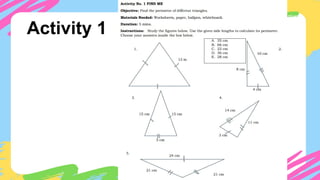
Activity 1
Today you will learn about
how to find the perimeter of
composite figures that
consist of triangles. The goal
is to apply the concept of
perimeter to these complex
shapes by breaking them
down into simpler
components.
• Perimeter is the total distance around a closed plane
figure.
• A composite figure is also referred to as a
''combined figure.'' A composite shape is made up of
two or more simple shapes that, when combined, form
a new shape.
• Triangle is a closed, 2-dimensional shape with 3
sides, 3 angles, and 3 vertices.
• Side length is a term used in mathematics to
describe the length of a side of a polygon
VOCABULARY WORDS
Read, analyze and solve the story
problem.
Problem:
Mr. Rabang bought a cartolina for his Math
Class. He needs two triangles of the same
size without wasting any part of the
cartolina. How will he divide it? What will be
the perimeter of each triangle
Answer the following questions:
1. Who bought cartolina for his Math class?
2. How will he cut the cartolina into two triangles
without wasting any part?
3. What do you call the figure cut into two equal
triangles, just like what Mr Rabang did to the
cartolina he bought?
4. What do you think is the distance around each
triangle?
5. What will be the perimeter of the two triangles?
1. How many triangles are there in the figure?
2. How do we solve for the perimeter of the two
triangles?
• To solve for the perimeter of the two triangles above,
first calculate the perimeter of triangle A, then
calculate the perimeter of Triangle B, then get the
sum of the two triangles.
• Since triangles have 3 sides, follow this formula.
Triangle A= side1 + side2 + side3 or s1 + s2 + s3
• Triangle A = 50 cm + 70 cm + 80 cm Triangle A = 200
cm Therefore, the Perimeter of Triangle A is 200
cm.
• Then, calculate the perimeter of Triangle B, following
the same formula.
• Triangle B = side1 + side2 + side3 or s1 + s2 + s3
• Triangle B = 50 cm + 70 cm + 80 cm Triangle B =
200cm
Therefore, the Perimeter of Triangle B is 200 cm.
• Now, add the perimeter of the two triangles.
• P= Triangle A (200 cm) + Triangle B (200
cm) P = 200 cm +200 cm P= 400 cm
• Therefore, the perimeter of the two
triangles is 400 cm.
• But if we are looking for the perimeter of the
composite figure, which is the rectangle, we
simply add all the sides around the figure using
this formula:
• P= (length 1 + length 2) + (width 1 + width 2)
P= ( 70 cm + 70 cm) +( 50 cm)+ 50 cm)
P = 140 cm + 100cm P = 240 cm
• Therefore, the perimeter of the composite figure
is 240 cm.
• Another process of calculating the perimeter of
a composite figure by finding the perimeter of
each triangle and then summing them up.
ex. Perimeter of
composite figure
composed of
triangles.
• Triangle A and Triangle B have the same
measurements of its sides which is 6 cm.
Triangle A
P = 6 cm + 6 cm + 6
cm
P = 18 cm Or
P = 3 x side
P= 3 x 6 cm
P = 18cm
Triangle B
P = 6 cm+ 6 cm+6 cm
P = 18 cm Or
P = 3 x side
P = 3 x 6 cm
P = 18 cm
• What is the perimeter of the two Triangles?
• Triangle A + Triangle B
P = 18 cm + 18 cm
P= 36 cm
• Therefore, the perimeter of the two triangles
is 36 cm.
• Since the given triangles have the same
measurements of its sides, follow this
formula:
P = 3 x side or P = 3s
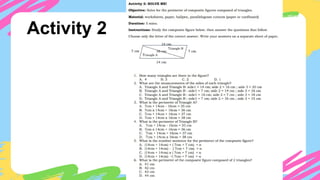
Activity 2
• Summarize what you’ve learned
about calculating the perimeter
of composite figures composed
of triangles.
Generalizations And
Abstractions
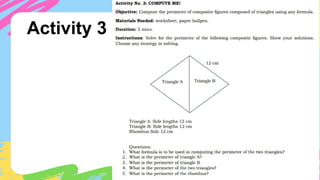
Activity 3
At the end of the lesson the learners will be able
to:
1. solve for the perimeter of composite figures
composed of triangles
2. follow the correct formula in solving for the
perimeter of composite figures composed of
triangles
Learning Objectives
Perimeter of
Composite Figures
Composed of
Triangles
DAY 2
Game: Solve for the perimeter. Show your
solutions on the board as fast as you can.
1.
2.
3.
"By the end of this lesson,
you will be able to find the
perimeter of composite
figures composed of
triangles."
Read, analyze, and solve the story
problem.
Problem:
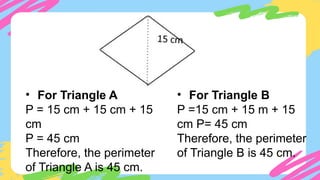
The Grade 4 pupils of Pantay Elementary
School were asked to draw a rhombus of 2
equal triangles with a side of 15 cm. What
is the perimeter of the two triangles? What
is the perimeter of the composite figure?
Answer the following questions:
1. Who drew a composite figure of two
equal triangles?
2. How long is the side of the figure?
3. How will you solve for the perimeter
of the drawn figure?
• Since the figure has 2 equal triangles,
all the sides are the same.
• Can anyone illustrate the figure on the
board with the measurements of the
sides, which are 15 cm?
• For Triangle A
P = 15 cm + 15 cm + 15
cm
P = 45 cm
Therefore, the perimeter
of Triangle A is 45 cm.
• For Triangle B
P =15 cm + 15 m + 15
cm P= 45 cm
Therefore, the perimeter
of Triangle B is 45 cm.
• Now, get the perimeters of the two
triangles:
• P = Triangle A + Triangle B
P = 45 cm + 45 cm P = 90 cm
• Therefore, the perimeter of the two
triangles is 90 cm.
• But if we are solving for the perimeter of the
composite figure which is the rhombus, we simply
add all the sides around the figure using this
formula.
• P= s1 + s2 + s3 + s4 ( since the rhombus has 4
sides)
P = 15 cm + 15 cm + 15 cm + 15 cm
P= 60 cm
• Therefore, the perimeter of the composite figure
cis 60 cm.
• Another formula in solving for the perimeter
of the composite figure composed of two
triangles.
• Since the composite figure has two equal
triangles and has the same lengths of its
sides, we can also use this formula.
• P = 3 x side or P = 3 x s or P = 3s
• For Triangle A
• Side = 15 cm
P = 3 x side
P = 3 x 15 cm
P = 45 cm
• Therefore, the
Perimeter of Triangle
A is 45 cm.
• For Triangle B
P = 3 x side
P = 3 x 15 cm
P = 45 cm
• Therefore, the
perimeter of Triangle B
is also 45 cm.
Example:
• So, if you get the sum of the perimeter of the
two triangles.
• Triangle A + Triangle B
45 cm + 45 cm
P = 90 cm.
• Therefore, the perimeter of the 2 triangles is
90 cm.
• But if we are solving for the perimeter of the
composite figure, which is the rhombus, we
again use this formula:
P = 4 x side or 4s
P = 4 x 15 cm
P = 60 cm
• Therefore, the perimeter of the composite
figure is 60 cm.
• Though we use different formulas we still
arrive at the same answer.
• Summarize what you’ve learned
about calculating the perimeter
of composite figures composed
of triangles.
Generalizations And
Abstractions
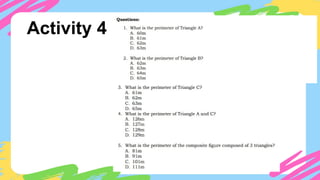
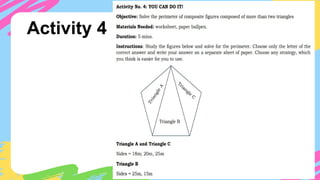
Activity 4
Activity 4
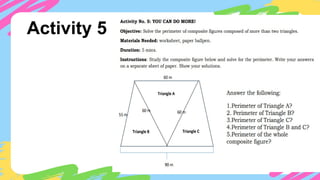
Activity 5
At the end of the lesson the learners will be able
to:
1. solve for the perimeter of composite figures
composed of quadrilaterals
2. follow the correct formula in solving for the
perimeter of composite figures composed of
quadrilaterals
Learning Objectives
Perimeter of
Composite Figures
Composed of
Quadrilaterals
DAY 3
Game: Mystery Bag
Draw at least one or two cut-outs,
and then you will solve for the
perimeter.
By the end of this lesson, you
will be able to find the perimeter
of composite figures composed
of quadrilaterals. The goal is to
apply the concept of perimeter
to these complex shapes by
breaking them down into
simpler components.
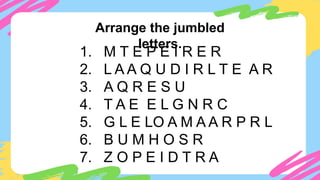
Arrange the jumbled
letters.
1. M T E P E I R E R
2. L A A Q U D I R L T E A R
3. A Q R E S U
4. T A E E L G N R C
5. G L E LO A M A A R P R L
6. B U M H O S R
7. Z O P E I D T R A
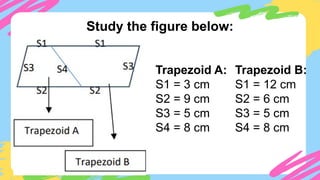
Study the figure below:
Trapezoid A:
S1 = 3 cm
S2 = 9 cm
S3 = 5 cm
S4 = 8 cm
Trapezoid B:
S1 = 12 cm
S2 = 6 cm
S3 = 5 cm
S4 = 8 cm
Answer the following questions:
1.How many trapezoids can you see in the
figure?
2. What kind of figure is a trapezoid?
3. What are the measurements of the sides of
the 2 trapezoids?
4. How do we solve for the perimeter of the two
trapezoids?
5. How do we solve for the perimeter of the
composite figure?
Since the figure has 2 quadrilaterals,
follow these steps:
1. Identify all the quadrilaterals that make up the
composite figure. * Trapezoid A and Trapezoid
B
2. For each trapezoid, find the lengths of its
sides.
Trapezoid A:
S1 = 3 cm
S2 = 9 cm
S3 = 5 cm
S4 = 8 cm
Trapezoid B:
S1 = 12 cm
S2 = 6 cm
S3 = 5 cm
S4 = 8 cm
3. Add up all the sides of each trapezoid. This
gives you the perimeter of each trapezoid.
For Trapezoid A
P = s1 + s2 + s3 + s4
P= 3 cm + 9 cm + 5 cm + 8
cm
P = 25 cm
Therefore, the
perimeter of Trapezoid A
is 25 cm.
For Trapezoid B
P = s1 + s2 + s3 + s4
P = 12 cm + 6 cm + 5 cm + 8
cm
P = 36 cm
Therefore, the
perimeter of Trapezoid B
is 31 cm.
4. Then, sum up all the perimeters of the 2
trapezoids, this gives you the perimeter of the two
quadrilaterals.
Since the Perimeter of Trapezoid A is 25 cm and
the Perimeter of Trapezoid B is 31 cm
P = 25 cm + 31 cm
P = 56 cm
Therefore, the perimeter of the two trapezoids
is
5. But if we are solving for the perimeter of the
composite figure which is the parallelogram, we
simply add all the sides around the figure using
this formula:
P = (length1+length 2) + (width 1 + width 2)
P = (15 cm + 15 cm) + (5 cm + 5 cm)
P = 30 cm + 10 cm
P= 40 cm
Therefore, the perimeter of the composite
figure above is 40 cm.
• Another formula in solving for the perimeter
of the composite figure composed of two
quadrilaterals.
• Square A and Square B
have 4 equal sides of 5 cm.
• Since the composite figure has two equal
squares and has the same lengths of its
sides, we can also use this formula.
• P = 4x side or
• P = 4 x s or
• P = 4s
Example:
• For Square A
Side = 5 cm
P = 4 x side
P = 4 x 5 cm
P = 20 cm
Therefore, the
Perimeter of Square A
is 20 cm.
• For Square B
P = 4 x side
P = 4 x 5 cm
P = 20 cm
Therefore, the
perimeter of Square B
is also 20 cm.
• So, if you get the sum of the perimeter of
the two squares.
Square A + Square B
P = 20 cm + 20 cm
P = 40 cm.
• Therefore, the perimeter of the 2
squares is 40 cm.
• But if we are solving for the perimeter of the
composite figure, composed of two squares,
simply add all the sides.
P=(length 1 + length2) +( width1 + width 2)
P = (10 cm + 10 cm ) + ( 5 cm + 5cm)
P= 20 cm + 10 cm
P= 30 cm
Therefore, the perimeter of the composite
figure is 30 cm.
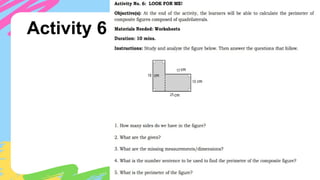
Activity 6
• Share your understanding of
calculating the perimeter of
composite figures composed of
quadrilaterals.
Generalizations And
Abstractions
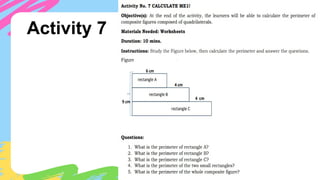
Activity 7
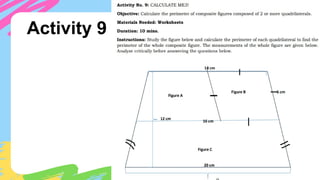
• Study the composite figure below. Use any
formula, which you think is easier for you
to apply in solving for the perimeter.
1. Perimeter of Fig. A
2. Perimeter of Fig. B
3. Perimeter of the 2 Figures
4. Perimeter of the composite figure
At the end of the lesson the learners will be able
to:
1. solve for the perimeter of composite figures
composed of quadrilaterals
2. follow the correct formula in solving for the
perimeter of quadrilaterals
Learning Objectives
Perimeter of
Composite Figures
Composed of
Quadrilaterals
DAY 4
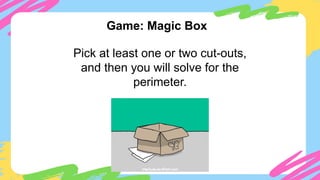
Game: Magic Box
Pick at least one or two cut-outs,
and then you will solve for the
perimeter.
By the end of this lesson,
you will be able to find the
perimeter of composite
figures composed of 2 or
more quadrilaterals.
Give the formulated words
yesterday and give a short
description for each word
and their relevance to the
day’s lesson.
Study the figure below:
Figure A:
Length= 8m
Width = 6 m
Figure B
Side = 4 m
Figure C
Side = 4 m
Answer the following questions:
1.How many quadrilaterals are there in the
composite figure?
2. What are the measurements of the sides of
Figure A? Figure B? Figure C?
3.How do we solve for the perimeter of the 3
quadrilaterals?
4. How do we solve for the perimeter of the
whole composite figure?
• Since there are 3 quadrilaterals in the composite
figure, find the perimeter of each figure.
Figure A:
Length = 8 m Width = 6 m
Simply add the measurements of the sides.
P = length 1 + length2 + width1 + width2
P= (8m + 8m) + (6m + 6m)
P = 16 cm + 12 cm
P = 28m
Therefore, the perimeter of Figure A is 28 m.
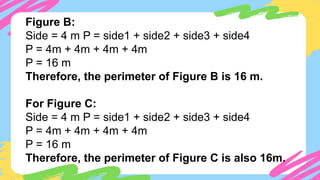
Figure B:
Side = 4 m P = side1 + side2 + side3 + side4
P = 4m + 4m + 4m + 4m
P = 16 m
Therefore, the perimeter of Figure B is 16 m.
For Figure C:
Side = 4 m P = side1 + side2 + side3 + side4
P = 4m + 4m + 4m + 4m
P = 16 m
Therefore, the perimeter of Figure C is also 16m.
What is the perimeter of the three quadrilaterals?.
• Add all the perimeter of the 3 figures.
P= Fig. A + Fig. B + Fig. C
P 28m + 16m + 16m
P= 60 m
• Therefore, the perimeter of the 3
quadrilaterals is 60 m
• But if we are solving for the perimeter of the
whole composite figure, we just simply add
all the sides using this formula:
Example:
P = (length1 + length 2 ) + ( width1 + width2)
P = ( 10 m + 10 m) + ( 8m + 8 m )
P = 20 m + 16 m
P = 36m
Therefore, the perimeter of the whole
composite figure is 36 m.
• Another formula in solving for the perimeter
of the given figure above by using another
formula.
• For Figure A, since the figure is a rectangle,
and a rectangle has 2 pairs of parallel sides,
we can also use this formula.
• P = (2x length) + (2 x width) or
P = 2l + 2w P = (2 x 8m) + (2 x 6m)
P= 16m + 12m P = 28m
Therefore, the perimeter of Figure A is
28m.
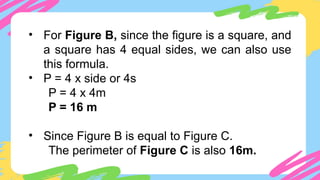
• For Figure B, since the figure is a square, and
a square has 4 equal sides, we can also use
this formula.
• P = 4 x side or 4s
P = 4 x 4m
P = 16 m
• Since Figure B is equal to Figure C.
The perimeter of Figure C is also 16m.
• Now, solve for the perimeter of the 3
quadrilaterals.
• Add all the perimeters of the three
quadrilaterals.
• Figure A + Figure B + Figure C
P 28m + 16m + 16m
P = 60m
• Therefore, the perimeter of the 3
quadrilaterals above is also 60m.
• But if we are solving for the perimeter of the
composite figure, we also use this formula:
P = (2 x L) + ( 2 x w) Or P = 2l + 2w
• Substitute the measurement of the length and
the width: P = (2 x 10m) + ( 2 x 8m)
P = 20 m + 16 m
P = 36 m
• Therefore, the perimeter of the composite
figure is 36 m.
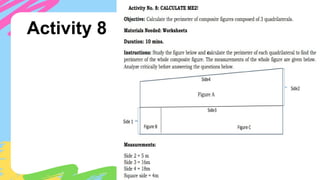
Activity 8
• Share your understanding of
calculating the perimeter of
composite figures composed of
two or more quadrilaterals.
Generalizations And
Abstractions
Activity 9
At the end of the lesson the learners will be able
to:
1. solve for the perimeter of composite figures
composed of triangles and quadrilaterals
2. follow the correct formula in solving for the
perimeter of triangles and quadrilaterals in the
composite figure
Learning Objectives
Perimeter of
Composite Figures
Composed of Triangles
and Quadrilaterals
DAY 5
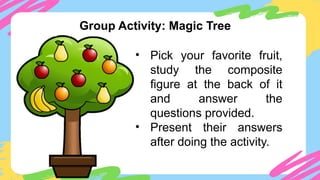
Group Activity: Magic Tree
• Pick your favorite fruit,
study the composite
figure at the back of it
and answer the
questions provided.
• Present their answers
after doing the activity.
By the end of this lesson,
you will be able to find the
perimeter of composite
figures composed of
triangles and quadrilaterals.
Give the words encountered
yesterday and give a short
description for each word
and their relevance to the
day’s lesson.
Study the figure below:
Figure A:
Length= 10 cm
Width = 9 cm
Figure B
Side1 = 5cm
Side2 = 9 cm
Side 3 = 10 cm
Figure C
Side1 = 5cm
Side2= 9 cm
Side3 = 10cm
Answer the following questions:
1.How many quadrilaterals are there in the
composite figure?
2. What are the measurements of the sides of
Figure A? Figure B? Figure C?
3.How do we solve for the perimeter of the 3
quadrilaterals?
4. How do we solve for the perimeter of the
composite figure?
• Since there are 3 quadrilaterals in the composite
figure, find the perimeter of each figure.
• For Figure A, what are the measurements of its
side. Figure A= Length = 10 cm Width = 9 cm
• Simply add the measurements of the sides.
P = length 1 + length2 + width1 + width2
P= 10cm + 10cm + 9cm + 9cm
P = 38cm
• Therefore, the perimeter of Figure A is 38
cm.
• For Figure B
Side1 = 5 cm
Side2 = 9 cm
Side3= 10 cm
• P = side1 + side2 + side3
P = 5cm + 9cm + 10cm
P = 24 cm
• Therefore, the perimeter of Figure B is 24
cm.
• For Figure C
Side1 = 5 cm
Side2 = 9 cm
Side3 = 10 cm
• P = side1 + side2 + side3
P = 5cm + 9cm +10cm
P = 24 cm
• Therefore, the perimeter of Figure C is also
24cm.
• Then, add all the perimeter of the 3 figures.
• Fig. A + Fig. B + Fig. C
P = 38cm + 24cm + 24cm
P= 86 cm
• Therefore, the perimeter of the 3
quadrilaterals is 86cm.
• But if we are solving for the perimeter of the
whole composite figure, we simply add all
the sides around the figure.
• P = s1 + s2 + s3 + s4 + s5
P = 10cm + 10cm + 9cm + 9cm + 10 cm
P= 48 cm
• Therefore, the perimeter of the whole
composite figure above is 48 cm.
Activity 10
• Share your understanding of
calculating the perimeter of
composite figures composed of
triangles and quadrilaterals.
Generalizations And
Abstractions
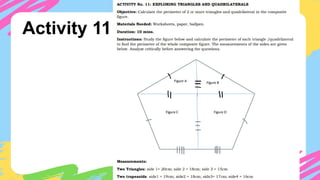
Activity 11
MATH 4_Q1_WEEK4.pptx....................

MATH 4_Q1_WEEK4.pptx....................

  • 1.
  • 2.
    Learning Competencies The learnerswill be able to: • Find the perimeter of composite figures composed of triangles and quadrilaterals
  • 3.
    At the endof the lesson the learners will be able to: 1. give the meaning of composite figures 2. give examples of composite figures 3. solve for the perimeter of composite figures composed of triangles 4. follow the correct formula in solving for the perimeter of composite figures Composed of triangles Learning Objectives
  • 4.
  • 5.
    What do youknow about the properties of triangles and perimeter.
  • 6.
  • 7.
    Today you willlearn about how to find the perimeter of composite figures that consist of triangles. The goal is to apply the concept of perimeter to these complex shapes by breaking them down into simpler components.
  • 8.
    • Perimeter isthe total distance around a closed plane figure. • A composite figure is also referred to as a ''combined figure.'' A composite shape is made up of two or more simple shapes that, when combined, form a new shape. • Triangle is a closed, 2-dimensional shape with 3 sides, 3 angles, and 3 vertices. • Side length is a term used in mathematics to describe the length of a side of a polygon VOCABULARY WORDS
  • 9.
    Read, analyze andsolve the story problem. Problem: Mr. Rabang bought a cartolina for his Math Class. He needs two triangles of the same size without wasting any part of the cartolina. How will he divide it? What will be the perimeter of each triangle
  • 10.
    Answer the followingquestions: 1. Who bought cartolina for his Math class? 2. How will he cut the cartolina into two triangles without wasting any part? 3. What do you call the figure cut into two equal triangles, just like what Mr Rabang did to the cartolina he bought? 4. What do you think is the distance around each triangle? 5. What will be the perimeter of the two triangles?
  • 11.
    1. How manytriangles are there in the figure? 2. How do we solve for the perimeter of the two triangles?
  • 12.
    • To solvefor the perimeter of the two triangles above, first calculate the perimeter of triangle A, then calculate the perimeter of Triangle B, then get the sum of the two triangles. • Since triangles have 3 sides, follow this formula. Triangle A= side1 + side2 + side3 or s1 + s2 + s3 • Triangle A = 50 cm + 70 cm + 80 cm Triangle A = 200 cm Therefore, the Perimeter of Triangle A is 200 cm.
  • 13.
    • Then, calculatethe perimeter of Triangle B, following the same formula. • Triangle B = side1 + side2 + side3 or s1 + s2 + s3 • Triangle B = 50 cm + 70 cm + 80 cm Triangle B = 200cm Therefore, the Perimeter of Triangle B is 200 cm.
  • 14.
    • Now, addthe perimeter of the two triangles. • P= Triangle A (200 cm) + Triangle B (200 cm) P = 200 cm +200 cm P= 400 cm • Therefore, the perimeter of the two triangles is 400 cm.
  • 15.
    • But ifwe are looking for the perimeter of the composite figure, which is the rectangle, we simply add all the sides around the figure using this formula: • P= (length 1 + length 2) + (width 1 + width 2) P= ( 70 cm + 70 cm) +( 50 cm)+ 50 cm) P = 140 cm + 100cm P = 240 cm • Therefore, the perimeter of the composite figure is 240 cm.
  • 16.
    • Another processof calculating the perimeter of a composite figure by finding the perimeter of each triangle and then summing them up. ex. Perimeter of composite figure composed of triangles.
  • 17.
    • Triangle Aand Triangle B have the same measurements of its sides which is 6 cm. Triangle A P = 6 cm + 6 cm + 6 cm P = 18 cm Or P = 3 x side P= 3 x 6 cm P = 18cm Triangle B P = 6 cm+ 6 cm+6 cm P = 18 cm Or P = 3 x side P = 3 x 6 cm P = 18 cm
  • 18.
    • What isthe perimeter of the two Triangles? • Triangle A + Triangle B P = 18 cm + 18 cm P= 36 cm • Therefore, the perimeter of the two triangles is 36 cm. • Since the given triangles have the same measurements of its sides, follow this formula: P = 3 x side or P = 3s
  • 19.
  • 20.
    • Summarize whatyou’ve learned about calculating the perimeter of composite figures composed of triangles. Generalizations And Abstractions
  • 21.
  • 22.
    At the endof the lesson the learners will be able to: 1. solve for the perimeter of composite figures composed of triangles 2. follow the correct formula in solving for the perimeter of composite figures composed of triangles Learning Objectives
  • 23.
  • 24.
    Game: Solve forthe perimeter. Show your solutions on the board as fast as you can. 1.
  • 25.
  • 26.
  • 27.
    "By the endof this lesson, you will be able to find the perimeter of composite figures composed of triangles."
  • 28.
    Read, analyze, andsolve the story problem. Problem: The Grade 4 pupils of Pantay Elementary School were asked to draw a rhombus of 2 equal triangles with a side of 15 cm. What is the perimeter of the two triangles? What is the perimeter of the composite figure?
  • 29.
    Answer the followingquestions: 1. Who drew a composite figure of two equal triangles? 2. How long is the side of the figure? 3. How will you solve for the perimeter of the drawn figure?
  • 30.
    • Since thefigure has 2 equal triangles, all the sides are the same. • Can anyone illustrate the figure on the board with the measurements of the sides, which are 15 cm?
  • 31.
    • For TriangleA P = 15 cm + 15 cm + 15 cm P = 45 cm Therefore, the perimeter of Triangle A is 45 cm. • For Triangle B P =15 cm + 15 m + 15 cm P= 45 cm Therefore, the perimeter of Triangle B is 45 cm.
  • 32.
    • Now, getthe perimeters of the two triangles: • P = Triangle A + Triangle B P = 45 cm + 45 cm P = 90 cm • Therefore, the perimeter of the two triangles is 90 cm.
  • 33.
    • But ifwe are solving for the perimeter of the composite figure which is the rhombus, we simply add all the sides around the figure using this formula. • P= s1 + s2 + s3 + s4 ( since the rhombus has 4 sides) P = 15 cm + 15 cm + 15 cm + 15 cm P= 60 cm • Therefore, the perimeter of the composite figure cis 60 cm.
  • 34.
    • Another formulain solving for the perimeter of the composite figure composed of two triangles. • Since the composite figure has two equal triangles and has the same lengths of its sides, we can also use this formula. • P = 3 x side or P = 3 x s or P = 3s
  • 35.
    • For TriangleA • Side = 15 cm P = 3 x side P = 3 x 15 cm P = 45 cm • Therefore, the Perimeter of Triangle A is 45 cm. • For Triangle B P = 3 x side P = 3 x 15 cm P = 45 cm • Therefore, the perimeter of Triangle B is also 45 cm. Example:
  • 36.
    • So, ifyou get the sum of the perimeter of the two triangles. • Triangle A + Triangle B 45 cm + 45 cm P = 90 cm. • Therefore, the perimeter of the 2 triangles is 90 cm.
  • 37.
    • But ifwe are solving for the perimeter of the composite figure, which is the rhombus, we again use this formula: P = 4 x side or 4s P = 4 x 15 cm P = 60 cm • Therefore, the perimeter of the composite figure is 60 cm. • Though we use different formulas we still arrive at the same answer.
  • 38.
    • Summarize whatyou’ve learned about calculating the perimeter of composite figures composed of triangles. Generalizations And Abstractions
  • 39.
  • 40.
  • 41.
  • 42.
    At the endof the lesson the learners will be able to: 1. solve for the perimeter of composite figures composed of quadrilaterals 2. follow the correct formula in solving for the perimeter of composite figures composed of quadrilaterals Learning Objectives
  • 43.
  • 44.
    Game: Mystery Bag Drawat least one or two cut-outs, and then you will solve for the perimeter.
  • 45.
    By the endof this lesson, you will be able to find the perimeter of composite figures composed of quadrilaterals. The goal is to apply the concept of perimeter to these complex shapes by breaking them down into simpler components.
  • 46.
    Arrange the jumbled letters. 1.M T E P E I R E R 2. L A A Q U D I R L T E A R 3. A Q R E S U 4. T A E E L G N R C 5. G L E LO A M A A R P R L 6. B U M H O S R 7. Z O P E I D T R A
  • 47.
    Study the figurebelow: Trapezoid A: S1 = 3 cm S2 = 9 cm S3 = 5 cm S4 = 8 cm Trapezoid B: S1 = 12 cm S2 = 6 cm S3 = 5 cm S4 = 8 cm
  • 48.
    Answer the followingquestions: 1.How many trapezoids can you see in the figure? 2. What kind of figure is a trapezoid? 3. What are the measurements of the sides of the 2 trapezoids? 4. How do we solve for the perimeter of the two trapezoids? 5. How do we solve for the perimeter of the composite figure?
  • 49.
    Since the figurehas 2 quadrilaterals, follow these steps: 1. Identify all the quadrilaterals that make up the composite figure. * Trapezoid A and Trapezoid B 2. For each trapezoid, find the lengths of its sides. Trapezoid A: S1 = 3 cm S2 = 9 cm S3 = 5 cm S4 = 8 cm Trapezoid B: S1 = 12 cm S2 = 6 cm S3 = 5 cm S4 = 8 cm
  • 50.
    3. Add upall the sides of each trapezoid. This gives you the perimeter of each trapezoid. For Trapezoid A P = s1 + s2 + s3 + s4 P= 3 cm + 9 cm + 5 cm + 8 cm P = 25 cm Therefore, the perimeter of Trapezoid A is 25 cm. For Trapezoid B P = s1 + s2 + s3 + s4 P = 12 cm + 6 cm + 5 cm + 8 cm P = 36 cm Therefore, the perimeter of Trapezoid B is 31 cm.
  • 51.
    4. Then, sumup all the perimeters of the 2 trapezoids, this gives you the perimeter of the two quadrilaterals. Since the Perimeter of Trapezoid A is 25 cm and the Perimeter of Trapezoid B is 31 cm P = 25 cm + 31 cm P = 56 cm Therefore, the perimeter of the two trapezoids is
  • 52.
    5. But ifwe are solving for the perimeter of the composite figure which is the parallelogram, we simply add all the sides around the figure using this formula: P = (length1+length 2) + (width 1 + width 2) P = (15 cm + 15 cm) + (5 cm + 5 cm) P = 30 cm + 10 cm P= 40 cm Therefore, the perimeter of the composite figure above is 40 cm.
  • 53.
    • Another formulain solving for the perimeter of the composite figure composed of two quadrilaterals. • Square A and Square B have 4 equal sides of 5 cm.
  • 54.
    • Since thecomposite figure has two equal squares and has the same lengths of its sides, we can also use this formula. • P = 4x side or • P = 4 x s or • P = 4s
  • 55.
    Example: • For SquareA Side = 5 cm P = 4 x side P = 4 x 5 cm P = 20 cm Therefore, the Perimeter of Square A is 20 cm. • For Square B P = 4 x side P = 4 x 5 cm P = 20 cm Therefore, the perimeter of Square B is also 20 cm.
  • 56.
    • So, ifyou get the sum of the perimeter of the two squares. Square A + Square B P = 20 cm + 20 cm P = 40 cm. • Therefore, the perimeter of the 2 squares is 40 cm.
  • 57.
    • But ifwe are solving for the perimeter of the composite figure, composed of two squares, simply add all the sides. P=(length 1 + length2) +( width1 + width 2) P = (10 cm + 10 cm ) + ( 5 cm + 5cm) P= 20 cm + 10 cm P= 30 cm Therefore, the perimeter of the composite figure is 30 cm.
  • 58.
  • 59.
    • Share yourunderstanding of calculating the perimeter of composite figures composed of quadrilaterals. Generalizations And Abstractions
  • 60.
  • 61.
    • Study thecomposite figure below. Use any formula, which you think is easier for you to apply in solving for the perimeter. 1. Perimeter of Fig. A 2. Perimeter of Fig. B 3. Perimeter of the 2 Figures 4. Perimeter of the composite figure
  • 62.
    At the endof the lesson the learners will be able to: 1. solve for the perimeter of composite figures composed of quadrilaterals 2. follow the correct formula in solving for the perimeter of quadrilaterals Learning Objectives
  • 63.
  • 64.
    Game: Magic Box Pickat least one or two cut-outs, and then you will solve for the perimeter.
  • 65.
    By the endof this lesson, you will be able to find the perimeter of composite figures composed of 2 or more quadrilaterals.
  • 66.
    Give the formulatedwords yesterday and give a short description for each word and their relevance to the day’s lesson.
  • 67.
    Study the figurebelow: Figure A: Length= 8m Width = 6 m Figure B Side = 4 m Figure C Side = 4 m
  • 68.
    Answer the followingquestions: 1.How many quadrilaterals are there in the composite figure? 2. What are the measurements of the sides of Figure A? Figure B? Figure C? 3.How do we solve for the perimeter of the 3 quadrilaterals? 4. How do we solve for the perimeter of the whole composite figure?
  • 69.
    • Since thereare 3 quadrilaterals in the composite figure, find the perimeter of each figure. Figure A: Length = 8 m Width = 6 m Simply add the measurements of the sides. P = length 1 + length2 + width1 + width2 P= (8m + 8m) + (6m + 6m) P = 16 cm + 12 cm P = 28m Therefore, the perimeter of Figure A is 28 m.
  • 70.
    Figure B: Side =4 m P = side1 + side2 + side3 + side4 P = 4m + 4m + 4m + 4m P = 16 m Therefore, the perimeter of Figure B is 16 m. For Figure C: Side = 4 m P = side1 + side2 + side3 + side4 P = 4m + 4m + 4m + 4m P = 16 m Therefore, the perimeter of Figure C is also 16m.
  • 71.
    What is theperimeter of the three quadrilaterals?. • Add all the perimeter of the 3 figures. P= Fig. A + Fig. B + Fig. C P 28m + 16m + 16m P= 60 m • Therefore, the perimeter of the 3 quadrilaterals is 60 m
  • 72.
    • But ifwe are solving for the perimeter of the whole composite figure, we just simply add all the sides using this formula: Example: P = (length1 + length 2 ) + ( width1 + width2) P = ( 10 m + 10 m) + ( 8m + 8 m ) P = 20 m + 16 m P = 36m Therefore, the perimeter of the whole composite figure is 36 m.
  • 73.
    • Another formulain solving for the perimeter of the given figure above by using another formula. • For Figure A, since the figure is a rectangle, and a rectangle has 2 pairs of parallel sides, we can also use this formula. • P = (2x length) + (2 x width) or P = 2l + 2w P = (2 x 8m) + (2 x 6m) P= 16m + 12m P = 28m Therefore, the perimeter of Figure A is 28m.
  • 74.
    • For FigureB, since the figure is a square, and a square has 4 equal sides, we can also use this formula. • P = 4 x side or 4s P = 4 x 4m P = 16 m • Since Figure B is equal to Figure C. The perimeter of Figure C is also 16m.
  • 75.
    • Now, solvefor the perimeter of the 3 quadrilaterals. • Add all the perimeters of the three quadrilaterals. • Figure A + Figure B + Figure C P 28m + 16m + 16m P = 60m • Therefore, the perimeter of the 3 quadrilaterals above is also 60m.
  • 76.
    • But ifwe are solving for the perimeter of the composite figure, we also use this formula: P = (2 x L) + ( 2 x w) Or P = 2l + 2w • Substitute the measurement of the length and the width: P = (2 x 10m) + ( 2 x 8m) P = 20 m + 16 m P = 36 m • Therefore, the perimeter of the composite figure is 36 m.
  • 77.
  • 79.
    • Share yourunderstanding of calculating the perimeter of composite figures composed of two or more quadrilaterals. Generalizations And Abstractions
  • 80.
  • 82.
    At the endof the lesson the learners will be able to: 1. solve for the perimeter of composite figures composed of triangles and quadrilaterals 2. follow the correct formula in solving for the perimeter of triangles and quadrilaterals in the composite figure Learning Objectives
  • 83.
    Perimeter of Composite Figures Composedof Triangles and Quadrilaterals DAY 5
  • 84.
    Group Activity: MagicTree • Pick your favorite fruit, study the composite figure at the back of it and answer the questions provided. • Present their answers after doing the activity.
  • 85.
    By the endof this lesson, you will be able to find the perimeter of composite figures composed of triangles and quadrilaterals.
  • 86.
    Give the wordsencountered yesterday and give a short description for each word and their relevance to the day’s lesson.
  • 87.
    Study the figurebelow: Figure A: Length= 10 cm Width = 9 cm Figure B Side1 = 5cm Side2 = 9 cm Side 3 = 10 cm Figure C Side1 = 5cm Side2= 9 cm Side3 = 10cm
  • 88.
    Answer the followingquestions: 1.How many quadrilaterals are there in the composite figure? 2. What are the measurements of the sides of Figure A? Figure B? Figure C? 3.How do we solve for the perimeter of the 3 quadrilaterals? 4. How do we solve for the perimeter of the composite figure?
  • 89.
    • Since thereare 3 quadrilaterals in the composite figure, find the perimeter of each figure. • For Figure A, what are the measurements of its side. Figure A= Length = 10 cm Width = 9 cm • Simply add the measurements of the sides. P = length 1 + length2 + width1 + width2 P= 10cm + 10cm + 9cm + 9cm P = 38cm • Therefore, the perimeter of Figure A is 38 cm.
  • 90.
    • For FigureB Side1 = 5 cm Side2 = 9 cm Side3= 10 cm • P = side1 + side2 + side3 P = 5cm + 9cm + 10cm P = 24 cm • Therefore, the perimeter of Figure B is 24 cm.
  • 91.
    • For FigureC Side1 = 5 cm Side2 = 9 cm Side3 = 10 cm • P = side1 + side2 + side3 P = 5cm + 9cm +10cm P = 24 cm • Therefore, the perimeter of Figure C is also 24cm.
  • 92.
    • Then, addall the perimeter of the 3 figures. • Fig. A + Fig. B + Fig. C P = 38cm + 24cm + 24cm P= 86 cm • Therefore, the perimeter of the 3 quadrilaterals is 86cm.
  • 93.
    • But ifwe are solving for the perimeter of the whole composite figure, we simply add all the sides around the figure. • P = s1 + s2 + s3 + s4 + s5 P = 10cm + 10cm + 9cm + 9cm + 10 cm P= 48 cm • Therefore, the perimeter of the whole composite figure above is 48 cm.
  • 94.
  • 96.
    • Share yourunderstanding of calculating the perimeter of composite figures composed of triangles and quadrilaterals. Generalizations And Abstractions
  • 97.