This Page Intentionally Left Blank
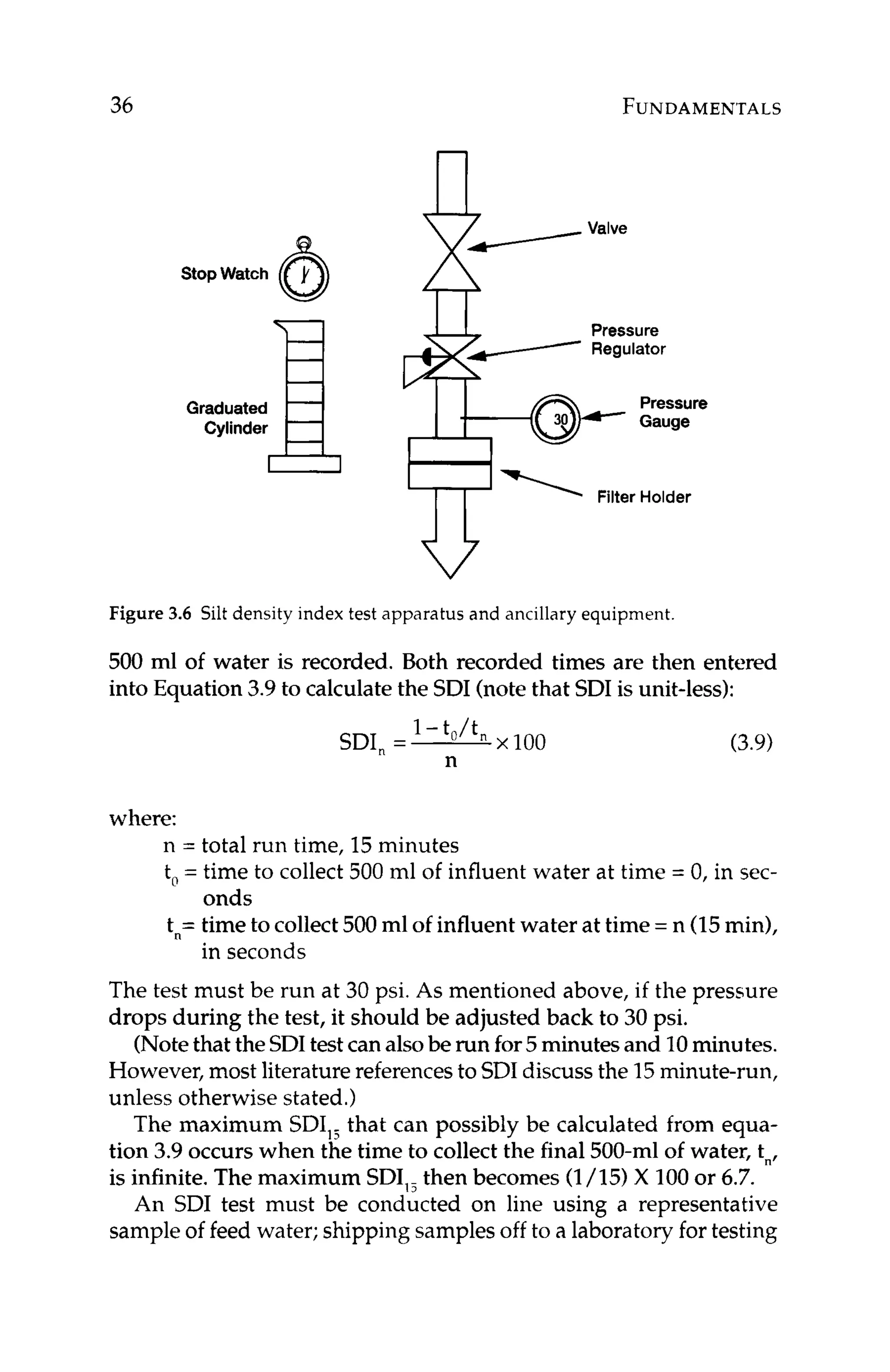
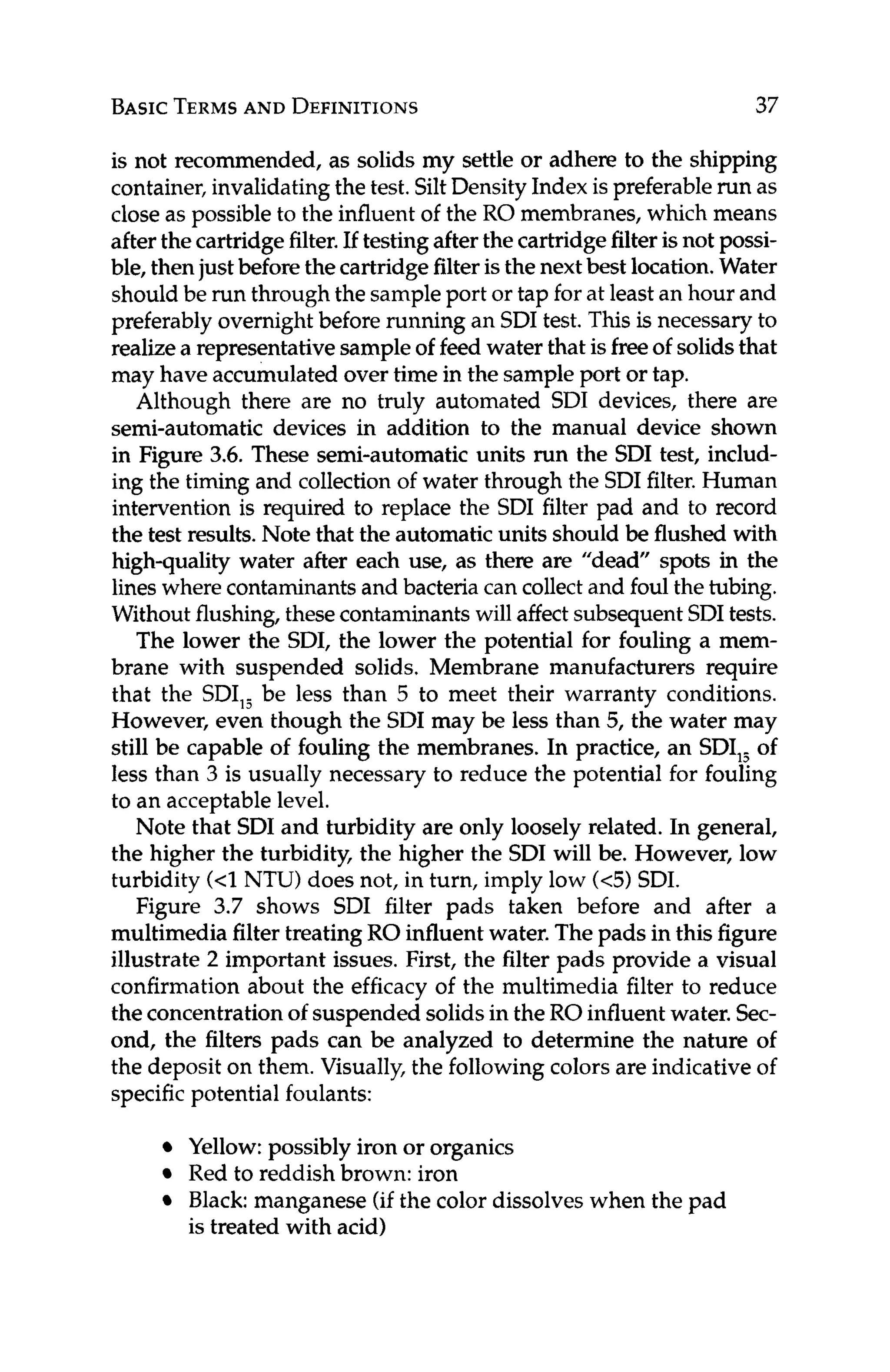
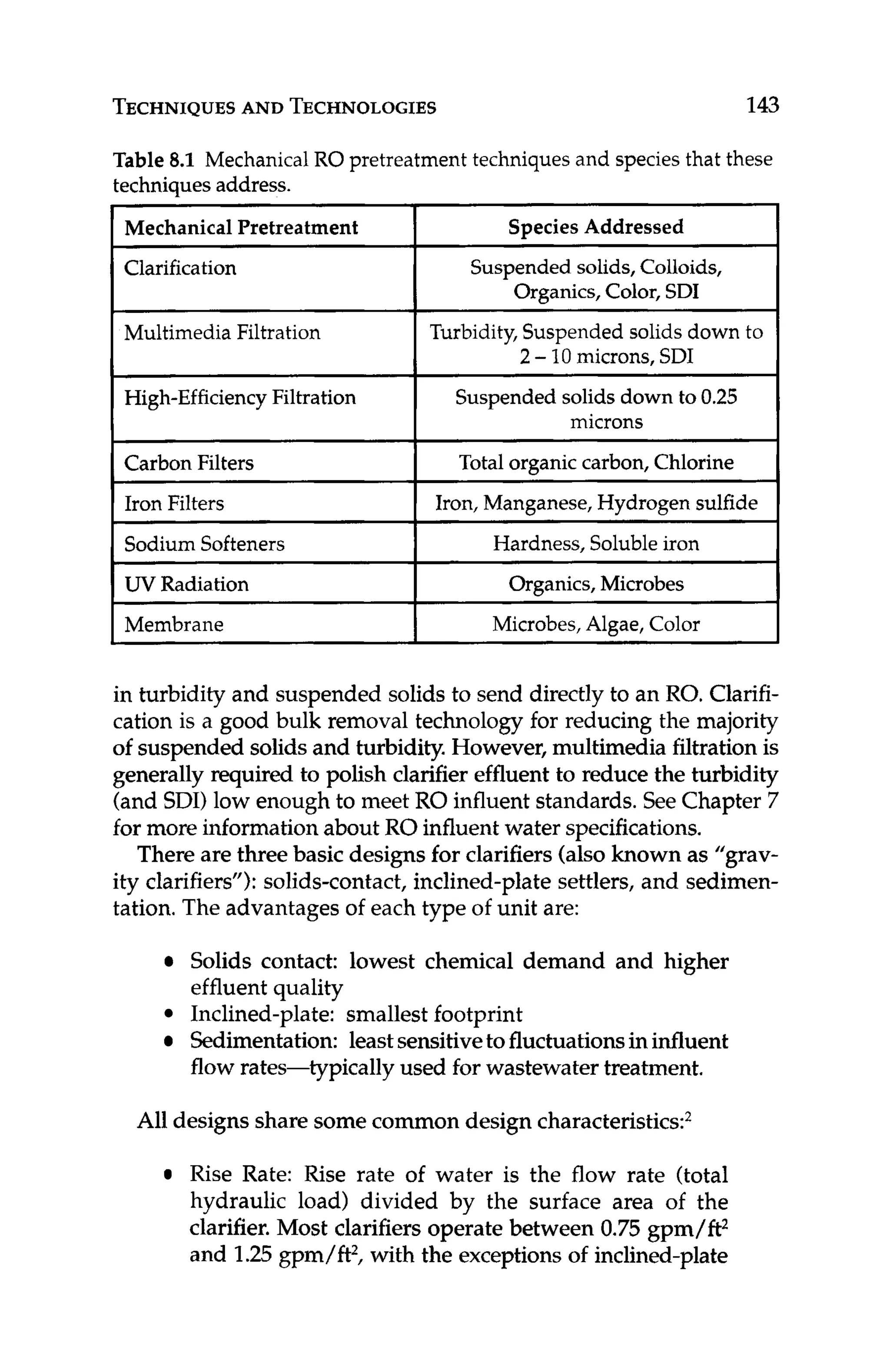
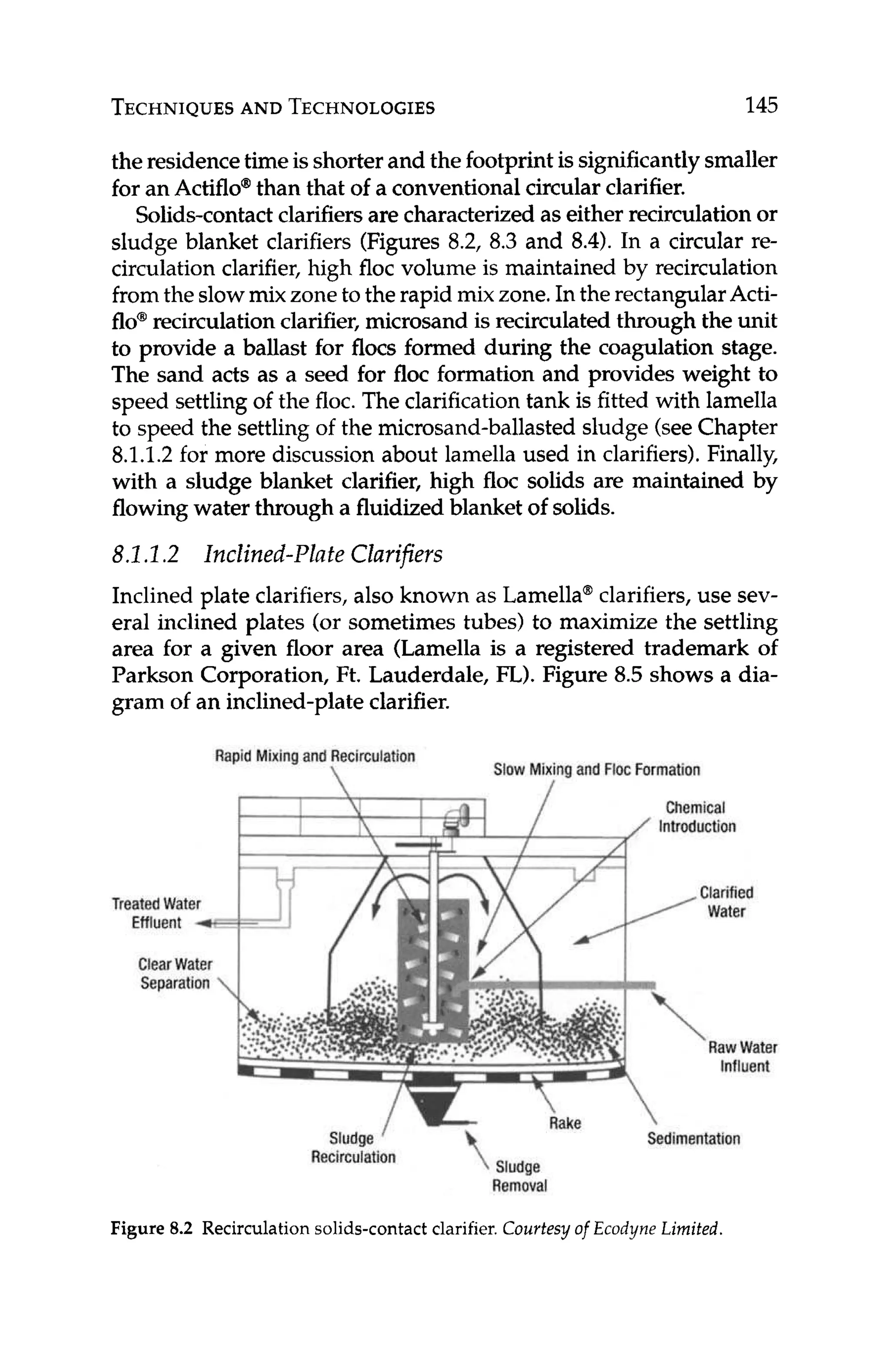
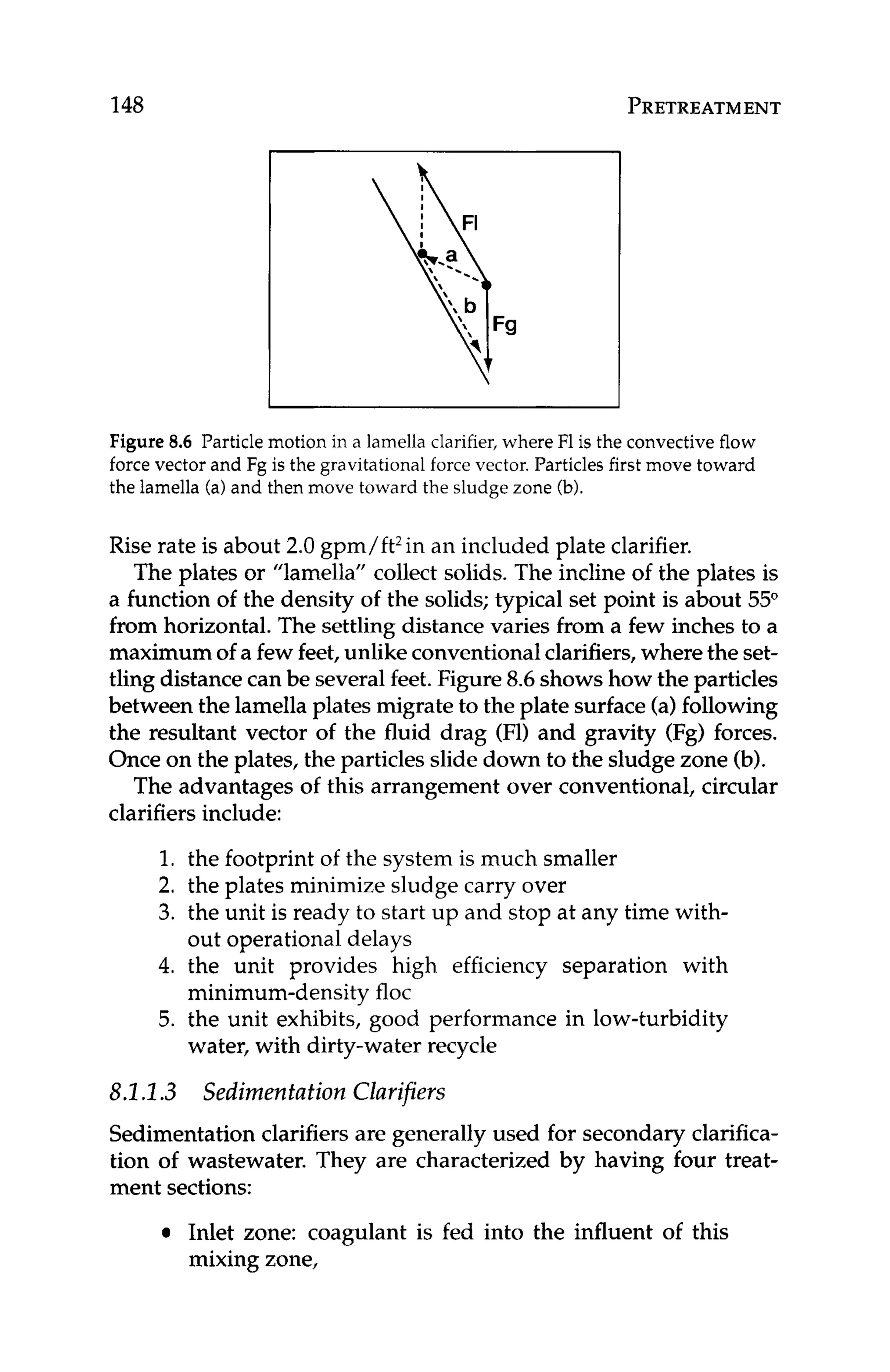
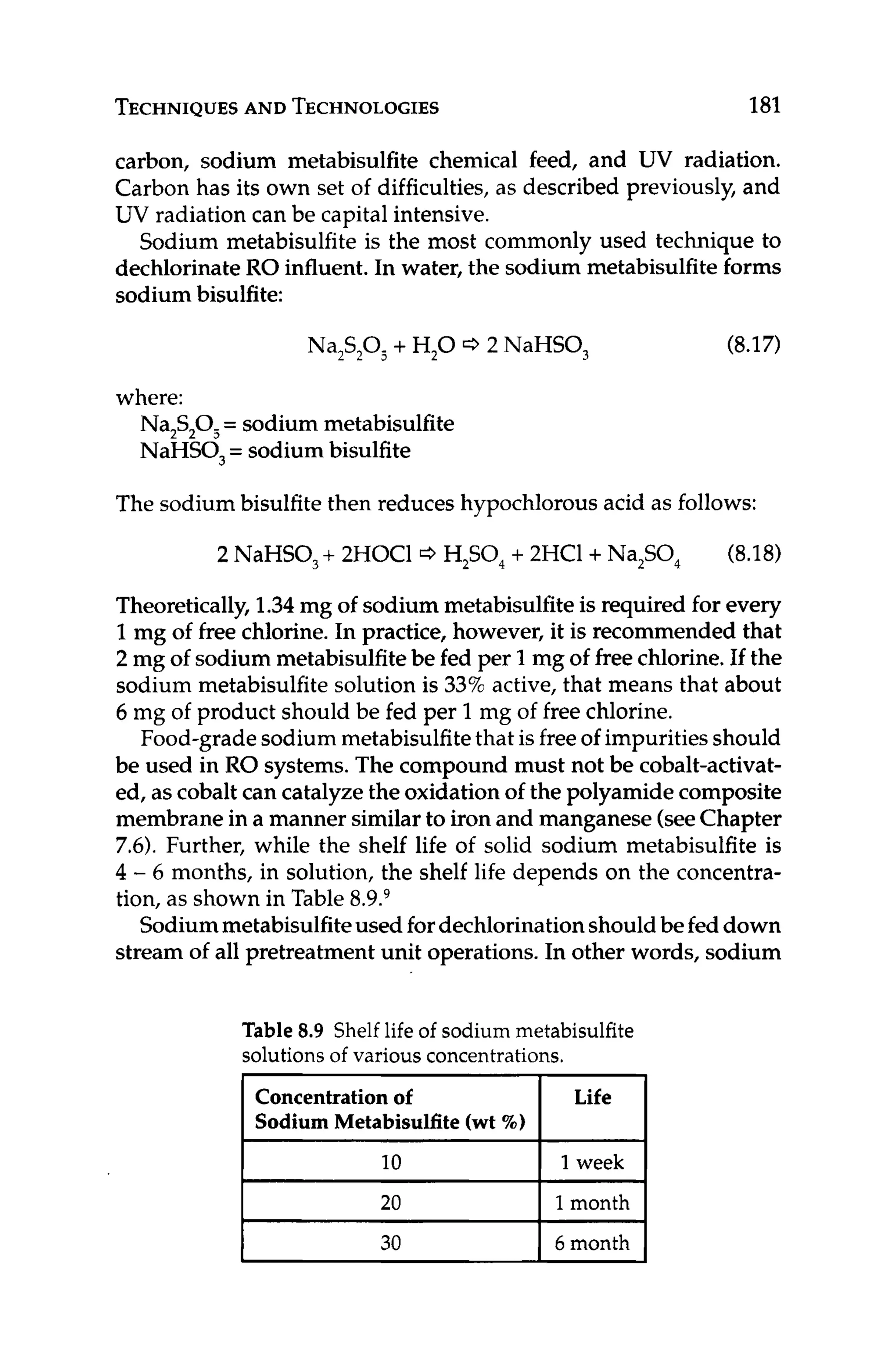
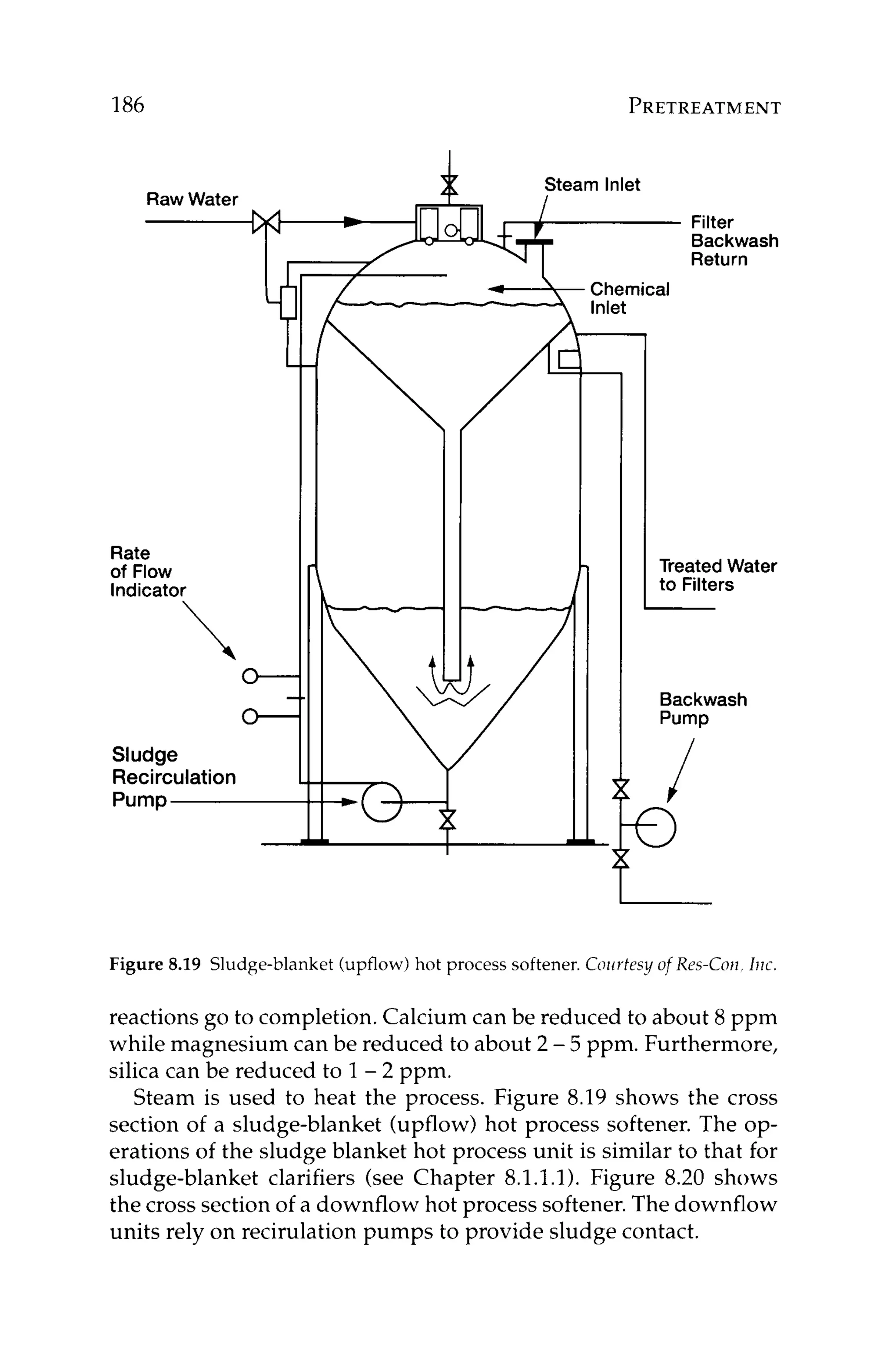
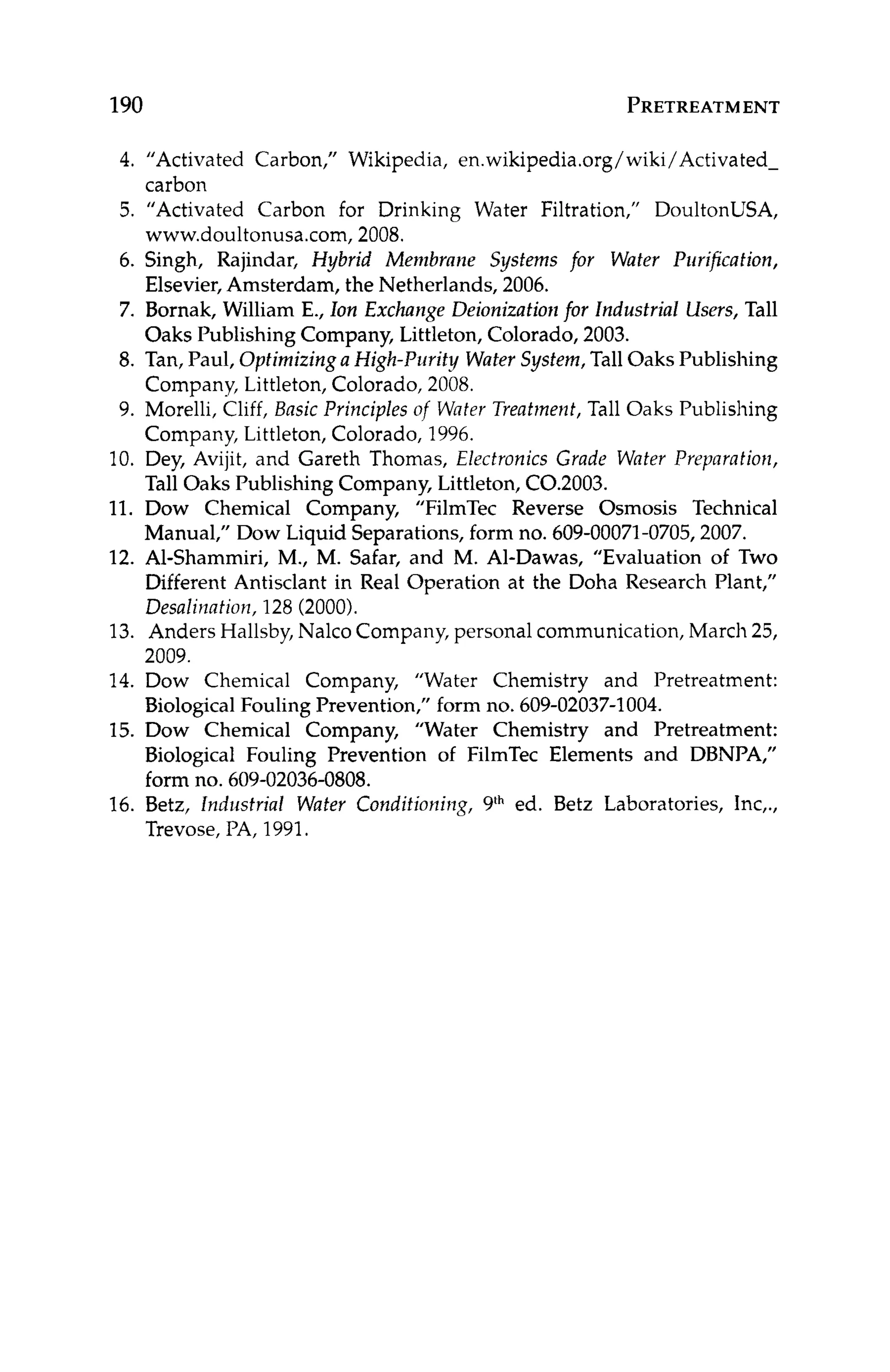
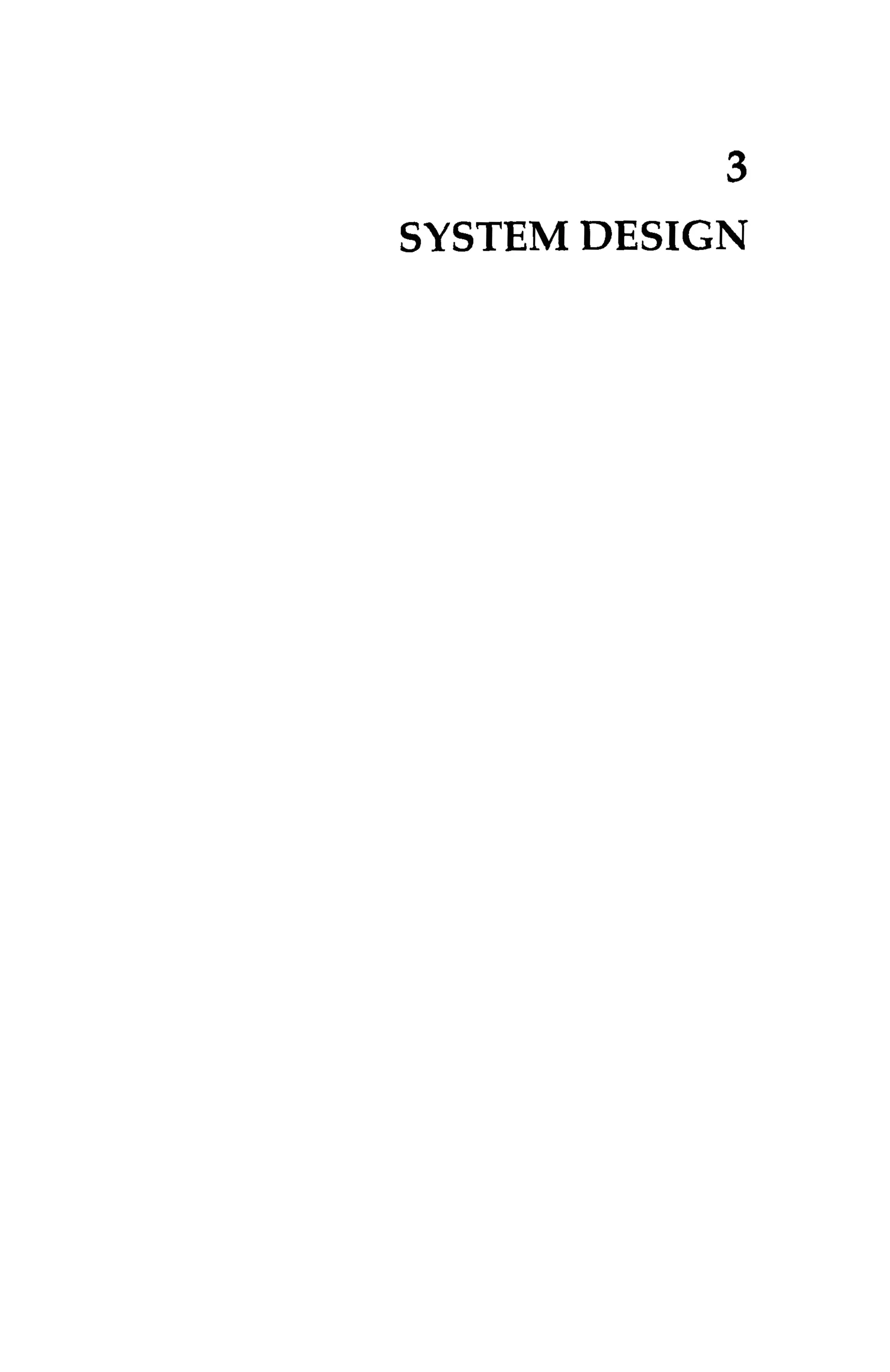
Reverse Osmosis
Scrivener Publishing
3 Winter Street, Suite 3
Salem, MA 01970
Scrivener Publishing Collections Editors
James E. R. Couper
Rafiq Islam Pradip Khaladkar
Norman Lieberman Peter Martin
W. Kent Muhlbauer Andrew Y. C. Nee
S.A. Sherif JamesG. Speight
Richard Erdlac
Piiblishers at Scriveiier
Martin Scrivener (martin@scrivenerpublishing.com)
Phillip Carmical (pcarmical@scrivenerpublishing.com)
Reverse Osmosis
Design, Processes, and
Applications for Engineers
Jane Kucera
Scrivener
~ W I L E Y
Copyright 0 2010by Scrivener Publishing LLC. All rights reserved.
Co-published by John Wiley & Sons, Inc. Hoboken, New Jersey, and Scrivener Publishing
LLC, Salem, Massachusetts
Published simultaneously in Canada
No part of this publication may be reproduced, stored in a retrieval system, or transmitted in any
form or by any means, electronic,mechanical, photocopying, recording, scanning, or otherwise,
except as permitted under Section 107or 108of the 1976United States Copyright Act, without
either the prior written permission of the Publisher, or authorization through payment of the
appropriateper-copy fee to the Copyright Clearance Center,Inc., 222 Rosewood Drive, Danvers,
MA01923, (978)750-8400,fax (978)750-4470,or on the web at uww.copyright.com.Requests to
the Publisher for permission should be addressed to the Permissions Department, John W e y
&Sons, Inc., 111River Street, Hoboken, NJ 07030, (201)748-6011,fax (201)748-6008, or online at
http://www.wiley.com/go/permission.
Limit of Liability/Disclaimer of Warranty: While the publisher and author have used their
best efforts in preparing this book, they make no representations or warranties with respect
to the accuracy or completeness of the contents of this book and specifically disclaim any
implied warranties of merchantability or fitness for a particular purpose. No warranty may
be created or extended by sales representatives or written sales materials, The advice and
strategies contained herein may not be suitable for your situation. You should consult with a
professional where appropriate. Neither the publisher nor author shall be liable for any loss
of profit or any other commercial damages, including but not limited to special, incidental,
consequential, or other damages.
For general information on our other products and services or for technical support, please
contact our Customer Care Department within the United States at (800)762-2974, outside the
United States at (317)572-3993or fax (317)572-4002.
Wiley also publishes its books in a variety of electronic formats. Some content that appears in
print may not be availablein electronic formats. For more information about Wiley products,
visit our web site at www.wiley.com.
For more information about Scrivener products please visit wwwscrivenerpublishing.com.
Cover design by Russell Richardson
Libray of Congress Cataloging-in-Ptrblicatiort Data:
ISBN 978-0-470-618431
Printed in the United States of America
10 9 8 7 6 3 4 3 2 1
For my dad; he’ll always be O.K.
This Page Intentionally Left Blank
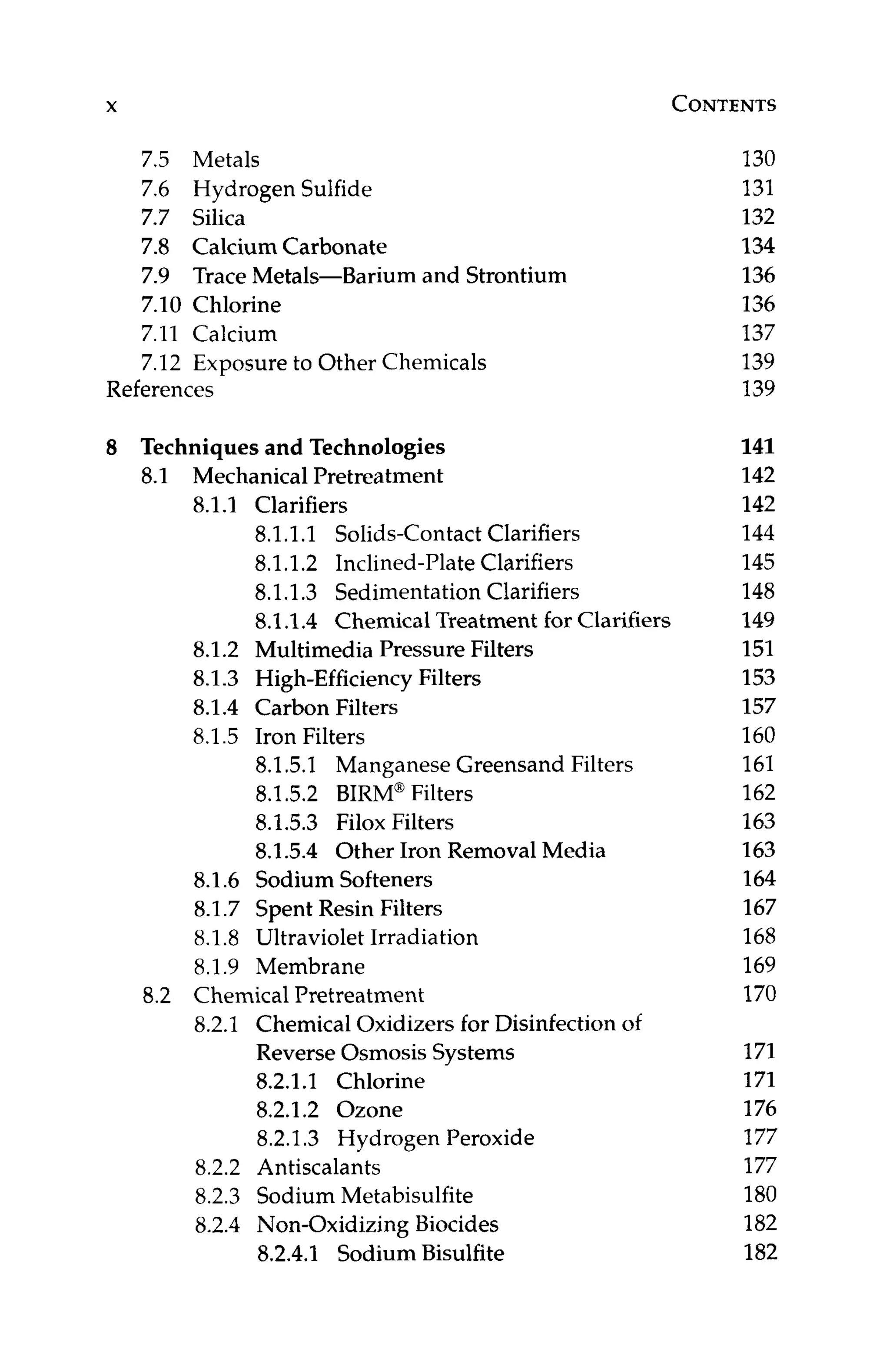
Contents
Preface xvii
PART 1 FUNDAMENTALS
1 Introduction and History o
f Development 3
1.1 Introduction 3
1.1.1 Uses of Reverse Osmosis 3
1.1.2 History of Reverse Osmosis Development 5
1.1.3 Recent Advances in RO Membrane Technology 9
1.1.4 Future Advancements 12
References 12
2 Reverse Osmosis Principles
2.1 Osmosis
2.2 Reverse Osmosis
2.3 Dead-End Filtration
2.4 Cross-Flow Filtration
3 Basic Terms and Definitions
3.1
3.2 Recovery
3.3 Rejection
3.4 Flux
3.5 Concentration Polarization
3.6 Beta
3.7 Fouling
3.8 Scaling
3.9 Silt Density Index
3.10 Langelier Saturation Index
Reverse Osmosis System Flow Rating
References
15
15
16
17
18
21
21
21
23
26
27
29
30
33
35
38
39
vii
viii CONTENTS
4 Membranes
4.1 Transport Models
4.1.1 Solution-Diffusion Model
(non-porous model)
4.1.2 Solution -Diffusion Imperfection
Model (porous model)
4.1.3 Finely-Porous Model
(porous model)
4.1.4 Preferential Sorption -Capillary
Flow Model (porousmodel)
4.1.5 Phenomenological Transport
Relationship (Irreversible
thermodynamics)
4.2.1 Cellulose Acetate
Membranes-Asymmetric
membranes
4.2.2 Polyamide and Composite
Membranes
4.2.2.1 Linear Aromatic Polyamide
4.2.2.2 Composite Polyamide Membranes
4.2.3 Improvements to Polyamide,
Composite Membranes
4.2.4 Other Membrane Materials
4.3.1 Plate and Frame Modules
4.3.2 Tubular Modules
4.3.3 Spiral Wound Modules
4.3.4 Hollow Fine Fiber Membrane
4.3.5 Other Module Configurations
4.4 Commercially-AvailableMembranes
4.4.1 Seawater Membranes
4.4.2 Brackish Water Membranes
4.2 Membrane Materials
Membranes
4.3 Membrane Modules
Modules
4.4.2.1 Low-Energy Membranes
4.4.2.2 High-Rejection Membranes
4.4.2.3 Low-Fouling Membranes
41
42
44
45
45
46
46
47
51
51
52
56
58
58
59
60
61
72
74
76
76
78
79
79
79
CONTENTS ix
4.4.2.4 Low-Differential-Pressure
Membrane Modules
4.4.2.5 High-ProductivityMembrane
Modules
4.4.2.6 Other Membrane/Module
T
YPes
References
5 Basic Flow Patterns
5.1 Arrays
5.2 Recycle
5.3 Double Pass
5.4 Multiple Trains
6 Reverse Osmosis Skids
6.1 Cartridge Filters
6.2 Reverse OsmosisFeed Pumps
6.3 Pressure Vessels
6.4 Manifolding-Materials of Construction
6.5 Instrumentation
6.6 Controls
6.7 Data Acquisition and Management
6.8 Reverse OsmosisSkid
6.9 Auxiliary Equipment
6.10 Other Design Considerations
6.10.1 Access to Profile and Probe
RO Membranes
6.10.2 Interstage PerformanceMonitoring
Instrumentation
6.10.3 Stage-by-Stage Membrane Cleaning
References
PART 2 PRETREATMENT
7 Water Quality Guidelines
7.1 Suspended Solids
7.2 Microbes
7.3 Organics
7.4 Color
80
81
81
83
85
85
89
90
93
95
97
100
106
114
114
116
118
120
120
121
121
121
122
122
125
125
127
128
129
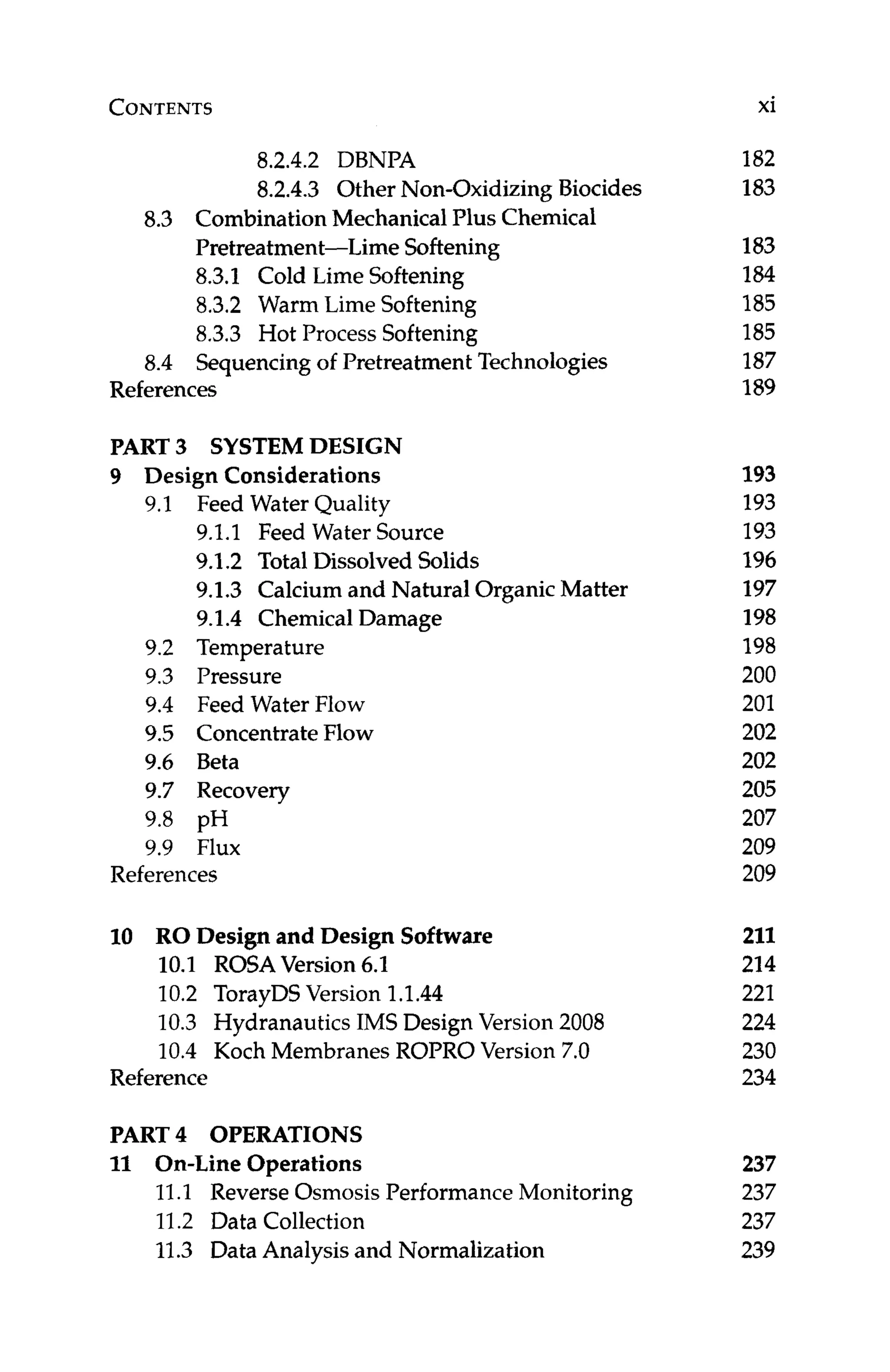
X CONTENTS
7.5 Metals
7.6 Hydrogen Sulfide
7.7 Silica
7.8 Calcium Carbonate
7.9 Trace Metals-Barium and Strontium
7.10 Chlorine
7.11 Calcium
7.12 Exposure to Other Chemicals
References
8 Techniques and Technologies
8.1 Mechanical Pretreatment
8.1.1 Clarifiers
8.1.1.1 Solids-Contact Clarifiers
8.1.1.2 Inclined-Plate Clarifiers
8.1.1.3 Sedimentation Clarifiers
8.1.1.4 Chemical Treatment for Clarifiers
8.1.2 Multimedia Pressure Filters
8.1.3 High-Efficiency Filters
8.1.4 Carbon Filters
8.1.5 Iron Filters
8.1.5.1 Manganese Greensand Filters
8.1.5.2 BIRM@
Filters
8.1.5.3 Filox Filters
8.1.5.4 Other Iron Removal Media
8.1.6 Sodium Softeners
8.1.7 Spent Resin Filters
8.1.8 Ultraviolet Irradiation
8.1.9 Membrane
8.2 Chemical Pretreatment
8.2.1 Chemical Oxidizers for Disinfection of
Reverse Osmosis Systems
8.2.1.1 Chlorine
8.2.1.2 Ozone
8.2.1.3 Hydrogen Peroxide
8.2.2 Antiscalants
8.2.3 Sodium Metabisulfite
8.2.4 Non-Oxidizing Biocides
8.2.4.1 Sodium Bisulfite
130
131
132
134
136
136
137
139
139
141
142
142
144
145
148
149
151
153
157
160
161
162
163
163
164
167
168
169
170
171
171
176
177
177
180
182
182
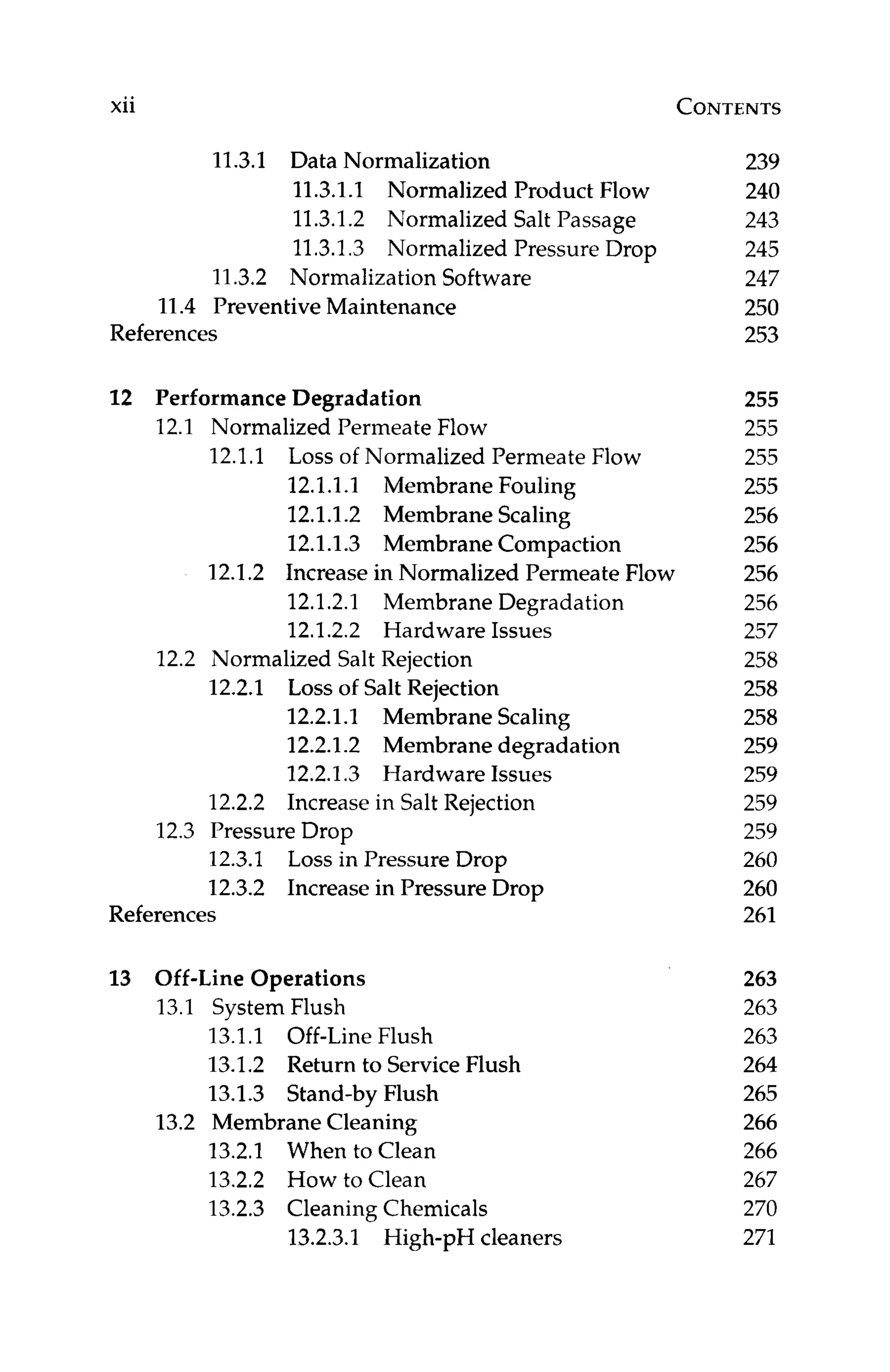
CONTENTS xi
8.2.4.2 DBNPA
8.2.4.3 Other Non-OxidizingBiocides
8.3 CombinationMechanical Plus Chemical
Pretreatment-Lime Softening
8.3.1 Cold Lime Softening
8.3.2 Warm Lime Softening
8.3.3 Hot Process Softening
8.4 Sequencing of Pretreatment Technologies
References
PART 3 SYSTEM DESIGN
9 Design Considerations
9.1 Feed Water Quality
9.1.1 Feed Water Source
9.1.2 TotalDissolved Solids
9.1.3 Calcium and Natural OrganicMatter
9.1.4 Chemical Damage
9.2 Temperature
9.3 Pressure
9.4 Feed Water Flow
9.5 ConcentrateFlow
9.6 Beta
9.7 Recovery
9.8 pH
9.9 Flux
References
10 RO Design and Design Software
10.1 ROSAVersion 6.1
10.2 TorayDSVersion 1.1.44
10.3 Hydranautics IMS Design Version 2008
10.4 Koch Membranes ROPRO Version 7.0
Reference
PART 4 OPERATIONS
11 On-Line Operations
11.1 Reverse Osmosis Performance Monitoring
11.2 Data Collection
11.3 Data Analysis and Normalization
182
183
183
184
185
185
187
189
193
193
193
196
197
198
198
200
201
202
202
205
207
209
209
211
214
221
224
230
234
237
237
237
239
xii CONTENTS
11.3.1 Data Normalization
11.3.1.1 Normalized Product Flow
11.3.1.2 Normalized Salt Passage
11.3.1.3 Normalized Pressure Drop
11.3.2 Normalization Software
11.4 Preventive Maintenance
References
12 Performance Degradation
12.1 Normalized Permeate Flow
12.1.1 Loss of Normalized Permeate Flow
12.1.1.1 Membrane Fouling
12.1.1.2 Membrane Scaling
12.1.1.3 Membrane Compaction
12.1.2 Increase in Normalized Permeate Flow
12.1.2.1 Membrane Degradation
12.1.2.2 Hardware Issues
12.2 Normalized Salt Rejection
12.2.1 Loss of Salt Rejection
12.2.1.1 Membrane Scaling
12.2.1.2 Membrane degradation
12.2.1.3 Hardware Issues
12.2.2 Increase in Salt Rejection
12.3.1 Loss in Pressure Drop
12.3.2 Increase in Pressure Drop
12.3 Pressure Drop
References
13 Off-Line Operations
13.1 System Flush
13.1.1 Off-Line Flush
13.1.2 Return to ServiceFlush
13.1.3 Stand-by Flush
13.2.1 When to Clean
13.2.2 How to Clean
13.2.3 Cleaning Chemicals
13.2 Membrane Cleaning
13.2.3.1 High-pH cleaners
239
240
243
245
247
250
253
255
255
255
255
256
256
256
256
257
258
258
258
259
259
259
259
260
260
261
263
263
263
264
265
266
266
267
270
271
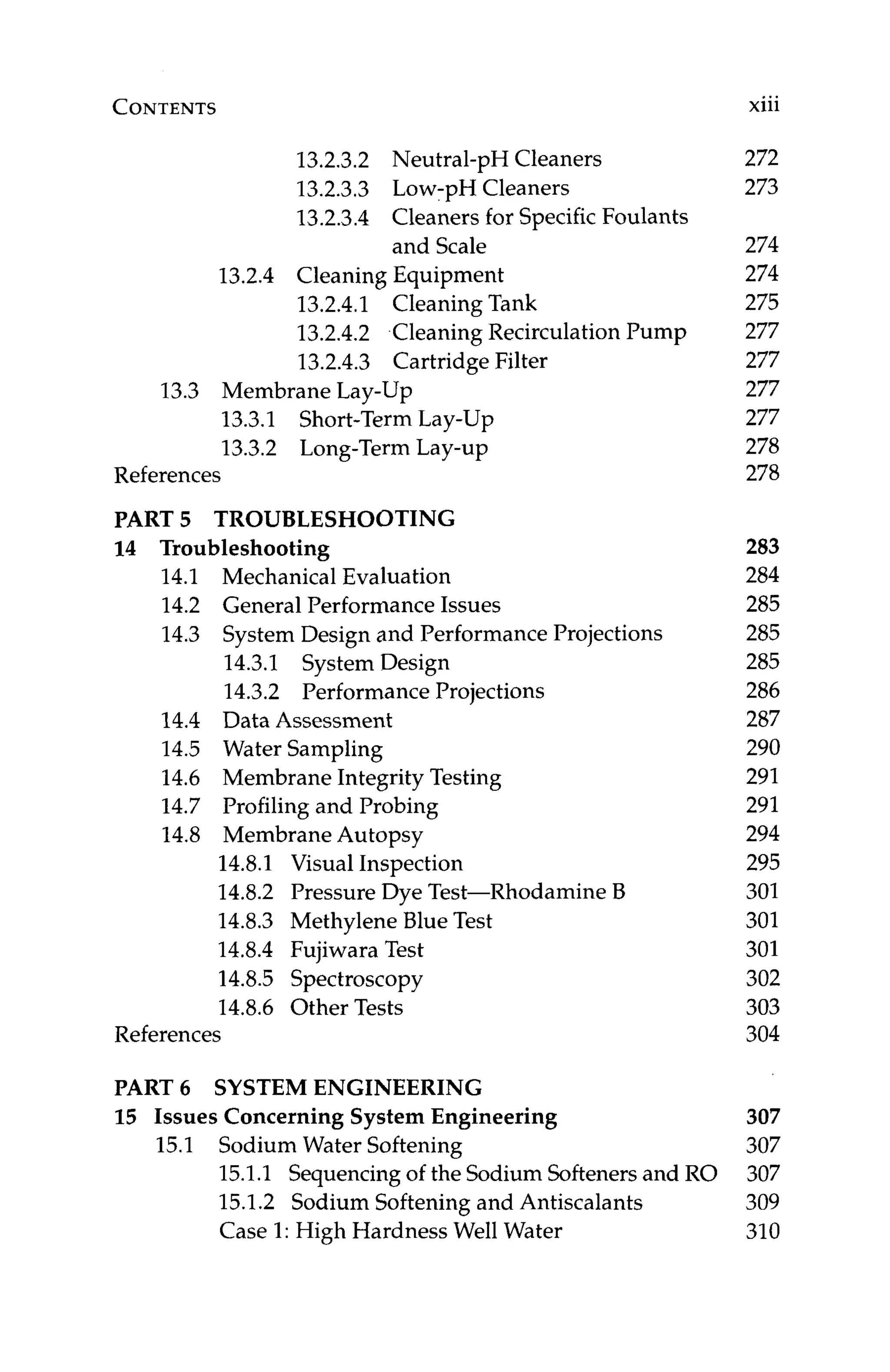
CONTENTS
13.2.3.2 Neutral-pH Cleaners
13.2.3.3 Low-pH Cleaners
13.2.3.4 Cleaners for SpecificFoulants
and Scale
13.2.4 Cleaning Equipment
13.2.4.1 Cleaning Tank
13.2.4.2 Cleaning Recirculation Pump
13.2.4.3 Cartridge Filter
13.3 Membrane Lay-Up
13.3.1 Short-TermLay-Up
13.3.2 Long-Term Lay-up
References
PART 5 TROUBLESHOOTING
14 Troubleshooting
14.1 Mechanical Evaluation
14.2 General Performance Issues
14.3 System Design and Performance Projections
14.3.1 System Design
14.3.2 Performance Projections
14.4 Data Assessment
14.5 Water Sampling
14.6 Membrane Integrity Testing
14.7 Profiling and Probing
14.8 Membrane Autopsy
14.8.1 Visual Inspection
14.8.2 Pressure Dye Test-Rhodamine B
14.8.3 Methylene Blue Test
14.8.4 Fujiwara Test
14.8.5 Spectroscopy
14.8.6 Other Tests
References
PART 6 SYSTEM ENGINEERING
15 Issues Concerning System Engineering
15.1 Sodium Water Softening
15.1.1 Sequencingof the Sodium Softenersand RO
15.1.2 Sodium Softening and Antiscalants
xiii
272
273
274
274
275
277
277
277
277
278
278
283
284
285
285
285
286
287
290
291
291
294
295
301
301
301
302
303
304
307
307
307
309
Case 1: High Hardness Well Water 310
xiv CONTENTS
Sodium Softener
Antiscalant
Summary
Case 2: Low Hardness Surface Water
Sodium Softener
Antiscalant
Summary
Case 3: Well Water with Iron and Manganese
Sodium Softener
Antiscalant
15.2 Reverse Osmosis Sizing and Capacity
15.3 Membrane Cleaning: On-Site versus Off-Site
15.3.1 Off-Site Membrane Cleaning
15.3.2 On-Site Membrane Cleaning
15.4 Reverse Osmosis Reject Disposal Options
15.4.1 Discharge to Drain or Sewer
15.4.2 Discharge to Cooling Tower
15.4.3 Zero Liquid Discharge
References
16 Impact of Other Membrane Technologies
16.1 Microfiltration and Ultrafiltration
16.1.1 Microfiltration
16.1.2 Ultrafiltration
16.2 Nanofiltration
16.3 Continuous Electrodeionization
16.4 HERO Process
References
PART 7 FREQUENTLYASKED QUESTIONS
17 FrequentlyAsked Questions
17.1 General
17.1.1 What is Reverse Osmosis Used for?
17.1.2 What is the Difference Between
Nanofiltration and Reverse Osmosis?
17.1.3 What is Data Normalization?
17.1.4 How Do SDI and Turbidity Correlate?
311
311
312
313
313
313
314
314
314
314
316
317
317
318
319
320
320
321
323
325
325
338
339
342
344
358
360
365
365
365
365
366
366
CONTENTS xv
17.1.5 Why Does the pH Drop from the RO
Feed to the RO Permeate? 366
17.2 Operational 367
17.2.1
17.2.2
17.2.3
17.2.4
17.2.5
17.2.6
17.2.7
17.2.8
17.2.9
When is it Time to Clean
an RO Membrane?
How Long Does it Take to Clean an
RO System?
What TemperatureCleaningSolution
Should Be Used to Clean Membranes?
Can Extended SoakTime Compensate for
Cleaning at Lower Temperature, for
Example, When the Heater is
Not Working?
Should the Low or High pH Cleaning
Be Conducted First?
What Should Be Done if CleaningDoes
Not Return Performanceto Baseline?
If the Clean-In-PlacePump Cannot
Provide the Required Flow Rate, Can
the Pump Be Run at Higher Pressure
to Compensate?
What Should Be Done with Permeate that
is Generated During Membrane Cleaning?
Why is the Permeate Conductivity High
After Cleaning the Membranes?
17.2.10 Why is ChlorineBoth Added and then
17.2.11 What ChemicalsCan Be Used to Disinfect
17.2.12 Why Does the RO Trip Off on Low
17.2.13 Should RO Feed Water Be Heated?
17.2.14 What Limits Recovery by an RO?
17.2.15 How Do I Start up an RO?
17.2.16 Do RO MembranesNeed to Be
Preserved When Taken Off Line?
17.2.17 Is there a Shelf Life for Reverse Osmosis
Membranes?
Removed Prior to the RO?
RO Membranes Directly?
Suction Pressure?
367
367
367
368
368
368
369
369
369
369
370
370
371
371
372
372
374
xvi CONTENTS
17.2.18 What is the Difference Between Membranes
that Have Been Wet Tested and those
that are Dry? 375
17.2.19 What is the Impact on the RO If the
Pretreatment System Fails, for
Example, If the Softener Leaks Hardness?
Be Used in an RO Unit?
375
376
17.3.1 What is the Footprint for an RO System? 377
17.3.2 What is a Variable Frequency Drive
Used for? 377
17.3.3 What is the Difference Between Pleated,
String-Wound, and Melt-Blown
Cartridge Filters? 378
17.3.4 What is the Correct Way to Install Shims
and the Thrust Ring? 379
17.3.5 How should the Cleaning Pump Be Sized? 379
References 379
17.2.20 Can Different Types of Membranes
17.3 Equipment 377
Unit Equivalent and Conversions 381
Index 383
Preface
The use of reverse osmosis (RO) technology has grown rapidly
through the 1990's and early 2000's. The ability of RO to replace
or augment conventional ion exchange saves end users the need
to store, handle, and dispose of large amounts of acid and caus-
tic, making RO a "greener" technology. Additionally, costs for
membranes have declined significantly since the introduction of
interfacial composite membranes in the 1980's, adding to the at-
tractiveness of RO. Membrane productivity and salt rejection have
both increased, reducing the size of RO systems and minimizing
the amount of post treatment necessary to achieve desired product
quality.
Unfortunately, knowledge about RO has not kept pace with the
growth in technology and use. Operators and others familiar with
ion exchange technology are often faced with an RO system with
little or no training. This has resulted in poor performance of RO
systems and perpetuation of misconceptionsabout RO.
Much of the current literature about RO includes lengthy discus-
sionsor focuseson a niche application that makes it difficult to find
an answer to a practical question or problemsassociated with more
common applications. Hence, my objective in writing this book is
to bring clear, concise, and practical information about RO to end
users, applicationsengineers,and consultants.In essence, the book
is a referencebringing together knowledge from other referencesas
well as that gained through personal experience.
The book focuses on brackish water industrial RO, but many
principles apply to seawater RO and process water as well.
xvii
This Page Intentionally Left Blank
Acknowledgements
My enthusiasm for reverse osmosis (RO) began while working
with my thesis advisor at UCLA, Professor Julius "Bud" Glater, a
pioneer who worked at UCLA with Sidney Loeb in the early days
of commercializing RO. Professor Glater was kind enough to ex-
tend a Research Assistantship to me, when my first choice was not
available.That was fortunate for me, as membrane technology is a
growing field with great future potential. Professor Glatel's guid-
ance and support were invaluable to me as a graduate student and
has continued to be throughout my career.
My knowledgegrewat Bend Research,Inc.under Harry Lonsdale,
another membrane pioneer who was involved in the theoretical
and practical side of membranes since the early 1960's at Gulf Gen-
eral Atomic (predecessor of Fluid Systems, now Koch Membrane
Systems),Alza, and later Bend Research,which he co-foundedwith
Richard Baker.At Bend Research, I had the opportunity to develop
novel membranes and membrane-based separation processes, in-
cluding leading several membrane-based projects for water recov-
ery and reuse aboard the International SpaceStation.
My desire to write this book was fostered by Loraine Huchler,
president of Mar-Tech Systems, which she founded in the mid
1990'~~
and author of the book series, Operating Practices for In-
dustrial Water Management. Loraine has provided both technical
and moral support.
Thanks also go to Nalco Company, Naperville, IL, for support-
ing me in this endeavor. Individuals at Nalco who have provided
technical and administrative support include: Ching Liang, Anne
Arza, Anders Hallsby, Beth Meyers, Carl Rossow, Alice Korneffel,
and Kevin OLeary.Nalco-CrossbowLLC personnel who have pro-
vided support includeMark Sadus(contributorto Chapter 6),Scott
Watkins, Mike Antenore, JasonFues, and Dave Weygandt.
xix
xx ACKNOWLEDGEMENTS
Valuable technica1 support has been provided by Julius
Glater-Professor Emeritus UCLA; Mark Wilf of Tetratech;Rajindar
Singh-Consultant; Madalyn Epple of Toray Membrane USA; Scott
Beardsley, Craig Granlund, of Dow Water and Process Solutions;
Jonathan Wood and John Yen of Siemens Water Technologies-
Ionpure Products; Bruce Tait of Layne Christensen; Jean Gucciardi
of MarTech Systems; Rick Ide of AdEdge Technologies; and Lisa
Fitzgerald of ITT-Goulds Pumps.
I would like to thank my graphic artist, Diana Szustowski, for
her excellent and tireless efforts.
Finally, I would like to thank Paul Szustowski and Irma Kucera
for their support.
1
FUNDAMENTALS
This Page Intentionally Left Blank
1
Introduction and History
of Development
1.1 Introduction
Reverse Osmosis (RO) is a membrane-based demineralization
technique used to separate dissolved solids, such as ions, from
solution (most applications involve water-based solutions, which is
the focus of this work). Membranes in general act as perm-selective
barriers,barriersthat allowsomespecies(suchaswater)to selectively
permeate through them while selectively retaining other dissolved
species (such as ions). Figure 1.1shows how RO perm-selectivity
comparesto many othermembrane-based and conventionalfiltration
techniques.As shown in the figure, RO offers the finest filtrationcur-
rently available,rejecting most dissolved solidsas well as suspended
solids. (Note that although RO membranes will remove suspended
solids, these solids, if present in RO feed water, will collect on the
membranesurfaceand foulthe membrane.SeeChapters3.7and 7for
more discussionon membranefouling).
1.1.1 Uses of Reverse Osmosis
Reverseosmosis can be used to either purify water or to concentrate
and recover dissolved solids in the feed water (known as "dewater-
ing").Themost commonapplicationof ROis to replaceion exchange,
including sodium softening, to purify water for use as boiler make-
up to low- to medium-pressure boilers, as the product quality from
an RO can directly meet the boiler make-up requirements for these
pressures. For higher-pressure boilers and steam generators, RO is
used in conjunction with ion exchange, usually as a pretreatment to
a two-bed or mixed-bed ion exchangesystem.Theuse of RO prior to
ion exchangecan significantlyreducethe frequencyof resin regenera-
tions, and hence, drastically reduce the amount of acid, caustic, and
regeneration waste that must be handled and stored. In some cases,
a secondary RO unit can be used in place of ion exchange to further
purify productwater froman ROunit (seeChapter5.3).Effluentfrom
3
4 FUNDAMENTALS
Figure 1
.
1 ”Filtration Spectrum” comparing the rejectioncapabilities of reverse
osmosis with other membrane technologies and with the separation afforded by
conventional filtration.
the second RO may be used directly or is sometimes polished with
mixed-bed ion exchangeor continuouselectrodeionizationto achieve
even higher product water purity (seeChapter 16.3).
Other common applications of RO include:
1. Desalination of seawater and brackish water for potable
use.Thisis verycommonin coastalareasand.theMiddle
East where supply of fresh water is scarce.
2. Generation of ultrapure water for the microelectronics
industry.
3. Generation of high-purity water for pharmaceuticals.
4. Generation of processwater for beverages (fruitjuices,
5. Processing of dairy products.
6. Concentration of corn sweeteners.
7. Waste treatment for the recovery of process materials
such as metals for the metal finishing industries, and
dyes used in the manufacture of textiles.
8. Water reclamation of municipal and industrial waste-
waters.
bottled water, beer).
INTRODUCTION
AND HISTORY
OF DEVELOPMENT 5
1.1.2 History of Reverse Osmosis Development
One of the earliest recorded documentationof semipermeablemem-
branes was in 1748,when Abbe Nollet observed the phenomenon of
osmosis.' Others, includingPfeffer and Traube studied osmoticphe-
nomena using ceramic membranes in the 1850's.However, current
technology dates back to the 1940's when Dr. Gerald Hassler at the
Unitversityof Californiaat LosAngeles (UCLA)began investigation
of osmotic properties of cellophane in 194fL2He proposed an "air
film" bounded by two cellophane membrane^.^ Hassler assumed
that osmosis takes place via evaporation at one membrane surface
followedby passagethrough the air gap as a vapor, with condensa-
tion on the opposingmembranesurface.Today,we know that osmo-
sis.does not involve evaporation, but most likely involves solution
and diffusion of the solutein the membrane(seeChapter 4).
Figure 1.2 shows a time line with important events in the devel-
opment of RO technology.Highlights are discussed below.
In 1959,C.E. Reid and E.J. BretonatUniversityof Florida,demon-
strated the desalination capabilitiesof cellulose acetate film.4They
evaluated candidate semipermeable membranes in a trial-and-
error approach, focusing on polymer films containing hydrophilic
groups. Materials tested included cellophane, rubber hydrochlo-
ride, polystyrene, and cellulose acetate. Many of these materials
exhibited no permeate flow, under pressures as high at 800 psi,
and had chloride rejections of less than 35%. Cellulose acetate
(specificallythe DuPont 88CA-43),however, exhibited chloride re-
jections of greater than 96%,even at pressures as low as 400 psi.
Fluxes ranged from about 2 gallons per square foot-day (gfd) for
a 22-micron thick cellulose acetate film to greater than 14gfd for a
3.7-micronthick film when tested at 600psi on a 0.1M sodium chlo-
ride solution. Reid and Breton's conclusions were that cellulose
acetate showed requisite semipermeability properties for practi-
cal application, but that improvements in flux and durability were
required forcommercialviability.
A decade after Dr. Hasslefs efforts, Sidney Loeb and Srinivasa
Sourirajan at UCLA attempted an approach to osmosis and re-
verse osmosisthat differedfrom that of Dr. Hassler.Their approach
consisted of pressurizing a solution directly against a flat, plastic
film.3Their work led to the development of the first asymmetric
cellulose acetate membrane in 1960(seeChapter 4.2.1).2This mem-
brane made RO a commercial viability due to the significantly
I I 1 I I I 1 I 1 1 I l l I I I 1 1 I 1 1
I 1 I I 1 1 I I 1 1 1 1 I I I t I I 1 I f
1940 1950 1960 1970 1980 1990 2000 2010
A.
B.
C.
0.
E.
F.
G.
H.
I.
1948- Hassler studies osmotic propertiesof cellophane membranes at UCM
1955-F
i
r
s
t reported u
s
eof theterm ”reverse osmosis”
1955-Reid beginsstudy of membranes of demineralizationat
Universityof Florida
1959-Breton and Reiddemonstratedesalinationcapabilityof cellulose
acetatefilm
1960-Loeband Sourirajandevelop asymmetricCellulose acetate membrane
at UCLA
1963-First practicalspiral wound moduledevelopedby GeneralAtomics
(seeChapter 4.3.3)
1965- First commercial brackish water RO facility at Coalinga.CA
1965-Solution-Diffusiontransport model describedby Lonsdale,et.al
(See Chapter 4.1.1)
1967-Firstcommercially successful hollow fiber InodUledeveloped
by DuPont(see Chapter 4.3.4)
J. 1968- First multi-leafspiral wound module developed by Fluid Systems
(SeeChapter 4.3.3)
I(. 1971-Richter-Hoehn at DuPontpatents aromatic polyamidemembrane
(seeChapter4.2.2)
L. 1972- Cadottedevelops interfacialcompositemembrane
(See Chapter 4.2.2)
M. 1974-First commercial seawater RO facility at Bermuda
N. 1994-TriSep introducesfirst “lowfouling” membrane(seeChapter 4.4.2.3)
0. 1995- Hydranauticsintroducesfirst ‘energy saving’ polyamidemembrane
(see Chapter4.4.2.1)
P 2002 - KochMembrane Systems introducesfirst 18-inchdiameter
“MegaMagnum” module
(1. 2006 -Thin-film nanocomposite membrane developed at UCLA
Figure1.2 Historical time line in the development of reverse osmosis. K
2
INTRODUCTION
AND HISTORY
OF DEVELOPMENT 7
improved flux, which was 10times that of other known membrane
materialsat the time (suchasReid and Breton's membranes).jThese
membranes were first cast by hand as flat sheets.Continued devel-
opment in this area led to casting of tubular membranes. Figure 1.3
is a schematic of the tubular casting equipment used by Loeb and
Sourirajan. Figure 1.4 shows the capped, in-floor immersion well
that was used by Loeb and students and is still located in Boelter
Hall at UCLA.
Following the lead of Loeb and Sourirajan, researchers in the
1960's and early 1970's made rapid progress in the development of
commercially-viable RO membranes. Harry Lonsdale, U. Merten,
and Robert Riley formulated the "solution-diffusion" model of mass
transport through RO membranes (see Chapter 4.1).6 Although
most membranes at the time were cellulose acetate, this model
CastingTube
for CastingTube -
Figure 1
.
3 Schematicon tubular casting equipment used by Loeb. Courtesyof
Julius Glater, UCLA.
8 FUNDAMENTALS
Figure 1
.
4 Capped, in-floor immersion tank located at Boelter Hall that was used
by Loeb and Sourirajan to cast tubular cellulose acetate membranes at UCLA,
as viewed in 2008.
represented empirical data very well, even with respect to present-
day polyamide membrane^.^ Understanding transport mechanisms
was important to the development of membranes that exhibit im-
proved performance (fluxand rejection).
In 1971, E. I. Du Pont De Nemours & Company, Inc. (DuPont)
patented a linear aromatic polyamide with pendant sulfonic acid
groups, which they commercialized as the PermasepTM
B-9 and
B-10 membranes (Permasep is a registered trademark of DuPont
Company, Inc. Wilmington, DE).These membranes exhibited high-
er water flux at slightly lower operating pressures than cellulose
acetate membranes. The membranes were cast as unique hollow
fine fibers rather than in flat sheets or a tubes (seeChapter 4.3.4).
Celluloseacetateand lineararomaticpolyamidemembraneswere
the industry standard until 1972,when JohnCadotte, then at North
Star Research, prepared the first interfacial composite polyamide
membrane.*This new membrane exhibited both higher through-
put and rejection of solutes at lower operating pressure than the
here-to-date celluloseacetate and linear aromatic polyamide mem-
branes. Later, Cadotte developed a fully aromatic interfacialcom-
posite membrane based on the reaction of phenylene diamine and
trimesoyl chloride. This membrane became the new industry stan-
dard and is known today as FT30, and it is the basis for the majority
INTRODUCTION AND HISTORY
OF DEVELOPMENT 9
of Dow Water and Process Solutions’ FilmTecTM
membranes (e.g.,
BW30, whichmeans “BrackishWater membrane,” FT30chemistry”;
TW30, which means ”Tap Water membrane,” FT30 chemistry; and
so on) as well as many commercially available membranes from
other producers (FilmTec is a trademark of Dow Chemical Com-
pany, Midland, Michigan). See Chapter 4.2for more information
about interfacialcompositemembranes.
Other noteworthy developments in membrane technology
include the following:
1963: First practical spiral wound module devel-
oped at Gulf General Atomics (later known as Fluid
Systems@,now owned by Koch Membrane Systems,
Wilmington, MA.) This increased the packing density
of membrane in a module to reduce the size of the RO
system (seeChapter 4.3).
1965: Thefirstcommercialbrackish water RO (BWRO)
was on lineat the Raintreefacility in Coalinga, Califor-
nia. Tubular cellulose acetate membranes developed
and prepared at UCLA were used in the facility.Addi-
tionally, the hardware for the system was fabricatedat
UCLA and transported piecemeal to the facility9
1967 First commercial hollow-fiber membrane module
developedby DuPont.Thismoduleconfigurationfurther
.
increasedthe packing density of membranemodules.
1968: First multi-leaf spiral wound membrane mod-
ule developed by Don Bray and others at Gulf Gen-
eral Atomic, under US Patent no. 3,417,870, ”Reverse
Osmosis Purification Apparatus,” December, 1968.A
multi-leaf spiral configurationimprovesthe flow char-
acteristicsof the RO module by minimizing the pres-
sure drop encountered by permeate as it spirals into
the central collectiontube.
1978: FT-30 membrane patented and assigned to
FilmTec (now owned by Dow Chemical Company,
Midland, MI).
1.1.3 Recent Advancesin RO Membrane Technology
Since the 1970’s, the membrane industry has focused on develop-
ing membranes that exhibit ever greater rejection ofsolutes while at
10 FUNDAMENTALS
Year
1970’s
1980’s
Pressure Relative
(psi) Flux
435 1
290 1.9
Year
1980
1983
1990
1995
2000
~~
Rejection
(70)
Relative Cost
1.oo
0.65
0.34
0.19
0.14
97
99.0
99.7
99.7
99.7
99.7
~~ ~~
Membrane Material
Celluloseacetate
Cross-linked
polyamidecomposite
polyamidecomposite
Cross-linkedaromatic
polyamide composite
Cross-linkedaromatic
polyamidecomposite
Cross-linkedaromatic
polyamide composite
the same time exhibiting higher throughput (flux)at lower operat-
ing pressure. Table 1.1shows the growth in RO membrane develop-
ment with respect to rejection, flux, and operating pressure.I0Along
with advances in membrane performance, membrane costs have
also improved. Table 1.2lists costs of membranes relative to 1980.j
In addition to the progress shown in Table 1.1,some membranes
now exhibit up to 99.75%rejection (a drop of 17%in salt passage
over membranes exhibiting 99.7%rejection). Other advancements
Table 1.1 Development of RO membranes for brackish water
desalination.
Table1
.
2 Membrane cost decline
relative to 1980.;
INTRODUCTION
AND HISTORY
OF DEVELOPMENT 1
1
in membrane technology include “low pressure” RO membranes
that allow for operation at lower water temperatures (<50°F(10°C))
with reasonably low operating pressure (seeChapter 4.4.2.1).And,
”fouling resistant” membranes have been developed that purport
to minimize fouling by suspended solids, organics, and microbes
(seeChapter 4.4.2.3).
Since the late 1970’s,researchersin the US, Japan,Korea, and other
locations have been making an effort to develop chlorine-tolerant
RO membranes that exhibit high flux and high rejection. Most
work, such as that by Riley and Ridgway et.al., focuses on modi-
fications in the preparation of polyamide composite membranes
(see Chapter 4.2.2).” Other work by Freeman (University of Texas
at Austin)and others involvesthe development of chlorine-tolerant
membrane materials other than polyamide. To date, no chlorine-
resistant polyamide compositemembranes are commerciallyavail-
able for large-scaleapplication.
Nanotechnology came to RO membranes on a research and
development scale in the mid 2000’s, with the creation of thin-
film nanocomposite membranes.2J2J3The novel membranes
created at UCLA in 2006 by Dr. Eric M.V. Hoek and team include
a type of zeolite nanoparticle dispersed within the polyamide thin
film. The nanoparticles have pores that are very hydrophilic such
that water permeates through the nanoparticlepores with very little
applied pressureascompared to the polyamidefilm, which requires
relatively high pressure for water to permeate. Hence, the water
permeability through the nanocomposite membranes at the high-
est nanoparticleloadinginvestigated,is twice that of a conventional
polyamide membrane.’*The rejection exhibited by the nanocom-
posite membrane was equivalent to that of the conventional poIy-
amide membrane.’*The controlled structure of the nanocomposite
membrane purports to improve key performancecharacteristics of
reverse osmosis membranes by controlling membrane roughness,
hydrophilicity, surface charge, and adhesion of bacteria cells.14The
thin-film nanocompositemembrane (TFN)technology was licensed
from UCLA in 2007by NanoH,O, Inc. (LosAngeles, CA)for further
research and development toward commercialization.’j
Alongsimilar lines, other researchershave been looking intonano-
composite membranes.I6Researchers at the University of Colorado
at Boulder have been developing lyotropic liquid crystals (LLCs)
to form what they call nanostructured polymer membranes.16The
LLCs can from liquid crystalline phases with regular geometries
12 FUNDAMENTALS
which act as conduits for water transport while rejection ions based
on size exclusion. In bench-scale tests, nanostructuered polymer
membranes exhibited a rejections of 9576 and 99.3%of sodium chlo-
ride and calcium chloride, respectively.I3These membranes also
exhibited greater resistance to chlorine degradation than commer-
cially-available polyamide composite membranes. As is the case
with the nanocomposite membranes, the nanostructured polymer
membranes are not yet in commercial production.
1.1.4 Future Advancements
Improvements will be necessary as RO is used to treat the ever great-
er expanding candidate feed waters, including municipal and indus-
trial wastewater effluents, and other source waters that are less than
optimal for conventional RO membranes (e.g., wastewaters con-
taining high concentrations of biological chemical demand (BOD),
chemicaloxygen demand (COD),TOC, silica,and suspended solids,
such as food-processingcondensates and cooling tower blowdown).
Membranes will need to be developed that are tolerant of chlorine for
microbialgrowth control,and resist to fouling with suspended solids
and organics. Other membrane technologies, such as microfiltration
and ultrafiltration, are finding fresh application in pre-treating RO
systems operating on these challenging water sources.
There is also continuing research into higher-performance (high
flux and high rejection) membranes to further reduce the size and
cost of RO systems. Nanotechnology shows promise for having a
role in the development of these high-performance membranes.
Improvements will be required in the chemistries used to treat
RO. These chemistries include antiscalants, which will be needed
to address higher concentrations of scale formers such as silica,and
membrane cleaners, which will have to address microbes, biofilms,
and organics.
References
1. Cheryan, Munir, Ultrafiltration niid Microfiltrotiorz Handbook, 2nded.,
2. Koenigsberg, Diana, ”Water Warriors,” UCLA Magazine, www.
3. Glater, Julius, ”The Early History of Reverse Osmosis Membrane
CRC Press, Boca Raton, FL, 1998.
magazine.ucla.edu/features/water warriors, July 1,2006.
Development,”Desulination, 117(1998).
INTRODUCTION
AND HISTORY
OF DEVELOPMENT 13
4. Reid, C.E. and E.J. Breton, “Water and Ion Flow Across Cellulosic
Membranes,” Journal of Applied Polymer Science, vol 1,issue 2 (1959).
5. Baker, Richard, Membrane Technology and Applications, 2nded., John
Wiley & Sons, Ltd, Chichester, West Sussex, England, 2004.
6. Lonsdale, H.K., U. Merten, and R.L. Riley, “Transport Properties of
Cellulose Acetate Osmotic Membranes,” Journal of Applied Polymer
Science, ~019,1965.
7. Sudak, Richard G., ”Reverse Osmosis,” in Handbook of Industrial
Membrane Technology, M.C. Porter, Ed., William Andrew Publishing,
1990.
8. Cadotte, John, R.S. King, R.J. Majerle, and R.J. Peterson, ”Interfacial
Synthesisin the Preparation of Reverse OsmosisMembranes,” Journal
of Macromolecular Science and Chemistry,Al5,1981.
9. Glater, Julius, Professor Emeritus, UCLA, personal communications,
February 24,2009.
10. Advanced Membrane Technologyand Applications, Li, Norman, Anthony
Fane, W.S. Winston Ho, and Takeshi Matsuura, eds., John Wiley &
Sons, Inc., Hoboken, NJ, 2008.
11. Riley, R.L., S.W. Lin, A. Murphy, I. Wiater-Protas, and H.F. Ridgway,
”Development of a New Chlorine and BiofoulingResistant Polyamide
Membrane,” technical report number A273214under the SBIRcontract
number DAAD19-02-C-0031.
12, Jeong, Byeong-Heon, Eric M.V. Hoek, Yushan Yan, Arun Subramani,
XiaofeiHuang,GilHurwitz,AsimK.Ghosh,andAnnaJawor,”Interfacial
Polymerization of Thin Film Nanocomposites: A New Concept for
ReverseOsmosisMembranes,”J O U Y ~
of Membrane Science,294,2007.
13. Merkel, T.C., B.D. Freeman, R.J.Spontak, Z. He, I. Pinnau, P. Meakin,
and A.J. Hill, ”Ultrapermeable, Reverse-Selective Nanocomposite
Membranes,” Science, Vol. 296, April 19,2002.
14. NanoH20 Inc. web page, www.nanoh2o.com.
15. Flanigan, James, ”California’s Glimmer of Hope: Nanotechnology,”
TheNew York Times DealBook Blog, www.NYTimes.com,July 16,2009.
16. Hatakeyama, Evan S.,Meijuan Zhour, Brian R. Wiesenauer,Richard D.
Noble, and Douglas L. Gin, ”Novel Polymer Materials for Improving
WaterFiltration Membranes,”proceedings of theAmerican Membrane
TechnologyAssociation 2009 Conference and Exposition,July, 2009.
This Page Intentionally Left Blank
2
Reverse OsmosisPrincides
Reverse osmosis is a demineralizationprocess that relies on a semi-
permeablemembraneto effectthe separationof dissolvedsolidsfrom
a liquid. The semipermeable membrane allows liquid and some
ions to pass, but retains the bulk of the dissolved solids.Although
many liquids (solvents) may be used, the primary application of
RO is water-based systems. Hence, all subsequent discussion and
exampleswill be based on the use of water as the liquid solvent.
To understand how RO works, it is first necessary to understand
the natural process of osmosis.This chapter covers the fundamen-
tals of osmosis and reverse osmosis.
2
.
1 Osmosis
Osmosisisanaturalprocesswherewaterflowsthroughasemiperme-
ablemembranefrom a solutionwith a low concentration of dissolved
solids to a solutionwith a high concentration ofdissolvedsolids.
Picture a cell divided into 2 compartments by a semipermeable
membrane, as shown in Figure 2.1. This membrane allows water
and some ions to pass through it, but is impermeable to most dis-
solvedsolids.Onecompartment inthecellhasa solutionwith a high
concentrationof dissolved solids while the other compartment has
a solution with a low concentrationof dissolved solids.Osmosis is
the natural process where water will flow from the compartment
with the low concentrationof dissolved solids to the compartment
with the high concentrationof dissolved solids.Water will continue
to flow through the membrane until the concentration is equalized
on both sides of the membrane.
At equilibrium, the concentrationof dissolved solids is the same
in both compartments (Figure2.2); there is no more net flow from
one compartment to the other. However, the compartment that
once contained the higher concentrationsolution now has a higher
water level than the other compartment.
The differencein height between the 2 compartmentscorresponds
to the osmotic pressure of the solution that is now at equilibrium.
15
16 FUNDAMENTALS
High t Low
Semi-permeablemembrane
Figure 2.1 Cell divided into 2 compartmentsseparated by a semipermeable
membrane. Water moves by osmosis from the low-concentration solution in one
compartment through the semipermeable membrane into the high-concentration
solution in the other compartment.
High t Low
Semi-permeable membrane
Figure 2.2 Concentration equilibrium. Differencein height corresponds to
osmotic pressure of the solution.
Osmotic pressure (typically represented by n (pi))is a function of
the concentration of dissolved solids. It ranges from 0.6 to 1.1psi for
every 100 pprn total dissolved solids (TDS). For example, brackish
water at 1,500ppm TDSwould have an osmoticpressureof about 15
psi. Seawater, at 35,000 pprn TDS, would have an osmotic pressure
of about 350 psi.
2.2 Reverse Osmosis
Reverseosmosisis the process by which an applied pressure, great-
er than the osmotic pressure, is exerted on the compartment that
REVERSE
OSMOSIS
PRINCIPLES 17
Applied Pressure
High f Low
Semi-permeable membrane
Figure 2.3 Reverse osmosisis the process by which an appliedpressure, greater
than the osmotic pressure, is exerted on the compartment that oncecontained the
high-concentration solution,forcing water to move through the semipermeable
membrane in the reverse direction of osmosis.
once contained the high-concentration solution (Figure 2.3). This
pressure forces water to pass through the membrane in the direc-
tion reverse to that of osmosis. Water now moves from the com-
partment with the high-concentrationsolution to that with the low
concentrationsolution. In this manner, relatively pure water passes
through membrane into the one compartment while dissolved
solids are retained in the other compartment. Hence, the water in
the one compartment is purified or ”demineralized,”and the solids
in the other compartmentare concentrated or dewatered.
Due to the added resistance of the membrane, the applied pres-
sures required to achieve reverse osmosis are significantly higher
than the osmotic pressure. For example, for 1,500ppm TDS brack-
ish water, RO operating pressures can range from about 150psi to
400 psi. For seawaterat 35,000 ppm TDS, RO operatingpressures as
high as 1,500 psi may be required.
2.3 Dead-End Filtration
The type of filtrationillustrated in Figures 2.1,2.2, and 2.3 is called
”dead end” (”end flow” or “directflow”)filtration.Dead end filtra-
tion involves all of the feed water passing through the membrane,
leaving the solids behind on the membrane.
Considera commoncoffeefilter as shownin Figure2.4. Feed water
mixeswith the coffeegrounds on one sideof the filter.Thewater then
18 FUNDAMENTALS
Common
coffee filter
- 0
0
1
Effluent
Figure 2.4 Dead-end filtration is a batch process that produces one effluent
stream given one influent stream.
passes through the filter to become coffeethat is largely free of coffee
grounds. Virtually all of the feed water passes through the filter to
becomecoffee.One influentstream,in this casewater, produces,only
one effluent stream, in this case coffee.This is dead end filtration.
Dead end filtration isabatch process.That means that the filterwill
accumulateand eventuallyblind off with particulatessuchthat water
cannolongerpass through.Thefiltration systemwill need tobe taken
off line and the filter will need to be either cleaned or replaced.
2.4 Cross-FlowFiltration
In cross-flow filtration, feed water passes tangentially over the
membrane surface rather than perpendicularly to it. Water and
some dissolved solids pass through the membrane while the ma-
jority of dissolved solids and some water do not pass through the
membrane. Hence, cross-flowfiltration has one influent stream but
yields two effluent streams. This is shown is Figure 2.5.
Permeate
r)
Feed I
)
Figure 2.5 Cross-flow filtration is a continuous process that produces two
effluent streams given one influent stream.
REVERSE
OSMOSIS
PRINCIPLES 19
Cross-flow helps to minimize fouling or scaling of the RO mem-
brane. In an effortto keep the membrane surface free of solids that
may accumulate and foul or scale the membrane, tangential flow
across the membrane surface aids in keeping the surface clean by
scouringthe surface; minimum flow rates across the membranesur-
face are required to effectively scour the surface.See Chapter 9.5 for
more detailsabout cross-flowfiltrationand RO systemflow rates.
In theory, cross-flow is a continuous operation, as the scouring
process keeps the membrane surface free of foulants. In practice,
however, the scouring action of cross flow is not always enough
to prevent all fouling and scaling. Periodically, the membranes
will need to be taken off line and cleaned free of material that has
accumulated at the surface.
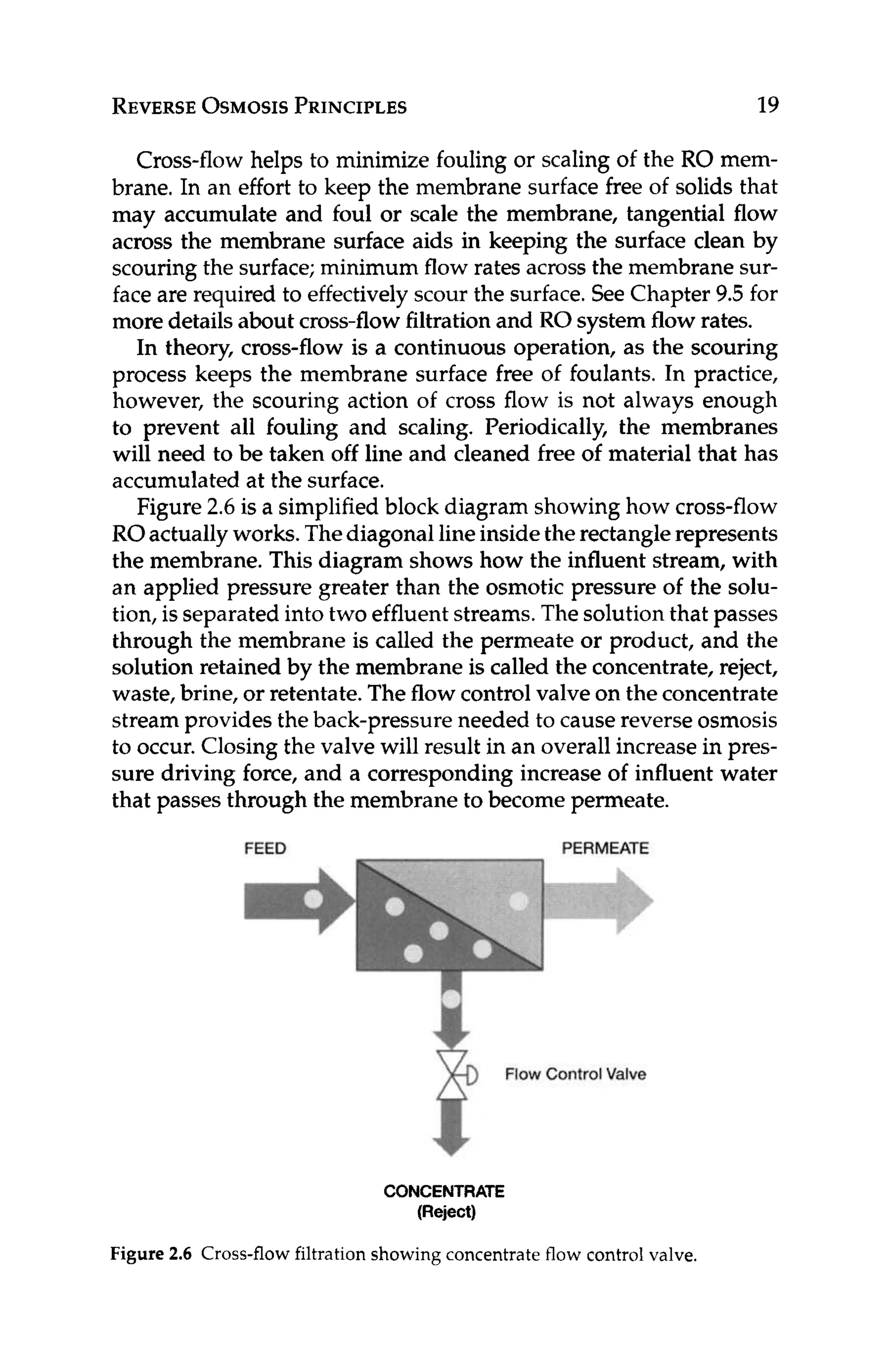
Figure 2.6 is a simplified block diagram showing how cross-flow
ROactuallyworks.Thediagonal lineinside the rectanglerepresents
the membrane. This diagram shows how the influent stream, with
an applied pressure greater than the osmotic pressure of the solu-
tion, is separated into two effluent streams.The solution that passes
through the membrane is called the permeate or product, and the
solution retained by the membrane is called the concentrate,reject,
waste, brine, or retentate. The flow controlvalve on the concentrate
stream provides the back-pressureneeded to causereverseosmosis
to occur. Closing the valve will result in an overall increase in pres-
sure driving force, and a corresponding increase of influent water
that passes through the membrane to become permeate.
FEED PERMEATE
CONCENTRATE
(Reject)
Figure 2.6 Cross-flow filtration showing concentrate flow control valve.
This Page Intentionally Left Blank
3
Basic Terms and Definitions
This chapter defines basic terms used in conjunction with RO
systems. Also see Chapter 9 for additional information as to how
these parameters affect the performance of an RO system.
3.1 Reverse Osmosis System Flow Rating
An RO system is rated based on product flow rate. An 800-gpm RO
would yield 800 gpm of permeate. The influent and reject flows are
typically not indicated except in the design details (they are usually
calculated knowing the product flow rate and the percent recovery).
In some cases, the actual design permeate flow rate of the RO
systemmaydifferfromthe “nameplate” flowrating. In most of these
situations, the RO system is de-rated by design due to a poor feed
water sourceor as a natural result of low feed water temperature.
3.2 Recovery
Recovery (sometimereferred to as ”conversion”)is a term used to
describe what volume percentage of influent water is ”recovered”
as permeate. Generally,RO system recoveriesrange from about 50%
to 85%,with the majority of systems designed for 75% recovery.
(Individual spiral wound membrane module recoveries vary from
about 10% to 15%-see Chapter 4
.
3
)
.A system recovery of 75%
meansthat for every 100gpm influent, 75gpm willbecomepermeate
and 25 gpm will be retained as concentrate.
Recovery is calculated using the followingequation:
% Recovery = (permeate flow / feed flow) * 100 (3.1)
At 75% recovery, the concentrate volume is one-fourth that of the
influent volume. If it were assumed that the membrane retains
all the dissolved solids, they would be contained in one-fourth of
the volume of influent water. Hence, the concentration of retained
dissolved solids would be four times that of the influent stream
21
22 FUNDAMENTALS
(since not all dissolved solids are retained by the membrane, this
becomes only an approximation). This is called the "concentration
factor." At 50%recovery,the concentratevolume would be one-half
that of the influent water. In this case, the dissolved solids would be
concentrated by a factor of two, so the concentration factor would
be 2. Table 3.1 shows the concentration factor as a function of
recovery. Understanding the reject concentration is important as
the concentrate side of the membrane is the area where fouling and
scalingoccur (seeChapters 3.6 and 3.7).
Higher recovery results in the need to dispose of less reject water.
However, higher recovery also results in lower-purity permeate.
Consider the exampleshown in Figure3.1.At the influentend of the
membrane,the influentconcentrationis 100ppm, whiletherecovery
is O%, and the membrane passes2%total dissolved solids(TDS)(see
Chapter 3.3).The permeate right at this spot would be about 2 ppm.
As the influent water passes across more and more membrane area,
more water is recovered.At 50%recovery, the concentrationfactoris
2, so the influent water now has a concentrationof about 200 ppm.
The permeate water at this point would now have a concentration
of 4 ppm. At 75%recovery, the concentrationfactoris4, so the influ-
ent water now has a concentrationof about 400 ppm. The permeate
water at this point would have a concentration of 8 ppm. Hence,
higher recovery results in lower product purity.
Thedesigner of the ROsystemselectsthe recoveryfor the system;
it is not a property of the membrane. The designer must consider
the trade off between higher recovery resulting in less concentrate
water to dispose of but also lower permeate purity.
Recovery (%) ConcentrationFactor
50 2
66 - 3
75 4
80 5
83 6
87.5 8
~
Table 3
.
1 Concentration factor as a
function of recovery.
BASICTERMS
AND DEFINITIONS 23
-
Instantaneous Pppm
Permeate
Concentration
98% Rejection Membrane
Feed / Concentrate 100 ppm 200 400
Concentration
Recovery 0% 50% 75%
-
Figure 3.1 Concentrateand instantaneouspermeate concentration as functions
of recovery.
In practice, the recovery of the RO system is adjusted using
the flow control valve located on the RO concentrate stream (see
Figure 2.6).Throttlingthe valve will result in higher operating pres-
sure, which forces more water through the membrane as opposed
to down along the feed/concentrate side of the membrane, and
results in higher recovery.
Therecovery of an ROsystem is fixed by the designer.Exceeding
the design recovery can result in accelerated foulingand scaling of
the membranes, because less water is available to scour the mem-
brane on the concentrate side. Falling below the design recovery
will not adversely impact membrane fouling or scaling, but will
result in higher volumes of wastewater from the RO system.
3.3 Rejection
Rejection is a term used to describe what percentage of an influent
species a membrane retains. For example, 98% rejection of silica
means that the membrane will retain 98% of the influent silica. It
alsomeans that 2%of influentsilica will pass through the membrane
into the permeate (known as "salt passage").
Rejection of a given species is calculated using the following
equation:
(3.2)
% Rejection = [(C,
- Cp)/C,]
* 100
C,= influent concentrationof a specific component
Cp= permeate concentrationof a specific component
where:
24 FUNDAMENTALS
Note that for exact calculation, the average feed concentration that
takes in accountboth the feed and concentrateconcentration rather
than just the feed concentration at a single point in time should
be used.
Salt passage is essentiallythe opposite of rejection:
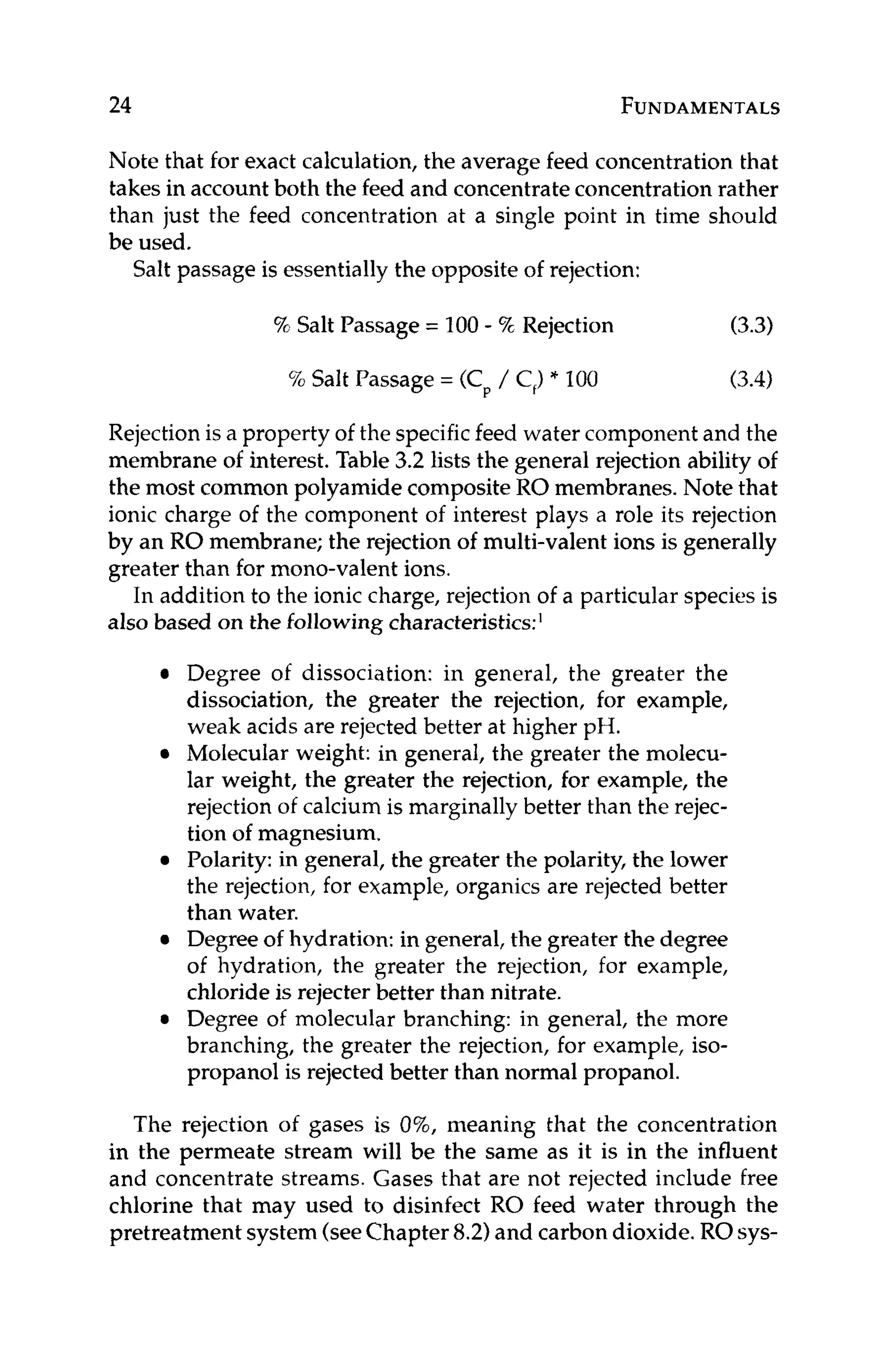
92 Salt Passage = 100- 5%Rejection (3.3)
% Salt Passage = (Cp/ C,)* I00 (3.4)
Rejection is a property of the specificfeed water component and the
membrane of interest. Table 3.2 lists the general rejection ability of
the most common polyamide composite RO membranes. Note that
ionic charge of the component of interest plays a role its rejection
by an RO membrane; the rejection of multi-valent ions is generally
greater than for mono-valent ions.
In addition to the ionic charge, rejection of a particular species is
also based on the followingcharacteristics:'
Degree of dissociation: in general, the greater the
dissociation, the greater the rejection, for example,
weak acids are rejected better at higher pH.
Molecular weight: in general, the greater the molecu-
lar weight, the greater the rejection, for example, the
rejection of calcium is marginally better than the rejec-
tion of magnesium.
Polarity:in general, the greater the polarity, the lower
the rejection, for example, organics are rejected better
than water.
Degree of hydration: in general, the greater the degree
of hydration, the greater the rejection, for example,
chloride is rejecter better than nitrate.
Degree of molecular branching: in general, the more
branching, the greater the rejection, for example, iso-
propanol is rejected better than normal propanol.
The rejection of gases is 0%, meaning that the concentration
in the permeate stream will be the same as it is in the influent
and concentrate streams. Gases that are not rejected include free
chlorine that may used to disinfect RO feed water through the
pretreatment system (seeChapter8.2)and carbon dioxide. ROsys-
BASICTERMS
AND DEFINITIONS
Species
25
Rejection (%)
Table 3
.
2 General rejection capabilities of
most polyamide composite membranes at
room temperature.
Sodium
Calcium
92 -98
93-99+
Potassium
Iron
I Magnesium I 93-98 I
92 -96
96 -98
Aluminum
Ammonium*
Manganese 96 -98
I
. 96-98
80 -90
Nickel
Copper 96 -99
96 -99
Bicarbonate
Sulfate
I Zinc I 96-98 I
96 -99
96 -99+
I Chloride I 92-98 I
Silicate
Phosphate
92 - 95
96 -98
IFluoride
Silicate
Phosphate
Bromide
Borate
Chromate
Cyanide
92 - 95
96 -98
90 -95
30 -50
85 -95
90 -99+
Bromide
Borate
Chromate
Cyanide
90 -95
30 -50
85 -95
90 -99+
*belowpH 7.8.Abovethis pH, ammoniaexists
as a gas that is not rejected by RO membranes.
26 FUNDAMENTALS
tems operating at near neutral pH will have some carbon dioxide
in the feed water. Since gases are not rejected by RO membranes,
the permeate and concentrate streams will also contain carbon
dioxide. If the permeate is sent to ion exchange demineralization
or electrodeionization after the RO, the carbon dioxide will use
sites on the anion resin so that other anions are not well removed.
In these cases, caustic soda (NaOH)is sometimes added to the RO
feed water. This raises the pH and converts the carbon dioxide,
which is not rejected by the RO membrane, to bicarbonate, which
is rejected by the RO membrane. Caustic addition is recommend-
ed after sodium softening, which removes hardness (calcium,
magnesium, barium, and strontium).Without softening, hardness
in the feed water would saturate at the higher pH following caus-
tic addition and scale the membranes. Caustic is also sometimes
added between passes in a two-pass RO system (see Chapter 5.3;
the first-pass RO removes the hardness while the effluent from the
second pass is relatively free of carbon dioxide.
3.4 Flux
Flux is defined as the volumetric flow rate of a fluid through a given
area. In the case of RO, the fluid is water and the area is that of the
membrane. In the language of RO, flux is expressed as gallons of
water per square foot of membrane area per day, (gfd).The flux of
water through an RO membrane is proportional to the net pressure
driving force applied to the water (see Chapter 4.1 for a discussion
on transport models):
J = K ( A P - A n ) (3.5)
where:
J = water flux
K = water transport coefficient = permeability / thickness of the
membrane active layer
AP = pressure difference across the membrane
A n = osmotic pressure difference across the membrane
Note that the water transport coefficient is unique to a given mem-
brane and is not a constant;it varies directlywith temperature.The co-
efficientfor some newer polyamide membranes also varies with pH.
The designer of the RO system chooses the flux rate; it is not a
property of the membrane. In general, the flux that an RO system is
designed for should be a function of the influent water quality.This is
BASICTERMS
AND DEFINITIONS 27
Feed Water Source
RO Permeate
Well Water
SurfaceSupply
SurfaceSupply
SecondaryMunicipal Effluent-
Microfiltration Pretreatment**
Secondary Municipal Effluent-
Conventional Pretreatment
Table3.3 Recommendedfluxas a function o
f influentwater source.
SDI
< 1
< 3
< 3
< 5
< 3
< 5
Recommended Flux, gfd * I
21 -25
14-16
12-14
I0-12
10 - 14
8 1 2 1
nodules
because higher flux results in more rapid foulingof the membranes.
So,the lower the influentwater quality, the lower the operating flux
of the RO systemshould be. Table3.3shows the recommended flux
as a functionof influent water source (whichis an indirectmeasure
of the water quality) and silt density index (SDI), which is a mea-
sure of the tendency of water to foul a membrane (SeeChapter 3.9).
When in doubt, a default flux of 14 gfd is usually recommended.
Specificflux issometimesdiscussedincomparingtheperformance
of one type of membrane with another.Specificflux is approximated
by taking theoverallsystemflux and dividingby the applied driving
pressure:
Specific Flux = Flux / Applied Pressure (3.6)
In comparing membranes, the higher the specific flux the lower the
driving pressure required to operate the RO system. Specific flux is
also defined as the permeability of the membrane.
3.5 Concentration Polarization
In simplest terms, the flow of water past an RO membrane is simi-
lar to that of the flow of water through a pipe, Figure 3.2.The flow
in the bulk solution is convective, while the flow in the boundary
layer is diffusiveand is perpendicular to the convectiveflow of the
bulk solution. There is no convective flow in the boundary layer.
* for 8-inch diameter, brackish water membrane modules
** Microfiltration pore size < 0.5 microns.
28 FUNDAMENTALS
Laminar Boundary Layer
Turbulent Region
- - - - - - _ _ _ _ _ _ _ _ _
Laminar Boundary Layer
Figure 3.2 Hydraulic boundary layer formed with fluid flow in a pipe.
cb C, CONVECTIVE FLOW
BACK DIFFUSION
Membrane
BOUNDARY
LAYER
Figure 3.3 Concentration polarization, where C, is the bulk concentration and C$
is the concentration at the membrane surface.
The slower the velocity of water through the pipe, the thicker the
boundary layer becomes.
Now, consider flow along the surface of a membrane. The same
boundary layer forms as with flow through a pipe. However, with
a membrane system, because there is a net flow out through the
membrane, there is convectiveflow to the membrane, but only dif-
fusional flow away from the membrane. Since diffusion is slower
than convection,solutes rejected by the membrane tend to build up
on the surface and in the boundary layer. Thus, the concentration
of solutes at the membrane surface is higher than in the bulk solu-
tion. This boundary layer is called "concentration polarization."*
The phenomenon is shown in Figure 3.3.
Concentrationpolarizationhasanegativeeffectontheperformance
of anROmembrane.It actstoreducethethroughputof themembrane
inthreeimportantways.First, it actsasa hydraulicresistancetowater
flowthrough the membrane.Second,the build up of solutesincreases
BASICTERMS
AND DEFINITIONS 29
the osmotic pressure within the boundary layer, effectively reducing
the driving force for water through the membrane. Third, the higher
concentration of solutes on the membrane surface than in the bulk
solution, leads to higher passage of solutes than would be predicted
by the feed water concentration.This is because an RO membrane
rejects solutes based on the concentration of the salt that it "sees."
If the concentration of a speciesis higher at the membrane surface,
as is the case with concentration polarization, the amount of solute
passing into the permeate willbe higher than the expected amount of
solutebased on thebulk concentrationof that solute.Theactualrejec-
tion and salt passage exhibited by the membrane does not change.
However,the apparent rejection/passage does. For example,assume
that thebulk concentrationof silicais 10ppm, whiletheconcentration
at the membrane surface is 11.5ppm. If the rejection is 98%,the silica
concentrationthat would be expected to be in the permeatebased on
the bulk concentrationis 0.20 ppm. However, the membrane "sees"
11.5ppm, so the actual salt passage is 2%of 11.5ppm, or 0.23ppm.
Actual rejection is still98%.Apparent rejectionis 97.7%.
(Seereference 1for a more completediscussionabout concentra-
tion polarization.)
3.6 Beta
Beta, sometimes called the "concentration polarization factor," is
the ratio of the concentration of a species at the membrane surface
to that in the bulk solution. Hence, Beta is a way of quantifying
concentrationpolarization.
The higher the Beta number, the more likely the membranesare to
foul or scale.Again, sinceBeta measuresthe ratio of concentration at
thesurfaceto that in thebulk solution,thehigherthebeta number,the
higher the relative concentration at the surface. If the concentration
at the surfacegets high enough, saturationmay be reached and scale
will begin to form. Maximum acceptable Beta typically ranges from
about 1.0to 1.2to minimize formationof scale. (seeChapter9.6).
Beta isnota propertyof themembrane;it isanartifactof thesystem
design that is selected. Specifically,Beta is a function of how quickly
the influent stream is dewatered through the RO system. If water
is removed too quickly from the influent stream, Beta will increase,
as a relatively high volume of dissolved solids is left behind on the
membrane because of the high volume of water that permeates
30 FUNDAMENTALS
through the membrane. Concentration polarization further exacer-
bates the problem because of the diffusional-only flow away from
the membrane surface. See Chapter 9.6 for more information about
Beta and its relationship with water flux and salt passage.
3
.
7 Fouling
Membrane fouling is a result of deposition of suspended solids,
organics, or microbes on the surface of the membrane, typically
on the feed/concentrate side. Fouling species include:
colloids, such as alumina- and iron-silicates. Silica can
precipitate at concentration below saturation in the
presence of aluminum or iron.'
organics, which provide nutrients for microbes,
microbes,
color, which irreversibly adsorbs onto the membrane
polymer,
metals, such as iron and manganese that precipitate
when oxidized; aluminum typically from alum, which
is commonly overfed, particularly into municipal/
surface sources; and hydrogen sulfide, which releases
elemental sulfur upon oxidation, a sticky material very
difficult if not impossible to remove from a membrane.
Table 3.4 lists generally-accepted water quality guidelines to mini-
mize fouling of RO membranes.?
Table 3.4 Generally-acceptedwater quality guidelinesto minimize RO
membrane fouling.
* Other methods see Chapter 7.3
** In RO reject stream
Species Measure Value
Suspended Solids
Colloids
Microbes
Organics
Color
Metals:iron, manganese,aluminum
Hydrogen Sulfide
Turbidity < 1NTU
SDI < 5
Dip Slides* < 1,000 CFU/ml**
TOC < 3 PPm
Concentration
Color units < 3APHA
Concentration < 0.05 ppm
Concentration < 0.1 ppm
BASICTERMS
AND DEFINITIONS 31
Fouling is exacerbated by high membrane flux and low cross-
flow velocity, both conditions that increase concentrationpolariza-
tion. Higher flux translates into water being removed through the
membrane at a faster rate, leavingbehind solids that now accumu-
late more rapidly in the concentrationpolarizationboundary layer.
If the residence time is sufficient in the boundary layer, these sol-
ids will deposit on the membrane surface, sometimes permanent-
ly. Cross-flow velocity affects the thickness of the boundary layer.
Lower cross-flow velocity corresponds to a thicker boundary layer.
A thicker boundary layer allows for greater accumulation of solids
in the layer, and the solids spend more time in the layer due to the
increased thickness of the boundary layer, setting up the potential
for accelerated fouling of the membrane.
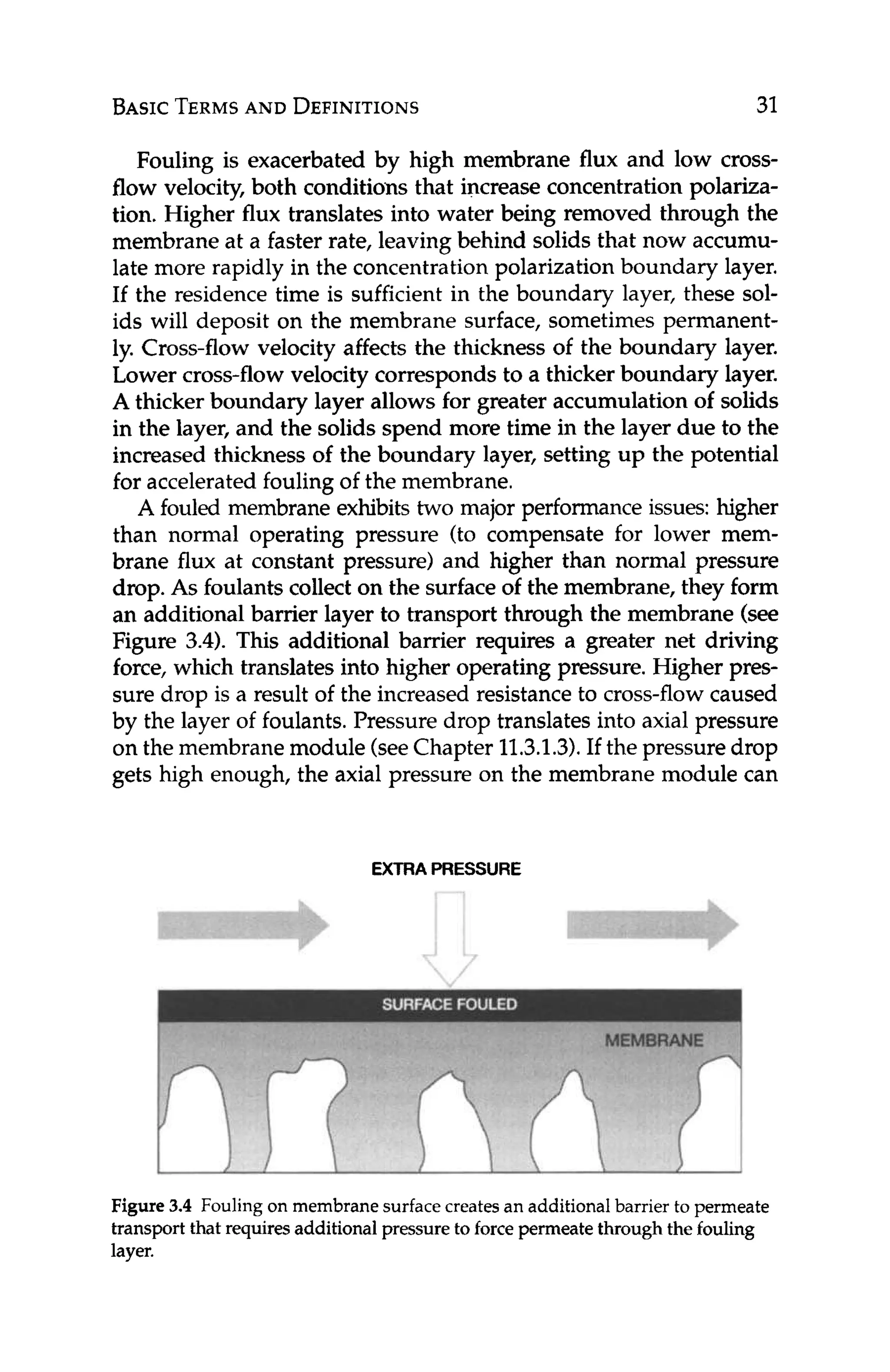
A fouled membrane exhibits two major performance issues: higher
than normal operating pressure (to compensate for lower mem-
brane flux at constant pressure) and higher than normal pressure
drop. As foulantscollect on the surface of the membrane, they form
an additional barrier layer to transport through the membrane (see
Figure 3.4). This additional barrier requires a greater net driving
force, which translates into higher operating pressure. Higher pres-
sure drop is a result of the increased resistance to cross-flowcaused
by the layer of foulants.Pressure drop translates into axial pressure
on the membranemodule (seeChapter 11.3.1.3).If the pressuredrop
gets high enough, the axial pressure on the membrane module can
EXTRA PRESSURE
Figure 3.4 Fouling on membranesurfacecreatesan additionalbarrier to permeate
transport that requiresadditionalpressure to force permeatethrough the fouling
layer.
32 FUNDAMENTALS
Figure 3
.
5 Cracked outer modulecasing (a)and telescopedmembranesand
spacers(b)due to excessivepressure drop.
become great enoughto cause the membraneand moduleto fail (see
Figures 11.5 and 11.6).Failure can manifest as cracks in the outer
module casing and telescoped membranes and spacers (Figure3.5A
and B respectively).
Fouling of a membrane is primarily a physical filtration event,
although in some cases, charge of a species can determine its poten-
tial to foul an RO membrane (asis the case with cationic coagulants
on the negatively-charged polyamide RO membrane-see Chapter
8.1.1.1).The lead membrane modules in an RO system are generally
most affectedby fouling("lead membranemoduleistheend module
in a pressure vessel that feed water contacts first).One exception is
BASICTERMS
AND DEFINITIONS 33
Species
Silica (Soluble)
Barium,Strontium
Calcium
microbial fouling. Microbes can establish colonies anywhere in the
membrane system where conditions favor growth. Satellitecolonies
canbreakoff and furtherdistributethemselvesthroughoutthesystem.
Note that even short term exposureto potential foulants can result in
long-termand even permanent foulingissuesfor a membrane?
Measure Value
PPm 200,
PPm < 0.05
LSI < o**
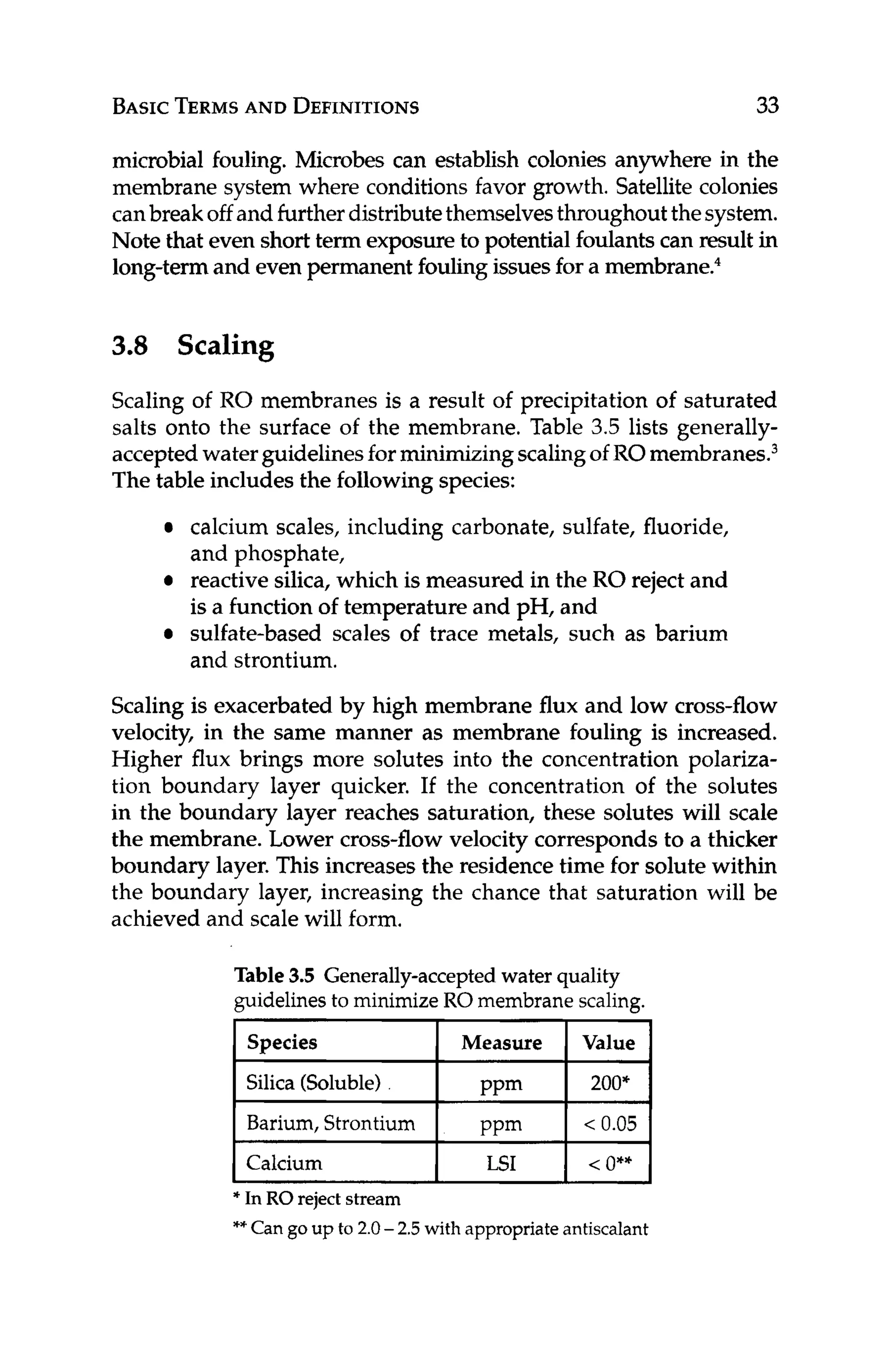
3.8 Scaling
Scaling of RO membranes is a result of precipitation of saturated
salts onto the surface of the membrane. Table 3.5 lists generally-
acceptedwaterguidelinesforminimizingscalingof RO membrane^.^
The table includes the followingspecies:
calcium scales, including carbonate, sulfate, fluoride,
and phosphate,
reactive silica, which is measured in the RO reject and
is a function of temperature and pH, and
sulfate-based scales of trace metals, such as barium
and strontium.
Scaling is exacerbated by high membrane flux and low cross-flow
velocity, in the same manner as membrane fouling is increased.
Higher flux brings more solutes into the concentration polariza-
tion boundary layer quicker. If the concentration of the solutes
in the boundary layer reaches saturation, these solutes will scale
the membrane. Lower cross-flow velocity corresponds to a thicker
boundary layer. This increases the residencetime for solute within
the boundary layer, increasing the chance that saturation will be
achieved and scale will form.
Table 3.5 Generally-accepted water quality
guidelines to minimize RO membrane scaling.
______
* In RO reject stream
**Can goup to 2.0 -2.5with appropriate antiscalant
34 FUNDAMENTALS
Ascaledmembraneexhibitsthreemajorperformanceissues:high-
er than normal operating pressure (to compensate for lower flux at
constant pressure), higher pressure drop, and lower than expected
salt rejection. As with fouled membranes, scale forms an additional
barrier layer through which water has to travel. Additional driving
force is required to push water through this barrier layer if the same
productivity is to be maintained. Higher pressure drop is due to re-
sistance of the scale to cross flow. Lower salt rejection is a function
of concentrationpolarization,in that the concentrationof the scaled
mineral is higher at the membrane surfacethan in the bulk solution.
Thus, the membrane "sees" a higher concentration, and, although
the intrinsicrejection by the membrane remains constant,the actual
amount of a solute that passes through the membrane is greater (see
Equation 4.2, which predicts that the flux of a solute through an RO
membrane is a functionof the concentrationdifferencebetween the
solute in the boundary layer and in the permeate).Hence, the appar-
ent rejection is lower and product purity is lower.
Since scaling is a concentration phenomenon, it goes to reason
that scale would be most likely found in the last stages of an RO
system where the concentrationof salts is the highest. To determine
the potential for a salt to form scale, the ion product of the salt in
question (taken in the reject stream) is compared with the solubility
product for the salt under the conditions in the reject.
Equation 3.7defines the ion product at any degree of saturation:
IP = [cati~n]~[anion]~ (3.7)
Where:
IP = ion product
[cation]= cation concentration
[anion] = anion concentration
Superscripts:
a = the quantity of cation present within the salt
b = the quantity of anion present within the salt.
Equation 3.8defines the solubility product at saturation:
KSp= [cationIa[anionlb
where:
KSP
= solubility product
[cation]= cation concentration
[anion]= anion concentration
(3.8)
BASICTERMS
AND DEFINITIONS 35
Superscripts:
a = the quantity of cation present within the salt
b = the quantity of anion present within the salt.
In general, scale will form when the ion product is greater than the
solubilityproduct. For sulfate-basedscales, scaling can occur when
the ion product is greater than 80%of the solubilityproduct.'
Scalingindexesare used to aid in the determination of whether a
saltwillscaleanROmembrane.TheLangelierSaturationIndex(LSI)
and the Stiff-DavisSaturation Index are commonlyused to predict
calcium carbonate scale(seeChapter 3.10).Design programs devel-
oped by membrane manufacturers typically report scaling indexes
for other forms of scale as a percent of saturation (seeChapter 10).
A scaling index is 100%when the ion product equals the solubility
constant for most salts. For sulfate-based scales, the saturation in-
dex is 100%when the ion product is equal to 80%of the solubility
constant. Feed water softeningor the use of antiscalantsis required
when the saturation index is 100%or greater.
3.9 Silt Density Index
Silt density index (SDI)is a test that measures the potential of an
influent water to foul an RO membrane with suspended solids and
colloids.Thetest involvestiming flowof the influentwater through
a 0.45-micronfilter pad.j
Figure 3.6 shows the basic materials required to run an SDI test.
The apparatus shown in Figure 3.6 should be connected as close
to the inlet of the RO as possible (preferablybetween the cartridge
filters and the RO, if possible).
Procedures to run an SDI test call for a 0.45-micron filter pad to
be placed with the shiny side up in the filter holder. A small squirt
of water from a water bottle is used to wet and completely seat the
filter pad. (If the pad shows signs of air bubbles or erratic coverage
of foulant of the pad upon removal from the filter holder, the filter
was not seated properly and the SDI test is invalid). The isolation
valve isopened and the pressureregulator is set to 30 psi. Thetimeit
takes to collect 500 ml of water through the 0.45-micron filter pad is
then recorded. After this volume of water has been collected, water
is allowed to run through the filter continuously for a total time of
15 minutes. If necessary, the pressure should be adjusted to remain
at 30 psi. At the end of 15minutes, the time it takes to collectanother
36 FUNDAMENTALS
Stopwatch 6
H
Graduated
Cylinder
Pressure
Regulator
Pressure
, I Gauge
PI' Filter Holder
V
Figure 3.6 Silt density index test apparatus and ancillary equipment
500 ml of water is recorded. Both recorded times are then entered
into Equation 3.9to calculate the SDI (notethat SDI is unit-less):
(3.9)
where:
n = total run time, 15minutes
t, = time to collect 500 ml of influent water at time = 0, in sec-
tn=time to collect 500ml of influent water at time =n (15min),
The test must be run at 30 psi. As mentioned above, if the pressure
drops during the test, it should be adjusted back to 30 psi.
(Notethat the SDItest can alsobe run for5minutes and 10minutes.
However,most literature referencesto SDIdiscuss the 15minute-run,
unless otherwise stated.)
The maximum SDI,, that can possibly be calculated from equa-
tion 3.9 occurs when the time to collect the final 500-ml of water, tn,
is infinite. The maximum SDI,, then becomes (1/15) X 100or 6.7.
An SDI test must be conducted on line using a representative
sample of feed water; shipping samples off to a laboratory for testing
onds
in seconds
BASICTERMS
AND DEFINITIONS 37
is not recommended, as solids my settle or adhere to the shipping
container,invalidatingthe test. SiltDensity Index is preferablerun as
close as possibleto the influent of the RO membranes, which means
afterthe cartridgefilter.If testingafter the cartridgefilter isnot possi-
ble, thenjust before the cartridgefilter isthe nextbest location.Water
shouldbe run through the sampleport or tap for at leastan hour and
preferablyovernightbefore running an SDI test. This is necessary to
realizea representativesampleof feed water that isfreeof solidsthat
may have accumulated over time in the sample port or tap.
Although there are no truly automated SDI devices, there are
semi-automatic devices in addition to the manual device shown
in Figure 3.6. These semi-automatic units run the SDI test, includ-
ing the timing and collection of water through the SDI filter.Human
intervention is required to replace the SDI filter pad and to record
the test results. Note that the automatic units should be flushed with
high-quality water after each use, as there are "dead" spots in the
lines where contaminantsand bacteria can collect and foul the tubing.
Withoutflushing, thesecontaminantswill affect subsequentSDItests.
The lower the SDI, the lower the potential for fouling a mem-
brane with suspended solids, Membrane manufacturers require
that the SDI,, be less than 5 to meet their warranty conditions.
However, even though the SDI may be less than 5, the water may
still be capable of fouling the membranes. In practice, an SDI,, of
less than 3 is usually necessary to reduce the potential for fouling
to an acceptable level.
Note that SDI and turbidity are only loosely related. In general,
the higher the turbidity, the higher the SDI will be. However, low
turbidity (<1
NTU) does not, in turn, imply low (<5) SDI.
Figure 3.7 shows SDI filter pads taken before and after a
multimedia filter treating RO influentwater. The pads in this figure
illustrate 2 important issues. First, the filter pads provide a visual
confirmation about the efficacy of the multimedia filter to reduce
the concentrationof suspended solidsin the RO influent water. Sec-
ond, the filters pads can be analyzed to determine the nature of
the deposit on them. Visually, the followingcolors are indicative of
specific potential foulants:
Yellow:possibly iron or organics
Red to reddish brown: iron
Black: manganese (if the color dissolveswhen the pad
is treated with acid)
38 FUNDAMENTALS
I
Figure 3.7 Silt density index pads taken before and after a filter treating RO
influent water.
The SDI filter pads can also be sent into a lab for analysis of the
deposit. The results of the deposit analysis will aid in the devel-
opment of an appropriate pretreatment scheme, as specific species
contributing to the suspended solids loading can be targeted for
treatment to reduce their concentration in the feed water to the RO.
3.10 Langelier Saturation Index
The Langelier Saturation Index (LSI) is a method for quantifying
the scalingor corrosion tendency of water. It was originally applied
to cooling water. The LSI is based on the pH and temperature of
the water in question as well as the concentrations of TDS, calcium
hardness, and alkalinity.
Langelier Saturation Index is calculated using equation 3.10:
LSI = pH - pHa
pH, = (9.30+ A + B) - (C + D)
(3.10)
where:
(3.11)
and:
A = (Log,,[TDSl - 1)/ 10, where [TDSIis in ppm
C = Log,,[Ca2+]
- 0.4, where [Ca”] is in ppm CaCO,
D = Log,,[alkalinityl, where [alkalinity]is in pprn CaCO,
B = -13.12 x Log,,(OC+ 273) + 34.55
BASICTERMS
AND DEFINITIONS 39
LSI
3.0
2.0
1.o
0.5
0.2
0.0
-0.2
Table 3.6 Langelier saturation index.
Condition
Extremely severe scaling
Very severe scaling
Severescaling
Moderate scaling
Slight scaling
Stable water (noscale)
No scale, very slight tendency to dissolve scale
If LSI is greater than 0, the water has the tendency to form
calcium carbonate scale. If the LSI is equal to 0, the water is in
chemical balance. If the LSI is less than 0, the water is corrosive
(refer to Table 3.6).
Langelier Saturation Index is valid up to about 4,000 ppm TDS.
At higher TDS concentrations, the Stiff-Davis Saturation Index
(SDSI)is used, Equation 3.12:
SDSI = pH -pCa - pArK
- K (3.12)
where:
pCa =-Log10[Ca2+],
where [Ca2+l
is in ppm
pAlk
= -LoglO[total alkalinity],where alkalinity is in ppm
K = a constant based on the total ionic strength and
temperature
For RO applications,a positive LSI or SDSIindicates that the influ-
ent water has a tendency to form calcium carbonate scale. In these
cases, pretreatment in the form of softening(eitherwith lime or ion
exchange),or via the use of antiscalantsand/or acid is required.
References
1. Dow Chemical Company, FilmTec Reuerse Osmosis Membranes Technical
Manual, Form no. 609-00071-0705, Dow Liquid Separations,2007.
40 FUNDAMENTALS
2. Dickson, James M., ”Fundamental Aspects of Reverse Osmosis,” in
Reilerse Osmosis Technology, Bipin S. Parekh, ed., Marcel Dekker, Inc.,
New York,New York,1988.
3. Kucera,J., “Troubleshooting:Methods to Improve System Performance -
Part 1,”UltraPure Water,24 (3),April, 2007.
4. Wilf, Mark, et. al., The Guidebook to Memhraire Desalination Technology,
Balaban Desalination Publications, Italy, 2007.
5. ”Standard Test Method for Slit Density Index (SDI) of Water,” ASME
Designation: D 4189-07.
Membranes
Membranes
Pertinent to the understanding of the operation of an RO system
is the fundamental knowledge of various theoretical models de-
scribing movement of solutes and water through an RO mem-
brane. By understanding how solutes and water are transported
through membranes, appropriate modifications can be made
to the membrane polymers to improve performance (flux and
rejection). See the book by Richard Baker, Membrane Technology
and Applications, 2ndedition (JohnWiley & Sons,2004)for more de-
tail about the history and development of membrane and transport
models.
This chapter covers the development of transport models. Also
discussed are basic membrane polymers and modules, and how
each is made.
4.1 Transport Models
The purpose of a transport model is to mathematically relate per-
formance (typicallyflux (see Chapter 3.4)of both solvent and sol-
ute) to operating conditions (typicallypressure and concentration
driving forces).' The objective is to predict membrane behavior un-
der certain conditions.
There are several models that describe the transport of mass
through RO membranes. These are based on different assumptions
and have varying degrees of complexity. The solution-diffusion
model best describesthe performance of "perfect," defect-free mem-
branes and is considered the leading theory on membrane trans-
port? Three other theories are presented here for completeness.
Transport models fallinto threebasic classifications:modelsbased
on solution/diffusion of solvents (nonporous transport models),
models based on irreversible thermodynamics, and models based
on porous membranes. Highlights of some of these models are
discussed below.
4
1
42 FUNDAMENTALS
4.1.1 Solution-DiffusionModel (non-porousmodel)
The solution-diffusiontransport model was originally described by
Lonsdale et. al.3This model assumes that the membrane is nonpo-
rous (without imperfections).The theory is that transport through
the membrane occurs as the molecule of interest dissolves in the
membrane and then diffuses through the membrane. This holds
true for both the solvent and solute in solution.
In the solution-diffusionmodel, the transport of solventand solute
are independent of each other, as seen in Equations4.1 and 4.2. The
flux of solvent through the membrane is linearlyproportional to the
effective pressure differenceacross the membrane (Equation4.1):
J ,= A(AP- An) 4.1
where:
Jw = flux of solvent
A = water permeability coefficient(a function of the diffusivity
AP = applied pressure driving force (a function of the feed, con-
AII = osmotic pressure of the solution (a function of the feed,
of water through the membrane)
centrate, and permeate pressures)
concentrate, and permeate concentrations)
The flux of solute through the membrane is proportional to the
effective solute concentration difference across the membrane
(Equation4.1):
4.2
where:
Js = flux of solute
K = salt permeability coefficient (a function of the salt diffusivity
through the membrane)
C, = molar concentration of solute
Subscripts:
2 = at the boundary layer
3 = in the permeate
Equations4.1and 4.2 are most commonlyused to describetransport
of water and solutes through membranes due to their simplicity
MEMBRANES 43
s
.d 60
H
g
1 -
20
0
and their closeapproximation to empiricaldata. Consider Figure 4.1,
which shows the flux of both water and salt and the rejection of
salt exhibited by a seawater membrane as a function of applied
pressure2. Specifically,a seawater FilmTec FT-30membrane was op-
erated on a 35,000 ppm sodium chloride solution with an osmotic
pressure of 350psi (2.5MPa).As the figureshows, there is virtually
no water flux until the applied pressure exceeds the osmotic pres-
sureof the solution.Upon commencementof water flux,it increased
linearly with increasing pressure, as is predicted by Equation 4.1.
The salt flux, on the other hand, remained fairly constant over the
range of applied pressure, as predicted by equation 4.2. Hence, as
applied pressure is increased, progressively more water passes
through the membrane relative to salt. This leads to the conclusion
-
-
I I I I I
30
25
g 20
5
15
ii
0
L
g 10
5
0
d
FromWijmans and Baker (1995)
Water
I
/ A A A A
/-,,-
Osmotic Salt Flux -
Pressure AX b -
I I I I
0 200 400 600 800 1000 1200
E
4 1
3
5 9
i
i
2
1
0
Figure 4.1 Flux and rejection data for a seawaterFilmTec FT-30 membranes
operating on 35,000 ppm (350psi osmoticpressure)sodium chloridesolution?
44
-100
.-97.6
.-95
.-90
I
.-85
FUNDAMENTALS
40
30
n
U
c.3
a
x 20
-
Y
10
0 80
0 100 200 300 403-
Applied Pressure, psig
Figure 4.2 Polyamide membrane flux and rejectionas a function of applied
pressure. Test conditions: 5,000 ppm NaCl solution at 25'C.'
that the concentration of salt in the permeate should decrease with
increasing applied pressure. Referring back to Equation 3.2, as the
concentration in the permeate goes down, the percent salt rejection
should approach 100%as applied pressure increases. Indeed, that is
what is shown in Figure4.1. These results are confirmed in Figure4.2
for a low-pressure membrane operated on a 5,000 ppm sodium
chloride solution at 2 5 C
4.1.2 Solution-Diffusion Imperfection Model
(porousmodel)
The solution-diffusion theory models the performance of the per-
fect membrane. In reality, industrial membranes are plagued with
imperfections that some argue must be considered when develop-
ing a complete theory that models performance. The basis of the
Diffusion Imperfection Model is the assumption that slight imper-
fections in the membrane occur during manufacturing that allow
for leakage of solution through the membrane.j This model helps
explain why lower-than-projected separation of solutes and water
were observed for industrial membranes than was predicted by the
non-porous, solution - diffusion model.
Water flux through the membrane is represented by Equation
4.3. This flux is based on the solutions - diffusion model with the
added term to reflect transport due to the imperfections.
MEMBRANES 45
Nw= Jw + K, APCw= A(AP-An)+ K,APCw 4.3
where:
Nw= total water flux
K, = coupling coefficient
Cw=concentrationof water on the feed sideof the membrane
The solute flux is given in Equation 4.4:
4.4
where:
Ns= total solute flux
C
,= solute concentrationon the feed side of the membrane.
Again, the solute flux is equivalent to that for the solution - diffu-
sion model (Equations4.1 and 4.2) with the added term to repre-
sent the flow through the imperfections.
Experiments have shown that the solution - diffusion imperfec-
tion model fits data better than the solution -diffusion model alone
and better than allotherporousflowmodels.6However, thesolution-
diffusion model is most often cited due to its simplicityand the fact
that it accurately models the performance of the perfect RO mem-
brane.
4.1.3 Finely-Porous Model (porousmodel)
The finely-porous model is based on a balance of applied and
frictionalforcesin a 1-dimentional The model considers fric-
tion between the soluteand solvent,and between the soluteand the
membrane material. The model also includes the membrane thick-
ness and the fractionalpore area of the membrane surface.
Due to the complexity of the model, it is not represented math-
ematically here, but the reader is advised to consider references'
and6for further details.
4.1.4 Preferential Sorption - Capillary Flow Model
(porousmodel)
This model is based on a generalized capillary flow model that in-
cludes viscous flow for water and solute transport, and for pore
46 FUNDAMENTALS
diffu~ion.~
It further relies on film theory for transport through
the boundary layers. The model states that by applying pressure,
both the solvent and solute permeate through the micropores of the
membrane, with water preferentially adsorbed onto the pore walls.
Salt is rejectedat the membrane surfacefor physiochemicalreasons.
Transport through the membrane is only through pores.
Solvent flux is given by Equation 4.1, where transport is propor-
tional to the pressuredrivingforce.Thetotal solutefluxdepends on
diffusion and is given by Equation 4.5:
4.5
where:
DAM
= diffusivity of solute in membrane
C,, = molar concentration of solute in boundary layer
C,, = molar concentration of solute in permeate
T = effectivethickness of the membrane
4.1.5 Phenomenological Transport Relationship
Phenomenological transport relationships can be developed even
in the absence of any knowledge of the mechanisms of transport
through the membrane or any information about the membrane
structure.’OThe basis of irreversible thermodynamics assumes that
if the system is divided into small enough subsystems in which lo-
cal equilibrium exists, thermodynamic equations can be written for
the subsystems.
As with the finely-porousmodel, (Chapter4.1.3),the mathemati-
cal representation of solvent and solute fluxes for the irreversible
thermodynamic model is quite complex and beyond the scope of
this work. However, it is recommended that readers consider refer-
ences’andsfor details on this transport model.
(Irreversiblethermodynamics)
4.2 Membrane Materials
The performance of reverse osmosis is directly dependent on
the properties of the membrane material.” More specifically, the
chemical nature of the membrane polymer and the structure of the
membrane are what determines the rejection and flux properties
MEMBRANES 47
of the RO system. Ideally, RO membranes should offer high flux
and high rejection, in addition to high strength and durability. In
practice, however, high rejection and high flux have been two mu-
tually-exclusive goals that have eluded researches for decades of
membrane development. Although the last few years has seen an
increasein fluxrateswith no decreasein rejection(andin somecases,
a slight increase in rejection), most membranes today represent a
compromisebetween high rejection and high flux.(l, 11)
Two most common families of RO membranes, based on the
type of polymer backbone, are cellulose acetate and polyamide.12
Membranes made from these polymers differ in many respects, in-
cluding performance, physical properties, structure and the man-
ner in which they are created. These aspects are discussed below.
4.2.1 Cellulose Acetate Membranes-Asymmetric
Celluloseacetate(CA)membranes were the firstcommercially-via-
ble RO membranesde~eloped.'~J*
Thesemembraneswere commer-
cially viable because of their relatively high flux due to the extreme
thinness of the membrane.'j High flux was important to reduce the
size and cost of an RO system.
Early cellulose acetate membranes were created by Loeb and
Sourirajan using the non-solvent phase separation or "phase inver-
sion" method.16In short, this method involves dissolving a non-
water solublepolymer (celluloseacetate)in an organicsolvent (such
as acetone) along with a casting-solution modifier (initially magne-
sium perchlorate but later a swelling agent, formamide) and then
casting a film on a sturdy surface such as a sheet of glass using a
thin blade.(2, 17)The film is left to stand for 10-100 seconds to par-
tially evaporate the solvent. As the solvent evaporates, there is an
increase in concentration of polymer at the solution/air interface,
since the solvent evaporates more rapidly from the surface. This
results in two phases within the film: a polymer-rich phase and a
polymer-poor phase. Before the solvent completely evaporates, the
membrane is immersed in water to completely form a thin "skin"
as the remaining polymer diffuses out. The membrane is then "an-
nealed" (heated to 70-90"C) in a hot water bath, which forms the
smallvoids in the polymer-poor phase behind the skin.This porous
region becomes thesupportstructure.Thethicknessof theskinistypi-
cally about 0.2 microns, while the thickness of the entire membrane is
membranes
48 FUNDAMENTALS
CAmembrane layer Fabric backing
Figure 4.3 Cross section of a cellulose acetate RO membrane.
Figure 4.4 Chemical structure of cellulose acetate RO membranes.
about 100 microns.19It is the extreme thinness of the skin and the
relatively high void volume of the supporting structure that gave
theseearlycelluloseacetatemembranesthehighrejectionand highflux
needed forcommercialviability,Subsequentdevelopmentallowed for
preparing the membrane from a blend of cellulose diacetate and
triacetateand casting the membrane on a fabric backing.
Figure 4.3 showsa crosssectionof a CAmembrane.The structure
is asymmetricor "anisotropic," with a solute-rejectinglayer on top of
a microporoussupport, all made of the one polymeric material.
Figure4.4 showsthe chemicalstructureof CAmembranes. Because
the functional groups at the ends of the polymer chains are not highly
charged, the membrane itself is considered uncharged.I2This is an
important characteristic, especially if charged (cationic) polymers
are used ahead of the membrane to pretreat the influent water. The
MEMBRANES 49
neutrality of charge will serve to minimize the potential for fouling
with any polymer that carriesover from the pretreatment system.
Table4
.
1lists the predominant characteristicsof a CAmembrane.
Some of these characteristicsare advantageous while others present
quite severelimitationsin using this type of membrane.
The relatively smooth surface morphology of the
membrane offerssomeprotection from fouling, in that
there are no obvious dead spaces on the membrane
where foulants can become trapped. See Figure 4.5.
Neutral surface charge minimizes the potential for
fouling with cationic polymer that might carry over
from the pretreatment equipment.
Beingableto tolerate up to 1ppm freechlorineon con-
tinuous basis offers some protection from biological
growth on the membrane. This is particularly impor-
tant because the CA polymer itself supplies nutrients
for microbial populations, which then metabolize the
polymer and degrade the membrane.
Temperature is limited to 35°C. Higher temperatures
will further anneal the membrane, resulting is a much
denser material that is difficult to forcewater through.
Hydrolysisof the membrane may alsooccur,alsolead-
ing to degradation of the membrane.I9
OperatingpH of a CAmembraneis limited to 4-6. This
implies that acid is required to drop the influent pH to
about 5 to 5.5 during nominal operations such that the
reject pH remains less than 6. pH extremes will cause
hydrolysis of the membranepolymer. Figure 4.6 shows
lifetime of a CAmembraneas a function of pH.
Operating pressure for a CA membrane ranges from
about 200-400 psig. Thecomparatively high pressure
for brackishwater applicationsis necessarybecauseof
the relatively dense nature of the CA membrane. Note
that pressures above 400 psig (2.8MPa)will result in
compaction of the membrane. Compaction occurs
when the pressure essentially ”crushes” the mem-
brane, making it even denser.
Salt rejection varies depending on whether “standard”
or “high rejection’’CA membranes are used. Rejection
of silica, however, is only about 80%.
50 FUNDAMENTALS
Property
Membrane Type
Table 4.1 Characteristics of cellulose acetate RO membranes.
Value for CA Membranes
Homogenous asymmetric
Salt Rejection (%I
Silica Reiection (%)
-95
-85
pH Range I 4-6
Feed Pressure (brackish membrane) 220-440 psi
Temperature Tolerence Up to 30°C
Surface Charge Neutral
Chlorine Tolerance
-
Up to 1 ppm continuously
I Biologicalgrowth I Metabolized membrane
I Fouling Tolerance I Good
Surface Roughness 1- Smooth
SEM picture of surfaceof cellulox, acetate membrane
Figure 4.5 Smooth surface morphology of celluloseacetate membranes.
Hydranautics makes a commonly used "CAB" cellu-
lose acetate membrane.
Cellulose acetate membranes were originally cast in tubular
form (refer to Figure 1.3).These tubular membranes were used in
MEMBRANES 51
1000-
100-
10
1-
0.1-
0.01
0.001-
I
I
0 14

0.0001.I 
Figure 4.6 Lifetimeof a CA membrane as a function of pH.
the first commercialRO system at Coalinga, California in 1965.The
membranes were developed and prepared at UCLA (seeChapter 1).
The break for commercial viability came when as an appropriate
swelling agent, formamide, was found for the cellulose acetate
membrane during pre~arati0n.I~
4.2.2 Polyamide and Composite Membranes
Polyamide membranes were developed in an effort to improve
upon the performance of CA membranes. In particular, the higher
operating pressure and relatively low salt rejection of CA mem-
branes were holding back RO technology from becoming more
commerciallyviable.
4.2.2.1 Linear Aromatic Polyamide Membranes
Aromatic polyamide membranes were developed by a few compa-
nies, including Toray, Monsanto and DuPont. DuPont developed
a linear aromatic polyamide (nylon) membrane with pendant sul-
fonic acid groups, which they commercialized as the PermasepTM
B-9 and B-10 membranes and is shown in Figure 4.7(Permasep is
a registered trademark of E. I. Du Pont De Nemours & Company,
Inc. Wilmington, DE). Just as CA membranes were created out of
52 FUNDAMENTALS
Figure 4.7 Aromatic polyamide membrane developed by DuPont.
a single polymer, Permasep membranes were also created out of
single polymer rather than a composite (see below). These mem-
branes exhibited higher rejection capabilities at higher flux and
somewhat lower operating pressures than CA membranes. They
were originally fabricated into hollow fine fiber membranes and
used primarily for seawater and brackish water desalination and
some specialty applications such a recovery of electric deposition
paints (see Chapter 4.3.4 for more information about hollow fine
fiber membranes). Dupont also developed a flat-sheet form of the
basic, linear aramid polymer used to make the B-9 hollow fine fiber
membranes. This asymmetric membrane was called the B-15, and
competed directly with CA membranes. DuPont withdrew their
polyamide membranes from the market in 1991.DuPont sold their
B15, A15, and developing X20 membranes to TriSep Corporation,
who kept them for a few years before they licensed the FT30 chem-
istry from FilmTec (seeChapter 4.2.2.2).
4.2.2.2 Composite Polyamide Membranes
Composite membranes, sometimes called ”thin film composite”
or TFC@
membranes are essentially a composite of two polymers
cast upon a fabric support (TFC is a registered trademark of Koch
Membrane Systems, Wilmington, MA). Today, cross-lined, fully
aromatic polyamide membranes are the most popular RO mem-
branes in use.” These membranes are generally formed using in-
terfacial polymerization as shown in Figure 4.8 as developed by
Cadotte (2, 19).A finely microporous substrate (typically polysul-
fone) is prepared using the Loeb-Sourirajan method described in
Section 4.2.1.1, but without the annealing step such that the sur-
face of the membrane does not “skin” over. The substrate is then
exposed to monomers that are known to have high permeability
to water but low permeability to salts, such as a polyamine. The
amine in then immersed in a water-immiscible solvent contain-
ing a reactant, such as diacid chloride in hexane. The reactant and
MEMBRANES 53
3
Surface of
Polysulfone
Support Film
PEI Coating
Crosslinked PEI-TDI
PEI Reacted
Zone
Figure 4.8 Interfacial polymerization, using polyethyleneimine (PEI)crosslinked
with toluene diisocyanate (TDI) to from the NS-100 membrane as patented by
Cadotte (U.S. Patent 4039440, August 2,1977).
amine react at the interface of the water and organic solvent to
forma highly-crosslinkedthin film.This thin filmformed on top of
the substrate layer can be as thin as 400 to 1,000Angstroms (0.04 to
0.1 microns).The substrate layer is typically 40 - 80 microns thick,
while the overall thickness of the membrane, including the fabric
backing, is about 1,500 to 2,000 microns thick.'*By comparison, a
sheet of paper varies from about 1,000 to 2,750 microns, depend-
ing on the weight. Figure4.9 shows a cross sectionof a polyamide,
composite membrane.
Figure 4.10 shows the chemical structure of a polyamide mem-
brane, namely the Dow Water and Process Solutions-FilmTecTM
FT30 (FilmTec is a trademark of Dow Chemical Company, Mid-
land, MI).This membrane is created using poly(pheny1enediamine
trimesamide) and trimesoyl chloride (U.S. patent 4277344, July 7,
1981).Thischemistryis used in someformby virtually all major RO
membrane producers.2Unlike the CA membrane, the polyamide
membrane has negatively-charged functional groups. This serves
to attract cationic polymers, and other cationic species, which can
permanently foul the membrane. Unlike the linear polyamide pro-
duced by DuPont, the FT-30 membrane is highly cross-linked, as
seen in Figure4.10.
54 FUNDAMENTALS
PA membrane surface Polymeric support Fabric backing
Figure 4.9 Cross-section of a polyamide composite RO membrane.
-CO -NH q
NH
NHCO
VoNH
co
NH
CONH
co CO - NH
...-
Figure 4.10 Chemical structure of the Dow Water Solutions FT30 polyamide
composite RO membrane.
MEMBRANES 55
Table 4.2 lists the predominant characteristics of polyamide,
composite membranes. .
The surface morphology of a polyamide membrane is
rough, allowing for many areas where foulants can be
captured and held by the membrane. SeeFigure4.11.
As discussed above, the charge on the polyamide
membrane is negative, thereby attracting cationic
polymer should it break through the pretreatment
equipment.
Unlike CA membranes, polyamide membranes can-
not tolerate free chlorine or any other oxidizers.Some
manufacturers quote 200 - 1,000 ppm-hrs of exposure
until the membrane rejection is lost.2'This means af-
ter 200 - 1,000 hours of exposure to 1ppm free chlo-
rine, the membrane rejection will be unacceptablylow.
Chlorine attack is faster at alkalinepH than at neutral
or acidic pH.
Polyamide membranes can tolerate higher operating
temperatures than CA membranes can. Polyamide
membranes can be operated up to 45°F. However, the
maximum temperature allowable is a function of pH.
Table 4.3 lists maximum temperature as a function of
pH. At temperatures greater than 45°Cand pH greater
than 11.5,the polyester support and polyamide layer
themselvescan be damaged.
Polyamidemembranes have a much broader pH range
over which the membranes can be operated compared
to CAmembranes.Operational pH can range from 2 to
11,but may vary slightlyfor different membranes and
different manufacturers.
Operating pressure for polyamide membranes is gen-
erally lower than for CA membranes, ranging from
about 150 to 400 psig (1- 2.8 MPa). This is because
the polyamide membrane has a thinner rejecting layer
and its microporoussupport layer is extremelyporous
offering minimal resistance to permeate flow.
Passage of salts and silica is much lower for poly-
amide membranes than for CA membranes. Some
membranes can achieve 99.7+% rejection on a stan-
dard test solution (2,000 ppm NaCl solution at 225 psi
56
~
Membrane Type
Salt Rejection (%I
FUNDAMENTALS
Homogenous asymmetric,
thin-film composite
-98+
(1.6MPa), 77°F(25"C),pH = 8, and 15%recovery).The
salt passage at this rejection is only 0.3%,while the
salt passage for high-rejection CA membranes at 98%
rejection is 2%. So, the salt passage is nearly 7-fold
lower for polyamide membranes than for CA mem-
branes. See Chapter 3, Table 3.2 for complete rejection
capabilities for polyamide membranes.
An example of a polyamide membrane is the FilmTec
FT-30membrane.
pH Range
Feed Pressure (brackish
membrane)
4.2.3 Improvements to Polyamide, Composite
Therehavebeenseveralimprovementsmadetopolyamide,composite
membranesthat have enhanced their performance.Perhaps the most
Membranes
2-12*
145- 400 psi
Table 4.2 Characteristics of polyamide composite RO membranes.
Temperature Tolerence
Surface Charge
I Property I Value for PA Membranes I
u p to 45"C**
Negative (anionic)
Chlorine Tolerance
Biological growth
Fouling Tolerance
Surface Roughness
I Silica Rejection (a) I -96+
< 0.02 ppm
Causes membrane fouling
Fair
Rough
* Broader range possible for cleaning. Check with membrane manufacturer.
** Higher temperature possible for "heat sanitisable" membranes. Check with
manufacturer.
MEMBRANES 57
Figure 4
.
1
1 Rough surfacemorphology of polyamidecompositeRO membranes.
important improvement has come through advanced manufactur-
ing techniques,whichhave allowed for thinnermembraneswith few
imperfections. Thinner membranes exhibit higher flux rates at the
same operatingpressure than their thicker counterparts.
Some membrane manufacturers now offer "low fouling" mem-
branes (see Chapter 4.42.3).These membranes exhibit better re-
sistance to fouling with suspended solids. This is accomplished in
several ways. Greater crosslinking of the polymer chain eliminates
"hanging" (non crossed-linked) function groups that can attract
foulants.12
Post-treatment of the membrane polymer, in a process
sometimes called, "sizing," is also used to minimize fouling of the
membrane. Some manufacturers have created membranes with a
lower surfacecharge and a smoother surface,both of which lead to
minimal organicfouling.
Low-pressure membranes have also been developed. These
membranes offer high flux at low temperatures and pressure albeit
with some reduction in rejection (the permeability of polyamide
membranes is a function of temperature, with lower water temper-
atures generally requiring higher operating pressures to maintain
productivity-see Chapter 9.2). These low-pressure membranes
allow for operation at low temperature at lower pressure than non
low-pressure membranes.
58 FUNDAMENTALS
4.2.4 Other Membrane Materials
Polyether urea (PEU) is another type of thin-film membrane. This
membrane differsfrom polyamidemembranesin the surfacecharge
and morphology. Polyether urea membranes have a slightly pos-
itive charge to them. Further, the surface of a PEU membrane is
smooth, similar to a CA membrane, thereby minimizing the poten-
tial for fouling. Hydranautics CPA membrane is an example of a
polyamide/ polyurea composite membrane.
4.3 Membrane Modules
Reverse osmosis membranes for industrial applications are typi-
cally modularized using configurationsthat pack a large amount of
membrane area into a relatively small volume. This makes the RO
system more economicalto use in that the system requiresa smaller
footprint, and membranes can be replaced in smaller modules
rather than system wide.
There are four basic forms for RO membrane modules: Plate
and frame, tubular, spiral wound, and hollow finefiber.These four
configurations are summarized in Table 4.3 and discussed below.
Additionally, some manufacturers have developed other module
configurations that are briefly discussed in Chapter 4.3.5.
Table 4.3 Brief comparison of four basic RO membrane module
:onfigurations.**
Property
Packing
Density, ft’/ ft3
Potential for
Fouling
Ease of
Cleaning
Relative
Manufacturing
cost
Frame Wound
45-1 50 6-120 150-380
Moderate 1 Low I High
Good I Excellent I Poor
High
Hollow
Fine Fiber
150-1,500
I
Very High
MEMBRANES 59
4.3.1 Plate and Frame Modules
Plate and frame RO modules are typically used for specialty, high
suspended solids applications and are not generally found in water-
purification facilities. These modules consist of flat sheets of mem-
brane that are modularized into plates, typically two membranes
placed back to back per plate. The plates are then stacked within a
frameworkfor support.Therearepatterned spacersmaterialsthat are
used to keep the membranes from sticking to each other and provid-
ing open channels for the feed and product water to flow through.
Figure4.12 showsa typical plant-and-framemembrane module.
Characteristicsof plate and frame modules are discussed below.
These membrane modules are expensive per unit
membrane area. This is because of a lot of hardware is
used for relatively littlemembrane area.
They are relatively easy to clean, hence their use in
high suspended solids applications. Cleaning in-situ
is possible but does not offer the best removal of fou-
lants and scale.The best membrane cleaning involves
removingthe plates from the frameand hand-cleaning
each individual flat sheet of membrane.
Tension ,Tte
Nut
Feed *
F
L . Retentate
I I
L- -' Tube
Support Plate--- I I
l -
1 -
. -. _.- --- -
Membrane --- I
Envelope 1 I '
II
II I I 1
-4
Permeate Channel End Plate
Figure 4
.
1
2 Plate-and-framemembrane module. Courtesy of Elseztier.
60 FUNDAMENTALS
These modules tend to foul because of the "dead"
areas within the modules where cross-flow is not high
enough to scour the surface free of debris.
Theseand tubular modulesofferthelow packingdensity
(membranearea per unit volume). Typical packing den-
sity is less than about 45 - 150fP/W for plate-and-frame
modules.22
4.3.2 Tubular Modules
Tubular modules are also used for specialty, high-solids applica-
tions typically found in the food and biological processing indus-
tries. Tubular modules range from %- to 1-inch (1.3- 2.6 cm) in
diameter with the membrane feed side on the inside of the tube.
Packing densities run about 6 - 120ft2/ft3.22
Figure 4.13 shows how a tubular module is assembled.u These
modules essentiallyresemble a shell-and-tube heat exchanger,with
the RO feed water on the tube side and RO permeate on the shell
side. The membrane tubes are supported by perforated stainless
steel tubes through which the permeate exits.
Characteristicsof tubular membranes are described below.
ROTubular Membrane Concentrate
SupportTubes
Figure 4
.
1
3 Tubular RO membrane module. Membrane tubes are placed in
seriesin the housing.
MEMBRANES 61
These modules are relatively expensiveper unit mem-
brane area. Again, the amount of hardware used per
membrane unit area is significant.
These modules are easy to clean. Typically, a sponge
ball is shot down through the feed channel or tube to
physically remove debris from the surfaceof the mem-
brane. In most tubular applications, the membranes
need to be cleaned on a daily basis. Thisis because the
nature of the solution being treated by the membranes
generally contains high concentrations of suspended
solids and organics, which collect on the membrane.
High feed flow rates, up to 20 gpm per tube, are neces-
sary to achievehigh cross-flow velocity and minimize
fouling.”
Most tubular membrane modules are used forspecialtymicrofil-
tration (MF)and ultrafiltration(UF)applicationsratherthan ROdue
to the lower packingdensity of this type of module and becauseMF
and UF typically treat higher-solidsfeed water (seeChapter 16.1).
4.3.3 Spiral Wound Modules
Spiralwound membranemodulesarethe most common typeof mod-
ule used forROtoday Themajor advantageof a spiralwound module
is that the packing density is fairly high, about 150 - 380 ft2/ft3,
Figure 4.14 Eight-inch diameter spiral wound membranemodule.Courtesyof
Dow Waferand Process Solutions.
62 FUNDAMENTALS
higher then for plate and frame or tubular modules.21Figure 4.14
shows an 8-inch diameter spiral wound membrane module.
Figure 4.15shows the cross section of the spiral wound module.24
The spiral construction starts with two sheets of membrane placed
back to back with a nylon tricot mesh spacer material in between.
This tricot spacer providesthe permeate channel for the membranes.
Thesesheetsof membraneand spacer areglued on3sidessothat the
permeate can onlyexit the spacer on one side.Thissetof membranes
and spacer is called a ”leaf.” Leaves are then placed together with a
low density polypropelene mesh spacer to provide the feed/reject
channel for the membranes. The thickness of the mesh feed spacer
canbe adjustedfrom28mils to 34 milsto accommodatehighersolids
influent water (thicker feed spacers are more forgiving with respect
to fouling with suspended solids than thinner spacers-see Chapter
4.4.2.3). The entire collection of leaves and mesh feed spacers are
then wrapped around a perforated permeate collection tube so that
the open side of the leaf is toward the perforated permeate tube (see
Figure 4.16). Note that an 8-inch diameter membrane module has
about 16 leaves, and each leaf is about 50 inches in length.
Influent that enters the spiral wound module does so tangentially
to the membrane surface and the reject exits the module at the end
opposite of the influent.Water that permeates the membrane does
so perpendicularly to the surface of the membrane and is collected
Comentrate
PerforatadCollmttlonTube
toward CollectionTuba
PermeateCarnw eringand BypassSpacer
Figure 4
.
1
5 Deconstructed spiral-wound RO membrane module.
MEMBRANES 63
Membrane Leaf
Figure 4.16 Spiral-wound RO membrane module showing leaves before winding.
in the permeatespacerand then spiralsinto the perforatedpermeate
tube. Permeate usually exits the module through only 1end of the
permeatetube (thissimplifiespiping).
Not shown in Figure4.15arethe end capsto the membrane mod-
ules.End capsare placed on eachend of a membrane module.There
are various forms of end caps, also called anti-telescopingdevices
or ATDs. The purpose of the end caps or ATDs is to prevent the
membranes and spacers from telescoping under high differential
pressure drop (see Chapters 11.3.1.3and 12.3).Telescoping occurs
when the membranes and spacer devices slide past each other and
forma cone-shapedend rather than a flushend (seeChapter 11.3.1.3
and Figures 4.17a and 4.1% for more information about telescop-
ing). The result is often damaged membranes that leak feed water
into the permeate. Despite the ATDs, if the pressure drop is high
enough, telescopingcan occur.Telescopingcanbe uniform,asshown
in Figure 4.17a or it can involve protruding spacers (Figure4.1%)
and membranes (Figure4.17~)
(seealso Figure 14.11a).Figure4.18a
and 4.18b show two differentstyles standard of ATDs.
64 FUNDAMENTALS
Figure 4
.
1
7 Uniform telescoping (a),protruding feed spacers (b),and protruding
spacers and membranes (c).
Modules are connected to each other using an interconnector
adaptor, as shown in Figure 4.19. The interconnector has O-rings
at ether end to ensure a tight seal with the module ATDs. These
O-rings can roll upon installation into membrane modules, thereby
MEMBRANES
(a)
65
Figure 4
.
1
8 Two stylesof standard anti-telescopingdevices(ATDs).
allowingfeed water to mingle with permeate. Great care should be
exercised when loading membranes to prevent rolling the O-rings.
Lubricationcan sometimesbe helpful to minimize frictionand roll-
ing (seeChapter 6.3).
Figure4.20showstheATDsfromanewFilmTeciLECTM
(Interlock-
ing End Cap) membrane module (iLEC is a trademark of The Dow
ChemicalCompany,Midland, MI).TheiLEC modulesjoinATDsby
twisting them together directly rather than relying on interconnec-
tor adaptors, the way standard modules are connectedtogether.As
shown in the figure, the ATD iLEC end cap has an integral O-ring
that cannot be rolled or pinched during installation. Furthermore,
66 FUNDAMENTALS
Figure 4.19 Placement of module interconnector adaptor for standard ATD end saps.
Figure 4.20 Dow Water Solutions-FilmTec iLEC ATDs with integral O-ring.
Courtesy of Dozo Waterarid Process Solutions.
MEMBRANES 67
Figure 4.21 Use of strap wrench with iLEC membranes. Courtesy of Crossbow
Water Technologies.
water hammer cannot wear on the O-ring as it does on the O-rings
on conventionalinterconnectors, which leads to fewer leaks of feed
water into the permeate (seeChapter 6.2).In fact, Dow Water Solu-
tions’ RO design program, ROSA, projectshigher-qualitypermeate
from an iLEC membrane than from the same membrane material in
a non-iLEC configuration.23
A strap wrench is used to hold one iLEC module in place as the
other iLEC module is twisted either onto or off of the first module
as illustrated in Figure 4.21.
Figure 4.22 shows the flow characteristics for standard ATDs
and the iLEC ATD. The reduced diameter of internal couplers and
vessel adapters for the standard ATDs accounts for more than
70 percent of the permeate-tube pressure drop in some systems.26
The interlocking iLEC ATD design eliminates these restrictions,
imposing less permeate backpressure, resulting in lower operating
pressure requirements.
68 FUNDAMENTALS
CONCENTRATE
PERM
PERMEATE !
Figure4.22 Flow characteristics through standard ADTs and iLEC ATDs. Courtesy
of Dozv Watcrarid Process Solutions.
All spiral wound modules also have a brine seal (see Figures
4.23a and 4.23b). The brine seal is a U-cup-shaped rubber gasket
material that is used to prevent feed water from passing by on the
outside of the membrane module, thereby preventing feed water
from bypassing the membranes (see Figure 4.24). The brine seal
MEMBRANES 69
Figure 4.23 Two views of the "Ucup"brine seal
is located at the inlet end of the membrane module with the " U
facing the oncoming feed water.
The standard spiral wound module is 8 inches in diameter with
a 40-inch length. There are also 4-inch and 18-inchdiameter indus-
trial membrane modules available (2.5-inch diameter modules are
availablefor tap water or home-use applications).Koch Membrane
Systemsalsomakesa 60-inch long, 8-inchdiameter module called a
Magnum@
and an 18-inchdiameter by 60-inchlength module called
a MegaMagnum@(Magnum and MegaMagnum are trademarks
of Koch Membrane Systems, Inc., Wilmington, MA). Figure 4.25
70 FUNDAMENTALS
DIRECTIONOF FLOW
' 9 % .
, .6$+
Brine Seal
Figure 4.24 "U-cup" brine seal.
Figure4.25 Two-train MegaMagnum RO system. Each train is capable of providing
1,390 gpm product flow when a 28-mil spacer is used, and 1,340gpm when a
31-mil spacer is used. Courtesy of Koch Membrane Systems.
shows two trains of MegaMagnum modules. Each train is capable
of providing 1,390gpm product flow when a 28-mil spacer is used,
and 1,340gpm when a 31-mil spacer is used (seeChapter 4.4.2.3for
details about different thicknesses of feed spacers).
Spiral wound modules are typically covered in fiberglass to pro-
tect the leaves (exceptions being sanitary modules, see Chapter
4.4.2.6). Because of the materials of construction (namely the ad-
hesives used) and the potential for "annealing" the membrane, the
maximum operating water temperature is limited to 45T.2i
Characteristics of spiral wound modules are described below.
MEMBRANES 71
Spiral wound modules are moderately expensive due
to the complexityand engineeringinvolved.However,
cost per unit membrane area is relatively low.
Spiral wound modules can be difficult to clean. There
are dead spaces within the module where high veloc-
ity cannot scour the surface of the membrane, and
cleaningsolution does not mix well to remove debris.
Automated manufacturing of the membrane modules
has allowed for more membrane area per unit volume
and for higher-quality modules. This is because auto-
mation allows for more precise glue line application
on the membrane leaves.A typical industrial module
that is 8-inches in diameter and 40-inches long can
hold up to 440 ft2 of membrane area when automated
manufacturing is employed (seeChapter 4.4.2.5).
Spiral wound modules are not themselves pressure vessels and
thereforeare placed in an external pressure vessel or "housing" for
use. These pressure vessels are rated for the duty they will operate
under, be it water softening, brackish water RO, or seawater RO
(seeChapter 16.2for membrane softening or "nanofiltration"). See
Chapter 6.3 for a more detailed discussion about pressure vessels.
Figure4.26 shows a cut-away of a pressure vessel with a cut-away
spiral-wound membrane module inside. Figure4.27shows the end
of a spiral wound module in the pressure vessel without the pres-
sure vessel end caps. Figures4.28a and b show the pressure vessel
end caps in place, one side with permeate effluent piping and one
without this piping.
Figure 4.26 Cut-away of a pressure vessel with a spiral-wound modules inside.
72 FUNDAMENTALS
Figure4.27 Spiralwoundmoduleinpressurevesselwithoutpressurevesselendcaps
installed.TheO-ringisusedtoseattheendcapinplace.CouvtesyofNalco-CrossbowLLC.
4.3.4 Hollow Fine Fiber Membrane Modules
Hollow fine fiber RO modules are membranes formed into very
small-diametertubes,with an outside diameter of about 85microns
and an inside diameter of about 42 microns.’j The fibers resemble
human hair and can be as flexible. The membrane “skin” or thin
film is on the outside of the fiber. This skin is about 0.1 to 1micron
thick.’jFigure 4.29 shows a cross section of such a fiber.
Figure 4.30 shows a hollow fine fiber membrane module. The
fibers are folded in half and the open end of each fiber is ”potted”
in epoxy “tube sheet,” while the folded end is potted in an epoxy,
non-porous block. Feed to the module is outside in, which requires
less strength on the part of the fiber than inside-out flow would.
Also, the pressure drop on the outsideof the fibersis much less than
would be in the inside of the fiber (whichis known as the lumen).
Characteristics of hollow fine fiber modules are described below.
These modules are relatively inexpensive due to the
high surfacearea per unit volume achievablewith this
configuration.
These modules are relatively difficultto clean. There are
several ”dead” areas in and among the hollow fibers
where flow does not reach well. Hence, higher-quality
feed is typically required for these modules, such as
seawater or brackish well water rather than high solids
surfacewater.
Packing density is extremely high, on the order of
150- 1500ft2/ft3.22
MEMBRANES 73
Figure 4.28 Pressure vessel end capsinstalleda)with permeate effluentpiping
and b)without permeate effluentpiping (permeateexits the pressure vessel at
one end only).Courtesyof Nulco-Crossbow LLC.
74 FUNDAMENTALS
Figure 4.29 Cross section of a hollow finefiber RO membrane.
Feed
Water
IN
I
)
(.
*
Concentn
OUT
Epoxy Module Hollow Frne
Block omdeshell FiberMembrane
I
,
?
d
EpoxyTube Sheet
Figure 4.30 Simplifiedcross section of a hollow finefiber RO membrane module.
As discussed in Chapter 4.2.2, DuPont introduced linear aromatic
polyamide membranes in hollow fine fiber form as the B-9 (brack-
ish water) and B-10 (seawater) Permeators. These Permeators were
available in 4-, 8- and 10-inch diameter models. The 4-, 8-, and 10-
inch B-9 Permeators were capable of producing 4,200, 16,000, and
25,000 gallon per day of permeate, respectively, at 75% recovery
(standard test conditions: 1,500 ppm NaCl at 400 psig and 25°C).28
Permeators ranged from about 47 inches to 53 inches in length.
DuPont discontinued these modules in 2001.
Currently, Toyobomarkets the Hollosep@cellulosetriacetate hol-
low fine fiber for RO applications (Hollosep is a registered trade-
mark of Toyobo Company, Ltd, Osaka, Japan).
4.3.5 Other Module Configurations
Somemanufacturers have developed unique module configurations
that rely on novel methods of introducing turbulence into the feed
MEMBRANES
(a)
75
Figure 4.31 ROCHEM ST module, a modified spiral wound module, showing
a) a cross-sectionand b) the module within a pressurevessel housing. Courtesy
ROCHEM UltrafiltrationsSystemeGmbH.
streamas a method of minimizing concentration polarization. These
configurations are generally suited to treat more difficult waters,
such as waters containinghigh concentrationsof suspended solids.
ROCHEM RO-Wasserbehandlung GmbH (ROCHEM) has de-
veloped three module configurationswhich offer reduced rates of
membrane fouling.This is achieved using open feed flow channels
and/or short feed flow water paths followed by a 180-degreeflow
reversalthat introduces turbulence. Figure 4.31a isa diagram of the
ROCHEM ST module, which features an open feed channel that
minimizesfoulingand pretreatment requirements aswell as allows
for easymembranecleaning.Thesemodules areused to treat waters
ranging from brackish and seawater to land-fill leachate. Figure
4.31b shows the ROCHEM module in its pressure vessel housing.
76 FUNDAMENTALS
New LogicResearch,Inc.has developeda vibratingmembranedisk
moduleusing what iscalled theVibratory ShearEnhanced Processing
(VSEP) technique to minimizing depositions of suspended solids on
the membrane surface. The VSEP membrane stack consists of paral-
lel membrane disk "leaves" separated by gaskets.The stack vibrates
at 53Hz and the amplitude of oscillationis % to 1-1/4 inches thereby
introducing turbulence into the pressurized feed. The VSEP system
is used for a variety of applications including boiler feed water, RO
reject, latex concentration,and acid minedrainage.
4.4 Commercially-AvailableMembranes
Several manufacturers currently supply RO membranes in the
United States.Table 4.4 provides a brief description of several cur-
rent US industrial RO membrane manufacturers.
Many varieties of spiral-wound, polyamide-composite mem-
branes are available to suit different feed water conditions. Mem-
branes discussed here include:
Seawater membranes
Brackish water membranes
Brackish, low-energymembranes
Brackish, low-differential pressure membranes
Brackish, low-foulingmembranes.
4.4.1 Seawater Membranes
Seawatermembranesareused to treat high-salinity(35,000to 50,000
ppm total dissolved solids(TDS))feed waters.Thesemembranes can
operate at pressures up to 1,500psi. Typical membrane test condi-
tions are as follows:
Feed water concentration: 32,000 ppm NaCl (sodium
chloride)
Operating pressure: 800 psi
Temperature:77°F
Feed water pH: 6.5-8
Recovery per module: 8- 10%
Test conditions are important to take note of as these are the con-
ditions under which rated performance is based. Operating under
Table4.4 Current US manufacturersof industrial RO membranes.
Location Brand Membrane
Material
Manufacturer SpiralWound
Configuration
Buena Park, CA
Koch Membrane Systems,Inc.
Osmotik PA
CA
Toray Membrane USA
Dow Water & ProcessSolutions
Hydranautics
TriSepCorporation
GE Water & ProcessTechnologies
%pro Membranes
OsmosisTechnology,Inc.
Poway, CA
Edina, MN FilmTec
Oceanside, CA
Goleta,CA P
A
CA
LAPA
Desal PA
I
Vista CA,
Minnetonka, MN Osmonics
Vacaville,CA I I Proprietary
PA = Polyamide composite
CA=Cellulose acetate or cellulose triacetate
LAPA = Linear aromatic polyamide (developed by DuPont)
* also available in flat sheets
Standard
Sanitary
Standard
Sanitary
Standard
Sanitary
~~
Standard
Sanitarv
Standard
Sanitary
Custom
Standard
Sanitarv
Standard*
Standard
Custom
78 FUNDAMENTALS
Koch Membrane Systems
SeawaterMembrane
8040-HF-400
8040-SW-400
Permeate Rejection"
Flow*gpd (%)
9,500 99.7
7,200 99.75
different conditions will result in performance that differs from the
rated performance. (Chapter 9 discusses the effect of varying op-
erating conditions on the performance of RO membranes). Notice
that there is not one uniform test condition to which all membrane
manufacturers adhere. Therefore, because of the difference in pH
and recovery under such membranes are tested, the rated perfor-
mance of seawater membranes from different manufacturers can-
not be directly compared.
Within the classification of seawater membranes, there are sub-
sets of membrane that are rated for different performance. For ex-
ample, Koch Membrane Systems offers a standard high rejection
seawater membrane module plus a high-flow seawater element
seawater membrane module. Table 4.5 lists the productivity and
rejection for two seawater membrane types. Other membrane sup-
pliers offer similar variety in seawater membranes.
4.4.2 Brackish Water Membranes
Brackish water membranes are designed to treat lower-salinityfeed
waters, up to about 4,000 to 5,000 pprn (TDS).Maximum operating
pressure for brackish water membranes is typically 600 psi. These
membranes are typically tested at the following conditions:
Feed water concentration: 1,500 to 2,000 pprn NaCl
(low energy membranes are tested at 500 - 2,000 pprn
NaC1)
Operating pressure: 225 psi (low energy membranes
are tested at 100- 150psi)
Temperature:77°F
Feed water pH: 6.5- 7
Recovery per module: 15%
Table4.5 Comparison of Koch Membrane Systems
seawater membranesZX
MEMBRANES 79
As with seawater membranes, there is no one uniform test con-
dition for all brackish water membranes of the same type. Thus, a
direct comparison between manufacturers requires a close look at
the test conditions.
Brackishwater membranesalso comein varioustypeswith differ-
ent performance ratings.These specifictypes are discussed below.
4.4.2.1 Low-Energy Membranes
Low energy membranes are designed to reduce the energy required
to generate permeate. In most cases, these membranes exhibitsimi-
lar productivity but at lower operating pressures than standard RO
membranes. Lower operating pressure is an advantage when ener-
gy costs are high or when the feed water temperature is low (lower
water temperature reducesthe water throughput if pressure is held
constant, as discussed in Chapter 9.2). A limitation of the low-pres-
sure membrane is that rejection is lower than the standard brack-
ish water membrane. In some cases the rejection drops enough to
double the salt passage as compared to standard brackish water
membranes.
4.4.2.2 High-RejectionMembranes
High-rejection brackish water membranes offer several tenths of a
percent higher rejection than standard brackish water membranes.
While the standard rejection is typically about 99.0%to 99.5%,high
rejection membranes can go as high as 99.7%rejection (somenewer
membranes now claim 99.75%rejection).Going from 99.5%rejec-
tion (0.5%salt passage) to 99.7%rejection (0.3% salt passage) de-
creases the salt passage by 67%.This can be critical in high-purity
applications.
4.4.2.3 Low-Fouling Membranes
Low-fouling membranes are available from some manufacturers.
Thesemembranescanbe modified is severalways to reduce the po-
tential for foulingthem with contaminants in the feed water. Chap-
ter 4.2.3 describesthese modifications in more detail.
An example of a low-fouling membrane is the Hydranautics
low-fouling composite LFC3-LD membrane (see Chapter 4.4.2.3
for a description of the LD (low-differential-pressure)membrane).
This membrane exhibits the same throughput as the standard
80 FUNDAMENTALS
Figure 4.32 Cross section of 4-inch diameter membrane modules with feed
spacers of various thicknesses, ranging from 28-mils, to 31-mils, to 34 mils-thick
when viewed left to right.
high-rejectionHydranauticsCPA3membraneand has slightlyhigher
rejection.30
The difference is in the surfacecharge of the membrane.
Thestandard brackish water membrane has a negativechargewhile
the low-fouling membrane has a neutral surface charge. This will
minimize fouling with cationic polymers and surfactants as well as
other positively-charged species that will foul a negatively-charged
membrane. Additionally, the membrane module is constructed
using 31-mil feed spacers rather than the standard 28-mil spacer.
Thicker feed spacers are more forgivingto fouling with suspended
solids than thinner spacers. Figure 4.32 shows the cross section of
4-inch diameter membrane modules with feed spacers of various
thicknesses. It is easy to see how the thinner the feed spacer, the
more prone to foulingthe corresponding module will be.
4.4.2.4 Low-Differential-Pressure Membrane Modules
Low-differential-pressuremembrane modules can be considered a
subset of low-fouling membranes. These low-differential-pressure
membrane modules typically have a thicker feed spacer. Instead
of the standard 28-mil thick spacer, these low-differential-pressure
membranes have 31- or 34-mil thick spacers. There is less resis-
tance to flow through the feed channels, resulting in lower pres-
sure drops through the membrane modules. Furthermore, the feed
channels will not plug as quickly with suspended solids, foulants,
or scale.Examples of low-differential-pressuremembrane modules
are the FilmTec BW30-400-34i (with a 34-mil feed spacer) and the
Hydranautics CPA3-LD (with a 31-mil feed spacer).
MEMBRANES 81
4.4.2.5 High-ProducfivityMembrane ModuEes
High-productivity membrane modules contain more membrane
areathat standardbrackish water membranesdespitefittingintothe
same size membrane module. Higher membrane area is achieved
using more sophisticated module-assembly techniques. Careful
positioning of the glue lines on the membrane leaves (see Chap-
ter 4.3.3) and automated module assembly are two improvements
in module assembly that have allowed for the inclusion of more
membrane area. While a standard brackish water membrane typi-
cally has about 365ft2of membrane area, high-productivity mem-
brane modules may have 400ft2or up to 440ft2of membrane area.
Productivity out of the membrane module is higher because of the
additional membrane area. In general, a 400ft2membrane module
producesabout 10%morepermeatethan a 365 ff membranemodule
produces under similar operating conditions.
High productivity can also be achieved with brief, measured ex-
posure to free chlorine (seeChapter 8.2.1).Membrane manufactur-
erswill sometimestreattheir membraneswith avery short exposure
to free chlorine.This results in membranes that exhibit higher flux
with no change in salt rejection. Longer exposure to free chlorine
will result in a permanent loss of salt rejection. Note that exposure
to free chlorine by the end user is a violation of the membrane
warranty and should not be attempted to increaseflux.
4.4.2.6 Other Membrane/Module Types
There are other types of membrane and modules available. These
types spring from applications where the need is different than
standard membranes can handle. Two common applications are
boron rejection and sanitary processing.
Boron rejection membranes: exhibit up to 90$% rejec-
tion of boron, while standard membranes reject about
50-70%.(20,29) These membranes are typically used
for seawater applications where boron removal is a
concern. Boron is difficult to remove with membranes
because boron, which exists as boric acid, is not ion-
ized a typical seawater pH, 7.0 - 8.0, whereas the pKa
of boric acid is 9.14-9.25.20
Sanitary membrane modules: these modules have a
net outer wrap rather than the standard fiberglass
wrap and aresometimesreferred to as “fullfit”modules
82 FUNDAMENTALS
Figure 4.33 Sanitary or "full fit" spiral wound membrane module. Courtesy of
Dozu Water Solutions.
(see Figure 4.33).The modules are designed with a by-
pass (nobrine seal)to eliminatestagnant or "dead" areas
within the module where bacteria can grow and foulants
can accumulate;typically 20%of the feed flowby-passes
the membrane modules.25
Additionally, the modules are
operated at higher vessel flows(highercross-flowveloci-
ties)and higherdifferentialpressuresto keep them clean.
Thetradeoff isthat thesemembranesarelessefficientthat
conventionalspiral-wound RO modules. Some sanitary
membrane modules can be sanitized for short periods
of time at temperatures up to 85°C (recallthat the maxi-
mum temperature for a standard spiral wound module
is 4 5 0 This is because of changes in the materials of
construction, including the permeate spacer. Standard
permeate spacers soften as they are heated; those used
for sanitary applicationsdo not. Note that the RO mem-
brane materialsarethesameand they anneal under heat,
making them denser and more difficult to force water
through them.31
Thus, sanitary membrane modules last
about only about one to two years on average, whereas
standard RO modules last up to threeto fiveyears in use.
Sanitary applicationsinclude dairy,pharmaceutical,and
biological processing.
MEMBRANES
References
83
1.
2.
3.
4.
5.
6.
7.
8.
9.
Dickson, James M., ”Fundamental Aspects of Reverse Osmosis,” in
Reverse Osmosis Technology, Bipin S. Parekh, ed., Marcel Dekker, Inc.,
New York, New York, 1988.
Baker, Richard, Membrane Technology and Applications, 2nded., John
Wiley & Sons, Ltd, Chichester, West Sussex, England, 2004.
Lonsdale, H. K., U. Merten, and R. L. Riley, “Transport Properties of
Cellulose Acetate Osmotic Membranes,” Journal of Applied Polymer
Science,Vol9,1965.
Sudak, Richard G., “Reverse Osmosis,” in Handbook of Industrial
Membrane Technology, M.C. Porter, Ed., William Andrew Publishing,
1990.
Sherwood, T. K., P. L. T. Brian, and R. E. Fisher, ”Desalination by
Reverse Osmosis,” I eiEC Fundamenfals,6, No. 1,1967.
Applegate, L. E., and C. R. Antonson, T h e Phenomenological
Characterization of DP-Membranes,” in Reverse Osmosisand Membrane
Research, H. K. Lonsdale and H. E. Podall eds., Plenum Press, New
York, New York, 1972.
Merten, U., Desalination by Reverse Osmosis, M.I.T. Press, Cambridge,
Mass., !966.
Soltanieh, Mohammad, and William N. Gill, “Review of Reverse
Osmosis Membranes and Transport Models,” Chemical Engineering
Communications,12, N0.4,1981.
Kimura, S. and S. Sourirajan, “Analysis of Data in Reverse Osmosis
with Porous Cellulose Acetate Membranes Used,” AIChE Journal,13,
No. 3,1967.
10. Kedem, O., and A. Katchalsky, ”Thermodynamic Analysis of the
Permeability of BiologicalMembranes toNon-Electrolytes,” Biochemica
et Biophysica Acta, 27,1958.
11. Williams,Michael E., “ABrief Review of Reverse Osmosis Membrane
Technology,”white paper, EET Corporation and WilliamsEngineering
Services Company, Inc., www.eetcorp.com/heepm/RO-ReviewE.
pdf, 2003.
12. Byrne,Wes, Reverse Osmosis:APractical Guidefor Industrial Users,2”*ed.
TallOaks Publishing, Inc., Littleton, Colorado, 2002.
13. Loeb, S., and S. Sourirajan, Advanced Chemical Ser., 38,1962.
14. Reid,C.E.,J.R.Kippers,”PhysicalCharacteristicsof OsmoticMembranes
of Organic Polymers,” Journalof Applied Polymer Science, 2,1959.
15. Lonsdale, H. K., ’The Growth of Membrane Technology,” Journal of
Membrane Science, 10 1982.
16. Lonsdale, H. K., ”Reverse Osmosis,” in Synthetic Membranes: Science,
Engineering and Applications, Bungay, EM., H.K. Lonsdale, and M.N. de
Pinho eds., D. Reidel PublishingCompany,Dordrecht,Holland, 1986.
84 FUNDAMENTALS
17. Julius”Bud”Glater,UCLAProfessorEmeritis,personalcommunication,
February 24,2009.
18. Sudak, Richard G., “Reverse Osmosis,” in Handbook of Industrial
Membrane Technology, M.C. Porter, Ed., William Andrew Publishing,
1990.
19. Taylor,JamesS.,and Ed.I? Jacobs,“ReverseOsmosisandNanofiltration,”
in Wuter Treatment: Membrane Processes, Joel Mallevialle, Peter E.
Odendaal, and Mark R. Wiesner, eds., McGraw-Hill Publishers, New
York, New York, 1996.
20. Adzanced Membrane Teciznologyand Applications, Li, Norman, Anthony
Fane, W.S. Winston Ho, and Takeshi Matsuura, eds., John Wiley &
Sons, Inc., Hoboken, NJ, 2008.
21. Dow Liquid Separations, FilmTecTkl Reverse Osmosis Membranes:
Technical Manual, The Dow Chemical Company, form no. 609-00071-
0705,2007.
22. Singh, Rajindar, Hybrid Membrane Systems for Water Purification,
Elsevier,Amsterdam, 2006.
23. KO, Albino, and Donald B. Guy, ”Brackish and Seawater Desalting,”
in Reverse Osmosis Technology, Bipin S. Parekh ed., Marcel Dekker, Inc.
New York, New York, 1988.
24. Kucera, Jane, ”Understanding RO Membrane Performance,” Chemical
Engineering Progress, 145,110.5, May, 2008.
25. Paul Olson, Dow Water Solutions, personal communication, March 5,
2009.
26. Craig Granlund, Dow Water Solutions-FilmTec, personal communi-
cation, February 6,2009.
27. Toray Membrane USA, www.toraywater.com.
28. ”Reverse Osmosis (R0)-Principals of Operation,” Perinnsep
Engineering Manml, Bulletin 202, DuPont & Company, Inc., 1987.
29. Fluid Systems@
TFC@
product specifications sheets, Koch Membrane
Systems, www.kochmembrane.com.
30. Hydranautics, www.membranes.com.
31. Epple, Madalyn, Toray Membrane USA, personal communication,
November 20,2008.
5
Basic Flow Patterns
Knowledge of the flow patterns for RO systems is fundamental to
the understanding of how an RO system functions.Arrays, passes,
recycle, and multiple trains are terms used to describe an RO sys-
tem that are discussed in this chapter.
5
.
1 Arrays
Focusingon spiral wound membrane modules as the most common
type of membrane modules used in industry today, an RO array or
"skid" or "train" consists of a number of pressure vessels arranged
in specificpatterns. Figure 5.1shows an array of 3 pressure vessels.
The pressure vessels are arranged into 2 sets, with 2 pressure ves-
sels in parallel followed by 1 single pressure vessel. The 2 sets of
pressure vesselsare in series.Each set of pressure vessels in parallel
(evenif there is only 1vessel)is called a STAGE.
In theory, influent water to the RO system is split evenly among
the pressure vessels in the first stage. Permeate from each pres-
sure vessel in the first stage is combined and collected in a com-
mon header. The reject from the first stage becomes the influent to
the second stage. Permeate from the pressure vessels in the second
stage is collected and combined with permeate from the first stage
to become the overall permeate from the system. The reject from
the second stage becomes the reject for the entire system.
The RO system shown in Figure 5.1 is called a 2-stage array, or
a 2:l array, indicating that there are 2 stages (by the 2 numbers)
and the first stage has 2 pressure vessels and the second stage has
1 pressure vessel. A 10:5 array would have 2 stages, the first stage
would have 10pressure vessels while the second stage would have
5 pressure vessels. A 4:2:1 array would have 3 stages, with 4 pres-
sure vessels in the firststage,2 pressure vessels in the second stage,
and 1pressure vessel in the third stage.
This type of array, the (n):(n/2):(n/4) is called a "taper" or
"Christmas tree" configuration. The reason for the tapered design
involves maintaining cross-flow velocity. The number of pressure
85
86 FUNDAMENTALS
SThGE1 STAGE2
A
I
,
REJECT
U
Figure 5
.
1 Two-by-one (2:1),2-stage array with 2 pressure vessels in the first
stage and 1 pressure vessel in the second stage.
vessels required for each stage is determined by the velocity or
influent flow rate to that stage.To maintain good cross-flow velocity
(Chapter2.4),influent flow rates per pressurevessel need to be about
40-60 gpm, while the reject flow rate needs to be greater than about
16 gpm, for 8-inch diameter membrane modules (see Chapter 9.1
and Tables 9.2 and 9.3 more more detailed discussions). Thus, an
influent flow of 100gpm would require 2 pressure vessels in the first
stage (see Figure 5.2).Ideally, the first stage recovers about 50% of
the influentwater (assumessix 8-inch diameter membrane modules
in series),so that 50 gprn would be permeate from the firststageand
50 gprn would be reject. The reject is sent on to the second stage as
its feed.Sincethe flow now is only 50gprn to the second stage,only
1pressure vessel is required. (If two pressure vessels were used, the
feed flow rate per pressure vessel would drop to 25 gprn each, too
low to maintain good feed cross-flow velocity.)The reject from the
single pressure vessel in the second stage would be 25 gpm, well
above the 16-gpmminimum concentrateflow rate per pressure ves-
sel. Permeate from the second stage would be about 25 gpm, and
adding that to the 50-gpm permeate from the first stage makes the
overall recovery of the system 75 gprn or 75%.
Overall recovery from a 2-stage RO is typically about 75%.Higher
recoveries(80%)
canbereached providedtheinfluentwaterisrelatively
free of suspended solids and scale formers. Recoveries higher than
BASICFLOW
PATTERNS 87
REJECT
Figure 5.2 Approximate flow is distributionthrough a 2 1 array.
about 75-80%generally require more than 2 stages (again, assuming
six,8-inchdiameter modulesper pressurevessel).
Figure 5.3 shows how concentrationchanges through an RO sys-
tem (assuming50%recovery per stage, as in Figure 5.2).In this ex-
ample, assumea feed concentrationof 100ppm totaldissolved solids
(TDS)and a membrane rejection of 98%TDS (2%salt passage).The
permeate concentrationout of the firststagewould be 2%of 100ppm
or 2 ppm. To calculate the reject concentration,use the concentration
factor.Recall from Table 3.1 concentration factor as a function of re-
covery.At 50%recovery after the first stage, the concentrationfactor
is two. Thus, the reject Concentration after the first stage is approxi-
mately 200 ppm. The feed to the second stage is then 200 ppm. The
salt passage is still2%,but now the concentrationis double the origi-
nal feed, so the permeate from the second stage is double the first
stage permeate concentration,or 4 ppm. The recovery over the sec-
ond stageis5070,sothe concentrationfactor isagain two. Thismakes
the overall reject concentrationapproximately400 ppm. To calculate
the permeate concentration, take 50 gpm permeate flow from the
first pass and multiply by it’s concentrationof 2 ppm. Add this to the
result of multiplyingthe second stage flow of 25 gpm by the second
stage concentration of 4 ppm. Divide by the total permeate flow of
75gpmand theresultis2.67ppm.Althoughtheindividualmembrane
rejection is 98%,the overall system rejection is 97.3%.
This is because
the 98% rejection refers to an individual membrane module under
88 FUND
AMENTALs
STAGE1 STAGE 2
400 ppm
REJECT
Figure 5.3 Concentration changes through an RO system assuming 98%rejection
by the membranes.
test conditions (typically 10-15%recovery for brackish water mem-
branes-see Chapter 4.4.2). Figure 5.4 shows in greater detail how
the concentration changes per module through a single stage of an
RO system. The data in Figure 5.4assumes 11% recovery per module
at 98%salt rejection.
In addition to observing how the flow and concentration
change over a single RO stage, it is also interesting to see how the
Langelier SaturationIndex (LSI)changes with position in two-stage,
75%-recovery RO system (See Chapter 3.9 for a discussion about
A TOTALPRODUCT -
2ppm +2.12 2.22 2.35 2.48 2.61
11 gprn -+ 21.7 30.3 38.0 44.8 50.1
k*
100gprn- 89 78.3 69.7 62.0 55.2 49.9
100 ppm +112 127 142 160 179 20.1
c c 4
-FEED - CONCENTRATE -
Figure 5.4 Module-by-module concentration and flow rate changes over a single
RO stage.Assumes 11%recovery per module and 98% solute rejection.
BASICFLOW
PATTERNS
1st Stage
89
2nd Stage
Feed 4
2.5
2.0
z
4
1.5
0.5
0.0
T
T
z
!
/
Figure 5.5 Langeleir SaturationIndex (LSI)as a function of module position
and recovery for a two-stage, 75%-recoveryRO system.Assumesfeed water
conditions:200 ppm calcium,150ppm bicarbonate, and pH = 7.0.
LSI).Figure 5.5 shows how concentrate LSI increases with increas-
ing recovery through an RO system at 75%total recovery. The LSI
increases linearly from zero with no recovery to over two at 75%
recovery.Recall from Chapter 3.9that if the LSI is greater than zero,
the potential exists for scaling the membranes. Antiscalants, and
in some cases acid feed, is required to minimize this potential (see
Chapter 8.2.2).
Atwo-or three-stageROsystemwill usually removeabout 96%to
98%of thetotaldissolvedsolids(TDS)inthewater.Theeffluentwater
quality is generallyhigh enough to send to low-to medium-pressure
boilers without additionalpolishing.However, each application and
feed water is different, and, therefore, water sampling and design
projections should be conducted for every application to determine
what the projected water qualitywill be (seeChapters7and 10).
5.2 Recycle
Figure 5.6 shows an RO array with concentrate recycle. A concen-
trate recycle is generally used in smaller RO systems, where the
cross-flow velocity is not high enough to maintain good scouring
of the membrane surface. The return of part of the concentrate to
90 FUNDAMENTALS
STAGE 1 STAGE 2
REJECTRECYLCLE REJECT
.-..--.-.-.................................*...........................
Figure 5.6 Two-by-onearray with concentraterecycle.
the feed increases the cross-flow velocity and reduces individual
module recovery, thereby reducing the risk of fouling.
Recyclehas some disadvantages as well:
Lower overall product quality. This is because
relatively high-concentration reject is added to the
lower-concentrationinfluent.
Larger feed-pumprequirements, because the RO feed
pump must now pressurize both the influent stream
plus the recycled reject stream.As a result, the RO feed
pump must be larger, which may mean higher capital
for the RO system.
Higher energy consumption, again because of the
reject and influent streams coming together and must
be repressurized. This results in higher operating costs
for the system.
5.3 Double Pass
Double pass (or two-pass) refers to further purification of perme-
ate fromone RO by running it through another RO. The first RO, as
described in Chapter 5.1,would be the first pass. Permeate from the
first pass is then sent to another RO known as the second-pass RO.
BASICFLOWPATTERNS 91
The second-pass RO "polishes" the first-pass RO product to yield
higher-quality water.
Figure 5.7shows a double-passRO system. The design principles
for the second pass are generally the same as for the first pass. How-
ever, because of the low concentration of dissolved and suspended
solidsin the influent to the second pass, the influentand concentrate
flows can by higher and lower, respectively, than for the first-pass
ROsystem(seeChapters9.4and 9.5, and Tables9.2and 9.3).Because
the reject from the second pass is relativelyclean (betterquality than
the influent to the first pass), it is virtually always recycled to the
frontof the first pass. This minimizesthe waste from the system and
also improves feed water quality, as the influent to the first pass is
"diluted" with the relatively high-quality second-passreject.
Recovery of the second pass can be as high as 90% with only
2 stages. This high recovery can be achievedbecause of the relatively
low-concentration of dissolved solids in the influent to the second
pass. Overall system recovery will be 73% with 75%first pass and
90%secondpassrecoveries(recoverywouldbe67.5%
withoutrecycle).
A tank is typically required between the first and second pass
systems. This is so that flows can equalize between the passes.
However, if the number of first-passskids is equal to the number of
second-passskids, a tank may not be required.
Some vendors place both passes on a single skid, thereby elimi-
nating the RO feed pump to the second pass RO. The backpres-
sure from the first pass is sufficient to provide the applied pressure
required of the second pass. Care must be taken so that perme-
ate backpressure does not exceed the applied influent pressure to
the first pass, or osmosis rather than reverse osmosis will occur,
Additionally, high back pressure can lead to delamination of the
membranes (seeChapter 12.1.2.1and Figure 12.1)
Inter-passcaustic injectionis commonlyused to drive out carbon
dioxide fromthe first-passRO permeate/second-pass feed.Carbon
dioxide,a gas that is not rejected by the membranes,is converted to
bicarbonate alkalinity,,which is rejected (seeChapter 3.2). Removal
of carbon dioxide is particularly important for applications that
polish the second-pass RO permeate with ion exchange. The con-
version and, therefore, elimination of carbon dioxide from the per-
meate will reduce the loading on the anion resin.
Effluent quality from a double-pass RO system is generally high
enough to allow for direct use in 600 to 900 psi boilers. Higher
pressure boilers (>l,OOOpsi) and higher purity applications will
92 FUNDAMENTALS
cu
BASICFLOWPATTERNS 93
still require some sort of post-treatment, typically a mixed-bed ion
exchanger or electrodionization(seeChapter 16.3).
5
.
4 Multiple Trains
Multiple trains or "skids" placed in parallel are used when larger
flow rates need to be treated. For example, an 800-gpm RO might
require 1 skid, if the vendor has that size skid in their inventory.
Alternatively,onecould use two 400-gpm RO skids to make up the
800 gpm production rate.
There is an advantage to using multiple skids in that multiple
skids provide redundancy for the system; one skid can still be on
line while the other is off line for cleaning or maintenance. Addi-
tionally, multiple skids can be used to juggle variable product wa-
ter demands. SeeChapter 15.2for more information about variable
demands and multiple RO skids.
The drawback to multiple skids is in capitaland operating costs;
the greater the number of skids, the higher the capital and operat-
ing/maintenance costs. These costs must be weighed against the
ability to still provide water during shut down of any one skid for
cleaning or maintenance. In some cases, multiple skids will make
economic sense and in others, bringing in temporary equipment
during shut down will make economicsense.
This Page Intentionally Left Blank
6
Reverse Osmosis Skids*
An RO skid includes the pressure vessels in which the membrane
modules are contained (see Chapters 4.3.3and 6.3 for detailed dis-
cussions about pressure vessels). Skids also commonly include
cartridge filters in a housing or housings and an RO feed pump,
although combinations exist with just pressure vessels or pressure
vessels with cartridge filters. Finally, there are included on the skid
instrumentationand controlsfor the system.Figure 6.1shows an RO
skid with thesecomponents.
Figure6.2 shows a detailed process flow diagram (PFD)for a 2:l
array RO system.The figureshows the major components of an RO
system including instrumentation, controlswitches,and valves.
Components of an RO system discussed in this chapter include:
Cartridge filters
RO feed (booster)pumps
Figure 6
.
1 Reverse osmosis skid. Courtesy of Nalcu-CrossbowWaferLLC.
* With contributions by Mark Sadus
Nalco-Crossbow Water LLC, Glenwood, IL 60425USA
95
Flow-Control
Valve
Figure 6.2 Sample RO process flow diagram (PFD)showing major equipment, valves, and instruments.
SeparateSource
RUSH SUPPLY
High-Pressure Switch
1 pressure Relief
ORP Low-Pressure High-Pressure Pressure Pressure
Temperature Switch Switch
Filter High
Drnrential
pressureswitch
valve HigCPressure
isolation Feedpump
Valve
tWN Flow-Control
Valve
REVERSE
OSMOSIS
SKIDS 97
Pressure vessels
Manifolding-materials of construction
Instrumentation
Controls
Data acquisition and management
RO skid frame
Auxiliary equipment
6.1 Cartridge Filters
Cartridgefiltersareusuallyused todirectlypretreatinfluentwaterjust
prior to the RO membranes.Cartridgefiltersare designed to prevent
resin and media that may have carried over from upstream soften-
ers and filters, from reaching the RO feed pump and damaging the
impelleraswell asreachingthe RO membranemodulesand blocking
off the feed channels. They are also designed to remove macropar-
ticles that could physically abrade or penetrate the thin membrane
layer. Cartridgefiltersare not intended for bulk removal of suspend-
ed solids,turbidity, or SDI(seeChapter3.81,asiscommonlybelieved.
The rating of cartridgefiltersis usually 5 microns nominal (although
absolute is recommended), which is much too large for removal of
solids that contribute to turbidity and SDI. Cartridge filters with a
rating of 1 to 3 microns absolute are sometime used when colloidal
silicaor metal silicatesarepresent,but thesefilterscanblind off quick-
ly with bulk solids if the pretreatment prior to the cartridge filter is
inadequate and, hence, require frequent replacement. This increases
the operatingcosts for the systemdueto labor and material expenses.
In addition to the micron rating, cartridge filters are also rated
in length using 10-inch equivalents. Cartridge filters can be up to
four10-inchequivalents,or 40 inchesin total length. Generally, RO
systems use 2.5-inchdiameter cartridge filters.
Thenumber of cartridgesrequired is determined by the flow rate
of the system. Design protocol calls for a maximum flow rate of
about 5 gpm per 10-inch equivalent (2.5-inch diameter) for opti-
mum performance.For example, a 200-gpm flow will require forty,
10-inchequivalents or ten, 40-inch long cartridge filters.
Cartridge filters are generally housed in steel vessels. The larg-
est standard housings hold about twenty-one, 40-inch filters. This
housing can handle a flow rate of about 420 gpm. Larger flow rates
require multiple housings or a custom housing.
98 FUNDAMENTALS
Disposablecartridgefiltersare recommended over back-washable
filters.Back-washablefilterssufferfrom severallimitations:
Risk of breakthrough if the backwashing mechanism
fails
Lower efficiency than disposable filters
Higher biofouling risk
Disposable cartridge filters should be made of synthetic, non-
degradable materials such as nylon or polypropylene. Their con-
struction can be spun-bonded or melt-blown, string-wound, and
pleated. These are described below.
Spun-bonded or melt blown: These cartridge filters
are manufactured by thermally either bonding or heat
blowing pure polypropylene microfibers so the den-
sity is lower on the outside surface and gradually gets
denser toward the center of the filter. Spun-bonded or
melt-blown filters have high capacity, as particles are
trapped throughout the entirecross sectionof the filter.
String-wound: These cartridge filters consist of a
string of polypropylene (or cotton, nylon, jute, polyes-
ter, and so forth) wound around a central core. String-
wound cartridge filters rely on Van der Walls forces
to capture small particles.These filters suffer from the
potential to unload particles at higher pressure drops.
Additionally, a slower flow rate is recommended for
these filters, about 2 -3 gpm per 10-inchequivalent.
Pleated: These cartridge filters are typically used in
higher-purity applications,such aspharmaceuticaland
microelectronics. The filters can have a multi-layered
construction or be single layer. Typical materials of
constructioninclude polypropylene, polyethersulfone,
and borosilicateglass fiber.
Cartridge filters come with various end cap styles, as shown
in Figure 6.3. When replacing used cartridges, they should be re-
placed with the same end cap style so they will properly mate with
the housing.
Upon start-up of new cartridge filters, the initial effluent should
be sent to drain. This is necessary to prevent fouling of the RO
REVERSE
OSMOSIS
SKIDS
Doubleopen end
with flat gasket
Single Open End
Internal0-Ring at Open End
Single Open End
with 0-Ring with Seal
Single Open End
with 0-Ring Seal
and Spear EndAssembly
99
Single Open End
with 0-Ring LockingSeal
and Spear EndAssembly
SpringAssemble,
saw cut end
Figure 6.3 Cartridge filter end cap styles.Courtesyof Siemens WaferTechnologies,
Inc.
100 FUNDAMENTALS
membranes with materials used in the manufacture of the cartridge
filter media. For example, lubricants and emulsifiers are used in
the manufacture of the strings used in string-wound cartridge fil-
ters. These materials can coat the RO membranes and foul them. In
the case of polypropylene depth filters, phthalates are used in their
manufacture. As little as 50 ppb of phthalate will irreversibly foul
an RO membrane.’
Cartridge filters should be inspected regularly during use to
determine the extent of fouling of the filter. Filters should be
replaced when the differential pressure across them reaches 5 psi
or 2 weeks, whichever comes first. At worst, filters operating with
relatively clean feed water (such as RO permeate or well water low
in iron) should be replaced at least once per month to minimize
biofouling risks.
Inspection of spent filters can yield useful information into the
nature of foulants that may be on the RO membranes. Scraping
of the material trapped by the filter can be analyzed for elemental
content. The results of this analysis can directly lead to upgrades of
the pretreatment system (seeChapter 8).
6.2 Reverse Osmosis Feed Pumps
The most common type of industrial, brackish-water, RO feed
pump (sometimes referred to as the “booster” pump) is a centrif-
ugal pump, although some older units still use positive displace-
ment pumps.*Centrifugal pumps are well suited to brackish-water
RO applications because these pumps operate favorablyat medium
flows (typicallyless than 1,000gpm) at relatively low pressures (up
to 400 psig). Positive displacement pumps have higher hydraulic
efficienciesbut are plagued with higher maintenance requirements
relative to centrifugal pumps.3
Reverse osmosis feed pumps are sized using the required flow
rate and operating pressure. Pump curves, as shown in Figure 6.4,
are then consulted to determine the number of stages, impeller
diameter, and horsepower (hp),required, as well as the efficiency
of the pump. For example, a 200 gpm influent flow to an RO that
requires 250 psig operating pressure would need a 4-stage pump
with a 6.69 in diameter impeller,and an 60 hp motor, after consult-
ing Figure 6.4.The pump motor would operate at 3550 rpm. (Note
that this pump will increase the pressure of the influent water by
REVERSE
OSMOSIS
SKIDS 101
'@mUtDS PUMPS CEFITRIFUGAL PUMPCHARACTERISTICS
L A
%
RPM 3550
'Model
Sue. .2X3-7B IZX3-7B 8o
3311, Stg No 4
Max
m ft
. I . 370
s 60
1 . 50
- I 40
I , * 3 0
,
. . - .
. ~ .. .
50- 200 / 8
1 . . I . . . *
O" 4L)
mVhr
0 i o 20 40 50 60 70
Figure 6.4 Pump curve showing stages,impeller diameter, efficiency,and
horsepower. Courtesy of ITT-Goulds Pumps.
250 psi over the pump suction pressure. If the suction pressure is
10 psig, the discharge pressure will be 260 psig). The curve also
indicates that the net pressure suction head required (NPSHr) to
prevent cavitation of the pump is about 3.45 psi (8.0 feet of water).
The efficiency of the pump is about 68%,just about the maximum
efficiency for this pump. This pump would be quite suitable for
use in the specifiedRO application.However, in the casewhere the
actual pump efficiency was far from the theoretical maximum, an-
other pump would need to selected that would yield higher pump
efficiency.Motor efficienciesrun at about 90%.Each pump and mo-
tor combinationhas its own specific pump curve.
Variable frequency drives (VFDs)are sometimeused to adjust the
operation of typical (US) standard of 48OVAC, 3PH, 60hz operation
of the motor. The functionalityof a VFD is to convertfrequencymea-
suredinHertz(Hz)to motorspeed.OneHz equalsl cycleper second.
When voltage is being received (input to the VFD), it is in the sinu-
soidalwaveform. Thesinewave isconvertedto a digitalsquarewave
that now controlsthe revolutionsper minute (RPM)of the motor.
102 FUNDAMENTALS
The VFD should receive an analog input signal from the perme-
ate flow sensor. This is best practice for utilizing a VFD on an RO
system. Some PLC manufacturers also make VFD controllers.This
allows for eithernet cable connection from the PLC directly to the
VFD. With eithernet cables an analog output is not required to con-
trol the VFD.A VFD can alsobe used with pressure sensorsto adjust
the RPM. Gaining total control of the RPM’s will adjust the speed of
the motor to operate at variable pressures (constant throughput) as
dictated by the conditionof the feed water and the membranes.This
is advantageous for RO systems that operate at differentwater tem-
peratures in the winter and summer. Lower pressures are required
at higher water temperatures to produce the same amount of yer-
meate (seeChapter 9.2 for more details on water temperature affects
on RO performance).TheVFD will reduce the speed of the motor to
generate lower discharge pressure to match to lower requirements
at higher water temperatures. Energy is, therefore, saved during the
warmer summer months when a VFD motor is used.
If the membranes foul or scale,the VFD will automatically adjust
the speed of the motor to generate higher pressure to compensate
for the fouling or scaling, which lowers flow through the mem-
brane. In this manner, energy and operating cost is conserved at
start up and higher energy costs do not come into play until the
membranes foul or scale.
An “inverted duty” motor is required for a VFD. Unless the
pump in question has this type of motor, it cannot be retrofitted
with a VFD.
During operation, adjustments may be made to the VFD, but
care should be taken that flow rates and recovery of the RO are not
affected.Figures 6.5 and 6.6 show the outside and inside of a VFD
control panel, respectively.
The discharge for centrifugalpumps is typically adjusted using a
proportional pressurecontrolvalveto achievethe requiredoperating
pressure (unlessa VFD is installed,in which case the pump speed is
adjusted to achieved the required discharge pressure).The pressure
control valve and concentrateflow control valve (also a proportion-
ing valve) are typically throttled together to achieve the desired pro-
ductivity and recovery, as shown in Figure 6.7. Manual start-up of
an RO unit requiresadjusting the concentrateflow control valve and
then the pressure control valve, then back to the flow control valve,
and so on until the desired performance set-point is reached. The
control system will automatically adjust these valves during an
REVERSE
OSMOSIS
SKIDS 103
Figure 6.5 Variable frequency drive (VFD)control cabinet. Courtesy of
Nalco-Crossbow WaterLLC.
automated start-up.It isimportanttoalwaysstartup theROwith the
concentrate flow control valve wide open to prevent damage to the
equipment or membranesupon receivingthe initial pump discharge
pressure blast. (Notethat positive displacement pumps are adjusted
using a flow control valve on a pump recycle line.The recycle line is
necessary because the pump output volume is fairly constant over
the entire range of output pressuresfor this type of pump.3)
As membranes age, their performance changes negatively due
to the effectsof fouling and scaling or degradation. These changes
require adjustment in the control valve settings. For example,
assuming that membrane flux declinesabout 15%over three years,
the pressure control valve will need to be throttled to increase the
discharge pressure to compensate for the loss in flux (hence, the
pump must be oversized for initial conditions to allow for this
increase in discharge pressure at the same flow rate).2RO feed
pumps should be selected based on a 10%pressure premium over
104 FUNDAMENTALS
Figure 6.6 Inside of a variable frequency drive (VFD)control cabinet. Courtesy of
Nalco-Crossbow Wakr LLC.
PressureControlValve
t
CentrifugalPump
f Flow ControlValve
B
Figure 6.7 Pressure and concentrate flow control valves used to achieve desired
productivity and recovery in an RO system with a centrifugal feed pump.
REVERSE
OSMOSIS
SKIDS 105
the 3-year membrane life pressure requirements as projected by the
RO design programs (see Chapter lo). This insures that enough
pressure has been built in to the pump and motor to overcomeany
irreversiblefouling that may occur over the life of the membranes.
In such cases, a VFD would saveenergy and operating cost by only
applying the pressure that is actually needed at any given time.
Pumps should be started slowly to prevent water hammer (a
surge resulting from a sudden change in liquid velocity). Water
hammer can cause cracks in the outer shell of the membrane mod-
ules as well as compaction of the membrane itself (compaction
results in lower flux through the membrane at constant pressure).
Also, water hammer causes the membrane modules to move in
the vessel, which can cause wear to the O-rings used on standard
interconnectors and lead to leaks of feed water into the permeate
(seeChapter 4.3.3).An increase in pressure of no more than 10psi
per secondis re~ommended.~
Somemotors maybe equipped with a
”soft start” that regulatesthe speed with which they start up. Other
considerations to minimize water hammer include:
Use centrifugal pumps. If positive displacement
pumps must be used, these pumps must be fitted with
approved pulsation dampening equipment; surge
tanks may alsobe required, particularly for very short
and very long pipe runs.
Air should be vented from the system, either via the
flushing cycle or mechanical vents at the uppermost
section of the pipe-work in question.
0 Flow valves should be open when pumps are
activated.
0 During valve change over, the closed valve should
complete it’s opening cycle before the open valve
closes.
0 Flow valves should fail open.
0 Valves should have adequate actuation time. A
solenoid valveclosingin40 millisecondsin a stream
pressurized to 50 psig will generate a total pressure
spike of about 490 psi.4
Valve operation.
An RO feed pump requires a certain volume and pressure of
make-up water to the suction side ofthe RO feed pump so as not to
106 FUNDAMENTALS
cavitate the pump, as discussed above. Low pressure and volume
to the suction side of a pump are typically caused by one of the fol-
lowing three problems:
1. Excessivepressure drop through the pretreatment sys-
tem, including the pre-filter installed on the RO.
2. Deficient pretreatment design. If pretreatment equip-
ment is designed to backwash with servicewater while
the RO unit is on-line, allowancesmust be made sothat
enough flow reaches the suction of the RO feed pump
while the pretreatmentequipment is in backwash.
3. Post installation modifications. Many times, new ap-
plicationsfor make-up water are developed within the
facility. In some cases, the easiest take-off point loca-
tion is the make-up pipe to the ROsystem.However, if
the new demand for water is significant, it will starve
the RO system.
6.3 Pressure Vessels
A pressure vessel is the pressure housing for the membrane mod-
ules and contains the pressurized feed water. Various pressure rat-
ings are availabledepending on the application:
Water softening (nanofiltration-see Chapter 16.2):
50 psig up to 150psig
Brackishwater reverseosmosis:300 psig up to 600 psig
Seawater reverse osmosis: 1,000 psig up to 1,500psig
Pressure vessels are availablein non-code or ASME-codedversions.
Pressure vessels are made to specificallyto accommodate what-
ever diameter of membrane module being used, be it a 2.5-inch di-
ameter tap water membrane module up to 18-inchdiameter indus-
trial membrane module. The length of the pressure vessel can be
as short a one membrane module in length up to seven membrane
modules in series (seeFigure 6.8).
Most pressurevessels are side-entryand exit for the feed and con-
centrate, although some older systems employ end-entry and exit
vessels. Side-entry pressure vessels are preferred over end-entry
vessels because the amount of piping that must be disconnected to
REVERSE
OSMOSIS
SKIDS 107
Figure 6.8 Pressure vessel containing six spiral-wound modules housed
in series.
SIDE ENTRY
Figure 6.9 Pressure vessel showing side entry of feed water. Courtesy of
Nalco-Crossbow Water LLC.
open the end of a pressure vessel for module replacement is mini-
mized; only the permeate piping must be disconnected. Permeate
exits out of the end of the pressure vessel in either configuration.
Figure 6.9 shows side-entry pressure vessels.
Proper installation of membrane modules into a pressure vessel
is critical.The membrane modules are guided into the pressure ves-
sel in series. Membranes should be loaded into pressure vessel in
the direction of flow.That is, the concentrate end of the module (the
end without the brine seal) is inserted first into the pressure vessel.
The brine seal and O-rings on the module inter-connectors can be
108 FUNDAMENTALS
lubricated to ease installation. They should always be lubricated
using silicone,glycerin,or water;petroleum products and vegetable-
based oilsare not recommended as they can damage the module and
membranes,thereby voiding the membrane warranty.'Oncethe first
module has been loaded into the pressure vessel, the second module
is connectedwith its concentrateend to feed end of the first module.
These two modules are then pushed into the pressure vessel using
additional modules that are connected in the same manner (the fi-
nal module into the pressure vessel may require additional force to
push it and the other modules all the way in. Usually, a tap with a
mallet on the end of the last module can move the train of modules
into place). The first module into the pressure vessel becomes the
last one in the series for that stage of the array.
Modules should also be removed from pressure vessel in
the same direction as the flow. Hence, the first module into the
vessel, which is the last one in the series, is the first module out.
Figures6.10 a,b, and cshow the removalsequencefor a FilmTec iLEC
membrane module (seeChapter 4.3.3).
Pressure vessels are usually constructed of fiberglass or stain-
less steel. Fiberglass is typically used for industrial, non-sanitary
applications. Stainless steel vessels are preferred for sanitary
applications, where high-temperature (up to 85OC)cleaning perfor-
mance may be required.
Each pressure vessel is supplied with end caps. Figure 6.11 shows
an end cap with an ellipticalhead with the end adaptor in place.This
end cap would be placed at the feed end of the pressurevessel.Figure
6.12 shows an elliptical end cap with the thrust cone (see discussion
below) for a side-entrypressure vessel. Figure 6.13shows a standard
end cap with thrust ring for an end-entry pressure vessel. Thrust
cones/rings are used on the concentrate end of the pressure vessel.
End caps are held in place with a snap ring, shown in Figure 6.14.
Thrustrings/cones and shimsareused inconjunctionwith pressure
vessel end caps to minimize longitudinal movement of membrane
modules within the pressure vessel. Movement of the membrane
modules can causethe O-rings to wear as well as cause telescoping of
the membranesand spacersduringpressurization.Thrustrings/cones
alsoserveto distributethe axial pressureload to the full end cap.
Correct installation of the thrust ring/cone and shims on the
pressure vessel end caps and adaptors is important.
Thrust ring/cone: the thrust ring/cone is designed
to protect the end cap of the last membrane module
REVERSE
OSMOSIS
SKIDS 109
Figure 6
.
1
0 Sequenceof module removalfor Dow Water and ProcessSolutions-
FilmTec iLEC membrane modules, a) module removal device,b) pulling module
out of pressure vessel, c) disconnecting2 modules.Courtesy of Nulco-Crossbow
WaterLLC.
110 FUNDAMENTALS
Figure 6.11 Elliptical pressure vessel end cap with end adaptor in place for feed
end of pressure vessel. Courtesy of Nalco-Crossboro WaferLLC.
from being destroyed during pressurized operation. It
is installed at the discharge or concentrate end of the
pressure vessel. Due to variations in design, the user
should consult the specific vendor's specificationson
how to correctly position the thrust ring. Figure 6.15 is
a photo of a thrust ring as positioned on the elliptical
end cap of the pressure vessel (theend adaptor similar
to the feed adaptor shown in Figure 6.10is hidden be-
hind the cone).The thrust cone performs the same ser-
vice as the thrust ring. However, the cones are easier
to install, as the cone separates from the end cap and
there is no specificorientation required.
Shims: Shimsare used to prevent modules from mov-
ing back and forth during pressurization and depres-
surization. Such movement could wear on the inter-
nal O-ring seals. Shims are plastic spacer rings similar
to washers. They are typically 0.20-inches thick, and
can be purchased from the manufacturer of the pres-
surevesselor fashioned from polyvinylchloride (PVC)
pipe. Shims fashioned from PVC pipe must be cut
parallel and free of burrs to work correctly. They are
installed between the face of the lead membrane mod-
ule and the adapter hub (see Figure 6.16) after all the
WARNING!
INTERNAL PORl
PRCSWRE MU51 NOT
CXCCED 125 PSI
PWT Se81 Elhylene Pmcylenne - 0 . Rsng
IElWNW~Pmwlrne-0 Ria11241
ELDIMTINTERFACE 1 MAX. ANGULAR VAR1AT:ON BETWEEN ANY PORTS * O Y 'L?)
0
12 I AIR 1 A d w W JEngt3m(mng
llmwmfh,l,C * DIMENSION IN INCHES (MU APPROY )
E1 "",
Y "
* DIMENSIONS FOR REFERENCE ONLY, NOT TO BE USED C
* SPECIFICATION SUBJECT TO CHANGE WITHOUT NOTICE.
FOR CONSTRUCTION UNLESS CERTIFIED.
I I
@ I I I 5 m 1 m
r
t
C
m
4 IE~~maanpmnnc#mlr.
' 3 Each Fumshe-3 With m h - 4 . 5 8 6 7
' L O A REFERS 10 OVERALL LENGTH O f THE VESSEL
* EMPTY WEIGHT REFERS TO SHELL WEIGHT INCLUDING
HEAD ASSCMBUES WITHOU~ MEMBRANES
m
w
m
v
,
Figure 6.12 Ellipticalpressure vessel end capwith thrust cone in place for concentrate end of pressure vessel. Courtesy of Pentair
Water.
INTERNAL PORT PRESSURE
MUST NOT EXCEED 125 PSI
Figure 6.13 Standard pressure vessel end cap with thrust ring for end-entry pressure vesst4. Courksy of Pentair Water.
REVERSE
OSMOSIS
SKIDS 113
Figure 6.14 Snap ring that holds pressure vessel end capin place. Courtesyof
Nalco-CrossbowWaterLLC.
Figure 6.15 Elliptical head with thrust cone in place for concentrate end of
pressure vessel. CourtesyNalco-Crossbow WaterLLC.
membrane modules have been loaded into the pres-
sure vessel.Prior to installationof the shims,the mem-
brane modules should be pushed completelyinto the
pressure vessel so that the modules seat firmlyagainst
the thrust ring.
Prior to installation of the end caps, the head seal should be in-
stalled.Thehead sealisan O-ringto prevent feed/concentrate from
leaking out of the end caps. Figure 4.22 shows the location of this
O-ring,as do Figures 6.12 and 6.13.
114 FUNDAMENTALS
Figure 6.16 Placement of shims between the lead membrane module and the
adapter hub. Courtesy of Dozu Watevand Process Solutions.
6.4 Manifolding-Materials of Construction
The low pressure piping on an RO skid is typically schedule
80 PVC. This includes the feed, low-pressure concentrate, and
product piping. High pressure piping is typically schedule 10,316L
stainless steel (suitable for waters with concentrate streams below
7,000 ppm TDS).Sanitary applications (such as food, pharmaceuti-
cal, or biotechnical processing-See Chapter 4.4.2.6)are generally
all stainless to allow for disinfectionof the system.
RO permeate distribution piping considerations need to be
mindful of the fact that the permeate is highly corrosive. Retrofit-
ting an RO system into a facility with carbon steel permeate piping
is difficult, as the piping will corrode. Nonmetallic materials such
as plastics and fiberglass are recommended for low-pressure RO
product distribution piping.
6.5 Instrumentation
Instrumentation is key to operating and monitoring an RO sys-
tem. Unfortunately, there is little uniformity among RO equipment
vendors in the instrumentation they provide. Table 6.1 lists basic
REVERSE
OSMOSIS
SKIDS 115
* Typicallyinstalled off skid
instrumentation that should be part of each RO system. Most ven-
dors do supply the influent, reject, and permeate instrumentation
listed with the exception of the pH, temperature, and chlorine or
ORPmonitors, which are sometimesavailableas options.However,
many vendors do not include the interstage instrumentation. This
is an important omission, as this instrumentation is vital to deter-
mining whether problems with an RO system are due to fouling in
the first stage of an RO or scaling in the last stage of an RO.
Alarms and shutdowns are necessary to prevent damage to RO
and pretreatment equipment and to personnel near the unit. Com-
mon shutdown alarms are listed below:
Low influentflow-insufficient flowisavailableto keep
the RO feed pump flooded and operatingproperly.
Low reject flow-the recovery of the RO system is
too high; this shutdown alarm also protects against
completelyclosingthe reject flow controlvalve, which
could damage the membranes.
Low permeate flow-not enough flow is available for
downstream processes such as polishers.
Low permeate quality-permeate should be diverted
as the RO shuts down.
Low influent pressure-this could lead to cavitation
of the RO feed pump.
Table 6.1 Basic recommended RO instrumentation .
Parameter
I Pressure
I Flow
Conductivity
Temperature
Raw
Feed
X
X
Pressurized
Feed
X
Interstage IProduct 1 Reject I
I I
I I
116 FUNDAMENTALS
High pump discharge pressure-this is to protect the
RO membranes from high-pressure water.
High influent temperature-this is to protect the
membrane module materials of construction that can
"melt" at high temperatures.
High oxidation potential-this is to prevent mem-
brane degradation by free chlorine or other oxidizers.
6.6 Controls
Most RO skids are equipped with either a microprocessor or pro-
grammable logic controller (PLC).Both the microprocessor and the
PLC replaced mechanical relay panels, that were very large in size,
and had tendencies for difficulttroubleshooting.From the earlytime
of ROmanufacturing,controlpanels in most caseswerelargeenough
for the average-sized human to stand in. Today'stechnology allows
for controls to be mounted directly to the RO units, and save a great
dealof space.ThePLC and microprocessor offerdigital relaytechnol-
ogy that are connected within a base moduals, other wise known as
bricks (orchipsets).This is opposed to the electromechanicalrelay.
Microprocessors are usually found on smaller or lower-priced
RO systems, while PLC controls are used for larger, more compli-
cated systems that require greater control over process conditions.
Major suppliers of PLC units for RO systemsincludeAllen-Bradley,
and Siemens.
Microprocessorsboards are used on smallerRO units that require
minimum input/output (I/O) function. In general, standard manu-
factured microprocessor boards, inexpensive are used. Trouble-
shooting a microprocessor board can be difficult without proper
documentation and experience.In many cases, it would be quicker
and more cost effective to replace a mal-functioningcontrol board.
Damage is usually caused by human errors on field wiring.
ThePLC provides more expanded optionsfor controland chang-
es to control. They are provided with many different (I/O) cards
such as, digital, analog, device net, modbus, and Internet Protocal
(IP).Along with a human machine interface (HMI),the combina-
tion makes a solid control system for water treatment. High end
PLC RO systems offer pretreatment control, along with multiple
external valve option, post-treatment DI, and external pumps.
REVERSE
OSMOSIS
SKIDS 117
Systemsthat arefullyautomated alsoincludeseveralproportion-
al plus integral plus derivative (PID)controllers.The PID control-
lers control individual set-point functions and can monitor alarm
conditions. Independent PID controllers can control their specific
functionwithout a PLC.Should an independent PID controllerfail,
only the specific function it controlled cannot be adjusted.
Larger, commercial installations will also be equipped with a
Supervisory Control And Data Acquisition system (SCADA).The
SCADA system is connected via a data highway with the PLC(s)
used in the system.
The basic function of a control system is to keep the RO system
functioningand on-line.At start-up,thecontrolsystemwillautomati-
callyadjustthepressureand flowcontrolvalvesto achievethedesired
productivity and recovery of the system (provided the system is in
automated start-up mode).It is highly recommendedthat an trained
RO specialist be on-site for start-up. This will ensure that manufac-
tures warranties are not compromised by human errors. The control
system will also automatically turn RO skids on and off according
to the demand for product water. This is typically accomplished via
level controlin the permeatetank.On/off (optional)divertvalvescan
be automaticallycontrolled to divert unsuitable feedwater from the
RO membranes. Examples of when divert valves spring into action
include high temperature, high pH and free chlorine present in the
feedwater.Theremay alsobe product divertvalvestodisposeof high-
conductivitypermeate.Wasteflushvalvescan cyclewaterin between
long down time to prevent bacteria growth (seeChapter 13.1).
Control systems also include features to protect the membranes
and the feed pump. Pressure switches are used on the pump suc-
tion for low inlet pressure and on the discharge for high pressure.
A pressure-relief valve is installed on the permeate line to pre-
vent backpressure from damaging the membranes. Back pressure
shouldn’t be considered an option for the membranes. Some sys-
tems may have a high membrane differential pressure switch to
prevent crushing of the membranes during conditions of excessive
membrane fouling or scaling.
Administrative functionsin the PLC are typicallyset at the factory
or during installation by factory-trained personnel. These functions
shouldnotbeadjusted exceptby thosetrained todoso.Changingthe
functionswithout understanding how all componentsof the RO sys-
tem are interdependent can be disastrousfor operationof the RO.
118 FUNDAMENTALS
Reverse osmosis systems operate best when the flows and, there-
fore, recovery of the system are held constant. Both were designed
with attention to other variables such as Beta, minimum velocity
through a pressure vessel, and maximum velocity through a pres-
sure vessel (see Chapters 3.5, 9.4, and 9.5). These variables and
others are important to minimize fouling and scaling of the RO
membranes; adjustment without regard to all of the other engineer-
ing design considerations will lead to accelerated fouling, scaling,
cleaning frequencies, and membrane replacement.
When operating conditions change, for example, when the
feed water temperature decreases or membrane fouling occurs,
performance such as the permeate flux also changes. Adjusting
the feed pressure compensates for such changes in performance.
This adjustment can be manually initiated, but generally occurs
automatically through the PLC if such a unit has been purchased.
Careful observation of the system is required to ensure that the
maximum allowable feed pressure is not surpassed or that fouling
does not become excessive.
There is a tendency to want to increase throughput shortly after
start up or after a successful membrane cleaning, when membranes
are performing their best. However, if changes are made without re-
gard to consideration of the other variablesin the system that depend
on flow and recovery,that will hasten fouling and scalingas a result.
6.7 Data Acquisition and Management
An operator interface is used to record data gathered by the PIC'
The operator interface is usually another computer (sometime
called the human-machine interface or HMI). The HMI uses pro-
cess displays with real-time sensor readings so that the operator
can quickly assess the status of the system (seeFigure 6.17).The op-
erator uses the control panel to adjust alarm settings and to turn on
and off process equipment. Once running, however, the PLC con-
trols and runs the system automatically, without further input from
the operator. Common HMI status indicators are listed below:
All shutdown alarms
Total run time
RO operating mode
REVERSE
OSMOSIS
SKIDS 119
Figure 6.17 Human-Machine Interface (HMI)showing status of the reverse
osmosis system, including pretreatment.
Recovery
Influentflow
Reject flow
Permeate flow
Pumpstatus
Valve status
0 Influent
0 Reject
0 Permeate to tank
0 Permeate to drain
0 Permeate flush
Data managementtypically means normalization.Normalization
softwareis availablefrom severalsourcesto help interpret ROoper-
ating data (seeChapters 11.3and 12for more detail about "normal-
ized" data). Membranemanufacturers have normalizationsoftware
that requires manual input of operating data, but that run the cal-
culations. Some chemical and equipment vendors have software/
hardware packages that collect data and perform all the normaliza-
tion calculationsautomatically.In general, RO control packages and
PLCs do not come with normalizationsoftware.
120 FUNDAMENTALS
6.8 Reverse Osmosis Skid
Reverse osmosis skids are typically contained within a frame of
galvanized or urethane-coated steel. Skids should be designed for
easy access for monitoring and maintenance. Access to controls,
instruments, valves, the pump and motor, and membranes is es-
sential. Access to the permeate from each pressure vessel is often
overlooked. Without such access, profiling and probing used to
troubleshoot poor performance is not possible (seeChapter 14.7).
When locating space for an RO skid, attention should be given
to space needed for access to controls and the membranes. Multiple
skids are usually put in face to face. Four feet should be allowed
between the face on a skid and neighboring equipment (oneto two
feet is acceptable for the back side of the skid).Each end of the skid
should have at least four feet and preferably six feet of free space
so that membranes can be installed and removed from the pressure
vessels.
There are advantages to hard piping most of the RO system,
but some piping needs to remain open so that flows can be ob-
served and measured. In particular, waste flows to drain, such as
filter backwash waste, RO reject, and RO permeate divert streams,
should be accessiblebefore they enter the drain so that they can be
easily observed and sampled if needed; waste-flow piping should
end 6 to 10 inches above the drain.
6.9 Auxiliary Equipment
Some RO skids come equipped with “onboard” integrated cleaning
equipment. The main process pump and cartridge filter are used for
the cleaning system. The skid also includes valves and hoses that
are used for the cleaning. A free-standing cleaning tank is placed
next to the RO skid. See Chapter 14.2 for more details about clean-
ing membranes.
If an RO skid does not come with an integrated cleaning system,
a free-standing cleaning skid is required (alternatively, the mem-
branes must be shipped out for off-site cleaning-see Chapter 13.2).
The cleaning skid should include a cartridge filter housing, low-
pressure recirculating pump, and tank. The tank may or may not be
equipped with a mixer and heating element. If a mixer and heating
REVERSE
OSMOSIS
SKIDS 121
elementare not included, the cleaningsolutionmust be recirculated
within the cleaning skid until the cleaningchemicalsare well mixed
and the recirculation pump imparts enough heat to the cleaning so-
lution that an effectivecleaning can be conducted.
Product blending "kits" are available by some equipment ven-
dors for factory installation. These kits allow for bypass of a pre-
scribed amount of influent water into the permeate line. The kit
includes check and butterfly valves, a rotameter, and all fittings.
Automated SDI kits are available that can be installed on the
RO influent line (seeChapter 3.8 for more information about SDI).
These kits provide the hardware and software to run up to 5 con-
secutiveSDItests and perform the SDI calculationswithout opera-
tor attention. Should an automated kit not be available, manual SDI
equipment should be installed. Equipment required for a manual
SDI system is shown in Figure 3.6.
6
.
1
0 Other Design Considerations
6.10.1 Access to Profile and Probe RO Membranes
Profiling and probing are two techniques use to sample the perfor-
manceof individualmembranesin situ (seeChapter 14.7).Accessfor
profiling and probing is important to assist with troubleshooting an
RO system.Profiling requiresthat permeatesampleport be installed
on the effluent from each pressure vessel. Probing requires that the
sample port be such that a section of flexible tubing can be snaked
down the throughthe port intothe permeatetubesof the membranes
while installed in the pressure vessel. Many commercially-available
standard skidsdonot includeproper valvesto allowforeitherprofil-
ing or probing.
6.10.2 Interstage PerformanceMonitoring
Data normalizationover individual stages is important to allow for
determination of the type of foulingor scalingthat is occurringand
where in the system is it occurring. Interstage instrumentation that
is required includes flow indicators, pressure sensors, and conduc-
tivity meters.
Instrumentation
122 FUNDAMENTALS
6.10.3 Stage-by-StageMembrane Cleaning
The ability to clean each stage individually in an RO system is very
important. This prevents scale from the last stages to be mixed
with the other stages, and foulants from the first stage being mixed
with other stages. It also allows for proper flow rates through the
pressure vessels to maximize cleaningefficacy.Valves should be in-
stalled to allowfor cleaningof each stage individually.Additionally,
if multiple skids arecleaned with the samecleaningskid, provisions
should be made to allow return piping to drain completelybetween
cleaning of each RO skid. This will eliminate cross contamination
from one skid to the next.
References
1. Johnson, Jantje, ”Reducing the total cost of RO operation-The Art of
Membrane Cleaning,” Presented at the 2009 Ultrapure Water-Micro
Executive Forum, November 4,2009.
2. Singh, Rajindar, Hybrid Membrane Systems for Water Purification,
Elsevier B.V., Amsterdam, The Netherlands, 2006.
3. Wilf, Mark, et. al., The Guidebook to Membrane Desalination Technology,
Balaban Desalination Publications, Italy, 2007.
4. Elimination of Pressure/Flow Surges in Membrane Systems,
Hydranautics TechnicalServiceBulletin, TSB 141.OO, August, 2006.
5. Koch Membrane Systems, www.kochmembrane.com.
2
PRETREATMENT
This Page Intentionally Left Blank
7
Water Quality Guidelines
The performance and successful operation of an RO system
depends directlyon the quality of water feedingthe RO. Thenature
of feed water constituents can influence membrane performance
by causing scaling, fouling, or degradation of the membrane.
Table 7.1 lists water quality guidelines against which RO influ-
ent (and concentrate) should be contrasted, to determine wheth-
er membrane fouling, scaling, or degradation is possible. This
chapter details various feed water constituents that affect the per-
formance of RO membranes.
7.1 Suspended Solids
Suspended solids are typically measured using turbidity. Turbid-
ity measures the light-scattering ability of particles in water. The
water quality guidelines call for an influent turbidity of less than
1Nephelometric Turbidity Units (NTU), which also happens to
be a warranty requirement of membrane manufacturers. Exceed
1NTU and the membrane warranty is voided. The lower the tur-
bidity, the less likely the membranes are to foul with suspended
solids. RO best practices call for feed water turbidity less than
0.5 NTU.
Another measure of suspended solids is particle size distribution.
However,thereare no recommendationson particlesizedistribution
in RO feed water that have been established.
Silt density index 'measures suspended solids, particularly col-
loids, such as alumina- or iron silicates, clay, iron corrosion prod-
ucts, and microbes, that have a great potential for fouling RO
membranes (see Chapter 3.8 for more details about SDI).The SDI
should be as low as possibleto minimizefoulingof the membranes,
but must be less than 5 to meet warranty requirements set by the
membrane manufacturers (best practices call for SDI in RO feed
water to be less than 3). Note that there is no direct correlation of
turbidity to SDI, other than high turbidity usually means high SDI
(theconverse is not always true).
125
126 PRETREATMENT
Species
Colloids
Units Guideline
Value/Range
SDI (unit-less) < 5*
Suspended Solids
Calcium Carbonate
Metals: iron, manganese, aluminum
Barium, Strontium
Hydrogen Sulfide
Microbes
Silica (soluble)
Organics (TOC)
Color
NTU < 1
LSI < 0**+
ppm < 0.05
PPm < 0.05
IChemical Oxygen Demand (COD)
APHA
PPm
pH units
pH units
PPm
pH-CA Membranes
< 3
< 10
4 - 6
2 - 12ttt
< 1
IChlorine, free-PA Membranes
Temperature-PA Membranes
PP*
"C < 45
I < 3 I
I Temperature-CA Membranes "C I <30 I
Table 7.1 Generally-accepted water quality guidelines for RO influent
and concentrate waters.
* Silt density index (seeChapter 3.8)
** Can be up to 2.0 - 2.5 depending of the type of antiscalant used
RO reject stream
++In
RO reject stream, varies as functions of pH and temperature (see Figures 7.1
and 7.2)
tttGeneral guideline-check with membrane manufacturer for limits for specific
membranes
WATER
QUALITY
GUIDELINES 127
Membranesfouled with suspended solidswill exhibitlower pro-
ductivity and an increase in pressure drop. Sometimes there is also
a decreasein salt rejection.
Suspended solids can be removed or reduced in RO feed water
using coagulation,clarification,and filtration(seechapter 8.1.1).
7.2 Microbes
Microbial fouling of RO membranes is a significant issue. Bacterial
colonies will grow virtually anywhere in the membrane module
where the conditions are favorable. Concentration polarization pro-
vides an environment next to the membranesurfacethat is enriched
in nutrients for microbes.Satellitecoloniescanbreak off and begin to
grow elsewherewithin the membranemodule, increasingthe surface
area of membrane that is covered with microbesand their associated
biofilm. For a more complete discussion on membranebiofilms, see
reference 1. Microbial fouling will lower membrane productivity,
increaseoperatingpressure, and increase pressuredrop.
The potential for biological fouling of a membrane can be deter-
mined by considering the assimilable organic carbon (AOC).This
test is a bioassay that measures the growth potential of microorgan-
isms in a sample. The test procedure is described in part 9217of the
Standard Methods2Avalue of 10microgramsper liter isa proposed
standard to minimizebiological fouling, but in some cases, fouling
may stilloccur even at this low value.3Dow Water Solutionsrecom-
mends an AOC value of less than 5.4
The degree of membrane fouling with microbes that has already
occurred is determined by checking the number of colonies that
slough off the membrane into the RO reject stream.This is typically
determined using one of two methods:
Culture: Thistechniqueis easy to perform and does not
require expensiveequipment.It is used to determinethe
numberof colony-formingunits (CFU)inawater sample
using part 9000 of the Standard Methods3.The number
of CFU in a sample is an expression of the number of
culturablemicroorganismspresent. Note that while this
techniqueis relativelyinexpensive,the counted colonies
may represent only about 1- 10%of the total bacterial
count (TBC).Never-the-less, this technique can be useful
128 PRETREATMENT
in tracking microbial fouling. Concentrations of 1,000
CFU per milliliteror greaterin an ROconcentratestream
are considered a fouling problem that can significantly
and negativelyeffect performance of the RO system.
Total Bacteria Count: The TBC is determine by di-
rectly counting the actual number of microorganisms
collected on a filter after it is used to filter a sample
of the water in questi0n.j The sample is stained with
acridine orange and viewed with an epi-illuminated
fluorescent microscope. This technique is more accu-
rate and quicker than the culture technique, but is not
as practical for field work.
Microbial fouling is best dealt with before biofilm becomes mature.
Biofilm protects the microorganisms from the action of shear forces
and biocidalchemicalsused to attackthem.Microbescanbedestroyed
using chlorine, ozone, ultraviolet radiation, or some non-oxidizing
biocides (seeChapters 8.2.1,8.2.2,8.1.8,and 8.2.5,respectively).An ef-
fectivemethod to controlbacteriaand biofilmgrowthusuallyinvolves
a combination of these measures. Specifically,chlorination or ozona-
tion of the pretreatment system, followedby dechlorinationto protect
the membranes, or W distruction followed by periodic sanitation
with a non-oxidizingbiocide used directly on the membranes.
7
.
3 Organics
Organicsadsorb to the membrane surfaceresulting in flux loss that
can be permanent in some cases.4Adsorption is favored at pH less
than 9 and where the organic compounds are positively charged.
Particularlytroublesomeareemulsifiedorganics,whichcanforman
organicfilm on the membrane surface.Organic foulingexacerbates
microbial fouling, as many organics are nutrients for microbes. It
is recommended that the organic concentration, as measured by
total organic carbon (TOC)be less than 3 ppm to minimize fouling
potential. Organic fouling of the membrane will decrease produc-
tivity of the membrane.
The concentration of oils (both hydrocarbon and silicone-based)
and greases should be less than 0.1 ppm in RO feed water. These
materials will readily adsorb onto polyamide membranes and
result in a decrease in membrane throughput. However, they can
WATER
QUALITY
GUIDELINES 129
be removed from the membrane using alkaline cleaners if the flux
has not declined by more than 15%from ~tart-up.~
Organics can be reduced in RO feed water using coagulation/
clarification, ultraviolet radiation, or activated carbon filtration (see
Chapters8.1.1,8.1.8,and 8.1.4,respectively).Lower molecular weight
organics such as urea, iso-propyl alcohol, and acetoneare not easily
removed using these techniques. However, oxidation of these organ-
ics using persulfate activated by UV light has been shown to be suc-
cessful? Oils and greasescan be removed from RO feed water using
coagulation/clarification, carbon filtration, with special carbon or, in
the case of wastewater reuse, dissolved or induced air flotation.
7
.
4 Color
Color also adsorbs onto the surface of the RO membrane. Color
is typically made up of naturally occurring humic substances that
form when organic substances such as leaves decay. Humic sub-
stancesare themselvescomposed of three differenttypes of organic
compounds. Humic acid is that color which precipitates during
acidification;these organics are dark brown to black in color.Fulvic
acid does not precipitate during acidification;these substances are
yellow to yellow-brown in color. Finally, humin is not soluble at
any pH and is black in color.
Color can be true or apparent. Apparent color is essentiallytotal
color, composed of dissolved and suspended organics and other
suspended solids such as iron oxidizes. True color is measured by
filtering out the suspended matter so that the only color present is
due to dissolved organics.Color is measured using APHA (Ameri-
can Public Health Association) dimensionlessunits.
Adsorption of color onto an RO membrane is favored when the
compounds are hydrophobic or positively charged. As with other
organics, a high pH (>9) helps to minimize fouling with color, but
causes other concerns, including calcium carbonate scaling.
True color should be less than 3 APHA to minimize fouling due
to color adsorption. Adsorption of color onto the membrane will
decreaseproductivity of the membrane.
Color can be reduced in RO feed water using coagulation/clari-
fication with hydroxide flocculants, ultrafiltration and nanofiltra-
tion, adsorption of activated carbon, and ultraviolet radiation (see
Chapters 8.1.1,8.1.9,8.1.4,and 8.1.8, respectively).
130 PRETREATMENT
Note that exposure to chlorine can result in color forming trihalo-
methanes (THMs),which areknown to possescarcinogenicproperties
(see Chapter 8.1.9 for more information about THMs and chlorina-
tion).This is a particular concern to potableor municipalRO systems.
7
.
5 Metals
ROmembranes will readily foul with precipitated metals,including
iron, manganese, and aluminum. Solubleiron and manganese (and
cobalt present in some bisulfite solutions used for dechlorination)
arealsoa problemforRO membranes.Thesemetalswill catalyzethe
oxidation of the RO membrane resulting a degradation to the mem-
brane. By dropping the pH and reducing the oxygen concentration,
higher concentrationsof soluble iron canbe tolerated. Metal fouling
will increase pressure drop and decrease productivity. Oxidization
of the membrane with soluble metals will result in lower salt rejec-
tion and higher productivity.
Iron and manganese are naturally occurring in well water,
although they can be found in surface waters in lower concentra-
tions (theexceptions include mine drainage water). Typically, iron
and manganese will be soluble while in the well, but upon expo-
sure to oxygen in air, they precipitate, forming oxides.Theseoxides
collect on the membrane surface, fouling the membrane.
Iron and manganese can be removed from RO feed water using
sodium softening or iron filters (seeChapters 8.1.6 and 8.1.5,respec-
tively).In some cases, it may be desirable to operatewith solubleiron
and/or manganesethrough the RO system,if the entiresystemcan be
kept air tight to prevent oxidationof the metalsintosuspended solids.
Carry-over and overfed of alum (aluminum sulfate) coagulants,
post-precipitation of alum coagulants due to poor pH control, and
naturally-occurringaluminum silicatesare responsibleforaluminum
foulingof RO membranes.Alum feed is usuallyemployedon surface
waters where clarification is the first pretreatment step. The overfed
of alum occurs when the raw water turbidity increases.Many opera-
tors will continue to add alum past the point called for by stoichio-
metry. Carry over occurswhen the clarifier is not operated properly.
Aluminumcanreactwithsilicainwater toformaluminumsilicates.
This reaction can occur at silica concentrationsas low as 10ppm.’
Alum’s minimum solubility is at pH 6.5.If the RO is run at pH
7-9, this should keep the alum in solution through the RO. Alum
WATER
QUALITY
GUIDELINES 131
is addressed either by operating at appropriate pH (7-9), or by
replacing the alum with another coagulant.
7
.
6 Hydrogen Sulfide
Hydrogen sulfide is typically found in well water that is devoid of
oxygen. This compound easily oxidizes and releases elementalsul-
fur, which is very sticky and results in irreversible fouling of RO
membranes.Metal sulfides can also form, which can precipitate.De-
posits can be sooty-black or a pasty-gray.* Fouling with elemental
sulfuror metallicsulfideswill causea decreaseif fluxand an increase
in salt passage.
The followingequations show the dependence o
f the amount of
hydrogen sulfide in solution on the pH of the system:
(7.1)
(7.2)
Treatment recommendations are polar opposite for hydrogen
sulfide. Some professionals recommend that no treatment to re-
move the compound be used and all efforts should be focused on
keeping the RO feed water freeof oxygen or other oxidizers.It may
be possibleto operate with hydrogen sulfidepresentIF the feed wa-
ter canbe kept free of oxygen or any other oxidizingagents to avoid
oxidizing the compound and forming elemental sulfur or metal sul-
fides.Any back flow of water into the well will create a vacuum on
the system which can lead to system voids where air can enter the
system and oxidize the hydrogen sulfide. Submersiblepumps with
check valves located on the dischargeof the pump or a procedure to
wastethe initialflow fromthe well aretechniquesthat can beused to
minimize the potentialfor foulingwith sulfur.
Others recommend treatment to remove the compound. Hydro-
gen sulfide can be removed or reduced from RO feed water us-
ing some iron filters (such as manganese greensand and Filox, see
Chapter 8.1.5)or a complicated combinationof oxidation, coagula-
tion and filtration, sulfiteaddition, and rechl~rination.~
Because hydrogen sulfide is a gas, it is not rejected by an RO
membrane. For systemsthat do not remove the compound prior to
the RO membranes, hydrogen sulfidewill be present in the perme-
ate. Exposure to air on the permeate side of the membrane, such
H,S +H,O = H,O + HS- pK = 7.0
HS-+H,O = H,O++ S2- pK = 14.0
132 PRETREATMENT
as during shut down of the system, can result is an ivory to yellow
precipitate on the permeate side of the membrane. This will result
in a loss of flux (increasein operating pressure) over time. It is not
possible to remove the precipitate manually. However, due to the
corrosive nature of the RO permeate, standard operation of the RO
system will eventually remove the precipitate, if additional fouling
with sulfur is prevented. Keeping the feed water pH below 6, as
shown in Equation 7.1,can help to keep elemental sulfur and metal
sulfide from forming on either side of the membrane.
7.7 Silica
Silica, as insoluble silicates and as soluble or "reactive" silica, can
cause problems for an RO system. Insoluble silicates form when
silicaprecipitates.When iron and aluminum are present, silicatesof
40
(1w
o l I  : I I ! ; I ' I 1 I 1 I I I I I I ' -I
0 5 10 15 20 25 30 39
(32) (41) (W (59) (68) (77) (W (95)
Temperature,'
C ( O F )
Figure 7.1 Silica solubilityas a function of temperature.
WATER
QUALITY
GUIDELINES 133
pH ofRO Concentrate
Figure 7.2 Silica solubility as a function of pH. To determine silicasolubility
at a given pH, multiply the solubility as a function of temperature by the pH
correction factor of the given pH of the concentrate solution.
these metals can form quickly and at silica concentration less then
~aturation.~
Saturation of soluble silica is a function of temperature
and pH. Silica is more soluble at higher temperature and at pH
below 7.0 and above 7.8 (See Figures 7.1 and 7.2).High Efficiency
Reverse Osmosis(HEROTM
is a trademark of Debasish Mukhopad-
hyay) is based on these facts; high recovery of high-concentration
silica solutions is possibleat high pH (seeChapter 16.4).
Soluble silica often limits the recovery of an RO system because
of the potential for scalingand the difficultyin removingsilica scale
from membranes. Silica antiscalants that can handle up to about
200 ppm silica (dependingon the conditionsand antiscalant manu-
facturer)are available.
134 PRETREATMENT
Silica fouling causes high pressure drop and low productivity.Silica
scalingcauses low rejection of silica and perhaps other ions as well.
Colloidal silica can be removed or reduced in RO feed water us-
ing coagulation/clarification (see Chapter 8.1.1). Soluble silica is
typically dealt with using high pH, elevated temperature, antiscal-
ants (see Chapter 8.2.3),or the HEROTM
process. Sometimes, the
recovery of the RO system is adjusted to minimize the potential for
forming silica scale.
7.8 Calcium Carbonate
Calcium carbonate scalingis perhaps the most common type of prob-
lem, with the possible exception of microbial fouling, that RO mem-
branes experience. Fortunately,it is fairly easy to detect and handle.
Basically, if the ion product (IP)of calcium carbonate in the RO re-
ject is greater than the solubility constant (KSJ under reject conditions,
then calciumcarbonate scalewill form. If IP < K ,scalingin unlikely.
The ion product at any degree of saturation is def%ed as:
IP = [cationla[anionlb (7.3)
where:
IP = ion product
[cation]= cation concentration
[anion]= anion concentration
superscripts:
a = quantity of cation within the salt
b = quantity of anion within the salt
The solubility product at saturation is defined as:
KSp= [cationla[anionlb
where:
KSp= solubility product
(7.4)
Langelier Saturation Index (LSI) is used to determine the scaling
potential of calcium carbonate. (Note that LSI is used up to about
4,000 ppm TDS; higher concentrations rely on the Stiff-Davis Satu-
ration Index.) The LSI is calculated using the following formulas
WATER
QUALITY GUIDELINES 135
(notethat the concentrateconcentrationis used to calculatethe LSI,
as this is where the concentrationsof solutes is the greatest):
(7.5)
(7.6)
LSI = pH - pHa
where:
pHa= (9.30+ A+ B) - (C +D)
where:
A = (log,,[TDS] -11/10
B = -13.12 x lOg,,(OC+273) + 34.55
C = log,,[Ca2+]
-0.4, where [Ca2+l
is in ppm as CaCO,
D = log,,[alkalinity], where [alkalinity]is in ppm as CaCO,
A positiveLSI means that scalingis favored;a negativeLSI means that
corrosionisfavored.It isdesirableto keeptheLSI near zero(orbelow)
in the RO concentrate to minimize calcium carbonate scaling. This
is usually accomplished by feeding acid to lower the pH or feeding
an antiscalant(seeChapter 8.2.3).Care must be given if sulfuricacid
is used to adjust the pH, as this may exacerbatesulfate-based scales,
such as calcium sulfate,barium sulfate,and strontiumsulfate.
Alternatively,antiscalantscan be used to control calcium carbonate
scaleatLSIvaluesashigh as2.0-2.5,dependingon thespecificantiscal-
ants. Calcium also forms scales with fluoride, sulfate, and phosphate.
TheLSIwillnothelppredictthesescales;analysisof waterquality,using
theionproductand solubilityconstants,isrequiredtodeterminethepo-
tentialforscalingwithcalciumfluorideorcalciumphosphate.Antiscal-
ants currently availablecan addresscalcium fluorideand calcium sul-
fatescale;theydonotaddresscalciumphosphatescale(althoughnewer
antiscalantswillbe availablein thenearfutureto addressthisscale).
Scaled membranes exhibit lower productivity and lower salt re-
jection. This lower salt rejection is a function of the concentration
polarization phenomenon (seeChapter 3.4).When membranes are
scaled, the surface of the membrane has a higher concentration of
solutes than in the bulk solution. Sincethe membrane rejects when
the membrane “sees,” the passage of salts will be higher, even
though the absolute or true rejection stays constant.
Calcium is removed from RO feed water using sodium soften-
ing, or reduced using lime softening(seeChapters 8.1.6and 8.3,re-
spectively).Dropping the LSI using acid is used to address calcium
scaling without removingor reducing the concentrationof calcium.
Antiscalantsarealsoused to address the issue without reducing the
amount of calcium present (seeChapter 8.2.3).
136 PRETREATMENT
7.9 Trace Metals-Barium and Strontium
Barium and strontium form sulfate scales that are not readily
soluble. In fact, barium is the least soluble of all the alkaline-earth
sulfates. It can act as a catalyst for strontium and calcium sulfates
scale.4Analyses of the ion product with the solubility constants for
barium and strontium sulfates is necessary to determine the poten-
tial for scaling with these species. If the ion product (IP)for barium
sulfate exceeds the solubility constant, scale will form. Note that in
thecaseof strontium sulfate, if IP>0.8K,, scaling islikely.However,
the induction period (thetime it takes for scaleto form)is longer for
these sulfate-based scales than it is for calcium carbonate scale.
Barium and strontium can be reduced in RO feed water using
sodium softening (see Chapter 8.1.6).Antiscalant can be used to
controlor inhibit scalingwithout reducing the concentrationof either
species (seeChapter 8.2.3).
7.10 Chlorine
Polyamide, composite membranes are very sensitive to free chlo-
rine (recall from Chapter 4.2.1 that cellulose acetate membranes
can tolerate up to 1ppm free chlorine continuously). Degradation
of the polyamide composite membrane occurs almost immediate-
ly upon exposure and can result in significant reduction in rejec-
tion after 200 and 1,000-ppm hours of exposure to free chlorine (in
other words after 200-1,000 hours exposure to 1 ppm free chlo-
rine). The rate of degradation depends on two important factors:
1)degradation is more rapid at high pH than at neutral or low pH,
and 2) the presence of transition metals such as iron, will catalyze
the oxidation of the membrane.
The mechanism of degradation is the loss of polymer cross-
linking. This results in the membrane polymer dissolving, similar
to a nylon stocking when exposed to chlorine bleach. Damage is
irreversible and will continue as long as the membrane is exposed
to the oxidizer.
Chloramines alsopose arisk topolyamide, compositemembranes
(see Chapter 8.2.1.1). Chloramines are virtually always in equilib-
rium with free chlorine. Although the tolerance of the FilmTec FT30
membrane to chloramines is 300,000 ppm-hrs, FilmTec still recom-
mends that influent water with chloramines be dechlorinated prior
WATER
QUALITY
GUIDELINES 137
to the membrane.4In most cases, ammonia is added to chlorine to
generate chloramines.This leaves open the possibility that there is
still some free chlorine available. The most successful chloramine
applications seem to be found in wastewater systems with a resi-
dent concentrationof ammonia, to which chlorineis added to make
the chloramines.
Another note of caution with chloramines is the need for good
pH control. If the pH gets up to 9, dissolved ammonia gas is pres-
ent as NH,(g), which swells at least some polyamide composite
membranes. This swelling can be enough to drop the salt rejection
from 98% down to about 85%.1°Dropping the pH back to about 7
converts the ammonia gas to ammonium ion, which does not swell
the membrane and rejection returns to nominal.
The use of chlorine dioxide is not recommended for use with
polyamide, composite membrane^.^ This is because free chlorine is
always present with chlorine dioxide that is generated on site from
chlorine and sodium chlorate (seeChapter 8.2.1.1).
Initially, polyamide composite membranes that have been de-
graded due to chlorine attack will exhibit a loss in flux.4This drop
in flux is followed by an increase in flux and salt passage.
Chlorine can be removed from RO feed water using sodium
bisulfiteorcarbonfiltration(seeChapters8.2.4and 8.1.4,respectively).
As discussed in Chapter 8.1.4, carbon in carbon filters can aide the
growth of microbes so carbon filtrationis typically not recommended
for dechlorination of RO feed water unless the concentrations of
organicsishigh enough towarrant itsuse, or if thedosageof sodium
bisulfite is too low for accurate control.
7
.
1
1 Calcium
Besides calcium carbonate, there are three other calcium-based
compounds that will scale RO membranes. These compounds are
calcium sulfate, phosphate, and fluoride. Although there are no
specified feed water guidelinesfor thesecompounds,they are worth
investigating.
Calciumsulfateis a sparingly-solublesalt.As with bar-
ium and strontium sulfate, the potential to scale with
calcium sulfate is high when the ion product exceeds
80%of the solubility constant.Antiscalantsor sodium
138 PRETREATMENT
Compound
Calcium Phosphate
Table 7.2 Solubilityof calcium phosphate compounds.
Formula PKsp
Ca,(PO,), 28.9
Brushite
Octacalcium Phosphate
Hydroxyapatite
Fluoroapatite
CaHPO;2H20 6.68
Ca,H(P04);3H,0 49.6
Caj(POJ,OH 57.74
Ca,(PO,),F 60
Calcium Carbonate CaCO, 8.42
softening to remove calcium can be used to controlcal-
cium sulfate scale.
Calcium phosphate has become a common problem
with the increase in treatment of municipal waste-
water for reuse. Surface waters can also contain
phosphate. Calcium phosphate compounds can con-
tain hydroxyl, chloride, fluoride, aluminum, and/
or iron. Several calcium phosphate compounds have
low solubility, as shown in Table 7.2.Solubilityfor cal-
cium carbonate and barium sulfate are also shown by
comparison. The potential for scaling RO membranes
with the calcium phosphate compounds listed in
Table 7.2 is high and will occur when the ion product
exceeds the solubility constant. This can occur at ortho-
phosphate concentrations as low as 0.5 ppm. Sodium
softening or antiscalants together with low pH help to
control phosphate-based scaling.
Calcium fluoride scalecan form when the concentration
of fluoride is as low as 0.1 ppm if the concentration of
calciumis high. Scalingwill occur when the ion product
exceeds the solubility constant. Antiscalants or sodium
softening can be used to controlcalcium fluoride scale.
Barium Sulfate
Calcium has also been shown to affect the deposition of natu-
ral organic matter (NOM).” Work by Schafer et. al., demonstrated
that NOM in the form of humic substances deposit preferentially
BaSO, 9.97
WATER
QUALITY GUIDELINES 139
on hydrophilicmembranes,suchaspolyamide-basedmembranes."
The presence of calcium resulted in high flux decline due to pre-
cipitation of primarily humic acids (due to their relatively low mo-
lecularweight and hence lower diffusionaway from the membrane
in the concentration polarization boundary layer). The higher the
calcium concentration,the faster the flux declined.'*Calcium binds
to the acidic functionalgroups of NOM resulting in a compactfoul-
ing layer on the membrane surface. Bridging between deposited
NOM molecules is enhanced in the presence of calcium, leading
to additional compactness of the fouling layer.I2Operation at low
flux, low trans-membrane pressure, and high shear was shown to
reduce the deposition of NOM on membrane surfaces and, there-
fore, fouling of the mernbrane.("J*)
As described previously, calcium can be removed or reduced in
RO feed water using sodium softeningor lime softening(seeChap-
ters 8.1.6 and 8.3, respectively).
7.12 Exposure to Other Chemicals
Exposure of a thin-film compositemembrane to a variety of organic
compounds can result in swellingor dissolution of the polysulfone
microporous support 1a~er.l~
Suspectchemicals include:
Solvents: dimethyl formamide, dimethyl acdimide,
n-methyl pyrrolidone, dimethyl sulfoxide, etc.
Aromaticcompounds:benzene,toluene,xylene,phenol,
diesel fuel, gasoline
Others: ketones, aldehydes, esters, strong ethers
Note that only low-molecularsolvents such as alcohols (isopro-
panol and smaller)are acceptable.
References
1. Ridgeway, Harry F., "Microbial Adhesion and Biofouling of Reverse
OsmosisMembranes," in Reverse Osmosis Technology,Parekh Bipin S.,
Marcel Dekker, Inc., New York, New York, 1988.
2. Standard Methods for the Examination of Water and Wastewater, 20th
edition,published jointly by the American Public Health Association,
the American Water Works Association, and the Water Pollution
Control Federation.
140 PRETREATMENT
3. Vrouwenvelder, J.S.,and D. van der Kooij, ”Predictionand Prevention
of Biofouling of NF and RO Membranes,” Desalination, 139,65,2001.
4. FilmTec Reverse Osmosis Membranes: Technical Manual, Dow Liquid
Separations, form number 609-00071-0705,2007.
5. ”Standard Test Method for Simultaneous Enumeration of Total and
RespiringBacteria in Aquatic Systemsby Microscopy,”D4454-85(2002).
6. Coulter, Bruce, Richard Woodling, and Feng Jing, ”Advanced
Oxidation for the Removal of Organic Contaminants in Industrial
Waters,” presented at the 2009 Ultrapure Water Micro Executive
Forum, November 5,2009.
7. The Dow Chemical Company, “Water Chemistry and Pretreatment:
Prevention of Lauminum Fouling,” form number 609-02041-504.
8. The Dow Chemical Company, ”Water Chemistry and Pretreatment:
Treatment of Feedwater Containing Hydrogen Sulfide,” form number
8. Kucera,Jane, ”ProperlyApply ReverseOsmosis,” Chemical Engineering
Progress, February, 1997.
10. Beardsley, Scott, The Dow Chemical Company, personal communi-
cation, July 2,2008.
11. Schafer, A. I., A. G. Fane, and T. D. Waite, “Nanofiltration of Natural
Organic Matter: Removal, Fouling, and the Influence of Multivalent
Ions,” Desalination, 118 (1998).
12. Seidel, Arza, and Menachem Elimelech, Coupling Between Chemical
and Physical Interactions in Natural OrganicMatter (NOM)Fouling of
Nanofiltration Membranes: Implications for Fouling Control,” Journal
of Membrane Science, 203 (2002).
13. ”RO/NF PolyamideMembraneFeedWaterRequirements,” Hydranautics
TechnicalApplication Bulletin,TSB 116,May, 2005.
609-02042-1004.
Techniaues and Technoloeies
Adequate pretreatment is one of the fundamental keys to success-
ful and cost-effective operation of an RO system. Pretreatment is
designed to prevent or minimize membrane fouling, scaling and
degradationof membrane performanceand materials.This chapter
covers mechanical and chemical techniques and technologies that
are commonly used to pretreat RO systems.
Figure8.1Showsthe projected performanceof an RO membrane
system with ideal, marginal and inadequate pretreatment.’ After
an initial period over which time new membranes stabilize perfor-
mance, a system with ideal performance will show only a slight
decline in performancewith time due to compactionand the inevi-
table fouling and scaling that will occur despite good pretreatment
and system hydraulics. Marginal pretreatment exhibits more rapid
decline in performance than the system with ideal pretreatment.
Initial cleaning may be able to revive most of the performance,but
after time, foulants and scale that were not removed become irre-
versibly attached to the membrane and cannot be cleaned away.
The RO system with inadequate pretreatment will show very rapid
declinein performancethat typically cannot be recovered by clean-
ing the membranes. An RO system with less than ideal pretreat-
ment faces frequent cleaning intervals and short membrane life.
Frequent cleaning and membrane replacement costs money, time,
and the environment.
Once optimized, the pretreatment system must be continuously
evaluated and re-optimized to adjust to changes in performance of
each unit operation, due to mechanicaldifficultiesor changesin the
influent water quality.
Pretreatment techniques and technologies can be categorized
into four (4)general types:
1. Mechanical
2. Chemical
3. Mechanical plus chemical
4. Sequenced
141
142 PRETREATMENT
Figure 8.1 Projected performance of an RO system as a functionof the qualityof
feed water pretreatment.
Appropriate pretreatment techniques and/or technologies for a
given RO application needs to be selected based on the quality of
the influent water to be treated by RO. Some water, such as well
water with low concentrationsof iron and manganese, may require
very little, if any, pretreatment, while other water, such as river or
lake water, may require extensive pretreatment using sequenced
techniques and technologies.
Obtaining historical influent water quality data as well as pilot
testing of proposed pretreatment unit operations are both good
practice in designing and optimizing the pretreatment system.
8.1 Mechanical Pretreatment
Mechanical pretreatment involves physical techniques to reduce
turbidity, suspended solids, SDI, bacteria, hardness, and heavy
metals present in RO influent water. Table 8.1 lists some mechani-
cal treatments and what species they will treat. It is important
to reduce or eliminate these species from RO influent water to
minimize fouling and scaling of the membranes.
8
.
1
.
1 Clarifiers
Clarifiersareusedtoremovelargesuspendedsolids,colloids,organics,
and color from surface water supplies.Coagulation and flocculation
using chemical treatments, and sedimentation or "settling" are the
threeprimary stepsused to achievereduction of contaminants.How-
ever, the typical effluent quality from a clarifier is not low enough
TECHNIQUES
AND TECHNOLOGIES 143
~
Multimedia Filtration
High-EfficiencyFiltration
Table 8.1 Mechanical RO pretreatmenttechniques and speciesthat these
techniquesaddress.
Mechanical Pretreatment SpeciesAddressed
I
Turbidity,Suspended solidsdown to
Suspendedsolids down to 0.25
2 -10microns, SDI
microns
Clarification
~ ~
Iron Filters
SodiumSofteners
UV Radiation
Membrane
Suspendedsolids,Colloids,
I Organics,Color, SDI
~~ ~
Iron,Manganese, Hydrogen sulfide
Hardness, Solubleiron
Organics,Microbes
Microbes,Algae, Color
Carbon Filters I Total organiccarbon,Chlorine
in turbidity and suspended solids to send directly to an RO. Clarifi-
cation is a good bulk removal technology for reducing the majority
of suspended solids and turbidity. However, multimedia filtration is
generally required to polish clarifier effluent to reduce the turbidity
(and SDI)low enough to meet RO influent standards. See Chapter 7
for more information about RO influent water specifications.
There are three basic designsfor clarifiers (also known as ”grav-
ity clarifiers”): solids-contact, inclined-plate settlers, and sedimen-
tation. The advantages of each type of unit are:
Solids contact: lowest chemical demand and higher
effluent quality
Inclined-plate: smallest footprint
Sedimentation: leastsensitivetofluctuationsin influent
flow rates-typically used for wastewater treatment.
All designs share some common design characteristics2
Rise Rate: Rise rate of water is the flow rate (total
hydraulic load) divided by the surface area of the
clarifier. Most clarifiers operate between 0.75 gpm/ft*
and 1.25gpm/ft2, with the exceptionsof inclined-plate
144 PRETREATMENT
settlers, which operate at higher rise rates, as high
as 2.0 gpm/ft2 and the Actiflo@
recirculation clarifier
which operates at a rise rate of at least 16 gpm/ft2
(Actifloisa registered trademarkof VeoliaWater North
America, Chicago, IL).
Rapid Mix Zone: This is the area of the clarifier(orjust
immediately prior to the clarifier) where coagulation
takes place.
Slow Mix Zone: This is the area of the clarifier where
flocculation takes place.
Rake: The purpose of the rake is twofold: direct the
settled solids to the blowdown and to control the char-
acter of the sludge bed. High rake speed results in a
fluffier bed while low speed hinders the contact be-
tween newly-formed floc (agglomerated suspended
solids)and the bed. Note that most inclined-plateclar-
ifiers do not have this feature.
Sludge Bed: The sludgebed provides filteringfor floc,
thereby improving the effluent quality. The height of
the bed depends on the specific clarifier design, the
type of chemical treatment program used, and the
operating protocol.
8.1.1.1 Solids-Contact Clarifiers
Solids-contact clarifiers (also known as "upflow" clarifiers) typi-
cally have four treatment zones:
Rapid mix zone: sludge is recirculated to this zone to
improve coagulation,
Slow mix zone: this is the zone where particle floccu-
late and settle,
Sedimentationzone: the sludgebed forms in this zone,
Clarifier water zone: this zone is where the clarified
water exits the unit.
Solids-contact clarifiers may be circular or rectangular in design.
Typical rise rates for circular clarifiers range from about 0.75 - 1.25
gpm/ft2;residence timeis about oneto two hours. In the rectangular
Actiflo@
clarifier,rise rate is significantlyhigher, as described above,
which yields a higher throughput for this type of clarifier.As a result,
TECHNIQUES
AND TECHNOLOGIES 145
the residencetimeisshorter and the footprintis significantlysmaller
for an Actiflo@
than that of a conventionalcircular clarifier.
Solids-contactclarifiersare characterizedas either recirculationor
sludge blanket clarifiers (Figures 8.2, 8.3 and 8.4). In a circular re-
circulation clarifier, high floc volume is maintained by recirculation
fromthe slowmix zone to the rapid mix zone.In the rectangularActi-
flo@
recirculationclarifier, microsand is recirculated through the unit
to provide a ballast for flocs formed during the coagulation stage.
The sand acts as a seed for floc formation and provides weight to
speed settling of the floc.The clarification tank is fitted with lamella
to speed the settling of the microsand-ballastedsludge (seeChapter
8.1.1.2 for more discussion about lamella used in clarifiers).Finally,
with a sludge blanket clarifier, high floc solids are maintained by
flowingwater through a fluidizedblanket of solids.
8.1.I .2 Inclined-Plate Clarifiers
Inclined plate clarifiers, also known as Lamella@
clarifiers,use sev-
eral inclined plates (or sometimes tubes) to maximize the settling
area for a given floor area (Lamella is a registered trademark of
Parkson Corporation, Ft. Lauderdale, FL).Figure 8.5 shows a dia-
gram of an inclined-plateclarifier.
Rapid Mixing and Recirculation
 Slow Mixingand FlocFormation
Chemical
Introduction
Treated Water
Effluent 4
ClearWater
Separation
ReC
Rake 
Sludge / - Sedimentation
Removal
Clarified
water

RawWater
Influent
Figure 8.2 Recirculation solids-contact clarifier. Courtesy of Ecodyne Limited.
146 PRETREATMENT
HYDROCYCLONE
Figure 8.3 Actiflo@
rectangular recirculation clarifier. Courtesyand registered
trademark of Veolia WaterNorth America, Chicago, IL.
ication
Figure 8.4 Spiracone@
sludge-blanket clarifier. Courtesy and registered trademark of
Siemens WaterTechnologiesCorp., Warrendale,PA.
147
Underflow
WudW
Figure 8.5 Inclined-plateclarifier. Courtesy of Parkson Corporation.
Inclined-plateclarifiershave five treatment zones:
Flash mix tank coagulant is feed in this rapid-mix
zone
Flocculationtank: flocculantsare fed in this tank
Settling zone: plates (or tubes) on which the solids
settle,
Outlet (Overflow)zone: this is where clarified water
exits the unit,
Sludge (Underflow)zone: area where sludge collects
and exits the unit
148 PRETREATMENT
Figure 8
.
6 Particle motion in a lamella clarifier, where F1is the convective flow
force vector and Fg is the gravitational force vector. Particles first move toward
the lamella (a)and then move toward the sludge zone (b).
Rise rate is about 2.0 gpm/ft2in an included plate clarifier.
The plates or "lamella" collect solids. The incline of the plates is
a function of the density of the solids; typical set point is about 55"
from horizontal. The settling distance varies from a few inches to a
maximum of a fewfeet,unlike conventionalclarifiers, where the set-
tling distancecan be severalfeet.Figure 8.6showshow the particles
between the lamella plates migrate to the plate surface(a)following
the resultant vector of the fluid drag (Fl) and gravity (Fg) forces.
Once on the plates, the particles slide down to the sludge zone (b).
The advantages of this arrangement over conventional, circular
clarifiers include:
1. the footprint of the system is much smaller
2. the plates minimize sludge carry over
3. the unit is ready to start up and stop at any time with-
4. the unit provides high efficiency separation with
5. the unit exhibits, good performance in low-turbidity
out operational delays
minimum-density floc
water, with dirty-water recycle
8.1.I.3 Sedimentation Clarifiers
Sedimentation clarifiers are generally used for secondary clarifica-
tion of wastewater, They are characterized by having four treat-
ment sections:
Inlet zone: coagulant is fed into the influent of this
mixing zone,
TECHNIQUES
AND TECHNOLOGIES 149
Settlingzone: this is the zone where particles settle,
Outlet zone: Weirs direct effluent out of the clarifier,
Sludge zone: This zone is where solids settle, and are
collected for removal.
Sedimentationclarifiersmay be circular or rectangularin configu-
ration. In a circular sedimentation clarifier, the influent enters into
the centeror the perimeter ("peripheral feed") of the unit.In a center-
fed unit, the effluent water is collected in the perimeter.It is difficult
to control the recirculationin a perimeter-fed unit, and hence, is not
common.In a rectangular sedimentationunit, the flow is linear. Rise
rate is about 1gpm/ft2with a residence time of two to six hours.
8.1.1.4 Chemical Treafmenffor Clarifiers
Chemical addition is typically used with clarification to improve
both the utility and performance of the unit operation. Coagulants
and flocculants are generally used to improve the ability to settle
particles in the clarifier. Jar tests are used to determine the proper
dosage of chemicals and streaming current detectors or turbidity
monitors are used to monitor performance and control chemical
dosage. Chlorine is often used to improve the removal of organics
and color in the clarifier.Chlorine also provides disinfectionof the
make-up water to prevent the clarifiersfrom going septic.
8.1.1.4.1 Coagulation
Coagulation involves using cationic compounds to charge neutral-
ize the net negative chargeof suspended particles in water. Charge
neutralization of the net negative charge on particles allows the
particles to move closer together in anticipation of creating larger
particles that settle faster. Coagulation requires rapid mixing and
occursimmediatelyupstream or in the influent well of the clarifier,
depending on design.
Coagulantscanbe inorganicsaltsororganiccompounds.Inorganic
salts include aluminum sulfate(alum),ferric sulfate, and ferric chlo-
ride. Organic polymersused for coagulationsuch as polyaminesand
poly(dially1-dimethyl-ammonium chloride), commonly known as
poly-DADMACS, are generally lower-molecular weight (<500,000),
high-charge cationicpolymers.
Theperformanceof inorganiccoagulantsdepends on pH. Theper-
formance of alum is optimum at pH 6.0 - 7.0 (with an optimum at
pH = 61, while ferriccoagulantscanbe used over a broader pH range,
from5.0-11.0(withan optimum at pH = 8).
150 PRETREATMENT
The performance of polymeric coagulants depends on the amount
of turbidity present in the water. At less than 10NTU, an inorganic or
combinationinorganic/organic polymer is preferred.At 10-60NTU,
a combinationof inorganicand organiccoagulantsaregenerallyused.
At greater than 60 NTU, a polymeric coagulant alone is sufficient.
Caution must be used whenever coagulants are used upstream of
an RO due to the potential for fouling the membrane with the coagu-
lanor its constituents. Alum and ferric carryover is common and the
aluminum and iron will foul theRO membranes. Under conditions of
poor pH control or high surface water turbidity, high doses of alum
can result in post precipitation of aluminum. Aluminum hydroxide
is difficultto remove through filtrationand will foul ROmembranes.
Operators of RO systems that are located downstream of an alum
feed need to be extra vigilant in monitoring membrane performance
for signs of fouling. Membranes need to be cleaned when normal-
ized product flow or pressure drop data indicate that performance
has dropped by 10%to 15%from start-up (seeChapter 13.2.1).
Cationic polymeric coagulants have a natural affinity for the neg-
atively-charged polyamide composite membranes, leading to irre-
versible fouling of the membrane. Therefore, overfeed and carryover
of polymeric cationonic coagulants must be carefully monitored and
avoided. Additionally, cationic polymers can co-precipitate with
negatively-charged antiscalants and further foul an RO membrane.
8.1.1.4.2 Flocculation
Flocculation is the agglomeration of charge-neutralized parti-
cles into larger particles. Unlike coagulation, rapid mixing is not
required for flocculation to take place. It typically occurs in the
reaction chamber or "slow mix" zone of the clarifier.
In general, very high molecular-weight, anionic polyacrylamides
are the most effective flocculants. Some flocculation success may
occur using non-ionic polymers. Typical anionic flocculants are
1,000,000 to 2,000,000 molecular weight, while non-ionics can be up
to 20,000,000 molecular weight. Flocculants, due to their anionic or
non-ionic nature, do not cause the same degree of fouling of nega-
tively-charged polyamide composite membranes that cationic coag-
ulants do, but overfeed can lead to organic fouling of the membranes
by the flocculant polymer that can usually be removed if addressed
in a timely manner.
8.1.1.4.3 Chlorine
Chlorine is usually added upstream of a clarifier to oxidize organ-
ics, to improve the removal of color in the clarifier, and to control
TECHNIQUES
AND TECHNOLOGIES 151
microbialgrowth in the clarifierand downstream equipment. Chlo-
rine along with an alum feed at pH 4.5 to 5.5 is optimum for color
removal. This is important for RO pretreatment, as color can irre-
versibly foul a polyamide compositemembrane (seeChapter 8.2.1.1
for a more detailed discussionabout chlorine for RO pretreatment).
8.1.2 Multimedia Pressure Filters
Multimedia pressure filtersare designedto reduce turbidity and col-
loids (measured as SDI) in water. These filters can remove particles
down to about 10microns in size. If a coagulant is added to the fil-
ter influent stream, reduction of particles down to 1-2 microns can
sometimesbe accomplished.Typical removalefficiencyfor multime-
dia pressure filters is about 50%of particles in the 10- 15micron size
range. Influent turbidity for RO pretreatment is limited to about 10
NTLJ. At turbidity greater than 10NTU, these filters may backwash
too frequently to provide consistent effluent quality at reasonable
run lengths.
Multimedia pressurefilterscontain graduated layersof anthracite
on top of sand on top of garnet.Figure 8.7shows a cross sectionof a
multimedia filter. The fine garnet material is denser than the coarse
anthracite material. There is no discrete boundary between each of
the layers; there is a gradual transitionfrom one materialdensityand
coarsenessto the next. Otherwise, there would be a build up of par-
ticles at each interface. Particles are subsequently removed through
the filter using physical entrapment.Larger particlesare removed on
top through the anthracite, while smaller particles are subsequently
removed through the sand and garnet.Multimedia filters offer finer
filtration than dual media (anthraciteand sand)filtersdue to the rel-
atively fine nature of the garnet.
Service flow rates for RO pretreatment should be about 5 gpm/
ft2of media. Throughput can be estimated using a filter about 0.45
lb of suspended solidsper squarefoot of filterloading of area. Back-
wash rates should be 15gpm/ft2at 60°F.Lower water temperatures
require higher flow rates to adequately raise the bed for a complete
backwash. A 30 -50%bed expansion is necessary to achieve good
backwashing of the media. Raw, unfiltered water can be used for
backwash. Alternatively, a filtered product tank can be provided
that also acts as a reservoir for backwash water. Some operators
choose to recovery RO reject by using this water to backwash fil-
ters. However, forbest results, use of RO reject water to backwash a
multimedia filter is not recommended. In some applications where
152
raw water
filtered water
PRETREATMENT
Figure 8
.
7 Multimedia pressure filter showing coarse,medium and finemedia,
typicallyanthracite,sand, and garnet, respectively.
there is heavy use of coagulants, an air scour during backwash is
recommended. An air scour involvesair that is bubbled up through
the bed to help release some stubborn solids from the media.
Multimedia pressure filters operate best when they are continu-
ously on line. When multiple filters are required, all filters will be
on line except during backwash, when only one filter is off line for
backwashing. During backwash of one filter, the remaining filters
on line will handle the full influent flow rate. To achievethe 5 gpm/
ft2 design flux as an average service flow rate, the diameter of the
filters should be such that when all filters are on line, the flux is
slightly less than 5 gpm/ft2,and during backwash of one filter, the
flux through the remaining filters on line should be less than about
7.5gpm/ft2.
Multimedia pressure filters can be vertically or horizontally ori-
ented.Figure8.7showsa vertical filter while Figure 8.8shows a hori-
zontal multimedia pressure filter. Horizontal multimedia filters are
separated internally into "tanks" or compartments.Each tank acts
as an individual filter. When it is time to backwash one of the tanks,
the effluent from the other tanks provides the backwash water. The
key in selectinghorizontalfilters is that the filter should have enough
internaltankssothat productivity (requiredeffluentflowrate plus the
TECHNIQUES
AND TECHNOLOGIES 153
Figure 8.8 Horizontal multimedia pressure filter with 4 internal tanks.
Courtesy of Siemens Water Technologies Corp.
flow rate needed to backwashone tank)can be maintained even when
one tank isin backwash.Giventhe design of a horizontalfilter,effluent
fromalltanksiscombinedand aportionof thistotalbecomesbackwash
water for one tank.Horizontalfiltersare used at higher flow rates, as
the footprint for the horizontalfiltersis smaller than that for vertical
filtersfor the same throughput.
Multimedia pressure filterscan be used as stand alone treatment,
when the feed sources is relatively clean water, such as a potable
municipal supply,or in series with clarification,for river and other
surfacewaters.
Multimedia pressure filters can be used in conjunctionwith filter
aids (typically polymeric coagulants) to increase the removal effi-
ciency of the media. In essence,the coagulant "bridges" particlesto
allow them to agglomerateso that they are more easilyremoved by
the filter media. There is an optimum dosage of filter aid at which
the turbidity removal is optimum. Too much or too little filter aid
will decrease the performance, as shown in Figure 8.9. The opti-
mum dosage is found empiricallyfor each application,with ranges
from about 3 -10ppm for inorganiccoagulants and 0.25-2.0 ppm
for organicand inorganic/organic blends.
.
8.1.3 High-EfficiencyFilters
High-efficiency filters (HEF)are pressure filters designed to remove
turbidityand SDIin water. They were originallyapplied to coolingtow-
ers, to reduce the concentration of suspended solids in those systems.
154
1.6
1.4
=3
s 1.2
'0
0.4
0.2
-
i
i
PRETREATMENT
0
0 5 10 15 20 25
FilterAid, ppm
Figure 8.9 Effect of filteraid dosage on effluent turbidity from a multimedia
pressure filter. Too littlecationiccoagulant feed does not chargeneutralize the net
negative charge on the particles thereby not reducing turbidity enough. Too much
cationic coagulant changesthe charge surrounding the particles from a net negative
to a net positive, resulting in chargerepulsion and higher effluent turbidity.
Table 8.2 shows a typical cooling water particle size distribution.
As seen in the table, nearly 98% of all particles are smaller than
0.5 microns, and greater than 99% of all particles are smaller than
5microns.Recallthat multimedia filterswere only about50%efficient
at 10-15 microns. By comparison,HEFs can remove 50%of particles
a smallas 0.25microns in size.
There are two basic HEF designs, the top-over-bottom design
and the vortex design. Figures 8.10 and 8.11show cross sections of
each of these types of HEFs.
Vortex filters use centrifugal force to swirl raw water above the
surface of the media in a cross-flow manner. Large suspended sol-
ids are collectedon the sidewall of the filter tank. Thesmaller solids
drop down to the surfaceof the finesand media and are filtered out
through this media. When the pressure drop reachesabout 15psig,
the vortex filters are backwashed.
Vortex filters operate at high flow rates, typically 15-20 gpm/ft2.
Backwash flow rate is about 2.5- 5 gpm/ft2and requires only 4 - 8
minutes of backwash time.
Vortex filters supplied by Sonitec, Inc., ("Vortisand@"filters-
Vortisand is a registered trademark of Sonitec, Inc., Holyoke, MA)
come complete with a chemical cleaning system. This system is
used every 3 - 8 backwash sequences to reduce filter media fouling
TECHNIQUES
AND TECHNOLOGIES 155
~
Percent of
Particles in
this Size
Table 8.2 Typical cooling water pal
~~
Cumulative
Percent of all
Particles
Size (micron)
t-1.0- < 5.0
5.0 - < 10
10-<15
15-<20
Per lOOml
614,664
72,l78
21,561
8,186
I 0.5-< 1.0
2.0
0.2
0.1
0.0
30,277,895
99.7
99.9
100.0
100.0
>20 5,765
Total 31,000,249
cle size distribution.
Particle Count I
97.7 I 97.7 I
0.0 I 100.0 I
100.0 I 100.0 I
raw water
filtered water
Figure 8.10 Top-over-bottomhigh efficiency filter.
156 PRETREATMENT
Figure 8.11 Vortex high efficiencyfilter. Coirrtfsyof Sonikc, IRK.
and maintain filtrationeffectiveness.Dispersants are typically used
in the spring when high run off can result in fouling of the filter
media with silt. Chlorine is necessary during the summer and fall
to reduce biofouling.
Top-over-bottomHEFs rely on tangentialflowacrossthe surfaceof
themedia toaffectfiltration.Rawwaterentersthefiltertangentiallyto
the surfaceof themedia, therebycreatingturbulenceover thebed and
a tangential forcethat scrubssuspended solidsoff of the surfaceof the
media. The tangential force also causes some of the sand in the filter
bed to collect near the inlet of the filter into what looks like a “camel
hump.” Solids that have been swept off of the filter surface collect
behind this hump, as this area, right underneath the inlet to the filter,
is an area of low turbulence.Solidscontinue to collect here until they
spillover the hump on to the high-turbulentarea of the bed.As more
solids collect on the turbulent side of the filterbed, the pressure drop
through the filter increases. When the pressure drop reaches about
18psig, the filtersshould be backwashed.Note that the filtersshould
be backwashed at least onceper day to avoid foulingof the bed.
Top-over-bottomHEFsoperateat higherflowrates,suchas 10- 15
gpm/ft2.Backwash flow rate is about 10gpm/ft2for about5 minutes
per backwash.
Table 8.3compares performance parameters or multimedia pres-
sure filters and HEFs. The higher throughput of HEFs reduces the
footprint of the system required when compared to multimedia fil-
ters. Also, the lower backwash flow requirements for HEFs leads to
less waste water to dispose of and smaller backwash components
on these filters.
TECHNIQUES
AND TECHNOLOGIES
Parameter
Serviceflow, gpm/ft2
Max differentialpressure, psig
Capacity,lb/ft3
Inlet turbidity, NTU
157
MMF HEF
5 10-15
15-25 18
0.45 NA
1O"30 1-200
Table 8.3 Performancecomparison of multimedia
and high-efficiency filters.
~~
Backwashtime per backwash, minutes 30-60 5
IBackwash flow rate, gpm/ft2 I 15 I 10 I
High-efficiency filters are gaining in acceptancefor RO pretreat-
ment.3These filters offer some advantages over conventional mul-
timedia filters, the most important of which may be the ability to
remove particles down to 0.25 microns in size for the top-over-bot-
tom filters, and 0.45microns for the vortex filters.
8
.
1
.
4 Carbon Filters
Activated carbon filters are used to reduce the concentration of
organics in RO feed water. These filters are also used to remove
oxidants such as free chlorine from RO feed water.
Activated carbon is derived from natural materials such as bitu-
minous coal, lignite, wood, fruit pits, bones, and coconut shells, to
name a few. The raw materials are fired in a low oxygen environ- '
ment to create char, which is then activated by steam, carbon diox-
ide or oxygen. For most industrial applications,bituminous carbon
is used. This isbecause of the smallerpores size,higher surfacearea
and higher density than other forms of carbon giving bituminous
carbonhighercapacityforchlorine.Carboncanalsocomeinoneof 3
forms:powdered (PAC),extruded block (CB),and granular (GAC).
Mostindustrial applicationsused GACasthisisthelowestcostof the
3 types of carbon media and this type of carbon can be reused.
All carbon is characterized by high surface area. A gram of car-
bon can have surfacearea in excess of 500m2,with 1,500 m2being
achievable44) High surface area is necessary for reduction of
organicsand chlorine within reasonable residence time.
* Maximum turbidity for RO pretreatment
N/A = not available
158 PRETREATMENT
Chlorine and other oxidants are removed using activated carbon
by an oxidation/reduction reaction. Chlorine oxidizes the carbon
while the chlorine is being reduced. Chlorine ends up forming
hydrochloric acid via equation 8.1.
C1, + H,O +C*c3 2HC1+C*O (8.1)
where:
C*= carbon
C*O= oxidized carbon
The reaction in equation 8.1 is virtually instantaneous. Effluent
concentrationsof chlorineare typically less than 0.05ppm, which is
adequate quality for feed to a downstream RO.
Activated carbon can also be used for chloramine removal, but
the reaction time is much longer, about 5- 10minutes in a new bed
and up to 30 minutes in a bed near equilibrium. The reaction with
chloramine is a two-step process:
NH,Cl + H,O +C* NH, + HCl + C*O (8.2)
2NH,Cl + C*O N, + 2HC1+ H,O +C* (8.3)
Note that the carbon filtration removal of chloramines leaves be-
hind some residual ammonia. Recall from Chapter 3, Table 3.2, that
ammonia as the gas is not rejected by polyamideRO membranes.The
pH of the solutionmust be below about7.8for the ionized form of am-
monia (ammonium)to be present and well rejected by the RO mem-
brane. Furthermore, ammonia gas swells the RO membrane leading
to lower rejection of dissolved solids by the membrane. See Chapter
8.2.1.1for more discussion about chloramines.
The removal of organics (typically measured by total organic
carbon or TOC),is an adsorption process. The surface of activated
carbon isboth hydrophobic and oleophilic, conditionsfavorablefor
good removal of TOC. The capacity for organics is a function of
temperature, pH, nature of the organic, and concentrationsuch that
accurate capacity predictions are not possible. However, typically
25%to 80%of TOC is removed through a carbon filter.
The iodine and molasses numbers are used to determine the
capacity of carbon for micro- and macro-molecules, respectively.
Iodine number is a measure of the micropore (0 to 20 angstroms)
TECHNIQUES
AND TECHNOLOGIES 159
content of the carbon. It is equivalent to about 900 to 1,100 m2/g.
Typical range for iodinenumber is500- 1,200mg/g. Ahigh number
indicatesa greater capacity for smallmolecules.The molasses num-
ber is a measure of the macropore (greaterthan 20 angstroms) con-
tent of the carbon. Typical range for molasses number is 95 - 600,
with higher numbers indicative of a higher adsorption capacityfor
large molecules. Note that the European molasses number is in-
versely related to the North American molassesnumber.
Carbon filters are not designed to remove suspended solids or
bacteria. In fact, carbon filters encourage the growth of bacteria,
with the organics removed through the media providing nutrients
for the microbe^.^,^ This invites caution when using carbon for pre-
treatment prior to RO. Carbon fines are continuously sloughing off
of the bed. These fines may be infected with bacteria, which can
then get into the RO system and can foul the membranes. Periodic
servicing of the carbon by hot water or steam sanitization is re-
quired to destroy bacteria in the bed. Note that using carbon as an
oxidant removal mechanism does not eliminate or reduce the need
to service the carbon unit for biofouling.
Carbon filters have the followinginfluent water requirements to
assure optimal operation of the filter:
Turbidity< 5 NTU
Free chlorine: 4 0 ppm
TOC: <5ppm
Service flow rates for carbon filters when used to pretreat RO
feed water are as follows:
TOC removal: 1gpm/ft3
Chlorine removal (preRO): 2 gpm/ft3
The filters are backwashed occasionally to remove any suspend-
ed solids that may have accumulated on the surface of the bed.
Backwashing does not remove material adsorbed in the pores of
the carbon.Although a few installationsregenerate their carbonus-
ing thermal, steam, solvent extraction, or other techniques, most
applications see replacement of carbon when exhausted. Typical
"life" of carbonused for TOC removal is 6 -12months. For chlorine
removal, the typical "life" is 12- 18months.
Carbon filterswere oncethe standard method for removingchlo-
rine from RO influent water. However, due to the microbialfouling
160 PRETREATMENT
that occurs downstream of a carbon filter, the current primary RO
application is for the reduction of TOC only.
8
.
1
.
5 Iron Filters
Many well waters contain soluble iron, manganese, and hydrogen
sulfide that oxidize in the presence of oxygen or chlorine to form
insolublehydroxidesand elementalsulfur,allof whichfoulROmem-
branes (in the case of elemental sulfur, the fouling is irreversible).j
Manganese dioxide media is used to oxidize and filter out the oxi-
dized metals. Specifically, manganese greensand and alternatives
such as BIRM@(sometimes called better iron removal media) and
Filox,arethreetypesof media containingmanganesedioxidethat are
used to oxidizeand filteriron, manganeseand the like(BIRMisa reg-
istered trademark of Clack Corporation,Windsor, Wisconsin).Table
8.4 compares properties of these three media. As the table shows,
Filox contains the most manganese dioxide and has the longest life
expectancy of the three media. Table 8.5 compares some additional
properties of Filox, B I N @ ,and manganesegreensand media.
Table 8.4 Properties of manganese greensand, BIRM@,and Filox.
Parameter BIRM@
6.5for Iron
Turbidity < 10 NTU
Service Flow Rate, 4
Bed Depth, inches
Backwash Flow 12
gpm/ft2
30 - 36
Rate, gpm/ft2
Backwash Duration, 20 - 30
Relative Service Life
Greensand
5.0-9.0
I
=EF
< 4 NTU
6
5 1
NA
l5 I 7500
50 I (unlimited)
NA = not available
TECHNIQUES
AND TECHNOLOGIES 161
~
Color Black
Form
ScreenSize (mesh) 9 x 35
44 -50
1 Density, lb/fP
1
Effluent (ppm)
TDS Limit (ppm)
Capacity ppm (unlessnoted)
1 Iron 10PPm
Manganese 5 PPm
Table 8
.
5 Additional properties of BIRM3
Filox.
Granular
18x 60
85
0.1 or 98%
reduction
Material I
Granular
12x 40
114
0.05
~
850
550"
400"
175"
> 1100
27 PPm
11PPm
17PPm
Hydrogensulfide I Oppm
nanganese greensand, and
Manganese Filox
Greensand
75 -85
Black I Grey-Black
~
*grains
8.1.5.1 Manganese GreensandFilters
Manganese greensand has been used in the United States since the
1920's. Manganese greensand is a natural zeolite with an exchange
capacityof about 3,000grains/ft3.It was used extensivelyforsoften-
ing applications until the development of synthetic gel-type resins
followingWorld War 11.It iscommonlyknown asNewJerseygreen-
sand and is derived from glauconite (an iron-potassium-silicate
zeolite of marine origin).Stabilized glauconite is coated with man-
ganeseoxide in various valence states.It is the coatingthat provides
the oxidative properties of the material.
Manganese greensand requires the use of oxidizers to aid in
the oxidation and removal of iron, manganese, and hydrogen sul-
fite. Iron can be removed with the use of chlorine as the oxidizer.
Manganese removal via manganese greensand requires the use of
potassium permanganate to adequately oxidize the metal.
162 PRETREATMENT
Manganese greensand can become exhausted and therefore,
require regeneration. Regeneration can be on a continuous or
intermittent basis. For continuous regenerationwithout manganese
present, iron can be removed with 1pprn of chlorine per ppm of
iron. For iron and manganese removal, the potassium permanga-
nate demand is about 1ppm per 1ppm of iron plus 2 ppm per 1
ppm of manganese (pH should be greater than about 7.5 for opti-
mum manganese oxidation).For intermittent regeneration,the dos-
age of potassium permanganate should be 1.5-2.0ounces per cubic
foot of media.
Effluent concentrationsof iron and manganese are limited to 2%
of the influent concentration (98%removal)or 0.1 pprn iron, which-
ever is greater.
Manganese greensand filters are periodically backwashed to re-
move the precipitated metals. Backwashing should be initiated at
10 psig pressure drop or at a filter loading of 700 grains of iron
removed per square foot of vessel area, whichever comes first (see
Table 8.5for capacity of manganese greensand).
Lowconcentrationsof hydrogen sulfidecanbe treated with manga-
nesegreensand.However, thegreensandwill degradeat a rate propor-
tional to the concentration of hydrogen sulfide.At somepoint in time,
the greensand will need to be replaced due to loss of functionality.
Waters that may be contaminated with high concentrations of
turbidity may want to consider a top layer of anthracite to cap-
ture these solids. This protects the greensand and ensures that the
greensand is free and clear to proceed with oxidation and filtration
of metals.A 15- 18-inchlayer of anthracite is recommended.
Because of the popularity of manganese greensand, occasional
shortages and long lead times have been experienced. Hence,
the development of alternatives to manganese greensand. These
alternatives include BIRM@and Filox. In general, these and other
alternativestomanganesegreensandexhibithighercapacity,efficiency,
and life.Alternativesto manganese greensand are discussed below.
8.1.5.2 BIMEFilters
BIRM@
or "better iron removal media" filters are used to oxidize
and filter out iron and manganese. BIRM@
is a man-made granular
zeolitecoated with a finedusting of manganesedioxide.BIRM@
acts
as a catalystand uses the dissolved oxygenin the water to affect the
oxidation of iron and manganese. The dissolved oxygen content in
the water must be at least 15%of the iron content. Chlorine is not
TECHNIQUES
AND TECHNOLOGIES 163
recommended as this may deplete the coatingon the media. BIRM@
is not compatiblewith hydrogen sulfide.
8.1.5.3 Filox Filters
Filox is a naturally-occurring ore used for the removal of iron,
manganese, and hydrogen sulfide from water. Filox contains 80%
manganese dioxide in a cluster format that enhances performance,
including its capacity. Filox is capable of removing up to 15 ppm
of iron, 7 ppm of hydrogen sulfide, and 3 pprn of manganese with-
out additional oxidizers. However, it is recommended that chemical
regenerationbe consideredfor most applications.
The need for oxidants can be determined by measuring the oxida-
tion reduction potential (OW)of the water to be treated. If the OW
measuresabovenegative 170millivolts, Filoxcanbe used withoutthe
use of additional oxidants. Lower than negative 170 millivolts will
require additional oxidants. Air, hypochlorite, hydrogen peroxide,
ozone, and potassium permanganate are all suitable oxidants to use
with Filox. Note that weaker oxidants, such as air and hypochlorite
will be sufficient for most applications.
Effluent concentrationsof iron and manganese from a Filox filter
are about 0.05 ppm.
Backwashing of the Filox media is critical to successful opera-
tions.Inadequate backwashing will lead to bed foulingand eventu-
al failureof the bed. About 20% to 50%bed expansion is required to
ensure adequate backwashing. Filox is a heavy medium at 114 lb/
ft3.Hence, a valve capable of allowing the lifting of the bed about
20% to 50%at 12 to 15gpm/ft2 (at 60°F)is required for successful
backwashing of the media.
8.1.5.4 Other Iron Removal Media
There are several other media available in the marketplace, includ-
ing AD26 (AdEdge Technologies), LayneOx (Layne Christensen),
and DM165 (Itochu ChemicalsAmerica), among others, that purport
to be effective for iron, manganese, and even arsenic and hydrogen
sulfideremoval.The performance characteristicsof these media vary,
and they have operating characteristics that also vary. Some require
more oxidizers than others. Most media are very heavy and require
significant back wash flow rates and/or air scour to clear metal ox-
ides from the bed. The best recommendation is to pilot the media of
interest prior to installing a full-scalesystem.Also, when considering
the full-scale system, the designers needs to be aware of the required
164 PRETREATMENT
Figure 8
.
1
2 DowexTvUpcoreTM Monosphere C-600, styrene-divinylbenzenegel
.I
cationresin (Dowexand Upcore are trademarks of Dow Chemical Company,
Midland,MI).
backwash flow rate which can be significant and determine whether
this flow is availableat the site.
8.1.6 Sodium Softeners
Sodium softeners are used to treated RO influent water to remove
soluble hardness (calcium, magnesium, barium, and strontium)
that can form scale on RO membranes. Once known as sodium
zeolite softeners, zeolites have been replaced with synthetic plastic
resin beads. For sodium softeners, these resin beads are strongly
acidic cation (SAC) polystyrene resin in the sodium form. The ac-
tive group is benzene sulfonic acid, in the sodium, not free acid,
form. Figure 8.12 shows styrene-divinylbenzene gel cation resin.
Equation 8.4 shows the softening reaction for calcium exchange:
Ca(HCO,), + SAC-Na 2NaHC0, + SAC-Ca (8.4)
Figure 8.13 illustrates equation 8.4.(6) Calcium exchanges with
sodium because the resin has selectivity for calcium over sodium.
The relative selectivity of SAC resin is shown below:
Fe3+
> Al'+> Ba2' > Sr2+
> Fe2+
> Mn2+
> Ca2+
> Mg2+> K' >Na' >H > L,i'
TECHNIQUES
AND TECHNOLOGIES 1
65
H H H H
- c - c - c - c -
/Na'+ t N
a
H H H H
-c-c-c-c -
Cap'
Figure 8.13 Sodium softening reaction for calcium exchange.
Assuming the selectivity of the resin for sodium is 1,the relative
selectivity for magnesium, calcium, and strontium would be 1.7,
2.6, and 3.3, respectively. Selectivityis related to valence or charge
on the ion.Thehigher the valence,the higher the SACresin selectiv-
ity for that ion.
Note that the resin showsa preferencefor iron and manganeseover
hardness. Although sodium softeners will remove these metals, they
also are not removed during regeneration. Therefore, sodium soften-
ersoperatingon well waters with high iron or manganesemust be pe-
riodically cleaned.The sameis true of aluminum, when alum is used
ahead of sodium softeners. Cleaning the resin of iron or aluminum
typicallyinvolvesthe use of an acid suchas hydrochloric, phosphoric,
or citric.Followingcleaningwith acid, a doubleregeneration with salt
isrequired to return all sitesback to thesodiumform (otherwise,a low
pH can result during the first service run after a cleaning).
Theoretically, hardness in the effluentfrom a sodium softenercan
be less than 1.0 ppm as CaCO,. In practice, effluent quality from a
sodium softener is dependent on the influent water quality. Higher
influenthardnessleadstohighereffluenthardness.Thetotaldissolved
solids (
T
D
S
)
concentrationin the effluent from the softeners should
be equivalent to that of the influent water since no TDS is removed
through the softener;instead sodiumreplaces hardnessin the treated
stream.Theeffluentwill have a much higherconcentrationof sodium
and lower concentrationof hardnessthan the influent has.
Effluent hardness is nearly constant for most of the service run.
As the resin nears exhaustion, the hardness in the effluentbegins to
increase.At this point, it is time to regenerate the resin.
Regenerationofthe resin involvesreplacingthe hardnessionsthat
have exchanged onto the resin with sodium.This is possiblefor two
166 PRETREATMENT
Salt Dosage,
lb/ft3
6
10
Table 8.6 Hardnessleakage and resin capacityas a function of
regenerant salt dosage.
Theoretical
Capacity
(grains)
20,000
24,000
0
.
1
15 3
0
,
0
0
0 0.1 -0.2 0.5- 1
Hardness Leakage (ppm)
0.1 -0.3 0.5-2
0.1 I 0.3- 0.5 I 1 - 3
reasons: first, exchange Equation 8.4 is reversible and second, an
excess of sodium will drive Equation 8.4 in the reverse direction.A
10%sodium chloridesolutionisused to regenerateresin.Thedosage
of salt used during regeneration will determine the capacity of the
resin for hardness.Table 8.6 lists the theoretical capacity of the resin
for hardness as a function of salt dosage used in regeneration. The
higher the salt dosage, the higher the resin capacity is for hardness.
Maximum salt dosage used in industrial applications is 15lb/W of
resin. This is because the curve of resin capacity as a function of salt
dosageis asymptotic;the curvetends to flattenout at higher salt dos-
ages resulting in little increase in capacity as the salt dosage is dra-
matically increased.
Regenerationof softener resin is a 4-step process.
1. Backwashing: Backwashing the resin removes sus-
pended solids and resin fines that may have collected
in the vessel.Typicalflow rates for backwashing range
from about 4 to 8 gpm/ft2for a minimum of 10 min-
utes or until the backwash water runs clear.The target
is to expand the bed by 50% for adequate backwash.
Backwash water is usually sent to drain.
2. Brining: This step involves the injection of brine into
the resin bed. A brine maker or day tank is used to
dissolve salt into a 25% solution. This solution is then
diluted in line with service water to 10% and either
pumped or educted into the resin bed. Flow rates
range from0.5to 1.0gpm/ft3.Thelow flowrate is nec-
TECHNIQUES
AND TECHNOLOGIES 167
essary to give ions time to diffuse into and out of the
resin beads. Duration of backwash is typically 20 to 30
minutes. Effluent is sent to drain.
3. Slowrinse: Aslowor "displacement" rinseisused to re-
move traces of brine from the bed.Dilution water from
the brining step continues to run at the same total flow
rate as the brining step. Duration of the low rinse step
ranges from 8 to 25 minutes.Thewater is sentto drain.
4. FastRinse: Thefast rinse isconductedusing servicewa-
ter at the serviceflow rate, typically6 to 8 gpm/ft2.The
objective is to rinse out traces of brine and hardness.
Duration of the fast rinse is 15 to 20 minutes or until
effluent hardness returns to nominal concentration.
Thefast rinse is usually sent to drain.
For optimal operating of the sodium softener, the feed water to
the system should adhere to these guidelines:
Temperature: 45°F- 250°F
Totaldissolved solids: < 750 ppm
Total hardness: < 350 ppm as CaCO,
TOC: <2ppm
Color: <5APHA
Turbidity: < 6 NTU
Iron: < 0.2 ppm
Manganese: <0.1 ppm
Free chlorine: < 0.5 pprn
Serviceflow rate: 8 gpm/ft2nominal, up to 25 gpm/ft2
for some polishing applications
Softening water prior to RO helps to minimize the potential for
scaling the membranes with hardness. However, more and more
facilities are being faced with chloride-discharge limitations, mak-
ing the use of sodium softenersprior to RO undesirable.To achieve
hardness-freewater while minimizing the chloridedischarge, sodi-
um softenersarebeingused aspolishersforROeffluent.SeeChapter
15.1.1for a discussion on the merits of pre- and post-ROsoftening.
8.1.7 Spent Resin Filters
Spent or exhausted resin has been used on occasion to filter RO
influent water. These filters are designed to remove silt and reduce
SDI from surface water sources.All evidence to the effect of such
168 PRETREATMENT
filters on the suspended solids in RO influent is anecdotal; there ap-
pears to be no data in the literature attesting to the efficacy of such
filters for RO influent filtration applications.
8.1.8 Ultraviolet Irradiation
Ultraviolet (UV)irradiation is used to destroy bacteria and reduce
organic compounds (measured as TOC) as well as destruction of
chlorine and chloramines. This technique involves passing water
over a UV lamp that is operating at a specific wavelength of energy.
Bacteria require a dosage of radiation equivalent to about 10,000-
30,000 microwatt-seconds/square centimeter. This can achieved by
using a 254-nanometer wavelength. This wavelength alters the
DNA of microbes, causing them to be unable to reproduce, leading
to their death.
A significant advantage of UV over use of chemical oxidizers for
microbial control is that no trihalomethane (THM) compounds are
generated (see Chapter 8.2.1).Additionally, the need to store and
feed a hazardous chemical oxidizer is avoided.
Figure 8.14 Ultraviolet light bulbs.
TECHNIQUES
AND TECHNOLOGIES 169
A limitationin using UV irradiation for microbialgrowth control
is that there is no residual. Unlike with chemical oxidizers, there is
no downstream protection against microbialgrowth once the treat-
ed water leaves the UV unit. Any viable material that happens to
make it through the UV process is then free to grow and foul down-
streamequipmentincluding the ROmembranes.Also, introduction
of microbes into the RO influent stream via, for example, chemical
feeds, are also free to proliferate and foul piping, equipment, and
membranes downstream of the introduction point.
Total organic carbon requires more energy to treat, typically
around 90,000 microwatt-seconds/square centimeter. Since lower
wavelengths correspond to higher energies, a wavelength of 185
nanometers is used for TOC removal.At this wavelength, organics
are oxidized to form organicacids, carbon dioxide, and water.8
Ultravioletradiationcan alsobe used asan alternativeto carbonor
sodium metabisulfitefor the destructionof chlorineand chloramines
in RO feed water. The UV radiation breaks the molecular bonds of
thesecompounds,reducing themto basicelements.For example, the
typical end products of chloramine destruction using W are chlo-
ride, hydrogen, nitrate, and ammonia. Ultraviolet radiation offers
advantages over conventional dechlorination techniques, including
being chemicalfreeand without the potentialfor increasedmicrobial
fouling that is associated with carbon filters.Limitationsof the tech-
nology include high energy requirements and capital investment.
Low-pressure mercury vapor lamps are used to produce the
UV light (see Figure 8.14). An electric current is passed through
an inert gas. This vaporizes mercury contained in the lamp, which
then emitsUV radiation. The lamp isencased in a quartz sleeveand
water is in contact with the quartz. Quartz is used instead of glass
because quartz does not absorb UV radiation while glass does.
Maximum contact between the water and the quartz sleeve is
achieved by using plug flow with a tangential flow pattern for the
water. Retention time of water in a W unit is designed to be at least
15 minutes.
For UV to be effective, certain water conditions must be met.
The water must be freeof suspended solids, which can foul quartz
sleeves,therebyreducingtheamountof radiationreachingthewater.
SomeUV systemsinclude cleaning mechanisms for quartz sleeves.
The water should also be free of taste, odor, iron, and manganese.
Furthermore,chloride,bicarbonate,and sulfatesshould be reduced,
as these affectthe absorption of W radiation.(9)Thus, some pre-
treatment is required prior to sending water to a UV system.
170
Chemical Pretreatment
Chlorine
Ozone
Antiscalants
Sodium Metabisulfite
PRETREATMENT
Species Addressed
Microbes,Total OrganicCarbon,Color
Hardness,Silica
Oxidizers(freechlorine)
8.1.9 Membrane
Membrane pretreatment includes microfiltration (MF), ultrafiltra-
tion (UF),and nanofiltration (NF).Microfiltrationand UFmembrane
processes can remove microbes and algae. However, the pores of
MF and UF membranes are too large to remove the smaller, low-
molecular weight organics that provide nutrients for microbes. As
a result, MF and UF can remove microbes in the source water, but
any microbes that are introduced downstream of these membranes
will have nutrients to metabolize. Therefore, chlorination along
with MF and UF is often recommended to minimize the potential
for microbial fouling of RO membranes. The MF or UF membranes
used should be chlorine resistant to tolerate chlorine treatment. It is
suggested that chlorinebe fed prior to the MFor UF membrane and
then after the membrane (into the clearwell), with dechlorination
just prior to the RO membranes. See Chapter 16.1 for additional
discussion about MF and UF membranes for RO pretreatment.
Nanofiltration membranes are "tighter" then either MF or UF
membranes but "looser" than RO membranes. They can be used to
remove dissolved species, such as hardness and color. Recent devel-
opments in NF membranes have made them applicable to de-color
feed water without chlorination and with minimal membrane foul-
ing (seeChapter 16.2).
Non-OxidizingBiocides
8.2 Chemical Pretreatment
Microbes
Chemical pretreatment focuses on bacteria, hardness scale, and
oxidizing agents. Chemicals are used to remove, destroy, inhibit, or
Table 8.7 Chemical RO pretreatment techniques and the specieseach
techniquetreat.
TECHNIQUES
AND TECHNOLOGIES 171
Table 8.8 Oxidation-reductionpotential for variouscompounds.'0
Species Oxidation Reduction Potential (volts)
Hydroxyl
Ozone
Peroxide
Chlorine gas
Hypochlorite
chemically reduce these species. Table 8.7lists chemicaltreatments
and what species they treat.
8.2.1 Chemical Oxidizers for Disinfection
of Reverse OsmosisSystems
Chemical oxidizers used to disinfect RO systems include hydro-
gen peroxide (peroxide),halogens, and ozone. Although halogens
(and specificallychlorine) are the most popular oxidizers using in
conjunctionwith RO pretreatment, they do not have the highest ox-
idization-reduction potential (ORP).Table 8.8lists the ORP for per-
oxide, ozone, and chlorine.As the table shows,ozone and peroxide
have nearly twice the ORP or disinfection capability as chlorine.
Despite the relatively low OW, chlorine is the most commonly
used disinfectantin brackish water RO pretreatment due to its ease
of use and its ability to provide residual disinfection (for seawater
desalination using RO, bromine (as HOBr) is predominantly used
because the high bromine concentrationin typical seawater would
rapidly form hypobromous acid if hypochlrous acid were used).
8.2.1.1 Chlorine
Chlorine is commonly used to kill microbes in pretreatment prior
to RO and to break up organics that may foul RO membranes. It is
used rather than other halogensbecauseof itshigher OW.Chlorine
is availablein many forms, such as chlorinegas, sodium hypochlo-
rite (bleach), chloramines, and chlorine dioxide. Chlorine gas and
sodium hypochlorite each react with water to form hypochlorous
acid, as shown in Equations 8.5and 8.6, respectively.
172 PRETREATMENT
C1, + 2H20Q HOCl +H++C1 (8.5)
NaOCl + H,O c3 HOCl + NaOH (8.6)
where:
NaOCl = sodium hypochlorite
HOCl = hypochlorous acid
Hypochlorous acid then dissociates in water to form hydrogen
ions and hypochlorite ions (Equation 8.7):
HOCl + 2H20@ H++ OC1- (8.7)
where:
OCl-= hypochlorite ion
The equilibrium in Equation 8.7 is a function of pH. Figure 8.15
shows how the presence of hydrochlorous acid, chlorine gas, and
hypochlorite ion are functionsof pH. Hydochlorousacid ispredomi-
nant at pH 4 -5.At pH 7.3or so, the concentrationsof hydrochlorous
acid and hypochloriteion are the same,and abovepH 8, hypoehinite
ion is the only speciespresent.
100%
90%
aovo
70yo
60%
500!0
40%
30%
20%
10%
0%
1 2 3 4 5 6 7 8 9 1 0
pH value
Figure 8
.
1
5 Presence of hydrochlorous acid, chlorine gas, and hypochlorite ion
as functions of pH.
TECHNIQUES
AND TECHNOLOGIES 173
Hydrochlorous acid has the highest disinfectingcapabilityof the
3 species; it is 100times more active than hypochlorite ion." Chlo-
rine gas contains100%availablechlorine(hydochlorousacid)while
industrial-grade bleach has about 12%- 15%availablechlorine.
The sum of chlorine gas, sodium hypochlorite, calcium hypo-
chlorite, hydochlorous acid, and hypochlorite ion is known as the
free or free available chlorine. Most polyamide composite mem-
branes have little tolerance for free chlorine; they can tolerateabout
200 - 1,000 ppm-hrs of exposure (e.g., 200 hours at 1ppm of free
chlorine) before rejection drops to unacceptable levels. While the
pretreatment to RO should have a freechlorineresidual of about 0.5
to lppm, the influent to the RO must be dechlorinated to bring the
free chlorineconcentrationdown to less than 0.02 ppm.
Note that some membrane manufacturers treat some of their
membranes with a measured amount of chlorineprior to shipment.
This brief, controlled exposure results in higher water flux with no
adverse effecton rejection.Thesemembranesaresometimereferred
to as "high flux" or "high capacity" membranes.Oncethe salt rejec-
tion decreasesupon exposure to chlorine, however, the membranes
are irreversibly damaged. Hence, this technique should not be
attempted in the field.
Chlorination of water containing organics will create trihalo-
methanes (THMs):
CH, + 3 C1, a CHC1, + 3 HC1 (8.8)
where:
CH, = Methane
CHCl, = chloroform
Besides chloroform (the most common THM), the other three
trihalomethane compounds are bromodichloromethane(CHCl,Br),
dibromochloromethane (CHClBr,), and bromoform (CHBr,). Tri-
halomethanes are considered to be carcinogenic at concentrations
greater than 100ppb. Concentration of THMs is a function of pH,
temperature, contact time, and concentration of organics that react
withchlorine.Concentrationof THMstendsto increasewith increas-
ing pH, temperature, contact time and concentration of organics.
Control of THMs involveseither eliminatingthe chlorine feed or
the organicprecursors. In caseswhere oxidation is required for mi-
crobial or organicscontrol, other oxidizers should be considered.
1
74 PRETREATMENT
If there is any ammonia present in the water being treated,
hydrochlorous acid reacts with it to form chloramines:
HOCl + NH, a NH2C1+ H,O (8.9)
HOCl + NH,C1 NHC1, + H,O (8.10)
(8.11)
HOCl + NHC1, a NCl, + H,O
where:
NH2C1= monochloramine
NHC1, = dichloramine
NCl, = trichloramine
Note that trichloramine is an unstable gas that quickly dissociates
into its components. The formation of the particular species of chlo-
ramines formed is dependent on pH. Trichloramineis formed at pH
less than 4.4. Dichloramine is formed at pH 4.4 to 6.0. Monochlora-
mine is the most prevalent speciesat pH greater than about 7.
Chloramines collectively are also known as the "combined"
chlorine. The sum of the free and combined chlorine is the "total"
chlorine.
In theory, the tolerance of polyamide composite membranes to
chloramines is about 300,000 ppm-hrs. However, chloramines are
usually in equilibrium with free chlorine, making it difficult to use
chloramine in RO pretreatment, as the free chlorine will degrade
polyamide composite membranes.
Although chloramines are generally not recommended by mem-
brane manufacturers for use with polyamide composite membranes,
there is some anecdotal support for the use of chloramines if the
ammonia is naturally occurring in the water to be treated.*In such
cases, there usually is an excess of ammonia. Difficulties arise when
ammonia is added to chlorine to make the chloramines. These sys-
tems tend to have more free chlorine present in equilibrium with the
chloramines (seeChapter 7.11for more discussion on this topic).
Sincechloramines are created using chlorine and ammonia, there
can be some ammonia present in the chloramine solution. Ammo-
nia is a gas and as such, is not rejected by a polyamide RO mem-
brane. Additionally, free ammonia in water will swell a polyamide
RO membrane, causing it to pass more dissolved solids. The pres-
ence of the ammonia is a function of pH, as illustrated below:
(8.12)
TECHNIQUES
AND TECHNOLOGIES 175
percent freeammonia
0
6.0
8.0 10
9.0 50
PH
where
NH, = free ammonia
NH; = ammonium ion
It is importantto keepthe pH below 7.0to assureminimalswellingof
the membranewith freeammoniaand minimizethe impacton prod-
uct quality.ThispH shouldbe maintained in the concentratestream.
Chloraminescan be removed from solutionusing carbon filtration,
as noted in Chapter 8.1.4.However, the contact time for removal is
about 4 times that of free chlorine.Chloraminescan also be removed
using sodium thiosulfateor bisulfite, and the reaction is fairly instan-
taneous. Note that with the carbon filtration removal method, some
ammonia is created, which is toxic and should be considered when
using an RO with chloraminesfor food processing and pharmaceu-
tical applications (see Equation 8.2).However, as free chlorine is re-
moved using sodium bisulfite, the chlorine-chloramine equilibrium
can shift back to creating more freechlorine. In this case, complete
removal of free chlorine cannot be assured.Carbon filtersmay be the
best method to remove chloramines, but can take up to 30 minutes
of residence time for complete reaction with the carbon. Ultraviolet
radiation can alsobe used to destroy chloramines(seeChapter 8.1.8).
Some jurisdictions, including municipalities that treat make-up
water prior to the RO pretreatment systems, have been known to
switch disinfection chemicalswith littleor no warning. In most cas-
es, the switch is from chlorine (or hypochlorite)to chloramines.As
discussed in above, if ammonia is added to chlorineto make hypo-
chlorite, chances are that there will be some residual free chlorine
in equilibrium with the chloramines that will remain even when
the chloramine is "dechlorinated." If free ammonia is present and
the RO concentrate pH is greater than 7.0, RO permeate quality
can be affected by the switch from free chlorineto chloramine.Any
changes in effluent quality for an RO operating on municipal sup-
ply should be evaluated for the presence of chlormaine.
Chlorine dioxide is sometimes used for disinfection and organic
destruction. Chlorine dioxide is a gas that does not hydrolyze into
hydrochlorous acid as does chlorine. Chlorine dioxide reacts with
hydroxyl under alkalineconditionsto form chlorite (Equation8.13).
176 PRETREATMENT
C10, +20H- ClOl- + H,O (8.13)
where:
C10, = chlorine dioxide
Cl0:- = chlorite
Chlorine dioxide is manufactured on site as the gas cannot be
stored in compressed form; it is explosive under pressure. Several
methods are used to generate chlorine dioxide. The most common
method involves the reaction of chlorine gas with sodium chlorite
to form chlorine dioxide and sodium chloride:
2NaC10, + C1, Q 2C10, + 2NaC1 (8.14)
Theoretically, 1 pound of chlorine gas is required for each 2.6
pounds of sodium chlorite.In practice, however, an excess of chlo-
rine is used to lower the pH to about 3.5 and drive the reaction to
completion. In reality, the reaction never goes to completion, and
there is always free chlorine in equilibrium with the chlorine diox-
ide. For this reason, membrane manufacturers discourage the use
of chlorine dioxide for disinfecting RO systems.”
Another method for generating chlorine dioxide involves the
acidification of sodium chlorite with hydrochloric acid to from
chlorine dioxide, sodium chloride, and water:
5NaC10, +4 HC1 4C10, +5NaCl+2H,O (8.15)
This method does not form free chlorine and therefore, could be
used with RO membranes.
Chlorinedioxideformsa true solutionin water;it does not hydro-
lyze as chlorine does. Therefore, it is very volatile (700 times more
volatile than hypochlorous acid) and, therefore, can easily volatize
in RO pretreatment systems, leaving the feed water without a dis-
infectant residual. For this reason and the fact that most chlorine
dioxide is generally in equilibrium with free chlorine, makes it un-
attractive for RO feed water disinfection.
8.2.1.2 Ozone
Ozone is a very powerful disinfectant.Its ORPis greater than that of
chlorine.As Table 8.8shows, the ORP for ozone is nearly twice that
for hypochlorite.Ozone is will also destroy a significant amount of
organicsas TOC.
TECHNIQUES
AND TECHNOLOGIES 177
Although ozone can be generated in a number of different fash-
ions, the most economical method is by dielectricbarrier discharge.'O
This method involves the passing of a high-voltage, alternatingcur-
rent (6to 20kV)through either air or pure oxygen:
30, +electric discharge 420, (8.16)
When added to water, ozone quickly converts to oxygen, leav-
ing behind no residual ozone. This makes it difficult for ozone to
provide residual disinfection of RO feed water. Although no triha-
lomethanes are produced when using ozone, side reactions have
been known to form carcinogenetic compounds such as aldehydes
and phthalate~.~
8.2.1.3 Hydrogen Peroxide
Peroxide or a combination of peroxide and peracetic acid is gener-
ally used to treat RO systems that are already contaminated with
microbes. Due to its high ORC however, a solution of only 0.2wt%
peroxide is normally used (see Table 8.8). Temperature must be
below 25°C and transition metals such as iron must be removed
prior to treatment with peroxide to minimize oxidation of the
membrane. Further, membrane should be cleaned free of depos-
its using an alkaline cleaner before peroxide is applied. Finally, a
pH of 3 - 4 should be maintained and exposure limited to about
20 minutes for optimum result and maximum membrane life.
Peroxideshould not be used for storage of membrane modules.
8.2.2 Antiscalants
Sequesteringagents (alsoknown as scale inhibitorsor antiscalants)
are used to minimize the potential for forming scale on the surface
of an RO membrane.Antiscalantswork by one of three methods:
Threshold inhibition-the ability to keep supersatu-
rated salts in solution
Crystal modification-the ability to change crystal
shapes, resulting in soft, non-adherent scales
Dispersion-the ability to impart a highly negative
charge to the crystal thereby keeping them separated
and preventing propagation.
1
78 PRETREATMENT
Figure 8.16 Normal crystals (inset)and crystals that have been surface-modified
by an antiscalant.
Figure 8.16 shows normal crystals (inset) and crystals that have
been modified by an antiscalant to inhibit their growth.
Early antiscalants used sodium hexametaphosphate (SHMP) as
a threshold agent to inhibit the growth of calcium carbonate and
sulfate-based scales.6Most antiscalants on the market today con-
tain sulfonate, phosphate, or carboxylic acid functional groups.
Perhaps the most effective antiscalants today contain and blend of
polyacrylic acid (PAA) and phosphoric acid or polyacrylate and
a hydroyethylidene diphosphonate (HEDP).12The polyacrylate-
HEDP blends also claim to have good dispersion qualities toward
silts and clays.12Some new inhibitors include a chelant and disper-
ant to keep suspended solids such as iron and manganese oxides in
solution. These newer antiscalants are generally more effectivethan
SHMP for a variety of potential scales.h
Antiscalants are usually fed alone for most applications. Acid
feed is sometime used in conjunction with an antiscalant to control
LSI for calcium carbonate scale and to control calcium phosphate
scale. Antiscalants currently on the market are not generally effec-
tive at controlling calcium phosphate scale and have difficulty con-
trolling calcium carbonate scale when the LSI is greater than about
2, depending on the manufacturer. To control calcium carbonate
scale, acid is added to drop the LSI down to "acceptable" numbers.
"Acceptable" numbers for LSI can range from 1.0up to greater than
2 (recall that an LSI greater than zero is indicative of calcium car-
bonate scaling potential). Antiscalant is then used to provide the
TECHNIQUES
AND TECHNOLOGIES 179
balanceof scaleprotectionforcalciumcarbonatescale.In the caseof
calcium phosphate scale, enough acid should be added to decrease
the calcium phosphate scalingpotential to 100%or lower.Anote of
caution when adding acid to lower LSI and calcium carbonate/cal-
cium phosphate scaling potential; the addition of sulfuric acid may
significantlyincrease the potential for formingsulfate-basedscales.
For this reason, hydrochloricacid is preferred for pH reduction.
Antiscalant feed is typically controlled based on the feed flow
rate to the RO. This type of control can lead to inconsistentdosage,
as shown in Figure8.17.Nalco Company offers3D TRASAR@
tech-
nology for RO, an alternative dosage controlmethod (3DTRASAR,
Nalco, and the logo are trademarks of Nalco Company,Naperville,
IL). The 3D TRASAR@
controller relies on a fluorescing molecule
that allows a fluorometer to detect exactly how much antiscalant
has been fed. Figure 8.18 shows how a 3D TRASAR@
system con-
trols the dosage of antiscalant to an RO.
Some antiscalants, such as those containing HEDP are sensitive
to chlorine and other oxidizers.I2They should be fed downstream
of the dechlorinationpoint. Most other antiscalantsare not affected
by chlorine at typical 0.5- + 1.0ppm concentration^,'^
6.0
5.0
5 4.0 ............................ ............................................
2
-
5
8
E
.........................
a
l
LL
c 3.0
......................................
cn
-- 2.0
1.0
20 40 60 80 100 120 140 160 180
OperatingTime, hours
Figure 8.17 Inconsistent dosage of antiscalant based on conventional,
3.85
,
!
?
l
2.35
flow-proportional control. Note the wide range of antiscalant dosages, resulting
in both underfed and overfed of chemical.
180 PRETREATMENT
5.0
6.0 i
i
$ 4*0
n
3.81
Q)
IL
c 3.43
-
5 3
.
0 3.05
Avg
z
*2.0
v)
.-
c
OperatingTime, hours
Figure 8.18 Consistent dosage control of antiscalant based on the 3D TRASAR@
system. Note the relatively narrow range of antiscalant dosages resulting in few
underfed or overfed episodes.
As mentioned in Chapter 8.1.1.1,overfeed of cationic coagulants
can complex with negatively-charged antiscalants to co-precipitate
and foul RO membranes. Care should be exercised to avoid over-
feed or carryover of cationiccoagulantsprior to RO membranes in
any case, but particularly when also feeding an antiscalant. Addi-
tionally, overdosing of antiscalants containing polyphosphate can
result in calcium phosphate scale, as the polyphosphate hydrolyz-
es to ortho-phosphate.’*Finally, there is a concern with microbio-
logical contamination of antiscalant solutions. Those antiscalants
containing phosphorous can accelerate the growth of microbes, as
can some antiscalants in total because they themselves are food for
microbes (e.g.,SHMP).’*
Antiscalants are completely rejected by RO membranes and,
therefore, are not a concern for product quality.
8.2.3 Sodium Metabisulfite
Dechlorination of feed water to polyamide composite membranes
is necessaryas a polyamide membrane polymer cannot tolerate oxi-
dizersof any kind. The optionsfor dechlorination includeactivated
TECHNIQUES
AND TECHNOLOGIES 181
Concentrationof
Sodium Metabisulfite(wt X)
carbon, sodium metabisulfite chemical feed, and UV radiation.
Carbon has its own set of difficulties, as described previously, and
UV radiation can be capital intensive.
Sodium metabisulfite is the most commonly used technique to
dechlorinate RO influent.In water, the sodium metabisulfiteforms
sodium bisulfite:
Life
Na,S,O, + H,O c3 2 NaHSO, (8.17)
where:
Na,S,O, = sodium metabisulfite
NaHSO, = sodium bisulfite
The sodium bisulfitethen reduces hypochlorous acid as follows:
2 NaHSO, + 2HOC1 c3 H,SO, + 2HC1+Na,SO, (8.18)
Theoretically, 1.34mg of sodium metabisulfiteis required for every
1mg of free chlorine.In practice, however, it is recommended that
2 mg of sodium metabisulfitebe fed per 1 mg of freechlorine.If the
sodium metabisulfitesolution is 33%active, that means that about
6 mg of product should be fed per 1mg of free chlorine.
Food-gradesodiummetabisulfitethat isfreeof impurities should
be used in RO systems. The compound must not be cobalt-activat-
ed, as cobalt can catalyzethe oxidation of the polyamide composite
membrane in a manner similarto iron and manganese (seeChapter
7.6). Further, while the shelf life of solid sodium metabisulfite is
4 - 6 months, in solution, the shelf life depends on the concentra-
tion, as shown in Table 8.9.9
Sodiummetabisulfiteused fordechlorinationshouldbefeddown
stream of all pretreatment unit operations. In other words, sodium
I 10 I 1week I
I 20 I 1month I
~~ ~
30 6 month
Table 8.9 Shelf life of sodium metabisulfite
solutions of various concentrations.
182 PRETREATMENT
metabisulfite should be fed after the RO cartridge filter, if possible.
This allows for protection of the cartridge filters with chlorine.
Dosage of sodium metabisulfite is typically based on
Oxidation-Reduction Potentiometer (ORP).To ensure all free chlo-
rine has been removed form RO feed water, the ORP should be
controlled to read less than about 175millivolts.
A note of caution when feeding sodium metabisulfite. If mem-
branes are heavily fouled with heavy metals such as cobalt, iron,
or manganese, residual sodium bisulfite actually converts to an
oxidant in the presence of excessive oxygen. In this case, the mem-
branes are in danger of being oxidized and de~troyed.~
8.2.4 Non-Oxidizing Biocides
Non-oxidizing biocides are used on membranes to prevent micro-
bial fouling. By definition, these products will not oxidize poly-
amide composite membranes and can be used directly on the
membranes. There two most common, non-oxidizing biocides
used with RO membranes: sodium bisulfite and 2,2,dibromo-3-
nitrilo-proprionamide or DBNPA.
8.2.4.1 Sodium Bisulfite
Sodium bisulfite can be used as a biocide on a shock feed basis.
Typically, 500 to 1,000 pprn as sodium bisulfite should be fed for
30 minutes.The frequencyof use should be dictated by the temper-
ature of the water and the concentration of nutrients for microbes
(warmer water and higher concentrations call for more frequent
application of the bisulfite).
8.2.4.2 DBNPA
DBNPA(2,2-dibromo-3-nitrilopropionamide)canbeused asabiocide
on a shock feed or continuous feed basis. For shock-feed treatment,
it is recommended that a concentrationof about 100ppm be fed for
30 to 60 minutes. Frequency of applicationdependson the degree of
microbial fouling or the potential for microbial fouling, but ranges
from once every 2 days to once per week. Higher temperatures, pH
greater than 8.5,and the presence of residual reducing agents (such
as sodium bisulfite) require higher dosages and longer contact time.
Continuous treatment calls for about 1to 2 ppm. Because some of
the degradation byproducts and other ingredients in the formula-
tions are not always rejected by the membrane, the shock treatment
TECHNIQUES
AND TECHNOLOGIES 183
is preferred, and permeate should be diverted during applicationas
concentration of organics may increase in the ~ystem.~
This is par-
ticularly important in ultrapure water applications.
For potablewater applications,only off-linetreatment with DBNPA
isrecommended.Thisistoensurethat thesingleproduceactiveconcen-
tration (SPAC)of 90 ppb of DBNPAin the permeate is not e~ceeded.'~
Sodium bisulfite and other reducing agents can decompose the
active ingredient in DBNPAformulations.Hence, it is recommend-
ed to suspend use of reducing agents during addition of DBNPAto
avoid decompositionof the biocide.14
Although DBNPAis non-oxidizing,it does give an OW response
of about 400 millivolts at 0.5 to 3.0 ppm. Chlorine gives a reading
of about 700 millivolts at 1pprn concentration.It is recommended
that the ORP set points be by-passed during addition of DBNPA.
DBNPAcan also be used as a cleaner to destroy microbes within
the membrane modules. Dosage is about 100ppm for 30 minutes at
pH 6.0to 7.5.Thiscleaningmay be followedby an alkalinecleaning
to help remove any biofilm that may be present (see Chapter 13.2
for more details on membrane cleaningformulations).
Stainlesssteelinjectionquills should not be used with DBNPAas
they may corrode.
8.2.4.3 Other Nun-Oxidizing Biucides
Isothiazolone has also been used as a non-oxidizing biocide for RO
applications.However,theresidencetimerequiredismuchlongerthan
for DBNPA.For example,a dosageof 50to 100ppm requires a 4-hour
contactperiod.Thus,isothiazoloneisnot recommended forshockfeed
or continuousfeed,but is recommended for cleaningevents.Isothiaz-
oloneis more effectivethan DBNPA in high-organicwaters.
Quaternarygermicides,phenoliccompoundsand iodinearenot re-
commended as sanitizingagainst for polyamide membranesas these
compoundscan causelossesin water flux through the membrane.15
8.3 Combination Mechanical Plus Chemical
Pretreatment-Lime 'Softening
Lime softeningis used to removethe following speciesfrom water:
Calcium
Iron
184 PRETREATMENT
Species
Table 8.10 Effluent from cold, warm, and hot
~
Raw Cold Cold
Water Lime Lime-
Soda
Total Hardness
(ppmCaCOJ
(ppmCaCO,)
(ppmCaCOJ
(ppmCaCO,)
(ppmCaCO,)
Calcium
Magnesium
P Alkalinity
M Alkalinity
Silica (ppm)
250 145 81
150 85 35
100 60 46
0 27 37
150 44 55
20 19 18
C
I PH I 7.5 I 10.3 I 10.6
.imesofi
Warm
Lime
70
30
40
24
40
15
10.4
mners.
115 15
j
1-2* I 1-2*
10.4 I 10.5
* Silica removal to this concentration may require the additional feed of magne-
sium oxide with sludge recirculation.
Turbidity
Organics
Silica
Magnesium
Manganese
Color
Oil
Lime softening can be conducted cold (ambient), at warmer
temperatures, or hot, where steam is used to heat the process. The
differences among the three options are in the removal of hardness,
alkalinity,and silica.Table 8.10lists approximate effluent from cold,
warm, and hot lime softeners.'6
8.3.1 Cold Lime Softening
Cold lime softening is conducted at ambient temperatures and in-
volves feeding calcium as lime (Ca(OH),)to precipitate out calcium
TECHNIQUES
AND TECHNOLOGIES 185
carbonate:
Ca(OH),+ 2C0, + Ca(HCO,), (8.19)
Ca(OH), +Ca(HCO,), 0 2CaC0, +2H20 (8.20)
where:
Ca(OH), = lime
Ca(HCO,), = calcium bicarbonate
CaCO, = calcium carbonate precipitate
Calcium can be reduced to about 35 - 50 ppm in this manner.
The removal of other species requires the addition of sodium
aluminate (Na2A1,0,). Reduction in the concentration magnesium
is only about 10%.The addition of sodium aluminate also helps
with the reduction in silica, as the magnesium precipitate, magne-
sium hydroxide, adsorbs silica. More complete removal requires
the addition of soda ash (Na,CO,) and warmer temperatures, as
shown in Table 8.10.
Cold lime and lime-soda softening is conducted in a solids-
contact clarifier (see Chapter 8.1.1.).Cold lime softeners are typi-
cally followed by filtration and sodium softening to remove the
balanceof hardnessfromthe water.
The cold lime process is slow, and gets slower as the tempera-
ture gets colder. For very cold waters, there is the danger of post-
precipitation elsewhere in the facility,as some of the reactionswill
not be completed in the lime softener, and will continue into the
transfer lines.
8.3.2 Warm Lime Softening
Warm limesofteningis conducted at 120- 140°F,where the solubili-
ties of calcium and magnesium are reduced. Temperaturecontrolis
critical. A change of as little as 4°F can cause carryover of softener
precipitates. Conventional cold lime softening equipment is used
for warm lime softening.
8.3.3 Hot Process Softening
Hot lime softening (also known as hot process softening) is con-
ducted at 227 - 240°F. At these temperatures, the lime softening
186 PRETREATMENT
Raw Water
Filter
Backwash
Return
1
Rate
of Flow
Indicator

Sludge
Recirculation
Pump
I
TreatedWater
to Filters
Backwash
Pump
0
Figure 8.19 Sludge-blanket (upflow)hot process softener. Courtesy of Res-Coil, Iiic.
reactions go to completion. Calcium can be reduced to about 8 ppm
while magnesium can be reduced to about 2 - 5 ppm. Furthermore,
silica can be reduced to 1- 2 ppm.
Steam is used to heat the process. Figure 8.19 shows the cross
section of a sludge-blanket (upflow) hot process softener. The op-
erations of the sludge blanket hot process unit is similar to that for
sludge-blanket clarifiers (see Chapter 8.1.1-1).Figure 8.20 shows
the cross section of a downflow hot process softener. The downflow
units rely on recirulation pumps to provide sludge contact.
TECHNIQUES
AND TECHNOLOGIES 187
Rate
of Flow
Indicator
0-
0-
Sludge
Recirculation
Pump
Steam Inlet
Chemical Inlet
Filter
Backwash
Return
TreatedWater
to Filters
Backwash
+
' rp
Figure 8.20 Downflowhot process softener. Courtesy of Res-Con, lnc.
Silica reduction is accomplished by adsorbing silica on the mag-
nesium hydroxide precipitate. If not enough magnesium is present,
magnesium oxide (MgO) can be added to provide the necessary
adsorption sites.
8.4 Sequencing of PretreatmentTechnologies
Although sequencing of pretreatment technologies is always site
specific,there are some generalizations that can be made. Figure 8.21
Chemical
Feed
(Chlorine,
Coagulant,
MultiMedia Greensand Sodium Carbon
Filtration Filtration Softener Filter Reverse Storage
Osmosis Unit Tank
J
+
,
Repressurization
Antiscaiant Bisuifite
Feed Feed
High Efficiency
Filtration Acid
Feed
Figure 8.21 Sample reverse osmosis and pretreatment process flow diagram.
TECHNIQUES
AND TECHNOLOGIES 189
shows a typical process flow diagram that includesmany of the pre-
treatment technologiesdescribed above.
Chemicalfeed: this includes chlorine,coagulants, and
flocculants.The chemicalfeedsdisinfect the water and
prepare it for solids and/or hardness removal.
Media filtration: this step includes multimedia filtra-
tion or high-efficiency filtration, and reduces the con-
centrations of suspended solids, turbidity, and SDI.
Greensand filtration: This step removes soluble iron
and manganese (and sometime hydrogen sulfide).
This type of filtration is typically only used on well
water sources. In some cases, media filtration is not
required prior to greensand filtration.
Sodium softener: The softener removes hardness and
any residual soluble iron from the RO feed water.
Carbon filtration: carbon removeschlorineand organ-
ics from RO feed water.
Bisulfite feed: bisulfite is added to eliminate free
chlorine, if carbon is not used.
Acid feed: acid is added to reduce the LSI and calcium
carbonate scaling potential, if required.
Antiscalant feed: antiscalant is used to minimize the
potential for scalingthe membranes.
Reverse osmosis: the RO unit removes the bulk of the
dissolved solids from the feed water. It is typically
followed by a storage tank and repressurization for
transport on to post-treatment or process.
References
1. Kucera, Jane, “Membrane Part 2: The Role of Product Flow
Normalization and MembraneCleaningin RO Operation,” UZtruPure
Water,Vol22, Number 8, November,2005.
2. Huchler, Loraine, Influent Wafer Systems, Gulf Publishing Company,
Houston,Texas, 2007.
3. Fues,Jasonand JaneKucera,“High-Efficiency Filtration forMembrane
Pretreatment,” presented at the 68thInternational Water Conference,
October,2007, paper no. IWC-07-07.
190 PRETREATMENT
4. ”Activated Carbon,” Wikipedia, en.wikipedia.org/wiki/Activated-
carbon
5. “Activated Carbon for Drinking Water Filtration,” DoultonUSA,
www.doultonusa.com, 2008.
6. Singh, Rajindar, Hybrid Menzbraize Systems for Wafer Purification,
Elsevier,Amsterdam, the Netherlands, 2006.
7. Bornak, William E., Ion Exchange Deionization for Industrial Users, Tall
Oaks Publishing Company, Littleton, Colorado, 2003.
8. Tan, Paul, Optimizinga High-Purity Water System, Tall Oaks Publishing
Company, Littleton, Colorado, 2008.
9. Morelli, Cliff, Basic Priizciples of Water Treutineizt, Tall Oaks Publishing
Company, Littleton, Colorado, 1996.
10. Dey, Avijit, and Gareth Thomas, Electronics Crude Water Preparation,
Tall Oaks Publishing Company, Littleton, C0.2003.
11. Dow Chemical Company, ”FilmTec Reverse Osmosis Technical
Manual,” Dow Liquid Separations, form no. 609-00071-0705,2007.
12. Al-Shammiri, M., M. Safar, and M. Al-Dawas, “Evaluation of Two
Different Antisclant in Real Operation at the Doha Research Plant,”
Desalination, 128 (2000).
13. Anders Hallsby, Nalco Company, personal communication, March 25,
2009.
14. Dow Chemical Company, ”Water Chemistry and Pretreatment:
Biological Fouling Prevention,” form no. 609-02037-1004.
15. Dow Chemical Company, ”Water Chemistry and Pretreatment:
Biological Fouling Prevention of FilmTec Elements and DBNPA,”
form no. 609-02036-0808.
16. Betz, Indiistriul Water Cotzdifioning, gthed. Betz Laboratories, Inc,.,
Trevose, PA, 1991.
3
SYSTEM DESIGN
This Page Intentionally Left Blank
Design Considerations
Operating conditions affect the performance of an RO system.
These conditions include:
Feed water quality and source
Temperature
Pressure
Feed water flow
.Concentrateflow
Beta
Recovery
Flux
PH
Theeffectsof theseconditionson the performanceof an ROsystem
are discussed in this chapter.
9
.
1 Feed Water Quality
Feed water quality and its tendency to foul has a significant impact
on the design of an RO system. Selection of the design flux, feed
water and reject flows (and hence, the array), and salt rejection is
influenced by the feed water quality.
9
.
1
.
1 Feed Water Source
The feed water source has a great impact on the potential of the water
to foul an RO membrane. High-quality source water, such as well
water with SDI less than 3, has a lower chance of fouling an RO
membrane than a lower-qualitysourcewater, such as surface water
with an SDI of 5. An RO system designed to operate on higher-
quality source water can be designed with a higher flux than one
operating on a lower-qualitysource water. This is because a higher
the flux rate brings contaminants (suspended solids, hardness) to
193
194 SYSTEM
DESIGN
Feed Water Source
RO Permeate
Well Water
Surface Supply
Surface Supply
the surface of the membrane faster than would a lower flow rate.
These contaminants then collect in the concentration polarization
boundary layer at the membrane surface, which leads to accelerated
foulingor scalingof the membrane. Hence, the higher the concentra-
tion of suspended solids and hardness in the feed water, the lower
the flux should be to reduce the potential for fouling and scaling the
membranes.
Table 9.1 lists the recommended average and conservative flux
rates for various feed water sourcequalities.'t2Asthetable shows, an
RO system operating on well water could be designed with a flux as
high as 14-16gfd, while a surfacewater with SDIless than 5 should
onlyhavea fluxof 10-12gfd.Inotherwords,foragivenproduct flow
rate, a well water-based RO system can have a 14%smaller RO sys-
tem than the surface water ROdue to the higher allowableflux.This
not only reduces capitaland operating costs,but also results in addi-
tional operatingcost savingsduetoreduced membrane cleaning and
replacement frequencies because of the higher quality feed water.
Silt Density
Index
< 1
< 3
< 3
< 5
Table 9.1 Recommended flux rates as a function of feed water source,as
adapted from Dow Water and ProcessSolutionsand Hydranautics.','
Average
Flux, gfd*
Conservative
Flux, gfd*
SecondaryMunicipal
Effluent-
Microfiltration
Pretreatment**
21 -25
14 - 16
12- 14
10-12
< 3
~
22
14
12
10
SecondaryMunicipal
Effluent-
Conventional
Pretreatment
L
* For 8-inch diameter, brackish water membrane modules
** Microfiltration pore size < 0.5microns.
DESIGN
CONSIDERATIONS 195
Feed Water Source Maximum Feed
Flow Rate for 365 ft2
Modules gpm
Feed water sourcealso influencesthe designarray of the RO unit.
Thisisbecause thefeed water flowand concentrateflowratesarealso
determined based on feed water quality. Higher feed water quality
allows for higher feed flows and lower concentrate flows to be em-
ployed. Higher feed water flowsand lower concentrateflowsreduce
the number of membranemodules required in the RO system.
Tables 9.2 and 9.3 list the recommended feed water and concen-
trate flow rates, respectively,as functionsof feed water sourcequality.’
Higher feed water flow rates result in water and its contaminants
being sent to the membrane more rapidly, leading to faster rates of
fouling and scaling. As Table 9.2 shows, an RO operating on a well
water source can have a feed flow rate as higher as 65 to 75 gpm per
pressurevessel,while a surfacewater sourceROshould not exceed 58
to 67gpm per pressure vessel.The well water RO would require 12%
fewer pressurevessels than the surfacewater RO.
Maximum Feed
Flow Rate for 400
and 440 ft2
Modules, gpm
!
Surface Supply 63
3
73
Surface Supply
Secondary Municipal
Effluent-
Microfiltration
Pretreatment*
Secondary Municipal
Effluent-
Conventional
Pretreatment
RO Permeate 1 65 I 75
58 67
52 61
52 61
Well Water I 65 I 75
’ Microfiltration pore size < 0.5microns
Table9.2 Recommendedfeed water flow rate as a functionof feed water
sourcefor brackish water membranes, as adapted from Dow Water and
ProcessSolutions.’
196 SYSTEM
DESIGN
Table 9.3 Recommendedconcentrateflow rates as a function of feed
water source for brackish water membranes,as adapted from Dow Water
and Process Solutions.’
Feed Water Source
~
RO Permeate
Well Water
Surface Supply
Surface Supply
SecondaryMunicipal
Effluent-
Microfiltration
Pretreatment*
Secondary Municipal
Effluent-
Conventional
Pretreatment
Minimum
Concentrate Flow
Rate for 365 ft2
Modules, gpm
10
13
13
15
16
18
Minimum
ConcentrateFlow Rate
for 400 and 440 ft2
Modules, gpm
10
13
13
13
18
20
* Microfiltration pore size < 0.5microns
The oppositeis true for the concentrateflow rate. Here, the slower
the flow rate, the thicker the concentration polarization boundary
layer, and the greater the chance for fouling or scaling the mem-
branes.Table9.3shows that an RO operating on relatively clean well
water should have a concentrateflow rate of not lessthan 13gpm per
pressure vessel, while an RO operating on high-solids surfacewater
should have a concentrate flow rate of not lessthan 15gpm per pres-
sure vessel.
9.1.2 Total Dissolved Solids
The total dissolved solids (TDS)concentration affects both the sys-
tem flux and the salt rejection of an RO system. Figures 9.1 and 9.2
shows the effect of TDS on flux and rejection, respectively, under
conditions of constant pressure.’ As feed TDS increases, the driv-
ing force for water decreases (under constant applied pressure),
due to the increase in osmotic pressure of the feed. This results in
DESIGN
CONSIDERATIONS 197
a decrease in system flux.As the driving force for water decreases,
the amount of water passing through the membrane relative to the
amount of salt decreases, resulting in a higher TDS concentration
in the permeate. Thus as shown in Figure 9.2, the rejection is lower
(and salt passage is higher) at higher feed water TDS.
9.1.3 Calcium and Natural Organic Matter
Divalent cations, particularly calcium, have been shown to en-
hance fouling of membranes with natural organic matter (NOM).3
Because is it’s acidic nature, NOM can form complexes with dis-
solved metal ions. The strongest bonds occur with calcium. This is
a function of the size of the metal ion, it’s electroniccharge, and the
Feed Concentration
Figure 9.1 Reverse osmosis membrane flux as a function of feed water total
dissolved solids. Assumes constant applied feed pressure.
‘
6
a
3
FeedConcentration
Figure 9.2 Reverse osmosis membrane rejectionas a function of feed water total
dissolved solids. Assumes constant applied feed pressure.
198 SYSTEM
DESIGN
energy it takes to break the shell of water molecules that typically
hydrate metal ions in water. When the hydration shell breaks away
from calcium, several negatively-charged NOM molecules can si-
multaneously attached to the same calcium ion, creating a much
larger particle. These particles are responsible for forming the bio-
fouling layers on membrane surface^.^
Factors that affect fouling with NOM-calcium complexes include
permeate flux and cross flow rate (seeChapters 3.3and 9.4).At high-
er flux though the membrane, the concentration of calcium increases
in the concentration polarization boundary layer at the membrane
surface, as described above. Lower cross flow rates also increase the
concentrationof calcium in the boundary layer.The increasesconcen-
tration of calcium at the membrane surface enhances the fouling of
the membranes by the NOM-calcium aggregates.j
9.1.4 Chemical Damage
Chemical damage occurs when a contaminant in the feed water is
incompatiblewith the polymer comprising the membrane, the micro-
porous support, or the fabric support. Besides oxidizers that degrade
the crosslinkingof a thin-film membrane, there are a variety of chemi-
cals that swell or dissolve the polysulfone microporous support, in-
cluding the followingcompounds.
Ketones
Aldehydes
Esters
Strong ethers
Aromatic hydrocarbons such as benzene, toluene,
xylene, and diesel fuel and gasoline.
Solventssuch asdimethyl formamide (DMF),dimethyl
sulfoxide (DMSO), dimethyl acedimide (DMAc) to
name a few.
Low-molecular weight solvents such as methanol, propanol, and iso-
propanol are considered acceptable.
9.2 Temperature
Temperature influences system flux and rejection performance.
Figures 9.3 and 9.4 shows the effect on water flux and salt
DESIGN
CONSIDERATIONS 199
rejection, respectively, under conditions of constant pressure and
at temperatures less than 45°C.As shown in Figure 9.3, water flux
is linearly proportional to the water temperature. For every 1°C
change in temperature, there is a 3%change in water flux. This oc-
curs because the lower viscosity of warmer water allows the water
to flow more readily through the membranes.6On the other hand,
salt rejection decreases slightly with increasing temperature. Salt
diffusionthrough the membrane is higher at higher water tempera-
ture (the salt transport coefficient shown in Equation 4.2 is a func-
tion of temperature).
In practice, temperature changes are dealt with by adjusting the
operating pressure: lower pressure in the warmer summer months
and higher pressure in the colder winter months. If there are sig-
nificant variations in temperature between summer and winter, a
Temperature
Figure 9.3 Reverse osmosismembranewater flux as a functionof temperature.
Assumes constant applied feed pressure and less than 45OC temperature.
Temperature
Figure 9.4 Reverseosmosismembranesalt rejectionas a function of temperature.
Assumes constant applied feed pressure and less than 45OC temperature.
200
150
e
8 100
50
0
'E
0
5
t
10
~ 15 L
20
1l
25
SYSTEM
DESIGN
1
30
35
~ 40
FeedWaterTemperature(C)
Figure 9.5 Operating pressure as a function of feed water temperature. Assumes
2000 ppm TDS at pH 7.6 feed water, 75%'recovery, 321 array with 3 membranes
per pressure vessel, FilmTec BW30-400/34 membranes.
variable frequency drive (VFD)can be used to adjust the speed of
the feed pump motor to run accordingto the water temperature (see
Chapter 6.2). A VFD can save considerable energy in the summer
months. Figure 9.5shows how the operating pressure changes with
changing feed water temperature for a brackish water system.
At temperatures greater then 45"C, the structureof the membrane
itself changes. The membrane anneals, meaning it gets denser. As
a result, it becomes more difficult to force water through the mem-
brane.7At temperatures greater than 45"C, flux goes down and re-
jection goes up, assuming constant driving pressure.
9.3 Pressure
Operating pressure directly affects water flux and indirectly affects
salt rejection. Figures 9.6 and 9.7 show the effect of pressure on flux
and rejection,respectively.Becauseoperatingpressuredirectlyaffects
the drivingforcefor water acrossthe membrane,higher pressurewill
result in higher flux (seeEquation4.1).Salttransport, however,isun-
affected by pressure (see Equation 4.2).So, the same amount of salt
passes through the membrane at low or at high feed water pressure.
However,because more water has passed through the membrane at
higher pressure, the absolute salt concentration in the permeate is
DESIGN
CONSIDERATIONS
/
8
=
3
ii
Pressure
Figure 9.6 Reverse osmosis membrane water flux as a function of pressure.
201
I
Pressure
Figure 9.7 Reverse osmosis membrane salt rejection as a functionof pressure.
lower, so it appears as if the salt passage decreasesand the salt rejec-
tion increasesas pressure increases, as shown in Figure 9.7.
9
.
4 Feed Water Flow
The feed water flow through an RO system should be dictated by
the water source, as described in Chapter 9.1. The "cleaner" the
water source, the higher the feed water flow may be, resulting in
smaller systems and lower overall cost of operation.
Table 9.2 listed the recommended feed flow rates as a function
of water source.' At higher feed water flow rates, contaminants
such as colloids and bacteria that may be present in the source
water, aresentto the membranemore rapidly, resultingin fasterfoul-
ing of the membrane.This is why lower flow rates are recommended
for water sourcesthat contain high concentrationsof contaminants.
202 SYSTEM
DESIGN
9.5 Concentrate Flow
The recommended concentrate flow rate is a function of feed water
source, as described in Chapter 9.1. The “cleaner” the water source,
the lower the concentrate flow may be, resulting in smaller systems
and lower overall cost of operation.
Table 9.3 listed the recommended concentrate flow rates as a
function of water source.’ At lower concentrate flow rates, good
cross-flow velocity is not maintained, and contaminants, such as
colloids and scale-formers, have a much greater chance of fouling
or scaling a membrane. This is because the concentration polariza-
tion boundary layer is thicker at lower cross-flow velocities than it
would be at higher concentrate flow rates. Since the bulk concen-
tration of contaminants toward the concentrate end of the pressure
vessel can be 3,4, or even 5 times the concentration as found in the
feed water, and since the concentration of contamination is even
higher in the boundary layer, the potential for fouling or scaling a
membrane can be very high at low concentrate flow rates.
9.6 Beta
Beta is the ratio of the concentration of a species at the membrane
surface to that in the bulk solution, as described in Chapter 3.5. Beta
is not a property of the membrane, nor does the designer of the RO
system directly select it, It is a function of how quickly the influent
stream is dewatered through the RO system. Hence, Beta is a con-
sequence of the system design that is selected.
Beta affects both the flux through an RO membrane and the salt
rejection. The increase in Beta due to concentration polarization at
the membrane surface results in increased osmotic pressure and de-
crease is water flux, as shown in Equation 9.1 (modified Equation
4.1).Salt passage also increases, as shown in Equation 9.2 (modified
Equation 4.2).
where:
J,, = water flux
A = Water permeability coefficient
DESIGN
CONSIDERATIONS 203
AP = applied pressure driving force
An = osmoticpressure of feed -concentratesolution
p = Beta
J, = salt flux
K = salt permeability coefficient
C,, = molar concentrationof solute in boundary layer
C,, = molar concentrationof solute in permeate
Figures9.8and 9.9showshow Beta affectsfluxand saltpassage(re-
jection), respectively for two different brackish water concentrations
(assumesmembrane will deliver 20 gfd at 400 psi with a rejection of
99%at Beta equal to one (no concentrationpolarization)).8From the
Figures,itisshownthatatBeta valuesgreaterthanabout1.1,thewater
fluxand saltpassage (rejection)aresignificantlyaffectedby Beta.Also
shownisthat theeffect of Beta on performanceismorepronounced at
higher TDSfeed water than with lower TDSfeed water.
In reality, Beta for RO systems is greater than 1.0, and hence,
concentration polarization always exists. While concentration po-
larization cannot be eliminated, it can be minimized by judicial RO
system design:
Beta can be changed by adjusting the permeate back-
pressure on each individual stage. This can be accom-
plished by adding flow restrictors into the permeate
O.* 1.0
*
1.5 2.0
BETA
Figure 9.8 Beta's effect on membrane water flux for two different brackish water
concentrations.
204 SYSTEM
DESIGN
Beta (Individual RO Brackish
Module) Permeate Well
Water
Conservative 1.30 1.18
Maximum 1.70* 1.2
BETA
Brackish Tertiary
Surface Wastewater
Water
1.18 1.18
1.2 1.2
Figure 9.9 Beta’s effect on salt passage for two different brackish water
concentrations.
pipeline. Increasing the backpressure decreases water
flux (the rate at which water is removed from the in-
fluent stream)which, in turn, decreases Beta.
Adjusting the array of the RO system can also change
Beta. Increasing the number of pressure vessels in a
subsequent stage will decrease the applied pressure
required by the prior stage, thereby decreasing the
flux and Beta for that prior stage.
Adherence to recommended concentrate flow rates
and membrane module recovery can also minimize
Beta and the effectsof concentration polarization.
Conventional wisdom calls for Beta values less than 1.2 in an
RO design to minimize membrane fouling and scaling.’ Table 9.4
Table 9.4 Hydranautics’ recommendation for beta values as a function of
feed water quality.2
DESIGN
CONSIDERATIONS 205
lists Hydranautics’ recommended beta values as a function of feed
water quality.*
9.7 Recovery
Reverse Osmosis recovery affects the overall water flux and salt
rejection as shown in Figures 9.10 and 9.11 respectively. As the
recovery increases, the water flux decreasesslowly until the recov-
ery is so high that the osmotic pressure of the feed water is as high
as the applied pressure, in which case, the driving force for water
through the membrane is lost and the flux ceases.
I
Recovery
Figure 9.10 Reverse osmosismembrane water flux as a functionof recovery.
Assumes constantapplied feed pressure.
I
Recovery
Figure 9
.
1
1 Reverse osmosis membranesalt rejectionas a function of recovery.
Assumes constant applied feed pressure.
206 SYSTEM
DESIGN
1.2
E
= 1.1
1.o
1s
lStage 2nd Stage
MODULEPOSITION
Figure 9.12 Individual membrane module recovery and rejection as a function of
position in a 2-stage RO system with 6 modules per pressure vessel.
The drop in water flux affects the apparent salt rejection. As the
osmotic pressure of the feed/concentrate stream approaches the ap-
plied pressure, the driving force for water is decreased, but the driv-
ing force for salt is unaffected (see Equation 4.2, which shows that
the solute flux is not a function of pressure driving force).Hence, less
water passes through the membrane relative to the amount of salt
passing through the membrane. Thus, it appears as if the salt passage
increases and salt rejection decreases with increasing recovery. Salt
rejection becomes 0%at about the same time that the flux ceases.
DESIGN
CONSIDERATIONS 207
Recoverythrough individualmembranemodules changes,based
on the position of the module in the pressure vessel. Most spi-
ral wound membrane modules operate with individual module
recoveries ranging from 10% to 15%,with an average of 11%to
achieve 50% recovery in a single, 6-module pressure vessel stage.
The module at the feed end of the pressure vessel typically ex-
hibits the lowest recovery of all modules in the pressure vessel.
The module at the concentrate end of the pressure vessel oper-
ates at the highest recovery in the vessel. This is because as more
water is recovered through the pressure vessel, the percent of the
total feed to a given module recovered by that module gets larger.
Figure 9.12 shows this effect.Also shown in the figureis how Beta
for individual modules changes through the pressure vessel. High
recoveryconditions leads to increased rates of foulingand/or seal-
ing due to a higher concentration of species in the boundary layer,
hence the higher Beta.
The designer of an RO system has at their discretion, the ability
to manipulate the recovery of the system to minimize the potential
for scaling of the membrane, both on the system and individual
module level. As system recovery increases, the concentration of
salts in the feed/concentrate stream increases to the point of satura-
tion for some species near the outlet end of the pressure vessel. If
acid and antiscalantsare not effective (or cannot be used), recovery
is typically decreased to minimize the scaling potential. Higher re-
covery can also result in too much water being removed in the lead
modules in the pressure vessel, making them more prone to foul-
ing and scaling. Adjusting the recovery down will increase both
the flux and rejection as described in Chapter 9.6. Adjusting the
recovery so that it is higher (tominimizeconcentratewaste) is only
recommended when the feed water is relatively free of suspended
solids and scale formers.
9.8 pH
pH affects the stability of both polyamide composite and cellulose
acetate membranes. Cellulose acetate membranes are stable over
a pH range of 4 to 6, due to hydrolysis at higher and lower pH.
(Hydrolysis is a chemical reaction where a compound is broken
down by reaction with water.) Polyamide composite membranes
also react with water, but the pH range of nominal application is
208 SYSTEM
DESIGN
much broader, ranging from as low as 2 to as high 11, depending
on the specific membrane and manufacturer.Acceptable operating
pH is a functionof temperature, with higher temperatures requiring
narrower pH ranges of operation.
pH also affects the rejection capabilities of polyamide composite
membranes.Rejectionof most speciesis highest at about pH 7.0- 7.5,
as shown in Figure 9.13.'"Rejection drops off at higher and at lower
pH, but the drop off is very gradual at lower pH. The reason for this
phenomenon is not clearly defined in the literature, but most likely
stems from the ionic state of the ions being rejected, as well as some
changes on the molecular level with the membrane itself. The flux
through a polyamide compositeRO membrane is relatively constant
over the range of pH, as shown in Figure 9.14.'"
PH
Figure 9.13 Reverse osmosismembrane salt rejection as a function of pH.
Assumes constantapplied feed pressure.
Figure 9
.
1
4 Reverse osmosis membrane water flux as a functionof pH. Assumes
constant applied feed pressure.
DESIGN
CONSIDERATIONS 209
Because of the carbon dioxide present in most waters, the pH of
RO product water is generally lower than the pH of feed water,
unless the carbon dioxide is completely removed from the feed
water. If carbon dioxide is present in feed water, it will be pres-
ent in permeate, as gases are not rejected by RO membranes (see
Chapter 3.2). However, the membrane rejects carbonate and bicar-
bonate. Passage of carbon dioxide upsets the equilibrium among
these compounds in the permeate.A new equilibrium occursin the
permeate, hence lowering its pH:
CO, +H,O HC0,- +H+ (9.3)
9.9 Flux
Flux determines the overall size of the RO system in terms of mem-
brane area required to achievethe desired separation.As discussed
in Chapter 9.1.1, the water flux for a given application should be
based on the feed water source. "Cleaner" source water allows for
higher flux, which, in turn, means less membrane area is required
to achievethe desired separation.
Water fluxis affected by severaloperating variables, as discussed
in this chapter.In summary:
Flux is directlyproportional to operating pressure.
Flux is directlyproportional to water temperature.
Flux decreases slightly as recovery increase until the
osmotic pressure of the feed water equals the driving
pressure, at which point productivity ceases.
Flux decreases with increasing feed concentration of
dissolved solids.
Flux is relatively constantovera range of pH, although
for some newer polyamide membranes, flux is also a
function of pH."
References
1. Dow Chemical Company, FiZmTec Reverse Osmosis Membranes:
Technical Manual, Dow Liquid Separations,form number 609-00071-
0705,2007.
2. HydranuaticsIMS Design programs,help menu.
210 SYSTEM
DESIGN
3. Li, Qilin, and Menachem Elimelech, “Organic Fouling and Chemical
Cleaning of Nanofiltration Membranes: Measurements and
Mechanisms,” volume 38, number 17,2004.
4. Aramthanapon, Kristen, “Researchers Study Role of Natural Organic
Matter in Environment,” University of Illinois at Urbana-Champaign,
December, 2006.
5. Seidel, A., and M. Elimelech, “Coupling Between Chemical and
Physical Interactions in Natural Organic Matter (NOM) Fouling of
Nanofiltration Membranes: ImplicationsforFouling Control,” volume
3, number 1,June 30,2002.
6. Dey, Avijit, and Gareth Thomas, Electronics Grade Water Preparation,
Tall Oaks Publishing Company, Littleton, CO, 2003.
7. Epple, Madalyn, TorayMembrane USA,Inc.,personal communication,
November 20,2008.
8. Sudak, Richard G., “Reverse Osmosis,” in Handbook of lndustrial
Membrane Technology, M.C. Porter, Ed., William Andrew Publishing,
1990.
9. Wilf, Mark, et.al., The Guidebook to Membrane Desalination Technology,
Balaban Desalination Publications, Italy, 2007.
10. Dow Water Solutions, ”FilmTec Membranes: Factors Affecting RO
Membrane Performance,” Dow Chemical Company, form number
11. Sudak, Richard G., “Reverse Osmosis,” in Handbook of Industrial
Membrane Technology, M.C. Porter, Ed., William Andrew Publishing,
1990.
609-00055-498XQRP, 1998.
10
RO Design and Design Software
Sound RO system design incorporates all issues discussed in
Chapters 1- 9. Perhaps the most important considerations when
developing a new design are the following:
Water flux (seeChapter 3.4)
Feed flow rate per pressure vessel (seeChapter 9.4)
Concentrateflow rate per pressure vessel (see
Chapter 9.5)
Beta (seeChapter 9.6)
Scalingindexes (seeChapter 3.8)
Adherence to the recommended guidelines for these variables
can determine the success of a design. This chapter covers the ba-
sics of designing an RO system, including the use of design soft-
ware availablefrom various membrane manufacturers.
Thestartingpoint in any RO design is the water flux.Thedesired
water flux should be selectedby the designer based on the feed wa-
ter source and quality (seeChapter 3.4 and Table 3.3).
Once the flux has been selected, the other variable that the de-
signerneeds to determine iswhich membraneto use and how much
membrane area per module is suitable for the particular applica-
tion. As discussed in Chapter 4.3.3, 8-inch diameter spiral wound
modules are available with various membrane areas. For example,
the Dow Water and Process Solutions FilmTec FT-30 membrane is
available with 365 ft2 or 400 ft2of membrane area. The BW30-365
membrane carries a 34-mil feed spacer while the BW30-400carries
a 28-mil spacer. The BW30-365 is recommended for more fouling-
prone feed waters because of the thicker feed spacer. Dow Water
and Process Solutions also offers,the BW30-400/34i, a 400ft2mod-
ule with 34-mil spacer and the iLEC end caps. This module would
be used as a replacement for the BW30-365when a lower flux is re-
quired on fouling-prone feed waters, or in a new system to reduce
the size of the system versus using the BW30-365 and still get the
resistanceto fouling offered by the thicker feed spacer.
211
212 SYSTEM
DESIGN
Having selected the appropriate water flux and membrane type,
the designer can use equation 10.1 to back calculate how many
membrane modules are required to meet the desired productivity.
J, = FP* 1/MA * 1/N (10.1)
where:
J,, = water flux, gfd
F = product flow rate, gallons/day
N = number of modules
MA = membrane area per module
Solvingequation 10.1for the number of modules, N, can give the
designer an idea of what the array might look like. For a two-stage,
75% recovery system with a tapered design, 2 / 3 of the total num-
ber of modules would be in the first stage and the remaining 1/3
would be in the second stage. Once the array has been estimated,
the design can be optimized with respect to other design variables
including flow rates, scaling indexes,recovery, and Beta.
At this point continuing to create a design by hand calculationis
very tedious considering all the variables that must be addressed
by the design. Thus, design software has been developed to aid the
designer in developing a design of an RO system. Some membrane
manufacturers have made available to the public, design software
that is specific for their membranes. Each software package, while
different in presentation, delivers the same result: design of the RO
unit, including array, operating pressure, scaling indices, and prod-
uct and concentrate water qualities.
The software is based on stabilized, nominal performance of the
membrane selected under design conditions. Actual performance
may vary up to +/-15% of nominal, according to the Dow Water
and Process Solutions-FilmTec Technical Manual.' The software
will give warnings when the basic element operating parameters
are exceeded, such as high element recovery or low concentrate
flow. However, the software will not give warnings when the over-
all design is not practical. In fact, the Dow Water and Process Solu-
tions FilmTec TechnicalManual states:
"ROSA [Reverse Osmosis System Analysis] 6 only projects
reverse osmosis and nanofiltration system performance from
a User-controlled set of data input and design decisions. The
RO DESIGN
AND DESIGN
SOFTWARE 213
1 Membrane Manufacturer Design Software Package
Dow Water Solutions--FilmTec Reverse Osmosis System Analysis
(Minneapolis,MN) (ROSA)
www.dow.com
program does not judge whether a system design is realistic [em-
phasis added] or optimized for a given set o
f conditions. It is
the Useis responsibility to review and judge the system design
based on the anticipated or existing pretreatment, reasonable
design guidelines, and experience.”’
Toray Membrane, USA
(Poway,CAI
www.toraywater.com
(Oceanside,CA)
www.membranes.com
Koch Membrane Systems
Hydranautics
(Wilmington,MA)
www.kochmembrane.com
Hence,experienceand common senseare necessary to ensure the
design selected using the any design software package is realistic,
particularly for feed streams other than well water with SDI <3.
Table 10.1 lists four major US.membrane manufacturers and
their respective design programs that are available to the public.
Each design program is discussed in detail below. The programs
can be downloaded from the manufacturers’ respective websites.
TriSep Corporation, Goleta, California also offers a design pro-
gram that can be downloaded from their website; it is not covered
in this chapter as TriSep is not generally considered a major US
manufacturer. The other major U.S. manufacturer, GE Water &
Process Technologies (Trevose,Pennsylvania), does not offer a de-
sign program that is availableto the public. Applied Membraneso,
Inc., (Vista, California),another U.S. manufacturer,does not offer a
design program to the public.
~
Toray Design System (TorayDS)
Integrated Membrane SolutionsTM
(IMSDesign)
ROPRO@
Table 1
0
.
1 Four major US suppliers of RO membranes and their design
programs Available to the public via download from their respective
websites.
214 SYSTEM
DESIGN
Theselectionof whosesoftwareprogramtouse dependsentirelyon
which membrane manufactureris specifiedby the customer.Each RO
systemdesignermay have a favoriteprogram that they use to provide
projection information should the membranes of choice not be speci-
fied. In most cases, it makes sense to run several programs and com-
pare/contrast the differencesamong them to find which membrane
performancemeets the requirementsof the specificapplication.
While each program is unique to its particular manufacturer's
membranes, there are similaritiesamong the programs. The details,
including similarities and differences among the four design pro-
grams listed in Table 10.1, are discussed below.
10.1 ROSA Version 6.1
Dow Water and Process Solutions-FilmTec's ROSA program ver-
sion 6.1 has four input pages and one report page, each tabbed on
the bottom of the screen.The five tabs are:
Project Info
Feed Data
Scaling
System Configuration
Report
The Project Info screen allows the designer to input information
about the project. This screen also lets the designer input different
cases,with each case having its own set of design information.This
allows the designer to examineseveralvariations in design without
having to input the bulk of the data again and again.
Thefeed screeniswheretheinfluentwater qualityisentered.ROSA
allowsthe designerto enter more than onefeed streamand have them
blended in whatever combination is required. This screen also has an
input for thetype of waterbeing treated based on SDIand source.This
is an importantinput asit affectsthe foulingrateof themembraneand
should agree with the overallaverage flux output (seeChapter 9.1.1).
The program considers this input when issuing warnings on concen-
trate flow rates that are too low.
The scaling screen provides the designer with feed and con-
centrate scaling indices for the recovery and temperature that the
designer inputs. This screen also allows the designer to select acid
RO DESIGN
AND DESIGN
SOFTWARE 215
or caustic feed for pH adjustment or to select sodium softening to
reduce hardness. ROSAwill calculatethe softened feed water qual-
ity, should this option be selected.
System design variables are input in the configuration screen.
This screen is shown in Figure 10.1.Several of the inputs are high-
lighted in Figure 10.1.Theseinputs are described below:
1. The number of passes is entered in this input box.
ROSA allows for a maximum of two passes.
2. Permeate flow rate is entered here. Units are selected
on the project info screen.
3. System recovery is entered here.
4.The number of stages in the pass and which stage is
currently being configured is entered in these two in-
put boxes. ROSA allows for in unlimited number of
stage per pass.
5. Permeate backpressure per stage (if any) is entered.
The back pressure will determine the effluent water
quality and Beta, as discussed in Chapter 9.6.
6. The system array is determined at this point. The de-
signer enters the number of pressure vessel per stage
and the number of membrane elements or modules
per pressure vessel. The program then calculates the
number of elements in the stage.
7. Thetype of membrane is selected here. ROSAoffersall
membrane products, fromtap water elementsthrough
seawater and nanofiltration membranes. Specifica-
tions for each membrane are available by clicking on
the Specsbutton. ROSA also allows the use of differ-
ence elements in the same pass so that each stage can
have differenceelements (seeChapter 17.2.20).
Other featureson the configuration screen include the following:
1. Recirculation Loops: Allows the designer to either
blend permeate or recycle concentrate to the feed of
that specificpass, or recycleconcentratefrom a second
pass to the feed to the first pass.
2. Fouling Factor: Thedesignercan input the rate of foul-
ing of the membranebased on the feed water quality.A
fouling factor of 1.00 is used for new membranes. For
216 SYSTEM
DESIGN
Figure 10.1 Configuration input screen in Dow Water and Process Solutions
ROSA design program.
brackish water membranes, a fouling factor of 0.85 is
a good approximation for loss of pressure due to com-
paction and irreversible fouling at year 3 of membrane
life. (the fouling factor 0.85 corresponds to a 15%loss
in flux due to compaction and irreversible fouling).
Note that if the feed water source is low quality (i.e.,
high in suspended solids) than a fouling factor greater
than 0.85 (actualfouling factor number is less than 0.85)
should be used. For example, treating municipal efflu-
ent the designer may want to select a fouling factor of
0.75.Appropriate estimation of the fouling factor is im-
portant to properly size the high-pressure feed pump
and motor for the RO system.
3. Feed Pressure: This value can be input by the designer
or will be calculated by the program. Feed pressure is
typically input only when running projections for ex-
isting systems.
Once all the input screens have been completely populated,
selecting the "Report" tab will allow the program to perform the
RO DESIGN
AND DESIGN
SOFTWARE 217
design calculations.Figures10.2through 10.6showtheoutput from
ROSA. These figuresare discussed below.
Figure 10.2 shows the primary design output from ROSA. The
primary design output includes design inputs as well as calculated
outputs. Inputs included are:
Fouling factor
Water classificationand SDI
Recovery
Membrane element selected
Array
Calculated outputs include the following:
Feed pressure: This is the projected pressure required
to the first stage of the RO system. The pressure is a
function of the flow rate, water temperature, array,
and fouling factor selected.
Average pass flux: This is the projected average flux
over the entire pass, including all stages. The average
flux,alongwith thewater classificationand SDI,should
agreewith the recommendationslisted in Table 9.1.
Feed flow: This is the projected feed flow per stage.
Thedesignershould dividethecalculated feedflowper
stage by the number of pressure vessels in that stage.
The result should fall under the recommendationsfor
feed flow rate per pressure vessel, Chapter 9.1.1, and
Table 9.2.
Concentrate flow: This is the projected concentrate
flow per stage. The designer should divide the cal-
culated concentrate flow per stage by the number of
pressure vessels in that stage. The result should agree
with the recommendations given in Table 9.3 for the
minimum concentrateflow rate per pressure vessel.
Concentrate pressure: Concentrate pressure can be
used to determine the projected pressure drop through
the RO system. Projected feed pressure minus the pro-
jected first stage concentrate pressure is the projected
pressuredropover the firststage.Theconcentratepres-
sure fromthe first stageminus that for the second stage
is the projected pressure drop over the second stage.
218 SYSTEM
DESIGN
ProJectInformation:
SystemDetails
FaedFlowtpStagei 438.16 gpm Pass IPermeateFiow332.95 gpm OsmoticPressure:
RawWaterFlowtoSystem 438.16gpm PaaxRecoverg 75.99% F e d 1.33wg
FeedPressure 201.88 psig FeedTemperature 60.1 F Concentrate 5.36 psig
Chem.Dme(100%H2S04) 0
.
0
0 mgfl Number ofElements 90 AverageNDP 180.52 psig
TatalActiveArea 32850.00 ft2 AveragePass i Flux 14.60 gfd Power 48.11 k
W
Water Classification:ROPermeata SDIc 1
FdhgFactoT 0.85 F e e d T E 179.32 mg/l Average 3.35 pslg
SpecificEnergy 2.41 kwhfkgal
Feed Feed Wire Conc Conc Perm Avg Perm Boost Perm
Stage Element #PV #€la Flow Press Flow Flow Press Flow Flux Press Press TDS
(gpW Wig) C
g
w
) (gpm) (ps@ (gpml (gfd) (pslg) (psig) (mg/l)
1 BW30-365 10 6 438.16 196.88 0.00 208.83 182.36 229.33 15.08 0
.
0
0 0.00 0.75
2 BW30-365 5 6 208.83 177.36 0.00 105.21 163.55 103.62 13.63 0.00 0.00 1.60
Figure 10.2 Primary design output of Dow Water and Process SolutionsROSA
design program.
And so forth. When running a projection for an existing
system, the projected and actual pressure drop data
should be contrasted and used to determine whether
fouling or scaling may be occurring.
The ROSAoutput continues in Figure 10.3.This figureshows the
actual and projected water quality throughout the RO system. The
”Feed” column represents the raw feed water to the system. ”Ad-
justed Feed” is the projected water quality after pH-adjust or after
softening. In this case, “Stage 2 Concentrate’’ is the project qual-
ity of the overall concentrate from the RO. If 3 stages were used,
then the “Stage 3 Concentrate’’would be the project quality of the
overall concentrate from the RO. “Permeate Total” is the projected
overall permeate concentration from the system.
Figure 10.4 continues the ROSA output showing the projected
performanceof eachelementin the RO system.Thisoutput includes
the recovery per element,which should be limited to no more than
15%.Higher recovery per element will trigger a design warning.
Design and solubility warnings are shown in Figure 10.5.The de-
sign warnings cover element operating parameters such as recovery
per module, but do not cover the feasibility of the design as selected
by the designer. Solubility warnings cover the LSI (seeChapter 3.9)
and specificscale-formingcompounds such as barium sulfate.
Figure 10.6showsthe projected scalingindices for raw feed,adjust-
ed feed, and concentratestreams.Theoutput includesLSI, alkalinity,
RO DESIGN
AND DESIGN
SOFTWARE 219
Figure 10.3 Actual feed and projected water quality output of Dow Water
and Process Solutions ROSAdesign program.
Figure 10.4 Element-by-element performance projection output of Dow Water
and ProcessSolutions ROSAdesign program.
220 SYSTEM
DESIGN
Figure 10.5 Design and solubility warnings output of Dow Water and Process
Solutions ROSA design program.
Figure 10.6 Projected scaling indexes of the Dow Water and Process Solutions
ROSA design program.
and the percent saturation for several salts including barium sul-
fate, calcium fluoride, and silica.
The printed output for ROSA is three pages. The format is the
same as the output screen.
At the bottom of the output screen is a link to an "Overview Re-
port." This report page provides a simplified process flow diagram,
as shown in Figure 10.7.The report also provides and overview of
the system configuration as well as the flow rates for each stream
depicted in Figure 10.7.This Overview Report can also be printed
out and used as a cover sheet for the main output page (Figures
10.2- 10.5).
RO DESIGN
AND DESIGN
SOFTWARE 221
Figure 10.7 Dow Water and ProcessSolutions ROSAOverview Report.
10.2 TorayDSVersion 1.1.44
Toray Membrane USA’s ”TorayDS reverse osmosis design soft-
ware has a lot of information packed into first screen upon start-up.
”TEACHMODE”gives a step-by-stepguide as to what data to enter
when and how.Further,thebasicinputs arehighlightedinred, sothat
the designercaneasilyidentifythem.Finally,thedesigner can elect to
have a “rudimentary”array and/or membrane selected by the pro-
gram itself, by clicking on the “Auto- Design” or “Auto- Element”
buttons, respectively.
The program has one main input screen, plus one screen for wa-
ter quality inputs. Figure 10.8 shows the main input screen that
comes up when entering the program. Rather than a tabbed ap-
proach such as ROSA, Toray uses a simple diagram to enter design
parameters. The terminology is a bit different using this program.
This will be explained as encountered in the specific descriptions
below (note that the numbers refer to the corresponding inputs in
the ROSA program).
1.
2.
“Select 2-Pass”-this is where the number of passes is
input. Default is one pass. Clicking on this button will
allowfor the secondpass screento load,after informa-
tion for the first pass is entered.
The permeate flow rate is entered here. Clicking of the
”Permeate” button will open up a box into which the
222 SYSTEM
DESIGN
permeate flow is entered. The minimum permeate flow
rate isshown in thebox asa guide. Units areselectedus-
ing the "Options" menu at the upper left of the screen.
3. System recovery is entered here. Clicking on "Recov-
ery" will open up a box into which the recovery can be
entered. Recovery upper and lower limits are shown
in the box as guides.
4. The number of banks (or stages) is entered here. Click-
ing on the right arrow increases the number of stages,
while the left arrow decreases the number of stages.
5. This is where the permeate backpressure per stage is
entered. Clicking on the control valve will open up a
box into which the backpressure is entered. Minimum
and maximum backpressures are given as guides.
5.a. Individual stagebackpressures canbeentered here.
This would be used, for example, reduce the recov-
ery for the selected stage and thereby increase the
feed flow rate to the subsequent stages.
5.b. Total permeate backpressure is entered here. This
is used when permeate from each stage is being
sent to a common unit operation or tank which
exerts a common backpressure on the system.
6. This is where the system array is entered. Use the Up
or Down arrows to increase or decrease the number of
elements per stage and the number of pressure vessels
per stage, respectively.
7. The membrane elements are selected here. Double
clicking on the input box will open up a window con-
taining all Toray membrane elements and specifica-
tions. The designer can select a membrane or use the
"AutoSelect" button and the program will select an
appropriate model. Each stage can contain a different
type of membrane, if required (seeChapter 17.2.20).
Other data that should be entered into the screen shown in Figure
10.8includes the "Water Type." Clicking on this button will open up
a box that allows the designer to select the feed water source (see
Chapter 9.1 for details about the importance of the source of the feed
water to theROsystem).Thisbox alsoliststherecommended percent
salt passage increase per year and fouling factor that corresponds to
the type of feed water selected, (Theseguidelines should be entered
RO DESIGN
AND DESIGN
SOFTWARE 223
Figure 10.8 Primary input screen of TorayDSdesign program.
into the ”SPI (salt passage increase)” and ”Fouling” buttons on the
primary input screen.) The default values are loaded for the pur-
poses of generating warnings unless the designer over-rides them
(they should only be changed by experienced designers). Clicking
on the ”Design Guidelines” button reveals most of the important
guidelines for RO system design as functionsof water type. Guide-
linesincluderecommended minimum and maximum flowrates per
pressure vessel, recommended flux rates, recommended maximum
differentialpressure per element and per pressure vessel, and soon.
Note that, ”...design guideline fouling factors are estimates only,
based on historicaldata from similarwater sources.Theactual foul-
ing rate is entirely dependent on site conditions.”’ Once the water
type has been completed, warnings will appear on the primary in-
put screen either in a box or as a red number in the design inputs
if any of the recommended guidelines have been exceeded by the
selected design.
After items one through seven above plus the water source are
entered into the screen shown in Figure 10.8,the feed water anal-
ysis is entered. The input screen can be accessed from the menu
under “Options,” or by clicking on the ”+/-” button on the input
screen (locatedjust left of the “Water Type” button). The designer
can enter water quality data as either ppm as ion, ppm as calcium
carbonate,milli-equivalentsper liter or milli-molesper cubic meter.
224 SYSTEM
DESIGN
The program calculates total dissolved solids (TDS),conductivity,
and the Langelier and Stiff-DavisSaturation Indexes (seeChapter
3.9).Thescreenallowsthe designer to use sodium, calcium,magne-
sium, chloride, sulfate,or bicarbonate to balance the water analysis.
Water quality for up to five feed streams can be entered and blend-
ed together to make the total, combined feed water to the system.
When the designer has completed water quality entries, clicking
on the "Go to Pretreatment" button will bring up a screen showing
the scalingindexes.Thisscreenallowsthe designer to selectpretreat-
ment with acid or caustic,sodiumsoftening,or weak acid cationres-
in for calcium scale control. The use of an antiscalant (SHMP-see
chapter 8.2.3-is the only specific antiscalant that can be selected)
can be added for sulfate-scalecontrol.Finally, degasificationor caus-
tic addition can be selected for reducing carbon dioxide in the RO
feed water.
Once the pretreatment screen has been completed, options to re-
turn to the water analysis screen or the RO design screen are avail-
able to the designer. Clicking on the "RO - Design" button will
return the designer to the primary input screen, Figure 10.9. If all
inputs are in order, the "inputs Missing" button in Figure 10.8 is
replaced with the "Calculate or F9" button. Clickingon this button
or the "Calculate" menu will run the projection.
The RO design screen shown in Figure 10.10appears when the
calculation is completed. All outputs are populated including per-
formance of each stage of the system as well as the permeate qual-
ity and concentrate ("brine") pressure.
Clickingon the view and print results button (withthe "eye" and
sheet of paper icon in the upper left under the menu) will bring up
completeperformancedata, including flowsand design inputs, wa-
ter quality, and disclaimers. The standard printout is about two to
three pages, including the disclaimers.The designer can select data
to be displayed with one or two decimal points. Twodecimal points
are useful when considering two-pass RO systems. A process flow
diagram (PFD)isavailableaswell.Note that the permeate backpres-
sure information is only displayed on the PFD, not in the text data.
10.3 Hydranautics IMS Design Version 2008
TheHydranautics designsoftwarepackageoffersultrafiltration(UF),
RO, and UF+ROdesign options. The RO only option has two input
RO DESIGN
AND DESIGN
SOFTWARE 225
Figure10.9 Primaryinput screen showing "calculate" button for TorayDSdesign
program.
Figure 10.10 Design output screen for TorayDSdesign program.
226 SYSTEM
DESIGN
screens, "Analysis" and "File." The menu bar allows the designer to
go to the "Analysis" or "File" screens or to the help screen.
The help menu opens up a long list of issuesthat the designer can
find assistancewith, as shown in Figure 10.11.Additionally, several
of the program inputsallowthe designerto doubleclickon the input
query and informationabout that issue will pop up on the screen.
The first input screen is the water analysis screen, shown in
Figure 10.12. This screen is where the designer inputs the water
analysis, either as ppm ion or ppm calcium carbonate. The screen
also has inputs for iron, SDI,hydrogen sulfide, and turbidity. There
is a drop-down menu where the feed water sourceis input. Thebot-
tom of the page lists the scaling indices.
Oncethe "analysis" page hasbeen completed,the "RO Design" in-
put screencanbe calledup by clickingon the appropriatebutton.This
screen is shown in Figure 10.13.The numbered inputs correspond to
the input numbers on the ROSAprimary input screen (Figure10.1):
1. Number of passes,
2. Permeate flow rate,
3. Recovery,
Contents
Welcome to the RODESIGNHelp module The Help module is organized into several sections to help you
better understand the ROdesign Program, principles of membrane filtration, RO and UF design guidelines,
element specrfications, and other information on operating and maintaining a reverse osmosis system
Seaion I- RODESIGN Operatlon. Section II - Overview of KO
Figure 10.11 "Help" contents of Hydranautics IMS Design program.
RO DESIGN
AND DESIGN
SOFTWARE 227
Figure 10.12 Water analysis input screen of Hydranautics IMS Design program.
Figure 10.13 Primary design input screen of Hydranautics IMS Design program.
4. Number of stage per pass,
5. Permeate backpressure,
6. Array,
7. Membrane selection.
8. Run-perform the design calculations.
228 SYSTEM
DESIGN
Flux Decline RO Permeate Brackish Brackish
per Year (%) Well Surface
Water Water
Conservative 7 10 10
Maximum 3 7 7
Other inputs into this screen include the following:
Tertiary
Wastewater
18
7
pH and chemical feed are located at the upper right
and upper leftof the screen, respectively.The designer
can select sulfuric acid or caustic (or none) for chemi-
cal feed. Once the chemical feed is selected, the desired
pH is entered. The chemical dosing rate required will
appear in the in the top center of the screen.
Membrane age. For general projections, 3 years should
be selected which assumes a 3-year membrane life.This
input works closely with the flux decline and salt pas-
sage increase inputs discussed below. Selecting perfor-
mance at end-of-life for the membranes will yield the
operating parameters necessary after years of fouling
and scaling of the membrane.
Flux decline per year input is located in the upper left
of the screen. Recommended percentage flux decline
per year as a function of feed water quality is shown
in Table 10.2.Note that the flux decline increases as the
water quality gets worse.
Salt passage increase is located in the upper left of
the screen, just below the flux decline input. Recom-
mended percentage salt passage increase per year as
a function of feed water quality is listed in Table 10.3.
Note that the salt passage increases as the feed water
quality goes down.
Clicking on the ”RecalcArray” button will change the
selected array to one that is more appropriate for the
conditions entered into the program.
Table 10.2 Hydranautics’ recommended flux decline percentage per year
as a function of feed water quality.
RO DESIGN
AND DESIGN
SOFTWARE 229
Salt Passage RO Brackish
Increaseper Permeate Well Water
year (%)
Conservative 7 15
Minimum 5 10
Brackish Tertiary
Surface Wastewater
Water
15 15
10 10
”Auto Display” allows the designer to opt for a full
report rather than a summary report of the projection.
The full report that comes up on the screen is what the
hard copy will look like.
The summary report that comes up after the calculations are
performed is shown in Figure 10.14. The top half of the screen
shows the input values, while the bottom half gives a summary of
the projected performance. To change any variable and rerun the
Figure 10.14 Summaryreportoutputscreenof HydranauticsIMSDesign program.
Table 1
0
.
3 Hydranautics’recommendedsalt passageincreasepercentages
per year as a function of feed water quality.
~
230 SYSTEM
DESIGN
projections, click on ”Next.” This brings the designer back to the
screen shown in figure 10.13.
The hard copy output from the Hydranautics design program is
two pages. The first page of the hard copy output shows the inputs
and project outputs for the design, the projected water quality, and
the scalingindices. The second page includes the element-by-element
projection data, including Beta values.
10.4 Koch Membranes ROPRO Version 7.0
Koch Membrane Systems ROPRO design program has four input
screens that are accessed via buttons or the menu at the top left of
the main screen. The four input screens are:
Project Information
Feed Analysis
Flow Rates Recovery
Array Specification
Each screen has a ”Help” button that provides information about
the inputs on that screen. Furthermore, there is an ”Input Wizard”
(accessed under menu “Tools-Inputs-Input Wizard,” or by the
button with the magician’s hand and wand) that walks the designer
through the design input screens as follows:
Project information
Unit selection
Water analysis
pH adjustment
Flow rates and recovery
Array configuration
Figure 10.15 shows the main screen that opens when the pro-
gram is initiated. This screen does not have any actual inputs
other than the ”Go” or run program icon at the top center of
the screen (see call out number “8” in Figure 10.1). The screen
shows a process flow diagram including the RO membranes and
feed pump, chemical feed pretreatment (if needed), and post-
treatment degasification and chemical treatment (if needed).
The program returns to this screen after each of the other input
screens are completed.
RO DESIGN
AND DESIGN
SOFTWARE 231
SinglePars Desim
Figure 10.15 Primary input screen of the Koch ROPRO design program.
The Project Information screen is accessed by the menu under
"Tools-Input,'' or the "INF button at the top of the main screen.
Project name, designer name, and the number of passes (along
with recycle and booster pump, if required) are entered into
this screen.
TheFeed analysisscreen is reached via the menu under "Tools-
Input-Water Analysis," or by the " H 2 0button at the top of the
main screen.Up to three feed analysescan be entered.Concentration
can be entered as ppm ion, ppm as calcium carbonate, or as milli-
equivalence per liter. Standard species, such as calcium and sodi-
um, are entered. There is also space for four designer-defined spe-
cies of interest. Examples of designer-defined species include total
organic carbon, boron, and the like. Note that the program will not
automatically calculate permeate and concentrate concentrations
for these designer-definedspecies.
Flow rates and recovery are entered into the screen that is ac-
cessed under the menu, "Tools-Input-Flow Rates & Recovery,"
or the button with the "pump" icon. Figure 10.16 shows this in-
put screen.This screen allows the designer to select the mix among
three potential feed streams in addition to the product (or feed or
concentrate)flowrate and recovery (noted as items 2 and 3, respec-
tively).Fouling allowanceis also entered in this screen.
Figure 10.17 shows the membrane array configuration screen.
This screen is accessed via the menu, "Tools-Input-Array
Specification," or the button with the "RO membrane" icon.
The designer can select up to 5 stages (called %banks") per pass
232 SYSTEM
DESIGN
Figure 10.16 Flow rates and recovery input screen of the Koch ROPRO design
program.
Figure 10.17 Array configurationinput screenof the Koch ROPROdesign program.
RO DESIGN
AND DESIGN
SOFTWARE 233
(item4). Item 6 indicateswhere the array is entered. Permeateback-
pressure is entered at item 5.The membrane module type is entered
at item 7. Note that by clicking the box to the left of each of inputs
5 -7, the same input carriesover to all stagesof the ROpass. Select-
ing the “array Wizard” button will enablethe program to select the
best array for the given inputs.
Once all inputs are entered, the designer should run the calcula-
tions by either selectingthebutton, “GO,” shown in Figure 10.15,or
by using the menu, “Tools-Calculate.”
Figure 10.18shows the output page. This screen shows the input
variables such as the selected membrane, permeate flow rates, and
recovery.Calculated outputs include:
Operating pressure
Permeate quality (TDS)
Flux
Beta
Differentialpressure
And saturation indexes
Problem outputs are noted in red. Clicking on the ”Warnings-
Click to see Preview” button located in the upper right side of the
Figure 1
0
.
1
8 Output screenof the Koch ROPROdesign program.
234 SYSTEM
DESIGN
nKOCH(
MBIBRINESYnEMS
9 1 7 0 . 3 4 3 1 . 2 1 3 2 . 1 2 6 6 . 8 1 9 . 0
1 3 0 . 0 333.0 1 . 5 6 0 . 9 0 .I
1 7 0 . 0 333.0 1 . 5 6 0 . 5 0 . 2
1 8 1 4 1 . 4 1OS.2 5 4 5 . 5 9 2 7 6 . d 7 0 . 6
Figure 1
0
.
1
9 A portion of the printed output of Koch ROPRO design program.
screen will bring up a preview of the printed output, a portion of
which is shown in Figure 10.19.The printed output is brief and in-
cludes warnings and disclaimers.
Reference
1. Madalyn Epple, Toray Membrane USA, personal communication,
August 15,2008.
4
OPERATIONS
This Page Intentionally Left Blank
11
On-Line ODerations*
The keys to understanding how well an RO system is operating
operate are to take the proper data, to use the appropriate analytical
techniques to interpret these data, and to perform maintenance to
keep the RO and pretreatment systems operating as designed. This
chapter covers both data that should be collected and how to inter-
pret them, as well asa preventivemaintenancescheduleto help keep
the ROand pretreatmentsystemsperformingwell.
11.1 Reverse Osmosis Performance Monitoring
Performance of "conventional" deionization technologies, such as
ion exchange, is well known and understood. In the case of RO,
however, operator and engineers do not have a long history with
this technology, and many lack the understanding of performance
that comeswith experience.Furthermore, monitoring of an RO sys-
tem is not straightforward; observed performanceis not always in-
dicative of what is actually happening at, on, or in the membrane.
11.2 Data Collection
Table 11.1 lists primary data points that should be monitored
to determine how an RO system is basically functioning.' The
parameters listed in Table 11.1all affect the product flow rate
and/or product quality, as described in Chapter 9. Of all the data
points identified in Table 11.1,feed, product, and reject data are
most commonly measured, and most RO skids are constructed
with required instrumentation for measuring these variables.
*Adapted from "Reverse Osmosis Performance: Data Collectionand Interpreta-
tion," originally presented at the 2FhAnnual Electric Utility Chemistry Work-
shop, Champaign, IL, May 2008, and published in "Ultrapure Water@Journal,
www.ultrapurewater.com, April, 2009.
237
238 OPERATIONS
Table 1
1
.
1Primary monitoring variables for an RO system.
However, many RO skids are not equipped with interstage-
measuring capabilities. Interstage data are necessary to obtain
when considering performance, as these data can assist with de-
termining what is occurring within each stage of the RO system.
Without interstage data, any degradation in performance cannot
be identified as occurring in the first stage of the RO (and thus,
most likely related to fouling of the membrane) or occurring in
the final stage of the RO (most commonly related to scaling of
the membrane).
In addition to the data in Table 11.1,it is necessary to gather oth-
er information so that a complete analysis of performance can be
conducted.*
Permeate backpressure: Are there valves on the per-
meate line or unit operations (including tanks) that
may exert backpressure on the membranes? Has this
backpressurebeen taken intoaccountin the performance
projections?
pH: What chemicals and concentrations are being
added, what is the dosing set point, and how is dosage
being controlled?
Oxidizing biocide: Which one(s) is being used and
how is its dosage controlled? Also, how is it being
removed and how is that being controlled?
Reducing agent (Anti-oxidant): Which one(s)is being
used and what is the feed protocol?How is the dosage
being controlled?
Non-Oxidizing biocide: Which one(s) is being used
and how is the dosage controlled? On-line or off-line
usage?
Pressure
Flow
Conductivity
Temperature
Feed Interstage Product Reject
X X X X
X X X
X X X X
X
ON-LINE
OPERATIONS 239
Antiscalant: What product is being used, what is the
dosage, and how is the dosage controlled?Is flow pro-
portional controlbeing used?
Other pretreatment chemical feeds: These include
coagulants and flocculants. What is the nature of
the chemical(s)being fed, the dosage, and how is the
dosage controlled?
Particle monitors: Particle monitors can be used to
follow changes in the nature of the suspended solids
in the feed water and throughout the pretreatment
system.Do the monitors indicatea changein the num-
ber of particles of a given size? This could indicate a
change in source water quality or in the efficiency of
the pretreatment.
11.3 Data Analysis and Normalization
Parameters listed in Table 11.1directly affect the observed prod-
uct flow rate and observed salt passage through an RO membrane.
Additional factors that affect membrane performance include the
degree of membrane fouling, scaling, and degradation that has oc-
curred. Thesethree factors directlyaffectthe observedproduct flow
rate and observed salt passage, just as temperature, concentration,
and pressure do. Becausethese operating conditionsare constantly
changing, it is not possible to compare the observed performance,
such as product flow rate, at one time with the observed perfor-
mance at another time.
11.3.1 Data Normalization
Data normalization was developed to allow for the direct com-
parison of performance at one time with that at another time by
"neutralizing" via normalization the effects of temperature, pres-
sure, and concentration on the performance parameter of interest.
Normalization converts data collected at a given time and condi-
tions to those at a designated baseline time, typically at start up of
the RO system (or following installation of new membranes). In
this manner, effectsof temperature, pressure,and concentrationare
eliminated so that the only changes in normalized performance are
due to membrane fouling, scaling, and/or degradation.
240 OPERATIONS
11.3.1.1 Normalized Product Flow
Equation 11.1is shows how temperature, in terms of the tempera-
turecorrectionfactor,TCF;pressure,P; and concentration,asosmotic
pressure, n,are used to normalize product flow rate.3
where
AAP = the average applied transmembrane pressure
(11.2)
where
Pfeed
= applied feed pressure
Pperm = permeate pressure
A
n n = differencebetween the osmotic pressure on the
membrane feed and permeate sides
TFC = temperature correctionfactor (membraneand
manufacturer dependent)
"s" = subscript for "standard" conditions
"a" = subscript for "actual" conditions
AP = pressure drop from feed inlet to concentrateeffluent
In practice, data normalization is calculated using a spreadsheet
or other of computer program.Thebest programs are integrated into
a package that includes the hardware to actually capture the raw
data. This eliminates the need to manually enter data. In general,
systems that require manual data entry do not stand up to the test
of time; operators will usually cease manually entering data within
the first couple of months after start-up, and they are left with only
observed data with which to analyze performance. As discussed
previously, observed data are unreliable due to the effects of pres-
sure, temperature, and concentration on product flow and salt
rejection.
Once the normalized product flow (NPF) is calculated, it is
best graphed to observe trends. Figure 11.1shows various trends in
the NPF. Curves with a positive slope are indicative of membrane
ON-LINE
OPERATIONS 241
DEGRADATION I
/
’
I
’
,
I
- NO NETCHANGE
B
.-
1
0
z
E
--
FOULING or SCALING --
I
OperatingTime
Figure 11.1 Trendsin normalizedproduct flow.
degradation, as more water is passing through the membrane at
time T > 0 than at the initialoperating conditions (T= 0).A negative
slope is indicative of membrane fouling or scaling, as less water is
passing through the membrane then would be at the initial operat-
ingconditions.A flatslopeisindicativeof nochangein performance
(this can mean no changes have occurred or that both degradation
and fouling or scaling are occurring and, in effect, canceling each
other out).
Case Study
Figure 11.2shows the actual raw data from a facility operating on
Delaware River Water.4As the graph shows, the operators did an
excellent job of keeping the productivity of the system steady at
340 gpm the design flow rate. Based on these raw data, one would
believe that the RO system was operating well.
Figure 11.3 shows the normalized data for the same ~ystem.~
The
normalizedproduct flowexhibitedan initialnegativeslopewith time.
Based on the informationgiven in Figure 11.1,it appears as if the RO
system was fouling or scaling, leading to a decrease in normalized
permeate flow. Upon investigation, the operators were constantly
increasing the operating pressure of the membrane system to force
water through the increasingly thick layer of foulant or scale on top
of the membrane.Hence, constantproduct flow rate was maintained
despite foulingor scaling,due to the increasein operatingpressure.
OPERATIONS
I I 1 1 I
242
370
350
330
3
1
0
6
= 290
2
270
250
cn
+
I
0
U
1
84'0
70.4
E
a
c
0
65.9
613
0 20 40 60 80 100 120
Operating Time, days
Figure 11.2 Actual product flow rate data from a facility operating on cold-lime
softened Delaware River water.
370
350
330
3
10
290
270
84.0
- 70.4
Normalizeddata
i
i
Given that the operators were able to maintain a constant prod-
uct flow rate, albeitby increasingthe operating pressure, one might
ask why we should even care about the NPF? When systems are
allowed to operate in fouling or scaling mode for extended periods
of time, the foulant or scale can become resistant to removal via
cleaning.Thus, NPF is used to determine when it istime to cleanthe
membranes before the surface contamination becomes permanent.
Figure 1
1
.
3 Normalize product flow rate data from a facility operating on cold
lime softened Delaware River water.
ON-LINE
OPERATIONS 243
Further, continued operation under fouling or scaling conditions
will result in the operating pressure reaching the maximum output
allowed by the feed pump. If permitted to continue operating in
this manner, the product flow rate would decrease as the pump
could not supply higher pressure to overcome the resistance of the
fouling layer. Hence, the key to keeping the membranes operating
is to monitor the NPF and clean when the drop in NPF indicates it
is time to do so.Cleaningof the membranes is recommended when
the NPF drops 10%to 15%from initial operating conditions. Ide-
ally, a cleaningshould be scheduled at 10%drop and completed by
the time the NPF drops 15%(seeChapter 13.2).
12-3.1.2 Normalized Salt Passage
Salt passage is another operating variable that is normalized. Since
concentration is constantly changing, it is difficult to compare
observed salt passage (or salt rejection) on a day-to-day basis. Nor-
malizing the salt passage takes out the concentrationand tempera-
ture variables, allowingthe passage at any onetime to be compared
that at another time. Equation 11.3shows how concentrationaffects
the normalized salt passage through an RO membrane.3
Normalized = {24
SaltPassage
Percent
where
EPF=average permeate flow divided by the number of
STCF= salt transport temperature correction factor (from
Cf = feed salt concentration
%SP= percent salt passage
CFC = concentrationof the feed-concentrate:
membrane modules
membrane manufacturer)
product flow
feed flow
Y =
(11.4)
(11.5)
244 OPERATIONS
and
“s”= subscript for ”standard” conditions
“a” = subscript for ”actual” conditions
Monitoring salt passage is important in tracking membrane seal-
ing and/or degradation. In both of these cases, salt passage will
increase with time. If membrane degradation is occurring, this in-
crease in salt passage is easy to understand. In the case of mem-
brane scaling, however, the increase in salt passage is not so intui-
tive. Consider the followingexample.
Figure 11.4depicts a cross-sectionof a membrane with a layer of
calcium carbonatescaleon the surface.Theconcentrationof calcium
at the membrane surface, Z , is higher than that in the bulk feed, X,
since the concentration at the surface has reached saturation. The
membrane passes saltsbased on what concentrationis actually next
to the membrane. In this case, the membrane is exposed to a satu-
rated concentration, not the lowerbulk solutionconcentration.Even
though the percent passageof calciumthrough the membranesstays
constant, the scaled membrane will yield higher permeate concen-
tration of calcium.This is because the concentrationof calcium that
the membrane is exposed to at the membrane surfaceis higher than
the bulk solution concentrationof calcium, [Z],[X].
Normalized salt passage is generallynot used as the primary indi-
catorof whentocleanmembranes.Thisisbecausenormalizedproduct
flowand/or differentialpressuredrop (seebelow)will usually indicate
problems with the membranesbefore product qualitybecomes an is-
sue.However, normalizedsalt passage shouldbe used in conjunction
BULK CONCENTRATION“X” 4
Figure 11.4 Cross-section of an RO membrane with a layer of scale on the
surface of the membrane. Concentration of scale formers is higher at the
membrane surface, Z than in the bulk solution, X.
ON-LINE
OPERATIONS 245
with NPF and pressure drop to diagnose and troubleshootproblems
with the RO system.
11.3.1.3 Normalized Pressure Drop
Pressure drop through the RO system can also be used as an in-
dicator of when it is time to clean membranes. Pressure drop is a
direct measure of the pressure loss due to friction caused by scale
or foulants on the membrane or the feed spacer.
The energy lost from pressurized feed water is absorbed by the
membrane module materials, which can causethe materials to shift
within the module when the degree of fouling or scaling is severe.
This can lead to telescoping of the membrane leaves, resulting in
200 psi -
-
b PRESSUREDROP -
+ 176psi
FEED CONCENTRATE
PERMEATE
AXIAL LOAD ,
-
W 1152psi
0 p
s
i
,
-
b
Inlet Module 1 Module2 Module3 MorJule4 Module5 Module6
Water -re
Figure11.5 Axial pressure load on 8-inch diameter membranemodules
operatingat 200 psig.Assumes six,8-inchmodulesper pressure vessel.
0A
x
i
d LM
OPERATIONS
246
2500
2000
e
h 1500
a
2
!
E lo00
500
0
r
,
I I
Inlet Module 1 Module2 Module 3 Module 4 Module5 Module 6
Recommended Load c?MaximumLoad
Figure 11.6 Comparison of axial pressure load on end module with recommend
3 4 psig pressure drop per module and a maximum recommended pressure drop
of 8.3psig per membrane module. Assume six, 8-inch diameter modules per
pressure vessel.
physical damage to the membrane itself (seeChapter 14.8.1).Figure
11.5 shows how the pressure drop on an 8-inch (20 cm) diameter
membrane module operating at 200 psig increases the axial load
on the modules themselves. Assuming a "good" pressure drop of 4
psig per membrane module, the axial pressure on the end of the last
module is over 1,150psig. Figure 11.6shows the different axial loads
for 8-inchdiameter modules operating at 200psig with a recommend
pressure drop of 3 - 4 psig per membrane module (21 psig drop per
single stage of 6 modules in series), and a maximum recommended
pressure drop of 8.3psig per membrane module (50 psig maximum
drop per single stage of 6 modules in series). At 50 psig pressure
drop, the axial load on the end of the last module is 2400 psig.
As a result, pressure drop should alsobe considered in making the
determination when to clean the membranes to avoid physical dam-
age to the modules. Membranes should be cleaned when the pres-
sure drop increasesby 10%to 15%from initial operating conditions.
Equation 11.6 can be used to normalized the system pressure
differentia1.j
I
ON-LINE
OPERATIONS 247
where
APacuta,
= actual differentialpressure
CF = concentrateflow
PF = permeate flow
"su" = subscript for start up
Normalized pressure drop and NPF should be monitored simul-
taneously, and the membrane cleaned when the first of these mea-
suresreaches the 10%change in performanceas compared to initial
operating performance.
11.3.2 Normalization Software
Normalization calculations can be tedious, so membrane manufac-
turers have made available, at no charge, normalization softwarefor
their specific membranes. Some chemical vendors and other mem-
brane consultants have software as well, which may or may not be
available for public use. Some even have hardware that will down-
load theappropriatedata fromthePLCordiscreteprobesto eliminate
the need for manual entry of the data. Operators will be able to use
the normalization software to review the normalized data, schedule
cleanings,and optimizethe RO operation.
Table 11.2lists the typical data inputs required by the normaliza-
tion software programs. These inputs cover a multi-stage RO skid
as if it were a single stage in terms of calculating normalized data.
Some programs have the ability to handle interstage data, which
allows the user to analyze each stage separately (typically limited
to 2 stages).The ability to analyze individual stages aids the user in
determining whether fouling is occurring in the first stage or seal-
ing is occurring in the second stage.
Virtually all normalization programs will calculate the normal-
ized permeate flow, normalized salt rejection and/or passage, and
differential pressure (some programs normalize it, some do not).
Some programs also include net driving pressure as an output as
well as the following outputs:
Recovery
Concentrationfactor
Salt passage
Salt rejection
Average system flux
Average feed osmotic pressure
248 OPERATIONS
Table 11.2 Typical input data required by normalization software
programs.
I I
Selectedevents*
*Cleaning,membrane replacement, etc.
Hydranautics’ ROData program includes the normalized water
transport coefficient and the normalized salt transport coefficient.
The water transport coefficient corresponds to the permeability
coefficient, A, in equation 4.1. The salt transport coefficient corre-
sponds to the permeability coefficient,K, in equation 4.2. The coef-
ficients should remain constant over normal (ambient) operating
conditions. Changes in the coefficients are indicative of changes
on or to the membranes. An increase is the water transport coef-
ficient generally implies that the membranes are degraded, while
a decrease in the coefficient means the membranes are fouling or
scaling. Similarly, an increase in salt transport coefficient means
the membranes are degraded or scaled while a decrease typically
means that the membranes are fouled.
The normalization programs provide graphs for the performance
variables. Some programs offer the ability to combine various data
curveson thesamegraph.Forexample,TorayTrakbyTorayMembrane
USAhas the ability to includefour (4) curveson the samegraph. Figure
11.7shows normalized permeate flow and normalized salt rejection as
functionsof time using Toray Trak. Figure 11.8shows the normalized
differentialpressureas a function of time. Multiplecurves,whether on
thesamegraph ornot, allowtheuser to comparedifferentperformance
parameters and aid in troubleshootingthe system,as trends are easier
to discern.For example,the loss in permeateflowshown in Figure11.5,
Input Data
Date and time
Raw water Feed Permeate Reject
X
Flow
(Pressure
Conductivity
Turbidity
ORP
ON-LINE
OPERATIONS 249
-NormalizaedSalt Passage -CleaningRequired -Normalized Permeate How
Train 1ToravTrak Data: Normalized SP, Perm Flow
500
400
W
300 3
€
h
0
Aug7 Sep5 Oct4 Nov2 Decl Dec30 Jan28 Feb26 Mar27 Apr25 May24
Figure 11.7 Normalized permeate flow and normalized salt rejection as functions
of time.Data courtesy of Madalyn Epple, TorayMembrane, USA,Inc.
-Normalized DP -Cleaning Required
Aug7 Sep5 Oct4 Nov2 Decl Dec30 Jan28 Feb26 Mar27 Apr25 May24
Figure 11.8 Normalizeddifferential pressure as a function of time. Data courtesy
of Madalyn Epple, TorayMembrane, USA,lnc.
250 OPERATIONS
coupled with the corresponding increase in differential pressure,
Figure 11.6 and the constant salt rejection, Figure 11.5, could be
caused by membrane fouling rather than scaling (seeChapter 13.3).
Bothgraphs (Figure11.7and 11.8)showthe suggestedtime toclean
the membranesbased on initialperformance.Theincreasein normal-
ized differential pressure reached the “cleaning required” condition
after about 3 months of operation, which is typical for a system with
good pretreatment.However,this cleaning indicatorwas overlooked
in favor of the normalized permeate flow, which did not drop to its
cleaningindicatorconditionuntil about fiveand one half months af-
ter start up. Fouling does not appear to have been permanent, how-
ever, as both the normalized permeate flow and differentialpressure
returned to start up performance followingcleaning.
Other outputs available from at least some normalization pro-
grams include:
Systemrecovery: thiscanbe comparedto the hand-calcu-
lated recoveryaswell asthe recoverybased on rejectionof
speciessuchas sulfate(whichisrejectedto a high degree);
Net pressuredriving force: looksat theeffectof concen-
tration on the pressure driving force for water flux;
Permeate and feed/concentrate average osmotic pres-
sures: used to calculatethe net pressure driving force;
Specific flux: calculated by dividing the flux by the
net driving pressure. The higher the specific flux, the
greater the permeabilityof the membrane. Low perme-
ability corresponds to fouling,scaling, or compaction.
Event identification: Allows the user to input events
such as cleaning, new membranes, etc., and the perfor-
mancegraphs will indicatethat an event hasoccurredby
placinga markeron the graphcorrespondingto the date
the event occurred. This helps in identifying any step
changesthat may occur in performanceafteran event.
.
11.4 Preventive Maintenance
Preventative maintenance (PM)is critical to RO operations. It may
require additional staff time and capital, just as the pretreatment to
RO requires additional capital, but in the long run, PM will pay for
itself in improved RO operations, including longer membrane life.
Successful RO operation requires diligent I‘M, so PM tasks must
ON-LINE
OPERATIONS 251
be assigned to be completed on a regular basis. Table 11.3 lists a
suggested I'M schedule for general maintenance tasks.
Tasks listed in the Table 11.3are critical for the performance of
the system and to keep total operating costs, including membrane
cleanings and replacements, to a minimum.
Table 1
1
.
3 General preventative maintenance schedule (adapted
from Anne Arza, Nalco company).
* after start-upand system equilibrium
** Biweekly
+ Semi-annually
++Or as required per normalized data
Check Pretreatment
Unit Operations (e.g.,
filters, softeners, etc)
Calibrate Chemical
Feed Pumps
Pump Maintenance (all)
Elution Studies
(if necessary)
Membrane Cleaning
X
X
X
X+
X++
Daily Logs
Normalization
SDI
Water Analysis (feed
permeate, reject)
Mass Balance
Check 5-micron
Prefilters
Check and Calibrate
Critical Sensors
Check and Calibrate
all Sensors
Preventive
Maintenance Item
Daily Weekly Monthly Quarterly
252 OPERATIONS
Daily logs: Collectingdata is perhaps the most funda-
mental aspect of PM. Without data, there is no way to
determine the conditions of the membranes. SeeChap-
ter 11.2for details about the type of data to collect.
Normalization: Should be conducted on a daily basis
following start-up or the installation of new mem-
branes. Once the system has reached equilibrium,
which could take up to 4 to 6 weeks, normalization
can be done on a weekly schedule. SeeChapter 11.3.1
for more details about data normalization.
SDZ: Silt density index tests should be conducted on a
daily basis following start up, but once the system has
reached equilibrium, weekly readings can be taken.
Note that if the make-up water is a surface source,SDI
may need to be taken daily to catch changes due to
weather conditions (e.g.,heavy rains), ship traffic, and
so forth.
Water analyses: See Chapter 7 for details on what spe-
cies to analyze.
Mass balance: Mass balance is an effectiveway to trou-
bleshoot an RO system to determine whether species
are being deposited on the membranes. See Chapter
14.4for information about mass balances.
Check cartridge filters: The cartridge prefilters should
be checked biweekly for pressure drop across them
and to be sure they are seated properly.High pressure
drop means it is time to replace the filters. Improper
seating of the filterswill lead to particulates bypassing
the filters and fouling or abrasion (and destruction)of
the membranes.
Clean and calibrate critical sensors: Critical instruments
include the ORPand pH sensors used to make surethe
RO feed water is acceptable.
Clean and calibrate all sensors: Instruments must be cali-
brated on a regular basis. Improper sensor readings
will lead to inaccurate normalization and present a
false picture as to how the RO system is functioning.
Calibrate chemical feed pumps: Chemical feed systems
should be calibrated on a regular basis to make sure
the required dosage of chemicalis being fed.
ON-LINE
OPERATIONS 253
Check pretreatment unit operations: The integrity of fil-
ters, softeners, tanks, and other pretreatment systems
should be checked. Performance of each should also
be evaluated and modifications made as required.
EZusion studies: Elusion studies should be conducted
on softeners on a quarterly basis or more frequently,
if required.
Membrane cleaning: RO membranes should be cleaned
based on normalized performance. Cleanings should
not be more frequent than every three months if the
pretreatment system is adequate. RO systems with
more frequent cleanings could benefit from upgrades
to the pretreatment system.
References
1.
2.
3.
4.
5.
Kucera-Gienger,Jane, "Successful Application of Reverse Osmosis in
the Chemical Process Industries," Technical Paper, presented at the
1995AIChE Summer National Meeting, Boston, MA, August 1,1995.
Scott Beardsly, Dow Chemical Company, personal communication,
September, 2008.
"Standard Practice for Standardizing Reverse Osmosis Performance
Data," ASTM D4516-00, Jan. 10,2000.
Kucera, Jane, "Understand Reverse Osmosis as a Vital Water
Treatment," HydrocarbonProcessing,85, No. 11,November,2006, p. 113.
Byrne, Wes, Reverse Osmosis: A Practical Guide for Industrial Users,
2nded. Tall Oaks Publishing, Inc., Littleton, Colorado, 2002.
This Page Intentionally Left Blank
12
Performance Degradation
Performance of an RO system, specifically the permeate flow rate,
salt rejection and pressure drop, is a function of membrane fouling,
scaling,and degradation,as previouslydiscussed (SeeChapter 11.3).
This chaptercoversthe detailed effectsof membranefouling,scaling,
and degradation have on normalized product flow, normalized salt
rejection, and pressure drop.
12.1 Normalized PermeateFlow
Normalized permeate flow (NPF) is a function of the average ap-
plied transmembrane pressure, the osmotic pressures of the feed
and permeate, and temperature, as shown in Equation 11.1.Factors
that causean increaseor decreasein the NPF are discussedbelow.
12.1.1
Membranefoulingand scalingcan both lead to a lossin normalized
permeate flow. Additionally, membrane compaction will result in
decreased permeate flow as well.
Loss of Normalized Permeate Flow
12.1.1.1 Membrane Fouling
Membrane fouling involves the deposition of suspended solids,
including bacteria, on the membrane or components within the
membrane module. These foulants form a layer on the surface of
the membrane that becomes an additional barrier for water to flow
through to the permeate side of the membrane. Hence, if the feed
pressure is held constant, the permeate flow will decrease.
In general, operators focus on observed permeate flow and
adjust operating variables to deliver the required permeate flow.
Thus, if the permeate flow is decreasingdue to fouling, the operat-
ing pressure is usually increased to overcomethe additional barrier
to transport and to maintain a constant observed permeate flow.
255
256 OPERATIONS
As discussed in Chapter 11.3.1.1,membrane fouling will result in
a negative slope for the NPF (seeFigure 11.1).
22.1.1.2 Membrane Scaling
Membrane scaling involves the deposition of saturated salts on the
surface of the membrane, typically in the later stages of the RO sys-
tem. Scaleforms a layer on the surfaceof the membrane that becomes
anadditionalbarrierforwatertohaveto flowthrough to thepermeate
side of the membrane, similarto that described above for foulants.
Typically, operating pressure is increased to adjust for the loss in
observed permeate flow due to scaling, so observed permeate flow
is not a good indicator of membrane scaling.However, the normal-
ized permeate flow will reflect the need to increase pressure with
scaling, and register this as a negative slope in the normalization
curve. Thus, membrane scaling will result in a decrease in NPF.
22.2.I.3 Membrane Compaction
Membrane compactioninvolves the compressing of the membrane
itself that, in essence,makes the membrane "denser" or thicker and
reduces the flow and salt passage through it. Compaction can oc-
cur under higher feed pressure, high temperature, and water ham-
mer. (Waterhammer occurs when the RO high-pressure feed pump
is started and there is air trapped in the membrane modules-see
Chapter 6.2.) Most brackish water membranes, when operated
properly, experience a minimal degree of compaction. However,
seawater membranes and cellulose acetate membranes at pressures
greater than about 500 psig, can experiencesignificantcompaction.'
Compation will cause a decrease in NPF.
12.1.2 Increase in Normalized Permeate Flow
An increase in normalized permeate flow is typically the result of
a leak, either due to a breach in the membrane itself or because of
problems with the membrane module hardware, or to exposure to
oxidizers such as chlorine.
22.1.2.2 Membrane Degradation
Membrane degradation involves the loss of membrane polymer
integrity. This can be a result of membrane oxidation, where the
oxidizer attacks the membrane polymer, leading to aromatic
PERFORMANCE
DEGRADATION 257
ring substitution and chain cleavage.' In this case, feed water is
allowed to pass into the permeate leading to an increase in per-
meate flow and a decrease is product quality. Oxidation degrada-
tion typically occurs at the lead membranes, as these membranes
are exposed to the oxidizer first, and, in many cases, the oxidizer
has been reduced before it can reach the later membranes. Typi-
cal oxidizers include free chlorine (and other halogens), chlorine
dioxide, ozone, hydrogen peroxide, and so on (seeChapters 8.2.1
and 8.2.2).
Membranes can also be oxidized in the presence of iron, manga-
nese, and other metals. These metals catalyze the oxidation of RO
membranes. This type of oxidation tends to involve the entire RO
skid rather than focus on the lead membranes. Again, when this
type of degradation occurs, feed water passes into the permeate,
resulting in an increase in permeate flow and a decreasein product
quality.
Exposure to high temperature at pH extremes can hydrolyze the
membranes, leading to loss of membrane integrity. (See Chapter
4.2.1, Table4.2, and Chapters 9.2,9.8, and 13.2for more detailed dis-
cussionson theeffectof temperature and pH on polyamidecompos-
ite membranes.)Hydrolysisalso tends to involve the entire RO skid
rather than focuson onlythe lead membranes.Justas with oxidation
of the membrane, feed water will pass into the permeate resultingin
an increase in permeate flow and decreasein the product quality.
Membrane degradation can also be a physical phenomenon.
Particles, such as granular activated carbon fines, abrade the
membrane surface and cause microscopic tears in the membrane
materials through which feed water can breach the membrane,
and increase the permeate flow. Also, excessive permeate back-
pressure can lead to ruptures in the glue lines holding the mem-
brane leaves together, again leading to breaches through which
feed water can enter the permeate and the permeate flow increases
(see Figure 12.1).
12.1.2.2 Hardware Issues
Breaches in hardware will allow feed water pass into the perme-
ate. Common problems include O-ring leaks and leaking module
product tubes, both of which can be damaged during installation.
Product tubes may alsobe damaged under conditions of high pres-
sure drop due to excessive fouling or scaling. Water hammer may
cause damage to the permeate tube as well.
258 OPERATIONS
Figure 1
2
.
1 Glue line breaches where feed water and permeate can mix.
12.2 Normalized Salt Rejection
Normalized salt rejection is a function of the concentration driving
force across the membrane, as shown in Equation 11.3.Factors that
lead to loss or increase in salt rejection are discussed below.
1
2
.
2
.
1 Loss of Salt Rejection
Membrane scaling and degradation can lead to a loss in normalized
salt rejection as can breaches O-rings and permeate tube.
12.2.1.1 Membrane Scaling
Membrane scaling involves the deposition of saturated salt(s)
onto the surface of the membrane or components within the
membrane module. This scale forms a layer on the surface of
the membrane where the concentration of the saturated salt(s) is
higher then the concentration of the salt(s) in the bulk solution.
The concentration that the membrane is exposed to is thus higher
than that recorded for the bulk solution. Since the actual percent
rejection exhibited by the membrane remains fairly constant dur-
ing nominal, industrial-type applications, the salt passage also
remains the same. However, since the concentration of salt(s) is
higher at the membrane surface, the actual amount of salt(s) that
passes through the membrane is higher than would be expected
based on the bulk concentration. Hence, the apparent salt passage
PERFORMANCE
DEGRADATION 259
increases and the apparent rejection decreases. This phenomenon
is registered as a loss in normalized salt rejection.
12.2.1.2 Membrane degradation
Membrane degradation involves the loss of membrane integrity
(see Chapter 12.1.2.1).Because of the loss in integrity, feed water
is allowed to pass into the permeate leading to an increase in per-
meate concentration. Thus, salt passage increases while the salt
rejection decreases.
12.2.1.3 HardwareIssues
Breachesin hardware can allow feed water to minglewith permeate.
As is the casewith an increasein water flux, breachesin O-rings and
permeate tubes will allow high concertration feed water to mingle
with low concentrationpermeate, thereby increasing the concentra-
tion of the permeate (seeChapter 12.1.2.2).The overall salt rejection
will decreaseand salt passage will increase.
12.2.2 Increase in Salt Rejection
Increases in salt rejection are typically due to membrane compac-
tion (seeChapter 12.1.1.4).As the membranebecomes denser due to
compaction, the passage of salts through the membrane is reduced,
leading to a loss in salt passage and in increase in salt rejection.
Note that brief, initial exposure to chlorine under tightly con-
trolled conditions can also lead to an increase in salt rejection for
some membranes (while longer exposure leads to a decrease in
salt rejecti~n).~
The reasons for this are not clear, but could involve
changesto the membrane surfacechargewhich resultsin a repelling
of anionic compounds,decreasing their passage and increasing the
reje~tion.~
12.3 Pressure Drop
Pressuredrop measuresthe loss in pressure from the feed to the con-
centrate.In effect,it measures the lossin driving forcefor water across
the membrane (see Chapter 12.3.1.3and Equation 12.6).Factors that
result in an increaseor decreasein pressuredrop arediscussedbelow.
260 OPERATIONS
12.3.1 Loss in Pressure Drop
It is unusual to find a loss in pressure drop under nominal operat-
ing conditions for most industrial applications.4If a loss in pressure
drop is recorded, it is typically a result of faulty instrumentation.
12.3.2 Increase in Pressure Drop
A number of factors can lead to high pressure drop, includ-
ing membrane scaling, colloidal fouling, and microbial foul-
ing. These three factors all involve deposition of material onto
the surface of the membrane as well as onto components of the
membrane module, such as the feed channel spacer. This causes
a disruption in the flow pattern through the membrane module,
which, in turn, leads to frictional pressure losses or an increase
in pressure drop.
High pressure drop causes disruptions to the system hydrau-
lics. Because of the high pressure drop, the lead membranes tend
to operate at very high fluxes while the lag membranes operate
at low flux. This increases the rate of membrane fouling for both
the lead and lag membranes. Lead membranes foul faster because
more water is forced to the membrane module faster and the rate
of contaminant accumulation in the boundary layer on the mem-
brane surface increases. The lag membranes, on the other hand,
experience low flows since most of the water is removed through
Figure 12.2 Damaged membrane module due to high pressure drop
PERFORMANCE
DEGRADATION 261
the lead membranes. In this case, the thickness of the boundary
layer increases, leading to faster rates of fouling.
High pressure drop can also lead to damage of the membranes
and membrane modules themselves. The loss in feed water pres-
sure is translated into pressure down the axis of the membrane
module. When the pressure drop gets very high, greater than about
50 psig per 6-element stage, the membrane modules can telescope
which can physically crack and tear the membrane or compact the
fiberglass module shell, as shown in Figure 12.2 (see Chapter 3.6,
Figure 3.5, Chapter 11.3.1.3,and Figure 11.6).
References
1. Kucera-Gienger, Studies on Halogen Interaction with Polyamide Type
Reverse OsmosisMembranes,Masteis Thesis, UCLA, March, 1984.
2. Byrne, Wes, Reverse Osmosis:A Practical Guidefor Industrial Users,2"d
Ed., Tall Oaks Publishing,Inc., Littleton, CO, 2002.
3. Craig Granlund, Dow Water Solutions, personal communication,
August 18,2008.
4. Dow Liquid Separations, FilmTecTMReverse Osmosis Membranes:
Technical Manual, The Dow Chemical Company, form no. 609-00071-
0705,2007.
This Page Intentionally Left Blank
13
Off-Line ODerations
Operations that are conducted while the RO system is off line are
just as important as on-line operations in keeping an RO system
functioningwell.Off-lineoperations covered in this chapter include
system flush, membrane cleaning, and membrane lay-up.
13.1 System Flush
Systemflushesare typically used when an RO systemgoes off-line,
comesback on-line, and during stand-by mode. The purpose of the
off-line and stand-by flushes is to rid the feed/concentrate side of
the membraneof eitherhigh concentrationsof feed water speciesor
to stir up materials that may have settled on the membrane during
down time. The on-line flush (when the membranes come back on
line) is to reduce the conductivity in the RO permeate before send-
ing the permeate on to further processing or to the ultimate use.
Flush water is typically sent to drain.
It is important during flush to keep the permeate line wide open
to prevent delaminationof membranesat the concentrateend of the
pressurevessel(seeFigure 13.1).Delaminationoccurswhen the per-
meate pressure is higher than the pressure of the feed side of the
membrane. During fouling conditions,the feed-side pressure drop
can be significantlyhigher than the 21 -24 psig for a &module pres-
sure vessel under "clean" conditions.If the permeate line is closed,
the potential exists for the permeate pressure to exceed the feed
pressure due to the pressure drop on the feed-sideof the membrane.
If this differenceis greater than about 10 - 15 psi, delamination
can occur.'
13.1.1 Off-Line Flush
The off-lineflush is conducted when the membranesare brought off
line for any reason. The flush is used to displace the high concen-
tration of solids in the feed/concentrate side of the membrane with
lower-concentrationwater (feedwater under minimal pressureso as
263
264 OPERATIONS
Figure 13.1 Membrane delamination caused by high permeate pressure.
not to concentratethe flush water).A flush of 3 to 5 minutes is usual-
ly sufficient.Any permeate generated is sent to drain.Typically,pre-
treated (softened)feed water isused forthe flush,although permeate
water is preferred (as a last resort, low-pressureraw feed water can
be used). The flush water should be free of pretreatment chemicals,
soany chemicalinjectionsystemsshould be stopped before flushing.
After the flush is completed, all feed valves should be completely
closed.If the concentratelinedrainstoa level that isbelowthat of the
pressure vessels, the vessels might be emptied by a siphoning effect.
To prevent this, an air break should be installed in the concentrate
line at a position higher than the highest pressure vessel.
The flush can be programmed into the PLC and thus occurs au-
tomatically when the RO skid shuts down or it can be manually
initiated. Note that not all RO systems are equipped with this flush-
ing feature. Without this feature, fouling and scalingof membranes
will be exacerbated, particularly if the RO unit cycles on and off on
a regular basis.
13.1.2 Return to Service Flush
Theon-lineflush takesplacewhen the RO skid is returned to service.
Theobjectiveof the flushis to removeparticulatesand saltsthat have
settled on the membrane surface while the skid was off line as well
as to bring down the concentrationof the RO permeate. Figure 13.2
shows the concentration of the RO permeate as a function of flush
OFF-LINE
OPERATIONS 265
250
5 200
3
E
2 100
8
150
a
50
0
Time.seconds
Figure 13.2 Permeate concentration as a function of flush time after membrane
stand-by (250ppm micro Siemens per centimeter feed conductivity).Courtesy of
Jonathan Woodand UltraPure WateP Journal,wwzu.ultrapurewater.com, March, 2009.
time after stand-by (assumesa feed water conductivity of 250 micro
Siemensper centimeterh2Typically,pretreated feed water isused for
the flush; there is no need to use higher-quality water for this flush.
Pressure is generally at nominal operating condition, and any per-
meate that is generated is sent to drain.
The on-line flush can also be programmed into the PLC and
occurs automatically when the RO skid is brought back on line.
Most RO systemsare equipped with this feature.
1
3
.
1
.
3 Stand-by Flush
The stand-by flush is used intermittently when the RO skid is off
line in stand-by mode. It can also be used during extended lay-up
of the skid. The objective is to remove particles and salts that have
collected on the membrane surface while the membranes are idle.
This minimizes the potential for membrane fouling and scaling
while the membranes are at rest.
The frequency for this type of flush is application and environ-
ment dependent. Flushing may be programmed to occur every 15
minutes to onceevery 2 hours, depending on how concentratedthe
pretreated feed water is and how high the temperature is. Higher
feed water concentrationsand higher temperatures require shorter
266 OPERATIONS
intervals between flushes. Flushes of 3 to 5 minutes are sufficient.
Permeate water is preferred to flush the membranes, although soft-
ened feed can be used (raw feed water can be used as a last resort).
Pressure is minimal to avoid concentrating the water used to flush
the membranes. Any permeate generated during the flush cycle is
sent to drain.
13.2 Membrane Cleaning
Membrane cleaning is one of the most important aspects of mem-
brane operations. Regardless of how good the pretreatment and
hydraulic design of an RO system, membranes will eventually foul
and/or scale. Timely and effective cleaning is necessary to keep
membranes free of foulants and scale, which can result in longer
cleaning intervals, and longer membrane life, both of which save
money, time, and the environment.
1
3
.
2
.
1 When to Clean
Membranes should be cleanedwhen the normalized permeate flow
dropsby 10%-15%from initial stabilizedperformance(seeChapter
11.3.1.1),or when the differential pressure increases by 10%- 15%
(seeChapter 11.3.1.3).Ideally, a cleaningis scheduled when the per-
formancechangesby 10%and should be completedby the time the
performance has changed by 15%.Waiting too long to clean can re-
sult in irreversible fouling and/or scaling of the membrane. Mem-
branes with good pretreatment can expect to clean about 4 times
per year or less.
Membranes are typically not cleaned due to a drop in salt rejec-
tion. This is because in most instances, there is a mechanical expla-
nation for the drop in salt rejection (see Chapter 32.2.2).However,
in the case where membrane scaling is responsiblefor a drop in salt
rejection, normalized permeate flow is generally the first indicator
of this phenomenon (seeChapter 11.3.1.2)
Figure 13.3compares the projected performance of an RO mem-
brane that has been cleaned on time (performance decline within
15% of initial performance) with that for membranes that were
cleaned after performance had dropped more than 15%.As the fig-
ure shows, cleaning on time results in better cleaning efficacy and
in longer intervalsbetween cleanings.Both of theseoutcomesresult
OFF-LINE
OPERATIONS
-
z 9
k t l
%
!
= €
267
t t t t t t
Cleaningafter 1045% decline
8 ..............................................................................................
,m
-03
.-
8 ;
E f i
q
$
-
m
t t t t t t
Cleaningafter >15%decline
Time
Figure 13.3 Comparison of cleaningwhen performed within 15%of performance
declineand when performancehas fallenmore than 15%from start-up conditions.
in lower operating and maintenance costs for the system. Waiting
too long to clean can cause some of the foulants and/or scale to be-
come permanently attached to the membranes or module compo-
nents. Oncefoulants or scale have deposited onto the membrane or
module components, they attract more materials, exacerbatingthe
problem, and leading to a more rapid decline in performance and,
therefore, more frequent cleaningepisodes.
13.2.2 How to Clean
Membrane manufacturers and cleaning-chemicalvendors typically
have cleaning procedures formulated for their specific product(s).
While it is impossibleto review all cleaningprocedures here, a basic
cleaning procedure is presented which can be modified to suit the
membrane,thecleaningchemical(s),and thespecificcontaminant(s)
to be removed:
1. Prepare the cleaning solution. If the solution is in liquid
form, it just needs to be pH-adjusted and heated. If
the solution is in dry form, it needs to be mixed (using
268 OPERATIONS
RO-permeate or better quality water), pH-adjusted
and heated
2. Introduce the solution to the RO skid. It is important to
clean eachstageindividually,sothat foulantsformed in
the first stagedo not carry over to the second stageand
scale formed in the second stage does not carry over to
the first stage. The solution should be introduced at a
flow rate of about 3 to 5 gprn per pressure ~essel.~
For
an 8-pressure vessel stage, the total introduction rate
would be no more than about 40 gpm. This slow flow
rate gives the user enough time to view the cleaning
solution and observe changes in color. If the cleaning
solution changes color (e.g.,becomes dark), it should
be discarded and a freshbatch should be prepared.
3. Recirculate the solution. The solution should be recir-
culated at about 35 gprn per pressure vessel. In other
words, foran 8-pressurevesselstagewith 8-inchdiam-
eter membrane modules, the recirculation rate should
be 8 times 35gprn or 280 gpm. Recirculationshould be
conducted using as little pressure as possible, thereby
minimizing the formation of permeate. If permeate is
generated, it increases the likelihood of re-deposition
of removed species on the membrane.' If the cleaning
solution comes out dark, it should be discarded and a
new batch should be prepared. Temperature and pH
should be monitored and adjusted during the recir-
culation as needed. Recirculation should continue for
about 45 to 60 minutes.
4. Soak the membranes. Membrane should be allowed
to soak in order to give the cleaning solution time to
"loosen" material on the membrane surface and to
penetrate biofilm. In some cases, a soak of one hour
is sufficient. In other cases an overnight soak may be
required. During longer soak periods, use the clean-
ing skid pump to recirculate the solution at about 10%
of the typical recirculation rate to help maintain tem-
perature. Note that longer periods of soaking is not a
substitutefor using the temperature and pH as recom-
mended by the manufacturer for efficient cleaning.
5. High-flow recircuhtion. The solution should be recircu-
lated at about 40 - 45 gprn per 8-inch pressure vessel
OFF-LINE
OPERATIONS 269
forabout45minutes.Note that higher flowrate recircu-
lation may result in pressure drop issues. The solution
shouldbe recirculatedat no morethan about 50psig for
8-inch diameter,six-elementpressurevessels.
6. Flush the membranes. Membranes should be flushed
followingcleaning using RO-permeate quality or bet-
ter water. Pretreated feed water should not be used as
components may interact with the cleaning solution
and precipitation of foulants my occur in the mem-
brane modules. The minimum flush temperature
should be 2OOC.l
7. Repeat steps 2 through 5 using the next cleaning
chemical(s).
Factors that effect cleaningefficacy include:
Chemicals used: using appropriate cleaning
formulations will greatly enhance the efficacy of the
cleaning procedure. The concentration of cleaning
chemicals is also important to the overall effective-
ness of cleaning4
Temperature:cleanings conducted at higher tempera-
tures are more effective at removing materials from
membranes.
pH: extremes in pH (both high and low) are more ef-
fectivein cleaningmembranes.However, temperature
and pH limits for cleaning should be followed to pre-
vent damaging the membranesor module components
(seeTable 13.1).4
Recirculation rate: the velocity of recirculation will im-
pact the ability of the cleaning solution to remove de-
bris from the membrane. Higher flow rates (seestep 5
above) are usually necessary to scour debris off of the
surfaceof a membrane.
Time: the time spent cleaning and soaking the mem-
brane is vital to the overall success of cleaning. Suffi-
cient time must be devoted to the cleaning process to
ensure that the cleaningsolution has time to penetrate
foulants and scale and that the recirculation flows
scour as much of the debris off of the membranes as
possible.
270 OPERATIONS
Temperature ("C)"
25
35
45
These factors should be monitored and recorded at 15 minute
intervals during the entire cleaning process. Temperature,pH, and
recirculation rate should be adjusted to maintain the initialcleaning
specification which will ensure the best cleaningaction.
PH
1-13
1-12
1- 10.5
13.2.3 Cleaning Chemicals
Effective cleaning is a function of pH, temperature, and cleaning
solution(s).Cleaningis most effectivewhen it is focused on the spe-
cific fouling or scaling problem experienced by the membrane. If
the "wrong" cleaningchemicals are used, the situation can become
worse.' If in doubt, most membrane manufacturers recommend
conducting the alkaline cleaning first.' Acid cleaning should only
be used first if it is known that calcium carbonate or iron oxidesare
present in the membrane modules. If acid cleaning were to be used
first, and microbial or organic fouling was present, the fouling situ-
ation may become irreversible.
Cleaning solutions are usually classified by pH. There are high-
pH, low-pH, and neutral-pH cleaners.Increasing temperature and
pH extremes together enhance the effectiveness of cleaning. How-
ever, there are limits to temperature as a function of pH, as shown
in Table 13.1for Dow Water and Process Solutionspolyamide com-
posite membranes (membrane manufacturers should be consulted
prior to cleaning to confirm their temperature/pH limitations).' At
high temperature and pH extremes, a conversion of the membrane
takes place, resulting in a loss of performance. The mechanism for
this change in the membranes is not clearly understood.'
Table13.1 Temperature and pH limitations
fordow water solutions polyamide composite
membranes.'
For all brackish water membranes (BW30, BW3OLE,
LE, and XLE)
* for temperatures greater than 5O”C, Dow-FilmTec
recommends that they be contacted
OFF-LINE
OPERATIONS 271
In addition to acid or caustic, cleanerswill sometimeshave other
compounds that are effectivein removing and suspending materi-
als off of the membrane. These compounds include metal chelating
agents, surfactants, and enzymes. These compounds clean a mem-
brane by one of three mechanism^:^
physically removing the foulants or scale off of the
surfaceof the membrane
changing the morphology of the foulant or scale such
that further accumulation is discouraged
changing the surfacechemistry of the fouling layer to,
again, dissuade additional accumulation.
The user can mix these cleaning formulations or some may be
available pre-packaged from a vendor. For vendor-provided pre-pack-
aged cleaners, the user should determine the compatibility of the cleaning
formulation with the specific membranes being cleaned to avoid potential
fouling ordegradationof themembranewith thecomponentsin thecleaning
solution. Somespecificcleaning formulationsare described below.
13.2.3.1 High-pH cleaners
High-pH cleaners are typically used to address removal of the
followingspecies:
Biofilm fouling
Organic fouling
Silica scale
Colloidal material fouling
Sulfate scale
High-pH cleanersare generallyformulated with a surfactant (de-
tergent) such as sodium dodecylsulfate (Na-DSS)or sodium laurel
sulfate. Note that cationic surfactants should not be used, as irreversible
fouling of the membrane may occur. The surfactant serves to lift sol-
ids of the membrane and support them in the solution. (Antifoams
may be added to suppress the foaming action of the surfactant.)
Some high-pH cleaners may also be formulated using a chelating
agent such as sodium EDTA (ethylenediaminetetraaceticacid).The
chelating agent serves to maintain salts in solution. Sequestering
agentsmay alsobe added to bind up calcium and other scale-forming
272
~ Biofouling
OPERATIONS
0.1 % caustic, pH 12,35”C
1.0 % Sodium EDTA*, ph
0.025% sodium DSS**,
2.0’: sodium TPP+ and
0.8%sodium EDTA,
pH 10.0,45”C
2.0% sodium TPP+
and 0.25% sodium
DDBS++, pH 10.0, 45°C
12,350c
pH 12,35”C
Table 13.2 Sample high-pH cleaning formulations for polyamide,
composite membranes.
Sulfate Organic
scale Fouling
X X
X
X
X X
X
X
Silica
X
X
cations. Table 13.2 lists L3ursample, high-pH cleaning solutions
formulations applicable to polyamide, composite membranes.’,h
Figure 13.4shows the effect of high pH on the removal of biofilm.’
As the figure shows, pH of 12 is much more effective at restoring
permeate flow than lower pH.
Note that performance fo the RO unit may be different after a
high pH cleaning. Specifically,the flux may be higher and the rejec-
tion may be lower. This is a result of the membrane “loosening” at
high pH and is a temporary condition. Performance should return
to nominal within a couple of days.
13.2.3.2 Neutral-pH Cleaners
Neutral-pH cleaners are usually used to address microbes. Most of
these cleaners use a non-oxidizing biocide such as DBNPA (dibro-
monitriloproprionamide) or isothiasolin, and are pre-packaged by
vendors.
* ethylene diamine tetraacetic acid
** dodecylsulfate
+ Tripolyphosphate
++ dodecylbenzene sulfonate
OFF-LINE
OPERATIONS 273
Figure 13.4 Effect of pH on ability of cleaning solution to remove biofilm and
restore membrane performance. Courtesy of Dow Water and Process Solutions.
13.2.3.3 Low-pH Cleaners
Low-pH cleaners are typically used to address calcium carbonate
scale and iron oxide deposition. These cleaners are usually for-
mulated using only acid, such as acetic, hydrochloric, or sulfamic.
Figure13.5showsthe effectsof temperatureand pH on the removal
of calciumcarbonatefrom a mernb~ane.~
As the figureshows, lower
pH, and higher temperatures are more effective at restoring perme-
ate flow than higher pH and lower temperatures.
Hydrogen peroxide or a combination of hydrogen peroxide and
peracetic acid can be used to address biologically fouled RO mem-
branes when operated at lower pH. The following precautions
should be taken when using hydrogen peroxide:
Dilute commercial products to 0.2wt% with RO per-
meate. Higher concentration will result in membrane
damage (higher salt passage).
Maintaintemperature less than 25°C.Higher tempera-
ture will result in membrane damage.
Remove all transition metals from the solution. The
presenceof metals will catalyzethe degradation of the
membrane.
274 OPERATIONS
L
2% CitricAcid HCI40pH2.5, HCId pH 2, HCI @ pH 1,
40 pH4,40‘C 35°C 35.c 25°C
I
HCI8 pH 1,
35°C
Figure 13.5 Effects of temperature and pH on removal of calcium carbonate from
an RO membrane. Courtesy [if Doiu Watermid Process Solutions.
Recirculate diluted hydrogen peroxide solution for
20 minutes.
Maintain a pH of 3-4 for optimal efficacy and longest
membrane life.
Completely clean the membranes with high pH
and low pH cleaners prior to recirculating hydrogen
peroxide.
As with high pH cleaning, the performance of the ROmembranes
after cleaning may temporarily change from nominal. In the case
of low pH, the membrane essentially becomes “tighter,” exhibiting
lower flux and higher rejection for up to a few days after the clean-
ing is completed.
13.2.3.4 Cleanersfor Specific Foulants and Scale
For stubborn foulants and scale, there are some preferred clean-
ing solutions that may improve the efficacy of cleaning. Some of
these generic solutions are listed in Table 13.3.’fR
Check with specific
membrane manufacturer for limits on pH and temperature.
1
3
.
2
.
4 Cleaning Equipment
Reverse osmosis cleaning equipment is simple and straightforward.
Figure 13.6shows a schematic of a cleaning skid. The skid can be
OFF-LINE
OPERATIONS 275
Species Dow-FilmTec
SulfateScale 0.1% caustic, pH 12,
30°C
Carbonate Scale 0.2%hydrochloric
acid, pH 2,30°C
0.1%caustic, pH 12,
35°C
Iron Fouling 1.0%sodium hydro-
sulfate, pH 5,30"c
OrganicFouling 0.1%caustic pH 12,
30°C followed by
0.2%hydrochloric
acid, pH 2,45"C
1 SilicaScaling
I
Biofouling 0.1%caustic,pH 12,
30°C
Table 13.3 Preferred cleaning solutionsfor specificfoulants and
~ c a l e . ~ , ~
Hydranautics*
2.0%sodium tripolyphos-
phate, pH 10,45"C
2.5,45"C
0.5%hydrochloric acid, pH
0.1%caustic, pH 11.5,35"C
1.0%sodium hydrosulfate,
0.1%caustic plus 0.03%
pH 11.5,35"C
sodium dodecylsulfate,
pH 11.5,35"C
0.1%caustic plus 0.03%
sodium dodecylsulfate,
pH 11.5,35"C
a stand-alone unit, which is connected to the RO skid via remov-
able hoses, or it can be permanently plumbed into the RO skid. A
cleaning skid includes three main pieces of equipment: a tank, a
recirculation pump, and a cartridge filter.
13.2.4.1 Cleaning Tank
Thecleaningtank istypically made of plastic,but fiberglassand stain-
less steel versions are available. (Keep in mind chemical compatibil-
ity when selecting the type of tank to use.) The tank should be sized
to handle the hold-up volume in the pressure vessels plus the vol-
ume in the piping or hoses. The approximate hold-up volume in an
8-inch diameter, 6-module long pressure vessel is about 52.2gallons.
Thus, for a 4:2-6M array, the cleaning tank would need to be about
210 gallons for the pressure vessels (sinceonly one stage is cleaned at
a time) plus piping volume for about 250 gallonstotal.
PERMEATE
from RO Skid
during cleaning
CONCENTRATE
cleaning solution
from RO Skid
Mixer

""'%
Heater
U RO
Filter
t Screen Pump
Tank U
Cartridge
Filter
Figure 1
3
.
6 Cleaning skid schematic. 0
CJ
M
w
OFF-LINE
OPERATIONS 277
13.2.4.2 Cleaning Recirculation Pump
The recirculation pump is typically a centrifugal pump. It should
be sized to handle the maximum recirculation rate for the largest
stage in the RO skid.For example, given a 4:2-6Marray,the recircu-
lation pump must be able to deliver 45 gpm per pressure vessel or
180gpm at less than 50 - 60 psig.
13.2.4.3 CartridgeFilter
The cartridge filter is typically a 5- to 10-micron nominal cutoff
filter. The housing can be PVC, FRP,or SS. It should be equipped
with a differential pressure gauge to measure the pressure drop
across the filter.Cartridge filters should be changed out with every
new cleaningsolution.
13.3 Membrane Lay-Up
Sometimes,it is necessary to shut down an RO system for a host of
reasons. For example, a peaking power facility might need to shut
down an RO system for several days or months depending on the
demand for power.
1
3
.
3
.
1 Short-TermLay-Up
Membranes that are laid-up for less than two weeks should fol-
low short-term lay-up procedures. These procedures are designed
to minimize fouling, scaling, and microbial growth on the mem-
branes. General procedures are given below.
1. Upon shut-down of the RO, the membranes should be
flushed with feed water under minimal pressure (see
Chapter 13.1.1) or with RO-permeate or better qual-
ity water. Flushingwith higher-qualitywater will help
remove foulants and scale and better preserve the
membrane^.^ While flushing, the air from the system
should be vented.
2. When the pressure vessels are filled, the valves should
be closed to prevent air form entering into the system.
3. Repeat steps 1and 2 every 5 days.9
278 OPERATIONS
13.3.2 Long-TermLay-up
Membranes that are left off line for extended periods of time should
follow these long-term lay-up procedures.Again, these proceduresare
designed to minimize fouling,particularlywith microbes,and scaling.
1. The RO membranes should be cleaned using the
procedures outlined in Chapter 13.2.2. Flush the
membranes with permeate or better quality water.
2. The cleaned membranes should then be flushed with
an approved biocide, such as sodium metabisulfite
(1to 1.5wt%)while venting air outside of the pressure
vessels. Non-cobalt-catalyzed sodium metabisulfite
should be used.
3. When the RO is completely filled with biocide, all
valves should be closed to prevent air from deactivat-
ing the biocide. To check to see if the pressure vessels
are completely filled, the solution should be allowed
to overflow through an opening in the top of the RO
skid that is higher that the highest pressure vessel
being filled.
4. Repeat steps 2 and 3 as necessary. If sodium meta-
bisulfite is being used, the steps should be repeated
when the pH reaches 3 or lower. For other biocides,
the steps should be repeated every 30 days when the
temperature is below 80°F and every 15 days if the
temperature is greater than 80°F.
5. When the RO system is being brought back on line,
it should be flushed with low-pressure feed water for
about an hour.Any permeategenerated should be sent
to drain.The permeate should be checked for residual
biocide prior to returning the RO unit to service.If any
is present, flushing should continue.
References
1. Dow Chemical Company, ”FilmTec Reverse Osmosis Technical
Manual,”Dow Liquid Separations,form no. 609-00071-0705,2007.
2. Wood, Jonathan, and Joseph Gifford, “Deionization: Process and
System Design Needs for Reliable Operation of RO/CEDI Systems,”
UltruPure Water,March, 2009.
OFF-LINE
OPERATIONS 279
3.
4.
5.
6.
7.
8.
9.
Scott Beardsley, Dow Chemical Company, personal communication,
September, 2008.
Li, Ailin, and Manachem Elimelech, "Organic Fouling and Chemical
Cleaning of Nanofiltration Membranes: Measurements and Mecha-
nisms," Environmental Science 6 Technology, vol38, no 17,2004.
Granlund, Craig, Dow Water Solutions, personal communication,
August 18,2008.
Hydranautics, "Foulants and Cleaning Procedures for Composite
Polyamide RO Membrane Elements," Technical Service Bulletin,
TBS107.15,2008.
Broden, Craig, and Cliff Gilbert, "Improved Reverse Osmosis
Membrane Cleaning Recommendations," presented at the 68th
Annual
International Water Conference, October 21-15,2007.
Hydranautics, "Foulants and Cleaning Procedures for Composite
Polyamide RO Membrane Elements (ESPA, ESNA, CPA, LFC, and
SWC)," TechnicalService Bulletin, TSBlO7.10, July 2003.
Hydranautics, "General StorageProcedures for Composite Polyamide
and Polyvinyl Derivative RO membrane Elements," TechnicalService
Bulletin, TBS108.09,2008.
This Page Intentionally Left Blank
5
TROUBLESHOOTING
This Page Intentionally Left Blank
Troubleshooting
Despite all the pretreatment and attention to system hydraulics,
most RO systems will eventually show degradation in perfor-
mance. This degradation is manifests itself as a loss in permeate
flow, a loss of salt rejection, or an increase in pressure drop. As
discussed in Chapter 12, membrane fouling, scaling, or degrada-
tion can cause these conditions. Figure 14.1 shows the relative
causes of membrane fouling and scaling for 150 membranes that
were autopsied.' As the figure shows, organic fouling is by far the
leading cause of membrane fouling for the membranes autopsied.
Scaling accounted for less than 5%of the total materials found on
these membranes. This is because pretreatment, such as sodium
softening and antiscalants, are generally effective at minimizing
the formation of scale on RO membranes. Data not shown in the
figure is microbial fouling. This is because all of the membranes
autopsied showed some degree of microbial fouling. Conclusions
in the report indicate that microbial fouling is a major problem is
the counts on the membrane itself reach lo4CFU (colonyforming
units)/cm2.*
This chapter offers techniques useful in troubleshooting RO sys-
tems. Theobjectiveof troubleshooting is to identify membrane sys-
tem irregularities and to investigate modes of membrane system
failures, with the intent of eventually restoring membrane perfor-
mance.2The ability to correct diagnose and rectify problems with
an RO system is critical to keeping the unit on line.
There are two types of irregularities that an RO system can
experience, those that are acute, and those that are chronic. Acute
irregularitiesoccurwhen there is a temporary changein feed water
quality or an upset in the pretreatment system. Acute situations
must be dealt with quicklybefore they have a chanceto foul, scale,
or degrade the RO membranes. Chronic problems, on the other
hand, can take a long time to manifest themselves,and can result in
membrane fouling, scaling, or degradation before the user can de-
termine a definitivecause(s).Note that in most cases, there is more
than one cause for performancedecline.
283
284 TROUBLESHOOTING
12.7% Other
1.5
3.4%
Ph
6.3% Aluminum
Figure 14.1 Causes of membrane fouling and scaling for 150autopsied
membranes. Courtesy of M. Fnzel mid The Eqiiieeritzg Society of Westem
Pennsylzmia.
There are several investigative techniques that can be used to
troubleshoot an RO system. These include:
Mechanical evaluation
General Performance Issues
System design and performance projections
Data normalization
Water Sample testing
Membrane integrity testing
Profiling and probing
Autopsy
In general, more than one of these techniques is necessary to get
a complete picture of how the system is operating and to determine
what might have led to the loss in performance.
14.1 Mechanical Evaluation
Perhapsthefirstlineof investigationshouldbeamechanicalevaluation
of the system to rule out causes such as instrumentation or valves.
Typical investigations include an instrument check; they should be
tested and calibrated.Filters should be checked forchanneling.Valves
should be checked to determine if they are functioning properly.
Filters and softeners should be checked to determine whether the
specificflow rate or flux is within design guidelines.
Once mechanical issues have either been ruled out or identified
as causes for poor performance, the performance of the RO system
TROUBLESHOOTING 285
should be evaluated to establish whether other factors are contrib-
uting to poor performance.
14.2 General Performance Issues
There are several general performance issues that should be in-
vestigated when troubleshooting an RO system. These include the
followingissues:
Membrane cleaning frequency: RO systems that require
more than four cleaning per year have a membrane
fouling and/or scaling problem.
Cartridge filter replacement frequency: high replacement
rates (every 2 weeks or less) could indicate a foul-
ing problem. Low replacement rates (every 1month
or more) could lead to microbial fouling as microbes
grow in the "old" cartridges.
Chemical application: dosages and controls should
be checked to ensure proper feeding of chemical.This
includesacid/caustic, chlorineor other oxidizer, coagu-
lant in pretreatment, and antiscalant.
Visual inspection:simple visual inspectionsof pretreat-
ment and RO systems can indicate potential for foul-
ing or scaling.
O
Check tanks and piping for mold or biogrowth.
O
Open the feed side of a pressure vessel and inspect
for fouling. Biofouling will feel slippery and may
also have an odor.
Opentheconcentratesideof a pressurevesseland in-
spect forscaling.Scalewill feel rough to the touch.
O
14.3 System Design and Performance
Projections
14.3.1 System Design
Design of an RO system has a great effect on the potential for foul-
ing or scalingthe membranes.As discussed in Chapter 9, feed water
flow,concentrateflow, water flux,and recoveryallaffectthe abilityof
the membranes to fouland scale. Flow rates affectthe concentration
polarization boundary layer where fouling and scaling occur (see
286 TROUBLESHOOTING
Chapter 3.4).Flux and recovery affect the concentration of contami-
nants within theboundary layer.Followingproper designguidelines,
foulingand scaling can be minimized. And, when design guidelines
are disregarded,foulingand scalingare very likely to occur.
Should an RO system show signs of performance problems, the
design of the systemshould be explored.Do the flow rates and flux-
es agree with the guidelines presented in Tables 9.1, 9.2, and 9.3?
If not, then the effect the variation(s)has on performance should be
evaluated.
14.3.2 PerformanceProjections
The same performance projection software programs described in
Chapter 10for the design of RO systemscan also be used to evaluate
the performanceof an RO system.Note that in actualapplication,the
flow performance may vary by up to +/- 15%from nominal values
(which are shown in the projections).3
Salt rejection my also vary for
individual membrane modules, but will never be less than the mini-
mum specified salt rejection in the manufacturer's literature. Thus,
actual, stabilized performancemay not agree with performance pro-
jections, but should be close for systems larger than about 125gpm
(assuming8-inchdiameter module^).^ For example,the actualperme-
ate TDS should be not greater than about 1.5times the projected con-
centration.Permeateflow should vary by no more than about +/- 5%.
If actual performance varies greatly from that projected, membrane
fouling, scaling, or degradationmay be occurring.
Note that there is a period after installation of new membranes,
where the performance of the membranes is not stable. During
this period, which can last up to 2 weeks of continuous operation,
the permeability and salt passage of the membrane both de~line.~
The decline in performance is due somewhat to compaction and is
worse for seawater and wastewater applications. Other reasons for
the decline are not clear but may include the degree of hydration
of the membrane upon start up. Up to 10%of initial permeability
and salt passage can declineduring this time of destabilized perfor-
mancea4
The decline in permeate flow is shown in Figure 14.2.
Permeate back pressure must be taken into account when evalu-
ating system performance. If not considered while running projec-
tions, actual performance will show a higher feed pressure than
what was projected. Hence, if observed operating pressure is great-
er than predicted, review the projection to determine if permeate
TROUBLESHOOTING 287
Time
Figure 14.2 Typical permeate flow decreaseupon start up of new membranes
due to compactionand possibly degree of membrane hydration.
pressure was included. If permeate pressure was considered in
developing the projection,then foulingor scalingof the membranes
could explain the difference between actual and predicted operat-
ing pressure.
Pressuredropmust alsobe assessed.Most projectionprogramsas-
sumea piping lossof about 5 psi (35kPa) per stageplus the pressure
drop through the membrane modules in the projection program.
Should the actual pressuredrop exceed the predicted pressure drop,
there could be two explanations:
0
0
1
4
.
4
membrane fouling or scaling,or
location of the pressure sensors leading to misleading
readings.Restrictionsin the feed and concentratehead-
ers could lead to higher than predicted pressure drop.
The pressure sensorsshould be located as close as pos-
sible to the pressure vessel to avoid these restrictions,
and away from high-turbulenceareas such as valves.
Data Assessment
Data, particularly normalized data, is evaluated to determine the
nature of the loss in membrane performance(seeChapter 11.3for a
complete discussionon data normalization).Normalized permeate
flow, salt rejection, and differential pressure should be evaluated to
determine trends in performance.
288 TROUBLESHOOTING
r
Case
1
2
3
4
5
6
7
8
Table 14.1 is a troubleshooting matrix that shows trends in nor-
malized performance and possible causes. The table lists different
sets of performance parameters and possible causes for each. Some
symptoms are the same, such as items one through three in the
table, but each occurs in a different place in the RO system, and
thus, each has a different cause.
As discussed in Chapter 13.2, normalized data should be used
to determine when the membranes should be cleaned. Normal-
ized data should be scanned to determine if the membranes were
cleaned on time, or if potential fouling and/or scaling could become
permanent because the membranes were not cleaned on time.
.
4
.
1Reverse
Normalized
Permeate
Flow
UP
UP
UP
Greatly
down
' Down
Greatly
Greatly
' Greatly
i down
jmosis troubleshootingmatrix.
* can increase as a secondary effect resulting from the fouling layer disrupting the
cross-flow action on the membrane, which increases concentration polarization
Normalized
Salt
Passage
Greatly up
1 Greatlyup
Greatly up
I UP
Vormalized
Differential
Pressure
Stable
Stable
Stable
UP
Greatly up
Stable
UP
Stable
Location
1st stage
All
stages
Random
Last
stage
All
stages
All
stages
1" stage
All
stages
Probable
Causes
Oxidation
Hydrolysis
O-ring,
membrane
failure
Scaling
Biofouling
~
Organic
fouling
Colloidal
fouling
Compac-
tion
TROUBLESHOOTING 289
The effectivenessof cleaning can also be determined by follow-
ing the trend in normalized data. Not only should the performance
after cleaning return to initial conditions, the performance should
remain at such a level for an extended period of time. Figure 14.3
compares the performance of a well-cleaned RO system to one
where the cleaningwas less than successful.Normalized permeate
flow rate returns to near initial performance and remains high for
the well-cleaned RO system.The performance of the other RO sys-
tem does not return to initial flow and drops off again rapidly.This
could be a sign of irreversiblefouling or scaling.
Normalized performance can also be used to track the improve-
ments in pretreatment, for systems that can be successfullycleaned
but performance still drops off too rapidly. Recall the case study
discussed in Chapter 11.3.1.1 and the normalized permeate flow
in Figure 11.3 (reproduced here). The membranes were fouled
with colloids that carried over from the cold-lime softener and that
passed through the three multimedia filters, which were all chan-
neling. Iron oxide was also fouling the membranes; the iron was
introduced by corrosion of the stainless steel pipe when exposed
to the hydrochloric acid used to adjust the pH after the cold-lime
softener. As improvements were being made to the pretreatment
system, the normalized permeate flow returned to a higher val-
ue after each cleaning. Eventually, the normalized permeate flow
reached the initial normalized permeate flow and stayed fairly
constant without benefit of additional cleanings. Additionally, the
normalized permeate flow now tracked with the actual permeate
flow. Both these conditions are indicative of the improvements in
pretreatment being successful.
Time
i
Well Cleaned RO
i -------
Poorly Cleaned
i
j
-
i * CIP
L -_
Figure 14.3 Trends in normalized data showing effectivenessof membrane
cleaning. Note the decline in permeate flow during the first few days of
operation due to compaction (seeChapter 14.1.2.2).
290 TROUBLESHOOTING
370 84.0
- 70.4
Normalized data
I I I I I
250 56.8
0 20 40 60 80 100 120
c
2
2
n
U
OperatingTime, days
Figure 11.3 Normalize product flow rate data from a facility operating on cold
lime softened Delaware River water.
14.5 Water Sampling
Water sampling cannotbe under-rated as to the importance it has to
the performance of the RO system. As described in Chapter 7, wa-
ter source plays a big role in determining the degree of membrane
fouling,scaling,and degradation that RO system might experience.
When troubleshooting, the water source should be determined. If
the water is municipal, the ultimate sourceneeds to be determined.
The pretreatment system should be reviewed to ensure that it meets
the challengesof the feed water.
A detailed water analysis is also required. The speciesshould be
compared to Table 7.1, to determine the potential for fouling, scal-
ing, and degradation. Specific species can be identified that may
have already fouled, scaled,or degraded the membranes, as shown
in Table 14.1.
Atroubleshootingtechniquethat will helpindeterminingwhat spe-
cies have fouled or scaled a membrane is a mass balance around the
membrane.Aspeciesisselected,suchasironor aluminum,and amass
balance is taken around the RO system.Theamount of that specieson
the feed side should be equal to that amount in the permeateplus the
concentrate.Keepin mind that this isconservationof massnot concen-
tration (there is no conservation of concentration).So, to calculation
the amounts, the user will have to take the concentration and multi-
ply by the flow rate. This will generate an amount per unit time that
TROUBLESHOOTING 291
will be suitable,if all time framesarethe same (forexample,if gallons
per minute is used).If a speciescome up short in the concentrateplus
permeateversus feed mass balance, it is probablethat this specieshas
deposited on the membranesor elsewherein the membranemodule.
14.6 Membrane IntegrityTesting
If the normalized salt rejection is low or the normalized permeate
flow is high, the integrity of the membrane may be in question. The
vacuum decay test is a direct test for the integrity of a spiral wound
RO membrane module.Thetest isbest used to identify leakswithin
the membrane modules rather than leaks due to chemical attack.
The test requires the isolation of an individual membrane mod-
ule or the entire pressure vessel. A vacuum is then pulled on the
membrane(s) and the rate of decay in pressure is observed. A de-
cay of greater than 100millibar per minute is indicative of a leaky
membrane.Refer to ASTM Standards D3923jand D690tY for a more
detailed review of the technique.
14.7 Profiling and Probing
Profiling and probing are two techniquestypically used together to
determine if and where in an RO system membranes are scaled or
leaking.These techniques should be used when the conductivity in
the product of an RO system is high.
Profilingisused to determinewhichROpressurevessel(s)has high
conductivity. To profile, the user must have access to the permeate
channelon each pressurevessel in the skid(s)of interest.A hand-held
meter is then used to determine the conductivityout of each pressure
vessel. The conductivityis then recorded in any manner that allows
forcomparisonof allthevaluesforma singleskid,suchasabargraph.
Figure 14.4shows such as bar graph for a hypothetical 4:2-6M array.
Theconductivitiesfromfirststagearecompared to each other,and the
higher values are singled out for vessel probing. The same procedure
should be followed for the second stage.As shown in Figure 1
4
.
4
,
the
firststagevessel exhibitinga conductivityof 3.6should be probed, as
should the second stagevessel with a conductivity of 6.6.
Probinginvolvesdetermining the permeate concentrationat var-
ious points within the pressure vessel. The most common points
292 TROUBLESHOOTING
1st Stage 1stStage 1st Stage 1st Stage 2nd Stage 2nd Stage
Figure 14.4 Bar graph showing permeate conductivities after profiling RO system.
selected for analysis are at the ends of the pressure vessel and at
the tie point between individual membrane modules. To probe a
vessel, the user must have access to the permeate port and be able
to thread a long piece of Tygono-type tubing down the permeate
channels of all the membrane modules in the vessel (Tygon is a reg-
istered trademark of Saint-Gobain Corporation, Valley Forge, PA).
SomeRO skids are equipped with a ball valve that makes threading
the tubing very easy. However, some skids are not equipped with
any sort of valve and may be even hard piped, making probing dif-
ficult if not impossible. The tubing is threaded down the permeate
channel of each membrane module all the way to the opposite end
of the pressure vessel, as illustrated in Figure 14.5.The conductiv-
ity is measured at this point in the vessel, using a hand-held meter.
The tubing is then extracted out of the pressure vessel by about
40 inches, corresponding to the length of a module, and the con-
ductivity is measured again. This procedure is repeated until all the
points of connection between modules within the pressure vessel
have been measured.
Data collected during probing is plotted as a function of distance
through the pressure vessel. Figure 14.6shows what some specific
problems would look like when graphed.
1. A pressure vessel with no leaks or scaling would show
a slight increase in conductivity from the feed end to
the concentrate end. This is a result of the feed water
becoming more concentrated (and hence, the product
TROUBLESHOOTING 293
‘ 0 I 40 I 80 I 120 inches
PRODUCT
P
FEED CONCENTRATE
(b) PRODUCT
FEED CONCENTRATE
(C) PRODUCT
‘I‘
FEED
‘t‘
CONCENTRATE
Figure 14.5 How to probe an RO pressure vessel: (a)pressure vessel prior to
probing, (b)Pressure vessel with probing Tyron@
tubing inserted all the way to
the end, (c)pressure vessel with probing tubing partially extracted.
becoming more concentrated) as water is removed
from the feed side of the membrane.
2. A pressure vessel with a leaking or missing O-ring at
the feed end (or any place in the vessel) would show
a spike in conductivity at that point, but then show
a drop in conductivity as the distance increases away
from the leak. The curve then takes on the general
shape of a pressure vessel with no leaks or scale.
3. Scaled membranes would show a more gradual
increasein conductivity than a pressure vessel with no
leaks or scale.
Should the results of the probing be inconclusive (i.e., an increase
in conductivity is noted but does not correlate with the ends of the
modules), then a damaged membrane may be at fault. To test this
theory, probing should be conducted again, this time measuring the
conductivityevery8-to 10-inchesorso.Thiswillcaptureperformance
of individualmembranes,not just the interconnectorsbetween them.
294 TROUBLESHOOTING
I I 1 I I
.,
40 80 120 160 200 240
PressureVessel Length, inch
Figure 1
4
.
6 Graphed results of RO membrane probing.
14.8 Membrane Autopsy
Membrane autopsy and subsequent tests are generally the last re-
sort in determining a definitive cause for membrane failure. This
is because these tests are all destructive to the membrane module
and membrane itself. The tests are used to determine the morphol-
ogy of material on the membrane, the types of chemicals present,
the amount of a specific species found on the membrane, and the
nature of the materials that oxidized the membrane.7
If the user is unsure about what may be causing performance
problems, it is best to autopsy at least two membranes, the lead
module in the first stage of the RO system and the last module at
the concentrate end of the last stage. The lead module will capture
suspended solids that may be fouling the membrane while the last
module will contain any scalingthat may be occurring. If fouling or
scaling is suspected, however, then a membrane($ from the appro-
priate location in the RO system should be selected for autopsy.
Modules should be prepared for autopsy following the vendofs
instructions. Typically, preparation involves bagging each module
individually in plastic and boxing it into the original shipping con-
tainer, if available.Modules should be sent via express mail within
2 days of removing them from service. Membranes should not be
cleaned prior to autopsy.
TROUBLESHOOTING 295
14.8.1 Visual Inspection
Thefirst inspectionof a membrane submitted for autopsyisa visual
one. The module itself is inspected for damage, such as crumpling
or crushing damagethat could have occurreddue to excessivepres-
sure drop or water hammer during operation. Figure 14.7shows a
crumpled membrane module (a)and a cracked membrane module
(b).The end caps of the module are checked for damage that also
may occur due to excessive pressure drop. A cracked end cap from
the concentrateoutlet end of an RO membrane module is shown in
Figure 14.8.The feed-end cap and face of the module are studied to
determine if there are any foulants present that may beblocking the
Figure 14.7 (a)Crumpled membranemodule due to excessive pressuredrop or
water hammer (b)cracked membranemodule.
296 TROUBLESHOOTING
Figure 14.8 Cracked end capas the concentrate outlet.
Figure 14.9 Feed end of membrane module showing foulants.
feed channels. Figure 14.9shows the feed inlet end of an RO mem-
brane module with debris blocking the feed channels to the mem-
branes. The concentrate end of the module is viewed to determine
whether any telescoping of the module has occurred (see Chapter
4.3.3).Figure 14.10ashows a severely-telescoped membrane mod-
ule. In most cases, however, telescoping is not as extreme as shown
in Figure 14.10a; it typically takes the form of protruding spacer
and sometimes membrane sheets, as shown in Figure 14.10b.
Once the module has been opened, the surface of the membrane,
glue lines, and feed spacers should be inspected for damage and
TROUBLESHOOTING 297
Figure 14.10 (a)excessively-telescopedmembrane module due to high
pres sure drop resulting from considerable membrane fouling or scaling, (b)
concentrate end of RO membrane module showing protruding (telescoped)feed
spacer material.
for scale and foulants. Damaged glue lines can mean excessive
backpressure was applied to the membrane module. Figure 14.11
showsblisterswhere the gluelinehasbeen breached. Permeateback
pressure must never exceed the concentratepressure by more than
15psi, particularly atthe tail end of thep ~ ~ s u r e
vessel.Shouldsuchan
event occur, the membranescan delaminateat or near the glue lines
in the membrane module, thereby allowing feed water to mix with
RO permeate water. One of the most common ways delamination
occurs is when there is high pressure drop on the feed/concentrate
298 TROUBLESHOOTING
side of the membrane due to excessive fouling or scaling. Others
ways in which delamination can occur include
Permeate Divert Valves:Permeate divert valves (or any
other valve on the permeate line)should be set to close
only after the other valve has opened completelyor the
RO system has shut down. If all permeate valves were
to be closed while the RO was operating, permeate
would have nowhere to go and pressure would build
up quickly on the permeate side of the membrane.
Tanks: Tanks provide an important break in back
pressure for RO permeate, if the tank is positioned
properly, Permeate rarely has enough pressure to feed
directly into another unit operation, so tanks provide
the break in back pressure that would occur if the per-
meate were sent to another unit operation. However,
tanks need to be carefullypositioned soas not to cause
significant back pressure themselves. For example,
tall, narrow tanks require that permeate have enough
head pressure to reach the inlet at the top of the tank.
Depending on the height of the tank, this may result
in permeate back pressure that is too high. Also, place-
ment of the tank on a another level in the facility that
is higher than the RO skid level can also result in high
permeateback pressure. For example, placing the tank
on the roof when the RO skid is on the ground floor
may result in high permeate back pressure.
Other issues that may be identified upon visual inspection include:
General Oxidation: Figure 14.12 shows damage to the
membrane. In this case, the damage took the form of a
holein themembrane.At the sametime,iron-fouledresin
beads of the samesizeasthe holeswerefound on the sur-
face of that membrane (seeFigure 14.13).It was deduced
that the damage to the membrane in Figure 14.12 was
probably caused by iron oxidation of the membrane.
Fouling and Scaling:Figure 14.14ashows a feed spacer
with foulants adhering to the spacer, while Figures
14.14 b and c show feed spacers virtually completely
blocked with foulants and scale, respectively. This
TROUBLESHOOTING 299
Figure 14.11 Damaged glue lines due to excessivebackpressure.
Figure 14.12 Hole in membrane surface.
Figure 14.13 Iron-fouledresin beads on membranesurface.
300 TROUBLESHOOTING
Figure 14.14 (a)foulantsadheringto feed spacer;feed spacersvirtuallyblocked
with (b)foulantsand (c) scale.
TROUBLESHOOTING 301
Figure 14.15 Microbial residueon the-surfaceof a membrane (SOOOXview).
would seriously hamper the flow through the mem-
brane leading to poor production, high operating
pressure, and high pressure drop.
Microbial Fouling: Finally, Figure 14.15 shows micro-
bial residue on the surface of a membrane magnified
5000 times.
14.8.2 Pressure Dye Test-Rhodamine B
This test is used to determine whether a membrane has been dam-
aged by exposure to an oxidizer or by some sort of physicalattack.
In the RhodamineB test, the membrane module is pressurized with
a dye prior to autopsy. If the permeate turns pink, the membrane
is probably damaged. Upon autopsy, damaged areas of the mem-
brane will be stained pink.
14.8.3 Methylene Blue Test
The Methylene Blue test is used to determine if there is any chemi-
cal or physicaldamageto the membrane surface.In this test, a sheet
of membrane taken after autopsy is tested in a flat-sheet test appa-
ratus. The feed sideof the membrane is exposed to a 0.05%solution
of methylene blue. If the membrane is damaged, the permeate will
turn blue and the membrane will stain blue in the damaged areas.
302 TROUBLESHOOTING
Feed side Permeate side
Figure 1
4
.
1
6 Methylene Blue test showing stained permeate side of a membrane,
indicating damage to the membrane.
Figure 14.16shows such a membrane. The darker shaded areas on
the permeate side are actually stained blue from the methylene blue
solution, indicating that the membrane has been damaged.
1
4
.
8
.
4 Fujiwara Test
TheFujiwaratest is used todeterminewhether a membrane hasbeen
oxidized by exposureto halogens.The test measures the presence of
halogenated organics in a membrane sample. The test involves a
small piece of membrane placed in the bottom of a test tube. One
drop of 5N sodium hydroxide solution and 2 drops of a pyridine
solution are added to the test tube. The tube is then placed in a wa-
ter bath at about 90°C,and held there for 30 seconds.A positive test
occurs when the pyridine layer in the test tube shows a red or pink
color.Note that prolonged heating of the samplewill causethe color
to fade or turn to bro~n/yellow.~
14.8.5 Spectroscopy
There are several spectroscopy tests that can be used to determine
the nature of materials that have fouled or scaled a membrane.
These are described below.
Scanning electron microscopy (SEMI, along with ste-
reo or standard light microscopes, can be used to de-
termine the morphology of materials on the surface of
a membrane.
Energy dispersive X-ray fluorescence (EDXRF) spec-
troscopy is used to determine which chemicals are
TROUBLESHOOTING 303
in the deposit on the membrane. This technique uses
short wavelengthX-rays to ionizecomponent atoms in
a material. This process emits energy in the form of a
photon. The energy is characteristicof the atoms pres-
ent.Theterm “fluorescence”is applied to this phenom-
enonbecause theabsorptionof higher-energy radiation
results in the re-emissionof lower-energyradiation.
Inductively coupled plasma emission (ICP) spectros-
copy is used to determine the amount of trace metals
and silica on a membrane. This technique uses induc-
tively coupled plasma to excite atoms and ions that
emit electromagneticradiation and wavelengths that
are characteristicof a particular element.The intensity
of the emission is indicative of the concentration of
that element in the sample.
Electron spectroscopyfor chemical analysis (ESCA)is
used to determine impurities that have been organi-
cally bound to a membrane surface. This technique
measures the elemental composition, chemical state,
and electronicstate of elements within a material.
.Infrared spectroscopy is used to detect most organic
material and some inorganic materials such as iron,
silicates, carbonates, and sulfates. The technique uses
the absorbanceof the infrared light frequencies to de-
tect the nature of chemicalbonds present.
14.8.6 Other Tests
X-Ray diffraction can determine whether or not the material on the
membraneiscrystalline.ThistechniqueusesX-rays to strikethe mate-
rial of interest.X-rays arescattered,and fmmtheanglesand intensities
of the scatteredbeams,the natureof the crystalcan be determined.
Microbial testing for aerobic and anaerobic bacteria and fungi is
typically conducted. Specific species searched for include:
Aerobic bacteria
0 Pseudomonas
0 Spores
Anaerobicbacteria
0 Clostridia
0 Sulfate-reducingbacteria
304 TROUBLESHOOTING
Fungi
0 Molds
0 Yeasts
Iron bacteria
Algae: filamentousand non-filamentous
Diatoms
Protozoa
References
1.
2.
3.
4.
5.
6.
7.
Fazel, M. and Darton, E.D., “Statistical Review of 150 Membrane
Autopsies,” presented at the 62”d Annual International Water
Conference, Pittsburgh, Pa, October 21 -25,2001.
Kucera, Jane, ”Membranes: Troubleshooting: Methods to Improve
System Performance-Part 1,” UltraPirre Water, Vol 24, no. 3, April,
2007.
Dow Liquid Separations, FilmTec7 Reverse Osmosis Membranes:
Technical Manual, The Dow Chemical Company, form no. 609-00071-
0705,2007.
Wilf, Mark, et. al., The Guidebook to Membrane Desalinatioii Technology,
Balaban Desalination Publications, Italy, 2007.
“Standard Practices for Detecting Leaks in Reverse Osmosis Devices,”
ASTM D3923-94(2003)e1,American Society of Testing and Materials
International, West Conshohocken, PA, 2003.
”Standard Practice for Integrity Testing of Water Filtration Membrane
Systems,” ASTM D6908-03,American Societyof Testing and Materials
International, West Conshohocken, PA, 2007.
Kucera, Jane, ”Membranes Part 2: Approaches to examine RO System
Operation,” UZtraPure Water,vol24, number 4, May/June, 2007.
6
SYSTEM ENGINEERING
This Page Intentionally Left Blank
15
Issues Concerning
System Engineering
Various engineering issues concerning RO and pre- and post-
treatment are discussed in this chapter. Commonly encountered
issues include:
sodium softening and whether to place the softener
before or after the RO unit
whether to use sodium softeningor antiscalant
sizing of an RO in variable flow demand conditions
cleaningof RO membranes on-site or off-site
disposal of RO reject
15.1 SodiumWater Softening
Sodium softening is used to remove soluble hardness from
water, including calcium, magnesium, barium, and strontium.
As discussed in Chapter 8.1.6, sodium softeners are commonly
used to pre-treat RO feed water to reduce the potential for scaling
the membrane with hardness scales. In the next two sections, the
placement of the sodium softener, either before or after the RO
system, as well as the use of sodium softeners versus antiscalants
are discussed.
15.1.1
Traditionally,sodium softeners have been used as pretreatment to
RO. Sodium softeners remove hardness and metals, such as iron
and manganese, that scale, foul, or degrade RO membranes.Anec-
dotally,softenersare alsoused to help reduce suspended solidsand
SDI from surface or other highly fouling feed waters prior to RO.
The sodium softener, in essence, acts as another barrier in front of
the membrane.
Sequencingof the Sodium Softeners
and RO
307
308 SYSTEM
ENGINEERING
The disadvantage with using sodium softening as RO pretreat-
ment is that the softener must treat not only the permeate volume
but also the volume of water that will become the reject. In other
words, the softener must be large enough to treat the entire feed
volume to the RO. This brings up two issues:
1. The softener system must be relatively large, as the
service flow rate through a softener vessel should be
about 6 -8 gpm/ft2.’A 500-gpm RO operating at 75%
recovery(seeChapter 3.1)would require two 120-inch
diameter vessel to soften the feed water and maintain
the desired service flow rate while one unit is in re-
generation.
2. Chloride discharge may become a concern. One 120-
inch diameter vessel will generate about 3,400 gallons
of 10% brine waste just from the brining step alone.
A 10%brine solution contains about 6,000-ppm chlo-
ride. Current Environmental Protection Agency (EPA)
guidelines call for a chronic (or continuous) chlorine
dischargelimit of 230ppm to a controlledwatercourse.
To meet the current guidelines, the brine solution
would have to been diluted by a factor of 18, or the
3,400 gallonsof 10%brine would need to be diluted by
61,200 gallonsof chloride-freewater.
These two issues have prompted several users to move or con-
sider moving the sodium softener from in front of the RO to after
the RO, to polish the RO permeate. Post treatment of RO permeate
is often necessary because the RO does not reject 100%of the hard-
ness in the feed water. And, sincethe feed water is not softened,the
concentration of hardness in the RO effluent will be higher than if
the feed water were softened prior to the RO. Depending on the
application of the permeate, polishing with a softener to remove
hardness may be required.
The advantages of this configuration include the following:
1. The sodium softener is only treating the RO permeate,
typically about 75%of the feed flow rate.
2. A polishing sodium softener can operate at a higher
service flow rate than a primary softener. Instead of
being limited to 6 - 8 gpm/ft2, a polishing softener
ISSUES
CONCERNING
SYSTEM
ENGINEERING 309
can operate at 10 - 15 gpm/ft2. The same 500-gpm
RO system that requires two 120-inch diameter soft-
ener vessels for pretreatment, would only require two
&inch diametervesselsto post-treatthe RO permeate.
3. One 84-inch diameter vessel will generate about 1,700
gallons of 10% brine waste. About 44,200 gallons of
chloride-free water will be required to dilute the chlo-
ride to meet discharge limits, or only about 60% of
that required when the sodium softener was located
in front of the RO.
The disadvantage of the post-RO arrangement is that the RO
membranes are now more prone to scaling, fouling, and degrada-
tion with hardness and metals such as iron and manganese. This
can be addressed by using antiscalants to minimize scaling (see
Chapter 8.2.3)and appropriate filtration, such as manganese filtra-
tion, to remove iron and manganese (seeChapter 8.1.5).However,
costs would have to be carefully evaluated to determinewhich op-
tion (softenerin front of or behind the RO) is more cost effective.
15.1.2 Sodium Softening and Antiscalants
The choiceof sodium softeningor antiscalant is specific to each ap-
plication. It is very difficult to make a blanket statement that one
technology is better than the other, since both are effective at mini-
mizing the potential for scaling RO membranes. Some designers
prefer using sodium softeners because of the additional barrier
they provide in front of the RO. Others prefer antiscalant to elimi-
nate the need to handle brine waste (seeChapter 15.1.1).
For practical purposes, it generally makes sense to use sodium
softeners for RO feed flow rates of less than about 20 gpm rather
than conventional,flow-proportionalcontrol;difficultiesin feeding
based on flow control are exacerbated at low flow rates because of
limited turn down on proportioning chemical feed pumps at low
flow rates. However, when Nalco Company’s3DTRASARtechnol-
ogy is used, antiscalant can be fed to RO systems operating feed
flow rates as little as 3 gpm.2
The other issue to consider is cost, both capital and operating.
Capital is generally lower for the antiscalant feed system than for a
softener.An antiscalant feed system can be had for as littleas about
$2,500 for the pump, make-down calibration equipment, and a day
310 SYSTEM
ENGINEERING
OperatingCost Issue
Table 15.1 Operating costs considerations for sodium softeners and
antiscalant feed systems.
Sodium Antiscalant
Softeners Feed System
Pump Maintenance
Pump Accrual
Yes* Yes
Yes Yes
~ ~~
Vessel Maintenance
Tank Maintenance
Salt
Yes No
Yes (brine) Yes (day)
Yes No
~ ~~
* for pumped-brine systems only
** Some anecdotal evidence on higher-fouling waters
+ some difficulty with calcium phosphate scale
~
Antiscalant
Resin Amortization
Membrane Fouling Protection
Membrane Scaling Protection
tank fora 20-gpm ROsystem.Acomparablesoftenercould run about
$20,000 for a duplex system that allows for continuousoperation.
Table 15.1lists operating cost issues for sodium softeners and
antiscalant feed systems. The three largest expenditures listed
in Table 15.1are the salt and resin amortization for the sodium
softener options and the antiscalant itself for that option. To
provide examples of these costs in greater detail, consider the
following cases.
No Yes
Yes No
Moderate** Little
High Moderate to High'
Case 1 High Hardness Well Water
Well water has a total hardness of 285 pprn as calcium carbonate,
with 250 ppm calcium and 35 ppm magnesium.Theremaining feed
water analysis is listed below (allspecieslisted as ppm ion):
sodium: 75.4 potassium: 5.7
barium: 0.08 strontium: 0.13
ISSUES
CONCERNING
SYSTEM
ENGINEERING 311
iron: 0 manganese: 0
sulfate: 21 chloride:240
fluoride:0.17 bicarbonate:84
nitrate:0.3 silica: 15
phosphate:0.5 pH:8.1
The feed is make-up water to a 110 gpm RO operating at 75%
recovery. Hence, the pretreatment system must treat 150 gpm of
feed water.
Sodium Softener
The sodium softener selected to treat this water is a duplex, 150-
gpm system with 54-inch diameter by 72-inch side sheet vessels.
Each vessel contains50ft3of resin.Sincethe duplex system operates
with one vessel on line and one vessel in stand-by,the total system
regenerates 2.4 times per day.At a salt dosage of 15 pounds per cu-
bic foot, the system uses about 1,800pounds (820kg) of salt per day
or 27.4 tons per month, assuming a 100%operating factor.At a salt
cost of $80 per ton, the total month cost for salt is about $2,200.3
Amortization of resin typically assumes a 5-year life or replace-
ment cycle. With two vessels at 100ft3of resin total, the monthly
amortization is $100.
Anfiscalant
Table 15.2lists the saturation indexes for the untreated feed water,
feed water with 10.2pprn antiscalant, and 4.2 ppm of antiscalant
plus 3.4 pprn sulfuric acid for pH reduction form 8.1 to 7.5. As the
untreated water shows,the major speciesof concernare the calcium
carbonate, barium sulfate, and calcium phosphate. The antiscalant
does a good job with all but the calciumphosphate. To address this
potential scale, acid must be added. This reduces the antiscalant
demand by 60%.
Average cost for an antiscalant in 2009 runs about $4.00 per
pound.(4) At a dosage of 10.2 ppm, the daily cost for antiscal-
ant is about $72.00 or about $2,200 per month. With acid feed, the
antiscalant requirement is about $905 per month. Sulfuric acid, at
about $600 per ton, and 3.4 ppm feed rate, would add about $55
312 SYSTEM
ENGINEERING
Feed Water
Condition
Calcium Carbonate
Calcium Sulfate
Barium Sulfate
Table 15.2 Saturationindexesfor untreated feed water and feed water
treated with antiscalant.
Untreated With
10.2 ppm
Antiscalant
164 75
1.7 0.6
200 2.4
StrontiumSulfate
Calcium Fluoride
0.4 0.0
30.1 0.0
~ ~~~
Silica 35 23
Calcium Phosphate 117 103
With 4.2 ppm
Antiscalant and
Supplemental
Acid Feed
74
0.6
2.4
0.0
0.0
31
96
per month. Monthly total for the antiscalant only option is about
$2,400, while that for the acid/antiscalant option is about $960.
Summay
For this high-hardness case, the softener and antiscalant options
appear to be about the same when only antiscalant (no acid) is
used. When acid is feed in conjunction with the antiscalant, the
lower cost option is the chemical one when comparing cost of salt
versus cost of antiscalant/acid. Note that any local variation in
cost of either salt or antiscalant can change the results. What is
not accounted for is the affect a softener has on the ability to re-
move suspended solids and SDI out of feed water, such as any iron
or manganese that may be in the well water. If the water were to
contain soluble iron and manganese, the softener would remove
these species and prevent both fouling and degradation of the RO
membrane, thereby reducing membrane O&M costs via reducing
membrane cleaning and replacement. The chemical option would
require an iron filter, thereby increasing the costs of this option. If
the softener were to have a positive affect on membrane perfor-
mance, this cost would have to be taken into account as well. See
Case 3 below.
ISSUES
CONCERNING
SYSTEM
ENGINEERING 313
Case 2 Low Hardness Surface Water
Surface water had a total hardness of 105 pm as calcium carbon-
ate, with 95 ppm calcium and 10ppm magnesium. The remaining
analysis is listed below (allspecieslisted a ppm ion):
sodium:19 potassium: 3
barium: 0.0 strontium:0.0
iron: 0 manganese: 0
sulfate:46 chloride: 33
fluoride:0.82 bicarbonate:42
nitrate: 12 silica: 5.5
phosphate:0.0 pH:8.5
As with Case 1,the RO system produces 110gpm at 75%recovery
that requires 150gpm of feed water.
Sodium Softener
The sodium softenerselected to treat this water is a duplex, 150-gpm
systemwith %-inch diameterby 72-inch sidesheetvessels.Each ves-
selcontains50fFof resin and the systemregenerates0.9timesper day.
At a salt dosage of 15pounds per cubic foot, the system uses about
675poundso
f saltper day, assuminga 100%operatingfactor.At a salt
cost of $80 per ton, the total monthly cost for salt is about $820.
Amortization of resin typically assumes a 5-year life or replace-
ment cycle.Giventwo vesselswith 100ft3of resin total, the monthly
amortization is $100.
Antiscalant
Projections shows that calcium carbonate and calcium fluoride,
with saturation indexes of 158% and 200571, respectively, are the
species to be concerned with. The addition of 2.6 pprn of antiscal-
ant would bring down the saturation indexes to 82%and 0% for
calcium carbonate and calcium fluoride, respectively.At $4.00 per
pound of antiscalant, the cost for antiscalant is about $19 per day,
or about $570 per month.
314 SYSTEM
ENGINEERING
Summary
For this low hardness, surface water case, the antiscalant operat-
ing cost is lower than that for the softener. Again, the affect of the
softener on improved membrane performance is not known and
should be considered for this surface water source.
Case 3 Well Water with Iron and Manganese
This case is taken from an actual analysis conducted for an O&M
contract for a facility in Venezuela. The system is to take potable
well water from the city and generate boiler make-up water. The
water has 77 ppm (as calcium carbonate) total hardness, with 60
pprn calcium and 17ppm magnesium. The water contains 0.5 ppm
iron and 0.4 pprn manganese. The remainder of the analysis is list-
ed below (all species listed as ppm ion):
. sodium: 17 . potassium: 4.8
. barium: <0.4 strontium: 0.12
. sulfate: 30 chloride: 56
fluoride: NA . bicarbonate: 40
. nitrate: <0.16 silica: 11
. phosphate: NA . pH: 6.8
Sodium Softener
The softener is a 48-inch diameter unit with 35ft3of resin. The soft-
ener will regenerate once per day with 15lb/ft-lof salt. At a salt cost
of $80 per ton, the sodium softener would require about $638 per
month to operate.
Antiscalant
Projections indicate that about 3 pprn of antiscalant is required to
minimize scaling dueto hardness. At a localcost of $4.50per pound,
the monthly cost for antiscalant is $46.
Table 15.3lists the pertinent operating costs for this system. As
the table shows, the cleaning and membrane replacement costs for
I
Concern
Antiscalant
1
With Sodium Softener Without Sodium Softener
FrequencyDose Cost Each Cost per Year FrequencyDose Cost Each Cost per Year
0 PPm $0 $0 3 PPm $4.50/lb 550
Salt 1regeneration $21*/day $7,665 0 regenerations $0 $0
/day
2
Membranes
Membrane
Cleaning
3 year life $600 $7,200 2.5 year life $600 $8,640
4 per year $3
,
240 $12,960 6 per year $3,240 $19,440
1 I $27,825 1 I
Total $28,630
Table 15.3 Projectedoperatingcosts for an RO pretreatment system with and without sodium softener.
316 SYSTEM
ENGINEERING
the two options are different. The iron and manganese make the
difference in this case. A softener will remove these species from
the RO feed water, thereby protecting the membranes from degra-
dation and fouling. This results in fewer membrane cleanings and
longer membrane life.
The significanceof these three cases are to show that each appli-
cation requires full accounting of operating costs when considering
whether to use a sodium softener or antiscalant.A complete water
analysis is required on which to base the operating cost assump-
tions (see Chapter 7). The presence of iron and/or manganese can
significantly affect the design, performance, and cost to operate an
RO system with pretreatment. Additionally, local pricing for com-
modities will also affect the cost to operate the system. Focusing
on just one operating cost variable, such as the cost of salt, may not
give a complete picture of the total affect the softener might have
on performance of the RO and pretreatment system.
15.2
Proper sizing of an RO system, particularly when the demand for
product is variable, can be a challenge. Variable product demand
can involve actual swings in demand or it can be brought on by
low-level and high-level sensors located in product tanks that cycle
the RO feed pump on and off. In either case, the ideal condition is
to keep all RO skids operating continuously.Idling the membranes
makes them more susceptible to fouling and scaling, especially
when a shut-down flush is not employed (seeChapter 13.1.1).Fur-
thermore, repeated start-ups subjects the membranes to physical
stress and perhaps even water hammer; soft-start motors can mini-
mize this (seeChapter 6.2).
The best approach to meeting variable product demand is to de-
sign the RO system for the average flow rate required. For example,
if demand for product water is 500 gpm for 10% of the time and
350 gpm for 90%of the time, the RO should be designed for about
365 gpm. A product tank that is large enough to hold the excess
15gpm for 90% of the time is required. Whether an RO system is on
line or not is often a function of the level settings in the RO perme-
ate or product tank. At the low set point, the RO feed pump trips
on, and at the high set point, it trips off. The key is to position the
levelset points far enough apart that the RO system remains on line
for the maximum amount of time.
Reverse Osmosis Sizing and Capacity
ISSUES
CONCERNING
SYSTEM
ENGINEERING 317
Should a large tank not be an option, the alternative is multiple
skids,someof which will sit idle.Thekey isto rotateskidson and off
sothat no one skid experiencesmost of the down time start-ups.It is
also recommended that an off-line or shut-down flush be employed,
and that the motor be equipped with a soft start. For the example
above, two 350-gpm skids would be required. Both skids would
be on line during the 500-gpm draw. A product tank with enough
capacity to handle the 200-gpm overage would be required.
If demand is continuously variable, the best option is still de-
signing for the average flow rate, as described above. However,
in some cases variation in demand may be such that it still may
become necessary to cycle the feed pumps on and off with level in
the product tank.
15.3 Membrane Cleaning: On-Site
versus Off-Site
Chapter 13.2discussed techniques and chemicalsused for cleaning
of ROmembranes.Thissectiondiscussesthemeritsof on-siteverses
off-site membrane cleaning. Table 15.4summarizes the advantages
and limitationsof on-siteand off-site membrane cleaning.
15.3.1 Off-Site Membrane Cleaning
Off-site membranecleaninginvolvesremoving membranemodules
from the pressure vessels and shipping them off site for cleaning
Table 15.4 Merits of on-site versus off-site membrane cleaning.
Off-Site Memb
Advantages
Expert
service
More effective
cleanings
Documented
results
me Cleaning
Limitations
Higher
cost
Requires
second set
of mem-
branes
On-Site Membran
~~
Advantages
Membranes
cleaned in
situ-no need
for replacement
membranes
Faster cleaning
Lessexpensive
I Cleaning KIP)
Limitations
Less efficient
Capital outlay
for cleaning
skid
Storage and
handling of
chemicals
and waste
318 SYSTEM
ENGINEERING
by a 3rdparty. If the RO must remain in operation, a second set of
membranes is used to replace those sent out for cleaning(oneof the
shortcomings of off-site cleaning).
Advantages of off-sitecleaningare detailed below.
Off-site cleaning offers expert service. Personnel spe-
cifically trained for that purpose clean membranes.
Experience goes a long way when it comes to mem-
brane cleaning,because cleaningcan be as much an art
as it is a science.
Off-site cleaning is generally more efficient. Off-site
cleaning operations have a variety of cleaners at their
disposal to use for most types of foulants and scale. If
one cleaning is not successful, another cleaner(s) can
be employed to improve upon results.
Membrane manufacturers at times give special vari-
ances to off-site cleaning operations to use conditions
outside the normal cleaning recommendations for
membranes, as listed in the membrane specifications.
For example, higher temperature and pH may be used
to addressbiofilms and lower pH and higher tempera-
ture may be used to remove calcium carbonate scale
(referto Table 13.1).
Results are documented. Documentation typically in-
cludes performance testing prior to and after cleaning,
and comparison of the results with specifications for
that specific membrane make.
Shortcomingsof off-site cleaning are as follows:
Off-site cleaning costs more than on-site cleaning.
Quotes should be obtained form specific vendors, but
pricing can be as high as $150or greater per membrane
8-inch diameter module.
A second set of membranes is required for continued
peration of the RO.
15.3.2 On-Site Membrane Cleaning
The techniques and chemicalsdes'cribed in Chapter 13.2apply di-
rectly to on-site or Clean-In-Place(CIP)membrane cleaning.
ISSUES
CONCERNING
SYSTEM
ENGINEERING 319
Advantages of CIP are as follows.
Cleaningis conducted with the membrane modules in
situ; there is no need for a second set of membranes.
Cleaning is faster with CIP than with off-site cleaning.
A two-stage,500-gpm RO skid can be cleaned is about
2 days. Off-site cleaning can take a couple of weeks to
turn around the membranes.
CIPislessexpensivethat off-sitecleaning.Dependingon
thechemical(s)used, an8-inchdiametermembranemod-
ule can be cleaned for anywherefrom $5 to $25each.
Shortcomingsof CIP are listed below.
Cleaning is less efficient than with off-site cleaning.
Typically, cleaning,operationsare limited to one cleaner
per pH (e.g.,onehigh-, moderate-, and low-pH cleaner)
on site.It is too costly to stock all cleanersthat "might"
be needed. Additionally membranemanufacturerswill
generallyrequire adherenceto cleaningspecifications.
Initial capital outlay will need to include a cleaning
skid.
On-site personnel must store and handle the cleaning
chemicals as well as the wastewater that is generated.
15.4 Reverse Osmosis Reject Disposal Options
While there may be many options to deal with RO reject, each one
has advantages and limitations.Someoffer cost savings,while oth-
ers may increase costs, but eliminate the need to dispose of a rela-
tively large waste stream. Reject is considered non-hazardous, and
containsonly those constituents that were present in the feed water
(onlymore concentrated,which canbe a problem)and any antiscal-
ants, biocides (such as DBNPA-see Chapter 8.2.5.2), or any other
chemicaladded aspretreatment. Disposaltechniquesover theyears
have included:
Surfacewater discharge
Land application
Sewer
320 SYSTEM
ENGINEERING
Deep well injection
Evaporation pond
The three most common techniques for dealing with RO reject
waste are discussed here.
15.4.1 Discharge to Drain or Sewer
Perhaps the most common disposal method for RO reject is sim-
ply sending it down the drain to sewer or waste treatment. How-
ever, discharging in this manner may actually not be a simple as
it sounds. There are regulations and permits that may be required
that limit discharge of specific contaminants.
Discharge to a natural watershed generallyrequiresa permit that
must be periodically renewed. Permit requirements vary greatly
from location to locationand take intoaccount the impact discharge
will have on the local ecosystem. Generally, discharge to a larger
body of water results in less stringent permits, while discharge to a
smaller or more delicateecosystem, typically will encounter tighter
permitting. For example, Louisiana does not regulate chlorides or
hardness into the Mississippi River near the Gulf of Mexico, so so-
dium softener brine waste and cold-lime softener sludge may be
discharged directlyto the river.' On the other hand, New Jerseyhas
such stringent regulations and permits, that zero-liquid-discharge
(ZLD)is often necessary.3
Dischargetoasewerorpubliclyownedtreatment system(POTW)
is not as regulated as discharge to a natural watershed. Most juris-
dictions do not require permits and regulate only pH. However,
there may be an up-charge for high concentrations of certain con-
taminants such as chlorides.
15.4.2 Discharge to Cooling Tower
Sending RO reject to the cooling tower is the second most common
method of disposing of the reject. The concernswith this method of
handling of RO reject are 1)scaling in the heat exchangeequipment,
2) tower chemistry, and 3) logistics.
Calcium,and to a somewhat lesserextent, silica,can causescaling
problems for thecoolingtower, particularlyif theROrejectisa major
portion of the coolingtower make-up.Scalingof the heat exchanger
equipment results in a loss in productivity on the process side of the
ISSUESCONCERNING
SYSTEM
ENGINEERING 321
facility.New chemistries that are better able to handle high concen-
trations of scale-formingspeciesarebeing introduced,but there will
always be a limit as to what the cooling system can tolerate.
The effect of the RO reject on the cooling tower chemical pro-
gram is also a concern. Because the reject contains the same species
as the cooling tower make-up (only cycled up 3 to 5 times), and a
possible antiscalant or biocide, adding reject to the cooling tower
should not adversely affect the tower chemical program, if the re-
ject is not a large percentage of the total make-up. However, when
the RO reject comprises a large percentage of the total make-up to
the tower, these issues become important.
Locationof the RO system relativeto the cooling towers is a con-
cern. In most facilities, the RO is not located near the major cooling
towers. There may be a small, local tower located nearby, but dis-
charging to this tower may be difficult as the RO reject could be a
major portion of the make-up flow to the tower. Pipelines must be
run from the RO to the major cooling towers to allow discharge of
the RO reject to these towers.
Prior to making the decisionto dischargeRO reject to the cooling
tower, an analysis should be conducted to determine what impact
the reject will have on tower operations. There is a need to balance
conservation and recovery of RO reject water with the impact on
the cooling system.
15.4.3 Zero Liquid Discharge
The use of RO to treat and recover reject from another RO system is
becoming more common, particularly in ZLD applications. A sec-
ondary RO is used to treat the reject from the primary RO to reduce
the thermal evaproative requirements of the ZLD system.
Figure 15.1shows a ZLD system with RO as a primary and sec-
ondary treatment for wastewater.As the figure shows, wastewater
from a variety of sources, including cooling tower and boiler blow
downs, boiler feed water makeup treatment wastes, and process
wastes, is sent to the pretreatment system. This pretreatment sys-
tem typically consists of a cold lime softener, either in traditional
form or using microfiltration. If the wastewater is high in organ-
ics, additional treatments might include digestion (aerobic and/or
anaerobic), dissolved air flotation, and stripping. Waste from the
pretreatment system is sent to a sludge press, which, in turn, yields
cake solids and another wastewater stream that is recycled to the
322
SYSTEM
ENGINEERING
t
Figure15.1 Zero-liquid discharge(ZLD)systemshowing primary and brine recovery RO systems.
ISSUES CONCERNING
SYSTEM
ENGINEERING 323
headworks of the ZLD system. The effluent from the pretreatment
system is sent to an RO, the product of which can be sent back to
the cooling tower. Reject from the primary RO is sent to a concen-
trate or secondary RO. The secondary RO is typically a seawater
system, capable of operating in the range of 45,000 to 85,000 ppm
TDS6Reject from the secondary RO is sent to the thermal system,
consisting of a brine concentrator and a crystallizer. The brine con-
centrator can achieve a concentration of about 300,000 ppm; the
crystallizer yields salt solids. Using the secondary RO reduces the
load on the brine concentrator by about 20%.This translates into a
corresponding 20%energy savings for a single-effect brine concen-
trator. Capital cost of the system is also significantly reduced, as the
size of the brine concentrator, one of the most expensive pieces of
capital equipment in the process, can be smaller. (Refer to Chapter
16.4to seediscussion on how high efficiencyreverse osmosiscan be
used in the ZLD system).
References
1.
2.
3.
4.
5.
6.
TheNulco WaterHandbook, 2"ded., McGraw-HillBook Company,New
York, New York, 1988.
Lu, Fred, Nalco Company,personal communication,October 17,2008.
Guzman, Natalia, Morton Salt, personal communication, November
13,2008.
Glanz, Doug, Nalco Company, personal communication, October 17,
2008.
Huchler, Loraine, MarTech Systems, Inc., personal communication,
November 3,2008.
Mittal, Arun, Aquatech International Corporation,personal commu-
nication,November 3,2008.
This Page Intentionally Left Blank
16
Impact of Other Membrane
Technologies
In this chapter, the impact of other membrane technologies on the
operation of RO systems is discussed. Technologies considered in-
clude microfiltration (MF), ultrafiltration (UF), and nanofiltration
(NF) as pretreatment to RO, and continuous electrodeionization
(CEDI) as post-treatment to RO. This chapter also describes the
HEROTM
(high efficiency RO-Debasish Mukhopadhyay patent
holder, 1999) processused to generate high purity water fromwater
that is difficult to treat, such as water containing high concentra-
tions of silica.
16.1 Microfiltration and Ultrafiltration
Microfiltration and UF are pressure-driven membrane separation
technologiesthat use positive pressureor suctionto separateparticles
(and high molecular-weight soluble species in the case of UF) from
solution (seeFigure 1.1).The history of MF and UF membranes goes
back to the early 1900's. Bechhlold developed the first synthetic UF
membranes made from nitrocellulose in 1907.' He is also credited
with coining the term "ultrafilter." By the 1920'sand 1930'sboth MF
and UF nitrocellulose membranes were commercially available for
laboratory use. The first industrial applications of MF and UF came
in the 1960's and 1970's. Microfiltration membranes became viable
for industrial application in the 1970's when Gelman introduced the
pleatedMFcartridge.' Ultrafiltrationmembranesbecomeindustrially
viable in the 1960's when Amicon began preparing UF membranes
using a modified Loeb-Sourirajan method (seeChapter4.2.1).]
Microporous membranes are used to effectthe separationby MF
and UF processes. These microporous membranes differ from poly-
amide composite RO membranes in that they are not compositesof
two differentpolymeric materials; they are usually constructedusing
a singlemembrane polymeric material.In simpleterms, both UFand
MFtechnologiesrelyon sizeastheprimaryfactordeterminingwhich
325
326 SYSTEM
ENGINEERING
suspended solids and high molecular-weight dissolved organics are
retained by therespectivemembranes.Dueto the microporousnature
of MF and UF membranes, the pressure required to drive water
throughthem issignificantlylower than forROmembranes,typically
less than 100psi; initial clean membranedifferential pressures can be
as low as 1.5to 2.0 psi, depending on the membrane material.
Common polymers currently used to prepare MF and UF mem-
branes include:
Polypropylene (PI?): a hydrophobic membrane with
good chemical resistanceand tolerance of moderately
high temperatures; sensitive to chlorine.
Polytetrafluoroethylene(PTFE)(MFonly): an extreme-
ly hydrophobic membrane, with high tolerance of
acids, alkalis, and solvents; can be used at tempera-
tures up to 260°C.
Polyvinylidene fluoride (PVDF): a hydrophobic
membrane (can be surface-modified to become more
hydrophilic) with good resistance to chlorine. Stable
pH range up to 10.
Polysulfone (PS): good resistance to chlorine and ali-
phatic hydrocarbons (not compatible with aromatic
hydrocarbons, ketones, ethers, and esters), stable pH
range from 1- 13,and tolerance of up to 125°C.
Polyethersulfone(PES): sameasPSmembranes.Stable
pH range up to 11.
Polyethylene (PE): poor resistant to chemical attack
and relatively low strength.
Polyacrylonitrile (PAN): good chemicalresistance,but
resistant to flexing.
Cellulose triacetate (CTA): Polymer with complete
acetylation of cellulosethat is hydrophilic, but suffers
from very narrow acceptabletemperature(c3o"C),and
pH (4-6 nominal, 2 - 9 occasional) ranges. This mate-
rial is also highly susceptible to microbial attack. (In-
filco Degremont is the only manufacatuer using this
material as of this publication.)
Figure16.1comparesthestrengthand elongationcharacteristicsof
various polymers used in the manufactureof MF & UF membranes.
High strength and good elongation characteristics are important
IMPACT OF OTHER MEMBRANE
TECHNOLOGIES 327
for the integrity of the membrane. Both properties ensure that the
membrane material, particularly in the form of hollow fibers (see
discussionbelow) can flexwithout breaking. Flexingisan important
property for hollow fiber UF and MF membranes, which have a ten-
dency to move in the turbulence of the flow of feed water.
Wettability or hydrophilic properties of UF and MF membranes
is also important characteristics. Wettability is measured using con-
tact angle.Contact angleis the result of the interface/surfacetensions
between liquid and solid. Consider a liquid droplet at rest on a flat,
solid surface,asshownin Figure 16.2.Thecontactangle, 0,
istheangle
formedby thesolidssurfaceandthetangent linetotheuppersurfaceat
theend point.Asmallercontactanglemeansthewettabilityand hydro-
philicityof thesolid materialisgreater.Table16.1liststhecontactangle
Figure 1
6
.
1 Strength and elongation characteristics of various UF and MF
polymers. Courtesy Dow Waterand Process Solutions.
/ ContactAngle
Droplet
Membrane
Surface
Figure 16.2 Contact angle between a liquid droplet and a flat, solid surface.
328 SYSTEM
ENGINEERING
Polymer .
PES
PAN
PVDF
PP
PTFE
Contactangle (degrees)
44 HYDROPHILIC
46
66
108
112 HYDROPHOBIC
v
for somecommonpolymers.A hydrophilicmembrane is usuallypref-
erableover a hydrophobicmembranefor UFand MFapplications.
Microfiltrationand UF membranescanbe asymmetric,with a dens-
er side and a more open side, or uniform without macrovoids (See
Figure 16.3).The open area behind the denser surface in an asym-
metric design means there is less resistance to water permeating
the membrane. Operating pressure can be lower and the membrane
systems can be more productive. The limitation of the asymmetric
design is that the material, predominately used in the hollow fiber
configuration, is not as strong as the uniform cross section.
Microfiltrationand UF membranes are available in tubular, spi-
ral wound, and hollow fiber membrane module configurations.Tu-
bular and spiral MF and UF modules are similar to RO tubular and
spiral wound membrane modules described in Chapters 4.3.2and
4.3.3. However, while the thickest feed spacer in a spiral RO mod-
ule is 34-mil, UF and MF modules nominally have up to a 45-mil
spacer due to the relatively high concentration of suspended solids
these membranes are called upon to treat (TriSepTM
Corporation of-
fers a special 65-mil spacer for dairy applications).
Improvements made over the last few years in MF and UF mem-
branes and modules,including thedevelopment of a new generation
of hollow-fiber (HF) membranes and modules for industrial appli-
cations has led to wider application of these membrane separation
technologies.2The new generation HF membranes are characterized
by high porosity, strength, and flexibility,all important characteris-
tics for MF and UF applications.
Microfiltrationand UF hollow fiber membranes are differentthan
the hollow fine fibers discussed in Chapter 4.3.4. The MF and UF
membranes are thicker and not quite as flexible, resembling fine-
diameter straws rather than human hair. Diameter of fibers ranges
Table 16.1 Contact angle for common membrane polymers.
IMPACT OF OTHER MEMBRANE
TECHNOLOGIES
Figure 16.3 Asymmetric (inside-skinned(a)and outside-skinned(b))and
uniform (c)cross-section UF membranes. Figure c courtesyof Dow Waterand
Process Solutions.
329
330 SYSTEM
ENGINEERING
from about 200 to 3,000 microns with a cross-sectional membrane
thickness of 100 - 200 microns. The fibers are not folded into the
pressure vessel as they are with hollow fine fibers, but are usually
potted and open onboth ends. (Notethat Koch's PuronB submerged
hollow fiber membrane is "potted" at one end only, with the other
end unencumbered and sealed (Puron@is a registered trademark of
Koch Membrane Systems, Wilmington, MA). The membrane mod-
ule assembly in operation resembles a "weed" blowing in the wind.
This configuration is less prone to fouling on the outside of the fibers
at the sealed end than a hollow fiber that has both ended potted).
Hollow fibers can be created with the dense side on the inside or
lumen of the fiberor on the outside of the fiber, or they canbe double-
skinned, whereboth the lumen and the outside of the fiber are dense.
Location of the denser side of the membrane determines whether
the service flow is outside-in or inside-out. Outside-in systems are
typically used in a dead-end mode (or some variation thereof),while
Table 1
6
.
2 Advantagesand limitations of outside-in and inside-out
serviceflow designsfor hollow fiber MF and UF membranes.
Service Flow
Denser Sideof
Membrane
Advantages
~ _ _ _ _ _ _ ~
Limitations
Outside-In
Outside of the fiber
Minimal filtration
Easier membrane
Higher surface area
pretreatment
cleaning
meansmore filtration
area per fiber
~
Solids collect around
and at potted ends
of fibers
Requires air scour to
clean
Cannot perform true
recycle
Inside-Out
Inside of the fiber
True cross flow velocity
minimizesconcentra-
tion polarizationand
membrane fouling
When no air is utilized
for backwashing the less
fiber movement leads to
breakage of fewer fibers
Can be created with a
variety of inside fiber
diamters
High pressure drop
limits fiber length
Requires signifi-
cant filtration for
pretreatment
IMPACTOF OTHER
MEMBRANE
TECHNOLOGIES 331
inside-out systemsare typically dead-end, but.can also provide true
cross flow.Manufacturersof outside-inmembranes includeSiemens
(Memcof),GE (ZeeWeed@),
and Pall (AriaTM--Aria
is a trademark of
Asahi Kasei Corporation, Tokyo,Japan).Koch manufactures inside-
out membranes (Romicon@),
as does Norit (X-Flow). Some hollow
fiber membranes, such as Dow Water and Process Solutions’ UF
membrane, are skinned on both in inside and outside of the fiber,
givingthefibermorestrengththerebyminimizingfiberbreakage(see
Figure16.3~).
TheDow membranesareoperatedin anoutside-inflow
pattern. Table 16.2lists the advantages and limitations of outside-in
and inside-out serviceflow designs.
Tubular and spiral configuration have advantages and limita-
tions as well. Tubular membranes, with diameters of ?4to 1-inch
can handle high concentrationsof suspended solids; the chance of
plugging the tubes is minimal. Fouled tubular membranes are eas-
ily cleaned mechanically using a spongeball to scour the membrane
surface free of foulants. However, the packing density of tubular
membranes is not high, so this configurationrequires a lot of floor
space.Spirals,on the other hand, requirelessfloorspace,but require
pre-filtration to minimizeplugging of the feed channel spacer with
Figure 16.4 Spiralwound ultrafiltrationsystem.Courtesyof Koch Membrane Systems.
332 SYSTEM
ENGINEERING
Figure 16.5 Hollow fiber microfiltration system. Courtesy of Koch Mernhrniie
Systenis.
Figure 1
6
.
6 Tubular ultrafiltration system. Courtesy of Koclz Mernbrnize Systems.
IMPACT
OF OTHER
MEMBRANE
TECHNOLOGIES 333
larger suspended solids. Figures 16.4, 16.5 and 16.6 show spiral
wound UF, hollow fiber MF, and tubular UF systems, respectively
Microfiltration and UF typically encounter some degree of foul-
ing with suspended solids.Foulingcan be particularly severeupon
start-up under high transmembrane pressure and flux, which can
cause compaction of the initial fouling layer. This results in a dra-
matic loss of flux and rapid drop in driving pressure, depending of
the solids loading. Figure 16.7compares the flux decline with time
for MFand UF membranes.As the figureindicates,MFsystems can
exhibit higher initial flux, but as suspended solids begin to plug
the pores of the membrane (which are larger than the pores in a
UF membrane, and hence, more prone to plugging), the flux can
decline more rapidly for the MF membrane.
Hollow fiber membrane modules can be backwashed to remove
foulants whereas tubular and most spiral configurations cannot be
backwashed. Backwashing of traditional spiral-wound modules
would break the glue lines holding the membrane leaves together or
causeblistering and delaminationof the membrane from the backing
in both spiral and tubular modules (TriSepCorporation has recently
developed a back-washable, spiral-wound module (SpiraSep-US
patent 6,755,9701, that is used in immersed systems see below).
1
Time
Figure 16.7 Flux decline with time forMF and UF membranes.Courtesy of Dow
Water and Process Solutions.
334 SYSTEM
ENGINEERING
Backwashingof HF membranes may need to be conducted frequent-
ly, up to 3 or 4 times per hour, depending of the rate of increase in
pressure drop. However, in general, a hollow fiber MF or UF system
will backwash onceevery 15to 90 minutes.Backwashingis enhanced
using air scour, where air is bubbled along the membrane surface to
promote turbulanceand left off solidsthat havecollectedon the mem-
brane surface. Air scour, for outside-in applications, may be applied
as oftenas onceeverybackwash.Flowreversal can be used to remove
solids blocking the fiber lumens for inside-out feed membranes (air
scour can also be used on some inside-out modulessuch as the Norit
Aquaflex 1.5 mm ID and Norit Airlift). Backwashing,along with air
scourand flowreversal,minimizesthe frequencyof chemicalcleaning.
A limitationof HF membranemodules is the fact that just as spiral
wound modules require pretreatment, so do HF modules, to reduce
the size and/or quantity of suspended solidsin the feed water, there-
by minimizing the chance of plugging the fibers and modules. This
is particularly important for inside-out feed HF membranes. Typical
pretreatment includesa 150pmor smaller screen filter.
Table16.3 Summarizestheadvantagesand limitationsof tubular,
spiral wound and hollow fiber module configurations.
Table16.3 Advantages and limitation of various module
configurations for microfiltration and ultrafiltration membranes.
MF/UFmodule
Tubular
Hollow Fiber
I
Advantages
Plug resistant
Easilv (mechanicallv)cleaned
Small footprint
Low capital cost
Small footprint
Low capital cost
Can be backwashed
Can easily be integrity
High membrane area per
tested
unit volume (high
packing density)
Limitations
7
Large footprint
High capital cost
Plugging of feed
Difficult to clean
Cannot perform
integrity tests
Plugging of fiber
(inside-out feed)
Bridging of fiber
bundle
(outside-in feed)
Difficult to clean
channel
IMPACT OF OTHER MEMBRANE
TECHNOLOGIES 335
Microfiltration and UF modules can be operated with a pressur-
ized feed or "immersed" in ambient-pressure solution, with a vacu-
um (or gravity) on the lumen side of the fiber. Figure 16.8ashows a
pressurized MF module, while Figure 16.8bshowsa module used in
immersed systems.In a pressurized system, water is forced into the
membrane under pressure, as shown in Figure 16.9a. Immersed or
"submerged" systemsrely on suctionto pullwater throughthe mem-
brane, as shown in Figure 16.9b.To minimizeconcentrationpolariza-
tion and fouling of the submerged fibers, two-phase bubbly flow (as
illustrated in Figure 16.8b)is used to inducesurfaceshearwhen oper-
atingon water containinga high concentrationof suspended solids.
(a)
Hollow Fiber
a
,
(D
a,
+
I
e,
0
E
2
(b)
Figure 1
6
.
8 Cross-sectionsof a (a)pressurized MF or UF hollow fiber membrane
module and an (b)submerged hollowfiber MF membrane cartridge.
336
(a)
Pressurized
Configuration
* Dead-end or Cross-
Outside-in, Inside-out
Flexible
flow
Less chemical
All chemicalscontained
in modules & piping
Moderate to Good
Moderate to Low
* Excellent ability to
identify module
SYSTEM
ENGINEERING
Submerged
Configuration
Dead-end or Cross-
Outside-in
Limited up-turn in
flow
flux
More Chemical
Limited to soaking
rather than
recirculation
required over cells
Covers and ventilation
Moderateto good
Low
Identification of mod-
ule is different and
requires removing
covers
PERMEATE
Membrane
(b)
Pump
PERMEATE
Figure 16.9 (a) pressurized and (b)submerged hollow fibers systems.
Table16.4 Comparison of pressurized and submerged hollow fiber MF
and UF systems.
Parameter
Operation
Flux
Cleaning
Fouling Control
Capital Cost
Integrity testing
IMPACTOF OTHER
MEMBRANE
TECHNOLOGIES 337
Table 16.4 shows a comparison of pressurized and submerged
hollow fiber MF and UF system^.^
Operation: Pressurized configurations can be oper-
ated in either cross-flow or dead-end modes while
submerged configuration are essentially only oper-
ated in dead-end mode. Submerged systems operate
with outside-in flow, while pressurized can be either
outside-inor inside out flow.
Flux: Both pressurized and submerged configurations
can be operated below design flux without difficulty.
If operation above design flux is required for short
periods of time, pressurized systems are preferred, as
they operate under a positive trans-membrane pres-
sure; positive pressure can always be increased, while
vaccum is limited.
Cleaning: Pressurized configurations required less
chemical during cleaning than submerged systems.
This is because the entire tank containing the sub-
merged membrane cartridge must be filledwith chem-
icalto cleanthe membranes (notethat spacersare used
to occupy space to minimize this factor).
Fouling Control: Pressurized and submerged hollow
fiber configurations with out-side-in flow both suffer
fromblockageof the fiber bundles that tends to be self-
accelerating. Hence, the need for two-phase bubbly
flow to minimize accumulationof foulants among the
fibersin a submerged systemto mitigate this issue.
Capital Cost: Submerged configurationshave a slight
cost advantage over pressurized configurations when
onlythe equipment suppliedby the membrane suppli-
er isconsidered.Submergedsystemslackpressureves-
sels and the plumbing is simpler, but tankage must be
supplied by the constructor.Additionally, submerged
system will need covers over the cells and ventilation
systems to avoid chemical fuming and other issues
that are not a concern with pressurized systems.
Hollow fibers are generally used for submerged applications,
although flat sheets, and more recently, spiral wound modules
have come into use in submerged systems. In general, pressurized
and submerged systems compare favorably,with the submerged
338 SYSTEM
ENGINEERING
configuration enjoying a slight cost advantage, particularly for
larger systems. Both configurations are used as pretreatment to RO
with success.
It is important to take into account permanent fouling of the MF
or UF membranes by over designing the system. Despite the dense
surface of these membranes, pore fouling can occur, particularly
at higher membrane driving pressures (typically caused when the
system is operated at high permeate flux or high trans-membrane
pressure (TMP)).Under constant pressure, MF and UF membranes
can lose 50%- 75%of water flux between backwashes. Pilot testing
is necessary to determine the degree of permanent fouling as well as
the backwash and air scour frequencies and the chemical programs
that are required. Pilot testing is particularly important in colder
climates where the seasonal range for temperature is great, as tem-
perature affects the flux through the membranes (higher tempera-
ture leads to higher flux and, conversely, lower temperature leads to
lower flux in a manner similar to RO membranes).
As discussed in Chapter 8.1.9, MF and UF membranes can delay
the onset of microbial fouling of RO membranes, but by themselves
are not fully effective. Nutrients, in the form of low-molecular
weight organics, can pass through these membranes such that any
post introduction of microbes into the RO feed water will result in
microbial fouling. Therefore, the use of chlorine is recommended in
conjunction with these membrane processes to minimize the poten-
tial for microbial fouling of RO membranes.
16.1.1 Microfiltration
Microfiltrationis a pressure-driven membrane separation technology
used to separateparticles from solution (seeFigure 1.1).This technol-
ogy uses microporousmembranes with pore sizesranging from about
0.1 up to about 3 microns. However, due to particle adsorption onto
the surface of the pores, and the collection of particleson the top of the
membrane (both of which serve to block pores), MF membranes can
often remove particles smaller than the rated pore size.4Microfiltra-
tion cannot, however, removal all colloidal material because colloids
can be as small as 0.01microns in diameter.jSinceMF membranes do
not reject ions, osmotic pressure is not a concern as it is with RO sys-
tems. Typical operating pressures for MF systems range from about
10- 100psi with 30 - 40 psi being typical. Industrial flux rates are up
to 100gfd, depending on the nature of the feed water.
IMPACT OF OTHER MEMBRANE
TECHNOLOGIES 339
Applicationsof MF include:
Water treatment-removal of suspended solids,includ-
ing up to 4-log removal of bacteria (a major application
growth area'),
Wastewater treatment-biomass sedimentation using
membrane bioreactors (MBRs), tertiary treatment of
municipal waste for reuse,
Food & beverage treatment-clarification of liquids
(fruitjuices, beer),
Resource recovery-recovery of inks, textile sizing
agents, and electrodepositionpaints.
Microfiltrationas pretreatment to RO is used for bulk removal of
suspended solids and bacteria. Microfiltration is a barrier technol-
ogy that can in many cases replace conventional clarification and
filtration. Advantages of MF over conventional clarification and
filtrationinclude the following:
Minimal need for treatment chemicals-coagulants,
flocculants, acid or caustic (coagulantsare used when
organicremoval is required),
Consistenteffluentquality,regardlessof raw feed water
quality,
Compact system,
Simple automation-minimal operator attention
required.
See references 1, and 6 - 8 for more detailed discussions about
microfiltration.
16.1.2 Ultrafiltration
Ultrafiltration is a pressure-driven membrane separation technol-
ogy used to separate particles and high-molecular-weight soluble
species from solution. Ultrafiltration also uses microporous mem-
branes with a pore sizedistribution of 0.005to 0.1 microns,an order
of magnitude smaller than the pore sizes for MF (see Figure 1.1).
In general, because of the smaller pores, the operating pressure re-
quired for transport through a UF membrane is greater than that
for an MF membrane, generally 5 - 150 psi with 30 - 75 psi being
typical (some UF membranes, such as the Norit PES membrane,
340
SYSTEM
ENGINEERING
CARTRIDGE
FILTER
4
BOTTLEDWATER REGENERABLE
CARBONATED
SODA DRINKS
CHEMICAL
FEED
-
BlSULFlTE
ANTISCALANT
CAUSTIC
WASTE
Figure 16.10 Typical water treatment process flow diagram for a beverage facility producing both bottled water and carbonated
soda drinks.
IMPACT
OF OTHER
MEMBRANE
TECHNOLOGIES 341
require a very low net driving force of 1.5- 2.0 psi on clean mem-
branes assuming proper flux selection).Typical industrial flux rates
for UF range from 5 to 70 gfd, depending on the nature of the feed
water.
As discussed above, UF membranes have smaller pores than
MF membranes indicating that their rejection of suspended solids
and bacteria are greater or "tighter" and that for ME For example,
the California Department of Public Health gives UF membranes
a 4-log removal credit for viruses, while MF typically receiveds
only a 0.5 log-removal credit for viruses. Species that are retained
by a UF membrane are typically defined as those whose molecular
weight is greater than the molecularweight cut off (MWCO)of the
UF membrane.TheMWCOof a UF membrane describesthe ability
of that membrane to retain 90% of a challenge macrosolute (such
and glycol, dextran, or pr~tein)~.
There is no international standard
for MWCO, so that membranes from different manufacturers can-
not be directly compared on the basis of MWCO only.
Applicationsof UF include:
Food & beverage-recovery of proteins for milk and
whey, sugar concentration of fruit juice, removal of
bacteria and suspended solids and organics from bot-
tled drinking water,
Wastewater-removal of free oil,
Municipalwater-removal of bacteria and largevirus-
es from potable water and wastewater for reuse.
RO pretreatment-reduction in concentration of
suspended solidsand high molecular-weightorganics.
The application of UF for RO pretreatment is growing, as users
are interested in reducing the size of their treatment facilities and
reducingor eliminatingchemicaltreatments.Althoughcapitalcostis
an issue, UF can be cost effectivewhen used to remove bacteria and
dissolved high-molecular weight organics from RO feed water and
asa polisher forreduction of suspended solidsand silt densityindex.
Ultrafiltration in the tubular configuration can alsobe used for bulk
removal of suspended solids prior to RO. Ultrafiltration is a barrier
technology providingconsistenteffluentqualityincluding6-logbac-
terial removal and SDIstypicallyless than 2 (turbidityless than 0.02
NTU). Ultrafiltration prior to RO is commonly seen in the produc-
tion of bottled drinking water, even when potable water is used as
342 SYSTEM
ENGINEERING
r -
I
FreeAmine Carboxylate
Figure 16.11 Structure of a typical nanofiltration membrane.
the make-up source. Figure 16.10 shows a water treatment process
flow diagram for a typical beverage facility.
See reference 1 and 6 - 8 for more detailed discussions about
ultrafiltration.
16.2 Nanofiltration
Nanofiltration(NF) is a pressure-driven membrane separation tech-
nologyused toseparateionsfromsolution.Nanofiltrationmembranes
were widely available beginning in the 1980's. This technology uses
microporous membranes with pore sizes ranging from about 0.001
to 0.01 microns. Nanofiltration is closely related to RO in that both
technologiesareused to separateions from solution.Both NF and RO
primarily use thin-film composite,polyamidemembraneswith a thin
polyamide skin atop a polysulfonesupport (seeChapter4.2.2).
Figure 16.11shows the chemistry of a typical Dow-FilmTecnanofil-
tration membrane.Comparethispolymer tothat of commonROmem-
brane polymers, a shown in figure 4.10. Both chemistriescontain free
amines and carboxylate end groups. The difference is in the nature of
therings.Reverseosmosismembraneshavearomaticring(C,H,), while
theNFmembraneshave apiperazinering (C4H,,,N2
ina6-memberring
with the2 nitrogens in opposition).Theeffectsof different dissociation
constantsfor piperazinealongwith theuse of traceadditivesallowNF
membranes to be designed with a wide range of salt selectivities.
Nanofiltration is sometimes called "loose R O or "leaky RO" be-
cause of its similarity to RO; the exception is that NF membranes
allow more ions to pass through than an RO membrane.'"Becauseof
the lower rejection of dissolved solids, the increase in osmotic pres-
sure is not as significant with NF system as it is with RO. Thus, NF
IMPACT OF OTHER MEMBRANE
TECHNOLOGIES 343
Silica
Total Dissolved Solids
Table 16.5 Rejection of ions exhibited by NF and RO membranes.
5-95 90 -98
90 -98
65-95
~~
Tolyamide compositemembranes
operatesat lowerpressurethan RO, typically50-150 psi.Nanofiltration
fallsbetween RO and UF on the filtration spectrum shown in Figure
1.1.Table16.5comparesthe generaldifferencesin rejection of species
between NF and RO membranes.
As shown in the table, NF membranes offer a wide selection of
rejection capabilities. In general, rejection of divalent ions is greater
than that for mono-valent ions for NF membranes, particularly for
the "loosest" of NF membranes. Reverseosmosis membranes,on the
other hand, exhibit high rejection of both mono-valent and divalent
ions (although rejection of divalent ions is also greater than that of
mono-valent ions-see Chapter4.2.2). Theadditionof traceadditives
and the differentdissociation constantsof the piperazine found in the
FilmTec NF membrane (Figure16.11)is used to yield the wide range
of solutetransportthrough this membrane.
In simple terms, nanofiltration membranes reject species based
on size or charge of the particle, depending on the charge of the
membrane.',l1,I2 Forexample,cationicNFmembraneshavenegatively-
charged groups attached to the polymer backboneand consequently,
sulfate, which is negatively charged, is rejected to a greater extent
by an cationicNF membranes than calcium, which has a larger hy-
drated radius but is positively charged.', This is a result of the
negativechargeon the membrane repulsing the negatively-charged
Species
Calcium
~ ~
Nanofiltration Reverse Osmosis
Rejection (%) Rejection*(%)
75 -98 93- 99
~~
Magnesium
Sodium
Chloride
Sulfate
70 -98
45 -95
93-98
92 -98
1-95 92-98
96 - 99
95 -99
Bicarbonate
Fluoride
40 -95
25 -95
85-95
92-95
344 SYSTEM
ENGINEERING
sulfate ion (Donnanexclusioneffect).The same principle applies to
anionic membranes and cationicspecies.
Fouling and scaling mechanisms are similar for spiral-wound
NF and RO membranes. In general, NF feed water should meet the
following characteristics to prevent fouling with suspended solids
(refer to Table 7.1 for a more detailed description of spiral-wound
RO feed water requirements):
SDI < 5 (< 3 is preferred)
Turbidity < 1NTU (< 0.5 NTU is preferred)
Hence, traditionalspiral wound NF membranes require the same
level of pretreatment as spiral-wound RO membranes, as well as
the same flux and flow rate considerations with respect to feed wa-
ter quality (seeChapters 9.9 and 9.4).
New generation NF membranes have been developed that
exhibit lower fouling tendencies, making them applicable to high
organics and high-colorapplications." While conventional RO and
NF membranes have a rough surface and a negative or positive
surface change, these new NF membranes have a smooth surface
and more neutral surfacecharge, making them more resistant to or-
ganic fouling. These low-fouling NF membranes can operate with
TOC concentrations ranging from 10- 20 ppm and color up to 90
APHA units.l0Examples of these new NF membranes include the
Hydranautics' ESNAI-LF, LF2, and LF3.
Applications of NF include:
Water treatment-water softening and color removal
for potable water applications
Wastewater treatment-color removal from pulp and
paper wastewater
Resource recovery-recovery of valuable, lower-
molecularweight products in the drug, semiconductor,
textile, metal-plating, and food industries9
For RO pretreatment, NF is typically used to pre-soften and
reduce color fromRO feed water (whenappropriateNF membranes
are employed).Nanofiltration replaces sodium softening (forhard-
ness removal) and augments clarification(forcolor removal).
16.3 Continuous Electrodeionization
Continuous electrodeionization (CEDI-the continuous process
subset of electrodeionization(EDI) that is sometimes referred to as
IMPACT
OF OTHER
MEMBRANE
TECHNOLOGIES 345
just continuous deionizationor CDP (CDIis a registered trademark
of SiemensWater Technologies))is an electrically-drivenmembrane
separation technique under development since the mid-1950's and
successfully commercialized in the late 1980'~.'~
Continuous elec-
trodionization is used to remove trace dissolved solids from water.
Thistechnologyrelies on a D.C. current that isapplied to cation-and
anion-exchangemembranes with ion exchange resin arranged in a
"stack" configurationto effect the separation of solutes from water.
Figure 16.12showsthe expanded view of a conventional,stacked-
disk plate-and-frame CEDI module (stack). Inside one end of the
module is the cathodeand insidethe other end is the anode.Between
the cathode and anode are layers of flat-sheet cation- and anion-
exchange membranes separated by spacers that act as alternating
diluting (product) and concentrating (reject) compartments. Resin
is placed in the diluting compartments,as shown in Figure 16.13a.
Note that in the newer "all filled" configurations,all compartments
are filledwith ion exchangeresin as shown in Figure 16.13b.An elec-
trical potential is applied to the stack (100 - 600 volts DC at 3 - 10
amps) that drives the cationstoward the cathode and anionstoward
the anode. (Theamount of current drawn from the power supply is
proportional to the concentration of ions in the solution.Typically,4
ppm feed to a CEDI system will draw about 3 amps.'4)Cations pass
through the cation-exchange membranesbut not through the anion-
exchangemembranes,whileanionspassthrough theanion-exchange
membranesbut not through the cation-exchange membranes. (Note
VNX Electrodeionization
(Ion ExchangeResln Not Shown)
Figure 16.12 CEDI stacked-disk,plate-and-frame configuration.Courtesyof
Siemens Woter Technologies-Ionpure Products.
346 SYSTEM
ENGINEERING
that the ion exchange membranes are not permeable to water; only
ions are transported through them.) In this manner, every other com-
partment becomes dilute in ions while the other compartments be-
come more concentrated in ions. The ion exchange resin facilitates
the transfer of ions in low ionic-strength solutions.
FEED FEED FEED
n
i J
PROJECT REJECT PROJECT
n
v
n
v
n
v
PRODUCT REJECT PRODUCT
OH-
+
.CI-
’ CI-
)n--W
ANODE
+
CEM.
CATIONE
- YembrsM
CATION
Exchangc Rosin
AEM -
ANIONExchangeM u n b m
GEM =
CATIONEachangeMembrane
CATION
ExchangeResrn
AEM =
ANION ExchangeMembrane
Figure 16.13 Transport through cation-and anion-exchange membranes
in a) “unfilled” and b) “all filled” CEDI stacks. Courtesyof Siemens Water
Technologies--lowpure Products.
IMPACT
OF
OTHER
MEMBRANE
TECHNOLOGIES
.....
---..4
t;
J
z
a8
@-
-
I
+
-
-
347
Figure 16.14 Typical process flow diagram for an all-filledCEDI configuration. Courtesy of Siemens Water Technologies-lonpure
Products.
348 SYSTEM
ENGINEERING
Figure 16.14showsa typical processflowdiagram for an all-filled
configuration, while Figure 16.15shows a typical process flow dia-
gram for an unfilled configurationwith concentraterecycle. Recycle
is used to achieve higher recoverywhile maintaining good velocity
through the concentrating compartments. The concentrate recycle
also increases the concentration in the concentrated compartment,
thereby reducing the resistance of the stack to the DC current. In
some cases, brine injection is used to supplement the concentration
recycle, particularly where the ionicconcentration of the feed water
is very low. The all-filled configuration does not need brine recycle
or brine injection. This results in lower capital cost for the all-filled
configuration, as the brine recirculationand brine metering pumps
and associated piping areeliminated. All-filled configurations offer
less electrical resistance and suffer less salt bridging than the un-
filled configuration (seediscussion on salt bridging below).
Equations 16.1and 16.2show the reactions at the cathode and an-
ode,respectively.Theseequationsindicatethat hydrogen and oxygen
gasesare produced at the electrodes.Typically,7.5ml/min of hydro-
gen and 2.7 ml/min of oxygen are produced at 25°C and 14.7psig.
Equation16.3indicatesthat chlorinegas may alsobe generated at the
anode.Concentrationsof chlorinegas range from non-detectable up
to 8 ppm, depending on the configuration of the CEDI module and
whether or brine injectionor concentraterecycle is employed.'j Chlo-
rine gas is more likely to be generated when more chlorideis present
in the concentratecompartment, as is the case when brine injection
is used. These gases require removal that is usually accomplished
using water passing over the electrodes and then venting the gases
from this water flush stream.'"
2H,O + 2e- +H, + 20H- Cathode (16.1)
2H,O +0,+ 4H' + 4e- Anode (16.2)
2C1- +C1, + 2e- Anode (16.3)
Some companies market spiral wound CEDI modules, such as
the DOWTM
ED1 spiral wound module (formerlyOmexell--DOW is
a trademark of Dow Chemical Company, Inc., Midland, Michigan).
Figure 16.16showsthe crosssectionof the Dow module.I6As the fig-
ure shows, RO permeate enters the module on one end, while CEDI
effluent exitsthe other end; concentrateis sent spiralinginto the met-
al center tube of the module and exits out of this tube. A titanium
I
Figure 16.15 Typicalprocess flow diagram foraCEDIconfigurationwith unfilled concentratespacers. Courtesyof Siemens Water
Technologi-lonpure Products.
350 SYSTEM
ENGINEERING
PIodudWater Concentrate Recycle
Electrol)
Outlet
Feed water Concentrate
“D” Chamber Inlet
(Dilute)
Cation Anion
Membrane Membrane
t ‘ 
Electrolyte Feedwater
“E“ Chamber “D” Chamber
(Dilute)
Figure 16.16 Cross-section of a DOWTM
EDI-CEDI spiral wound module.
Courtesy of Dow Water and Process Solutions.
cylinderis placed insidethe fiberglassouter shell to act as the anode.
Thecathodeis the metal center tube.In the caseof this spiralmodule,
only the diluting compartments are filled with ion exchange resin.
Hence, a recycle of the concentratesolutionis required.Figure 16.17
shows a process flow diagram of a spiral-wound CEDI module.
The major advantage of the spiral configuration over a plate-
and-frame configuration is that there is minimal leakage associ-
ated with the spiral configuration. The spiral wound module does
not require periodic tightening of nuts and bolts to prevent leaks,
unlike plate-and-frame modules. Limitations of the spiral con-
figuration include inferior current and flow distribution relative
to plate-and-frame modules, as well as difficulty in assembly and
field membrane rep1a~ement.I~
A CEDI system can produce up to 18-megohm-cm water at
90-95% water recovery. Recovery by the CEDI system is a function
of the total hardness in the feed water to the system.In general, 95%
recovery canbe realized at a feed water hardnessof lessthan 0.1ppm
as calcium carbonate.I6This is typically attained if the pretreatment
to the CEDI consists of either 2-pass RO or sodium-cycle softening
followedby RO. Recovery that is achievableis a functionof the feed
IMPACT
OF OTHER
MEMBRANE
TECHNOLOGIES 351
.
c
-
Electrolyte
Flush
Concentrate
Bleed
RO
Permeate
Figure16.17 Process flow diagram of a spiral wound CEDImodule. Courtesyof
Dow Waterand Process Solutions.
Table 16.6 Continuouselectrodeionization
recoveryas a function o
f feed water hardness
for an E-Cell (GE)module.Is
(ppmas CaCO,)
< 0.10
0.10 -0.50
I 0.50- 0.75 I 85 I
I 0.75- 1.00 I 80 I
water hardness concentrationand varies with manufactureras well.
Table 16.6shows how recovery is a function of feed water hardness
for a GE-E-Cell@ module (E-Cellis a registered trademark of Gen-
eral ElectricCompany,Fairfield,Connecticut).Is
Continuous electrodeionization systems can achieve 95% rejec-
tion of boron and silica,and 99+%rejection of sodium and chloride.
This performanceis possible due to voltage-induced dissociation of
water that effectively regenerates a portion of the resin thereby al-
lowingremoval of weakly ionized speciessuch as silicaand boron.I9
In fact, the boron in the effluent from a CEDI system can be lower
than that in the effluent from a mixed-bed ion exchange system.I3
352 SYSTEM
ENGINEERING
High feedwater carbondioxideis the leadingcause of poor prod-
uct quality in the effluent from a CEDI unit. This is because carbon
dioxide is converted to carbonate and bicarbonate within the stack,
and thus it contributes to total exchangeable anions. This must be
taken into account when designing the system. Carbon dioxidecon-
centrations below 5 pprn can reduce the removal of ions from the
feed water, particularly weakly ionized species such as silica and
b0r0n.l~
In an effort to account for the carbon dioxide and its draw
on the DC current, a “conversion factor” of 2.79micro-Siemens per
centimeterfor every 1ppm carbondioxideis added to the measured
conductivityof the feed water to theCEDIunit.I9Carbondioxidecan
be removed prior to the CEDI system using a membrane degasifica-
tion system such as a Membrana Liqui-CeP membrane contactor
(Liqui-Celis a registered trademark of Celgard LLC, Charlotte,NC)
thereby minimizing the power required by the CEDI system and
improving the removal efficiencyof other ions.
Note that silica, is weakly ionized and will also contribute to the
draw on DC current. A conversion-factor of 1.94micro-Siemensper
centimeter for every 1ppm silica is added to the measured conduc-
tivity of the feed water to accountfor this.Although the conversion-
factor is greater for silica than for carbon dioxide, silica has much
lesser effect on the DC current draw than carbon dioxide because
of the relatively low concentration of silica in CEDI feed water as
compared to carbondioxide.
A significant amount of pretreatment is required to minimize
fouling and scalingof the membranes in a CEDI system. Table 16.7
lists general feed water quality requirements for CEDI systems.13,21
Due to the stringent feed water quality requirements, most CEDI
systems are preceded by RO. Common configurations used to pre-
treat CEDI feed water include the following:13
Antiscalant +RO
Softening+RO
Antiscalant -+ RO -+ softening
Antiscalant +RO -+ RO
Because of the high-quality feed water sent to a CEDI system,
the concentrate from the CEDI is very low in dissolved solids and
is often recycled to the influent of the RO system. This reduces the
overallwaste generated by the systemand increasesthe water qual-
ity to the RO through dilution of the source water.
IMPACT
OF OTHER
MEMBRANE
TECHNOLOGIES 353
Typical Feed Quality Units
< 25 PPm
< 0.5* PPm CaCO,
< 0.01 PPm
<0.5 (someup to 1.0) ppm
I
' <65 micro6/cm
5-9 (range4- 11)
< 0.05 PPm
, ND** PPm
Table16.7 General feed water quality requirements for CEDI systems.
Adapted from specificationsheetsfor various manufacturers.
< 10
< 0.5
ND**
< 5
Constituent
Total ExchangeableAnions
(TEA)
Total Hardness
PPm
PPm
PPm
APHA
Iron, Manganese, Hydrogen
Silica (soluble)
Sulfide
Conductivity
PH
Free Chlorine
IOther Oxidizing agents
Carbon Dioxide
~~
Total Organic Carbon (TOC)
Oil & Grease
Color
SDI I<1.0 I
*See Table 17.4
**Nonedetectable
Despiteeffortsto complywith the limitationson feed water qual-
ity, CEDI systems can still foul and scale with microbes, organics,
iron and manganese,and calcium-and silica-basedscales.Thisusu-
ally occursdue to upsets in the pretreatment system or a deficiency
in the system design that result in excursion in feed water quality to
the CEDI system. Organics, metals, hardness, and silica problems
are usually found on the membranes and sometimes on the resin
(as is the case with organics).Biofouling is typically found on the
354 SYSTEM
ENGINEERING
concentrate spacersoutside of the electricfield.’jSystemwith recir-
culating concentrate experience greater biofouling issues than the
once-through (all-filled)systems.”
If the membranes do foul or scale, they can often be cleaned. A
typical cleaning frequency is once per year. Cleaners include
Sodium chloride/sodium hydroxide mixture: used for or-
ganic fouling in a manner similar to a “brine squeeze’’
of anion resin
Hydantoin (Halane): used for microbial fouling-
should be used infrequently
Peracetic acid: used as a sanitizing agent to prevent mi-
crobial fouling
Sodium curbonatelhydrogen peroxide mixture: used for
removal of biofilm
Hydrochloric acid: used for scale
Sodium hydroxide: used for microbial fouling and silica
scale
Consult with the vendor for details on how to properly clean
specific CEDI systems. Most CEDI systems can handle tempera-
tures up to 45°C during cleaning (seeTable 16.7).SomeCEDI units
may be heat sanitized at up to 80°C.
Continuous electrodeionizationsystems can also suffermechani-
cal failure, including salt bridging and electrical arcing. Salt bridg-
ing occurs when leaks, such as water wicking out of membrane
edgesthat are left exposed to the environment, evaporate and leave
behind salts. The amount of salt can build up until bridging occurs.
This provides another path for the DC current, leading to arcing
and module damage.’j
The system can also degrade due to exposure to free chlorine.
Note that this problem is usually encountered when chloramines
are feed to the RO. In such cases, the amount of free chlorine in the
RO product can be greater than that in the feed. Hence, total chlo-
rine must be removed prior to the RO membranes before it even
gets to the CEDI system.
Continuous electrodeionization is primarily used as an alterna-
tive to ion exchange.Becauseof the extensivepretreatment required
by CEDI systems, the technology has grown into a polisher for RO
(see Figure 16.18). Continuous deionization can achieve mixed-
bed water quality of RO permeate without the need to store and
1970-Present
MIXED-BED DEIONIZED
ION EXCHANGE
WASTE WASTE WASTE
198O-pI.essnt
DEIONIZED
WATER
ED1
REVERSE
OSMOSIS
WASTE
FEED +
WASTE
REELEDWASTE
Figure16.18 Evolution of membrane deionization. w
U
I
U
I
356 SYSTEM
ENGINEERING
handle acid, caustic, and regeneration waste associated with con-
ventional ion exchange. As a result, CEDI systems take up less
space than traditional ion exchangethat is equipped with regenera-
tion equipment. Costs for CEDI systems have also decreased rela-
tive to mixed-bed ion exchange, as shown in Figure 16.19.
The pharmaceutical industry lead the way in adoptionof CEDI for
the production of ultrapure water. Since the early 1990's, the power
industry has been employing CEDI as a polisher for RO effluent for
steam generation. Other industries currently using CEDI include
general industry for boiler make-up or high-purity process applica-
tions, including semiconductormanufacture.Commercially-available
industrialCEDImodules rangein sizefrom lessthan 1gpm to 80gpm.
Manufacturers of CEDI modules include:
100%
80%
60%
40%
30%
0%
SiemensWater Technologies (Ionpure3
GE (E-Cella)
Dow Water and Process Solutions(Omexcell)
Snowpure (ElectropureTM)
Christ Water Technology Group (Septron3
Millipore (Elix9
1stGeneration 2nd Generation 3rd Generation Mixed Bed 01
1945 2000 2004
Figure 16.19 Costs of CEDI systems relative to mixed-bed ion exchange systems
that follow improvements to CEDI technology. Assumes 120gpm system. Couvfc
of Siemens WaterTechnologies-lonpure Proudcts.
'
l
j
IMPACT
OF
OTHER
MEMBRANE
TECHNOLOGIES
357
I
4
l
-
m
0
w
.
E
t
I
*
I Filtration I
DEGASSIFIER
WEAK ACID
CATION
MAKE-UP
WATER +
L
PRETREATMENT
AS NEEDED
Clarification
CAUSTIC
(as required)
Figure16.20 Process flow diagram of a typical HEROIMprocess.
ACID
(as required)
CAUSTIC
RO
358 SYSTEM
ENGINEERING
16.4 HEROTM
Process
High efficiency reverse osmosis (HERO)is a patented process (US
Patent ## 5925255,Debasish Mukhopadhyay, 1999)originally devel-
oped to treat high silica water for the microelectronics industry. Its
use has expanded to power and zero liquid discharge applications
(see Chapter 15.4.3).Features of the process include:
High water recovery, typically 90 - 95%
High rejections of species, including weakly ionized
compounds such as boron and fluoride
Significant reduction in membrane fouling from or-
ganics and microbes
The HERO process includes the following process steps:
Hardness/bicarbonate alkalinity removal
Dissolved carbon dioxide gas removal
Caustic addition to pH 10- 10.5
Figure 16.20shows a simplified process flow diagram of a typical
HERO process. The preferred method of hardness and bicarbonate
alkalinity removal is simultaneous removal in a weak acid cation
(WAC)ion exchange unit. Caustic is sometimes added prior to the
WAC unit to improve the efficiency of the hardness/alkalinity re-
moval process. Hardness removal via the WAC unit enables the RO
system to operate at high recovery without fear of hardness seal-
ing. The exchange of hardness for hydrogen ions in the WAC unit
decreases the pH of the water, converting much of the alkalinity
to carbonic acid and carbon dioxide. Additional acid is sometimes
added after the WAC unit to complete the bicarbonate alkalinity
conversion to carbon dioxide gas. Carbon dioxide is then removed
in the degassifier (eitherconventionalor membrane-based). Caustic
is added after the degassifier to raise the pH to about 10- 10.5prior
to the RO. Raising the pH to this high level does several things:
Increases the solubility of silica, thereby reducing its
tendency to scale. Solubility of silica at ambient tem-
perature and pH 11 (typical reject pH in a HERO sys-
tem) is greater then 1,500ppm as compared to a solu-
bility of about 120- 160 ppm at pH 8 (see Chapter 7.8
IMPACT
OF OTHER
MEMBRANE
TECHNOLOGIES 359
and Figure 7.2, which shows how the silica solubility
increasesexponentiallyat concentratepH greater than
about 8).
Increases the ionizationof silica, thereby increasingits
rejection by the RO membrane.
Increases the ionization of weakly ionized species
such as boron, fluoride, and organicsas TOC, thereby
increasingtheir rejection by the RO membrane.
Destroys or disablesthe ability of biologicalorganisms
to propagate, thereby eliminatingmicrobialgrowth on
the RO membranes.
Ionizes organics to organic acids, thereby increasing
their rejection by the membrane and decreasing their
tendency to foul the membrane.
In many cases, additional pretreatment is required prior to the
HERO process. Additional pretreatment can include cold lime
softening, sodium softening, and ultrafiltration or microfiltration.
These pretreatment unit operations are required when the total
hardness is very high and/or the concentration of suspended sol-
ids is high.
High efficiencyROis not practical for every-day ROapplications
due to the relative complexityand high capital and operating cost
involved. However, for difficult feed streams that require high re-
covery, HERO is well suited. Advantages of HERO over conven-
tional RO for these applications include:
Very high recovery, including high silica feed water
Lessspacerequireddueto higher water fluxand smaller
RO (HEROsystemstypically operate at 25-30 gfd)”
Reduced membrane cleaningdue to the eliminationof
bacterial growth on the membranes and reduced silica
scaling
Reducedcapitalcostforlarger(greatthanabout50gpm)
systemsdue to smallerRO (higherflux rates)23
Lower operating costs due to lower operating energy
and fewer specialtychemicals (e.g., antiscalants)
Limitationsof HERO for ZLD include the number of unit opera-
tions required for treatment and the need for significant chemical
application and sludge disposal. Other limitations with the HERO
360 SYSTEM
ENGINEERING
process revolve around the weak acid cation (WAC) unit that is
used to remove hardness associated with alkalinity.
The pH in the effluent from the WAC unit is typically
about 4.5. At this pH, the organicsin solution drop out
of solution and it is difficultto re-solublizethem when
the pH is raised. This leads to higher-than expected
organic fouling of the RO membranes.
In many applications, single-stage solids contact clari-
fiersare used for bulk removal of hardness prior to the
HERO process (via lime softening). For applications
where cooling tower blowdown is being teated, the
single stage softeningdoes not allow sufficient time to
break up dispersants used in the tower. Hence, the ef-
fluent from the unit is significantlyhigher than expect-
ed.Thischelated hardness leaks through the WAC unit,
and the ROexperienceshardness scaling,particularlyat
the high recoveriesand fluxes often used with HERO.
High efficiency RO is often used in zero liquid discharge
(ZLD) applications. The HERO process is used prior to the ther-
mal equipment to reduce the size and energy required by the
thermal system. In many cases, the brine concentrator can be
eliminated entirely, such that the concentrate from the HERO
process feeds directly to the crystallizer.
Suppliers of the HERO process under license include GE and
AquaTech.
References
1.
2.
3.
4.
5.
Baker, Richard, Membrane Technology and Applications, Pded., John
Wiley & Sons, Chichester, West Sussex, England, 2004.
Byrne, Wes, Rezierse Osmosis:A Practical Guide for lndiistrial Users,
2nded., Tall Oaks Publishing, Inc., Littleton, Colorado, 2002.
Fane, Anthony G. "Submerged Membranes" in Adzlanced Membrane
Technologyand Applications, John Wiley & Sons,Hoboken, New Jersey,
2008.
Singh, Rajindar, Hybrid Membrane Systems for Wafer Purification,
Elsevier,Amsterdam, 2006.
Paul, David H., "Back to Basics: A Primer on Different Membrane
Types,", Ultrapure Water, www.ultrapurewater.com, April, 2009.
IMPACT
OF OTHER
MEMBRANE
TECHNOLOGIES 361
6. Water Treatment Membrane Processes, American Water Works
AssociationResearchFoundation, LyonnaisedesEaux,Water Research
Commission of South Africa, eds., McGraw Hill, 1996.
7. Advanced Membrane Technologyand Applications, Li, Norman, Anthony
Fane, W.S. Winston Ho, and Takeshi Matsuura, eds., John Wiley &
Sons, Inc., Hoboken, NJ, 2008.
8. Cheryan, Munir, Ultrafiltration and Microfiltration Handbook, Pd ed.,
CRC Press, Boca Raton, FL, 1998.
9. Anselme, C., and E. P. Jacobs, ”Ultrafiltration,” Water Treatment
Membrane Processes, American Water Works Association Research
Foundation, Lyonnaise des Eaux, and Water Research Commission of
South Africa, Eds., McGraw-Hill, New York, 1996.
10. Peterson, R. J., “Composite Reverse Osmosis and Nanofiltration
Membranes,” Journalof Membrane Science, 83,1993.
11. Bartels, Craig, “Nanofiltration Technology and Applications,” in The
GuidebooktoMembrane Desalination Technology,Mark Wilf, ed., Balaban
Desalination Publications, Italy, 2007.
12. Bartels, Craig, Kirk Lai, and Mark Wilf, ”New Generation of Low
Fouling Nanofiltration Membranes,” paper presented at the 2007EDS
Conference, Halkidiki, Greece,April, 2007.
13. Wood, Jonathan, and Joe Gifford, “Process and System Designs for
Reliable Operations of RO/CEDI Systems,’’ Proceedings, 65thAnnual
International Water Conference, Engineering Society of Western
Pennsylvania, Pittsburgh, 2004.
14. ElecfropureTMIL Series EDI OEM Technical Manual, Version 2.7 (XL),
Snowpure LLC, September, 2008.
15. Wood, Jonathan, and Joseph Gifford, “Deionization: Process and
System Design Needs for Reliable Operation of RO/CEDI Systems,”
UltraPure Water, March, 2009.
16. Dey, Avijit, and Bill Loyd, ”Unique Design Features of OmexellTM
Spiral Wound Electrodeionization Technology,”White paper, Omexell
Inc., and Dow Water Solutions.
17. Wood, Jonathan, “Prepared Discussion of: Introduction of Spiral
Wound EDI-Exclusive Design and Its Applications,” discussion of
paper no. !WC-04-51, presented at the International Water Conference,
October, 2004.
18. General Electric-E-Cell Owner‘s Manual, 2002.
19. Wood, Jonathan, Joseph Gifford, John Arba, and Michael Shaw,
”Production of Ultrapure Water by Continuous Electrodeionization,”
presented at the 12th Aachener Menbran Kolloquium, Aachen,
Germany, October,2008.
20. Wood, Jonathan, Siemens Water Technologies-Ionpure Products,
personal communication, March 27,2009.
21. Liang,Li-Shiang,“Evolution in Design of CEDISystems,” White paper,
Ionpure Technologies,Inc., a Division of SiemensWater Technologies.
362 SYSTEM
ENGINEERING
22. “HERO-High-Efficiency RO Process Boosts Recovery Ratios, Cuts
Cleaning Frequency,” GE Water & Process Technologies, www.
gewater.com/products/equipment /spiral-membrane/HERO.jsp
23. ”Saving Energy, Water, and Money with Efficient Water Treatment
Technologies,” Federal Energy Management Program Technology
Focus paper, US Department of Energy no. DOE/EE-0294.
7
FREQUENTLY ASKED
QUESTIONS
This Page Intentionally Left Blank
17
Frequently Asked Questions
Thischapters answers somecommonquestionsabout ROin general
as well as operational and equipment-related questions.
1
7
.
1 General
17.1.1 What IsReverse Osmosis Used For?
An RO system is designed to remove ions from solution. Rejection
of most ions ranges from about 96%to 99+%,depending of the na-
ture of the ion and the type of membrane used (seeChapter 4
.
2
)
.
Although RO membranes also act as barriers to suspended sol-
ids, it is not recommended that they be used for this purpose. The
membranes will foul with suspended solids, resulting in higher
operating pressure,frequent membranecleaning,and shorter mem-
brane life.To avoid fouling, pretreatment is required to removesus-
pended solids from the RO feed water (seeChapter 8).
The most common uses of RO are for desalination of seawater
and brackish water for potable and industrial applications. How-
ever, as demand for fresh water grows, RO is being pressed into
service for wastewater and reuse applications. These will require
extensive pretreatment, sometimes involving other membrane
technologies such as micro- or ultrafiltration, to minimize fouling
of the RO membranes (seeChapter 16).
17.1.2 What is the Difference Between
Nanofiltration and Reverse Osmosis?
Nanofiltration (NF)and RO are closely related in that both share the
same composite membrane structure and are generally used to re-
moveionsfromsolution.However,NFmembranesuseboth sizeand
chargeof the ion to remove it from solution whereas RO membranes
rely onlyon "solution-diffusion" transport to affect a separation (see
Chapters 16.2and 4.1, respectively).Nanofiltrationmembraneshave
pore sizes ranging from about 0.001 to 0.01 microns, and therefore,
365
366 FREQUENTLY
ASKED
QUESTIONS
the rejection of ions in solution by an NF membrane is not a good
as that by an RO membrane (see Figure 1.1).Because NF is similar
to RO, but with lower rejection, NF is sometimes called "loose" or
"leaky" RO.' Nanofiltration is commonly used to "soften" potable
water or to remove color and organics from RO feed water.
17.1.3 What is Data Normalization?
Data normalization is a method used to understand the perfor-
mance of the membranes in an RO system (see Chapters 11.3 and
12).Performance, namely permeate flux,salt rejection, and pressure
drop, are all functions of operating conditions, such as temperature
and pressure, and functions of the degree of membrane fouling,
scaling, and degradation. Since these conditions are always chang-
ing, comparison of actual data is difficult, as there are no common
reference conditions. Normalizing data takes out the changes in op-
erating conditions (temperature,pressure, and concentration),such
that the only changes in normalized performance are due to mem-
brane fouling, scaling, and degradation. Normalization provides a
common reference point, start-up conditions, that all data is com-
pared to. Hence, normalizing data allows the user to determine the
condition of the membranes, be they fouled, scaled, or degraded.
17.1.4
Silt density index (SDI) and turbidity are only loosely related. In
general, the higher the feed water turbidity, the higher the SDI.
However, the converse is not always true. Low turbidity, less than
1 NTU, can still correspond to high (greater than 5) SDI. This is
particularly important to consider when using potable water as the
feed source, especially if the ultimate source is surface water. City
water generally has a turbidity less than 1NTU, but will often have
SDI greater than 5. Hence, it is not uncommon to install multimedia
filters as RO pretreatment on city water sources.
How do SDI and Turbidity Correlate?
17.1.5 Why Does the pH Drop from the RO Feed to
the RO Permeate?
This phenomenon is a function of the carbon dioxide present in the
RO feed water. Because carbon dioxide is a gas, it is not rejected by an
RO membrane.Hence, the permeate will containcarbondioxide if the
FREQUENTLY
ASKED
QUESTIONS 367
feed water contains it. However, the membranerejects carbonateand
bicarbonate which are in equilibriumwith carbondioxidein the feed
water. Because carbonate and bicarbonate are rejected by the mem-
brane, a new equilibriumoccursin the RO permeate, reducingthe pH
(seeChapter 9.8and equation9.1).
1
7
.
2 Operational
17.2.1 When is it Time to Clean an RO Membrane?
Cleaningan RO membrane is generallybased on the normalized per-
meatefloworthepressuredrop(seeChapter 13.2.1).Whenthenormal-
izedpermeateflowdmpsby10%-15% orthepressuredropincreasesby
10%-15%fromstartup,itistimetoclean.Waitingtoolongtocleanmem-
branes will most certainlyresult in somepermanent fouling.Cleaning
toooften(whenit’snotyettimetoclean)willresultinshortermembrane
life, due to the destructionof the membraneby thecleaningconditions
and chemicals.Thus,cleaningbased onacalendarscheduleratherthan
based on performance is not recommended, because inevitably, the
membraneswilleitherbecleanedtoooftenornotoftenenough.
17.2.2 How Long does it Take to Clean an
RO System?
A typicaltwo-stageRO skids can take 8- 12hours to clean,depend-
ing on the time it takes to heat up the cleaningchemicalsolutions.If
an extended soak time is required, it can take even longer, up to 24
hours, including the soak period (seeChapter 13.2.2).Each stage in
a skid should be cleaned independently of the other(s)so as not to
contaminate one stage with foulants or scale fromanother,which is
why it may take a day or so to clear an entire system.
17.2.3 What Temperature Cleaning Solution Should
Be Used to Clean Membranes?
Membranes should be cleaned at as high a temperature and at pH
extremesas recommended by the manufacturer (seeChapter 13.2.2).
Studieshave indicated that cleaningunder these conditionsremoves
more scale and foulants than cleaning at ambient temperature and
neutral pH (see Chapters 13.2.3.1and 13.2.3.3).However, cleaning
outside the recommended temperature and pH parameters leads to
368 FREQUENTLY
ASKED
QUESTIONS
membranedegradation,willvoid themembranewarranty,and should
not be attempted without prior approvalfrom the manufacturer.
17.2.4 Can Extended Soak Time Compensate for
Cleaning at Lower Temperature, forExample,
When the Heater is Not Working?
Cleaning at lower temperatures is not recommended. Cleaning
solutions are typically not effective at ambient temperatures and
some components of the solution may even precipitate at these
temperatures. Hence, a longer soak will not compensate for clean-
ing at lower temperatures. In fact, during extended soak periods at
higher temperatures, a slow recirculation is recommended to main-
tain temperature.
17.2.5 Should the Low or High pH Cleaning Be
Conducted First?
It is strongly recommended that the high pH cleaningbe conducted
first.Acid cleanerswill generallyreact with silica,organics,and bio-
film on the membranes, making these foulingand scaling problems
worse. Acid cleaning should only be used first if it is known that
calcium carbonate or iron oxides are present on the membrane.
17.2.6 What Should Be Done if Cleaning Does Not
Return Performance to Baseline?
It is acceptable if performance returns to within a couple of per-
cent of baseline. However, if performance falls short of baseline
by more than 2 - 310,additional cleaning is recommended. Refer
to Table 13.3 for specific foulants and scale removal cleaning solu-
tions. Should these additional cleaning solutions fail to return per-
formance, off-site cleaningis suggested (seeChapter 15.3).Vendors
of off-site cleaning services have access to several cleaning solu-
tions and can try different variations to find one that is effective.
If off-site cleaning is ineffective, the fouling or scaling problem is
probably irreversible.Improvements to the pretreatment system as
well as cleaning when normalized data indicate it is time to do so,
will reduce the potential for irreversible fouling or scaling in the
future.
FREQUENTLY
ASKED
QUESTIONS 369
17.2.7 Ifthe Clean-in-Place Pump cannot Provide the
Required Flow Rate, Can the Pump be Run at
Higher Pressureto Compensate?
The CIPpump should provide up to 45gpm at less than 50 -60 psi
per pressurevesselbeing cleaned (seeChapter 13.2.4.2).
If the pump
cannot supply this flow rate, operating at higher pressure will not
help; it will make the fouling or scaling situation worse. This is be-
cause the higher pressure will force particles and cleaning solution
irreversibly into the membrane. Cleaning should be conducted at
pressures less than 60 psig. A good indicator of pressure is that
little or no permeate should be generated during cleaning.
17.2.8 What Should Be Done With PermeateThat is
GeneratedDuring Membrane Cleaning?
The RO membranes should be cleaned at pressures low enough
to prevent generation of permeate during the cleaning process. If
permeate is generated, the risk is that the high pressure is forcing
cleaningsolution and foulants or scaleinto the irreversiblyinto the
membrane (see Question 17.2.7).If any permeate is generated, re-
duce the pressure and send the permeate back to the CIP tank.
17.2.9 Why is the Permeate ConductivityHigh after
Cleaning the Membranes?
Permeate conductivity is typically higher the nominal after a high
pH cleaning of membranes. High pH used during cleaning "loos-
en" the membrane polymer,making it morepermeableto dissolved
solids.This is a temporary condition;conductivity should return to
nominal within a few hours to a few days. The converse is true
for low p H cleaning; the permeate conductivity will be lower than
nominal after low pH cleaning.
17.2.10 Why is Chlorine Both Added and then
Removed Priorto the RO?
Chlorine(orother disinfectant)is required to minimizethe potential
for fouling the membranes with microbes (see Chapters 8.2.1 and
8.2.2). Once membranesare fouled with microbes, it is very difficult
370 FREQUENTLY
ASKED
QUESTIONS
to remove them. A free chlorine residual of about 0.5 to 1.0pprn in
the pretreatment system is desirable. Feed water to the RO must
be dechlorinated prior to the membranes because the membranes
are sensitive to oxidizers, which will degrade the membrane (see
Chapters 8.1.4 and 8.2.4). Sodium bisulfite is the preferred method
to dechlorinate unless the RO feed water has a high organicconcen-
tration, in which case, carbon filtrationat a flow rate of 2 gpm/fP is
recommended. Sodium metabisulfite is typically about 33%active,
and the stoichiometic dosage of sodium metabisulfite is about 1.8
ppm per ppm free chlorine. So, the stoichiometric dosage of 33%
active sodium metabisulfite is 5.4 ppm. For safety, a factor of 1.5is
used to increase the dosage of sodium metabisulfiteto ensure com-
plete elimination of free chlorine.
17.2.11 What ChemicalsCan be Used to Disinfect RO
Membranes Directly?
For biocide treatment directly on the membranes, DBNPA is a good
non-oxidizing biocide (seeChapter 8.2.5.2).For clean membranes,
a dosage of about 100ppm for 30 minutes 2 to 3 times per week is
recommended. For heavier fouling, 100 pprn for 60 minutes 2 to
3 times per week should be fed. Alternatively, DBNPA can be fed
continuously at about 2-3 ppm. Note that once biofouling gets out
of control, it will be very difficult for DBNPA to work, because it is
a non-oxidizer and cannot penetrate biofilm. DBNPA works best as
a preventative treatment.
Isothiazolone can be used as a cleaner, but not for slug treat-
ment, as it requires a longer contact time than DBNPA (seeChapter
8.2.5.3).When cleaning with isothiazolone, it should be allowed to
contact the membrane for at least 4 hours.
17.2.12 Why does the RO Trip Off on Low Suction
Pressure?
Low suction pressure is typically a result of inadequate water sup-
ply to the RO feed pump caused by upstream demand starving the
RO system. Upstream demands include filter backwash water and
water diverted for other applications within the facility. Starving of
the RO due to equipment backwashing upstream is a system design
flaw. Diversion of feed water usually occurs during installation or
FREQUENTLY
ASKED
QUESTIONS 371
even after, as the need for fresh make-up water grows for other ap-
plications within the facility.Theseissues should be considered dur-
ing the design phase and/or prior to installation of the RO system.
17.2.13
There are advantages and concerns with heating RO feed water.
Heating the water, particularly in the winter time when surface
waters tend to be cooler than in the summer months, will reduce
the energy required to pressurize the water (see Chapter 9.2). On
the other hand, heating water will encourage microbialgrowth and
perhaps microbiologicalfouling of the RO membranes. These two
conditions should be carefully evaluated before heating water is
considered. A variable frequency drive or VFD is recommended
for applications where there is a significant temperature difference
from summer to winter (seeChapters 6.2and 9.2).
Should RO Feed Water be Heated?
17.2.14 What Limits Recovery by an RO?
The recovery of feed water as product water is a function of several
factors.These factorsincludethe concentrationof scaleformersin the
feed water and the designof the RO array (seeChapters3.7and 5.1).
Scale formers limit recovery to the saturation concen-
tration of the scale formers involved. Projections us-
ing ion product, solubilityproducts, and LSI should be
prepared prior to completingdesign of the RO system
to determine the likelihood for scaling (see Chapter
3.7).Antiscalants can be used to delay or even elimi-
nate scaling so that higher recoveries can be achieved
(seeChapter 8.2.3).
System design plays a role in determining acceptable
recovery by an RO. Flow rates per pressure vessel, re-
coveryper module, and BETAvalues must allbe taken
into account when considering acceptable recovery
by the RO system (seeChapters 9.4,9.5,and 9.6).The
higher the recovery of the RO system, the closer con-
centrate flow rates and individual module recoveries
come to reaching limits recommended by membrane
manufacturers.
372 FREQUENTLY
ASKED
QUESTIONS
1
7
.
2
.
1
5 How do I Start Up an RO?
Starting up an RO, particularly when new membranes have been
installed, needs to be done carefully to prevent water hammer from
crushing the membrane modules (seeChapter 6.2) First, before any-
thing is started, the start-up procedures provided by the equipment
vendor should be read completelyand understood. Then, to prevent
water-hammer damage to the membranes, the concentrate and per-
meate valves should be wide open at start-up.Never start the RO sys-
tem with the concentrate value closed and then opening it until the desired
recovery is reached. The RO feed pump should be started slowly, in-
creasing the pressure at a rate no greater than 10 psi per second.If a
variable frequency drive is used, it can be adjusted to start up slowly.
If not VFD is installed,and a centrifugal pump is being used, the con-
centratevalve should start open and then be closed down slowlyun-
til the desired recoveryand feed pressureis reached,makingsure that
the pressure increases at an acceptablerate. Theuse of older, positive
displacementpumps requires a pulsationdampener and a slowstart,
using the concentrateand pump recyclevalves (bothof which are to
start wide open)to adjust the recovery and feed pressure.
To prevent damage to the membranes, they should be properly
shimmed and the thrust ring correctly installed (see Chapter 4.3.3
and Question 17.3.4).The shims and thrust ring will minimize or
prevent movement of the modules during start-up and shut-down
of the RO system.
1
7
.
2
.
1
6 Do RO Membranes Need to be Preserved
When Taken Off Line?
First, when membranes come off line, they should be flushed with
either permeate water or low-pressure feed water (see Chapter
13.1.1).
This will reduce the concentration of ions and any suspend-
ed solids on the feed side of the membrane, thereby minimizing the
potential for fouling or scaling the membrane while idle. The next
step(s)depends on how long the membranes will be off line.
Short-termidling:Short-termidlingincludesmembranes
that are off linefor no more than 48 hours.An automatic
flushevent shouldoccurat least onceevery24 hours.No
other stepsneed to be taken to preserve the membranes.
FREQUENTLY
ASKED
QUESTIONS 373
Short-termstorage:Short-termin sifu storage includes
membranes that are off line for longer than 48 hours
but less than 2 weeks (seeChapter 13.1.1).
o Membranes should be flushed as described above.
All air should be vented from the system while
flushing. This can be accomplished by overflowing
the flushing solution through the utmost point of
the highest pressure vessel.
o Oncethevesselsarefilled,allvalvesshouldbeclosed
to prevent air from entering the membranes.
These steps should be repeated every 5 days.(2)
Long-termstorage:Long-term in situ storage includes
membranes that are off line for longer than two weeks
(seeChapter 13.3.2).It is necessary to clean the mem-
branes prior to storage. Standard cleaning techniques
should be applied (see Chapter 13.2). After cleaning,
the following preservations procedures should be
conducted:
0 Circulate a 1 to 1.5% solution of sodium meta-
bisulfite through the membranes, completely filling
the pressure vessels. To ensure that the vessel are
completelyfilled, the solution should be allowed to
overflow through an opening located at the utmost
point of the highest pressure vessel being filled.
0 Oncethe pressure vessels are filled with thebisulfite
solution, all valves should be closed to prevent the
oxygen in the ambient air from oxidizing the sodi-
um metabisulfite.
0 The pH of the preservative solution should be
checked once a week. The solution should be
changed out when the pH reaches 3or lower.
0 Thepreservativesolutionshould be changed at least
once per month during colder weather (less than
800F),regardless of its pH. During warmer weather,
the solution should be changed every two weeks.
During long-term in situ storage, the following precautions
should be taken:
0 Membranes should not be allowed to dry out. Dry
membranes irreversiblylose flux.
374 FREQUENTLY
ASKED
QUESTIONS
0 Temperature extremes should be avoided. The sys-
tem must be kept free of frost (typically greater than
5°C)and should not be allowed to exceed 45°C (con-
sult with membrane manufacturer for temperature
ranges for specific membranes). Cooler tempera-
tures are preferred, as lower temperatures minimize
microbial growth.
17.2.17 Is there a Shelf Life for Reverse Osmosis
Membranes?
Shelf life depends on the condition of the membrane when they
were stored. New membranes that are stored in their original, un-
opened bags have a shelf life of about 1 ear.^,^ Membrane war-
ranties typically start at system start-up or 1 year after shipment,
whichever comes first.' Membranes that were wet tested prior to
shipment from the factory should be inspected every three months
for biological growth and for pH. If biological activity is found
(the preservative solution is not clear), after six months of storage,
or if the pH of the preservative solution drops below 3, the mod-
ules should be stored in fresh preservative solution, as described
below. Membranes that were not wet tested ("dry" membranes)
should also be inspected regularly for biological growth. If growth
is found, they should be soaked in a preservative solution as de-
scribed below.
Membranes that have been used can be removed from the RO skid
and stored. They should be cleaned prior to storage. Once removed
from the pressure vessel, each membrane module should be soaked
in a 1% solution of non-cobalt activated sodium metabisulfite solu-
tion mixed with deionized water such as RO permeate. For greater
disinfection and protection, Toray recommends soaking on a 0.2 to
0.3%solution of formaldehyde for membranes that have been in op-
eration for more than 72 h0urs.j (Note that storage in formaldehyde
may result in permanent flux loss. Formaldehyde is a poison to hu-
mans, and, therefore, is not recommended for food-related applica-
tions. Consult with the membrane manufacturer before using pre-
servatives other than sodium metabisulfite.)The modules should be
soaked in the vertical position for one hour. After soaking, allow the
module to drip and then storage it in an oxygen-barrier plastic bag.
There is no need to fill the bag with the preservative solution, as the
FREQUENTLY
ASKED
QUESTIONS 375
moisture in the module is adequate. Modules can be stored for six
months using this method. Stored membranes should be inspected
every three months for biological growth and for pH. If biological
activity is found, after six months of storage, or if the pH of the pre-
servative solution drops below 3, the modules should be soaked in
fresh preservativesolutionand sealed in a new oxygen-barrier bag.
Membrane should be cleaned in a high-pH solution when it comes
time to return them to service.
Membrane modules should always be stored in a cool, dark
place out of direct sunlight and kept from freezing. Wet-tested
membranes should be stored at no lower than about 5°C to pre-
vent freezing of the sodium metabisulfite preservative solution
(FilmTecmembranes can go to 4°C).6Dry membranes will not be
affected by freezing temperatures. (Note that once wetted, mem-
branes should not be allowed to dry out, as irreversibleloss of flux
may occur.)
17.2.18 What is the Difference Between
Membranes that Have Been Wet
Tested and those that are Dry?
Brackish water membranes can be shipped from the manufacturer
wet or dry.Wet membraneshavebeen performancetested at thefac-
tory. However, testing is usually conducted for shorter (hours)ver-
sus longer (days)periods. As noted in Figure 14.2(Chapter 14.3.2),
there is a period of time after start up during which membrane per-
formance is not stable due to compaction.Flux and rejection both
decrease during this period. Unless a membrane is wet tested until
stable performance is achieved, the performance specifications for
that membranes based on the wet test are not acc~rate.~
Dry membranes may have been leak tested with air or they may
not have been tested at all.
17.2.19 What isthe Impact on the RO If the
Pretreatment System Fails, for Example, If the
Softener Leaks Hardness?
Any failurein the pretreatment systemwill be registered on the RO
membranes as fouling or scaling or degradation (see Chapter 12).
Failures include:
376 FREQUENTLY
ASKED
QUESTIONS
Malfunction of chemical pretreatments, including
chlorine, sodium bisulfite, and antiscalant leading to
biofouling,degradation, and scaling, respectively
Channeling through multimedia filtersleading to foul-
ing of the membranes
Hardness leaking from softeners leading to scaling of
the membranes
Particle unloading from cartridge filters due to high
pressure drop leading to fouling of the membranes
Foulingwillusually affectthefirstmembranesin thefirststageof the
ROsystem.Pressuredrop will increaseacross this stageand operating
pressure will increase.Normalized permeate flow will decrease over
the firststage.Degradationwillalsoprimarilyaffectthefirststage.Salt
passagewillincreaseandoperatingpressurewilldecrease.Normalized
permeate flow will increaseover the first stage. Scalingwill affect the
last stage of the RO system. Salt passage and operating pressure will
both increase, Normalized permeate flow will decrease over the last
stage.Refer to Chapters3.6,3.7,and 12for additional information.
To prevent these failures, constant monitoring of the pretreat-
ment system is necessary. Alarms should be installed on critical
systems,such as the ORP associated with the sodium bisulfitefeed.
Particle monitors could be used to detect channeling or carry over
through filters. Hardness analyzers with alarm should be installed
on the effluentfrom softeners.
17.2.20 Can Different Types of Membranes Be Used
in an RO Unit?
Different membranes can be mixed in a single RO unit, but is usu-
ally not recommended. One case where membranes are mixed is
in low-pressure systems. In a low-pressure system, the water flux
can drop off significantly through the last few membrane modules
as the osmotic pressure of the feed approaches the difference be-
tween the applied pressure and the pressure drop (driving force) in
the pressure vessel. This situation is common in low-pressuremuni-
cipal applications where many systems have 7 membrane modules
in seriesin a pressure vessel.R
In this case, the last 2 or 3 membranes
in the last stage can be replaced with low-energy (high flow) mem-
branes (seeChapter 4.4.2.1). Theses low-pressuremembranesusual-
ly sacrificerejection,but high rejectionis not as critical for municipal
FREQUENTLY
ASKED
QUESTIONS 377
applications where 80 - 90 ppm TDS product water is acceptable.
Notethat low-pressuremembranes should never precedestandard-
pressure membranes in an RO system. This is because water will
follow the path of least resistanceand a disproportional amount of
water will flow through the lead membranes, in effect “starving”
the later, standard-pressure membranes.
The other case where membranes are sometimes mixed is dur-
ing emergency situations where some but not all membranes have
been damaged in some way and need replacing. In this case, it is
not uncommon for membranes from different manufacturers to be
combined in a single RO unit. If this is a necessity, the interconnec-
tors should be compatiblewith each membrane (seeChapter 4.3.3).
Becauseof the variationsamonginterconnections, membranesfrom
different manufacturers are generally not combined in the same
stage of an RO system.Also, performance specifications should be
similar for all the differentmembranes used in an RO system.
17.3 Equipment
17.3.1 What isthe Footprint For an RO System?
While the footprint of an RO system will obviously very with size
of the system, there are some generalities that can be made. The
length of the RO system depends on how many membrane mod-
ules are in series in the pressure vessels.Table 17.1lists the approxi-
mate size of an RO skid as a function of the number of modules in
the pressure vessels. Note that sizes may vary depending on the
manufacturer.
Additionally,thereare ”workzone”areasthat shouldbe allowedfor
in theplant layout of theROskid.At eachend of theROskid,azoneof
a minimum of 4 feet (6feet is best) should be allotted for loading and
unloading membranemodules.The frontsideof the skid should have
about4 feet allotted for pump maintenance and accessto the controls
and instruments.The backside of the skid requires no access and the
skidscan be placed 1to 2 feetaway from adjacentequipment.
17.3.2 What isa Variable FrequencyDrive Used For?
A variable frequency drive (VFD) adjusts the speed of a motor to
alter the discharge pressure (see Chapter 6.2).This is useful when
378 FREQUENTLY
ASKED
QUESTIONS
Table 17.1 ApproximateRO skid sizeas a function of number of modules
14:7
’ 18:9
3er pressure vessel.
Modules inches
in Series
4
I 226
Width,
inches
32
57
66
94
Height,
inches
77- 89
80 - 91
115
128
Array
3:2:1
4:3:2
3:2:1
6:4:2
8:4
10:5
Capacity,
gpm
30 - 100
100- 200
320 -400
560 - 720
there are significant variations in feed water temperature with
changes of seasons. Because an RO membrane requires lower pres-
sure at higher temperature to force water through the membrane,
energy can be saved during the summer months if a VFD is em-
ployed (see Chapter 9.2). Thus, during the warmer months, the
VFD can be used to “dial back” the discharge pressure, reducing
the energy required to operate the system.
17.3.3 What is the Difference Between Pleated,
String-Wound, and Melt-Blown
Cartridge Filters?
All three types of cartridge filtersare acceptablefor pretreatment to
RO membranes (seeChapter 6.1). Pleated cartridge filters are typi-
cally used in higher-purity applications such as pharmaceuticals
and microelectronics. String-wound filters are just as they sound;
material such as polypropylene in string form is wound around a
central core. These filters suffer form particle unloading at higher
pressure drops and requirea slower velocitythrough them than oth-
er types of cartridge filters,typically 2-3 gpm per 10-inchequivalent
rather than 5gpm per 10-inchequivalent for pleated and melt-blown
filters. The melt-blown variety is thermally bonded polypropylene
microfibersand is typicallydenser near the corethan at the outside.
FREQUENTLY
ASKED
QUESTIONS 379
This allows for particlesto be trapped throughout the cross section
of the filter similar to a depth filter.
17.3.4 What is the CorrectWay to Install Shims
and the Thrust Ring?
Shims and the thrust ring are used to protect the membrane mod-
ules from moving around in the pressure vessel during start-up
and shut-down of the RO system (seeChapter 4.3.3).
The thrust ring is installed at the concentrateend of the pressure
vessel before any membranes are installed.Consult with the manu-
facturer of the pressure vessel for correct orientation of the ring.
Shimsare installed at the feed end of the module/pressure vessel
assembly(referto figures4.18 and 4.19).Becausepressure vessels are
constructed with slight variations in length (knownas "freeboard"),
membrane modules can slide during pressurization and depressur-
ization.Shimsare installed between the faceof the lead module and
the adapter hub to prevent this motion. Membrane modules should
be pushed completelyagainst the thrust ring prior to installation of
the shims.Shimsarewasher-like plastic ringsthat maybe purchased
fromthepressurevesselmanufacturer or fashionedout of PVC (must
be free of burrs and be cut parallel to work properly).
17.3.5 How Should the Cleaning Pump be Sized?
The cleaning pump should be sized to handle 45 gpm per 8-inch
pressure vessel to be cleaned at a pressure less than a 50-60 psig
(see Chapter 13.2.4.2).For example, given an 8:4-6M array, the
pump would have to provide cleaning solution for a maximum of
8 pressure vessel at one time. At 45 gpm per pressure vessel, the
pump needs a discharge flow of 360 gpm.
References
1.
2.
Peterson, R. J., "Composite Reverse Osmosis and Nanofiltration
Membranes," Journalof Membrane Science,83,1993.
Hydranautics, "General StorageProcedures for Composite Polyamide
and Polyvinyl Derivative ROMembrane Elements," Technical Service
Bulletin, TBS108.09,2008.
380 FREQUENTLY
ASKED
QUESTIONS
3.
4.
5.
6.
7.
8.
Scott Beardsley, Dow Chemical Company-FilmTec, personal
communication, December 5,2008.
Madalyn Epple, Toray Membrane USA, personal communication,
December 5,2008.
Toray Membrane Europe, “Storage and Preservation,” ServiceBulletin
RSU-600, February, 2004.
Dow Chemical Company, FilmTec Reverse Osinosis Membranes Technical
Mmual, Form no. 609-00071-0705,Dow Liquid Separations, 2007.
Olson, Paul, Dow Water Solutions, personal communication, March 5,
2009.
Glanz, Doug, Nalco Company, personal communication, March 4,
2009.
Unit Eauivalents and Conversions
Parameter
Mass
I 1 I 3
Value Equivalent Values
1 lbm = 453.593g = 0.453593kg
Volume
Pressure
Power
Flux
Temperature
I Length
~
1fP
1psig
1hp = 754 watts
1gfd
= 7.4805gal = 28.3171= 0.028317m3
= 0.06895bar = 6895Pa
= 0.58865l/m2hr = 0.0005887m/hr
1°F = "C1.8+32
I 1ft I=0.3048m=30.38cm
381
This Page Intentionally Left Blank
Index
Acid feed, 189
Actiflo@
clarifier,144-145,146
AD26 (AdEdgeTechnologies),163
Aerobicbacteria, microbial
testing, 303
Anaerobicbacteria, microbial
testing, 303
Anti-telescopingdevices
(ATDs),63
Antiscalants, 177-180
acid feed, 178-1 79
dosages, 179
feed, 189
methods, 177
normal crystalsand crystals,
Aromaticinterfacialcomposite
Arrays, 85-89
modified, 178
membrane,8
2-stage array with 3pressure
concentrationchanges, 88
concentration changesper
LSI increaseswith increasing
vessels, 86
module, 88
recovery,89
Assimilableorganiccarbon
test, 127
Automated SDIkits, 121
Auxiliary equipment, 120-121
Barium and strontium, scaling
control, 136
Beta (concentrationpolarization
factor),29-30
concentrationpolarization
minimization,203-204
definition, 29,202
effect on flux and salt passage,
203-204
Hydranautics’recommended
beta values, 204
BIRM@
filters, iron and manganese
removal, 162-1 63
Bisulfitefeed, 189
Boronrejection membranes, 81
Brackish water membranes,
78-82
modules, 81
high-productivitymembrane
high-rejection membranes, 79
low-differential-pressure
membranemodules, 80
low-energy membranes,79
low-foulingmembranes, 79-80
test conditions, 78
Brackishwater RO (BWKO),
9,77
BW30-365membrane, 211
BW30-400membrane, 211
BW30-400-34i,80,211
B-10 (seawater)Permeators, 74
B-10 membranes,8
B-9 (brackishwater)Permeators.74
Calcium carbonate, scalingcontrol,
C
a
l
c
i
u
m fluoride,scaling
134-135
-
, ~ -~~~ I - - control, 138
383
384 INDEX
Calaum phosphate, scaling
Calcium sulfate, scalingcontrol,
Capillary flow model (preferential
Capped, in-floor immersionwell, 8
Carbon filters
control, 138
137-138
sorption),45-46
backwashing, 159
chloramineremoval, 158,175
chlorineremoval, 158
flow rates, 159
influent water requirements, 159
TOC removal, 158
Carbon filtration, 189
Cartridgefilters,97-100
back-washable, limitations,98
disposable,construction, 98
end cap styles,99
Cationic polymeric coagulants, 150
Celluloseacetatemembranes,5,8,
47-51
characteristics,50
chemicalstructure,48
cross section,48
effectof pH, 207-209
improvements in fluxand
lifetime, 5
1
smooth surfacemorphology,50
tubular membranes, 7,51-52
durability., 5
-
7
Centrifugalpumps, 100
Chemical feed, 189
Chemical pretreatment,
170-183
disinfectionchemicaloxidizers
chlorine, 1
7
1
-
17
6
hydrogen peroxide, 177
ozone, 176177
ondation-reduction
potential, 171
techniquesand species
treated, 170
Chloramines,136-137,174-175
Chlorine, 136-137
clarifier, 150-151
dechlorinationo
fROfeed
water, 137
degradation of polyamide
composite membrane,
136-137
disinfection, 149,171-176
Chlorinedioxide, disinfection, 175
Clarifiers,142-151
chemicaltreatment
chlorine, 150-151
coagulation, 149-150
flocculation,150
design characteristics, 143-144
inclinedplate, 145-148
sedimentation, 148-149
solids-contact, 142-145
Cleaningpump, sizing, 379
Cleaningskid, 120
Coagulants, 149-150
Coagulation,149-150
Color, 129-130
control, 129
measure of, 129
poly-DADMACS, 149
Compositepolyamide membranes,
52-56
characteristics,55-56
chemicalstructure, 54
cross-sectiun, 54
interfacial polymerization,53
Concentrateflow, 202
Concentrationfactor,22
Concentrationpolarization,
27-29
definition, 28
hydraulic boundary layer, 28
Continuous eledrodeionization,
344-357
cleaners, 354
costs, 356
Dow module, 350
evolution,355
INDEX 385
feed water quality
requirements,353
manufacturers,356
process flow diagram,
347,349,351
recovery, 351
Controls, 116-118
Cross-flow filtration, 18-19
Current US industrial RO
concentrateflowcontrol valve, 19
membranemanufacturers,77
Data acquisition and management,
HMI status indicators,118-119
human-machineinterface, 119
normalizationsoftware, 119
118-119
Data analysis,239
Data assessment,287-290
Data collection,237-239
Data normalization,239-241,366
DBNPA, biocide, 182-183
Dead end filtration, 17-18
Delamination,298
Delaware River Water (casestudy),
primarymonitoringvariables,238
normalized product flow,240-241
241-247
actualraw data, 242
different axial loads,246
normalized pressure drop,
normalized raw data, 242
normalized salt passage,
243-245
pressure drop, 245
DesigningRO system
beta, 202-205
concentrateflow rate per
pressure vessel, 202
design software,212
feed flow rate per pressure
vessel, 201
scalingindexes, 35
245-247
US membranemanufacturers
water flux, 26-27,211
and design programs,213
Dewatering, 3
Disposablecartridge filters,98
DMI65(ItochuChemicals
America), 163
Double pass, 90-93
Dow Water and Process
SolutionsFilmTec
TechnicalManual, 212
3D TRASAR" system, 179,180
Electron spectroscopyfor chemical
analysis(ESCA),303
Energy dispersiveX-ray
fluorescence(EDXRF),
302-303
Exposure to other chemicals, 139
Feed water flow, 201
Feed water quality
calcium and NOM, 197-198
chemicaldamage, 198
feed water source, 193-196
concentrateflow rates, 196
feed water flowrate, 195
flux rates, 194
total dissolved solids, 196-197
effecton flux and salt
flux and crossflow rate, 198
rejection, 197
FilmTec, 9
Filox filters,iron, manganese
and hydrogen sulfite
removal, 163
Filtration spectrum,4
Finely-porousmodel, 45
Flocculants, 150
Flocculation, 150
Fluid Systems", 9,77
Flux, 2627,209
definition,26
operating variables,209
386 INDEX
recommended, 27
specific,27
Fouling, 30-33
barrier layer, 31
definition, 30
membrane, 32
species, 30
water quality guidelines for
FT-30 membrane, 8,9,43,53,56,
Fujiwara test, 302
Fungi, microbial testing, 303-304
minimizing, 30
136,211
General performance issues, 285
Greensand filtration, 189
High efficiency reverse osmosisTM
(HERO)process, 133,
358-360
additional pretreatment, 359
advantages, 359
features, 358
limitations, 359-360
process flow diagram, 357
process steps, 358
raising pH, 358-359
High flux/high capacity
membranes, 173
High hardness well water
(case study)
antiscalant, 311-312
sodium softener, 311
High-efficiencyfilters (HEF),
153-157
advantages, 157
cooling water particle size
distribution, 155
multimedia pressure
filters us., 157
top-over-bottom design, 155
turbidity and SDI removal,
153-1 57
vortex design, 156
High-pH cleaners
effecton removal of biofilm, 273
sample high-pH cleaning
formulations, 272
target species, 271
Hollosep@
cellulose triacetate
Hollow fine fiber membrane
hollow fine fiber, 74
modules, 8,9,52,58,72-74,
328,330-337
characteristics, 72
cross section, 74
Humic substances, 129
Hydranautics CPA3-LD, 80
Hydranautics IMS Design Version
2008,224-230
help contents, 226
numbered inputs, 226,227
primary design input screen, 227
recommended flux decline per
year, 228
recommended salt passage
increase per year, 229
screen inputs, 228,229
summary report output screen,
water analysis input screen, 227
229
Hydranautics low-fouling
composite LFC3-LD
membrane, 79
Hydrogen peroxide,
disinfection, 177
Hydrogen sulfide, 131-132
treatment recommendations, 131
ILECTM
(Interlocking End Cap)
membrane module, 65,
66,108
clarifiers), 145-148
Inclined-plate clarifiers (Lamella0
advantages, 148
treatment zones, 147
Inductively coupled plasma
emission (ICP),303
INDEX 387
Infrared spectroscopy,303
Instrumentation, 114
-
1 16
alarms and shutdowns,
basic recommended,115
Inter-passcausticinjection,91
Interstageperformancemonitoring
instrumentation, 121
Iron filters, 160-164
B
I
R
M
@
' filters, 162-163
filoxfilters, 163
iron removalmedia,
manganesegreensand filters,
properties of manganese
115-116
163-1 64
161-162
greensand,BIRM@,and
Filox, 160461
Isothiazolone,biocide, 183
Koch Membranes ROPRO Version
7.0,230-234
231,232
array configurationinput screen,
feed analysisscreen, 231
flowrates and recovery input
screen,231,232
input screens, 230
output screen, 233
primary input screen, 231
printed output, 234
project informationscreen,231
LangelierSaturationIndex, 35,
LayneOx (LayneChristensen),163
Lead membrane modules, 32
Lime softening, 183-187
cold, 184-185
downflow hot process
softener,187
effluentfrom cold, warm, and
hot, 184
38-39
hot, 185-187
sludge-blanket hot process
warm, 185
softener,186
Linear aromaticpolyamide
membranes,8,51-52
Loeb-Sourirajanmethod, 52
Low foulingmembranes,57
Low hardness surfacewater (case
study)
antiscalant, 313-314
sodium softener,313
hydrogen peroxide, precautions,
specificfoulantsand scale,274
Low-pH cleaners
273-274
preferred cleaning
solutions,275
Low-pressure membranes, 57
LSI see LangelierSaturationIndex
Lyotropicliquid crystals(LLCs),
11-12
Magnum@
module, 69
Manganese greensand filters,
161-162
backwashing, 162
iron, manganese and hydrogen
regeneration, 162
sulfite removal, 161-162
Manifolding, 114
Mechanical evaluation,284-285
Mechanical pretreatment, 142-170
target species, 143
Media filtration, 189
MegaMagnum@
module, 69,70
Melt-blown cartridge.filter,
Membrane autopsy,294
Membranecleaning
378-379
visual inspection, 295-301
CIPpump flowrate, 369
cleaning chemicals
for foulantsand scale,274
high-pH cleaners,271-272
388 INDEX
low-pH cleaners, 273-274
neutral-pH cleaners,272
cleaning procedure, 267-269
different membranes, 376-377
factorsaffectingcleaning
efficacy,269-270
fail to return performance, 368
generation of permeate
prevention, 369
heating RO feed water,
advantages, 371
high pH, 368
low suctionpressure, 370-371
non-oxidizing biocide, 370
on-site versus off-site, 317-319
permeate conductivity,369
preserve in off line, 372-374
shelf life, 374-375
temperature and pH, 367-368
time to clean, 266-267,367
wet versus dry, 375
Membrane cleaning equipment
cartridge filter,277
cleaningtank, 275
recirculation pump, 277
Membranecompaction, 256
Membrane degradation,
Membranefouling, 255-256
Membraneintegrity testing, 291
Membranelay-up
long-term, 278
short-term,277
256-257,259
Membranematerials, 46-58
Membrane modules, 58-76
comparisonof basic forms, 58
Membranepretreatment, 170
Membrane scaling,256,258-259
Membranetechnology
developments in, 9
recent advances,9-12
Metal fouling,130-131
MethyleneBlue test, 301-302
MF see microfiltration
Microbial fouling, 127-128
bacteria and biofilm control, 128
culture technique, 127-128
total bacteria count, 128
Microfiltrationand ultrafiltration,
325-338
advantages and limitations
outside-in and inside-out
service flow designs,330
tubular, spiral wound and
hollow fiber module
configurations,334
advantages of MF, 339
applicationsof MF, 339
asymmetricand uniform,
328,329
flux decline, 333
hollow fiber MF system,332
improvements,328
microbes and algaeremoval, 170
polymers used, 326
pressurized VS.submerged
hollow fiber, 336,337
spiral wound UF system,331
strength and elongation
characteristicsof
polymers, 327
tubular UF system, 332
wettability/hydrophilic
properties, 327
Microporousmembranes, 325
Microprocessor, 116
Module configurations, 74-76
Multimediapressure filters,151-153
horizontal filter, 153
turbidity and colloids removal,
vertical filter, 152
151-1 53
Multiple trains, advantages and
disadvantages, 93
Nanofiltration,342-344
applications,344
hardness and color removal, 170
INDEX 389
rejection of speciesbetween NF
structure,342
versus reverse osmosis, 365-366
and RO membranes, 343
Nanostructured polymer
membranes, 11-12
Nanotechnology,1
1
Natural organicmatter (NOM),138
Neutral-pH cleaners,272-273
NOM seenatural organicmatter
Non-oxidizing biocides, microbial
foulingprevention
DBNPA, 182-183
isothiazolone, 183
sodium bisulfite, 182
normalized differential
pressure, 249
normalizedpermeate flow, 249
normalized salt rejection,249
outputs, 250
typical data inputs, 248
Normalized permeate flow
increasein
Normalizationsoftware,247-250
hardware issues, 257
membrane degradation,
256-257
loss in
membrane compaction,256
membrane fouling, 255-256
membrane scaling,256
Normalized salt rejection
increasein, 259
lossin
hardware issues, 259
membrane degradation, 259
membrane scaling, 258-259
O-ring leaksand permeate
tubes, 257
breaches,259
advantages of, 318
shortcomings,318
Off-sitecleaning,317-318
On-site membrane cleaning
advantages of, 319
shortcomingsof, 319
Organicfouling, 128-129
contol methods, 129
Osmosis, 15-16
concentrationequilibrium, 16
definition, 15
Osmoticpressure, 16
Ozone, disinfection,
176-1 77
PermasepTM
B-9 and B-10
PermasepTM
B-9 membranes, 8
pH, effect on flux and salt
rejection,207-209
Phase inversionmethod, 47
Phenomenologicaltransport
relationships, 46
PIDcontrollers, 117
Plate and frame membrane
membranes,51
modules, characteristics,
59-60
PLC see programmablelogic
controller
Pleated cartridge filters,378
Polyacrylate-HEDP,178
Polyamidecompositemembranes,
11,51-58
characteristics,56
degradation, 136
effect of pH, 207-209
improvements,56-57
rough surfacemorphology,57
Polyether urea (PEU),58
Positive displacementpumps, 100
Pressure,200-201
effect on flux and rejection,201
Pressure drop, 245,259
increase/decrease in,
260-261
301
Pressuredye test-Rhodamine B,
390 INDEX
Pressure vessels, 106-114
adaptor, 110
cone, 111
113
elliptical end cap with end
ellipticalend cap with thrust
elliptical head with thrust cone,
end cap with snap ring, 113
end cap with thrust ring, 112
sequence of module removal,
shims, 110,114
side entry of feed water, 106,107
spiral-wound modules, 107
thrust rings/cones, 108,110
RO and process flow
diagram, 188
system failure, impact on
RO, 375-376
technologies, 189
items, 252-253
schedule,251
109
Pretreatment, 141
Preventativemaintenance, 250-253
Processflow diagram, 96
Product blending kits, 121
Profiling and probing, 121,
Programmablelogiccontroller,116
291-294
Recovery,21-23,205207
concentrateconcentration, 23
concentrationfactor, 22
definition, 21
effecton flux and salt
rejection, 205
individual membrane modules
and rejection, 206
instantaneous permeate
concentration,23
Recycle, 89-90
array with concentrate
recycle,90
disadvantages, 90
Reject disposal options
dischargeto cooling tower,
dischargeto drain or sewer, 320
zero liquid discharge, 321-323
Rejection, 23-26
characteristics,24
definition, 23
polyamide composite
Reverseosmosis,16-17
applications,3-4
components, 95,97
definition, 3,15
flow rate, 21
future advancements,12
history and development,5-9
time line in development of
uses of, 34,365
320-321
membranes,ability of, 25
technology, 5
ReverseOsmosisPurification
Apparatus, 9
RO feed pumps, 100-106
centrifugalpumps, 100
concentrateflow control
valve, 104
factorsresponsiblefor low
pressure and volume, 106
outside and inside o
f VFD
controlpanel, 103,104
pressure control valve, 104
pump curves, 101
water hammer prevention, 105
RO membranes
chlorine-tolerant, 11
costsof, 10
development, 10
foulingresistant, 11
low pressure, 1
1
RO performancemonitoring,237
ROsee Reverse osmosis
ROCHEMRO-Wasserbehandlung
ROCHEMSTmodule, 75
GmbH (ROCHEM),75
INDEX 391
ROSA Version 6.1,53,214-221
actual and projected water
configuration input screen,
quality,219
215,216
215,216
warnings,220
inputs and features,
design and solubility
feed data screen, 214
overviewreport, 221
primary design output, 218
design inputs and
outputs, 217
project info screen,214
projected performance of each
element, 219
projected scalingindexes, 220
report screen,215
scalingscreen,214-215
Sanitarymembranemodules,
81-82
SCADAsystem, 117
Scaling,33-35
index, 35
performance issues, 34
species, 33
water guidelinesfor
minimizing, 33
Scanningelectronmicroscopy
(SEMI,302
SDIsee Siltdensity index
Seawatermembranes, 76-78
Koch Membrane Systems, 78
test conditions, 76
Sedimentationclarifiers, treatment
zones, 148-149
Sequencingof pretreatment
technologies,187-189
Shimsand thrust ring,
installation,379
Silicafouling/scaling control,
132-1 34
Silt density index,35-38
and turbidity, 37,366
apparatus, 36
definition, 35
pads, 37-38
procedures, 35-37
Sizingand capacity,316-317
Sizingprocess,57
Skids, 120
Sodiumbisulfite,biocide, 182
Sodiumhexametaphosphate
Sodium metabisulfite,
Sodium softener, 189
Sodium softeners, 166167
approximatesize, 378
WIMP), 178
dechlorination,180-1 82
feed water guidelines,167
hardness leakageand resin
regeneration of softenerresin,
softening reaction for calcium
solublehardness removal, 164
styrene-divinylbenzenegel
capacity, 166
166-1 67
exchange,165
cation resin, 164
Sodium water softening
advantages, 308-309
and antiscalants, 309-310
issues, 308
sequencing,307-309
operating cost issues, 310
Solids-contactclarifiers(upflow
clarifiers),144-145
treatment zones, 144
Solution-diffusiontransport
model, 7,41,42-44
flux and salt rejection,
43,44
nonporous, 42
SolutionAiffusion imperfection
models, 44-45
Spentresin filters, 167-168
392 INDEX
Spiral wound membrane modules,
9,61-72
advantages, 61-62
ATDs and iLEC ATD, flow
characteristics, 68
characteristics, 71
cross section, 62
cut-away of pressure
Dow Water Solutions-FilmTec
multi-leaf, 9,62
placement of module
interconnector
adaptor, 66
vessel, 71
iLEC ATDs, 66
pressure vessel end caps, 73
pressure vessel without end
caps, 72
strap wrench with iLEC
membranes, 67
styles of standard ATDs, 65
two-train MegaMagnum
U cup brine seal, 69,70
uniform telescoping,64
Stage-by-stagemembrane
cleaning,122
Starting up RO, 372
Stiff-DavisSaturation Index, 35
String-wound filters,378
Suspended solids, 125-127
modules, 70
fouling of membranes, 127
measure of, 125
Systemdesign, 285-286
Systemflush
off-line flush, 263-264
return to serviceflush,
stand-by flush, 265-266
264-265
Systemperformance projections,
286-287
Taper/Christmastree
configuration,85
Temperature,feed water
effect on water flux and salt
rejection, 199
operating pressure, 200
TFC@
membranes, 52
Thin-film nanocomposite
membrane (TFN)
technology, 11
Top-over-bottomhigh efficiency
filter, 155,156
TorayDSVersion 1.1.44,221-224
Auto -Design/Auto -Element,
data inputs, 221-222
design output screen, 225
primary input screen, 223
TEACHMODE,221
Transport models, 41-46
Trihalomethanes,173
Troubleshooting,283
data assessment,287-290
Fujiwara test, 302
general performance issues,285
matrix, 288
mechanical evaluation, 284-285
membrane autopsy,294-301
membrane integrity testing, 291
methylene blue test, 301-302
other tests, 303-304
performance projection,
pressure dye test, 301
profiling and probing, 291-294
spectroscopytests, 302-303
system design, 285-286
water sampling, 290-291
Tubular casting equipment, 7
Tubular cellulose acetate
membranes, 9
Tubularmembrane modules,
60-61
applications,61
characteristics,61
221
286-287
TW30, tap water membrane, 9
INDEX 393
UF seeultrafiltration
Ultrafiltration,339-342
Ultrafiltration
applications,341
microbesand algae removal, 170
water treatment process flow
Ultravioletirradiation, 168-169
diagram, 340
advantages, 169
destruction of bacteria, chlorine
and chloramines,169
limitation, 169
organiccompounds reduction,
water conditions, 169
168
Variablefrequencydrives, 101-103,
377-378
Vibratory ShearEnhanced
Processing (VSEP)
membrane, 76
Vortex high efficiency filter,
154,156
Vortisand@
filters, 154
Water hammer, 257
Water quality guidelines, 125-139
Water sampling, 290-291
Well water with iron and
antiscalant,314-31 6
sodium softener,314
manganese (casestudy)
X-Ray diffraction, 303
Zero liquid discharge, 321-323
This Page Intentionally Left Blank

Reverse_Osmosis_pdf.pdf

  • 2.
  • 3.
  • 4.
    Scrivener Publishing 3 WinterStreet, Suite 3 Salem, MA 01970 Scrivener Publishing Collections Editors James E. R. Couper Rafiq Islam Pradip Khaladkar Norman Lieberman Peter Martin W. Kent Muhlbauer Andrew Y. C. Nee S.A. Sherif JamesG. Speight Richard Erdlac Piiblishers at Scriveiier Martin Scrivener (martin@scrivenerpublishing.com) Phillip Carmical (pcarmical@scrivenerpublishing.com)
  • 5.
    Reverse Osmosis Design, Processes,and Applications for Engineers Jane Kucera Scrivener ~ W I L E Y
  • 6.
    Copyright 0 2010byScrivener Publishing LLC. All rights reserved. Co-published by John Wiley & Sons, Inc. Hoboken, New Jersey, and Scrivener Publishing LLC, Salem, Massachusetts Published simultaneously in Canada No part of this publication may be reproduced, stored in a retrieval system, or transmitted in any form or by any means, electronic,mechanical, photocopying, recording, scanning, or otherwise, except as permitted under Section 107or 108of the 1976United States Copyright Act, without either the prior written permission of the Publisher, or authorization through payment of the appropriateper-copy fee to the Copyright Clearance Center,Inc., 222 Rosewood Drive, Danvers, MA01923, (978)750-8400,fax (978)750-4470,or on the web at uww.copyright.com.Requests to the Publisher for permission should be addressed to the Permissions Department, John W e y &Sons, Inc., 111River Street, Hoboken, NJ 07030, (201)748-6011,fax (201)748-6008, or online at http://www.wiley.com/go/permission. Limit of Liability/Disclaimer of Warranty: While the publisher and author have used their best efforts in preparing this book, they make no representations or warranties with respect to the accuracy or completeness of the contents of this book and specifically disclaim any implied warranties of merchantability or fitness for a particular purpose. No warranty may be created or extended by sales representatives or written sales materials, The advice and strategies contained herein may not be suitable for your situation. You should consult with a professional where appropriate. Neither the publisher nor author shall be liable for any loss of profit or any other commercial damages, including but not limited to special, incidental, consequential, or other damages. For general information on our other products and services or for technical support, please contact our Customer Care Department within the United States at (800)762-2974, outside the United States at (317)572-3993or fax (317)572-4002. Wiley also publishes its books in a variety of electronic formats. Some content that appears in print may not be availablein electronic formats. For more information about Wiley products, visit our web site at www.wiley.com. For more information about Scrivener products please visit wwwscrivenerpublishing.com. Cover design by Russell Richardson Libray of Congress Cataloging-in-Ptrblicatiort Data: ISBN 978-0-470-618431 Printed in the United States of America 10 9 8 7 6 3 4 3 2 1
  • 7.
    For my dad;he’ll always be O.K.
  • 8.
  • 9.
    Contents Preface xvii PART 1FUNDAMENTALS 1 Introduction and History o f Development 3 1.1 Introduction 3 1.1.1 Uses of Reverse Osmosis 3 1.1.2 History of Reverse Osmosis Development 5 1.1.3 Recent Advances in RO Membrane Technology 9 1.1.4 Future Advancements 12 References 12 2 Reverse Osmosis Principles 2.1 Osmosis 2.2 Reverse Osmosis 2.3 Dead-End Filtration 2.4 Cross-Flow Filtration 3 Basic Terms and Definitions 3.1 3.2 Recovery 3.3 Rejection 3.4 Flux 3.5 Concentration Polarization 3.6 Beta 3.7 Fouling 3.8 Scaling 3.9 Silt Density Index 3.10 Langelier Saturation Index Reverse Osmosis System Flow Rating References 15 15 16 17 18 21 21 21 23 26 27 29 30 33 35 38 39 vii
  • 10.
    viii CONTENTS 4 Membranes 4.1Transport Models 4.1.1 Solution-Diffusion Model (non-porous model) 4.1.2 Solution -Diffusion Imperfection Model (porous model) 4.1.3 Finely-Porous Model (porous model) 4.1.4 Preferential Sorption -Capillary Flow Model (porousmodel) 4.1.5 Phenomenological Transport Relationship (Irreversible thermodynamics) 4.2.1 Cellulose Acetate Membranes-Asymmetric membranes 4.2.2 Polyamide and Composite Membranes 4.2.2.1 Linear Aromatic Polyamide 4.2.2.2 Composite Polyamide Membranes 4.2.3 Improvements to Polyamide, Composite Membranes 4.2.4 Other Membrane Materials 4.3.1 Plate and Frame Modules 4.3.2 Tubular Modules 4.3.3 Spiral Wound Modules 4.3.4 Hollow Fine Fiber Membrane 4.3.5 Other Module Configurations 4.4 Commercially-AvailableMembranes 4.4.1 Seawater Membranes 4.4.2 Brackish Water Membranes 4.2 Membrane Materials Membranes 4.3 Membrane Modules Modules 4.4.2.1 Low-Energy Membranes 4.4.2.2 High-Rejection Membranes 4.4.2.3 Low-Fouling Membranes 41 42 44 45 45 46 46 47 51 51 52 56 58 58 59 60 61 72 74 76 76 78 79 79 79
  • 11.
    CONTENTS ix 4.4.2.4 Low-Differential-Pressure MembraneModules 4.4.2.5 High-ProductivityMembrane Modules 4.4.2.6 Other Membrane/Module T YPes References 5 Basic Flow Patterns 5.1 Arrays 5.2 Recycle 5.3 Double Pass 5.4 Multiple Trains 6 Reverse Osmosis Skids 6.1 Cartridge Filters 6.2 Reverse OsmosisFeed Pumps 6.3 Pressure Vessels 6.4 Manifolding-Materials of Construction 6.5 Instrumentation 6.6 Controls 6.7 Data Acquisition and Management 6.8 Reverse OsmosisSkid 6.9 Auxiliary Equipment 6.10 Other Design Considerations 6.10.1 Access to Profile and Probe RO Membranes 6.10.2 Interstage PerformanceMonitoring Instrumentation 6.10.3 Stage-by-Stage Membrane Cleaning References PART 2 PRETREATMENT 7 Water Quality Guidelines 7.1 Suspended Solids 7.2 Microbes 7.3 Organics 7.4 Color 80 81 81 83 85 85 89 90 93 95 97 100 106 114 114 116 118 120 120 121 121 121 122 122 125 125 127 128 129
  • 12.
    X CONTENTS 7.5 Metals 7.6Hydrogen Sulfide 7.7 Silica 7.8 Calcium Carbonate 7.9 Trace Metals-Barium and Strontium 7.10 Chlorine 7.11 Calcium 7.12 Exposure to Other Chemicals References 8 Techniques and Technologies 8.1 Mechanical Pretreatment 8.1.1 Clarifiers 8.1.1.1 Solids-Contact Clarifiers 8.1.1.2 Inclined-Plate Clarifiers 8.1.1.3 Sedimentation Clarifiers 8.1.1.4 Chemical Treatment for Clarifiers 8.1.2 Multimedia Pressure Filters 8.1.3 High-Efficiency Filters 8.1.4 Carbon Filters 8.1.5 Iron Filters 8.1.5.1 Manganese Greensand Filters 8.1.5.2 BIRM@ Filters 8.1.5.3 Filox Filters 8.1.5.4 Other Iron Removal Media 8.1.6 Sodium Softeners 8.1.7 Spent Resin Filters 8.1.8 Ultraviolet Irradiation 8.1.9 Membrane 8.2 Chemical Pretreatment 8.2.1 Chemical Oxidizers for Disinfection of Reverse Osmosis Systems 8.2.1.1 Chlorine 8.2.1.2 Ozone 8.2.1.3 Hydrogen Peroxide 8.2.2 Antiscalants 8.2.3 Sodium Metabisulfite 8.2.4 Non-Oxidizing Biocides 8.2.4.1 Sodium Bisulfite 130 131 132 134 136 136 137 139 139 141 142 142 144 145 148 149 151 153 157 160 161 162 163 163 164 167 168 169 170 171 171 176 177 177 180 182 182
  • 13.
    CONTENTS xi 8.2.4.2 DBNPA 8.2.4.3Other Non-OxidizingBiocides 8.3 CombinationMechanical Plus Chemical Pretreatment-Lime Softening 8.3.1 Cold Lime Softening 8.3.2 Warm Lime Softening 8.3.3 Hot Process Softening 8.4 Sequencing of Pretreatment Technologies References PART 3 SYSTEM DESIGN 9 Design Considerations 9.1 Feed Water Quality 9.1.1 Feed Water Source 9.1.2 TotalDissolved Solids 9.1.3 Calcium and Natural OrganicMatter 9.1.4 Chemical Damage 9.2 Temperature 9.3 Pressure 9.4 Feed Water Flow 9.5 ConcentrateFlow 9.6 Beta 9.7 Recovery 9.8 pH 9.9 Flux References 10 RO Design and Design Software 10.1 ROSAVersion 6.1 10.2 TorayDSVersion 1.1.44 10.3 Hydranautics IMS Design Version 2008 10.4 Koch Membranes ROPRO Version 7.0 Reference PART 4 OPERATIONS 11 On-Line Operations 11.1 Reverse Osmosis Performance Monitoring 11.2 Data Collection 11.3 Data Analysis and Normalization 182 183 183 184 185 185 187 189 193 193 193 196 197 198 198 200 201 202 202 205 207 209 209 211 214 221 224 230 234 237 237 237 239
  • 14.
    xii CONTENTS 11.3.1 DataNormalization 11.3.1.1 Normalized Product Flow 11.3.1.2 Normalized Salt Passage 11.3.1.3 Normalized Pressure Drop 11.3.2 Normalization Software 11.4 Preventive Maintenance References 12 Performance Degradation 12.1 Normalized Permeate Flow 12.1.1 Loss of Normalized Permeate Flow 12.1.1.1 Membrane Fouling 12.1.1.2 Membrane Scaling 12.1.1.3 Membrane Compaction 12.1.2 Increase in Normalized Permeate Flow 12.1.2.1 Membrane Degradation 12.1.2.2 Hardware Issues 12.2 Normalized Salt Rejection 12.2.1 Loss of Salt Rejection 12.2.1.1 Membrane Scaling 12.2.1.2 Membrane degradation 12.2.1.3 Hardware Issues 12.2.2 Increase in Salt Rejection 12.3.1 Loss in Pressure Drop 12.3.2 Increase in Pressure Drop 12.3 Pressure Drop References 13 Off-Line Operations 13.1 System Flush 13.1.1 Off-Line Flush 13.1.2 Return to ServiceFlush 13.1.3 Stand-by Flush 13.2.1 When to Clean 13.2.2 How to Clean 13.2.3 Cleaning Chemicals 13.2 Membrane Cleaning 13.2.3.1 High-pH cleaners 239 240 243 245 247 250 253 255 255 255 255 256 256 256 256 257 258 258 258 259 259 259 259 260 260 261 263 263 263 264 265 266 266 267 270 271
  • 15.
    CONTENTS 13.2.3.2 Neutral-pH Cleaners 13.2.3.3Low-pH Cleaners 13.2.3.4 Cleaners for SpecificFoulants and Scale 13.2.4 Cleaning Equipment 13.2.4.1 Cleaning Tank 13.2.4.2 Cleaning Recirculation Pump 13.2.4.3 Cartridge Filter 13.3 Membrane Lay-Up 13.3.1 Short-TermLay-Up 13.3.2 Long-Term Lay-up References PART 5 TROUBLESHOOTING 14 Troubleshooting 14.1 Mechanical Evaluation 14.2 General Performance Issues 14.3 System Design and Performance Projections 14.3.1 System Design 14.3.2 Performance Projections 14.4 Data Assessment 14.5 Water Sampling 14.6 Membrane Integrity Testing 14.7 Profiling and Probing 14.8 Membrane Autopsy 14.8.1 Visual Inspection 14.8.2 Pressure Dye Test-Rhodamine B 14.8.3 Methylene Blue Test 14.8.4 Fujiwara Test 14.8.5 Spectroscopy 14.8.6 Other Tests References PART 6 SYSTEM ENGINEERING 15 Issues Concerning System Engineering 15.1 Sodium Water Softening 15.1.1 Sequencingof the Sodium Softenersand RO 15.1.2 Sodium Softening and Antiscalants xiii 272 273 274 274 275 277 277 277 277 278 278 283 284 285 285 285 286 287 290 291 291 294 295 301 301 301 302 303 304 307 307 307 309 Case 1: High Hardness Well Water 310
  • 16.
    xiv CONTENTS Sodium Softener Antiscalant Summary Case2: Low Hardness Surface Water Sodium Softener Antiscalant Summary Case 3: Well Water with Iron and Manganese Sodium Softener Antiscalant 15.2 Reverse Osmosis Sizing and Capacity 15.3 Membrane Cleaning: On-Site versus Off-Site 15.3.1 Off-Site Membrane Cleaning 15.3.2 On-Site Membrane Cleaning 15.4 Reverse Osmosis Reject Disposal Options 15.4.1 Discharge to Drain or Sewer 15.4.2 Discharge to Cooling Tower 15.4.3 Zero Liquid Discharge References 16 Impact of Other Membrane Technologies 16.1 Microfiltration and Ultrafiltration 16.1.1 Microfiltration 16.1.2 Ultrafiltration 16.2 Nanofiltration 16.3 Continuous Electrodeionization 16.4 HERO Process References PART 7 FREQUENTLYASKED QUESTIONS 17 FrequentlyAsked Questions 17.1 General 17.1.1 What is Reverse Osmosis Used for? 17.1.2 What is the Difference Between Nanofiltration and Reverse Osmosis? 17.1.3 What is Data Normalization? 17.1.4 How Do SDI and Turbidity Correlate? 311 311 312 313 313 313 314 314 314 314 316 317 317 318 319 320 320 321 323 325 325 338 339 342 344 358 360 365 365 365 365 366 366
  • 17.
    CONTENTS xv 17.1.5 WhyDoes the pH Drop from the RO Feed to the RO Permeate? 366 17.2 Operational 367 17.2.1 17.2.2 17.2.3 17.2.4 17.2.5 17.2.6 17.2.7 17.2.8 17.2.9 When is it Time to Clean an RO Membrane? How Long Does it Take to Clean an RO System? What TemperatureCleaningSolution Should Be Used to Clean Membranes? Can Extended SoakTime Compensate for Cleaning at Lower Temperature, for Example, When the Heater is Not Working? Should the Low or High pH Cleaning Be Conducted First? What Should Be Done if CleaningDoes Not Return Performanceto Baseline? If the Clean-In-PlacePump Cannot Provide the Required Flow Rate, Can the Pump Be Run at Higher Pressure to Compensate? What Should Be Done with Permeate that is Generated During Membrane Cleaning? Why is the Permeate Conductivity High After Cleaning the Membranes? 17.2.10 Why is ChlorineBoth Added and then 17.2.11 What ChemicalsCan Be Used to Disinfect 17.2.12 Why Does the RO Trip Off on Low 17.2.13 Should RO Feed Water Be Heated? 17.2.14 What Limits Recovery by an RO? 17.2.15 How Do I Start up an RO? 17.2.16 Do RO MembranesNeed to Be Preserved When Taken Off Line? 17.2.17 Is there a Shelf Life for Reverse Osmosis Membranes? Removed Prior to the RO? RO Membranes Directly? Suction Pressure? 367 367 367 368 368 368 369 369 369 369 370 370 371 371 372 372 374
  • 18.
    xvi CONTENTS 17.2.18 Whatis the Difference Between Membranes that Have Been Wet Tested and those that are Dry? 375 17.2.19 What is the Impact on the RO If the Pretreatment System Fails, for Example, If the Softener Leaks Hardness? Be Used in an RO Unit? 375 376 17.3.1 What is the Footprint for an RO System? 377 17.3.2 What is a Variable Frequency Drive Used for? 377 17.3.3 What is the Difference Between Pleated, String-Wound, and Melt-Blown Cartridge Filters? 378 17.3.4 What is the Correct Way to Install Shims and the Thrust Ring? 379 17.3.5 How should the Cleaning Pump Be Sized? 379 References 379 17.2.20 Can Different Types of Membranes 17.3 Equipment 377 Unit Equivalent and Conversions 381 Index 383
  • 19.
    Preface The use ofreverse osmosis (RO) technology has grown rapidly through the 1990's and early 2000's. The ability of RO to replace or augment conventional ion exchange saves end users the need to store, handle, and dispose of large amounts of acid and caus- tic, making RO a "greener" technology. Additionally, costs for membranes have declined significantly since the introduction of interfacial composite membranes in the 1980's, adding to the at- tractiveness of RO. Membrane productivity and salt rejection have both increased, reducing the size of RO systems and minimizing the amount of post treatment necessary to achieve desired product quality. Unfortunately, knowledge about RO has not kept pace with the growth in technology and use. Operators and others familiar with ion exchange technology are often faced with an RO system with little or no training. This has resulted in poor performance of RO systems and perpetuation of misconceptionsabout RO. Much of the current literature about RO includes lengthy discus- sionsor focuseson a niche application that makes it difficult to find an answer to a practical question or problemsassociated with more common applications. Hence, my objective in writing this book is to bring clear, concise, and practical information about RO to end users, applicationsengineers,and consultants.In essence, the book is a referencebringing together knowledge from other referencesas well as that gained through personal experience. The book focuses on brackish water industrial RO, but many principles apply to seawater RO and process water as well. xvii
  • 20.
  • 21.
    Acknowledgements My enthusiasm forreverse osmosis (RO) began while working with my thesis advisor at UCLA, Professor Julius "Bud" Glater, a pioneer who worked at UCLA with Sidney Loeb in the early days of commercializing RO. Professor Glater was kind enough to ex- tend a Research Assistantship to me, when my first choice was not available.That was fortunate for me, as membrane technology is a growing field with great future potential. Professor Glatel's guid- ance and support were invaluable to me as a graduate student and has continued to be throughout my career. My knowledgegrewat Bend Research,Inc.under Harry Lonsdale, another membrane pioneer who was involved in the theoretical and practical side of membranes since the early 1960's at Gulf Gen- eral Atomic (predecessor of Fluid Systems, now Koch Membrane Systems),Alza, and later Bend Research,which he co-foundedwith Richard Baker.At Bend Research, I had the opportunity to develop novel membranes and membrane-based separation processes, in- cluding leading several membrane-based projects for water recov- ery and reuse aboard the International SpaceStation. My desire to write this book was fostered by Loraine Huchler, president of Mar-Tech Systems, which she founded in the mid 1990'~~ and author of the book series, Operating Practices for In- dustrial Water Management. Loraine has provided both technical and moral support. Thanks also go to Nalco Company, Naperville, IL, for support- ing me in this endeavor. Individuals at Nalco who have provided technical and administrative support include: Ching Liang, Anne Arza, Anders Hallsby, Beth Meyers, Carl Rossow, Alice Korneffel, and Kevin OLeary.Nalco-CrossbowLLC personnel who have pro- vided support includeMark Sadus(contributorto Chapter 6),Scott Watkins, Mike Antenore, JasonFues, and Dave Weygandt. xix
  • 22.
    xx ACKNOWLEDGEMENTS Valuable technica1support has been provided by Julius Glater-Professor Emeritus UCLA; Mark Wilf of Tetratech;Rajindar Singh-Consultant; Madalyn Epple of Toray Membrane USA; Scott Beardsley, Craig Granlund, of Dow Water and Process Solutions; Jonathan Wood and John Yen of Siemens Water Technologies- Ionpure Products; Bruce Tait of Layne Christensen; Jean Gucciardi of MarTech Systems; Rick Ide of AdEdge Technologies; and Lisa Fitzgerald of ITT-Goulds Pumps. I would like to thank my graphic artist, Diana Szustowski, for her excellent and tireless efforts. Finally, I would like to thank Paul Szustowski and Irma Kucera for their support.
  • 23.
  • 24.
  • 25.
    1 Introduction and History ofDevelopment 1.1 Introduction Reverse Osmosis (RO) is a membrane-based demineralization technique used to separate dissolved solids, such as ions, from solution (most applications involve water-based solutions, which is the focus of this work). Membranes in general act as perm-selective barriers,barriersthat allowsomespecies(suchaswater)to selectively permeate through them while selectively retaining other dissolved species (such as ions). Figure 1.1shows how RO perm-selectivity comparesto many othermembrane-based and conventionalfiltration techniques.As shown in the figure, RO offers the finest filtrationcur- rently available,rejecting most dissolved solidsas well as suspended solids. (Note that although RO membranes will remove suspended solids, these solids, if present in RO feed water, will collect on the membranesurfaceand foulthe membrane.SeeChapters3.7and 7for more discussionon membranefouling). 1.1.1 Uses of Reverse Osmosis Reverseosmosis can be used to either purify water or to concentrate and recover dissolved solids in the feed water (known as "dewater- ing").Themost commonapplicationof ROis to replaceion exchange, including sodium softening, to purify water for use as boiler make- up to low- to medium-pressure boilers, as the product quality from an RO can directly meet the boiler make-up requirements for these pressures. For higher-pressure boilers and steam generators, RO is used in conjunction with ion exchange, usually as a pretreatment to a two-bed or mixed-bed ion exchangesystem.Theuse of RO prior to ion exchangecan significantlyreducethe frequencyof resin regenera- tions, and hence, drastically reduce the amount of acid, caustic, and regeneration waste that must be handled and stored. In some cases, a secondary RO unit can be used in place of ion exchange to further purify productwater froman ROunit (seeChapter5.3).Effluentfrom 3
  • 26.
    4 FUNDAMENTALS Figure 1 . 1”Filtration Spectrum” comparing the rejectioncapabilities of reverse osmosis with other membrane technologies and with the separation afforded by conventional filtration. the second RO may be used directly or is sometimes polished with mixed-bed ion exchangeor continuouselectrodeionizationto achieve even higher product water purity (seeChapter 16.3). Other common applications of RO include: 1. Desalination of seawater and brackish water for potable use.Thisis verycommonin coastalareasand.theMiddle East where supply of fresh water is scarce. 2. Generation of ultrapure water for the microelectronics industry. 3. Generation of high-purity water for pharmaceuticals. 4. Generation of processwater for beverages (fruitjuices, 5. Processing of dairy products. 6. Concentration of corn sweeteners. 7. Waste treatment for the recovery of process materials such as metals for the metal finishing industries, and dyes used in the manufacture of textiles. 8. Water reclamation of municipal and industrial waste- waters. bottled water, beer).
  • 27.
    INTRODUCTION AND HISTORY OF DEVELOPMENT5 1.1.2 History of Reverse Osmosis Development One of the earliest recorded documentationof semipermeablemem- branes was in 1748,when Abbe Nollet observed the phenomenon of osmosis.' Others, includingPfeffer and Traube studied osmoticphe- nomena using ceramic membranes in the 1850's.However, current technology dates back to the 1940's when Dr. Gerald Hassler at the Unitversityof Californiaat LosAngeles (UCLA)began investigation of osmotic properties of cellophane in 194fL2He proposed an "air film" bounded by two cellophane membrane^.^ Hassler assumed that osmosis takes place via evaporation at one membrane surface followedby passagethrough the air gap as a vapor, with condensa- tion on the opposingmembranesurface.Today,we know that osmo- sis.does not involve evaporation, but most likely involves solution and diffusion of the solutein the membrane(seeChapter 4). Figure 1.2 shows a time line with important events in the devel- opment of RO technology.Highlights are discussed below. In 1959,C.E. Reid and E.J. BretonatUniversityof Florida,demon- strated the desalination capabilitiesof cellulose acetate film.4They evaluated candidate semipermeable membranes in a trial-and- error approach, focusing on polymer films containing hydrophilic groups. Materials tested included cellophane, rubber hydrochlo- ride, polystyrene, and cellulose acetate. Many of these materials exhibited no permeate flow, under pressures as high at 800 psi, and had chloride rejections of less than 35%. Cellulose acetate (specificallythe DuPont 88CA-43),however, exhibited chloride re- jections of greater than 96%,even at pressures as low as 400 psi. Fluxes ranged from about 2 gallons per square foot-day (gfd) for a 22-micron thick cellulose acetate film to greater than 14gfd for a 3.7-micronthick film when tested at 600psi on a 0.1M sodium chlo- ride solution. Reid and Breton's conclusions were that cellulose acetate showed requisite semipermeability properties for practi- cal application, but that improvements in flux and durability were required forcommercialviability. A decade after Dr. Hasslefs efforts, Sidney Loeb and Srinivasa Sourirajan at UCLA attempted an approach to osmosis and re- verse osmosisthat differedfrom that of Dr. Hassler.Their approach consisted of pressurizing a solution directly against a flat, plastic film.3Their work led to the development of the first asymmetric cellulose acetate membrane in 1960(seeChapter 4.2.1).2This mem- brane made RO a commercial viability due to the significantly
  • 28.
    I I 1I I I 1 I 1 1 I l l I I I 1 1 I 1 1 I 1 I I 1 1 I I 1 1 1 1 I I I t I I 1 I f 1940 1950 1960 1970 1980 1990 2000 2010 A. B. C. 0. E. F. G. H. I. 1948- Hassler studies osmotic propertiesof cellophane membranes at UCM 1955-F i r s t reported u s eof theterm ”reverse osmosis” 1955-Reid beginsstudy of membranes of demineralizationat Universityof Florida 1959-Breton and Reiddemonstratedesalinationcapabilityof cellulose acetatefilm 1960-Loeband Sourirajandevelop asymmetricCellulose acetate membrane at UCLA 1963-First practicalspiral wound moduledevelopedby GeneralAtomics (seeChapter 4.3.3) 1965- First commercial brackish water RO facility at Coalinga.CA 1965-Solution-Diffusiontransport model describedby Lonsdale,et.al (See Chapter 4.1.1) 1967-Firstcommercially successful hollow fiber InodUledeveloped by DuPont(see Chapter 4.3.4) J. 1968- First multi-leafspiral wound module developed by Fluid Systems (SeeChapter 4.3.3) I(. 1971-Richter-Hoehn at DuPontpatents aromatic polyamidemembrane (seeChapter4.2.2) L. 1972- Cadottedevelops interfacialcompositemembrane (See Chapter 4.2.2) M. 1974-First commercial seawater RO facility at Bermuda N. 1994-TriSep introducesfirst “lowfouling” membrane(seeChapter 4.4.2.3) 0. 1995- Hydranauticsintroducesfirst ‘energy saving’ polyamidemembrane (see Chapter4.4.2.1) P 2002 - KochMembrane Systems introducesfirst 18-inchdiameter “MegaMagnum” module (1. 2006 -Thin-film nanocomposite membrane developed at UCLA Figure1.2 Historical time line in the development of reverse osmosis. K 2
  • 29.
    INTRODUCTION AND HISTORY OF DEVELOPMENT7 improved flux, which was 10times that of other known membrane materialsat the time (suchasReid and Breton's membranes).jThese membranes were first cast by hand as flat sheets.Continued devel- opment in this area led to casting of tubular membranes. Figure 1.3 is a schematic of the tubular casting equipment used by Loeb and Sourirajan. Figure 1.4 shows the capped, in-floor immersion well that was used by Loeb and students and is still located in Boelter Hall at UCLA. Following the lead of Loeb and Sourirajan, researchers in the 1960's and early 1970's made rapid progress in the development of commercially-viable RO membranes. Harry Lonsdale, U. Merten, and Robert Riley formulated the "solution-diffusion" model of mass transport through RO membranes (see Chapter 4.1).6 Although most membranes at the time were cellulose acetate, this model CastingTube for CastingTube - Figure 1 . 3 Schematicon tubular casting equipment used by Loeb. Courtesyof Julius Glater, UCLA.
  • 30.
    8 FUNDAMENTALS Figure 1 . 4Capped, in-floor immersion tank located at Boelter Hall that was used by Loeb and Sourirajan to cast tubular cellulose acetate membranes at UCLA, as viewed in 2008. represented empirical data very well, even with respect to present- day polyamide membrane^.^ Understanding transport mechanisms was important to the development of membranes that exhibit im- proved performance (fluxand rejection). In 1971, E. I. Du Pont De Nemours & Company, Inc. (DuPont) patented a linear aromatic polyamide with pendant sulfonic acid groups, which they commercialized as the PermasepTM B-9 and B-10 membranes (Permasep is a registered trademark of DuPont Company, Inc. Wilmington, DE).These membranes exhibited high- er water flux at slightly lower operating pressures than cellulose acetate membranes. The membranes were cast as unique hollow fine fibers rather than in flat sheets or a tubes (seeChapter 4.3.4). Celluloseacetateand lineararomaticpolyamidemembraneswere the industry standard until 1972,when JohnCadotte, then at North Star Research, prepared the first interfacial composite polyamide membrane.*This new membrane exhibited both higher through- put and rejection of solutes at lower operating pressure than the here-to-date celluloseacetate and linear aromatic polyamide mem- branes. Later, Cadotte developed a fully aromatic interfacialcom- posite membrane based on the reaction of phenylene diamine and trimesoyl chloride. This membrane became the new industry stan- dard and is known today as FT30, and it is the basis for the majority
  • 31.
    INTRODUCTION AND HISTORY OFDEVELOPMENT 9 of Dow Water and Process Solutions’ FilmTecTM membranes (e.g., BW30, whichmeans “BrackishWater membrane,” FT30chemistry”; TW30, which means ”Tap Water membrane,” FT30 chemistry; and so on) as well as many commercially available membranes from other producers (FilmTec is a trademark of Dow Chemical Com- pany, Midland, Michigan). See Chapter 4.2for more information about interfacialcompositemembranes. Other noteworthy developments in membrane technology include the following: 1963: First practical spiral wound module devel- oped at Gulf General Atomics (later known as Fluid Systems@,now owned by Koch Membrane Systems, Wilmington, MA.) This increased the packing density of membrane in a module to reduce the size of the RO system (seeChapter 4.3). 1965: Thefirstcommercialbrackish water RO (BWRO) was on lineat the Raintreefacility in Coalinga, Califor- nia. Tubular cellulose acetate membranes developed and prepared at UCLA were used in the facility.Addi- tionally, the hardware for the system was fabricatedat UCLA and transported piecemeal to the facility9 1967 First commercial hollow-fiber membrane module developedby DuPont.Thismoduleconfigurationfurther . increasedthe packing density of membranemodules. 1968: First multi-leaf spiral wound membrane mod- ule developed by Don Bray and others at Gulf Gen- eral Atomic, under US Patent no. 3,417,870, ”Reverse Osmosis Purification Apparatus,” December, 1968.A multi-leaf spiral configurationimprovesthe flow char- acteristicsof the RO module by minimizing the pres- sure drop encountered by permeate as it spirals into the central collectiontube. 1978: FT-30 membrane patented and assigned to FilmTec (now owned by Dow Chemical Company, Midland, MI). 1.1.3 Recent Advancesin RO Membrane Technology Since the 1970’s, the membrane industry has focused on develop- ing membranes that exhibit ever greater rejection ofsolutes while at
  • 32.
    10 FUNDAMENTALS Year 1970’s 1980’s Pressure Relative (psi)Flux 435 1 290 1.9 Year 1980 1983 1990 1995 2000 ~~ Rejection (70) Relative Cost 1.oo 0.65 0.34 0.19 0.14 97 99.0 99.7 99.7 99.7 99.7 ~~ ~~ Membrane Material Celluloseacetate Cross-linked polyamidecomposite polyamidecomposite Cross-linkedaromatic Cross-linkedaromatic polyamide composite Cross-linkedaromatic polyamidecomposite Cross-linkedaromatic polyamide composite the same time exhibiting higher throughput (flux)at lower operat- ing pressure. Table 1.1shows the growth in RO membrane develop- ment with respect to rejection, flux, and operating pressure.I0Along with advances in membrane performance, membrane costs have also improved. Table 1.2lists costs of membranes relative to 1980.j In addition to the progress shown in Table 1.1,some membranes now exhibit up to 99.75%rejection (a drop of 17%in salt passage over membranes exhibiting 99.7%rejection). Other advancements Table 1.1 Development of RO membranes for brackish water desalination. Table1 . 2 Membrane cost decline relative to 1980.;
  • 33.
    INTRODUCTION AND HISTORY OF DEVELOPMENT1 1 in membrane technology include “low pressure” RO membranes that allow for operation at lower water temperatures (<50°F(10°C)) with reasonably low operating pressure (seeChapter 4.4.2.1).And, ”fouling resistant” membranes have been developed that purport to minimize fouling by suspended solids, organics, and microbes (seeChapter 4.4.2.3). Since the late 1970’s,researchersin the US, Japan,Korea, and other locations have been making an effort to develop chlorine-tolerant RO membranes that exhibit high flux and high rejection. Most work, such as that by Riley and Ridgway et.al., focuses on modi- fications in the preparation of polyamide composite membranes (see Chapter 4.2.2).” Other work by Freeman (University of Texas at Austin)and others involvesthe development of chlorine-tolerant membrane materials other than polyamide. To date, no chlorine- resistant polyamide compositemembranes are commerciallyavail- able for large-scaleapplication. Nanotechnology came to RO membranes on a research and development scale in the mid 2000’s, with the creation of thin- film nanocomposite membranes.2J2J3The novel membranes created at UCLA in 2006 by Dr. Eric M.V. Hoek and team include a type of zeolite nanoparticle dispersed within the polyamide thin film. The nanoparticles have pores that are very hydrophilic such that water permeates through the nanoparticlepores with very little applied pressureascompared to the polyamidefilm, which requires relatively high pressure for water to permeate. Hence, the water permeability through the nanocomposite membranes at the high- est nanoparticleloadinginvestigated,is twice that of a conventional polyamide membrane.’*The rejection exhibited by the nanocom- posite membrane was equivalent to that of the conventional poIy- amide membrane.’*The controlled structure of the nanocomposite membrane purports to improve key performancecharacteristics of reverse osmosis membranes by controlling membrane roughness, hydrophilicity, surface charge, and adhesion of bacteria cells.14The thin-film nanocompositemembrane (TFN)technology was licensed from UCLA in 2007by NanoH,O, Inc. (LosAngeles, CA)for further research and development toward commercialization.’j Alongsimilar lines, other researchershave been looking intonano- composite membranes.I6Researchers at the University of Colorado at Boulder have been developing lyotropic liquid crystals (LLCs) to form what they call nanostructured polymer membranes.16The LLCs can from liquid crystalline phases with regular geometries
  • 34.
    12 FUNDAMENTALS which actas conduits for water transport while rejection ions based on size exclusion. In bench-scale tests, nanostructuered polymer membranes exhibited a rejections of 9576 and 99.3%of sodium chlo- ride and calcium chloride, respectively.I3These membranes also exhibited greater resistance to chlorine degradation than commer- cially-available polyamide composite membranes. As is the case with the nanocomposite membranes, the nanostructured polymer membranes are not yet in commercial production. 1.1.4 Future Advancements Improvements will be necessary as RO is used to treat the ever great- er expanding candidate feed waters, including municipal and indus- trial wastewater effluents, and other source waters that are less than optimal for conventional RO membranes (e.g., wastewaters con- taining high concentrations of biological chemical demand (BOD), chemicaloxygen demand (COD),TOC, silica,and suspended solids, such as food-processingcondensates and cooling tower blowdown). Membranes will need to be developed that are tolerant of chlorine for microbialgrowth control,and resist to fouling with suspended solids and organics. Other membrane technologies, such as microfiltration and ultrafiltration, are finding fresh application in pre-treating RO systems operating on these challenging water sources. There is also continuing research into higher-performance (high flux and high rejection) membranes to further reduce the size and cost of RO systems. Nanotechnology shows promise for having a role in the development of these high-performance membranes. Improvements will be required in the chemistries used to treat RO. These chemistries include antiscalants, which will be needed to address higher concentrations of scale formers such as silica,and membrane cleaners, which will have to address microbes, biofilms, and organics. References 1. Cheryan, Munir, Ultrafiltration niid Microfiltrotiorz Handbook, 2nded., 2. Koenigsberg, Diana, ”Water Warriors,” UCLA Magazine, www. 3. Glater, Julius, ”The Early History of Reverse Osmosis Membrane CRC Press, Boca Raton, FL, 1998. magazine.ucla.edu/features/water warriors, July 1,2006. Development,”Desulination, 117(1998).
  • 35.
    INTRODUCTION AND HISTORY OF DEVELOPMENT13 4. Reid, C.E. and E.J. Breton, “Water and Ion Flow Across Cellulosic Membranes,” Journal of Applied Polymer Science, vol 1,issue 2 (1959). 5. Baker, Richard, Membrane Technology and Applications, 2nded., John Wiley & Sons, Ltd, Chichester, West Sussex, England, 2004. 6. Lonsdale, H.K., U. Merten, and R.L. Riley, “Transport Properties of Cellulose Acetate Osmotic Membranes,” Journal of Applied Polymer Science, ~019,1965. 7. Sudak, Richard G., ”Reverse Osmosis,” in Handbook of Industrial Membrane Technology, M.C. Porter, Ed., William Andrew Publishing, 1990. 8. Cadotte, John, R.S. King, R.J. Majerle, and R.J. Peterson, ”Interfacial Synthesisin the Preparation of Reverse OsmosisMembranes,” Journal of Macromolecular Science and Chemistry,Al5,1981. 9. Glater, Julius, Professor Emeritus, UCLA, personal communications, February 24,2009. 10. Advanced Membrane Technologyand Applications, Li, Norman, Anthony Fane, W.S. Winston Ho, and Takeshi Matsuura, eds., John Wiley & Sons, Inc., Hoboken, NJ, 2008. 11. Riley, R.L., S.W. Lin, A. Murphy, I. Wiater-Protas, and H.F. Ridgway, ”Development of a New Chlorine and BiofoulingResistant Polyamide Membrane,” technical report number A273214under the SBIRcontract number DAAD19-02-C-0031. 12, Jeong, Byeong-Heon, Eric M.V. Hoek, Yushan Yan, Arun Subramani, XiaofeiHuang,GilHurwitz,AsimK.Ghosh,andAnnaJawor,”Interfacial Polymerization of Thin Film Nanocomposites: A New Concept for ReverseOsmosisMembranes,”J O U Y ~ of Membrane Science,294,2007. 13. Merkel, T.C., B.D. Freeman, R.J.Spontak, Z. He, I. Pinnau, P. Meakin, and A.J. Hill, ”Ultrapermeable, Reverse-Selective Nanocomposite Membranes,” Science, Vol. 296, April 19,2002. 14. NanoH20 Inc. web page, www.nanoh2o.com. 15. Flanigan, James, ”California’s Glimmer of Hope: Nanotechnology,” TheNew York Times DealBook Blog, www.NYTimes.com,July 16,2009. 16. Hatakeyama, Evan S.,Meijuan Zhour, Brian R. Wiesenauer,Richard D. Noble, and Douglas L. Gin, ”Novel Polymer Materials for Improving WaterFiltration Membranes,”proceedings of theAmerican Membrane TechnologyAssociation 2009 Conference and Exposition,July, 2009.
  • 36.
  • 37.
    2 Reverse OsmosisPrincides Reverse osmosisis a demineralizationprocess that relies on a semi- permeablemembraneto effectthe separationof dissolvedsolidsfrom a liquid. The semipermeable membrane allows liquid and some ions to pass, but retains the bulk of the dissolved solids.Although many liquids (solvents) may be used, the primary application of RO is water-based systems. Hence, all subsequent discussion and exampleswill be based on the use of water as the liquid solvent. To understand how RO works, it is first necessary to understand the natural process of osmosis.This chapter covers the fundamen- tals of osmosis and reverse osmosis. 2 . 1 Osmosis Osmosisisanaturalprocesswherewaterflowsthroughasemiperme- ablemembranefrom a solutionwith a low concentration of dissolved solids to a solutionwith a high concentration ofdissolvedsolids. Picture a cell divided into 2 compartments by a semipermeable membrane, as shown in Figure 2.1. This membrane allows water and some ions to pass through it, but is impermeable to most dis- solvedsolids.Onecompartment inthecellhasa solutionwith a high concentrationof dissolved solids while the other compartment has a solution with a low concentrationof dissolved solids.Osmosis is the natural process where water will flow from the compartment with the low concentrationof dissolved solids to the compartment with the high concentrationof dissolved solids.Water will continue to flow through the membrane until the concentration is equalized on both sides of the membrane. At equilibrium, the concentrationof dissolved solids is the same in both compartments (Figure2.2); there is no more net flow from one compartment to the other. However, the compartment that once contained the higher concentrationsolution now has a higher water level than the other compartment. The differencein height between the 2 compartmentscorresponds to the osmotic pressure of the solution that is now at equilibrium. 15
  • 38.
    16 FUNDAMENTALS High tLow Semi-permeablemembrane Figure 2.1 Cell divided into 2 compartmentsseparated by a semipermeable membrane. Water moves by osmosis from the low-concentration solution in one compartment through the semipermeable membrane into the high-concentration solution in the other compartment. High t Low Semi-permeable membrane Figure 2.2 Concentration equilibrium. Differencein height corresponds to osmotic pressure of the solution. Osmotic pressure (typically represented by n (pi))is a function of the concentration of dissolved solids. It ranges from 0.6 to 1.1psi for every 100 pprn total dissolved solids (TDS). For example, brackish water at 1,500ppm TDSwould have an osmoticpressureof about 15 psi. Seawater, at 35,000 pprn TDS, would have an osmotic pressure of about 350 psi. 2.2 Reverse Osmosis Reverseosmosisis the process by which an applied pressure, great- er than the osmotic pressure, is exerted on the compartment that
  • 39.
    REVERSE OSMOSIS PRINCIPLES 17 Applied Pressure Highf Low Semi-permeable membrane Figure 2.3 Reverse osmosisis the process by which an appliedpressure, greater than the osmotic pressure, is exerted on the compartment that oncecontained the high-concentration solution,forcing water to move through the semipermeable membrane in the reverse direction of osmosis. once contained the high-concentration solution (Figure 2.3). This pressure forces water to pass through the membrane in the direc- tion reverse to that of osmosis. Water now moves from the com- partment with the high-concentrationsolution to that with the low concentrationsolution. In this manner, relatively pure water passes through membrane into the one compartment while dissolved solids are retained in the other compartment. Hence, the water in the one compartment is purified or ”demineralized,”and the solids in the other compartmentare concentrated or dewatered. Due to the added resistance of the membrane, the applied pres- sures required to achieve reverse osmosis are significantly higher than the osmotic pressure. For example, for 1,500ppm TDS brack- ish water, RO operating pressures can range from about 150psi to 400 psi. For seawaterat 35,000 ppm TDS, RO operatingpressures as high as 1,500 psi may be required. 2.3 Dead-End Filtration The type of filtrationillustrated in Figures 2.1,2.2, and 2.3 is called ”dead end” (”end flow” or “directflow”)filtration.Dead end filtra- tion involves all of the feed water passing through the membrane, leaving the solids behind on the membrane. Considera commoncoffeefilter as shownin Figure2.4. Feed water mixeswith the coffeegrounds on one sideof the filter.Thewater then
  • 40.
    18 FUNDAMENTALS Common coffee filter -0 0 1 Effluent Figure 2.4 Dead-end filtration is a batch process that produces one effluent stream given one influent stream. passes through the filter to become coffeethat is largely free of coffee grounds. Virtually all of the feed water passes through the filter to becomecoffee.One influentstream,in this casewater, produces,only one effluent stream, in this case coffee.This is dead end filtration. Dead end filtration isabatch process.That means that the filterwill accumulateand eventuallyblind off with particulatessuchthat water cannolongerpass through.Thefiltration systemwill need tobe taken off line and the filter will need to be either cleaned or replaced. 2.4 Cross-FlowFiltration In cross-flow filtration, feed water passes tangentially over the membrane surface rather than perpendicularly to it. Water and some dissolved solids pass through the membrane while the ma- jority of dissolved solids and some water do not pass through the membrane. Hence, cross-flowfiltration has one influent stream but yields two effluent streams. This is shown is Figure 2.5. Permeate r) Feed I ) Figure 2.5 Cross-flow filtration is a continuous process that produces two effluent streams given one influent stream.
  • 41.
    REVERSE OSMOSIS PRINCIPLES 19 Cross-flow helpsto minimize fouling or scaling of the RO mem- brane. In an effortto keep the membrane surface free of solids that may accumulate and foul or scale the membrane, tangential flow across the membrane surface aids in keeping the surface clean by scouringthe surface; minimum flow rates across the membranesur- face are required to effectively scour the surface.See Chapter 9.5 for more detailsabout cross-flowfiltrationand RO systemflow rates. In theory, cross-flow is a continuous operation, as the scouring process keeps the membrane surface free of foulants. In practice, however, the scouring action of cross flow is not always enough to prevent all fouling and scaling. Periodically, the membranes will need to be taken off line and cleaned free of material that has accumulated at the surface. Figure 2.6 is a simplified block diagram showing how cross-flow ROactuallyworks.Thediagonal lineinside the rectanglerepresents the membrane. This diagram shows how the influent stream, with an applied pressure greater than the osmotic pressure of the solu- tion, is separated into two effluent streams.The solution that passes through the membrane is called the permeate or product, and the solution retained by the membrane is called the concentrate,reject, waste, brine, or retentate. The flow controlvalve on the concentrate stream provides the back-pressureneeded to causereverseosmosis to occur. Closing the valve will result in an overall increase in pres- sure driving force, and a corresponding increase of influent water that passes through the membrane to become permeate. FEED PERMEATE CONCENTRATE (Reject) Figure 2.6 Cross-flow filtration showing concentrate flow control valve.
  • 42.
  • 43.
    3 Basic Terms andDefinitions This chapter defines basic terms used in conjunction with RO systems. Also see Chapter 9 for additional information as to how these parameters affect the performance of an RO system. 3.1 Reverse Osmosis System Flow Rating An RO system is rated based on product flow rate. An 800-gpm RO would yield 800 gpm of permeate. The influent and reject flows are typically not indicated except in the design details (they are usually calculated knowing the product flow rate and the percent recovery). In some cases, the actual design permeate flow rate of the RO systemmaydifferfromthe “nameplate” flowrating. In most of these situations, the RO system is de-rated by design due to a poor feed water sourceor as a natural result of low feed water temperature. 3.2 Recovery Recovery (sometimereferred to as ”conversion”)is a term used to describe what volume percentage of influent water is ”recovered” as permeate. Generally,RO system recoveriesrange from about 50% to 85%,with the majority of systems designed for 75% recovery. (Individual spiral wound membrane module recoveries vary from about 10% to 15%-see Chapter 4 . 3 ) .A system recovery of 75% meansthat for every 100gpm influent, 75gpm willbecomepermeate and 25 gpm will be retained as concentrate. Recovery is calculated using the followingequation: % Recovery = (permeate flow / feed flow) * 100 (3.1) At 75% recovery, the concentrate volume is one-fourth that of the influent volume. If it were assumed that the membrane retains all the dissolved solids, they would be contained in one-fourth of the volume of influent water. Hence, the concentration of retained dissolved solids would be four times that of the influent stream 21
  • 44.
    22 FUNDAMENTALS (since notall dissolved solids are retained by the membrane, this becomes only an approximation). This is called the "concentration factor." At 50%recovery,the concentratevolume would be one-half that of the influent water. In this case, the dissolved solids would be concentrated by a factor of two, so the concentration factor would be 2. Table 3.1 shows the concentration factor as a function of recovery. Understanding the reject concentration is important as the concentrate side of the membrane is the area where fouling and scalingoccur (seeChapters 3.6 and 3.7). Higher recovery results in the need to dispose of less reject water. However, higher recovery also results in lower-purity permeate. Consider the exampleshown in Figure3.1.At the influentend of the membrane,the influentconcentrationis 100ppm, whiletherecovery is O%, and the membrane passes2%total dissolved solids(TDS)(see Chapter 3.3).The permeate right at this spot would be about 2 ppm. As the influent water passes across more and more membrane area, more water is recovered.At 50%recovery, the concentrationfactoris 2, so the influent water now has a concentrationof about 200 ppm. The permeate water at this point would now have a concentration of 4 ppm. At 75%recovery, the concentrationfactoris4, so the influ- ent water now has a concentrationof about 400 ppm. The permeate water at this point would have a concentration of 8 ppm. Hence, higher recovery results in lower product purity. Thedesigner of the ROsystemselectsthe recoveryfor the system; it is not a property of the membrane. The designer must consider the trade off between higher recovery resulting in less concentrate water to dispose of but also lower permeate purity. Recovery (%) ConcentrationFactor 50 2 66 - 3 75 4 80 5 83 6 87.5 8 ~ Table 3 . 1 Concentration factor as a function of recovery.
  • 45.
    BASICTERMS AND DEFINITIONS 23 - InstantaneousPppm Permeate Concentration 98% Rejection Membrane Feed / Concentrate 100 ppm 200 400 Concentration Recovery 0% 50% 75% - Figure 3.1 Concentrateand instantaneouspermeate concentration as functions of recovery. In practice, the recovery of the RO system is adjusted using the flow control valve located on the RO concentrate stream (see Figure 2.6).Throttlingthe valve will result in higher operating pres- sure, which forces more water through the membrane as opposed to down along the feed/concentrate side of the membrane, and results in higher recovery. Therecovery of an ROsystem is fixed by the designer.Exceeding the design recovery can result in accelerated foulingand scaling of the membranes, because less water is available to scour the mem- brane on the concentrate side. Falling below the design recovery will not adversely impact membrane fouling or scaling, but will result in higher volumes of wastewater from the RO system. 3.3 Rejection Rejection is a term used to describe what percentage of an influent species a membrane retains. For example, 98% rejection of silica means that the membrane will retain 98% of the influent silica. It alsomeans that 2%of influentsilica will pass through the membrane into the permeate (known as "salt passage"). Rejection of a given species is calculated using the following equation: (3.2) % Rejection = [(C, - Cp)/C,] * 100 C,= influent concentrationof a specific component Cp= permeate concentrationof a specific component where:
  • 46.
    24 FUNDAMENTALS Note thatfor exact calculation, the average feed concentration that takes in accountboth the feed and concentrateconcentration rather than just the feed concentration at a single point in time should be used. Salt passage is essentiallythe opposite of rejection: 92 Salt Passage = 100- 5%Rejection (3.3) % Salt Passage = (Cp/ C,)* I00 (3.4) Rejection is a property of the specificfeed water component and the membrane of interest. Table 3.2 lists the general rejection ability of the most common polyamide composite RO membranes. Note that ionic charge of the component of interest plays a role its rejection by an RO membrane; the rejection of multi-valent ions is generally greater than for mono-valent ions. In addition to the ionic charge, rejection of a particular species is also based on the followingcharacteristics:' Degree of dissociation: in general, the greater the dissociation, the greater the rejection, for example, weak acids are rejected better at higher pH. Molecular weight: in general, the greater the molecu- lar weight, the greater the rejection, for example, the rejection of calcium is marginally better than the rejec- tion of magnesium. Polarity:in general, the greater the polarity, the lower the rejection, for example, organics are rejected better than water. Degree of hydration: in general, the greater the degree of hydration, the greater the rejection, for example, chloride is rejecter better than nitrate. Degree of molecular branching: in general, the more branching, the greater the rejection, for example, iso- propanol is rejected better than normal propanol. The rejection of gases is 0%, meaning that the concentration in the permeate stream will be the same as it is in the influent and concentrate streams. Gases that are not rejected include free chlorine that may used to disinfect RO feed water through the pretreatment system (seeChapter8.2)and carbon dioxide. ROsys-
  • 47.
    BASICTERMS AND DEFINITIONS Species 25 Rejection (%) Table3 . 2 General rejection capabilities of most polyamide composite membranes at room temperature. Sodium Calcium 92 -98 93-99+ Potassium Iron I Magnesium I 93-98 I 92 -96 96 -98 Aluminum Ammonium* Manganese 96 -98 I . 96-98 80 -90 Nickel Copper 96 -99 96 -99 Bicarbonate Sulfate I Zinc I 96-98 I 96 -99 96 -99+ I Chloride I 92-98 I Silicate Phosphate 92 - 95 96 -98 IFluoride Silicate Phosphate Bromide Borate Chromate Cyanide 92 - 95 96 -98 90 -95 30 -50 85 -95 90 -99+ Bromide Borate Chromate Cyanide 90 -95 30 -50 85 -95 90 -99+ *belowpH 7.8.Abovethis pH, ammoniaexists as a gas that is not rejected by RO membranes.
  • 48.
    26 FUNDAMENTALS tems operatingat near neutral pH will have some carbon dioxide in the feed water. Since gases are not rejected by RO membranes, the permeate and concentrate streams will also contain carbon dioxide. If the permeate is sent to ion exchange demineralization or electrodeionization after the RO, the carbon dioxide will use sites on the anion resin so that other anions are not well removed. In these cases, caustic soda (NaOH)is sometimes added to the RO feed water. This raises the pH and converts the carbon dioxide, which is not rejected by the RO membrane, to bicarbonate, which is rejected by the RO membrane. Caustic addition is recommend- ed after sodium softening, which removes hardness (calcium, magnesium, barium, and strontium).Without softening, hardness in the feed water would saturate at the higher pH following caus- tic addition and scale the membranes. Caustic is also sometimes added between passes in a two-pass RO system (see Chapter 5.3; the first-pass RO removes the hardness while the effluent from the second pass is relatively free of carbon dioxide. 3.4 Flux Flux is defined as the volumetric flow rate of a fluid through a given area. In the case of RO, the fluid is water and the area is that of the membrane. In the language of RO, flux is expressed as gallons of water per square foot of membrane area per day, (gfd).The flux of water through an RO membrane is proportional to the net pressure driving force applied to the water (see Chapter 4.1 for a discussion on transport models): J = K ( A P - A n ) (3.5) where: J = water flux K = water transport coefficient = permeability / thickness of the membrane active layer AP = pressure difference across the membrane A n = osmotic pressure difference across the membrane Note that the water transport coefficient is unique to a given mem- brane and is not a constant;it varies directlywith temperature.The co- efficientfor some newer polyamide membranes also varies with pH. The designer of the RO system chooses the flux rate; it is not a property of the membrane. In general, the flux that an RO system is designed for should be a function of the influent water quality.This is
  • 49.
    BASICTERMS AND DEFINITIONS 27 FeedWater Source RO Permeate Well Water SurfaceSupply SurfaceSupply SecondaryMunicipal Effluent- Microfiltration Pretreatment** Secondary Municipal Effluent- Conventional Pretreatment Table3.3 Recommendedfluxas a function o f influentwater source. SDI < 1 < 3 < 3 < 5 < 3 < 5 Recommended Flux, gfd * I 21 -25 14-16 12-14 I0-12 10 - 14 8 1 2 1 nodules because higher flux results in more rapid foulingof the membranes. So,the lower the influentwater quality, the lower the operating flux of the RO systemshould be. Table3.3shows the recommended flux as a functionof influent water source (whichis an indirectmeasure of the water quality) and silt density index (SDI), which is a mea- sure of the tendency of water to foul a membrane (SeeChapter 3.9). When in doubt, a default flux of 14 gfd is usually recommended. Specificflux issometimesdiscussedincomparingtheperformance of one type of membrane with another.Specificflux is approximated by taking theoverallsystemflux and dividingby the applied driving pressure: Specific Flux = Flux / Applied Pressure (3.6) In comparing membranes, the higher the specific flux the lower the driving pressure required to operate the RO system. Specific flux is also defined as the permeability of the membrane. 3.5 Concentration Polarization In simplest terms, the flow of water past an RO membrane is simi- lar to that of the flow of water through a pipe, Figure 3.2.The flow in the bulk solution is convective, while the flow in the boundary layer is diffusiveand is perpendicular to the convectiveflow of the bulk solution. There is no convective flow in the boundary layer. * for 8-inch diameter, brackish water membrane modules ** Microfiltration pore size < 0.5 microns.
  • 50.
    28 FUNDAMENTALS Laminar BoundaryLayer Turbulent Region - - - - - - _ _ _ _ _ _ _ _ _ Laminar Boundary Layer Figure 3.2 Hydraulic boundary layer formed with fluid flow in a pipe. cb C, CONVECTIVE FLOW BACK DIFFUSION Membrane BOUNDARY LAYER Figure 3.3 Concentration polarization, where C, is the bulk concentration and C$ is the concentration at the membrane surface. The slower the velocity of water through the pipe, the thicker the boundary layer becomes. Now, consider flow along the surface of a membrane. The same boundary layer forms as with flow through a pipe. However, with a membrane system, because there is a net flow out through the membrane, there is convectiveflow to the membrane, but only dif- fusional flow away from the membrane. Since diffusion is slower than convection,solutes rejected by the membrane tend to build up on the surface and in the boundary layer. Thus, the concentration of solutes at the membrane surface is higher than in the bulk solu- tion. This boundary layer is called "concentration polarization."* The phenomenon is shown in Figure 3.3. Concentrationpolarizationhasanegativeeffectontheperformance of anROmembrane.It actstoreducethethroughputof themembrane inthreeimportantways.First, it actsasa hydraulicresistancetowater flowthrough the membrane.Second,the build up of solutesincreases
  • 51.
    BASICTERMS AND DEFINITIONS 29 theosmotic pressure within the boundary layer, effectively reducing the driving force for water through the membrane. Third, the higher concentration of solutes on the membrane surface than in the bulk solution, leads to higher passage of solutes than would be predicted by the feed water concentration.This is because an RO membrane rejects solutes based on the concentration of the salt that it "sees." If the concentration of a speciesis higher at the membrane surface, as is the case with concentration polarization, the amount of solute passing into the permeate willbe higher than the expected amount of solutebased on thebulk concentrationof that solute.Theactualrejec- tion and salt passage exhibited by the membrane does not change. However,the apparent rejection/passage does. For example,assume that thebulk concentrationof silicais 10ppm, whiletheconcentration at the membrane surface is 11.5ppm. If the rejection is 98%,the silica concentrationthat would be expected to be in the permeatebased on the bulk concentrationis 0.20 ppm. However, the membrane "sees" 11.5ppm, so the actual salt passage is 2%of 11.5ppm, or 0.23ppm. Actual rejection is still98%.Apparent rejectionis 97.7%. (Seereference 1for a more completediscussionabout concentra- tion polarization.) 3.6 Beta Beta, sometimes called the "concentration polarization factor," is the ratio of the concentration of a species at the membrane surface to that in the bulk solution. Hence, Beta is a way of quantifying concentrationpolarization. The higher the Beta number, the more likely the membranesare to foul or scale.Again, sinceBeta measuresthe ratio of concentration at thesurfaceto that in thebulk solution,thehigherthebeta number,the higher the relative concentration at the surface. If the concentration at the surfacegets high enough, saturationmay be reached and scale will begin to form. Maximum acceptable Beta typically ranges from about 1.0to 1.2to minimize formationof scale. (seeChapter9.6). Beta isnota propertyof themembrane;it isanartifactof thesystem design that is selected. Specifically,Beta is a function of how quickly the influent stream is dewatered through the RO system. If water is removed too quickly from the influent stream, Beta will increase, as a relatively high volume of dissolved solids is left behind on the membrane because of the high volume of water that permeates
  • 52.
    30 FUNDAMENTALS through themembrane. Concentration polarization further exacer- bates the problem because of the diffusional-only flow away from the membrane surface. See Chapter 9.6 for more information about Beta and its relationship with water flux and salt passage. 3 . 7 Fouling Membrane fouling is a result of deposition of suspended solids, organics, or microbes on the surface of the membrane, typically on the feed/concentrate side. Fouling species include: colloids, such as alumina- and iron-silicates. Silica can precipitate at concentration below saturation in the presence of aluminum or iron.' organics, which provide nutrients for microbes, microbes, color, which irreversibly adsorbs onto the membrane polymer, metals, such as iron and manganese that precipitate when oxidized; aluminum typically from alum, which is commonly overfed, particularly into municipal/ surface sources; and hydrogen sulfide, which releases elemental sulfur upon oxidation, a sticky material very difficult if not impossible to remove from a membrane. Table 3.4 lists generally-accepted water quality guidelines to mini- mize fouling of RO membranes.? Table 3.4 Generally-acceptedwater quality guidelinesto minimize RO membrane fouling. * Other methods see Chapter 7.3 ** In RO reject stream Species Measure Value Suspended Solids Colloids Microbes Organics Color Metals:iron, manganese,aluminum Hydrogen Sulfide Turbidity < 1NTU SDI < 5 Dip Slides* < 1,000 CFU/ml** TOC < 3 PPm Concentration Color units < 3APHA Concentration < 0.05 ppm Concentration < 0.1 ppm
  • 53.
    BASICTERMS AND DEFINITIONS 31 Foulingis exacerbated by high membrane flux and low cross- flow velocity, both conditions that increase concentrationpolariza- tion. Higher flux translates into water being removed through the membrane at a faster rate, leavingbehind solids that now accumu- late more rapidly in the concentrationpolarizationboundary layer. If the residence time is sufficient in the boundary layer, these sol- ids will deposit on the membrane surface, sometimes permanent- ly. Cross-flow velocity affects the thickness of the boundary layer. Lower cross-flow velocity corresponds to a thicker boundary layer. A thicker boundary layer allows for greater accumulation of solids in the layer, and the solids spend more time in the layer due to the increased thickness of the boundary layer, setting up the potential for accelerated fouling of the membrane. A fouled membrane exhibits two major performance issues: higher than normal operating pressure (to compensate for lower mem- brane flux at constant pressure) and higher than normal pressure drop. As foulantscollect on the surface of the membrane, they form an additional barrier layer to transport through the membrane (see Figure 3.4). This additional barrier requires a greater net driving force, which translates into higher operating pressure. Higher pres- sure drop is a result of the increased resistance to cross-flowcaused by the layer of foulants.Pressure drop translates into axial pressure on the membranemodule (seeChapter 11.3.1.3).If the pressuredrop gets high enough, the axial pressure on the membrane module can EXTRA PRESSURE Figure 3.4 Fouling on membranesurfacecreatesan additionalbarrier to permeate transport that requiresadditionalpressure to force permeatethrough the fouling layer.
  • 54.
    32 FUNDAMENTALS Figure 3 . 5Cracked outer modulecasing (a)and telescopedmembranesand spacers(b)due to excessivepressure drop. become great enoughto cause the membraneand moduleto fail (see Figures 11.5 and 11.6).Failure can manifest as cracks in the outer module casing and telescoped membranes and spacers (Figure3.5A and B respectively). Fouling of a membrane is primarily a physical filtration event, although in some cases, charge of a species can determine its poten- tial to foul an RO membrane (asis the case with cationic coagulants on the negatively-charged polyamide RO membrane-see Chapter 8.1.1.1).The lead membrane modules in an RO system are generally most affectedby fouling("lead membranemoduleistheend module in a pressure vessel that feed water contacts first).One exception is
  • 55.
    BASICTERMS AND DEFINITIONS 33 Species Silica(Soluble) Barium,Strontium Calcium microbial fouling. Microbes can establish colonies anywhere in the membrane system where conditions favor growth. Satellitecolonies canbreakoff and furtherdistributethemselvesthroughoutthesystem. Note that even short term exposureto potential foulants can result in long-termand even permanent foulingissuesfor a membrane? Measure Value PPm 200, PPm < 0.05 LSI < o** 3.8 Scaling Scaling of RO membranes is a result of precipitation of saturated salts onto the surface of the membrane. Table 3.5 lists generally- acceptedwaterguidelinesforminimizingscalingof RO membrane^.^ The table includes the followingspecies: calcium scales, including carbonate, sulfate, fluoride, and phosphate, reactive silica, which is measured in the RO reject and is a function of temperature and pH, and sulfate-based scales of trace metals, such as barium and strontium. Scaling is exacerbated by high membrane flux and low cross-flow velocity, in the same manner as membrane fouling is increased. Higher flux brings more solutes into the concentration polariza- tion boundary layer quicker. If the concentration of the solutes in the boundary layer reaches saturation, these solutes will scale the membrane. Lower cross-flow velocity corresponds to a thicker boundary layer. This increases the residencetime for solute within the boundary layer, increasing the chance that saturation will be achieved and scale will form. Table 3.5 Generally-accepted water quality guidelines to minimize RO membrane scaling. ______ * In RO reject stream **Can goup to 2.0 -2.5with appropriate antiscalant
  • 56.
    34 FUNDAMENTALS Ascaledmembraneexhibitsthreemajorperformanceissues:high- er thannormal operating pressure (to compensate for lower flux at constant pressure), higher pressure drop, and lower than expected salt rejection. As with fouled membranes, scale forms an additional barrier layer through which water has to travel. Additional driving force is required to push water through this barrier layer if the same productivity is to be maintained. Higher pressure drop is due to re- sistance of the scale to cross flow. Lower salt rejection is a function of concentrationpolarization,in that the concentrationof the scaled mineral is higher at the membrane surfacethan in the bulk solution. Thus, the membrane "sees" a higher concentration, and, although the intrinsicrejection by the membrane remains constant,the actual amount of a solute that passes through the membrane is greater (see Equation 4.2, which predicts that the flux of a solute through an RO membrane is a functionof the concentrationdifferencebetween the solute in the boundary layer and in the permeate).Hence, the appar- ent rejection is lower and product purity is lower. Since scaling is a concentration phenomenon, it goes to reason that scale would be most likely found in the last stages of an RO system where the concentrationof salts is the highest. To determine the potential for a salt to form scale, the ion product of the salt in question (taken in the reject stream) is compared with the solubility product for the salt under the conditions in the reject. Equation 3.7defines the ion product at any degree of saturation: IP = [cati~n]~[anion]~ (3.7) Where: IP = ion product [cation]= cation concentration [anion] = anion concentration Superscripts: a = the quantity of cation present within the salt b = the quantity of anion present within the salt. Equation 3.8defines the solubility product at saturation: KSp= [cationIa[anionlb where: KSP = solubility product [cation]= cation concentration [anion]= anion concentration (3.8)
  • 57.
    BASICTERMS AND DEFINITIONS 35 Superscripts: a= the quantity of cation present within the salt b = the quantity of anion present within the salt. In general, scale will form when the ion product is greater than the solubilityproduct. For sulfate-basedscales, scaling can occur when the ion product is greater than 80%of the solubilityproduct.' Scalingindexesare used to aid in the determination of whether a saltwillscaleanROmembrane.TheLangelierSaturationIndex(LSI) and the Stiff-DavisSaturation Index are commonlyused to predict calcium carbonate scale(seeChapter 3.10).Design programs devel- oped by membrane manufacturers typically report scaling indexes for other forms of scale as a percent of saturation (seeChapter 10). A scaling index is 100%when the ion product equals the solubility constant for most salts. For sulfate-based scales, the saturation in- dex is 100%when the ion product is equal to 80%of the solubility constant. Feed water softeningor the use of antiscalantsis required when the saturation index is 100%or greater. 3.9 Silt Density Index Silt density index (SDI)is a test that measures the potential of an influent water to foul an RO membrane with suspended solids and colloids.Thetest involvestiming flowof the influentwater through a 0.45-micronfilter pad.j Figure 3.6 shows the basic materials required to run an SDI test. The apparatus shown in Figure 3.6 should be connected as close to the inlet of the RO as possible (preferablybetween the cartridge filters and the RO, if possible). Procedures to run an SDI test call for a 0.45-micron filter pad to be placed with the shiny side up in the filter holder. A small squirt of water from a water bottle is used to wet and completely seat the filter pad. (If the pad shows signs of air bubbles or erratic coverage of foulant of the pad upon removal from the filter holder, the filter was not seated properly and the SDI test is invalid). The isolation valve isopened and the pressureregulator is set to 30 psi. Thetimeit takes to collect 500 ml of water through the 0.45-micron filter pad is then recorded. After this volume of water has been collected, water is allowed to run through the filter continuously for a total time of 15 minutes. If necessary, the pressure should be adjusted to remain at 30 psi. At the end of 15minutes, the time it takes to collectanother
  • 58.
    36 FUNDAMENTALS Stopwatch 6 H Graduated Cylinder Pressure Regulator Pressure ,I Gauge PI' Filter Holder V Figure 3.6 Silt density index test apparatus and ancillary equipment 500 ml of water is recorded. Both recorded times are then entered into Equation 3.9to calculate the SDI (notethat SDI is unit-less): (3.9) where: n = total run time, 15minutes t, = time to collect 500 ml of influent water at time = 0, in sec- tn=time to collect 500ml of influent water at time =n (15min), The test must be run at 30 psi. As mentioned above, if the pressure drops during the test, it should be adjusted back to 30 psi. (Notethat the SDItest can alsobe run for5minutes and 10minutes. However,most literature referencesto SDIdiscuss the 15minute-run, unless otherwise stated.) The maximum SDI,, that can possibly be calculated from equa- tion 3.9 occurs when the time to collect the final 500-ml of water, tn, is infinite. The maximum SDI,, then becomes (1/15) X 100or 6.7. An SDI test must be conducted on line using a representative sample of feed water; shipping samples off to a laboratory for testing onds in seconds
  • 59.
    BASICTERMS AND DEFINITIONS 37 isnot recommended, as solids my settle or adhere to the shipping container,invalidatingthe test. SiltDensity Index is preferablerun as close as possibleto the influent of the RO membranes, which means afterthe cartridgefilter.If testingafter the cartridgefilter isnot possi- ble, thenjust before the cartridgefilter isthe nextbest location.Water shouldbe run through the sampleport or tap for at leastan hour and preferablyovernightbefore running an SDI test. This is necessary to realizea representativesampleof feed water that isfreeof solidsthat may have accumulated over time in the sample port or tap. Although there are no truly automated SDI devices, there are semi-automatic devices in addition to the manual device shown in Figure 3.6. These semi-automatic units run the SDI test, includ- ing the timing and collection of water through the SDI filter.Human intervention is required to replace the SDI filter pad and to record the test results. Note that the automatic units should be flushed with high-quality water after each use, as there are "dead" spots in the lines where contaminantsand bacteria can collect and foul the tubing. Withoutflushing, thesecontaminantswill affect subsequentSDItests. The lower the SDI, the lower the potential for fouling a mem- brane with suspended solids, Membrane manufacturers require that the SDI,, be less than 5 to meet their warranty conditions. However, even though the SDI may be less than 5, the water may still be capable of fouling the membranes. In practice, an SDI,, of less than 3 is usually necessary to reduce the potential for fouling to an acceptable level. Note that SDI and turbidity are only loosely related. In general, the higher the turbidity, the higher the SDI will be. However, low turbidity (<1 NTU) does not, in turn, imply low (<5) SDI. Figure 3.7 shows SDI filter pads taken before and after a multimedia filter treating RO influentwater. The pads in this figure illustrate 2 important issues. First, the filter pads provide a visual confirmation about the efficacy of the multimedia filter to reduce the concentrationof suspended solidsin the RO influent water. Sec- ond, the filters pads can be analyzed to determine the nature of the deposit on them. Visually, the followingcolors are indicative of specific potential foulants: Yellow:possibly iron or organics Red to reddish brown: iron Black: manganese (if the color dissolveswhen the pad is treated with acid)
  • 60.
    38 FUNDAMENTALS I Figure 3.7Silt density index pads taken before and after a filter treating RO influent water. The SDI filter pads can also be sent into a lab for analysis of the deposit. The results of the deposit analysis will aid in the devel- opment of an appropriate pretreatment scheme, as specific species contributing to the suspended solids loading can be targeted for treatment to reduce their concentration in the feed water to the RO. 3.10 Langelier Saturation Index The Langelier Saturation Index (LSI) is a method for quantifying the scalingor corrosion tendency of water. It was originally applied to cooling water. The LSI is based on the pH and temperature of the water in question as well as the concentrations of TDS, calcium hardness, and alkalinity. Langelier Saturation Index is calculated using equation 3.10: LSI = pH - pHa pH, = (9.30+ A + B) - (C + D) (3.10) where: (3.11) and: A = (Log,,[TDSl - 1)/ 10, where [TDSIis in ppm C = Log,,[Ca2+] - 0.4, where [Ca”] is in ppm CaCO, D = Log,,[alkalinityl, where [alkalinity]is in pprn CaCO, B = -13.12 x Log,,(OC+ 273) + 34.55
  • 61.
    BASICTERMS AND DEFINITIONS 39 LSI 3.0 2.0 1.o 0.5 0.2 0.0 -0.2 Table3.6 Langelier saturation index. Condition Extremely severe scaling Very severe scaling Severescaling Moderate scaling Slight scaling Stable water (noscale) No scale, very slight tendency to dissolve scale If LSI is greater than 0, the water has the tendency to form calcium carbonate scale. If the LSI is equal to 0, the water is in chemical balance. If the LSI is less than 0, the water is corrosive (refer to Table 3.6). Langelier Saturation Index is valid up to about 4,000 ppm TDS. At higher TDS concentrations, the Stiff-Davis Saturation Index (SDSI)is used, Equation 3.12: SDSI = pH -pCa - pArK - K (3.12) where: pCa =-Log10[Ca2+], where [Ca2+l is in ppm pAlk = -LoglO[total alkalinity],where alkalinity is in ppm K = a constant based on the total ionic strength and temperature For RO applications,a positive LSI or SDSIindicates that the influ- ent water has a tendency to form calcium carbonate scale. In these cases, pretreatment in the form of softening(eitherwith lime or ion exchange),or via the use of antiscalantsand/or acid is required. References 1. Dow Chemical Company, FilmTec Reuerse Osmosis Membranes Technical Manual, Form no. 609-00071-0705, Dow Liquid Separations,2007.
  • 62.
    40 FUNDAMENTALS 2. Dickson,James M., ”Fundamental Aspects of Reverse Osmosis,” in Reilerse Osmosis Technology, Bipin S. Parekh, ed., Marcel Dekker, Inc., New York,New York,1988. 3. Kucera,J., “Troubleshooting:Methods to Improve System Performance - Part 1,”UltraPure Water,24 (3),April, 2007. 4. Wilf, Mark, et. al., The Guidebook to Memhraire Desalination Technology, Balaban Desalination Publications, Italy, 2007. 5. ”Standard Test Method for Slit Density Index (SDI) of Water,” ASME Designation: D 4189-07.
  • 63.
    Membranes Membranes Pertinent to theunderstanding of the operation of an RO system is the fundamental knowledge of various theoretical models de- scribing movement of solutes and water through an RO mem- brane. By understanding how solutes and water are transported through membranes, appropriate modifications can be made to the membrane polymers to improve performance (flux and rejection). See the book by Richard Baker, Membrane Technology and Applications, 2ndedition (JohnWiley & Sons,2004)for more de- tail about the history and development of membrane and transport models. This chapter covers the development of transport models. Also discussed are basic membrane polymers and modules, and how each is made. 4.1 Transport Models The purpose of a transport model is to mathematically relate per- formance (typicallyflux (see Chapter 3.4)of both solvent and sol- ute) to operating conditions (typicallypressure and concentration driving forces).' The objective is to predict membrane behavior un- der certain conditions. There are several models that describe the transport of mass through RO membranes. These are based on different assumptions and have varying degrees of complexity. The solution-diffusion model best describesthe performance of "perfect," defect-free mem- branes and is considered the leading theory on membrane trans- port? Three other theories are presented here for completeness. Transport models fallinto threebasic classifications:modelsbased on solution/diffusion of solvents (nonporous transport models), models based on irreversible thermodynamics, and models based on porous membranes. Highlights of some of these models are discussed below. 4 1
  • 64.
    42 FUNDAMENTALS 4.1.1 Solution-DiffusionModel(non-porousmodel) The solution-diffusiontransport model was originally described by Lonsdale et. al.3This model assumes that the membrane is nonpo- rous (without imperfections).The theory is that transport through the membrane occurs as the molecule of interest dissolves in the membrane and then diffuses through the membrane. This holds true for both the solvent and solute in solution. In the solution-diffusionmodel, the transport of solventand solute are independent of each other, as seen in Equations4.1 and 4.2. The flux of solvent through the membrane is linearlyproportional to the effective pressure differenceacross the membrane (Equation4.1): J ,= A(AP- An) 4.1 where: Jw = flux of solvent A = water permeability coefficient(a function of the diffusivity AP = applied pressure driving force (a function of the feed, con- AII = osmotic pressure of the solution (a function of the feed, of water through the membrane) centrate, and permeate pressures) concentrate, and permeate concentrations) The flux of solute through the membrane is proportional to the effective solute concentration difference across the membrane (Equation4.1): 4.2 where: Js = flux of solute K = salt permeability coefficient (a function of the salt diffusivity through the membrane) C, = molar concentration of solute Subscripts: 2 = at the boundary layer 3 = in the permeate Equations4.1and 4.2 are most commonlyused to describetransport of water and solutes through membranes due to their simplicity
  • 65.
    MEMBRANES 43 s .d 60 H g 1- 20 0 and their closeapproximation to empiricaldata. Consider Figure 4.1, which shows the flux of both water and salt and the rejection of salt exhibited by a seawater membrane as a function of applied pressure2. Specifically,a seawater FilmTec FT-30membrane was op- erated on a 35,000 ppm sodium chloride solution with an osmotic pressure of 350psi (2.5MPa).As the figureshows, there is virtually no water flux until the applied pressure exceeds the osmotic pres- sureof the solution.Upon commencementof water flux,it increased linearly with increasing pressure, as is predicted by Equation 4.1. The salt flux, on the other hand, remained fairly constant over the range of applied pressure, as predicted by equation 4.2. Hence, as applied pressure is increased, progressively more water passes through the membrane relative to salt. This leads to the conclusion - - I I I I I 30 25 g 20 5 15 ii 0 L g 10 5 0 d FromWijmans and Baker (1995) Water I / A A A A /-,,- Osmotic Salt Flux - Pressure AX b - I I I I 0 200 400 600 800 1000 1200 E 4 1 3 5 9 i i 2 1 0 Figure 4.1 Flux and rejection data for a seawaterFilmTec FT-30 membranes operating on 35,000 ppm (350psi osmoticpressure)sodium chloridesolution?
  • 66.
    44 -100 .-97.6 .-95 .-90 I .-85 FUNDAMENTALS 40 30 n U c.3 a x 20 - Y 10 0 80 0100 200 300 403- Applied Pressure, psig Figure 4.2 Polyamide membrane flux and rejectionas a function of applied pressure. Test conditions: 5,000 ppm NaCl solution at 25'C.' that the concentration of salt in the permeate should decrease with increasing applied pressure. Referring back to Equation 3.2, as the concentration in the permeate goes down, the percent salt rejection should approach 100%as applied pressure increases. Indeed, that is what is shown in Figure4.1. These results are confirmed in Figure4.2 for a low-pressure membrane operated on a 5,000 ppm sodium chloride solution at 2 5 C 4.1.2 Solution-Diffusion Imperfection Model (porousmodel) The solution-diffusion theory models the performance of the per- fect membrane. In reality, industrial membranes are plagued with imperfections that some argue must be considered when develop- ing a complete theory that models performance. The basis of the Diffusion Imperfection Model is the assumption that slight imper- fections in the membrane occur during manufacturing that allow for leakage of solution through the membrane.j This model helps explain why lower-than-projected separation of solutes and water were observed for industrial membranes than was predicted by the non-porous, solution - diffusion model. Water flux through the membrane is represented by Equation 4.3. This flux is based on the solutions - diffusion model with the added term to reflect transport due to the imperfections.
  • 67.
    MEMBRANES 45 Nw= Jw+ K, APCw= A(AP-An)+ K,APCw 4.3 where: Nw= total water flux K, = coupling coefficient Cw=concentrationof water on the feed sideof the membrane The solute flux is given in Equation 4.4: 4.4 where: Ns= total solute flux C ,= solute concentrationon the feed side of the membrane. Again, the solute flux is equivalent to that for the solution - diffu- sion model (Equations4.1 and 4.2) with the added term to repre- sent the flow through the imperfections. Experiments have shown that the solution - diffusion imperfec- tion model fits data better than the solution -diffusion model alone and better than allotherporousflowmodels.6However, thesolution- diffusion model is most often cited due to its simplicityand the fact that it accurately models the performance of the perfect RO mem- brane. 4.1.3 Finely-Porous Model (porousmodel) The finely-porous model is based on a balance of applied and frictionalforcesin a 1-dimentional The model considers fric- tion between the soluteand solvent,and between the soluteand the membrane material. The model also includes the membrane thick- ness and the fractionalpore area of the membrane surface. Due to the complexity of the model, it is not represented math- ematically here, but the reader is advised to consider references' and6for further details. 4.1.4 Preferential Sorption - Capillary Flow Model (porousmodel) This model is based on a generalized capillary flow model that in- cludes viscous flow for water and solute transport, and for pore
  • 68.
    46 FUNDAMENTALS diffu~ion.~ It furtherrelies on film theory for transport through the boundary layers. The model states that by applying pressure, both the solvent and solute permeate through the micropores of the membrane, with water preferentially adsorbed onto the pore walls. Salt is rejectedat the membrane surfacefor physiochemicalreasons. Transport through the membrane is only through pores. Solvent flux is given by Equation 4.1, where transport is propor- tional to the pressuredrivingforce.Thetotal solutefluxdepends on diffusion and is given by Equation 4.5: 4.5 where: DAM = diffusivity of solute in membrane C,, = molar concentration of solute in boundary layer C,, = molar concentration of solute in permeate T = effectivethickness of the membrane 4.1.5 Phenomenological Transport Relationship Phenomenological transport relationships can be developed even in the absence of any knowledge of the mechanisms of transport through the membrane or any information about the membrane structure.’OThe basis of irreversible thermodynamics assumes that if the system is divided into small enough subsystems in which lo- cal equilibrium exists, thermodynamic equations can be written for the subsystems. As with the finely-porousmodel, (Chapter4.1.3),the mathemati- cal representation of solvent and solute fluxes for the irreversible thermodynamic model is quite complex and beyond the scope of this work. However, it is recommended that readers consider refer- ences’andsfor details on this transport model. (Irreversiblethermodynamics) 4.2 Membrane Materials The performance of reverse osmosis is directly dependent on the properties of the membrane material.” More specifically, the chemical nature of the membrane polymer and the structure of the membrane are what determines the rejection and flux properties
  • 69.
    MEMBRANES 47 of theRO system. Ideally, RO membranes should offer high flux and high rejection, in addition to high strength and durability. In practice, however, high rejection and high flux have been two mu- tually-exclusive goals that have eluded researches for decades of membrane development. Although the last few years has seen an increasein fluxrateswith no decreasein rejection(andin somecases, a slight increase in rejection), most membranes today represent a compromisebetween high rejection and high flux.(l, 11) Two most common families of RO membranes, based on the type of polymer backbone, are cellulose acetate and polyamide.12 Membranes made from these polymers differ in many respects, in- cluding performance, physical properties, structure and the man- ner in which they are created. These aspects are discussed below. 4.2.1 Cellulose Acetate Membranes-Asymmetric Celluloseacetate(CA)membranes were the firstcommercially-via- ble RO membranesde~eloped.'~J* Thesemembraneswere commer- cially viable because of their relatively high flux due to the extreme thinness of the membrane.'j High flux was important to reduce the size and cost of an RO system. Early cellulose acetate membranes were created by Loeb and Sourirajan using the non-solvent phase separation or "phase inver- sion" method.16In short, this method involves dissolving a non- water solublepolymer (celluloseacetate)in an organicsolvent (such as acetone) along with a casting-solution modifier (initially magne- sium perchlorate but later a swelling agent, formamide) and then casting a film on a sturdy surface such as a sheet of glass using a thin blade.(2, 17)The film is left to stand for 10-100 seconds to par- tially evaporate the solvent. As the solvent evaporates, there is an increase in concentration of polymer at the solution/air interface, since the solvent evaporates more rapidly from the surface. This results in two phases within the film: a polymer-rich phase and a polymer-poor phase. Before the solvent completely evaporates, the membrane is immersed in water to completely form a thin "skin" as the remaining polymer diffuses out. The membrane is then "an- nealed" (heated to 70-90"C) in a hot water bath, which forms the smallvoids in the polymer-poor phase behind the skin.This porous region becomes thesupportstructure.Thethicknessof theskinistypi- cally about 0.2 microns, while the thickness of the entire membrane is membranes
  • 70.
    48 FUNDAMENTALS CAmembrane layerFabric backing Figure 4.3 Cross section of a cellulose acetate RO membrane. Figure 4.4 Chemical structure of cellulose acetate RO membranes. about 100 microns.19It is the extreme thinness of the skin and the relatively high void volume of the supporting structure that gave theseearlycelluloseacetatemembranesthehighrejectionand highflux needed forcommercialviability,Subsequentdevelopmentallowed for preparing the membrane from a blend of cellulose diacetate and triacetateand casting the membrane on a fabric backing. Figure 4.3 showsa crosssectionof a CAmembrane.The structure is asymmetricor "anisotropic," with a solute-rejectinglayer on top of a microporoussupport, all made of the one polymeric material. Figure4.4 showsthe chemicalstructureof CAmembranes. Because the functional groups at the ends of the polymer chains are not highly charged, the membrane itself is considered uncharged.I2This is an important characteristic, especially if charged (cationic) polymers are used ahead of the membrane to pretreat the influent water. The
  • 71.
    MEMBRANES 49 neutrality ofcharge will serve to minimize the potential for fouling with any polymer that carriesover from the pretreatment system. Table4 . 1lists the predominant characteristicsof a CAmembrane. Some of these characteristicsare advantageous while others present quite severelimitationsin using this type of membrane. The relatively smooth surface morphology of the membrane offerssomeprotection from fouling, in that there are no obvious dead spaces on the membrane where foulants can become trapped. See Figure 4.5. Neutral surface charge minimizes the potential for fouling with cationic polymer that might carry over from the pretreatment equipment. Beingableto tolerate up to 1ppm freechlorineon con- tinuous basis offers some protection from biological growth on the membrane. This is particularly impor- tant because the CA polymer itself supplies nutrients for microbial populations, which then metabolize the polymer and degrade the membrane. Temperature is limited to 35°C. Higher temperatures will further anneal the membrane, resulting is a much denser material that is difficult to forcewater through. Hydrolysisof the membrane may alsooccur,alsolead- ing to degradation of the membrane.I9 OperatingpH of a CAmembraneis limited to 4-6. This implies that acid is required to drop the influent pH to about 5 to 5.5 during nominal operations such that the reject pH remains less than 6. pH extremes will cause hydrolysis of the membranepolymer. Figure 4.6 shows lifetime of a CAmembraneas a function of pH. Operating pressure for a CA membrane ranges from about 200-400 psig. Thecomparatively high pressure for brackishwater applicationsis necessarybecauseof the relatively dense nature of the CA membrane. Note that pressures above 400 psig (2.8MPa)will result in compaction of the membrane. Compaction occurs when the pressure essentially ”crushes” the mem- brane, making it even denser. Salt rejection varies depending on whether “standard” or “high rejection’’CA membranes are used. Rejection of silica, however, is only about 80%.
  • 72.
    50 FUNDAMENTALS Property Membrane Type Table4.1 Characteristics of cellulose acetate RO membranes. Value for CA Membranes Homogenous asymmetric Salt Rejection (%I Silica Reiection (%) -95 -85 pH Range I 4-6 Feed Pressure (brackish membrane) 220-440 psi Temperature Tolerence Up to 30°C Surface Charge Neutral Chlorine Tolerance - Up to 1 ppm continuously I Biologicalgrowth I Metabolized membrane I Fouling Tolerance I Good Surface Roughness 1- Smooth SEM picture of surfaceof cellulox, acetate membrane Figure 4.5 Smooth surface morphology of celluloseacetate membranes. Hydranautics makes a commonly used "CAB" cellu- lose acetate membrane. Cellulose acetate membranes were originally cast in tubular form (refer to Figure 1.3).These tubular membranes were used in
  • 73.
    MEMBRANES 51 1000- 100- 10 1- 0.1- 0.01 0.001- I I 0 14 0.0001.I Figure 4.6 Lifetimeof a CA membrane as a function of pH. the first commercialRO system at Coalinga, California in 1965.The membranes were developed and prepared at UCLA (seeChapter 1). The break for commercial viability came when as an appropriate swelling agent, formamide, was found for the cellulose acetate membrane during pre~arati0n.I~ 4.2.2 Polyamide and Composite Membranes Polyamide membranes were developed in an effort to improve upon the performance of CA membranes. In particular, the higher operating pressure and relatively low salt rejection of CA mem- branes were holding back RO technology from becoming more commerciallyviable. 4.2.2.1 Linear Aromatic Polyamide Membranes Aromatic polyamide membranes were developed by a few compa- nies, including Toray, Monsanto and DuPont. DuPont developed a linear aromatic polyamide (nylon) membrane with pendant sul- fonic acid groups, which they commercialized as the PermasepTM B-9 and B-10 membranes and is shown in Figure 4.7(Permasep is a registered trademark of E. I. Du Pont De Nemours & Company, Inc. Wilmington, DE). Just as CA membranes were created out of
  • 74.
    52 FUNDAMENTALS Figure 4.7Aromatic polyamide membrane developed by DuPont. a single polymer, Permasep membranes were also created out of single polymer rather than a composite (see below). These mem- branes exhibited higher rejection capabilities at higher flux and somewhat lower operating pressures than CA membranes. They were originally fabricated into hollow fine fiber membranes and used primarily for seawater and brackish water desalination and some specialty applications such a recovery of electric deposition paints (see Chapter 4.3.4 for more information about hollow fine fiber membranes). Dupont also developed a flat-sheet form of the basic, linear aramid polymer used to make the B-9 hollow fine fiber membranes. This asymmetric membrane was called the B-15, and competed directly with CA membranes. DuPont withdrew their polyamide membranes from the market in 1991.DuPont sold their B15, A15, and developing X20 membranes to TriSep Corporation, who kept them for a few years before they licensed the FT30 chem- istry from FilmTec (seeChapter 4.2.2.2). 4.2.2.2 Composite Polyamide Membranes Composite membranes, sometimes called ”thin film composite” or TFC@ membranes are essentially a composite of two polymers cast upon a fabric support (TFC is a registered trademark of Koch Membrane Systems, Wilmington, MA). Today, cross-lined, fully aromatic polyamide membranes are the most popular RO mem- branes in use.” These membranes are generally formed using in- terfacial polymerization as shown in Figure 4.8 as developed by Cadotte (2, 19).A finely microporous substrate (typically polysul- fone) is prepared using the Loeb-Sourirajan method described in Section 4.2.1.1, but without the annealing step such that the sur- face of the membrane does not “skin” over. The substrate is then exposed to monomers that are known to have high permeability to water but low permeability to salts, such as a polyamine. The amine in then immersed in a water-immiscible solvent contain- ing a reactant, such as diacid chloride in hexane. The reactant and
  • 75.
    MEMBRANES 53 3 Surface of Polysulfone SupportFilm PEI Coating Crosslinked PEI-TDI PEI Reacted Zone Figure 4.8 Interfacial polymerization, using polyethyleneimine (PEI)crosslinked with toluene diisocyanate (TDI) to from the NS-100 membrane as patented by Cadotte (U.S. Patent 4039440, August 2,1977). amine react at the interface of the water and organic solvent to forma highly-crosslinkedthin film.This thin filmformed on top of the substrate layer can be as thin as 400 to 1,000Angstroms (0.04 to 0.1 microns).The substrate layer is typically 40 - 80 microns thick, while the overall thickness of the membrane, including the fabric backing, is about 1,500 to 2,000 microns thick.'*By comparison, a sheet of paper varies from about 1,000 to 2,750 microns, depend- ing on the weight. Figure4.9 shows a cross sectionof a polyamide, composite membrane. Figure 4.10 shows the chemical structure of a polyamide mem- brane, namely the Dow Water and Process Solutions-FilmTecTM FT30 (FilmTec is a trademark of Dow Chemical Company, Mid- land, MI).This membrane is created using poly(pheny1enediamine trimesamide) and trimesoyl chloride (U.S. patent 4277344, July 7, 1981).Thischemistryis used in someformby virtually all major RO membrane producers.2Unlike the CA membrane, the polyamide membrane has negatively-charged functional groups. This serves to attract cationic polymers, and other cationic species, which can permanently foul the membrane. Unlike the linear polyamide pro- duced by DuPont, the FT-30 membrane is highly cross-linked, as seen in Figure4.10.
  • 76.
    54 FUNDAMENTALS PA membranesurface Polymeric support Fabric backing Figure 4.9 Cross-section of a polyamide composite RO membrane. -CO -NH q NH NHCO VoNH co NH CONH co CO - NH ...- Figure 4.10 Chemical structure of the Dow Water Solutions FT30 polyamide composite RO membrane.
  • 77.
    MEMBRANES 55 Table 4.2lists the predominant characteristics of polyamide, composite membranes. . The surface morphology of a polyamide membrane is rough, allowing for many areas where foulants can be captured and held by the membrane. SeeFigure4.11. As discussed above, the charge on the polyamide membrane is negative, thereby attracting cationic polymer should it break through the pretreatment equipment. Unlike CA membranes, polyamide membranes can- not tolerate free chlorine or any other oxidizers.Some manufacturers quote 200 - 1,000 ppm-hrs of exposure until the membrane rejection is lost.2'This means af- ter 200 - 1,000 hours of exposure to 1ppm free chlo- rine, the membrane rejection will be unacceptablylow. Chlorine attack is faster at alkalinepH than at neutral or acidic pH. Polyamide membranes can tolerate higher operating temperatures than CA membranes can. Polyamide membranes can be operated up to 45°F. However, the maximum temperature allowable is a function of pH. Table 4.3 lists maximum temperature as a function of pH. At temperatures greater than 45°Cand pH greater than 11.5,the polyester support and polyamide layer themselvescan be damaged. Polyamidemembranes have a much broader pH range over which the membranes can be operated compared to CAmembranes.Operational pH can range from 2 to 11,but may vary slightlyfor different membranes and different manufacturers. Operating pressure for polyamide membranes is gen- erally lower than for CA membranes, ranging from about 150 to 400 psig (1- 2.8 MPa). This is because the polyamide membrane has a thinner rejecting layer and its microporoussupport layer is extremelyporous offering minimal resistance to permeate flow. Passage of salts and silica is much lower for poly- amide membranes than for CA membranes. Some membranes can achieve 99.7+% rejection on a stan- dard test solution (2,000 ppm NaCl solution at 225 psi
  • 78.
    56 ~ Membrane Type Salt Rejection(%I FUNDAMENTALS Homogenous asymmetric, thin-film composite -98+ (1.6MPa), 77°F(25"C),pH = 8, and 15%recovery).The salt passage at this rejection is only 0.3%,while the salt passage for high-rejection CA membranes at 98% rejection is 2%. So, the salt passage is nearly 7-fold lower for polyamide membranes than for CA mem- branes. See Chapter 3, Table 3.2 for complete rejection capabilities for polyamide membranes. An example of a polyamide membrane is the FilmTec FT-30membrane. pH Range Feed Pressure (brackish membrane) 4.2.3 Improvements to Polyamide, Composite Therehavebeenseveralimprovementsmadetopolyamide,composite membranesthat have enhanced their performance.Perhaps the most Membranes 2-12* 145- 400 psi Table 4.2 Characteristics of polyamide composite RO membranes. Temperature Tolerence Surface Charge I Property I Value for PA Membranes I u p to 45"C** Negative (anionic) Chlorine Tolerance Biological growth Fouling Tolerance Surface Roughness I Silica Rejection (a) I -96+ < 0.02 ppm Causes membrane fouling Fair Rough * Broader range possible for cleaning. Check with membrane manufacturer. ** Higher temperature possible for "heat sanitisable" membranes. Check with manufacturer.
  • 79.
    MEMBRANES 57 Figure 4 . 1 1Rough surfacemorphology of polyamidecompositeRO membranes. important improvement has come through advanced manufactur- ing techniques,whichhave allowed for thinnermembraneswith few imperfections. Thinner membranes exhibit higher flux rates at the same operatingpressure than their thicker counterparts. Some membrane manufacturers now offer "low fouling" mem- branes (see Chapter 4.42.3).These membranes exhibit better re- sistance to fouling with suspended solids. This is accomplished in several ways. Greater crosslinking of the polymer chain eliminates "hanging" (non crossed-linked) function groups that can attract foulants.12 Post-treatment of the membrane polymer, in a process sometimes called, "sizing," is also used to minimize fouling of the membrane. Some manufacturers have created membranes with a lower surfacecharge and a smoother surface,both of which lead to minimal organicfouling. Low-pressure membranes have also been developed. These membranes offer high flux at low temperatures and pressure albeit with some reduction in rejection (the permeability of polyamide membranes is a function of temperature, with lower water temper- atures generally requiring higher operating pressures to maintain productivity-see Chapter 9.2). These low-pressure membranes allow for operation at low temperature at lower pressure than non low-pressure membranes.
  • 80.
    58 FUNDAMENTALS 4.2.4 OtherMembrane Materials Polyether urea (PEU) is another type of thin-film membrane. This membrane differsfrom polyamidemembranesin the surfacecharge and morphology. Polyether urea membranes have a slightly pos- itive charge to them. Further, the surface of a PEU membrane is smooth, similar to a CA membrane, thereby minimizing the poten- tial for fouling. Hydranautics CPA membrane is an example of a polyamide/ polyurea composite membrane. 4.3 Membrane Modules Reverse osmosis membranes for industrial applications are typi- cally modularized using configurationsthat pack a large amount of membrane area into a relatively small volume. This makes the RO system more economicalto use in that the system requiresa smaller footprint, and membranes can be replaced in smaller modules rather than system wide. There are four basic forms for RO membrane modules: Plate and frame, tubular, spiral wound, and hollow finefiber.These four configurations are summarized in Table 4.3 and discussed below. Additionally, some manufacturers have developed other module configurations that are briefly discussed in Chapter 4.3.5. Table 4.3 Brief comparison of four basic RO membrane module :onfigurations.** Property Packing Density, ft’/ ft3 Potential for Fouling Ease of Cleaning Relative Manufacturing cost Frame Wound 45-1 50 6-120 150-380 Moderate 1 Low I High Good I Excellent I Poor High Hollow Fine Fiber 150-1,500 I Very High
  • 81.
    MEMBRANES 59 4.3.1 Plateand Frame Modules Plate and frame RO modules are typically used for specialty, high suspended solids applications and are not generally found in water- purification facilities. These modules consist of flat sheets of mem- brane that are modularized into plates, typically two membranes placed back to back per plate. The plates are then stacked within a frameworkfor support.Therearepatterned spacersmaterialsthat are used to keep the membranes from sticking to each other and provid- ing open channels for the feed and product water to flow through. Figure4.12 showsa typical plant-and-framemembrane module. Characteristicsof plate and frame modules are discussed below. These membrane modules are expensive per unit membrane area. This is because of a lot of hardware is used for relatively littlemembrane area. They are relatively easy to clean, hence their use in high suspended solids applications. Cleaning in-situ is possible but does not offer the best removal of fou- lants and scale.The best membrane cleaning involves removingthe plates from the frameand hand-cleaning each individual flat sheet of membrane. Tension ,Tte Nut Feed * F L . Retentate I I L- -' Tube Support Plate--- I I l - 1 - . -. _.- --- - Membrane --- I Envelope 1 I ' II II I I 1 -4 Permeate Channel End Plate Figure 4 . 1 2 Plate-and-framemembrane module. Courtesy of Elseztier.
  • 82.
    60 FUNDAMENTALS These modulestend to foul because of the "dead" areas within the modules where cross-flow is not high enough to scour the surface free of debris. Theseand tubular modulesofferthelow packingdensity (membranearea per unit volume). Typical packing den- sity is less than about 45 - 150fP/W for plate-and-frame modules.22 4.3.2 Tubular Modules Tubular modules are also used for specialty, high-solids applica- tions typically found in the food and biological processing indus- tries. Tubular modules range from %- to 1-inch (1.3- 2.6 cm) in diameter with the membrane feed side on the inside of the tube. Packing densities run about 6 - 120ft2/ft3.22 Figure 4.13 shows how a tubular module is assembled.u These modules essentiallyresemble a shell-and-tube heat exchanger,with the RO feed water on the tube side and RO permeate on the shell side. The membrane tubes are supported by perforated stainless steel tubes through which the permeate exits. Characteristicsof tubular membranes are described below. ROTubular Membrane Concentrate SupportTubes Figure 4 . 1 3 Tubular RO membrane module. Membrane tubes are placed in seriesin the housing.
  • 83.
    MEMBRANES 61 These modulesare relatively expensiveper unit mem- brane area. Again, the amount of hardware used per membrane unit area is significant. These modules are easy to clean. Typically, a sponge ball is shot down through the feed channel or tube to physically remove debris from the surfaceof the mem- brane. In most tubular applications, the membranes need to be cleaned on a daily basis. Thisis because the nature of the solution being treated by the membranes generally contains high concentrations of suspended solids and organics, which collect on the membrane. High feed flow rates, up to 20 gpm per tube, are neces- sary to achievehigh cross-flow velocity and minimize fouling.” Most tubular membrane modules are used forspecialtymicrofil- tration (MF)and ultrafiltration(UF)applicationsratherthan ROdue to the lower packingdensity of this type of module and becauseMF and UF typically treat higher-solidsfeed water (seeChapter 16.1). 4.3.3 Spiral Wound Modules Spiralwound membranemodulesarethe most common typeof mod- ule used forROtoday Themajor advantageof a spiralwound module is that the packing density is fairly high, about 150 - 380 ft2/ft3, Figure 4.14 Eight-inch diameter spiral wound membranemodule.Courtesyof Dow Waferand Process Solutions.
  • 84.
    62 FUNDAMENTALS higher thenfor plate and frame or tubular modules.21Figure 4.14 shows an 8-inch diameter spiral wound membrane module. Figure 4.15shows the cross section of the spiral wound module.24 The spiral construction starts with two sheets of membrane placed back to back with a nylon tricot mesh spacer material in between. This tricot spacer providesthe permeate channel for the membranes. Thesesheetsof membraneand spacer areglued on3sidessothat the permeate can onlyexit the spacer on one side.Thissetof membranes and spacer is called a ”leaf.” Leaves are then placed together with a low density polypropelene mesh spacer to provide the feed/reject channel for the membranes. The thickness of the mesh feed spacer canbe adjustedfrom28mils to 34 milsto accommodatehighersolids influent water (thicker feed spacers are more forgiving with respect to fouling with suspended solids than thinner spacers-see Chapter 4.4.2.3). The entire collection of leaves and mesh feed spacers are then wrapped around a perforated permeate collection tube so that the open side of the leaf is toward the perforated permeate tube (see Figure 4.16). Note that an 8-inch diameter membrane module has about 16 leaves, and each leaf is about 50 inches in length. Influent that enters the spiral wound module does so tangentially to the membrane surface and the reject exits the module at the end opposite of the influent.Water that permeates the membrane does so perpendicularly to the surface of the membrane and is collected Comentrate PerforatadCollmttlonTube toward CollectionTuba PermeateCarnw eringand BypassSpacer Figure 4 . 1 5 Deconstructed spiral-wound RO membrane module.
  • 85.
    MEMBRANES 63 Membrane Leaf Figure4.16 Spiral-wound RO membrane module showing leaves before winding. in the permeatespacerand then spiralsinto the perforatedpermeate tube. Permeate usually exits the module through only 1end of the permeatetube (thissimplifiespiping). Not shown in Figure4.15arethe end capsto the membrane mod- ules.End capsare placed on eachend of a membrane module.There are various forms of end caps, also called anti-telescopingdevices or ATDs. The purpose of the end caps or ATDs is to prevent the membranes and spacers from telescoping under high differential pressure drop (see Chapters 11.3.1.3and 12.3).Telescoping occurs when the membranes and spacer devices slide past each other and forma cone-shapedend rather than a flushend (seeChapter 11.3.1.3 and Figures 4.17a and 4.1% for more information about telescop- ing). The result is often damaged membranes that leak feed water into the permeate. Despite the ATDs, if the pressure drop is high enough, telescopingcan occur.Telescopingcanbe uniform,asshown in Figure 4.17a or it can involve protruding spacers (Figure4.1%) and membranes (Figure4.17~) (seealso Figure 14.11a).Figure4.18a and 4.18b show two differentstyles standard of ATDs.
  • 86.
    64 FUNDAMENTALS Figure 4 . 1 7Uniform telescoping (a),protruding feed spacers (b),and protruding spacers and membranes (c). Modules are connected to each other using an interconnector adaptor, as shown in Figure 4.19. The interconnector has O-rings at ether end to ensure a tight seal with the module ATDs. These O-rings can roll upon installation into membrane modules, thereby
  • 87.
    MEMBRANES (a) 65 Figure 4 . 1 8 Twostylesof standard anti-telescopingdevices(ATDs). allowingfeed water to mingle with permeate. Great care should be exercised when loading membranes to prevent rolling the O-rings. Lubricationcan sometimesbe helpful to minimize frictionand roll- ing (seeChapter 6.3). Figure4.20showstheATDsfromanewFilmTeciLECTM (Interlock- ing End Cap) membrane module (iLEC is a trademark of The Dow ChemicalCompany,Midland, MI).TheiLEC modulesjoinATDsby twisting them together directly rather than relying on interconnec- tor adaptors, the way standard modules are connectedtogether.As shown in the figure, the ATD iLEC end cap has an integral O-ring that cannot be rolled or pinched during installation. Furthermore,
  • 88.
    66 FUNDAMENTALS Figure 4.19Placement of module interconnector adaptor for standard ATD end saps. Figure 4.20 Dow Water Solutions-FilmTec iLEC ATDs with integral O-ring. Courtesy of Dozo Waterarid Process Solutions.
  • 89.
    MEMBRANES 67 Figure 4.21Use of strap wrench with iLEC membranes. Courtesy of Crossbow Water Technologies. water hammer cannot wear on the O-ring as it does on the O-rings on conventionalinterconnectors, which leads to fewer leaks of feed water into the permeate (seeChapter 6.2).In fact, Dow Water Solu- tions’ RO design program, ROSA, projectshigher-qualitypermeate from an iLEC membrane than from the same membrane material in a non-iLEC configuration.23 A strap wrench is used to hold one iLEC module in place as the other iLEC module is twisted either onto or off of the first module as illustrated in Figure 4.21. Figure 4.22 shows the flow characteristics for standard ATDs and the iLEC ATD. The reduced diameter of internal couplers and vessel adapters for the standard ATDs accounts for more than 70 percent of the permeate-tube pressure drop in some systems.26 The interlocking iLEC ATD design eliminates these restrictions, imposing less permeate backpressure, resulting in lower operating pressure requirements.
  • 90.
    68 FUNDAMENTALS CONCENTRATE PERM PERMEATE ! Figure4.22Flow characteristics through standard ADTs and iLEC ATDs. Courtesy of Dozv Watcrarid Process Solutions. All spiral wound modules also have a brine seal (see Figures 4.23a and 4.23b). The brine seal is a U-cup-shaped rubber gasket material that is used to prevent feed water from passing by on the outside of the membrane module, thereby preventing feed water from bypassing the membranes (see Figure 4.24). The brine seal
  • 91.
    MEMBRANES 69 Figure 4.23Two views of the "Ucup"brine seal is located at the inlet end of the membrane module with the " U facing the oncoming feed water. The standard spiral wound module is 8 inches in diameter with a 40-inch length. There are also 4-inch and 18-inchdiameter indus- trial membrane modules available (2.5-inch diameter modules are availablefor tap water or home-use applications).Koch Membrane Systemsalsomakesa 60-inch long, 8-inchdiameter module called a Magnum@ and an 18-inchdiameter by 60-inchlength module called a MegaMagnum@(Magnum and MegaMagnum are trademarks of Koch Membrane Systems, Inc., Wilmington, MA). Figure 4.25
  • 92.
    70 FUNDAMENTALS DIRECTIONOF FLOW '9 % . , .6$+ Brine Seal Figure 4.24 "U-cup" brine seal. Figure4.25 Two-train MegaMagnum RO system. Each train is capable of providing 1,390 gpm product flow when a 28-mil spacer is used, and 1,340gpm when a 31-mil spacer is used. Courtesy of Koch Membrane Systems. shows two trains of MegaMagnum modules. Each train is capable of providing 1,390gpm product flow when a 28-mil spacer is used, and 1,340gpm when a 31-mil spacer is used (seeChapter 4.4.2.3for details about different thicknesses of feed spacers). Spiral wound modules are typically covered in fiberglass to pro- tect the leaves (exceptions being sanitary modules, see Chapter 4.4.2.6). Because of the materials of construction (namely the ad- hesives used) and the potential for "annealing" the membrane, the maximum operating water temperature is limited to 45T.2i Characteristics of spiral wound modules are described below.
  • 93.
    MEMBRANES 71 Spiral woundmodules are moderately expensive due to the complexityand engineeringinvolved.However, cost per unit membrane area is relatively low. Spiral wound modules can be difficult to clean. There are dead spaces within the module where high veloc- ity cannot scour the surface of the membrane, and cleaningsolution does not mix well to remove debris. Automated manufacturing of the membrane modules has allowed for more membrane area per unit volume and for higher-quality modules. This is because auto- mation allows for more precise glue line application on the membrane leaves.A typical industrial module that is 8-inches in diameter and 40-inches long can hold up to 440 ft2 of membrane area when automated manufacturing is employed (seeChapter 4.4.2.5). Spiral wound modules are not themselves pressure vessels and thereforeare placed in an external pressure vessel or "housing" for use. These pressure vessels are rated for the duty they will operate under, be it water softening, brackish water RO, or seawater RO (seeChapter 16.2for membrane softening or "nanofiltration"). See Chapter 6.3 for a more detailed discussion about pressure vessels. Figure4.26 shows a cut-away of a pressure vessel with a cut-away spiral-wound membrane module inside. Figure4.27shows the end of a spiral wound module in the pressure vessel without the pres- sure vessel end caps. Figures4.28a and b show the pressure vessel end caps in place, one side with permeate effluent piping and one without this piping. Figure 4.26 Cut-away of a pressure vessel with a spiral-wound modules inside.
  • 94.
    72 FUNDAMENTALS Figure4.27 Spiralwoundmoduleinpressurevesselwithoutpressurevesselendcaps installed.TheO-ringisusedtoseattheendcapinplace.CouvtesyofNalco-CrossbowLLC. 4.3.4Hollow Fine Fiber Membrane Modules Hollow fine fiber RO modules are membranes formed into very small-diametertubes,with an outside diameter of about 85microns and an inside diameter of about 42 microns.’j The fibers resemble human hair and can be as flexible. The membrane “skin” or thin film is on the outside of the fiber. This skin is about 0.1 to 1micron thick.’jFigure 4.29 shows a cross section of such a fiber. Figure 4.30 shows a hollow fine fiber membrane module. The fibers are folded in half and the open end of each fiber is ”potted” in epoxy “tube sheet,” while the folded end is potted in an epoxy, non-porous block. Feed to the module is outside in, which requires less strength on the part of the fiber than inside-out flow would. Also, the pressure drop on the outsideof the fibersis much less than would be in the inside of the fiber (whichis known as the lumen). Characteristics of hollow fine fiber modules are described below. These modules are relatively inexpensive due to the high surfacearea per unit volume achievablewith this configuration. These modules are relatively difficultto clean. There are several ”dead” areas in and among the hollow fibers where flow does not reach well. Hence, higher-quality feed is typically required for these modules, such as seawater or brackish well water rather than high solids surfacewater. Packing density is extremely high, on the order of 150- 1500ft2/ft3.22
  • 95.
    MEMBRANES 73 Figure 4.28Pressure vessel end capsinstalleda)with permeate effluentpiping and b)without permeate effluentpiping (permeateexits the pressure vessel at one end only).Courtesyof Nulco-Crossbow LLC.
  • 96.
    74 FUNDAMENTALS Figure 4.29Cross section of a hollow finefiber RO membrane. Feed Water IN I ) (. * Concentn OUT Epoxy Module Hollow Frne Block omdeshell FiberMembrane I , ? d EpoxyTube Sheet Figure 4.30 Simplifiedcross section of a hollow finefiber RO membrane module. As discussed in Chapter 4.2.2, DuPont introduced linear aromatic polyamide membranes in hollow fine fiber form as the B-9 (brack- ish water) and B-10 (seawater) Permeators. These Permeators were available in 4-, 8- and 10-inch diameter models. The 4-, 8-, and 10- inch B-9 Permeators were capable of producing 4,200, 16,000, and 25,000 gallon per day of permeate, respectively, at 75% recovery (standard test conditions: 1,500 ppm NaCl at 400 psig and 25°C).28 Permeators ranged from about 47 inches to 53 inches in length. DuPont discontinued these modules in 2001. Currently, Toyobomarkets the Hollosep@cellulosetriacetate hol- low fine fiber for RO applications (Hollosep is a registered trade- mark of Toyobo Company, Ltd, Osaka, Japan). 4.3.5 Other Module Configurations Somemanufacturers have developed unique module configurations that rely on novel methods of introducing turbulence into the feed
  • 97.
    MEMBRANES (a) 75 Figure 4.31 ROCHEMST module, a modified spiral wound module, showing a) a cross-sectionand b) the module within a pressurevessel housing. Courtesy ROCHEM UltrafiltrationsSystemeGmbH. streamas a method of minimizing concentration polarization. These configurations are generally suited to treat more difficult waters, such as waters containinghigh concentrationsof suspended solids. ROCHEM RO-Wasserbehandlung GmbH (ROCHEM) has de- veloped three module configurationswhich offer reduced rates of membrane fouling.This is achieved using open feed flow channels and/or short feed flow water paths followed by a 180-degreeflow reversalthat introduces turbulence. Figure 4.31a isa diagram of the ROCHEM ST module, which features an open feed channel that minimizesfoulingand pretreatment requirements aswell as allows for easymembranecleaning.Thesemodules areused to treat waters ranging from brackish and seawater to land-fill leachate. Figure 4.31b shows the ROCHEM module in its pressure vessel housing.
  • 98.
    76 FUNDAMENTALS New LogicResearch,Inc.hasdevelopeda vibratingmembranedisk moduleusing what iscalled theVibratory ShearEnhanced Processing (VSEP) technique to minimizing depositions of suspended solids on the membrane surface. The VSEP membrane stack consists of paral- lel membrane disk "leaves" separated by gaskets.The stack vibrates at 53Hz and the amplitude of oscillationis % to 1-1/4 inches thereby introducing turbulence into the pressurized feed. The VSEP system is used for a variety of applications including boiler feed water, RO reject, latex concentration,and acid minedrainage. 4.4 Commercially-AvailableMembranes Several manufacturers currently supply RO membranes in the United States.Table 4.4 provides a brief description of several cur- rent US industrial RO membrane manufacturers. Many varieties of spiral-wound, polyamide-composite mem- branes are available to suit different feed water conditions. Mem- branes discussed here include: Seawater membranes Brackish water membranes Brackish, low-energymembranes Brackish, low-differential pressure membranes Brackish, low-foulingmembranes. 4.4.1 Seawater Membranes Seawatermembranesareused to treat high-salinity(35,000to 50,000 ppm total dissolved solids(TDS))feed waters.Thesemembranes can operate at pressures up to 1,500psi. Typical membrane test condi- tions are as follows: Feed water concentration: 32,000 ppm NaCl (sodium chloride) Operating pressure: 800 psi Temperature:77°F Feed water pH: 6.5-8 Recovery per module: 8- 10% Test conditions are important to take note of as these are the con- ditions under which rated performance is based. Operating under
  • 99.
    Table4.4 Current USmanufacturersof industrial RO membranes. Location Brand Membrane Material Manufacturer SpiralWound Configuration Buena Park, CA Koch Membrane Systems,Inc. Osmotik PA CA Toray Membrane USA Dow Water & ProcessSolutions Hydranautics TriSepCorporation GE Water & ProcessTechnologies %pro Membranes OsmosisTechnology,Inc. Poway, CA Edina, MN FilmTec Oceanside, CA Goleta,CA P A CA LAPA Desal PA I Vista CA, Minnetonka, MN Osmonics Vacaville,CA I I Proprietary PA = Polyamide composite CA=Cellulose acetate or cellulose triacetate LAPA = Linear aromatic polyamide (developed by DuPont) * also available in flat sheets Standard Sanitary Standard Sanitary Standard Sanitary ~~ Standard Sanitarv Standard Sanitary Custom Standard Sanitarv Standard* Standard Custom
  • 100.
    78 FUNDAMENTALS Koch MembraneSystems SeawaterMembrane 8040-HF-400 8040-SW-400 Permeate Rejection" Flow*gpd (%) 9,500 99.7 7,200 99.75 different conditions will result in performance that differs from the rated performance. (Chapter 9 discusses the effect of varying op- erating conditions on the performance of RO membranes). Notice that there is not one uniform test condition to which all membrane manufacturers adhere. Therefore, because of the difference in pH and recovery under such membranes are tested, the rated perfor- mance of seawater membranes from different manufacturers can- not be directly compared. Within the classification of seawater membranes, there are sub- sets of membrane that are rated for different performance. For ex- ample, Koch Membrane Systems offers a standard high rejection seawater membrane module plus a high-flow seawater element seawater membrane module. Table 4.5 lists the productivity and rejection for two seawater membrane types. Other membrane sup- pliers offer similar variety in seawater membranes. 4.4.2 Brackish Water Membranes Brackish water membranes are designed to treat lower-salinityfeed waters, up to about 4,000 to 5,000 pprn (TDS).Maximum operating pressure for brackish water membranes is typically 600 psi. These membranes are typically tested at the following conditions: Feed water concentration: 1,500 to 2,000 pprn NaCl (low energy membranes are tested at 500 - 2,000 pprn NaC1) Operating pressure: 225 psi (low energy membranes are tested at 100- 150psi) Temperature:77°F Feed water pH: 6.5- 7 Recovery per module: 15% Table4.5 Comparison of Koch Membrane Systems seawater membranesZX
  • 101.
    MEMBRANES 79 As withseawater membranes, there is no one uniform test con- dition for all brackish water membranes of the same type. Thus, a direct comparison between manufacturers requires a close look at the test conditions. Brackishwater membranesalso comein varioustypeswith differ- ent performance ratings.These specifictypes are discussed below. 4.4.2.1 Low-Energy Membranes Low energy membranes are designed to reduce the energy required to generate permeate. In most cases, these membranes exhibitsimi- lar productivity but at lower operating pressures than standard RO membranes. Lower operating pressure is an advantage when ener- gy costs are high or when the feed water temperature is low (lower water temperature reducesthe water throughput if pressure is held constant, as discussed in Chapter 9.2). A limitation of the low-pres- sure membrane is that rejection is lower than the standard brack- ish water membrane. In some cases the rejection drops enough to double the salt passage as compared to standard brackish water membranes. 4.4.2.2 High-RejectionMembranes High-rejection brackish water membranes offer several tenths of a percent higher rejection than standard brackish water membranes. While the standard rejection is typically about 99.0%to 99.5%,high rejection membranes can go as high as 99.7%rejection (somenewer membranes now claim 99.75%rejection).Going from 99.5%rejec- tion (0.5%salt passage) to 99.7%rejection (0.3% salt passage) de- creases the salt passage by 67%.This can be critical in high-purity applications. 4.4.2.3 Low-Fouling Membranes Low-fouling membranes are available from some manufacturers. Thesemembranescanbe modified is severalways to reduce the po- tential for foulingthem with contaminants in the feed water. Chap- ter 4.2.3 describesthese modifications in more detail. An example of a low-fouling membrane is the Hydranautics low-fouling composite LFC3-LD membrane (see Chapter 4.4.2.3 for a description of the LD (low-differential-pressure)membrane). This membrane exhibits the same throughput as the standard
  • 102.
    80 FUNDAMENTALS Figure 4.32Cross section of 4-inch diameter membrane modules with feed spacers of various thicknesses, ranging from 28-mils, to 31-mils, to 34 mils-thick when viewed left to right. high-rejectionHydranauticsCPA3membraneand has slightlyhigher rejection.30 The difference is in the surfacecharge of the membrane. Thestandard brackish water membrane has a negativechargewhile the low-fouling membrane has a neutral surface charge. This will minimize fouling with cationic polymers and surfactants as well as other positively-charged species that will foul a negatively-charged membrane. Additionally, the membrane module is constructed using 31-mil feed spacers rather than the standard 28-mil spacer. Thicker feed spacers are more forgivingto fouling with suspended solids than thinner spacers. Figure 4.32 shows the cross section of 4-inch diameter membrane modules with feed spacers of various thicknesses. It is easy to see how the thinner the feed spacer, the more prone to foulingthe corresponding module will be. 4.4.2.4 Low-Differential-Pressure Membrane Modules Low-differential-pressuremembrane modules can be considered a subset of low-fouling membranes. These low-differential-pressure membrane modules typically have a thicker feed spacer. Instead of the standard 28-mil thick spacer, these low-differential-pressure membranes have 31- or 34-mil thick spacers. There is less resis- tance to flow through the feed channels, resulting in lower pres- sure drops through the membrane modules. Furthermore, the feed channels will not plug as quickly with suspended solids, foulants, or scale.Examples of low-differential-pressuremembrane modules are the FilmTec BW30-400-34i (with a 34-mil feed spacer) and the Hydranautics CPA3-LD (with a 31-mil feed spacer).
  • 103.
    MEMBRANES 81 4.4.2.5 High-ProducfivityMembraneModuEes High-productivity membrane modules contain more membrane areathat standardbrackish water membranesdespitefittingintothe same size membrane module. Higher membrane area is achieved using more sophisticated module-assembly techniques. Careful positioning of the glue lines on the membrane leaves (see Chap- ter 4.3.3) and automated module assembly are two improvements in module assembly that have allowed for the inclusion of more membrane area. While a standard brackish water membrane typi- cally has about 365ft2of membrane area, high-productivity mem- brane modules may have 400ft2or up to 440ft2of membrane area. Productivity out of the membrane module is higher because of the additional membrane area. In general, a 400ft2membrane module producesabout 10%morepermeatethan a 365 ff membranemodule produces under similar operating conditions. High productivity can also be achieved with brief, measured ex- posure to free chlorine (seeChapter 8.2.1).Membrane manufactur- erswill sometimestreattheir membraneswith avery short exposure to free chlorine.This results in membranes that exhibit higher flux with no change in salt rejection. Longer exposure to free chlorine will result in a permanent loss of salt rejection. Note that exposure to free chlorine by the end user is a violation of the membrane warranty and should not be attempted to increaseflux. 4.4.2.6 Other Membrane/Module Types There are other types of membrane and modules available. These types spring from applications where the need is different than standard membranes can handle. Two common applications are boron rejection and sanitary processing. Boron rejection membranes: exhibit up to 90$% rejec- tion of boron, while standard membranes reject about 50-70%.(20,29) These membranes are typically used for seawater applications where boron removal is a concern. Boron is difficult to remove with membranes because boron, which exists as boric acid, is not ion- ized a typical seawater pH, 7.0 - 8.0, whereas the pKa of boric acid is 9.14-9.25.20 Sanitary membrane modules: these modules have a net outer wrap rather than the standard fiberglass wrap and aresometimesreferred to as “fullfit”modules
  • 104.
    82 FUNDAMENTALS Figure 4.33Sanitary or "full fit" spiral wound membrane module. Courtesy of Dozu Water Solutions. (see Figure 4.33).The modules are designed with a by- pass (nobrine seal)to eliminatestagnant or "dead" areas within the module where bacteria can grow and foulants can accumulate;typically 20%of the feed flowby-passes the membrane modules.25 Additionally, the modules are operated at higher vessel flows(highercross-flowveloci- ties)and higherdifferentialpressuresto keep them clean. Thetradeoff isthat thesemembranesarelessefficientthat conventionalspiral-wound RO modules. Some sanitary membrane modules can be sanitized for short periods of time at temperatures up to 85°C (recallthat the maxi- mum temperature for a standard spiral wound module is 4 5 0 This is because of changes in the materials of construction, including the permeate spacer. Standard permeate spacers soften as they are heated; those used for sanitary applicationsdo not. Note that the RO mem- brane materialsarethesameand they anneal under heat, making them denser and more difficult to force water through them.31 Thus, sanitary membrane modules last about only about one to two years on average, whereas standard RO modules last up to threeto fiveyears in use. Sanitary applicationsinclude dairy,pharmaceutical,and biological processing.
  • 105.
    MEMBRANES References 83 1. 2. 3. 4. 5. 6. 7. 8. 9. Dickson, James M.,”Fundamental Aspects of Reverse Osmosis,” in Reverse Osmosis Technology, Bipin S. Parekh, ed., Marcel Dekker, Inc., New York, New York, 1988. Baker, Richard, Membrane Technology and Applications, 2nded., John Wiley & Sons, Ltd, Chichester, West Sussex, England, 2004. Lonsdale, H. K., U. Merten, and R. L. Riley, “Transport Properties of Cellulose Acetate Osmotic Membranes,” Journal of Applied Polymer Science,Vol9,1965. Sudak, Richard G., “Reverse Osmosis,” in Handbook of Industrial Membrane Technology, M.C. Porter, Ed., William Andrew Publishing, 1990. Sherwood, T. K., P. L. T. Brian, and R. E. Fisher, ”Desalination by Reverse Osmosis,” I eiEC Fundamenfals,6, No. 1,1967. Applegate, L. E., and C. R. Antonson, T h e Phenomenological Characterization of DP-Membranes,” in Reverse Osmosisand Membrane Research, H. K. Lonsdale and H. E. Podall eds., Plenum Press, New York, New York, 1972. Merten, U., Desalination by Reverse Osmosis, M.I.T. Press, Cambridge, Mass., !966. Soltanieh, Mohammad, and William N. Gill, “Review of Reverse Osmosis Membranes and Transport Models,” Chemical Engineering Communications,12, N0.4,1981. Kimura, S. and S. Sourirajan, “Analysis of Data in Reverse Osmosis with Porous Cellulose Acetate Membranes Used,” AIChE Journal,13, No. 3,1967. 10. Kedem, O., and A. Katchalsky, ”Thermodynamic Analysis of the Permeability of BiologicalMembranes toNon-Electrolytes,” Biochemica et Biophysica Acta, 27,1958. 11. Williams,Michael E., “ABrief Review of Reverse Osmosis Membrane Technology,”white paper, EET Corporation and WilliamsEngineering Services Company, Inc., www.eetcorp.com/heepm/RO-ReviewE. pdf, 2003. 12. Byrne,Wes, Reverse Osmosis:APractical Guidefor Industrial Users,2”*ed. TallOaks Publishing, Inc., Littleton, Colorado, 2002. 13. Loeb, S., and S. Sourirajan, Advanced Chemical Ser., 38,1962. 14. Reid,C.E.,J.R.Kippers,”PhysicalCharacteristicsof OsmoticMembranes of Organic Polymers,” Journalof Applied Polymer Science, 2,1959. 15. Lonsdale, H. K., ’The Growth of Membrane Technology,” Journal of Membrane Science, 10 1982. 16. Lonsdale, H. K., ”Reverse Osmosis,” in Synthetic Membranes: Science, Engineering and Applications, Bungay, EM., H.K. Lonsdale, and M.N. de Pinho eds., D. Reidel PublishingCompany,Dordrecht,Holland, 1986.
  • 106.
    84 FUNDAMENTALS 17. Julius”Bud”Glater,UCLAProfessorEmeritis,personalcommunication, February24,2009. 18. Sudak, Richard G., “Reverse Osmosis,” in Handbook of Industrial Membrane Technology, M.C. Porter, Ed., William Andrew Publishing, 1990. 19. Taylor,JamesS.,and Ed.I? Jacobs,“ReverseOsmosisandNanofiltration,” in Wuter Treatment: Membrane Processes, Joel Mallevialle, Peter E. Odendaal, and Mark R. Wiesner, eds., McGraw-Hill Publishers, New York, New York, 1996. 20. Adzanced Membrane Teciznologyand Applications, Li, Norman, Anthony Fane, W.S. Winston Ho, and Takeshi Matsuura, eds., John Wiley & Sons, Inc., Hoboken, NJ, 2008. 21. Dow Liquid Separations, FilmTecTkl Reverse Osmosis Membranes: Technical Manual, The Dow Chemical Company, form no. 609-00071- 0705,2007. 22. Singh, Rajindar, Hybrid Membrane Systems for Water Purification, Elsevier,Amsterdam, 2006. 23. KO, Albino, and Donald B. Guy, ”Brackish and Seawater Desalting,” in Reverse Osmosis Technology, Bipin S. Parekh ed., Marcel Dekker, Inc. New York, New York, 1988. 24. Kucera, Jane, ”Understanding RO Membrane Performance,” Chemical Engineering Progress, 145,110.5, May, 2008. 25. Paul Olson, Dow Water Solutions, personal communication, March 5, 2009. 26. Craig Granlund, Dow Water Solutions-FilmTec, personal communi- cation, February 6,2009. 27. Toray Membrane USA, www.toraywater.com. 28. ”Reverse Osmosis (R0)-Principals of Operation,” Perinnsep Engineering Manml, Bulletin 202, DuPont & Company, Inc., 1987. 29. Fluid Systems@ TFC@ product specifications sheets, Koch Membrane Systems, www.kochmembrane.com. 30. Hydranautics, www.membranes.com. 31. Epple, Madalyn, Toray Membrane USA, personal communication, November 20,2008.
  • 107.
    5 Basic Flow Patterns Knowledgeof the flow patterns for RO systems is fundamental to the understanding of how an RO system functions.Arrays, passes, recycle, and multiple trains are terms used to describe an RO sys- tem that are discussed in this chapter. 5 . 1 Arrays Focusingon spiral wound membrane modules as the most common type of membrane modules used in industry today, an RO array or "skid" or "train" consists of a number of pressure vessels arranged in specificpatterns. Figure 5.1shows an array of 3 pressure vessels. The pressure vessels are arranged into 2 sets, with 2 pressure ves- sels in parallel followed by 1 single pressure vessel. The 2 sets of pressure vesselsare in series.Each set of pressure vessels in parallel (evenif there is only 1vessel)is called a STAGE. In theory, influent water to the RO system is split evenly among the pressure vessels in the first stage. Permeate from each pres- sure vessel in the first stage is combined and collected in a com- mon header. The reject from the first stage becomes the influent to the second stage. Permeate from the pressure vessels in the second stage is collected and combined with permeate from the first stage to become the overall permeate from the system. The reject from the second stage becomes the reject for the entire system. The RO system shown in Figure 5.1 is called a 2-stage array, or a 2:l array, indicating that there are 2 stages (by the 2 numbers) and the first stage has 2 pressure vessels and the second stage has 1 pressure vessel. A 10:5 array would have 2 stages, the first stage would have 10pressure vessels while the second stage would have 5 pressure vessels. A 4:2:1 array would have 3 stages, with 4 pres- sure vessels in the firststage,2 pressure vessels in the second stage, and 1pressure vessel in the third stage. This type of array, the (n):(n/2):(n/4) is called a "taper" or "Christmas tree" configuration. The reason for the tapered design involves maintaining cross-flow velocity. The number of pressure 85
  • 108.
    86 FUNDAMENTALS SThGE1 STAGE2 A I , REJECT U Figure5 . 1 Two-by-one (2:1),2-stage array with 2 pressure vessels in the first stage and 1 pressure vessel in the second stage. vessels required for each stage is determined by the velocity or influent flow rate to that stage.To maintain good cross-flow velocity (Chapter2.4),influent flow rates per pressurevessel need to be about 40-60 gpm, while the reject flow rate needs to be greater than about 16 gpm, for 8-inch diameter membrane modules (see Chapter 9.1 and Tables 9.2 and 9.3 more more detailed discussions). Thus, an influent flow of 100gpm would require 2 pressure vessels in the first stage (see Figure 5.2).Ideally, the first stage recovers about 50% of the influentwater (assumessix 8-inch diameter membrane modules in series),so that 50 gprn would be permeate from the firststageand 50 gprn would be reject. The reject is sent on to the second stage as its feed.Sincethe flow now is only 50gprn to the second stage,only 1pressure vessel is required. (If two pressure vessels were used, the feed flow rate per pressure vessel would drop to 25 gprn each, too low to maintain good feed cross-flow velocity.)The reject from the single pressure vessel in the second stage would be 25 gpm, well above the 16-gpmminimum concentrateflow rate per pressure ves- sel. Permeate from the second stage would be about 25 gpm, and adding that to the 50-gpm permeate from the first stage makes the overall recovery of the system 75 gprn or 75%. Overall recovery from a 2-stage RO is typically about 75%.Higher recoveries(80%) canbereached providedtheinfluentwaterisrelatively free of suspended solids and scale formers. Recoveries higher than
  • 109.
    BASICFLOW PATTERNS 87 REJECT Figure 5.2Approximate flow is distributionthrough a 2 1 array. about 75-80%generally require more than 2 stages (again, assuming six,8-inchdiameter modulesper pressurevessel). Figure 5.3 shows how concentrationchanges through an RO sys- tem (assuming50%recovery per stage, as in Figure 5.2).In this ex- ample, assumea feed concentrationof 100ppm totaldissolved solids (TDS)and a membrane rejection of 98%TDS (2%salt passage).The permeate concentrationout of the firststagewould be 2%of 100ppm or 2 ppm. To calculate the reject concentration,use the concentration factor.Recall from Table 3.1 concentration factor as a function of re- covery.At 50%recovery after the first stage, the concentrationfactor is two. Thus, the reject Concentration after the first stage is approxi- mately 200 ppm. The feed to the second stage is then 200 ppm. The salt passage is still2%,but now the concentrationis double the origi- nal feed, so the permeate from the second stage is double the first stage permeate concentration,or 4 ppm. The recovery over the sec- ond stageis5070,sothe concentrationfactor isagain two. Thismakes the overall reject concentrationapproximately400 ppm. To calculate the permeate concentration, take 50 gpm permeate flow from the first pass and multiply by it’s concentrationof 2 ppm. Add this to the result of multiplyingthe second stage flow of 25 gpm by the second stage concentration of 4 ppm. Divide by the total permeate flow of 75gpmand theresultis2.67ppm.Althoughtheindividualmembrane rejection is 98%,the overall system rejection is 97.3%. This is because the 98% rejection refers to an individual membrane module under
  • 110.
    88 FUND AMENTALs STAGE1 STAGE2 400 ppm REJECT Figure 5.3 Concentration changes through an RO system assuming 98%rejection by the membranes. test conditions (typically 10-15%recovery for brackish water mem- branes-see Chapter 4.4.2). Figure 5.4 shows in greater detail how the concentration changes per module through a single stage of an RO system. The data in Figure 5.4assumes 11% recovery per module at 98%salt rejection. In addition to observing how the flow and concentration change over a single RO stage, it is also interesting to see how the Langelier SaturationIndex (LSI)changes with position in two-stage, 75%-recovery RO system (See Chapter 3.9 for a discussion about A TOTALPRODUCT - 2ppm +2.12 2.22 2.35 2.48 2.61 11 gprn -+ 21.7 30.3 38.0 44.8 50.1 k* 100gprn- 89 78.3 69.7 62.0 55.2 49.9 100 ppm +112 127 142 160 179 20.1 c c 4 -FEED - CONCENTRATE - Figure 5.4 Module-by-module concentration and flow rate changes over a single RO stage.Assumes 11%recovery per module and 98% solute rejection.
  • 111.
    BASICFLOW PATTERNS 1st Stage 89 2nd Stage Feed4 2.5 2.0 z 4 1.5 0.5 0.0 T T z ! / Figure 5.5 Langeleir SaturationIndex (LSI)as a function of module position and recovery for a two-stage, 75%-recoveryRO system.Assumesfeed water conditions:200 ppm calcium,150ppm bicarbonate, and pH = 7.0. LSI).Figure 5.5 shows how concentrate LSI increases with increas- ing recovery through an RO system at 75%total recovery. The LSI increases linearly from zero with no recovery to over two at 75% recovery.Recall from Chapter 3.9that if the LSI is greater than zero, the potential exists for scaling the membranes. Antiscalants, and in some cases acid feed, is required to minimize this potential (see Chapter 8.2.2). Atwo-or three-stageROsystemwill usually removeabout 96%to 98%of thetotaldissolvedsolids(TDS)inthewater.Theeffluentwater quality is generallyhigh enough to send to low-to medium-pressure boilers without additionalpolishing.However, each application and feed water is different, and, therefore, water sampling and design projections should be conducted for every application to determine what the projected water qualitywill be (seeChapters7and 10). 5.2 Recycle Figure 5.6 shows an RO array with concentrate recycle. A concen- trate recycle is generally used in smaller RO systems, where the cross-flow velocity is not high enough to maintain good scouring of the membrane surface. The return of part of the concentrate to
  • 112.
    90 FUNDAMENTALS STAGE 1STAGE 2 REJECTRECYLCLE REJECT .-..--.-.-.................................*........................... Figure 5.6 Two-by-onearray with concentraterecycle. the feed increases the cross-flow velocity and reduces individual module recovery, thereby reducing the risk of fouling. Recyclehas some disadvantages as well: Lower overall product quality. This is because relatively high-concentration reject is added to the lower-concentrationinfluent. Larger feed-pumprequirements, because the RO feed pump must now pressurize both the influent stream plus the recycled reject stream.As a result, the RO feed pump must be larger, which may mean higher capital for the RO system. Higher energy consumption, again because of the reject and influent streams coming together and must be repressurized. This results in higher operating costs for the system. 5.3 Double Pass Double pass (or two-pass) refers to further purification of perme- ate fromone RO by running it through another RO. The first RO, as described in Chapter 5.1,would be the first pass. Permeate from the first pass is then sent to another RO known as the second-pass RO.
  • 113.
    BASICFLOWPATTERNS 91 The second-passRO "polishes" the first-pass RO product to yield higher-quality water. Figure 5.7shows a double-passRO system. The design principles for the second pass are generally the same as for the first pass. How- ever, because of the low concentration of dissolved and suspended solidsin the influent to the second pass, the influentand concentrate flows can by higher and lower, respectively, than for the first-pass ROsystem(seeChapters9.4and 9.5, and Tables9.2and 9.3).Because the reject from the second pass is relativelyclean (betterquality than the influent to the first pass), it is virtually always recycled to the frontof the first pass. This minimizesthe waste from the system and also improves feed water quality, as the influent to the first pass is "diluted" with the relatively high-quality second-passreject. Recovery of the second pass can be as high as 90% with only 2 stages. This high recovery can be achievedbecause of the relatively low-concentration of dissolved solids in the influent to the second pass. Overall system recovery will be 73% with 75%first pass and 90%secondpassrecoveries(recoverywouldbe67.5% withoutrecycle). A tank is typically required between the first and second pass systems. This is so that flows can equalize between the passes. However, if the number of first-passskids is equal to the number of second-passskids, a tank may not be required. Some vendors place both passes on a single skid, thereby elimi- nating the RO feed pump to the second pass RO. The backpres- sure from the first pass is sufficient to provide the applied pressure required of the second pass. Care must be taken so that perme- ate backpressure does not exceed the applied influent pressure to the first pass, or osmosis rather than reverse osmosis will occur, Additionally, high back pressure can lead to delamination of the membranes (seeChapter 12.1.2.1and Figure 12.1) Inter-passcaustic injectionis commonlyused to drive out carbon dioxide fromthe first-passRO permeate/second-pass feed.Carbon dioxide,a gas that is not rejected by the membranes,is converted to bicarbonate alkalinity,,which is rejected (seeChapter 3.2). Removal of carbon dioxide is particularly important for applications that polish the second-pass RO permeate with ion exchange. The con- version and, therefore, elimination of carbon dioxide from the per- meate will reduce the loading on the anion resin. Effluent quality from a double-pass RO system is generally high enough to allow for direct use in 600 to 900 psi boilers. Higher pressure boilers (>l,OOOpsi) and higher purity applications will
  • 114.
  • 115.
    BASICFLOWPATTERNS 93 still requiresome sort of post-treatment, typically a mixed-bed ion exchanger or electrodionization(seeChapter 16.3). 5 . 4 Multiple Trains Multiple trains or "skids" placed in parallel are used when larger flow rates need to be treated. For example, an 800-gpm RO might require 1 skid, if the vendor has that size skid in their inventory. Alternatively,onecould use two 400-gpm RO skids to make up the 800 gpm production rate. There is an advantage to using multiple skids in that multiple skids provide redundancy for the system; one skid can still be on line while the other is off line for cleaning or maintenance. Addi- tionally, multiple skids can be used to juggle variable product wa- ter demands. SeeChapter 15.2for more information about variable demands and multiple RO skids. The drawback to multiple skids is in capitaland operating costs; the greater the number of skids, the higher the capital and operat- ing/maintenance costs. These costs must be weighed against the ability to still provide water during shut down of any one skid for cleaning or maintenance. In some cases, multiple skids will make economic sense and in others, bringing in temporary equipment during shut down will make economicsense.
  • 116.
  • 117.
    6 Reverse Osmosis Skids* AnRO skid includes the pressure vessels in which the membrane modules are contained (see Chapters 4.3.3and 6.3 for detailed dis- cussions about pressure vessels). Skids also commonly include cartridge filters in a housing or housings and an RO feed pump, although combinations exist with just pressure vessels or pressure vessels with cartridge filters. Finally, there are included on the skid instrumentationand controlsfor the system.Figure 6.1shows an RO skid with thesecomponents. Figure6.2 shows a detailed process flow diagram (PFD)for a 2:l array RO system.The figureshows the major components of an RO system including instrumentation, controlswitches,and valves. Components of an RO system discussed in this chapter include: Cartridge filters RO feed (booster)pumps Figure 6 . 1 Reverse osmosis skid. Courtesy of Nalcu-CrossbowWaferLLC. * With contributions by Mark Sadus Nalco-Crossbow Water LLC, Glenwood, IL 60425USA 95
  • 118.
    Flow-Control Valve Figure 6.2 SampleRO process flow diagram (PFD)showing major equipment, valves, and instruments. SeparateSource RUSH SUPPLY High-Pressure Switch 1 pressure Relief ORP Low-Pressure High-Pressure Pressure Pressure Temperature Switch Switch Filter High Drnrential pressureswitch valve HigCPressure isolation Feedpump Valve tWN Flow-Control Valve
  • 119.
    REVERSE OSMOSIS SKIDS 97 Pressure vessels Manifolding-materialsof construction Instrumentation Controls Data acquisition and management RO skid frame Auxiliary equipment 6.1 Cartridge Filters Cartridgefiltersareusuallyused todirectlypretreatinfluentwaterjust prior to the RO membranes.Cartridgefiltersare designed to prevent resin and media that may have carried over from upstream soften- ers and filters, from reaching the RO feed pump and damaging the impelleraswell asreachingthe RO membranemodulesand blocking off the feed channels. They are also designed to remove macropar- ticles that could physically abrade or penetrate the thin membrane layer. Cartridgefiltersare not intended for bulk removal of suspend- ed solids,turbidity, or SDI(seeChapter3.81,asiscommonlybelieved. The rating of cartridgefiltersis usually 5 microns nominal (although absolute is recommended), which is much too large for removal of solids that contribute to turbidity and SDI. Cartridge filters with a rating of 1 to 3 microns absolute are sometime used when colloidal silicaor metal silicatesarepresent,but thesefilterscanblind off quick- ly with bulk solids if the pretreatment prior to the cartridge filter is inadequate and, hence, require frequent replacement. This increases the operatingcosts for the systemdueto labor and material expenses. In addition to the micron rating, cartridge filters are also rated in length using 10-inch equivalents. Cartridge filters can be up to four10-inchequivalents,or 40 inchesin total length. Generally, RO systems use 2.5-inchdiameter cartridge filters. Thenumber of cartridgesrequired is determined by the flow rate of the system. Design protocol calls for a maximum flow rate of about 5 gpm per 10-inch equivalent (2.5-inch diameter) for opti- mum performance.For example, a 200-gpm flow will require forty, 10-inchequivalents or ten, 40-inch long cartridge filters. Cartridge filters are generally housed in steel vessels. The larg- est standard housings hold about twenty-one, 40-inch filters. This housing can handle a flow rate of about 420 gpm. Larger flow rates require multiple housings or a custom housing.
  • 120.
    98 FUNDAMENTALS Disposablecartridgefiltersare recommendedover back-washable filters.Back-washablefilterssufferfrom severallimitations: Risk of breakthrough if the backwashing mechanism fails Lower efficiency than disposable filters Higher biofouling risk Disposable cartridge filters should be made of synthetic, non- degradable materials such as nylon or polypropylene. Their con- struction can be spun-bonded or melt-blown, string-wound, and pleated. These are described below. Spun-bonded or melt blown: These cartridge filters are manufactured by thermally either bonding or heat blowing pure polypropylene microfibers so the den- sity is lower on the outside surface and gradually gets denser toward the center of the filter. Spun-bonded or melt-blown filters have high capacity, as particles are trapped throughout the entirecross sectionof the filter. String-wound: These cartridge filters consist of a string of polypropylene (or cotton, nylon, jute, polyes- ter, and so forth) wound around a central core. String- wound cartridge filters rely on Van der Walls forces to capture small particles.These filters suffer from the potential to unload particles at higher pressure drops. Additionally, a slower flow rate is recommended for these filters, about 2 -3 gpm per 10-inchequivalent. Pleated: These cartridge filters are typically used in higher-purity applications,such aspharmaceuticaland microelectronics. The filters can have a multi-layered construction or be single layer. Typical materials of constructioninclude polypropylene, polyethersulfone, and borosilicateglass fiber. Cartridge filters come with various end cap styles, as shown in Figure 6.3. When replacing used cartridges, they should be re- placed with the same end cap style so they will properly mate with the housing. Upon start-up of new cartridge filters, the initial effluent should be sent to drain. This is necessary to prevent fouling of the RO
  • 121.
    REVERSE OSMOSIS SKIDS Doubleopen end with flatgasket Single Open End Internal0-Ring at Open End Single Open End with 0-Ring with Seal Single Open End with 0-Ring Seal and Spear EndAssembly 99 Single Open End with 0-Ring LockingSeal and Spear EndAssembly SpringAssemble, saw cut end Figure 6.3 Cartridge filter end cap styles.Courtesyof Siemens WaferTechnologies, Inc.
  • 122.
    100 FUNDAMENTALS membranes withmaterials used in the manufacture of the cartridge filter media. For example, lubricants and emulsifiers are used in the manufacture of the strings used in string-wound cartridge fil- ters. These materials can coat the RO membranes and foul them. In the case of polypropylene depth filters, phthalates are used in their manufacture. As little as 50 ppb of phthalate will irreversibly foul an RO membrane.’ Cartridge filters should be inspected regularly during use to determine the extent of fouling of the filter. Filters should be replaced when the differential pressure across them reaches 5 psi or 2 weeks, whichever comes first. At worst, filters operating with relatively clean feed water (such as RO permeate or well water low in iron) should be replaced at least once per month to minimize biofouling risks. Inspection of spent filters can yield useful information into the nature of foulants that may be on the RO membranes. Scraping of the material trapped by the filter can be analyzed for elemental content. The results of this analysis can directly lead to upgrades of the pretreatment system (seeChapter 8). 6.2 Reverse Osmosis Feed Pumps The most common type of industrial, brackish-water, RO feed pump (sometimes referred to as the “booster” pump) is a centrif- ugal pump, although some older units still use positive displace- ment pumps.*Centrifugal pumps are well suited to brackish-water RO applications because these pumps operate favorablyat medium flows (typicallyless than 1,000gpm) at relatively low pressures (up to 400 psig). Positive displacement pumps have higher hydraulic efficienciesbut are plagued with higher maintenance requirements relative to centrifugal pumps.3 Reverse osmosis feed pumps are sized using the required flow rate and operating pressure. Pump curves, as shown in Figure 6.4, are then consulted to determine the number of stages, impeller diameter, and horsepower (hp),required, as well as the efficiency of the pump. For example, a 200 gpm influent flow to an RO that requires 250 psig operating pressure would need a 4-stage pump with a 6.69 in diameter impeller,and an 60 hp motor, after consult- ing Figure 6.4.The pump motor would operate at 3550 rpm. (Note that this pump will increase the pressure of the influent water by
  • 123.
    REVERSE OSMOSIS SKIDS 101 '@mUtDS PUMPSCEFITRIFUGAL PUMPCHARACTERISTICS L A % RPM 3550 'Model Sue. .2X3-7B IZX3-7B 8o 3311, Stg No 4 Max m ft . I . 370 s 60 1 . 50 - I 40 I , * 3 0 , . . - . . ~ .. . 50- 200 / 8 1 . . I . . . * O" 4L) mVhr 0 i o 20 40 50 60 70 Figure 6.4 Pump curve showing stages,impeller diameter, efficiency,and horsepower. Courtesy of ITT-Goulds Pumps. 250 psi over the pump suction pressure. If the suction pressure is 10 psig, the discharge pressure will be 260 psig). The curve also indicates that the net pressure suction head required (NPSHr) to prevent cavitation of the pump is about 3.45 psi (8.0 feet of water). The efficiency of the pump is about 68%,just about the maximum efficiency for this pump. This pump would be quite suitable for use in the specifiedRO application.However, in the casewhere the actual pump efficiency was far from the theoretical maximum, an- other pump would need to selected that would yield higher pump efficiency.Motor efficienciesrun at about 90%.Each pump and mo- tor combinationhas its own specific pump curve. Variable frequency drives (VFDs)are sometimeused to adjust the operation of typical (US) standard of 48OVAC, 3PH, 60hz operation of the motor. The functionalityof a VFD is to convertfrequencymea- suredinHertz(Hz)to motorspeed.OneHz equalsl cycleper second. When voltage is being received (input to the VFD), it is in the sinu- soidalwaveform. Thesinewave isconvertedto a digitalsquarewave that now controlsthe revolutionsper minute (RPM)of the motor.
  • 124.
    102 FUNDAMENTALS The VFDshould receive an analog input signal from the perme- ate flow sensor. This is best practice for utilizing a VFD on an RO system. Some PLC manufacturers also make VFD controllers.This allows for eithernet cable connection from the PLC directly to the VFD. With eithernet cables an analog output is not required to con- trol the VFD.A VFD can alsobe used with pressure sensorsto adjust the RPM. Gaining total control of the RPM’s will adjust the speed of the motor to operate at variable pressures (constant throughput) as dictated by the conditionof the feed water and the membranes.This is advantageous for RO systems that operate at differentwater tem- peratures in the winter and summer. Lower pressures are required at higher water temperatures to produce the same amount of yer- meate (seeChapter 9.2 for more details on water temperature affects on RO performance).TheVFD will reduce the speed of the motor to generate lower discharge pressure to match to lower requirements at higher water temperatures. Energy is, therefore, saved during the warmer summer months when a VFD motor is used. If the membranes foul or scale,the VFD will automatically adjust the speed of the motor to generate higher pressure to compensate for the fouling or scaling, which lowers flow through the mem- brane. In this manner, energy and operating cost is conserved at start up and higher energy costs do not come into play until the membranes foul or scale. An “inverted duty” motor is required for a VFD. Unless the pump in question has this type of motor, it cannot be retrofitted with a VFD. During operation, adjustments may be made to the VFD, but care should be taken that flow rates and recovery of the RO are not affected.Figures 6.5 and 6.6 show the outside and inside of a VFD control panel, respectively. The discharge for centrifugalpumps is typically adjusted using a proportional pressurecontrolvalveto achievethe requiredoperating pressure (unlessa VFD is installed,in which case the pump speed is adjusted to achieved the required discharge pressure).The pressure control valve and concentrateflow control valve (also a proportion- ing valve) are typically throttled together to achieve the desired pro- ductivity and recovery, as shown in Figure 6.7. Manual start-up of an RO unit requiresadjusting the concentrateflow control valve and then the pressure control valve, then back to the flow control valve, and so on until the desired performance set-point is reached. The control system will automatically adjust these valves during an
  • 125.
    REVERSE OSMOSIS SKIDS 103 Figure 6.5Variable frequency drive (VFD)control cabinet. Courtesy of Nalco-Crossbow WaterLLC. automated start-up.It isimportanttoalwaysstartup theROwith the concentrate flow control valve wide open to prevent damage to the equipment or membranesupon receivingthe initial pump discharge pressure blast. (Notethat positive displacement pumps are adjusted using a flow control valve on a pump recycle line.The recycle line is necessary because the pump output volume is fairly constant over the entire range of output pressuresfor this type of pump.3) As membranes age, their performance changes negatively due to the effectsof fouling and scaling or degradation. These changes require adjustment in the control valve settings. For example, assuming that membrane flux declinesabout 15%over three years, the pressure control valve will need to be throttled to increase the discharge pressure to compensate for the loss in flux (hence, the pump must be oversized for initial conditions to allow for this increase in discharge pressure at the same flow rate).2RO feed pumps should be selected based on a 10%pressure premium over
  • 126.
    104 FUNDAMENTALS Figure 6.6Inside of a variable frequency drive (VFD)control cabinet. Courtesy of Nalco-Crossbow Wakr LLC. PressureControlValve t CentrifugalPump f Flow ControlValve B Figure 6.7 Pressure and concentrate flow control valves used to achieve desired productivity and recovery in an RO system with a centrifugal feed pump.
  • 127.
    REVERSE OSMOSIS SKIDS 105 the 3-yearmembrane life pressure requirements as projected by the RO design programs (see Chapter lo). This insures that enough pressure has been built in to the pump and motor to overcomeany irreversiblefouling that may occur over the life of the membranes. In such cases, a VFD would saveenergy and operating cost by only applying the pressure that is actually needed at any given time. Pumps should be started slowly to prevent water hammer (a surge resulting from a sudden change in liquid velocity). Water hammer can cause cracks in the outer shell of the membrane mod- ules as well as compaction of the membrane itself (compaction results in lower flux through the membrane at constant pressure). Also, water hammer causes the membrane modules to move in the vessel, which can cause wear to the O-rings used on standard interconnectors and lead to leaks of feed water into the permeate (seeChapter 4.3.3).An increase in pressure of no more than 10psi per secondis re~ommended.~ Somemotors maybe equipped with a ”soft start” that regulatesthe speed with which they start up. Other considerations to minimize water hammer include: Use centrifugal pumps. If positive displacement pumps must be used, these pumps must be fitted with approved pulsation dampening equipment; surge tanks may alsobe required, particularly for very short and very long pipe runs. Air should be vented from the system, either via the flushing cycle or mechanical vents at the uppermost section of the pipe-work in question. 0 Flow valves should be open when pumps are activated. 0 During valve change over, the closed valve should complete it’s opening cycle before the open valve closes. 0 Flow valves should fail open. 0 Valves should have adequate actuation time. A solenoid valveclosingin40 millisecondsin a stream pressurized to 50 psig will generate a total pressure spike of about 490 psi.4 Valve operation. An RO feed pump requires a certain volume and pressure of make-up water to the suction side ofthe RO feed pump so as not to
  • 128.
    106 FUNDAMENTALS cavitate thepump, as discussed above. Low pressure and volume to the suction side of a pump are typically caused by one of the fol- lowing three problems: 1. Excessivepressure drop through the pretreatment sys- tem, including the pre-filter installed on the RO. 2. Deficient pretreatment design. If pretreatment equip- ment is designed to backwash with servicewater while the RO unit is on-line, allowancesmust be made sothat enough flow reaches the suction of the RO feed pump while the pretreatmentequipment is in backwash. 3. Post installation modifications. Many times, new ap- plicationsfor make-up water are developed within the facility. In some cases, the easiest take-off point loca- tion is the make-up pipe to the ROsystem.However, if the new demand for water is significant, it will starve the RO system. 6.3 Pressure Vessels A pressure vessel is the pressure housing for the membrane mod- ules and contains the pressurized feed water. Various pressure rat- ings are availabledepending on the application: Water softening (nanofiltration-see Chapter 16.2): 50 psig up to 150psig Brackishwater reverseosmosis:300 psig up to 600 psig Seawater reverse osmosis: 1,000 psig up to 1,500psig Pressure vessels are availablein non-code or ASME-codedversions. Pressure vessels are made to specificallyto accommodate what- ever diameter of membrane module being used, be it a 2.5-inch di- ameter tap water membrane module up to 18-inchdiameter indus- trial membrane module. The length of the pressure vessel can be as short a one membrane module in length up to seven membrane modules in series (seeFigure 6.8). Most pressurevessels are side-entryand exit for the feed and con- centrate, although some older systems employ end-entry and exit vessels. Side-entry pressure vessels are preferred over end-entry vessels because the amount of piping that must be disconnected to
  • 129.
    REVERSE OSMOSIS SKIDS 107 Figure 6.8Pressure vessel containing six spiral-wound modules housed in series. SIDE ENTRY Figure 6.9 Pressure vessel showing side entry of feed water. Courtesy of Nalco-Crossbow Water LLC. open the end of a pressure vessel for module replacement is mini- mized; only the permeate piping must be disconnected. Permeate exits out of the end of the pressure vessel in either configuration. Figure 6.9 shows side-entry pressure vessels. Proper installation of membrane modules into a pressure vessel is critical.The membrane modules are guided into the pressure ves- sel in series. Membranes should be loaded into pressure vessel in the direction of flow.That is, the concentrate end of the module (the end without the brine seal) is inserted first into the pressure vessel. The brine seal and O-rings on the module inter-connectors can be
  • 130.
    108 FUNDAMENTALS lubricated toease installation. They should always be lubricated using silicone,glycerin,or water;petroleum products and vegetable- based oilsare not recommended as they can damage the module and membranes,thereby voiding the membrane warranty.'Oncethe first module has been loaded into the pressure vessel, the second module is connectedwith its concentrateend to feed end of the first module. These two modules are then pushed into the pressure vessel using additional modules that are connected in the same manner (the fi- nal module into the pressure vessel may require additional force to push it and the other modules all the way in. Usually, a tap with a mallet on the end of the last module can move the train of modules into place). The first module into the pressure vessel becomes the last one in the series for that stage of the array. Modules should also be removed from pressure vessel in the same direction as the flow. Hence, the first module into the vessel, which is the last one in the series, is the first module out. Figures6.10 a,b, and cshow the removalsequencefor a FilmTec iLEC membrane module (seeChapter 4.3.3). Pressure vessels are usually constructed of fiberglass or stain- less steel. Fiberglass is typically used for industrial, non-sanitary applications. Stainless steel vessels are preferred for sanitary applications, where high-temperature (up to 85OC)cleaning perfor- mance may be required. Each pressure vessel is supplied with end caps. Figure 6.11 shows an end cap with an ellipticalhead with the end adaptor in place.This end cap would be placed at the feed end of the pressurevessel.Figure 6.12 shows an elliptical end cap with the thrust cone (see discussion below) for a side-entrypressure vessel. Figure 6.13shows a standard end cap with thrust ring for an end-entry pressure vessel. Thrust cones/rings are used on the concentrate end of the pressure vessel. End caps are held in place with a snap ring, shown in Figure 6.14. Thrustrings/cones and shimsareused inconjunctionwith pressure vessel end caps to minimize longitudinal movement of membrane modules within the pressure vessel. Movement of the membrane modules can causethe O-rings to wear as well as cause telescoping of the membranesand spacersduringpressurization.Thrustrings/cones alsoserveto distributethe axial pressureload to the full end cap. Correct installation of the thrust ring/cone and shims on the pressure vessel end caps and adaptors is important. Thrust ring/cone: the thrust ring/cone is designed to protect the end cap of the last membrane module
  • 131.
    REVERSE OSMOSIS SKIDS 109 Figure 6 . 1 0Sequenceof module removalfor Dow Water and ProcessSolutions- FilmTec iLEC membrane modules, a) module removal device,b) pulling module out of pressure vessel, c) disconnecting2 modules.Courtesy of Nulco-Crossbow WaterLLC.
  • 132.
    110 FUNDAMENTALS Figure 6.11Elliptical pressure vessel end cap with end adaptor in place for feed end of pressure vessel. Courtesy of Nalco-Crossboro WaferLLC. from being destroyed during pressurized operation. It is installed at the discharge or concentrate end of the pressure vessel. Due to variations in design, the user should consult the specific vendor's specificationson how to correctly position the thrust ring. Figure 6.15 is a photo of a thrust ring as positioned on the elliptical end cap of the pressure vessel (theend adaptor similar to the feed adaptor shown in Figure 6.10is hidden be- hind the cone).The thrust cone performs the same ser- vice as the thrust ring. However, the cones are easier to install, as the cone separates from the end cap and there is no specificorientation required. Shims: Shimsare used to prevent modules from mov- ing back and forth during pressurization and depres- surization. Such movement could wear on the inter- nal O-ring seals. Shims are plastic spacer rings similar to washers. They are typically 0.20-inches thick, and can be purchased from the manufacturer of the pres- surevesselor fashioned from polyvinylchloride (PVC) pipe. Shims fashioned from PVC pipe must be cut parallel and free of burrs to work correctly. They are installed between the face of the lead membrane mod- ule and the adapter hub (see Figure 6.16) after all the
  • 133.
    WARNING! INTERNAL PORl PRCSWRE MU51NOT CXCCED 125 PSI PWT Se81 Elhylene Pmcylenne - 0 . Rsng IElWNW~Pmwlrne-0 Ria11241 ELDIMTINTERFACE 1 MAX. ANGULAR VAR1AT:ON BETWEEN ANY PORTS * O Y 'L?) 0 12 I AIR 1 A d w W JEngt3m(mng llmwmfh,l,C * DIMENSION IN INCHES (MU APPROY ) E1 "", Y " * DIMENSIONS FOR REFERENCE ONLY, NOT TO BE USED C * SPECIFICATION SUBJECT TO CHANGE WITHOUT NOTICE. FOR CONSTRUCTION UNLESS CERTIFIED. I I @ I I I 5 m 1 m r t C m 4 IE~~maanpmnnc#mlr. ' 3 Each Fumshe-3 With m h - 4 . 5 8 6 7 ' L O A REFERS 10 OVERALL LENGTH O f THE VESSEL * EMPTY WEIGHT REFERS TO SHELL WEIGHT INCLUDING HEAD ASSCMBUES WITHOU~ MEMBRANES m w m v , Figure 6.12 Ellipticalpressure vessel end capwith thrust cone in place for concentrate end of pressure vessel. Courtesy of Pentair Water.
  • 134.
    INTERNAL PORT PRESSURE MUSTNOT EXCEED 125 PSI Figure 6.13 Standard pressure vessel end cap with thrust ring for end-entry pressure vesst4. Courksy of Pentair Water.
  • 135.
    REVERSE OSMOSIS SKIDS 113 Figure 6.14Snap ring that holds pressure vessel end capin place. Courtesyof Nalco-CrossbowWaterLLC. Figure 6.15 Elliptical head with thrust cone in place for concentrate end of pressure vessel. CourtesyNalco-Crossbow WaterLLC. membrane modules have been loaded into the pres- sure vessel.Prior to installationof the shims,the mem- brane modules should be pushed completelyinto the pressure vessel so that the modules seat firmlyagainst the thrust ring. Prior to installation of the end caps, the head seal should be in- stalled.Thehead sealisan O-ringto prevent feed/concentrate from leaking out of the end caps. Figure 4.22 shows the location of this O-ring,as do Figures 6.12 and 6.13.
  • 136.
    114 FUNDAMENTALS Figure 6.16Placement of shims between the lead membrane module and the adapter hub. Courtesy of Dozu Watevand Process Solutions. 6.4 Manifolding-Materials of Construction The low pressure piping on an RO skid is typically schedule 80 PVC. This includes the feed, low-pressure concentrate, and product piping. High pressure piping is typically schedule 10,316L stainless steel (suitable for waters with concentrate streams below 7,000 ppm TDS).Sanitary applications (such as food, pharmaceuti- cal, or biotechnical processing-See Chapter 4.4.2.6)are generally all stainless to allow for disinfectionof the system. RO permeate distribution piping considerations need to be mindful of the fact that the permeate is highly corrosive. Retrofit- ting an RO system into a facility with carbon steel permeate piping is difficult, as the piping will corrode. Nonmetallic materials such as plastics and fiberglass are recommended for low-pressure RO product distribution piping. 6.5 Instrumentation Instrumentation is key to operating and monitoring an RO sys- tem. Unfortunately, there is little uniformity among RO equipment vendors in the instrumentation they provide. Table 6.1 lists basic
  • 137.
    REVERSE OSMOSIS SKIDS 115 * Typicallyinstalledoff skid instrumentation that should be part of each RO system. Most ven- dors do supply the influent, reject, and permeate instrumentation listed with the exception of the pH, temperature, and chlorine or ORPmonitors, which are sometimesavailableas options.However, many vendors do not include the interstage instrumentation. This is an important omission, as this instrumentation is vital to deter- mining whether problems with an RO system are due to fouling in the first stage of an RO or scaling in the last stage of an RO. Alarms and shutdowns are necessary to prevent damage to RO and pretreatment equipment and to personnel near the unit. Com- mon shutdown alarms are listed below: Low influentflow-insufficient flowisavailableto keep the RO feed pump flooded and operatingproperly. Low reject flow-the recovery of the RO system is too high; this shutdown alarm also protects against completelyclosingthe reject flow controlvalve, which could damage the membranes. Low permeate flow-not enough flow is available for downstream processes such as polishers. Low permeate quality-permeate should be diverted as the RO shuts down. Low influent pressure-this could lead to cavitation of the RO feed pump. Table 6.1 Basic recommended RO instrumentation . Parameter I Pressure I Flow Conductivity Temperature Raw Feed X X Pressurized Feed X Interstage IProduct 1 Reject I I I I I
  • 138.
    116 FUNDAMENTALS High pumpdischarge pressure-this is to protect the RO membranes from high-pressure water. High influent temperature-this is to protect the membrane module materials of construction that can "melt" at high temperatures. High oxidation potential-this is to prevent mem- brane degradation by free chlorine or other oxidizers. 6.6 Controls Most RO skids are equipped with either a microprocessor or pro- grammable logic controller (PLC).Both the microprocessor and the PLC replaced mechanical relay panels, that were very large in size, and had tendencies for difficulttroubleshooting.From the earlytime of ROmanufacturing,controlpanels in most caseswerelargeenough for the average-sized human to stand in. Today'stechnology allows for controls to be mounted directly to the RO units, and save a great dealof space.ThePLC and microprocessor offerdigital relaytechnol- ogy that are connected within a base moduals, other wise known as bricks (orchipsets).This is opposed to the electromechanicalrelay. Microprocessors are usually found on smaller or lower-priced RO systems, while PLC controls are used for larger, more compli- cated systems that require greater control over process conditions. Major suppliers of PLC units for RO systemsincludeAllen-Bradley, and Siemens. Microprocessorsboards are used on smallerRO units that require minimum input/output (I/O) function. In general, standard manu- factured microprocessor boards, inexpensive are used. Trouble- shooting a microprocessor board can be difficult without proper documentation and experience.In many cases, it would be quicker and more cost effective to replace a mal-functioningcontrol board. Damage is usually caused by human errors on field wiring. ThePLC provides more expanded optionsfor controland chang- es to control. They are provided with many different (I/O) cards such as, digital, analog, device net, modbus, and Internet Protocal (IP).Along with a human machine interface (HMI),the combina- tion makes a solid control system for water treatment. High end PLC RO systems offer pretreatment control, along with multiple external valve option, post-treatment DI, and external pumps.
  • 139.
    REVERSE OSMOSIS SKIDS 117 Systemsthat arefullyautomatedalsoincludeseveralproportion- al plus integral plus derivative (PID)controllers.The PID control- lers control individual set-point functions and can monitor alarm conditions. Independent PID controllers can control their specific functionwithout a PLC.Should an independent PID controllerfail, only the specific function it controlled cannot be adjusted. Larger, commercial installations will also be equipped with a Supervisory Control And Data Acquisition system (SCADA).The SCADA system is connected via a data highway with the PLC(s) used in the system. The basic function of a control system is to keep the RO system functioningand on-line.At start-up,thecontrolsystemwillautomati- callyadjustthepressureand flowcontrolvalvesto achievethedesired productivity and recovery of the system (provided the system is in automated start-up mode).It is highly recommendedthat an trained RO specialist be on-site for start-up. This will ensure that manufac- tures warranties are not compromised by human errors. The control system will also automatically turn RO skids on and off according to the demand for product water. This is typically accomplished via level controlin the permeatetank.On/off (optional)divertvalvescan be automaticallycontrolled to divert unsuitable feedwater from the RO membranes. Examples of when divert valves spring into action include high temperature, high pH and free chlorine present in the feedwater.Theremay alsobe product divertvalvestodisposeof high- conductivitypermeate.Wasteflushvalvescan cyclewaterin between long down time to prevent bacteria growth (seeChapter 13.1). Control systems also include features to protect the membranes and the feed pump. Pressure switches are used on the pump suc- tion for low inlet pressure and on the discharge for high pressure. A pressure-relief valve is installed on the permeate line to pre- vent backpressure from damaging the membranes. Back pressure shouldn’t be considered an option for the membranes. Some sys- tems may have a high membrane differential pressure switch to prevent crushing of the membranes during conditions of excessive membrane fouling or scaling. Administrative functionsin the PLC are typicallyset at the factory or during installation by factory-trained personnel. These functions shouldnotbeadjusted exceptby thosetrained todoso.Changingthe functionswithout understanding how all componentsof the RO sys- tem are interdependent can be disastrousfor operationof the RO.
  • 140.
    118 FUNDAMENTALS Reverse osmosissystems operate best when the flows and, there- fore, recovery of the system are held constant. Both were designed with attention to other variables such as Beta, minimum velocity through a pressure vessel, and maximum velocity through a pres- sure vessel (see Chapters 3.5, 9.4, and 9.5). These variables and others are important to minimize fouling and scaling of the RO membranes; adjustment without regard to all of the other engineer- ing design considerations will lead to accelerated fouling, scaling, cleaning frequencies, and membrane replacement. When operating conditions change, for example, when the feed water temperature decreases or membrane fouling occurs, performance such as the permeate flux also changes. Adjusting the feed pressure compensates for such changes in performance. This adjustment can be manually initiated, but generally occurs automatically through the PLC if such a unit has been purchased. Careful observation of the system is required to ensure that the maximum allowable feed pressure is not surpassed or that fouling does not become excessive. There is a tendency to want to increase throughput shortly after start up or after a successful membrane cleaning, when membranes are performing their best. However, if changes are made without re- gard to consideration of the other variablesin the system that depend on flow and recovery,that will hasten fouling and scalingas a result. 6.7 Data Acquisition and Management An operator interface is used to record data gathered by the PIC' The operator interface is usually another computer (sometime called the human-machine interface or HMI). The HMI uses pro- cess displays with real-time sensor readings so that the operator can quickly assess the status of the system (seeFigure 6.17).The op- erator uses the control panel to adjust alarm settings and to turn on and off process equipment. Once running, however, the PLC con- trols and runs the system automatically, without further input from the operator. Common HMI status indicators are listed below: All shutdown alarms Total run time RO operating mode
  • 141.
    REVERSE OSMOSIS SKIDS 119 Figure 6.17Human-Machine Interface (HMI)showing status of the reverse osmosis system, including pretreatment. Recovery Influentflow Reject flow Permeate flow Pumpstatus Valve status 0 Influent 0 Reject 0 Permeate to tank 0 Permeate to drain 0 Permeate flush Data managementtypically means normalization.Normalization softwareis availablefrom severalsourcesto help interpret ROoper- ating data (seeChapters 11.3and 12for more detail about "normal- ized" data). Membranemanufacturers have normalizationsoftware that requires manual input of operating data, but that run the cal- culations. Some chemical and equipment vendors have software/ hardware packages that collect data and perform all the normaliza- tion calculationsautomatically.In general, RO control packages and PLCs do not come with normalizationsoftware.
  • 142.
    120 FUNDAMENTALS 6.8 ReverseOsmosis Skid Reverse osmosis skids are typically contained within a frame of galvanized or urethane-coated steel. Skids should be designed for easy access for monitoring and maintenance. Access to controls, instruments, valves, the pump and motor, and membranes is es- sential. Access to the permeate from each pressure vessel is often overlooked. Without such access, profiling and probing used to troubleshoot poor performance is not possible (seeChapter 14.7). When locating space for an RO skid, attention should be given to space needed for access to controls and the membranes. Multiple skids are usually put in face to face. Four feet should be allowed between the face on a skid and neighboring equipment (oneto two feet is acceptable for the back side of the skid).Each end of the skid should have at least four feet and preferably six feet of free space so that membranes can be installed and removed from the pressure vessels. There are advantages to hard piping most of the RO system, but some piping needs to remain open so that flows can be ob- served and measured. In particular, waste flows to drain, such as filter backwash waste, RO reject, and RO permeate divert streams, should be accessiblebefore they enter the drain so that they can be easily observed and sampled if needed; waste-flow piping should end 6 to 10 inches above the drain. 6.9 Auxiliary Equipment Some RO skids come equipped with “onboard” integrated cleaning equipment. The main process pump and cartridge filter are used for the cleaning system. The skid also includes valves and hoses that are used for the cleaning. A free-standing cleaning tank is placed next to the RO skid. See Chapter 14.2 for more details about clean- ing membranes. If an RO skid does not come with an integrated cleaning system, a free-standing cleaning skid is required (alternatively, the mem- branes must be shipped out for off-site cleaning-see Chapter 13.2). The cleaning skid should include a cartridge filter housing, low- pressure recirculating pump, and tank. The tank may or may not be equipped with a mixer and heating element. If a mixer and heating
  • 143.
    REVERSE OSMOSIS SKIDS 121 elementare notincluded, the cleaningsolutionmust be recirculated within the cleaning skid until the cleaningchemicalsare well mixed and the recirculation pump imparts enough heat to the cleaning so- lution that an effectivecleaning can be conducted. Product blending "kits" are available by some equipment ven- dors for factory installation. These kits allow for bypass of a pre- scribed amount of influent water into the permeate line. The kit includes check and butterfly valves, a rotameter, and all fittings. Automated SDI kits are available that can be installed on the RO influent line (seeChapter 3.8 for more information about SDI). These kits provide the hardware and software to run up to 5 con- secutiveSDItests and perform the SDI calculationswithout opera- tor attention. Should an automated kit not be available, manual SDI equipment should be installed. Equipment required for a manual SDI system is shown in Figure 3.6. 6 . 1 0 Other Design Considerations 6.10.1 Access to Profile and Probe RO Membranes Profiling and probing are two techniques use to sample the perfor- manceof individualmembranesin situ (seeChapter 14.7).Accessfor profiling and probing is important to assist with troubleshooting an RO system.Profiling requiresthat permeatesampleport be installed on the effluent from each pressure vessel. Probing requires that the sample port be such that a section of flexible tubing can be snaked down the throughthe port intothe permeatetubesof the membranes while installed in the pressure vessel. Many commercially-available standard skidsdonot includeproper valvesto allowforeitherprofil- ing or probing. 6.10.2 Interstage PerformanceMonitoring Data normalizationover individual stages is important to allow for determination of the type of foulingor scalingthat is occurringand where in the system is it occurring. Interstage instrumentation that is required includes flow indicators, pressure sensors, and conduc- tivity meters. Instrumentation
  • 144.
    122 FUNDAMENTALS 6.10.3 Stage-by-StageMembraneCleaning The ability to clean each stage individually in an RO system is very important. This prevents scale from the last stages to be mixed with the other stages, and foulants from the first stage being mixed with other stages. It also allows for proper flow rates through the pressure vessels to maximize cleaningefficacy.Valves should be in- stalled to allowfor cleaningof each stage individually.Additionally, if multiple skids arecleaned with the samecleaningskid, provisions should be made to allow return piping to drain completelybetween cleaning of each RO skid. This will eliminate cross contamination from one skid to the next. References 1. Johnson, Jantje, ”Reducing the total cost of RO operation-The Art of Membrane Cleaning,” Presented at the 2009 Ultrapure Water-Micro Executive Forum, November 4,2009. 2. Singh, Rajindar, Hybrid Membrane Systems for Water Purification, Elsevier B.V., Amsterdam, The Netherlands, 2006. 3. Wilf, Mark, et. al., The Guidebook to Membrane Desalination Technology, Balaban Desalination Publications, Italy, 2007. 4. Elimination of Pressure/Flow Surges in Membrane Systems, Hydranautics TechnicalServiceBulletin, TSB 141.OO, August, 2006. 5. Koch Membrane Systems, www.kochmembrane.com.
  • 145.
  • 146.
  • 147.
    7 Water Quality Guidelines Theperformance and successful operation of an RO system depends directlyon the quality of water feedingthe RO. Thenature of feed water constituents can influence membrane performance by causing scaling, fouling, or degradation of the membrane. Table 7.1 lists water quality guidelines against which RO influ- ent (and concentrate) should be contrasted, to determine wheth- er membrane fouling, scaling, or degradation is possible. This chapter details various feed water constituents that affect the per- formance of RO membranes. 7.1 Suspended Solids Suspended solids are typically measured using turbidity. Turbid- ity measures the light-scattering ability of particles in water. The water quality guidelines call for an influent turbidity of less than 1Nephelometric Turbidity Units (NTU), which also happens to be a warranty requirement of membrane manufacturers. Exceed 1NTU and the membrane warranty is voided. The lower the tur- bidity, the less likely the membranes are to foul with suspended solids. RO best practices call for feed water turbidity less than 0.5 NTU. Another measure of suspended solids is particle size distribution. However,thereare no recommendationson particlesizedistribution in RO feed water that have been established. Silt density index 'measures suspended solids, particularly col- loids, such as alumina- or iron silicates, clay, iron corrosion prod- ucts, and microbes, that have a great potential for fouling RO membranes (see Chapter 3.8 for more details about SDI).The SDI should be as low as possibleto minimizefoulingof the membranes, but must be less than 5 to meet warranty requirements set by the membrane manufacturers (best practices call for SDI in RO feed water to be less than 3). Note that there is no direct correlation of turbidity to SDI, other than high turbidity usually means high SDI (theconverse is not always true). 125
  • 148.
    126 PRETREATMENT Species Colloids Units Guideline Value/Range SDI(unit-less) < 5* Suspended Solids Calcium Carbonate Metals: iron, manganese, aluminum Barium, Strontium Hydrogen Sulfide Microbes Silica (soluble) Organics (TOC) Color NTU < 1 LSI < 0**+ ppm < 0.05 PPm < 0.05 IChemical Oxygen Demand (COD) APHA PPm pH units pH units PPm pH-CA Membranes < 3 < 10 4 - 6 2 - 12ttt < 1 IChlorine, free-PA Membranes Temperature-PA Membranes PP* "C < 45 I < 3 I I Temperature-CA Membranes "C I <30 I Table 7.1 Generally-accepted water quality guidelines for RO influent and concentrate waters. * Silt density index (seeChapter 3.8) ** Can be up to 2.0 - 2.5 depending of the type of antiscalant used RO reject stream ++In RO reject stream, varies as functions of pH and temperature (see Figures 7.1 and 7.2) tttGeneral guideline-check with membrane manufacturer for limits for specific membranes
  • 149.
    WATER QUALITY GUIDELINES 127 Membranesfouled withsuspended solidswill exhibitlower pro- ductivity and an increase in pressure drop. Sometimes there is also a decreasein salt rejection. Suspended solids can be removed or reduced in RO feed water using coagulation,clarification,and filtration(seechapter 8.1.1). 7.2 Microbes Microbial fouling of RO membranes is a significant issue. Bacterial colonies will grow virtually anywhere in the membrane module where the conditions are favorable. Concentration polarization pro- vides an environment next to the membranesurfacethat is enriched in nutrients for microbes.Satellitecoloniescanbreak off and begin to grow elsewherewithin the membranemodule, increasingthe surface area of membrane that is covered with microbesand their associated biofilm. For a more complete discussion on membranebiofilms, see reference 1. Microbial fouling will lower membrane productivity, increaseoperatingpressure, and increase pressuredrop. The potential for biological fouling of a membrane can be deter- mined by considering the assimilable organic carbon (AOC).This test is a bioassay that measures the growth potential of microorgan- isms in a sample. The test procedure is described in part 9217of the Standard Methods2Avalue of 10microgramsper liter isa proposed standard to minimizebiological fouling, but in some cases, fouling may stilloccur even at this low value.3Dow Water Solutionsrecom- mends an AOC value of less than 5.4 The degree of membrane fouling with microbes that has already occurred is determined by checking the number of colonies that slough off the membrane into the RO reject stream.This is typically determined using one of two methods: Culture: Thistechniqueis easy to perform and does not require expensiveequipment.It is used to determinethe numberof colony-formingunits (CFU)inawater sample using part 9000 of the Standard Methods3.The number of CFU in a sample is an expression of the number of culturablemicroorganismspresent. Note that while this techniqueis relativelyinexpensive,the counted colonies may represent only about 1- 10%of the total bacterial count (TBC).Never-the-less, this technique can be useful
  • 150.
    128 PRETREATMENT in trackingmicrobial fouling. Concentrations of 1,000 CFU per milliliteror greaterin an ROconcentratestream are considered a fouling problem that can significantly and negativelyeffect performance of the RO system. Total Bacteria Count: The TBC is determine by di- rectly counting the actual number of microorganisms collected on a filter after it is used to filter a sample of the water in questi0n.j The sample is stained with acridine orange and viewed with an epi-illuminated fluorescent microscope. This technique is more accu- rate and quicker than the culture technique, but is not as practical for field work. Microbial fouling is best dealt with before biofilm becomes mature. Biofilm protects the microorganisms from the action of shear forces and biocidalchemicalsused to attackthem.Microbescanbedestroyed using chlorine, ozone, ultraviolet radiation, or some non-oxidizing biocides (seeChapters 8.2.1,8.2.2,8.1.8,and 8.2.5,respectively).An ef- fectivemethod to controlbacteriaand biofilmgrowthusuallyinvolves a combination of these measures. Specifically,chlorination or ozona- tion of the pretreatment system, followedby dechlorinationto protect the membranes, or W distruction followed by periodic sanitation with a non-oxidizingbiocide used directly on the membranes. 7 . 3 Organics Organicsadsorb to the membrane surfaceresulting in flux loss that can be permanent in some cases.4Adsorption is favored at pH less than 9 and where the organic compounds are positively charged. Particularlytroublesomeareemulsifiedorganics,whichcanforman organicfilm on the membrane surface.Organic foulingexacerbates microbial fouling, as many organics are nutrients for microbes. It is recommended that the organic concentration, as measured by total organic carbon (TOC)be less than 3 ppm to minimize fouling potential. Organic fouling of the membrane will decrease produc- tivity of the membrane. The concentration of oils (both hydrocarbon and silicone-based) and greases should be less than 0.1 ppm in RO feed water. These materials will readily adsorb onto polyamide membranes and result in a decrease in membrane throughput. However, they can
  • 151.
    WATER QUALITY GUIDELINES 129 be removedfrom the membrane using alkaline cleaners if the flux has not declined by more than 15%from ~tart-up.~ Organics can be reduced in RO feed water using coagulation/ clarification, ultraviolet radiation, or activated carbon filtration (see Chapters8.1.1,8.1.8,and 8.1.4,respectively).Lower molecular weight organics such as urea, iso-propyl alcohol, and acetoneare not easily removed using these techniques. However, oxidation of these organ- ics using persulfate activated by UV light has been shown to be suc- cessful? Oils and greasescan be removed from RO feed water using coagulation/clarification, carbon filtration, with special carbon or, in the case of wastewater reuse, dissolved or induced air flotation. 7 . 4 Color Color also adsorbs onto the surface of the RO membrane. Color is typically made up of naturally occurring humic substances that form when organic substances such as leaves decay. Humic sub- stancesare themselvescomposed of three differenttypes of organic compounds. Humic acid is that color which precipitates during acidification;these organics are dark brown to black in color.Fulvic acid does not precipitate during acidification;these substances are yellow to yellow-brown in color. Finally, humin is not soluble at any pH and is black in color. Color can be true or apparent. Apparent color is essentiallytotal color, composed of dissolved and suspended organics and other suspended solids such as iron oxidizes. True color is measured by filtering out the suspended matter so that the only color present is due to dissolved organics.Color is measured using APHA (Ameri- can Public Health Association) dimensionlessunits. Adsorption of color onto an RO membrane is favored when the compounds are hydrophobic or positively charged. As with other organics, a high pH (>9) helps to minimize fouling with color, but causes other concerns, including calcium carbonate scaling. True color should be less than 3 APHA to minimize fouling due to color adsorption. Adsorption of color onto the membrane will decreaseproductivity of the membrane. Color can be reduced in RO feed water using coagulation/clari- fication with hydroxide flocculants, ultrafiltration and nanofiltra- tion, adsorption of activated carbon, and ultraviolet radiation (see Chapters 8.1.1,8.1.9,8.1.4,and 8.1.8, respectively).
  • 152.
    130 PRETREATMENT Note thatexposure to chlorine can result in color forming trihalo- methanes (THMs),which areknown to possescarcinogenicproperties (see Chapter 8.1.9 for more information about THMs and chlorina- tion).This is a particular concern to potableor municipalRO systems. 7 . 5 Metals ROmembranes will readily foul with precipitated metals,including iron, manganese, and aluminum. Solubleiron and manganese (and cobalt present in some bisulfite solutions used for dechlorination) arealsoa problemforRO membranes.Thesemetalswill catalyzethe oxidation of the RO membrane resulting a degradation to the mem- brane. By dropping the pH and reducing the oxygen concentration, higher concentrationsof soluble iron canbe tolerated. Metal fouling will increase pressure drop and decrease productivity. Oxidization of the membrane with soluble metals will result in lower salt rejec- tion and higher productivity. Iron and manganese are naturally occurring in well water, although they can be found in surface waters in lower concentra- tions (theexceptions include mine drainage water). Typically, iron and manganese will be soluble while in the well, but upon expo- sure to oxygen in air, they precipitate, forming oxides.Theseoxides collect on the membrane surface, fouling the membrane. Iron and manganese can be removed from RO feed water using sodium softening or iron filters (seeChapters 8.1.6 and 8.1.5,respec- tively).In some cases, it may be desirable to operatewith solubleiron and/or manganesethrough the RO system,if the entiresystemcan be kept air tight to prevent oxidationof the metalsintosuspended solids. Carry-over and overfed of alum (aluminum sulfate) coagulants, post-precipitation of alum coagulants due to poor pH control, and naturally-occurringaluminum silicatesare responsibleforaluminum foulingof RO membranes.Alum feed is usuallyemployedon surface waters where clarification is the first pretreatment step. The overfed of alum occurs when the raw water turbidity increases.Many opera- tors will continue to add alum past the point called for by stoichio- metry. Carry over occurswhen the clarifier is not operated properly. Aluminumcanreactwithsilicainwater toformaluminumsilicates. This reaction can occur at silica concentrationsas low as 10ppm.’ Alum’s minimum solubility is at pH 6.5.If the RO is run at pH 7-9, this should keep the alum in solution through the RO. Alum
  • 153.
    WATER QUALITY GUIDELINES 131 is addressedeither by operating at appropriate pH (7-9), or by replacing the alum with another coagulant. 7 . 6 Hydrogen Sulfide Hydrogen sulfide is typically found in well water that is devoid of oxygen. This compound easily oxidizes and releases elementalsul- fur, which is very sticky and results in irreversible fouling of RO membranes.Metal sulfides can also form, which can precipitate.De- posits can be sooty-black or a pasty-gray.* Fouling with elemental sulfuror metallicsulfideswill causea decreaseif fluxand an increase in salt passage. The followingequations show the dependence o f the amount of hydrogen sulfide in solution on the pH of the system: (7.1) (7.2) Treatment recommendations are polar opposite for hydrogen sulfide. Some professionals recommend that no treatment to re- move the compound be used and all efforts should be focused on keeping the RO feed water freeof oxygen or other oxidizers.It may be possibleto operate with hydrogen sulfidepresentIF the feed wa- ter canbe kept free of oxygen or any other oxidizingagents to avoid oxidizing the compound and forming elemental sulfur or metal sul- fides.Any back flow of water into the well will create a vacuum on the system which can lead to system voids where air can enter the system and oxidize the hydrogen sulfide. Submersiblepumps with check valves located on the dischargeof the pump or a procedure to wastethe initialflow fromthe well aretechniquesthat can beused to minimize the potentialfor foulingwith sulfur. Others recommend treatment to remove the compound. Hydro- gen sulfide can be removed or reduced from RO feed water us- ing some iron filters (such as manganese greensand and Filox, see Chapter 8.1.5)or a complicated combinationof oxidation, coagula- tion and filtration, sulfiteaddition, and rechl~rination.~ Because hydrogen sulfide is a gas, it is not rejected by an RO membrane. For systemsthat do not remove the compound prior to the RO membranes, hydrogen sulfidewill be present in the perme- ate. Exposure to air on the permeate side of the membrane, such H,S +H,O = H,O + HS- pK = 7.0 HS-+H,O = H,O++ S2- pK = 14.0
  • 154.
    132 PRETREATMENT as duringshut down of the system, can result is an ivory to yellow precipitate on the permeate side of the membrane. This will result in a loss of flux (increasein operating pressure) over time. It is not possible to remove the precipitate manually. However, due to the corrosive nature of the RO permeate, standard operation of the RO system will eventually remove the precipitate, if additional fouling with sulfur is prevented. Keeping the feed water pH below 6, as shown in Equation 7.1,can help to keep elemental sulfur and metal sulfide from forming on either side of the membrane. 7.7 Silica Silica, as insoluble silicates and as soluble or "reactive" silica, can cause problems for an RO system. Insoluble silicates form when silicaprecipitates.When iron and aluminum are present, silicatesof 40 (1w o l I : I I ! ; I ' I 1 I 1 I I I I I I ' -I 0 5 10 15 20 25 30 39 (32) (41) (W (59) (68) (77) (W (95) Temperature,' C ( O F ) Figure 7.1 Silica solubilityas a function of temperature.
  • 155.
    WATER QUALITY GUIDELINES 133 pH ofROConcentrate Figure 7.2 Silica solubility as a function of pH. To determine silicasolubility at a given pH, multiply the solubility as a function of temperature by the pH correction factor of the given pH of the concentrate solution. these metals can form quickly and at silica concentration less then ~aturation.~ Saturation of soluble silica is a function of temperature and pH. Silica is more soluble at higher temperature and at pH below 7.0 and above 7.8 (See Figures 7.1 and 7.2).High Efficiency Reverse Osmosis(HEROTM is a trademark of Debasish Mukhopad- hyay) is based on these facts; high recovery of high-concentration silica solutions is possibleat high pH (seeChapter 16.4). Soluble silica often limits the recovery of an RO system because of the potential for scalingand the difficultyin removingsilica scale from membranes. Silica antiscalants that can handle up to about 200 ppm silica (dependingon the conditionsand antiscalant manu- facturer)are available.
  • 156.
    134 PRETREATMENT Silica foulingcauses high pressure drop and low productivity.Silica scalingcauses low rejection of silica and perhaps other ions as well. Colloidal silica can be removed or reduced in RO feed water us- ing coagulation/clarification (see Chapter 8.1.1). Soluble silica is typically dealt with using high pH, elevated temperature, antiscal- ants (see Chapter 8.2.3),or the HEROTM process. Sometimes, the recovery of the RO system is adjusted to minimize the potential for forming silica scale. 7.8 Calcium Carbonate Calcium carbonate scalingis perhaps the most common type of prob- lem, with the possible exception of microbial fouling, that RO mem- branes experience. Fortunately,it is fairly easy to detect and handle. Basically, if the ion product (IP)of calcium carbonate in the RO re- ject is greater than the solubility constant (KSJ under reject conditions, then calciumcarbonate scalewill form. If IP < K ,scalingin unlikely. The ion product at any degree of saturation is def%ed as: IP = [cationla[anionlb (7.3) where: IP = ion product [cation]= cation concentration [anion]= anion concentration superscripts: a = quantity of cation within the salt b = quantity of anion within the salt The solubility product at saturation is defined as: KSp= [cationla[anionlb where: KSp= solubility product (7.4) Langelier Saturation Index (LSI) is used to determine the scaling potential of calcium carbonate. (Note that LSI is used up to about 4,000 ppm TDS; higher concentrations rely on the Stiff-Davis Satu- ration Index.) The LSI is calculated using the following formulas
  • 157.
    WATER QUALITY GUIDELINES 135 (notethatthe concentrateconcentrationis used to calculatethe LSI, as this is where the concentrationsof solutes is the greatest): (7.5) (7.6) LSI = pH - pHa where: pHa= (9.30+ A+ B) - (C +D) where: A = (log,,[TDS] -11/10 B = -13.12 x lOg,,(OC+273) + 34.55 C = log,,[Ca2+] -0.4, where [Ca2+l is in ppm as CaCO, D = log,,[alkalinity], where [alkalinity]is in ppm as CaCO, A positiveLSI means that scalingis favored;a negativeLSI means that corrosionisfavored.It isdesirableto keeptheLSI near zero(orbelow) in the RO concentrate to minimize calcium carbonate scaling. This is usually accomplished by feeding acid to lower the pH or feeding an antiscalant(seeChapter 8.2.3).Care must be given if sulfuricacid is used to adjust the pH, as this may exacerbatesulfate-based scales, such as calcium sulfate,barium sulfate,and strontiumsulfate. Alternatively,antiscalantscan be used to control calcium carbonate scaleatLSIvaluesashigh as2.0-2.5,dependingon thespecificantiscal- ants. Calcium also forms scales with fluoride, sulfate, and phosphate. TheLSIwillnothelppredictthesescales;analysisof waterquality,using theionproductand solubilityconstants,isrequiredtodeterminethepo- tentialforscalingwithcalciumfluorideorcalciumphosphate.Antiscal- ants currently availablecan addresscalcium fluorideand calcium sul- fatescale;theydonotaddresscalciumphosphatescale(althoughnewer antiscalantswillbe availablein thenearfutureto addressthisscale). Scaled membranes exhibit lower productivity and lower salt re- jection. This lower salt rejection is a function of the concentration polarization phenomenon (seeChapter 3.4).When membranes are scaled, the surface of the membrane has a higher concentration of solutes than in the bulk solution. Sincethe membrane rejects when the membrane “sees,” the passage of salts will be higher, even though the absolute or true rejection stays constant. Calcium is removed from RO feed water using sodium soften- ing, or reduced using lime softening(seeChapters 8.1.6and 8.3,re- spectively).Dropping the LSI using acid is used to address calcium scaling without removingor reducing the concentrationof calcium. Antiscalantsarealsoused to address the issue without reducing the amount of calcium present (seeChapter 8.2.3).
  • 158.
    136 PRETREATMENT 7.9 TraceMetals-Barium and Strontium Barium and strontium form sulfate scales that are not readily soluble. In fact, barium is the least soluble of all the alkaline-earth sulfates. It can act as a catalyst for strontium and calcium sulfates scale.4Analyses of the ion product with the solubility constants for barium and strontium sulfates is necessary to determine the poten- tial for scaling with these species. If the ion product (IP)for barium sulfate exceeds the solubility constant, scale will form. Note that in thecaseof strontium sulfate, if IP>0.8K,, scaling islikely.However, the induction period (thetime it takes for scaleto form)is longer for these sulfate-based scales than it is for calcium carbonate scale. Barium and strontium can be reduced in RO feed water using sodium softening (see Chapter 8.1.6).Antiscalant can be used to controlor inhibit scalingwithout reducing the concentrationof either species (seeChapter 8.2.3). 7.10 Chlorine Polyamide, composite membranes are very sensitive to free chlo- rine (recall from Chapter 4.2.1 that cellulose acetate membranes can tolerate up to 1ppm free chlorine continuously). Degradation of the polyamide composite membrane occurs almost immediate- ly upon exposure and can result in significant reduction in rejec- tion after 200 and 1,000-ppm hours of exposure to free chlorine (in other words after 200-1,000 hours exposure to 1 ppm free chlo- rine). The rate of degradation depends on two important factors: 1)degradation is more rapid at high pH than at neutral or low pH, and 2) the presence of transition metals such as iron, will catalyze the oxidation of the membrane. The mechanism of degradation is the loss of polymer cross- linking. This results in the membrane polymer dissolving, similar to a nylon stocking when exposed to chlorine bleach. Damage is irreversible and will continue as long as the membrane is exposed to the oxidizer. Chloramines alsopose arisk topolyamide, compositemembranes (see Chapter 8.2.1.1). Chloramines are virtually always in equilib- rium with free chlorine. Although the tolerance of the FilmTec FT30 membrane to chloramines is 300,000 ppm-hrs, FilmTec still recom- mends that influent water with chloramines be dechlorinated prior
  • 159.
    WATER QUALITY GUIDELINES 137 to themembrane.4In most cases, ammonia is added to chlorine to generate chloramines.This leaves open the possibility that there is still some free chlorine available. The most successful chloramine applications seem to be found in wastewater systems with a resi- dent concentrationof ammonia, to which chlorineis added to make the chloramines. Another note of caution with chloramines is the need for good pH control. If the pH gets up to 9, dissolved ammonia gas is pres- ent as NH,(g), which swells at least some polyamide composite membranes. This swelling can be enough to drop the salt rejection from 98% down to about 85%.1°Dropping the pH back to about 7 converts the ammonia gas to ammonium ion, which does not swell the membrane and rejection returns to nominal. The use of chlorine dioxide is not recommended for use with polyamide, composite membrane^.^ This is because free chlorine is always present with chlorine dioxide that is generated on site from chlorine and sodium chlorate (seeChapter 8.2.1.1). Initially, polyamide composite membranes that have been de- graded due to chlorine attack will exhibit a loss in flux.4This drop in flux is followed by an increase in flux and salt passage. Chlorine can be removed from RO feed water using sodium bisulfiteorcarbonfiltration(seeChapters8.2.4and 8.1.4,respectively). As discussed in Chapter 8.1.4, carbon in carbon filters can aide the growth of microbes so carbon filtrationis typically not recommended for dechlorination of RO feed water unless the concentrations of organicsishigh enough towarrant itsuse, or if thedosageof sodium bisulfite is too low for accurate control. 7 . 1 1 Calcium Besides calcium carbonate, there are three other calcium-based compounds that will scale RO membranes. These compounds are calcium sulfate, phosphate, and fluoride. Although there are no specified feed water guidelinesfor thesecompounds,they are worth investigating. Calciumsulfateis a sparingly-solublesalt.As with bar- ium and strontium sulfate, the potential to scale with calcium sulfate is high when the ion product exceeds 80%of the solubility constant.Antiscalantsor sodium
  • 160.
    138 PRETREATMENT Compound Calcium Phosphate Table7.2 Solubilityof calcium phosphate compounds. Formula PKsp Ca,(PO,), 28.9 Brushite Octacalcium Phosphate Hydroxyapatite Fluoroapatite CaHPO;2H20 6.68 Ca,H(P04);3H,0 49.6 Caj(POJ,OH 57.74 Ca,(PO,),F 60 Calcium Carbonate CaCO, 8.42 softening to remove calcium can be used to controlcal- cium sulfate scale. Calcium phosphate has become a common problem with the increase in treatment of municipal waste- water for reuse. Surface waters can also contain phosphate. Calcium phosphate compounds can con- tain hydroxyl, chloride, fluoride, aluminum, and/ or iron. Several calcium phosphate compounds have low solubility, as shown in Table 7.2.Solubilityfor cal- cium carbonate and barium sulfate are also shown by comparison. The potential for scaling RO membranes with the calcium phosphate compounds listed in Table 7.2 is high and will occur when the ion product exceeds the solubility constant. This can occur at ortho- phosphate concentrations as low as 0.5 ppm. Sodium softening or antiscalants together with low pH help to control phosphate-based scaling. Calcium fluoride scalecan form when the concentration of fluoride is as low as 0.1 ppm if the concentration of calciumis high. Scalingwill occur when the ion product exceeds the solubility constant. Antiscalants or sodium softening can be used to controlcalcium fluoride scale. Barium Sulfate Calcium has also been shown to affect the deposition of natu- ral organic matter (NOM).” Work by Schafer et. al., demonstrated that NOM in the form of humic substances deposit preferentially BaSO, 9.97
  • 161.
    WATER QUALITY GUIDELINES 139 onhydrophilicmembranes,suchaspolyamide-basedmembranes." The presence of calcium resulted in high flux decline due to pre- cipitation of primarily humic acids (due to their relatively low mo- lecularweight and hence lower diffusionaway from the membrane in the concentration polarization boundary layer). The higher the calcium concentration,the faster the flux declined.'*Calcium binds to the acidic functionalgroups of NOM resulting in a compactfoul- ing layer on the membrane surface. Bridging between deposited NOM molecules is enhanced in the presence of calcium, leading to additional compactness of the fouling layer.I2Operation at low flux, low trans-membrane pressure, and high shear was shown to reduce the deposition of NOM on membrane surfaces and, there- fore, fouling of the mernbrane.("J*) As described previously, calcium can be removed or reduced in RO feed water using sodium softeningor lime softening(seeChap- ters 8.1.6 and 8.3, respectively). 7.12 Exposure to Other Chemicals Exposure of a thin-film compositemembrane to a variety of organic compounds can result in swellingor dissolution of the polysulfone microporous support 1a~er.l~ Suspectchemicals include: Solvents: dimethyl formamide, dimethyl acdimide, n-methyl pyrrolidone, dimethyl sulfoxide, etc. Aromaticcompounds:benzene,toluene,xylene,phenol, diesel fuel, gasoline Others: ketones, aldehydes, esters, strong ethers Note that only low-molecularsolvents such as alcohols (isopro- panol and smaller)are acceptable. References 1. Ridgeway, Harry F., "Microbial Adhesion and Biofouling of Reverse OsmosisMembranes," in Reverse Osmosis Technology,Parekh Bipin S., Marcel Dekker, Inc., New York, New York, 1988. 2. Standard Methods for the Examination of Water and Wastewater, 20th edition,published jointly by the American Public Health Association, the American Water Works Association, and the Water Pollution Control Federation.
  • 162.
    140 PRETREATMENT 3. Vrouwenvelder,J.S.,and D. van der Kooij, ”Predictionand Prevention of Biofouling of NF and RO Membranes,” Desalination, 139,65,2001. 4. FilmTec Reverse Osmosis Membranes: Technical Manual, Dow Liquid Separations, form number 609-00071-0705,2007. 5. ”Standard Test Method for Simultaneous Enumeration of Total and RespiringBacteria in Aquatic Systemsby Microscopy,”D4454-85(2002). 6. Coulter, Bruce, Richard Woodling, and Feng Jing, ”Advanced Oxidation for the Removal of Organic Contaminants in Industrial Waters,” presented at the 2009 Ultrapure Water Micro Executive Forum, November 5,2009. 7. The Dow Chemical Company, “Water Chemistry and Pretreatment: Prevention of Lauminum Fouling,” form number 609-02041-504. 8. The Dow Chemical Company, ”Water Chemistry and Pretreatment: Treatment of Feedwater Containing Hydrogen Sulfide,” form number 8. Kucera,Jane, ”ProperlyApply ReverseOsmosis,” Chemical Engineering Progress, February, 1997. 10. Beardsley, Scott, The Dow Chemical Company, personal communi- cation, July 2,2008. 11. Schafer, A. I., A. G. Fane, and T. D. Waite, “Nanofiltration of Natural Organic Matter: Removal, Fouling, and the Influence of Multivalent Ions,” Desalination, 118 (1998). 12. Seidel, Arza, and Menachem Elimelech, Coupling Between Chemical and Physical Interactions in Natural OrganicMatter (NOM)Fouling of Nanofiltration Membranes: Implications for Fouling Control,” Journal of Membrane Science, 203 (2002). 13. ”RO/NF PolyamideMembraneFeedWaterRequirements,” Hydranautics TechnicalApplication Bulletin,TSB 116,May, 2005. 609-02042-1004.
  • 163.
    Techniaues and Technoloeies Adequatepretreatment is one of the fundamental keys to success- ful and cost-effective operation of an RO system. Pretreatment is designed to prevent or minimize membrane fouling, scaling and degradationof membrane performanceand materials.This chapter covers mechanical and chemical techniques and technologies that are commonly used to pretreat RO systems. Figure8.1Showsthe projected performanceof an RO membrane system with ideal, marginal and inadequate pretreatment.’ After an initial period over which time new membranes stabilize perfor- mance, a system with ideal performance will show only a slight decline in performancewith time due to compactionand the inevi- table fouling and scaling that will occur despite good pretreatment and system hydraulics. Marginal pretreatment exhibits more rapid decline in performance than the system with ideal pretreatment. Initial cleaning may be able to revive most of the performance,but after time, foulants and scale that were not removed become irre- versibly attached to the membrane and cannot be cleaned away. The RO system with inadequate pretreatment will show very rapid declinein performancethat typically cannot be recovered by clean- ing the membranes. An RO system with less than ideal pretreat- ment faces frequent cleaning intervals and short membrane life. Frequent cleaning and membrane replacement costs money, time, and the environment. Once optimized, the pretreatment system must be continuously evaluated and re-optimized to adjust to changes in performance of each unit operation, due to mechanicaldifficultiesor changesin the influent water quality. Pretreatment techniques and technologies can be categorized into four (4)general types: 1. Mechanical 2. Chemical 3. Mechanical plus chemical 4. Sequenced 141
  • 164.
    142 PRETREATMENT Figure 8.1Projected performance of an RO system as a functionof the qualityof feed water pretreatment. Appropriate pretreatment techniques and/or technologies for a given RO application needs to be selected based on the quality of the influent water to be treated by RO. Some water, such as well water with low concentrationsof iron and manganese, may require very little, if any, pretreatment, while other water, such as river or lake water, may require extensive pretreatment using sequenced techniques and technologies. Obtaining historical influent water quality data as well as pilot testing of proposed pretreatment unit operations are both good practice in designing and optimizing the pretreatment system. 8.1 Mechanical Pretreatment Mechanical pretreatment involves physical techniques to reduce turbidity, suspended solids, SDI, bacteria, hardness, and heavy metals present in RO influent water. Table 8.1 lists some mechani- cal treatments and what species they will treat. It is important to reduce or eliminate these species from RO influent water to minimize fouling and scaling of the membranes. 8 . 1 . 1 Clarifiers Clarifiersareusedtoremovelargesuspendedsolids,colloids,organics, and color from surface water supplies.Coagulation and flocculation using chemical treatments, and sedimentation or "settling" are the threeprimary stepsused to achievereduction of contaminants.How- ever, the typical effluent quality from a clarifier is not low enough
  • 165.
    TECHNIQUES AND TECHNOLOGIES 143 ~ MultimediaFiltration High-EfficiencyFiltration Table 8.1 Mechanical RO pretreatmenttechniques and speciesthat these techniquesaddress. Mechanical Pretreatment SpeciesAddressed I Turbidity,Suspended solidsdown to Suspendedsolids down to 0.25 2 -10microns, SDI microns Clarification ~ ~ Iron Filters SodiumSofteners UV Radiation Membrane Suspendedsolids,Colloids, I Organics,Color, SDI ~~ ~ Iron,Manganese, Hydrogen sulfide Hardness, Solubleiron Organics,Microbes Microbes,Algae, Color Carbon Filters I Total organiccarbon,Chlorine in turbidity and suspended solids to send directly to an RO. Clarifi- cation is a good bulk removal technology for reducing the majority of suspended solids and turbidity. However, multimedia filtration is generally required to polish clarifier effluent to reduce the turbidity (and SDI)low enough to meet RO influent standards. See Chapter 7 for more information about RO influent water specifications. There are three basic designsfor clarifiers (also known as ”grav- ity clarifiers”): solids-contact, inclined-plate settlers, and sedimen- tation. The advantages of each type of unit are: Solids contact: lowest chemical demand and higher effluent quality Inclined-plate: smallest footprint Sedimentation: leastsensitivetofluctuationsin influent flow rates-typically used for wastewater treatment. All designs share some common design characteristics2 Rise Rate: Rise rate of water is the flow rate (total hydraulic load) divided by the surface area of the clarifier. Most clarifiers operate between 0.75 gpm/ft* and 1.25gpm/ft2, with the exceptionsof inclined-plate
  • 166.
    144 PRETREATMENT settlers, whichoperate at higher rise rates, as high as 2.0 gpm/ft2 and the Actiflo@ recirculation clarifier which operates at a rise rate of at least 16 gpm/ft2 (Actifloisa registered trademarkof VeoliaWater North America, Chicago, IL). Rapid Mix Zone: This is the area of the clarifier(orjust immediately prior to the clarifier) where coagulation takes place. Slow Mix Zone: This is the area of the clarifier where flocculation takes place. Rake: The purpose of the rake is twofold: direct the settled solids to the blowdown and to control the char- acter of the sludge bed. High rake speed results in a fluffier bed while low speed hinders the contact be- tween newly-formed floc (agglomerated suspended solids)and the bed. Note that most inclined-plateclar- ifiers do not have this feature. Sludge Bed: The sludgebed provides filteringfor floc, thereby improving the effluent quality. The height of the bed depends on the specific clarifier design, the type of chemical treatment program used, and the operating protocol. 8.1.1.1 Solids-Contact Clarifiers Solids-contact clarifiers (also known as "upflow" clarifiers) typi- cally have four treatment zones: Rapid mix zone: sludge is recirculated to this zone to improve coagulation, Slow mix zone: this is the zone where particle floccu- late and settle, Sedimentationzone: the sludgebed forms in this zone, Clarifier water zone: this zone is where the clarified water exits the unit. Solids-contact clarifiers may be circular or rectangular in design. Typical rise rates for circular clarifiers range from about 0.75 - 1.25 gpm/ft2;residence timeis about oneto two hours. In the rectangular Actiflo@ clarifier,rise rate is significantlyhigher, as described above, which yields a higher throughput for this type of clarifier.As a result,
  • 167.
    TECHNIQUES AND TECHNOLOGIES 145 theresidencetimeisshorter and the footprintis significantlysmaller for an Actiflo@ than that of a conventionalcircular clarifier. Solids-contactclarifiersare characterizedas either recirculationor sludge blanket clarifiers (Figures 8.2, 8.3 and 8.4). In a circular re- circulation clarifier, high floc volume is maintained by recirculation fromthe slowmix zone to the rapid mix zone.In the rectangularActi- flo@ recirculationclarifier, microsand is recirculated through the unit to provide a ballast for flocs formed during the coagulation stage. The sand acts as a seed for floc formation and provides weight to speed settling of the floc.The clarification tank is fitted with lamella to speed the settling of the microsand-ballastedsludge (seeChapter 8.1.1.2 for more discussion about lamella used in clarifiers).Finally, with a sludge blanket clarifier, high floc solids are maintained by flowingwater through a fluidizedblanket of solids. 8.1.I .2 Inclined-Plate Clarifiers Inclined plate clarifiers, also known as Lamella@ clarifiers,use sev- eral inclined plates (or sometimes tubes) to maximize the settling area for a given floor area (Lamella is a registered trademark of Parkson Corporation, Ft. Lauderdale, FL).Figure 8.5 shows a dia- gram of an inclined-plateclarifier. Rapid Mixing and Recirculation Slow Mixingand FlocFormation Chemical Introduction Treated Water Effluent 4 ClearWater Separation ReC Rake Sludge / - Sedimentation Removal Clarified water RawWater Influent Figure 8.2 Recirculation solids-contact clarifier. Courtesy of Ecodyne Limited.
  • 168.
    146 PRETREATMENT HYDROCYCLONE Figure 8.3Actiflo@ rectangular recirculation clarifier. Courtesyand registered trademark of Veolia WaterNorth America, Chicago, IL. ication Figure 8.4 Spiracone@ sludge-blanket clarifier. Courtesy and registered trademark of Siemens WaterTechnologiesCorp., Warrendale,PA.
  • 169.
    147 Underflow WudW Figure 8.5 Inclined-plateclarifier.Courtesy of Parkson Corporation. Inclined-plateclarifiershave five treatment zones: Flash mix tank coagulant is feed in this rapid-mix zone Flocculationtank: flocculantsare fed in this tank Settling zone: plates (or tubes) on which the solids settle, Outlet (Overflow)zone: this is where clarified water exits the unit, Sludge (Underflow)zone: area where sludge collects and exits the unit
  • 170.
    148 PRETREATMENT Figure 8 . 6Particle motion in a lamella clarifier, where F1is the convective flow force vector and Fg is the gravitational force vector. Particles first move toward the lamella (a)and then move toward the sludge zone (b). Rise rate is about 2.0 gpm/ft2in an included plate clarifier. The plates or "lamella" collect solids. The incline of the plates is a function of the density of the solids; typical set point is about 55" from horizontal. The settling distance varies from a few inches to a maximum of a fewfeet,unlike conventionalclarifiers, where the set- tling distancecan be severalfeet.Figure 8.6showshow the particles between the lamella plates migrate to the plate surface(a)following the resultant vector of the fluid drag (Fl) and gravity (Fg) forces. Once on the plates, the particles slide down to the sludge zone (b). The advantages of this arrangement over conventional, circular clarifiers include: 1. the footprint of the system is much smaller 2. the plates minimize sludge carry over 3. the unit is ready to start up and stop at any time with- 4. the unit provides high efficiency separation with 5. the unit exhibits, good performance in low-turbidity out operational delays minimum-density floc water, with dirty-water recycle 8.1.I.3 Sedimentation Clarifiers Sedimentation clarifiers are generally used for secondary clarifica- tion of wastewater, They are characterized by having four treat- ment sections: Inlet zone: coagulant is fed into the influent of this mixing zone,
  • 171.
    TECHNIQUES AND TECHNOLOGIES 149 Settlingzone:this is the zone where particles settle, Outlet zone: Weirs direct effluent out of the clarifier, Sludge zone: This zone is where solids settle, and are collected for removal. Sedimentationclarifiersmay be circular or rectangularin configu- ration. In a circular sedimentation clarifier, the influent enters into the centeror the perimeter ("peripheral feed") of the unit.In a center- fed unit, the effluent water is collected in the perimeter.It is difficult to control the recirculationin a perimeter-fed unit, and hence, is not common.In a rectangular sedimentationunit, the flow is linear. Rise rate is about 1gpm/ft2with a residence time of two to six hours. 8.1.1.4 Chemical Treafmenffor Clarifiers Chemical addition is typically used with clarification to improve both the utility and performance of the unit operation. Coagulants and flocculants are generally used to improve the ability to settle particles in the clarifier. Jar tests are used to determine the proper dosage of chemicals and streaming current detectors or turbidity monitors are used to monitor performance and control chemical dosage. Chlorine is often used to improve the removal of organics and color in the clarifier.Chlorine also provides disinfectionof the make-up water to prevent the clarifiersfrom going septic. 8.1.1.4.1 Coagulation Coagulation involves using cationic compounds to charge neutral- ize the net negative chargeof suspended particles in water. Charge neutralization of the net negative charge on particles allows the particles to move closer together in anticipation of creating larger particles that settle faster. Coagulation requires rapid mixing and occursimmediatelyupstream or in the influent well of the clarifier, depending on design. Coagulantscanbe inorganicsaltsororganiccompounds.Inorganic salts include aluminum sulfate(alum),ferric sulfate, and ferric chlo- ride. Organic polymersused for coagulationsuch as polyaminesand poly(dially1-dimethyl-ammonium chloride), commonly known as poly-DADMACS, are generally lower-molecular weight (<500,000), high-charge cationicpolymers. Theperformanceof inorganiccoagulantsdepends on pH. Theper- formance of alum is optimum at pH 6.0 - 7.0 (with an optimum at pH = 61, while ferriccoagulantscanbe used over a broader pH range, from5.0-11.0(withan optimum at pH = 8).
  • 172.
    150 PRETREATMENT The performanceof polymeric coagulants depends on the amount of turbidity present in the water. At less than 10NTU, an inorganic or combinationinorganic/organic polymer is preferred.At 10-60NTU, a combinationof inorganicand organiccoagulantsaregenerallyused. At greater than 60 NTU, a polymeric coagulant alone is sufficient. Caution must be used whenever coagulants are used upstream of an RO due to the potential for fouling the membrane with the coagu- lanor its constituents. Alum and ferric carryover is common and the aluminum and iron will foul theRO membranes. Under conditions of poor pH control or high surface water turbidity, high doses of alum can result in post precipitation of aluminum. Aluminum hydroxide is difficultto remove through filtrationand will foul ROmembranes. Operators of RO systems that are located downstream of an alum feed need to be extra vigilant in monitoring membrane performance for signs of fouling. Membranes need to be cleaned when normal- ized product flow or pressure drop data indicate that performance has dropped by 10%to 15%from start-up (seeChapter 13.2.1). Cationic polymeric coagulants have a natural affinity for the neg- atively-charged polyamide composite membranes, leading to irre- versible fouling of the membrane. Therefore, overfeed and carryover of polymeric cationonic coagulants must be carefully monitored and avoided. Additionally, cationic polymers can co-precipitate with negatively-charged antiscalants and further foul an RO membrane. 8.1.1.4.2 Flocculation Flocculation is the agglomeration of charge-neutralized parti- cles into larger particles. Unlike coagulation, rapid mixing is not required for flocculation to take place. It typically occurs in the reaction chamber or "slow mix" zone of the clarifier. In general, very high molecular-weight, anionic polyacrylamides are the most effective flocculants. Some flocculation success may occur using non-ionic polymers. Typical anionic flocculants are 1,000,000 to 2,000,000 molecular weight, while non-ionics can be up to 20,000,000 molecular weight. Flocculants, due to their anionic or non-ionic nature, do not cause the same degree of fouling of nega- tively-charged polyamide composite membranes that cationic coag- ulants do, but overfeed can lead to organic fouling of the membranes by the flocculant polymer that can usually be removed if addressed in a timely manner. 8.1.1.4.3 Chlorine Chlorine is usually added upstream of a clarifier to oxidize organ- ics, to improve the removal of color in the clarifier, and to control
  • 173.
    TECHNIQUES AND TECHNOLOGIES 151 microbialgrowthin the clarifierand downstream equipment. Chlo- rine along with an alum feed at pH 4.5 to 5.5 is optimum for color removal. This is important for RO pretreatment, as color can irre- versibly foul a polyamide compositemembrane (seeChapter 8.2.1.1 for a more detailed discussionabout chlorine for RO pretreatment). 8.1.2 Multimedia Pressure Filters Multimedia pressure filtersare designedto reduce turbidity and col- loids (measured as SDI) in water. These filters can remove particles down to about 10microns in size. If a coagulant is added to the fil- ter influent stream, reduction of particles down to 1-2 microns can sometimesbe accomplished.Typical removalefficiencyfor multime- dia pressure filters is about 50%of particles in the 10- 15micron size range. Influent turbidity for RO pretreatment is limited to about 10 NTLJ. At turbidity greater than 10NTU, these filters may backwash too frequently to provide consistent effluent quality at reasonable run lengths. Multimedia pressurefilterscontain graduated layersof anthracite on top of sand on top of garnet.Figure 8.7shows a cross sectionof a multimedia filter. The fine garnet material is denser than the coarse anthracite material. There is no discrete boundary between each of the layers; there is a gradual transitionfrom one materialdensityand coarsenessto the next. Otherwise, there would be a build up of par- ticles at each interface. Particles are subsequently removed through the filter using physical entrapment.Larger particlesare removed on top through the anthracite, while smaller particles are subsequently removed through the sand and garnet.Multimedia filters offer finer filtration than dual media (anthraciteand sand)filtersdue to the rel- atively fine nature of the garnet. Service flow rates for RO pretreatment should be about 5 gpm/ ft2of media. Throughput can be estimated using a filter about 0.45 lb of suspended solidsper squarefoot of filterloading of area. Back- wash rates should be 15gpm/ft2at 60°F.Lower water temperatures require higher flow rates to adequately raise the bed for a complete backwash. A 30 -50%bed expansion is necessary to achieve good backwashing of the media. Raw, unfiltered water can be used for backwash. Alternatively, a filtered product tank can be provided that also acts as a reservoir for backwash water. Some operators choose to recovery RO reject by using this water to backwash fil- ters. However, forbest results, use of RO reject water to backwash a multimedia filter is not recommended. In some applications where
  • 174.
    152 raw water filtered water PRETREATMENT Figure8 . 7 Multimedia pressure filter showing coarse,medium and finemedia, typicallyanthracite,sand, and garnet, respectively. there is heavy use of coagulants, an air scour during backwash is recommended. An air scour involvesair that is bubbled up through the bed to help release some stubborn solids from the media. Multimedia pressure filters operate best when they are continu- ously on line. When multiple filters are required, all filters will be on line except during backwash, when only one filter is off line for backwashing. During backwash of one filter, the remaining filters on line will handle the full influent flow rate. To achievethe 5 gpm/ ft2 design flux as an average service flow rate, the diameter of the filters should be such that when all filters are on line, the flux is slightly less than 5 gpm/ft2,and during backwash of one filter, the flux through the remaining filters on line should be less than about 7.5gpm/ft2. Multimedia pressure filters can be vertically or horizontally ori- ented.Figure8.7showsa vertical filter while Figure 8.8shows a hori- zontal multimedia pressure filter. Horizontal multimedia filters are separated internally into "tanks" or compartments.Each tank acts as an individual filter. When it is time to backwash one of the tanks, the effluent from the other tanks provides the backwash water. The key in selectinghorizontalfilters is that the filter should have enough internaltankssothat productivity (requiredeffluentflowrate plus the
  • 175.
    TECHNIQUES AND TECHNOLOGIES 153 Figure8.8 Horizontal multimedia pressure filter with 4 internal tanks. Courtesy of Siemens Water Technologies Corp. flow rate needed to backwashone tank)can be maintained even when one tank isin backwash.Giventhe design of a horizontalfilter,effluent fromalltanksiscombinedand aportionof thistotalbecomesbackwash water for one tank.Horizontalfiltersare used at higher flow rates, as the footprint for the horizontalfiltersis smaller than that for vertical filtersfor the same throughput. Multimedia pressure filterscan be used as stand alone treatment, when the feed sources is relatively clean water, such as a potable municipal supply,or in series with clarification,for river and other surfacewaters. Multimedia pressure filters can be used in conjunctionwith filter aids (typically polymeric coagulants) to increase the removal effi- ciency of the media. In essence,the coagulant "bridges" particlesto allow them to agglomerateso that they are more easilyremoved by the filter media. There is an optimum dosage of filter aid at which the turbidity removal is optimum. Too much or too little filter aid will decrease the performance, as shown in Figure 8.9. The opti- mum dosage is found empiricallyfor each application,with ranges from about 3 -10ppm for inorganiccoagulants and 0.25-2.0 ppm for organicand inorganic/organic blends. . 8.1.3 High-EfficiencyFilters High-efficiency filters (HEF)are pressure filters designed to remove turbidityand SDIin water. They were originallyapplied to coolingtow- ers, to reduce the concentration of suspended solids in those systems.
  • 176.
    154 1.6 1.4 =3 s 1.2 '0 0.4 0.2 - i i PRETREATMENT 0 0 510 15 20 25 FilterAid, ppm Figure 8.9 Effect of filteraid dosage on effluent turbidity from a multimedia pressure filter. Too littlecationiccoagulant feed does not chargeneutralize the net negative charge on the particles thereby not reducing turbidity enough. Too much cationic coagulant changesthe charge surrounding the particles from a net negative to a net positive, resulting in chargerepulsion and higher effluent turbidity. Table 8.2 shows a typical cooling water particle size distribution. As seen in the table, nearly 98% of all particles are smaller than 0.5 microns, and greater than 99% of all particles are smaller than 5microns.Recallthat multimedia filterswere only about50%efficient at 10-15 microns. By comparison,HEFs can remove 50%of particles a smallas 0.25microns in size. There are two basic HEF designs, the top-over-bottom design and the vortex design. Figures 8.10 and 8.11show cross sections of each of these types of HEFs. Vortex filters use centrifugal force to swirl raw water above the surface of the media in a cross-flow manner. Large suspended sol- ids are collectedon the sidewall of the filter tank. Thesmaller solids drop down to the surfaceof the finesand media and are filtered out through this media. When the pressure drop reachesabout 15psig, the vortex filters are backwashed. Vortex filters operate at high flow rates, typically 15-20 gpm/ft2. Backwash flow rate is about 2.5- 5 gpm/ft2and requires only 4 - 8 minutes of backwash time. Vortex filters supplied by Sonitec, Inc., ("Vortisand@"filters- Vortisand is a registered trademark of Sonitec, Inc., Holyoke, MA) come complete with a chemical cleaning system. This system is used every 3 - 8 backwash sequences to reduce filter media fouling
  • 177.
    TECHNIQUES AND TECHNOLOGIES 155 ~ Percentof Particles in this Size Table 8.2 Typical cooling water pal ~~ Cumulative Percent of all Particles Size (micron) t-1.0- < 5.0 5.0 - < 10 10-<15 15-<20 Per lOOml 614,664 72,l78 21,561 8,186 I 0.5-< 1.0 2.0 0.2 0.1 0.0 30,277,895 99.7 99.9 100.0 100.0 >20 5,765 Total 31,000,249 cle size distribution. Particle Count I 97.7 I 97.7 I 0.0 I 100.0 I 100.0 I 100.0 I raw water filtered water Figure 8.10 Top-over-bottomhigh efficiency filter.
  • 178.
    156 PRETREATMENT Figure 8.11Vortex high efficiencyfilter. Coirrtfsyof Sonikc, IRK. and maintain filtrationeffectiveness.Dispersants are typically used in the spring when high run off can result in fouling of the filter media with silt. Chlorine is necessary during the summer and fall to reduce biofouling. Top-over-bottomHEFs rely on tangentialflowacrossthe surfaceof themedia toaffectfiltration.Rawwaterentersthefiltertangentiallyto the surfaceof themedia, therebycreatingturbulenceover thebed and a tangential forcethat scrubssuspended solidsoff of the surfaceof the media. The tangential force also causes some of the sand in the filter bed to collect near the inlet of the filter into what looks like a “camel hump.” Solids that have been swept off of the filter surface collect behind this hump, as this area, right underneath the inlet to the filter, is an area of low turbulence.Solidscontinue to collect here until they spillover the hump on to the high-turbulentarea of the bed.As more solids collect on the turbulent side of the filterbed, the pressure drop through the filter increases. When the pressure drop reaches about 18psig, the filtersshould be backwashed.Note that the filtersshould be backwashed at least onceper day to avoid foulingof the bed. Top-over-bottomHEFsoperateat higherflowrates,suchas 10- 15 gpm/ft2.Backwash flow rate is about 10gpm/ft2for about5 minutes per backwash. Table 8.3compares performance parameters or multimedia pres- sure filters and HEFs. The higher throughput of HEFs reduces the footprint of the system required when compared to multimedia fil- ters. Also, the lower backwash flow requirements for HEFs leads to less waste water to dispose of and smaller backwash components on these filters.
  • 179.
    TECHNIQUES AND TECHNOLOGIES Parameter Serviceflow, gpm/ft2 Maxdifferentialpressure, psig Capacity,lb/ft3 Inlet turbidity, NTU 157 MMF HEF 5 10-15 15-25 18 0.45 NA 1O"30 1-200 Table 8.3 Performancecomparison of multimedia and high-efficiency filters. ~~ Backwashtime per backwash, minutes 30-60 5 IBackwash flow rate, gpm/ft2 I 15 I 10 I High-efficiency filters are gaining in acceptancefor RO pretreat- ment.3These filters offer some advantages over conventional mul- timedia filters, the most important of which may be the ability to remove particles down to 0.25 microns in size for the top-over-bot- tom filters, and 0.45microns for the vortex filters. 8 . 1 . 4 Carbon Filters Activated carbon filters are used to reduce the concentration of organics in RO feed water. These filters are also used to remove oxidants such as free chlorine from RO feed water. Activated carbon is derived from natural materials such as bitu- minous coal, lignite, wood, fruit pits, bones, and coconut shells, to name a few. The raw materials are fired in a low oxygen environ- ' ment to create char, which is then activated by steam, carbon diox- ide or oxygen. For most industrial applications,bituminous carbon is used. This isbecause of the smallerpores size,higher surfacearea and higher density than other forms of carbon giving bituminous carbonhighercapacityforchlorine.Carboncanalsocomeinoneof 3 forms:powdered (PAC),extruded block (CB),and granular (GAC). Mostindustrial applicationsused GACasthisisthelowestcostof the 3 types of carbon media and this type of carbon can be reused. All carbon is characterized by high surface area. A gram of car- bon can have surfacearea in excess of 500m2,with 1,500 m2being achievable44) High surface area is necessary for reduction of organicsand chlorine within reasonable residence time. * Maximum turbidity for RO pretreatment N/A = not available
  • 180.
    158 PRETREATMENT Chlorine andother oxidants are removed using activated carbon by an oxidation/reduction reaction. Chlorine oxidizes the carbon while the chlorine is being reduced. Chlorine ends up forming hydrochloric acid via equation 8.1. C1, + H,O +C*c3 2HC1+C*O (8.1) where: C*= carbon C*O= oxidized carbon The reaction in equation 8.1 is virtually instantaneous. Effluent concentrationsof chlorineare typically less than 0.05ppm, which is adequate quality for feed to a downstream RO. Activated carbon can also be used for chloramine removal, but the reaction time is much longer, about 5- 10minutes in a new bed and up to 30 minutes in a bed near equilibrium. The reaction with chloramine is a two-step process: NH,Cl + H,O +C* NH, + HCl + C*O (8.2) 2NH,Cl + C*O N, + 2HC1+ H,O +C* (8.3) Note that the carbon filtration removal of chloramines leaves be- hind some residual ammonia. Recall from Chapter 3, Table 3.2, that ammonia as the gas is not rejected by polyamideRO membranes.The pH of the solutionmust be below about7.8for the ionized form of am- monia (ammonium)to be present and well rejected by the RO mem- brane. Furthermore, ammonia gas swells the RO membrane leading to lower rejection of dissolved solids by the membrane. See Chapter 8.2.1.1for more discussion about chloramines. The removal of organics (typically measured by total organic carbon or TOC),is an adsorption process. The surface of activated carbon isboth hydrophobic and oleophilic, conditionsfavorablefor good removal of TOC. The capacity for organics is a function of temperature, pH, nature of the organic, and concentrationsuch that accurate capacity predictions are not possible. However, typically 25%to 80%of TOC is removed through a carbon filter. The iodine and molasses numbers are used to determine the capacity of carbon for micro- and macro-molecules, respectively. Iodine number is a measure of the micropore (0 to 20 angstroms)
  • 181.
    TECHNIQUES AND TECHNOLOGIES 159 contentof the carbon. It is equivalent to about 900 to 1,100 m2/g. Typical range for iodinenumber is500- 1,200mg/g. Ahigh number indicatesa greater capacity for smallmolecules.The molasses num- ber is a measure of the macropore (greaterthan 20 angstroms) con- tent of the carbon. Typical range for molasses number is 95 - 600, with higher numbers indicative of a higher adsorption capacityfor large molecules. Note that the European molasses number is in- versely related to the North American molassesnumber. Carbon filters are not designed to remove suspended solids or bacteria. In fact, carbon filters encourage the growth of bacteria, with the organics removed through the media providing nutrients for the microbe^.^,^ This invites caution when using carbon for pre- treatment prior to RO. Carbon fines are continuously sloughing off of the bed. These fines may be infected with bacteria, which can then get into the RO system and can foul the membranes. Periodic servicing of the carbon by hot water or steam sanitization is re- quired to destroy bacteria in the bed. Note that using carbon as an oxidant removal mechanism does not eliminate or reduce the need to service the carbon unit for biofouling. Carbon filters have the followinginfluent water requirements to assure optimal operation of the filter: Turbidity< 5 NTU Free chlorine: 4 0 ppm TOC: <5ppm Service flow rates for carbon filters when used to pretreat RO feed water are as follows: TOC removal: 1gpm/ft3 Chlorine removal (preRO): 2 gpm/ft3 The filters are backwashed occasionally to remove any suspend- ed solids that may have accumulated on the surface of the bed. Backwashing does not remove material adsorbed in the pores of the carbon.Although a few installationsregenerate their carbonus- ing thermal, steam, solvent extraction, or other techniques, most applications see replacement of carbon when exhausted. Typical "life" of carbonused for TOC removal is 6 -12months. For chlorine removal, the typical "life" is 12- 18months. Carbon filterswere oncethe standard method for removingchlo- rine from RO influent water. However, due to the microbialfouling
  • 182.
    160 PRETREATMENT that occursdownstream of a carbon filter, the current primary RO application is for the reduction of TOC only. 8 . 1 . 5 Iron Filters Many well waters contain soluble iron, manganese, and hydrogen sulfide that oxidize in the presence of oxygen or chlorine to form insolublehydroxidesand elementalsulfur,allof whichfoulROmem- branes (in the case of elemental sulfur, the fouling is irreversible).j Manganese dioxide media is used to oxidize and filter out the oxi- dized metals. Specifically, manganese greensand and alternatives such as BIRM@(sometimes called better iron removal media) and Filox,arethreetypesof media containingmanganesedioxidethat are used to oxidizeand filteriron, manganeseand the like(BIRMisa reg- istered trademark of Clack Corporation,Windsor, Wisconsin).Table 8.4 compares properties of these three media. As the table shows, Filox contains the most manganese dioxide and has the longest life expectancy of the three media. Table 8.5 compares some additional properties of Filox, B I N @ ,and manganesegreensand media. Table 8.4 Properties of manganese greensand, BIRM@,and Filox. Parameter BIRM@ 6.5for Iron Turbidity < 10 NTU Service Flow Rate, 4 Bed Depth, inches Backwash Flow 12 gpm/ft2 30 - 36 Rate, gpm/ft2 Backwash Duration, 20 - 30 Relative Service Life Greensand 5.0-9.0 I =EF < 4 NTU 6 5 1 NA l5 I 7500 50 I (unlimited) NA = not available
  • 183.
    TECHNIQUES AND TECHNOLOGIES 161 ~ ColorBlack Form ScreenSize (mesh) 9 x 35 44 -50 1 Density, lb/fP 1 Effluent (ppm) TDS Limit (ppm) Capacity ppm (unlessnoted) 1 Iron 10PPm Manganese 5 PPm Table 8 . 5 Additional properties of BIRM3 Filox. Granular 18x 60 85 0.1 or 98% reduction Material I Granular 12x 40 114 0.05 ~ 850 550" 400" 175" > 1100 27 PPm 11PPm 17PPm Hydrogensulfide I Oppm nanganese greensand, and Manganese Filox Greensand 75 -85 Black I Grey-Black ~ *grains 8.1.5.1 Manganese GreensandFilters Manganese greensand has been used in the United States since the 1920's. Manganese greensand is a natural zeolite with an exchange capacityof about 3,000grains/ft3.It was used extensivelyforsoften- ing applications until the development of synthetic gel-type resins followingWorld War 11.It iscommonlyknown asNewJerseygreen- sand and is derived from glauconite (an iron-potassium-silicate zeolite of marine origin).Stabilized glauconite is coated with man- ganeseoxide in various valence states.It is the coatingthat provides the oxidative properties of the material. Manganese greensand requires the use of oxidizers to aid in the oxidation and removal of iron, manganese, and hydrogen sul- fite. Iron can be removed with the use of chlorine as the oxidizer. Manganese removal via manganese greensand requires the use of potassium permanganate to adequately oxidize the metal.
  • 184.
    162 PRETREATMENT Manganese greensandcan become exhausted and therefore, require regeneration. Regeneration can be on a continuous or intermittent basis. For continuous regenerationwithout manganese present, iron can be removed with 1pprn of chlorine per ppm of iron. For iron and manganese removal, the potassium permanga- nate demand is about 1ppm per 1ppm of iron plus 2 ppm per 1 ppm of manganese (pH should be greater than about 7.5 for opti- mum manganese oxidation).For intermittent regeneration,the dos- age of potassium permanganate should be 1.5-2.0ounces per cubic foot of media. Effluent concentrationsof iron and manganese are limited to 2% of the influent concentration (98%removal)or 0.1 pprn iron, which- ever is greater. Manganese greensand filters are periodically backwashed to re- move the precipitated metals. Backwashing should be initiated at 10 psig pressure drop or at a filter loading of 700 grains of iron removed per square foot of vessel area, whichever comes first (see Table 8.5for capacity of manganese greensand). Lowconcentrationsof hydrogen sulfidecanbe treated with manga- nesegreensand.However, thegreensandwill degradeat a rate propor- tional to the concentration of hydrogen sulfide.At somepoint in time, the greensand will need to be replaced due to loss of functionality. Waters that may be contaminated with high concentrations of turbidity may want to consider a top layer of anthracite to cap- ture these solids. This protects the greensand and ensures that the greensand is free and clear to proceed with oxidation and filtration of metals.A 15- 18-inchlayer of anthracite is recommended. Because of the popularity of manganese greensand, occasional shortages and long lead times have been experienced. Hence, the development of alternatives to manganese greensand. These alternatives include BIRM@and Filox. In general, these and other alternativestomanganesegreensandexhibithighercapacity,efficiency, and life.Alternativesto manganese greensand are discussed below. 8.1.5.2 BIMEFilters BIRM@ or "better iron removal media" filters are used to oxidize and filter out iron and manganese. BIRM@ is a man-made granular zeolitecoated with a finedusting of manganesedioxide.BIRM@ acts as a catalystand uses the dissolved oxygenin the water to affect the oxidation of iron and manganese. The dissolved oxygen content in the water must be at least 15%of the iron content. Chlorine is not
  • 185.
    TECHNIQUES AND TECHNOLOGIES 163 recommendedas this may deplete the coatingon the media. BIRM@ is not compatiblewith hydrogen sulfide. 8.1.5.3 Filox Filters Filox is a naturally-occurring ore used for the removal of iron, manganese, and hydrogen sulfide from water. Filox contains 80% manganese dioxide in a cluster format that enhances performance, including its capacity. Filox is capable of removing up to 15 ppm of iron, 7 ppm of hydrogen sulfide, and 3 pprn of manganese with- out additional oxidizers. However, it is recommended that chemical regenerationbe consideredfor most applications. The need for oxidants can be determined by measuring the oxida- tion reduction potential (OW)of the water to be treated. If the OW measuresabovenegative 170millivolts, Filoxcanbe used withoutthe use of additional oxidants. Lower than negative 170 millivolts will require additional oxidants. Air, hypochlorite, hydrogen peroxide, ozone, and potassium permanganate are all suitable oxidants to use with Filox. Note that weaker oxidants, such as air and hypochlorite will be sufficient for most applications. Effluent concentrationsof iron and manganese from a Filox filter are about 0.05 ppm. Backwashing of the Filox media is critical to successful opera- tions.Inadequate backwashing will lead to bed foulingand eventu- al failureof the bed. About 20% to 50%bed expansion is required to ensure adequate backwashing. Filox is a heavy medium at 114 lb/ ft3.Hence, a valve capable of allowing the lifting of the bed about 20% to 50%at 12 to 15gpm/ft2 (at 60°F)is required for successful backwashing of the media. 8.1.5.4 Other Iron Removal Media There are several other media available in the marketplace, includ- ing AD26 (AdEdge Technologies), LayneOx (Layne Christensen), and DM165 (Itochu ChemicalsAmerica), among others, that purport to be effective for iron, manganese, and even arsenic and hydrogen sulfideremoval.The performance characteristicsof these media vary, and they have operating characteristics that also vary. Some require more oxidizers than others. Most media are very heavy and require significant back wash flow rates and/or air scour to clear metal ox- ides from the bed. The best recommendation is to pilot the media of interest prior to installing a full-scalesystem.Also, when considering the full-scale system, the designers needs to be aware of the required
  • 186.
    164 PRETREATMENT Figure 8 . 1 2DowexTvUpcoreTM Monosphere C-600, styrene-divinylbenzenegel .I cationresin (Dowexand Upcore are trademarks of Dow Chemical Company, Midland,MI). backwash flow rate which can be significant and determine whether this flow is availableat the site. 8.1.6 Sodium Softeners Sodium softeners are used to treated RO influent water to remove soluble hardness (calcium, magnesium, barium, and strontium) that can form scale on RO membranes. Once known as sodium zeolite softeners, zeolites have been replaced with synthetic plastic resin beads. For sodium softeners, these resin beads are strongly acidic cation (SAC) polystyrene resin in the sodium form. The ac- tive group is benzene sulfonic acid, in the sodium, not free acid, form. Figure 8.12 shows styrene-divinylbenzene gel cation resin. Equation 8.4 shows the softening reaction for calcium exchange: Ca(HCO,), + SAC-Na 2NaHC0, + SAC-Ca (8.4) Figure 8.13 illustrates equation 8.4.(6) Calcium exchanges with sodium because the resin has selectivity for calcium over sodium. The relative selectivity of SAC resin is shown below: Fe3+ > Al'+> Ba2' > Sr2+ > Fe2+ > Mn2+ > Ca2+ > Mg2+> K' >Na' >H > L,i'
  • 187.
    TECHNIQUES AND TECHNOLOGIES 1 65 HH H H - c - c - c - c - /Na'+ t N a H H H H -c-c-c-c - Cap' Figure 8.13 Sodium softening reaction for calcium exchange. Assuming the selectivity of the resin for sodium is 1,the relative selectivity for magnesium, calcium, and strontium would be 1.7, 2.6, and 3.3, respectively. Selectivityis related to valence or charge on the ion.Thehigher the valence,the higher the SACresin selectiv- ity for that ion. Note that the resin showsa preferencefor iron and manganeseover hardness. Although sodium softeners will remove these metals, they also are not removed during regeneration. Therefore, sodium soften- ersoperatingon well waters with high iron or manganesemust be pe- riodically cleaned.The sameis true of aluminum, when alum is used ahead of sodium softeners. Cleaning the resin of iron or aluminum typicallyinvolvesthe use of an acid suchas hydrochloric, phosphoric, or citric.Followingcleaningwith acid, a doubleregeneration with salt isrequired to return all sitesback to thesodiumform (otherwise,a low pH can result during the first service run after a cleaning). Theoretically, hardness in the effluentfrom a sodium softenercan be less than 1.0 ppm as CaCO,. In practice, effluent quality from a sodium softener is dependent on the influent water quality. Higher influenthardnessleadstohighereffluenthardness.Thetotaldissolved solids ( T D S ) concentrationin the effluent from the softeners should be equivalent to that of the influent water since no TDS is removed through the softener;instead sodiumreplaces hardnessin the treated stream.Theeffluentwill have a much higherconcentrationof sodium and lower concentrationof hardnessthan the influent has. Effluent hardness is nearly constant for most of the service run. As the resin nears exhaustion, the hardness in the effluentbegins to increase.At this point, it is time to regenerate the resin. Regenerationofthe resin involvesreplacingthe hardnessionsthat have exchanged onto the resin with sodium.This is possiblefor two
  • 188.
    166 PRETREATMENT Salt Dosage, lb/ft3 6 10 Table8.6 Hardnessleakage and resin capacityas a function of regenerant salt dosage. Theoretical Capacity (grains) 20,000 24,000 0 . 1 15 3 0 , 0 0 0 0.1 -0.2 0.5- 1 Hardness Leakage (ppm) 0.1 -0.3 0.5-2 0.1 I 0.3- 0.5 I 1 - 3 reasons: first, exchange Equation 8.4 is reversible and second, an excess of sodium will drive Equation 8.4 in the reverse direction.A 10%sodium chloridesolutionisused to regenerateresin.Thedosage of salt used during regeneration will determine the capacity of the resin for hardness.Table 8.6 lists the theoretical capacity of the resin for hardness as a function of salt dosage used in regeneration. The higher the salt dosage, the higher the resin capacity is for hardness. Maximum salt dosage used in industrial applications is 15lb/W of resin. This is because the curve of resin capacity as a function of salt dosageis asymptotic;the curvetends to flattenout at higher salt dos- ages resulting in little increase in capacity as the salt dosage is dra- matically increased. Regenerationof softener resin is a 4-step process. 1. Backwashing: Backwashing the resin removes sus- pended solids and resin fines that may have collected in the vessel.Typicalflow rates for backwashing range from about 4 to 8 gpm/ft2for a minimum of 10 min- utes or until the backwash water runs clear.The target is to expand the bed by 50% for adequate backwash. Backwash water is usually sent to drain. 2. Brining: This step involves the injection of brine into the resin bed. A brine maker or day tank is used to dissolve salt into a 25% solution. This solution is then diluted in line with service water to 10% and either pumped or educted into the resin bed. Flow rates range from0.5to 1.0gpm/ft3.Thelow flowrate is nec-
  • 189.
    TECHNIQUES AND TECHNOLOGIES 167 essaryto give ions time to diffuse into and out of the resin beads. Duration of backwash is typically 20 to 30 minutes. Effluent is sent to drain. 3. Slowrinse: Aslowor "displacement" rinseisused to re- move traces of brine from the bed.Dilution water from the brining step continues to run at the same total flow rate as the brining step. Duration of the low rinse step ranges from 8 to 25 minutes.Thewater is sentto drain. 4. FastRinse: Thefast rinse isconductedusing servicewa- ter at the serviceflow rate, typically6 to 8 gpm/ft2.The objective is to rinse out traces of brine and hardness. Duration of the fast rinse is 15 to 20 minutes or until effluent hardness returns to nominal concentration. Thefast rinse is usually sent to drain. For optimal operating of the sodium softener, the feed water to the system should adhere to these guidelines: Temperature: 45°F- 250°F Totaldissolved solids: < 750 ppm Total hardness: < 350 ppm as CaCO, TOC: <2ppm Color: <5APHA Turbidity: < 6 NTU Iron: < 0.2 ppm Manganese: <0.1 ppm Free chlorine: < 0.5 pprn Serviceflow rate: 8 gpm/ft2nominal, up to 25 gpm/ft2 for some polishing applications Softening water prior to RO helps to minimize the potential for scaling the membranes with hardness. However, more and more facilities are being faced with chloride-discharge limitations, mak- ing the use of sodium softenersprior to RO undesirable.To achieve hardness-freewater while minimizing the chloridedischarge, sodi- um softenersarebeingused aspolishersforROeffluent.SeeChapter 15.1.1for a discussion on the merits of pre- and post-ROsoftening. 8.1.7 Spent Resin Filters Spent or exhausted resin has been used on occasion to filter RO influent water. These filters are designed to remove silt and reduce SDI from surface water sources.All evidence to the effect of such
  • 190.
    168 PRETREATMENT filters onthe suspended solids in RO influent is anecdotal; there ap- pears to be no data in the literature attesting to the efficacy of such filters for RO influent filtration applications. 8.1.8 Ultraviolet Irradiation Ultraviolet (UV)irradiation is used to destroy bacteria and reduce organic compounds (measured as TOC) as well as destruction of chlorine and chloramines. This technique involves passing water over a UV lamp that is operating at a specific wavelength of energy. Bacteria require a dosage of radiation equivalent to about 10,000- 30,000 microwatt-seconds/square centimeter. This can achieved by using a 254-nanometer wavelength. This wavelength alters the DNA of microbes, causing them to be unable to reproduce, leading to their death. A significant advantage of UV over use of chemical oxidizers for microbial control is that no trihalomethane (THM) compounds are generated (see Chapter 8.2.1).Additionally, the need to store and feed a hazardous chemical oxidizer is avoided. Figure 8.14 Ultraviolet light bulbs.
  • 191.
    TECHNIQUES AND TECHNOLOGIES 169 Alimitationin using UV irradiation for microbialgrowth control is that there is no residual. Unlike with chemical oxidizers, there is no downstream protection against microbialgrowth once the treat- ed water leaves the UV unit. Any viable material that happens to make it through the UV process is then free to grow and foul down- streamequipmentincluding the ROmembranes.Also, introduction of microbes into the RO influent stream via, for example, chemical feeds, are also free to proliferate and foul piping, equipment, and membranes downstream of the introduction point. Total organic carbon requires more energy to treat, typically around 90,000 microwatt-seconds/square centimeter. Since lower wavelengths correspond to higher energies, a wavelength of 185 nanometers is used for TOC removal.At this wavelength, organics are oxidized to form organicacids, carbon dioxide, and water.8 Ultravioletradiationcan alsobe used asan alternativeto carbonor sodium metabisulfitefor the destructionof chlorineand chloramines in RO feed water. The UV radiation breaks the molecular bonds of thesecompounds,reducing themto basicelements.For example, the typical end products of chloramine destruction using W are chlo- ride, hydrogen, nitrate, and ammonia. Ultraviolet radiation offers advantages over conventional dechlorination techniques, including being chemicalfreeand without the potentialfor increasedmicrobial fouling that is associated with carbon filters.Limitationsof the tech- nology include high energy requirements and capital investment. Low-pressure mercury vapor lamps are used to produce the UV light (see Figure 8.14). An electric current is passed through an inert gas. This vaporizes mercury contained in the lamp, which then emitsUV radiation. The lamp isencased in a quartz sleeveand water is in contact with the quartz. Quartz is used instead of glass because quartz does not absorb UV radiation while glass does. Maximum contact between the water and the quartz sleeve is achieved by using plug flow with a tangential flow pattern for the water. Retention time of water in a W unit is designed to be at least 15 minutes. For UV to be effective, certain water conditions must be met. The water must be freeof suspended solids, which can foul quartz sleeves,therebyreducingtheamountof radiationreachingthewater. SomeUV systemsinclude cleaning mechanisms for quartz sleeves. The water should also be free of taste, odor, iron, and manganese. Furthermore,chloride,bicarbonate,and sulfatesshould be reduced, as these affectthe absorption of W radiation.(9)Thus, some pre- treatment is required prior to sending water to a UV system.
  • 192.
    170 Chemical Pretreatment Chlorine Ozone Antiscalants Sodium Metabisulfite PRETREATMENT SpeciesAddressed Microbes,Total OrganicCarbon,Color Microbes,Total OrganicCarbon,Color Hardness,Silica Oxidizers(freechlorine) 8.1.9 Membrane Membrane pretreatment includes microfiltration (MF), ultrafiltra- tion (UF),and nanofiltration (NF).Microfiltrationand UFmembrane processes can remove microbes and algae. However, the pores of MF and UF membranes are too large to remove the smaller, low- molecular weight organics that provide nutrients for microbes. As a result, MF and UF can remove microbes in the source water, but any microbes that are introduced downstream of these membranes will have nutrients to metabolize. Therefore, chlorination along with MF and UF is often recommended to minimize the potential for microbial fouling of RO membranes. The MF or UF membranes used should be chlorine resistant to tolerate chlorine treatment. It is suggested that chlorinebe fed prior to the MFor UF membrane and then after the membrane (into the clearwell), with dechlorination just prior to the RO membranes. See Chapter 16.1 for additional discussion about MF and UF membranes for RO pretreatment. Nanofiltration membranes are "tighter" then either MF or UF membranes but "looser" than RO membranes. They can be used to remove dissolved species, such as hardness and color. Recent devel- opments in NF membranes have made them applicable to de-color feed water without chlorination and with minimal membrane foul- ing (seeChapter 16.2). Non-OxidizingBiocides 8.2 Chemical Pretreatment Microbes Chemical pretreatment focuses on bacteria, hardness scale, and oxidizing agents. Chemicals are used to remove, destroy, inhibit, or Table 8.7 Chemical RO pretreatment techniques and the specieseach techniquetreat.
  • 193.
    TECHNIQUES AND TECHNOLOGIES 171 Table8.8 Oxidation-reductionpotential for variouscompounds.'0 Species Oxidation Reduction Potential (volts) Hydroxyl Ozone Peroxide Chlorine gas Hypochlorite chemically reduce these species. Table 8.7lists chemicaltreatments and what species they treat. 8.2.1 Chemical Oxidizers for Disinfection of Reverse OsmosisSystems Chemical oxidizers used to disinfect RO systems include hydro- gen peroxide (peroxide),halogens, and ozone. Although halogens (and specificallychlorine) are the most popular oxidizers using in conjunctionwith RO pretreatment, they do not have the highest ox- idization-reduction potential (ORP).Table 8.8lists the ORP for per- oxide, ozone, and chlorine.As the table shows,ozone and peroxide have nearly twice the ORP or disinfection capability as chlorine. Despite the relatively low OW, chlorine is the most commonly used disinfectantin brackish water RO pretreatment due to its ease of use and its ability to provide residual disinfection (for seawater desalination using RO, bromine (as HOBr) is predominantly used because the high bromine concentrationin typical seawater would rapidly form hypobromous acid if hypochlrous acid were used). 8.2.1.1 Chlorine Chlorine is commonly used to kill microbes in pretreatment prior to RO and to break up organics that may foul RO membranes. It is used rather than other halogensbecauseof itshigher OW.Chlorine is availablein many forms, such as chlorinegas, sodium hypochlo- rite (bleach), chloramines, and chlorine dioxide. Chlorine gas and sodium hypochlorite each react with water to form hypochlorous acid, as shown in Equations 8.5and 8.6, respectively.
  • 194.
    172 PRETREATMENT C1, +2H20Q HOCl +H++C1 (8.5) NaOCl + H,O c3 HOCl + NaOH (8.6) where: NaOCl = sodium hypochlorite HOCl = hypochlorous acid Hypochlorous acid then dissociates in water to form hydrogen ions and hypochlorite ions (Equation 8.7): HOCl + 2H20@ H++ OC1- (8.7) where: OCl-= hypochlorite ion The equilibrium in Equation 8.7 is a function of pH. Figure 8.15 shows how the presence of hydrochlorous acid, chlorine gas, and hypochlorite ion are functionsof pH. Hydochlorousacid ispredomi- nant at pH 4 -5.At pH 7.3or so, the concentrationsof hydrochlorous acid and hypochloriteion are the same,and abovepH 8, hypoehinite ion is the only speciespresent. 100% 90% aovo 70yo 60% 500!0 40% 30% 20% 10% 0% 1 2 3 4 5 6 7 8 9 1 0 pH value Figure 8 . 1 5 Presence of hydrochlorous acid, chlorine gas, and hypochlorite ion as functions of pH.
  • 195.
    TECHNIQUES AND TECHNOLOGIES 173 Hydrochlorousacid has the highest disinfectingcapabilityof the 3 species; it is 100times more active than hypochlorite ion." Chlo- rine gas contains100%availablechlorine(hydochlorousacid)while industrial-grade bleach has about 12%- 15%availablechlorine. The sum of chlorine gas, sodium hypochlorite, calcium hypo- chlorite, hydochlorous acid, and hypochlorite ion is known as the free or free available chlorine. Most polyamide composite mem- branes have little tolerance for free chlorine; they can tolerateabout 200 - 1,000 ppm-hrs of exposure (e.g., 200 hours at 1ppm of free chlorine) before rejection drops to unacceptable levels. While the pretreatment to RO should have a freechlorineresidual of about 0.5 to lppm, the influent to the RO must be dechlorinated to bring the free chlorineconcentrationdown to less than 0.02 ppm. Note that some membrane manufacturers treat some of their membranes with a measured amount of chlorineprior to shipment. This brief, controlled exposure results in higher water flux with no adverse effecton rejection.Thesemembranesaresometimereferred to as "high flux" or "high capacity" membranes.Oncethe salt rejec- tion decreasesupon exposure to chlorine, however, the membranes are irreversibly damaged. Hence, this technique should not be attempted in the field. Chlorination of water containing organics will create trihalo- methanes (THMs): CH, + 3 C1, a CHC1, + 3 HC1 (8.8) where: CH, = Methane CHCl, = chloroform Besides chloroform (the most common THM), the other three trihalomethane compounds are bromodichloromethane(CHCl,Br), dibromochloromethane (CHClBr,), and bromoform (CHBr,). Tri- halomethanes are considered to be carcinogenic at concentrations greater than 100ppb. Concentration of THMs is a function of pH, temperature, contact time, and concentration of organics that react withchlorine.Concentrationof THMstendsto increasewith increas- ing pH, temperature, contact time and concentration of organics. Control of THMs involveseither eliminatingthe chlorine feed or the organicprecursors. In caseswhere oxidation is required for mi- crobial or organicscontrol, other oxidizers should be considered.
  • 196.
    1 74 PRETREATMENT If thereis any ammonia present in the water being treated, hydrochlorous acid reacts with it to form chloramines: HOCl + NH, a NH2C1+ H,O (8.9) HOCl + NH,C1 NHC1, + H,O (8.10) (8.11) HOCl + NHC1, a NCl, + H,O where: NH2C1= monochloramine NHC1, = dichloramine NCl, = trichloramine Note that trichloramine is an unstable gas that quickly dissociates into its components. The formation of the particular species of chlo- ramines formed is dependent on pH. Trichloramineis formed at pH less than 4.4. Dichloramine is formed at pH 4.4 to 6.0. Monochlora- mine is the most prevalent speciesat pH greater than about 7. Chloramines collectively are also known as the "combined" chlorine. The sum of the free and combined chlorine is the "total" chlorine. In theory, the tolerance of polyamide composite membranes to chloramines is about 300,000 ppm-hrs. However, chloramines are usually in equilibrium with free chlorine, making it difficult to use chloramine in RO pretreatment, as the free chlorine will degrade polyamide composite membranes. Although chloramines are generally not recommended by mem- brane manufacturers for use with polyamide composite membranes, there is some anecdotal support for the use of chloramines if the ammonia is naturally occurring in the water to be treated.*In such cases, there usually is an excess of ammonia. Difficulties arise when ammonia is added to chlorine to make the chloramines. These sys- tems tend to have more free chlorine present in equilibrium with the chloramines (seeChapter 7.11for more discussion on this topic). Sincechloramines are created using chlorine and ammonia, there can be some ammonia present in the chloramine solution. Ammo- nia is a gas and as such, is not rejected by a polyamide RO mem- brane. Additionally, free ammonia in water will swell a polyamide RO membrane, causing it to pass more dissolved solids. The pres- ence of the ammonia is a function of pH, as illustrated below: (8.12)
  • 197.
    TECHNIQUES AND TECHNOLOGIES 175 percentfreeammonia 0 6.0 8.0 10 9.0 50 PH where NH, = free ammonia NH; = ammonium ion It is importantto keepthe pH below 7.0to assureminimalswellingof the membranewith freeammoniaand minimizethe impacton prod- uct quality.ThispH shouldbe maintained in the concentratestream. Chloraminescan be removed from solutionusing carbon filtration, as noted in Chapter 8.1.4.However, the contact time for removal is about 4 times that of free chlorine.Chloraminescan also be removed using sodium thiosulfateor bisulfite, and the reaction is fairly instan- taneous. Note that with the carbon filtration removal method, some ammonia is created, which is toxic and should be considered when using an RO with chloraminesfor food processing and pharmaceu- tical applications (see Equation 8.2).However, as free chlorine is re- moved using sodium bisulfite, the chlorine-chloramine equilibrium can shift back to creating more freechlorine. In this case, complete removal of free chlorine cannot be assured.Carbon filtersmay be the best method to remove chloramines, but can take up to 30 minutes of residence time for complete reaction with the carbon. Ultraviolet radiation can alsobe used to destroy chloramines(seeChapter 8.1.8). Some jurisdictions, including municipalities that treat make-up water prior to the RO pretreatment systems, have been known to switch disinfection chemicalswith littleor no warning. In most cas- es, the switch is from chlorine (or hypochlorite)to chloramines.As discussed in above, if ammonia is added to chlorineto make hypo- chlorite, chances are that there will be some residual free chlorine in equilibrium with the chloramines that will remain even when the chloramine is "dechlorinated." If free ammonia is present and the RO concentrate pH is greater than 7.0, RO permeate quality can be affected by the switch from free chlorineto chloramine.Any changes in effluent quality for an RO operating on municipal sup- ply should be evaluated for the presence of chlormaine. Chlorine dioxide is sometimes used for disinfection and organic destruction. Chlorine dioxide is a gas that does not hydrolyze into hydrochlorous acid as does chlorine. Chlorine dioxide reacts with hydroxyl under alkalineconditionsto form chlorite (Equation8.13).
  • 198.
    176 PRETREATMENT C10, +20H-ClOl- + H,O (8.13) where: C10, = chlorine dioxide Cl0:- = chlorite Chlorine dioxide is manufactured on site as the gas cannot be stored in compressed form; it is explosive under pressure. Several methods are used to generate chlorine dioxide. The most common method involves the reaction of chlorine gas with sodium chlorite to form chlorine dioxide and sodium chloride: 2NaC10, + C1, Q 2C10, + 2NaC1 (8.14) Theoretically, 1 pound of chlorine gas is required for each 2.6 pounds of sodium chlorite.In practice, however, an excess of chlo- rine is used to lower the pH to about 3.5 and drive the reaction to completion. In reality, the reaction never goes to completion, and there is always free chlorine in equilibrium with the chlorine diox- ide. For this reason, membrane manufacturers discourage the use of chlorine dioxide for disinfecting RO systems.” Another method for generating chlorine dioxide involves the acidification of sodium chlorite with hydrochloric acid to from chlorine dioxide, sodium chloride, and water: 5NaC10, +4 HC1 4C10, +5NaCl+2H,O (8.15) This method does not form free chlorine and therefore, could be used with RO membranes. Chlorinedioxideformsa true solutionin water;it does not hydro- lyze as chlorine does. Therefore, it is very volatile (700 times more volatile than hypochlorous acid) and, therefore, can easily volatize in RO pretreatment systems, leaving the feed water without a dis- infectant residual. For this reason and the fact that most chlorine dioxide is generally in equilibrium with free chlorine, makes it un- attractive for RO feed water disinfection. 8.2.1.2 Ozone Ozone is a very powerful disinfectant.Its ORPis greater than that of chlorine.As Table 8.8shows, the ORP for ozone is nearly twice that for hypochlorite.Ozone is will also destroy a significant amount of organicsas TOC.
  • 199.
    TECHNIQUES AND TECHNOLOGIES 177 Althoughozone can be generated in a number of different fash- ions, the most economical method is by dielectricbarrier discharge.'O This method involves the passing of a high-voltage, alternatingcur- rent (6to 20kV)through either air or pure oxygen: 30, +electric discharge 420, (8.16) When added to water, ozone quickly converts to oxygen, leav- ing behind no residual ozone. This makes it difficult for ozone to provide residual disinfection of RO feed water. Although no triha- lomethanes are produced when using ozone, side reactions have been known to form carcinogenetic compounds such as aldehydes and phthalate~.~ 8.2.1.3 Hydrogen Peroxide Peroxide or a combination of peroxide and peracetic acid is gener- ally used to treat RO systems that are already contaminated with microbes. Due to its high ORC however, a solution of only 0.2wt% peroxide is normally used (see Table 8.8). Temperature must be below 25°C and transition metals such as iron must be removed prior to treatment with peroxide to minimize oxidation of the membrane. Further, membrane should be cleaned free of depos- its using an alkaline cleaner before peroxide is applied. Finally, a pH of 3 - 4 should be maintained and exposure limited to about 20 minutes for optimum result and maximum membrane life. Peroxideshould not be used for storage of membrane modules. 8.2.2 Antiscalants Sequesteringagents (alsoknown as scale inhibitorsor antiscalants) are used to minimize the potential for forming scale on the surface of an RO membrane.Antiscalantswork by one of three methods: Threshold inhibition-the ability to keep supersatu- rated salts in solution Crystal modification-the ability to change crystal shapes, resulting in soft, non-adherent scales Dispersion-the ability to impart a highly negative charge to the crystal thereby keeping them separated and preventing propagation.
  • 200.
    1 78 PRETREATMENT Figure 8.16Normal crystals (inset)and crystals that have been surface-modified by an antiscalant. Figure 8.16 shows normal crystals (inset) and crystals that have been modified by an antiscalant to inhibit their growth. Early antiscalants used sodium hexametaphosphate (SHMP) as a threshold agent to inhibit the growth of calcium carbonate and sulfate-based scales.6Most antiscalants on the market today con- tain sulfonate, phosphate, or carboxylic acid functional groups. Perhaps the most effective antiscalants today contain and blend of polyacrylic acid (PAA) and phosphoric acid or polyacrylate and a hydroyethylidene diphosphonate (HEDP).12The polyacrylate- HEDP blends also claim to have good dispersion qualities toward silts and clays.12Some new inhibitors include a chelant and disper- ant to keep suspended solids such as iron and manganese oxides in solution. These newer antiscalants are generally more effectivethan SHMP for a variety of potential scales.h Antiscalants are usually fed alone for most applications. Acid feed is sometime used in conjunction with an antiscalant to control LSI for calcium carbonate scale and to control calcium phosphate scale. Antiscalants currently on the market are not generally effec- tive at controlling calcium phosphate scale and have difficulty con- trolling calcium carbonate scale when the LSI is greater than about 2, depending on the manufacturer. To control calcium carbonate scale, acid is added to drop the LSI down to "acceptable" numbers. "Acceptable" numbers for LSI can range from 1.0up to greater than 2 (recall that an LSI greater than zero is indicative of calcium car- bonate scaling potential). Antiscalant is then used to provide the
  • 201.
    TECHNIQUES AND TECHNOLOGIES 179 balanceofscaleprotectionforcalciumcarbonatescale.In the caseof calcium phosphate scale, enough acid should be added to decrease the calcium phosphate scalingpotential to 100%or lower.Anote of caution when adding acid to lower LSI and calcium carbonate/cal- cium phosphate scaling potential; the addition of sulfuric acid may significantlyincrease the potential for formingsulfate-basedscales. For this reason, hydrochloricacid is preferred for pH reduction. Antiscalant feed is typically controlled based on the feed flow rate to the RO. This type of control can lead to inconsistentdosage, as shown in Figure8.17.Nalco Company offers3D TRASAR@ tech- nology for RO, an alternative dosage controlmethod (3DTRASAR, Nalco, and the logo are trademarks of Nalco Company,Naperville, IL). The 3D TRASAR@ controller relies on a fluorescing molecule that allows a fluorometer to detect exactly how much antiscalant has been fed. Figure 8.18 shows how a 3D TRASAR@ system con- trols the dosage of antiscalant to an RO. Some antiscalants, such as those containing HEDP are sensitive to chlorine and other oxidizers.I2They should be fed downstream of the dechlorinationpoint. Most other antiscalantsare not affected by chlorine at typical 0.5- + 1.0ppm concentration^,'^ 6.0 5.0 5 4.0 ............................ ............................................ 2 - 5 8 E ......................... a l LL c 3.0 ...................................... cn -- 2.0 1.0 20 40 60 80 100 120 140 160 180 OperatingTime, hours Figure 8.17 Inconsistent dosage of antiscalant based on conventional, 3.85 , ! ? l 2.35 flow-proportional control. Note the wide range of antiscalant dosages, resulting in both underfed and overfed of chemical.
  • 202.
    180 PRETREATMENT 5.0 6.0 i i $4*0 n 3.81 Q) IL c 3.43 - 5 3 . 0 3.05 Avg z *2.0 v) .- c OperatingTime, hours Figure 8.18 Consistent dosage control of antiscalant based on the 3D TRASAR@ system. Note the relatively narrow range of antiscalant dosages resulting in few underfed or overfed episodes. As mentioned in Chapter 8.1.1.1,overfeed of cationic coagulants can complex with negatively-charged antiscalants to co-precipitate and foul RO membranes. Care should be exercised to avoid over- feed or carryover of cationiccoagulantsprior to RO membranes in any case, but particularly when also feeding an antiscalant. Addi- tionally, overdosing of antiscalants containing polyphosphate can result in calcium phosphate scale, as the polyphosphate hydrolyz- es to ortho-phosphate.’*Finally, there is a concern with microbio- logical contamination of antiscalant solutions. Those antiscalants containing phosphorous can accelerate the growth of microbes, as can some antiscalants in total because they themselves are food for microbes (e.g.,SHMP).’* Antiscalants are completely rejected by RO membranes and, therefore, are not a concern for product quality. 8.2.3 Sodium Metabisulfite Dechlorination of feed water to polyamide composite membranes is necessaryas a polyamide membrane polymer cannot tolerate oxi- dizersof any kind. The optionsfor dechlorination includeactivated
  • 203.
    TECHNIQUES AND TECHNOLOGIES 181 Concentrationof SodiumMetabisulfite(wt X) carbon, sodium metabisulfite chemical feed, and UV radiation. Carbon has its own set of difficulties, as described previously, and UV radiation can be capital intensive. Sodium metabisulfite is the most commonly used technique to dechlorinate RO influent.In water, the sodium metabisulfiteforms sodium bisulfite: Life Na,S,O, + H,O c3 2 NaHSO, (8.17) where: Na,S,O, = sodium metabisulfite NaHSO, = sodium bisulfite The sodium bisulfitethen reduces hypochlorous acid as follows: 2 NaHSO, + 2HOC1 c3 H,SO, + 2HC1+Na,SO, (8.18) Theoretically, 1.34mg of sodium metabisulfiteis required for every 1mg of free chlorine.In practice, however, it is recommended that 2 mg of sodium metabisulfitebe fed per 1 mg of freechlorine.If the sodium metabisulfitesolution is 33%active, that means that about 6 mg of product should be fed per 1mg of free chlorine. Food-gradesodiummetabisulfitethat isfreeof impurities should be used in RO systems. The compound must not be cobalt-activat- ed, as cobalt can catalyzethe oxidation of the polyamide composite membrane in a manner similarto iron and manganese (seeChapter 7.6). Further, while the shelf life of solid sodium metabisulfite is 4 - 6 months, in solution, the shelf life depends on the concentra- tion, as shown in Table 8.9.9 Sodiummetabisulfiteused fordechlorinationshouldbefeddown stream of all pretreatment unit operations. In other words, sodium I 10 I 1week I I 20 I 1month I ~~ ~ 30 6 month Table 8.9 Shelf life of sodium metabisulfite solutions of various concentrations.
  • 204.
    182 PRETREATMENT metabisulfite shouldbe fed after the RO cartridge filter, if possible. This allows for protection of the cartridge filters with chlorine. Dosage of sodium metabisulfite is typically based on Oxidation-Reduction Potentiometer (ORP).To ensure all free chlo- rine has been removed form RO feed water, the ORP should be controlled to read less than about 175millivolts. A note of caution when feeding sodium metabisulfite. If mem- branes are heavily fouled with heavy metals such as cobalt, iron, or manganese, residual sodium bisulfite actually converts to an oxidant in the presence of excessive oxygen. In this case, the mem- branes are in danger of being oxidized and de~troyed.~ 8.2.4 Non-Oxidizing Biocides Non-oxidizing biocides are used on membranes to prevent micro- bial fouling. By definition, these products will not oxidize poly- amide composite membranes and can be used directly on the membranes. There two most common, non-oxidizing biocides used with RO membranes: sodium bisulfite and 2,2,dibromo-3- nitrilo-proprionamide or DBNPA. 8.2.4.1 Sodium Bisulfite Sodium bisulfite can be used as a biocide on a shock feed basis. Typically, 500 to 1,000 pprn as sodium bisulfite should be fed for 30 minutes.The frequencyof use should be dictated by the temper- ature of the water and the concentration of nutrients for microbes (warmer water and higher concentrations call for more frequent application of the bisulfite). 8.2.4.2 DBNPA DBNPA(2,2-dibromo-3-nitrilopropionamide)canbeused asabiocide on a shock feed or continuous feed basis. For shock-feed treatment, it is recommended that a concentrationof about 100ppm be fed for 30 to 60 minutes. Frequency of applicationdependson the degree of microbial fouling or the potential for microbial fouling, but ranges from once every 2 days to once per week. Higher temperatures, pH greater than 8.5,and the presence of residual reducing agents (such as sodium bisulfite) require higher dosages and longer contact time. Continuous treatment calls for about 1to 2 ppm. Because some of the degradation byproducts and other ingredients in the formula- tions are not always rejected by the membrane, the shock treatment
  • 205.
    TECHNIQUES AND TECHNOLOGIES 183 ispreferred, and permeate should be diverted during applicationas concentration of organics may increase in the ~ystem.~ This is par- ticularly important in ultrapure water applications. For potablewater applications,only off-linetreatment with DBNPA isrecommended.Thisistoensurethat thesingleproduceactiveconcen- tration (SPAC)of 90 ppb of DBNPAin the permeate is not e~ceeded.'~ Sodium bisulfite and other reducing agents can decompose the active ingredient in DBNPAformulations.Hence, it is recommend- ed to suspend use of reducing agents during addition of DBNPAto avoid decompositionof the biocide.14 Although DBNPAis non-oxidizing,it does give an OW response of about 400 millivolts at 0.5 to 3.0 ppm. Chlorine gives a reading of about 700 millivolts at 1pprn concentration.It is recommended that the ORP set points be by-passed during addition of DBNPA. DBNPAcan also be used as a cleaner to destroy microbes within the membrane modules. Dosage is about 100ppm for 30 minutes at pH 6.0to 7.5.Thiscleaningmay be followedby an alkalinecleaning to help remove any biofilm that may be present (see Chapter 13.2 for more details on membrane cleaningformulations). Stainlesssteelinjectionquills should not be used with DBNPAas they may corrode. 8.2.4.3 Other Nun-Oxidizing Biucides Isothiazolone has also been used as a non-oxidizing biocide for RO applications.However,theresidencetimerequiredismuchlongerthan for DBNPA.For example,a dosageof 50to 100ppm requires a 4-hour contactperiod.Thus,isothiazoloneisnot recommended forshockfeed or continuousfeed,but is recommended for cleaningevents.Isothiaz- oloneis more effectivethan DBNPA in high-organicwaters. Quaternarygermicides,phenoliccompoundsand iodinearenot re- commended as sanitizingagainst for polyamide membranesas these compoundscan causelossesin water flux through the membrane.15 8.3 Combination Mechanical Plus Chemical Pretreatment-Lime 'Softening Lime softeningis used to removethe following speciesfrom water: Calcium Iron
  • 206.
    184 PRETREATMENT Species Table 8.10Effluent from cold, warm, and hot ~ Raw Cold Cold Water Lime Lime- Soda Total Hardness (ppmCaCOJ (ppmCaCO,) (ppmCaCOJ (ppmCaCO,) (ppmCaCO,) Calcium Magnesium P Alkalinity M Alkalinity Silica (ppm) 250 145 81 150 85 35 100 60 46 0 27 37 150 44 55 20 19 18 C I PH I 7.5 I 10.3 I 10.6 .imesofi Warm Lime 70 30 40 24 40 15 10.4 mners. 115 15 j 1-2* I 1-2* 10.4 I 10.5 * Silica removal to this concentration may require the additional feed of magne- sium oxide with sludge recirculation. Turbidity Organics Silica Magnesium Manganese Color Oil Lime softening can be conducted cold (ambient), at warmer temperatures, or hot, where steam is used to heat the process. The differences among the three options are in the removal of hardness, alkalinity,and silica.Table 8.10lists approximate effluent from cold, warm, and hot lime softeners.'6 8.3.1 Cold Lime Softening Cold lime softening is conducted at ambient temperatures and in- volves feeding calcium as lime (Ca(OH),)to precipitate out calcium
  • 207.
    TECHNIQUES AND TECHNOLOGIES 185 carbonate: Ca(OH),+2C0, + Ca(HCO,), (8.19) Ca(OH), +Ca(HCO,), 0 2CaC0, +2H20 (8.20) where: Ca(OH), = lime Ca(HCO,), = calcium bicarbonate CaCO, = calcium carbonate precipitate Calcium can be reduced to about 35 - 50 ppm in this manner. The removal of other species requires the addition of sodium aluminate (Na2A1,0,). Reduction in the concentration magnesium is only about 10%.The addition of sodium aluminate also helps with the reduction in silica, as the magnesium precipitate, magne- sium hydroxide, adsorbs silica. More complete removal requires the addition of soda ash (Na,CO,) and warmer temperatures, as shown in Table 8.10. Cold lime and lime-soda softening is conducted in a solids- contact clarifier (see Chapter 8.1.1.).Cold lime softeners are typi- cally followed by filtration and sodium softening to remove the balanceof hardnessfromthe water. The cold lime process is slow, and gets slower as the tempera- ture gets colder. For very cold waters, there is the danger of post- precipitation elsewhere in the facility,as some of the reactionswill not be completed in the lime softener, and will continue into the transfer lines. 8.3.2 Warm Lime Softening Warm limesofteningis conducted at 120- 140°F,where the solubili- ties of calcium and magnesium are reduced. Temperaturecontrolis critical. A change of as little as 4°F can cause carryover of softener precipitates. Conventional cold lime softening equipment is used for warm lime softening. 8.3.3 Hot Process Softening Hot lime softening (also known as hot process softening) is con- ducted at 227 - 240°F. At these temperatures, the lime softening
  • 208.
    186 PRETREATMENT Raw Water Filter Backwash Return 1 Rate ofFlow Indicator Sludge Recirculation Pump I TreatedWater to Filters Backwash Pump 0 Figure 8.19 Sludge-blanket (upflow)hot process softener. Courtesy of Res-Coil, Iiic. reactions go to completion. Calcium can be reduced to about 8 ppm while magnesium can be reduced to about 2 - 5 ppm. Furthermore, silica can be reduced to 1- 2 ppm. Steam is used to heat the process. Figure 8.19 shows the cross section of a sludge-blanket (upflow) hot process softener. The op- erations of the sludge blanket hot process unit is similar to that for sludge-blanket clarifiers (see Chapter 8.1.1-1).Figure 8.20 shows the cross section of a downflow hot process softener. The downflow units rely on recirulation pumps to provide sludge contact.
  • 209.
    TECHNIQUES AND TECHNOLOGIES 187 Rate ofFlow Indicator 0- 0- Sludge Recirculation Pump Steam Inlet Chemical Inlet Filter Backwash Return TreatedWater to Filters Backwash + ' rp Figure 8.20 Downflowhot process softener. Courtesy of Res-Con, lnc. Silica reduction is accomplished by adsorbing silica on the mag- nesium hydroxide precipitate. If not enough magnesium is present, magnesium oxide (MgO) can be added to provide the necessary adsorption sites. 8.4 Sequencing of PretreatmentTechnologies Although sequencing of pretreatment technologies is always site specific,there are some generalizations that can be made. Figure 8.21
  • 210.
    Chemical Feed (Chlorine, Coagulant, MultiMedia Greensand SodiumCarbon Filtration Filtration Softener Filter Reverse Storage Osmosis Unit Tank J + , Repressurization Antiscaiant Bisuifite Feed Feed High Efficiency Filtration Acid Feed Figure 8.21 Sample reverse osmosis and pretreatment process flow diagram.
  • 211.
    TECHNIQUES AND TECHNOLOGIES 189 showsa typical process flow diagram that includesmany of the pre- treatment technologiesdescribed above. Chemicalfeed: this includes chlorine,coagulants, and flocculants.The chemicalfeedsdisinfect the water and prepare it for solids and/or hardness removal. Media filtration: this step includes multimedia filtra- tion or high-efficiency filtration, and reduces the con- centrations of suspended solids, turbidity, and SDI. Greensand filtration: This step removes soluble iron and manganese (and sometime hydrogen sulfide). This type of filtration is typically only used on well water sources. In some cases, media filtration is not required prior to greensand filtration. Sodium softener: The softener removes hardness and any residual soluble iron from the RO feed water. Carbon filtration: carbon removeschlorineand organ- ics from RO feed water. Bisulfite feed: bisulfite is added to eliminate free chlorine, if carbon is not used. Acid feed: acid is added to reduce the LSI and calcium carbonate scaling potential, if required. Antiscalant feed: antiscalant is used to minimize the potential for scalingthe membranes. Reverse osmosis: the RO unit removes the bulk of the dissolved solids from the feed water. It is typically followed by a storage tank and repressurization for transport on to post-treatment or process. References 1. Kucera, Jane, “Membrane Part 2: The Role of Product Flow Normalization and MembraneCleaningin RO Operation,” UZtruPure Water,Vol22, Number 8, November,2005. 2. Huchler, Loraine, Influent Wafer Systems, Gulf Publishing Company, Houston,Texas, 2007. 3. Fues,Jasonand JaneKucera,“High-Efficiency Filtration forMembrane Pretreatment,” presented at the 68thInternational Water Conference, October,2007, paper no. IWC-07-07.
  • 212.
    190 PRETREATMENT 4. ”ActivatedCarbon,” Wikipedia, en.wikipedia.org/wiki/Activated- carbon 5. “Activated Carbon for Drinking Water Filtration,” DoultonUSA, www.doultonusa.com, 2008. 6. Singh, Rajindar, Hybrid Menzbraize Systems for Wafer Purification, Elsevier,Amsterdam, the Netherlands, 2006. 7. Bornak, William E., Ion Exchange Deionization for Industrial Users, Tall Oaks Publishing Company, Littleton, Colorado, 2003. 8. Tan, Paul, Optimizinga High-Purity Water System, Tall Oaks Publishing Company, Littleton, Colorado, 2008. 9. Morelli, Cliff, Basic Priizciples of Water Treutineizt, Tall Oaks Publishing Company, Littleton, Colorado, 1996. 10. Dey, Avijit, and Gareth Thomas, Electronics Crude Water Preparation, Tall Oaks Publishing Company, Littleton, C0.2003. 11. Dow Chemical Company, ”FilmTec Reverse Osmosis Technical Manual,” Dow Liquid Separations, form no. 609-00071-0705,2007. 12. Al-Shammiri, M., M. Safar, and M. Al-Dawas, “Evaluation of Two Different Antisclant in Real Operation at the Doha Research Plant,” Desalination, 128 (2000). 13. Anders Hallsby, Nalco Company, personal communication, March 25, 2009. 14. Dow Chemical Company, ”Water Chemistry and Pretreatment: Biological Fouling Prevention,” form no. 609-02037-1004. 15. Dow Chemical Company, ”Water Chemistry and Pretreatment: Biological Fouling Prevention of FilmTec Elements and DBNPA,” form no. 609-02036-0808. 16. Betz, Indiistriul Water Cotzdifioning, gthed. Betz Laboratories, Inc,., Trevose, PA, 1991.
  • 213.
  • 214.
  • 215.
    Design Considerations Operating conditionsaffect the performance of an RO system. These conditions include: Feed water quality and source Temperature Pressure Feed water flow .Concentrateflow Beta Recovery Flux PH Theeffectsof theseconditionson the performanceof an ROsystem are discussed in this chapter. 9 . 1 Feed Water Quality Feed water quality and its tendency to foul has a significant impact on the design of an RO system. Selection of the design flux, feed water and reject flows (and hence, the array), and salt rejection is influenced by the feed water quality. 9 . 1 . 1 Feed Water Source The feed water source has a great impact on the potential of the water to foul an RO membrane. High-quality source water, such as well water with SDI less than 3, has a lower chance of fouling an RO membrane than a lower-qualitysourcewater, such as surface water with an SDI of 5. An RO system designed to operate on higher- quality source water can be designed with a higher flux than one operating on a lower-qualitysource water. This is because a higher the flux rate brings contaminants (suspended solids, hardness) to 193
  • 216.
    194 SYSTEM DESIGN Feed WaterSource RO Permeate Well Water Surface Supply Surface Supply the surface of the membrane faster than would a lower flow rate. These contaminants then collect in the concentration polarization boundary layer at the membrane surface, which leads to accelerated foulingor scalingof the membrane. Hence, the higher the concentra- tion of suspended solids and hardness in the feed water, the lower the flux should be to reduce the potential for fouling and scaling the membranes. Table 9.1 lists the recommended average and conservative flux rates for various feed water sourcequalities.'t2Asthetable shows, an RO system operating on well water could be designed with a flux as high as 14-16gfd, while a surfacewater with SDIless than 5 should onlyhavea fluxof 10-12gfd.Inotherwords,foragivenproduct flow rate, a well water-based RO system can have a 14%smaller RO sys- tem than the surface water ROdue to the higher allowableflux.This not only reduces capitaland operating costs,but also results in addi- tional operatingcost savingsduetoreduced membrane cleaning and replacement frequencies because of the higher quality feed water. Silt Density Index < 1 < 3 < 3 < 5 Table 9.1 Recommended flux rates as a function of feed water source,as adapted from Dow Water and ProcessSolutionsand Hydranautics.',' Average Flux, gfd* Conservative Flux, gfd* SecondaryMunicipal Effluent- Microfiltration Pretreatment** 21 -25 14 - 16 12- 14 10-12 < 3 ~ 22 14 12 10 SecondaryMunicipal Effluent- Conventional Pretreatment L * For 8-inch diameter, brackish water membrane modules ** Microfiltration pore size < 0.5microns.
  • 217.
    DESIGN CONSIDERATIONS 195 Feed WaterSource Maximum Feed Flow Rate for 365 ft2 Modules gpm Feed water sourcealso influencesthe designarray of the RO unit. Thisisbecause thefeed water flowand concentrateflowratesarealso determined based on feed water quality. Higher feed water quality allows for higher feed flows and lower concentrate flows to be em- ployed. Higher feed water flowsand lower concentrateflowsreduce the number of membranemodules required in the RO system. Tables 9.2 and 9.3 list the recommended feed water and concen- trate flow rates, respectively,as functionsof feed water sourcequality.’ Higher feed water flow rates result in water and its contaminants being sent to the membrane more rapidly, leading to faster rates of fouling and scaling. As Table 9.2 shows, an RO operating on a well water source can have a feed flow rate as higher as 65 to 75 gpm per pressurevessel,while a surfacewater sourceROshould not exceed 58 to 67gpm per pressure vessel.The well water RO would require 12% fewer pressurevessels than the surfacewater RO. Maximum Feed Flow Rate for 400 and 440 ft2 Modules, gpm ! Surface Supply 63 3 73 Surface Supply Secondary Municipal Effluent- Microfiltration Pretreatment* Secondary Municipal Effluent- Conventional Pretreatment RO Permeate 1 65 I 75 58 67 52 61 52 61 Well Water I 65 I 75 ’ Microfiltration pore size < 0.5microns Table9.2 Recommendedfeed water flow rate as a functionof feed water sourcefor brackish water membranes, as adapted from Dow Water and ProcessSolutions.’
  • 218.
    196 SYSTEM DESIGN Table 9.3Recommendedconcentrateflow rates as a function of feed water source for brackish water membranes,as adapted from Dow Water and Process Solutions.’ Feed Water Source ~ RO Permeate Well Water Surface Supply Surface Supply SecondaryMunicipal Effluent- Microfiltration Pretreatment* Secondary Municipal Effluent- Conventional Pretreatment Minimum Concentrate Flow Rate for 365 ft2 Modules, gpm 10 13 13 15 16 18 Minimum ConcentrateFlow Rate for 400 and 440 ft2 Modules, gpm 10 13 13 13 18 20 * Microfiltration pore size < 0.5microns The oppositeis true for the concentrateflow rate. Here, the slower the flow rate, the thicker the concentration polarization boundary layer, and the greater the chance for fouling or scaling the mem- branes.Table9.3shows that an RO operating on relatively clean well water should have a concentrateflow rate of not lessthan 13gpm per pressure vessel, while an RO operating on high-solids surfacewater should have a concentrate flow rate of not lessthan 15gpm per pres- sure vessel. 9.1.2 Total Dissolved Solids The total dissolved solids (TDS)concentration affects both the sys- tem flux and the salt rejection of an RO system. Figures 9.1 and 9.2 shows the effect of TDS on flux and rejection, respectively, under conditions of constant pressure.’ As feed TDS increases, the driv- ing force for water decreases (under constant applied pressure), due to the increase in osmotic pressure of the feed. This results in
  • 219.
    DESIGN CONSIDERATIONS 197 a decreasein system flux.As the driving force for water decreases, the amount of water passing through the membrane relative to the amount of salt decreases, resulting in a higher TDS concentration in the permeate. Thus as shown in Figure 9.2, the rejection is lower (and salt passage is higher) at higher feed water TDS. 9.1.3 Calcium and Natural Organic Matter Divalent cations, particularly calcium, have been shown to en- hance fouling of membranes with natural organic matter (NOM).3 Because is it’s acidic nature, NOM can form complexes with dis- solved metal ions. The strongest bonds occur with calcium. This is a function of the size of the metal ion, it’s electroniccharge, and the Feed Concentration Figure 9.1 Reverse osmosis membrane flux as a function of feed water total dissolved solids. Assumes constant applied feed pressure. ‘ 6 a 3 FeedConcentration Figure 9.2 Reverse osmosis membrane rejectionas a function of feed water total dissolved solids. Assumes constant applied feed pressure.
  • 220.
    198 SYSTEM DESIGN energy ittakes to break the shell of water molecules that typically hydrate metal ions in water. When the hydration shell breaks away from calcium, several negatively-charged NOM molecules can si- multaneously attached to the same calcium ion, creating a much larger particle. These particles are responsible for forming the bio- fouling layers on membrane surface^.^ Factors that affect fouling with NOM-calcium complexes include permeate flux and cross flow rate (seeChapters 3.3and 9.4).At high- er flux though the membrane, the concentration of calcium increases in the concentration polarization boundary layer at the membrane surface, as described above. Lower cross flow rates also increase the concentrationof calcium in the boundary layer.The increasesconcen- tration of calcium at the membrane surface enhances the fouling of the membranes by the NOM-calcium aggregates.j 9.1.4 Chemical Damage Chemical damage occurs when a contaminant in the feed water is incompatiblewith the polymer comprising the membrane, the micro- porous support, or the fabric support. Besides oxidizers that degrade the crosslinkingof a thin-film membrane, there are a variety of chemi- cals that swell or dissolve the polysulfone microporous support, in- cluding the followingcompounds. Ketones Aldehydes Esters Strong ethers Aromatic hydrocarbons such as benzene, toluene, xylene, and diesel fuel and gasoline. Solventssuch asdimethyl formamide (DMF),dimethyl sulfoxide (DMSO), dimethyl acedimide (DMAc) to name a few. Low-molecular weight solvents such as methanol, propanol, and iso- propanol are considered acceptable. 9.2 Temperature Temperature influences system flux and rejection performance. Figures 9.3 and 9.4 shows the effect on water flux and salt
  • 221.
    DESIGN CONSIDERATIONS 199 rejection, respectively,under conditions of constant pressure and at temperatures less than 45°C.As shown in Figure 9.3, water flux is linearly proportional to the water temperature. For every 1°C change in temperature, there is a 3%change in water flux. This oc- curs because the lower viscosity of warmer water allows the water to flow more readily through the membranes.6On the other hand, salt rejection decreases slightly with increasing temperature. Salt diffusionthrough the membrane is higher at higher water tempera- ture (the salt transport coefficient shown in Equation 4.2 is a func- tion of temperature). In practice, temperature changes are dealt with by adjusting the operating pressure: lower pressure in the warmer summer months and higher pressure in the colder winter months. If there are sig- nificant variations in temperature between summer and winter, a Temperature Figure 9.3 Reverse osmosismembranewater flux as a functionof temperature. Assumes constant applied feed pressure and less than 45OC temperature. Temperature Figure 9.4 Reverseosmosismembranesalt rejectionas a function of temperature. Assumes constant applied feed pressure and less than 45OC temperature.
  • 222.
    200 150 e 8 100 50 0 'E 0 5 t 10 ~ 15L 20 1l 25 SYSTEM DESIGN 1 30 35 ~ 40 FeedWaterTemperature(C) Figure 9.5 Operating pressure as a function of feed water temperature. Assumes 2000 ppm TDS at pH 7.6 feed water, 75%'recovery, 321 array with 3 membranes per pressure vessel, FilmTec BW30-400/34 membranes. variable frequency drive (VFD)can be used to adjust the speed of the feed pump motor to run accordingto the water temperature (see Chapter 6.2). A VFD can save considerable energy in the summer months. Figure 9.5shows how the operating pressure changes with changing feed water temperature for a brackish water system. At temperatures greater then 45"C, the structureof the membrane itself changes. The membrane anneals, meaning it gets denser. As a result, it becomes more difficult to force water through the mem- brane.7At temperatures greater than 45"C, flux goes down and re- jection goes up, assuming constant driving pressure. 9.3 Pressure Operating pressure directly affects water flux and indirectly affects salt rejection. Figures 9.6 and 9.7 show the effect of pressure on flux and rejection,respectively.Becauseoperatingpressuredirectlyaffects the drivingforcefor water acrossthe membrane,higher pressurewill result in higher flux (seeEquation4.1).Salttransport, however,isun- affected by pressure (see Equation 4.2).So, the same amount of salt passes through the membrane at low or at high feed water pressure. However,because more water has passed through the membrane at higher pressure, the absolute salt concentration in the permeate is
  • 223.
    DESIGN CONSIDERATIONS / 8 = 3 ii Pressure Figure 9.6 Reverseosmosis membrane water flux as a function of pressure. 201 I Pressure Figure 9.7 Reverse osmosis membrane salt rejection as a functionof pressure. lower, so it appears as if the salt passage decreasesand the salt rejec- tion increasesas pressure increases, as shown in Figure 9.7. 9 . 4 Feed Water Flow The feed water flow through an RO system should be dictated by the water source, as described in Chapter 9.1. The "cleaner" the water source, the higher the feed water flow may be, resulting in smaller systems and lower overall cost of operation. Table 9.2 listed the recommended feed flow rates as a function of water source.' At higher feed water flow rates, contaminants such as colloids and bacteria that may be present in the source water, aresentto the membranemore rapidly, resultingin fasterfoul- ing of the membrane.This is why lower flow rates are recommended for water sourcesthat contain high concentrationsof contaminants.
  • 224.
    202 SYSTEM DESIGN 9.5 ConcentrateFlow The recommended concentrate flow rate is a function of feed water source, as described in Chapter 9.1. The “cleaner” the water source, the lower the concentrate flow may be, resulting in smaller systems and lower overall cost of operation. Table 9.3 listed the recommended concentrate flow rates as a function of water source.’ At lower concentrate flow rates, good cross-flow velocity is not maintained, and contaminants, such as colloids and scale-formers, have a much greater chance of fouling or scaling a membrane. This is because the concentration polariza- tion boundary layer is thicker at lower cross-flow velocities than it would be at higher concentrate flow rates. Since the bulk concen- tration of contaminants toward the concentrate end of the pressure vessel can be 3,4, or even 5 times the concentration as found in the feed water, and since the concentration of contamination is even higher in the boundary layer, the potential for fouling or scaling a membrane can be very high at low concentrate flow rates. 9.6 Beta Beta is the ratio of the concentration of a species at the membrane surface to that in the bulk solution, as described in Chapter 3.5. Beta is not a property of the membrane, nor does the designer of the RO system directly select it, It is a function of how quickly the influent stream is dewatered through the RO system. Hence, Beta is a con- sequence of the system design that is selected. Beta affects both the flux through an RO membrane and the salt rejection. The increase in Beta due to concentration polarization at the membrane surface results in increased osmotic pressure and de- crease is water flux, as shown in Equation 9.1 (modified Equation 4.1).Salt passage also increases, as shown in Equation 9.2 (modified Equation 4.2). where: J,, = water flux A = Water permeability coefficient
  • 225.
    DESIGN CONSIDERATIONS 203 AP =applied pressure driving force An = osmoticpressure of feed -concentratesolution p = Beta J, = salt flux K = salt permeability coefficient C,, = molar concentrationof solute in boundary layer C,, = molar concentrationof solute in permeate Figures9.8and 9.9showshow Beta affectsfluxand saltpassage(re- jection), respectively for two different brackish water concentrations (assumesmembrane will deliver 20 gfd at 400 psi with a rejection of 99%at Beta equal to one (no concentrationpolarization)).8From the Figures,itisshownthatatBeta valuesgreaterthanabout1.1,thewater fluxand saltpassage (rejection)aresignificantlyaffectedby Beta.Also shownisthat theeffect of Beta on performanceismorepronounced at higher TDSfeed water than with lower TDSfeed water. In reality, Beta for RO systems is greater than 1.0, and hence, concentration polarization always exists. While concentration po- larization cannot be eliminated, it can be minimized by judicial RO system design: Beta can be changed by adjusting the permeate back- pressure on each individual stage. This can be accom- plished by adding flow restrictors into the permeate O.* 1.0 * 1.5 2.0 BETA Figure 9.8 Beta's effect on membrane water flux for two different brackish water concentrations.
  • 226.
    204 SYSTEM DESIGN Beta (IndividualRO Brackish Module) Permeate Well Water Conservative 1.30 1.18 Maximum 1.70* 1.2 BETA Brackish Tertiary Surface Wastewater Water 1.18 1.18 1.2 1.2 Figure 9.9 Beta’s effect on salt passage for two different brackish water concentrations. pipeline. Increasing the backpressure decreases water flux (the rate at which water is removed from the in- fluent stream)which, in turn, decreases Beta. Adjusting the array of the RO system can also change Beta. Increasing the number of pressure vessels in a subsequent stage will decrease the applied pressure required by the prior stage, thereby decreasing the flux and Beta for that prior stage. Adherence to recommended concentrate flow rates and membrane module recovery can also minimize Beta and the effectsof concentration polarization. Conventional wisdom calls for Beta values less than 1.2 in an RO design to minimize membrane fouling and scaling.’ Table 9.4 Table 9.4 Hydranautics’ recommendation for beta values as a function of feed water quality.2
  • 227.
    DESIGN CONSIDERATIONS 205 lists Hydranautics’recommended beta values as a function of feed water quality.* 9.7 Recovery Reverse Osmosis recovery affects the overall water flux and salt rejection as shown in Figures 9.10 and 9.11 respectively. As the recovery increases, the water flux decreasesslowly until the recov- ery is so high that the osmotic pressure of the feed water is as high as the applied pressure, in which case, the driving force for water through the membrane is lost and the flux ceases. I Recovery Figure 9.10 Reverse osmosismembrane water flux as a functionof recovery. Assumes constantapplied feed pressure. I Recovery Figure 9 . 1 1 Reverse osmosis membranesalt rejectionas a function of recovery. Assumes constant applied feed pressure.
  • 228.
    206 SYSTEM DESIGN 1.2 E = 1.1 1.o 1s lStage2nd Stage MODULEPOSITION Figure 9.12 Individual membrane module recovery and rejection as a function of position in a 2-stage RO system with 6 modules per pressure vessel. The drop in water flux affects the apparent salt rejection. As the osmotic pressure of the feed/concentrate stream approaches the ap- plied pressure, the driving force for water is decreased, but the driv- ing force for salt is unaffected (see Equation 4.2, which shows that the solute flux is not a function of pressure driving force).Hence, less water passes through the membrane relative to the amount of salt passing through the membrane. Thus, it appears as if the salt passage increases and salt rejection decreases with increasing recovery. Salt rejection becomes 0%at about the same time that the flux ceases.
  • 229.
    DESIGN CONSIDERATIONS 207 Recoverythrough individualmembranemoduleschanges,based on the position of the module in the pressure vessel. Most spi- ral wound membrane modules operate with individual module recoveries ranging from 10% to 15%,with an average of 11%to achieve 50% recovery in a single, 6-module pressure vessel stage. The module at the feed end of the pressure vessel typically ex- hibits the lowest recovery of all modules in the pressure vessel. The module at the concentrate end of the pressure vessel oper- ates at the highest recovery in the vessel. This is because as more water is recovered through the pressure vessel, the percent of the total feed to a given module recovered by that module gets larger. Figure 9.12 shows this effect.Also shown in the figureis how Beta for individual modules changes through the pressure vessel. High recoveryconditions leads to increased rates of foulingand/or seal- ing due to a higher concentration of species in the boundary layer, hence the higher Beta. The designer of an RO system has at their discretion, the ability to manipulate the recovery of the system to minimize the potential for scaling of the membrane, both on the system and individual module level. As system recovery increases, the concentration of salts in the feed/concentrate stream increases to the point of satura- tion for some species near the outlet end of the pressure vessel. If acid and antiscalantsare not effective (or cannot be used), recovery is typically decreased to minimize the scaling potential. Higher re- covery can also result in too much water being removed in the lead modules in the pressure vessel, making them more prone to foul- ing and scaling. Adjusting the recovery down will increase both the flux and rejection as described in Chapter 9.6. Adjusting the recovery so that it is higher (tominimizeconcentratewaste) is only recommended when the feed water is relatively free of suspended solids and scale formers. 9.8 pH pH affects the stability of both polyamide composite and cellulose acetate membranes. Cellulose acetate membranes are stable over a pH range of 4 to 6, due to hydrolysis at higher and lower pH. (Hydrolysis is a chemical reaction where a compound is broken down by reaction with water.) Polyamide composite membranes also react with water, but the pH range of nominal application is
  • 230.
    208 SYSTEM DESIGN much broader,ranging from as low as 2 to as high 11, depending on the specific membrane and manufacturer.Acceptable operating pH is a functionof temperature, with higher temperatures requiring narrower pH ranges of operation. pH also affects the rejection capabilities of polyamide composite membranes.Rejectionof most speciesis highest at about pH 7.0- 7.5, as shown in Figure 9.13.'"Rejection drops off at higher and at lower pH, but the drop off is very gradual at lower pH. The reason for this phenomenon is not clearly defined in the literature, but most likely stems from the ionic state of the ions being rejected, as well as some changes on the molecular level with the membrane itself. The flux through a polyamide compositeRO membrane is relatively constant over the range of pH, as shown in Figure 9.14.'" PH Figure 9.13 Reverse osmosismembrane salt rejection as a function of pH. Assumes constantapplied feed pressure. Figure 9 . 1 4 Reverse osmosis membrane water flux as a functionof pH. Assumes constant applied feed pressure.
  • 231.
    DESIGN CONSIDERATIONS 209 Because ofthe carbon dioxide present in most waters, the pH of RO product water is generally lower than the pH of feed water, unless the carbon dioxide is completely removed from the feed water. If carbon dioxide is present in feed water, it will be pres- ent in permeate, as gases are not rejected by RO membranes (see Chapter 3.2). However, the membrane rejects carbonate and bicar- bonate. Passage of carbon dioxide upsets the equilibrium among these compounds in the permeate.A new equilibrium occursin the permeate, hence lowering its pH: CO, +H,O HC0,- +H+ (9.3) 9.9 Flux Flux determines the overall size of the RO system in terms of mem- brane area required to achievethe desired separation.As discussed in Chapter 9.1.1, the water flux for a given application should be based on the feed water source. "Cleaner" source water allows for higher flux, which, in turn, means less membrane area is required to achievethe desired separation. Water fluxis affected by severaloperating variables, as discussed in this chapter.In summary: Flux is directlyproportional to operating pressure. Flux is directlyproportional to water temperature. Flux decreases slightly as recovery increase until the osmotic pressure of the feed water equals the driving pressure, at which point productivity ceases. Flux decreases with increasing feed concentration of dissolved solids. Flux is relatively constantovera range of pH, although for some newer polyamide membranes, flux is also a function of pH." References 1. Dow Chemical Company, FiZmTec Reverse Osmosis Membranes: Technical Manual, Dow Liquid Separations,form number 609-00071- 0705,2007. 2. HydranuaticsIMS Design programs,help menu.
  • 232.
    210 SYSTEM DESIGN 3. Li,Qilin, and Menachem Elimelech, “Organic Fouling and Chemical Cleaning of Nanofiltration Membranes: Measurements and Mechanisms,” volume 38, number 17,2004. 4. Aramthanapon, Kristen, “Researchers Study Role of Natural Organic Matter in Environment,” University of Illinois at Urbana-Champaign, December, 2006. 5. Seidel, A., and M. Elimelech, “Coupling Between Chemical and Physical Interactions in Natural Organic Matter (NOM) Fouling of Nanofiltration Membranes: ImplicationsforFouling Control,” volume 3, number 1,June 30,2002. 6. Dey, Avijit, and Gareth Thomas, Electronics Grade Water Preparation, Tall Oaks Publishing Company, Littleton, CO, 2003. 7. Epple, Madalyn, TorayMembrane USA,Inc.,personal communication, November 20,2008. 8. Sudak, Richard G., “Reverse Osmosis,” in Handbook of lndustrial Membrane Technology, M.C. Porter, Ed., William Andrew Publishing, 1990. 9. Wilf, Mark, et.al., The Guidebook to Membrane Desalination Technology, Balaban Desalination Publications, Italy, 2007. 10. Dow Water Solutions, ”FilmTec Membranes: Factors Affecting RO Membrane Performance,” Dow Chemical Company, form number 11. Sudak, Richard G., “Reverse Osmosis,” in Handbook of Industrial Membrane Technology, M.C. Porter, Ed., William Andrew Publishing, 1990. 609-00055-498XQRP, 1998.
  • 233.
    10 RO Design andDesign Software Sound RO system design incorporates all issues discussed in Chapters 1- 9. Perhaps the most important considerations when developing a new design are the following: Water flux (seeChapter 3.4) Feed flow rate per pressure vessel (seeChapter 9.4) Concentrateflow rate per pressure vessel (see Chapter 9.5) Beta (seeChapter 9.6) Scalingindexes (seeChapter 3.8) Adherence to the recommended guidelines for these variables can determine the success of a design. This chapter covers the ba- sics of designing an RO system, including the use of design soft- ware availablefrom various membrane manufacturers. Thestartingpoint in any RO design is the water flux.Thedesired water flux should be selectedby the designer based on the feed wa- ter source and quality (seeChapter 3.4 and Table 3.3). Once the flux has been selected, the other variable that the de- signerneeds to determine iswhich membraneto use and how much membrane area per module is suitable for the particular applica- tion. As discussed in Chapter 4.3.3, 8-inch diameter spiral wound modules are available with various membrane areas. For example, the Dow Water and Process Solutions FilmTec FT-30 membrane is available with 365 ft2 or 400 ft2of membrane area. The BW30-365 membrane carries a 34-mil feed spacer while the BW30-400carries a 28-mil spacer. The BW30-365 is recommended for more fouling- prone feed waters because of the thicker feed spacer. Dow Water and Process Solutions also offers,the BW30-400/34i, a 400ft2mod- ule with 34-mil spacer and the iLEC end caps. This module would be used as a replacement for the BW30-365when a lower flux is re- quired on fouling-prone feed waters, or in a new system to reduce the size of the system versus using the BW30-365 and still get the resistanceto fouling offered by the thicker feed spacer. 211
  • 234.
    212 SYSTEM DESIGN Having selectedthe appropriate water flux and membrane type, the designer can use equation 10.1 to back calculate how many membrane modules are required to meet the desired productivity. J, = FP* 1/MA * 1/N (10.1) where: J,, = water flux, gfd F = product flow rate, gallons/day N = number of modules MA = membrane area per module Solvingequation 10.1for the number of modules, N, can give the designer an idea of what the array might look like. For a two-stage, 75% recovery system with a tapered design, 2 / 3 of the total num- ber of modules would be in the first stage and the remaining 1/3 would be in the second stage. Once the array has been estimated, the design can be optimized with respect to other design variables including flow rates, scaling indexes,recovery, and Beta. At this point continuing to create a design by hand calculationis very tedious considering all the variables that must be addressed by the design. Thus, design software has been developed to aid the designer in developing a design of an RO system. Some membrane manufacturers have made available to the public, design software that is specific for their membranes. Each software package, while different in presentation, delivers the same result: design of the RO unit, including array, operating pressure, scaling indices, and prod- uct and concentrate water qualities. The software is based on stabilized, nominal performance of the membrane selected under design conditions. Actual performance may vary up to +/-15% of nominal, according to the Dow Water and Process Solutions-FilmTec Technical Manual.' The software will give warnings when the basic element operating parameters are exceeded, such as high element recovery or low concentrate flow. However, the software will not give warnings when the over- all design is not practical. In fact, the Dow Water and Process Solu- tions FilmTec TechnicalManual states: "ROSA [Reverse Osmosis System Analysis] 6 only projects reverse osmosis and nanofiltration system performance from a User-controlled set of data input and design decisions. The
  • 235.
    RO DESIGN AND DESIGN SOFTWARE213 1 Membrane Manufacturer Design Software Package Dow Water Solutions--FilmTec Reverse Osmosis System Analysis (Minneapolis,MN) (ROSA) www.dow.com program does not judge whether a system design is realistic [em- phasis added] or optimized for a given set o f conditions. It is the Useis responsibility to review and judge the system design based on the anticipated or existing pretreatment, reasonable design guidelines, and experience.”’ Toray Membrane, USA (Poway,CAI www.toraywater.com (Oceanside,CA) www.membranes.com Koch Membrane Systems Hydranautics (Wilmington,MA) www.kochmembrane.com Hence,experienceand common senseare necessary to ensure the design selected using the any design software package is realistic, particularly for feed streams other than well water with SDI <3. Table 10.1 lists four major US.membrane manufacturers and their respective design programs that are available to the public. Each design program is discussed in detail below. The programs can be downloaded from the manufacturers’ respective websites. TriSep Corporation, Goleta, California also offers a design pro- gram that can be downloaded from their website; it is not covered in this chapter as TriSep is not generally considered a major US manufacturer. The other major U.S. manufacturer, GE Water & Process Technologies (Trevose,Pennsylvania), does not offer a de- sign program that is availableto the public. Applied Membraneso, Inc., (Vista, California),another U.S. manufacturer,does not offer a design program to the public. ~ Toray Design System (TorayDS) Integrated Membrane SolutionsTM (IMSDesign) ROPRO@ Table 1 0 . 1 Four major US suppliers of RO membranes and their design programs Available to the public via download from their respective websites.
  • 236.
    214 SYSTEM DESIGN Theselectionof whosesoftwareprogramtousedependsentirelyon which membrane manufactureris specifiedby the customer.Each RO systemdesignermay have a favoriteprogram that they use to provide projection information should the membranes of choice not be speci- fied. In most cases, it makes sense to run several programs and com- pare/contrast the differencesamong them to find which membrane performancemeets the requirementsof the specificapplication. While each program is unique to its particular manufacturer's membranes, there are similaritiesamong the programs. The details, including similarities and differences among the four design pro- grams listed in Table 10.1, are discussed below. 10.1 ROSA Version 6.1 Dow Water and Process Solutions-FilmTec's ROSA program ver- sion 6.1 has four input pages and one report page, each tabbed on the bottom of the screen.The five tabs are: Project Info Feed Data Scaling System Configuration Report The Project Info screen allows the designer to input information about the project. This screen also lets the designer input different cases,with each case having its own set of design information.This allows the designer to examineseveralvariations in design without having to input the bulk of the data again and again. Thefeed screeniswheretheinfluentwater qualityisentered.ROSA allowsthe designerto enter more than onefeed streamand have them blended in whatever combination is required. This screen also has an input for thetype of waterbeing treated based on SDIand source.This is an importantinput asit affectsthe foulingrateof themembraneand should agree with the overallaverage flux output (seeChapter 9.1.1). The program considers this input when issuing warnings on concen- trate flow rates that are too low. The scaling screen provides the designer with feed and con- centrate scaling indices for the recovery and temperature that the designer inputs. This screen also allows the designer to select acid
  • 237.
    RO DESIGN AND DESIGN SOFTWARE215 or caustic feed for pH adjustment or to select sodium softening to reduce hardness. ROSAwill calculatethe softened feed water qual- ity, should this option be selected. System design variables are input in the configuration screen. This screen is shown in Figure 10.1.Several of the inputs are high- lighted in Figure 10.1.Theseinputs are described below: 1. The number of passes is entered in this input box. ROSA allows for a maximum of two passes. 2. Permeate flow rate is entered here. Units are selected on the project info screen. 3. System recovery is entered here. 4.The number of stages in the pass and which stage is currently being configured is entered in these two in- put boxes. ROSA allows for in unlimited number of stage per pass. 5. Permeate backpressure per stage (if any) is entered. The back pressure will determine the effluent water quality and Beta, as discussed in Chapter 9.6. 6. The system array is determined at this point. The de- signer enters the number of pressure vessel per stage and the number of membrane elements or modules per pressure vessel. The program then calculates the number of elements in the stage. 7. Thetype of membrane is selected here. ROSAoffersall membrane products, fromtap water elementsthrough seawater and nanofiltration membranes. Specifica- tions for each membrane are available by clicking on the Specsbutton. ROSA also allows the use of differ- ence elements in the same pass so that each stage can have differenceelements (seeChapter 17.2.20). Other featureson the configuration screen include the following: 1. Recirculation Loops: Allows the designer to either blend permeate or recycle concentrate to the feed of that specificpass, or recycleconcentratefrom a second pass to the feed to the first pass. 2. Fouling Factor: Thedesignercan input the rate of foul- ing of the membranebased on the feed water quality.A fouling factor of 1.00 is used for new membranes. For
  • 238.
    216 SYSTEM DESIGN Figure 10.1Configuration input screen in Dow Water and Process Solutions ROSA design program. brackish water membranes, a fouling factor of 0.85 is a good approximation for loss of pressure due to com- paction and irreversible fouling at year 3 of membrane life. (the fouling factor 0.85 corresponds to a 15%loss in flux due to compaction and irreversible fouling). Note that if the feed water source is low quality (i.e., high in suspended solids) than a fouling factor greater than 0.85 (actualfouling factor number is less than 0.85) should be used. For example, treating municipal efflu- ent the designer may want to select a fouling factor of 0.75.Appropriate estimation of the fouling factor is im- portant to properly size the high-pressure feed pump and motor for the RO system. 3. Feed Pressure: This value can be input by the designer or will be calculated by the program. Feed pressure is typically input only when running projections for ex- isting systems. Once all the input screens have been completely populated, selecting the "Report" tab will allow the program to perform the
  • 239.
    RO DESIGN AND DESIGN SOFTWARE217 design calculations.Figures10.2through 10.6showtheoutput from ROSA. These figuresare discussed below. Figure 10.2 shows the primary design output from ROSA. The primary design output includes design inputs as well as calculated outputs. Inputs included are: Fouling factor Water classificationand SDI Recovery Membrane element selected Array Calculated outputs include the following: Feed pressure: This is the projected pressure required to the first stage of the RO system. The pressure is a function of the flow rate, water temperature, array, and fouling factor selected. Average pass flux: This is the projected average flux over the entire pass, including all stages. The average flux,alongwith thewater classificationand SDI,should agreewith the recommendationslisted in Table 9.1. Feed flow: This is the projected feed flow per stage. Thedesignershould dividethecalculated feedflowper stage by the number of pressure vessels in that stage. The result should fall under the recommendationsfor feed flow rate per pressure vessel, Chapter 9.1.1, and Table 9.2. Concentrate flow: This is the projected concentrate flow per stage. The designer should divide the cal- culated concentrate flow per stage by the number of pressure vessels in that stage. The result should agree with the recommendations given in Table 9.3 for the minimum concentrateflow rate per pressure vessel. Concentrate pressure: Concentrate pressure can be used to determine the projected pressure drop through the RO system. Projected feed pressure minus the pro- jected first stage concentrate pressure is the projected pressuredropover the firststage.Theconcentratepres- sure fromthe first stageminus that for the second stage is the projected pressure drop over the second stage.
  • 240.
    218 SYSTEM DESIGN ProJectInformation: SystemDetails FaedFlowtpStagei 438.16gpm Pass IPermeateFiow332.95 gpm OsmoticPressure: RawWaterFlowtoSystem 438.16gpm PaaxRecoverg 75.99% F e d 1.33wg FeedPressure 201.88 psig FeedTemperature 60.1 F Concentrate 5.36 psig Chem.Dme(100%H2S04) 0 . 0 0 mgfl Number ofElements 90 AverageNDP 180.52 psig TatalActiveArea 32850.00 ft2 AveragePass i Flux 14.60 gfd Power 48.11 k W Water Classification:ROPermeata SDIc 1 FdhgFactoT 0.85 F e e d T E 179.32 mg/l Average 3.35 pslg SpecificEnergy 2.41 kwhfkgal Feed Feed Wire Conc Conc Perm Avg Perm Boost Perm Stage Element #PV #€la Flow Press Flow Flow Press Flow Flux Press Press TDS (gpW Wig) C g w ) (gpm) (ps@ (gpml (gfd) (pslg) (psig) (mg/l) 1 BW30-365 10 6 438.16 196.88 0.00 208.83 182.36 229.33 15.08 0 . 0 0 0.00 0.75 2 BW30-365 5 6 208.83 177.36 0.00 105.21 163.55 103.62 13.63 0.00 0.00 1.60 Figure 10.2 Primary design output of Dow Water and Process SolutionsROSA design program. And so forth. When running a projection for an existing system, the projected and actual pressure drop data should be contrasted and used to determine whether fouling or scaling may be occurring. The ROSAoutput continues in Figure 10.3.This figureshows the actual and projected water quality throughout the RO system. The ”Feed” column represents the raw feed water to the system. ”Ad- justed Feed” is the projected water quality after pH-adjust or after softening. In this case, “Stage 2 Concentrate’’ is the project qual- ity of the overall concentrate from the RO. If 3 stages were used, then the “Stage 3 Concentrate’’would be the project quality of the overall concentrate from the RO. “Permeate Total” is the projected overall permeate concentration from the system. Figure 10.4 continues the ROSA output showing the projected performanceof eachelementin the RO system.Thisoutput includes the recovery per element,which should be limited to no more than 15%.Higher recovery per element will trigger a design warning. Design and solubility warnings are shown in Figure 10.5.The de- sign warnings cover element operating parameters such as recovery per module, but do not cover the feasibility of the design as selected by the designer. Solubility warnings cover the LSI (seeChapter 3.9) and specificscale-formingcompounds such as barium sulfate. Figure 10.6showsthe projected scalingindices for raw feed,adjust- ed feed, and concentratestreams.Theoutput includesLSI, alkalinity,
  • 241.
    RO DESIGN AND DESIGN SOFTWARE219 Figure 10.3 Actual feed and projected water quality output of Dow Water and Process Solutions ROSAdesign program. Figure 10.4 Element-by-element performance projection output of Dow Water and ProcessSolutions ROSAdesign program.
  • 242.
    220 SYSTEM DESIGN Figure 10.5Design and solubility warnings output of Dow Water and Process Solutions ROSA design program. Figure 10.6 Projected scaling indexes of the Dow Water and Process Solutions ROSA design program. and the percent saturation for several salts including barium sul- fate, calcium fluoride, and silica. The printed output for ROSA is three pages. The format is the same as the output screen. At the bottom of the output screen is a link to an "Overview Re- port." This report page provides a simplified process flow diagram, as shown in Figure 10.7.The report also provides and overview of the system configuration as well as the flow rates for each stream depicted in Figure 10.7.This Overview Report can also be printed out and used as a cover sheet for the main output page (Figures 10.2- 10.5).
  • 243.
    RO DESIGN AND DESIGN SOFTWARE221 Figure 10.7 Dow Water and ProcessSolutions ROSAOverview Report. 10.2 TorayDSVersion 1.1.44 Toray Membrane USA’s ”TorayDS reverse osmosis design soft- ware has a lot of information packed into first screen upon start-up. ”TEACHMODE”gives a step-by-stepguide as to what data to enter when and how.Further,thebasicinputs arehighlightedinred, sothat the designercaneasilyidentifythem.Finally,thedesigner can elect to have a “rudimentary”array and/or membrane selected by the pro- gram itself, by clicking on the “Auto- Design” or “Auto- Element” buttons, respectively. The program has one main input screen, plus one screen for wa- ter quality inputs. Figure 10.8 shows the main input screen that comes up when entering the program. Rather than a tabbed ap- proach such as ROSA, Toray uses a simple diagram to enter design parameters. The terminology is a bit different using this program. This will be explained as encountered in the specific descriptions below (note that the numbers refer to the corresponding inputs in the ROSA program). 1. 2. “Select 2-Pass”-this is where the number of passes is input. Default is one pass. Clicking on this button will allowfor the secondpass screento load,after informa- tion for the first pass is entered. The permeate flow rate is entered here. Clicking of the ”Permeate” button will open up a box into which the
  • 244.
    222 SYSTEM DESIGN permeate flowis entered. The minimum permeate flow rate isshown in thebox asa guide. Units areselectedus- ing the "Options" menu at the upper left of the screen. 3. System recovery is entered here. Clicking on "Recov- ery" will open up a box into which the recovery can be entered. Recovery upper and lower limits are shown in the box as guides. 4. The number of banks (or stages) is entered here. Click- ing on the right arrow increases the number of stages, while the left arrow decreases the number of stages. 5. This is where the permeate backpressure per stage is entered. Clicking on the control valve will open up a box into which the backpressure is entered. Minimum and maximum backpressures are given as guides. 5.a. Individual stagebackpressures canbeentered here. This would be used, for example, reduce the recov- ery for the selected stage and thereby increase the feed flow rate to the subsequent stages. 5.b. Total permeate backpressure is entered here. This is used when permeate from each stage is being sent to a common unit operation or tank which exerts a common backpressure on the system. 6. This is where the system array is entered. Use the Up or Down arrows to increase or decrease the number of elements per stage and the number of pressure vessels per stage, respectively. 7. The membrane elements are selected here. Double clicking on the input box will open up a window con- taining all Toray membrane elements and specifica- tions. The designer can select a membrane or use the "AutoSelect" button and the program will select an appropriate model. Each stage can contain a different type of membrane, if required (seeChapter 17.2.20). Other data that should be entered into the screen shown in Figure 10.8includes the "Water Type." Clicking on this button will open up a box that allows the designer to select the feed water source (see Chapter 9.1 for details about the importance of the source of the feed water to theROsystem).Thisbox alsoliststherecommended percent salt passage increase per year and fouling factor that corresponds to the type of feed water selected, (Theseguidelines should be entered
  • 245.
    RO DESIGN AND DESIGN SOFTWARE223 Figure 10.8 Primary input screen of TorayDSdesign program. into the ”SPI (salt passage increase)” and ”Fouling” buttons on the primary input screen.) The default values are loaded for the pur- poses of generating warnings unless the designer over-rides them (they should only be changed by experienced designers). Clicking on the ”Design Guidelines” button reveals most of the important guidelines for RO system design as functionsof water type. Guide- linesincluderecommended minimum and maximum flowrates per pressure vessel, recommended flux rates, recommended maximum differentialpressure per element and per pressure vessel, and soon. Note that, ”...design guideline fouling factors are estimates only, based on historicaldata from similarwater sources.Theactual foul- ing rate is entirely dependent on site conditions.”’ Once the water type has been completed, warnings will appear on the primary in- put screen either in a box or as a red number in the design inputs if any of the recommended guidelines have been exceeded by the selected design. After items one through seven above plus the water source are entered into the screen shown in Figure 10.8,the feed water anal- ysis is entered. The input screen can be accessed from the menu under “Options,” or by clicking on the ”+/-” button on the input screen (locatedjust left of the “Water Type” button). The designer can enter water quality data as either ppm as ion, ppm as calcium carbonate,milli-equivalentsper liter or milli-molesper cubic meter.
  • 246.
    224 SYSTEM DESIGN The programcalculates total dissolved solids (TDS),conductivity, and the Langelier and Stiff-DavisSaturation Indexes (seeChapter 3.9).Thescreenallowsthe designer to use sodium, calcium,magne- sium, chloride, sulfate,or bicarbonate to balance the water analysis. Water quality for up to five feed streams can be entered and blend- ed together to make the total, combined feed water to the system. When the designer has completed water quality entries, clicking on the "Go to Pretreatment" button will bring up a screen showing the scalingindexes.Thisscreenallowsthe designer to selectpretreat- ment with acid or caustic,sodiumsoftening,or weak acid cationres- in for calcium scale control. The use of an antiscalant (SHMP-see chapter 8.2.3-is the only specific antiscalant that can be selected) can be added for sulfate-scalecontrol.Finally, degasificationor caus- tic addition can be selected for reducing carbon dioxide in the RO feed water. Once the pretreatment screen has been completed, options to re- turn to the water analysis screen or the RO design screen are avail- able to the designer. Clicking on the "RO - Design" button will return the designer to the primary input screen, Figure 10.9. If all inputs are in order, the "inputs Missing" button in Figure 10.8 is replaced with the "Calculate or F9" button. Clickingon this button or the "Calculate" menu will run the projection. The RO design screen shown in Figure 10.10appears when the calculation is completed. All outputs are populated including per- formance of each stage of the system as well as the permeate qual- ity and concentrate ("brine") pressure. Clickingon the view and print results button (withthe "eye" and sheet of paper icon in the upper left under the menu) will bring up completeperformancedata, including flowsand design inputs, wa- ter quality, and disclaimers. The standard printout is about two to three pages, including the disclaimers.The designer can select data to be displayed with one or two decimal points. Twodecimal points are useful when considering two-pass RO systems. A process flow diagram (PFD)isavailableaswell.Note that the permeate backpres- sure information is only displayed on the PFD, not in the text data. 10.3 Hydranautics IMS Design Version 2008 TheHydranautics designsoftwarepackageoffersultrafiltration(UF), RO, and UF+ROdesign options. The RO only option has two input
  • 247.
    RO DESIGN AND DESIGN SOFTWARE225 Figure10.9 Primaryinput screen showing "calculate" button for TorayDSdesign program. Figure 10.10 Design output screen for TorayDSdesign program.
  • 248.
    226 SYSTEM DESIGN screens, "Analysis"and "File." The menu bar allows the designer to go to the "Analysis" or "File" screens or to the help screen. The help menu opens up a long list of issuesthat the designer can find assistancewith, as shown in Figure 10.11.Additionally, several of the program inputsallowthe designerto doubleclickon the input query and informationabout that issue will pop up on the screen. The first input screen is the water analysis screen, shown in Figure 10.12. This screen is where the designer inputs the water analysis, either as ppm ion or ppm calcium carbonate. The screen also has inputs for iron, SDI,hydrogen sulfide, and turbidity. There is a drop-down menu where the feed water sourceis input. Thebot- tom of the page lists the scaling indices. Oncethe "analysis" page hasbeen completed,the "RO Design" in- put screencanbe calledup by clickingon the appropriatebutton.This screen is shown in Figure 10.13.The numbered inputs correspond to the input numbers on the ROSAprimary input screen (Figure10.1): 1. Number of passes, 2. Permeate flow rate, 3. Recovery, Contents Welcome to the RODESIGNHelp module The Help module is organized into several sections to help you better understand the ROdesign Program, principles of membrane filtration, RO and UF design guidelines, element specrfications, and other information on operating and maintaining a reverse osmosis system Seaion I- RODESIGN Operatlon. Section II - Overview of KO Figure 10.11 "Help" contents of Hydranautics IMS Design program.
  • 249.
    RO DESIGN AND DESIGN SOFTWARE227 Figure 10.12 Water analysis input screen of Hydranautics IMS Design program. Figure 10.13 Primary design input screen of Hydranautics IMS Design program. 4. Number of stage per pass, 5. Permeate backpressure, 6. Array, 7. Membrane selection. 8. Run-perform the design calculations.
  • 250.
    228 SYSTEM DESIGN Flux DeclineRO Permeate Brackish Brackish per Year (%) Well Surface Water Water Conservative 7 10 10 Maximum 3 7 7 Other inputs into this screen include the following: Tertiary Wastewater 18 7 pH and chemical feed are located at the upper right and upper leftof the screen, respectively.The designer can select sulfuric acid or caustic (or none) for chemi- cal feed. Once the chemical feed is selected, the desired pH is entered. The chemical dosing rate required will appear in the in the top center of the screen. Membrane age. For general projections, 3 years should be selected which assumes a 3-year membrane life.This input works closely with the flux decline and salt pas- sage increase inputs discussed below. Selecting perfor- mance at end-of-life for the membranes will yield the operating parameters necessary after years of fouling and scaling of the membrane. Flux decline per year input is located in the upper left of the screen. Recommended percentage flux decline per year as a function of feed water quality is shown in Table 10.2.Note that the flux decline increases as the water quality gets worse. Salt passage increase is located in the upper left of the screen, just below the flux decline input. Recom- mended percentage salt passage increase per year as a function of feed water quality is listed in Table 10.3. Note that the salt passage increases as the feed water quality goes down. Clicking on the ”RecalcArray” button will change the selected array to one that is more appropriate for the conditions entered into the program. Table 10.2 Hydranautics’ recommended flux decline percentage per year as a function of feed water quality.
  • 251.
    RO DESIGN AND DESIGN SOFTWARE229 Salt Passage RO Brackish Increaseper Permeate Well Water year (%) Conservative 7 15 Minimum 5 10 Brackish Tertiary Surface Wastewater Water 15 15 10 10 ”Auto Display” allows the designer to opt for a full report rather than a summary report of the projection. The full report that comes up on the screen is what the hard copy will look like. The summary report that comes up after the calculations are performed is shown in Figure 10.14. The top half of the screen shows the input values, while the bottom half gives a summary of the projected performance. To change any variable and rerun the Figure 10.14 Summaryreportoutputscreenof HydranauticsIMSDesign program. Table 1 0 . 3 Hydranautics’recommendedsalt passageincreasepercentages per year as a function of feed water quality. ~
  • 252.
    230 SYSTEM DESIGN projections, clickon ”Next.” This brings the designer back to the screen shown in figure 10.13. The hard copy output from the Hydranautics design program is two pages. The first page of the hard copy output shows the inputs and project outputs for the design, the projected water quality, and the scalingindices. The second page includes the element-by-element projection data, including Beta values. 10.4 Koch Membranes ROPRO Version 7.0 Koch Membrane Systems ROPRO design program has four input screens that are accessed via buttons or the menu at the top left of the main screen. The four input screens are: Project Information Feed Analysis Flow Rates Recovery Array Specification Each screen has a ”Help” button that provides information about the inputs on that screen. Furthermore, there is an ”Input Wizard” (accessed under menu “Tools-Inputs-Input Wizard,” or by the button with the magician’s hand and wand) that walks the designer through the design input screens as follows: Project information Unit selection Water analysis pH adjustment Flow rates and recovery Array configuration Figure 10.15 shows the main screen that opens when the pro- gram is initiated. This screen does not have any actual inputs other than the ”Go” or run program icon at the top center of the screen (see call out number “8” in Figure 10.1). The screen shows a process flow diagram including the RO membranes and feed pump, chemical feed pretreatment (if needed), and post- treatment degasification and chemical treatment (if needed). The program returns to this screen after each of the other input screens are completed.
  • 253.
    RO DESIGN AND DESIGN SOFTWARE231 SinglePars Desim Figure 10.15 Primary input screen of the Koch ROPRO design program. The Project Information screen is accessed by the menu under "Tools-Input,'' or the "INF button at the top of the main screen. Project name, designer name, and the number of passes (along with recycle and booster pump, if required) are entered into this screen. TheFeed analysisscreen is reached via the menu under "Tools- Input-Water Analysis," or by the " H 2 0button at the top of the main screen.Up to three feed analysescan be entered.Concentration can be entered as ppm ion, ppm as calcium carbonate, or as milli- equivalence per liter. Standard species, such as calcium and sodi- um, are entered. There is also space for four designer-defined spe- cies of interest. Examples of designer-defined species include total organic carbon, boron, and the like. Note that the program will not automatically calculate permeate and concentrate concentrations for these designer-definedspecies. Flow rates and recovery are entered into the screen that is ac- cessed under the menu, "Tools-Input-Flow Rates & Recovery," or the button with the "pump" icon. Figure 10.16 shows this in- put screen.This screen allows the designer to select the mix among three potential feed streams in addition to the product (or feed or concentrate)flowrate and recovery (noted as items 2 and 3, respec- tively).Fouling allowanceis also entered in this screen. Figure 10.17 shows the membrane array configuration screen. This screen is accessed via the menu, "Tools-Input-Array Specification," or the button with the "RO membrane" icon. The designer can select up to 5 stages (called %banks") per pass
  • 254.
    232 SYSTEM DESIGN Figure 10.16Flow rates and recovery input screen of the Koch ROPRO design program. Figure 10.17 Array configurationinput screenof the Koch ROPROdesign program.
  • 255.
    RO DESIGN AND DESIGN SOFTWARE233 (item4). Item 6 indicateswhere the array is entered. Permeateback- pressure is entered at item 5.The membrane module type is entered at item 7. Note that by clicking the box to the left of each of inputs 5 -7, the same input carriesover to all stagesof the ROpass. Select- ing the “array Wizard” button will enablethe program to select the best array for the given inputs. Once all inputs are entered, the designer should run the calcula- tions by either selectingthebutton, “GO,” shown in Figure 10.15,or by using the menu, “Tools-Calculate.” Figure 10.18shows the output page. This screen shows the input variables such as the selected membrane, permeate flow rates, and recovery.Calculated outputs include: Operating pressure Permeate quality (TDS) Flux Beta Differentialpressure And saturation indexes Problem outputs are noted in red. Clicking on the ”Warnings- Click to see Preview” button located in the upper right side of the Figure 1 0 . 1 8 Output screenof the Koch ROPROdesign program.
  • 256.
    234 SYSTEM DESIGN nKOCH( MBIBRINESYnEMS 9 17 0 . 3 4 3 1 . 2 1 3 2 . 1 2 6 6 . 8 1 9 . 0 1 3 0 . 0 333.0 1 . 5 6 0 . 9 0 .I 1 7 0 . 0 333.0 1 . 5 6 0 . 5 0 . 2 1 8 1 4 1 . 4 1OS.2 5 4 5 . 5 9 2 7 6 . d 7 0 . 6 Figure 1 0 . 1 9 A portion of the printed output of Koch ROPRO design program. screen will bring up a preview of the printed output, a portion of which is shown in Figure 10.19.The printed output is brief and in- cludes warnings and disclaimers. Reference 1. Madalyn Epple, Toray Membrane USA, personal communication, August 15,2008.
  • 257.
  • 258.
  • 259.
    11 On-Line ODerations* The keysto understanding how well an RO system is operating operate are to take the proper data, to use the appropriate analytical techniques to interpret these data, and to perform maintenance to keep the RO and pretreatment systems operating as designed. This chapter covers both data that should be collected and how to inter- pret them, as well asa preventivemaintenancescheduleto help keep the ROand pretreatmentsystemsperformingwell. 11.1 Reverse Osmosis Performance Monitoring Performance of "conventional" deionization technologies, such as ion exchange, is well known and understood. In the case of RO, however, operator and engineers do not have a long history with this technology, and many lack the understanding of performance that comeswith experience.Furthermore, monitoring of an RO sys- tem is not straightforward; observed performanceis not always in- dicative of what is actually happening at, on, or in the membrane. 11.2 Data Collection Table 11.1 lists primary data points that should be monitored to determine how an RO system is basically functioning.' The parameters listed in Table 11.1all affect the product flow rate and/or product quality, as described in Chapter 9. Of all the data points identified in Table 11.1,feed, product, and reject data are most commonly measured, and most RO skids are constructed with required instrumentation for measuring these variables. *Adapted from "Reverse Osmosis Performance: Data Collectionand Interpreta- tion," originally presented at the 2FhAnnual Electric Utility Chemistry Work- shop, Champaign, IL, May 2008, and published in "Ultrapure Water@Journal, www.ultrapurewater.com, April, 2009. 237
  • 260.
    238 OPERATIONS Table 1 1 . 1Primarymonitoring variables for an RO system. However, many RO skids are not equipped with interstage- measuring capabilities. Interstage data are necessary to obtain when considering performance, as these data can assist with de- termining what is occurring within each stage of the RO system. Without interstage data, any degradation in performance cannot be identified as occurring in the first stage of the RO (and thus, most likely related to fouling of the membrane) or occurring in the final stage of the RO (most commonly related to scaling of the membrane). In addition to the data in Table 11.1,it is necessary to gather oth- er information so that a complete analysis of performance can be conducted.* Permeate backpressure: Are there valves on the per- meate line or unit operations (including tanks) that may exert backpressure on the membranes? Has this backpressurebeen taken intoaccountin the performance projections? pH: What chemicals and concentrations are being added, what is the dosing set point, and how is dosage being controlled? Oxidizing biocide: Which one(s) is being used and how is its dosage controlled? Also, how is it being removed and how is that being controlled? Reducing agent (Anti-oxidant): Which one(s)is being used and what is the feed protocol?How is the dosage being controlled? Non-Oxidizing biocide: Which one(s) is being used and how is the dosage controlled? On-line or off-line usage? Pressure Flow Conductivity Temperature Feed Interstage Product Reject X X X X X X X X X X X X
  • 261.
    ON-LINE OPERATIONS 239 Antiscalant: Whatproduct is being used, what is the dosage, and how is the dosage controlled?Is flow pro- portional controlbeing used? Other pretreatment chemical feeds: These include coagulants and flocculants. What is the nature of the chemical(s)being fed, the dosage, and how is the dosage controlled? Particle monitors: Particle monitors can be used to follow changes in the nature of the suspended solids in the feed water and throughout the pretreatment system.Do the monitors indicatea changein the num- ber of particles of a given size? This could indicate a change in source water quality or in the efficiency of the pretreatment. 11.3 Data Analysis and Normalization Parameters listed in Table 11.1directly affect the observed prod- uct flow rate and observed salt passage through an RO membrane. Additional factors that affect membrane performance include the degree of membrane fouling, scaling, and degradation that has oc- curred. Thesethree factors directlyaffectthe observedproduct flow rate and observed salt passage, just as temperature, concentration, and pressure do. Becausethese operating conditionsare constantly changing, it is not possible to compare the observed performance, such as product flow rate, at one time with the observed perfor- mance at another time. 11.3.1 Data Normalization Data normalization was developed to allow for the direct com- parison of performance at one time with that at another time by "neutralizing" via normalization the effects of temperature, pres- sure, and concentration on the performance parameter of interest. Normalization converts data collected at a given time and condi- tions to those at a designated baseline time, typically at start up of the RO system (or following installation of new membranes). In this manner, effectsof temperature, pressure,and concentrationare eliminated so that the only changes in normalized performance are due to membrane fouling, scaling, and/or degradation.
  • 262.
    240 OPERATIONS 11.3.1.1 NormalizedProduct Flow Equation 11.1is shows how temperature, in terms of the tempera- turecorrectionfactor,TCF;pressure,P; and concentration,asosmotic pressure, n,are used to normalize product flow rate.3 where AAP = the average applied transmembrane pressure (11.2) where Pfeed = applied feed pressure Pperm = permeate pressure A n n = differencebetween the osmotic pressure on the membrane feed and permeate sides TFC = temperature correctionfactor (membraneand manufacturer dependent) "s" = subscript for "standard" conditions "a" = subscript for "actual" conditions AP = pressure drop from feed inlet to concentrateeffluent In practice, data normalization is calculated using a spreadsheet or other of computer program.Thebest programs are integrated into a package that includes the hardware to actually capture the raw data. This eliminates the need to manually enter data. In general, systems that require manual data entry do not stand up to the test of time; operators will usually cease manually entering data within the first couple of months after start-up, and they are left with only observed data with which to analyze performance. As discussed previously, observed data are unreliable due to the effects of pres- sure, temperature, and concentration on product flow and salt rejection. Once the normalized product flow (NPF) is calculated, it is best graphed to observe trends. Figure 11.1shows various trends in the NPF. Curves with a positive slope are indicative of membrane
  • 263.
    ON-LINE OPERATIONS 241 DEGRADATION I / ’ I ’ , I -NO NETCHANGE B .- 1 0 z E -- FOULING or SCALING -- I OperatingTime Figure 11.1 Trendsin normalizedproduct flow. degradation, as more water is passing through the membrane at time T > 0 than at the initialoperating conditions (T= 0).A negative slope is indicative of membrane fouling or scaling, as less water is passing through the membrane then would be at the initial operat- ingconditions.A flatslopeisindicativeof nochangein performance (this can mean no changes have occurred or that both degradation and fouling or scaling are occurring and, in effect, canceling each other out). Case Study Figure 11.2shows the actual raw data from a facility operating on Delaware River Water.4As the graph shows, the operators did an excellent job of keeping the productivity of the system steady at 340 gpm the design flow rate. Based on these raw data, one would believe that the RO system was operating well. Figure 11.3 shows the normalized data for the same ~ystem.~ The normalizedproduct flowexhibitedan initialnegativeslopewith time. Based on the informationgiven in Figure 11.1,it appears as if the RO system was fouling or scaling, leading to a decrease in normalized permeate flow. Upon investigation, the operators were constantly increasing the operating pressure of the membrane system to force water through the increasingly thick layer of foulant or scale on top of the membrane.Hence, constantproduct flow rate was maintained despite foulingor scaling,due to the increasein operatingpressure.
  • 264.
    OPERATIONS I I 11 I 242 370 350 330 3 1 0 6 = 290 2 270 250 cn + I 0 U 1 84'0 70.4 E a c 0 65.9 613 0 20 40 60 80 100 120 Operating Time, days Figure 11.2 Actual product flow rate data from a facility operating on cold-lime softened Delaware River water. 370 350 330 3 10 290 270 84.0 - 70.4 Normalizeddata i i Given that the operators were able to maintain a constant prod- uct flow rate, albeitby increasingthe operating pressure, one might ask why we should even care about the NPF? When systems are allowed to operate in fouling or scaling mode for extended periods of time, the foulant or scale can become resistant to removal via cleaning.Thus, NPF is used to determine when it istime to cleanthe membranes before the surface contamination becomes permanent. Figure 1 1 . 3 Normalize product flow rate data from a facility operating on cold lime softened Delaware River water.
  • 265.
    ON-LINE OPERATIONS 243 Further, continuedoperation under fouling or scaling conditions will result in the operating pressure reaching the maximum output allowed by the feed pump. If permitted to continue operating in this manner, the product flow rate would decrease as the pump could not supply higher pressure to overcome the resistance of the fouling layer. Hence, the key to keeping the membranes operating is to monitor the NPF and clean when the drop in NPF indicates it is time to do so.Cleaningof the membranes is recommended when the NPF drops 10%to 15%from initial operating conditions. Ide- ally, a cleaningshould be scheduled at 10%drop and completed by the time the NPF drops 15%(seeChapter 13.2). 12-3.1.2 Normalized Salt Passage Salt passage is another operating variable that is normalized. Since concentration is constantly changing, it is difficult to compare observed salt passage (or salt rejection) on a day-to-day basis. Nor- malizing the salt passage takes out the concentrationand tempera- ture variables, allowingthe passage at any onetime to be compared that at another time. Equation 11.3shows how concentrationaffects the normalized salt passage through an RO membrane.3 Normalized = {24 SaltPassage Percent where EPF=average permeate flow divided by the number of STCF= salt transport temperature correction factor (from Cf = feed salt concentration %SP= percent salt passage CFC = concentrationof the feed-concentrate: membrane modules membrane manufacturer) product flow feed flow Y = (11.4) (11.5)
  • 266.
    244 OPERATIONS and “s”= subscriptfor ”standard” conditions “a” = subscript for ”actual” conditions Monitoring salt passage is important in tracking membrane seal- ing and/or degradation. In both of these cases, salt passage will increase with time. If membrane degradation is occurring, this in- crease in salt passage is easy to understand. In the case of mem- brane scaling, however, the increase in salt passage is not so intui- tive. Consider the followingexample. Figure 11.4depicts a cross-sectionof a membrane with a layer of calcium carbonatescaleon the surface.Theconcentrationof calcium at the membrane surface, Z , is higher than that in the bulk feed, X, since the concentration at the surface has reached saturation. The membrane passes saltsbased on what concentrationis actually next to the membrane. In this case, the membrane is exposed to a satu- rated concentration, not the lowerbulk solutionconcentration.Even though the percent passageof calciumthrough the membranesstays constant, the scaled membrane will yield higher permeate concen- tration of calcium.This is because the concentrationof calcium that the membrane is exposed to at the membrane surfaceis higher than the bulk solution concentrationof calcium, [Z],[X]. Normalized salt passage is generallynot used as the primary indi- catorof whentocleanmembranes.Thisisbecausenormalizedproduct flowand/or differentialpressuredrop (seebelow)will usually indicate problems with the membranesbefore product qualitybecomes an is- sue.However, normalizedsalt passage shouldbe used in conjunction BULK CONCENTRATION“X” 4 Figure 11.4 Cross-section of an RO membrane with a layer of scale on the surface of the membrane. Concentration of scale formers is higher at the membrane surface, Z than in the bulk solution, X.
  • 267.
    ON-LINE OPERATIONS 245 with NPFand pressure drop to diagnose and troubleshootproblems with the RO system. 11.3.1.3 Normalized Pressure Drop Pressure drop through the RO system can also be used as an in- dicator of when it is time to clean membranes. Pressure drop is a direct measure of the pressure loss due to friction caused by scale or foulants on the membrane or the feed spacer. The energy lost from pressurized feed water is absorbed by the membrane module materials, which can causethe materials to shift within the module when the degree of fouling or scaling is severe. This can lead to telescoping of the membrane leaves, resulting in 200 psi - - b PRESSUREDROP - + 176psi FEED CONCENTRATE PERMEATE AXIAL LOAD , - W 1152psi 0 p s i , - b Inlet Module 1 Module2 Module3 MorJule4 Module5 Module6 Water -re Figure11.5 Axial pressure load on 8-inch diameter membranemodules operatingat 200 psig.Assumes six,8-inchmodulesper pressure vessel. 0A x i d LM
  • 268.
    OPERATIONS 246 2500 2000 e h 1500 a 2 ! E lo00 500 0 r , II Inlet Module 1 Module2 Module 3 Module 4 Module5 Module 6 Recommended Load c?MaximumLoad Figure 11.6 Comparison of axial pressure load on end module with recommend 3 4 psig pressure drop per module and a maximum recommended pressure drop of 8.3psig per membrane module. Assume six, 8-inch diameter modules per pressure vessel. physical damage to the membrane itself (seeChapter 14.8.1).Figure 11.5 shows how the pressure drop on an 8-inch (20 cm) diameter membrane module operating at 200 psig increases the axial load on the modules themselves. Assuming a "good" pressure drop of 4 psig per membrane module, the axial pressure on the end of the last module is over 1,150psig. Figure 11.6shows the different axial loads for 8-inchdiameter modules operating at 200psig with a recommend pressure drop of 3 - 4 psig per membrane module (21 psig drop per single stage of 6 modules in series), and a maximum recommended pressure drop of 8.3psig per membrane module (50 psig maximum drop per single stage of 6 modules in series). At 50 psig pressure drop, the axial load on the end of the last module is 2400 psig. As a result, pressure drop should alsobe considered in making the determination when to clean the membranes to avoid physical dam- age to the modules. Membranes should be cleaned when the pres- sure drop increasesby 10%to 15%from initial operating conditions. Equation 11.6 can be used to normalized the system pressure differentia1.j I
  • 269.
    ON-LINE OPERATIONS 247 where APacuta, = actualdifferentialpressure CF = concentrateflow PF = permeate flow "su" = subscript for start up Normalized pressure drop and NPF should be monitored simul- taneously, and the membrane cleaned when the first of these mea- suresreaches the 10%change in performanceas compared to initial operating performance. 11.3.2 Normalization Software Normalization calculations can be tedious, so membrane manufac- turers have made available, at no charge, normalization softwarefor their specific membranes. Some chemical vendors and other mem- brane consultants have software as well, which may or may not be available for public use. Some even have hardware that will down- load theappropriatedata fromthePLCordiscreteprobesto eliminate the need for manual entry of the data. Operators will be able to use the normalization software to review the normalized data, schedule cleanings,and optimizethe RO operation. Table 11.2lists the typical data inputs required by the normaliza- tion software programs. These inputs cover a multi-stage RO skid as if it were a single stage in terms of calculating normalized data. Some programs have the ability to handle interstage data, which allows the user to analyze each stage separately (typically limited to 2 stages).The ability to analyze individual stages aids the user in determining whether fouling is occurring in the first stage or seal- ing is occurring in the second stage. Virtually all normalization programs will calculate the normal- ized permeate flow, normalized salt rejection and/or passage, and differential pressure (some programs normalize it, some do not). Some programs also include net driving pressure as an output as well as the following outputs: Recovery Concentrationfactor Salt passage Salt rejection Average system flux Average feed osmotic pressure
  • 270.
    248 OPERATIONS Table 11.2Typical input data required by normalization software programs. I I Selectedevents* *Cleaning,membrane replacement, etc. Hydranautics’ ROData program includes the normalized water transport coefficient and the normalized salt transport coefficient. The water transport coefficient corresponds to the permeability coefficient, A, in equation 4.1. The salt transport coefficient corre- sponds to the permeability coefficient,K, in equation 4.2. The coef- ficients should remain constant over normal (ambient) operating conditions. Changes in the coefficients are indicative of changes on or to the membranes. An increase is the water transport coef- ficient generally implies that the membranes are degraded, while a decrease in the coefficient means the membranes are fouling or scaling. Similarly, an increase in salt transport coefficient means the membranes are degraded or scaled while a decrease typically means that the membranes are fouled. The normalization programs provide graphs for the performance variables. Some programs offer the ability to combine various data curveson thesamegraph.Forexample,TorayTrakbyTorayMembrane USAhas the ability to includefour (4) curveson the samegraph. Figure 11.7shows normalized permeate flow and normalized salt rejection as functionsof time using Toray Trak. Figure 11.8shows the normalized differentialpressureas a function of time. Multiplecurves,whether on thesamegraph ornot, allowtheuser to comparedifferentperformance parameters and aid in troubleshootingthe system,as trends are easier to discern.For example,the loss in permeateflowshown in Figure11.5, Input Data Date and time Raw water Feed Permeate Reject X Flow (Pressure Conductivity Turbidity ORP
  • 271.
    ON-LINE OPERATIONS 249 -NormalizaedSalt Passage-CleaningRequired -Normalized Permeate How Train 1ToravTrak Data: Normalized SP, Perm Flow 500 400 W 300 3 € h 0 Aug7 Sep5 Oct4 Nov2 Decl Dec30 Jan28 Feb26 Mar27 Apr25 May24 Figure 11.7 Normalized permeate flow and normalized salt rejection as functions of time.Data courtesy of Madalyn Epple, TorayMembrane, USA,Inc. -Normalized DP -Cleaning Required Aug7 Sep5 Oct4 Nov2 Decl Dec30 Jan28 Feb26 Mar27 Apr25 May24 Figure 11.8 Normalizeddifferential pressure as a function of time. Data courtesy of Madalyn Epple, TorayMembrane, USA,lnc.
  • 272.
    250 OPERATIONS coupled withthe corresponding increase in differential pressure, Figure 11.6 and the constant salt rejection, Figure 11.5, could be caused by membrane fouling rather than scaling (seeChapter 13.3). Bothgraphs (Figure11.7and 11.8)showthe suggestedtime toclean the membranesbased on initialperformance.Theincreasein normal- ized differential pressure reached the “cleaning required” condition after about 3 months of operation, which is typical for a system with good pretreatment.However,this cleaning indicatorwas overlooked in favor of the normalized permeate flow, which did not drop to its cleaningindicatorconditionuntil about fiveand one half months af- ter start up. Fouling does not appear to have been permanent, how- ever, as both the normalized permeate flow and differentialpressure returned to start up performance followingcleaning. Other outputs available from at least some normalization pro- grams include: Systemrecovery: thiscanbe comparedto the hand-calcu- lated recoveryaswell asthe recoverybased on rejectionof speciessuchas sulfate(whichisrejectedto a high degree); Net pressuredriving force: looksat theeffectof concen- tration on the pressure driving force for water flux; Permeate and feed/concentrate average osmotic pres- sures: used to calculatethe net pressure driving force; Specific flux: calculated by dividing the flux by the net driving pressure. The higher the specific flux, the greater the permeabilityof the membrane. Low perme- ability corresponds to fouling,scaling, or compaction. Event identification: Allows the user to input events such as cleaning, new membranes, etc., and the perfor- mancegraphs will indicatethat an event hasoccurredby placinga markeron the graphcorrespondingto the date the event occurred. This helps in identifying any step changesthat may occur in performanceafteran event. . 11.4 Preventive Maintenance Preventative maintenance (PM)is critical to RO operations. It may require additional staff time and capital, just as the pretreatment to RO requires additional capital, but in the long run, PM will pay for itself in improved RO operations, including longer membrane life. Successful RO operation requires diligent I‘M, so PM tasks must
  • 273.
    ON-LINE OPERATIONS 251 be assignedto be completed on a regular basis. Table 11.3 lists a suggested I'M schedule for general maintenance tasks. Tasks listed in the Table 11.3are critical for the performance of the system and to keep total operating costs, including membrane cleanings and replacements, to a minimum. Table 1 1 . 3 General preventative maintenance schedule (adapted from Anne Arza, Nalco company). * after start-upand system equilibrium ** Biweekly + Semi-annually ++Or as required per normalized data Check Pretreatment Unit Operations (e.g., filters, softeners, etc) Calibrate Chemical Feed Pumps Pump Maintenance (all) Elution Studies (if necessary) Membrane Cleaning X X X X+ X++ Daily Logs Normalization SDI Water Analysis (feed permeate, reject) Mass Balance Check 5-micron Prefilters Check and Calibrate Critical Sensors Check and Calibrate all Sensors Preventive Maintenance Item Daily Weekly Monthly Quarterly
  • 274.
    252 OPERATIONS Daily logs:Collectingdata is perhaps the most funda- mental aspect of PM. Without data, there is no way to determine the conditions of the membranes. SeeChap- ter 11.2for details about the type of data to collect. Normalization: Should be conducted on a daily basis following start-up or the installation of new mem- branes. Once the system has reached equilibrium, which could take up to 4 to 6 weeks, normalization can be done on a weekly schedule. SeeChapter 11.3.1 for more details about data normalization. SDZ: Silt density index tests should be conducted on a daily basis following start up, but once the system has reached equilibrium, weekly readings can be taken. Note that if the make-up water is a surface source,SDI may need to be taken daily to catch changes due to weather conditions (e.g.,heavy rains), ship traffic, and so forth. Water analyses: See Chapter 7 for details on what spe- cies to analyze. Mass balance: Mass balance is an effectiveway to trou- bleshoot an RO system to determine whether species are being deposited on the membranes. See Chapter 14.4for information about mass balances. Check cartridge filters: The cartridge prefilters should be checked biweekly for pressure drop across them and to be sure they are seated properly.High pressure drop means it is time to replace the filters. Improper seating of the filterswill lead to particulates bypassing the filters and fouling or abrasion (and destruction)of the membranes. Clean and calibrate critical sensors: Critical instruments include the ORPand pH sensors used to make surethe RO feed water is acceptable. Clean and calibrate all sensors: Instruments must be cali- brated on a regular basis. Improper sensor readings will lead to inaccurate normalization and present a false picture as to how the RO system is functioning. Calibrate chemical feed pumps: Chemical feed systems should be calibrated on a regular basis to make sure the required dosage of chemicalis being fed.
  • 275.
    ON-LINE OPERATIONS 253 Check pretreatmentunit operations: The integrity of fil- ters, softeners, tanks, and other pretreatment systems should be checked. Performance of each should also be evaluated and modifications made as required. EZusion studies: Elusion studies should be conducted on softeners on a quarterly basis or more frequently, if required. Membrane cleaning: RO membranes should be cleaned based on normalized performance. Cleanings should not be more frequent than every three months if the pretreatment system is adequate. RO systems with more frequent cleanings could benefit from upgrades to the pretreatment system. References 1. 2. 3. 4. 5. Kucera-Gienger,Jane, "Successful Application of Reverse Osmosis in the Chemical Process Industries," Technical Paper, presented at the 1995AIChE Summer National Meeting, Boston, MA, August 1,1995. Scott Beardsly, Dow Chemical Company, personal communication, September, 2008. "Standard Practice for Standardizing Reverse Osmosis Performance Data," ASTM D4516-00, Jan. 10,2000. Kucera, Jane, "Understand Reverse Osmosis as a Vital Water Treatment," HydrocarbonProcessing,85, No. 11,November,2006, p. 113. Byrne, Wes, Reverse Osmosis: A Practical Guide for Industrial Users, 2nded. Tall Oaks Publishing, Inc., Littleton, Colorado, 2002.
  • 276.
  • 277.
    12 Performance Degradation Performance ofan RO system, specifically the permeate flow rate, salt rejection and pressure drop, is a function of membrane fouling, scaling,and degradation,as previouslydiscussed (SeeChapter 11.3). This chaptercoversthe detailed effectsof membranefouling,scaling, and degradation have on normalized product flow, normalized salt rejection, and pressure drop. 12.1 Normalized PermeateFlow Normalized permeate flow (NPF) is a function of the average ap- plied transmembrane pressure, the osmotic pressures of the feed and permeate, and temperature, as shown in Equation 11.1.Factors that causean increaseor decreasein the NPF are discussedbelow. 12.1.1 Membranefoulingand scalingcan both lead to a lossin normalized permeate flow. Additionally, membrane compaction will result in decreased permeate flow as well. Loss of Normalized Permeate Flow 12.1.1.1 Membrane Fouling Membrane fouling involves the deposition of suspended solids, including bacteria, on the membrane or components within the membrane module. These foulants form a layer on the surface of the membrane that becomes an additional barrier for water to flow through to the permeate side of the membrane. Hence, if the feed pressure is held constant, the permeate flow will decrease. In general, operators focus on observed permeate flow and adjust operating variables to deliver the required permeate flow. Thus, if the permeate flow is decreasingdue to fouling, the operat- ing pressure is usually increased to overcomethe additional barrier to transport and to maintain a constant observed permeate flow. 255
  • 278.
    256 OPERATIONS As discussedin Chapter 11.3.1.1,membrane fouling will result in a negative slope for the NPF (seeFigure 11.1). 22.1.1.2 Membrane Scaling Membrane scaling involves the deposition of saturated salts on the surface of the membrane, typically in the later stages of the RO sys- tem. Scaleforms a layer on the surfaceof the membrane that becomes anadditionalbarrierforwatertohaveto flowthrough to thepermeate side of the membrane, similarto that described above for foulants. Typically, operating pressure is increased to adjust for the loss in observed permeate flow due to scaling, so observed permeate flow is not a good indicator of membrane scaling.However, the normal- ized permeate flow will reflect the need to increase pressure with scaling, and register this as a negative slope in the normalization curve. Thus, membrane scaling will result in a decrease in NPF. 22.2.I.3 Membrane Compaction Membrane compactioninvolves the compressing of the membrane itself that, in essence,makes the membrane "denser" or thicker and reduces the flow and salt passage through it. Compaction can oc- cur under higher feed pressure, high temperature, and water ham- mer. (Waterhammer occurs when the RO high-pressure feed pump is started and there is air trapped in the membrane modules-see Chapter 6.2.) Most brackish water membranes, when operated properly, experience a minimal degree of compaction. However, seawater membranes and cellulose acetate membranes at pressures greater than about 500 psig, can experiencesignificantcompaction.' Compation will cause a decrease in NPF. 12.1.2 Increase in Normalized Permeate Flow An increase in normalized permeate flow is typically the result of a leak, either due to a breach in the membrane itself or because of problems with the membrane module hardware, or to exposure to oxidizers such as chlorine. 22.1.2.2 Membrane Degradation Membrane degradation involves the loss of membrane polymer integrity. This can be a result of membrane oxidation, where the oxidizer attacks the membrane polymer, leading to aromatic
  • 279.
    PERFORMANCE DEGRADATION 257 ring substitutionand chain cleavage.' In this case, feed water is allowed to pass into the permeate leading to an increase in per- meate flow and a decrease is product quality. Oxidation degrada- tion typically occurs at the lead membranes, as these membranes are exposed to the oxidizer first, and, in many cases, the oxidizer has been reduced before it can reach the later membranes. Typi- cal oxidizers include free chlorine (and other halogens), chlorine dioxide, ozone, hydrogen peroxide, and so on (seeChapters 8.2.1 and 8.2.2). Membranes can also be oxidized in the presence of iron, manga- nese, and other metals. These metals catalyze the oxidation of RO membranes. This type of oxidation tends to involve the entire RO skid rather than focus on the lead membranes. Again, when this type of degradation occurs, feed water passes into the permeate, resulting in an increase in permeate flow and a decreasein product quality. Exposure to high temperature at pH extremes can hydrolyze the membranes, leading to loss of membrane integrity. (See Chapter 4.2.1, Table4.2, and Chapters 9.2,9.8, and 13.2for more detailed dis- cussionson theeffectof temperature and pH on polyamidecompos- ite membranes.)Hydrolysisalso tends to involve the entire RO skid rather than focuson onlythe lead membranes.Justas with oxidation of the membrane, feed water will pass into the permeate resultingin an increase in permeate flow and decreasein the product quality. Membrane degradation can also be a physical phenomenon. Particles, such as granular activated carbon fines, abrade the membrane surface and cause microscopic tears in the membrane materials through which feed water can breach the membrane, and increase the permeate flow. Also, excessive permeate back- pressure can lead to ruptures in the glue lines holding the mem- brane leaves together, again leading to breaches through which feed water can enter the permeate and the permeate flow increases (see Figure 12.1). 12.1.2.2 Hardware Issues Breaches in hardware will allow feed water pass into the perme- ate. Common problems include O-ring leaks and leaking module product tubes, both of which can be damaged during installation. Product tubes may alsobe damaged under conditions of high pres- sure drop due to excessive fouling or scaling. Water hammer may cause damage to the permeate tube as well.
  • 280.
    258 OPERATIONS Figure 1 2 . 1Glue line breaches where feed water and permeate can mix. 12.2 Normalized Salt Rejection Normalized salt rejection is a function of the concentration driving force across the membrane, as shown in Equation 11.3.Factors that lead to loss or increase in salt rejection are discussed below. 1 2 . 2 . 1 Loss of Salt Rejection Membrane scaling and degradation can lead to a loss in normalized salt rejection as can breaches O-rings and permeate tube. 12.2.1.1 Membrane Scaling Membrane scaling involves the deposition of saturated salt(s) onto the surface of the membrane or components within the membrane module. This scale forms a layer on the surface of the membrane where the concentration of the saturated salt(s) is higher then the concentration of the salt(s) in the bulk solution. The concentration that the membrane is exposed to is thus higher than that recorded for the bulk solution. Since the actual percent rejection exhibited by the membrane remains fairly constant dur- ing nominal, industrial-type applications, the salt passage also remains the same. However, since the concentration of salt(s) is higher at the membrane surface, the actual amount of salt(s) that passes through the membrane is higher than would be expected based on the bulk concentration. Hence, the apparent salt passage
  • 281.
    PERFORMANCE DEGRADATION 259 increases andthe apparent rejection decreases. This phenomenon is registered as a loss in normalized salt rejection. 12.2.1.2 Membrane degradation Membrane degradation involves the loss of membrane integrity (see Chapter 12.1.2.1).Because of the loss in integrity, feed water is allowed to pass into the permeate leading to an increase in per- meate concentration. Thus, salt passage increases while the salt rejection decreases. 12.2.1.3 HardwareIssues Breachesin hardware can allow feed water to minglewith permeate. As is the casewith an increasein water flux, breachesin O-rings and permeate tubes will allow high concertration feed water to mingle with low concentrationpermeate, thereby increasing the concentra- tion of the permeate (seeChapter 12.1.2.2).The overall salt rejection will decreaseand salt passage will increase. 12.2.2 Increase in Salt Rejection Increases in salt rejection are typically due to membrane compac- tion (seeChapter 12.1.1.4).As the membranebecomes denser due to compaction, the passage of salts through the membrane is reduced, leading to a loss in salt passage and in increase in salt rejection. Note that brief, initial exposure to chlorine under tightly con- trolled conditions can also lead to an increase in salt rejection for some membranes (while longer exposure leads to a decrease in salt rejecti~n).~ The reasons for this are not clear, but could involve changesto the membrane surfacechargewhich resultsin a repelling of anionic compounds,decreasing their passage and increasing the reje~tion.~ 12.3 Pressure Drop Pressuredrop measuresthe loss in pressure from the feed to the con- centrate.In effect,it measures the lossin driving forcefor water across the membrane (see Chapter 12.3.1.3and Equation 12.6).Factors that result in an increaseor decreasein pressuredrop arediscussedbelow.
  • 282.
    260 OPERATIONS 12.3.1 Lossin Pressure Drop It is unusual to find a loss in pressure drop under nominal operat- ing conditions for most industrial applications.4If a loss in pressure drop is recorded, it is typically a result of faulty instrumentation. 12.3.2 Increase in Pressure Drop A number of factors can lead to high pressure drop, includ- ing membrane scaling, colloidal fouling, and microbial foul- ing. These three factors all involve deposition of material onto the surface of the membrane as well as onto components of the membrane module, such as the feed channel spacer. This causes a disruption in the flow pattern through the membrane module, which, in turn, leads to frictional pressure losses or an increase in pressure drop. High pressure drop causes disruptions to the system hydrau- lics. Because of the high pressure drop, the lead membranes tend to operate at very high fluxes while the lag membranes operate at low flux. This increases the rate of membrane fouling for both the lead and lag membranes. Lead membranes foul faster because more water is forced to the membrane module faster and the rate of contaminant accumulation in the boundary layer on the mem- brane surface increases. The lag membranes, on the other hand, experience low flows since most of the water is removed through Figure 12.2 Damaged membrane module due to high pressure drop
  • 283.
    PERFORMANCE DEGRADATION 261 the leadmembranes. In this case, the thickness of the boundary layer increases, leading to faster rates of fouling. High pressure drop can also lead to damage of the membranes and membrane modules themselves. The loss in feed water pres- sure is translated into pressure down the axis of the membrane module. When the pressure drop gets very high, greater than about 50 psig per 6-element stage, the membrane modules can telescope which can physically crack and tear the membrane or compact the fiberglass module shell, as shown in Figure 12.2 (see Chapter 3.6, Figure 3.5, Chapter 11.3.1.3,and Figure 11.6). References 1. Kucera-Gienger, Studies on Halogen Interaction with Polyamide Type Reverse OsmosisMembranes,Masteis Thesis, UCLA, March, 1984. 2. Byrne, Wes, Reverse Osmosis:A Practical Guidefor Industrial Users,2"d Ed., Tall Oaks Publishing,Inc., Littleton, CO, 2002. 3. Craig Granlund, Dow Water Solutions, personal communication, August 18,2008. 4. Dow Liquid Separations, FilmTecTMReverse Osmosis Membranes: Technical Manual, The Dow Chemical Company, form no. 609-00071- 0705,2007.
  • 284.
  • 285.
    13 Off-Line ODerations Operations thatare conducted while the RO system is off line are just as important as on-line operations in keeping an RO system functioningwell.Off-lineoperations covered in this chapter include system flush, membrane cleaning, and membrane lay-up. 13.1 System Flush Systemflushesare typically used when an RO systemgoes off-line, comesback on-line, and during stand-by mode. The purpose of the off-line and stand-by flushes is to rid the feed/concentrate side of the membraneof eitherhigh concentrationsof feed water speciesor to stir up materials that may have settled on the membrane during down time. The on-line flush (when the membranes come back on line) is to reduce the conductivity in the RO permeate before send- ing the permeate on to further processing or to the ultimate use. Flush water is typically sent to drain. It is important during flush to keep the permeate line wide open to prevent delaminationof membranesat the concentrateend of the pressurevessel(seeFigure 13.1).Delaminationoccurswhen the per- meate pressure is higher than the pressure of the feed side of the membrane. During fouling conditions,the feed-side pressure drop can be significantlyhigher than the 21 -24 psig for a &module pres- sure vessel under "clean" conditions.If the permeate line is closed, the potential exists for the permeate pressure to exceed the feed pressure due to the pressure drop on the feed-sideof the membrane. If this differenceis greater than about 10 - 15 psi, delamination can occur.' 13.1.1 Off-Line Flush The off-lineflush is conducted when the membranesare brought off line for any reason. The flush is used to displace the high concen- tration of solids in the feed/concentrate side of the membrane with lower-concentrationwater (feedwater under minimal pressureso as 263
  • 286.
    264 OPERATIONS Figure 13.1Membrane delamination caused by high permeate pressure. not to concentratethe flush water).A flush of 3 to 5 minutes is usual- ly sufficient.Any permeate generated is sent to drain.Typically,pre- treated (softened)feed water isused forthe flush,although permeate water is preferred (as a last resort, low-pressureraw feed water can be used). The flush water should be free of pretreatment chemicals, soany chemicalinjectionsystemsshould be stopped before flushing. After the flush is completed, all feed valves should be completely closed.If the concentratelinedrainstoa level that isbelowthat of the pressure vessels, the vessels might be emptied by a siphoning effect. To prevent this, an air break should be installed in the concentrate line at a position higher than the highest pressure vessel. The flush can be programmed into the PLC and thus occurs au- tomatically when the RO skid shuts down or it can be manually initiated. Note that not all RO systems are equipped with this flush- ing feature. Without this feature, fouling and scalingof membranes will be exacerbated, particularly if the RO unit cycles on and off on a regular basis. 13.1.2 Return to Service Flush Theon-lineflush takesplacewhen the RO skid is returned to service. Theobjectiveof the flushis to removeparticulatesand saltsthat have settled on the membrane surface while the skid was off line as well as to bring down the concentrationof the RO permeate. Figure 13.2 shows the concentration of the RO permeate as a function of flush
  • 287.
    OFF-LINE OPERATIONS 265 250 5 200 3 E 2100 8 150 a 50 0 Time.seconds Figure 13.2 Permeate concentration as a function of flush time after membrane stand-by (250ppm micro Siemens per centimeter feed conductivity).Courtesy of Jonathan Woodand UltraPure WateP Journal,wwzu.ultrapurewater.com, March, 2009. time after stand-by (assumesa feed water conductivity of 250 micro Siemensper centimeterh2Typically,pretreated feed water isused for the flush; there is no need to use higher-quality water for this flush. Pressure is generally at nominal operating condition, and any per- meate that is generated is sent to drain. The on-line flush can also be programmed into the PLC and occurs automatically when the RO skid is brought back on line. Most RO systemsare equipped with this feature. 1 3 . 1 . 3 Stand-by Flush The stand-by flush is used intermittently when the RO skid is off line in stand-by mode. It can also be used during extended lay-up of the skid. The objective is to remove particles and salts that have collected on the membrane surface while the membranes are idle. This minimizes the potential for membrane fouling and scaling while the membranes are at rest. The frequency for this type of flush is application and environ- ment dependent. Flushing may be programmed to occur every 15 minutes to onceevery 2 hours, depending on how concentratedthe pretreated feed water is and how high the temperature is. Higher feed water concentrationsand higher temperatures require shorter
  • 288.
    266 OPERATIONS intervals betweenflushes. Flushes of 3 to 5 minutes are sufficient. Permeate water is preferred to flush the membranes, although soft- ened feed can be used (raw feed water can be used as a last resort). Pressure is minimal to avoid concentrating the water used to flush the membranes. Any permeate generated during the flush cycle is sent to drain. 13.2 Membrane Cleaning Membrane cleaning is one of the most important aspects of mem- brane operations. Regardless of how good the pretreatment and hydraulic design of an RO system, membranes will eventually foul and/or scale. Timely and effective cleaning is necessary to keep membranes free of foulants and scale, which can result in longer cleaning intervals, and longer membrane life, both of which save money, time, and the environment. 1 3 . 2 . 1 When to Clean Membranes should be cleanedwhen the normalized permeate flow dropsby 10%-15%from initial stabilizedperformance(seeChapter 11.3.1.1),or when the differential pressure increases by 10%- 15% (seeChapter 11.3.1.3).Ideally, a cleaningis scheduled when the per- formancechangesby 10%and should be completedby the time the performance has changed by 15%.Waiting too long to clean can re- sult in irreversible fouling and/or scaling of the membrane. Mem- branes with good pretreatment can expect to clean about 4 times per year or less. Membranes are typically not cleaned due to a drop in salt rejec- tion. This is because in most instances, there is a mechanical expla- nation for the drop in salt rejection (see Chapter 32.2.2).However, in the case where membrane scaling is responsiblefor a drop in salt rejection, normalized permeate flow is generally the first indicator of this phenomenon (seeChapter 11.3.1.2) Figure 13.3compares the projected performance of an RO mem- brane that has been cleaned on time (performance decline within 15% of initial performance) with that for membranes that were cleaned after performance had dropped more than 15%.As the fig- ure shows, cleaning on time results in better cleaning efficacy and in longer intervalsbetween cleanings.Both of theseoutcomesresult
  • 289.
    OFF-LINE OPERATIONS - z 9 k tl % ! = € 267 t t t t t t Cleaningafter 1045% decline 8 .............................................................................................. ,m -03 .- 8 ; E f i q $ - m t t t t t t Cleaningafter >15%decline Time Figure 13.3 Comparison of cleaningwhen performed within 15%of performance declineand when performancehas fallenmore than 15%from start-up conditions. in lower operating and maintenance costs for the system. Waiting too long to clean can cause some of the foulants and/or scale to be- come permanently attached to the membranes or module compo- nents. Oncefoulants or scale have deposited onto the membrane or module components, they attract more materials, exacerbatingthe problem, and leading to a more rapid decline in performance and, therefore, more frequent cleaningepisodes. 13.2.2 How to Clean Membrane manufacturers and cleaning-chemicalvendors typically have cleaning procedures formulated for their specific product(s). While it is impossibleto review all cleaningprocedures here, a basic cleaning procedure is presented which can be modified to suit the membrane,thecleaningchemical(s),and thespecificcontaminant(s) to be removed: 1. Prepare the cleaning solution. If the solution is in liquid form, it just needs to be pH-adjusted and heated. If the solution is in dry form, it needs to be mixed (using
  • 290.
    268 OPERATIONS RO-permeate orbetter quality water), pH-adjusted and heated 2. Introduce the solution to the RO skid. It is important to clean eachstageindividually,sothat foulantsformed in the first stagedo not carry over to the second stageand scale formed in the second stage does not carry over to the first stage. The solution should be introduced at a flow rate of about 3 to 5 gprn per pressure ~essel.~ For an 8-pressure vessel stage, the total introduction rate would be no more than about 40 gpm. This slow flow rate gives the user enough time to view the cleaning solution and observe changes in color. If the cleaning solution changes color (e.g.,becomes dark), it should be discarded and a freshbatch should be prepared. 3. Recirculate the solution. The solution should be recir- culated at about 35 gprn per pressure vessel. In other words, foran 8-pressurevesselstagewith 8-inchdiam- eter membrane modules, the recirculation rate should be 8 times 35gprn or 280 gpm. Recirculationshould be conducted using as little pressure as possible, thereby minimizing the formation of permeate. If permeate is generated, it increases the likelihood of re-deposition of removed species on the membrane.' If the cleaning solution comes out dark, it should be discarded and a new batch should be prepared. Temperature and pH should be monitored and adjusted during the recir- culation as needed. Recirculation should continue for about 45 to 60 minutes. 4. Soak the membranes. Membrane should be allowed to soak in order to give the cleaning solution time to "loosen" material on the membrane surface and to penetrate biofilm. In some cases, a soak of one hour is sufficient. In other cases an overnight soak may be required. During longer soak periods, use the clean- ing skid pump to recirculate the solution at about 10% of the typical recirculation rate to help maintain tem- perature. Note that longer periods of soaking is not a substitutefor using the temperature and pH as recom- mended by the manufacturer for efficient cleaning. 5. High-flow recircuhtion. The solution should be recircu- lated at about 40 - 45 gprn per 8-inch pressure vessel
  • 291.
    OFF-LINE OPERATIONS 269 forabout45minutes.Note thathigher flowrate recircu- lation may result in pressure drop issues. The solution shouldbe recirculatedat no morethan about 50psig for 8-inch diameter,six-elementpressurevessels. 6. Flush the membranes. Membranes should be flushed followingcleaning using RO-permeate quality or bet- ter water. Pretreated feed water should not be used as components may interact with the cleaning solution and precipitation of foulants my occur in the mem- brane modules. The minimum flush temperature should be 2OOC.l 7. Repeat steps 2 through 5 using the next cleaning chemical(s). Factors that effect cleaningefficacy include: Chemicals used: using appropriate cleaning formulations will greatly enhance the efficacy of the cleaning procedure. The concentration of cleaning chemicals is also important to the overall effective- ness of cleaning4 Temperature:cleanings conducted at higher tempera- tures are more effective at removing materials from membranes. pH: extremes in pH (both high and low) are more ef- fectivein cleaningmembranes.However, temperature and pH limits for cleaning should be followed to pre- vent damaging the membranesor module components (seeTable 13.1).4 Recirculation rate: the velocity of recirculation will im- pact the ability of the cleaning solution to remove de- bris from the membrane. Higher flow rates (seestep 5 above) are usually necessary to scour debris off of the surfaceof a membrane. Time: the time spent cleaning and soaking the mem- brane is vital to the overall success of cleaning. Suffi- cient time must be devoted to the cleaning process to ensure that the cleaningsolution has time to penetrate foulants and scale and that the recirculation flows scour as much of the debris off of the membranes as possible.
  • 292.
    270 OPERATIONS Temperature ("C)" 25 35 45 Thesefactors should be monitored and recorded at 15 minute intervals during the entire cleaning process. Temperature,pH, and recirculation rate should be adjusted to maintain the initialcleaning specification which will ensure the best cleaningaction. PH 1-13 1-12 1- 10.5 13.2.3 Cleaning Chemicals Effective cleaning is a function of pH, temperature, and cleaning solution(s).Cleaningis most effectivewhen it is focused on the spe- cific fouling or scaling problem experienced by the membrane. If the "wrong" cleaningchemicals are used, the situation can become worse.' If in doubt, most membrane manufacturers recommend conducting the alkaline cleaning first.' Acid cleaning should only be used first if it is known that calcium carbonate or iron oxidesare present in the membrane modules. If acid cleaning were to be used first, and microbial or organic fouling was present, the fouling situ- ation may become irreversible. Cleaning solutions are usually classified by pH. There are high- pH, low-pH, and neutral-pH cleaners.Increasing temperature and pH extremes together enhance the effectiveness of cleaning. How- ever, there are limits to temperature as a function of pH, as shown in Table 13.1for Dow Water and Process Solutionspolyamide com- posite membranes (membrane manufacturers should be consulted prior to cleaning to confirm their temperature/pH limitations).' At high temperature and pH extremes, a conversion of the membrane takes place, resulting in a loss of performance. The mechanism for this change in the membranes is not clearly understood.' Table13.1 Temperature and pH limitations fordow water solutions polyamide composite membranes.' For all brackish water membranes (BW30, BW3OLE, LE, and XLE) * for temperatures greater than 5O”C, Dow-FilmTec recommends that they be contacted
  • 293.
    OFF-LINE OPERATIONS 271 In additionto acid or caustic, cleanerswill sometimeshave other compounds that are effectivein removing and suspending materi- als off of the membrane. These compounds include metal chelating agents, surfactants, and enzymes. These compounds clean a mem- brane by one of three mechanism^:^ physically removing the foulants or scale off of the surfaceof the membrane changing the morphology of the foulant or scale such that further accumulation is discouraged changing the surfacechemistry of the fouling layer to, again, dissuade additional accumulation. The user can mix these cleaning formulations or some may be available pre-packaged from a vendor. For vendor-provided pre-pack- aged cleaners, the user should determine the compatibility of the cleaning formulation with the specific membranes being cleaned to avoid potential fouling ordegradationof themembranewith thecomponentsin thecleaning solution. Somespecificcleaning formulationsare described below. 13.2.3.1 High-pH cleaners High-pH cleaners are typically used to address removal of the followingspecies: Biofilm fouling Organic fouling Silica scale Colloidal material fouling Sulfate scale High-pH cleanersare generallyformulated with a surfactant (de- tergent) such as sodium dodecylsulfate (Na-DSS)or sodium laurel sulfate. Note that cationic surfactants should not be used, as irreversible fouling of the membrane may occur. The surfactant serves to lift sol- ids of the membrane and support them in the solution. (Antifoams may be added to suppress the foaming action of the surfactant.) Some high-pH cleaners may also be formulated using a chelating agent such as sodium EDTA (ethylenediaminetetraaceticacid).The chelating agent serves to maintain salts in solution. Sequestering agentsmay alsobe added to bind up calcium and other scale-forming
  • 294.
    272 ~ Biofouling OPERATIONS 0.1 %caustic, pH 12,35”C 1.0 % Sodium EDTA*, ph 0.025% sodium DSS**, 2.0’: sodium TPP+ and 0.8%sodium EDTA, pH 10.0,45”C 2.0% sodium TPP+ and 0.25% sodium DDBS++, pH 10.0, 45°C 12,350c pH 12,35”C Table 13.2 Sample high-pH cleaning formulations for polyamide, composite membranes. Sulfate Organic scale Fouling X X X X X X X X Silica X X cations. Table 13.2 lists L3ursample, high-pH cleaning solutions formulations applicable to polyamide, composite membranes.’,h Figure 13.4shows the effect of high pH on the removal of biofilm.’ As the figure shows, pH of 12 is much more effective at restoring permeate flow than lower pH. Note that performance fo the RO unit may be different after a high pH cleaning. Specifically,the flux may be higher and the rejec- tion may be lower. This is a result of the membrane “loosening” at high pH and is a temporary condition. Performance should return to nominal within a couple of days. 13.2.3.2 Neutral-pH Cleaners Neutral-pH cleaners are usually used to address microbes. Most of these cleaners use a non-oxidizing biocide such as DBNPA (dibro- monitriloproprionamide) or isothiasolin, and are pre-packaged by vendors. * ethylene diamine tetraacetic acid ** dodecylsulfate + Tripolyphosphate ++ dodecylbenzene sulfonate
  • 295.
    OFF-LINE OPERATIONS 273 Figure 13.4Effect of pH on ability of cleaning solution to remove biofilm and restore membrane performance. Courtesy of Dow Water and Process Solutions. 13.2.3.3 Low-pH Cleaners Low-pH cleaners are typically used to address calcium carbonate scale and iron oxide deposition. These cleaners are usually for- mulated using only acid, such as acetic, hydrochloric, or sulfamic. Figure13.5showsthe effectsof temperatureand pH on the removal of calciumcarbonatefrom a mernb~ane.~ As the figureshows, lower pH, and higher temperatures are more effective at restoring perme- ate flow than higher pH and lower temperatures. Hydrogen peroxide or a combination of hydrogen peroxide and peracetic acid can be used to address biologically fouled RO mem- branes when operated at lower pH. The following precautions should be taken when using hydrogen peroxide: Dilute commercial products to 0.2wt% with RO per- meate. Higher concentration will result in membrane damage (higher salt passage). Maintaintemperature less than 25°C.Higher tempera- ture will result in membrane damage. Remove all transition metals from the solution. The presenceof metals will catalyzethe degradation of the membrane.
  • 296.
    274 OPERATIONS L 2% CitricAcidHCI40pH2.5, HCId pH 2, HCI @ pH 1, 40 pH4,40‘C 35°C 35.c 25°C I HCI8 pH 1, 35°C Figure 13.5 Effects of temperature and pH on removal of calcium carbonate from an RO membrane. Courtesy [if Doiu Watermid Process Solutions. Recirculate diluted hydrogen peroxide solution for 20 minutes. Maintain a pH of 3-4 for optimal efficacy and longest membrane life. Completely clean the membranes with high pH and low pH cleaners prior to recirculating hydrogen peroxide. As with high pH cleaning, the performance of the ROmembranes after cleaning may temporarily change from nominal. In the case of low pH, the membrane essentially becomes “tighter,” exhibiting lower flux and higher rejection for up to a few days after the clean- ing is completed. 13.2.3.4 Cleanersfor Specific Foulants and Scale For stubborn foulants and scale, there are some preferred clean- ing solutions that may improve the efficacy of cleaning. Some of these generic solutions are listed in Table 13.3.’fR Check with specific membrane manufacturer for limits on pH and temperature. 1 3 . 2 . 4 Cleaning Equipment Reverse osmosis cleaning equipment is simple and straightforward. Figure 13.6shows a schematic of a cleaning skid. The skid can be
  • 297.
    OFF-LINE OPERATIONS 275 Species Dow-FilmTec SulfateScale0.1% caustic, pH 12, 30°C Carbonate Scale 0.2%hydrochloric acid, pH 2,30°C 0.1%caustic, pH 12, 35°C Iron Fouling 1.0%sodium hydro- sulfate, pH 5,30"c OrganicFouling 0.1%caustic pH 12, 30°C followed by 0.2%hydrochloric acid, pH 2,45"C 1 SilicaScaling I Biofouling 0.1%caustic,pH 12, 30°C Table 13.3 Preferred cleaning solutionsfor specificfoulants and ~ c a l e . ~ , ~ Hydranautics* 2.0%sodium tripolyphos- phate, pH 10,45"C 2.5,45"C 0.5%hydrochloric acid, pH 0.1%caustic, pH 11.5,35"C 1.0%sodium hydrosulfate, 0.1%caustic plus 0.03% pH 11.5,35"C sodium dodecylsulfate, pH 11.5,35"C 0.1%caustic plus 0.03% sodium dodecylsulfate, pH 11.5,35"C a stand-alone unit, which is connected to the RO skid via remov- able hoses, or it can be permanently plumbed into the RO skid. A cleaning skid includes three main pieces of equipment: a tank, a recirculation pump, and a cartridge filter. 13.2.4.1 Cleaning Tank Thecleaningtank istypically made of plastic,but fiberglassand stain- less steel versions are available. (Keep in mind chemical compatibil- ity when selecting the type of tank to use.) The tank should be sized to handle the hold-up volume in the pressure vessels plus the vol- ume in the piping or hoses. The approximate hold-up volume in an 8-inch diameter, 6-module long pressure vessel is about 52.2gallons. Thus, for a 4:2-6M array, the cleaning tank would need to be about 210 gallons for the pressure vessels (sinceonly one stage is cleaned at a time) plus piping volume for about 250 gallonstotal.
  • 298.
    PERMEATE from RO Skid duringcleaning CONCENTRATE cleaning solution from RO Skid Mixer ""'% Heater U RO Filter t Screen Pump Tank U Cartridge Filter Figure 1 3 . 6 Cleaning skid schematic. 0 CJ M w
  • 299.
    OFF-LINE OPERATIONS 277 13.2.4.2 CleaningRecirculation Pump The recirculation pump is typically a centrifugal pump. It should be sized to handle the maximum recirculation rate for the largest stage in the RO skid.For example, given a 4:2-6Marray,the recircu- lation pump must be able to deliver 45 gpm per pressure vessel or 180gpm at less than 50 - 60 psig. 13.2.4.3 CartridgeFilter The cartridge filter is typically a 5- to 10-micron nominal cutoff filter. The housing can be PVC, FRP,or SS. It should be equipped with a differential pressure gauge to measure the pressure drop across the filter.Cartridge filters should be changed out with every new cleaningsolution. 13.3 Membrane Lay-Up Sometimes,it is necessary to shut down an RO system for a host of reasons. For example, a peaking power facility might need to shut down an RO system for several days or months depending on the demand for power. 1 3 . 3 . 1 Short-TermLay-Up Membranes that are laid-up for less than two weeks should fol- low short-term lay-up procedures. These procedures are designed to minimize fouling, scaling, and microbial growth on the mem- branes. General procedures are given below. 1. Upon shut-down of the RO, the membranes should be flushed with feed water under minimal pressure (see Chapter 13.1.1) or with RO-permeate or better qual- ity water. Flushingwith higher-qualitywater will help remove foulants and scale and better preserve the membrane^.^ While flushing, the air from the system should be vented. 2. When the pressure vessels are filled, the valves should be closed to prevent air form entering into the system. 3. Repeat steps 1and 2 every 5 days.9
  • 300.
    278 OPERATIONS 13.3.2 Long-TermLay-up Membranesthat are left off line for extended periods of time should follow these long-term lay-up procedures.Again, these proceduresare designed to minimize fouling,particularlywith microbes,and scaling. 1. The RO membranes should be cleaned using the procedures outlined in Chapter 13.2.2. Flush the membranes with permeate or better quality water. 2. The cleaned membranes should then be flushed with an approved biocide, such as sodium metabisulfite (1to 1.5wt%)while venting air outside of the pressure vessels. Non-cobalt-catalyzed sodium metabisulfite should be used. 3. When the RO is completely filled with biocide, all valves should be closed to prevent air from deactivat- ing the biocide. To check to see if the pressure vessels are completely filled, the solution should be allowed to overflow through an opening in the top of the RO skid that is higher that the highest pressure vessel being filled. 4. Repeat steps 2 and 3 as necessary. If sodium meta- bisulfite is being used, the steps should be repeated when the pH reaches 3 or lower. For other biocides, the steps should be repeated every 30 days when the temperature is below 80°F and every 15 days if the temperature is greater than 80°F. 5. When the RO system is being brought back on line, it should be flushed with low-pressure feed water for about an hour.Any permeategenerated should be sent to drain.The permeate should be checked for residual biocide prior to returning the RO unit to service.If any is present, flushing should continue. References 1. Dow Chemical Company, ”FilmTec Reverse Osmosis Technical Manual,”Dow Liquid Separations,form no. 609-00071-0705,2007. 2. Wood, Jonathan, and Joseph Gifford, “Deionization: Process and System Design Needs for Reliable Operation of RO/CEDI Systems,” UltruPure Water,March, 2009.
  • 301.
    OFF-LINE OPERATIONS 279 3. 4. 5. 6. 7. 8. 9. Scott Beardsley,Dow Chemical Company, personal communication, September, 2008. Li, Ailin, and Manachem Elimelech, "Organic Fouling and Chemical Cleaning of Nanofiltration Membranes: Measurements and Mecha- nisms," Environmental Science 6 Technology, vol38, no 17,2004. Granlund, Craig, Dow Water Solutions, personal communication, August 18,2008. Hydranautics, "Foulants and Cleaning Procedures for Composite Polyamide RO Membrane Elements," Technical Service Bulletin, TBS107.15,2008. Broden, Craig, and Cliff Gilbert, "Improved Reverse Osmosis Membrane Cleaning Recommendations," presented at the 68th Annual International Water Conference, October 21-15,2007. Hydranautics, "Foulants and Cleaning Procedures for Composite Polyamide RO Membrane Elements (ESPA, ESNA, CPA, LFC, and SWC)," TechnicalService Bulletin, TSBlO7.10, July 2003. Hydranautics, "General StorageProcedures for Composite Polyamide and Polyvinyl Derivative RO membrane Elements," TechnicalService Bulletin, TBS108.09,2008.
  • 302.
  • 303.
  • 304.
  • 305.
    Troubleshooting Despite all thepretreatment and attention to system hydraulics, most RO systems will eventually show degradation in perfor- mance. This degradation is manifests itself as a loss in permeate flow, a loss of salt rejection, or an increase in pressure drop. As discussed in Chapter 12, membrane fouling, scaling, or degrada- tion can cause these conditions. Figure 14.1 shows the relative causes of membrane fouling and scaling for 150 membranes that were autopsied.' As the figure shows, organic fouling is by far the leading cause of membrane fouling for the membranes autopsied. Scaling accounted for less than 5%of the total materials found on these membranes. This is because pretreatment, such as sodium softening and antiscalants, are generally effective at minimizing the formation of scale on RO membranes. Data not shown in the figure is microbial fouling. This is because all of the membranes autopsied showed some degree of microbial fouling. Conclusions in the report indicate that microbial fouling is a major problem is the counts on the membrane itself reach lo4CFU (colonyforming units)/cm2.* This chapter offers techniques useful in troubleshooting RO sys- tems. Theobjectiveof troubleshooting is to identify membrane sys- tem irregularities and to investigate modes of membrane system failures, with the intent of eventually restoring membrane perfor- mance.2The ability to correct diagnose and rectify problems with an RO system is critical to keeping the unit on line. There are two types of irregularities that an RO system can experience, those that are acute, and those that are chronic. Acute irregularitiesoccurwhen there is a temporary changein feed water quality or an upset in the pretreatment system. Acute situations must be dealt with quicklybefore they have a chanceto foul, scale, or degrade the RO membranes. Chronic problems, on the other hand, can take a long time to manifest themselves,and can result in membrane fouling, scaling, or degradation before the user can de- termine a definitivecause(s).Note that in most cases, there is more than one cause for performancedecline. 283
  • 306.
    284 TROUBLESHOOTING 12.7% Other 1.5 3.4% Ph 6.3%Aluminum Figure 14.1 Causes of membrane fouling and scaling for 150autopsied membranes. Courtesy of M. Fnzel mid The Eqiiieeritzg Society of Westem Pennsylzmia. There are several investigative techniques that can be used to troubleshoot an RO system. These include: Mechanical evaluation General Performance Issues System design and performance projections Data normalization Water Sample testing Membrane integrity testing Profiling and probing Autopsy In general, more than one of these techniques is necessary to get a complete picture of how the system is operating and to determine what might have led to the loss in performance. 14.1 Mechanical Evaluation Perhapsthefirstlineof investigationshouldbeamechanicalevaluation of the system to rule out causes such as instrumentation or valves. Typical investigations include an instrument check; they should be tested and calibrated.Filters should be checked forchanneling.Valves should be checked to determine if they are functioning properly. Filters and softeners should be checked to determine whether the specificflow rate or flux is within design guidelines. Once mechanical issues have either been ruled out or identified as causes for poor performance, the performance of the RO system
  • 307.
    TROUBLESHOOTING 285 should beevaluated to establish whether other factors are contrib- uting to poor performance. 14.2 General Performance Issues There are several general performance issues that should be in- vestigated when troubleshooting an RO system. These include the followingissues: Membrane cleaning frequency: RO systems that require more than four cleaning per year have a membrane fouling and/or scaling problem. Cartridge filter replacement frequency: high replacement rates (every 2 weeks or less) could indicate a foul- ing problem. Low replacement rates (every 1month or more) could lead to microbial fouling as microbes grow in the "old" cartridges. Chemical application: dosages and controls should be checked to ensure proper feeding of chemical.This includesacid/caustic, chlorineor other oxidizer, coagu- lant in pretreatment, and antiscalant. Visual inspection:simple visual inspectionsof pretreat- ment and RO systems can indicate potential for foul- ing or scaling. O Check tanks and piping for mold or biogrowth. O Open the feed side of a pressure vessel and inspect for fouling. Biofouling will feel slippery and may also have an odor. Opentheconcentratesideof a pressurevesseland in- spect forscaling.Scalewill feel rough to the touch. O 14.3 System Design and Performance Projections 14.3.1 System Design Design of an RO system has a great effect on the potential for foul- ing or scalingthe membranes.As discussed in Chapter 9, feed water flow,concentrateflow, water flux,and recoveryallaffectthe abilityof the membranes to fouland scale. Flow rates affectthe concentration polarization boundary layer where fouling and scaling occur (see
  • 308.
    286 TROUBLESHOOTING Chapter 3.4).Fluxand recovery affect the concentration of contami- nants within theboundary layer.Followingproper designguidelines, foulingand scaling can be minimized. And, when design guidelines are disregarded,foulingand scalingare very likely to occur. Should an RO system show signs of performance problems, the design of the systemshould be explored.Do the flow rates and flux- es agree with the guidelines presented in Tables 9.1, 9.2, and 9.3? If not, then the effect the variation(s)has on performance should be evaluated. 14.3.2 PerformanceProjections The same performance projection software programs described in Chapter 10for the design of RO systemscan also be used to evaluate the performanceof an RO system.Note that in actualapplication,the flow performance may vary by up to +/- 15%from nominal values (which are shown in the projections).3 Salt rejection my also vary for individual membrane modules, but will never be less than the mini- mum specified salt rejection in the manufacturer's literature. Thus, actual, stabilized performancemay not agree with performance pro- jections, but should be close for systems larger than about 125gpm (assuming8-inchdiameter module^).^ For example,the actualperme- ate TDS should be not greater than about 1.5times the projected con- centration.Permeateflow should vary by no more than about +/- 5%. If actual performance varies greatly from that projected, membrane fouling, scaling, or degradationmay be occurring. Note that there is a period after installation of new membranes, where the performance of the membranes is not stable. During this period, which can last up to 2 weeks of continuous operation, the permeability and salt passage of the membrane both de~line.~ The decline in performance is due somewhat to compaction and is worse for seawater and wastewater applications. Other reasons for the decline are not clear but may include the degree of hydration of the membrane upon start up. Up to 10%of initial permeability and salt passage can declineduring this time of destabilized perfor- mancea4 The decline in permeate flow is shown in Figure 14.2. Permeate back pressure must be taken into account when evalu- ating system performance. If not considered while running projec- tions, actual performance will show a higher feed pressure than what was projected. Hence, if observed operating pressure is great- er than predicted, review the projection to determine if permeate
  • 309.
    TROUBLESHOOTING 287 Time Figure 14.2Typical permeate flow decreaseupon start up of new membranes due to compactionand possibly degree of membrane hydration. pressure was included. If permeate pressure was considered in developing the projection,then foulingor scalingof the membranes could explain the difference between actual and predicted operat- ing pressure. Pressuredropmust alsobe assessed.Most projectionprogramsas- sumea piping lossof about 5 psi (35kPa) per stageplus the pressure drop through the membrane modules in the projection program. Should the actual pressuredrop exceed the predicted pressure drop, there could be two explanations: 0 0 1 4 . 4 membrane fouling or scaling,or location of the pressure sensors leading to misleading readings.Restrictionsin the feed and concentratehead- ers could lead to higher than predicted pressure drop. The pressure sensorsshould be located as close as pos- sible to the pressure vessel to avoid these restrictions, and away from high-turbulenceareas such as valves. Data Assessment Data, particularly normalized data, is evaluated to determine the nature of the loss in membrane performance(seeChapter 11.3for a complete discussionon data normalization).Normalized permeate flow, salt rejection, and differential pressure should be evaluated to determine trends in performance.
  • 310.
    288 TROUBLESHOOTING r Case 1 2 3 4 5 6 7 8 Table 14.1is a troubleshooting matrix that shows trends in nor- malized performance and possible causes. The table lists different sets of performance parameters and possible causes for each. Some symptoms are the same, such as items one through three in the table, but each occurs in a different place in the RO system, and thus, each has a different cause. As discussed in Chapter 13.2, normalized data should be used to determine when the membranes should be cleaned. Normal- ized data should be scanned to determine if the membranes were cleaned on time, or if potential fouling and/or scaling could become permanent because the membranes were not cleaned on time. . 4 . 1Reverse Normalized Permeate Flow UP UP UP Greatly down ' Down Greatly Greatly ' Greatly i down jmosis troubleshootingmatrix. * can increase as a secondary effect resulting from the fouling layer disrupting the cross-flow action on the membrane, which increases concentration polarization Normalized Salt Passage Greatly up 1 Greatlyup Greatly up I UP Vormalized Differential Pressure Stable Stable Stable UP Greatly up Stable UP Stable Location 1st stage All stages Random Last stage All stages All stages 1" stage All stages Probable Causes Oxidation Hydrolysis O-ring, membrane failure Scaling Biofouling ~ Organic fouling Colloidal fouling Compac- tion
  • 311.
    TROUBLESHOOTING 289 The effectivenessofcleaning can also be determined by follow- ing the trend in normalized data. Not only should the performance after cleaning return to initial conditions, the performance should remain at such a level for an extended period of time. Figure 14.3 compares the performance of a well-cleaned RO system to one where the cleaningwas less than successful.Normalized permeate flow rate returns to near initial performance and remains high for the well-cleaned RO system.The performance of the other RO sys- tem does not return to initial flow and drops off again rapidly.This could be a sign of irreversiblefouling or scaling. Normalized performance can also be used to track the improve- ments in pretreatment, for systems that can be successfullycleaned but performance still drops off too rapidly. Recall the case study discussed in Chapter 11.3.1.1 and the normalized permeate flow in Figure 11.3 (reproduced here). The membranes were fouled with colloids that carried over from the cold-lime softener and that passed through the three multimedia filters, which were all chan- neling. Iron oxide was also fouling the membranes; the iron was introduced by corrosion of the stainless steel pipe when exposed to the hydrochloric acid used to adjust the pH after the cold-lime softener. As improvements were being made to the pretreatment system, the normalized permeate flow returned to a higher val- ue after each cleaning. Eventually, the normalized permeate flow reached the initial normalized permeate flow and stayed fairly constant without benefit of additional cleanings. Additionally, the normalized permeate flow now tracked with the actual permeate flow. Both these conditions are indicative of the improvements in pretreatment being successful. Time i Well Cleaned RO i ------- Poorly Cleaned i j - i * CIP L -_ Figure 14.3 Trends in normalized data showing effectivenessof membrane cleaning. Note the decline in permeate flow during the first few days of operation due to compaction (seeChapter 14.1.2.2).
  • 312.
    290 TROUBLESHOOTING 370 84.0 -70.4 Normalized data I I I I I 250 56.8 0 20 40 60 80 100 120 c 2 2 n U OperatingTime, days Figure 11.3 Normalize product flow rate data from a facility operating on cold lime softened Delaware River water. 14.5 Water Sampling Water sampling cannotbe under-rated as to the importance it has to the performance of the RO system. As described in Chapter 7, wa- ter source plays a big role in determining the degree of membrane fouling,scaling,and degradation that RO system might experience. When troubleshooting, the water source should be determined. If the water is municipal, the ultimate sourceneeds to be determined. The pretreatment system should be reviewed to ensure that it meets the challengesof the feed water. A detailed water analysis is also required. The speciesshould be compared to Table 7.1, to determine the potential for fouling, scal- ing, and degradation. Specific species can be identified that may have already fouled, scaled,or degraded the membranes, as shown in Table 14.1. Atroubleshootingtechniquethat will helpindeterminingwhat spe- cies have fouled or scaled a membrane is a mass balance around the membrane.Aspeciesisselected,suchasironor aluminum,and amass balance is taken around the RO system.Theamount of that specieson the feed side should be equal to that amount in the permeateplus the concentrate.Keepin mind that this isconservationof massnot concen- tration (there is no conservation of concentration).So, to calculation the amounts, the user will have to take the concentration and multi- ply by the flow rate. This will generate an amount per unit time that
  • 313.
    TROUBLESHOOTING 291 will besuitable,if all time framesarethe same (forexample,if gallons per minute is used).If a speciescome up short in the concentrateplus permeateversus feed mass balance, it is probablethat this specieshas deposited on the membranesor elsewherein the membranemodule. 14.6 Membrane IntegrityTesting If the normalized salt rejection is low or the normalized permeate flow is high, the integrity of the membrane may be in question. The vacuum decay test is a direct test for the integrity of a spiral wound RO membrane module.Thetest isbest used to identify leakswithin the membrane modules rather than leaks due to chemical attack. The test requires the isolation of an individual membrane mod- ule or the entire pressure vessel. A vacuum is then pulled on the membrane(s) and the rate of decay in pressure is observed. A de- cay of greater than 100millibar per minute is indicative of a leaky membrane.Refer to ASTM Standards D3923jand D690tY for a more detailed review of the technique. 14.7 Profiling and Probing Profiling and probing are two techniquestypically used together to determine if and where in an RO system membranes are scaled or leaking.These techniques should be used when the conductivity in the product of an RO system is high. Profilingisused to determinewhichROpressurevessel(s)has high conductivity. To profile, the user must have access to the permeate channelon each pressurevessel in the skid(s)of interest.A hand-held meter is then used to determine the conductivityout of each pressure vessel. The conductivityis then recorded in any manner that allows forcomparisonof allthevaluesforma singleskid,suchasabargraph. Figure 14.4shows such as bar graph for a hypothetical 4:2-6M array. Theconductivitiesfromfirststagearecompared to each other,and the higher values are singled out for vessel probing. The same procedure should be followed for the second stage.As shown in Figure 1 4 . 4 , the firststagevessel exhibitinga conductivityof 3.6should be probed, as should the second stagevessel with a conductivity of 6.6. Probinginvolvesdetermining the permeate concentrationat var- ious points within the pressure vessel. The most common points
  • 314.
    292 TROUBLESHOOTING 1st Stage1stStage 1st Stage 1st Stage 2nd Stage 2nd Stage Figure 14.4 Bar graph showing permeate conductivities after profiling RO system. selected for analysis are at the ends of the pressure vessel and at the tie point between individual membrane modules. To probe a vessel, the user must have access to the permeate port and be able to thread a long piece of Tygono-type tubing down the permeate channels of all the membrane modules in the vessel (Tygon is a reg- istered trademark of Saint-Gobain Corporation, Valley Forge, PA). SomeRO skids are equipped with a ball valve that makes threading the tubing very easy. However, some skids are not equipped with any sort of valve and may be even hard piped, making probing dif- ficult if not impossible. The tubing is threaded down the permeate channel of each membrane module all the way to the opposite end of the pressure vessel, as illustrated in Figure 14.5.The conductiv- ity is measured at this point in the vessel, using a hand-held meter. The tubing is then extracted out of the pressure vessel by about 40 inches, corresponding to the length of a module, and the con- ductivity is measured again. This procedure is repeated until all the points of connection between modules within the pressure vessel have been measured. Data collected during probing is plotted as a function of distance through the pressure vessel. Figure 14.6shows what some specific problems would look like when graphed. 1. A pressure vessel with no leaks or scaling would show a slight increase in conductivity from the feed end to the concentrate end. This is a result of the feed water becoming more concentrated (and hence, the product
  • 315.
    TROUBLESHOOTING 293 ‘ 0I 40 I 80 I 120 inches PRODUCT P FEED CONCENTRATE (b) PRODUCT FEED CONCENTRATE (C) PRODUCT ‘I‘ FEED ‘t‘ CONCENTRATE Figure 14.5 How to probe an RO pressure vessel: (a)pressure vessel prior to probing, (b)Pressure vessel with probing Tyron@ tubing inserted all the way to the end, (c)pressure vessel with probing tubing partially extracted. becoming more concentrated) as water is removed from the feed side of the membrane. 2. A pressure vessel with a leaking or missing O-ring at the feed end (or any place in the vessel) would show a spike in conductivity at that point, but then show a drop in conductivity as the distance increases away from the leak. The curve then takes on the general shape of a pressure vessel with no leaks or scale. 3. Scaled membranes would show a more gradual increasein conductivity than a pressure vessel with no leaks or scale. Should the results of the probing be inconclusive (i.e., an increase in conductivity is noted but does not correlate with the ends of the modules), then a damaged membrane may be at fault. To test this theory, probing should be conducted again, this time measuring the conductivityevery8-to 10-inchesorso.Thiswillcaptureperformance of individualmembranes,not just the interconnectorsbetween them.
  • 316.
    294 TROUBLESHOOTING I I1 I I ., 40 80 120 160 200 240 PressureVessel Length, inch Figure 1 4 . 6 Graphed results of RO membrane probing. 14.8 Membrane Autopsy Membrane autopsy and subsequent tests are generally the last re- sort in determining a definitive cause for membrane failure. This is because these tests are all destructive to the membrane module and membrane itself. The tests are used to determine the morphol- ogy of material on the membrane, the types of chemicals present, the amount of a specific species found on the membrane, and the nature of the materials that oxidized the membrane.7 If the user is unsure about what may be causing performance problems, it is best to autopsy at least two membranes, the lead module in the first stage of the RO system and the last module at the concentrate end of the last stage. The lead module will capture suspended solids that may be fouling the membrane while the last module will contain any scalingthat may be occurring. If fouling or scaling is suspected, however, then a membrane($ from the appro- priate location in the RO system should be selected for autopsy. Modules should be prepared for autopsy following the vendofs instructions. Typically, preparation involves bagging each module individually in plastic and boxing it into the original shipping con- tainer, if available.Modules should be sent via express mail within 2 days of removing them from service. Membranes should not be cleaned prior to autopsy.
  • 317.
    TROUBLESHOOTING 295 14.8.1 VisualInspection Thefirst inspectionof a membrane submitted for autopsyisa visual one. The module itself is inspected for damage, such as crumpling or crushing damagethat could have occurreddue to excessivepres- sure drop or water hammer during operation. Figure 14.7shows a crumpled membrane module (a)and a cracked membrane module (b).The end caps of the module are checked for damage that also may occur due to excessive pressure drop. A cracked end cap from the concentrateoutlet end of an RO membrane module is shown in Figure 14.8.The feed-end cap and face of the module are studied to determine if there are any foulants present that may beblocking the Figure 14.7 (a)Crumpled membranemodule due to excessive pressuredrop or water hammer (b)cracked membranemodule.
  • 318.
    296 TROUBLESHOOTING Figure 14.8Cracked end capas the concentrate outlet. Figure 14.9 Feed end of membrane module showing foulants. feed channels. Figure 14.9shows the feed inlet end of an RO mem- brane module with debris blocking the feed channels to the mem- branes. The concentrate end of the module is viewed to determine whether any telescoping of the module has occurred (see Chapter 4.3.3).Figure 14.10ashows a severely-telescoped membrane mod- ule. In most cases, however, telescoping is not as extreme as shown in Figure 14.10a; it typically takes the form of protruding spacer and sometimes membrane sheets, as shown in Figure 14.10b. Once the module has been opened, the surface of the membrane, glue lines, and feed spacers should be inspected for damage and
  • 319.
    TROUBLESHOOTING 297 Figure 14.10(a)excessively-telescopedmembrane module due to high pres sure drop resulting from considerable membrane fouling or scaling, (b) concentrate end of RO membrane module showing protruding (telescoped)feed spacer material. for scale and foulants. Damaged glue lines can mean excessive backpressure was applied to the membrane module. Figure 14.11 showsblisterswhere the gluelinehasbeen breached. Permeateback pressure must never exceed the concentratepressure by more than 15psi, particularly atthe tail end of thep ~ ~ s u r e vessel.Shouldsuchan event occur, the membranescan delaminateat or near the glue lines in the membrane module, thereby allowing feed water to mix with RO permeate water. One of the most common ways delamination occurs is when there is high pressure drop on the feed/concentrate
  • 320.
    298 TROUBLESHOOTING side ofthe membrane due to excessive fouling or scaling. Others ways in which delamination can occur include Permeate Divert Valves:Permeate divert valves (or any other valve on the permeate line)should be set to close only after the other valve has opened completelyor the RO system has shut down. If all permeate valves were to be closed while the RO was operating, permeate would have nowhere to go and pressure would build up quickly on the permeate side of the membrane. Tanks: Tanks provide an important break in back pressure for RO permeate, if the tank is positioned properly, Permeate rarely has enough pressure to feed directly into another unit operation, so tanks provide the break in back pressure that would occur if the per- meate were sent to another unit operation. However, tanks need to be carefullypositioned soas not to cause significant back pressure themselves. For example, tall, narrow tanks require that permeate have enough head pressure to reach the inlet at the top of the tank. Depending on the height of the tank, this may result in permeate back pressure that is too high. Also, place- ment of the tank on a another level in the facility that is higher than the RO skid level can also result in high permeateback pressure. For example, placing the tank on the roof when the RO skid is on the ground floor may result in high permeate back pressure. Other issues that may be identified upon visual inspection include: General Oxidation: Figure 14.12 shows damage to the membrane. In this case, the damage took the form of a holein themembrane.At the sametime,iron-fouledresin beads of the samesizeasthe holeswerefound on the sur- face of that membrane (seeFigure 14.13).It was deduced that the damage to the membrane in Figure 14.12 was probably caused by iron oxidation of the membrane. Fouling and Scaling:Figure 14.14ashows a feed spacer with foulants adhering to the spacer, while Figures 14.14 b and c show feed spacers virtually completely blocked with foulants and scale, respectively. This
  • 321.
    TROUBLESHOOTING 299 Figure 14.11Damaged glue lines due to excessivebackpressure. Figure 14.12 Hole in membrane surface. Figure 14.13 Iron-fouledresin beads on membranesurface.
  • 322.
    300 TROUBLESHOOTING Figure 14.14(a)foulantsadheringto feed spacer;feed spacersvirtuallyblocked with (b)foulantsand (c) scale.
  • 323.
    TROUBLESHOOTING 301 Figure 14.15Microbial residueon the-surfaceof a membrane (SOOOXview). would seriously hamper the flow through the mem- brane leading to poor production, high operating pressure, and high pressure drop. Microbial Fouling: Finally, Figure 14.15 shows micro- bial residue on the surface of a membrane magnified 5000 times. 14.8.2 Pressure Dye Test-Rhodamine B This test is used to determine whether a membrane has been dam- aged by exposure to an oxidizer or by some sort of physicalattack. In the RhodamineB test, the membrane module is pressurized with a dye prior to autopsy. If the permeate turns pink, the membrane is probably damaged. Upon autopsy, damaged areas of the mem- brane will be stained pink. 14.8.3 Methylene Blue Test The Methylene Blue test is used to determine if there is any chemi- cal or physicaldamageto the membrane surface.In this test, a sheet of membrane taken after autopsy is tested in a flat-sheet test appa- ratus. The feed sideof the membrane is exposed to a 0.05%solution of methylene blue. If the membrane is damaged, the permeate will turn blue and the membrane will stain blue in the damaged areas.
  • 324.
    302 TROUBLESHOOTING Feed sidePermeate side Figure 1 4 . 1 6 Methylene Blue test showing stained permeate side of a membrane, indicating damage to the membrane. Figure 14.16shows such a membrane. The darker shaded areas on the permeate side are actually stained blue from the methylene blue solution, indicating that the membrane has been damaged. 1 4 . 8 . 4 Fujiwara Test TheFujiwaratest is used todeterminewhether a membrane hasbeen oxidized by exposureto halogens.The test measures the presence of halogenated organics in a membrane sample. The test involves a small piece of membrane placed in the bottom of a test tube. One drop of 5N sodium hydroxide solution and 2 drops of a pyridine solution are added to the test tube. The tube is then placed in a wa- ter bath at about 90°C,and held there for 30 seconds.A positive test occurs when the pyridine layer in the test tube shows a red or pink color.Note that prolonged heating of the samplewill causethe color to fade or turn to bro~n/yellow.~ 14.8.5 Spectroscopy There are several spectroscopy tests that can be used to determine the nature of materials that have fouled or scaled a membrane. These are described below. Scanning electron microscopy (SEMI, along with ste- reo or standard light microscopes, can be used to de- termine the morphology of materials on the surface of a membrane. Energy dispersive X-ray fluorescence (EDXRF) spec- troscopy is used to determine which chemicals are
  • 325.
    TROUBLESHOOTING 303 in thedeposit on the membrane. This technique uses short wavelengthX-rays to ionizecomponent atoms in a material. This process emits energy in the form of a photon. The energy is characteristicof the atoms pres- ent.Theterm “fluorescence”is applied to this phenom- enonbecause theabsorptionof higher-energy radiation results in the re-emissionof lower-energyradiation. Inductively coupled plasma emission (ICP) spectros- copy is used to determine the amount of trace metals and silica on a membrane. This technique uses induc- tively coupled plasma to excite atoms and ions that emit electromagneticradiation and wavelengths that are characteristicof a particular element.The intensity of the emission is indicative of the concentration of that element in the sample. Electron spectroscopyfor chemical analysis (ESCA)is used to determine impurities that have been organi- cally bound to a membrane surface. This technique measures the elemental composition, chemical state, and electronicstate of elements within a material. .Infrared spectroscopy is used to detect most organic material and some inorganic materials such as iron, silicates, carbonates, and sulfates. The technique uses the absorbanceof the infrared light frequencies to de- tect the nature of chemicalbonds present. 14.8.6 Other Tests X-Ray diffraction can determine whether or not the material on the membraneiscrystalline.ThistechniqueusesX-rays to strikethe mate- rial of interest.X-rays arescattered,and fmmtheanglesand intensities of the scatteredbeams,the natureof the crystalcan be determined. Microbial testing for aerobic and anaerobic bacteria and fungi is typically conducted. Specific species searched for include: Aerobic bacteria 0 Pseudomonas 0 Spores Anaerobicbacteria 0 Clostridia 0 Sulfate-reducingbacteria
  • 326.
    304 TROUBLESHOOTING Fungi 0 Molds 0Yeasts Iron bacteria Algae: filamentousand non-filamentous Diatoms Protozoa References 1. 2. 3. 4. 5. 6. 7. Fazel, M. and Darton, E.D., “Statistical Review of 150 Membrane Autopsies,” presented at the 62”d Annual International Water Conference, Pittsburgh, Pa, October 21 -25,2001. Kucera, Jane, ”Membranes: Troubleshooting: Methods to Improve System Performance-Part 1,” UltraPirre Water, Vol 24, no. 3, April, 2007. Dow Liquid Separations, FilmTec7 Reverse Osmosis Membranes: Technical Manual, The Dow Chemical Company, form no. 609-00071- 0705,2007. Wilf, Mark, et. al., The Guidebook to Membrane Desalinatioii Technology, Balaban Desalination Publications, Italy, 2007. “Standard Practices for Detecting Leaks in Reverse Osmosis Devices,” ASTM D3923-94(2003)e1,American Society of Testing and Materials International, West Conshohocken, PA, 2003. ”Standard Practice for Integrity Testing of Water Filtration Membrane Systems,” ASTM D6908-03,American Societyof Testing and Materials International, West Conshohocken, PA, 2007. Kucera, Jane, ”Membranes Part 2: Approaches to examine RO System Operation,” UZtraPure Water,vol24, number 4, May/June, 2007.
  • 327.
  • 328.
  • 329.
    15 Issues Concerning System Engineering Variousengineering issues concerning RO and pre- and post- treatment are discussed in this chapter. Commonly encountered issues include: sodium softening and whether to place the softener before or after the RO unit whether to use sodium softeningor antiscalant sizing of an RO in variable flow demand conditions cleaningof RO membranes on-site or off-site disposal of RO reject 15.1 SodiumWater Softening Sodium softening is used to remove soluble hardness from water, including calcium, magnesium, barium, and strontium. As discussed in Chapter 8.1.6, sodium softeners are commonly used to pre-treat RO feed water to reduce the potential for scaling the membrane with hardness scales. In the next two sections, the placement of the sodium softener, either before or after the RO system, as well as the use of sodium softeners versus antiscalants are discussed. 15.1.1 Traditionally,sodium softeners have been used as pretreatment to RO. Sodium softeners remove hardness and metals, such as iron and manganese, that scale, foul, or degrade RO membranes.Anec- dotally,softenersare alsoused to help reduce suspended solidsand SDI from surface or other highly fouling feed waters prior to RO. The sodium softener, in essence, acts as another barrier in front of the membrane. Sequencingof the Sodium Softeners and RO 307
  • 330.
    308 SYSTEM ENGINEERING The disadvantagewith using sodium softening as RO pretreat- ment is that the softener must treat not only the permeate volume but also the volume of water that will become the reject. In other words, the softener must be large enough to treat the entire feed volume to the RO. This brings up two issues: 1. The softener system must be relatively large, as the service flow rate through a softener vessel should be about 6 -8 gpm/ft2.’A 500-gpm RO operating at 75% recovery(seeChapter 3.1)would require two 120-inch diameter vessel to soften the feed water and maintain the desired service flow rate while one unit is in re- generation. 2. Chloride discharge may become a concern. One 120- inch diameter vessel will generate about 3,400 gallons of 10% brine waste just from the brining step alone. A 10%brine solution contains about 6,000-ppm chlo- ride. Current Environmental Protection Agency (EPA) guidelines call for a chronic (or continuous) chlorine dischargelimit of 230ppm to a controlledwatercourse. To meet the current guidelines, the brine solution would have to been diluted by a factor of 18, or the 3,400 gallonsof 10%brine would need to be diluted by 61,200 gallonsof chloride-freewater. These two issues have prompted several users to move or con- sider moving the sodium softener from in front of the RO to after the RO, to polish the RO permeate. Post treatment of RO permeate is often necessary because the RO does not reject 100%of the hard- ness in the feed water. And, sincethe feed water is not softened,the concentration of hardness in the RO effluent will be higher than if the feed water were softened prior to the RO. Depending on the application of the permeate, polishing with a softener to remove hardness may be required. The advantages of this configuration include the following: 1. The sodium softener is only treating the RO permeate, typically about 75%of the feed flow rate. 2. A polishing sodium softener can operate at a higher service flow rate than a primary softener. Instead of being limited to 6 - 8 gpm/ft2, a polishing softener
  • 331.
    ISSUES CONCERNING SYSTEM ENGINEERING 309 can operateat 10 - 15 gpm/ft2. The same 500-gpm RO system that requires two 120-inch diameter soft- ener vessels for pretreatment, would only require two &inch diametervesselsto post-treatthe RO permeate. 3. One 84-inch diameter vessel will generate about 1,700 gallons of 10% brine waste. About 44,200 gallons of chloride-free water will be required to dilute the chlo- ride to meet discharge limits, or only about 60% of that required when the sodium softener was located in front of the RO. The disadvantage of the post-RO arrangement is that the RO membranes are now more prone to scaling, fouling, and degrada- tion with hardness and metals such as iron and manganese. This can be addressed by using antiscalants to minimize scaling (see Chapter 8.2.3)and appropriate filtration, such as manganese filtra- tion, to remove iron and manganese (seeChapter 8.1.5).However, costs would have to be carefully evaluated to determinewhich op- tion (softenerin front of or behind the RO) is more cost effective. 15.1.2 Sodium Softening and Antiscalants The choiceof sodium softeningor antiscalant is specific to each ap- plication. It is very difficult to make a blanket statement that one technology is better than the other, since both are effective at mini- mizing the potential for scaling RO membranes. Some designers prefer using sodium softeners because of the additional barrier they provide in front of the RO. Others prefer antiscalant to elimi- nate the need to handle brine waste (seeChapter 15.1.1). For practical purposes, it generally makes sense to use sodium softeners for RO feed flow rates of less than about 20 gpm rather than conventional,flow-proportionalcontrol;difficultiesin feeding based on flow control are exacerbated at low flow rates because of limited turn down on proportioning chemical feed pumps at low flow rates. However, when Nalco Company’s3DTRASARtechnol- ogy is used, antiscalant can be fed to RO systems operating feed flow rates as little as 3 gpm.2 The other issue to consider is cost, both capital and operating. Capital is generally lower for the antiscalant feed system than for a softener.An antiscalant feed system can be had for as littleas about $2,500 for the pump, make-down calibration equipment, and a day
  • 332.
    310 SYSTEM ENGINEERING OperatingCost Issue Table15.1 Operating costs considerations for sodium softeners and antiscalant feed systems. Sodium Antiscalant Softeners Feed System Pump Maintenance Pump Accrual Yes* Yes Yes Yes ~ ~~ Vessel Maintenance Tank Maintenance Salt Yes No Yes (brine) Yes (day) Yes No ~ ~~ * for pumped-brine systems only ** Some anecdotal evidence on higher-fouling waters + some difficulty with calcium phosphate scale ~ Antiscalant Resin Amortization Membrane Fouling Protection Membrane Scaling Protection tank fora 20-gpm ROsystem.Acomparablesoftenercould run about $20,000 for a duplex system that allows for continuousoperation. Table 15.1lists operating cost issues for sodium softeners and antiscalant feed systems. The three largest expenditures listed in Table 15.1are the salt and resin amortization for the sodium softener options and the antiscalant itself for that option. To provide examples of these costs in greater detail, consider the following cases. No Yes Yes No Moderate** Little High Moderate to High' Case 1 High Hardness Well Water Well water has a total hardness of 285 pprn as calcium carbonate, with 250 ppm calcium and 35 ppm magnesium.Theremaining feed water analysis is listed below (allspecieslisted as ppm ion): sodium: 75.4 potassium: 5.7 barium: 0.08 strontium: 0.13
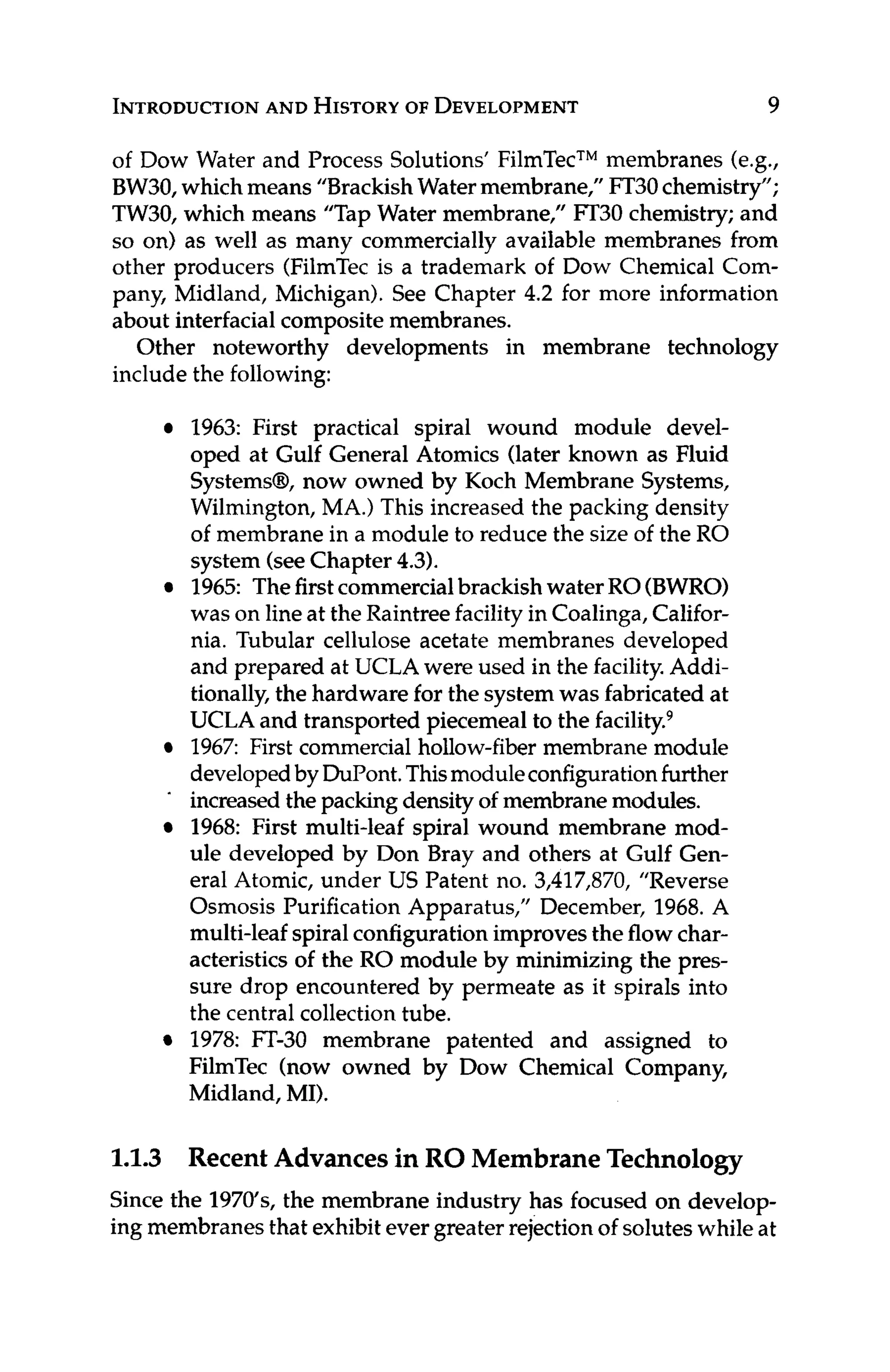
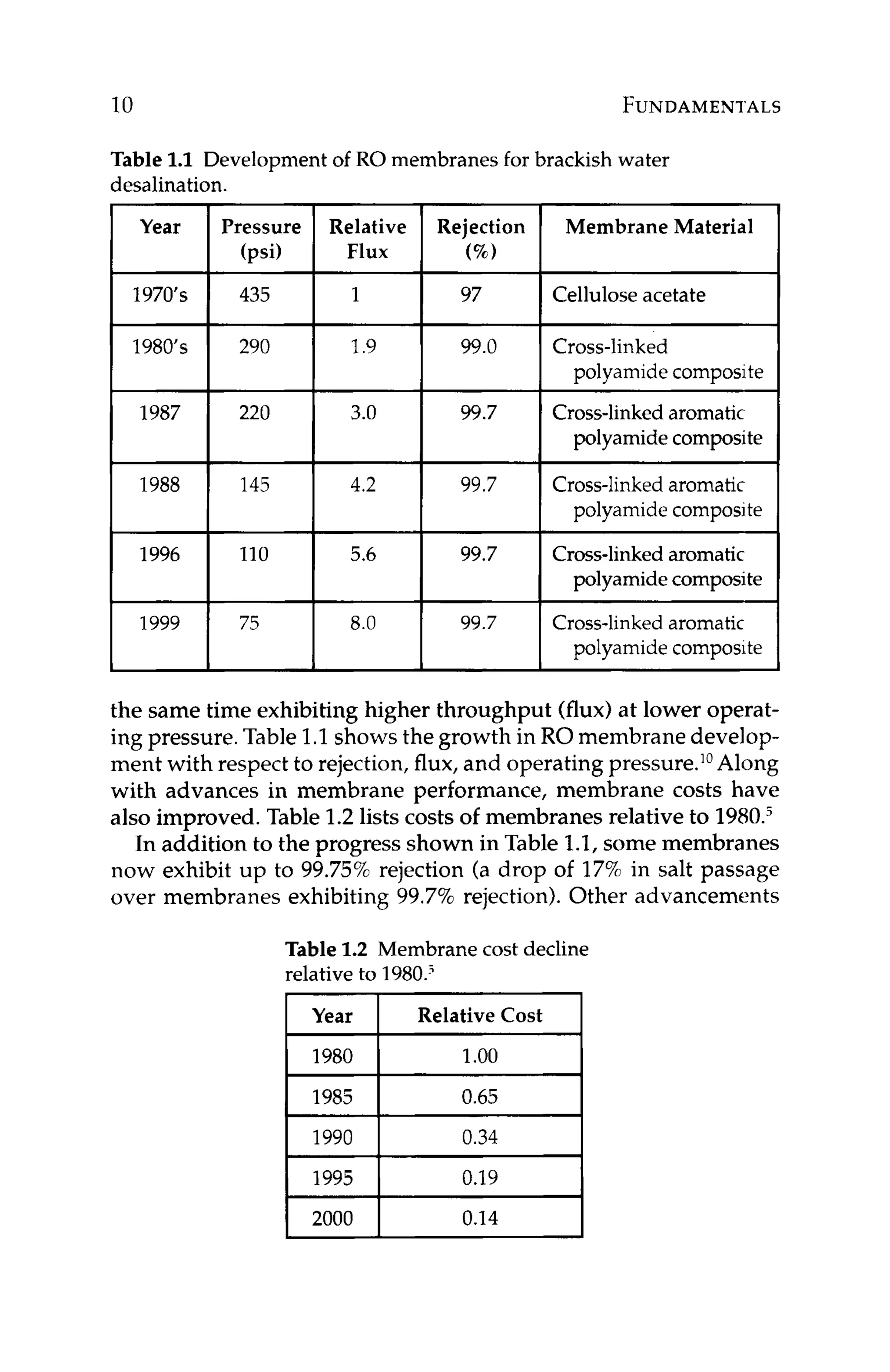
  • 333.
    ISSUES CONCERNING SYSTEM ENGINEERING 311 iron: 0manganese: 0 sulfate: 21 chloride:240 fluoride:0.17 bicarbonate:84 nitrate:0.3 silica: 15 phosphate:0.5 pH:8.1 The feed is make-up water to a 110 gpm RO operating at 75% recovery. Hence, the pretreatment system must treat 150 gpm of feed water. Sodium Softener The sodium softener selected to treat this water is a duplex, 150- gpm system with 54-inch diameter by 72-inch side sheet vessels. Each vessel contains50ft3of resin.Sincethe duplex system operates with one vessel on line and one vessel in stand-by,the total system regenerates 2.4 times per day.At a salt dosage of 15 pounds per cu- bic foot, the system uses about 1,800pounds (820kg) of salt per day or 27.4 tons per month, assuming a 100%operating factor.At a salt cost of $80 per ton, the total month cost for salt is about $2,200.3 Amortization of resin typically assumes a 5-year life or replace- ment cycle. With two vessels at 100ft3of resin total, the monthly amortization is $100. Anfiscalant Table 15.2lists the saturation indexes for the untreated feed water, feed water with 10.2pprn antiscalant, and 4.2 ppm of antiscalant plus 3.4 pprn sulfuric acid for pH reduction form 8.1 to 7.5. As the untreated water shows,the major speciesof concernare the calcium carbonate, barium sulfate, and calcium phosphate. The antiscalant does a good job with all but the calciumphosphate. To address this potential scale, acid must be added. This reduces the antiscalant demand by 60%. Average cost for an antiscalant in 2009 runs about $4.00 per pound.(4) At a dosage of 10.2 ppm, the daily cost for antiscal- ant is about $72.00 or about $2,200 per month. With acid feed, the antiscalant requirement is about $905 per month. Sulfuric acid, at about $600 per ton, and 3.4 ppm feed rate, would add about $55
  • 334.
    312 SYSTEM ENGINEERING Feed Water Condition CalciumCarbonate Calcium Sulfate Barium Sulfate Table 15.2 Saturationindexesfor untreated feed water and feed water treated with antiscalant. Untreated With 10.2 ppm Antiscalant 164 75 1.7 0.6 200 2.4 StrontiumSulfate Calcium Fluoride 0.4 0.0 30.1 0.0 ~ ~~~ Silica 35 23 Calcium Phosphate 117 103 With 4.2 ppm Antiscalant and Supplemental Acid Feed 74 0.6 2.4 0.0 0.0 31 96 per month. Monthly total for the antiscalant only option is about $2,400, while that for the acid/antiscalant option is about $960. Summay For this high-hardness case, the softener and antiscalant options appear to be about the same when only antiscalant (no acid) is used. When acid is feed in conjunction with the antiscalant, the lower cost option is the chemical one when comparing cost of salt versus cost of antiscalant/acid. Note that any local variation in cost of either salt or antiscalant can change the results. What is not accounted for is the affect a softener has on the ability to re- move suspended solids and SDI out of feed water, such as any iron or manganese that may be in the well water. If the water were to contain soluble iron and manganese, the softener would remove these species and prevent both fouling and degradation of the RO membrane, thereby reducing membrane O&M costs via reducing membrane cleaning and replacement. The chemical option would require an iron filter, thereby increasing the costs of this option. If the softener were to have a positive affect on membrane perfor- mance, this cost would have to be taken into account as well. See Case 3 below.
  • 335.
    ISSUES CONCERNING SYSTEM ENGINEERING 313 Case 2Low Hardness Surface Water Surface water had a total hardness of 105 pm as calcium carbon- ate, with 95 ppm calcium and 10ppm magnesium. The remaining analysis is listed below (allspecieslisted a ppm ion): sodium:19 potassium: 3 barium: 0.0 strontium:0.0 iron: 0 manganese: 0 sulfate:46 chloride: 33 fluoride:0.82 bicarbonate:42 nitrate: 12 silica: 5.5 phosphate:0.0 pH:8.5 As with Case 1,the RO system produces 110gpm at 75%recovery that requires 150gpm of feed water. Sodium Softener The sodium softenerselected to treat this water is a duplex, 150-gpm systemwith %-inch diameterby 72-inch sidesheetvessels.Each ves- selcontains50fFof resin and the systemregenerates0.9timesper day. At a salt dosage of 15pounds per cubic foot, the system uses about 675poundso f saltper day, assuminga 100%operatingfactor.At a salt cost of $80 per ton, the total monthly cost for salt is about $820. Amortization of resin typically assumes a 5-year life or replace- ment cycle.Giventwo vesselswith 100ft3of resin total, the monthly amortization is $100. Antiscalant Projections shows that calcium carbonate and calcium fluoride, with saturation indexes of 158% and 200571, respectively, are the species to be concerned with. The addition of 2.6 pprn of antiscal- ant would bring down the saturation indexes to 82%and 0% for calcium carbonate and calcium fluoride, respectively.At $4.00 per pound of antiscalant, the cost for antiscalant is about $19 per day, or about $570 per month.
  • 336.
    314 SYSTEM ENGINEERING Summary For thislow hardness, surface water case, the antiscalant operat- ing cost is lower than that for the softener. Again, the affect of the softener on improved membrane performance is not known and should be considered for this surface water source. Case 3 Well Water with Iron and Manganese This case is taken from an actual analysis conducted for an O&M contract for a facility in Venezuela. The system is to take potable well water from the city and generate boiler make-up water. The water has 77 ppm (as calcium carbonate) total hardness, with 60 pprn calcium and 17ppm magnesium. The water contains 0.5 ppm iron and 0.4 pprn manganese. The remainder of the analysis is list- ed below (all species listed as ppm ion): . sodium: 17 . potassium: 4.8 . barium: <0.4 strontium: 0.12 . sulfate: 30 chloride: 56 fluoride: NA . bicarbonate: 40 . nitrate: <0.16 silica: 11 . phosphate: NA . pH: 6.8 Sodium Softener The softener is a 48-inch diameter unit with 35ft3of resin. The soft- ener will regenerate once per day with 15lb/ft-lof salt. At a salt cost of $80 per ton, the sodium softener would require about $638 per month to operate. Antiscalant Projections indicate that about 3 pprn of antiscalant is required to minimize scaling dueto hardness. At a localcost of $4.50per pound, the monthly cost for antiscalant is $46. Table 15.3lists the pertinent operating costs for this system. As the table shows, the cleaning and membrane replacement costs for
  • 337.
    I Concern Antiscalant 1 With Sodium SoftenerWithout Sodium Softener FrequencyDose Cost Each Cost per Year FrequencyDose Cost Each Cost per Year 0 PPm $0 $0 3 PPm $4.50/lb 550 Salt 1regeneration $21*/day $7,665 0 regenerations $0 $0 /day 2 Membranes Membrane Cleaning 3 year life $600 $7,200 2.5 year life $600 $8,640 4 per year $3 , 240 $12,960 6 per year $3,240 $19,440 1 I $27,825 1 I Total $28,630 Table 15.3 Projectedoperatingcosts for an RO pretreatment system with and without sodium softener.
  • 338.
    316 SYSTEM ENGINEERING the twooptions are different. The iron and manganese make the difference in this case. A softener will remove these species from the RO feed water, thereby protecting the membranes from degra- dation and fouling. This results in fewer membrane cleanings and longer membrane life. The significanceof these three cases are to show that each appli- cation requires full accounting of operating costs when considering whether to use a sodium softener or antiscalant.A complete water analysis is required on which to base the operating cost assump- tions (see Chapter 7). The presence of iron and/or manganese can significantly affect the design, performance, and cost to operate an RO system with pretreatment. Additionally, local pricing for com- modities will also affect the cost to operate the system. Focusing on just one operating cost variable, such as the cost of salt, may not give a complete picture of the total affect the softener might have on performance of the RO and pretreatment system. 15.2 Proper sizing of an RO system, particularly when the demand for product is variable, can be a challenge. Variable product demand can involve actual swings in demand or it can be brought on by low-level and high-level sensors located in product tanks that cycle the RO feed pump on and off. In either case, the ideal condition is to keep all RO skids operating continuously.Idling the membranes makes them more susceptible to fouling and scaling, especially when a shut-down flush is not employed (seeChapter 13.1.1).Fur- thermore, repeated start-ups subjects the membranes to physical stress and perhaps even water hammer; soft-start motors can mini- mize this (seeChapter 6.2). The best approach to meeting variable product demand is to de- sign the RO system for the average flow rate required. For example, if demand for product water is 500 gpm for 10% of the time and 350 gpm for 90%of the time, the RO should be designed for about 365 gpm. A product tank that is large enough to hold the excess 15gpm for 90% of the time is required. Whether an RO system is on line or not is often a function of the level settings in the RO perme- ate or product tank. At the low set point, the RO feed pump trips on, and at the high set point, it trips off. The key is to position the levelset points far enough apart that the RO system remains on line for the maximum amount of time. Reverse Osmosis Sizing and Capacity
  • 339.
    ISSUES CONCERNING SYSTEM ENGINEERING 317 Should alarge tank not be an option, the alternative is multiple skids,someof which will sit idle.Thekey isto rotateskidson and off sothat no one skid experiencesmost of the down time start-ups.It is also recommended that an off-line or shut-down flush be employed, and that the motor be equipped with a soft start. For the example above, two 350-gpm skids would be required. Both skids would be on line during the 500-gpm draw. A product tank with enough capacity to handle the 200-gpm overage would be required. If demand is continuously variable, the best option is still de- signing for the average flow rate, as described above. However, in some cases variation in demand may be such that it still may become necessary to cycle the feed pumps on and off with level in the product tank. 15.3 Membrane Cleaning: On-Site versus Off-Site Chapter 13.2discussed techniques and chemicalsused for cleaning of ROmembranes.Thissectiondiscussesthemeritsof on-siteverses off-site membrane cleaning. Table 15.4summarizes the advantages and limitationsof on-siteand off-site membrane cleaning. 15.3.1 Off-Site Membrane Cleaning Off-site membranecleaninginvolvesremoving membranemodules from the pressure vessels and shipping them off site for cleaning Table 15.4 Merits of on-site versus off-site membrane cleaning. Off-Site Memb Advantages Expert service More effective cleanings Documented results me Cleaning Limitations Higher cost Requires second set of mem- branes On-Site Membran ~~ Advantages Membranes cleaned in situ-no need for replacement membranes Faster cleaning Lessexpensive I Cleaning KIP) Limitations Less efficient Capital outlay for cleaning skid Storage and handling of chemicals and waste
  • 340.
    318 SYSTEM ENGINEERING by a3rdparty. If the RO must remain in operation, a second set of membranes is used to replace those sent out for cleaning(oneof the shortcomings of off-site cleaning). Advantages of off-sitecleaningare detailed below. Off-site cleaning offers expert service. Personnel spe- cifically trained for that purpose clean membranes. Experience goes a long way when it comes to mem- brane cleaning,because cleaningcan be as much an art as it is a science. Off-site cleaning is generally more efficient. Off-site cleaning operations have a variety of cleaners at their disposal to use for most types of foulants and scale. If one cleaning is not successful, another cleaner(s) can be employed to improve upon results. Membrane manufacturers at times give special vari- ances to off-site cleaning operations to use conditions outside the normal cleaning recommendations for membranes, as listed in the membrane specifications. For example, higher temperature and pH may be used to addressbiofilms and lower pH and higher tempera- ture may be used to remove calcium carbonate scale (referto Table 13.1). Results are documented. Documentation typically in- cludes performance testing prior to and after cleaning, and comparison of the results with specifications for that specific membrane make. Shortcomingsof off-site cleaning are as follows: Off-site cleaning costs more than on-site cleaning. Quotes should be obtained form specific vendors, but pricing can be as high as $150or greater per membrane 8-inch diameter module. A second set of membranes is required for continued peration of the RO. 15.3.2 On-Site Membrane Cleaning The techniques and chemicalsdes'cribed in Chapter 13.2apply di- rectly to on-site or Clean-In-Place(CIP)membrane cleaning.
  • 341.
    ISSUES CONCERNING SYSTEM ENGINEERING 319 Advantages ofCIP are as follows. Cleaningis conducted with the membrane modules in situ; there is no need for a second set of membranes. Cleaning is faster with CIP than with off-site cleaning. A two-stage,500-gpm RO skid can be cleaned is about 2 days. Off-site cleaning can take a couple of weeks to turn around the membranes. CIPislessexpensivethat off-sitecleaning.Dependingon thechemical(s)used, an8-inchdiametermembranemod- ule can be cleaned for anywherefrom $5 to $25each. Shortcomingsof CIP are listed below. Cleaning is less efficient than with off-site cleaning. Typically, cleaning,operationsare limited to one cleaner per pH (e.g.,onehigh-, moderate-, and low-pH cleaner) on site.It is too costly to stock all cleanersthat "might" be needed. Additionally membranemanufacturerswill generallyrequire adherenceto cleaningspecifications. Initial capital outlay will need to include a cleaning skid. On-site personnel must store and handle the cleaning chemicals as well as the wastewater that is generated. 15.4 Reverse Osmosis Reject Disposal Options While there may be many options to deal with RO reject, each one has advantages and limitations.Someoffer cost savings,while oth- ers may increase costs, but eliminate the need to dispose of a rela- tively large waste stream. Reject is considered non-hazardous, and containsonly those constituents that were present in the feed water (onlymore concentrated,which canbe a problem)and any antiscal- ants, biocides (such as DBNPA-see Chapter 8.2.5.2), or any other chemicaladded aspretreatment. Disposaltechniquesover theyears have included: Surfacewater discharge Land application Sewer
  • 342.
    320 SYSTEM ENGINEERING Deep wellinjection Evaporation pond The three most common techniques for dealing with RO reject waste are discussed here. 15.4.1 Discharge to Drain or Sewer Perhaps the most common disposal method for RO reject is sim- ply sending it down the drain to sewer or waste treatment. How- ever, discharging in this manner may actually not be a simple as it sounds. There are regulations and permits that may be required that limit discharge of specific contaminants. Discharge to a natural watershed generallyrequiresa permit that must be periodically renewed. Permit requirements vary greatly from location to locationand take intoaccount the impact discharge will have on the local ecosystem. Generally, discharge to a larger body of water results in less stringent permits, while discharge to a smaller or more delicateecosystem, typically will encounter tighter permitting. For example, Louisiana does not regulate chlorides or hardness into the Mississippi River near the Gulf of Mexico, so so- dium softener brine waste and cold-lime softener sludge may be discharged directlyto the river.' On the other hand, New Jerseyhas such stringent regulations and permits, that zero-liquid-discharge (ZLD)is often necessary.3 Dischargetoasewerorpubliclyownedtreatment system(POTW) is not as regulated as discharge to a natural watershed. Most juris- dictions do not require permits and regulate only pH. However, there may be an up-charge for high concentrations of certain con- taminants such as chlorides. 15.4.2 Discharge to Cooling Tower Sending RO reject to the cooling tower is the second most common method of disposing of the reject. The concernswith this method of handling of RO reject are 1)scaling in the heat exchangeequipment, 2) tower chemistry, and 3) logistics. Calcium,and to a somewhat lesserextent, silica,can causescaling problems for thecoolingtower, particularlyif theROrejectisa major portion of the coolingtower make-up.Scalingof the heat exchanger equipment results in a loss in productivity on the process side of the
  • 343.
    ISSUESCONCERNING SYSTEM ENGINEERING 321 facility.New chemistriesthat are better able to handle high concen- trations of scale-formingspeciesarebeing introduced,but there will always be a limit as to what the cooling system can tolerate. The effect of the RO reject on the cooling tower chemical pro- gram is also a concern. Because the reject contains the same species as the cooling tower make-up (only cycled up 3 to 5 times), and a possible antiscalant or biocide, adding reject to the cooling tower should not adversely affect the tower chemical program, if the re- ject is not a large percentage of the total make-up. However, when the RO reject comprises a large percentage of the total make-up to the tower, these issues become important. Locationof the RO system relativeto the cooling towers is a con- cern. In most facilities, the RO is not located near the major cooling towers. There may be a small, local tower located nearby, but dis- charging to this tower may be difficult as the RO reject could be a major portion of the make-up flow to the tower. Pipelines must be run from the RO to the major cooling towers to allow discharge of the RO reject to these towers. Prior to making the decisionto dischargeRO reject to the cooling tower, an analysis should be conducted to determine what impact the reject will have on tower operations. There is a need to balance conservation and recovery of RO reject water with the impact on the cooling system. 15.4.3 Zero Liquid Discharge The use of RO to treat and recover reject from another RO system is becoming more common, particularly in ZLD applications. A sec- ondary RO is used to treat the reject from the primary RO to reduce the thermal evaproative requirements of the ZLD system. Figure 15.1shows a ZLD system with RO as a primary and sec- ondary treatment for wastewater.As the figure shows, wastewater from a variety of sources, including cooling tower and boiler blow downs, boiler feed water makeup treatment wastes, and process wastes, is sent to the pretreatment system. This pretreatment sys- tem typically consists of a cold lime softener, either in traditional form or using microfiltration. If the wastewater is high in organ- ics, additional treatments might include digestion (aerobic and/or anaerobic), dissolved air flotation, and stripping. Waste from the pretreatment system is sent to a sludge press, which, in turn, yields cake solids and another wastewater stream that is recycled to the
  • 344.
  • 345.
    ISSUES CONCERNING SYSTEM ENGINEERING 323 headworksof the ZLD system. The effluent from the pretreatment system is sent to an RO, the product of which can be sent back to the cooling tower. Reject from the primary RO is sent to a concen- trate or secondary RO. The secondary RO is typically a seawater system, capable of operating in the range of 45,000 to 85,000 ppm TDS6Reject from the secondary RO is sent to the thermal system, consisting of a brine concentrator and a crystallizer. The brine con- centrator can achieve a concentration of about 300,000 ppm; the crystallizer yields salt solids. Using the secondary RO reduces the load on the brine concentrator by about 20%.This translates into a corresponding 20%energy savings for a single-effect brine concen- trator. Capital cost of the system is also significantly reduced, as the size of the brine concentrator, one of the most expensive pieces of capital equipment in the process, can be smaller. (Refer to Chapter 16.4to seediscussion on how high efficiencyreverse osmosiscan be used in the ZLD system). References 1. 2. 3. 4. 5. 6. TheNulco WaterHandbook, 2"ded., McGraw-HillBook Company,New York, New York, 1988. Lu, Fred, Nalco Company,personal communication,October 17,2008. Guzman, Natalia, Morton Salt, personal communication, November 13,2008. Glanz, Doug, Nalco Company, personal communication, October 17, 2008. Huchler, Loraine, MarTech Systems, Inc., personal communication, November 3,2008. Mittal, Arun, Aquatech International Corporation,personal commu- nication,November 3,2008.
  • 346.
  • 347.
    16 Impact of OtherMembrane Technologies In this chapter, the impact of other membrane technologies on the operation of RO systems is discussed. Technologies considered in- clude microfiltration (MF), ultrafiltration (UF), and nanofiltration (NF) as pretreatment to RO, and continuous electrodeionization (CEDI) as post-treatment to RO. This chapter also describes the HEROTM (high efficiency RO-Debasish Mukhopadhyay patent holder, 1999) processused to generate high purity water fromwater that is difficult to treat, such as water containing high concentra- tions of silica. 16.1 Microfiltration and Ultrafiltration Microfiltration and UF are pressure-driven membrane separation technologiesthat use positive pressureor suctionto separateparticles (and high molecular-weight soluble species in the case of UF) from solution (seeFigure 1.1).The history of MF and UF membranes goes back to the early 1900's. Bechhlold developed the first synthetic UF membranes made from nitrocellulose in 1907.' He is also credited with coining the term "ultrafilter." By the 1920'sand 1930'sboth MF and UF nitrocellulose membranes were commercially available for laboratory use. The first industrial applications of MF and UF came in the 1960's and 1970's. Microfiltration membranes became viable for industrial application in the 1970's when Gelman introduced the pleatedMFcartridge.' Ultrafiltrationmembranesbecomeindustrially viable in the 1960's when Amicon began preparing UF membranes using a modified Loeb-Sourirajan method (seeChapter4.2.1).] Microporous membranes are used to effectthe separationby MF and UF processes. These microporous membranes differ from poly- amide composite RO membranes in that they are not compositesof two differentpolymeric materials; they are usually constructedusing a singlemembrane polymeric material.In simpleterms, both UFand MFtechnologiesrelyon sizeastheprimaryfactordeterminingwhich 325
  • 348.
    326 SYSTEM ENGINEERING suspended solidsand high molecular-weight dissolved organics are retained by therespectivemembranes.Dueto the microporousnature of MF and UF membranes, the pressure required to drive water throughthem issignificantlylower than forROmembranes,typically less than 100psi; initial clean membranedifferential pressures can be as low as 1.5to 2.0 psi, depending on the membrane material. Common polymers currently used to prepare MF and UF mem- branes include: Polypropylene (PI?): a hydrophobic membrane with good chemical resistanceand tolerance of moderately high temperatures; sensitive to chlorine. Polytetrafluoroethylene(PTFE)(MFonly): an extreme- ly hydrophobic membrane, with high tolerance of acids, alkalis, and solvents; can be used at tempera- tures up to 260°C. Polyvinylidene fluoride (PVDF): a hydrophobic membrane (can be surface-modified to become more hydrophilic) with good resistance to chlorine. Stable pH range up to 10. Polysulfone (PS): good resistance to chlorine and ali- phatic hydrocarbons (not compatible with aromatic hydrocarbons, ketones, ethers, and esters), stable pH range from 1- 13,and tolerance of up to 125°C. Polyethersulfone(PES): sameasPSmembranes.Stable pH range up to 11. Polyethylene (PE): poor resistant to chemical attack and relatively low strength. Polyacrylonitrile (PAN): good chemicalresistance,but resistant to flexing. Cellulose triacetate (CTA): Polymer with complete acetylation of cellulosethat is hydrophilic, but suffers from very narrow acceptabletemperature(c3o"C),and pH (4-6 nominal, 2 - 9 occasional) ranges. This mate- rial is also highly susceptible to microbial attack. (In- filco Degremont is the only manufacatuer using this material as of this publication.) Figure16.1comparesthestrengthand elongationcharacteristicsof various polymers used in the manufactureof MF & UF membranes. High strength and good elongation characteristics are important
  • 349.
    IMPACT OF OTHERMEMBRANE TECHNOLOGIES 327 for the integrity of the membrane. Both properties ensure that the membrane material, particularly in the form of hollow fibers (see discussionbelow) can flexwithout breaking. Flexingisan important property for hollow fiber UF and MF membranes, which have a ten- dency to move in the turbulence of the flow of feed water. Wettability or hydrophilic properties of UF and MF membranes is also important characteristics. Wettability is measured using con- tact angle.Contact angleis the result of the interface/surfacetensions between liquid and solid. Consider a liquid droplet at rest on a flat, solid surface,asshownin Figure 16.2.Thecontactangle, 0, istheangle formedby thesolidssurfaceandthetangent linetotheuppersurfaceat theend point.Asmallercontactanglemeansthewettabilityand hydro- philicityof thesolid materialisgreater.Table16.1liststhecontactangle Figure 1 6 . 1 Strength and elongation characteristics of various UF and MF polymers. Courtesy Dow Waterand Process Solutions. / ContactAngle Droplet Membrane Surface Figure 16.2 Contact angle between a liquid droplet and a flat, solid surface.
  • 350.
    328 SYSTEM ENGINEERING Polymer . PES PAN PVDF PP PTFE Contactangle(degrees) 44 HYDROPHILIC 46 66 108 112 HYDROPHOBIC v for somecommonpolymers.A hydrophilicmembrane is usuallypref- erableover a hydrophobicmembranefor UFand MFapplications. Microfiltrationand UF membranescanbe asymmetric,with a dens- er side and a more open side, or uniform without macrovoids (See Figure 16.3).The open area behind the denser surface in an asym- metric design means there is less resistance to water permeating the membrane. Operating pressure can be lower and the membrane systems can be more productive. The limitation of the asymmetric design is that the material, predominately used in the hollow fiber configuration, is not as strong as the uniform cross section. Microfiltrationand UF membranes are available in tubular, spi- ral wound, and hollow fiber membrane module configurations.Tu- bular and spiral MF and UF modules are similar to RO tubular and spiral wound membrane modules described in Chapters 4.3.2and 4.3.3. However, while the thickest feed spacer in a spiral RO mod- ule is 34-mil, UF and MF modules nominally have up to a 45-mil spacer due to the relatively high concentration of suspended solids these membranes are called upon to treat (TriSepTM Corporation of- fers a special 65-mil spacer for dairy applications). Improvements made over the last few years in MF and UF mem- branes and modules,including thedevelopment of a new generation of hollow-fiber (HF) membranes and modules for industrial appli- cations has led to wider application of these membrane separation technologies.2The new generation HF membranes are characterized by high porosity, strength, and flexibility,all important characteris- tics for MF and UF applications. Microfiltrationand UF hollow fiber membranes are differentthan the hollow fine fibers discussed in Chapter 4.3.4. The MF and UF membranes are thicker and not quite as flexible, resembling fine- diameter straws rather than human hair. Diameter of fibers ranges Table 16.1 Contact angle for common membrane polymers.
  • 351.
    IMPACT OF OTHERMEMBRANE TECHNOLOGIES Figure 16.3 Asymmetric (inside-skinned(a)and outside-skinned(b))and uniform (c)cross-section UF membranes. Figure c courtesyof Dow Waterand Process Solutions. 329
  • 352.
    330 SYSTEM ENGINEERING from about200 to 3,000 microns with a cross-sectional membrane thickness of 100 - 200 microns. The fibers are not folded into the pressure vessel as they are with hollow fine fibers, but are usually potted and open onboth ends. (Notethat Koch's PuronB submerged hollow fiber membrane is "potted" at one end only, with the other end unencumbered and sealed (Puron@is a registered trademark of Koch Membrane Systems, Wilmington, MA). The membrane mod- ule assembly in operation resembles a "weed" blowing in the wind. This configuration is less prone to fouling on the outside of the fibers at the sealed end than a hollow fiber that has both ended potted). Hollow fibers can be created with the dense side on the inside or lumen of the fiberor on the outside of the fiber, or they canbe double- skinned, whereboth the lumen and the outside of the fiber are dense. Location of the denser side of the membrane determines whether the service flow is outside-in or inside-out. Outside-in systems are typically used in a dead-end mode (or some variation thereof),while Table 1 6 . 2 Advantagesand limitations of outside-in and inside-out serviceflow designsfor hollow fiber MF and UF membranes. Service Flow Denser Sideof Membrane Advantages ~ _ _ _ _ _ _ ~ Limitations Outside-In Outside of the fiber Minimal filtration Easier membrane Higher surface area pretreatment cleaning meansmore filtration area per fiber ~ Solids collect around and at potted ends of fibers Requires air scour to clean Cannot perform true recycle Inside-Out Inside of the fiber True cross flow velocity minimizesconcentra- tion polarizationand membrane fouling When no air is utilized for backwashing the less fiber movement leads to breakage of fewer fibers Can be created with a variety of inside fiber diamters High pressure drop limits fiber length Requires signifi- cant filtration for pretreatment
  • 353.
    IMPACTOF OTHER MEMBRANE TECHNOLOGIES 331 inside-outsystemsare typically dead-end, but.can also provide true cross flow.Manufacturersof outside-inmembranes includeSiemens (Memcof),GE (ZeeWeed@), and Pall (AriaTM--Aria is a trademark of Asahi Kasei Corporation, Tokyo,Japan).Koch manufactures inside- out membranes (Romicon@), as does Norit (X-Flow). Some hollow fiber membranes, such as Dow Water and Process Solutions’ UF membrane, are skinned on both in inside and outside of the fiber, givingthefibermorestrengththerebyminimizingfiberbreakage(see Figure16.3~). TheDow membranesareoperatedin anoutside-inflow pattern. Table 16.2lists the advantages and limitations of outside-in and inside-out serviceflow designs. Tubular and spiral configuration have advantages and limita- tions as well. Tubular membranes, with diameters of ?4to 1-inch can handle high concentrationsof suspended solids; the chance of plugging the tubes is minimal. Fouled tubular membranes are eas- ily cleaned mechanically using a spongeball to scour the membrane surface free of foulants. However, the packing density of tubular membranes is not high, so this configurationrequires a lot of floor space.Spirals,on the other hand, requirelessfloorspace,but require pre-filtration to minimizeplugging of the feed channel spacer with Figure 16.4 Spiralwound ultrafiltrationsystem.Courtesyof Koch Membrane Systems.
  • 354.
    332 SYSTEM ENGINEERING Figure 16.5Hollow fiber microfiltration system. Courtesy of Koch Mernhrniie Systenis. Figure 1 6 . 6 Tubular ultrafiltration system. Courtesy of Koclz Mernbrnize Systems.
  • 355.
    IMPACT OF OTHER MEMBRANE TECHNOLOGIES 333 largersuspended solids. Figures 16.4, 16.5 and 16.6 show spiral wound UF, hollow fiber MF, and tubular UF systems, respectively Microfiltration and UF typically encounter some degree of foul- ing with suspended solids.Foulingcan be particularly severeupon start-up under high transmembrane pressure and flux, which can cause compaction of the initial fouling layer. This results in a dra- matic loss of flux and rapid drop in driving pressure, depending of the solids loading. Figure 16.7compares the flux decline with time for MFand UF membranes.As the figureindicates,MFsystems can exhibit higher initial flux, but as suspended solids begin to plug the pores of the membrane (which are larger than the pores in a UF membrane, and hence, more prone to plugging), the flux can decline more rapidly for the MF membrane. Hollow fiber membrane modules can be backwashed to remove foulants whereas tubular and most spiral configurations cannot be backwashed. Backwashing of traditional spiral-wound modules would break the glue lines holding the membrane leaves together or causeblistering and delaminationof the membrane from the backing in both spiral and tubular modules (TriSepCorporation has recently developed a back-washable, spiral-wound module (SpiraSep-US patent 6,755,9701, that is used in immersed systems see below). 1 Time Figure 16.7 Flux decline with time forMF and UF membranes.Courtesy of Dow Water and Process Solutions.
  • 356.
    334 SYSTEM ENGINEERING Backwashingof HFmembranes may need to be conducted frequent- ly, up to 3 or 4 times per hour, depending of the rate of increase in pressure drop. However, in general, a hollow fiber MF or UF system will backwash onceevery 15to 90 minutes.Backwashingis enhanced using air scour, where air is bubbled along the membrane surface to promote turbulanceand left off solidsthat havecollectedon the mem- brane surface. Air scour, for outside-in applications, may be applied as oftenas onceeverybackwash.Flowreversal can be used to remove solids blocking the fiber lumens for inside-out feed membranes (air scour can also be used on some inside-out modulessuch as the Norit Aquaflex 1.5 mm ID and Norit Airlift). Backwashing,along with air scourand flowreversal,minimizesthe frequencyof chemicalcleaning. A limitationof HF membranemodules is the fact that just as spiral wound modules require pretreatment, so do HF modules, to reduce the size and/or quantity of suspended solidsin the feed water, there- by minimizing the chance of plugging the fibers and modules. This is particularly important for inside-out feed HF membranes. Typical pretreatment includesa 150pmor smaller screen filter. Table16.3 Summarizestheadvantagesand limitationsof tubular, spiral wound and hollow fiber module configurations. Table16.3 Advantages and limitation of various module configurations for microfiltration and ultrafiltration membranes. MF/UFmodule Tubular Hollow Fiber I Advantages Plug resistant Easilv (mechanicallv)cleaned Small footprint Low capital cost Small footprint Low capital cost Can be backwashed Can easily be integrity High membrane area per tested unit volume (high packing density) Limitations 7 Large footprint High capital cost Plugging of feed Difficult to clean Cannot perform integrity tests Plugging of fiber (inside-out feed) Bridging of fiber bundle (outside-in feed) Difficult to clean channel
  • 357.
    IMPACT OF OTHERMEMBRANE TECHNOLOGIES 335 Microfiltration and UF modules can be operated with a pressur- ized feed or "immersed" in ambient-pressure solution, with a vacu- um (or gravity) on the lumen side of the fiber. Figure 16.8ashows a pressurized MF module, while Figure 16.8bshowsa module used in immersed systems.In a pressurized system, water is forced into the membrane under pressure, as shown in Figure 16.9a. Immersed or "submerged" systemsrely on suctionto pullwater throughthe mem- brane, as shown in Figure 16.9b.To minimizeconcentrationpolariza- tion and fouling of the submerged fibers, two-phase bubbly flow (as illustrated in Figure 16.8b)is used to inducesurfaceshearwhen oper- atingon water containinga high concentrationof suspended solids. (a) Hollow Fiber a , (D a, + I e, 0 E 2 (b) Figure 1 6 . 8 Cross-sectionsof a (a)pressurized MF or UF hollow fiber membrane module and an (b)submerged hollowfiber MF membrane cartridge.
  • 358.
    336 (a) Pressurized Configuration * Dead-end orCross- Outside-in, Inside-out Flexible flow Less chemical All chemicalscontained in modules & piping Moderate to Good Moderate to Low * Excellent ability to identify module SYSTEM ENGINEERING Submerged Configuration Dead-end or Cross- Outside-in Limited up-turn in flow flux More Chemical Limited to soaking rather than recirculation required over cells Covers and ventilation Moderateto good Low Identification of mod- ule is different and requires removing covers PERMEATE Membrane (b) Pump PERMEATE Figure 16.9 (a) pressurized and (b)submerged hollow fibers systems. Table16.4 Comparison of pressurized and submerged hollow fiber MF and UF systems. Parameter Operation Flux Cleaning Fouling Control Capital Cost Integrity testing
  • 359.
    IMPACTOF OTHER MEMBRANE TECHNOLOGIES 337 Table16.4 shows a comparison of pressurized and submerged hollow fiber MF and UF system^.^ Operation: Pressurized configurations can be oper- ated in either cross-flow or dead-end modes while submerged configuration are essentially only oper- ated in dead-end mode. Submerged systems operate with outside-in flow, while pressurized can be either outside-inor inside out flow. Flux: Both pressurized and submerged configurations can be operated below design flux without difficulty. If operation above design flux is required for short periods of time, pressurized systems are preferred, as they operate under a positive trans-membrane pres- sure; positive pressure can always be increased, while vaccum is limited. Cleaning: Pressurized configurations required less chemical during cleaning than submerged systems. This is because the entire tank containing the sub- merged membrane cartridge must be filledwith chem- icalto cleanthe membranes (notethat spacersare used to occupy space to minimize this factor). Fouling Control: Pressurized and submerged hollow fiber configurations with out-side-in flow both suffer fromblockageof the fiber bundles that tends to be self- accelerating. Hence, the need for two-phase bubbly flow to minimize accumulationof foulants among the fibersin a submerged systemto mitigate this issue. Capital Cost: Submerged configurationshave a slight cost advantage over pressurized configurations when onlythe equipment suppliedby the membrane suppli- er isconsidered.Submergedsystemslackpressureves- sels and the plumbing is simpler, but tankage must be supplied by the constructor.Additionally, submerged system will need covers over the cells and ventilation systems to avoid chemical fuming and other issues that are not a concern with pressurized systems. Hollow fibers are generally used for submerged applications, although flat sheets, and more recently, spiral wound modules have come into use in submerged systems. In general, pressurized and submerged systems compare favorably,with the submerged
  • 360.
    338 SYSTEM ENGINEERING configuration enjoyinga slight cost advantage, particularly for larger systems. Both configurations are used as pretreatment to RO with success. It is important to take into account permanent fouling of the MF or UF membranes by over designing the system. Despite the dense surface of these membranes, pore fouling can occur, particularly at higher membrane driving pressures (typically caused when the system is operated at high permeate flux or high trans-membrane pressure (TMP)).Under constant pressure, MF and UF membranes can lose 50%- 75%of water flux between backwashes. Pilot testing is necessary to determine the degree of permanent fouling as well as the backwash and air scour frequencies and the chemical programs that are required. Pilot testing is particularly important in colder climates where the seasonal range for temperature is great, as tem- perature affects the flux through the membranes (higher tempera- ture leads to higher flux and, conversely, lower temperature leads to lower flux in a manner similar to RO membranes). As discussed in Chapter 8.1.9, MF and UF membranes can delay the onset of microbial fouling of RO membranes, but by themselves are not fully effective. Nutrients, in the form of low-molecular weight organics, can pass through these membranes such that any post introduction of microbes into the RO feed water will result in microbial fouling. Therefore, the use of chlorine is recommended in conjunction with these membrane processes to minimize the poten- tial for microbial fouling of RO membranes. 16.1.1 Microfiltration Microfiltrationis a pressure-driven membrane separation technology used to separateparticles from solution (seeFigure 1.1).This technol- ogy uses microporousmembranes with pore sizesranging from about 0.1 up to about 3 microns. However, due to particle adsorption onto the surface of the pores, and the collection of particleson the top of the membrane (both of which serve to block pores), MF membranes can often remove particles smaller than the rated pore size.4Microfiltra- tion cannot, however, removal all colloidal material because colloids can be as small as 0.01microns in diameter.jSinceMF membranes do not reject ions, osmotic pressure is not a concern as it is with RO sys- tems. Typical operating pressures for MF systems range from about 10- 100psi with 30 - 40 psi being typical. Industrial flux rates are up to 100gfd, depending on the nature of the feed water.
  • 361.
    IMPACT OF OTHERMEMBRANE TECHNOLOGIES 339 Applicationsof MF include: Water treatment-removal of suspended solids,includ- ing up to 4-log removal of bacteria (a major application growth area'), Wastewater treatment-biomass sedimentation using membrane bioreactors (MBRs), tertiary treatment of municipal waste for reuse, Food & beverage treatment-clarification of liquids (fruitjuices, beer), Resource recovery-recovery of inks, textile sizing agents, and electrodepositionpaints. Microfiltrationas pretreatment to RO is used for bulk removal of suspended solids and bacteria. Microfiltration is a barrier technol- ogy that can in many cases replace conventional clarification and filtration. Advantages of MF over conventional clarification and filtrationinclude the following: Minimal need for treatment chemicals-coagulants, flocculants, acid or caustic (coagulantsare used when organicremoval is required), Consistenteffluentquality,regardlessof raw feed water quality, Compact system, Simple automation-minimal operator attention required. See references 1, and 6 - 8 for more detailed discussions about microfiltration. 16.1.2 Ultrafiltration Ultrafiltration is a pressure-driven membrane separation technol- ogy used to separate particles and high-molecular-weight soluble species from solution. Ultrafiltration also uses microporous mem- branes with a pore sizedistribution of 0.005to 0.1 microns,an order of magnitude smaller than the pore sizes for MF (see Figure 1.1). In general, because of the smaller pores, the operating pressure re- quired for transport through a UF membrane is greater than that for an MF membrane, generally 5 - 150 psi with 30 - 75 psi being typical (some UF membranes, such as the Norit PES membrane,
  • 362.
    340 SYSTEM ENGINEERING CARTRIDGE FILTER 4 BOTTLEDWATER REGENERABLE CARBONATED SODA DRINKS CHEMICAL FEED - BlSULFlTE ANTISCALANT CAUSTIC WASTE Figure16.10 Typical water treatment process flow diagram for a beverage facility producing both bottled water and carbonated soda drinks.
  • 363.
    IMPACT OF OTHER MEMBRANE TECHNOLOGIES 341 requirea very low net driving force of 1.5- 2.0 psi on clean mem- branes assuming proper flux selection).Typical industrial flux rates for UF range from 5 to 70 gfd, depending on the nature of the feed water. As discussed above, UF membranes have smaller pores than MF membranes indicating that their rejection of suspended solids and bacteria are greater or "tighter" and that for ME For example, the California Department of Public Health gives UF membranes a 4-log removal credit for viruses, while MF typically receiveds only a 0.5 log-removal credit for viruses. Species that are retained by a UF membrane are typically defined as those whose molecular weight is greater than the molecularweight cut off (MWCO)of the UF membrane.TheMWCOof a UF membrane describesthe ability of that membrane to retain 90% of a challenge macrosolute (such and glycol, dextran, or pr~tein)~. There is no international standard for MWCO, so that membranes from different manufacturers can- not be directly compared on the basis of MWCO only. Applicationsof UF include: Food & beverage-recovery of proteins for milk and whey, sugar concentration of fruit juice, removal of bacteria and suspended solids and organics from bot- tled drinking water, Wastewater-removal of free oil, Municipalwater-removal of bacteria and largevirus- es from potable water and wastewater for reuse. RO pretreatment-reduction in concentration of suspended solidsand high molecular-weightorganics. The application of UF for RO pretreatment is growing, as users are interested in reducing the size of their treatment facilities and reducingor eliminatingchemicaltreatments.Althoughcapitalcostis an issue, UF can be cost effectivewhen used to remove bacteria and dissolved high-molecular weight organics from RO feed water and asa polisher forreduction of suspended solidsand silt densityindex. Ultrafiltration in the tubular configuration can alsobe used for bulk removal of suspended solids prior to RO. Ultrafiltration is a barrier technology providingconsistenteffluentqualityincluding6-logbac- terial removal and SDIstypicallyless than 2 (turbidityless than 0.02 NTU). Ultrafiltration prior to RO is commonly seen in the produc- tion of bottled drinking water, even when potable water is used as
  • 364.
    342 SYSTEM ENGINEERING r - I FreeAmineCarboxylate Figure 16.11 Structure of a typical nanofiltration membrane. the make-up source. Figure 16.10 shows a water treatment process flow diagram for a typical beverage facility. See reference 1 and 6 - 8 for more detailed discussions about ultrafiltration. 16.2 Nanofiltration Nanofiltration(NF) is a pressure-driven membrane separation tech- nologyused toseparateionsfromsolution.Nanofiltrationmembranes were widely available beginning in the 1980's. This technology uses microporous membranes with pore sizes ranging from about 0.001 to 0.01 microns. Nanofiltration is closely related to RO in that both technologiesareused to separateions from solution.Both NF and RO primarily use thin-film composite,polyamidemembraneswith a thin polyamide skin atop a polysulfonesupport (seeChapter4.2.2). Figure 16.11shows the chemistry of a typical Dow-FilmTecnanofil- tration membrane.Comparethispolymer tothat of commonROmem- brane polymers, a shown in figure 4.10. Both chemistriescontain free amines and carboxylate end groups. The difference is in the nature of therings.Reverseosmosismembraneshavearomaticring(C,H,), while theNFmembraneshave apiperazinering (C4H,,,N2 ina6-memberring with the2 nitrogens in opposition).Theeffectsof different dissociation constantsfor piperazinealongwith theuse of traceadditivesallowNF membranes to be designed with a wide range of salt selectivities. Nanofiltration is sometimes called "loose R O or "leaky RO" be- cause of its similarity to RO; the exception is that NF membranes allow more ions to pass through than an RO membrane.'"Becauseof the lower rejection of dissolved solids, the increase in osmotic pres- sure is not as significant with NF system as it is with RO. Thus, NF
  • 365.
    IMPACT OF OTHERMEMBRANE TECHNOLOGIES 343 Silica Total Dissolved Solids Table 16.5 Rejection of ions exhibited by NF and RO membranes. 5-95 90 -98 90 -98 65-95 ~~ Tolyamide compositemembranes operatesat lowerpressurethan RO, typically50-150 psi.Nanofiltration fallsbetween RO and UF on the filtration spectrum shown in Figure 1.1.Table16.5comparesthe generaldifferencesin rejection of species between NF and RO membranes. As shown in the table, NF membranes offer a wide selection of rejection capabilities. In general, rejection of divalent ions is greater than that for mono-valent ions for NF membranes, particularly for the "loosest" of NF membranes. Reverseosmosis membranes,on the other hand, exhibit high rejection of both mono-valent and divalent ions (although rejection of divalent ions is also greater than that of mono-valent ions-see Chapter4.2.2). Theadditionof traceadditives and the differentdissociation constantsof the piperazine found in the FilmTec NF membrane (Figure16.11)is used to yield the wide range of solutetransportthrough this membrane. In simple terms, nanofiltration membranes reject species based on size or charge of the particle, depending on the charge of the membrane.',l1,I2 Forexample,cationicNFmembraneshavenegatively- charged groups attached to the polymer backboneand consequently, sulfate, which is negatively charged, is rejected to a greater extent by an cationicNF membranes than calcium, which has a larger hy- drated radius but is positively charged.', This is a result of the negativechargeon the membrane repulsing the negatively-charged Species Calcium ~ ~ Nanofiltration Reverse Osmosis Rejection (%) Rejection*(%) 75 -98 93- 99 ~~ Magnesium Sodium Chloride Sulfate 70 -98 45 -95 93-98 92 -98 1-95 92-98 96 - 99 95 -99 Bicarbonate Fluoride 40 -95 25 -95 85-95 92-95
  • 366.
    344 SYSTEM ENGINEERING sulfate ion(Donnanexclusioneffect).The same principle applies to anionic membranes and cationicspecies. Fouling and scaling mechanisms are similar for spiral-wound NF and RO membranes. In general, NF feed water should meet the following characteristics to prevent fouling with suspended solids (refer to Table 7.1 for a more detailed description of spiral-wound RO feed water requirements): SDI < 5 (< 3 is preferred) Turbidity < 1NTU (< 0.5 NTU is preferred) Hence, traditionalspiral wound NF membranes require the same level of pretreatment as spiral-wound RO membranes, as well as the same flux and flow rate considerations with respect to feed wa- ter quality (seeChapters 9.9 and 9.4). New generation NF membranes have been developed that exhibit lower fouling tendencies, making them applicable to high organics and high-colorapplications." While conventional RO and NF membranes have a rough surface and a negative or positive surface change, these new NF membranes have a smooth surface and more neutral surfacecharge, making them more resistant to or- ganic fouling. These low-fouling NF membranes can operate with TOC concentrations ranging from 10- 20 ppm and color up to 90 APHA units.l0Examples of these new NF membranes include the Hydranautics' ESNAI-LF, LF2, and LF3. Applications of NF include: Water treatment-water softening and color removal for potable water applications Wastewater treatment-color removal from pulp and paper wastewater Resource recovery-recovery of valuable, lower- molecularweight products in the drug, semiconductor, textile, metal-plating, and food industries9 For RO pretreatment, NF is typically used to pre-soften and reduce color fromRO feed water (whenappropriateNF membranes are employed).Nanofiltration replaces sodium softening (forhard- ness removal) and augments clarification(forcolor removal). 16.3 Continuous Electrodeionization Continuous electrodeionization (CEDI-the continuous process subset of electrodeionization(EDI) that is sometimes referred to as
  • 367.
    IMPACT OF OTHER MEMBRANE TECHNOLOGIES 345 justcontinuous deionizationor CDP (CDIis a registered trademark of SiemensWater Technologies))is an electrically-drivenmembrane separation technique under development since the mid-1950's and successfully commercialized in the late 1980'~.'~ Continuous elec- trodionization is used to remove trace dissolved solids from water. Thistechnologyrelies on a D.C. current that isapplied to cation-and anion-exchangemembranes with ion exchange resin arranged in a "stack" configurationto effect the separation of solutes from water. Figure 16.12showsthe expanded view of a conventional,stacked- disk plate-and-frame CEDI module (stack). Inside one end of the module is the cathodeand insidethe other end is the anode.Between the cathode and anode are layers of flat-sheet cation- and anion- exchange membranes separated by spacers that act as alternating diluting (product) and concentrating (reject) compartments. Resin is placed in the diluting compartments,as shown in Figure 16.13a. Note that in the newer "all filled" configurations,all compartments are filledwith ion exchangeresin as shown in Figure 16.13b.An elec- trical potential is applied to the stack (100 - 600 volts DC at 3 - 10 amps) that drives the cationstoward the cathode and anionstoward the anode. (Theamount of current drawn from the power supply is proportional to the concentration of ions in the solution.Typically,4 ppm feed to a CEDI system will draw about 3 amps.'4)Cations pass through the cation-exchange membranesbut not through the anion- exchangemembranes,whileanionspassthrough theanion-exchange membranesbut not through the cation-exchange membranes. (Note VNX Electrodeionization (Ion ExchangeResln Not Shown) Figure 16.12 CEDI stacked-disk,plate-and-frame configuration.Courtesyof Siemens Woter Technologies-Ionpure Products.
  • 368.
    346 SYSTEM ENGINEERING that theion exchange membranes are not permeable to water; only ions are transported through them.) In this manner, every other com- partment becomes dilute in ions while the other compartments be- come more concentrated in ions. The ion exchange resin facilitates the transfer of ions in low ionic-strength solutions. FEED FEED FEED n i J PROJECT REJECT PROJECT n v n v n v PRODUCT REJECT PRODUCT OH- + .CI- ’ CI- )n--W ANODE + CEM. CATIONE - YembrsM CATION Exchangc Rosin AEM - ANIONExchangeM u n b m GEM = CATIONEachangeMembrane CATION ExchangeResrn AEM = ANION ExchangeMembrane Figure 16.13 Transport through cation-and anion-exchange membranes in a) “unfilled” and b) “all filled” CEDI stacks. Courtesyof Siemens Water Technologies--lowpure Products.
  • 369.
    IMPACT OF OTHER MEMBRANE TECHNOLOGIES ..... ---..4 t; J z a8 @- - I + - - 347 Figure 16.14 Typicalprocess flow diagram for an all-filledCEDI configuration. Courtesy of Siemens Water Technologies-lonpure Products.
  • 370.
    348 SYSTEM ENGINEERING Figure 16.14showsatypical processflowdiagram for an all-filled configuration, while Figure 16.15shows a typical process flow dia- gram for an unfilled configurationwith concentraterecycle. Recycle is used to achieve higher recoverywhile maintaining good velocity through the concentrating compartments. The concentrate recycle also increases the concentration in the concentrated compartment, thereby reducing the resistance of the stack to the DC current. In some cases, brine injection is used to supplement the concentration recycle, particularly where the ionicconcentration of the feed water is very low. The all-filled configuration does not need brine recycle or brine injection. This results in lower capital cost for the all-filled configuration, as the brine recirculationand brine metering pumps and associated piping areeliminated. All-filled configurations offer less electrical resistance and suffer less salt bridging than the un- filled configuration (seediscussion on salt bridging below). Equations 16.1and 16.2show the reactions at the cathode and an- ode,respectively.Theseequationsindicatethat hydrogen and oxygen gasesare produced at the electrodes.Typically,7.5ml/min of hydro- gen and 2.7 ml/min of oxygen are produced at 25°C and 14.7psig. Equation16.3indicatesthat chlorinegas may alsobe generated at the anode.Concentrationsof chlorinegas range from non-detectable up to 8 ppm, depending on the configuration of the CEDI module and whether or brine injectionor concentraterecycle is employed.'j Chlo- rine gas is more likely to be generated when more chlorideis present in the concentratecompartment, as is the case when brine injection is used. These gases require removal that is usually accomplished using water passing over the electrodes and then venting the gases from this water flush stream.'" 2H,O + 2e- +H, + 20H- Cathode (16.1) 2H,O +0,+ 4H' + 4e- Anode (16.2) 2C1- +C1, + 2e- Anode (16.3) Some companies market spiral wound CEDI modules, such as the DOWTM ED1 spiral wound module (formerlyOmexell--DOW is a trademark of Dow Chemical Company, Inc., Midland, Michigan). Figure 16.16showsthe crosssectionof the Dow module.I6As the fig- ure shows, RO permeate enters the module on one end, while CEDI effluent exitsthe other end; concentrateis sent spiralinginto the met- al center tube of the module and exits out of this tube. A titanium
  • 371.
    I Figure 16.15 Typicalprocessflow diagram foraCEDIconfigurationwith unfilled concentratespacers. Courtesyof Siemens Water Technologi-lonpure Products.
  • 372.
    350 SYSTEM ENGINEERING PIodudWater ConcentrateRecycle Electrol) Outlet Feed water Concentrate “D” Chamber Inlet (Dilute) Cation Anion Membrane Membrane t ‘ Electrolyte Feedwater “E“ Chamber “D” Chamber (Dilute) Figure 16.16 Cross-section of a DOWTM EDI-CEDI spiral wound module. Courtesy of Dow Water and Process Solutions. cylinderis placed insidethe fiberglassouter shell to act as the anode. Thecathodeis the metal center tube.In the caseof this spiralmodule, only the diluting compartments are filled with ion exchange resin. Hence, a recycle of the concentratesolutionis required.Figure 16.17 shows a process flow diagram of a spiral-wound CEDI module. The major advantage of the spiral configuration over a plate- and-frame configuration is that there is minimal leakage associ- ated with the spiral configuration. The spiral wound module does not require periodic tightening of nuts and bolts to prevent leaks, unlike plate-and-frame modules. Limitations of the spiral con- figuration include inferior current and flow distribution relative to plate-and-frame modules, as well as difficulty in assembly and field membrane rep1a~ement.I~ A CEDI system can produce up to 18-megohm-cm water at 90-95% water recovery. Recovery by the CEDI system is a function of the total hardness in the feed water to the system.In general, 95% recovery canbe realized at a feed water hardnessof lessthan 0.1ppm as calcium carbonate.I6This is typically attained if the pretreatment to the CEDI consists of either 2-pass RO or sodium-cycle softening followedby RO. Recovery that is achievableis a functionof the feed
  • 373.
    IMPACT OF OTHER MEMBRANE TECHNOLOGIES 351 . c - Electrolyte Flush Concentrate Bleed RO Permeate Figure16.17Process flow diagram of a spiral wound CEDImodule. Courtesyof Dow Waterand Process Solutions. Table 16.6 Continuouselectrodeionization recoveryas a function o f feed water hardness for an E-Cell (GE)module.Is (ppmas CaCO,) < 0.10 0.10 -0.50 I 0.50- 0.75 I 85 I I 0.75- 1.00 I 80 I water hardness concentrationand varies with manufactureras well. Table 16.6shows how recovery is a function of feed water hardness for a GE-E-Cell@ module (E-Cellis a registered trademark of Gen- eral ElectricCompany,Fairfield,Connecticut).Is Continuous electrodeionization systems can achieve 95% rejec- tion of boron and silica,and 99+%rejection of sodium and chloride. This performanceis possible due to voltage-induced dissociation of water that effectively regenerates a portion of the resin thereby al- lowingremoval of weakly ionized speciessuch as silicaand boron.I9 In fact, the boron in the effluent from a CEDI system can be lower than that in the effluent from a mixed-bed ion exchange system.I3
  • 374.
    352 SYSTEM ENGINEERING High feedwatercarbondioxideis the leadingcause of poor prod- uct quality in the effluent from a CEDI unit. This is because carbon dioxide is converted to carbonate and bicarbonate within the stack, and thus it contributes to total exchangeable anions. This must be taken into account when designing the system. Carbon dioxidecon- centrations below 5 pprn can reduce the removal of ions from the feed water, particularly weakly ionized species such as silica and b0r0n.l~ In an effort to account for the carbon dioxide and its draw on the DC current, a “conversion factor” of 2.79micro-Siemens per centimeterfor every 1ppm carbondioxideis added to the measured conductivityof the feed water to theCEDIunit.I9Carbondioxidecan be removed prior to the CEDI system using a membrane degasifica- tion system such as a Membrana Liqui-CeP membrane contactor (Liqui-Celis a registered trademark of Celgard LLC, Charlotte,NC) thereby minimizing the power required by the CEDI system and improving the removal efficiencyof other ions. Note that silica, is weakly ionized and will also contribute to the draw on DC current. A conversion-factor of 1.94micro-Siemensper centimeter for every 1ppm silica is added to the measured conduc- tivity of the feed water to accountfor this.Although the conversion- factor is greater for silica than for carbon dioxide, silica has much lesser effect on the DC current draw than carbon dioxide because of the relatively low concentration of silica in CEDI feed water as compared to carbondioxide. A significant amount of pretreatment is required to minimize fouling and scalingof the membranes in a CEDI system. Table 16.7 lists general feed water quality requirements for CEDI systems.13,21 Due to the stringent feed water quality requirements, most CEDI systems are preceded by RO. Common configurations used to pre- treat CEDI feed water include the following:13 Antiscalant +RO Softening+RO Antiscalant -+ RO -+ softening Antiscalant +RO -+ RO Because of the high-quality feed water sent to a CEDI system, the concentrate from the CEDI is very low in dissolved solids and is often recycled to the influent of the RO system. This reduces the overallwaste generated by the systemand increasesthe water qual- ity to the RO through dilution of the source water.
  • 375.
    IMPACT OF OTHER MEMBRANE TECHNOLOGIES 353 TypicalFeed Quality Units < 25 PPm < 0.5* PPm CaCO, < 0.01 PPm <0.5 (someup to 1.0) ppm I ' <65 micro6/cm 5-9 (range4- 11) < 0.05 PPm , ND** PPm Table16.7 General feed water quality requirements for CEDI systems. Adapted from specificationsheetsfor various manufacturers. < 10 < 0.5 ND** < 5 Constituent Total ExchangeableAnions (TEA) Total Hardness PPm PPm PPm APHA Iron, Manganese, Hydrogen Silica (soluble) Sulfide Conductivity PH Free Chlorine IOther Oxidizing agents Carbon Dioxide ~~ Total Organic Carbon (TOC) Oil & Grease Color SDI I<1.0 I *See Table 17.4 **Nonedetectable Despiteeffortsto complywith the limitationson feed water qual- ity, CEDI systems can still foul and scale with microbes, organics, iron and manganese,and calcium-and silica-basedscales.Thisusu- ally occursdue to upsets in the pretreatment system or a deficiency in the system design that result in excursion in feed water quality to the CEDI system. Organics, metals, hardness, and silica problems are usually found on the membranes and sometimes on the resin (as is the case with organics).Biofouling is typically found on the
  • 376.
    354 SYSTEM ENGINEERING concentrate spacersoutsideof the electricfield.’jSystemwith recir- culating concentrate experience greater biofouling issues than the once-through (all-filled)systems.” If the membranes do foul or scale, they can often be cleaned. A typical cleaning frequency is once per year. Cleaners include Sodium chloride/sodium hydroxide mixture: used for or- ganic fouling in a manner similar to a “brine squeeze’’ of anion resin Hydantoin (Halane): used for microbial fouling- should be used infrequently Peracetic acid: used as a sanitizing agent to prevent mi- crobial fouling Sodium curbonatelhydrogen peroxide mixture: used for removal of biofilm Hydrochloric acid: used for scale Sodium hydroxide: used for microbial fouling and silica scale Consult with the vendor for details on how to properly clean specific CEDI systems. Most CEDI systems can handle tempera- tures up to 45°C during cleaning (seeTable 16.7).SomeCEDI units may be heat sanitized at up to 80°C. Continuous electrodeionizationsystems can also suffermechani- cal failure, including salt bridging and electrical arcing. Salt bridg- ing occurs when leaks, such as water wicking out of membrane edgesthat are left exposed to the environment, evaporate and leave behind salts. The amount of salt can build up until bridging occurs. This provides another path for the DC current, leading to arcing and module damage.’j The system can also degrade due to exposure to free chlorine. Note that this problem is usually encountered when chloramines are feed to the RO. In such cases, the amount of free chlorine in the RO product can be greater than that in the feed. Hence, total chlo- rine must be removed prior to the RO membranes before it even gets to the CEDI system. Continuous electrodeionization is primarily used as an alterna- tive to ion exchange.Becauseof the extensivepretreatment required by CEDI systems, the technology has grown into a polisher for RO (see Figure 16.18). Continuous deionization can achieve mixed- bed water quality of RO permeate without the need to store and
  • 377.
    1970-Present MIXED-BED DEIONIZED ION EXCHANGE WASTEWASTE WASTE 198O-pI.essnt DEIONIZED WATER ED1 REVERSE OSMOSIS WASTE FEED + WASTE REELEDWASTE Figure16.18 Evolution of membrane deionization. w U I U I
  • 378.
    356 SYSTEM ENGINEERING handle acid,caustic, and regeneration waste associated with con- ventional ion exchange. As a result, CEDI systems take up less space than traditional ion exchangethat is equipped with regenera- tion equipment. Costs for CEDI systems have also decreased rela- tive to mixed-bed ion exchange, as shown in Figure 16.19. The pharmaceutical industry lead the way in adoptionof CEDI for the production of ultrapure water. Since the early 1990's, the power industry has been employing CEDI as a polisher for RO effluent for steam generation. Other industries currently using CEDI include general industry for boiler make-up or high-purity process applica- tions, including semiconductormanufacture.Commercially-available industrialCEDImodules rangein sizefrom lessthan 1gpm to 80gpm. Manufacturers of CEDI modules include: 100% 80% 60% 40% 30% 0% SiemensWater Technologies (Ionpure3 GE (E-Cella) Dow Water and Process Solutions(Omexcell) Snowpure (ElectropureTM) Christ Water Technology Group (Septron3 Millipore (Elix9 1stGeneration 2nd Generation 3rd Generation Mixed Bed 01 1945 2000 2004 Figure 16.19 Costs of CEDI systems relative to mixed-bed ion exchange systems that follow improvements to CEDI technology. Assumes 120gpm system. Couvfc of Siemens WaterTechnologies-lonpure Proudcts. ' l j
  • 379.
    IMPACT OF OTHER MEMBRANE TECHNOLOGIES 357 I 4 l - m 0 w . E t I * I Filtration I DEGASSIFIER WEAKACID CATION MAKE-UP WATER + L PRETREATMENT AS NEEDED Clarification CAUSTIC (as required) Figure16.20 Process flow diagram of a typical HEROIMprocess. ACID (as required) CAUSTIC RO
  • 380.
    358 SYSTEM ENGINEERING 16.4 HEROTM Process Highefficiency reverse osmosis (HERO)is a patented process (US Patent ## 5925255,Debasish Mukhopadhyay, 1999)originally devel- oped to treat high silica water for the microelectronics industry. Its use has expanded to power and zero liquid discharge applications (see Chapter 15.4.3).Features of the process include: High water recovery, typically 90 - 95% High rejections of species, including weakly ionized compounds such as boron and fluoride Significant reduction in membrane fouling from or- ganics and microbes The HERO process includes the following process steps: Hardness/bicarbonate alkalinity removal Dissolved carbon dioxide gas removal Caustic addition to pH 10- 10.5 Figure 16.20shows a simplified process flow diagram of a typical HERO process. The preferred method of hardness and bicarbonate alkalinity removal is simultaneous removal in a weak acid cation (WAC)ion exchange unit. Caustic is sometimes added prior to the WAC unit to improve the efficiency of the hardness/alkalinity re- moval process. Hardness removal via the WAC unit enables the RO system to operate at high recovery without fear of hardness seal- ing. The exchange of hardness for hydrogen ions in the WAC unit decreases the pH of the water, converting much of the alkalinity to carbonic acid and carbon dioxide. Additional acid is sometimes added after the WAC unit to complete the bicarbonate alkalinity conversion to carbon dioxide gas. Carbon dioxide is then removed in the degassifier (eitherconventionalor membrane-based). Caustic is added after the degassifier to raise the pH to about 10- 10.5prior to the RO. Raising the pH to this high level does several things: Increases the solubility of silica, thereby reducing its tendency to scale. Solubility of silica at ambient tem- perature and pH 11 (typical reject pH in a HERO sys- tem) is greater then 1,500ppm as compared to a solu- bility of about 120- 160 ppm at pH 8 (see Chapter 7.8
  • 381.
    IMPACT OF OTHER MEMBRANE TECHNOLOGIES 359 andFigure 7.2, which shows how the silica solubility increasesexponentiallyat concentratepH greater than about 8). Increases the ionizationof silica, thereby increasingits rejection by the RO membrane. Increases the ionization of weakly ionized species such as boron, fluoride, and organicsas TOC, thereby increasingtheir rejection by the RO membrane. Destroys or disablesthe ability of biologicalorganisms to propagate, thereby eliminatingmicrobialgrowth on the RO membranes. Ionizes organics to organic acids, thereby increasing their rejection by the membrane and decreasing their tendency to foul the membrane. In many cases, additional pretreatment is required prior to the HERO process. Additional pretreatment can include cold lime softening, sodium softening, and ultrafiltration or microfiltration. These pretreatment unit operations are required when the total hardness is very high and/or the concentration of suspended sol- ids is high. High efficiencyROis not practical for every-day ROapplications due to the relative complexityand high capital and operating cost involved. However, for difficult feed streams that require high re- covery, HERO is well suited. Advantages of HERO over conven- tional RO for these applications include: Very high recovery, including high silica feed water Lessspacerequireddueto higher water fluxand smaller RO (HEROsystemstypically operate at 25-30 gfd)” Reduced membrane cleaningdue to the eliminationof bacterial growth on the membranes and reduced silica scaling Reducedcapitalcostforlarger(greatthanabout50gpm) systemsdue to smallerRO (higherflux rates)23 Lower operating costs due to lower operating energy and fewer specialtychemicals (e.g., antiscalants) Limitationsof HERO for ZLD include the number of unit opera- tions required for treatment and the need for significant chemical application and sludge disposal. Other limitations with the HERO
  • 382.
    360 SYSTEM ENGINEERING process revolvearound the weak acid cation (WAC) unit that is used to remove hardness associated with alkalinity. The pH in the effluent from the WAC unit is typically about 4.5. At this pH, the organicsin solution drop out of solution and it is difficultto re-solublizethem when the pH is raised. This leads to higher-than expected organic fouling of the RO membranes. In many applications, single-stage solids contact clari- fiersare used for bulk removal of hardness prior to the HERO process (via lime softening). For applications where cooling tower blowdown is being teated, the single stage softeningdoes not allow sufficient time to break up dispersants used in the tower. Hence, the ef- fluent from the unit is significantlyhigher than expect- ed.Thischelated hardness leaks through the WAC unit, and the ROexperienceshardness scaling,particularlyat the high recoveriesand fluxes often used with HERO. High efficiency RO is often used in zero liquid discharge (ZLD) applications. The HERO process is used prior to the ther- mal equipment to reduce the size and energy required by the thermal system. In many cases, the brine concentrator can be eliminated entirely, such that the concentrate from the HERO process feeds directly to the crystallizer. Suppliers of the HERO process under license include GE and AquaTech. References 1. 2. 3. 4. 5. Baker, Richard, Membrane Technology and Applications, Pded., John Wiley & Sons, Chichester, West Sussex, England, 2004. Byrne, Wes, Rezierse Osmosis:A Practical Guide for lndiistrial Users, 2nded., Tall Oaks Publishing, Inc., Littleton, Colorado, 2002. Fane, Anthony G. "Submerged Membranes" in Adzlanced Membrane Technologyand Applications, John Wiley & Sons,Hoboken, New Jersey, 2008. Singh, Rajindar, Hybrid Membrane Systems for Wafer Purification, Elsevier,Amsterdam, 2006. Paul, David H., "Back to Basics: A Primer on Different Membrane Types,", Ultrapure Water, www.ultrapurewater.com, April, 2009.
  • 383.
    IMPACT OF OTHER MEMBRANE TECHNOLOGIES 361 6.Water Treatment Membrane Processes, American Water Works AssociationResearchFoundation, LyonnaisedesEaux,Water Research Commission of South Africa, eds., McGraw Hill, 1996. 7. Advanced Membrane Technologyand Applications, Li, Norman, Anthony Fane, W.S. Winston Ho, and Takeshi Matsuura, eds., John Wiley & Sons, Inc., Hoboken, NJ, 2008. 8. Cheryan, Munir, Ultrafiltration and Microfiltration Handbook, Pd ed., CRC Press, Boca Raton, FL, 1998. 9. Anselme, C., and E. P. Jacobs, ”Ultrafiltration,” Water Treatment Membrane Processes, American Water Works Association Research Foundation, Lyonnaise des Eaux, and Water Research Commission of South Africa, Eds., McGraw-Hill, New York, 1996. 10. Peterson, R. J., “Composite Reverse Osmosis and Nanofiltration Membranes,” Journalof Membrane Science, 83,1993. 11. Bartels, Craig, “Nanofiltration Technology and Applications,” in The GuidebooktoMembrane Desalination Technology,Mark Wilf, ed., Balaban Desalination Publications, Italy, 2007. 12. Bartels, Craig, Kirk Lai, and Mark Wilf, ”New Generation of Low Fouling Nanofiltration Membranes,” paper presented at the 2007EDS Conference, Halkidiki, Greece,April, 2007. 13. Wood, Jonathan, and Joe Gifford, “Process and System Designs for Reliable Operations of RO/CEDI Systems,’’ Proceedings, 65thAnnual International Water Conference, Engineering Society of Western Pennsylvania, Pittsburgh, 2004. 14. ElecfropureTMIL Series EDI OEM Technical Manual, Version 2.7 (XL), Snowpure LLC, September, 2008. 15. Wood, Jonathan, and Joseph Gifford, “Deionization: Process and System Design Needs for Reliable Operation of RO/CEDI Systems,” UltraPure Water, March, 2009. 16. Dey, Avijit, and Bill Loyd, ”Unique Design Features of OmexellTM Spiral Wound Electrodeionization Technology,”White paper, Omexell Inc., and Dow Water Solutions. 17. Wood, Jonathan, “Prepared Discussion of: Introduction of Spiral Wound EDI-Exclusive Design and Its Applications,” discussion of paper no. !WC-04-51, presented at the International Water Conference, October, 2004. 18. General Electric-E-Cell Owner‘s Manual, 2002. 19. Wood, Jonathan, Joseph Gifford, John Arba, and Michael Shaw, ”Production of Ultrapure Water by Continuous Electrodeionization,” presented at the 12th Aachener Menbran Kolloquium, Aachen, Germany, October,2008. 20. Wood, Jonathan, Siemens Water Technologies-Ionpure Products, personal communication, March 27,2009. 21. Liang,Li-Shiang,“Evolution in Design of CEDISystems,” White paper, Ionpure Technologies,Inc., a Division of SiemensWater Technologies.
  • 384.
    362 SYSTEM ENGINEERING 22. “HERO-High-EfficiencyRO Process Boosts Recovery Ratios, Cuts Cleaning Frequency,” GE Water & Process Technologies, www. gewater.com/products/equipment /spiral-membrane/HERO.jsp 23. ”Saving Energy, Water, and Money with Efficient Water Treatment Technologies,” Federal Energy Management Program Technology Focus paper, US Department of Energy no. DOE/EE-0294.
  • 385.
  • 386.
  • 387.
    17 Frequently Asked Questions Thischaptersanswers somecommonquestionsabout ROin general as well as operational and equipment-related questions. 1 7 . 1 General 17.1.1 What IsReverse Osmosis Used For? An RO system is designed to remove ions from solution. Rejection of most ions ranges from about 96%to 99+%,depending of the na- ture of the ion and the type of membrane used (seeChapter 4 . 2 ) . Although RO membranes also act as barriers to suspended sol- ids, it is not recommended that they be used for this purpose. The membranes will foul with suspended solids, resulting in higher operating pressure,frequent membranecleaning,and shorter mem- brane life.To avoid fouling, pretreatment is required to removesus- pended solids from the RO feed water (seeChapter 8). The most common uses of RO are for desalination of seawater and brackish water for potable and industrial applications. How- ever, as demand for fresh water grows, RO is being pressed into service for wastewater and reuse applications. These will require extensive pretreatment, sometimes involving other membrane technologies such as micro- or ultrafiltration, to minimize fouling of the RO membranes (seeChapter 16). 17.1.2 What is the Difference Between Nanofiltration and Reverse Osmosis? Nanofiltration (NF)and RO are closely related in that both share the same composite membrane structure and are generally used to re- moveionsfromsolution.However,NFmembranesuseboth sizeand chargeof the ion to remove it from solution whereas RO membranes rely onlyon "solution-diffusion" transport to affect a separation (see Chapters 16.2and 4.1, respectively).Nanofiltrationmembraneshave pore sizes ranging from about 0.001 to 0.01 microns, and therefore, 365
  • 388.
    366 FREQUENTLY ASKED QUESTIONS the rejectionof ions in solution by an NF membrane is not a good as that by an RO membrane (see Figure 1.1).Because NF is similar to RO, but with lower rejection, NF is sometimes called "loose" or "leaky" RO.' Nanofiltration is commonly used to "soften" potable water or to remove color and organics from RO feed water. 17.1.3 What is Data Normalization? Data normalization is a method used to understand the perfor- mance of the membranes in an RO system (see Chapters 11.3 and 12).Performance, namely permeate flux,salt rejection, and pressure drop, are all functions of operating conditions, such as temperature and pressure, and functions of the degree of membrane fouling, scaling, and degradation. Since these conditions are always chang- ing, comparison of actual data is difficult, as there are no common reference conditions. Normalizing data takes out the changes in op- erating conditions (temperature,pressure, and concentration),such that the only changes in normalized performance are due to mem- brane fouling, scaling, and degradation. Normalization provides a common reference point, start-up conditions, that all data is com- pared to. Hence, normalizing data allows the user to determine the condition of the membranes, be they fouled, scaled, or degraded. 17.1.4 Silt density index (SDI) and turbidity are only loosely related. In general, the higher the feed water turbidity, the higher the SDI. However, the converse is not always true. Low turbidity, less than 1 NTU, can still correspond to high (greater than 5) SDI. This is particularly important to consider when using potable water as the feed source, especially if the ultimate source is surface water. City water generally has a turbidity less than 1NTU, but will often have SDI greater than 5. Hence, it is not uncommon to install multimedia filters as RO pretreatment on city water sources. How do SDI and Turbidity Correlate? 17.1.5 Why Does the pH Drop from the RO Feed to the RO Permeate? This phenomenon is a function of the carbon dioxide present in the RO feed water. Because carbon dioxide is a gas, it is not rejected by an RO membrane.Hence, the permeate will containcarbondioxide if the
  • 389.
    FREQUENTLY ASKED QUESTIONS 367 feed watercontains it. However, the membranerejects carbonateand bicarbonate which are in equilibriumwith carbondioxidein the feed water. Because carbonate and bicarbonate are rejected by the mem- brane, a new equilibriumoccursin the RO permeate, reducingthe pH (seeChapter 9.8and equation9.1). 1 7 . 2 Operational 17.2.1 When is it Time to Clean an RO Membrane? Cleaningan RO membrane is generallybased on the normalized per- meatefloworthepressuredrop(seeChapter 13.2.1).Whenthenormal- izedpermeateflowdmpsby10%-15% orthepressuredropincreasesby 10%-15%fromstartup,itistimetoclean.Waitingtoolongtocleanmem- branes will most certainlyresult in somepermanent fouling.Cleaning toooften(whenit’snotyettimetoclean)willresultinshortermembrane life, due to the destructionof the membraneby thecleaningconditions and chemicals.Thus,cleaningbased onacalendarscheduleratherthan based on performance is not recommended, because inevitably, the membraneswilleitherbecleanedtoooftenornotoftenenough. 17.2.2 How Long does it Take to Clean an RO System? A typicaltwo-stageRO skids can take 8- 12hours to clean,depend- ing on the time it takes to heat up the cleaningchemicalsolutions.If an extended soak time is required, it can take even longer, up to 24 hours, including the soak period (seeChapter 13.2.2).Each stage in a skid should be cleaned independently of the other(s)so as not to contaminate one stage with foulants or scale fromanother,which is why it may take a day or so to clear an entire system. 17.2.3 What Temperature Cleaning Solution Should Be Used to Clean Membranes? Membranes should be cleaned at as high a temperature and at pH extremesas recommended by the manufacturer (seeChapter 13.2.2). Studieshave indicated that cleaningunder these conditionsremoves more scale and foulants than cleaning at ambient temperature and neutral pH (see Chapters 13.2.3.1and 13.2.3.3).However, cleaning outside the recommended temperature and pH parameters leads to
  • 390.
    368 FREQUENTLY ASKED QUESTIONS membranedegradation,willvoid themembranewarranty,andshould not be attempted without prior approvalfrom the manufacturer. 17.2.4 Can Extended Soak Time Compensate for Cleaning at Lower Temperature, forExample, When the Heater is Not Working? Cleaning at lower temperatures is not recommended. Cleaning solutions are typically not effective at ambient temperatures and some components of the solution may even precipitate at these temperatures. Hence, a longer soak will not compensate for clean- ing at lower temperatures. In fact, during extended soak periods at higher temperatures, a slow recirculation is recommended to main- tain temperature. 17.2.5 Should the Low or High pH Cleaning Be Conducted First? It is strongly recommended that the high pH cleaningbe conducted first.Acid cleanerswill generallyreact with silica,organics,and bio- film on the membranes, making these foulingand scaling problems worse. Acid cleaning should only be used first if it is known that calcium carbonate or iron oxides are present on the membrane. 17.2.6 What Should Be Done if Cleaning Does Not Return Performance to Baseline? It is acceptable if performance returns to within a couple of per- cent of baseline. However, if performance falls short of baseline by more than 2 - 310,additional cleaning is recommended. Refer to Table 13.3 for specific foulants and scale removal cleaning solu- tions. Should these additional cleaning solutions fail to return per- formance, off-site cleaningis suggested (seeChapter 15.3).Vendors of off-site cleaning services have access to several cleaning solu- tions and can try different variations to find one that is effective. If off-site cleaning is ineffective, the fouling or scaling problem is probably irreversible.Improvements to the pretreatment system as well as cleaning when normalized data indicate it is time to do so, will reduce the potential for irreversible fouling or scaling in the future.
  • 391.
    FREQUENTLY ASKED QUESTIONS 369 17.2.7 IftheClean-in-Place Pump cannot Provide the Required Flow Rate, Can the Pump be Run at Higher Pressureto Compensate? The CIPpump should provide up to 45gpm at less than 50 -60 psi per pressurevesselbeing cleaned (seeChapter 13.2.4.2). If the pump cannot supply this flow rate, operating at higher pressure will not help; it will make the fouling or scaling situation worse. This is be- cause the higher pressure will force particles and cleaning solution irreversibly into the membrane. Cleaning should be conducted at pressures less than 60 psig. A good indicator of pressure is that little or no permeate should be generated during cleaning. 17.2.8 What Should Be Done With PermeateThat is GeneratedDuring Membrane Cleaning? The RO membranes should be cleaned at pressures low enough to prevent generation of permeate during the cleaning process. If permeate is generated, the risk is that the high pressure is forcing cleaningsolution and foulants or scaleinto the irreversiblyinto the membrane (see Question 17.2.7).If any permeate is generated, re- duce the pressure and send the permeate back to the CIP tank. 17.2.9 Why is the Permeate ConductivityHigh after Cleaning the Membranes? Permeate conductivity is typically higher the nominal after a high pH cleaning of membranes. High pH used during cleaning "loos- en" the membrane polymer,making it morepermeableto dissolved solids.This is a temporary condition;conductivity should return to nominal within a few hours to a few days. The converse is true for low p H cleaning; the permeate conductivity will be lower than nominal after low pH cleaning. 17.2.10 Why is Chlorine Both Added and then Removed Priorto the RO? Chlorine(orother disinfectant)is required to minimizethe potential for fouling the membranes with microbes (see Chapters 8.2.1 and 8.2.2). Once membranesare fouled with microbes, it is very difficult
  • 392.
    370 FREQUENTLY ASKED QUESTIONS to removethem. A free chlorine residual of about 0.5 to 1.0pprn in the pretreatment system is desirable. Feed water to the RO must be dechlorinated prior to the membranes because the membranes are sensitive to oxidizers, which will degrade the membrane (see Chapters 8.1.4 and 8.2.4). Sodium bisulfite is the preferred method to dechlorinate unless the RO feed water has a high organicconcen- tration, in which case, carbon filtrationat a flow rate of 2 gpm/fP is recommended. Sodium metabisulfite is typically about 33%active, and the stoichiometic dosage of sodium metabisulfite is about 1.8 ppm per ppm free chlorine. So, the stoichiometric dosage of 33% active sodium metabisulfite is 5.4 ppm. For safety, a factor of 1.5is used to increase the dosage of sodium metabisulfiteto ensure com- plete elimination of free chlorine. 17.2.11 What ChemicalsCan be Used to Disinfect RO Membranes Directly? For biocide treatment directly on the membranes, DBNPA is a good non-oxidizing biocide (seeChapter 8.2.5.2).For clean membranes, a dosage of about 100ppm for 30 minutes 2 to 3 times per week is recommended. For heavier fouling, 100 pprn for 60 minutes 2 to 3 times per week should be fed. Alternatively, DBNPA can be fed continuously at about 2-3 ppm. Note that once biofouling gets out of control, it will be very difficult for DBNPA to work, because it is a non-oxidizer and cannot penetrate biofilm. DBNPA works best as a preventative treatment. Isothiazolone can be used as a cleaner, but not for slug treat- ment, as it requires a longer contact time than DBNPA (seeChapter 8.2.5.3).When cleaning with isothiazolone, it should be allowed to contact the membrane for at least 4 hours. 17.2.12 Why does the RO Trip Off on Low Suction Pressure? Low suction pressure is typically a result of inadequate water sup- ply to the RO feed pump caused by upstream demand starving the RO system. Upstream demands include filter backwash water and water diverted for other applications within the facility. Starving of the RO due to equipment backwashing upstream is a system design flaw. Diversion of feed water usually occurs during installation or
  • 393.
    FREQUENTLY ASKED QUESTIONS 371 even after,as the need for fresh make-up water grows for other ap- plications within the facility.Theseissues should be considered dur- ing the design phase and/or prior to installation of the RO system. 17.2.13 There are advantages and concerns with heating RO feed water. Heating the water, particularly in the winter time when surface waters tend to be cooler than in the summer months, will reduce the energy required to pressurize the water (see Chapter 9.2). On the other hand, heating water will encourage microbialgrowth and perhaps microbiologicalfouling of the RO membranes. These two conditions should be carefully evaluated before heating water is considered. A variable frequency drive or VFD is recommended for applications where there is a significant temperature difference from summer to winter (seeChapters 6.2and 9.2). Should RO Feed Water be Heated? 17.2.14 What Limits Recovery by an RO? The recovery of feed water as product water is a function of several factors.These factorsincludethe concentrationof scaleformersin the feed water and the designof the RO array (seeChapters3.7and 5.1). Scale formers limit recovery to the saturation concen- tration of the scale formers involved. Projections us- ing ion product, solubilityproducts, and LSI should be prepared prior to completingdesign of the RO system to determine the likelihood for scaling (see Chapter 3.7).Antiscalants can be used to delay or even elimi- nate scaling so that higher recoveries can be achieved (seeChapter 8.2.3). System design plays a role in determining acceptable recovery by an RO. Flow rates per pressure vessel, re- coveryper module, and BETAvalues must allbe taken into account when considering acceptable recovery by the RO system (seeChapters 9.4,9.5,and 9.6).The higher the recovery of the RO system, the closer con- centrate flow rates and individual module recoveries come to reaching limits recommended by membrane manufacturers.
  • 394.
    372 FREQUENTLY ASKED QUESTIONS 1 7 . 2 . 1 5 Howdo I Start Up an RO? Starting up an RO, particularly when new membranes have been installed, needs to be done carefully to prevent water hammer from crushing the membrane modules (seeChapter 6.2) First, before any- thing is started, the start-up procedures provided by the equipment vendor should be read completelyand understood. Then, to prevent water-hammer damage to the membranes, the concentrate and per- meate valves should be wide open at start-up.Never start the RO sys- tem with the concentrate value closed and then opening it until the desired recovery is reached. The RO feed pump should be started slowly, in- creasing the pressure at a rate no greater than 10 psi per second.If a variable frequency drive is used, it can be adjusted to start up slowly. If not VFD is installed,and a centrifugal pump is being used, the con- centratevalve should start open and then be closed down slowlyun- til the desired recoveryand feed pressureis reached,makingsure that the pressure increases at an acceptablerate. Theuse of older, positive displacementpumps requires a pulsationdampener and a slowstart, using the concentrateand pump recyclevalves (bothof which are to start wide open)to adjust the recovery and feed pressure. To prevent damage to the membranes, they should be properly shimmed and the thrust ring correctly installed (see Chapter 4.3.3 and Question 17.3.4).The shims and thrust ring will minimize or prevent movement of the modules during start-up and shut-down of the RO system. 1 7 . 2 . 1 6 Do RO Membranes Need to be Preserved When Taken Off Line? First, when membranes come off line, they should be flushed with either permeate water or low-pressure feed water (see Chapter 13.1.1). This will reduce the concentration of ions and any suspend- ed solids on the feed side of the membrane, thereby minimizing the potential for fouling or scaling the membrane while idle. The next step(s)depends on how long the membranes will be off line. Short-termidling:Short-termidlingincludesmembranes that are off linefor no more than 48 hours.An automatic flushevent shouldoccurat least onceevery24 hours.No other stepsneed to be taken to preserve the membranes.
  • 395.
    FREQUENTLY ASKED QUESTIONS 373 Short-termstorage:Short-termin sifustorage includes membranes that are off line for longer than 48 hours but less than 2 weeks (seeChapter 13.1.1). o Membranes should be flushed as described above. All air should be vented from the system while flushing. This can be accomplished by overflowing the flushing solution through the utmost point of the highest pressure vessel. o Oncethevesselsarefilled,allvalvesshouldbeclosed to prevent air from entering the membranes. These steps should be repeated every 5 days.(2) Long-termstorage:Long-term in situ storage includes membranes that are off line for longer than two weeks (seeChapter 13.3.2).It is necessary to clean the mem- branes prior to storage. Standard cleaning techniques should be applied (see Chapter 13.2). After cleaning, the following preservations procedures should be conducted: 0 Circulate a 1 to 1.5% solution of sodium meta- bisulfite through the membranes, completely filling the pressure vessels. To ensure that the vessel are completelyfilled, the solution should be allowed to overflow through an opening located at the utmost point of the highest pressure vessel being filled. 0 Oncethe pressure vessels are filled with thebisulfite solution, all valves should be closed to prevent the oxygen in the ambient air from oxidizing the sodi- um metabisulfite. 0 The pH of the preservative solution should be checked once a week. The solution should be changed out when the pH reaches 3or lower. 0 Thepreservativesolutionshould be changed at least once per month during colder weather (less than 800F),regardless of its pH. During warmer weather, the solution should be changed every two weeks. During long-term in situ storage, the following precautions should be taken: 0 Membranes should not be allowed to dry out. Dry membranes irreversiblylose flux.
  • 396.
    374 FREQUENTLY ASKED QUESTIONS 0 Temperatureextremes should be avoided. The sys- tem must be kept free of frost (typically greater than 5°C)and should not be allowed to exceed 45°C (con- sult with membrane manufacturer for temperature ranges for specific membranes). Cooler tempera- tures are preferred, as lower temperatures minimize microbial growth. 17.2.17 Is there a Shelf Life for Reverse Osmosis Membranes? Shelf life depends on the condition of the membrane when they were stored. New membranes that are stored in their original, un- opened bags have a shelf life of about 1 ear.^,^ Membrane war- ranties typically start at system start-up or 1 year after shipment, whichever comes first.' Membranes that were wet tested prior to shipment from the factory should be inspected every three months for biological growth and for pH. If biological activity is found (the preservative solution is not clear), after six months of storage, or if the pH of the preservative solution drops below 3, the mod- ules should be stored in fresh preservative solution, as described below. Membranes that were not wet tested ("dry" membranes) should also be inspected regularly for biological growth. If growth is found, they should be soaked in a preservative solution as de- scribed below. Membranes that have been used can be removed from the RO skid and stored. They should be cleaned prior to storage. Once removed from the pressure vessel, each membrane module should be soaked in a 1% solution of non-cobalt activated sodium metabisulfite solu- tion mixed with deionized water such as RO permeate. For greater disinfection and protection, Toray recommends soaking on a 0.2 to 0.3%solution of formaldehyde for membranes that have been in op- eration for more than 72 h0urs.j (Note that storage in formaldehyde may result in permanent flux loss. Formaldehyde is a poison to hu- mans, and, therefore, is not recommended for food-related applica- tions. Consult with the membrane manufacturer before using pre- servatives other than sodium metabisulfite.)The modules should be soaked in the vertical position for one hour. After soaking, allow the module to drip and then storage it in an oxygen-barrier plastic bag. There is no need to fill the bag with the preservative solution, as the
  • 397.
    FREQUENTLY ASKED QUESTIONS 375 moisture inthe module is adequate. Modules can be stored for six months using this method. Stored membranes should be inspected every three months for biological growth and for pH. If biological activity is found, after six months of storage, or if the pH of the pre- servative solution drops below 3, the modules should be soaked in fresh preservativesolutionand sealed in a new oxygen-barrier bag. Membrane should be cleaned in a high-pH solution when it comes time to return them to service. Membrane modules should always be stored in a cool, dark place out of direct sunlight and kept from freezing. Wet-tested membranes should be stored at no lower than about 5°C to pre- vent freezing of the sodium metabisulfite preservative solution (FilmTecmembranes can go to 4°C).6Dry membranes will not be affected by freezing temperatures. (Note that once wetted, mem- branes should not be allowed to dry out, as irreversibleloss of flux may occur.) 17.2.18 What is the Difference Between Membranes that Have Been Wet Tested and those that are Dry? Brackish water membranes can be shipped from the manufacturer wet or dry.Wet membraneshavebeen performancetested at thefac- tory. However, testing is usually conducted for shorter (hours)ver- sus longer (days)periods. As noted in Figure 14.2(Chapter 14.3.2), there is a period of time after start up during which membrane per- formance is not stable due to compaction.Flux and rejection both decrease during this period. Unless a membrane is wet tested until stable performance is achieved, the performance specifications for that membranes based on the wet test are not acc~rate.~ Dry membranes may have been leak tested with air or they may not have been tested at all. 17.2.19 What isthe Impact on the RO If the Pretreatment System Fails, for Example, If the Softener Leaks Hardness? Any failurein the pretreatment systemwill be registered on the RO membranes as fouling or scaling or degradation (see Chapter 12). Failures include:
  • 398.
    376 FREQUENTLY ASKED QUESTIONS Malfunction ofchemical pretreatments, including chlorine, sodium bisulfite, and antiscalant leading to biofouling,degradation, and scaling, respectively Channeling through multimedia filtersleading to foul- ing of the membranes Hardness leaking from softeners leading to scaling of the membranes Particle unloading from cartridge filters due to high pressure drop leading to fouling of the membranes Foulingwillusually affectthefirstmembranesin thefirststageof the ROsystem.Pressuredrop will increaseacross this stageand operating pressure will increase.Normalized permeate flow will decrease over the firststage.Degradationwillalsoprimarilyaffectthefirststage.Salt passagewillincreaseandoperatingpressurewilldecrease.Normalized permeate flow will increaseover the first stage. Scalingwill affect the last stage of the RO system. Salt passage and operating pressure will both increase, Normalized permeate flow will decrease over the last stage.Refer to Chapters3.6,3.7,and 12for additional information. To prevent these failures, constant monitoring of the pretreat- ment system is necessary. Alarms should be installed on critical systems,such as the ORP associated with the sodium bisulfitefeed. Particle monitors could be used to detect channeling or carry over through filters. Hardness analyzers with alarm should be installed on the effluentfrom softeners. 17.2.20 Can Different Types of Membranes Be Used in an RO Unit? Different membranes can be mixed in a single RO unit, but is usu- ally not recommended. One case where membranes are mixed is in low-pressure systems. In a low-pressure system, the water flux can drop off significantly through the last few membrane modules as the osmotic pressure of the feed approaches the difference be- tween the applied pressure and the pressure drop (driving force) in the pressure vessel. This situation is common in low-pressuremuni- cipal applications where many systems have 7 membrane modules in seriesin a pressure vessel.R In this case, the last 2 or 3 membranes in the last stage can be replaced with low-energy (high flow) mem- branes (seeChapter 4.4.2.1). Theses low-pressuremembranesusual- ly sacrificerejection,but high rejectionis not as critical for municipal
  • 399.
    FREQUENTLY ASKED QUESTIONS 377 applications where80 - 90 ppm TDS product water is acceptable. Notethat low-pressuremembranes should never precedestandard- pressure membranes in an RO system. This is because water will follow the path of least resistanceand a disproportional amount of water will flow through the lead membranes, in effect “starving” the later, standard-pressure membranes. The other case where membranes are sometimes mixed is dur- ing emergency situations where some but not all membranes have been damaged in some way and need replacing. In this case, it is not uncommon for membranes from different manufacturers to be combined in a single RO unit. If this is a necessity, the interconnec- tors should be compatiblewith each membrane (seeChapter 4.3.3). Becauseof the variationsamonginterconnections, membranesfrom different manufacturers are generally not combined in the same stage of an RO system.Also, performance specifications should be similar for all the differentmembranes used in an RO system. 17.3 Equipment 17.3.1 What isthe Footprint For an RO System? While the footprint of an RO system will obviously very with size of the system, there are some generalities that can be made. The length of the RO system depends on how many membrane mod- ules are in series in the pressure vessels.Table 17.1lists the approxi- mate size of an RO skid as a function of the number of modules in the pressure vessels. Note that sizes may vary depending on the manufacturer. Additionally,thereare ”workzone”areasthat shouldbe allowedfor in theplant layout of theROskid.At eachend of theROskid,azoneof a minimum of 4 feet (6feet is best) should be allotted for loading and unloading membranemodules.The frontsideof the skid should have about4 feet allotted for pump maintenance and accessto the controls and instruments.The backside of the skid requires no access and the skidscan be placed 1to 2 feetaway from adjacentequipment. 17.3.2 What isa Variable FrequencyDrive Used For? A variable frequency drive (VFD) adjusts the speed of a motor to alter the discharge pressure (see Chapter 6.2).This is useful when
  • 400.
    378 FREQUENTLY ASKED QUESTIONS Table 17.1ApproximateRO skid sizeas a function of number of modules 14:7 ’ 18:9 3er pressure vessel. Modules inches in Series 4 I 226 Width, inches 32 57 66 94 Height, inches 77- 89 80 - 91 115 128 Array 3:2:1 4:3:2 3:2:1 6:4:2 8:4 10:5 Capacity, gpm 30 - 100 100- 200 320 -400 560 - 720 there are significant variations in feed water temperature with changes of seasons. Because an RO membrane requires lower pres- sure at higher temperature to force water through the membrane, energy can be saved during the summer months if a VFD is em- ployed (see Chapter 9.2). Thus, during the warmer months, the VFD can be used to “dial back” the discharge pressure, reducing the energy required to operate the system. 17.3.3 What is the Difference Between Pleated, String-Wound, and Melt-Blown Cartridge Filters? All three types of cartridge filtersare acceptablefor pretreatment to RO membranes (seeChapter 6.1). Pleated cartridge filters are typi- cally used in higher-purity applications such as pharmaceuticals and microelectronics. String-wound filters are just as they sound; material such as polypropylene in string form is wound around a central core. These filters suffer form particle unloading at higher pressure drops and requirea slower velocitythrough them than oth- er types of cartridge filters,typically 2-3 gpm per 10-inchequivalent rather than 5gpm per 10-inchequivalent for pleated and melt-blown filters. The melt-blown variety is thermally bonded polypropylene microfibersand is typicallydenser near the corethan at the outside.
  • 401.
    FREQUENTLY ASKED QUESTIONS 379 This allowsfor particlesto be trapped throughout the cross section of the filter similar to a depth filter. 17.3.4 What is the CorrectWay to Install Shims and the Thrust Ring? Shims and the thrust ring are used to protect the membrane mod- ules from moving around in the pressure vessel during start-up and shut-down of the RO system (seeChapter 4.3.3). The thrust ring is installed at the concentrateend of the pressure vessel before any membranes are installed.Consult with the manu- facturer of the pressure vessel for correct orientation of the ring. Shimsare installed at the feed end of the module/pressure vessel assembly(referto figures4.18 and 4.19).Becausepressure vessels are constructed with slight variations in length (knownas "freeboard"), membrane modules can slide during pressurization and depressur- ization.Shimsare installed between the faceof the lead module and the adapter hub to prevent this motion. Membrane modules should be pushed completelyagainst the thrust ring prior to installation of the shims.Shimsarewasher-like plastic ringsthat maybe purchased fromthepressurevesselmanufacturer or fashionedout of PVC (must be free of burrs and be cut parallel to work properly). 17.3.5 How Should the Cleaning Pump be Sized? The cleaning pump should be sized to handle 45 gpm per 8-inch pressure vessel to be cleaned at a pressure less than a 50-60 psig (see Chapter 13.2.4.2).For example, given an 8:4-6M array, the pump would have to provide cleaning solution for a maximum of 8 pressure vessel at one time. At 45 gpm per pressure vessel, the pump needs a discharge flow of 360 gpm. References 1. 2. Peterson, R. J., "Composite Reverse Osmosis and Nanofiltration Membranes," Journalof Membrane Science,83,1993. Hydranautics, "General StorageProcedures for Composite Polyamide and Polyvinyl Derivative ROMembrane Elements," Technical Service Bulletin, TBS108.09,2008.
  • 402.
    380 FREQUENTLY ASKED QUESTIONS 3. 4. 5. 6. 7. 8. Scott Beardsley,Dow Chemical Company-FilmTec, personal communication, December 5,2008. Madalyn Epple, Toray Membrane USA, personal communication, December 5,2008. Toray Membrane Europe, “Storage and Preservation,” ServiceBulletin RSU-600, February, 2004. Dow Chemical Company, FilmTec Reverse Osinosis Membranes Technical Mmual, Form no. 609-00071-0705,Dow Liquid Separations, 2007. Olson, Paul, Dow Water Solutions, personal communication, March 5, 2009. Glanz, Doug, Nalco Company, personal communication, March 4, 2009.
  • 403.
    Unit Eauivalents andConversions Parameter Mass I 1 I 3 Value Equivalent Values 1 lbm = 453.593g = 0.453593kg Volume Pressure Power Flux Temperature I Length ~ 1fP 1psig 1hp = 754 watts 1gfd = 7.4805gal = 28.3171= 0.028317m3 = 0.06895bar = 6895Pa = 0.58865l/m2hr = 0.0005887m/hr 1°F = "C1.8+32 I 1ft I=0.3048m=30.38cm 381
  • 404.
  • 405.
    Index Acid feed, 189 Actiflo@ clarifier,144-145,146 AD26(AdEdgeTechnologies),163 Aerobicbacteria, microbial testing, 303 Anaerobicbacteria, microbial testing, 303 Anti-telescopingdevices (ATDs),63 Antiscalants, 177-180 acid feed, 178-1 79 dosages, 179 feed, 189 methods, 177 normal crystalsand crystals, Aromaticinterfacialcomposite Arrays, 85-89 modified, 178 membrane,8 2-stage array with 3pressure concentrationchanges, 88 concentration changesper LSI increaseswith increasing vessels, 86 module, 88 recovery,89 Assimilableorganiccarbon test, 127 Automated SDIkits, 121 Auxiliary equipment, 120-121 Barium and strontium, scaling control, 136 Beta (concentrationpolarization factor),29-30 concentrationpolarization minimization,203-204 definition, 29,202 effect on flux and salt passage, 203-204 Hydranautics’recommended beta values, 204 BIRM@ filters, iron and manganese removal, 162-1 63 Bisulfitefeed, 189 Boronrejection membranes, 81 Brackish water membranes, 78-82 modules, 81 high-productivitymembrane high-rejection membranes, 79 low-differential-pressure membranemodules, 80 low-energy membranes,79 low-foulingmembranes, 79-80 test conditions, 78 Brackishwater RO (BWKO), 9,77 BW30-365membrane, 211 BW30-400membrane, 211 BW30-400-34i,80,211 B-10 (seawater)Permeators, 74 B-10 membranes,8 B-9 (brackishwater)Permeators.74 Calcium carbonate, scalingcontrol, C a l c i u m fluoride,scaling 134-135 - , ~ -~~~ I - - control, 138 383
  • 406.
    384 INDEX Calaum phosphate,scaling Calcium sulfate, scalingcontrol, Capillary flow model (preferential Capped, in-floor immersionwell, 8 Carbon filters control, 138 137-138 sorption),45-46 backwashing, 159 chloramineremoval, 158,175 chlorineremoval, 158 flow rates, 159 influent water requirements, 159 TOC removal, 158 Carbon filtration, 189 Cartridgefilters,97-100 back-washable, limitations,98 disposable,construction, 98 end cap styles,99 Cationic polymeric coagulants, 150 Celluloseacetatemembranes,5,8, 47-51 characteristics,50 chemicalstructure,48 cross section,48 effectof pH, 207-209 improvements in fluxand lifetime, 5 1 smooth surfacemorphology,50 tubular membranes, 7,51-52 durability., 5 - 7 Centrifugalpumps, 100 Chemical feed, 189 Chemical pretreatment, 170-183 disinfectionchemicaloxidizers chlorine, 1 7 1 - 17 6 hydrogen peroxide, 177 ozone, 176177 ondation-reduction potential, 171 techniquesand species treated, 170 Chloramines,136-137,174-175 Chlorine, 136-137 clarifier, 150-151 dechlorinationo fROfeed water, 137 degradation of polyamide composite membrane, 136-137 disinfection, 149,171-176 Chlorinedioxide, disinfection, 175 Clarifiers,142-151 chemicaltreatment chlorine, 150-151 coagulation, 149-150 flocculation,150 design characteristics, 143-144 inclinedplate, 145-148 sedimentation, 148-149 solids-contact, 142-145 Cleaningpump, sizing, 379 Cleaningskid, 120 Coagulants, 149-150 Coagulation,149-150 Color, 129-130 control, 129 measure of, 129 poly-DADMACS, 149 Compositepolyamide membranes, 52-56 characteristics,55-56 chemicalstructure, 54 cross-sectiun, 54 interfacial polymerization,53 Concentrateflow, 202 Concentrationfactor,22 Concentrationpolarization, 27-29 definition, 28 hydraulic boundary layer, 28 Continuous eledrodeionization, 344-357 cleaners, 354 costs, 356 Dow module, 350 evolution,355
  • 407.
    INDEX 385 feed waterquality requirements,353 manufacturers,356 process flow diagram, 347,349,351 recovery, 351 Controls, 116-118 Cross-flow filtration, 18-19 Current US industrial RO concentrateflowcontrol valve, 19 membranemanufacturers,77 Data acquisition and management, HMI status indicators,118-119 human-machineinterface, 119 normalizationsoftware, 119 118-119 Data analysis,239 Data assessment,287-290 Data collection,237-239 Data normalization,239-241,366 DBNPA, biocide, 182-183 Dead end filtration, 17-18 Delamination,298 Delaware River Water (casestudy), primarymonitoringvariables,238 normalized product flow,240-241 241-247 actualraw data, 242 different axial loads,246 normalized pressure drop, normalized raw data, 242 normalized salt passage, 243-245 pressure drop, 245 DesigningRO system beta, 202-205 concentrateflow rate per pressure vessel, 202 design software,212 feed flow rate per pressure vessel, 201 scalingindexes, 35 245-247 US membranemanufacturers water flux, 26-27,211 and design programs,213 Dewatering, 3 Disposablecartridge filters,98 DMI65(ItochuChemicals America), 163 Double pass, 90-93 Dow Water and Process SolutionsFilmTec TechnicalManual, 212 3D TRASAR" system, 179,180 Electron spectroscopyfor chemical analysis(ESCA),303 Energy dispersiveX-ray fluorescence(EDXRF), 302-303 Exposure to other chemicals, 139 Feed water flow, 201 Feed water quality calcium and NOM, 197-198 chemicaldamage, 198 feed water source, 193-196 concentrateflow rates, 196 feed water flowrate, 195 flux rates, 194 total dissolved solids, 196-197 effecton flux and salt flux and crossflow rate, 198 rejection, 197 FilmTec, 9 Filox filters,iron, manganese and hydrogen sulfite removal, 163 Filtration spectrum,4 Finely-porousmodel, 45 Flocculants, 150 Flocculation, 150 Fluid Systems", 9,77 Flux, 2627,209 definition,26 operating variables,209
  • 408.
    386 INDEX recommended, 27 specific,27 Fouling,30-33 barrier layer, 31 definition, 30 membrane, 32 species, 30 water quality guidelines for FT-30 membrane, 8,9,43,53,56, Fujiwara test, 302 Fungi, microbial testing, 303-304 minimizing, 30 136,211 General performance issues, 285 Greensand filtration, 189 High efficiency reverse osmosisTM (HERO)process, 133, 358-360 additional pretreatment, 359 advantages, 359 features, 358 limitations, 359-360 process flow diagram, 357 process steps, 358 raising pH, 358-359 High flux/high capacity membranes, 173 High hardness well water (case study) antiscalant, 311-312 sodium softener, 311 High-efficiencyfilters (HEF), 153-157 advantages, 157 cooling water particle size distribution, 155 multimedia pressure filters us., 157 top-over-bottom design, 155 turbidity and SDI removal, 153-1 57 vortex design, 156 High-pH cleaners effecton removal of biofilm, 273 sample high-pH cleaning formulations, 272 target species, 271 Hollosep@ cellulose triacetate Hollow fine fiber membrane hollow fine fiber, 74 modules, 8,9,52,58,72-74, 328,330-337 characteristics, 72 cross section, 74 Humic substances, 129 Hydranautics CPA3-LD, 80 Hydranautics IMS Design Version 2008,224-230 help contents, 226 numbered inputs, 226,227 primary design input screen, 227 recommended flux decline per year, 228 recommended salt passage increase per year, 229 screen inputs, 228,229 summary report output screen, water analysis input screen, 227 229 Hydranautics low-fouling composite LFC3-LD membrane, 79 Hydrogen peroxide, disinfection, 177 Hydrogen sulfide, 131-132 treatment recommendations, 131 ILECTM (Interlocking End Cap) membrane module, 65, 66,108 clarifiers), 145-148 Inclined-plate clarifiers (Lamella0 advantages, 148 treatment zones, 147 Inductively coupled plasma emission (ICP),303
  • 409.
    INDEX 387 Infrared spectroscopy,303 Instrumentation,114 - 1 16 alarms and shutdowns, basic recommended,115 Inter-passcausticinjection,91 Interstageperformancemonitoring instrumentation, 121 Iron filters, 160-164 B I R M @ ' filters, 162-163 filoxfilters, 163 iron removalmedia, manganesegreensand filters, properties of manganese 115-116 163-1 64 161-162 greensand,BIRM@,and Filox, 160461 Isothiazolone,biocide, 183 Koch Membranes ROPRO Version 7.0,230-234 231,232 array configurationinput screen, feed analysisscreen, 231 flowrates and recovery input screen,231,232 input screens, 230 output screen, 233 primary input screen, 231 printed output, 234 project informationscreen,231 LangelierSaturationIndex, 35, LayneOx (LayneChristensen),163 Lead membrane modules, 32 Lime softening, 183-187 cold, 184-185 downflow hot process softener,187 effluentfrom cold, warm, and hot, 184 38-39 hot, 185-187 sludge-blanket hot process warm, 185 softener,186 Linear aromaticpolyamide membranes,8,51-52 Loeb-Sourirajanmethod, 52 Low foulingmembranes,57 Low hardness surfacewater (case study) antiscalant, 313-314 sodium softener,313 hydrogen peroxide, precautions, specificfoulantsand scale,274 Low-pH cleaners 273-274 preferred cleaning solutions,275 Low-pressure membranes, 57 LSI see LangelierSaturationIndex Lyotropicliquid crystals(LLCs), 11-12 Magnum@ module, 69 Manganese greensand filters, 161-162 backwashing, 162 iron, manganese and hydrogen regeneration, 162 sulfite removal, 161-162 Manifolding, 114 Mechanical evaluation,284-285 Mechanical pretreatment, 142-170 target species, 143 Media filtration, 189 MegaMagnum@ module, 69,70 Melt-blown cartridge.filter, Membrane autopsy,294 Membranecleaning 378-379 visual inspection, 295-301 CIPpump flowrate, 369 cleaning chemicals for foulantsand scale,274 high-pH cleaners,271-272
  • 410.
    388 INDEX low-pH cleaners,273-274 neutral-pH cleaners,272 cleaning procedure, 267-269 different membranes, 376-377 factorsaffectingcleaning efficacy,269-270 fail to return performance, 368 generation of permeate prevention, 369 heating RO feed water, advantages, 371 high pH, 368 low suctionpressure, 370-371 non-oxidizing biocide, 370 on-site versus off-site, 317-319 permeate conductivity,369 preserve in off line, 372-374 shelf life, 374-375 temperature and pH, 367-368 time to clean, 266-267,367 wet versus dry, 375 Membrane cleaning equipment cartridge filter,277 cleaningtank, 275 recirculation pump, 277 Membranecompaction, 256 Membrane degradation, Membranefouling, 255-256 Membraneintegrity testing, 291 Membranelay-up long-term, 278 short-term,277 256-257,259 Membranematerials, 46-58 Membrane modules, 58-76 comparisonof basic forms, 58 Membranepretreatment, 170 Membrane scaling,256,258-259 Membranetechnology developments in, 9 recent advances,9-12 Metal fouling,130-131 MethyleneBlue test, 301-302 MF see microfiltration Microbial fouling, 127-128 bacteria and biofilm control, 128 culture technique, 127-128 total bacteria count, 128 Microfiltrationand ultrafiltration, 325-338 advantages and limitations outside-in and inside-out service flow designs,330 tubular, spiral wound and hollow fiber module configurations,334 advantages of MF, 339 applicationsof MF, 339 asymmetricand uniform, 328,329 flux decline, 333 hollow fiber MF system,332 improvements,328 microbes and algaeremoval, 170 polymers used, 326 pressurized VS.submerged hollow fiber, 336,337 spiral wound UF system,331 strength and elongation characteristicsof polymers, 327 tubular UF system, 332 wettability/hydrophilic properties, 327 Microporousmembranes, 325 Microprocessor, 116 Module configurations, 74-76 Multimediapressure filters,151-153 horizontal filter, 153 turbidity and colloids removal, vertical filter, 152 151-1 53 Multiple trains, advantages and disadvantages, 93 Nanofiltration,342-344 applications,344 hardness and color removal, 170
  • 411.
    INDEX 389 rejection ofspeciesbetween NF structure,342 versus reverse osmosis, 365-366 and RO membranes, 343 Nanostructured polymer membranes, 11-12 Nanotechnology,1 1 Natural organicmatter (NOM),138 Neutral-pH cleaners,272-273 NOM seenatural organicmatter Non-oxidizing biocides, microbial foulingprevention DBNPA, 182-183 isothiazolone, 183 sodium bisulfite, 182 normalized differential pressure, 249 normalizedpermeate flow, 249 normalized salt rejection,249 outputs, 250 typical data inputs, 248 Normalized permeate flow increasein Normalizationsoftware,247-250 hardware issues, 257 membrane degradation, 256-257 loss in membrane compaction,256 membrane fouling, 255-256 membrane scaling,256 Normalized salt rejection increasein, 259 lossin hardware issues, 259 membrane degradation, 259 membrane scaling, 258-259 O-ring leaksand permeate tubes, 257 breaches,259 advantages of, 318 shortcomings,318 Off-sitecleaning,317-318 On-site membrane cleaning advantages of, 319 shortcomingsof, 319 Organicfouling, 128-129 contol methods, 129 Osmosis, 15-16 concentrationequilibrium, 16 definition, 15 Osmoticpressure, 16 Ozone, disinfection, 176-1 77 PermasepTM B-9 and B-10 PermasepTM B-9 membranes, 8 pH, effect on flux and salt rejection,207-209 Phase inversionmethod, 47 Phenomenologicaltransport relationships, 46 PIDcontrollers, 117 Plate and frame membrane membranes,51 modules, characteristics, 59-60 PLC see programmablelogic controller Pleated cartridge filters,378 Polyacrylate-HEDP,178 Polyamidecompositemembranes, 11,51-58 characteristics,56 degradation, 136 effect of pH, 207-209 improvements,56-57 rough surfacemorphology,57 Polyether urea (PEU),58 Positive displacementpumps, 100 Pressure,200-201 effect on flux and rejection,201 Pressure drop, 245,259 increase/decrease in, 260-261 301 Pressuredye test-Rhodamine B,
  • 412.
    390 INDEX Pressure vessels,106-114 adaptor, 110 cone, 111 113 elliptical end cap with end ellipticalend cap with thrust elliptical head with thrust cone, end cap with snap ring, 113 end cap with thrust ring, 112 sequence of module removal, shims, 110,114 side entry of feed water, 106,107 spiral-wound modules, 107 thrust rings/cones, 108,110 RO and process flow diagram, 188 system failure, impact on RO, 375-376 technologies, 189 items, 252-253 schedule,251 109 Pretreatment, 141 Preventativemaintenance, 250-253 Processflow diagram, 96 Product blending kits, 121 Profiling and probing, 121, Programmablelogiccontroller,116 291-294 Recovery,21-23,205207 concentrateconcentration, 23 concentrationfactor, 22 definition, 21 effecton flux and salt rejection, 205 individual membrane modules and rejection, 206 instantaneous permeate concentration,23 Recycle, 89-90 array with concentrate recycle,90 disadvantages, 90 Reject disposal options dischargeto cooling tower, dischargeto drain or sewer, 320 zero liquid discharge, 321-323 Rejection, 23-26 characteristics,24 definition, 23 polyamide composite Reverseosmosis,16-17 applications,3-4 components, 95,97 definition, 3,15 flow rate, 21 future advancements,12 history and development,5-9 time line in development of uses of, 34,365 320-321 membranes,ability of, 25 technology, 5 ReverseOsmosisPurification Apparatus, 9 RO feed pumps, 100-106 centrifugalpumps, 100 concentrateflow control valve, 104 factorsresponsiblefor low pressure and volume, 106 outside and inside o f VFD controlpanel, 103,104 pressure control valve, 104 pump curves, 101 water hammer prevention, 105 RO membranes chlorine-tolerant, 11 costsof, 10 development, 10 foulingresistant, 11 low pressure, 1 1 RO performancemonitoring,237 ROsee Reverse osmosis ROCHEMRO-Wasserbehandlung ROCHEMSTmodule, 75 GmbH (ROCHEM),75
  • 413.
    INDEX 391 ROSA Version6.1,53,214-221 actual and projected water configuration input screen, quality,219 215,216 215,216 warnings,220 inputs and features, design and solubility feed data screen, 214 overviewreport, 221 primary design output, 218 design inputs and outputs, 217 project info screen,214 projected performance of each element, 219 projected scalingindexes, 220 report screen,215 scalingscreen,214-215 Sanitarymembranemodules, 81-82 SCADAsystem, 117 Scaling,33-35 index, 35 performance issues, 34 species, 33 water guidelinesfor minimizing, 33 Scanningelectronmicroscopy (SEMI,302 SDIsee Siltdensity index Seawatermembranes, 76-78 Koch Membrane Systems, 78 test conditions, 76 Sedimentationclarifiers, treatment zones, 148-149 Sequencingof pretreatment technologies,187-189 Shimsand thrust ring, installation,379 Silicafouling/scaling control, 132-1 34 Silt density index,35-38 and turbidity, 37,366 apparatus, 36 definition, 35 pads, 37-38 procedures, 35-37 Sizingand capacity,316-317 Sizingprocess,57 Skids, 120 Sodiumbisulfite,biocide, 182 Sodiumhexametaphosphate Sodium metabisulfite, Sodium softener, 189 Sodium softeners, 166167 approximatesize, 378 WIMP), 178 dechlorination,180-1 82 feed water guidelines,167 hardness leakageand resin regeneration of softenerresin, softening reaction for calcium solublehardness removal, 164 styrene-divinylbenzenegel capacity, 166 166-1 67 exchange,165 cation resin, 164 Sodium water softening advantages, 308-309 and antiscalants, 309-310 issues, 308 sequencing,307-309 operating cost issues, 310 Solids-contactclarifiers(upflow clarifiers),144-145 treatment zones, 144 Solution-diffusiontransport model, 7,41,42-44 flux and salt rejection, 43,44 nonporous, 42 SolutionAiffusion imperfection models, 44-45 Spentresin filters, 167-168
  • 414.
    392 INDEX Spiral woundmembrane modules, 9,61-72 advantages, 61-62 ATDs and iLEC ATD, flow characteristics, 68 characteristics, 71 cross section, 62 cut-away of pressure Dow Water Solutions-FilmTec multi-leaf, 9,62 placement of module interconnector adaptor, 66 vessel, 71 iLEC ATDs, 66 pressure vessel end caps, 73 pressure vessel without end caps, 72 strap wrench with iLEC membranes, 67 styles of standard ATDs, 65 two-train MegaMagnum U cup brine seal, 69,70 uniform telescoping,64 Stage-by-stagemembrane cleaning,122 Starting up RO, 372 Stiff-DavisSaturation Index, 35 String-wound filters,378 Suspended solids, 125-127 modules, 70 fouling of membranes, 127 measure of, 125 Systemdesign, 285-286 Systemflush off-line flush, 263-264 return to serviceflush, stand-by flush, 265-266 264-265 Systemperformance projections, 286-287 Taper/Christmastree configuration,85 Temperature,feed water effect on water flux and salt rejection, 199 operating pressure, 200 TFC@ membranes, 52 Thin-film nanocomposite membrane (TFN) technology, 11 Top-over-bottomhigh efficiency filter, 155,156 TorayDSVersion 1.1.44,221-224 Auto -Design/Auto -Element, data inputs, 221-222 design output screen, 225 primary input screen, 223 TEACHMODE,221 Transport models, 41-46 Trihalomethanes,173 Troubleshooting,283 data assessment,287-290 Fujiwara test, 302 general performance issues,285 matrix, 288 mechanical evaluation, 284-285 membrane autopsy,294-301 membrane integrity testing, 291 methylene blue test, 301-302 other tests, 303-304 performance projection, pressure dye test, 301 profiling and probing, 291-294 spectroscopytests, 302-303 system design, 285-286 water sampling, 290-291 Tubular casting equipment, 7 Tubular cellulose acetate membranes, 9 Tubularmembrane modules, 60-61 applications,61 characteristics,61 221 286-287 TW30, tap water membrane, 9
  • 415.
    INDEX 393 UF seeultrafiltration Ultrafiltration,339-342 Ultrafiltration applications,341 microbesandalgae removal, 170 water treatment process flow Ultravioletirradiation, 168-169 diagram, 340 advantages, 169 destruction of bacteria, chlorine and chloramines,169 limitation, 169 organiccompounds reduction, water conditions, 169 168 Variablefrequencydrives, 101-103, 377-378 Vibratory ShearEnhanced Processing (VSEP) membrane, 76 Vortex high efficiency filter, 154,156 Vortisand@ filters, 154 Water hammer, 257 Water quality guidelines, 125-139 Water sampling, 290-291 Well water with iron and antiscalant,314-31 6 sodium softener,314 manganese (casestudy) X-Ray diffraction, 303 Zero liquid discharge, 321-323
  • 416.