Prepared by 
Stephin.S 
Natural science 
KUCTE 
Kumarapuram
Nutrition in different lower 
animals like 
Nutrition in Amoeba 
Nutrition in Hydra 
Nutrition in Planaria
Nutrition also 
called nourishment or aliment is the 
provision, to cells andorganisms, of the 
materials necessary (in the form of 
food) to support life. 
Many common health problems can be 
prevented or alleviated with a healthy 
diet.
Nutrition: The process of intake of food and 
its conversion into living protoplasm in cells. 
• Autotrophs- Organisms which can prepare 
their food 
• Heterotrophs- Organism which cannot prepare 
their own food due to lack of chlorophyll.
It is the nutrition obtained by 
digesting organic compounds. 
Animals, fungi, many prokaryotes and 
protoctists are unable to synthesize 
organic compounds to use as food, 
They are called heterotrophs
Types of Heterotrophic Nutrition 
Holozoic nutrition 
Complex food is taken into a specialist digestive 
system and broken down into small pieces to be 
absorbed. 
Saprotrophitic nutrition 
Organisms feed on dead organic remains of 
other organisms.
Parasitism 
Organisms obtain food from other living 
organisms (the host), with the host receiving 
no benefit from the parasite. 
Mutualism 
A symbiotic relationship between organisms, 
with each contributing and benefiting from 
each other.
 Holozoic nutrition (Gr. holo, whole + zoikos, of 
animals) is a method of nutrition that involves the 
ingestion of liquid or solid organic material, 
digestion, absorption and assimilation of it to 
utilize it. 
 This method suggests phagocytosis where the cell 
membrane completely surrounds the food 
particle(engulfing of food material)
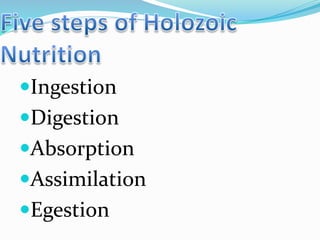
Ingestion 
Digestion 
Absorption 
Assimilation 
Egestion
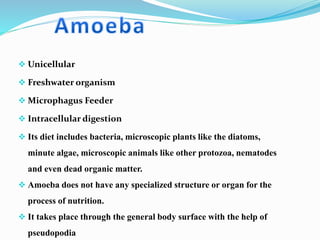
 Unicellular 
 Freshwater organism 
 Microphagus Feeder 
 Intracellular digestion 
 Its diet includes bacteria, microscopic plants like the diatoms, 
minute algae, microscopic animals like other protozoa, nematodes 
and even dead organic matter. 
 Amoeba does not have any specialized structure or organ for the 
process of nutrition. 
 It takes place through the general body surface with the help of 
pseudopodia
Amoeba
Structure of Amoeba 
The amoeba belongs to the kingdom Protista 
. The name amoeba comes from the greek word amoibe, which means 
change. 
The amoeba is a single celled microscopic organism (about 0.3 mm across). 
 It has cytoplasm, nucleus, cell membrane and a variety of inclusions in the 
cytoplasm and exhibits all the essential functions of any living organism. 
They are found in fresh water (like puddle and ponds), salty water, 
wet soil and in animals.
Structure of Amoeba (cont…) 
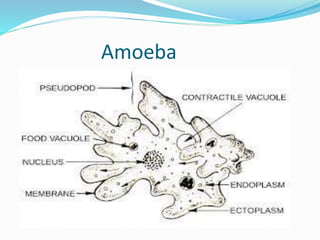
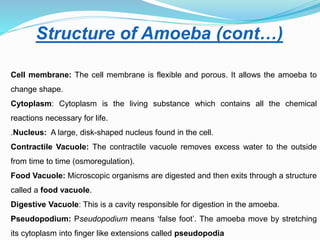
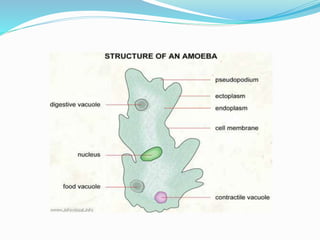
Cell membrane: The cell membrane is flexible and porous. It allows the amoeba to 
change shape. 
Cytoplasm: Cytoplasm is the living substance which contains all the chemical 
reactions necessary for life. 
.Nucleus: A large, disk-shaped nucleus found in the cell. 
Contractile Vacuole: The contractile vacuole removes excess water to the outside 
from time to time (osmoregulation). 
Food Vacuole: Microscopic organisms are digested and then exits through a structure 
called a food vacuole. 
Digestive Vacuole: This is a cavity responsible for digestion in the amoeba. 
Pseudopodium: Pseudopodium means ‘false foot’. The amoeba move by stretching 
its cytoplasm into finger like extensions called pseudopodia
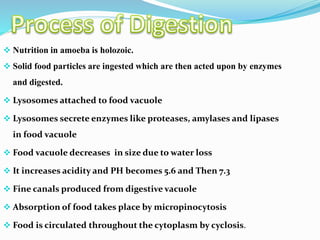
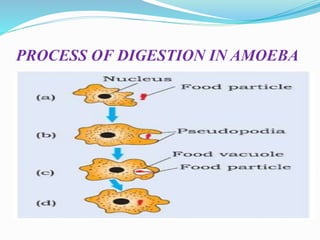
 Nutrition in amoeba is holozoic. 
 Solid food particles are ingested which are then acted upon by enzymes 
and digested. 
 Lysosomes attached to food vacuole 
 Lysosomes secrete enzymes like proteases, amylases and lipases 
in food vacuole 
 Food vacuole decreases in size due to water loss 
 It increases acidity and PH becomes 5.6 and Then 7.3 
 Fine canals produced from digestive vacuole 
 Absorption of food takes place by micropinocytosis 
 Food is circulated throughout the cytoplasm by cyclosis.
PROCESS OF DIGESTION IN AMOEBA
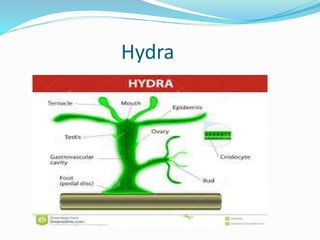
Hydra
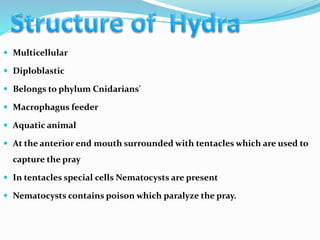
 Multicellular 
 Diploblastic 
 Belongs to phylum Cnidarians' 
 Macrophagus feeder 
 Aquatic animal 
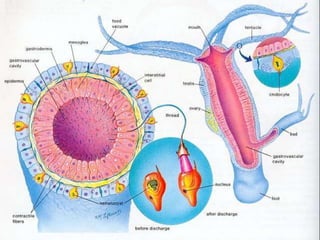
 At the anterior end mouth surrounded with tentacles which are used to 
capture the pray 
 In tentacles special cells Nematocysts are present 
 Nematocysts contains poison which paralyze the pray.
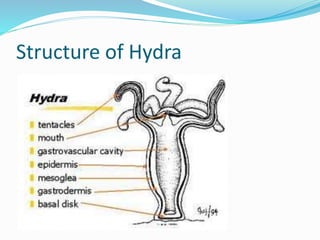
Structure of Hydra
 The mouth of hydra opens into a cavity called gastrocoel or 
enteron. 
 The endoderm contains two types of cells, glandular and 
flagellated. 
 Glandular cells secrete proteolytic enzymes , which are helpful in 
digestion 
 The flagellated cells and contraction of body wall also help in 
digestion 
 Hydra cannot digest starch. 
 The digestion is extracellular as well as intracellular
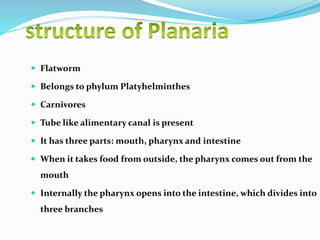
 Flatworm 
 Belongs to phylum Platyhelminthes 
 Carnivores 
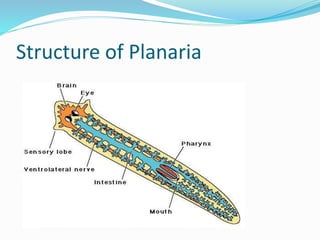
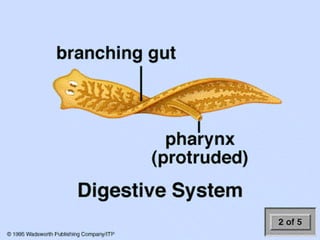
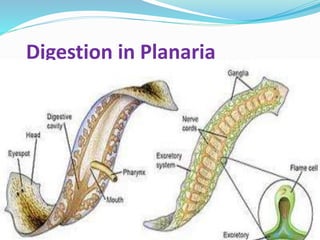
 Tube like alimentary canal is present 
 It has three parts: mouth, pharynx and intestine 
 When it takes food from outside, the pharynx comes out from the 
mouth 
 Internally the pharynx opens into the intestine, which divides into 
three branches
Structure of Planaria
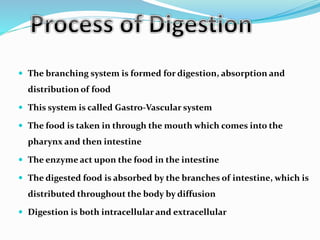
 The branching system is formed for digestion, absorption and 
distribution of food 
 This system is called Gastro-Vascular system 
 The food is taken in through the mouth which comes into the 
pharynx and then intestine 
 The enzyme act upon the food in the intestine 
 The digested food is absorbed by the branches of intestine, which is 
distributed throughout the body by diffusion 
 Digestion is both intracellular and extracellular
Digestion in Planaria
conclusion 
 The process of intake of food and its conversion into 
living protoplasm in cells 
 Most of the lower animal that possess hetrotrophic 
nutrition 
 Amoeba, Hydra ,and Planaria each one possess 
different mode of nutrition
Quiz paper 
 Q1: The nutrition which is obtained by digesting organic compounds is called as 
 Holozoic 
 Heterotrophic 
 Autographs 
 Saprotrophs 
 Q2: There are five steps of holozoic nutrition: Ingestion, digestion, absorption , 
assimilation and egestion. 
 True 
 False 
 Q3: The digestion in hydra is _______________ as well as ___ 
 Q4: In tentacles special cells called _______________ are present 
 Q5: The process of ingestion takes place by _______________ in amoeba.
References 
SCERT Text Book of Standard VIII 
www.Google.com 
www.Youtube.com
Ppt stephin

Ppt stephin

  • 1.
    Prepared by Stephin.S Natural science KUCTE Kumarapuram
  • 3.
    Nutrition in differentlower animals like Nutrition in Amoeba Nutrition in Hydra Nutrition in Planaria
  • 4.
    Nutrition also callednourishment or aliment is the provision, to cells andorganisms, of the materials necessary (in the form of food) to support life. Many common health problems can be prevented or alleviated with a healthy diet.
  • 5.
    Nutrition: The processof intake of food and its conversion into living protoplasm in cells. • Autotrophs- Organisms which can prepare their food • Heterotrophs- Organism which cannot prepare their own food due to lack of chlorophyll.
  • 6.
    It is thenutrition obtained by digesting organic compounds. Animals, fungi, many prokaryotes and protoctists are unable to synthesize organic compounds to use as food, They are called heterotrophs
  • 7.
    Types of HeterotrophicNutrition Holozoic nutrition Complex food is taken into a specialist digestive system and broken down into small pieces to be absorbed. Saprotrophitic nutrition Organisms feed on dead organic remains of other organisms.
  • 8.
    Parasitism Organisms obtainfood from other living organisms (the host), with the host receiving no benefit from the parasite. Mutualism A symbiotic relationship between organisms, with each contributing and benefiting from each other.
  • 9.
     Holozoic nutrition(Gr. holo, whole + zoikos, of animals) is a method of nutrition that involves the ingestion of liquid or solid organic material, digestion, absorption and assimilation of it to utilize it.  This method suggests phagocytosis where the cell membrane completely surrounds the food particle(engulfing of food material)
  • 10.
    Ingestion Digestion Absorption Assimilation Egestion
  • 11.
     Unicellular Freshwater organism  Microphagus Feeder  Intracellular digestion  Its diet includes bacteria, microscopic plants like the diatoms, minute algae, microscopic animals like other protozoa, nematodes and even dead organic matter.  Amoeba does not have any specialized structure or organ for the process of nutrition.  It takes place through the general body surface with the help of pseudopodia
  • 12.
  • 13.
    Structure of Amoeba The amoeba belongs to the kingdom Protista . The name amoeba comes from the greek word amoibe, which means change. The amoeba is a single celled microscopic organism (about 0.3 mm across).  It has cytoplasm, nucleus, cell membrane and a variety of inclusions in the cytoplasm and exhibits all the essential functions of any living organism. They are found in fresh water (like puddle and ponds), salty water, wet soil and in animals.
  • 14.
    Structure of Amoeba(cont…) Cell membrane: The cell membrane is flexible and porous. It allows the amoeba to change shape. Cytoplasm: Cytoplasm is the living substance which contains all the chemical reactions necessary for life. .Nucleus: A large, disk-shaped nucleus found in the cell. Contractile Vacuole: The contractile vacuole removes excess water to the outside from time to time (osmoregulation). Food Vacuole: Microscopic organisms are digested and then exits through a structure called a food vacuole. Digestive Vacuole: This is a cavity responsible for digestion in the amoeba. Pseudopodium: Pseudopodium means ‘false foot’. The amoeba move by stretching its cytoplasm into finger like extensions called pseudopodia
  • 16.
     Nutrition inamoeba is holozoic.  Solid food particles are ingested which are then acted upon by enzymes and digested.  Lysosomes attached to food vacuole  Lysosomes secrete enzymes like proteases, amylases and lipases in food vacuole  Food vacuole decreases in size due to water loss  It increases acidity and PH becomes 5.6 and Then 7.3  Fine canals produced from digestive vacuole  Absorption of food takes place by micropinocytosis  Food is circulated throughout the cytoplasm by cyclosis.
  • 17.
  • 18.
  • 19.
     Multicellular Diploblastic  Belongs to phylum Cnidarians'  Macrophagus feeder  Aquatic animal  At the anterior end mouth surrounded with tentacles which are used to capture the pray  In tentacles special cells Nematocysts are present  Nematocysts contains poison which paralyze the pray.
  • 20.
  • 21.
     The mouthof hydra opens into a cavity called gastrocoel or enteron.  The endoderm contains two types of cells, glandular and flagellated.  Glandular cells secrete proteolytic enzymes , which are helpful in digestion  The flagellated cells and contraction of body wall also help in digestion  Hydra cannot digest starch.  The digestion is extracellular as well as intracellular
  • 23.
     Flatworm Belongs to phylum Platyhelminthes  Carnivores  Tube like alimentary canal is present  It has three parts: mouth, pharynx and intestine  When it takes food from outside, the pharynx comes out from the mouth  Internally the pharynx opens into the intestine, which divides into three branches
  • 24.
  • 25.
     The branchingsystem is formed for digestion, absorption and distribution of food  This system is called Gastro-Vascular system  The food is taken in through the mouth which comes into the pharynx and then intestine  The enzyme act upon the food in the intestine  The digested food is absorbed by the branches of intestine, which is distributed throughout the body by diffusion  Digestion is both intracellular and extracellular
  • 27.
  • 28.
    conclusion  Theprocess of intake of food and its conversion into living protoplasm in cells  Most of the lower animal that possess hetrotrophic nutrition  Amoeba, Hydra ,and Planaria each one possess different mode of nutrition
  • 29.
    Quiz paper Q1: The nutrition which is obtained by digesting organic compounds is called as  Holozoic  Heterotrophic  Autographs  Saprotrophs  Q2: There are five steps of holozoic nutrition: Ingestion, digestion, absorption , assimilation and egestion.  True  False  Q3: The digestion in hydra is _______________ as well as ___  Q4: In tentacles special cells called _______________ are present  Q5: The process of ingestion takes place by _______________ in amoeba.
  • 30.
    References SCERT TextBook of Standard VIII www.Google.com www.Youtube.com