Effect of Mobile Phone to the Academic
Performance of Grade 11 Archimedes
Student: Development of Mobile
Learning through Instructional
Materials
PRESENTER: GROUP 1
GENERALACADEMIC STRAND
GROUP MEMBERS:
RIZZA MAE CABUSAS BANDIOLA
JOSHUA GOMURIT BATISTING
JEANETTE GOMEZ BONION
RUCHIE CASUMPANG CADENAS
SOPHIA KATHLEEN LACERNA CORTON
EJ LYKA BUSTALIÑO DALUMPINES
CHELOU SERDEÑA FELECIDARIO
REXIL JEAN TUGA-OB GODIO
KURT JHON TAPIA HONOR
JOEBERT JR. TRIO LOMOTOS
EMMABEL BELTRAN MARTINEZ
ALEXANDER JAMITO NIEGAS
MARINA PABIA
AICRIS OCARIZ ROCERO
ROGELIO JR. ARTOS SILFAVAN
OLIVER BARRIOS TRIO
ABSTRACT
The research presented focused on the effect of mobile phone usage on the academic performance of
the students. The research design used in this study is qualitative research that uses a descriptive
correlational technique because it's aimed at finding out the effect of mobile phone use among students
and determining whether it has a positive or negative impact on academic performance. The researcher
provided a questionnaire on how mobile phones affect their academic performance. A survey was
conducted among 12 males and 20 females for a total of 32 students in Grade 11 Gas Archimedes of
Lucena National High School, Lucena Prosperidad Agusan del Sur. This study provides and interprets the
respondents answers through a narrative analysis. The findings of the study suggest that mobile phone
usage affects the academic performance of students as they stick to this device during their classes. Also,
the results indicate that mobile phone usage has a positive and negative impact on the students
performance and ability to manage themselves when the students use mobile phones for educational
purposes.
INTRODUCTION:
Humans have always desired communication or solution to make their lives simpler because being able to
communicate from a distance is crucial to humankind. The majority of people become heavily reliant on them.
Mobile phone are widely use in our educational institutions and quite popular among young people.
Mobile phone quickly gained popularity in the 1990’s and since then, they have practically become a need in
daily life (Aoki & Downess, 2003). A national survey, cellphones are the most important form of communication.
Cellphones are a vital part of students lives. Since cellphone technology continuous to advance quickly, it seems
to be helping pupils learn and achieve better academics results.
In addition to talking on the phone during class, people also frequently used their phones to browse the
internet, take screenshots of texts, and cheat on quizzes and exams. It also aims to identify the effect and
instance of mobile phone use among students and determine whether this use has a positive or negative impact
on student’s academic performance. Yet, the use of mobile phone device allows pupils to mix up their jobs,
distracting them and upsetting their academic environment. (George, 2002). The cellphone has the potential to
undermine the authority of the schools, decrease its ability to exert control over pupils, and an impact on the
academic achievement of those kids.
CHAPTTER 1
The following are the specific questions that the researcher hopes to answer:
1. What are the positive effect of mobile phone to the academic performance of
Grade 11 Archimedes Student in Lucena National High School, Lucena,
Prosperidad, Agusan del Sur?
2. What are the negative effect of mobile phone to the academic performance of
Grade 11 Archimedes Student in Lucena National High School, Lucena,
Prosperidad, Agusan del Sur?
3. What is the reason why student can’t put their phones away during classes?
STATEMENT OF THE PROBLEM
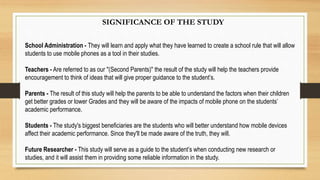
SIGNIFICANCE OF THE STUDY
School Administration - They will learn and apply what they have learned to create a school rule that will allow
students to use mobile phones as a tool in their studies.
Teachers - Are referred to as our "(Second Parents)" the result of the study will help the teachers provide
encouragement to think of ideas that will give proper guidance to the student’s.
Parents - The result of this study will help the parents to be able to understand the factors when their children
get better grades or lower Grades and they will be aware of the impacts of mobile phone on the students’
academic performance.
Students - The study's biggest beneficiaries are the students who will better understand how mobile devices
affect their academic performance. Since they'll be made aware of the truth, they will.
Future Researcher - This study will serve as a guide to the student’s when conducting new research or
studies, and it will assist them in providing some reliable information in the study.
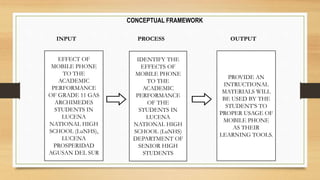
CONCEPTUAL FRAMEWORK
INPUT PROCESS OUTPUT
EFFECT OF
MOBILE PHONE
TO THE
ACADEMIC
PERFORMANCE
OF GRADE 11 GAS
ARCHIMEDES
STUDENTS IN
LUCENA
NATIONAL HIGH
SCHOOL (LuNHS),
LUCENA
PROSPERIDAD
AGUSAN DEL SUR
IDENTIFY THE
EFFECTS OF
MOBILE PHONE
TO THE
ACADEMIC
PERFORMANCE
OF THE
STUDENTS IN
LUCENA
NATIONAL HIGH
SCHOOL (LuNHS)
DEPARTMENT OF
SENIOR HIGH
STUDENTS
PROVIDE AN
INTRUCTIONAL
MATERIALS WILL
BE USED BY THE
STUDENT’S TO
PROPER USAGE OF
MOBILE PHONE
AS THEIR
LEARNING TOOLS.
SCOPE AND DELIMITATIONS
This research focuses on the effects of mobile phone to the academic performance of
Grade 11 Gas students, Section Archimedes, in LUCENA NATIONAL HIGH SCHOOL
(LuNHS), Lucena, Prosperidad Agusan Del Sur. It is delimited on determining the positive and
negative effects of mobile phone, and the reason why students can’t put away their phone
during class
CHAPTER 2
REVIEW OF RELATED LITERATURE
One of the new technologies with the greatest rate of growth is the mobile phone. Less than one billion people had
cellphone in 2001. Thus, the growing use of cellphones and smart phones in recent years has drown study interest. People
have varied feeling about cellphones. Phones, according to teenagers, make their life easier and safer. However, he also
mention recent conflicts brought on by cell phones use ( Pew research center, 2010).
Higher education has always had as its main objective working and learning together in ways that improve the world. The
work of Bransford et al, (2000) provides more justification for the axioms. Their knowledge centered, learner-centered,
assessment-centered and community-centered components make up their paradigm for successful teaching and learning.
In mobile learning, where students continuously expand their knowledge, learners can receive regular development,
claim Shaples et al, (2005). Students can get information and many other resources by using portable devices expertise of a
particular area. The students can also in corporate prior information from many academic contexts, such as books and ideas
into their new learnings.
In one of the earlier studies on the subject, Bianchi & Phillips (2005) suggested that excessive mobile phone use could
be a sign of depression or an issue with impulse control. According to Choliz (2010), dependence on and excessive use of cell
phones should be seen as an additive disorder. Research identified various areas of interest and teased them out to address
some of the challenges related to cell phones.
CHAPTER 3
I. RESEARCH DESIGN
This study is qualitative research that mainly used the descriptive-correlational design. It is descriptive because it aims to
find out how does mobile phone affect the academic performance of the students. It is correlational because it seeks to find
out if there is a relationship between mobile phone usage and to academic performance of the student.
II. LOCALE OF THE STUDY
The Lucena Prosperidad, Agusan Del Sur National High School is the site of this study. As one of the greatest high
schools not just in Agusan Del Sur but also in the Philippines, it was picked by the researchers as the study located. In order to
better motivate their students, the researchers anticipated that this study might assist management.
III. RESPONDENTS
The participants in this study are 12 male and 20 female for the total of 32 students of Grade 11 Gas Section Archimedes
of Lucena National High School (LuNHS) in Lucena, Prosperidad Agusan Del Sur.
These participants are those who are affected by using mobile phones in their academic performance and who are
knowledgeable enough to respond to the issues raised in the present. They provided the information required by the
researchers by responding to the questionnaire that was provided to them.
METHODOLOGY
IV. RESEARCH INSTRUMENTS
The study made use of a questionnaires about the impact of mobile phone on academic
students at Lucena National High School (LuNHS). The research team employed as 10-item
quiz on using mobile phone as learning tools, and they also used a reviewer on the subject
before the question. Conducted an earlier study to evaluate the quiz’s validity.
V. DATA GATHERING PROCEDURE
The researchers in Lucena National High School, Lucena Prosperidad, Agusan Del Sur,
Philippines, sent a letter requesting permission from the head teacher, advisor, and practical
research coordinator to conduct a survey titled ‘’ Effect of Mobile Phone to The Academic
Performance of Grade 11 Archimedes’’.
4.2 SUMMARY
This study will be conducted to analyze the effect of mobile phones on the academic
performance of Grade 11 Archimedes students at Lucena National High School (LuNHS),
Lucena Prosperidad Agusan Del Sur. The research design in this study is qualitative research
that uses a descriptive correlational study because it aims to find out the effect of mobile
phone use among students and determine whether this use has a positive or negative impact
on their academic performance. This research provides a questionnaire to the Grade 11
Archimedes student about how mobile phones affect their academic performance. The
respondent writes the answer on a piece of paper that the researcher provides and interprets
the respondent’s answer through a narrative analysis.
CHAPTER 4
SUMMARY AND FINDINGS
4.3 FINDINGS
The following are the finding that obtained on the analysis and interpretation of data:
1.Based on the respondent’s answer, mobile phones give them a good effect on their academic performance by
making their schoolwork easier, especially researching information about their report and activities.
2.Other student’s use of mobile phones in class affected them negatively. Because of the dependency on mobile
phone applications like dictionaries.
3.In student performance, some students believe that using a mobile phone in class helps them get good grades,
while others also say that it lends to cause them to get lower grades.
4.Some students said that using a mobile phone in class is a distraction, especially during times of class
discussion, because of applications that their phones have like Facebook, Messenger, Online Games, and other
accesses.
5.The student also stated that their mobile phones catch their attention while studying their lessons, which can
affect their lack in learning.
6.Some other students feel that it’s good for them to know the limitations when it comes to
using a mobile phone in school.
7.Most of the students who point out that they can’t go to school without their mobile phone in
their backpack while others are more likely to go to school without their phone.
8.But some respondents said that their mobile phones did not affect their knowledge because
they could manage themselves in terms of the proper usage of their phones in school as a
learning tool.
9.The student also stated that using a mobile phone in class helped them get out of the lesson
that they couldn’t understand, especially when they felt asleep while the teacher lectured.
5.1 CONCLUSION
Based on the findings above the following conclusion are drawn:
1.It makes life much easier for student using mobile phone.
2.The student can explore new things in an enjoyable manner that going through whole books to find the desired
information, they can get access to any book or educational site at any of the day.
3.The student uses their smartphones to record the class lectures and photograph the instructions notes.
4.Students find a lot of educational apps in the smartphone’s app store for students at different levels of education.
5.Student can utilize a particular application to seek help in a subject they are struggling with.
6.Mobile phone has/have positively affected on their academic performance.
CHAPTER 5
CONCLUSION AND RECOMMENDATION
7.The use of mobile phone affects the lack of knowledge of some students.
8.The use of mobile phones disturbs some students when they are studying or while the teacher is discussing.
9.It is good to know the limitation of mobile phone use especially for students.
10.The students experienced second thoughts about what to do first because of the mobile phone.
11. The student experienced the dependency on their mobile phone for ding their school woks.
12. The student can’t go to school without the present of their mobile phone on their packet.
13. Using mobile phone help student get easier to access their activities and projects.
14. Mobile phone is very useful to the students’ daily lives.
15. Using mobile phone in class affect student in positive and negative impact to their grades and performances.
16. Mobile phones can make some students lazy.
5.2 RECOMMENDATION
This study has contributed to the understanding of students about the effects of mobile phones on their
academic performance. As the study progresses a few suggested areas for future studies are as follows:
1.This research needs further study about how mobile phones affect the mental, physical, and social behavior of
students when used for academic purposes.
2.What is the importance of self-management in times when mobile phones are used for academic achievement.
3.How mobile phones contribute to student daily lives in times of doing their projects and activities.
4.The influence of mobile phone applications on student performance.
5.In what aspects is more likely to develop student capacity and ability in times of using mobile phone?
6.Are the students using their mobile phones at school as their learning tools?
7.The problems that students are facing when it comes to the addiction to mobile phones.
8.Is that mobile phone having a big impact on the students’ ability to learn?
9.The research needs to embrace the 20th century learners of gadgets for the students of Lucena National High
School (LuNHS). Especially in Senior High School student.

PPT PR GROUP 1.pptx

  • 1.
    Effect of MobilePhone to the Academic Performance of Grade 11 Archimedes Student: Development of Mobile Learning through Instructional Materials PRESENTER: GROUP 1 GENERALACADEMIC STRAND
  • 2.
    GROUP MEMBERS: RIZZA MAECABUSAS BANDIOLA JOSHUA GOMURIT BATISTING JEANETTE GOMEZ BONION RUCHIE CASUMPANG CADENAS SOPHIA KATHLEEN LACERNA CORTON EJ LYKA BUSTALIÑO DALUMPINES CHELOU SERDEÑA FELECIDARIO REXIL JEAN TUGA-OB GODIO KURT JHON TAPIA HONOR JOEBERT JR. TRIO LOMOTOS EMMABEL BELTRAN MARTINEZ ALEXANDER JAMITO NIEGAS MARINA PABIA AICRIS OCARIZ ROCERO ROGELIO JR. ARTOS SILFAVAN OLIVER BARRIOS TRIO
  • 3.
    ABSTRACT The research presentedfocused on the effect of mobile phone usage on the academic performance of the students. The research design used in this study is qualitative research that uses a descriptive correlational technique because it's aimed at finding out the effect of mobile phone use among students and determining whether it has a positive or negative impact on academic performance. The researcher provided a questionnaire on how mobile phones affect their academic performance. A survey was conducted among 12 males and 20 females for a total of 32 students in Grade 11 Gas Archimedes of Lucena National High School, Lucena Prosperidad Agusan del Sur. This study provides and interprets the respondents answers through a narrative analysis. The findings of the study suggest that mobile phone usage affects the academic performance of students as they stick to this device during their classes. Also, the results indicate that mobile phone usage has a positive and negative impact on the students performance and ability to manage themselves when the students use mobile phones for educational purposes.
  • 4.
    INTRODUCTION: Humans have alwaysdesired communication or solution to make their lives simpler because being able to communicate from a distance is crucial to humankind. The majority of people become heavily reliant on them. Mobile phone are widely use in our educational institutions and quite popular among young people. Mobile phone quickly gained popularity in the 1990’s and since then, they have practically become a need in daily life (Aoki & Downess, 2003). A national survey, cellphones are the most important form of communication. Cellphones are a vital part of students lives. Since cellphone technology continuous to advance quickly, it seems to be helping pupils learn and achieve better academics results. In addition to talking on the phone during class, people also frequently used their phones to browse the internet, take screenshots of texts, and cheat on quizzes and exams. It also aims to identify the effect and instance of mobile phone use among students and determine whether this use has a positive or negative impact on student’s academic performance. Yet, the use of mobile phone device allows pupils to mix up their jobs, distracting them and upsetting their academic environment. (George, 2002). The cellphone has the potential to undermine the authority of the schools, decrease its ability to exert control over pupils, and an impact on the academic achievement of those kids. CHAPTTER 1
  • 5.
    The following arethe specific questions that the researcher hopes to answer: 1. What are the positive effect of mobile phone to the academic performance of Grade 11 Archimedes Student in Lucena National High School, Lucena, Prosperidad, Agusan del Sur? 2. What are the negative effect of mobile phone to the academic performance of Grade 11 Archimedes Student in Lucena National High School, Lucena, Prosperidad, Agusan del Sur? 3. What is the reason why student can’t put their phones away during classes? STATEMENT OF THE PROBLEM
  • 6.
    SIGNIFICANCE OF THESTUDY School Administration - They will learn and apply what they have learned to create a school rule that will allow students to use mobile phones as a tool in their studies. Teachers - Are referred to as our "(Second Parents)" the result of the study will help the teachers provide encouragement to think of ideas that will give proper guidance to the student’s. Parents - The result of this study will help the parents to be able to understand the factors when their children get better grades or lower Grades and they will be aware of the impacts of mobile phone on the students’ academic performance. Students - The study's biggest beneficiaries are the students who will better understand how mobile devices affect their academic performance. Since they'll be made aware of the truth, they will. Future Researcher - This study will serve as a guide to the student’s when conducting new research or studies, and it will assist them in providing some reliable information in the study.
  • 7.
    CONCEPTUAL FRAMEWORK INPUT PROCESSOUTPUT EFFECT OF MOBILE PHONE TO THE ACADEMIC PERFORMANCE OF GRADE 11 GAS ARCHIMEDES STUDENTS IN LUCENA NATIONAL HIGH SCHOOL (LuNHS), LUCENA PROSPERIDAD AGUSAN DEL SUR IDENTIFY THE EFFECTS OF MOBILE PHONE TO THE ACADEMIC PERFORMANCE OF THE STUDENTS IN LUCENA NATIONAL HIGH SCHOOL (LuNHS) DEPARTMENT OF SENIOR HIGH STUDENTS PROVIDE AN INTRUCTIONAL MATERIALS WILL BE USED BY THE STUDENT’S TO PROPER USAGE OF MOBILE PHONE AS THEIR LEARNING TOOLS.
  • 8.
    SCOPE AND DELIMITATIONS Thisresearch focuses on the effects of mobile phone to the academic performance of Grade 11 Gas students, Section Archimedes, in LUCENA NATIONAL HIGH SCHOOL (LuNHS), Lucena, Prosperidad Agusan Del Sur. It is delimited on determining the positive and negative effects of mobile phone, and the reason why students can’t put away their phone during class
  • 9.
    CHAPTER 2 REVIEW OFRELATED LITERATURE One of the new technologies with the greatest rate of growth is the mobile phone. Less than one billion people had cellphone in 2001. Thus, the growing use of cellphones and smart phones in recent years has drown study interest. People have varied feeling about cellphones. Phones, according to teenagers, make their life easier and safer. However, he also mention recent conflicts brought on by cell phones use ( Pew research center, 2010). Higher education has always had as its main objective working and learning together in ways that improve the world. The work of Bransford et al, (2000) provides more justification for the axioms. Their knowledge centered, learner-centered, assessment-centered and community-centered components make up their paradigm for successful teaching and learning. In mobile learning, where students continuously expand their knowledge, learners can receive regular development, claim Shaples et al, (2005). Students can get information and many other resources by using portable devices expertise of a particular area. The students can also in corporate prior information from many academic contexts, such as books and ideas into their new learnings. In one of the earlier studies on the subject, Bianchi & Phillips (2005) suggested that excessive mobile phone use could be a sign of depression or an issue with impulse control. According to Choliz (2010), dependence on and excessive use of cell phones should be seen as an additive disorder. Research identified various areas of interest and teased them out to address some of the challenges related to cell phones.
  • 10.
    CHAPTER 3 I. RESEARCHDESIGN This study is qualitative research that mainly used the descriptive-correlational design. It is descriptive because it aims to find out how does mobile phone affect the academic performance of the students. It is correlational because it seeks to find out if there is a relationship between mobile phone usage and to academic performance of the student. II. LOCALE OF THE STUDY The Lucena Prosperidad, Agusan Del Sur National High School is the site of this study. As one of the greatest high schools not just in Agusan Del Sur but also in the Philippines, it was picked by the researchers as the study located. In order to better motivate their students, the researchers anticipated that this study might assist management. III. RESPONDENTS The participants in this study are 12 male and 20 female for the total of 32 students of Grade 11 Gas Section Archimedes of Lucena National High School (LuNHS) in Lucena, Prosperidad Agusan Del Sur. These participants are those who are affected by using mobile phones in their academic performance and who are knowledgeable enough to respond to the issues raised in the present. They provided the information required by the researchers by responding to the questionnaire that was provided to them. METHODOLOGY
  • 11.
    IV. RESEARCH INSTRUMENTS Thestudy made use of a questionnaires about the impact of mobile phone on academic students at Lucena National High School (LuNHS). The research team employed as 10-item quiz on using mobile phone as learning tools, and they also used a reviewer on the subject before the question. Conducted an earlier study to evaluate the quiz’s validity. V. DATA GATHERING PROCEDURE The researchers in Lucena National High School, Lucena Prosperidad, Agusan Del Sur, Philippines, sent a letter requesting permission from the head teacher, advisor, and practical research coordinator to conduct a survey titled ‘’ Effect of Mobile Phone to The Academic Performance of Grade 11 Archimedes’’.
  • 12.
    4.2 SUMMARY This studywill be conducted to analyze the effect of mobile phones on the academic performance of Grade 11 Archimedes students at Lucena National High School (LuNHS), Lucena Prosperidad Agusan Del Sur. The research design in this study is qualitative research that uses a descriptive correlational study because it aims to find out the effect of mobile phone use among students and determine whether this use has a positive or negative impact on their academic performance. This research provides a questionnaire to the Grade 11 Archimedes student about how mobile phones affect their academic performance. The respondent writes the answer on a piece of paper that the researcher provides and interprets the respondent’s answer through a narrative analysis. CHAPTER 4 SUMMARY AND FINDINGS
  • 13.
    4.3 FINDINGS The followingare the finding that obtained on the analysis and interpretation of data: 1.Based on the respondent’s answer, mobile phones give them a good effect on their academic performance by making their schoolwork easier, especially researching information about their report and activities. 2.Other student’s use of mobile phones in class affected them negatively. Because of the dependency on mobile phone applications like dictionaries. 3.In student performance, some students believe that using a mobile phone in class helps them get good grades, while others also say that it lends to cause them to get lower grades. 4.Some students said that using a mobile phone in class is a distraction, especially during times of class discussion, because of applications that their phones have like Facebook, Messenger, Online Games, and other accesses. 5.The student also stated that their mobile phones catch their attention while studying their lessons, which can affect their lack in learning.
  • 14.
    6.Some other studentsfeel that it’s good for them to know the limitations when it comes to using a mobile phone in school. 7.Most of the students who point out that they can’t go to school without their mobile phone in their backpack while others are more likely to go to school without their phone. 8.But some respondents said that their mobile phones did not affect their knowledge because they could manage themselves in terms of the proper usage of their phones in school as a learning tool. 9.The student also stated that using a mobile phone in class helped them get out of the lesson that they couldn’t understand, especially when they felt asleep while the teacher lectured.
  • 15.
    5.1 CONCLUSION Based onthe findings above the following conclusion are drawn: 1.It makes life much easier for student using mobile phone. 2.The student can explore new things in an enjoyable manner that going through whole books to find the desired information, they can get access to any book or educational site at any of the day. 3.The student uses their smartphones to record the class lectures and photograph the instructions notes. 4.Students find a lot of educational apps in the smartphone’s app store for students at different levels of education. 5.Student can utilize a particular application to seek help in a subject they are struggling with. 6.Mobile phone has/have positively affected on their academic performance. CHAPTER 5 CONCLUSION AND RECOMMENDATION
  • 16.
    7.The use ofmobile phone affects the lack of knowledge of some students. 8.The use of mobile phones disturbs some students when they are studying or while the teacher is discussing. 9.It is good to know the limitation of mobile phone use especially for students. 10.The students experienced second thoughts about what to do first because of the mobile phone. 11. The student experienced the dependency on their mobile phone for ding their school woks. 12. The student can’t go to school without the present of their mobile phone on their packet. 13. Using mobile phone help student get easier to access their activities and projects. 14. Mobile phone is very useful to the students’ daily lives. 15. Using mobile phone in class affect student in positive and negative impact to their grades and performances. 16. Mobile phones can make some students lazy.
  • 17.
    5.2 RECOMMENDATION This studyhas contributed to the understanding of students about the effects of mobile phones on their academic performance. As the study progresses a few suggested areas for future studies are as follows: 1.This research needs further study about how mobile phones affect the mental, physical, and social behavior of students when used for academic purposes. 2.What is the importance of self-management in times when mobile phones are used for academic achievement. 3.How mobile phones contribute to student daily lives in times of doing their projects and activities. 4.The influence of mobile phone applications on student performance. 5.In what aspects is more likely to develop student capacity and ability in times of using mobile phone? 6.Are the students using their mobile phones at school as their learning tools? 7.The problems that students are facing when it comes to the addiction to mobile phones. 8.Is that mobile phone having a big impact on the students’ ability to learn? 9.The research needs to embrace the 20th century learners of gadgets for the students of Lucena National High School (LuNHS). Especially in Senior High School student.