Network
Presented to : Ma’am Tayyaba
Presented by: Faiza Afzal
Rimsha Azmat
Anum Khalid
Sheeza Kanwal
Qaswa Zahra
Mahnoor Azam
Contents:
• Network Topologies
• Transmission Media
• Internetworking Devices
Network Topologies
Introduction to Topology
• The layout of the wire and connected
devices in a network.
• The paths used by data transmissions.
• The way in which computers, printers or
other devices are connected.
Types of Topologies
• Bus Topology
• Ring Topology
• Star Topology
• Tree Topology
• Mesh Topology
Bus Topology
• Bus topology is the simplest topology and supports a small
number of computers.
• In a bus topology each computer or server is connected in
series to a single cable hence all the nodes share the same
communication channel.
Bus Topology
Conti…
Advantage
• Cheap and easy to use.
• It is less expensive.
• Requires less cable.
Disadvantage
• It only supports small
number of computers.
• If number of computers
increases, network speed
will slow down.
Ring Topology
• The ring topology is like a bus topology but the end of the
network is connected to the first node.
• Each computer is connected to the next computer in a ring.
The message transmits to each computer and passes
around the ring until it reaches the correct destination.
Ring Topology
Conti…
Advantage
• It is less expensive than
star topology.
• Rings topology is easy to
install.
Disadvantage
• The failure of one
computer in the ring can
affect the whole network.
• Adding or removing
computers affects the
whole network.
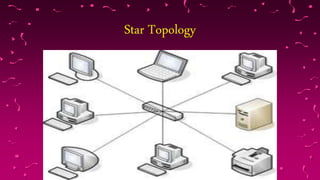
Star Topology
• All computers are connected with the central device like a
hub or switch.
• The sending computer sends the data to central device that
sends data to receiving computer.
• Each computer communicates with a central device called
hub.
Star Topology
Conti…
Advantages
• Easily expanded without
disturbing the network.
• Cable failure affects only a
single user.
• Finding the faults becomes
very simple.
Disadvantages
• Requires more cable.
• A central connecting
device allows for a single
point of failure.
• It is more expensive.
Thank you

Ppt on network topologies

  • 1.
  • 2.
    Presented to :Ma’am Tayyaba Presented by: Faiza Afzal Rimsha Azmat Anum Khalid Sheeza Kanwal Qaswa Zahra Mahnoor Azam
  • 3.
    Contents: • Network Topologies •Transmission Media • Internetworking Devices
  • 4.
  • 5.
    Introduction to Topology •The layout of the wire and connected devices in a network. • The paths used by data transmissions. • The way in which computers, printers or other devices are connected.
  • 6.
    Types of Topologies •Bus Topology • Ring Topology • Star Topology • Tree Topology • Mesh Topology
  • 7.
    Bus Topology • Bustopology is the simplest topology and supports a small number of computers. • In a bus topology each computer or server is connected in series to a single cable hence all the nodes share the same communication channel.
  • 8.
  • 9.
    Conti… Advantage • Cheap andeasy to use. • It is less expensive. • Requires less cable. Disadvantage • It only supports small number of computers. • If number of computers increases, network speed will slow down.
  • 10.
    Ring Topology • Thering topology is like a bus topology but the end of the network is connected to the first node. • Each computer is connected to the next computer in a ring. The message transmits to each computer and passes around the ring until it reaches the correct destination.
  • 11.
  • 12.
    Conti… Advantage • It isless expensive than star topology. • Rings topology is easy to install. Disadvantage • The failure of one computer in the ring can affect the whole network. • Adding or removing computers affects the whole network.
  • 13.
    Star Topology • Allcomputers are connected with the central device like a hub or switch. • The sending computer sends the data to central device that sends data to receiving computer. • Each computer communicates with a central device called hub.
  • 14.
  • 15.
    Conti… Advantages • Easily expandedwithout disturbing the network. • Cable failure affects only a single user. • Finding the faults becomes very simple. Disadvantages • Requires more cable. • A central connecting device allows for a single point of failure. • It is more expensive.
  • 16.