EMPOWERING VOICES:
A Journalism Training for School Paper
Advisers and Coaches
Venue
Date
ILLUSTRATING IDEAS: HANDS-ON
WORKSHOP FOR EDITORIAL
CARTOONING
ROLO B. ATENCIO
Pambujan National High School
Teacher III
Session Objectives
 Define editorial cartooning and its
significance.
 Identify the elements of an effective
editorial cartoon.
 Create a draft of an editorial cartoon
based on current social or political
issues
At the end of the session, the participants will be able to:
Professional Standards Covered
PPST:
Domain 7: Personal Growth and
Professional Development
Strand 5: Professional Development
Goals
Discussion Flow
Introduction to Editorial Cartooning
Characteristics of Effective
Editorial Cartoons
Elements of an Editorial Cartoon
Discussion Flow
Techniques and Tools for Cartooning
Tips and Ethical Standards in
Cartooning
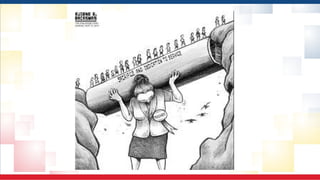
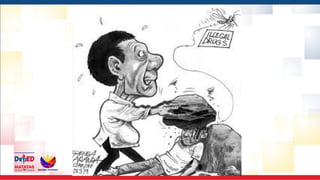
GUESS ME !
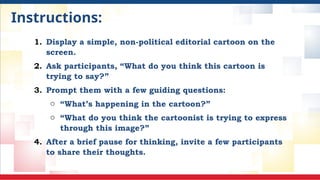
Instructions:
1. Display a simple, non-political editorial cartoon on the
screen.
2. Ask participants, “What do you think this cartoon is
trying to say?”
3. Prompt them with a few guiding questions:
o “What’s happening in the cartoon?”
o “What do you think the cartoonist is trying to express
through this image?”
4. After a brief pause for thinking, invite a few participants
to share their thoughts.
What’s happening in the cartoon?
ANALYSIS
What do you think the cartoonist is trying to
express through this image?
ABSTRACTION
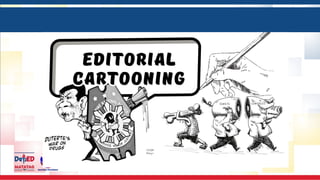
Editorial Cartooning is derived from two words:
Caricature – which means a sketch or a description
which exaggerates the peculiarities of a person or
defects of a thing.
Lampoon – which means a remark that attacks and
makes fun of a person in a more or less negative way.
Cartoon
 Visual interpretation of a news or issue through
illustration or caricature.
 Similar to Editorial Writing (both discuss timely issues)
 Similar to poster making (both use illustrations to convey
ideas)
 Difference from editorial article (medium is
artworks/illustrations)
 Difference from poster (simple, easy to understand)
The newspaper page reserved for the editorial
section also includes editorial cartoons.
Editorial cartoons are actually editorials in
pictorial form.
Editorial cartoons are almost anywhere in the
newspaper (it could be in the first page and editorial
page)
Editorial cartoons depict social, political,
economic, cultural and historical conditions.
Importance:
Communicates powerful messages
visually.
Simplifies complex issues.
Engages and influences public
opinion.
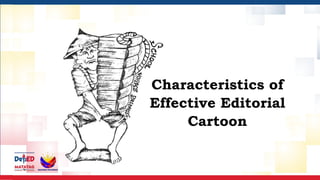
Characteristics of
Effective Editorial
Cartoon
It deals with a single idea.
It is humorous.
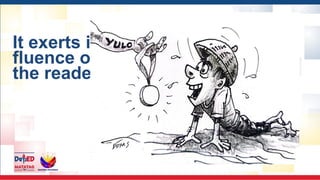
It exerts influence on the reade
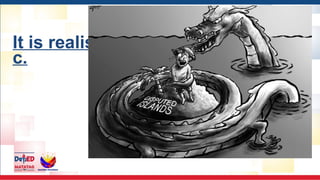
It is realistic.
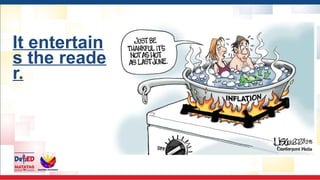
It entertains the reader.
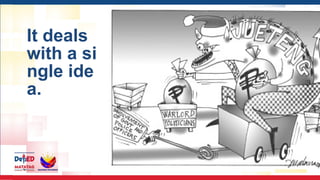
It deals
with a si
ngle ide
a.
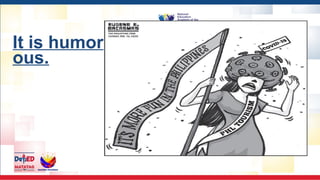
It is humor
ous.
It exerts in
fluence on
the reader.
It is realisti
c.
It entertain
s the reade
r.
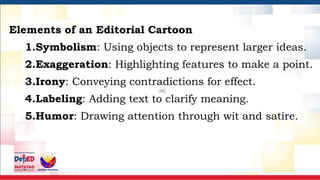
Elements of an Editorial Cartoon
1.Symbolism: Using objects to represent larger ideas.
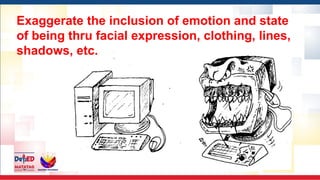
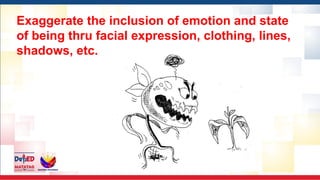
2.Exaggeration: Highlighting features to make a point.
3.Irony: Conveying contradictions for effect.
4.Labeling: Adding text to clarify meaning.
5.Humor: Drawing attention through wit and satire.
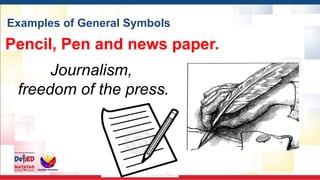
Examples of General Symbols
Pencil, Pen and news paper.
Journalism,
freedom of the press.
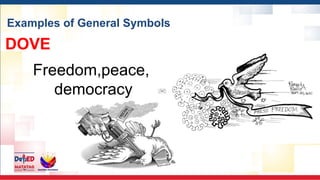
Examples of General Symbols
DOVE
Freedom,peace,
democracy
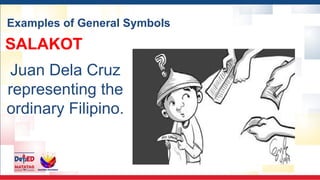
Examples of General Symbols
SALAKOT
Juan Dela Cruz
representing the
ordinary Filipino.
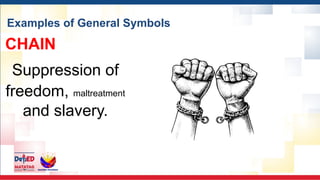
Examples of General Symbols
CHAIN
Suppression of
freedom, maltreatment
and slavery.
Examples of General Symbols
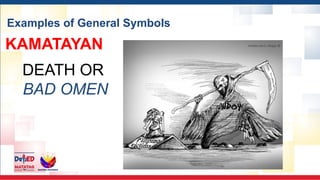
KAMATAYAN
DEATH OR
BAD OMEN
Examples of General Symbols
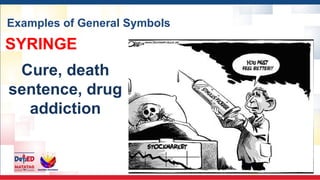
SYRINGE
Cure, death
sentence, drug
addiction
Examples of General Symbols
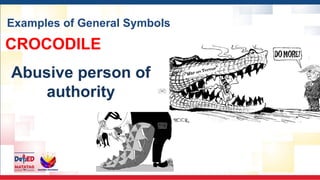
CROCODILE
Abusive person of
authority
Examples of General Symbols
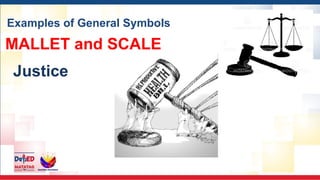
MALLET and SCALE
Justice
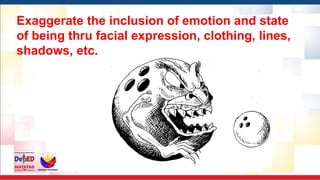
Exaggerate the inclusion of emotion and state
of being thru facial expression, clothing, lines,
shadows, etc.
Exaggerate the inclusion of emotion and state
of being thru facial expression, clothing, lines,
shadows, etc.
Exaggerate the inclusion of emotion and state
of being thru facial expression, clothing, lines,
shadows, etc.
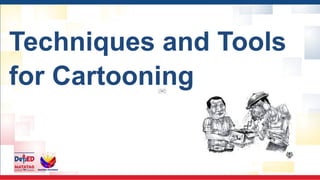
Techniques and Tools
for Cartooning
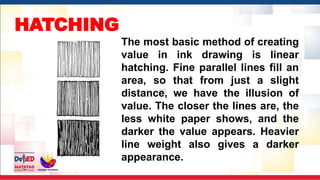
HATCHING
The most basic method of creating
value in ink drawing is linear
hatching. Fine parallel lines fill an
area, so that from just a slight
distance, we have the illusion of
value. The closer the lines are, the
less white paper shows, and the
darker the value appears. Heavier
line weight also gives a darker
appearance.
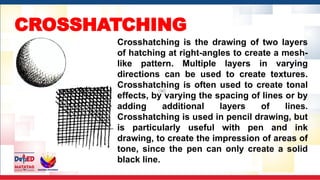
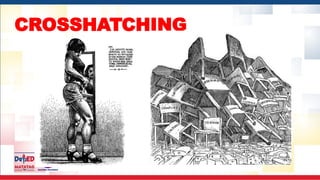
CROSSHATCHING
Crosshatching is the drawing of two layers
of hatching at right-angles to create a mesh-
like pattern. Multiple layers in varying
directions can be used to create textures.
Crosshatching is often used to create tonal
effects, by varying the spacing of lines or by
adding additional layers of lines.
Crosshatching is used in pencil drawing, but
is particularly useful with pen and ink
drawing, to create the impression of areas of
tone, since the pen can only create a solid
black line.
CROSSHATCHING
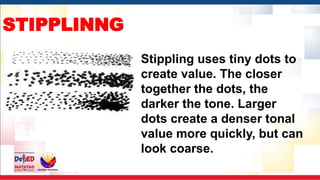
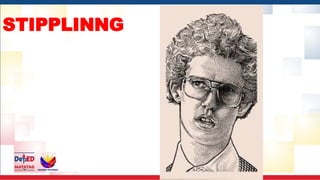
STIPPLINNG
Stippling uses tiny dots to
create value. The closer
together the dots, the
darker the tone. Larger
dots create a denser tonal
value more quickly, but can
look coarse.
STIPPLINNG
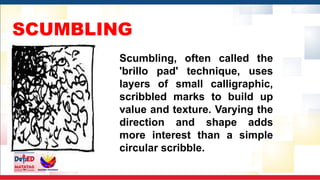
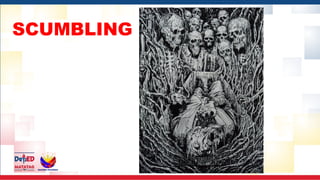
SCUMBLING
Scumbling, often called the
'brillo pad' technique, uses
layers of small calligraphic,
scribbled marks to build up
value and texture. Varying the
direction and shape adds
more interest than a simple
circular scribble.
SCUMBLING
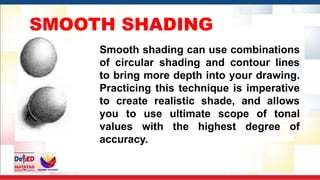
SMOOTH SHADING
Smooth shading can use combinations
of circular shading and contour lines
to bring more depth into your drawing.
Practicing this technique is imperative
to create realistic shade, and allows
you to use ultimate scope of tonal
values with the highest degree of
accuracy.
SMOOTH SHADING
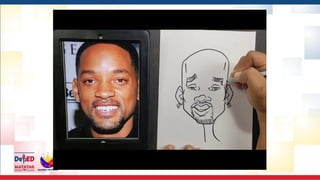
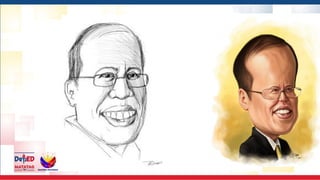
Caricature
• it is a rendered image showing the features of its subject
in a simplified or exaggerated way.
• It is a description of a person using exaggeration of some
characteristics.
• It is the satirical illustration of a person or a thing.
• It can be insulting or complimentary and can serve a
political purpose or be drawn solely for entertainment.
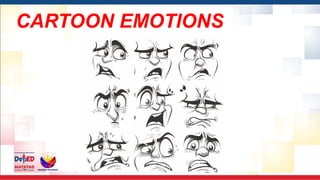
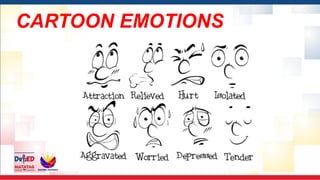
CARTOON EMOTIONS
CARTOON EMOTIONS
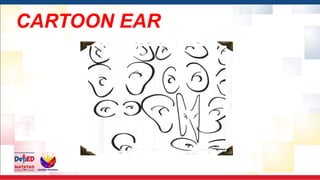
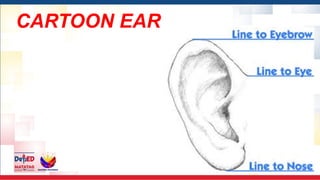
CARTOON EAR
CARTOON EAR
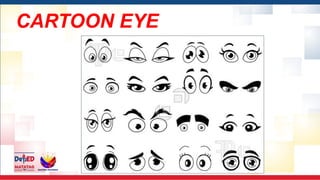
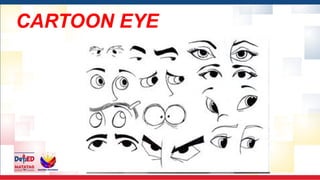
CARTOON EYE
CARTOON EYE
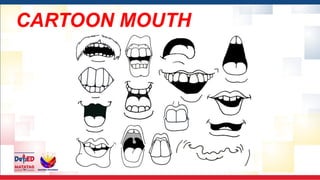
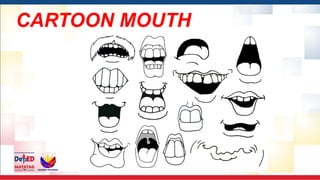
CARTOON MOUTH
CARTOON MOUTH
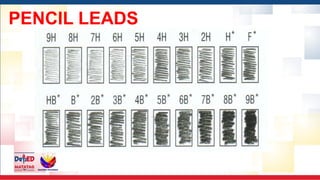
PENCIL LEADS
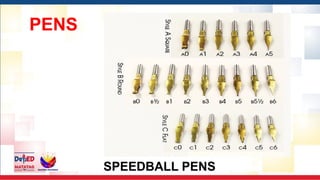
PENS
SPEEDBALL PENS
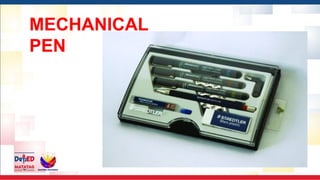
MECHANICAL
PEN
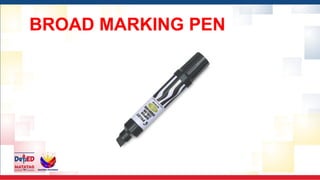
BROAD MARKING PEN
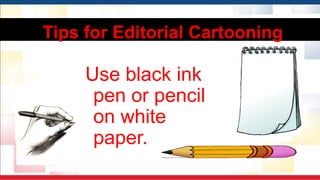
Use black ink
pen or pencil
on white
paper.
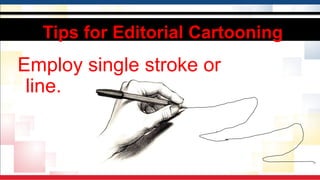
Tips for Editorial Cartooning
Employ single stroke or
line.
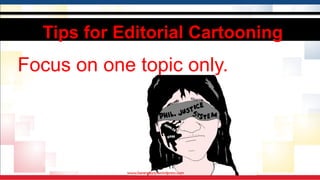
Tips for Editorial Cartooning
Focus on one topic only.
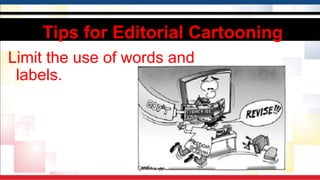
Tips for Editorial Cartooning
Limit the use of words and
labels.
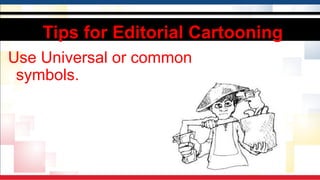
Tips for Editorial Cartooning
Use Universal or common
symbols.
Tips for Editorial Cartooning
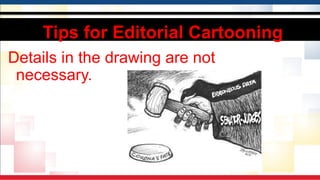
Details in the drawing are not
necessary.
Tips for Editorial Cartooning
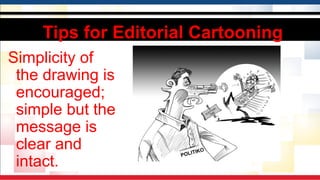
Simplicity of
the drawing is
encouraged;
simple but the
message is
clear and
intact.
Tips for Editorial Cartooning
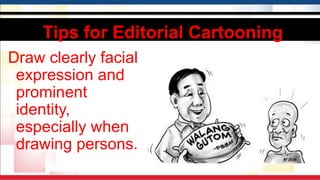
Draw clearly facial
expression and
prominent
identity,
especially when
drawing persons.
Tips for Editorial Cartooning
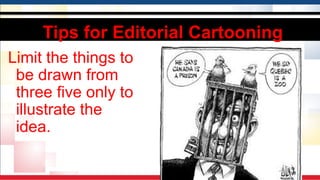
Limit the things to
be drawn from
three five only to
illustrate the
idea.
Ethical Standards in Cartooning
o Avoid defamation and discrimination.
o Ensure accuracy and fairness.
o Respect diverse opinions and sensibilities.
o Balance satire with responsibility.
ACTIVITY/FINAL OUTPUT
INSTRUCTIONS:
1. All participants will create their own editorial cartoon
about a current social or political issue (e.g., school rules,
environmental issues, or any topic of relevance to them).
2. Provide them with the following guidelines:
o The cartoon should include at least two of the core
elements discussed (e.g., symbolism, exaggeration,
irony).
o The message should be clear, and the cartoon should
use visual techniques to express an opinion or
perspective on the issue.
INSTRUCTIONS:
3. Allow participants for 30 minutes to brainstorm,
sketch, and finalize their cartoons. They can use
traditional tools, paper and markers or digital tools if
available.
4, After the allotted time, volunteers from the group
will explain the message and techniques they used
(e.g., "We used a broken chain to symbolize freedom" or
"The exaggerated face represents frustration over the
issue").
References
• Editorial Cartooning Handbook for Campus Journalists"
(2024 Edition)
• PARADOX: A GRAPHIC GUIDE ON EDITORIAL
CARTOONING 2023
• Philippine Professional Standards for Teachers (PPST).
“Cartoons may be drawn in jest, but
their messages are profound. Use
your artistry to inspire, provoke
thought, and illuminate truth.“
-Anonymous

PPT Editorial cartooning Campus Journalism

  • 1.
    EMPOWERING VOICES: A JournalismTraining for School Paper Advisers and Coaches Venue Date
  • 2.
    ILLUSTRATING IDEAS: HANDS-ON WORKSHOPFOR EDITORIAL CARTOONING ROLO B. ATENCIO Pambujan National High School Teacher III
  • 3.
    Session Objectives  Defineeditorial cartooning and its significance.  Identify the elements of an effective editorial cartoon.  Create a draft of an editorial cartoon based on current social or political issues At the end of the session, the participants will be able to:
  • 4.
    Professional Standards Covered PPST: Domain7: Personal Growth and Professional Development Strand 5: Professional Development Goals
  • 5.
    Discussion Flow Introduction toEditorial Cartooning Characteristics of Effective Editorial Cartoons Elements of an Editorial Cartoon
  • 6.
    Discussion Flow Techniques andTools for Cartooning Tips and Ethical Standards in Cartooning
  • 7.
  • 8.
    Instructions: 1. Display asimple, non-political editorial cartoon on the screen. 2. Ask participants, “What do you think this cartoon is trying to say?” 3. Prompt them with a few guiding questions: o “What’s happening in the cartoon?” o “What do you think the cartoonist is trying to express through this image?” 4. After a brief pause for thinking, invite a few participants to share their thoughts.
  • 10.
    What’s happening inthe cartoon? ANALYSIS
  • 11.
    What do youthink the cartoonist is trying to express through this image?
  • 12.
  • 14.
    Editorial Cartooning isderived from two words: Caricature – which means a sketch or a description which exaggerates the peculiarities of a person or defects of a thing. Lampoon – which means a remark that attacks and makes fun of a person in a more or less negative way.
  • 15.
    Cartoon  Visual interpretationof a news or issue through illustration or caricature.  Similar to Editorial Writing (both discuss timely issues)  Similar to poster making (both use illustrations to convey ideas)  Difference from editorial article (medium is artworks/illustrations)  Difference from poster (simple, easy to understand)
  • 16.
    The newspaper pagereserved for the editorial section also includes editorial cartoons. Editorial cartoons are actually editorials in pictorial form. Editorial cartoons are almost anywhere in the newspaper (it could be in the first page and editorial page) Editorial cartoons depict social, political, economic, cultural and historical conditions.
  • 17.
    Importance: Communicates powerful messages visually. Simplifiescomplex issues. Engages and influences public opinion.
  • 18.
  • 19.
    It deals witha single idea. It is humorous. It exerts influence on the reade It is realistic. It entertains the reader.
  • 20.
    It deals with asi ngle ide a.
  • 21.
  • 22.
    It exerts in fluenceon the reader.
  • 23.
  • 24.
  • 25.
    Elements of anEditorial Cartoon 1.Symbolism: Using objects to represent larger ideas. 2.Exaggeration: Highlighting features to make a point. 3.Irony: Conveying contradictions for effect. 4.Labeling: Adding text to clarify meaning. 5.Humor: Drawing attention through wit and satire.
  • 26.
    Examples of GeneralSymbols Pencil, Pen and news paper. Journalism, freedom of the press.
  • 27.
    Examples of GeneralSymbols DOVE Freedom,peace, democracy
  • 28.
    Examples of GeneralSymbols SALAKOT Juan Dela Cruz representing the ordinary Filipino.
  • 29.
    Examples of GeneralSymbols CHAIN Suppression of freedom, maltreatment and slavery.
  • 30.
    Examples of GeneralSymbols KAMATAYAN DEATH OR BAD OMEN
  • 31.
    Examples of GeneralSymbols SYRINGE Cure, death sentence, drug addiction
  • 32.
    Examples of GeneralSymbols CROCODILE Abusive person of authority
  • 33.
    Examples of GeneralSymbols MALLET and SCALE Justice
  • 34.
    Exaggerate the inclusionof emotion and state of being thru facial expression, clothing, lines, shadows, etc.
  • 35.
    Exaggerate the inclusionof emotion and state of being thru facial expression, clothing, lines, shadows, etc.
  • 36.
    Exaggerate the inclusionof emotion and state of being thru facial expression, clothing, lines, shadows, etc.
  • 37.
  • 38.
    HATCHING The most basicmethod of creating value in ink drawing is linear hatching. Fine parallel lines fill an area, so that from just a slight distance, we have the illusion of value. The closer the lines are, the less white paper shows, and the darker the value appears. Heavier line weight also gives a darker appearance.
  • 39.
    CROSSHATCHING Crosshatching is thedrawing of two layers of hatching at right-angles to create a mesh- like pattern. Multiple layers in varying directions can be used to create textures. Crosshatching is often used to create tonal effects, by varying the spacing of lines or by adding additional layers of lines. Crosshatching is used in pencil drawing, but is particularly useful with pen and ink drawing, to create the impression of areas of tone, since the pen can only create a solid black line.
  • 40.
  • 41.
    STIPPLINNG Stippling uses tinydots to create value. The closer together the dots, the darker the tone. Larger dots create a denser tonal value more quickly, but can look coarse.
  • 42.
  • 43.
    SCUMBLING Scumbling, often calledthe 'brillo pad' technique, uses layers of small calligraphic, scribbled marks to build up value and texture. Varying the direction and shape adds more interest than a simple circular scribble.
  • 44.
  • 45.
    SMOOTH SHADING Smooth shadingcan use combinations of circular shading and contour lines to bring more depth into your drawing. Practicing this technique is imperative to create realistic shade, and allows you to use ultimate scope of tonal values with the highest degree of accuracy.
  • 46.
  • 47.
    Caricature • it isa rendered image showing the features of its subject in a simplified or exaggerated way. • It is a description of a person using exaggeration of some characteristics. • It is the satirical illustration of a person or a thing. • It can be insulting or complimentary and can serve a political purpose or be drawn solely for entertainment.
  • 51.
  • 52.
  • 53.
  • 54.
  • 55.
  • 56.
  • 57.
  • 58.
  • 59.
  • 60.
  • 61.
  • 62.
  • 63.
    Use black ink penor pencil on white paper. Tips for Editorial Cartooning
  • 64.
    Tips for EditorialCartooning Employ single stroke or line.
  • 65.
    Tips for EditorialCartooning Focus on one topic only.
  • 66.
    Tips for EditorialCartooning Limit the use of words and labels.
  • 67.
    Tips for EditorialCartooning Use Universal or common symbols.
  • 68.
    Tips for EditorialCartooning Details in the drawing are not necessary.
  • 69.
    Tips for EditorialCartooning Simplicity of the drawing is encouraged; simple but the message is clear and intact.
  • 70.
    Tips for EditorialCartooning Draw clearly facial expression and prominent identity, especially when drawing persons.
  • 71.
    Tips for EditorialCartooning Limit the things to be drawn from three five only to illustrate the idea.
  • 72.
    Ethical Standards inCartooning o Avoid defamation and discrimination. o Ensure accuracy and fairness. o Respect diverse opinions and sensibilities. o Balance satire with responsibility.
  • 73.
  • 74.
    INSTRUCTIONS: 1. All participantswill create their own editorial cartoon about a current social or political issue (e.g., school rules, environmental issues, or any topic of relevance to them). 2. Provide them with the following guidelines: o The cartoon should include at least two of the core elements discussed (e.g., symbolism, exaggeration, irony). o The message should be clear, and the cartoon should use visual techniques to express an opinion or perspective on the issue.
  • 75.
    INSTRUCTIONS: 3. Allow participantsfor 30 minutes to brainstorm, sketch, and finalize their cartoons. They can use traditional tools, paper and markers or digital tools if available. 4, After the allotted time, volunteers from the group will explain the message and techniques they used (e.g., "We used a broken chain to symbolize freedom" or "The exaggerated face represents frustration over the issue").
  • 76.
    References • Editorial CartooningHandbook for Campus Journalists" (2024 Edition) • PARADOX: A GRAPHIC GUIDE ON EDITORIAL CARTOONING 2023 • Philippine Professional Standards for Teachers (PPST).
  • 77.
    “Cartoons may bedrawn in jest, but their messages are profound. Use your artistry to inspire, provoke thought, and illuminate truth.“ -Anonymous