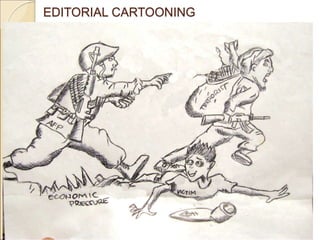
EDITORIAL CARTOONING
Editorial Cartooning
There are 10 Differences
Match the Difference
Editorial Cartooning
Match the Difference
Editorial Cartooning Tips
Cartoon not Poster
Criteria for Evaluating Editorial Cartoon
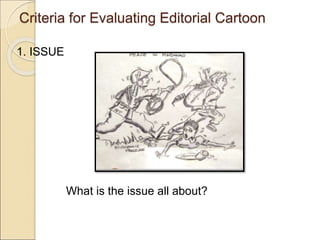
1. ISSUE
What is the issue all about?
Criteria for Evaluating Editorial Cartoon
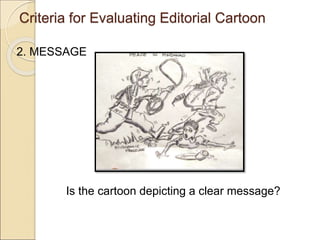
2. MESSAGE
Is the cartoon depicting a clear message?
Criteria for Evaluating Editorial Cartoon
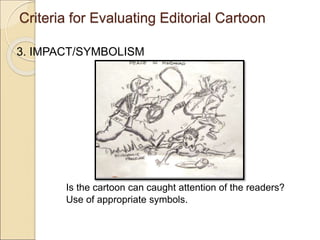
3. IMPACT/SYMBOLISM
Is the cartoon can caught attention of the readers?
Use of appropriate symbols.
Criteria for Evaluating Editorial Cartoon
4. HUMORS/EMOTIONS
Is the cartoonist using humors or emotions to
grab attention and interest of the readers?
Criteria for Evaluating Editorial Cartoon
HUMORS/EMOTIONS
Is the cartoon humorous or depicting emotions to
grab attention and interest of the readers?
Criteria for Evaluating Editorial Cartoon
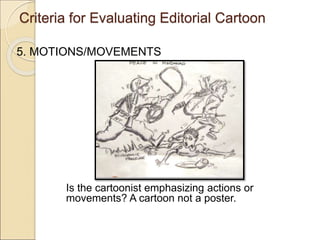
5. MOTIONS/MOVEMENTS
Is the cartoonist emphasizing actions or
movements? A cartoon not a poster.
10 Guidelines for Better Editorial Cartooning
1. Let your cartoon speak for itself.
2. Limit labels, instead use symbols.
3. Don’t use talk balloon. However, if it can’t be avoided, make sure the dialogue
is witty.
Don’t use the talk balloon to portray the obvious.
4. Avoid stereotyping along race, gender, and religion.
5. Editorial cartoons are gene rally satire (humorous) and paradoxical in nature.
But avoid poking fun at tragic scenarios specifically those which portray the
loss of innocent lives.
6. Don’t clutter your cartoon with too many different ideas. Decide on a single
point you want to execute.
7. Editorial cartoon should not be so shallow that it merely serves as an
illustration of the editorial essay nor too complicated that it cannot be
understood by the readers of Editorial page.
8. Editorial cartooning is a traditional art form that reflects your very own culture.
Avoid executing cartoons in manga style. Rather, try to develop your own
distinct style.
9. As much as possible, avoid joining any poster making contest.
10. Read always. Being informed of issues will help you conceptualize editorial
cartoons better.

EDITORIAL-CARTOONING.ppt

  • 1.
  • 2.
    Editorial Cartooning There are10 Differences Match the Difference
  • 3.
  • 4.
  • 5.
    Criteria for EvaluatingEditorial Cartoon 1. ISSUE What is the issue all about?
  • 6.
    Criteria for EvaluatingEditorial Cartoon 2. MESSAGE Is the cartoon depicting a clear message?
  • 7.
    Criteria for EvaluatingEditorial Cartoon 3. IMPACT/SYMBOLISM Is the cartoon can caught attention of the readers? Use of appropriate symbols.
  • 8.
    Criteria for EvaluatingEditorial Cartoon 4. HUMORS/EMOTIONS Is the cartoonist using humors or emotions to grab attention and interest of the readers?
  • 9.
    Criteria for EvaluatingEditorial Cartoon HUMORS/EMOTIONS Is the cartoon humorous or depicting emotions to grab attention and interest of the readers?
  • 10.
    Criteria for EvaluatingEditorial Cartoon 5. MOTIONS/MOVEMENTS Is the cartoonist emphasizing actions or movements? A cartoon not a poster.
  • 11.
    10 Guidelines forBetter Editorial Cartooning 1. Let your cartoon speak for itself. 2. Limit labels, instead use symbols. 3. Don’t use talk balloon. However, if it can’t be avoided, make sure the dialogue is witty. Don’t use the talk balloon to portray the obvious. 4. Avoid stereotyping along race, gender, and religion. 5. Editorial cartoons are gene rally satire (humorous) and paradoxical in nature. But avoid poking fun at tragic scenarios specifically those which portray the loss of innocent lives. 6. Don’t clutter your cartoon with too many different ideas. Decide on a single point you want to execute. 7. Editorial cartoon should not be so shallow that it merely serves as an illustration of the editorial essay nor too complicated that it cannot be understood by the readers of Editorial page. 8. Editorial cartooning is a traditional art form that reflects your very own culture. Avoid executing cartoons in manga style. Rather, try to develop your own distinct style. 9. As much as possible, avoid joining any poster making contest. 10. Read always. Being informed of issues will help you conceptualize editorial cartoons better.