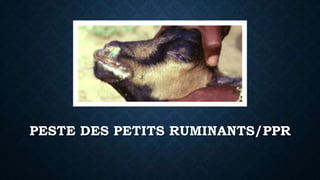
PESTE DES PETITS RUMINANTS/PPR
INTRODUCTION
• PPR is a French name which means GOAT
PLAGUE.
• It is also called KATA because KATA was named
given to stomatitis and pnemo enteritis in
Nigerian dwarf goats
• As PPR also cause stomatitis and pnemo enteritis
which is not clinically distinguishable from KATA
that’s why the name KATA is also given to PPR
ETIOLOGY
• Caused by PPR virus belongs to genus Morbilivirus,
family paramaxoviridae
• The virus shows similarities to rinderpest virus
• The virus is fragile and within few days outside the
host it is inactivated
• It has antigenic similarities with rinderpest virus,
canine distemper virus and measles in humans and
equine influenza virus.
• There is cross immunity between vaccines of
rinderpest and PPR.
EPIDEMIOLOGY
• WHO: small ruminants: goat, sheep and deer
• WHERE: Asia, Africa, Middle east
• When: no proper season
• Transmission: direct and close indirect contact
• All secretion and excretions are infectious
• MORBIDITY: 90%
• MORTILITY: 55-85% in goats and less than 10% in sheep
PATHOGENESIS
• Entry of virus through ingestion--- initial replication in
tonsils and retropharyngeal lymph nodes--- reach GIT
through blood-- virus replicates in GIT epithelium---
necrotic lesions appear in GIT---clinical signs and symptoms
appear.
DIAGNOSI
S
On the basis of clinical signs
Confirmatory diagnosis
It includes:
ELIZA
PCR
CFT
Tissue culture
Virus isolation
AGID
DIFFERENTIAL DIAGNOSIS
• FMD:
• DIFFERENTIAL POINTS:
• FMD is large ruminants disease mostly while PPR is a disease of small ruminants
• Diarrhea or dysentery and pneumonia occur in PPR
• No lesion in feet and lameness in PPR
CONT…
• RINDERPEST:
• DIFFERENTIAL POINTS:
• Shooting diarrhea in rinderpest
• Rinderpest effects both small and large
animals while PPR effects only small animals
• BLUE TONGUE:
• DIFFERENTIAL POINTS:
• BT causes lesions on coronary band and
lameness
• Bluish cynotic tongue appears in BT
CONT..
.
POX:
DIFFERENTIAL POINTS:
Whole body lesions are involve while
in PPR lesions are limited to mouth
In pox scabby lesions are formed and
they are catriform in nature, while in
PPR necrotic lesions are found in
mouth
CONT…
• ORF:
• DIFFERENTIAL POINTS:
• There will be no systemic signs like no fever and no diarrhea In orf
• Lesions will extend from mucocutanous junction of mouth and will spread further
• HEART WATER DISEASE:
• DIFFERENTIAL POINTS:
• There will be fluid accumulation in heart
• There will be nervous signs
• Ascites will be found in heart water disease
CONT…
• NAIROBI SHEEP DISEASE:
• DIFFERENTIAL POINTS:
• There will be hemorrhagic stomatitis in nairobi sheep
disease
• It is commonly occurs in sheep
• COCCIDIOSIS:
• DIFFERENTIAL POINTS:
• There will be copious bloody diarrhea
• No oral lesions
• Severe straining in coccidiosis
NECROPSY
FINDINGS
• Erosions and ulcers in GIT
• Zebra stripes in colon and rectum
• Lungs will be inflamed because of
pneumonia
• There will be lungs consolidation
and increase in lungs size, the color
will be bluish purple
TREATMENT
• Broad spectrum antibiotics:
• amoxicillin, enrofloxacillin, sulphonamide
along with trimethoprim {trade name
Tribetrol}
• Ceftiofer can also be use for lung infection and
pneumonia
• Hyper immune serum
• NSAIDS:
• Flunixin meglumin
• Fluid therapy:
• Ringer lactate
PREVENTION
• Quarantine measures
• Isolation of sick animals
• Vaccination
• Hygienic environment
• Restriction of animal movement
• Slaughtering and proper disposal of sick animals

Ppr

  • 2.
    PESTE DES PETITSRUMINANTS/PPR
  • 3.
    INTRODUCTION • PPR isa French name which means GOAT PLAGUE. • It is also called KATA because KATA was named given to stomatitis and pnemo enteritis in Nigerian dwarf goats • As PPR also cause stomatitis and pnemo enteritis which is not clinically distinguishable from KATA that’s why the name KATA is also given to PPR
  • 4.
    ETIOLOGY • Caused byPPR virus belongs to genus Morbilivirus, family paramaxoviridae • The virus shows similarities to rinderpest virus • The virus is fragile and within few days outside the host it is inactivated • It has antigenic similarities with rinderpest virus, canine distemper virus and measles in humans and equine influenza virus. • There is cross immunity between vaccines of rinderpest and PPR.
  • 5.
    EPIDEMIOLOGY • WHO: smallruminants: goat, sheep and deer • WHERE: Asia, Africa, Middle east • When: no proper season • Transmission: direct and close indirect contact • All secretion and excretions are infectious • MORBIDITY: 90% • MORTILITY: 55-85% in goats and less than 10% in sheep
  • 6.
    PATHOGENESIS • Entry ofvirus through ingestion--- initial replication in tonsils and retropharyngeal lymph nodes--- reach GIT through blood-- virus replicates in GIT epithelium--- necrotic lesions appear in GIT---clinical signs and symptoms appear.
  • 7.
    DIAGNOSI S On the basisof clinical signs Confirmatory diagnosis It includes: ELIZA PCR CFT Tissue culture Virus isolation AGID
  • 8.
    DIFFERENTIAL DIAGNOSIS • FMD: •DIFFERENTIAL POINTS: • FMD is large ruminants disease mostly while PPR is a disease of small ruminants • Diarrhea or dysentery and pneumonia occur in PPR • No lesion in feet and lameness in PPR
  • 9.
    CONT… • RINDERPEST: • DIFFERENTIALPOINTS: • Shooting diarrhea in rinderpest • Rinderpest effects both small and large animals while PPR effects only small animals • BLUE TONGUE: • DIFFERENTIAL POINTS: • BT causes lesions on coronary band and lameness • Bluish cynotic tongue appears in BT
  • 10.
    CONT.. . POX: DIFFERENTIAL POINTS: Whole bodylesions are involve while in PPR lesions are limited to mouth In pox scabby lesions are formed and they are catriform in nature, while in PPR necrotic lesions are found in mouth
  • 11.
    CONT… • ORF: • DIFFERENTIALPOINTS: • There will be no systemic signs like no fever and no diarrhea In orf • Lesions will extend from mucocutanous junction of mouth and will spread further • HEART WATER DISEASE: • DIFFERENTIAL POINTS: • There will be fluid accumulation in heart • There will be nervous signs • Ascites will be found in heart water disease
  • 12.
    CONT… • NAIROBI SHEEPDISEASE: • DIFFERENTIAL POINTS: • There will be hemorrhagic stomatitis in nairobi sheep disease • It is commonly occurs in sheep • COCCIDIOSIS: • DIFFERENTIAL POINTS: • There will be copious bloody diarrhea • No oral lesions • Severe straining in coccidiosis
  • 13.
    NECROPSY FINDINGS • Erosions andulcers in GIT • Zebra stripes in colon and rectum • Lungs will be inflamed because of pneumonia • There will be lungs consolidation and increase in lungs size, the color will be bluish purple
  • 14.
    TREATMENT • Broad spectrumantibiotics: • amoxicillin, enrofloxacillin, sulphonamide along with trimethoprim {trade name Tribetrol} • Ceftiofer can also be use for lung infection and pneumonia • Hyper immune serum • NSAIDS: • Flunixin meglumin • Fluid therapy: • Ringer lactate
  • 15.
    PREVENTION • Quarantine measures •Isolation of sick animals • Vaccination • Hygienic environment • Restriction of animal movement • Slaughtering and proper disposal of sick animals