Preface
The IUSB
April 19, 2006
April 19, 2006Blogs on Paper: The home of Campus Columnists
2
Institutions of Intolerance Part II
Dear Editor(s),
 I am writing in response to
information in the Preface re-
garding our “chance to tell next
year’s editor(s)” how we feel
about Kinsey.
 I have read many of the arti-
cles in Kinsey, and I don’t believe
that most of them are applicable
to a large or even moderate num-
ber of students. I feel the mission
of the Preface should be about
providing good and accurate in-
formation that is applicable to a
large number of students.
 I strongly believe the space
would better be used to discuss
health issues, weight control is-
sues, general healthy lifestyle
tips, etc. MOST people (students,
faculty, and staff) would benefit
from these types of articles as
most people deal with those is-
sues almost daily, either in their
own lives or in the lives of loved
ones.
 I do not feel most students are
seriously looking to the Preface
for answers to their “sex ques-
tions.” There is a time and place
for everything, and the Preface
is not the place for this kind of
material. Other media is more
appropriate for Kinsey.
 
Thanks for listening,
Sharon Busenbark
Kill Kinsey
or Keep
Kinsey Alive
L e t t e r s t o
t h e E d i t o r
Sometime in the 1960’s I lent
some space and a mimeograph ma-
chine to an energized and talented
group that wanted to start, at that
time, an off-campus newspaper
called “The Preface.” It’s warm-
ing to know that it is still going as
an alternative to our major media
paper.
In response to various threats
over the years our country has
shifted its resources to meet them.
Often this entailed overindulg-
ing some of our institutions, i.e.
the thousands of nuclear tipped
missiles. So while today we’re
narrowly focused on the terrorist
problem, we’re in denial and most-
ly ignoring a much greater one.
In his book, “The Weather
Makers” Tim Flannery takes on
the global warming issue. In it he
details the problems, and what the
future probably has in store for us
and our planet. According to his
research, 100,000 years ago there
were just 2,000 of our ancestors
here. Today the earth’s population
is 6.3 billion, on track for 9 billion
by 2050.
In the meantime our use of coal
in particular is increasing the CO2
in our breathable atmosphere. That
atmosphereis1to5milesabovethe
earth. He points out that the excess
CO2 takes years to dissipate and
is one of the key causes of global
warming. This warming in turn is
melting our ice caps and glaciers,
creating droughts and floods, and
is contributing to violent weather,
while killing off biodiversity and
damaging food chains.
This generation needs to chal-
lenge our existing values and sys-
tems, so that much of life as we
know it can continue. The tools are
there, but is the awareness, leader-
ship, and will?
Carl Fisher
IUSB Class of 68
Chuck Norton
News Analyst
In my last column, published in
the April 5th issue of The Preface,
you learned about several draco-
nian incidences of ideological per-
secution on the part of university
administrations against faculty
and students. You learned how
conservative students at Bucknell
were brought up on “charges” of
being offensive and how the uni-
versity failed to act when members
of that club were threatened with
violence. You also learned about
how the University of Tennessee
used threats and strong arm tactics
to protect a university organization
who’s members had sent out mul-
tiple emails that said that a conser-
vative student should be shot in
the face.
Le Moyne College expelled a
conservative student in violation of
its own free expression policy. His
crime: he wrote a paper that called
for more classroom discipline
(www.thefire.org Feb. 15, 2005).
According to the Foundation for
Individual Rights in Education
(FIRE), “the chair of Le Moyne’s
education department expelled
master’s student Scott McConnell
because of a ‘mismatch’ between
his personal beliefs and the goals
of the college’s graduate education
program.”
After the September 11th at-
tacks, Central Michigan Univer-
sity ordered students to remove
American flags from their dorm
room doors.
Steven Hinkle, a student at Cal-
ifornia Polytech, was charged with
“disruption of a campus event” for
posting club posters announcing
a speaking event featuring Ma-
son Weaver, a noted Black Con-
servative Author. Leftist students
complained
that a poster
featuring a
black conser-
vative speak-
ing about race
was “racially
offensive”.
The univer-
sity ordered
Hinkle to write letters of apology
and make an appointment with a
campus shrink or face trial. Hinkle
refused.
Hinkle was put on trial and was
allowed no representation and his
parents were not allowed to attend.
During the trial, Hinkle asked what
campus event he was accused of
disrupting, the university refused
to answer and found him guilty.
The incident was logged on Hin-
kle’s transcript. The FIRE sued the
university on behalf of Hinkle and
an ACLU attorney volunteered to
help represent him. At trial, Cali-
fornia Polytech lost on every count
and was ordered to pay Hinkle
$40,000. This incident is featured
in the film documentary, Academ-
ic Bias 101.
Washington State University
School of Education had a “dis-
positions” requirement in order
to stay enrolled. This requirement
amounted to a series of ideological
and political litmus tests that every
student had to agree too. Ed Swan,
a student, refused to cooperate and
was punished for his conservative
views such as his opposition to
gun control.
The univer-
sity ordered
Swam to sign
a contract
that forced
him to agree
with their
ideological
litmus tests
or be expelled. The FIRE wrote a
letter that explained to Washington
State University the consequences
of its actions so the university ca-
pitulated (http://www.thefire.org/
index.php/article/6832.html).
Davidson College in North
Carolina has a speech code that
defines endearing terms such as
‘girl,’ ‘boy,’ ‘hunk,’ ‘doll,’ ‘hon-
ey,’ and ‘sweetie’ to be sexual
harassment (http://www.thefire.
org/index.php/article/6835.html).
What would happen if a theatre
group were to attempt a presenta-
tion of Guys & Dolls? Northeast-
ern Illinois University banned the
College Republicans from having
an “affirmative action bake sale”
while allowing a feminist group to
have a “pay equity bake sale”.
According to the Associated
Press, “more than 70 faculty mem-
bers at the University of North
Carolina at Chapel Hill are de-
manding that administrators stop
negotiations with a foundation that
wants to create a Western cultures
program at the school” (AP Mar.
3, 2005).
Democrat faculty outnumbers
Republican faculty seven to one
in humanities and social sciences.
A voter registration survey of the
faculties of Stanford and Berkeley
show a nine to one ratio. Young
professors of the associate or as-
sistant rank showed “183 Demo-
crats to six Republicans” (NYT
Nov. 18, 2004).
The cases of intolerance and
persecution number in the thou-
sands and someone has a pos-
sible solution. David Horowitz,
a conservative free speech ac-
tivist, has been pushing for the
adoption of the Academic Bill of
Rights. Horowitz has a long his-
tory in the civil rights movement.
He marched with black civil rights
activists and faced the fire hoses,
and the police wielding dogs and
clubs during the civil disobedience
commonly practiced as a means of
protest during the 1960’s.
The Academic Bill of Rights
states:
• All faculty shall be hired,
fired, promoted, and granted ten-
ure on the basis of their compe-
tence and appropriate knowledge
in the field of their expertise and,
in the humanities, the social sci-
ences, and the arts, with a view
toward fostering a plurality of
methodologies and perspectives.
No faculty shall be hired or fired
or denied promotion or tenure on
the basis of his or her political or
religious beliefs.
• No faculty member will be
excluded from tenure, search and
hiring committees on the basis of
their political or religious beliefs.
• Students will be graded
solely on the basis of their rea-
soned answers and appropriate
knowledge of the subjects and
disciplines they study, not on the
basis of their political or religious
beliefs.
• Curricula and reading lists in
the humanities and social sciences
should reflect the uncertainty and
unsettled character of all human
knowledge in these areas by pro-
viding students with dissenting
sources and viewpoints where ap-
propriate. While teachers are and
should be free to pursue their own
findings and perspectives in pre-
senting their views, they should
consider and make their students
aware of other viewpoints. Aca-
demic disciplines should welcome
a diversity of approaches to unset-
tled questions.
• Exposing students to the
spectrum of significant scholarly
viewpoints on the subjects exam-
ined in their courses is a major
“Democrat faculty
outnumbers Republican
faculty seven to one in
humanities and social
sciences.”
See INTOLERANCE, page 5
April 19, 2006 Letters and Columns
3
I have been in a relationship
with my boyfriend for a few
years, and everyone, including
him, is hinting towards a mar-
riage proposal. I love him and he
is my best friend, but for as long
as I can remember, I have been
attracted to women. I have great
relationships with men, friends
and lovers, but the majority
of my fantasies focus on other
women. Up to this point in my
life, I have not had the oppor-
tunity to have a sexual encoun-
ter with a woman. Now that the
prospect of marriage has come
up, I’m afraid that I will make
the wrong choice. I could marry
him, my best friend, and always
wonder what it would be like
to be with a woman. Or I could
end the relationship, and see if I
could have the sexually passion-
ate relationship I would like with
a woman. However, I’m afraid
that I wouldn’t find the friend-
ship, support and trust that I
have with him. I guess part of my
question is: what does it mean to
be gay? I am attracted to women
sexually (not really turned on by
men sexually), but I can make
deep, meaningful connections
with men, while I have trouble
establishing friendships with
women. Sex with my boyfriend
is not bad, but he really has to
work (which he does do) to get
me to orgasm. (I love him even
more for that.) Is being gay only
about sexual preference? When
does emotional attachment come
into play? Thanks.
Thanks for your questions.
Sexual orientation is very com-
plex and there is no standard way
– even among researchers - to de-
fine at what point one is best de-
scribed as homosexual (lesbian or
gay), heterosexual (straight), or
bisexual.
Some sex researchers and edu-
cators define sexual orientation as
the pattern of romantic and sexual
attraction that one feels based on
their gender and the gender of the
person they are interested in. The
difficulty, of course, is that emo-
tional and physical feelings and
attraction or don’t always go hand
in hand. In your case, for example,
you have deep friendships with
men but apparently greater sexual
attraction for women. It seems
like you’ve tried to “work on”
the sexual aspects with your male
partner, but have you tried to work
on developing more meaningful
friendships (with greater emotion-
al depth) with women? Some sex
researchers and educators feel that
a fundamental task of sexual de-
velopment is to develop the ability
to have respectful communication
as well as meaningful friendships/
relationships with both men and
women. It may be that you did
not have as many opportunities to
develop close relationships with
women, but could if you wanted
to. Then again, it’s hard to say how
malleable the capacity for friend-
ships and emotional attachments
may be.
 One resource that may be help-
ful is to consider counseling on
campus or in the community. Pro-
fessional counseling services are
confidential and the experience
may provide you with additional
information about these issues re-
lated to sexual orientation, sexual
desire and friendship. Also, you
may find support and guidance in
such a setting or through a campus
or community organization related
to GLBT (gay, lesbian, bisexual
and transgender) issues. You can
also check out www.pflag.org
(PFLAG stands for Parents and
Friends of Lesbians and Gays and
it is an excellent resource for ad-
ditional information about sexual
orientation).
It seems like you’re struggling
with issues that many men and
women - regardless of sexual ori-
entation - encounter. Specifically,
discovering what factors are most
important to you in a relationship
(e.g., friendship, sexual attraction,
trust, support, intimacy, common
interests, etc) and at what point
one is “settling” if you don’t have
everything you want in a partner.
This is a common enough issue
that many people seek counseling
for in order to explore in deeper
ways, and on top of it, you also
have questions related to sexual
orientation.
 I’m sorry there aren’t more
concrete answers to these age-old
questions, but perhaps the local
counseling services or other re-
sources (e.g., information and sup-
port resources) may provide good
options as well. This is an impor-
tant topic for you to sort through
so it is worth spending some time
continuing to gather information,
think it through, and talk over with
someone.
Upcoming Events
BFA Student Exhibition I
12 p.m. - 5 p.m.
Ernestine M. Raclin School of the
Arts Gallery
Thursday, April 13-
Sunday April 23
Dance at IUSB
8 p.m.
Campus Auditorium, Northside
Hall
Friday, April 21-
Saturday, April 22
TABLE TALK:
My Barbie, My Story
Unspecified
Outside room DW1001
in Wiekamp Hall
Wednesday, April 19
TRIVIA NIGHT: 1960s to the
Present
7 p.m. - 10 p.m.
The Grille, Administration
Building
Titan Productions - Acoustic Cafe
featuring Blu Sanders
7 p.m.
SAC Lounge
Aids Awareness Week - Family
Movie Night - Rent
7 p.m.
Wiekamp 1001
Thursday, April 20
IUSB Music Club - Career
Symposium for Musicians
4:20 p.m.
Northside Lounge
Campus Theme Screening of
Film: The Corporation
7 p.m. - 8 p.m.
DW1001
Saturday, April 22
Lester M. Wolfson Literary
Awards Ceremony
7 p.m. - 8:30 p.m.
Wiekamp Hall, room DW1001
Community Forum on
Economical Development
Speaker Madeline Janis-Aparicio
and Greg LeRoy
9 a.m.- 4 p.m.
Wiekamp Hall 101
Monday, April 24
Speech Night Finals
7 p.m. Northside Recital Hall
Tuesday, April 25
Environmental Justice Advocates
- Cell Phones: Invisible Hazards
in the Wireless Age
11:30 a.m. - 2 p.m.
SAC 225
Flute and Guitar Ensembles
8 p.m.
Northside Recital Hall
Between April 17 - April 22, the
IUSB Recycling Committee will host a
Styrofoam recycling drive. Students,
Staff, and Faculty may bring
styrofoam packing peanuts and clean
white Styrofoam (e.g. white Styrofoam
coolers, and Styrofoam used to package
electronic equipment and other
products) to designated drop off areas
in the Cafeteria or Student
Activities Center (SAC).
Styrofoam is difficult to recycle, but
it can be reused! Packing
peanuts will be taken to Mail Boxes Etc.
The hard molded Styrofoam will be
taken to a plastics manufacturing com-
pany in Michigan City where it will
be broken down and remolded into new
Styrofoam.
Celebrate Earth Day by getting rid of
the Styrofoam you have
accumulated AND reduce your impact
on landfills by supporting the reuse of
this material.
The Annual Take Back the
Night March, sponsored by S-O-S
of Madison Center, the rape crisis
center for St. Joseph County, will
be held on Tuesday, April 25. The
event will start at 7 p.m. on the Main
Street steps of the St. Joseph Coun-
ty Courthouse in downtown South
Bend. The purpose of the march is
to call attention to the fact that peo-
ple, especially women, do not feel
safe when going out at night. There
will be speakers, music, a one-mile
march to the College Football Hall
of Fame, and an opportunity for
survivors and others to speak out
against sexual violence.
This event is open to the com-
munity and all are welcome to join
S-O-S volunteers and staff as they
take a stand against sexual vio-
lence.
For more information, call the
S-O-S office at (574) 283-1308.
Take Back the Night MarchThe IUSB Styrofoam
Recycling Drive
April 19, 2006Commentary
4
Wendy Mills
Thought Criminal
Present on the Senate calendar
exists an amendment to the bill
which resulted in the forced
relocation of over 15,000 Navajo
in what experts call one of the
“worst involuntary resettlements”
worldwide in the modern era.
Senate bill S 1003, entitled “The
Navajo Hopi Land Settlement Act
Amendments of 2005”, arrived
in the Senate as Peabody Energy,
the world’s largest coal company,
makes plans to expand its strip
mining operations even further
onto American Indian lands.
This bill comes at a time while
Peabody Energy is in the process
of acquiring a life-of-mine lease
in the Black Mesa area even
though the Black Mesa Mine is
temporarily shut down.
Sponsored by Sen. John
McCain, the enactment of S
1003 will permanently displace
a considerable amount of native
families of Big Mountain and the
surrounding communities and also
relieve the federal government of
any further responsibility for the
relocated people. Jack Abramoff
and his associates have been
involvedinlobbyingforcompanies
interested in the Navajo’s land.
It is no coincidence that the land
from which the Navajo are being
removed contains over $20 billion
worth of coal.
History of the Dispossessed
In 1966, the Hopi and Navajo
tribal councils, not to be confused
with the general tribal population,
signed strip-mining leases with
a consortium of twenty utilities
that had designed a new coal-
fired energy grid for the urban
Southwest. Under the umbrella
name WEST (Western Energy
Supply and Transmission),
the utilities promised more air
conditioning for Los Angeles,
more neon lights for Las Vegas,
more water for Phoenix, more
power for Tucson... and for the
Indians, great wealth.
Black Mesa became home
to the largest strip mine in the
United States. What to do about
the thousands of Navajos who
lived in the way of the mining?
With the passing of PL 93-531
in 1974, the Navajo and Hopi at
Big Mountain were subject to the
biggest forced removal of Indian
people since the Cherokee Trail
of Tears of 1838 and the Navajo
Long Walk of 1864. “The forcible
relocation of over 12,000 Navajo
people is a tragedy of genocide
and injustice that will be a blot on
the conscience of this country for
many generations,” stated
Leon Berger, who resigned
as Executive Director of
the Navajo-Hopi Relocation
Commission.
Congress had no plans for
alternative lands, no provisions
for housing, health care, or
social services to acclimate the
Navajo to an urban environment.
Suicide and alcoholism became
endemic among the displaced
Navajo. Both Navajo and
Hopi lived through the horror
of forced relocation, the lack of
infrastructure, rehabilitation and
support as promised to them by the
original law. Furthermore, these
communities have had to with the
accompanying coal mining that
has devastated the environment,
including the desecration of
hundreds of sacred sites.
The federal government spent
$440 million on the relocation
program, impoverishing many
Navajo families who previously
lived self-sustaining lifestyles on
the land but who, upon relocation,
have found it impossible to
reestablish these economic
and cultural practices and have
subsequently been locked into a
downward spiral of despair and
tragedy.
Ecological and Economic
Factors
Today, over 30 years later, the
cities have the energy they were
promised, but the Hopi and Navajo
nations are not prosperous. Instead,
Black Mesa has suffered human
rights abuses and environmental
devastation. By the time the coal is
extracted, the land has turned gray,
all vegetation has disappeared,
the air is filled with coal dust,
the groundwater is contaminated
with toxic runoff, and electric
green ponds adorn the landscape.
Sheep that
drink from such
ponds at noon are dead
by sunset.
Peabody Coal has pumped a
billion gallons a year for almost
thirty years from the Black Mesa
aquifer, the sole water source for
the Hopi and Navajo peoples of
the region. In these three decades,
groundwater levels have dropped
and wells and springs have dried
up. In desert country, where water
is life, taking water is taking life.
The Southwest has been under a
severe drought, so water is more
precious now than ever. Adding
insulttoinjury,thelandsdesignated
for relocation are contaminated by
one of the worst uranium mine
accidents in US history.
Monetarily, the Congressional
Budget Office estimates that
enacting S 1003 would have
“no significant effect on direct
spending or revenues.” Actually,
the original Navajo Hopi Land
Settlement Act forced thousands
of hardworking, self-sustaining
families into welfare dependency,
despair, and early death. This ill-
conceived bill may actual force
hardworking, independent people
into welfare dependency on the
federal government and increase
the cost to US taxpayers.
Tied to the Land
It’sdifficulttoconveytheserious
nature of these new developments.
The identity and way of life of the
Dineh, the true name of the Navajo,
are tied directly into the lands on
which they live. The immediate
land-base where they currently
reside holds the microcosm of
the six sacred mountains of the
Dineh world. They have areas
for shrines, dwelling sites of their
ancestors, and buried umbilical
cords. Certain traditional Hopi
and Navajo ceremonies consist
of visiting a sequence of sacred
sites to give offerings and prayers.
Some of these ceremonies can
no longer be conducted since the
sites have been strip-mined out of
existence.
Some Navajo can trace their
ancestry at Big Mountain on
Black Mesa for 25 generations.
That’s longer than the USA has
been in existence. The Hopi
have been documented to live at
Black Mesa for at least 800 years.
Depriving them of water threatens
to destroy their ability to survive
in their homeland. That would
be a violation of international
law. Their human rights and land
rights take precedence over the
right of people to pay a low fee
to flip on switches to live a life of
comparative luxury, or the right of
corporations to make any profit.
Dineh elder Roberta Blackgoat
describes the earth as a sacred
and living organism, in which
human beings and the earth exist
in a reciprocal relationship. This
reciprocity is the foundation for
her life. “We are the people of the
earth’s surface,” she said, “and no
more important than the winged
creatures or four-legged beings.
The church is everywhere. Land
is the repository for religion,
economics, sociology, history,
science.” That is why she cannot
leave her land. And what about the
coal? “The coal is the liver of the
earth. When you take it out, she
dies.”
Tragedy at Black Mesa:
Corporation Afforded More Rights than Sovereign Nations
Sign the Petition:
www.democracyinaction.org/dia/
organizationsORG/blackmesais/
campaign.jsp?campaign_KEY=2552
Sources:
shundahai.org/
bigmtbackground.html
b l a c k m e s a i s . o r g /
background0206.htm
blackmesais.org/McCain_
bill0805.htm
April 19, 2006
5
responsibility of faculty. Faculty
will not use their courses for the
purpose of political, ideological,
religious, or anti-religious indoc-
trination.
• Selection of speakers, al-
location of funds for speakers pro-
grams, and other student activities
will observe the principles of aca-
demic freedom and promote intel-
lectual pluralism.
• An environment conducive
to the civil exchange of ideas be-
ing an essential component of a
free university, the obstruction of
invited campus speakers, destruc-
tion of campus literature, or other
effort to obstruct this exchange
will not be tolerated.
• Knowledge advances when
individual scholars are left free to
reach their own conclusions about
which methods, facts, and theories
have been validated by research.
Academic institutions and profes-
sional societies formed to advance
knowledge within an area of re-
search, maintain the integrity of
the research process, and organize
the professional lives of related
researchers serve as indispensable
venues within which scholars cir-
culate research findings and de-
bate their interpretation.
To perform these functions
adequately, academic institutions
and professional societies should
maintain a posture of organiza-
tional neutrality with respect to
the substantive disagreements that
divide researchers on questions
within, or outside, their fields of
inquiry.
Several leftist and faculty or-
ganizations have launched a cam-
paign against Horowitz and the
Academic Bill of Rights in order
to maintain the status quo. The
status quo is not acceptable if the
only diversity that really matters is
to prosper.
Tracy Sherwood
Managing Editor
Society associates Title IX
with women and sports. For the
speakers at the Table Talk on Title
IX, held in the SAC on April 12,
the legislation is about more than
sports. “Its equal opportunity for
everybody,” said Lynn Kachmarik,
Director of Athletics at St. Mary’s
in South Bend.
The table talk featured three
women who all had firsts on their
resumes in the field of athletics.
Nan Tulchinsky, Director of
Athletics for the South Bend
Community School Corporation,
was the first athletic director at
LaSalle High School. As the
athletic director of a large school
cooperation, Tulchinsky could
see first hand the positive impact
of athletics in children’s lives.
“It (athletics) gives you a chance
to step away from academics,”
Tulchinsky said.
The speakers used personal
examples of struggles and
triumphs to showcase the impact
of the 1972 Title IX legislation.
Theirs was a wealth of experience,
from coaching men’s teams, which
included recruiting, to dealing with
outright discrimination throughout
various institutions.
Sally Derengoski, Director of
RecSports and Fitness at Notre
Dame, also spoke of the difficulties
in advancing recreation for both
sexes. She credited Title IX with
the increase in fitness facilities,
such as
the IUSB
SAC,whichhave
sprung up on campuses
nationwide. Fitness machines
are now made to fit all body
types, not just the male physique;
another advantage of Title IX, said
Derengoski.
The last ten years have seen
a renewed push of Title IX by
women who demanded more from
their institutions, said Kachmarik.
“Its not about taking away
from the men, but creating equal
opportunity for women,” said
Kachmarik.
Kachmarik also spoke of St.
Mary’sandhowtheirathleticteams
had lagged behind other colleges at
their division level. “They didn’t
have any men’s teams to use as a
guide, so money wasn’t put into
the women’s teams to make them
equal,” said Kachmarik, adding
that progress was being made.
When questioned about career
options for women in coaching,
the dilemma of family versus
career entered the discussion.
“You
needtocreate
opportunities
to keep
women in the
field,” said
Kachmarik.
She stated
that as
p r i o r i t i e s
shift in a
woman’s life to
include family, it makes it harder to
choose top coaching jobs because
of their demanding schedules.
The event was
sponsored by
W o m e n ’ s
Studies,
t h e
American Democracy Project of
IUSB, Political Science Club,
SGA and the Office of Student
Services.
Talking Women and Sports:
Effects of Title IX
“Being the first is the nice,
but being the first is awfully
hard. If you don’t perform
well, you shut the door on
others.”
- Nan Tulchinsky
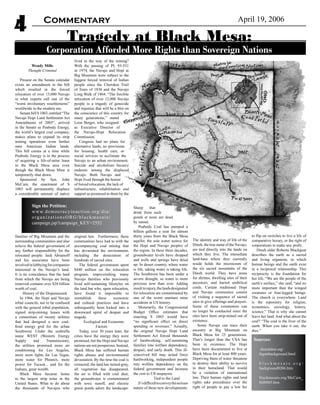
“Competition is a reason, butnot the only one why we wantand need to participate”- Sally Derengoski
photo courtesy of www.afn.org
From INTOLERANCE, page 2
Campus News: Features and Events
6 April 19, 2006
Andrew Hostetter
Staff Writer
The New York Dolls are a glam
band from the early/mid seventies
that totally set the stage for the
punk rock movement of the late
seventies. They were one of the
first groups with the attitude of,
“We know we can’t play, but we’re
gonna rock out anyway.”
The Dolls took rock and roll
back to what it was suppose to be;
teenage angst and rebellion. They
didn’t write over-thought rock
songs. They didn’t have twenty
m i n u t e
guitarsolos,
they just
gave it to
you; slam
bam thank
you glam
was the
formula.
Ta k i n g
their sound
fromgroups
like the
Stoogesand
the MC5,
along with
Bo Diddley
and the
Yardbirds; they were able to mesh
all of their influences together for
a new sound and style. All the
while dressing in drag, and living
the lifestyle of the “junkie” to its
full punk rock potential.
The group reformed a few
years ago, toured and recorded
a live CD/DVD. They now plan
to record new material for a new
album, and this is where I become
upset.
The New York Dolls of today
look far from what they did 30
years ago. Original members
Johnny Thunders, Jerry Nolan, and
Arthur Kane are no longer living,
and have been replaced with new
members while lead singer David
Johansen and guitarist Sylvain
Sylvain try to squeeze the band’s
legendary status into a new
album.
This attempt at a new album
just doesn’t make sense. One
member gone from the group ok,
two members gone from a group
maybe, but three members gone
from a group no way.
It’s almost sacrilegious to use
the New York Dolls name now.
Johnny Thunders (guitarist, died
in 1991 of a drug overdose) was
the blue print for what punk rock
guitar would become. Replacing
him is like replacing Keith
Richards in the Rolling Stones, his
guitar playing and stage presence
is that essential to the Dolls sound
and image.
It makes no sense for a group
that 30 years ago released two
studio albums to reform now with
a very non-original line up and try
to recreate the magic of before.
Why destroy the legacy? At best
they should tour in tribute of a once
great band and
that’s it. Let
the legacy
live, but don’t
tarnish it.
Legendary
producer Jack
Douglas has
signed on as
producer. He
engineered the
group’s first
album and has
produced for
artists such
as: Aerosmith,
Cheap Trick,
Alice Cooper,
and John Lennon. What has he
done lately? Not much, Douglas’
career can be safely said to be in
the toilet. Over the past decade
what he has done has been sub
par at best (and I hate to say this
because he’s one of my all time
favorite producers).
So the Dolls have there work cut
out for them. They have three new
members, their key guitarist gone,
a producer who is way past his
prime, and tons of hardcore fans
holding their breath waiting for
them to fail. If Johansen and
Sylvain want to prowl around
the stage if women’s clothing
pretending they’re the Dolls,
fine, but keep the new material
hidden from the public’s ears. I
speak for the fans I know when I
say, “We don’t want to hear it.”
If you want to check out some
classic New York Dolls try picking
up albums New York Dolls or Too
Much Too Soon. Try not to hold
your breath on the new Dolls
fiasco.
JamesTaylor:Telling Stories
at the Mo’
Dolls New Album, a
Personality Crisis
Matt Stefaniak
Entertainment Editor
There was no glitz or glam,
just a piano and an acoustic guitar
onstage as people poured into a
sold-out Morris Center in South
Bend to see James Taylor.
The legendary folk/rock singer
walked onstage to thunderous
applause without even an opening
band to warm the crowd up. No
one wanted to see an opener
anyhow, just James, and that’s
what we got.
He politely bowed and waved
and walked up to his guitar and
started strumming the chords to
his classic hit “I Feel Fine.” I
expected the voice to be a little
out as age is creeping up with
the legend, but the voice was as
boisterous and original as it ever
was. There was no mistaking
that we were getting James at his
best.
After the song James greeted
the crowd and pressed a pedal
on the floor with his foot. On a
screen to James’ left an image of
a woman appeared. He began to
tell the story of how he wrote the
song and explain who the woman
was.
James told stories about
several songs and each time I felt
like I was in the mind of one of
America’s greatest songwriters.
The most interesting story was
about “You’ve Got a Friend,”
which was actually written by his
ex-wife Carol Kane. He showed
clips of Carol and told about
how she asked him to record the
song after she heard him sing
it backstage one time. He also
talked about how Joni Mitchell
provided the backing vocals on
the track. He showed personal
pictures of himself with Carol
Kane and Joni Mitchell. Seeing
three legends in the same room
working on what would be a
classic hit was very nostalgic and
exciting.
Interestingly enough James
never said a word
before he sang
“Fire and
R a i n . ”
Thestory
of “Fire
a n d
Rain” is so interesting. I
wondered why he would leave it
out. The song was written right
after Taylor was released from
a stint in a mental hospital (he
had drug problems). His family
and friends refused to tell him
about the death of a close friend
while he was being treated and
when they told him, he wrote the
song. And those classic lyrics
“Just yesterday morning, they
let me know you were gone” and
“I always thought that I’d see
you again” become much more
personal and profound. Maybe
even 30 years later the story is
still too painful for James to get
into.
At the end of the show, you
felt close to James. You felt
almost humbled that this man
was willing to share so much of
his life with you for $60. It truly
was a treat, and one of the best
shows I’ve ever been to.
Entertainment
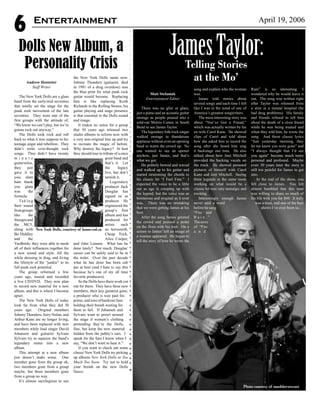
Photo courtesy of markbrewer.net
New York Dolls, courtesy of home.eol.ca
7April 19, 2006
Matt Stefaniak
Entertainment Editor
Why do they do it? It seems
like over the last few years almost
every mainstream media entity
wants to make a list of something.
Rolling Stone came out with their
“greatest guitarist” list, and their
“greatest albums” list, Blender had
“the greatest songs since you were
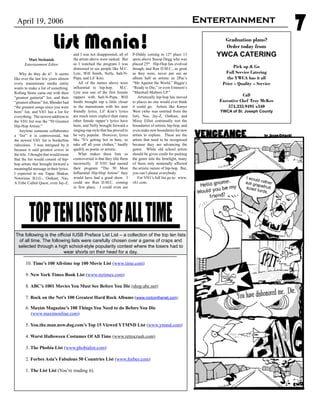
born” list, and VH1 has a list for
everything. The newest addition to
the VH1 list was the “50 Greatest
Hip-Hop Artists.”
Anytime someone collaborates
a “list” it is controversial, but
the newest VH1 list is borderline
ridiculous. I was intrigued by it
because it said greatest artists in
the title. I thought that would mean
that the list would consist of hip-
hop artists that brought forward a
meaningful message in their lyrics.
I expected to see Tupac Shakur,
Notorious B.I.G., Outkast, Nas,
A Tribe Called Quest, even Jay-Z,
and I was not disappointed, all of
the artists above were ranked. But
as I watched the program I was
distressed to see people like M.C.
Lyte, Will Smith, Nelly, Salt-N-
Pepa, and Lil’ Kim.
All of the names above were
influential to hip-hop. M.C.
Lyte was one of the first female
rappers with Salt-N-Pepa, Will
Smith brought rap a little closer
to the mainstream with his user
friendly lyrics, Lil’ Kim’s lyrics
are much more explicit than many
other female rapper’s lyrics have
been, and Nelly brought forward a
singing-rap style that has proved to
be very popular. However, lyrics
like “It’s getting hot in here, so
take off all your clothes,” hardly
qualify as poetic or artistic.
What makes these lists so
controversial is that they title them
incorrectly. If VH1 had named
their program “The 50 Most
Influential Hip-Hop Artists” they
would have had a good show. I
could see Run D.M.C. coming
in first place. I could even see
P-Diddy coming in 12th
place 13
spots above Snoop Dogg who was
placed 25th
. Hip-Hop has evolved
though, and Run D.M.C., as great
as they were, never put out an
album half as artistic as 2Pac’s
“Me Against the World,” Biggie’s
“Ready to Die,” or even Eminem’s
“Marshall Mathers LP.”
Artistically hip-hop has moved
to places no one would ever think
it could go. Artists like Kanye
West (who was omitted from the
list), Nas, Jay-Z, Outkast, and
Missy Elliot continually test the
boundaries of artistic hip-hop, and
even make new boundaries for new
artists to explore. These are the
artists that need to be recognized
because they are advancing the
genre. While old school artists
should be given credit for pushing
the genre into the limelight, many
of them only minimally affected
the artistic nature of hip-hop. But,
you can’t please everybody.
For VH1’s full list go to: www.
vh1.com.
List Mania! Graduation plans?
Order today from
YWCA CATERING
Pick up & Go
Full Service Catering
the YWCA has it all
Price – Quality – Service
Call
Executive Chef Troy McKee
574.233.9491 x340
YWCA of St. Joseph County
Entertainment
The following is the official IUSB Preface List List – a collection of the top ten lists
of all time. The following lists were carefully chosen over a game of craps and
selected through a high school-style popularity contest where the losers had to
wear shorts on their head for a day.
10. Time’s 100 All-time top 100 Movie List (www.time.com)
9. New York Times Book List (www.nytimes.com)
8. ABC’s 1001 Movies You Must See Before You Die (shop.abc.net)
7. Rock on the Net’s 100 Greatest Hard Rock Albums (www.rockonthenet.com)
6. Maxim Magazine’s 100 Things You Need to do Before You Die
(www.maximonline.com)
5. You.the.man.now.dog.com’s Top 15 Viewed YTMND List (www.ytmnd.com)
4. Worst Halloween Costumes Of All Time (www.retrocrush.com)
3. The Phobia List (www.phobialist.com)
2. Forbes Asia’s Fabulous 50 Countries List (www.forbes.com)
1. The List List (You’re reading it).
Toptenlistsofalltime
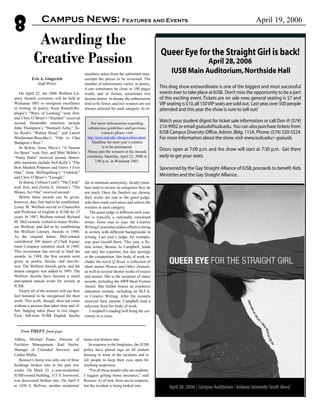
Queer Eye for the Straight Girl is back!
April 28,2006
IUSB Main Auditorium,Northside Hall
This drag show extraordinaire is one of the biggest and most successful
events ever to take place at IUSB. Don’t miss the opportunity to be a part
of this exciting event.Tickets are on sale now, general seating is $7 and
VIP seating is $10,all 150VIP seats are sold out. Last year,over 500 people
attended and this year the show is sure to sell out!
Watch your student digest for ticket sale information or call Don @ (574)
210-9902 or email gsaiusb@iusb.edu. You can also purchase tickets from:
IUSB Campus Diversity Office,Admin.Bldg.115A,Phone:(574) 520-5524.
For more information about the show,visit www.iusb.edu/~gsaiusb.
Doors open at 7:00 p.m. and the show will start at 7:30 p.m. Get there
early to get your seats.
Sponsored by the Gay Straight Alliance of IUSB,proceeds to benefit Aids
Ministries and the Gay Straight Alliance.
Eric A. Gingerich
Staff Writer
On April 22, the 2006 Wolfson Lit-
erary Awards ceremony will be held in
Wiekamp 1001 to recognize excellence
in writing. In poetry, Susie Russell-Re-
plogle’s “Ways of Looking” took first,
and Chris O’Brien’s “Stardust” received
second. Honorable mentions include
John Thompson’s “Stomach Ache,” Ta-
lia Reed’s “Walnut Road,” and Laurel
Wiederman-Bieschke’s “Ode to Chai
Budapest’s Best.”
In fiction, Jesus Moya’s “A Season
for Bears” took first, and Matt Skibbe’s
“Nasty Habit” received second. Honor-
able mentions include Neil Kelly’s “The
Best Mashed Potatoes and Gravy I Ever
Had,” Anne Shillingsburg’s “Untitled,”
and Chris O’Brien’s “Enough.”
In drama, Colleen Card’s “The Clerk”
took first, and Zorina E. Jerome’s “The
Means, Act One” received second.
Before these awards can be given,
however, they first had to be established.
Lester M. Wolfson served as Chancellor
and Professor of English at IUSB for 23
years. In 1987, Wolfson retired. Richard
M. McCormack wished to honor Profes-
sor Wolfson, and did so by establishing
the Wolfson Literary Awards in 1988.
As the original donor, McCormack
contributed 100 shares of Clark Equip-
ment Company common stock in 1969.
This investment has served to fund the
awards. In 1988, the first awards were
given in poetry, fiction, and non-fic-
tion. The Wolfson Awards grew, and the
drama category was added in 1993. The
Wolfson Awards have become a much
anticipated annual event for writers at
IUSB.
Nearly all of the winners will say they
feel honored to be recognized for their
work. This work, though, does not come
without a process that takes time and ef-
fort. Judging takes place in two stages.
First, full-time IUSB English faculty
members select from the submitted man-
uscripts the pieces to be reviewed. The
number of submissions varies; in poetry,
it can sometimes be close to 100 pages
worth, and in fiction, sometimes two
dozens stories. In drama, the submissions
tend to be fewer, and two winners are not
always selected for each category. In or-
der to maintain anonymity, faculty mem-
bers tend to review in categories they do
not teach. Once the finalists are chosen,
their works are sent to the guest judge,
who then reads each piece and selects the
winners in each category.
The guest judge is different each year,
but is typically a nationally renowned
writer. From year to year, the Creative
Writing Committee makes efforts to bring
in writers with different backgrounds in
writing. Last year’s judge, for example,
was poet Gerald Stern. This year, a fic-
tion writer, Bonnie Jo Campbell, lends
not only her expertise, but also prestige
to the competition. Her body of work in-
cludes the novel Q Road, a collection of
short stories Women and Other Animals,
as well as several shorter works of essays
and stories. She is the recipient of many
awards, including the AWP Short Fiction
Award. She further boasts an extensive
education resume, including an M.F.A.
in Creative Writing. After the winners
received their awards, Campbell read a
selection from her body of work.
Campbell’s reading will bring the cer-
emony to a close.
For more information regarding
submission guidelines and previous
winners please visit
http://www.iusb.edu/~sbeng/wolfson.shtml.
Deadline for next year’s contest
is to be announced.
Please join the winners at the Awards
ceremony, Saturday, April 22, 2006 at
7:00 p.m. in Wiekamp 1001.
Awarding the
Creative Passion
8 April 19, 2006Campus News: Features and Events
Affairs, Michael Prater, Director of
Facilities Management, Karl Stetler,
Manager of Custodial Services, and
Caitlin Mullis.
Reusser’s home was only one of three
buildings broken into in the past few
weeks. On Mach 25, a non-residential
IUSB-owned building, 315 S. Ironwood,
was discovered broken into. On April 4
at 1030 S. Bellvue, another residential
home was broken into.
In response to the burglaries, the IUSB
police have placed tags on all student
housing to warn of the incidents and to
tell people to keep their eyes open for
anything suspicious.
“For all those people who are students,
I suggest getting home insurance,” said
Reusser. As of now, there are no suspects,
but the incident is being looked into.
From THEFT, front page
April 19, 2006 Campus News: Features and Events
9
LET YOUR VOICE
BE HEARD
SEARCH FOR STUDENT
EDITORS
The Student Publications Board invites
applications from all undergraduate students
for the position of
editor-in-chief for each of the four
publications below. These positions each
carry an annual stipend and the possibility
of a credit-earning internship.
2006-2007 Editor of the IUSB
student newspaper,
The Preface
Published every week during the fall and
spring semesters, The Preface includes
news stories and feature articles about
campus life and issues along with items
such as film or music reviews. Duties
include recruitment and management
of editorial staff and working with the
advertising staff.
2006-2007 Editor of the IUSB
student literary and visual arts
magazine, Analecta
This annual publishes the best poetry,
fiction, non-fiction prose, and artwork
submitted by IUSB students. The
editor’s duties include staff recruitment,
publicity, selection of submissions,
magazine design, and print preparation.
2006-2007 Editor of the IUSB
journal,
New Views on Gender
This journal publishes student essays,
interviews, and book reviews related to
gender issues. The editor’s duties include
staff recruitment, publicity, selection of
submissions, magazine design, and print
preparation.
2007-2007 Editor of the IUSB
Undergraduate Research
Journal
This annual journal publishes research
papers from any discipline. It welcomes
papers written independently, for
classes, or for SMART research projects.
All papers are initially reviewed and
communicated to the editors by a faculty
member in the appropriate discipline.
The editor, with the assistance of his or
her staff, selects and edits the papers for
publication.
Students holding any of these
editorships must meet the
following criteria:
	 a.Undergraduate status;
	 b. Enrollment at IUSB for at least
six credit hours each semester
as editor;
	 c. Cumulative GPA of at least 2.0.
Candidates for these positions should
submit a letter of interest along with a
résumé and two letters of reference to
James Blodgett, Chair of the Student
Publications Board, Wiekamp 3163. Please
contact him if you have any questions at
520-4275 or jblodget@iusb.edu.
The deadline for applications is:
MONDAY, APRIL 24, 2006
Terrie Phillips
Staff Writer
Tuition costs for the 06-
07 academic school year was
discussed during a public forum
that was teleconferenced from
Bloomington to all IU campuses
on April 5 in NS 038.
Due to decreases in government
funding and inflation, Indiana
University has been forced once
again to raise tuition and other fees
for students in 06-07.
This means that IU South
Bend students can expect about
a 4.9% raise in tuition and other
fees for residential students. Non-
residential students can expect
a rise of approximately 6.2%
increase. Dr. Adam Herbert,
President, said during his
president’s report, “many families
are making significant financial
sacrifices to send their children to
Indiana University.”
Judith Palmer, Vice President
and CFO, said, “The University
is not immune to inflation. Units
across the University are doing
a good job to mange inflation.”
Herbertsaidstatefundingmodestly
has increased 1.5% in the last three
years.
Indiana University has two
major sources of funding;
tuition and state operating from
legislature, but IU tuition rates for
undergraduates and graduates are
in the lower 3rd.
This is not just a local
problem, but a national
one, according to Palmer.
“Nationally, states have
to cut back on higher
education.” As the floor
opened for questions,
concern was shown for
the hike in tuition costs in
Kentucky, which is in the
teens.
Each individual
campus has individual
control over their budget.
“Put these dollars where
the highest priorities are,”
said Palmer, concerning
one question about how
the money is spent on the
individual campuses.
As the forum
continued, students and
faculty from all IU units
were able to ask questions
about their individual
campuses. Ending in
acknowledgement of
individual supporters
of IU, Palmer said,
“Everyone has worked
very hard to make this
possible; the philanthropy
of the friends and those
who have supported IU.”
We can look to the
horizon for costs of tuition
to rise, but they still
promise the sweet dew of
success. 	
Terrie Phillips
Staff Writer
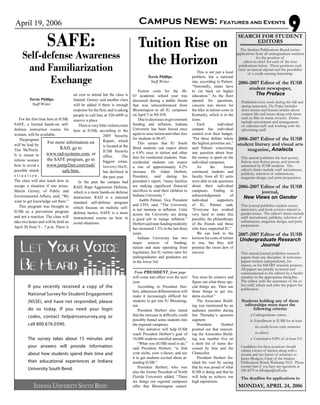
For the first time here at IUSB,
SAFE, a limited hands-on self-
defense instruction course for
women, will be available.
Theprogram
will be lead by
Tim McNeely.
It is meant to
inform women
how to avoid a
possible attack
s i t u a t i o n .
The class will also teach how to
escape a situation if one arises.
Martin Gersey, of Public and
Environmental Affairs, said, “We
want to get knowledge out there.”
This program was brought to
IUSB as a prevention program
and not a reaction. The class will
take two hours and will be held on
April 20 from 5 – 7 p.m. There is
no cost to attend but the class is
limited. Gersey said another class
will be added if there is enough
response for the first, and is asking
people to call him at 520-4499 to
reserve a place.
Thereisverylittleviolentcrime
here at IUSB, according to the
2005 Security
Report, which
is located at the
IUSB Security
office. The
biggest crime,
larceny/theft,
has declined in
the past year.
In the past the campus had
RAD, Rape Aggression Defense,
which is a more hands-on defense
instruction. RAD is a national
standard self-defense program
which focuses on realistic self-
defense tactics. SAFE is a more
instructional course on how to
avoid situations.
Tuition Rise on
the Horizon
SAFE:
Self-defense Awareness
and Familiarization
Exchange
will come into effect over the next
year.
According to President Her-
bert, admission differentiation will
make it increasingly difficult for
students to get into IU Blooming-
ton.
President Herbert also stated
that the increase in difficulty could
possibly funnel some students into
the regional campuses.
This initiative will help IUSB
reach President Herbert’s goal of
10,000 students enrolled annually.
“What you (IUSB) need to do,”
said President Herbert, “is find
your niche, your x-factor, and use
it to get students excited about at-
tending IUSB.”
President Herbert, who was
also the former President of North
Florida University added, “There
are things our regional campuses
offer that Bloomington cannot.
You must be creative and
figure out what those spe-
cial things are. Then use
those things to get stu-
dents excited.”
The Associates Build-
ing was mentioned by an
audience member during
last Thursday’s question
segment.
President Herbert
pointed out that renovat-
ing the Associates Build-
ing was number five on
a short list of items dis-
cussed by him and the
Chancellor.
President Herbert fin-
ished his visit by saying
that he was proud of what
IUSB is doing and that he
will help us achieve our
high aspirations.
From PRESIDENT, front page
For more information on
RAD, go to
www.rad-systems.com, or
the SAFE program, go to
www.jump2net.com/nsdi/
safe.htm.
10 April 19, 2006
Michiana’s premier GLBT bookstore and café
wishes to congratulate the graduates of 2006!
Upcoming Concerts:
Nayla Wocjik - April 22nd
Amanda Lepre - April 22nd
Jennifer Spector ‒ May 6th
Shows at 7pm ‒ Tickets $10 advance, $12 at door.
Open Mic Night is the last Saturday of each month
beginning at 7pm.
Poetry and Writers Group will meet May 4th at 7pm.
(Bring your poetry or come to listen.)
Book Club meets the second Wednesday at 7pm.
Join and get a 10% discount on the book of the
month.
Cards and Games Night every Friday from 7-10pm.
Euchre, poker, and more.
Bring in this ad for 10% off a drink of your choice!
Another Bookstore is located in the 100 Center of
Mishawaka, below Rum Runners. Call 254-1411 or
visit us online at www.anotherbookstore.net for more
information.
Student Government Association
Election Results 2006
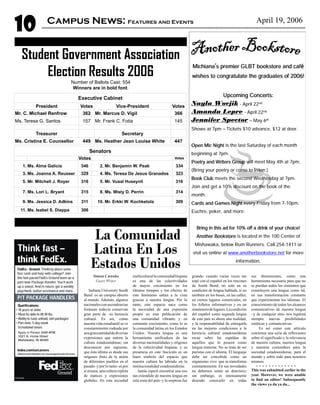
Number of Ballots Cast: 554
Winners are in bold font.
Executive Cabinet
President Votes Vice-President Votes
Mr. C. Michael Renfrow 362 Mr. Marcus D. Vigil 366
Ms. Teresa G. Santos 157 Mr. Frank C. Fotia 145
       
Treasurer   Secretary  
Ms. Cristina E. Counsellor 449 Ms. Heather Jean Louise White 447
Senators
  Votes   Votes
1. Ms. Alma Galicia 346 2. Mr. Benjamin W. Peak 334
3. Ms. Joanna A. Reusser 329 4. Ms. Teresa De Jesus Granados 323
5. Mr. Mitchell J. Royer 316 5. Mr. Vusal Huseynli 316
7. Ms. Lori L. Bryant 315 8. Ms. Misty D. Perrin 314
9. Ms. Jessica D. Adkins 311 10. Mr. Erkki W. Kochketola 309
11. Ms. Isabel S. Dieppa 306    
Simon Castaño
Guest Writer
Indiana University South
Bend es un campus abierto
al mundo. Además, algunos
nacionalesconascendencias
foráneas todavía conservan
gran parte de su herencia
cultural. Es así, como
nuestra vida estudiantil se ve
constantemente rodeada por
unagrancantidaddediversas
expresiones que nutren la
cultura estadounidense; sin
desconocer por supuesto,
que ésta última es desde sus
orígenes fruto de la unión
de diferentes pueblos en el
pasado -y por lo tanto- es por
sí misma, una cultura repleta
de matices y expresiones
globales. En esta sociedad
multiculturallacomunidadhispana
es una de las colectividades
de mayor crecimiento en los
últimos tiempos y los efectos de
este fenómeno saltan a la vista
gracias a nuestra lengua. Por lo
tanto, este espacio nace como
la necesidad de una expresión
propia en esta publicación de
una comunidad vibrante y en
constante crecimiento, como lo es
la comunidad latina en los Estados
Unidos. Nuestra lengua es una
herramienta unificadora de las
diversas nacionalidades y orígenes
de la colectividad hispana; y su
presencia en este fascículo es un
buen símbolo del espacio que
nuestra cultura ha labrado en la
institucionalidad estadounidense.
Jamás esperé encontrar una uso
tan extendido de nuestra lengua en
esta zona del país -y la sorpresa fue
grande- cuando varias veces me
topé con el español en los rincones
de South Bend; no solo en su
condición de lengua hablada, si no
también en los buses, en las calles,
en ciertos lugares comerciales, en
los folletos informativos y en un
sinnúmerodelugares.Lacondición
del español como segunda lengua
de este país es ahora una realidad,
y la responsabilidad de entregarla
en las mejores condiciones a la
herencia cultural estadounidense
recae sobre las espaldas de
aquellos que lo poseen como
lengua materna. No se trata de ser
puristas con el idioma. El lenguaje
debe ser concebido como un
organismo vivo que se transforma
constantemente. En sus novedades
no debemos sentir un deterioro;
sin embargo, es intensamente
deseado conocerlo en todas
sus dimensiones, como una
herramienta necesaria para que no
se pierdan todos los cimientos que
constituyen una lengua como tal,
en esa transformación constante
que experimentan los idiomas. El
conocimiento de todos los alcances
comunicativos de nuestra lengua
–y de cualquier otra- nos regalará
siempre nuevas posibilidades
estéticas y comunicativas.
Es así como este artículo
comienza una serie de reflexiones
sobre el significado y la relevancia
de nuestra cultura, nuestra lengua
y nuestras costumbres para la
sociedad estadounidense, para el
mundo y sobre todo para nosotros
mismos.
Campus News: Features and Events
La Comunidad
Latina En Los
Estados Unidos
This was submitted earlier in the
year. However, we were unable
to find an editor! Subsequently
the views ya da ya da...
Preface
Mission
We will represent IUSB Culture.
To do so we will present as many
different voices and student
opinions as possible. Our mission
is to push the boundaries of
journalistic innovation, increase
dialogue on campus, and report
news that is fair, accurate and
complete.
The Preface Staff
Editor-in-Chief
Jedediah Walls
Managing Editor
Tracy Sherwood
Entertainment Editor
Matthew Stefaniak
Graphic Design Editor
Jason Cytacki
Graphic Design
Julie Brackett
Copy Editor
Wendy Mills
The Preface is a venue for
communication between students
and student journalists of Indiana
University South Bend. We are an
independent student press, not the
official voice of the student body,
administration or faculty of IUSB.
Letters to the editor become property
of The Preface, and may be edited
for space and clarity. The deadline
for advertising and copy is noon
Wednesday prior to publication. The
Preface reserves the right to publish
or reject submissions.
Contact The Preface:
Editorial Dept
520-4325
preface@iusb.edu
Advertising Dept
520-4553
prefads@iusb.edu
Staff Advisor
Nancy Sulok
Advertising Manager
Jedediah Walls
News Analysts
Chuck Norton
Writing Staff
Connie Strean
Andrew Hostetter
Sarah Stefaniak
Adam Gallippo
Terrie Phillips
Robert Francis
Photographer
Michele Ives
Adam Turner
11April 19, 2006 Goodbyes
To our readers:
This year has flown by. When
I started at the Preface over four
years ago, my only thought was to
write. Today, I have found that I
am an editor at heart. I love watch-
ing writers dig for the story and
turn it into something informative
and entertaining. I loved watching
the paper take shape every week,
as Jason and I struggled to create
a meaningful layout that Jed would
love. It wasn’t always easy. He
pushed us to make it better every
week. Sometimes we failed, but
when we succeeded, my heart al-
most burst with pride that this was
my paper.
For those who disagreed with
how we ran the paper this year or
disagreed with our content, thank
you. Your comments reminded
me of why I love this business so
much. It is the diversity of ideas,
thoughts and beliefs that make re-
porting an exhilarating experience.
Yet at the same time, it was hard not
to take it personal. When you pour
your heart and soul into something
like the Preface week after week, it
becomes a part of you. Personally,
the Preface defined my experience
at IUSB. When I look at early is-
sues, I am amazed at how much my
writing and editorial skills have
grown. At the same time, I be-
came a student leader, something
I wasn’t looking for, but gratefully
embraced.
I am ruined for creative writing
forever. My fiction writing class-
mates say I write like a journalist.
After five years at IUSB, I have to
say I agree. When I came to this
campus, I knew I was a writer. But
what kind of writer I would be re-
mained elusive. If I had majored
in English, perhaps another editor
would be writing this now. Instead,
I was drawn to the Preface, where
I defined myself and my writing. I
will be forever grateful to the edi-
tors that shaped me, including Me-
lissa Cikara, Stacy Logan and my
current Editor-in-Chief, Jed Walls.
All of them stressed something
important. Melissa wanted me to
find a balance between ticking ev-
eryone off and kissing everyone’s
ass. Stacy forced me to be a more
assertive member of the team. And
Jed, well, he just made me rethink
everything I took for granted. We
don’t always agree, but we both
believe that the free flow of ideas
is the best part of our newspaper.
We complimented each other this
year in so many ways. Even our
disagreements were peppered with
respect. Thank you, Jed, for allow-
ing me the privilege of being your
co-pilot on this journey.
Now before I start to get really
sappy, thanks to the readers, who
have made me laugh, yell and even
cry (just once, it was a bad day).
We couldn’t have done it without
you.
To the editor next year, whoever
you are, the shoes are large, but you
can fill them. Just keep your ears
to the ground and your mind wide
open!
- Tracy Sherwood
Ending of an EraThe Land of Do As You Please
Adam Gallippo
Personal Lord and Savior
Here we are, closing in on the
end of another year.
I definitely want to take the
time to thank Jed and Tracy. It’s
been a pleasure working with you
both these past few months. I wish
you two the best of luck with all
future endeavors.
Having said that, allow me to
plug myself shamelessly.
Pick up the New Views on
Gender when it’s released. I have
a story in this year’s issue titled
“Skin Deep”. Check it out.
The same goes for the Analecta.
“Lizard King,” is my poetic
homage to a hero of sorts, Jim
Morrison. Check that out as well.
Now that the shameless plugs
are finished, let’s move on.
The one thing that I feel we need
more of in this field is “gonzo”
journalism. This Fox News style
of journalism is way too popular.
Especially for the crap it puts out.
You know, Fox News is for
people who like their news
delivered on a short bus. They
have that little ticker that runs at
the bottom of the screen. It shows
the terrorist level for any given day.
Since 9/11 those morons have had
the same shit at the bottom of the
screen. “Terrorist level elevated.”
I think things like that are
incredibly insulting to our
intelligence AND used to keep
ideologies in place. But, low and
behold, there’s someone out there
reading this and cursing me. I can
visualize the rant.
“The terrorist level should
be elevated,” the yokel protests.
“Them bastards could strike us
any minute. We got the Hummer
plant.”
My junior year of high school,
the year of the 9/11 attacks,
someone actually said something
similar to that. “South Bend/
Mishawaka could be attacked next.
We have the Hummer plant.”
To which I responded, “Are you
retarded?”
Couldn’t you see it now? Bin
Laden’s henchmen telling him the
details of their attacks. “Yeah, we
blew up the World Trade Center,
hit the Pentagon and took out a
Hummer plant in South Bend,
Indiana.”
It’s just not kosher.
As far as the Preface is
concerned, I plan to be aboard next
year if the new editor will have me.
(“Goddamnit!” scream the three
guys who wrote in about that Bush
article as they read this.)
I enjoy journalism. It’s a cool
field with some very interesting
people. Though, I still wish we had
a “gonzo” page. And hopefully we
can do bigger and better things
with next year’s paper.
Personal Lord and Savior, out.
This is a picture by Robert English that we finally have the space to run. Thanks Rob!
Tracy Sherwood, Managing Editor
Jedediah Walls
Editor in Chief
So, it has been a tradition of past
preface Editors to so something
outrageous in their last issue. Once,
a pair of editors put a picture of
their naked bodies on the front
page. Last year, we admitted that
our sports editor was really a cat.
This year, I was going to blow
my brains out on the front cover.
My good friend and movie-special-
effects expert Ian Strandberg was
going to carve out my skull real
nice like making me look putrid,
and it would have grossed you out.
I’d a loved it.
Instead, I am donating the cover
of this year’s final issue to the Gay
Straight Alliance and their event
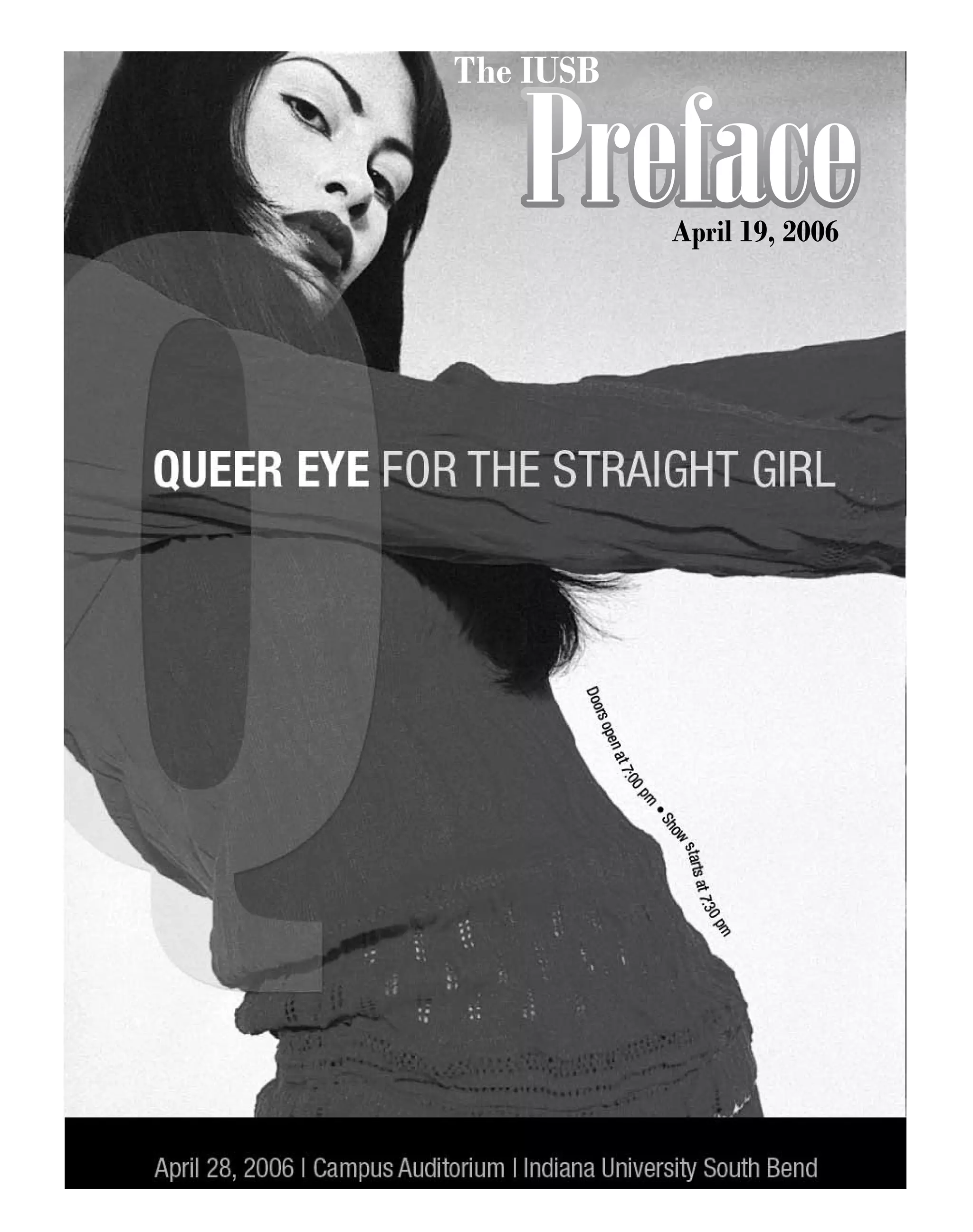
Queer Eye for the Straight Girl.
This is a better use for the space,
and I believe in the importance
of their cause. This represents a
donation of over $2400 dollars in
value. I’m proud to have made it.
AsfarastheKinseyConfidential
is concerned, I received one letter
for and one against. Good job,
guys.
In terms of business, we
did very well this year. Current
projections show that we spent
$29,826.70 of our budget, $29,000
of which was given to us by the
student government association.
Our advertising figures aren’t back
yet, but we brought in somewhere
around $5,000 in advertising
revenue, just under where I wanted.
However, this is still an increase
of around $3,500 dollars over last
year.
We tightened our belts this year
in order to afford new equipment
and technology necessary to remain
prosperous in the years ahead. The
remainder of this year’s budget
will be spent on gaining the rest of
the equipment necessary to set our
office up for the next ten years.
In terms of structure, it took me
most of
my two year term on the editorial
staff in order to discover the proper
formula for handling our college
newsroom. Rather than the large-
but-underpaid staffing formats of
year’s previous, we ran a relatively
small staff and kept a few “core
writer” positions open which paid
more and allowed those writers to
focus exclusively on the Preface.
This turned out to be a good tactic,
and allowed us to increase our
coverage of news events despite
the fact that we were smaller in
numbers.
This year I hoped to create
lasting infrastructure for the Preface
to thrive. I’m proud to say that my
attempts have been moderately
successful, but more work must be
done in years to come.
I’d like to thank everyone
responsible for making my time
with The IUSB Preface what it
was. Without Tracy Sherwood, you
would not have had the level of
coverage you did. Her management
ofthewritersandstorieswascritical
to what we did this year. Matt
Stephaniak defies it all by somehow
creating the most loyal and effective
entertainment staff this paper has
s e e n .
Wendy Mills has always been there
for me, a long time friend who has
more skills as a Copyeditor than I
could I hope for. She’s a diamond in
the rough, and I hope one day to see
her fill this office. Adam Gallippo
and Terrie Phillips, though they just
got here have already made waves
in what defines a campus journalist.
Hiring Chuck Norton was one of
the best things I could have done.
Without Jason Cytaki’s direction,
the paper would have looked like
poop. Thank you everyone, whom
space cannot provide me the means
to mention.
If there’s any final thought or
words of wisdom that I can leave
you with, it is that your breadth of
knowledge is of greater importance
than your depth of it. It’s a sticky-
icky world out there. Learn the
difference between a newspaper
and a newsletter.
And to this, nothing could have
made me feel better than the letter
we received this week by Carl
Fisher, one of the people who began
the Preface. Seeing that made me
know what I did here was good.
The IUSB PrefaceApril 19, 2006
The Final issue...
SGA Election
Results
Page 10
James Taylor at
the Morris
Page 3
The Final Kinsey
Confidential?
Front Page
Page 6
Effects of Title IX
Terrie Phillips
Staff Writer
When Joanna Reusser of 918
Bellvue came home on March 26,
she found her back door busted in
and items stolen from her home.
“I live in student housing, so
coming home to a forced-entry
robbery was quite unnerving,”
said Reusser. Items such as
clothing, jewelry, and DVDs were
all reported stolen. “Officer Garcia
was the responding officer,” said
Reusser. “This man deserves huge
credit.”
“The IUSB Facilities
Management also deserves my
most sincere gratitude,” said
Reusser. “There was someone
there within 15 minutes to drill
the broken doors shut.” She also
expressed her gratitude towards
Detective Bryant with the South
Bend Police Department, Charlotte
D. Pfeifer, Director of the Offices
of Campus Diversity and Judicial
Theft at IUSB
GOING OUT WITH
A BANG
Adam Gallippo
Staff Writer
Indiana University’s 17th
Presi-
dent visited IUSB on Thursday,
March 13th
.
President Herbert stopped by
IUSB to discuss future develop-
ment plans for this campus along
with innovations and goals for all
IU schools.
President Herbert drew a warm
round of applause when campus
housing was brought up for the
South Bend campus.
The question is: when will the
housing be built? IUSB sopho-
more, Devin Megyese believes
whatever they’re planning on
building, the sooner the better.
“The new bridge opens up numer-
ous possibilities. Will that area be-
come a parking lot or housing?”
One of the bigger issues that
President Herbert spoke of was the
new admission differentiation that
President
Herbert
Visits IUSB
See PRESIDENT, page 9 See THEFT, page 8
Page 5
President Herbert, courtesy of
www.indiana.edu

april19

  • 1.
  • 2.
    April 19, 2006Blogson Paper: The home of Campus Columnists 2 Institutions of Intolerance Part II Dear Editor(s),  I am writing in response to information in the Preface re- garding our “chance to tell next year’s editor(s)” how we feel about Kinsey.  I have read many of the arti- cles in Kinsey, and I don’t believe that most of them are applicable to a large or even moderate num- ber of students. I feel the mission of the Preface should be about providing good and accurate in- formation that is applicable to a large number of students.  I strongly believe the space would better be used to discuss health issues, weight control is- sues, general healthy lifestyle tips, etc. MOST people (students, faculty, and staff) would benefit from these types of articles as most people deal with those is- sues almost daily, either in their own lives or in the lives of loved ones.  I do not feel most students are seriously looking to the Preface for answers to their “sex ques- tions.” There is a time and place for everything, and the Preface is not the place for this kind of material. Other media is more appropriate for Kinsey.   Thanks for listening, Sharon Busenbark Kill Kinsey or Keep Kinsey Alive L e t t e r s t o t h e E d i t o r Sometime in the 1960’s I lent some space and a mimeograph ma- chine to an energized and talented group that wanted to start, at that time, an off-campus newspaper called “The Preface.” It’s warm- ing to know that it is still going as an alternative to our major media paper. In response to various threats over the years our country has shifted its resources to meet them. Often this entailed overindulg- ing some of our institutions, i.e. the thousands of nuclear tipped missiles. So while today we’re narrowly focused on the terrorist problem, we’re in denial and most- ly ignoring a much greater one. In his book, “The Weather Makers” Tim Flannery takes on the global warming issue. In it he details the problems, and what the future probably has in store for us and our planet. According to his research, 100,000 years ago there were just 2,000 of our ancestors here. Today the earth’s population is 6.3 billion, on track for 9 billion by 2050. In the meantime our use of coal in particular is increasing the CO2 in our breathable atmosphere. That atmosphereis1to5milesabovethe earth. He points out that the excess CO2 takes years to dissipate and is one of the key causes of global warming. This warming in turn is melting our ice caps and glaciers, creating droughts and floods, and is contributing to violent weather, while killing off biodiversity and damaging food chains. This generation needs to chal- lenge our existing values and sys- tems, so that much of life as we know it can continue. The tools are there, but is the awareness, leader- ship, and will? Carl Fisher IUSB Class of 68 Chuck Norton News Analyst In my last column, published in the April 5th issue of The Preface, you learned about several draco- nian incidences of ideological per- secution on the part of university administrations against faculty and students. You learned how conservative students at Bucknell were brought up on “charges” of being offensive and how the uni- versity failed to act when members of that club were threatened with violence. You also learned about how the University of Tennessee used threats and strong arm tactics to protect a university organization who’s members had sent out mul- tiple emails that said that a conser- vative student should be shot in the face. Le Moyne College expelled a conservative student in violation of its own free expression policy. His crime: he wrote a paper that called for more classroom discipline (www.thefire.org Feb. 15, 2005). According to the Foundation for Individual Rights in Education (FIRE), “the chair of Le Moyne’s education department expelled master’s student Scott McConnell because of a ‘mismatch’ between his personal beliefs and the goals of the college’s graduate education program.” After the September 11th at- tacks, Central Michigan Univer- sity ordered students to remove American flags from their dorm room doors. Steven Hinkle, a student at Cal- ifornia Polytech, was charged with “disruption of a campus event” for posting club posters announcing a speaking event featuring Ma- son Weaver, a noted Black Con- servative Author. Leftist students complained that a poster featuring a black conser- vative speak- ing about race was “racially offensive”. The univer- sity ordered Hinkle to write letters of apology and make an appointment with a campus shrink or face trial. Hinkle refused. Hinkle was put on trial and was allowed no representation and his parents were not allowed to attend. During the trial, Hinkle asked what campus event he was accused of disrupting, the university refused to answer and found him guilty. The incident was logged on Hin- kle’s transcript. The FIRE sued the university on behalf of Hinkle and an ACLU attorney volunteered to help represent him. At trial, Cali- fornia Polytech lost on every count and was ordered to pay Hinkle $40,000. This incident is featured in the film documentary, Academ- ic Bias 101. Washington State University School of Education had a “dis- positions” requirement in order to stay enrolled. This requirement amounted to a series of ideological and political litmus tests that every student had to agree too. Ed Swan, a student, refused to cooperate and was punished for his conservative views such as his opposition to gun control. The univer- sity ordered Swam to sign a contract that forced him to agree with their ideological litmus tests or be expelled. The FIRE wrote a letter that explained to Washington State University the consequences of its actions so the university ca- pitulated (http://www.thefire.org/ index.php/article/6832.html). Davidson College in North Carolina has a speech code that defines endearing terms such as ‘girl,’ ‘boy,’ ‘hunk,’ ‘doll,’ ‘hon- ey,’ and ‘sweetie’ to be sexual harassment (http://www.thefire. org/index.php/article/6835.html). What would happen if a theatre group were to attempt a presenta- tion of Guys & Dolls? Northeast- ern Illinois University banned the College Republicans from having an “affirmative action bake sale” while allowing a feminist group to have a “pay equity bake sale”. According to the Associated Press, “more than 70 faculty mem- bers at the University of North Carolina at Chapel Hill are de- manding that administrators stop negotiations with a foundation that wants to create a Western cultures program at the school” (AP Mar. 3, 2005). Democrat faculty outnumbers Republican faculty seven to one in humanities and social sciences. A voter registration survey of the faculties of Stanford and Berkeley show a nine to one ratio. Young professors of the associate or as- sistant rank showed “183 Demo- crats to six Republicans” (NYT Nov. 18, 2004). The cases of intolerance and persecution number in the thou- sands and someone has a pos- sible solution. David Horowitz, a conservative free speech ac- tivist, has been pushing for the adoption of the Academic Bill of Rights. Horowitz has a long his- tory in the civil rights movement. He marched with black civil rights activists and faced the fire hoses, and the police wielding dogs and clubs during the civil disobedience commonly practiced as a means of protest during the 1960’s. The Academic Bill of Rights states: • All faculty shall be hired, fired, promoted, and granted ten- ure on the basis of their compe- tence and appropriate knowledge in the field of their expertise and, in the humanities, the social sci- ences, and the arts, with a view toward fostering a plurality of methodologies and perspectives. No faculty shall be hired or fired or denied promotion or tenure on the basis of his or her political or religious beliefs. • No faculty member will be excluded from tenure, search and hiring committees on the basis of their political or religious beliefs. • Students will be graded solely on the basis of their rea- soned answers and appropriate knowledge of the subjects and disciplines they study, not on the basis of their political or religious beliefs. • Curricula and reading lists in the humanities and social sciences should reflect the uncertainty and unsettled character of all human knowledge in these areas by pro- viding students with dissenting sources and viewpoints where ap- propriate. While teachers are and should be free to pursue their own findings and perspectives in pre- senting their views, they should consider and make their students aware of other viewpoints. Aca- demic disciplines should welcome a diversity of approaches to unset- tled questions. • Exposing students to the spectrum of significant scholarly viewpoints on the subjects exam- ined in their courses is a major “Democrat faculty outnumbers Republican faculty seven to one in humanities and social sciences.” See INTOLERANCE, page 5
  • 3.
    April 19, 2006Letters and Columns 3 I have been in a relationship with my boyfriend for a few years, and everyone, including him, is hinting towards a mar- riage proposal. I love him and he is my best friend, but for as long as I can remember, I have been attracted to women. I have great relationships with men, friends and lovers, but the majority of my fantasies focus on other women. Up to this point in my life, I have not had the oppor- tunity to have a sexual encoun- ter with a woman. Now that the prospect of marriage has come up, I’m afraid that I will make the wrong choice. I could marry him, my best friend, and always wonder what it would be like to be with a woman. Or I could end the relationship, and see if I could have the sexually passion- ate relationship I would like with a woman. However, I’m afraid that I wouldn’t find the friend- ship, support and trust that I have with him. I guess part of my question is: what does it mean to be gay? I am attracted to women sexually (not really turned on by men sexually), but I can make deep, meaningful connections with men, while I have trouble establishing friendships with women. Sex with my boyfriend is not bad, but he really has to work (which he does do) to get me to orgasm. (I love him even more for that.) Is being gay only about sexual preference? When does emotional attachment come into play? Thanks. Thanks for your questions. Sexual orientation is very com- plex and there is no standard way – even among researchers - to de- fine at what point one is best de- scribed as homosexual (lesbian or gay), heterosexual (straight), or bisexual. Some sex researchers and edu- cators define sexual orientation as the pattern of romantic and sexual attraction that one feels based on their gender and the gender of the person they are interested in. The difficulty, of course, is that emo- tional and physical feelings and attraction or don’t always go hand in hand. In your case, for example, you have deep friendships with men but apparently greater sexual attraction for women. It seems like you’ve tried to “work on” the sexual aspects with your male partner, but have you tried to work on developing more meaningful friendships (with greater emotion- al depth) with women? Some sex researchers and educators feel that a fundamental task of sexual de- velopment is to develop the ability to have respectful communication as well as meaningful friendships/ relationships with both men and women. It may be that you did not have as many opportunities to develop close relationships with women, but could if you wanted to. Then again, it’s hard to say how malleable the capacity for friend- ships and emotional attachments may be.  One resource that may be help- ful is to consider counseling on campus or in the community. Pro- fessional counseling services are confidential and the experience may provide you with additional information about these issues re- lated to sexual orientation, sexual desire and friendship. Also, you may find support and guidance in such a setting or through a campus or community organization related to GLBT (gay, lesbian, bisexual and transgender) issues. You can also check out www.pflag.org (PFLAG stands for Parents and Friends of Lesbians and Gays and it is an excellent resource for ad- ditional information about sexual orientation). It seems like you’re struggling with issues that many men and women - regardless of sexual ori- entation - encounter. Specifically, discovering what factors are most important to you in a relationship (e.g., friendship, sexual attraction, trust, support, intimacy, common interests, etc) and at what point one is “settling” if you don’t have everything you want in a partner. This is a common enough issue that many people seek counseling for in order to explore in deeper ways, and on top of it, you also have questions related to sexual orientation.  I’m sorry there aren’t more concrete answers to these age-old questions, but perhaps the local counseling services or other re- sources (e.g., information and sup- port resources) may provide good options as well. This is an impor- tant topic for you to sort through so it is worth spending some time continuing to gather information, think it through, and talk over with someone. Upcoming Events BFA Student Exhibition I 12 p.m. - 5 p.m. Ernestine M. Raclin School of the Arts Gallery Thursday, April 13- Sunday April 23 Dance at IUSB 8 p.m. Campus Auditorium, Northside Hall Friday, April 21- Saturday, April 22 TABLE TALK: My Barbie, My Story Unspecified Outside room DW1001 in Wiekamp Hall Wednesday, April 19 TRIVIA NIGHT: 1960s to the Present 7 p.m. - 10 p.m. The Grille, Administration Building Titan Productions - Acoustic Cafe featuring Blu Sanders 7 p.m. SAC Lounge Aids Awareness Week - Family Movie Night - Rent 7 p.m. Wiekamp 1001 Thursday, April 20 IUSB Music Club - Career Symposium for Musicians 4:20 p.m. Northside Lounge Campus Theme Screening of Film: The Corporation 7 p.m. - 8 p.m. DW1001 Saturday, April 22 Lester M. Wolfson Literary Awards Ceremony 7 p.m. - 8:30 p.m. Wiekamp Hall, room DW1001 Community Forum on Economical Development Speaker Madeline Janis-Aparicio and Greg LeRoy 9 a.m.- 4 p.m. Wiekamp Hall 101 Monday, April 24 Speech Night Finals 7 p.m. Northside Recital Hall Tuesday, April 25 Environmental Justice Advocates - Cell Phones: Invisible Hazards in the Wireless Age 11:30 a.m. - 2 p.m. SAC 225 Flute and Guitar Ensembles 8 p.m. Northside Recital Hall Between April 17 - April 22, the IUSB Recycling Committee will host a Styrofoam recycling drive. Students, Staff, and Faculty may bring styrofoam packing peanuts and clean white Styrofoam (e.g. white Styrofoam coolers, and Styrofoam used to package electronic equipment and other products) to designated drop off areas in the Cafeteria or Student Activities Center (SAC). Styrofoam is difficult to recycle, but it can be reused! Packing peanuts will be taken to Mail Boxes Etc. The hard molded Styrofoam will be taken to a plastics manufacturing com- pany in Michigan City where it will be broken down and remolded into new Styrofoam. Celebrate Earth Day by getting rid of the Styrofoam you have accumulated AND reduce your impact on landfills by supporting the reuse of this material. The Annual Take Back the Night March, sponsored by S-O-S of Madison Center, the rape crisis center for St. Joseph County, will be held on Tuesday, April 25. The event will start at 7 p.m. on the Main Street steps of the St. Joseph Coun- ty Courthouse in downtown South Bend. The purpose of the march is to call attention to the fact that peo- ple, especially women, do not feel safe when going out at night. There will be speakers, music, a one-mile march to the College Football Hall of Fame, and an opportunity for survivors and others to speak out against sexual violence. This event is open to the com- munity and all are welcome to join S-O-S volunteers and staff as they take a stand against sexual vio- lence. For more information, call the S-O-S office at (574) 283-1308. Take Back the Night MarchThe IUSB Styrofoam Recycling Drive
  • 4.
    April 19, 2006Commentary 4 WendyMills Thought Criminal Present on the Senate calendar exists an amendment to the bill which resulted in the forced relocation of over 15,000 Navajo in what experts call one of the “worst involuntary resettlements” worldwide in the modern era. Senate bill S 1003, entitled “The Navajo Hopi Land Settlement Act Amendments of 2005”, arrived in the Senate as Peabody Energy, the world’s largest coal company, makes plans to expand its strip mining operations even further onto American Indian lands. This bill comes at a time while Peabody Energy is in the process of acquiring a life-of-mine lease in the Black Mesa area even though the Black Mesa Mine is temporarily shut down. Sponsored by Sen. John McCain, the enactment of S 1003 will permanently displace a considerable amount of native families of Big Mountain and the surrounding communities and also relieve the federal government of any further responsibility for the relocated people. Jack Abramoff and his associates have been involvedinlobbyingforcompanies interested in the Navajo’s land. It is no coincidence that the land from which the Navajo are being removed contains over $20 billion worth of coal. History of the Dispossessed In 1966, the Hopi and Navajo tribal councils, not to be confused with the general tribal population, signed strip-mining leases with a consortium of twenty utilities that had designed a new coal- fired energy grid for the urban Southwest. Under the umbrella name WEST (Western Energy Supply and Transmission), the utilities promised more air conditioning for Los Angeles, more neon lights for Las Vegas, more water for Phoenix, more power for Tucson... and for the Indians, great wealth. Black Mesa became home to the largest strip mine in the United States. What to do about the thousands of Navajos who lived in the way of the mining? With the passing of PL 93-531 in 1974, the Navajo and Hopi at Big Mountain were subject to the biggest forced removal of Indian people since the Cherokee Trail of Tears of 1838 and the Navajo Long Walk of 1864. “The forcible relocation of over 12,000 Navajo people is a tragedy of genocide and injustice that will be a blot on the conscience of this country for many generations,” stated Leon Berger, who resigned as Executive Director of the Navajo-Hopi Relocation Commission. Congress had no plans for alternative lands, no provisions for housing, health care, or social services to acclimate the Navajo to an urban environment. Suicide and alcoholism became endemic among the displaced Navajo. Both Navajo and Hopi lived through the horror of forced relocation, the lack of infrastructure, rehabilitation and support as promised to them by the original law. Furthermore, these communities have had to with the accompanying coal mining that has devastated the environment, including the desecration of hundreds of sacred sites. The federal government spent $440 million on the relocation program, impoverishing many Navajo families who previously lived self-sustaining lifestyles on the land but who, upon relocation, have found it impossible to reestablish these economic and cultural practices and have subsequently been locked into a downward spiral of despair and tragedy. Ecological and Economic Factors Today, over 30 years later, the cities have the energy they were promised, but the Hopi and Navajo nations are not prosperous. Instead, Black Mesa has suffered human rights abuses and environmental devastation. By the time the coal is extracted, the land has turned gray, all vegetation has disappeared, the air is filled with coal dust, the groundwater is contaminated with toxic runoff, and electric green ponds adorn the landscape. Sheep that drink from such ponds at noon are dead by sunset. Peabody Coal has pumped a billion gallons a year for almost thirty years from the Black Mesa aquifer, the sole water source for the Hopi and Navajo peoples of the region. In these three decades, groundwater levels have dropped and wells and springs have dried up. In desert country, where water is life, taking water is taking life. The Southwest has been under a severe drought, so water is more precious now than ever. Adding insulttoinjury,thelandsdesignated for relocation are contaminated by one of the worst uranium mine accidents in US history. Monetarily, the Congressional Budget Office estimates that enacting S 1003 would have “no significant effect on direct spending or revenues.” Actually, the original Navajo Hopi Land Settlement Act forced thousands of hardworking, self-sustaining families into welfare dependency, despair, and early death. This ill- conceived bill may actual force hardworking, independent people into welfare dependency on the federal government and increase the cost to US taxpayers. Tied to the Land It’sdifficulttoconveytheserious nature of these new developments. The identity and way of life of the Dineh, the true name of the Navajo, are tied directly into the lands on which they live. The immediate land-base where they currently reside holds the microcosm of the six sacred mountains of the Dineh world. They have areas for shrines, dwelling sites of their ancestors, and buried umbilical cords. Certain traditional Hopi and Navajo ceremonies consist of visiting a sequence of sacred sites to give offerings and prayers. Some of these ceremonies can no longer be conducted since the sites have been strip-mined out of existence. Some Navajo can trace their ancestry at Big Mountain on Black Mesa for 25 generations. That’s longer than the USA has been in existence. The Hopi have been documented to live at Black Mesa for at least 800 years. Depriving them of water threatens to destroy their ability to survive in their homeland. That would be a violation of international law. Their human rights and land rights take precedence over the right of people to pay a low fee to flip on switches to live a life of comparative luxury, or the right of corporations to make any profit. Dineh elder Roberta Blackgoat describes the earth as a sacred and living organism, in which human beings and the earth exist in a reciprocal relationship. This reciprocity is the foundation for her life. “We are the people of the earth’s surface,” she said, “and no more important than the winged creatures or four-legged beings. The church is everywhere. Land is the repository for religion, economics, sociology, history, science.” That is why she cannot leave her land. And what about the coal? “The coal is the liver of the earth. When you take it out, she dies.” Tragedy at Black Mesa: Corporation Afforded More Rights than Sovereign Nations Sign the Petition: www.democracyinaction.org/dia/ organizationsORG/blackmesais/ campaign.jsp?campaign_KEY=2552 Sources: shundahai.org/ bigmtbackground.html b l a c k m e s a i s . o r g / background0206.htm blackmesais.org/McCain_ bill0805.htm
  • 5.
    April 19, 2006 5 responsibilityof faculty. Faculty will not use their courses for the purpose of political, ideological, religious, or anti-religious indoc- trination. • Selection of speakers, al- location of funds for speakers pro- grams, and other student activities will observe the principles of aca- demic freedom and promote intel- lectual pluralism. • An environment conducive to the civil exchange of ideas be- ing an essential component of a free university, the obstruction of invited campus speakers, destruc- tion of campus literature, or other effort to obstruct this exchange will not be tolerated. • Knowledge advances when individual scholars are left free to reach their own conclusions about which methods, facts, and theories have been validated by research. Academic institutions and profes- sional societies formed to advance knowledge within an area of re- search, maintain the integrity of the research process, and organize the professional lives of related researchers serve as indispensable venues within which scholars cir- culate research findings and de- bate their interpretation. To perform these functions adequately, academic institutions and professional societies should maintain a posture of organiza- tional neutrality with respect to the substantive disagreements that divide researchers on questions within, or outside, their fields of inquiry. Several leftist and faculty or- ganizations have launched a cam- paign against Horowitz and the Academic Bill of Rights in order to maintain the status quo. The status quo is not acceptable if the only diversity that really matters is to prosper. Tracy Sherwood Managing Editor Society associates Title IX with women and sports. For the speakers at the Table Talk on Title IX, held in the SAC on April 12, the legislation is about more than sports. “Its equal opportunity for everybody,” said Lynn Kachmarik, Director of Athletics at St. Mary’s in South Bend. The table talk featured three women who all had firsts on their resumes in the field of athletics. Nan Tulchinsky, Director of Athletics for the South Bend Community School Corporation, was the first athletic director at LaSalle High School. As the athletic director of a large school cooperation, Tulchinsky could see first hand the positive impact of athletics in children’s lives. “It (athletics) gives you a chance to step away from academics,” Tulchinsky said. The speakers used personal examples of struggles and triumphs to showcase the impact of the 1972 Title IX legislation. Theirs was a wealth of experience, from coaching men’s teams, which included recruiting, to dealing with outright discrimination throughout various institutions. Sally Derengoski, Director of RecSports and Fitness at Notre Dame, also spoke of the difficulties in advancing recreation for both sexes. She credited Title IX with the increase in fitness facilities, such as the IUSB SAC,whichhave sprung up on campuses nationwide. Fitness machines are now made to fit all body types, not just the male physique; another advantage of Title IX, said Derengoski. The last ten years have seen a renewed push of Title IX by women who demanded more from their institutions, said Kachmarik. “Its not about taking away from the men, but creating equal opportunity for women,” said Kachmarik. Kachmarik also spoke of St. Mary’sandhowtheirathleticteams had lagged behind other colleges at their division level. “They didn’t have any men’s teams to use as a guide, so money wasn’t put into the women’s teams to make them equal,” said Kachmarik, adding that progress was being made. When questioned about career options for women in coaching, the dilemma of family versus career entered the discussion. “You needtocreate opportunities to keep women in the field,” said Kachmarik. She stated that as p r i o r i t i e s shift in a woman’s life to include family, it makes it harder to choose top coaching jobs because of their demanding schedules. The event was sponsored by W o m e n ’ s Studies, t h e American Democracy Project of IUSB, Political Science Club, SGA and the Office of Student Services. Talking Women and Sports: Effects of Title IX “Being the first is the nice, but being the first is awfully hard. If you don’t perform well, you shut the door on others.” - Nan Tulchinsky “Competition is a reason, butnot the only one why we wantand need to participate”- Sally Derengoski photo courtesy of www.afn.org From INTOLERANCE, page 2 Campus News: Features and Events
  • 6.
    6 April 19,2006 Andrew Hostetter Staff Writer The New York Dolls are a glam band from the early/mid seventies that totally set the stage for the punk rock movement of the late seventies. They were one of the first groups with the attitude of, “We know we can’t play, but we’re gonna rock out anyway.” The Dolls took rock and roll back to what it was suppose to be; teenage angst and rebellion. They didn’t write over-thought rock songs. They didn’t have twenty m i n u t e guitarsolos, they just gave it to you; slam bam thank you glam was the formula. Ta k i n g their sound fromgroups like the Stoogesand the MC5, along with Bo Diddley and the Yardbirds; they were able to mesh all of their influences together for a new sound and style. All the while dressing in drag, and living the lifestyle of the “junkie” to its full punk rock potential. The group reformed a few years ago, toured and recorded a live CD/DVD. They now plan to record new material for a new album, and this is where I become upset. The New York Dolls of today look far from what they did 30 years ago. Original members Johnny Thunders, Jerry Nolan, and Arthur Kane are no longer living, and have been replaced with new members while lead singer David Johansen and guitarist Sylvain Sylvain try to squeeze the band’s legendary status into a new album. This attempt at a new album just doesn’t make sense. One member gone from the group ok, two members gone from a group maybe, but three members gone from a group no way. It’s almost sacrilegious to use the New York Dolls name now. Johnny Thunders (guitarist, died in 1991 of a drug overdose) was the blue print for what punk rock guitar would become. Replacing him is like replacing Keith Richards in the Rolling Stones, his guitar playing and stage presence is that essential to the Dolls sound and image. It makes no sense for a group that 30 years ago released two studio albums to reform now with a very non-original line up and try to recreate the magic of before. Why destroy the legacy? At best they should tour in tribute of a once great band and that’s it. Let the legacy live, but don’t tarnish it. Legendary producer Jack Douglas has signed on as producer. He engineered the group’s first album and has produced for artists such as: Aerosmith, Cheap Trick, Alice Cooper, and John Lennon. What has he done lately? Not much, Douglas’ career can be safely said to be in the toilet. Over the past decade what he has done has been sub par at best (and I hate to say this because he’s one of my all time favorite producers). So the Dolls have there work cut out for them. They have three new members, their key guitarist gone, a producer who is way past his prime, and tons of hardcore fans holding their breath waiting for them to fail. If Johansen and Sylvain want to prowl around the stage if women’s clothing pretending they’re the Dolls, fine, but keep the new material hidden from the public’s ears. I speak for the fans I know when I say, “We don’t want to hear it.” If you want to check out some classic New York Dolls try picking up albums New York Dolls or Too Much Too Soon. Try not to hold your breath on the new Dolls fiasco. JamesTaylor:Telling Stories at the Mo’ Dolls New Album, a Personality Crisis Matt Stefaniak Entertainment Editor There was no glitz or glam, just a piano and an acoustic guitar onstage as people poured into a sold-out Morris Center in South Bend to see James Taylor. The legendary folk/rock singer walked onstage to thunderous applause without even an opening band to warm the crowd up. No one wanted to see an opener anyhow, just James, and that’s what we got. He politely bowed and waved and walked up to his guitar and started strumming the chords to his classic hit “I Feel Fine.” I expected the voice to be a little out as age is creeping up with the legend, but the voice was as boisterous and original as it ever was. There was no mistaking that we were getting James at his best. After the song James greeted the crowd and pressed a pedal on the floor with his foot. On a screen to James’ left an image of a woman appeared. He began to tell the story of how he wrote the song and explain who the woman was. James told stories about several songs and each time I felt like I was in the mind of one of America’s greatest songwriters. The most interesting story was about “You’ve Got a Friend,” which was actually written by his ex-wife Carol Kane. He showed clips of Carol and told about how she asked him to record the song after she heard him sing it backstage one time. He also talked about how Joni Mitchell provided the backing vocals on the track. He showed personal pictures of himself with Carol Kane and Joni Mitchell. Seeing three legends in the same room working on what would be a classic hit was very nostalgic and exciting. Interestingly enough James never said a word before he sang “Fire and R a i n . ” Thestory of “Fire a n d Rain” is so interesting. I wondered why he would leave it out. The song was written right after Taylor was released from a stint in a mental hospital (he had drug problems). His family and friends refused to tell him about the death of a close friend while he was being treated and when they told him, he wrote the song. And those classic lyrics “Just yesterday morning, they let me know you were gone” and “I always thought that I’d see you again” become much more personal and profound. Maybe even 30 years later the story is still too painful for James to get into. At the end of the show, you felt close to James. You felt almost humbled that this man was willing to share so much of his life with you for $60. It truly was a treat, and one of the best shows I’ve ever been to. Entertainment Photo courtesy of markbrewer.net New York Dolls, courtesy of home.eol.ca
  • 7.
    7April 19, 2006 MattStefaniak Entertainment Editor Why do they do it? It seems like over the last few years almost every mainstream media entity wants to make a list of something. Rolling Stone came out with their “greatest guitarist” list, and their “greatest albums” list, Blender had “the greatest songs since you were born” list, and VH1 has a list for everything. The newest addition to the VH1 list was the “50 Greatest Hip-Hop Artists.” Anytime someone collaborates a “list” it is controversial, but the newest VH1 list is borderline ridiculous. I was intrigued by it because it said greatest artists in the title. I thought that would mean that the list would consist of hip- hop artists that brought forward a meaningful message in their lyrics. I expected to see Tupac Shakur, Notorious B.I.G., Outkast, Nas, A Tribe Called Quest, even Jay-Z, and I was not disappointed, all of the artists above were ranked. But as I watched the program I was distressed to see people like M.C. Lyte, Will Smith, Nelly, Salt-N- Pepa, and Lil’ Kim. All of the names above were influential to hip-hop. M.C. Lyte was one of the first female rappers with Salt-N-Pepa, Will Smith brought rap a little closer to the mainstream with his user friendly lyrics, Lil’ Kim’s lyrics are much more explicit than many other female rapper’s lyrics have been, and Nelly brought forward a singing-rap style that has proved to be very popular. However, lyrics like “It’s getting hot in here, so take off all your clothes,” hardly qualify as poetic or artistic. What makes these lists so controversial is that they title them incorrectly. If VH1 had named their program “The 50 Most Influential Hip-Hop Artists” they would have had a good show. I could see Run D.M.C. coming in first place. I could even see P-Diddy coming in 12th place 13 spots above Snoop Dogg who was placed 25th . Hip-Hop has evolved though, and Run D.M.C., as great as they were, never put out an album half as artistic as 2Pac’s “Me Against the World,” Biggie’s “Ready to Die,” or even Eminem’s “Marshall Mathers LP.” Artistically hip-hop has moved to places no one would ever think it could go. Artists like Kanye West (who was omitted from the list), Nas, Jay-Z, Outkast, and Missy Elliot continually test the boundaries of artistic hip-hop, and even make new boundaries for new artists to explore. These are the artists that need to be recognized because they are advancing the genre. While old school artists should be given credit for pushing the genre into the limelight, many of them only minimally affected the artistic nature of hip-hop. But, you can’t please everybody. For VH1’s full list go to: www. vh1.com. List Mania! Graduation plans? Order today from YWCA CATERING Pick up & Go Full Service Catering the YWCA has it all Price – Quality – Service Call Executive Chef Troy McKee 574.233.9491 x340 YWCA of St. Joseph County Entertainment The following is the official IUSB Preface List List – a collection of the top ten lists of all time. The following lists were carefully chosen over a game of craps and selected through a high school-style popularity contest where the losers had to wear shorts on their head for a day. 10. Time’s 100 All-time top 100 Movie List (www.time.com) 9. New York Times Book List (www.nytimes.com) 8. ABC’s 1001 Movies You Must See Before You Die (shop.abc.net) 7. Rock on the Net’s 100 Greatest Hard Rock Albums (www.rockonthenet.com) 6. Maxim Magazine’s 100 Things You Need to do Before You Die (www.maximonline.com) 5. You.the.man.now.dog.com’s Top 15 Viewed YTMND List (www.ytmnd.com) 4. Worst Halloween Costumes Of All Time (www.retrocrush.com) 3. The Phobia List (www.phobialist.com) 2. Forbes Asia’s Fabulous 50 Countries List (www.forbes.com) 1. The List List (You’re reading it). Toptenlistsofalltime
  • 8.
    Queer Eye forthe Straight Girl is back! April 28,2006 IUSB Main Auditorium,Northside Hall This drag show extraordinaire is one of the biggest and most successful events ever to take place at IUSB. Don’t miss the opportunity to be a part of this exciting event.Tickets are on sale now, general seating is $7 and VIP seating is $10,all 150VIP seats are sold out. Last year,over 500 people attended and this year the show is sure to sell out! Watch your student digest for ticket sale information or call Don @ (574) 210-9902 or email gsaiusb@iusb.edu. You can also purchase tickets from: IUSB Campus Diversity Office,Admin.Bldg.115A,Phone:(574) 520-5524. For more information about the show,visit www.iusb.edu/~gsaiusb. Doors open at 7:00 p.m. and the show will start at 7:30 p.m. Get there early to get your seats. Sponsored by the Gay Straight Alliance of IUSB,proceeds to benefit Aids Ministries and the Gay Straight Alliance. Eric A. Gingerich Staff Writer On April 22, the 2006 Wolfson Lit- erary Awards ceremony will be held in Wiekamp 1001 to recognize excellence in writing. In poetry, Susie Russell-Re- plogle’s “Ways of Looking” took first, and Chris O’Brien’s “Stardust” received second. Honorable mentions include John Thompson’s “Stomach Ache,” Ta- lia Reed’s “Walnut Road,” and Laurel Wiederman-Bieschke’s “Ode to Chai Budapest’s Best.” In fiction, Jesus Moya’s “A Season for Bears” took first, and Matt Skibbe’s “Nasty Habit” received second. Honor- able mentions include Neil Kelly’s “The Best Mashed Potatoes and Gravy I Ever Had,” Anne Shillingsburg’s “Untitled,” and Chris O’Brien’s “Enough.” In drama, Colleen Card’s “The Clerk” took first, and Zorina E. Jerome’s “The Means, Act One” received second. Before these awards can be given, however, they first had to be established. Lester M. Wolfson served as Chancellor and Professor of English at IUSB for 23 years. In 1987, Wolfson retired. Richard M. McCormack wished to honor Profes- sor Wolfson, and did so by establishing the Wolfson Literary Awards in 1988. As the original donor, McCormack contributed 100 shares of Clark Equip- ment Company common stock in 1969. This investment has served to fund the awards. In 1988, the first awards were given in poetry, fiction, and non-fic- tion. The Wolfson Awards grew, and the drama category was added in 1993. The Wolfson Awards have become a much anticipated annual event for writers at IUSB. Nearly all of the winners will say they feel honored to be recognized for their work. This work, though, does not come without a process that takes time and ef- fort. Judging takes place in two stages. First, full-time IUSB English faculty members select from the submitted man- uscripts the pieces to be reviewed. The number of submissions varies; in poetry, it can sometimes be close to 100 pages worth, and in fiction, sometimes two dozens stories. In drama, the submissions tend to be fewer, and two winners are not always selected for each category. In or- der to maintain anonymity, faculty mem- bers tend to review in categories they do not teach. Once the finalists are chosen, their works are sent to the guest judge, who then reads each piece and selects the winners in each category. The guest judge is different each year, but is typically a nationally renowned writer. From year to year, the Creative Writing Committee makes efforts to bring in writers with different backgrounds in writing. Last year’s judge, for example, was poet Gerald Stern. This year, a fic- tion writer, Bonnie Jo Campbell, lends not only her expertise, but also prestige to the competition. Her body of work in- cludes the novel Q Road, a collection of short stories Women and Other Animals, as well as several shorter works of essays and stories. She is the recipient of many awards, including the AWP Short Fiction Award. She further boasts an extensive education resume, including an M.F.A. in Creative Writing. After the winners received their awards, Campbell read a selection from her body of work. Campbell’s reading will bring the cer- emony to a close. For more information regarding submission guidelines and previous winners please visit http://www.iusb.edu/~sbeng/wolfson.shtml. Deadline for next year’s contest is to be announced. Please join the winners at the Awards ceremony, Saturday, April 22, 2006 at 7:00 p.m. in Wiekamp 1001. Awarding the Creative Passion 8 April 19, 2006Campus News: Features and Events Affairs, Michael Prater, Director of Facilities Management, Karl Stetler, Manager of Custodial Services, and Caitlin Mullis. Reusser’s home was only one of three buildings broken into in the past few weeks. On Mach 25, a non-residential IUSB-owned building, 315 S. Ironwood, was discovered broken into. On April 4 at 1030 S. Bellvue, another residential home was broken into. In response to the burglaries, the IUSB police have placed tags on all student housing to warn of the incidents and to tell people to keep their eyes open for anything suspicious. “For all those people who are students, I suggest getting home insurance,” said Reusser. As of now, there are no suspects, but the incident is being looked into. From THEFT, front page
  • 9.
    April 19, 2006Campus News: Features and Events 9 LET YOUR VOICE BE HEARD SEARCH FOR STUDENT EDITORS The Student Publications Board invites applications from all undergraduate students for the position of editor-in-chief for each of the four publications below. These positions each carry an annual stipend and the possibility of a credit-earning internship. 2006-2007 Editor of the IUSB student newspaper, The Preface Published every week during the fall and spring semesters, The Preface includes news stories and feature articles about campus life and issues along with items such as film or music reviews. Duties include recruitment and management of editorial staff and working with the advertising staff. 2006-2007 Editor of the IUSB student literary and visual arts magazine, Analecta This annual publishes the best poetry, fiction, non-fiction prose, and artwork submitted by IUSB students. The editor’s duties include staff recruitment, publicity, selection of submissions, magazine design, and print preparation. 2006-2007 Editor of the IUSB journal, New Views on Gender This journal publishes student essays, interviews, and book reviews related to gender issues. The editor’s duties include staff recruitment, publicity, selection of submissions, magazine design, and print preparation. 2007-2007 Editor of the IUSB Undergraduate Research Journal This annual journal publishes research papers from any discipline. It welcomes papers written independently, for classes, or for SMART research projects. All papers are initially reviewed and communicated to the editors by a faculty member in the appropriate discipline. The editor, with the assistance of his or her staff, selects and edits the papers for publication. Students holding any of these editorships must meet the following criteria: a.Undergraduate status; b. Enrollment at IUSB for at least six credit hours each semester as editor; c. Cumulative GPA of at least 2.0. Candidates for these positions should submit a letter of interest along with a résumé and two letters of reference to James Blodgett, Chair of the Student Publications Board, Wiekamp 3163. Please contact him if you have any questions at 520-4275 or jblodget@iusb.edu. The deadline for applications is: MONDAY, APRIL 24, 2006 Terrie Phillips Staff Writer Tuition costs for the 06- 07 academic school year was discussed during a public forum that was teleconferenced from Bloomington to all IU campuses on April 5 in NS 038. Due to decreases in government funding and inflation, Indiana University has been forced once again to raise tuition and other fees for students in 06-07. This means that IU South Bend students can expect about a 4.9% raise in tuition and other fees for residential students. Non- residential students can expect a rise of approximately 6.2% increase. Dr. Adam Herbert, President, said during his president’s report, “many families are making significant financial sacrifices to send their children to Indiana University.” Judith Palmer, Vice President and CFO, said, “The University is not immune to inflation. Units across the University are doing a good job to mange inflation.” Herbertsaidstatefundingmodestly has increased 1.5% in the last three years. Indiana University has two major sources of funding; tuition and state operating from legislature, but IU tuition rates for undergraduates and graduates are in the lower 3rd. This is not just a local problem, but a national one, according to Palmer. “Nationally, states have to cut back on higher education.” As the floor opened for questions, concern was shown for the hike in tuition costs in Kentucky, which is in the teens. Each individual campus has individual control over their budget. “Put these dollars where the highest priorities are,” said Palmer, concerning one question about how the money is spent on the individual campuses. As the forum continued, students and faculty from all IU units were able to ask questions about their individual campuses. Ending in acknowledgement of individual supporters of IU, Palmer said, “Everyone has worked very hard to make this possible; the philanthropy of the friends and those who have supported IU.” We can look to the horizon for costs of tuition to rise, but they still promise the sweet dew of success. Terrie Phillips Staff Writer For the first time here at IUSB, SAFE, a limited hands-on self- defense instruction course for women, will be available. Theprogram will be lead by Tim McNeely. It is meant to inform women how to avoid a possible attack s i t u a t i o n . The class will also teach how to escape a situation if one arises. Martin Gersey, of Public and Environmental Affairs, said, “We want to get knowledge out there.” This program was brought to IUSB as a prevention program and not a reaction. The class will take two hours and will be held on April 20 from 5 – 7 p.m. There is no cost to attend but the class is limited. Gersey said another class will be added if there is enough response for the first, and is asking people to call him at 520-4499 to reserve a place. Thereisverylittleviolentcrime here at IUSB, according to the 2005 Security Report, which is located at the IUSB Security office. The biggest crime, larceny/theft, has declined in the past year. In the past the campus had RAD, Rape Aggression Defense, which is a more hands-on defense instruction. RAD is a national standard self-defense program which focuses on realistic self- defense tactics. SAFE is a more instructional course on how to avoid situations. Tuition Rise on the Horizon SAFE: Self-defense Awareness and Familiarization Exchange will come into effect over the next year. According to President Her- bert, admission differentiation will make it increasingly difficult for students to get into IU Blooming- ton. President Herbert also stated that the increase in difficulty could possibly funnel some students into the regional campuses. This initiative will help IUSB reach President Herbert’s goal of 10,000 students enrolled annually. “What you (IUSB) need to do,” said President Herbert, “is find your niche, your x-factor, and use it to get students excited about at- tending IUSB.” President Herbert, who was also the former President of North Florida University added, “There are things our regional campuses offer that Bloomington cannot. You must be creative and figure out what those spe- cial things are. Then use those things to get stu- dents excited.” The Associates Build- ing was mentioned by an audience member during last Thursday’s question segment. President Herbert pointed out that renovat- ing the Associates Build- ing was number five on a short list of items dis- cussed by him and the Chancellor. President Herbert fin- ished his visit by saying that he was proud of what IUSB is doing and that he will help us achieve our high aspirations. From PRESIDENT, front page For more information on RAD, go to www.rad-systems.com, or the SAFE program, go to www.jump2net.com/nsdi/ safe.htm.
  • 10.
    10 April 19,2006 Michiana’s premier GLBT bookstore and café wishes to congratulate the graduates of 2006! Upcoming Concerts: Nayla Wocjik - April 22nd Amanda Lepre - April 22nd Jennifer Spector ‒ May 6th Shows at 7pm ‒ Tickets $10 advance, $12 at door. Open Mic Night is the last Saturday of each month beginning at 7pm. Poetry and Writers Group will meet May 4th at 7pm. (Bring your poetry or come to listen.) Book Club meets the second Wednesday at 7pm. Join and get a 10% discount on the book of the month. Cards and Games Night every Friday from 7-10pm. Euchre, poker, and more. Bring in this ad for 10% off a drink of your choice! Another Bookstore is located in the 100 Center of Mishawaka, below Rum Runners. Call 254-1411 or visit us online at www.anotherbookstore.net for more information. Student Government Association Election Results 2006 Number of Ballots Cast: 554 Winners are in bold font. Executive Cabinet President Votes Vice-President Votes Mr. C. Michael Renfrow 362 Mr. Marcus D. Vigil 366 Ms. Teresa G. Santos 157 Mr. Frank C. Fotia 145         Treasurer   Secretary   Ms. Cristina E. Counsellor 449 Ms. Heather Jean Louise White 447 Senators   Votes   Votes 1. Ms. Alma Galicia 346 2. Mr. Benjamin W. Peak 334 3. Ms. Joanna A. Reusser 329 4. Ms. Teresa De Jesus Granados 323 5. Mr. Mitchell J. Royer 316 5. Mr. Vusal Huseynli 316 7. Ms. Lori L. Bryant 315 8. Ms. Misty D. Perrin 314 9. Ms. Jessica D. Adkins 311 10. Mr. Erkki W. Kochketola 309 11. Ms. Isabel S. Dieppa 306     Simon Castaño Guest Writer Indiana University South Bend es un campus abierto al mundo. Además, algunos nacionalesconascendencias foráneas todavía conservan gran parte de su herencia cultural. Es así, como nuestra vida estudiantil se ve constantemente rodeada por unagrancantidaddediversas expresiones que nutren la cultura estadounidense; sin desconocer por supuesto, que ésta última es desde sus orígenes fruto de la unión de diferentes pueblos en el pasado -y por lo tanto- es por sí misma, una cultura repleta de matices y expresiones globales. En esta sociedad multiculturallacomunidadhispana es una de las colectividades de mayor crecimiento en los últimos tiempos y los efectos de este fenómeno saltan a la vista gracias a nuestra lengua. Por lo tanto, este espacio nace como la necesidad de una expresión propia en esta publicación de una comunidad vibrante y en constante crecimiento, como lo es la comunidad latina en los Estados Unidos. Nuestra lengua es una herramienta unificadora de las diversas nacionalidades y orígenes de la colectividad hispana; y su presencia en este fascículo es un buen símbolo del espacio que nuestra cultura ha labrado en la institucionalidad estadounidense. Jamás esperé encontrar una uso tan extendido de nuestra lengua en esta zona del país -y la sorpresa fue grande- cuando varias veces me topé con el español en los rincones de South Bend; no solo en su condición de lengua hablada, si no también en los buses, en las calles, en ciertos lugares comerciales, en los folletos informativos y en un sinnúmerodelugares.Lacondición del español como segunda lengua de este país es ahora una realidad, y la responsabilidad de entregarla en las mejores condiciones a la herencia cultural estadounidense recae sobre las espaldas de aquellos que lo poseen como lengua materna. No se trata de ser puristas con el idioma. El lenguaje debe ser concebido como un organismo vivo que se transforma constantemente. En sus novedades no debemos sentir un deterioro; sin embargo, es intensamente deseado conocerlo en todas sus dimensiones, como una herramienta necesaria para que no se pierdan todos los cimientos que constituyen una lengua como tal, en esa transformación constante que experimentan los idiomas. El conocimiento de todos los alcances comunicativos de nuestra lengua –y de cualquier otra- nos regalará siempre nuevas posibilidades estéticas y comunicativas. Es así como este artículo comienza una serie de reflexiones sobre el significado y la relevancia de nuestra cultura, nuestra lengua y nuestras costumbres para la sociedad estadounidense, para el mundo y sobre todo para nosotros mismos. Campus News: Features and Events La Comunidad Latina En Los Estados Unidos This was submitted earlier in the year. However, we were unable to find an editor! Subsequently the views ya da ya da...
  • 11.
    Preface Mission We will representIUSB Culture. To do so we will present as many different voices and student opinions as possible. Our mission is to push the boundaries of journalistic innovation, increase dialogue on campus, and report news that is fair, accurate and complete. The Preface Staff Editor-in-Chief Jedediah Walls Managing Editor Tracy Sherwood Entertainment Editor Matthew Stefaniak Graphic Design Editor Jason Cytacki Graphic Design Julie Brackett Copy Editor Wendy Mills The Preface is a venue for communication between students and student journalists of Indiana University South Bend. We are an independent student press, not the official voice of the student body, administration or faculty of IUSB. Letters to the editor become property of The Preface, and may be edited for space and clarity. The deadline for advertising and copy is noon Wednesday prior to publication. The Preface reserves the right to publish or reject submissions. Contact The Preface: Editorial Dept 520-4325 preface@iusb.edu Advertising Dept 520-4553 prefads@iusb.edu Staff Advisor Nancy Sulok Advertising Manager Jedediah Walls News Analysts Chuck Norton Writing Staff Connie Strean Andrew Hostetter Sarah Stefaniak Adam Gallippo Terrie Phillips Robert Francis Photographer Michele Ives Adam Turner 11April 19, 2006 Goodbyes To our readers: This year has flown by. When I started at the Preface over four years ago, my only thought was to write. Today, I have found that I am an editor at heart. I love watch- ing writers dig for the story and turn it into something informative and entertaining. I loved watching the paper take shape every week, as Jason and I struggled to create a meaningful layout that Jed would love. It wasn’t always easy. He pushed us to make it better every week. Sometimes we failed, but when we succeeded, my heart al- most burst with pride that this was my paper. For those who disagreed with how we ran the paper this year or disagreed with our content, thank you. Your comments reminded me of why I love this business so much. It is the diversity of ideas, thoughts and beliefs that make re- porting an exhilarating experience. Yet at the same time, it was hard not to take it personal. When you pour your heart and soul into something like the Preface week after week, it becomes a part of you. Personally, the Preface defined my experience at IUSB. When I look at early is- sues, I am amazed at how much my writing and editorial skills have grown. At the same time, I be- came a student leader, something I wasn’t looking for, but gratefully embraced. I am ruined for creative writing forever. My fiction writing class- mates say I write like a journalist. After five years at IUSB, I have to say I agree. When I came to this campus, I knew I was a writer. But what kind of writer I would be re- mained elusive. If I had majored in English, perhaps another editor would be writing this now. Instead, I was drawn to the Preface, where I defined myself and my writing. I will be forever grateful to the edi- tors that shaped me, including Me- lissa Cikara, Stacy Logan and my current Editor-in-Chief, Jed Walls. All of them stressed something important. Melissa wanted me to find a balance between ticking ev- eryone off and kissing everyone’s ass. Stacy forced me to be a more assertive member of the team. And Jed, well, he just made me rethink everything I took for granted. We don’t always agree, but we both believe that the free flow of ideas is the best part of our newspaper. We complimented each other this year in so many ways. Even our disagreements were peppered with respect. Thank you, Jed, for allow- ing me the privilege of being your co-pilot on this journey. Now before I start to get really sappy, thanks to the readers, who have made me laugh, yell and even cry (just once, it was a bad day). We couldn’t have done it without you. To the editor next year, whoever you are, the shoes are large, but you can fill them. Just keep your ears to the ground and your mind wide open! - Tracy Sherwood Ending of an EraThe Land of Do As You Please Adam Gallippo Personal Lord and Savior Here we are, closing in on the end of another year. I definitely want to take the time to thank Jed and Tracy. It’s been a pleasure working with you both these past few months. I wish you two the best of luck with all future endeavors. Having said that, allow me to plug myself shamelessly. Pick up the New Views on Gender when it’s released. I have a story in this year’s issue titled “Skin Deep”. Check it out. The same goes for the Analecta. “Lizard King,” is my poetic homage to a hero of sorts, Jim Morrison. Check that out as well. Now that the shameless plugs are finished, let’s move on. The one thing that I feel we need more of in this field is “gonzo” journalism. This Fox News style of journalism is way too popular. Especially for the crap it puts out. You know, Fox News is for people who like their news delivered on a short bus. They have that little ticker that runs at the bottom of the screen. It shows the terrorist level for any given day. Since 9/11 those morons have had the same shit at the bottom of the screen. “Terrorist level elevated.” I think things like that are incredibly insulting to our intelligence AND used to keep ideologies in place. But, low and behold, there’s someone out there reading this and cursing me. I can visualize the rant. “The terrorist level should be elevated,” the yokel protests. “Them bastards could strike us any minute. We got the Hummer plant.” My junior year of high school, the year of the 9/11 attacks, someone actually said something similar to that. “South Bend/ Mishawaka could be attacked next. We have the Hummer plant.” To which I responded, “Are you retarded?” Couldn’t you see it now? Bin Laden’s henchmen telling him the details of their attacks. “Yeah, we blew up the World Trade Center, hit the Pentagon and took out a Hummer plant in South Bend, Indiana.” It’s just not kosher. As far as the Preface is concerned, I plan to be aboard next year if the new editor will have me. (“Goddamnit!” scream the three guys who wrote in about that Bush article as they read this.) I enjoy journalism. It’s a cool field with some very interesting people. Though, I still wish we had a “gonzo” page. And hopefully we can do bigger and better things with next year’s paper. Personal Lord and Savior, out. This is a picture by Robert English that we finally have the space to run. Thanks Rob! Tracy Sherwood, Managing Editor
  • 12.
    Jedediah Walls Editor inChief So, it has been a tradition of past preface Editors to so something outrageous in their last issue. Once, a pair of editors put a picture of their naked bodies on the front page. Last year, we admitted that our sports editor was really a cat. This year, I was going to blow my brains out on the front cover. My good friend and movie-special- effects expert Ian Strandberg was going to carve out my skull real nice like making me look putrid, and it would have grossed you out. I’d a loved it. Instead, I am donating the cover of this year’s final issue to the Gay Straight Alliance and their event Queer Eye for the Straight Girl. This is a better use for the space, and I believe in the importance of their cause. This represents a donation of over $2400 dollars in value. I’m proud to have made it. AsfarastheKinseyConfidential is concerned, I received one letter for and one against. Good job, guys. In terms of business, we did very well this year. Current projections show that we spent $29,826.70 of our budget, $29,000 of which was given to us by the student government association. Our advertising figures aren’t back yet, but we brought in somewhere around $5,000 in advertising revenue, just under where I wanted. However, this is still an increase of around $3,500 dollars over last year. We tightened our belts this year in order to afford new equipment and technology necessary to remain prosperous in the years ahead. The remainder of this year’s budget will be spent on gaining the rest of the equipment necessary to set our office up for the next ten years. In terms of structure, it took me most of my two year term on the editorial staff in order to discover the proper formula for handling our college newsroom. Rather than the large- but-underpaid staffing formats of year’s previous, we ran a relatively small staff and kept a few “core writer” positions open which paid more and allowed those writers to focus exclusively on the Preface. This turned out to be a good tactic, and allowed us to increase our coverage of news events despite the fact that we were smaller in numbers. This year I hoped to create lasting infrastructure for the Preface to thrive. I’m proud to say that my attempts have been moderately successful, but more work must be done in years to come. I’d like to thank everyone responsible for making my time with The IUSB Preface what it was. Without Tracy Sherwood, you would not have had the level of coverage you did. Her management ofthewritersandstorieswascritical to what we did this year. Matt Stephaniak defies it all by somehow creating the most loyal and effective entertainment staff this paper has s e e n . Wendy Mills has always been there for me, a long time friend who has more skills as a Copyeditor than I could I hope for. She’s a diamond in the rough, and I hope one day to see her fill this office. Adam Gallippo and Terrie Phillips, though they just got here have already made waves in what defines a campus journalist. Hiring Chuck Norton was one of the best things I could have done. Without Jason Cytaki’s direction, the paper would have looked like poop. Thank you everyone, whom space cannot provide me the means to mention. If there’s any final thought or words of wisdom that I can leave you with, it is that your breadth of knowledge is of greater importance than your depth of it. It’s a sticky- icky world out there. Learn the difference between a newspaper and a newsletter. And to this, nothing could have made me feel better than the letter we received this week by Carl Fisher, one of the people who began the Preface. Seeing that made me know what I did here was good. The IUSB PrefaceApril 19, 2006 The Final issue... SGA Election Results Page 10 James Taylor at the Morris Page 3 The Final Kinsey Confidential? Front Page Page 6 Effects of Title IX Terrie Phillips Staff Writer When Joanna Reusser of 918 Bellvue came home on March 26, she found her back door busted in and items stolen from her home. “I live in student housing, so coming home to a forced-entry robbery was quite unnerving,” said Reusser. Items such as clothing, jewelry, and DVDs were all reported stolen. “Officer Garcia was the responding officer,” said Reusser. “This man deserves huge credit.” “The IUSB Facilities Management also deserves my most sincere gratitude,” said Reusser. “There was someone there within 15 minutes to drill the broken doors shut.” She also expressed her gratitude towards Detective Bryant with the South Bend Police Department, Charlotte D. Pfeifer, Director of the Offices of Campus Diversity and Judicial Theft at IUSB GOING OUT WITH A BANG Adam Gallippo Staff Writer Indiana University’s 17th Presi- dent visited IUSB on Thursday, March 13th . President Herbert stopped by IUSB to discuss future develop- ment plans for this campus along with innovations and goals for all IU schools. President Herbert drew a warm round of applause when campus housing was brought up for the South Bend campus. The question is: when will the housing be built? IUSB sopho- more, Devin Megyese believes whatever they’re planning on building, the sooner the better. “The new bridge opens up numer- ous possibilities. Will that area be- come a parking lot or housing?” One of the bigger issues that President Herbert spoke of was the new admission differentiation that President Herbert Visits IUSB See PRESIDENT, page 9 See THEFT, page 8 Page 5 President Herbert, courtesy of www.indiana.edu