Public Sector Capacity Building for Strategic Implementation of
Tourism Public-Private Partnerships (PPP) in the CLMV region.
Vientiane, Lao PDR. 3 – 5 May, 2017
PPP for tourism growth and development
in developing countries.
Steve Noakes
Content:
1) Introduction
– Asia Pacific tourism perspectives
over the past four decades
2) PPP interpretations
– No standard, internationally
accepted definition
3) PPP applications
– From UNWTO Global Report on PPP:
Tourism Development
 Saudi Arabia
 Myanmar
 Vanuatu
 Samoa
Pa-O guide, Nan Khin.
Zoology graduate from Taunggyi University,
Shan State, Myanmar
CLMV stamps as historical record
1970s
Introduction:
40 years ago …
early stages of tourism in ASEAN
… zero or little tourism in CLMV
Bali
Image source: www.eda.admin.ch/deza/en/home/countries/mekong.html
Tourism: CLMV within ASEAN & GMS context
1975: 1.3 mil
2016: 32.5 mil
1975: 1.4 mil
2016: 26.7 mil
Norlida Hanim, M.S. (2007)
Every nation is an ‘emerging economy’ at some stage:
 competing for private sector investments
 interested in using Public-Private Partnerships (PPPs) to provide
public infrastructure assets & services
From wartorn to warm welcome.
‘Countries with a more sustainable & open tourism sector are more likely to enjoy
higher levels of positive peace in the future’ (WTTC).
www.wttc.org/research/other-research/tourism-as-a-driver-of-peace/
Developmental peace.
 For 140 years, from the First Opium War
in 1839 to the Sino-Vietnamese War in
1979, East Asia did not experience one
single decade without a serious war
somewhere.
 East Asia major battlefield in the ‘Cold
War’ era.
 The age of peace in Indochina – allowed
Vietnam, Cambodia and Laos to
normalize their relations with both
China and the USA – got access to the
USA market.
Professor Stein Tønnesson, Department of Peace and
Conflict Research, Uppsala University, Sweden +
Peace Research Institute Oslo, Norway.
East Asians have a Peace to Defend.
‘Tourism brings people together; it opens our
minds and hearts”
UNWTO Secretary-General Taleb Rifai
‘Public-private partnership’ – no standard, internationally accepted definition
 can describe several types of arrangements between public & private entities
 up to individual country if they wish to have a definition to suit own institutional & legal situation
UNWTO publications
A broad application:
 Whatever is the best way to
contribute to public policy goals
 Brings together government
agencies + public sector +
representatives of the whole
tourism value chain
 Goals of promoting socio-economic
development, sustainability, job
creation & international
competitiveness through tourism
Development Banks
Focus on:
 Longer-term contracts between a
private party & a government entity
 Capital investment
 Provision of public assets or services
 Private party:
• bears significant risk
• management responsibility
• accountable for project performance
• remuneration linked to performance
UNWTO facilitates public & private initiatives
via the Affiliate Members Programme.
‘PPPs are beyond a developmental tool, but are sometimes essential to
stimulate creativity, enhance competitiveness and achieve visionary
results which may be difficult if both parties operated in isolation.’
Yolanda Perdomo
Director:
Affiliate Members Programme,
UN World Tourism Organization
The role and need for PPPs as tools for development.
 The term Public-Private Partnerships (PPPs) covers
voluntary collaborative tourism partnerships
involving both the government and businesses.
 Can also include non-governmental organizations
(NGOs) and various other types of associations.
Since 1990, UNWTO has released a series of reports and publications that highlight
the importance of PPPs in tourism – examples:
1997
2003
2001
ESCAP/WTO/TAT Asia-Pacific
Seminar on Public-Private
Partnership in Tourism
Development, Bangkok,
20-22 March 2000.
Seventeen (17) case studies
in countries/regions ranging
Asia, Pacific, Africa, South America
& Middle East
+
4 on PPs & Destination Management
6 on Universities as resources for PPPs
3 on Training & PPPs
‘The development of
tourism in emerging
economies has been
shaped by many
factors among which
Public-Private
Partnerships (PPP)
play a key role.’
Taleb Rifai
Secretary-General,
UN World Tourism Organization
Free download:
http://affiliatemembers.unwto.org/publication/global-report-public-private-partnerships-tourism-development
The cases presented
demonstrate four types of
objectives:
1. Business competitiveness
(e.g., marketing);
2. Economic sustainability
(e.g., economic equity in
profit distribution);
3. Capacity building (e.g.,
knowledge transfer and
communication);
4. Environmental
conservation (e.g.,
biodiversity conservation).
Objective: Business competitiveness
Making cultural heritage a competive advantage
Saudi Hospitality Heritage Company: The Kingdom of Saudi Arabia
The program: Custodian
Program for Caring of the
Kingdom’s Cultural Heritage,
which aims to preserve, develop,
and raise awareness on the
national cultural heritage.
The policy:
Develop a high-quality network of heritage hospitality
facilities in different regions of the Kingdom as a sustainable
and internationally well-known tourism initiative.
The Vision:
Tourism and Heritage in the Vision 2030
Custodian Program for Caring of the Kingdom’s Cultural Heritage
Minarets are the most visible structures in Saudi Arabia - towers used to call people to prayer
The PPP project:
Established a joint stock holding
company – Saudi Hospitality
Heritage Company (SHHC).
The partners:
 Saudi Government – via the Public Investment Fund
 Development of, and investment in, heritage
buildings for area of accommodation & hospitality
purposes
 Established a joint stock holding company – Saudi
Hospitality Heritage Company (SHHC)
 SCTH offered private placement of company capital
targeting private joint stock companies specialized in
the development of hospitality and urban heritage
sites
 Founding shareholders:
Public Investment Fund (15%),
Taiba Holding Company (30%),
Dur Hospitality (25%),
Al-Tayyar Real Estate and Development Co. (20%),
Riyadh Development Company (8%),
Jeddah Development and Urban Regeneration
Company (Jedrick) (2%).
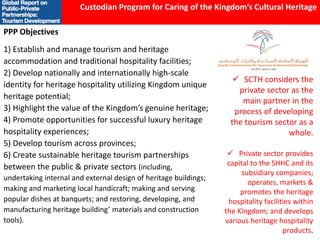
Custodian Program for Caring of the Kingdom’s Cultural Heritage
PPP Objectives
1) Establish and manage tourism and heritage
accommodation and traditional hospitality facilities;
2) Develop nationally and internationally high-scale
identity for heritage hospitality utilizing Kingdom unique
heritage potential;
3) Highlight the value of the Kingdom’s genuine heritage;
4) Promote opportunities for successful luxury heritage
hospitality experiences;
5) Develop tourism across provinces;
6) Create sustainable heritage tourism partnerships
between the public & private sectors (including,
undertaking internal and external design of heritage buildings;
making and marketing local handicraft; making and serving
popular dishes at banquets; and restoring, developing, and
manufacturing heritage building’ materials and construction
tools).
Custodian Program for Caring of the Kingdom’s Cultural Heritage
 SCTH considers the
private sector as the
main partner in the
process of developing
the tourism sector as a
whole.
 Private sector provides
capital to the SHHC and its
subsidiary companies;
operates, markets &
promotes the heritage
hospitality facilities within
the Kingdom; and develops
various heritage hospitality
products.
Inclusive business for tourism training in
Yangon and Nyaung Shwe (Inle Lake), Myanmar
Objective: Economic sustainability
The problem(s)
 Constraints to innovation & tourism market development in Myanmar
 Lack of product diversity & differentiation of product offering to target markets /
different markets
 Lack of understanding about the concept of inclusive business
The project:
 Provide training on inclusive
tourism business
 Help companies develop and pilot
new inclusive business models
Partnerships:
• Industry
• Government
agencies
(National,
state/provincial)
• International
donor
• NGOs
Product & Packaging Innovation Competition
Example:
Donor cooperation & partnerships to advance the Myanmar tourist guide industry.
Objective: Capacity building
Providing capacity building opportunities:
Carnival Australia and cruise ship tourism in Vanuatu, Pacific Islands.
The partnership:
World Bank/IFC; Vanuatu Government; Australian Government; Carnival Australia
Cruiselines, local communities.
Port Vila,
Vanuatu
The problem (s):
 Lack of training & direct employment
opportunities for local people in the
cruise ship sector.
 Many of the recruited locals find the
transition into the cruise ship
employment regime difficult and
unfamiliar, leading to a high turnover.
Methods:
 Preparatory cultural induction
seminar to ease this transition and
ensure that recruits feel better
prepared for their new working life
as crewmembers (IFC, 2014).
 The partnership provides
employment on the ships to
progress through the ranks, increase
their salaries, and job satisfaction
 For those interested in a career in
tourism hospitality to work for the
company in their onshore offices.
Outcome:
 This partnership programme added
130 jobs to the 120 jobs offered to
ni-Vanuatu people on board of
these ships in 2013.
Objective: Environmental conservation
Samoa ́s community tourism operators and the development of
innovative mechanisms to adapt to climate change.
The context:
Tourism in small island destinations, such as
Samoa, is highly vulnerable to climate-induced
risks, with small community operators having
relatively limited capacity to adapt
Tourism is the dominant sector of the
Samoan economy contributing more than
20% of GDP.
Context:
70% of Samoa’s population & tourism operations are located
within 100m of the coastline.
Many operators & communities are:
• exposed to the impacts of climate change induced events,
• other long-term incremental changes (e.g., sea-level rise),
• by changing seasonal weather patterns
 Threatening the viability and profitability of community value
chains.
The partnership:
• Samoan Tourism Authority, with the support of the United
Nations Development Programme (UNDP) - funding from
the Global Environmental Facility
• Government: Ministries of Natural Resources and
Environment and the Ministry of Women, Community and
Social Development.
• Private sector represented by Samoa Hotel Association & Savaii Samoa Tourism
Association
• Input from the civil society is provided through the community
members who participated in project workshops.
Activity:
 Support clusters of small operators at selected
local destinations around the country’s
coastline
 Establish management plans for Tourism
Development Areas (TDAs) by integrating
climate risks and adaptation measures
 Used 3D modelling techniques for TDA
planning process to provide a visual support
and engagement tool that facilitates
discussions around issues and solutions on
natural resources and tourism assets
management
 Connects tourism operators to the Climate
Information and Early Warning System through
innovative software and media applications
that transmit weather warnings and long-term
climate projections
Outcome:
 Helped tourism product diversification as a means of climate change adaptation,
by developing alternative cultural and natural programmes for beach activities
when affected by rainy and stormy weather
 Has enhanced water supplies and tourism related infrastructure
 Reduced shoreline erosion
though the introduction of
soft-engineering techniques
(e.g., beach replenishment)
aided by ecosystem-based
measures (e.g., vegetation
cover) and some protective
structures which help
maintain tourism
functionality (e.g., access,
aesthetics) of beaches.
Conclusions from UNWTO report:
 Tourism PPPs are common around the world
 Tourism builds on partnerships and collaboration at many geographic levels
 PPPs involve governments at central, regional and local levels, individual
businesses and tourism representative bodies, donor organizations of many
types, non-governmental agencies and community organizations
 Collaboration does not just happen, and often requires an external party or well
positioned stakeholder to create consensus or lead partnership development
Collaboration does not just happen - often requires an external party or well
positioned stakeholder to create consensus or lead partnership development.
 Focuses attention on key individuals, their network of contacts, their leadership,
authority and collaborative skills (Beritelli and Bieger, 2014)
 An effective convenor can build trust & relationships that support effective
governance, will be passionate about their task and imbue others that energy
(Gardiner and Scott, 2014).
 Can provide the needed linkage between the public, private & local community
sectors involved in the partnership.
 Important to bring the participants together & provide leadership and direction -
often a person trusted by and with great influence in the community.
Conclusions: Cases presented in the UNWTO report emphasize …
Report identifies 3 different types
of resources available for
developing PPPs.
1. Destination management
organizations provide a
natural home for collaborative
initiatives such as PPPs
2. Universities have a role in
supporting PPPs in emerging
areas
3. Some examples of funding and
training support that may be
available to PPPs have been
identified
Conclusions: Cases presented in the UNWTO report emphasize …
Successful PPPs:
1. Provide a benefit to all stakeholders
involved
2. Demonstrating tangible outcomes -
encourages participation & maintains
momentum to ensure the
sustainability of the project
3. Are collaborations between many
different stakeholders who come
together for mutual economic benefit
from providing memorable
experiences to tourists – they form
partnerships as they cannot achieve
their individual objectives on their
own
Conclusions: The cases in the UNWTO report indicate …
The combination of stakeholders’ actions can achieve what they cannot do individually.
Image source: www.shutterstock.com/image-vector/map-flag-laos-cambodia-myanmar-vietnam-422394277
Public Sector Capacity Building for Strategic Implementation of
Tourism Public-Private Partnerships (PPP) in the CLMV region.
Vientiane, Lao PDR. 3 – 5 May, 2017
PPP for tourism growth and development in developing countries.
Correspondence:
Steve Noakes
steve@pacificasiatourism.org

PPP for tourism growth and development in developing countries.

  • 1.
    Public Sector CapacityBuilding for Strategic Implementation of Tourism Public-Private Partnerships (PPP) in the CLMV region. Vientiane, Lao PDR. 3 – 5 May, 2017 PPP for tourism growth and development in developing countries. Steve Noakes
  • 2.
    Content: 1) Introduction – AsiaPacific tourism perspectives over the past four decades 2) PPP interpretations – No standard, internationally accepted definition 3) PPP applications – From UNWTO Global Report on PPP: Tourism Development  Saudi Arabia  Myanmar  Vanuatu  Samoa Pa-O guide, Nan Khin. Zoology graduate from Taunggyi University, Shan State, Myanmar
  • 3.
    CLMV stamps ashistorical record 1970s Introduction: 40 years ago … early stages of tourism in ASEAN … zero or little tourism in CLMV Bali
  • 4.
    Image source: www.eda.admin.ch/deza/en/home/countries/mekong.html Tourism:CLMV within ASEAN & GMS context 1975: 1.3 mil 2016: 32.5 mil 1975: 1.4 mil 2016: 26.7 mil Norlida Hanim, M.S. (2007) Every nation is an ‘emerging economy’ at some stage:  competing for private sector investments  interested in using Public-Private Partnerships (PPPs) to provide public infrastructure assets & services
  • 5.
    From wartorn towarm welcome. ‘Countries with a more sustainable & open tourism sector are more likely to enjoy higher levels of positive peace in the future’ (WTTC). www.wttc.org/research/other-research/tourism-as-a-driver-of-peace/
  • 6.
    Developmental peace.  For140 years, from the First Opium War in 1839 to the Sino-Vietnamese War in 1979, East Asia did not experience one single decade without a serious war somewhere.  East Asia major battlefield in the ‘Cold War’ era.  The age of peace in Indochina – allowed Vietnam, Cambodia and Laos to normalize their relations with both China and the USA – got access to the USA market. Professor Stein Tønnesson, Department of Peace and Conflict Research, Uppsala University, Sweden + Peace Research Institute Oslo, Norway. East Asians have a Peace to Defend. ‘Tourism brings people together; it opens our minds and hearts” UNWTO Secretary-General Taleb Rifai
  • 7.
    ‘Public-private partnership’ –no standard, internationally accepted definition  can describe several types of arrangements between public & private entities  up to individual country if they wish to have a definition to suit own institutional & legal situation UNWTO publications A broad application:  Whatever is the best way to contribute to public policy goals  Brings together government agencies + public sector + representatives of the whole tourism value chain  Goals of promoting socio-economic development, sustainability, job creation & international competitiveness through tourism Development Banks Focus on:  Longer-term contracts between a private party & a government entity  Capital investment  Provision of public assets or services  Private party: • bears significant risk • management responsibility • accountable for project performance • remuneration linked to performance
  • 8.
    UNWTO facilitates public& private initiatives via the Affiliate Members Programme. ‘PPPs are beyond a developmental tool, but are sometimes essential to stimulate creativity, enhance competitiveness and achieve visionary results which may be difficult if both parties operated in isolation.’ Yolanda Perdomo Director: Affiliate Members Programme, UN World Tourism Organization The role and need for PPPs as tools for development.  The term Public-Private Partnerships (PPPs) covers voluntary collaborative tourism partnerships involving both the government and businesses.  Can also include non-governmental organizations (NGOs) and various other types of associations.
  • 9.
    Since 1990, UNWTOhas released a series of reports and publications that highlight the importance of PPPs in tourism – examples: 1997 2003 2001 ESCAP/WTO/TAT Asia-Pacific Seminar on Public-Private Partnership in Tourism Development, Bangkok, 20-22 March 2000.
  • 10.
    Seventeen (17) casestudies in countries/regions ranging Asia, Pacific, Africa, South America & Middle East + 4 on PPs & Destination Management 6 on Universities as resources for PPPs 3 on Training & PPPs ‘The development of tourism in emerging economies has been shaped by many factors among which Public-Private Partnerships (PPP) play a key role.’ Taleb Rifai Secretary-General, UN World Tourism Organization Free download: http://affiliatemembers.unwto.org/publication/global-report-public-private-partnerships-tourism-development
  • 11.
    The cases presented demonstratefour types of objectives: 1. Business competitiveness (e.g., marketing); 2. Economic sustainability (e.g., economic equity in profit distribution); 3. Capacity building (e.g., knowledge transfer and communication); 4. Environmental conservation (e.g., biodiversity conservation).
  • 12.
    Objective: Business competitiveness Makingcultural heritage a competive advantage Saudi Hospitality Heritage Company: The Kingdom of Saudi Arabia
  • 13.
    The program: Custodian Programfor Caring of the Kingdom’s Cultural Heritage, which aims to preserve, develop, and raise awareness on the national cultural heritage. The policy: Develop a high-quality network of heritage hospitality facilities in different regions of the Kingdom as a sustainable and internationally well-known tourism initiative. The Vision: Tourism and Heritage in the Vision 2030 Custodian Program for Caring of the Kingdom’s Cultural Heritage Minarets are the most visible structures in Saudi Arabia - towers used to call people to prayer The PPP project: Established a joint stock holding company – Saudi Hospitality Heritage Company (SHHC).
  • 14.
    The partners:  SaudiGovernment – via the Public Investment Fund  Development of, and investment in, heritage buildings for area of accommodation & hospitality purposes  Established a joint stock holding company – Saudi Hospitality Heritage Company (SHHC)  SCTH offered private placement of company capital targeting private joint stock companies specialized in the development of hospitality and urban heritage sites  Founding shareholders: Public Investment Fund (15%), Taiba Holding Company (30%), Dur Hospitality (25%), Al-Tayyar Real Estate and Development Co. (20%), Riyadh Development Company (8%), Jeddah Development and Urban Regeneration Company (Jedrick) (2%). Custodian Program for Caring of the Kingdom’s Cultural Heritage
  • 15.
    PPP Objectives 1) Establishand manage tourism and heritage accommodation and traditional hospitality facilities; 2) Develop nationally and internationally high-scale identity for heritage hospitality utilizing Kingdom unique heritage potential; 3) Highlight the value of the Kingdom’s genuine heritage; 4) Promote opportunities for successful luxury heritage hospitality experiences; 5) Develop tourism across provinces; 6) Create sustainable heritage tourism partnerships between the public & private sectors (including, undertaking internal and external design of heritage buildings; making and marketing local handicraft; making and serving popular dishes at banquets; and restoring, developing, and manufacturing heritage building’ materials and construction tools). Custodian Program for Caring of the Kingdom’s Cultural Heritage  SCTH considers the private sector as the main partner in the process of developing the tourism sector as a whole.  Private sector provides capital to the SHHC and its subsidiary companies; operates, markets & promotes the heritage hospitality facilities within the Kingdom; and develops various heritage hospitality products.
  • 16.
    Inclusive business fortourism training in Yangon and Nyaung Shwe (Inle Lake), Myanmar Objective: Economic sustainability
  • 17.
    The problem(s)  Constraintsto innovation & tourism market development in Myanmar  Lack of product diversity & differentiation of product offering to target markets / different markets  Lack of understanding about the concept of inclusive business
  • 18.
    The project:  Providetraining on inclusive tourism business  Help companies develop and pilot new inclusive business models
  • 19.
    Partnerships: • Industry • Government agencies (National, state/provincial) •International donor • NGOs Product & Packaging Innovation Competition
  • 20.
    Example: Donor cooperation &partnerships to advance the Myanmar tourist guide industry.
  • 21.
    Objective: Capacity building Providingcapacity building opportunities: Carnival Australia and cruise ship tourism in Vanuatu, Pacific Islands.
  • 22.
    The partnership: World Bank/IFC;Vanuatu Government; Australian Government; Carnival Australia Cruiselines, local communities. Port Vila, Vanuatu The problem (s):  Lack of training & direct employment opportunities for local people in the cruise ship sector.  Many of the recruited locals find the transition into the cruise ship employment regime difficult and unfamiliar, leading to a high turnover.
  • 23.
    Methods:  Preparatory culturalinduction seminar to ease this transition and ensure that recruits feel better prepared for their new working life as crewmembers (IFC, 2014).  The partnership provides employment on the ships to progress through the ranks, increase their salaries, and job satisfaction  For those interested in a career in tourism hospitality to work for the company in their onshore offices. Outcome:  This partnership programme added 130 jobs to the 120 jobs offered to ni-Vanuatu people on board of these ships in 2013.
  • 24.
    Objective: Environmental conservation Samoás community tourism operators and the development of innovative mechanisms to adapt to climate change.
  • 25.
    The context: Tourism insmall island destinations, such as Samoa, is highly vulnerable to climate-induced risks, with small community operators having relatively limited capacity to adapt Tourism is the dominant sector of the Samoan economy contributing more than 20% of GDP.
  • 26.
    Context: 70% of Samoa’spopulation & tourism operations are located within 100m of the coastline. Many operators & communities are: • exposed to the impacts of climate change induced events, • other long-term incremental changes (e.g., sea-level rise), • by changing seasonal weather patterns  Threatening the viability and profitability of community value chains. The partnership: • Samoan Tourism Authority, with the support of the United Nations Development Programme (UNDP) - funding from the Global Environmental Facility • Government: Ministries of Natural Resources and Environment and the Ministry of Women, Community and Social Development. • Private sector represented by Samoa Hotel Association & Savaii Samoa Tourism Association • Input from the civil society is provided through the community members who participated in project workshops.
  • 27.
    Activity:  Support clustersof small operators at selected local destinations around the country’s coastline  Establish management plans for Tourism Development Areas (TDAs) by integrating climate risks and adaptation measures  Used 3D modelling techniques for TDA planning process to provide a visual support and engagement tool that facilitates discussions around issues and solutions on natural resources and tourism assets management  Connects tourism operators to the Climate Information and Early Warning System through innovative software and media applications that transmit weather warnings and long-term climate projections
  • 28.
    Outcome:  Helped tourismproduct diversification as a means of climate change adaptation, by developing alternative cultural and natural programmes for beach activities when affected by rainy and stormy weather  Has enhanced water supplies and tourism related infrastructure  Reduced shoreline erosion though the introduction of soft-engineering techniques (e.g., beach replenishment) aided by ecosystem-based measures (e.g., vegetation cover) and some protective structures which help maintain tourism functionality (e.g., access, aesthetics) of beaches.
  • 29.
    Conclusions from UNWTOreport:  Tourism PPPs are common around the world  Tourism builds on partnerships and collaboration at many geographic levels  PPPs involve governments at central, regional and local levels, individual businesses and tourism representative bodies, donor organizations of many types, non-governmental agencies and community organizations  Collaboration does not just happen, and often requires an external party or well positioned stakeholder to create consensus or lead partnership development
  • 30.
    Collaboration does notjust happen - often requires an external party or well positioned stakeholder to create consensus or lead partnership development.  Focuses attention on key individuals, their network of contacts, their leadership, authority and collaborative skills (Beritelli and Bieger, 2014)  An effective convenor can build trust & relationships that support effective governance, will be passionate about their task and imbue others that energy (Gardiner and Scott, 2014).  Can provide the needed linkage between the public, private & local community sectors involved in the partnership.  Important to bring the participants together & provide leadership and direction - often a person trusted by and with great influence in the community. Conclusions: Cases presented in the UNWTO report emphasize …
  • 31.
    Report identifies 3different types of resources available for developing PPPs. 1. Destination management organizations provide a natural home for collaborative initiatives such as PPPs 2. Universities have a role in supporting PPPs in emerging areas 3. Some examples of funding and training support that may be available to PPPs have been identified Conclusions: Cases presented in the UNWTO report emphasize …
  • 32.
    Successful PPPs: 1. Providea benefit to all stakeholders involved 2. Demonstrating tangible outcomes - encourages participation & maintains momentum to ensure the sustainability of the project 3. Are collaborations between many different stakeholders who come together for mutual economic benefit from providing memorable experiences to tourists – they form partnerships as they cannot achieve their individual objectives on their own Conclusions: The cases in the UNWTO report indicate … The combination of stakeholders’ actions can achieve what they cannot do individually. Image source: www.shutterstock.com/image-vector/map-flag-laos-cambodia-myanmar-vietnam-422394277
  • 33.
    Public Sector CapacityBuilding for Strategic Implementation of Tourism Public-Private Partnerships (PPP) in the CLMV region. Vientiane, Lao PDR. 3 – 5 May, 2017 PPP for tourism growth and development in developing countries. Correspondence: Steve Noakes steve@pacificasiatourism.org