COLLABORATIVE WORKING
Joining forces in uncertain times
Latin American Women’s
Aid (LAWA)
Empowering women and children who are
experiencing violence to start a new life
and play a fuller role in the community
Latin American Women’s Aid
• Only specialist VAWG organisation for the Latin
American community in the UK - 186.500 (UK), 113.500
in London (QM & LAWRS 2011)
• Only refuge provider for this community since 1987
• Holistic advice & advocacy services
• Also supports other Spanish/Portuguese speakers and
since 2011 women from other ethnic minority groups
• Bridge between community & service providers
March 2012- 2013: 594 women and children supported
• The Refuge
- Refuge Coordinator
- Child Support Worker
- Floating Support Project
• The Advice and Information Centre
- DV Advice & Advocacy Project
- Samira Project (VAWG Outreach Project)
- Family Outreach Support Project
• Workshops, in-house legal advice surgeries
• Family Outings and social activities
Service Overview
• 1 in 4 women affected by DV, women from BME backgrounds
stay longer in abusive relationships than white British women:
- Lack of knowledge about their rights,
- Isolation and discrimination,
- Insufficient English language skills,
- Economic dependency on their abusive partner.
• BME women often don’t approach generic services, fearing:
discrimination, language barrier or failure to address their
needs
• Mainstream services often consider BME women’s needs too
“challenging” or “complex” to deal with
• BME services are able to reach “hard-to-reach” groups and
complement mainstream service gaps
Why are BME specialist services
like LAWA needed?
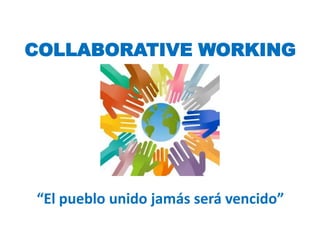
COLLABORATIVE WORKING
“
“El pueblo unido jamás será vencido”
What is Collaborative Working?
• Different ways in which organisations can work
together for fixed length of time or permanently
Examples:
 Informal networks
 Partnerships
 Alliances
 Project collaboration
 Full mergers
• Involves some sort of exchange, for mutual
advantage, that ultimately benefits service users.
(NCVO 2013)
Benefits of Collaboration
Improved or wider range of services for
beneficiaries
Financial savings & better use of resources
Knowledge & information sharing
Sharing the risk in new projects
Stronger, united voice
Capacity to replicate success & avoid “reinventing
the wheel”
Better co -ordination of organisations’ activities
and mutual support (NCVO Collaborative Working Unit 2007)
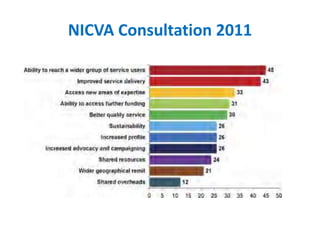
NICVA Consultation 2011
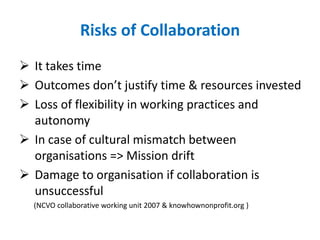
Risks of Collaboration
 It takes time
 Outcomes don’t justify time & resources invested
 Loss of flexibility in working practices and
autonomy
 In case of cultural mismatch between
organisations => Mission drift
 Damage to organisation if collaboration is
unsuccessful
(NCVO collaborative working unit 2007 & knowhownonprofit.org )
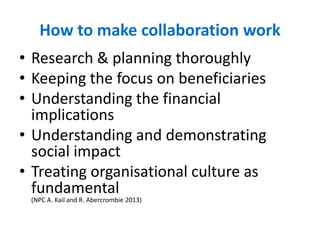
How to make collaboration work
• Research & planning thoroughly
• Keeping the focus on beneficiaries
• Understanding the financial
implications
• Understanding and demonstrating
social impact
• Treating organisational culture as
fundamental
(NPC A. Kail and R. Abercrombie 2013)
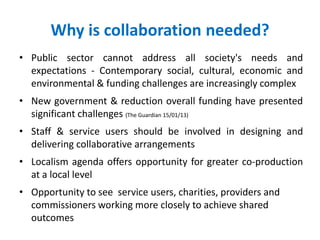
Why is collaboration needed?
• Public sector cannot address all society's needs and
expectations - Contemporary social, cultural, economic and
environmental & funding challenges are increasingly complex
• New government & reduction overall funding have presented
significant challenges (The Guardian 15/01/13)
• Staff & service users should be involved in designing and
delivering collaborative arrangements
• Localism agenda offers opportunity for greater co-production
at a local level
• Opportunity to see service users, charities, providers and
commissioners working more closely to achieve shared
outcomes
Why does LAWA think that
collaboration is useful ?
• Strong civil society with high levels of
collaboration to bring about social change =
key Latin American characteristic
• Successful track record of working in
partnership
• Collaboration as a way of strengthening
service delivery in uncertain times
FGS & LAWA
The beginning of a collaboration
• We do not reinvent the wheel – we keep it
rolling
• Similar goals and overlap of key work areas
• Sharing experiences
• Transferring success-models
• Enhancing communal learning in sector =>
increases sector knowledge and stimulates
growth and replication
Useful resources
What is collaborative working: http://www.ncvo-vol.org.uk/advice-support/collaborative-
working
Guides on collaborative working (collaboration, mergers, due diligence): http://www.ncvo-
vol.org.uk/advice-support/collaborative-working/information-and-tools
Ways of working together collaboratively
http://knowhownonprofit.org/organisation/collaboration/working-collaboratively
Collaboration for impact report: http://www.thinknpc.org/publications/collaborating-for-
impact/
Why cross sector working is vital in civil society: http://www.guardian.co.uk/voluntary-sector-
network/2012/jan/31/cross-sector-collaboration-civil-society
Collaborative working a practical guide:
http://www.collaborationni.org/sites/default/files/A%20Practical%20Guide%20to%20Collabor
ation_0.pdf
Stephanie Futter- Orel
stephanie@lawadv.org.uk
General Manager
0207 275 0321
079 460 234 77
advice@lawadv.org.uk
www.lawadv.org.uk
(Website currently under reconstruction)
Contact Details
THANK YOU !

LAWA: Collaborative Working

  • 1.
  • 2.
    Latin American Women’s Aid(LAWA) Empowering women and children who are experiencing violence to start a new life and play a fuller role in the community
  • 3.
    Latin American Women’sAid • Only specialist VAWG organisation for the Latin American community in the UK - 186.500 (UK), 113.500 in London (QM & LAWRS 2011) • Only refuge provider for this community since 1987 • Holistic advice & advocacy services • Also supports other Spanish/Portuguese speakers and since 2011 women from other ethnic minority groups • Bridge between community & service providers
  • 4.
    March 2012- 2013:594 women and children supported • The Refuge - Refuge Coordinator - Child Support Worker - Floating Support Project • The Advice and Information Centre - DV Advice & Advocacy Project - Samira Project (VAWG Outreach Project) - Family Outreach Support Project • Workshops, in-house legal advice surgeries • Family Outings and social activities Service Overview
  • 5.
    • 1 in4 women affected by DV, women from BME backgrounds stay longer in abusive relationships than white British women: - Lack of knowledge about their rights, - Isolation and discrimination, - Insufficient English language skills, - Economic dependency on their abusive partner. • BME women often don’t approach generic services, fearing: discrimination, language barrier or failure to address their needs • Mainstream services often consider BME women’s needs too “challenging” or “complex” to deal with • BME services are able to reach “hard-to-reach” groups and complement mainstream service gaps Why are BME specialist services like LAWA needed?
  • 6.
    COLLABORATIVE WORKING “ “El pueblounido jamás será vencido”
  • 7.
    What is CollaborativeWorking? • Different ways in which organisations can work together for fixed length of time or permanently Examples:  Informal networks  Partnerships  Alliances  Project collaboration  Full mergers • Involves some sort of exchange, for mutual advantage, that ultimately benefits service users. (NCVO 2013)
  • 8.
    Benefits of Collaboration Improvedor wider range of services for beneficiaries Financial savings & better use of resources Knowledge & information sharing Sharing the risk in new projects Stronger, united voice Capacity to replicate success & avoid “reinventing the wheel” Better co -ordination of organisations’ activities and mutual support (NCVO Collaborative Working Unit 2007)
  • 9.
  • 10.
    Risks of Collaboration It takes time  Outcomes don’t justify time & resources invested  Loss of flexibility in working practices and autonomy  In case of cultural mismatch between organisations => Mission drift  Damage to organisation if collaboration is unsuccessful (NCVO collaborative working unit 2007 & knowhownonprofit.org )
  • 11.
    How to makecollaboration work • Research & planning thoroughly • Keeping the focus on beneficiaries • Understanding the financial implications • Understanding and demonstrating social impact • Treating organisational culture as fundamental (NPC A. Kail and R. Abercrombie 2013)
  • 12.
    Why is collaborationneeded? • Public sector cannot address all society's needs and expectations - Contemporary social, cultural, economic and environmental & funding challenges are increasingly complex • New government & reduction overall funding have presented significant challenges (The Guardian 15/01/13) • Staff & service users should be involved in designing and delivering collaborative arrangements • Localism agenda offers opportunity for greater co-production at a local level • Opportunity to see service users, charities, providers and commissioners working more closely to achieve shared outcomes
  • 13.
    Why does LAWAthink that collaboration is useful ? • Strong civil society with high levels of collaboration to bring about social change = key Latin American characteristic • Successful track record of working in partnership • Collaboration as a way of strengthening service delivery in uncertain times
  • 14.
    FGS & LAWA Thebeginning of a collaboration • We do not reinvent the wheel – we keep it rolling • Similar goals and overlap of key work areas • Sharing experiences • Transferring success-models • Enhancing communal learning in sector => increases sector knowledge and stimulates growth and replication
  • 15.
    Useful resources What iscollaborative working: http://www.ncvo-vol.org.uk/advice-support/collaborative- working Guides on collaborative working (collaboration, mergers, due diligence): http://www.ncvo- vol.org.uk/advice-support/collaborative-working/information-and-tools Ways of working together collaboratively http://knowhownonprofit.org/organisation/collaboration/working-collaboratively Collaboration for impact report: http://www.thinknpc.org/publications/collaborating-for- impact/ Why cross sector working is vital in civil society: http://www.guardian.co.uk/voluntary-sector- network/2012/jan/31/cross-sector-collaboration-civil-society Collaborative working a practical guide: http://www.collaborationni.org/sites/default/files/A%20Practical%20Guide%20to%20Collabor ation_0.pdf
  • 16.
    Stephanie Futter- Orel stephanie@lawadv.org.uk GeneralManager 0207 275 0321 079 460 234 77 advice@lawadv.org.uk www.lawadv.org.uk (Website currently under reconstruction) Contact Details
  • 17.

Editor's Notes

  • #4 LA community disproportionally marginalised in the UK, and not accounted for in official statistics85% employment rates - 40% experience workplace abuse Only 1 in 5 receive some form of welfare benefit and 1 in 5 Latin Americans have never been to a GP Community groups are of high importance
  • #10 Northern Ireland Council for Voluntary Action 2011
  • #11 Working with other organisations is more complex than alone & takes time to be established – but can also have great benefits Involvingstaff and volunteers and making them understanding each others culture is vital
  • #12 -> Commissioners have a role to encourage collaboration 
  • #13 Current challenges cannot be tackled by state alone & significant cuts to voluntary sector – specifically women’s services have experienced 31% of funding cuts from local authorities between 2010-2012, a reduction from £7.8m to £5.4m. Specialist services are being particularly hardest hit, and experience cuts ranging between 20-70% to their local authority budgets.http://www.guardian.co.uk/society/2012/jan/31/domestic-violence-victims-risk-cutsNew collaborative effect will require leadership skills and some new ways of behaving to achieve this
  • #14 Collaboration = key element of Latin American culture -> history of strong social movements which brought about political/economical/social change
  • #15 Impact demonstration: adapted electronic version of user consultation to paper form for now with view of future electronic dev.Changing community attitudes not only about our areas of work, but also on how to work together – creating shared sector knowledgeOrganisations like ours enable users to actively engage in wider community – we empower people so they can be contributors to society&integrate