What’s Wrong with ESL Textbooks and How to Fix Them Harvey Utech, Sc.D., MBA Poznan, Poland November 22, 2009
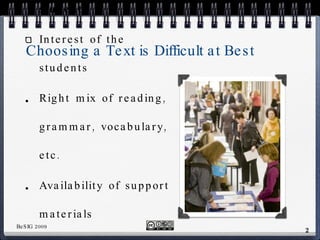
Choosing a Text is Difficult at Best Needs of the students Interest of the students Right mix of reading, grammar, vocabulary, etc. Availability of support materials Style, writing, & design Cost
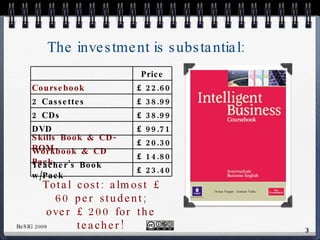
The investment is substantial: Total cost: almost £ 60 per student; over £ 200 for the teacher! Price Coursebook £ 22.60 2 Cassettes £ 38.99 2 CDs £ 38.99 DVD £ 99.71 Skills Book & CD-ROM £ 20.30 Workbook & CD Pack £ 14.80 Teacher’s Book w/Pack £ 23.40
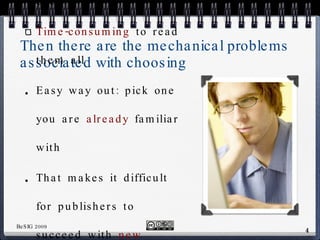
Then there are the mechanical problems associated with choosing Have to get a  copy  of each Time-consuming  to read them all Easy way out: pick one you are  already  familiar with That makes it difficult for publishers to succeed with  new  textbooks, increasing their costs and driving up prices
Speakers at BeSIG/Bonn/2008 took a dim view of textbooks; some quotes: “ As no  book /material is adequate . . .” “ . . . CBEC courses do away with the need for  coursebooks ”  “ Move away from  coursebooks  and discover . . .” “ . . . will we still be using traditional  printed  materials to teach Business English in the future?” “ . . . informed choices can be difficult - whether to use  published  materials” “ Business English  Texts  [have] their limitations.”
I also take a dim view: No textbook has exactly what I want in it Typically, they have reading, listening, comprehension, vocabulary, discussion exercises in every chapter. Some are excellent, some are good, some are poor (or at least not what I want for my class) BUT I can’t change them! Nor can I use what I like and leave what I don’t!
Most texts can meet some of our requirements but not all of them We Can’t pick and choose from the best because  they are not in electronic form (xerox machine) illegal to copy and distribute parts of book due to publisher’s copyright New vocabulary introduced by the text not in a form convenient to learn To put it another way,
And let’s face it, Improving one’s English is some-thing a good ESL book could enable one to do  on his/her own For some, it may even be  better and faster  than in a classroom And in case you haven’t noticed, most publishers suggest their books can be used for  “stand alone”  learning
As teachers, we know the classroom setting is better for the average student than stand-alone, if we do our job well  And part of doing our job well is selecting the right material. And books, the way they are now published on paper with copyright protection, keep us from doing that.  And it keeps publishers from benefitting from our know-how.
What can be done to fix that? That’s what the first part of this workshop is all about.
Here are my suggestions on what publishers should do Adopt a more flexible copyright Let us change/improve their content Let us mix-and-match and custom-make our own printed textbooks Put vocabulary associated with each exercise online in either a: 5-step format flash-card format Allow me to explain
Let’s take a look at traditional copyright . . .
Traditional Copyright Copyright*  gives the author of an original work  exclusive right  for a certain time period in relation to that work, including its publication, distribution and adaptation, after which time the work is said to enter the  public domain . Virtually every ESL/EFL textbook on the market is protected by the publisher’s copyright. That means that the only way to use it is to buy it.  *Excerpted from Wikipedia: “On-Demand Publishing”
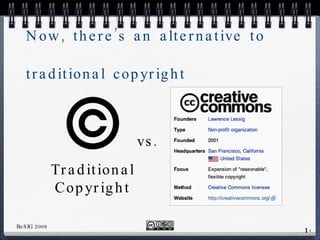
Now, there’s an alternative to traditional copyright vs. Traditional Copyright
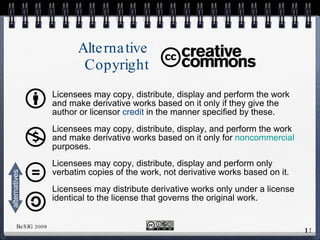
Alternative Copyright Licensees may copy, distribute, display and perform the work and make derivative works based on it only if they give the author or licensor  credit  in the manner specified by these. Licensees may copy, distribute, display, and perform the work and make derivative works based on it only for  noncommercial  purposes. Licensees may copy, distribute, display and perform only verbatim copies of the work,  not derivative  works based on it. Licensees may distribute  derivative  works only under a license identical to the license that governs the original work.  alternatives
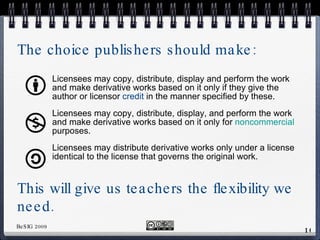
Licensees may copy, distribute, display and perform the work and make derivative works based on it only if they give the author or licensor  credit  in the manner specified by these. Licensees may copy, distribute, display, and perform the work and make derivative works based on it only for  noncommercial  purposes. Licensees may distribute  derivative  works only under a license identical to the license that governs the original work.  The choice publishers should make: This will give us teachers the flexibility we need.
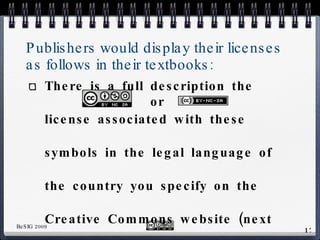
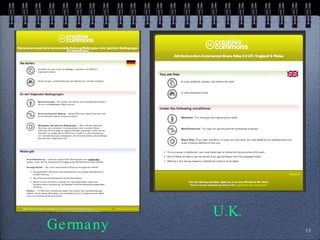
Publishers would display their licenses as follows in their textbooks: There is a full description the license associated with these symbols in the legal language of the country you specify on the Creative Commons website (next slide). or
Germany U.K.
 
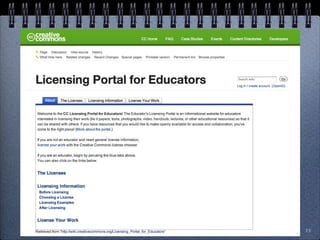
If publishers copyright their work under this type of license, we could use their material without paying for it modify the contents and republish the work under the same kind of license neither we nor the publisher could sell our modification for profit
Allow us to print our our own books made up of the materials we select (or do it for us (POD)* Print on demand (POD) is a  printing  technology in which a book is not printed until an order has been received. Digital printing makes this possible. While the unit price of each physical copy printed is higher than with  offset or letterpress printing , the average cost is lower for small print runs, because setup costs are much higher for offset printing. *Excerpted from Wikipedia: “On-Demand Publishing”
POD has benefits for the publisher too*: Technical set-up is much quicker than for offset printing because we do most of it. Large inventories of a book do not need to be kept in stock, reducing the publisher’s storage, handling, and inventory costs. There is little or no waste from unsold products. *Excerpted from Wikipedia: “On-Demand Publishing”
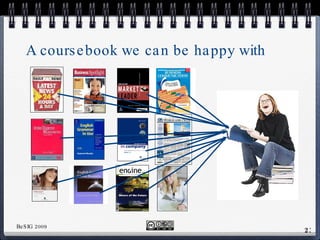
A coursebook we can be happy with
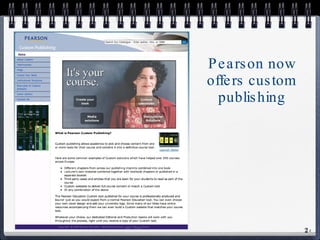
Pearson now offers custom publishing
That’s a big step forward but . . . I still can’t modify Pearson’s copyrighted material I can only take chapter-by-chapter from Pearson’s existing texts; can’t take individual parts of chapters Cost?
Enter vocabulary onto learning software Let’s take a look first at the 5-step plan for learning vocabulary
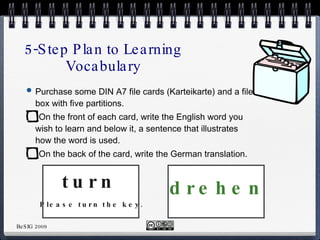
5-Step Plan to Learning Vocabulary Purchase some DIN A7 file cards (Karteikarte) and a file box with five partitions. On the front of each card, write the English word you wish to learn and below it, a sentence that illustrates how the word is used. On the back of the card, write the German translation. turn drehen Please turn the key.
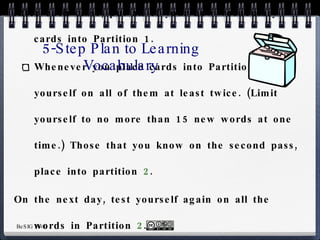
After each class, put all of your new vocabulary cards into Partition 1.  Whenever you place cards into Partition  1 , test yourself on all of them at least twice. (Limit yourself to no more than 15 new words at one time.) Those that you know on the second pass, place into partition  2 .  On the next day, test yourself again on all the words in Partition  2 .  Place those you remember in Partition  3 ; place those you forget back in Partition  1 . 5-Step Plan to Learning Vocabulary
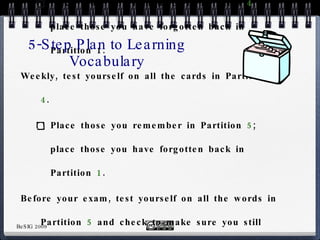
Every three days, test yourself on all the cards in Partition  3 .  Place those you remember in Partition  4 ; place those you have forgotten back in Partition 1.  Weekly, test yourself on all the cards in Partition  4 .  Place those you remember in Partition  5 ; place those you have forgotten back in Partition  1 . Before your exam, test yourself on all the words in Partition  5  and check to make sure you still know the meaning of these words and how to use them.  Remove those you remember from the box, because now you can be sure they are stored in long-term memory. 5-Step Plan to Learning Vocabulary
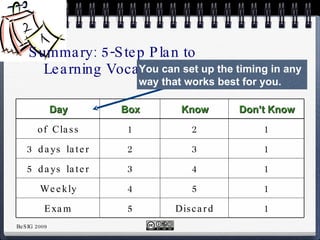
Summary: 5-Step Plan to Learning Vocabulary Day Box Know Don’t Know of Class 1 2 1 3 days later 2 3 1 5 days later 3 4 1 Weekly 4 5 1 Exam 5 Discard 1 You can set up the timing in any way that works best for you.
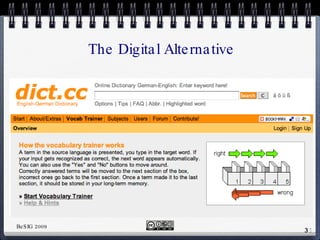
The Digital Alternative
Advantages for the Publishers Continue to control book market Can set up site for derivative works based on their materials; charge reasonable access fee (e.g. £ 10 monthly/(£ 100 annual) Can make money on print-on-demand books Get continual feedback from teachers on which materials work best.
Advantages for Teachers Can get the materials we want Can change (and improve) the books we have to use now Can readily find other teachers’ solutions to serving the needs of classes can publish our own books for the classes we teach
Summarizing my three suggestions to EFL publishers: Replace traditional copyright with a  Creative Contents  license Offer  print-on-demand Make vocabulary available in  dict.cc
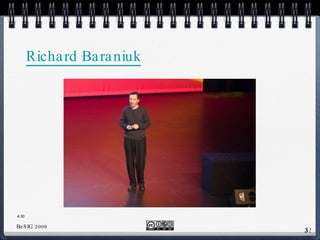
Richard Baraniuk 4:30
So let’s start building our own EFL “Knowledge Ecosystem” Let’s hope the publishing industry takes the lead. But if not . . . See you next year!
The Kind of Teaching I do University students Most have had 4-8 years of English before coming to university Large classes (25-30) Fairly wide range of fluency (CEF Ratings from A2 to C1 in same class)
Study aids I have available 36 suitable jokes 12 technical articles (with German translations interspersed) and accompanying PowerPoint slides 15 ESL podcards (visits to foreign English-speaking cities) with accompanying PowerPoints in some cases 18 musical selections with lyrics on slides and accompanying photos
36 jokes
13 (semi-)technical articles; each consists of: Condensed article from “How Stuff Works” or other source Translation of key vocabulary Slides to illustrate points in article Sample on internal combustion engine being passed around Here are some slides designed to accompany that talk
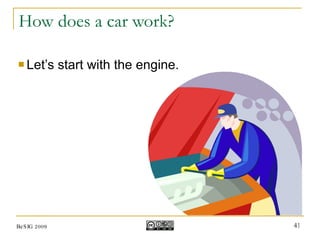
How does a car work? Let’s start with the engine. BeSIG 2009
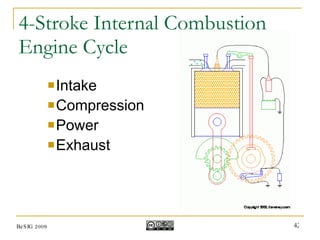
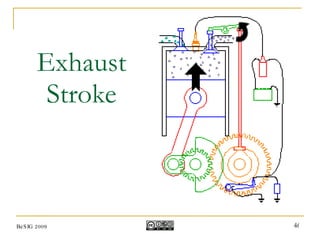
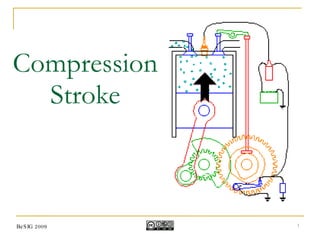
4-Stroke Internal Combustion Engine Cycle Intake Compression Power Exhaust BeSIG 2009
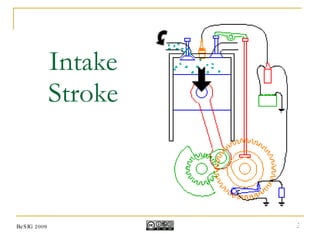
Intake Stroke BeSIG 2009
Compression Stroke BeSIG 2009
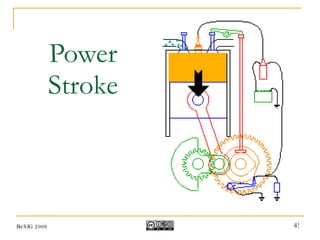
Power Stroke BeSIG 2009
Exhaust Stroke BeSIG 2009
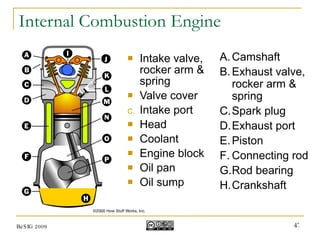
Internal Combustion Engine Intake valve, rocker arm & spring Valve cover Intake port Head Coolant Engine block Oil pan Oil sump BeSIG 2009 Camshaft Exhaust valve, rocker arm & spring Spark plug Exhaust port Piston Connecting rod Rod bearing Crankshaft
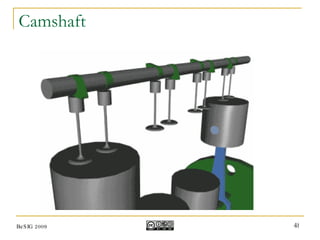
Camshaft BeSIG 2009
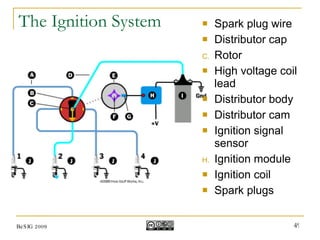
The Ignition System Spark plug wire Distributor cap Rotor High voltage coil lead Distributor body Distributor cam Ignition signal sensor Ignition module Ignition coil Spark plugs BeSIG 2009
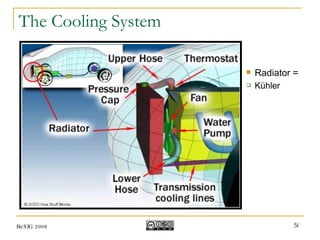
The Cooling System BeSIG 2009 Radiator = Kühler
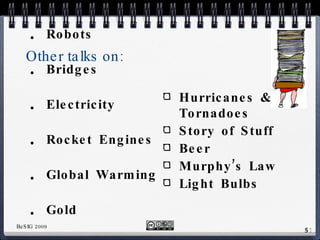
Other talks on: Robots Bridges Electricity Rocket Engines Global Warming Gold The Eden Project Hurricanes & Tornadoes  Story of Stuff Beer Murphy’s Law Light Bulbs
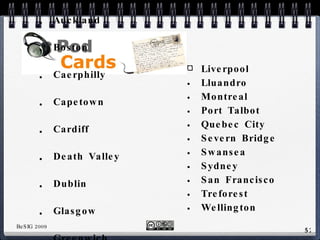
Auckland Boston Caerphilly Capetown Cardiff Death Valley Dublin Glasgow Greenwich Isle-of-Wight Liverpool Lluandro Montreal Port Talbot Quebec City Severn Bridge Swansea Sydney San Francisco Treforest Wellington
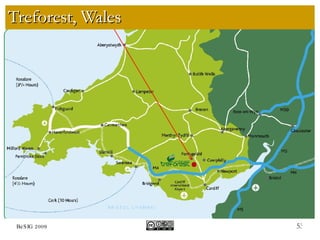
Treforest, Wales BeSIG 2009
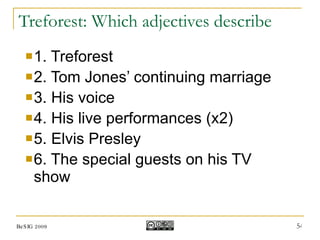
Treforest: Which adjectives describe 1. Treforest 2. Tom Jones’ continuing marriage 3. His voice 4. His live performances (x2) 5. Elvis Presley 6. The special guests on his TV show BeSIG 2009
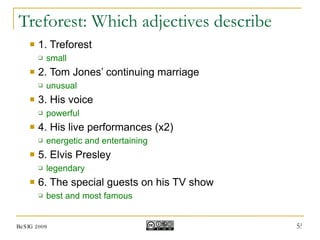
Treforest: Which adjectives describe 1. Treforest small 2. Tom Jones’ continuing marriage unusual 3. His voice powerful 4. His live performances (x2) energetic and entertaining 5. Elvis Presley legendary 6. The special guests on his TV show best and most famous BeSIG 2009
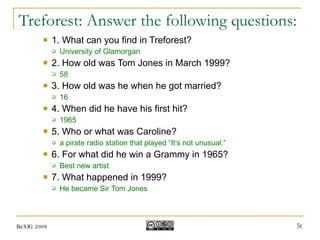
Treforest: Answer the following questions: 1. What can you find in Treforest? University of Glamorgan 2. How old was Tom Jones in March 1999? 58 3. How old was he when he got married? 16 4. When did he have his first hit? 1965 5. Who or what was Caroline? a pirate radio station that played “It’s not unusual.” 6. For what did he win a Grammy in 1965? Best new artist 7. What happened in 1999? He became Sir Tom Jones BeSIG 2009
Musical Selections Either  YouTube  Video OR ITunes  download Lyrics  (and photos) on slides Sometimes tied to a  Podcard  or other class element Provide an entertaining  change-of-pace  to a class Encouragement for students to  listen  to English-language music on their own
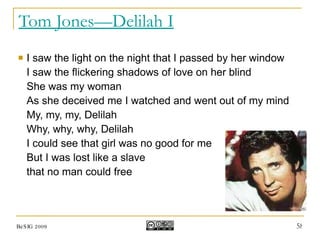
Tom Jones—Delilah I I saw the light on the night that I passed by her window I saw the flickering shadows of love on her blind She was my woman As she deceived me I watched and went out of my mind My, my, my, Delilah Why, why, why, Delilah I could see that girl was no good for me But I was lost like a slave  that no man could free BeSIG 2009
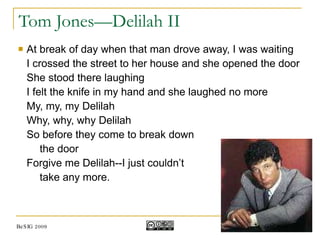
Tom Jones—Delilah II At break of day when that man drove away, I was waiting I crossed the street to her house and she opened the door She stood there laughing I felt the knife in my hand and she laughed no more My, my, my Delilah Why, why, why Delilah So before they come to break down  the door Forgive me Delilah--I just couldn’t  take any more. BeSIG 2009
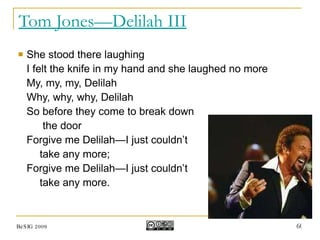
Tom Jones—Delilah III She stood there laughing I felt the knife in my hand and she laughed no more My, my, my, Delilah Why, why, why, Delilah So before they come to break down  the door Forgive me Delilah—I just couldn’t  take any more; Forgive me Delilah—I just couldn’t  take any more.  BeSIG 2009
Questions for You: Would you be able to use these classroom elements? If so, would you also, on occasion, be willing to improve on them? Would you then return the modified versions to the site from which you got them so others could use them? Would you agree to a Creative Commons license?

Poznan Talk

  • 1.
    What’s Wrong withESL Textbooks and How to Fix Them Harvey Utech, Sc.D., MBA Poznan, Poland November 22, 2009
  • 2.
    Choosing a Textis Difficult at Best Needs of the students Interest of the students Right mix of reading, grammar, vocabulary, etc. Availability of support materials Style, writing, & design Cost
  • 3.
    The investment issubstantial: Total cost: almost £ 60 per student; over £ 200 for the teacher! Price Coursebook £ 22.60 2 Cassettes £ 38.99 2 CDs £ 38.99 DVD £ 99.71 Skills Book & CD-ROM £ 20.30 Workbook & CD Pack £ 14.80 Teacher’s Book w/Pack £ 23.40
  • 4.
    Then there arethe mechanical problems associated with choosing Have to get a copy of each Time-consuming to read them all Easy way out: pick one you are already familiar with That makes it difficult for publishers to succeed with new textbooks, increasing their costs and driving up prices
  • 5.
    Speakers at BeSIG/Bonn/2008took a dim view of textbooks; some quotes: “ As no book /material is adequate . . .” “ . . . CBEC courses do away with the need for coursebooks ” “ Move away from coursebooks and discover . . .” “ . . . will we still be using traditional printed materials to teach Business English in the future?” “ . . . informed choices can be difficult - whether to use published materials” “ Business English Texts [have] their limitations.”
  • 6.
    I also takea dim view: No textbook has exactly what I want in it Typically, they have reading, listening, comprehension, vocabulary, discussion exercises in every chapter. Some are excellent, some are good, some are poor (or at least not what I want for my class) BUT I can’t change them! Nor can I use what I like and leave what I don’t!
  • 7.
    Most texts canmeet some of our requirements but not all of them We Can’t pick and choose from the best because they are not in electronic form (xerox machine) illegal to copy and distribute parts of book due to publisher’s copyright New vocabulary introduced by the text not in a form convenient to learn To put it another way,
  • 8.
    And let’s faceit, Improving one’s English is some-thing a good ESL book could enable one to do on his/her own For some, it may even be better and faster than in a classroom And in case you haven’t noticed, most publishers suggest their books can be used for “stand alone” learning
  • 9.
    As teachers, weknow the classroom setting is better for the average student than stand-alone, if we do our job well And part of doing our job well is selecting the right material. And books, the way they are now published on paper with copyright protection, keep us from doing that. And it keeps publishers from benefitting from our know-how.
  • 10.
    What can bedone to fix that? That’s what the first part of this workshop is all about.
  • 11.
    Here are mysuggestions on what publishers should do Adopt a more flexible copyright Let us change/improve their content Let us mix-and-match and custom-make our own printed textbooks Put vocabulary associated with each exercise online in either a: 5-step format flash-card format Allow me to explain
  • 12.
    Let’s take alook at traditional copyright . . .
  • 13.
    Traditional Copyright Copyright* gives the author of an original work exclusive right for a certain time period in relation to that work, including its publication, distribution and adaptation, after which time the work is said to enter the public domain . Virtually every ESL/EFL textbook on the market is protected by the publisher’s copyright. That means that the only way to use it is to buy it. *Excerpted from Wikipedia: “On-Demand Publishing”
  • 14.
    Now, there’s analternative to traditional copyright vs. Traditional Copyright
  • 15.
    Alternative Copyright Licenseesmay copy, distribute, display and perform the work and make derivative works based on it only if they give the author or licensor credit in the manner specified by these. Licensees may copy, distribute, display, and perform the work and make derivative works based on it only for noncommercial purposes. Licensees may copy, distribute, display and perform only verbatim copies of the work, not derivative works based on it. Licensees may distribute derivative works only under a license identical to the license that governs the original work. alternatives
  • 16.
    Licensees may copy,distribute, display and perform the work and make derivative works based on it only if they give the author or licensor credit in the manner specified by these. Licensees may copy, distribute, display, and perform the work and make derivative works based on it only for noncommercial purposes. Licensees may distribute derivative works only under a license identical to the license that governs the original work. The choice publishers should make: This will give us teachers the flexibility we need.
  • 17.
    Publishers would displaytheir licenses as follows in their textbooks: There is a full description the license associated with these symbols in the legal language of the country you specify on the Creative Commons website (next slide). or
  • 18.
  • 19.
  • 20.
    If publishers copyrighttheir work under this type of license, we could use their material without paying for it modify the contents and republish the work under the same kind of license neither we nor the publisher could sell our modification for profit
  • 21.
    Allow us toprint our our own books made up of the materials we select (or do it for us (POD)* Print on demand (POD) is a printing technology in which a book is not printed until an order has been received. Digital printing makes this possible. While the unit price of each physical copy printed is higher than with offset or letterpress printing , the average cost is lower for small print runs, because setup costs are much higher for offset printing. *Excerpted from Wikipedia: “On-Demand Publishing”
  • 22.
    POD has benefitsfor the publisher too*: Technical set-up is much quicker than for offset printing because we do most of it. Large inventories of a book do not need to be kept in stock, reducing the publisher’s storage, handling, and inventory costs. There is little or no waste from unsold products. *Excerpted from Wikipedia: “On-Demand Publishing”
  • 23.
    A coursebook wecan be happy with
  • 24.
    Pearson now offerscustom publishing
  • 25.
    That’s a bigstep forward but . . . I still can’t modify Pearson’s copyrighted material I can only take chapter-by-chapter from Pearson’s existing texts; can’t take individual parts of chapters Cost?
  • 26.
    Enter vocabulary ontolearning software Let’s take a look first at the 5-step plan for learning vocabulary
  • 27.
    5-Step Plan toLearning Vocabulary Purchase some DIN A7 file cards (Karteikarte) and a file box with five partitions. On the front of each card, write the English word you wish to learn and below it, a sentence that illustrates how the word is used. On the back of the card, write the German translation. turn drehen Please turn the key.
  • 28.
    After each class,put all of your new vocabulary cards into Partition 1. Whenever you place cards into Partition 1 , test yourself on all of them at least twice. (Limit yourself to no more than 15 new words at one time.) Those that you know on the second pass, place into partition 2 . On the next day, test yourself again on all the words in Partition 2 . Place those you remember in Partition 3 ; place those you forget back in Partition 1 . 5-Step Plan to Learning Vocabulary
  • 29.
    Every three days,test yourself on all the cards in Partition 3 . Place those you remember in Partition 4 ; place those you have forgotten back in Partition 1. Weekly, test yourself on all the cards in Partition 4 . Place those you remember in Partition 5 ; place those you have forgotten back in Partition 1 . Before your exam, test yourself on all the words in Partition 5 and check to make sure you still know the meaning of these words and how to use them. Remove those you remember from the box, because now you can be sure they are stored in long-term memory. 5-Step Plan to Learning Vocabulary
  • 30.
    Summary: 5-Step Planto Learning Vocabulary Day Box Know Don’t Know of Class 1 2 1 3 days later 2 3 1 5 days later 3 4 1 Weekly 4 5 1 Exam 5 Discard 1 You can set up the timing in any way that works best for you.
  • 31.
  • 32.
    Advantages for thePublishers Continue to control book market Can set up site for derivative works based on their materials; charge reasonable access fee (e.g. £ 10 monthly/(£ 100 annual) Can make money on print-on-demand books Get continual feedback from teachers on which materials work best.
  • 33.
    Advantages for TeachersCan get the materials we want Can change (and improve) the books we have to use now Can readily find other teachers’ solutions to serving the needs of classes can publish our own books for the classes we teach
  • 34.
    Summarizing my threesuggestions to EFL publishers: Replace traditional copyright with a Creative Contents license Offer print-on-demand Make vocabulary available in dict.cc
  • 35.
  • 36.
    So let’s startbuilding our own EFL “Knowledge Ecosystem” Let’s hope the publishing industry takes the lead. But if not . . . See you next year!
  • 37.
    The Kind ofTeaching I do University students Most have had 4-8 years of English before coming to university Large classes (25-30) Fairly wide range of fluency (CEF Ratings from A2 to C1 in same class)
  • 38.
    Study aids Ihave available 36 suitable jokes 12 technical articles (with German translations interspersed) and accompanying PowerPoint slides 15 ESL podcards (visits to foreign English-speaking cities) with accompanying PowerPoints in some cases 18 musical selections with lyrics on slides and accompanying photos
  • 39.
  • 40.
    13 (semi-)technical articles;each consists of: Condensed article from “How Stuff Works” or other source Translation of key vocabulary Slides to illustrate points in article Sample on internal combustion engine being passed around Here are some slides designed to accompany that talk
  • 41.
    How does acar work? Let’s start with the engine. BeSIG 2009
  • 42.
    4-Stroke Internal CombustionEngine Cycle Intake Compression Power Exhaust BeSIG 2009
  • 43.
  • 44.
  • 45.
  • 46.
  • 47.
    Internal Combustion EngineIntake valve, rocker arm & spring Valve cover Intake port Head Coolant Engine block Oil pan Oil sump BeSIG 2009 Camshaft Exhaust valve, rocker arm & spring Spark plug Exhaust port Piston Connecting rod Rod bearing Crankshaft
  • 48.
  • 49.
    The Ignition SystemSpark plug wire Distributor cap Rotor High voltage coil lead Distributor body Distributor cam Ignition signal sensor Ignition module Ignition coil Spark plugs BeSIG 2009
  • 50.
    The Cooling SystemBeSIG 2009 Radiator = Kühler
  • 51.
    Other talks on:Robots Bridges Electricity Rocket Engines Global Warming Gold The Eden Project Hurricanes & Tornadoes Story of Stuff Beer Murphy’s Law Light Bulbs
  • 52.
    Auckland Boston CaerphillyCapetown Cardiff Death Valley Dublin Glasgow Greenwich Isle-of-Wight Liverpool Lluandro Montreal Port Talbot Quebec City Severn Bridge Swansea Sydney San Francisco Treforest Wellington
  • 53.
  • 54.
    Treforest: Which adjectivesdescribe 1. Treforest 2. Tom Jones’ continuing marriage 3. His voice 4. His live performances (x2) 5. Elvis Presley 6. The special guests on his TV show BeSIG 2009
  • 55.
    Treforest: Which adjectivesdescribe 1. Treforest small 2. Tom Jones’ continuing marriage unusual 3. His voice powerful 4. His live performances (x2) energetic and entertaining 5. Elvis Presley legendary 6. The special guests on his TV show best and most famous BeSIG 2009
  • 56.
    Treforest: Answer thefollowing questions: 1. What can you find in Treforest? University of Glamorgan 2. How old was Tom Jones in March 1999? 58 3. How old was he when he got married? 16 4. When did he have his first hit? 1965 5. Who or what was Caroline? a pirate radio station that played “It’s not unusual.” 6. For what did he win a Grammy in 1965? Best new artist 7. What happened in 1999? He became Sir Tom Jones BeSIG 2009
  • 57.
    Musical Selections Either YouTube Video OR ITunes download Lyrics (and photos) on slides Sometimes tied to a Podcard or other class element Provide an entertaining change-of-pace to a class Encouragement for students to listen to English-language music on their own
  • 58.
    Tom Jones—Delilah II saw the light on the night that I passed by her window I saw the flickering shadows of love on her blind She was my woman As she deceived me I watched and went out of my mind My, my, my, Delilah Why, why, why, Delilah I could see that girl was no good for me But I was lost like a slave that no man could free BeSIG 2009
  • 59.
    Tom Jones—Delilah IIAt break of day when that man drove away, I was waiting I crossed the street to her house and she opened the door She stood there laughing I felt the knife in my hand and she laughed no more My, my, my Delilah Why, why, why Delilah So before they come to break down the door Forgive me Delilah--I just couldn’t take any more. BeSIG 2009
  • 60.
    Tom Jones—Delilah IIIShe stood there laughing I felt the knife in my hand and she laughed no more My, my, my, Delilah Why, why, why, Delilah So before they come to break down the door Forgive me Delilah—I just couldn’t take any more; Forgive me Delilah—I just couldn’t take any more. BeSIG 2009
  • 61.
    Questions for You:Would you be able to use these classroom elements? If so, would you also, on occasion, be willing to improve on them? Would you then return the modified versions to the site from which you got them so others could use them? Would you agree to a Creative Commons license?