CONTENTS
Foreword                 ••••••••••••••••••••••••••••••••••••••••••••••• ••••••••••••••••••••••••••••••••••••••••                                                                2


Key Points                 •••••••••••••••••••••••••••••••••••••••••••••• ••••••••••••••••••••••••••••••••••••••••                                                               4


Introduction                    ••••••••••••••••••••••••••••••••••••••••••• ••••••••••••••••••••••••••••••••••••••••                                                             6


Chapter 1: Overview of Corporate Governance                                                                     •••••••••••••••••••••••••••••••••••••                            9


Chapter 2: Board Structure and Composition                                                                   ••••••••••••••••• ••••••••••••••••••••••                            17


Chapter 3: Board Operation and Effectiveness • • • • • • • • • • • • • • • • • • • • • • • • • • • • • • • • • • • • • • 33


Chapter 4: Strategy, Planning and Monitoring • • • • • • • • • • • • • • • • • • • • • • • • • • • • • • • • • • • • • • 45


Chapter 5: Transparency and Disclosure • • • • • • • • • • • • • • • • • • • • • • • • • • • • • • • • • • • • • • • • • • • • • • • 67


Chapter 6: Corporate Citizenship • • • • • • • • • • • • • • • • • • • • • • • • • • • • • • • • • • • • • • • • • • • • • • • • • • • • • • • • 79


Chapter 7: Risk Management and Compliance • • • • • • • • • • • • • • • • • • • • • • • • • • • • • • • • • • • • • • 91


Chapter 8: Legal Issues                                  •••••••••••••••••••••••••••••••••••••••••••••••••••••••••••••••••••••                                                   99


Abbreviations and Glossary of Terms                                                     •••••••••••••••••••••••••••••••••••••••••••••••••••                                      109


Annexes               •••••••••••••••••••••••••••••••••••••••••••••••••••••••••••••••••••••••••••••••••••••••••                                                                  113


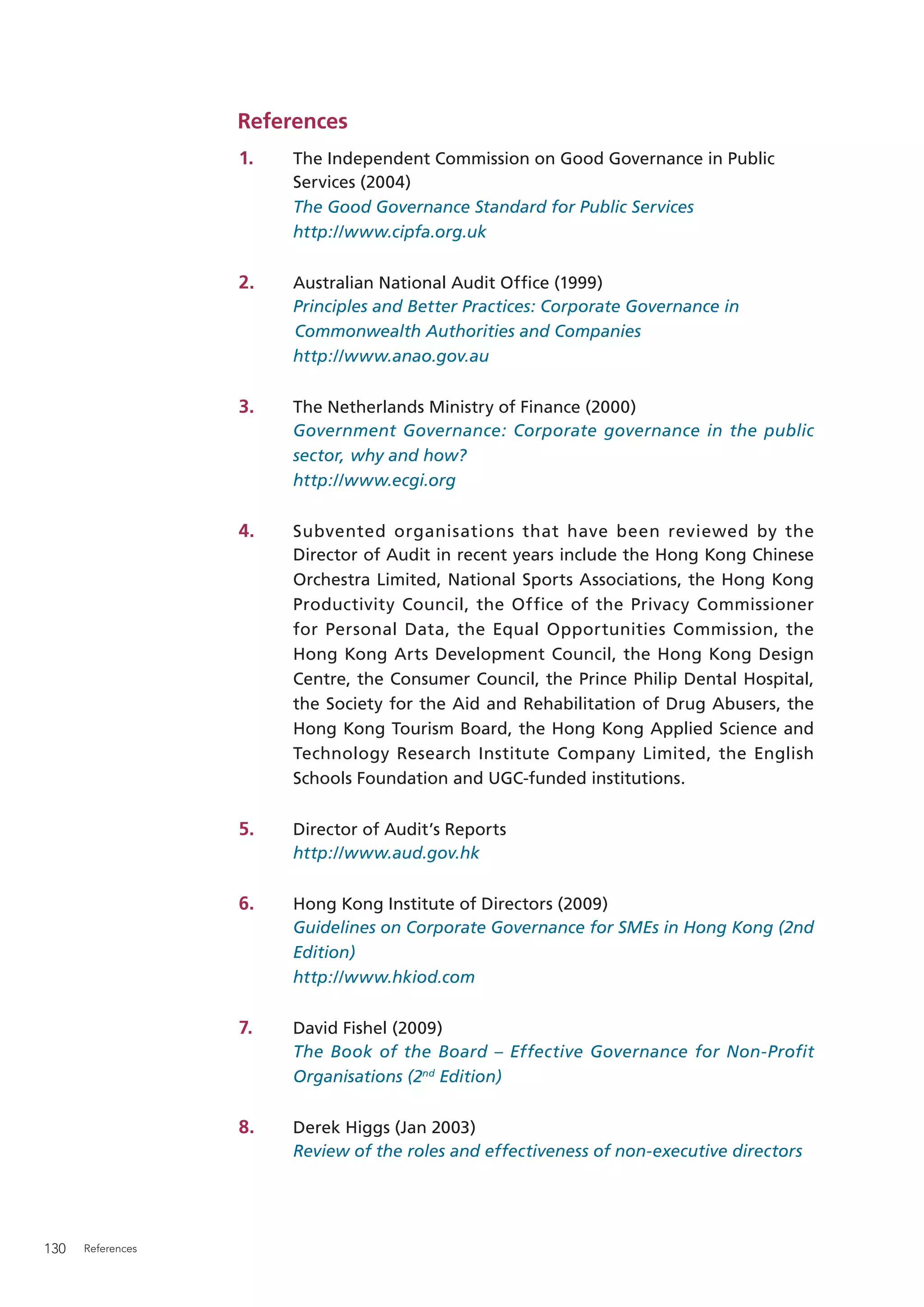
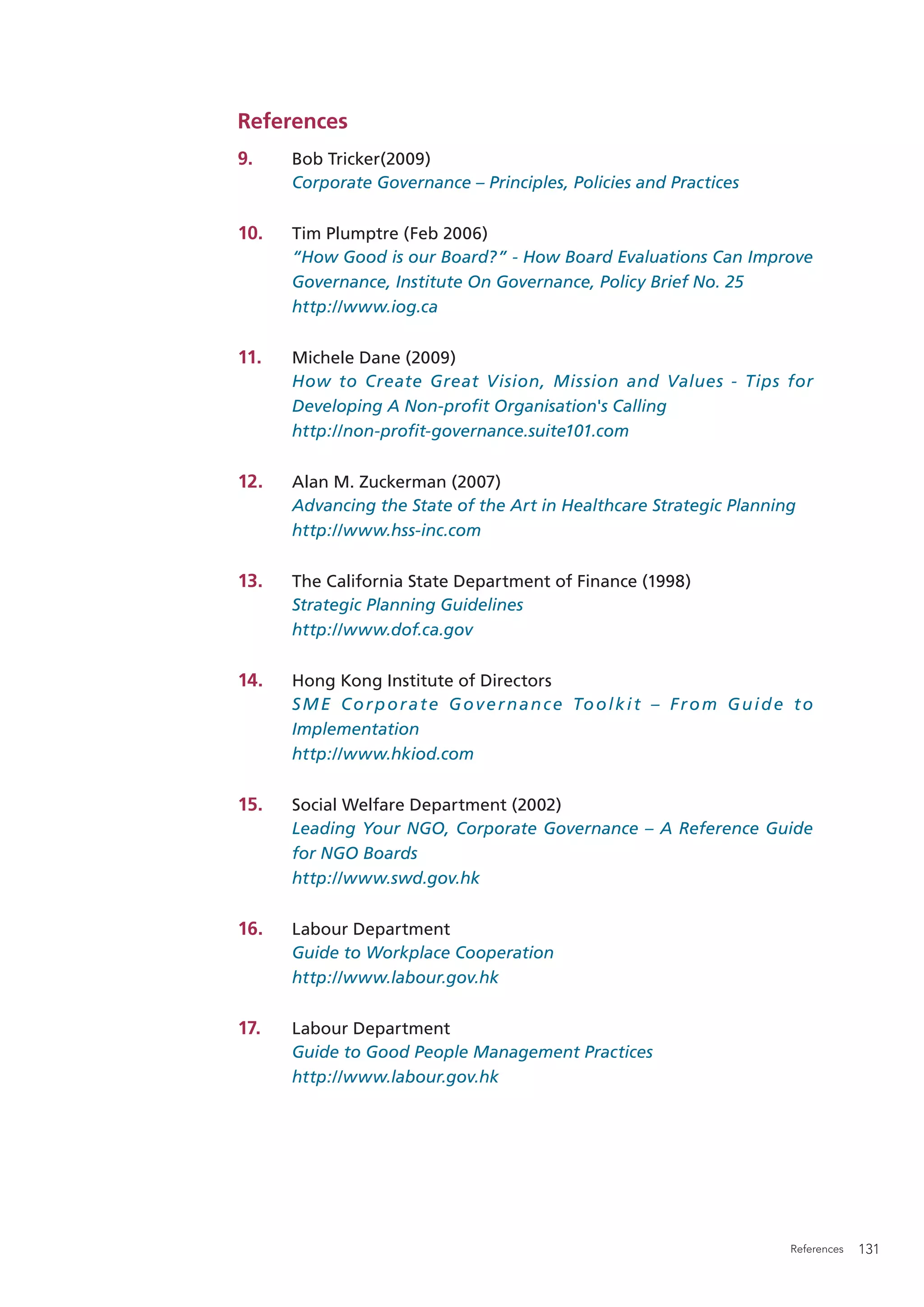
References • • • • • • • • • • • • • • • • • • • • • • • • • • • • • • • • • • • • • • • • • • • • • • • • • • • • • • • • • • • • • • • • • • • • • • • • • • • • • • • • • • • • • • 129


Other Useful Reading Materials                                              ••••••••••••••••••••••••••••••••••••••••••••••••••••••••••                                           135


Acknowledgements                                ••••••••••••••••••••••••••••••••••••••••••••••••••••••••••••••••••••••••••                                                       139


                                                                                                                                                                                             1
Foreword   ••••••••••••••••••••••••


                Hong Kong is fortunate to have a great wealth of
                individuals who are willing to put their talents to public
                use in directing subvented organisations of every kind.
                Often their services are given voluntarily and amidst
                many other demands from work, family and other
       photo    pursuits. This guide is intended to help all who take up
                this responsibility.

                By establishing clear frameworks of responsibility
                and better understanding of roles I hope that an
                environment can be created in which the sense of duty
                and commitment, passion and creativity that members
                of boards bring to their work can continue to be put to
                good effect.

                It is in that spirit that I commend this guide to your
                attention.


                Henry Tang
                Chief Secretary for Administration


2
Foreword   ••••••••••••••••••••••••


            Good governance is needed in every area of activity to
            which public funds are applied. The public has a right
            to know that their money is being put towards purposes
            of public value and that the organisations through
            which these funds flow are conducted in a manner that
   photo    inspires confidence that the money is being used wisely
            and well for the public benefit.

            With about 40% of recurrent government expenditure
            being channelled through subvented organisations each
            year, the need for careful attention to this matter is
            obvious.

            I welcome the production of this guide and trust that it
            will prove helpful to all those who hold responsibilities
            for the governance of subvented organisations.


            John C Tsang
            Financial Secretary


                                                                        3
u r ead e ,
    I f yo       el s
           hing –                                    Key Points
     not t his
       r ead
      •   Corporate Governance refers to the processes by which
          organisations are directed, controlled and held to account. It
          encompasses authority, accountability, stewardship, leadership,
          direction and control exercised in the organisation.

      •   The Government considers it essential that subvented
          organisations attain, and maintain, high standards of corporate
          governance.

      •   Many subvented organisations receive substantial recurrent
          funding from the public purse, and so must be accountable to
          both the Government and the community.

      •   The board of each subvented organisation is responsible for its
          activities and performance.

      •   The board and individual board members of subvented
          organisations have important responsibilities for corporate
          governance. They need to discharge their responsibilities with a
          serious, professional, committed and honest approach.

      •   There is no “one-size-fits-all” corporate governance model.

      •   Subvented organisations should establish effective and
          appropriate arrangements for their board of directors, to ensure
          that it has the necessary skills and experience available to it, that
          board meetings are conducted in a professional manner, and that
          board decisions are implemented in a timely and effective way.

      •   Boards need to consider the various arrangements necessary and
          appropriate to the subvented organisation’s circumstances, then
          implement, monitor and review these arrangements. Of particular
          importance are –


4
− compliance with relevant legislation and
      common law requirements;
    − compliance with Memorandum of Administrative Arrangements
      or other funding agreements with the Government;
    − compliance with the organisation’s Memorandum
      and Articles of Association, if one exists;
    − sound budgetary and financial management;
    − internal and external auditing arrangements;
    − effective performance monitoring;
    − appropriate levels of transparency within the organisation,
      and between the organisation and its stakeholders;
    − proper management of conflicts of interest and
      establishment of codes of conduct; and
    − maintenance of effective communication between
      the board and its stakeholders including its staff.

•   Subvented organisations need to establish a clear working
    relationship between the chairperson and the Chief Executive
    Officer, and between the board and the senior management.
    There should be a clear understanding of the relevant roles,
    responsibilities, delegations of authority, checks and balances
    and so on.

•   The Government is responsible and accountable for the proper
    use of public funds, and is duty bound to monitor the activities
    and performance of publicly funded bodies to ensure that public
    monies are properly used for their intended purposes. Subvented
    organisations are obliged to cooperate with the Government’s
    monitoring.

•   Subvented organisations should aim to introduce the best
    practices outlined in this Guide. Where this is not appropriate,
    the organisation should be prepared to explain why not – the
    “comply or explain” principle.


                                                                       5
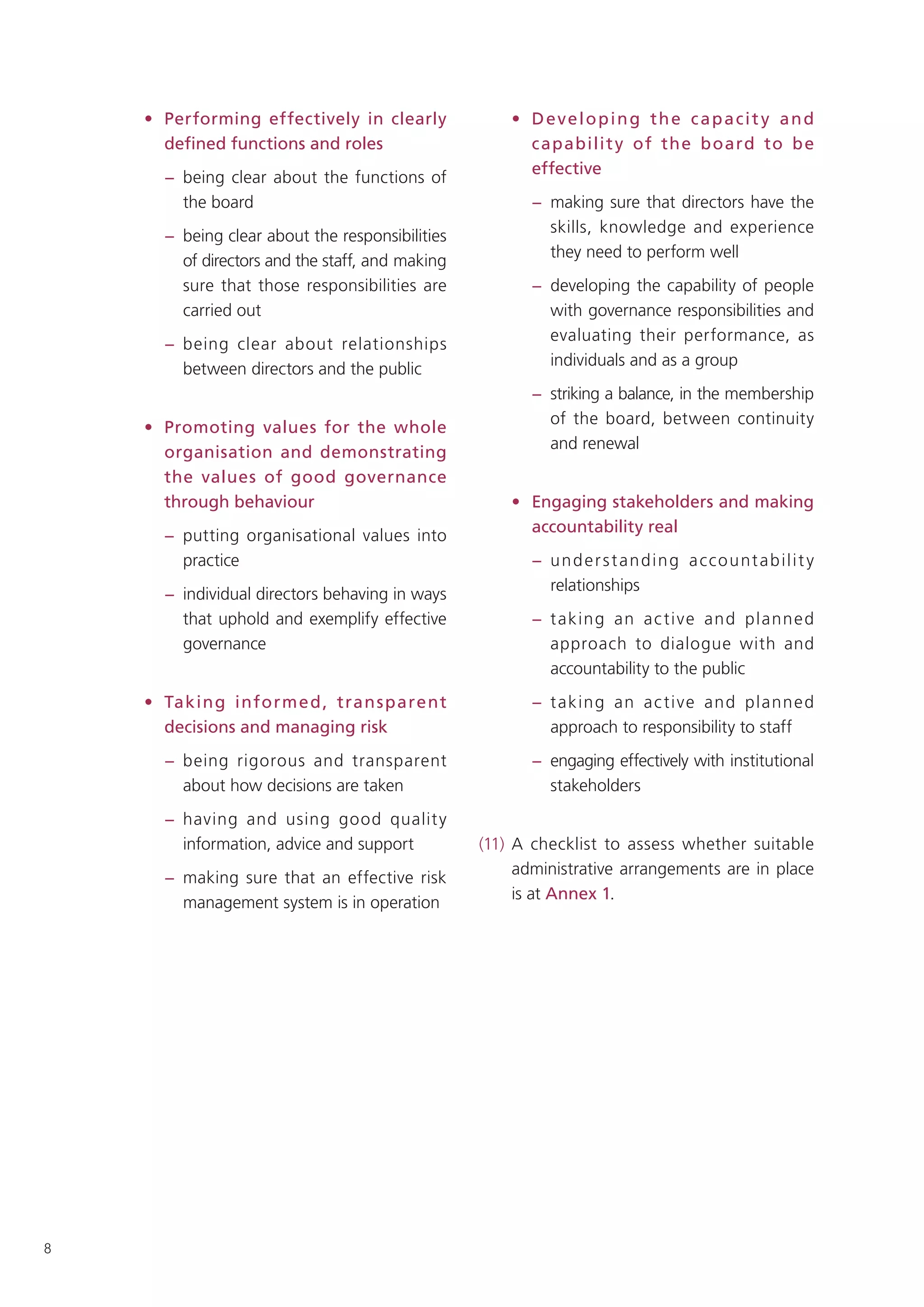
Introduction                                              •••••••••••••••••


    (1) This Guide to Corporate Governance for                 (4) Subvented organisations are diverse in
        Subvented Organisations (the Guide) is                     size, purpose and the extent of public
        intended to help board members and                         funding provided. T here are over
        senior executives of these organisations.                  1 000 organisations receiving recurrent
        By setting out principles and best practices               subventions from the Government,
        relating to the corporate governance of                    including schools, welfare non-
        such organisations, advising on matters                    governmental organisations ( NGOs),
        that have raised concern, and providing                    hospitals and clinics, National Sports
        checklists, it is intended to help individuals             Associations, statutory organisations such
        and organisations to assess the way in                     as the Consumer Council, arts and sports
        which they are discharging their duties                    bodies, youth groups, and district and
        and decide whether changes need to be                      rural associations.
        made. The goal is to help sustain public
        trust in bodies which receive public funds.            (5) Clearly, there is no “one-size-fits-all”
                                                                   corporate governance arrangement
    (2) T h e G u i d e i s a i m e d p r i m a r i l y a t        that is appropriate to all. Subvented
        organisations that receive recurrent                       organisations are encouraged to draw
        subventions from the Government to                         on the advice and guidance contained
        cover part or all of their operational                     herein to establish their own directives.
        expenses. Nevertheless, organisations                      Common sense and judgement should be
        that receive capital grants, non-cash                      used to apply the basic expectations and
        concessions or one-off payments, and                       principles set out in the Guide to each
        companies in which Government holds                        organisation’s circumstances.
        shares are also encouraged to refer to the
        best practices promulgated in the Guide.                   An organisation may not find it appropriate
                                                                   to adopt a particular practice suggested
    (3) T he primar y re sp o nsibilit y fo r the                  in the Guide, or may not be able to
        behaviour and per formance of any                          do so. In either case it is important to
        subvented organisation lies with the                       understand and be ready to explain the
        board of that organisation.                                reason why this is so.

                                                                   Proper planning and training so that
                                                                   any necessary changes are implemented
                                                                   effectively is also advisable. Identifying


6
priorities and a practical timetable for                 observed in the event of conflict with this
     phasing in new practices is better than                  Guide.
     hasty reaction.
                                                          (9) Corporate governance is an evolving
(6) The Guide does not have a binding effect                  concept. Many of the good practices
    on subvented organisations. To render                     set out in this Guide are recent
    the Guide or any government regulations                   developments. Some old legislation,
    binding over a subvented organisation,                    MAA or other tailor made instruments
    a specific requirement of compliance                      may need to be reviewed in light of
    should be contained in an agreement,                      these developments. Readers are also
    such as a Memorandum of Administrative                    advised to conduct regular reviews of
    A r ra n g e m e nt s ( M A A ) , o r f u n d i n g       their corporate governance practices to
    agreement with a specified subvented                      take account of changes in need and
    organisation.                                             expectation. This Guide will be reviewed
                                                              and updated from time to time to assist
(7) High standards of corporate governance                    subvented organisations with relevant
    are critical for public trust in subvented                new practices.
    organisations. Failure to meet such
    standards is damaging to reputations                  (10) Subvented organisations have a wide
    and calls into question continued public                   range of structures, sizes and complexity.
    funding.                                                   No single Guide can prescribe what
                                                               is appropriate for all of them. Nor
(8) The Guide does not compromise, or                          can legislation, regulations, funding
    limit the effect of statutory provisions,                  agreements or codes dictate how people
    decisions of the Chief E xecutive in                       will think, act or behave. The most
    Council or the Finance Committee of                        important thing is that all concerned
    the Legislative Council governing the                      adhere to the spirit and ethics of good
    operation and control of a subvented                       corporate governance. The United
    organis ation. T hose provisions or                        Kingdom Independent Commission on
    decisions prevail until they are superseded,               Good Corporate Governance in Public
    updated or amended. Similarly, the terms                   Services1 identifies the key principles of
    of existing MAA and other tailor-made                      good governance:
    instruments such as the relevant codes
    of aid for aided schools, the Lump Sum                    • Focusing on the organisation’s
    Grant (LSG) Manual for Welfare Services,                    purpose and on outcome s for
    University Grants Committee (UGC) Notes                     citizens and service users
    on Procedures, terms and conditions of
                                                                 − being clear about the organisation’s
    the Direct Subsidy Scheme, terms and
                                                                   purpose and its intended outcomes
    conditions for subsidies to subsidised
                                                                   for citizens and service users
    schools, and various grant agreements
    between departments and organisations,                       − making sure that users receive a
    continue to take precedence. Internal                          high quality service
    circular s o r m em o randa is su e d by                     − making sure that taxpayers receive
    individual departments should also be                          value for money


                                                                                                            7
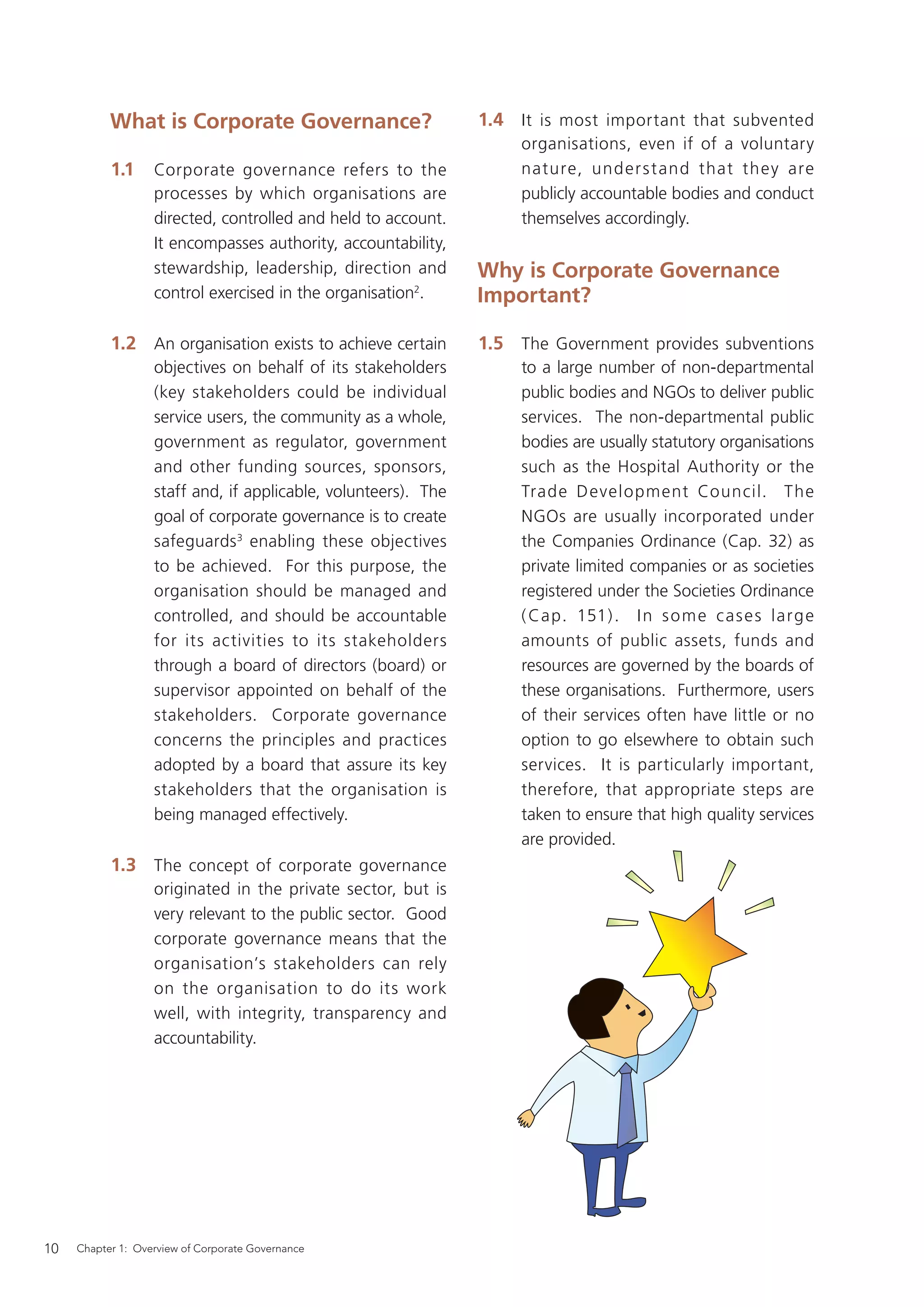
• Performing effectively in clearly              • Developing the capacit y and
      defined functions and roles                       c apabilit y of the b oard to b e
                                                       effective
      − being clear about the functions of
        the board                                       − making sure that directors have the
                                                          skills, knowledge and experience
      − being clear about the responsibilities
                                                          they need to perform well
        of directors and the staff, and making
        sure that those responsibilities are            − developing the capability of people
        carried out                                       with governance responsibilities and
                                                          evaluating their performance, as
      − being clear about relationships
                                                          individuals and as a group
        between directors and the public
                                                        − striking a balance, in the membership
                                                          of the board, between continuity
    • Promoting values for the whole
                                                          and renewal
      organisation and demonstrating
      the values of good governance
      through behaviour                              • Engaging stakeholders and making
                                                       accountability real
      − putting organisational values into
        practice                                        − u n d e r s t a n d i n g a cc o u nt a b i l i t y
                                                          relationships
      − individual directors behaving in ways
        that uphold and exemplify effective             − t aking an a c ti ve and p lann e d
        governance                                        approach to dialogue with and
                                                          accountability to the public
    • Takin g info rm e d , tran s pare nt              − t aking an a c ti ve and p lann e d
      decisions and managing risk                         approach to responsibility to staff
      − being rigorous and transparent                  − engaging effectively with institutional
        about how decisions are taken                     stakeholders
      − having and using good qualit y
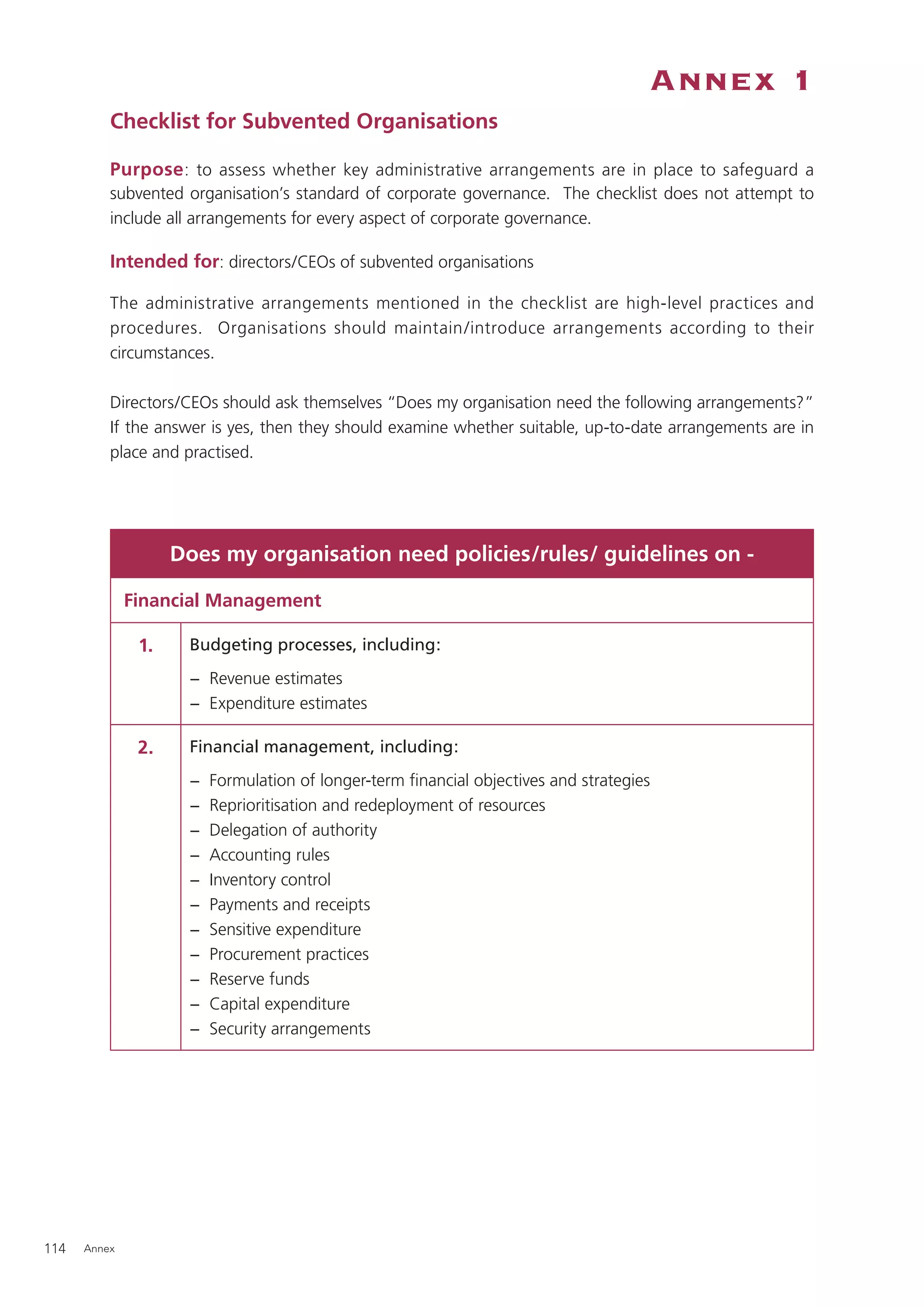
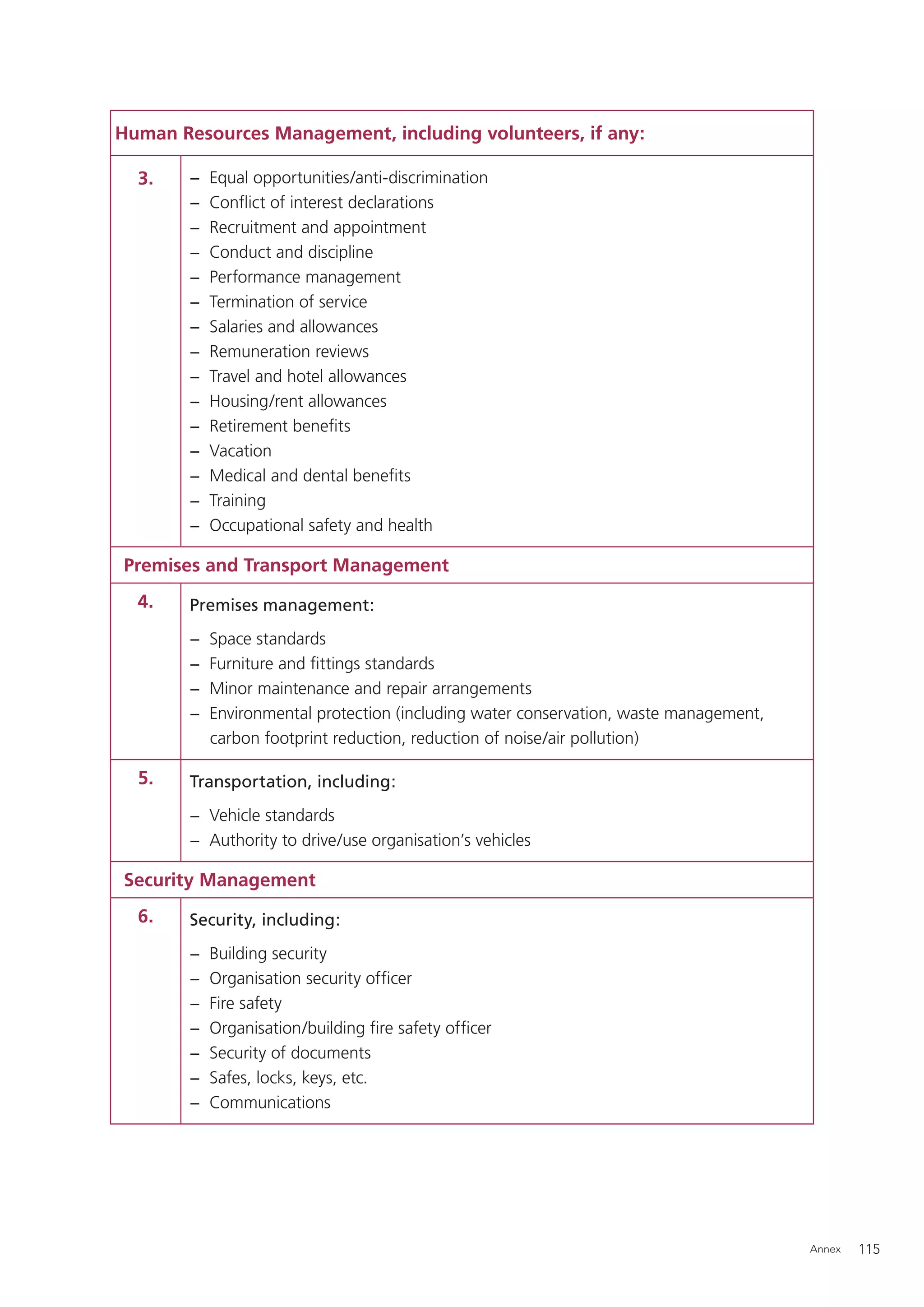
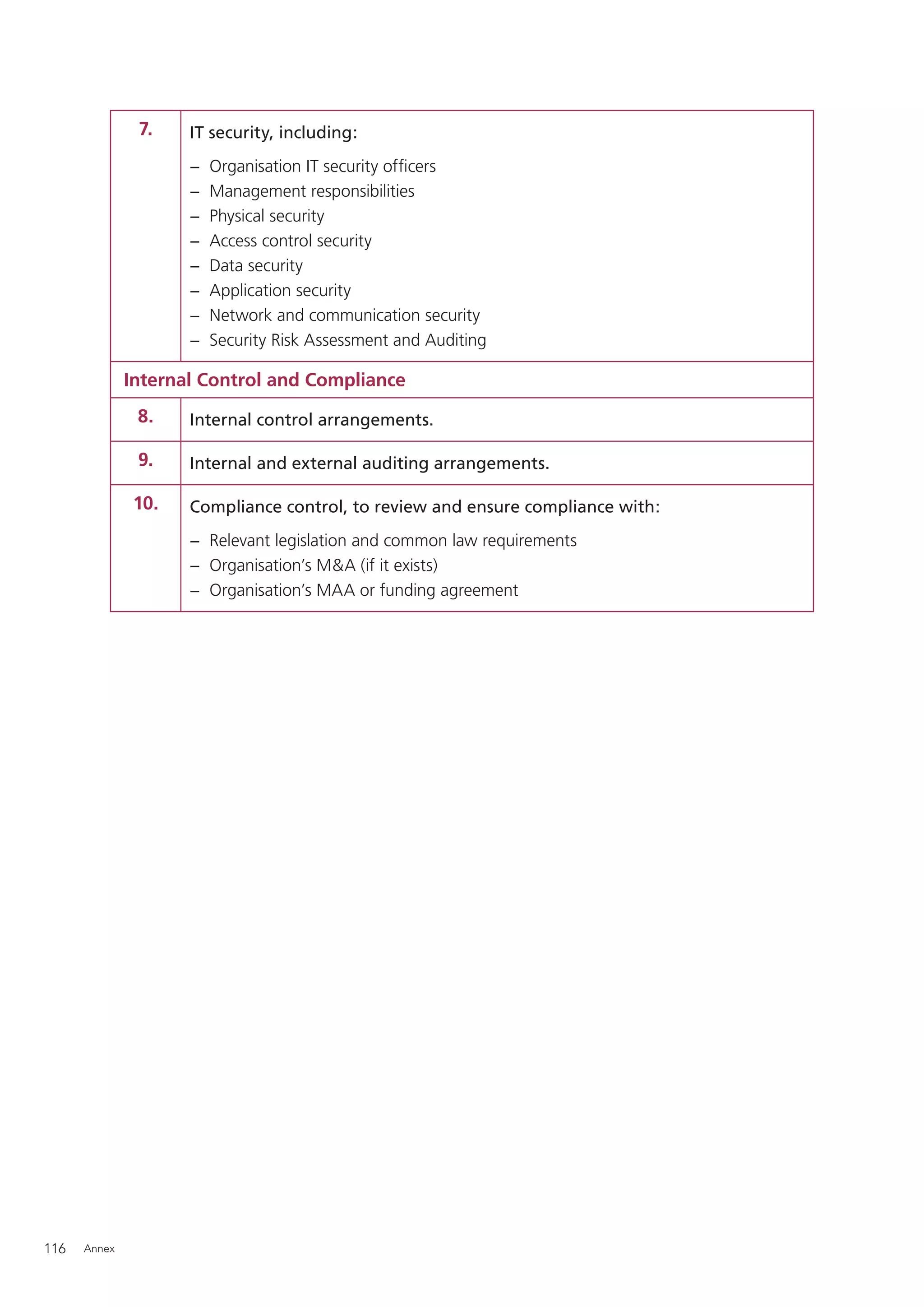
        information, advice and support          (11) A checklist to assess whether suitable
                                                      administrative arrangements are in place
      − making sure that an effective risk
                                                      is at Annex 1.
        management system is in operation


8
Chapter 1
Overview of Corporate Governance
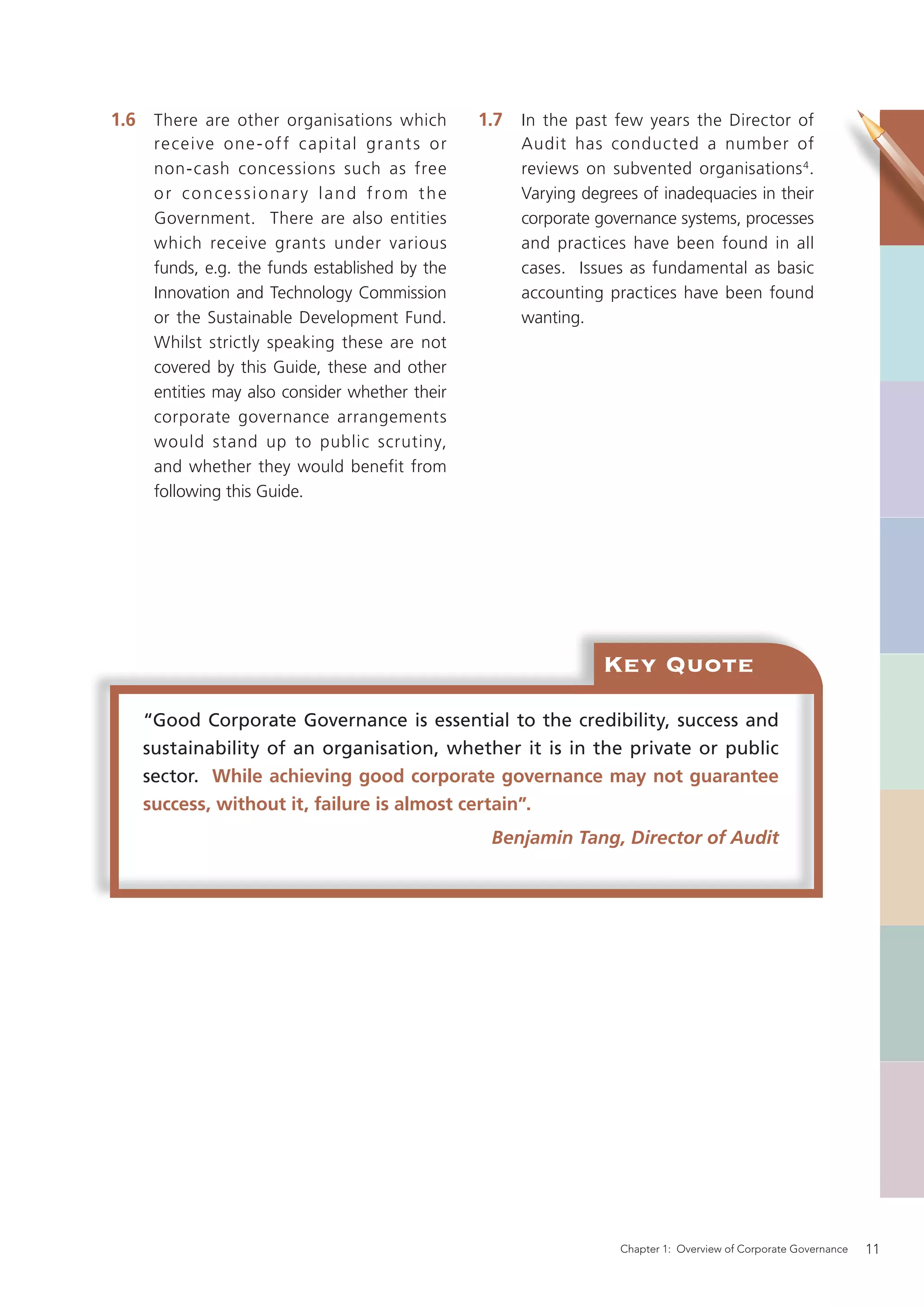
What is Corporate Governance?                        1.4 It is most important that subvented
                                                                     organisations, even if of a voluntary
           1.1     Corporate governance refers to the                nature, under s t and that they are
                   processes by which organisations are              publicly accountable bodies and conduct
                   directed, controlled and held to account.         themselves accordingly.
                   It encompasses authority, accountability,
                   stewardship, leadership, direction and       Why is Corporate Governance
                   control exercised in the organisation2.      Important?

           1.2 An organisation exists to achieve certain        1.5 The Government provides subventions
                   objectives on behalf of its stakeholders          to a large number of non-departmental
                   (key stakeholders could be individual             public bodies and NGOs to deliver public
                   service users, the community as a whole,          services. The non-departmental public
                   government as regulator, government               bodies are usually statutory organisations
                   and other funding sources, sponsors,              such as the Hospital Authority or the
                   staff and, if applicable, volunteers). The        Trade Development Council. The
                   goal of corporate governance is to create         NGOs are usually incorporated under
                   safeguards 3 enabling these objectives            the Companies Ordinance (Cap. 32) as
                   to be achieved. For this purpose, the             private limited companies or as societies
                   organisation should be managed and                registered under the Societies Ordinance
                   controlled, and should be accountable             ( Cap. 151) . I n s o m e c as e s larg e
                   for its activities to its stakeholders            amounts of public assets, funds and
                   through a board of directors (board) or           resources are governed by the boards of
                   supervisor appointed on behalf of the             these organisations. Furthermore, users
                   stakeholders. Corporate governance                of their services often have little or no
                   concerns the principles and practices             option to go elsewhere to obtain such
                   adopted by a board that assure its key            services. It is particularly important,
                   stakeholders that the organisation is             therefore, that appropriate steps are
                   being managed effectively.                        taken to ensure that high quality services
                                                                     are provided.
           1.3 The concept of corporate governance
                   originated in the private sector, but is
                   very relevant to the public sector. Good
                   corporate governance means that the
                   organisation’s stakeholders can rely
                   on the organisation to do its work
                   well, with integrity, transparency and
                   accountability.


10   Chapter 1: Overview of Corporate Governance
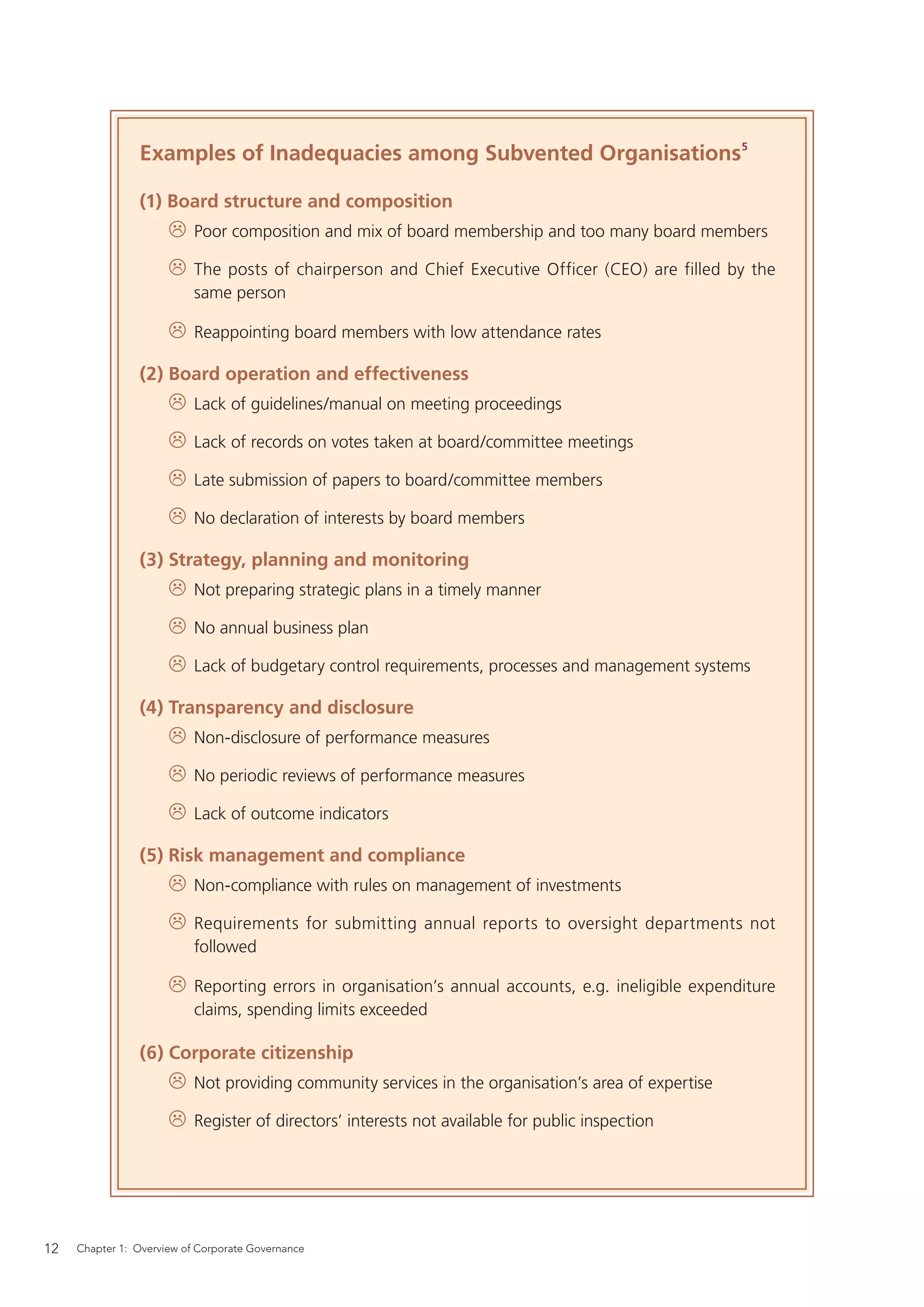
1.6 There are other organisations which          1.7 In the past few years the Director of
     re cei ve one - of f c apit al grant s or        Audit has conducted a number of
     non-cash concessions such as free                reviews on subvented organisations 4 .
     or concessionar y land from the                  Varying degrees of inadequacies in their
     Government. There are also entities              corporate governance systems, processes
     which receive grants under various               and practices have been found in all
     funds, e.g. the funds established by the         cases. Issues as fundamental as basic
     Innovation and Technology Commission             accounting practices have been found
     or the Sustainable Development Fund.             wanting.
     Whilst strictly speaking these are not
     covered by this Guide, these and other
     entities may also consider whether their
     corporate governance arrangements
     would stand up to public scrutiny,
     and whether they would benefit from
     following this Guide.


                                                                 Key Quote
   “Good Corporate Governance is essential to the credibility, success and
   sustainability of an organisation, whether it is in the private or public
   sector. While achieving good corporate governance may not guarantee
   success, without it, failure is almost certain”.
                                                  Benjamin Tang, Director of Audit


                                                                   Chapter 1: Overview of Corporate Governance   11
Examples of Inadequacies among Subvented Organisations5

                (1) Board structure and composition
                           Poor composition and mix of board membership and too many board members

                           The posts of chairperson and Chief Executive Officer (CEO) are filled by the
                           same person

                           Reappointing board members with low attendance rates

                (2) Board operation and effectiveness
                           Lack of guidelines/manual on meeting proceedings

                           Lack of records on votes taken at board/committee meetings

                           Late submission of papers to board/committee members

                           No declaration of interests by board members

                (3) Strategy, planning and monitoring
                           Not preparing strategic plans in a timely manner

                           No annual business plan

                           Lack of budgetary control requirements, processes and management systems

                (4) Transparency and disclosure
                           Non-disclosure of performance measures

                           No periodic reviews of performance measures

                           Lack of outcome indicators

                (5) Risk management and compliance
                           Non-compliance with rules on management of investments

                           Requirements for submitting annual reports to oversight departments not
                           followed

                           Reporting errors in organisation’s annual accounts, e.g. ineligible expenditure
                           claims, spending limits exceeded

                (6) Corporate citizenship
                           Not providing community services in the organisation’s area of expertise

                           Register of directors’ interests not available for public inspection


12   Chapter 1: Overview of Corporate Governance
Corporate Governance Model                                not blindly follow all the practices
                                                           promulgated in the Guide but adapt
                                                           them as appropriate. Readers should
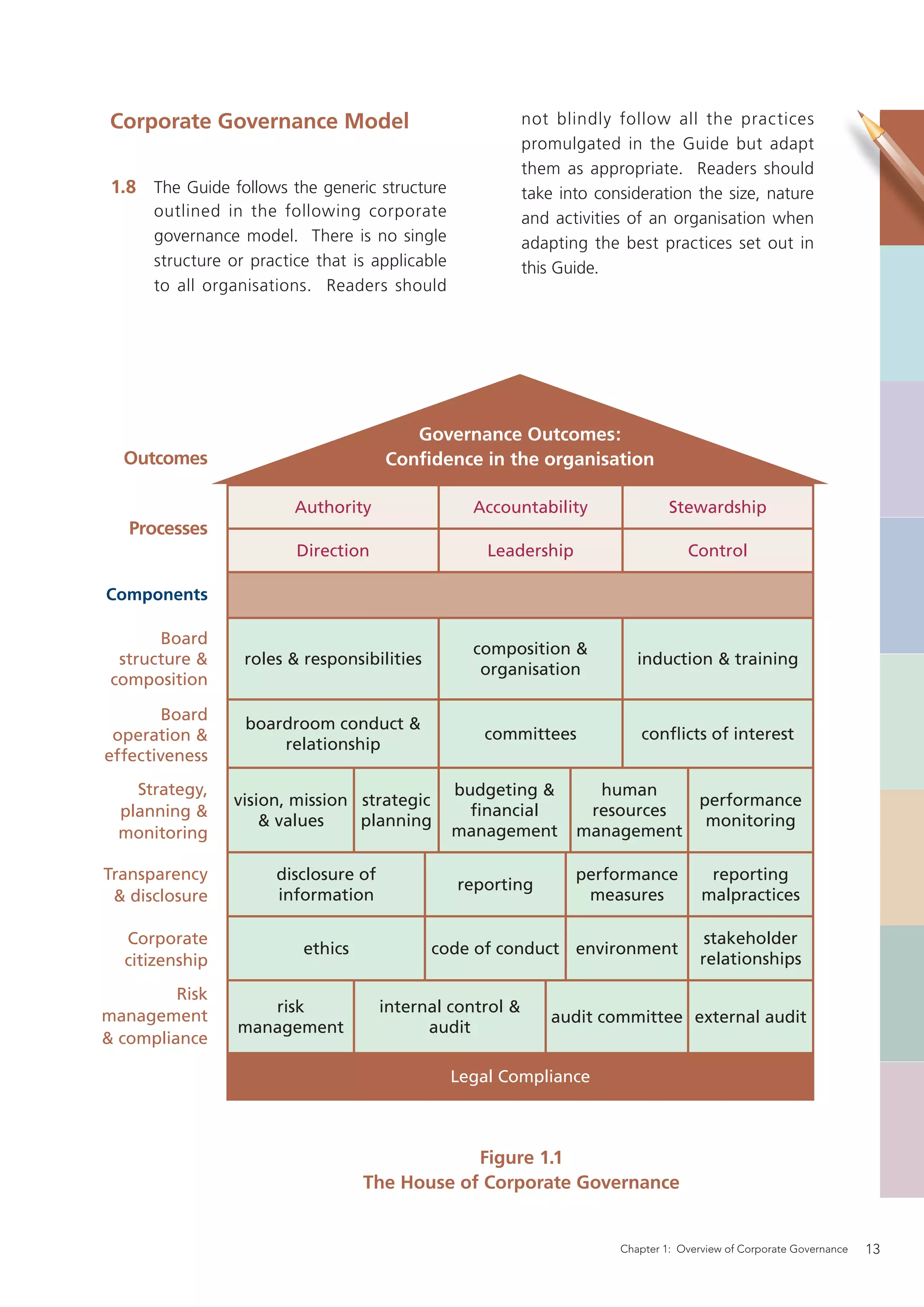
 1.8 The Guide follows the generic structure               take into consideration the size, nature
      outlined in the following corporate                  and activities of an organisation when
      governance model. There is no single                 adapting the best practices set out in
      structure or practice that is applicable             this Guide.
      to all organisations. Readers should


                                         Governance Outcomes:
  Outcomes                            Confidence in the organisation

                         Authority                 Accountability                Stewardship
   Processes
                         Direction                   Leadership                     Control

Components

       Board
                                                   composition &
  structure &     roles & responsibilities                                 induction & training
                                                    organisation
 composition

        Board
                  boardroom conduct &
 operation &                                        committees             conflicts of interest
                      relationship
effectiveness
    Strategy,                                    budgeting &        human
                vision, mission strategic                                    performance
  planning &                                       financial        resources
                    & values    planning                                      monitoring
  monitoring                                     management       management

Transparency          disclosure of                               performance           reporting
                                                 reporting
 & disclosure         information                                  measures            malpractices

  Corporate                                                                             stakeholder
                          ethics             code of conduct environment
  citizenship                                                                          relationships

         Risk
                    risk              internal control &
management                                                     audit committee external audit
                 management                 audit
& compliance

                                                 Legal Compliance


                                               Figure 1.1
                                   The House of Corporate Governance


                                                                        Chapter 1: Overview of Corporate Governance   13
Key Quote                  2


               “Good corporate governance is more than just prescribing particular
               corporate structures and complying with a number of accepted rules.
               Instead, it is about a range of broad principles which should be applied
               flexibly to the varying circumstances of individual organisations in a way
               that facilitates appropriate accountability and performance.”


                                                              Australian National Audit Office (1999)


           Managing the Relationship                                    legislation, or interfere with the
                                                                        substance of an oversight agency’s
           1.9 The successful delivery of subvented                     tasks. However, it is proper that
                   services hinges on the clarity of the                they should take into account the
                   subvention agreement and the quality                 quality of corporate governance
                   of the relationship bet ween the                     in a subvented organisation and
                   three related parties, i.e. sponsoring               the evidence of its commitment to
                   department, subvented organisation and               achieve and sustain good standards
                   service users.                                       when considering the allocation of
                                                                        public funds. Officers with oversight
                   • Sponsoring department –                            responsibilities are obliged to follow
                       Depar tment s should not micro -                 the guidelines and broad principles
                       manage any subvented organisation.               laid down by:
                       Nor should they take any action
                                                                     − A d m i n i s t r a t i o n W i n g Ci r c u l a r
                       inconsistent with a statutory body’s
                                                                       Memorandum No. 2/2003 - Internal
                                                                       Review of Remunerations of Senior
                                                                       Executives of Government-funded
                                                                       Bodies and New Guidelines Arising
                                                                       from the Review
                                                                     − Financial Circular N o. 9 / 20 0 4 -
                                                                       Guidelines on the Management and
                                                                       Control of Government Funding for
                                                                       Subvented Organisations
                                                                     − G e n e ral Circular N o. 8 / 20 0 8 -
                                                                       Governance of Government-owned
                                                                       or Funded Statutory Bodies
                                                                     − Other relevant departmental circulars


14   Chapter 1: Overview of Corporate Governance
• Subvented organisation – An
   organisation should deliver services
   to its end users in accordance with
   the agreed service requirements. It
   must also satisfy the department
   and the public that it is achieving
   acceptable standards of corporate
   governance and is being prudent
   in its expenditure of public funds.
   The organisation should understand
   that the department must monitor
   the use of public funds for public
   accountability’s sake, and it should
   cooperate with government officials
   who have oversight responsibilities.


• Service users – End users play
   an important role in monitoring
   the quality of service delivery. The
   organisation concerned should put
   in place mechanisms to encourage
   regular, and structured feedback.


                                                   Key Quote

“It is important that we are clear about what kind of a role we want to
define for ourselves. Do we want to be a micro-manager or do we want
to take a macro view of how a subvented organisation is delivering
its services? The bureau’s role should be commonly understood by all
concerned.”

        Ms Sandra Lee, Permanent Secretary for Food & Health (Health)


                                                     Chapter 1: Overview of Corporate Governance   15
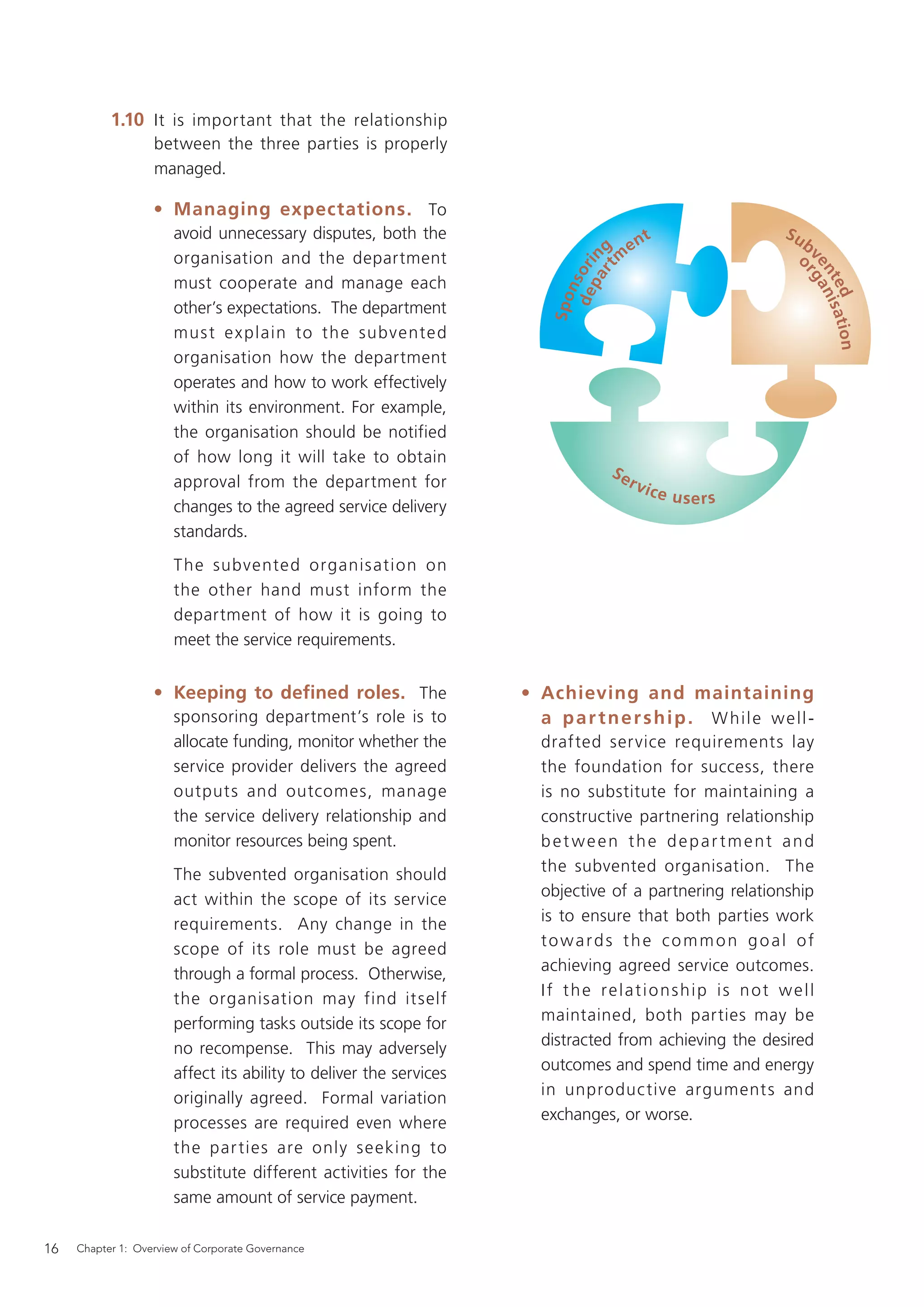
1.10 It is important that the relationship
                   between the three parties is properly
                   managed.

                   • Managing expectations. To
                       avoid unnecessary disputes, both the                              t                 Su
                                                                                g en                          b
                       organisation and the department                           m                           ov


                                                                            pa n
                                                                         d e s o ri


                                                                                                             engan
                                                                                rt


                                                                                                              r
                                                                                                                t e i s at
                       must cooperate and manage each


                                                                            n


                                                                                                                   d
                                                                       Sp o
                       other’s expectations. The department
                       mus t e x plain to the subvente d


                                                                                                                           io n
                       organisation how the department
                       operates and how to work effectively
                       within its environment. For example,
                       the organisation should be notified
                       of how long it will take to obtain
                                                                                 Se
                       approval from the department for                               r vi
                                                                                             ce u se r s
                       changes to the agreed service delivery
                       standards.
                       T he subvented organis ation on
                       the other hand must inform the
                       department of how it is going to
                       meet the service requirements.


                   • Keeping to defined roles. The                  • Achieving and maintaining
                       sponsoring department’s role is to             a par tner ship. While well-
                       allocate funding, monitor whether the          drafted ser vice requirements lay
                       service provider delivers the agreed           the foundation for success, there
                       outputs and outcomes, manage                   is no substitute for maintaining a
                       the service delivery relationship and          constructive partnering relationship
                       monitor resources being spent.                 bet ween the depar tment and
                       The subvented organisation should              the subvented organisation. The
                       act within the scope of its service            objective of a partnering relationship
                       requirements. Any change in the                is to ensure that both parties work
                       scope of its role must be agreed               towards the common goal of
                       through a formal process. Otherwise,           achieving agreed service outcomes.
                       the organisation may find itself               If the relationship is not well
                       performing tasks outside its scope for         maintained, both parties may be
                       no recompense. This may adversely              distracted from achieving the desired
                       affect its ability to deliver the services     outcomes and spend time and energy
                       originally agreed. Formal variation            in unproduc tive argument s and
                       processes are required even where              exchanges, or worse.
                       the par ties are only seeking to
                       substitute different activities for the
                       same amount of service payment.

16   Chapter 1: Overview of Corporate Governance
Chapter 2
Board Structure and Composition
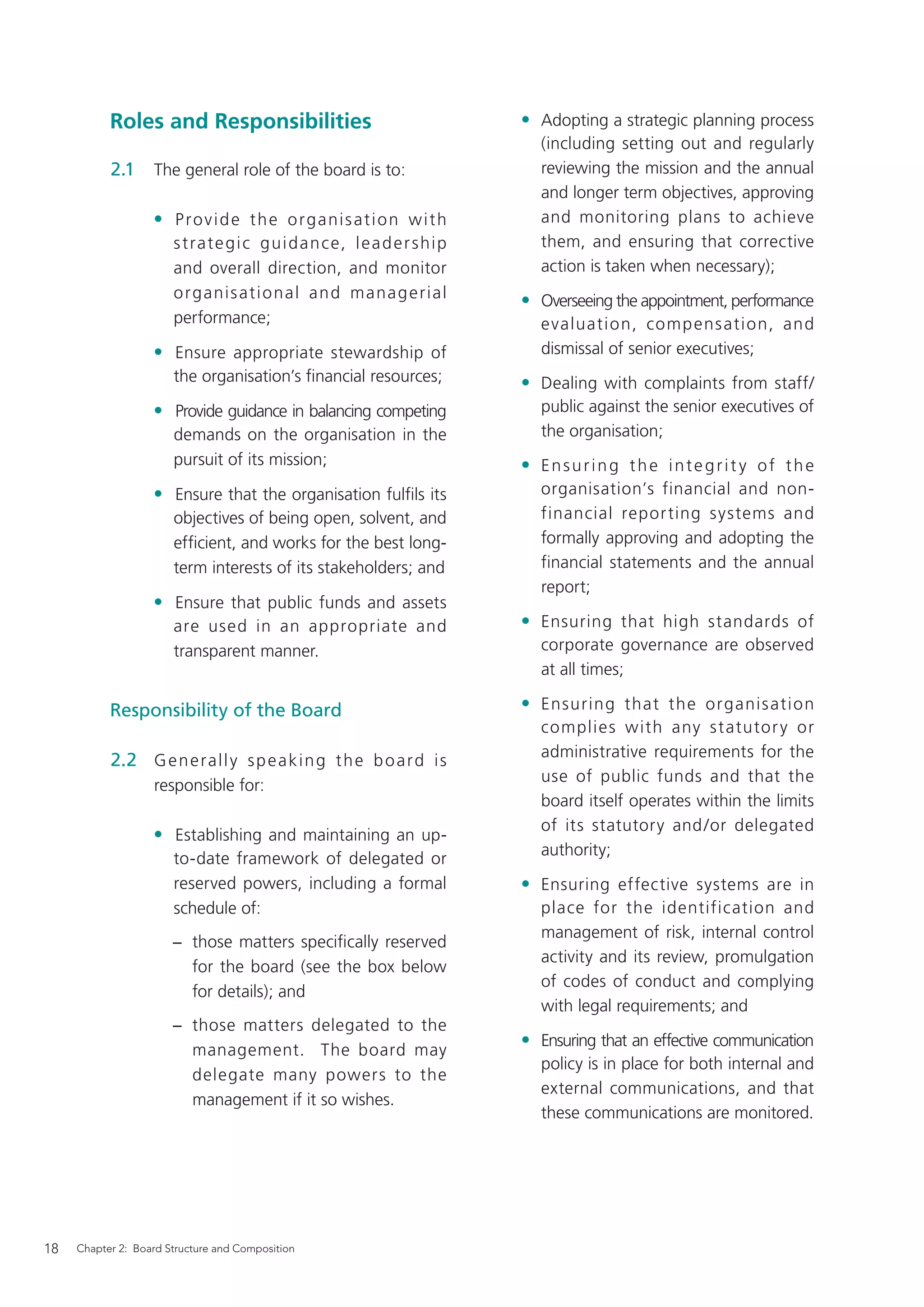
Roles and Responsibilities                                          • Adopting a strategic planning process
                                                                                 (including setting out and regularly
           2.1     The general role of the board is to:                          reviewing the mission and the annual
                                                                                 and longer term objectives, approving
                   • Provide the organisation with                               and monitoring plans to achieve
                       s t ra t e g i c g u i d a n c e, l e a d e r s h i p     them, and ensuring that corrective
                       and overall direction, and monitor                        action is taken when necessary);
                       o rg a nis a t i o na l a n d ma na g e r ia l          • Overseeing the appointment, performance
                       performance;                                              evaluation, comp ens ation, and
                   • Ensure appropriate stewardship of                           dismissal of senior executives;
                       the organisation’s financial resources;                  • Dealing with complaints from staff/
                   • Provide guidance in balancing competing                     public against the senior executives of
                       demands on the organisation in the                        the organisation;
                       pursuit of its mission;                                 • Ensuring the integrit y of the
                   • Ensure that the organisation fulfils its                     organisation’s financial and non-
                       objectives of being open, solvent, and                    financial repor ting systems and
                       efficient, and works for the best long-                    formally approving and adopting the
                       term interests of its stakeholders; and                   financial statements and the annual
                                                                                 report;
                   • Ensure that public funds and assets
                       are used in an appropriate and                          • Ensuring that high standards of
                       transparent manner.                                       corporate governance are observed
                                                                                 at all times;

           Responsibility of the Board                                         • Ensuring that the organis ati on
                                                                                 complies with any s t atutor y or
                                                                                 administrative requirements for the
           2.2 G e n e r a l l y s p e a k i n g t h e b o a r d i s
                                                                                 use of public funds and that the
                   responsible for:
                                                                                 board itself operates within the limits
                                                                                 of its statutory and /or delegated
                   • Establishing and maintaining an up-
                                                                                 authority;
                       to-date framework of delegated or
                       reserved powers, including a formal                     • Ensuring effective systems are in
                       schedule of:                                              place for the identification and
                                                                                 management of risk, internal control
                       − those matters specifically reserved
                                                                                 activity and its review, promulgation
                         for the board (see the box below
                                                                                 of codes of conduct and complying
                         for details); and
                                                                                 with legal requirements; and
                       − those matters delegated to the
                                                                               • Ensuring that an effective communication
                         management. The board may
                                                                                 policy is in place for both internal and
                         delegate many powers to the
                                                                                 external communications, and that
                         management if it so wishes.
                                                                                 these communications are monitored.


18   Chapter 2: Board Structure and Composition
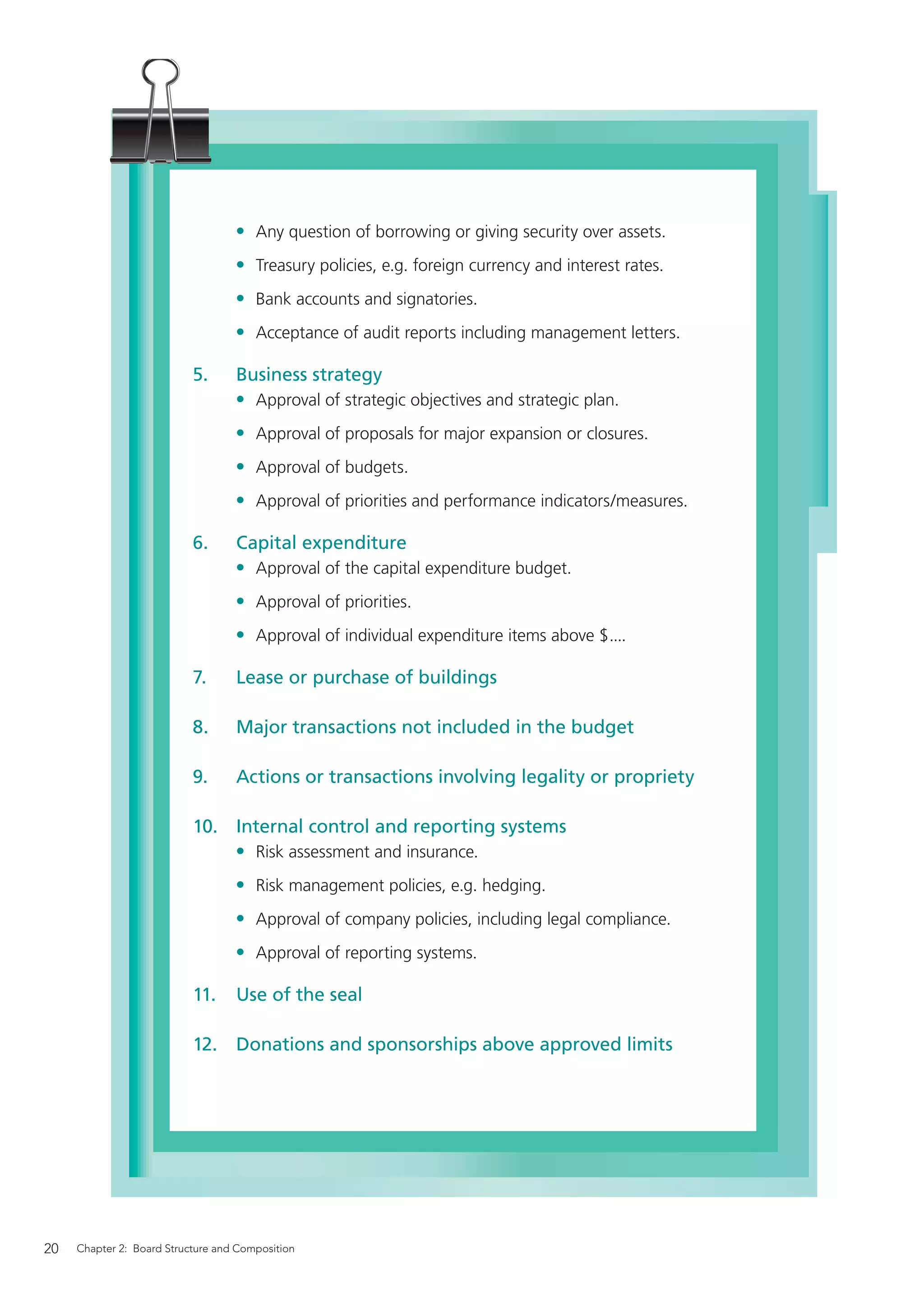
Best Practices6
Matters reserved for the board

1.   Appointments
     • Appointment of the CEO and senior management.
     • Membership and terms of reference of board committees.

2.   Matters concerning board and senior management
     • Delegations of authority to the CEO.
     • Ratification of the organisation chart.
     • Approval of remuneration and incentive policies.
     • Management contracts.
     • Overseas visit approvals.
     • Approval of succession plans.
     • Disclosure of conflicts of interest.
     • Assessment of the organisation’s and CEO’s performance.
     • Assessment of board performance.
     • Matters concerning the governance of the organisation.

3.   Relations with the members and stakeholders
     • Arrangements for the Annual General Meeting (AGM) and other
       members’ meetings [if any].

     • Matters relating to reports as required by the Law.
     • Suggestions for nomination of directors for election by the
       members.

4.   Financial matters
     • Approval of annual accounts and directors’ reports.
     • Approval of accounting policies.
     • Approval of the internal audit plan.


                                                             Chapter 2: Board Structure and Composition   19
• Any question of borrowing or giving security over assets.
                                   • Treasury policies, e.g. foreign currency and interest rates.
                                   • Bank accounts and signatories.
                                   • Acceptance of audit reports including management letters.

                           5.      Business strategy
                                   • Approval of strategic objectives and strategic plan.
                                   • Approval of proposals for major expansion or closures.
                                   • Approval of budgets.
                                   • Approval of priorities and performance indicators/measures.

                           6.      Capital expenditure
                                   • Approval of the capital expenditure budget.
                                   • Approval of priorities.
                                   • Approval of individual expenditure items above $....

                           7.      Lease or purchase of buildings

                           8.      Major transactions not included in the budget

                           9.      Actions or transactions involving legality or propriety

                           10. Internal control and reporting systems
                               • Risk assessment and insurance.
                                   • Risk management policies, e.g. hedging.
                                   • Approval of company policies, including legal compliance.
                                   • Approval of reporting systems.

                           11.     Use of the seal

                           12.     Donations and sponsorships above approved limits


20   Chapter 2: Board Structure and Composition
2.3 Most of the roles and responsibilities           • A position description of the role
     and matters reserved for the board                 of the chairperson, CEO, senior
     are not requirements of law, but in the            executives, Executive Directors (EDs)
     case of a private company, a matter for            and NEDs;
     the shareholders to determine when
                                                     • Appointment of board committees;
     agreeing on the Memorandum and
     Articles of Association (M&A) of the            • Board memb er ’s induc tion and
     company.                                           training programme;

                                                     • Agreed procedure for taking independent
Board Charter                                           professional advice (whether as a
                                                        board or in an individual capacity) on
2.4 Every board is encouraged to have                   matters where there may be material
     a board charter/terms of reference,                risk to the organisation, or where the
     outlining its roles and responsibilities,          board members may be in breach of
     which is accessible by the public and              their duties; and
     may include:
                                                     • The board’s policy on transparency/
                                                        disclosure.
     • A general description of the board’s
       purpose;
                                                 Composition and Organisation
     • An overview of the board’s monitoring
       role;
                                                 Board Structure
     • Structure and membership, including
       any requirement of the mix and            2.5 In H ong Kong, the unit ar y board
       composition of board members                  structure, in which one single board
       (e.g. number or proportion of Non-            comprises both EDs and NEDs, is most
       executive Directors (NEDs));                  common. Companies incorporated
                                                     under the Companies Ordinance (the
     • Matters reser ved for the board,
       delegations to commit tees and                majority of subvented organisations) are
       executives and authority levels;              required to have a unitary board. The
                                                     Guide will not elaborate on other board
                                                     structures.


                                                                      Chapter 2: Board Structure and Composition   21
Size of the Board

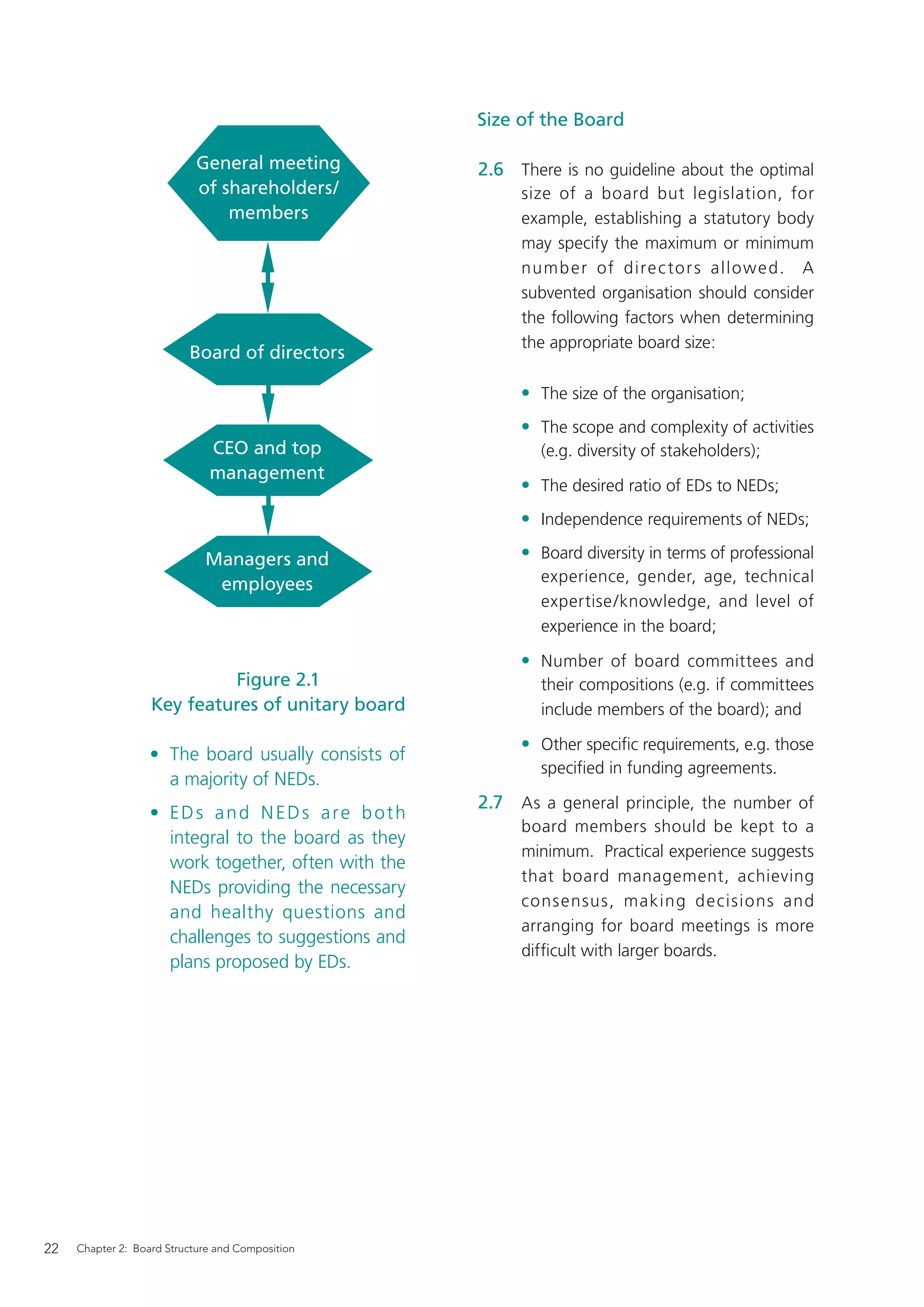
                            General meeting          2.6 There is no guideline about the optimal
                            of shareholders/              size of a board but legislation, for
                                members                   example, establishing a statutory body
                                                          may specify the maximum or minimum
                                                          num b e r of dire c to r s all ow e d. A
                                                          subvented organisation should consider
                                                          the following factors when determining
                                                          the appropriate board size:
                          Board of directors

                                                          • The size of the organisation;
                                                          • The scope and complexity of activities
                              CEO and top                    (e.g. diversity of stakeholders);
                              management
                                                          • The desired ratio of EDs to NEDs;
                                                          • Independence requirements of NEDs;

                             Managers and                 • Board diversity in terms of professional
                              employees                      experience, gender, age, technical
                                                             expertise /knowledge, and level of
                                                             experience in the board;

                                                          • Number of board committees and
                            Figure 2.1                       their compositions (e.g. if committees
                   Key features of unitary board             include members of the board); and

                                                          • Other specific requirements, e.g. those
                   • The board usually consists of
                                                             specified in funding agreements.
                     a majority of NEDs.
                                                     2.7 As a general principle, the number of
                   • EDs and NEDs are both
                                                          board members should be kept to a
                     integral to the board as they
                                                          minimum. Practical experience suggests
                     work together, often with the
                                                          that board management, achieving
                     NEDs providing the necessary
                                                          cons ensus, making d e cisions and
                     and healthy questions and
                                                          arranging for board meetings is more
                     challenges to suggestions and
                                                          difficult with larger boards.
                     plans proposed by EDs.


22   Chapter 2: Board Structure and Composition
Case          Board Structure and Composition
             5
S t u d ie s     Inadequacies

                 One subvented organisation operated 15 subsidiary service units
                 to provide public services to over 10 000 beneficiaries. Its board
                 comprised over 100 members from the Government, the community,
                 service recipients, staff and management within the organisation. It
                 had the following inadequacies –
                      The board was too large and was not conducive to effective
                      decision making;
                      O ver 4 0 % of the board member s were s t af f of the
                      organisation; and
                      Three members of a nine-member Executive Committee were
                      staff members, who should abstain from voting on matters
                      concerning staff benefits.

                 Audit recommended that the organisation should –

                      Reduce the size of its board;
                      Review the composition of the board with a view to creating a
                      majority of external members (independent NEDs); and
                      Ensure that staff members of the Ex-Com abstained from
                      voting on matters concerning staff benefits.

                 Improvements made

                      The organisation established a new board of 25 members, with
                      a substantial majority being independent members, service
                      recipients and chairpersons of subsidiary service units. Directors
                      were required to declare possible conflicts of interest at the
                      beginning of each board meeting. No staff members would be
                      appointed to committees on audit, finance and remuneration.


                                                                    Chapter 2: Board Structure and Composition   23
Key members of the Board                             • Ensuring the appropriate induction
                                                                  of new board members, making sure
           Chairperson                                            that they are fully briefed on their
                                                                  duties and responsibilities;
           2.8 The chairperson is responsible for               • Setting the agenda, style and tone
                   leading the board and must demonstrate
                                                                  of board discussions to promote
                   the ability to manage the board, obtain
                                                                  e f fe c t i v e d e c i s i o n - m a k i n g a n d
                   the support and confidence of the board
                                                                  constructive debate;
                   members and stakeholders, and devote
                   sufficient time to the organisation’s        • Ensuring that there is an effective
                   affairs. The responsibilities of the           per formance review process for
                   chairperson include:                           individual board members and for the
                                                                  board as a whole;
                   • Chairing AGMs and board meetings.          • Ensuring that the board takes proper
                       The chairperson must ensure that           account of statutor y and other
                       every board member contributes             requirements and makes decisions
                       to the functioning of the board.           based on a full consideration of all
                       Decisions should only be made with         relevant issues;
                       due reference to views expressed
                                                                • Ensuring that the b oard me et s
                       by board members. Dissenting
                                                                  regularly and that minutes of
                       views should be fully explored with
                                                                  meetings accurately record decisions
                       discussion focusing on the best
                                                                  taken, interests declared, views
                       outcome;
                                                                  expressed and, where appropriate,
                   • Providing leadership to the board;           the attribution of views to individual
                                                                  board members;
                   • Upholding the highest standards of
                       integrity and probity;                   • Ensuring that key issues are discussed
                                                                  by the board in a timely manner, that
                   • Promoting the highest standards of
                       corporate governance;                      the board has adequate support and
                                                                  resources and is provided with all the
                   • Dealing with conflict or disagreement         necessary information on which to
                       within the board;
                                                                  make decisions;
                   • Establishing an effective working          • Taking decisions between meetings
                       relationship with the CEO, providing
                                                                  where necessar y and within
                       support and advice while respecting
                                                                  parameters agreed by the board;
                       executive responsibility, and ensuring
                       that board decisions are carried out;    • Ensuring that the organis ati on
                                                                  communicates effectively
                  • Building an effective and complementary       with its stakeholders;
                      board, initiating change and planning
                                                                  and
                      succession in board appointments,
                      subject to board and stakeholders’        • Communicating with
                      approval;                                   external stakeholders.


24   Chapter 2: Board Structure and Composition
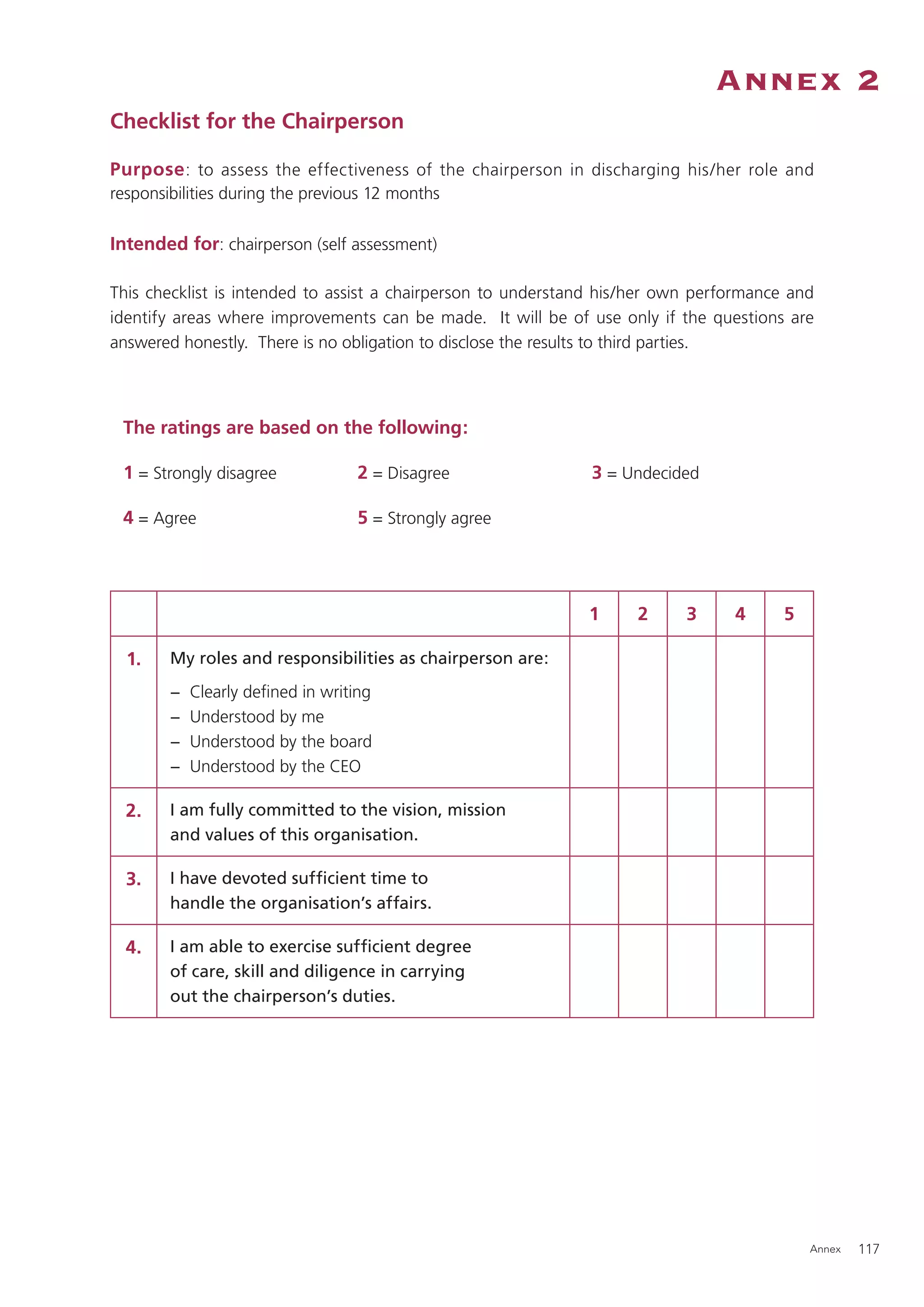
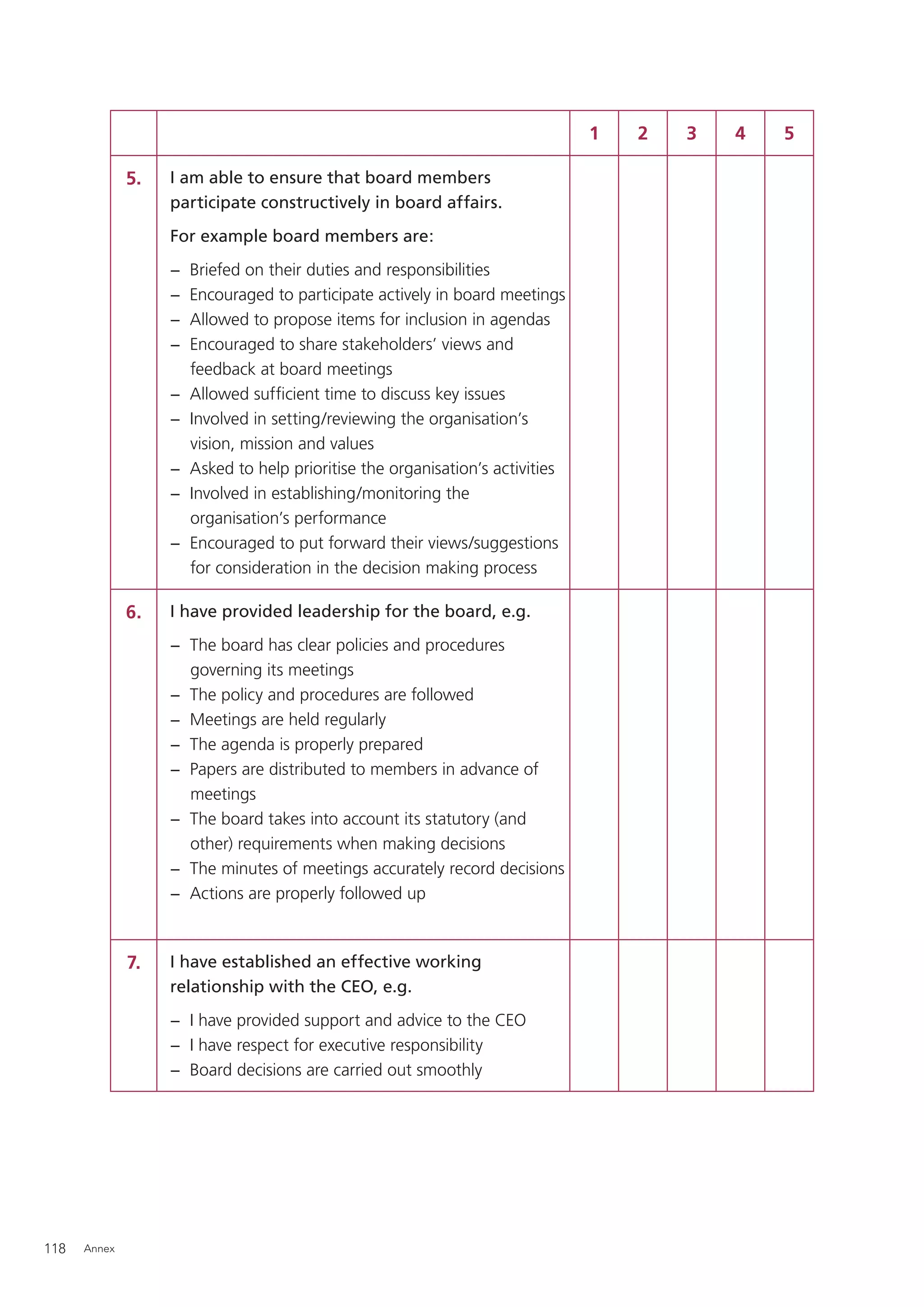
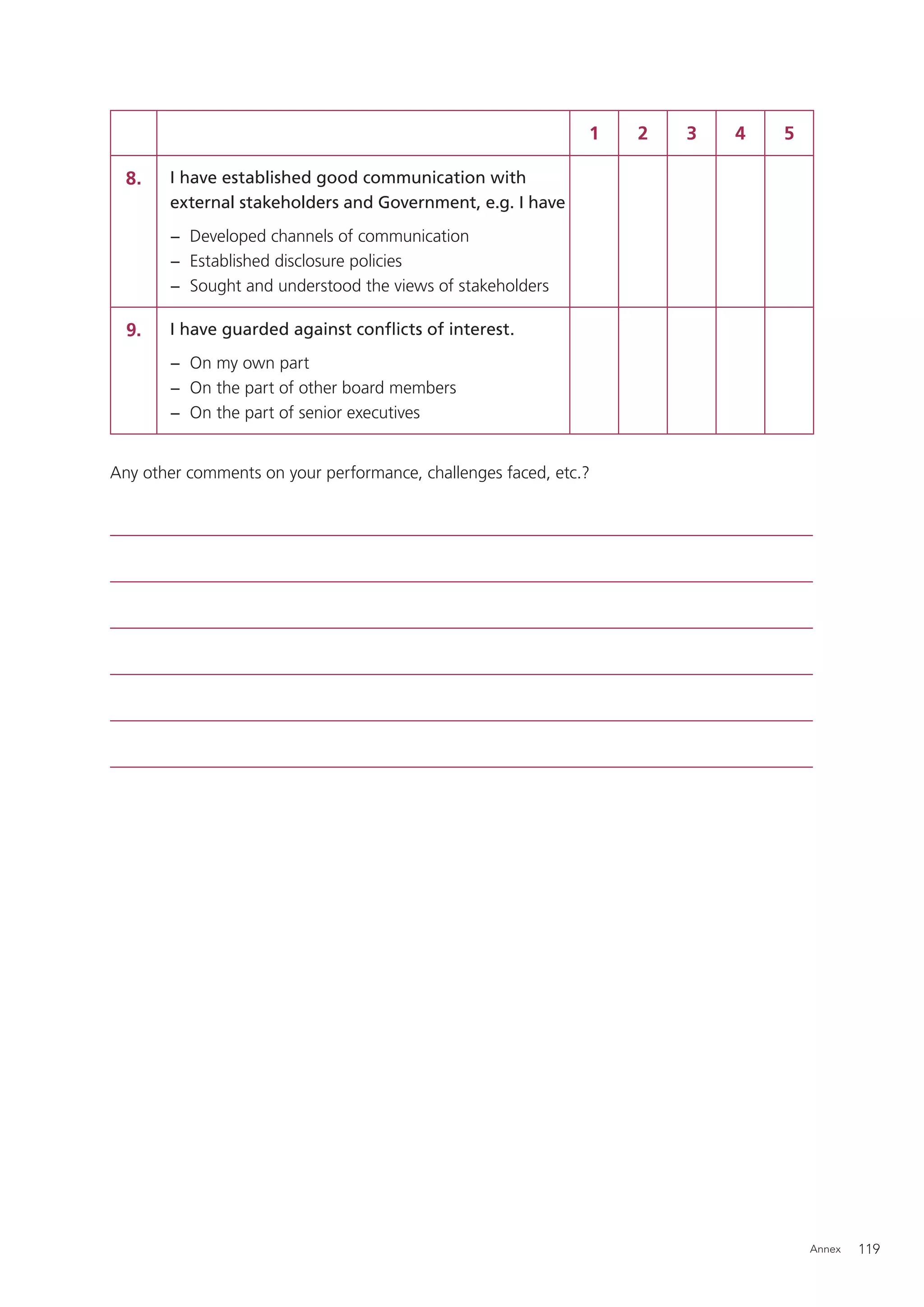
2.9 A checklist for the chairperson is at        2.10 D a y - t o - d a y m a n a g e m e n t o f t h e
    Annex 2.                                           organisation is not the role of the
                                                       chairperson. In order to strengthen
                                                       the structural checks and balances, the
                                                       roles of chairperson and CEO should
                                                       be separated and fulfilled by different
                                                       persons.


          Best Practice
          Main Responsibilities of a CEO

               Provide strategic vision and high-level business judgement and
               wisdom to facilitate the board’s decisions;

               Oversee the day-to-day running of the business and executing the
               board’s decisions/instructions;

               Provide leadership to achieve the organisation’s purposes and
               objectives;

               Develop rules and procedures within which the executive carries out
               its operations;

               Meet performance targets;

               Build necessary internal infrastructure to ensure the cost effectiveness
               of operations; and

               Maintain good relationships with the organisation’s stakeholders.


                                                                         Chapter 2: Board Structure and Composition   25
Best Practice                  7


                           The chairperson’s relationship with the CEO

                           It is important for the chairperson and CEO to discuss and agree between
                           them their respective roles, to ensure the organisation provides a united
                           and coordinated front and to avoid potential friction.

                           More broadly, the chairperson will need to agree with the CEO how they
                           are going to work together. This will include:

                           1.      Agreeing the key things they need to achieve;

                           2.      Confirming the expectations each has of the other;

                           3.      Confirming how the board will interact with and assist the
                                   organisation and the CEO:
                                   − What support and advice does the CEO want
                                   − What are the protocols for board-staff communication

                           4.      Confirming how the CEO will report to the board and how the
                                   CEO’s performance will be reviewed;

                           5.      Discussing how board meetings will be organised/serviced:
                                   − How to prepare board agendas
                                   − What are the key areas the board needs to focus on
                                   − What papers will be prepared and in what format
                                   − Who will minute the meetings and in what detail

                           6.      Clarifying the role of the CEO in making the board effective,
                                   including recruitment of future board members;

                           7.      Clarifying what information the chair wants/doesn’t want; and

                           8.      Confirming who will be the principal external spokesperson for the
                                   organisation.


26   Chapter 2: Board Structure and Composition
Directors

2.11 D ire c to r s of a n o r g a ni s a t i o n a re   The legal duties of directors are
      collectively responsible for corporate             e x p lain e d in Chapter 8. S o m e
      governance and make the decisions that             additional considerations specific
      determine the organisation’s prosperity            to EDs and NEDs are shown in the
      and integrity.                                     following box:


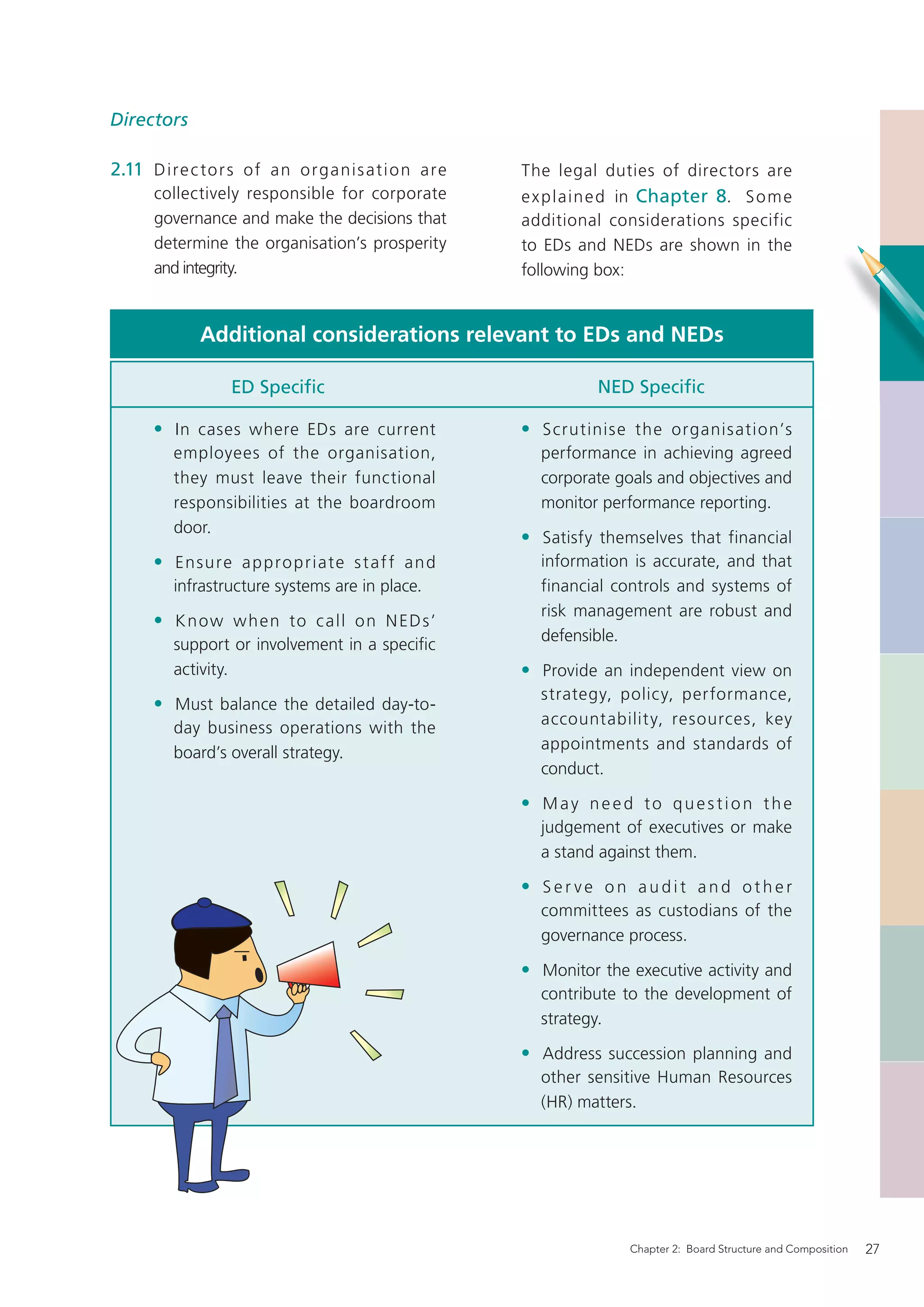
              Additional considerations relevant to EDs and NEDs


      • In cases where EDs are current                   • Scrutinise the organis ation’s
          employees of the organisation,                   performance in achieving agreed
          they must leave their functional                 corporate goals and objectives and
          responsibilities at the boardroom                monitor performance reporting.
          door.
                                                         • Satisfy themselves that financial
      • Ensu re a p p ro p r i a te s t a f f a n d        information is accurate, and that
          infrastructure systems are in place.             financial controls and systems of
                                                           risk management are robust and
      • K n ow w h e n to c all o n N ED s’
                                                           defensible.
          support or involvement in a specific
          activity.                                      • Provide an independent view on
                                                           strategy, policy, performance,
      • Must balance the detailed day-to-
                                                           accountabilit y, resources, key
          day business operations with the
                                                           appointments and standards of
          board’s overall strategy.
                                                           conduct.

                                                         • May need to question the
                                                           judgement of executives or make
                                                           a stand against them.

                                                         • Serve on audit and other
                                                           committees as custodians of the
                                                           governance process.

                                                         • Monitor the executive activity and
                                                           contribute to the development of
                                                           strategy.

                                                         • Address succession planning and
                                                           other sensitive Human Resources
                                                           (HR) matters.


                                                                       Chapter 2: Board Structure and Composition   27
Best Practice
                               The effective non-executive director

                                       • Upholds the highest ethical standards of integrity and
                                           probity;

                                       • Supports executives in their leadership of the organisation
                                           while monitoring their conduct;

                                       • Questions intelligently, debates constructively, challenges
                                           rigorously and decides dispassionately;

                                       • Listens sensitively to the views of others, inside and outside
                                           the board;

                                       • Gains the trust and respect of other board members; and
                                       • Promotes the highest standards of corporate governance.


                                                         Source: Adapted from Derek Higgs (Jan 2003) 8


           2.12 A sample appointment letter for a NED                        • Integrity – board members should
                is at Annex 3.                                                  not place themselves under any
                                                                                obligation to outside individuals or
           Personal and Ethical Attributes of                                   organisations that might influence the
           Board Members                                                        performance of their board duties.

                                                                             • Objec tivit y – board members
           2.13 B o a rd m e m b e r s s h o u l d have t h e                   should make board business choices
                   following personal and ethical attributes:
                                                                                purely on merit.

                   • Selflessness – board members                            • Accountability – board members
                       should take decisions in the interest                    are accountable for their decisions
                       of the organisation, not to gain                         and actions and must submit
                       financial or other material benefits                     themselves to the appropriate level of
                       for themselves, their family, or their                   scrutiny.
                       friends.


28   Chapter 2: Board Structure and Composition
• Openness – board members should             2.18 The training should explain the expected
        be as open as possible about the                 standards of integrity and accountability.
        decisions and actions that they take.            Board members need to understand
                                                         their fiduciary duty (see Chapter 8 ) to
     • Honesty – board members have a
                                                         the organisation.
        duty to declare any private interests
        relating to their board duties.
                                                   2.19 The board should have a strategy for the
     • Leader ship – board member s                      support and personal development of
        should promote and support these                 board members so that they can keep
        principles by leadership and example.            abreast of the knowledge and skills
     • Commitment – board members                        they need. This can include training/
        who do not attend meetings and                   familiarisation in areas such as public
        other tasks regularly cannot fulfil their         sec tor development s, governance
        roles.                                           practices, financial literacy and risk
                                                         management.

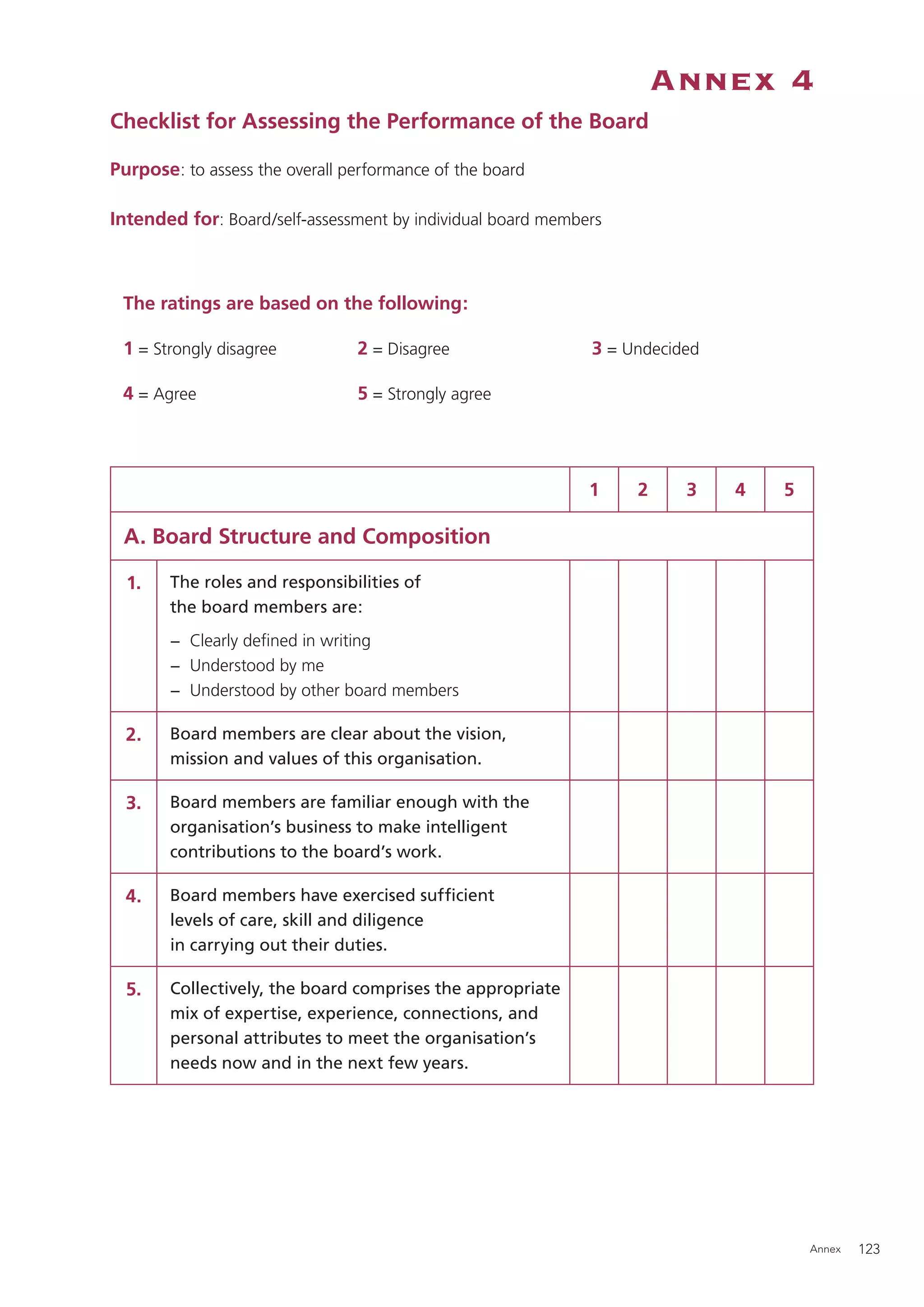
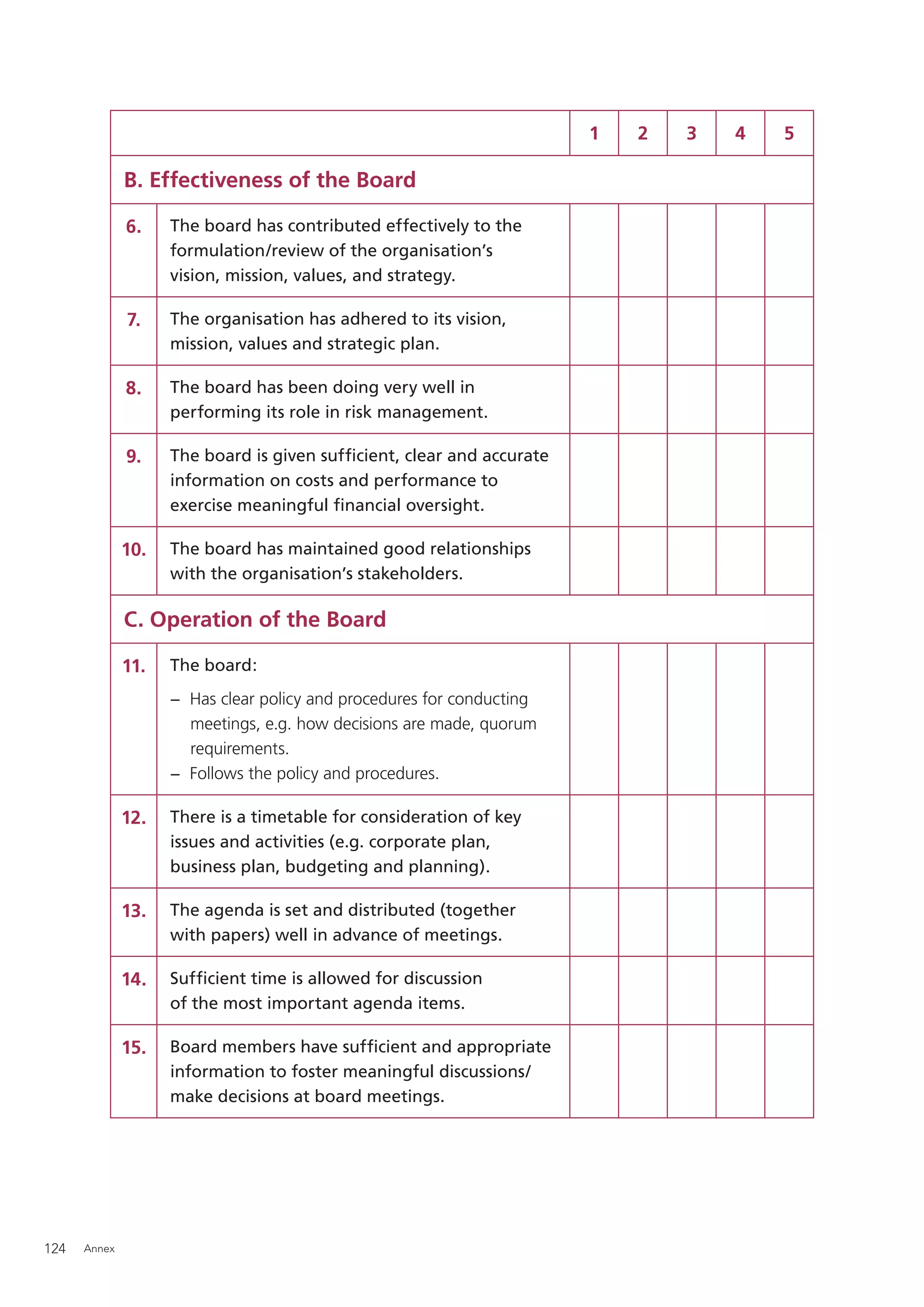
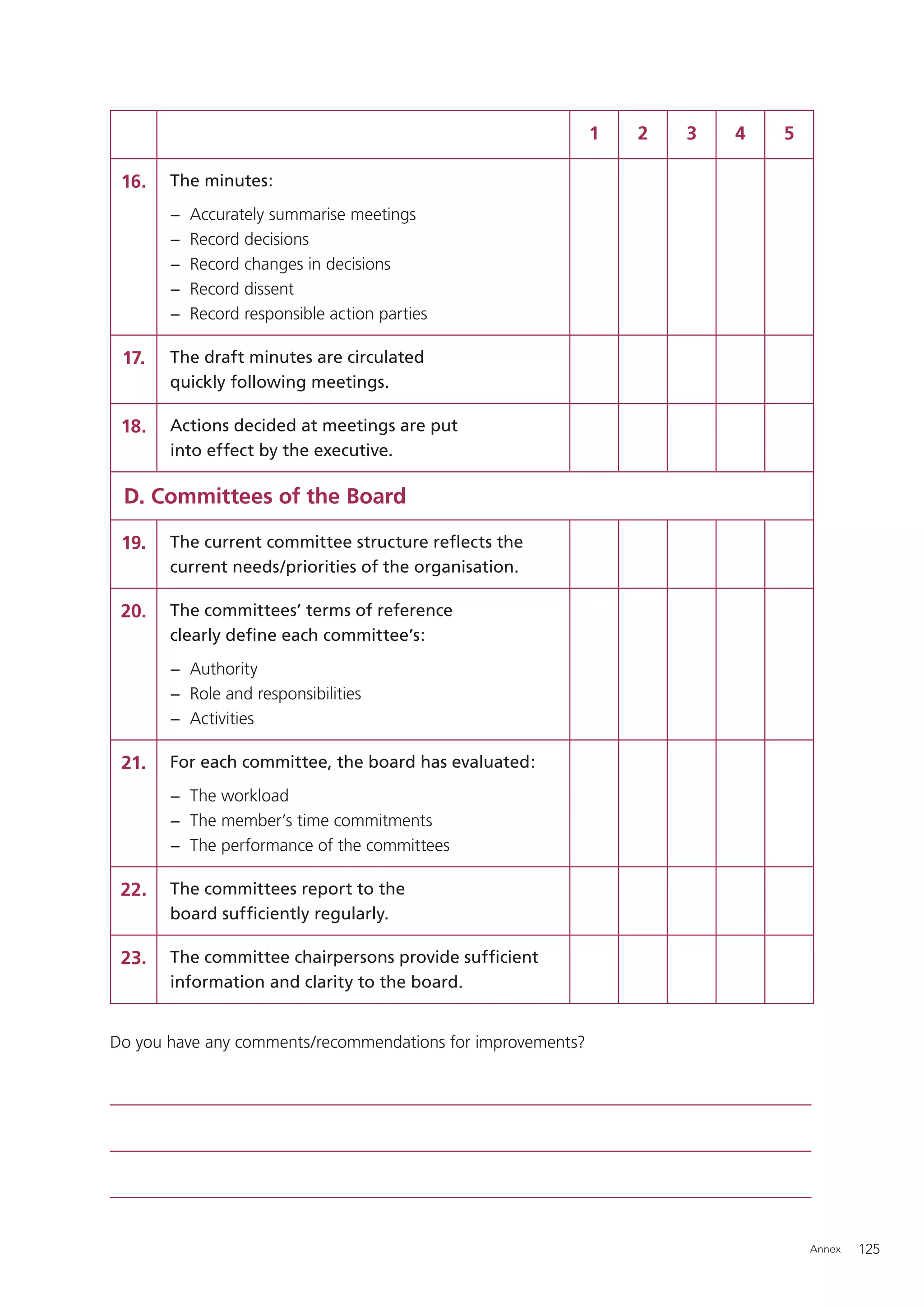
2.14 A checklist for the board is at Annex 4.
                                                   2.20 Board members should continue to visit
                                                         the organisation’s facilities regularly.
Induction and Training                                   This serves both to ensure that they
                                                         remain familiar with the organisation’s
2.15 New board members should undergo a                  operations and staff as well as helping
     full induction, in which they receive the           t h e m to p e r fo r m t h e i r o v e r s i g ht
     training and information they need to               function.
     carry out their new role. They should
     also meet key staff, service users and
                                                   Succession Planning
     beneficiaries, and other stakeholders.

                                                   2.21 In many statutory bodies, it is Government
2.16 Training should enable board members                that makes the appointments. In other
     to understand both the public sector
                                                         circumstances, the board should ensure
     contex t in which the organisation
                                                         timely replacement of directors resigning
     operates and its specific operations and
                                                         or reaching the end of their terms.
     environment.
                                                         Attention should be given to:

2.17 Information provided to new board
                                                         • Determining an appropriate length of
     members should include the
                                                            service so as to balance the need for
     organisation’s aims and objectives,
                                                            a retention of corporate knowledge
     control environment, organisational risks
                                                            with a healthy turn-over of board
     and risk management practices, key
                                                            members; and
     personnel, delegation arrangements,
     board and staff structure, and budget               • Succession planning for replacement
     planning and performance management                    of the chairperson and other
     processes.                                             directors.


                                                                           Chapter 2: Board Structure and Composition   29
2.22 B e f o r e n e w b o a r d m e m b e r s a r e       2.23 It is particularly important that individual
                   appointed, the board (perhaps on the                     board members realise that an invitation
                   advice of a Nomination Committee)                        to join the board of a statutory body
                   should determine what attributes and                     or NGO is not merely an honour. Such
                   knowledge are needed, and document                       a role carries real responsibilities and
                   these in the form of a role description                  should be treated seriously.
                   or profile. All board members including
                   government representatives should be
                   appointed for their relevant skills and
                   experience. The board should ensure
                   that the recruitment process is able
                   to attract a wide range of candidates
                   who possess the necessary skill sets to
                   support the board.


                             Best Practice
                             Elements of a good succession planning process:

                                     • A continuous process
                                     • Driven and controlled by the board, with the CEO’s
                                         participation

                                     • Easily executable in the event of a crisis or any adverse event
                                     • Considers succession requirements based on corporate strategy
                                     • Geared towards finding the right leader at the right time
                                     • Develops talent pools at lower levels


30   Chapter 2: Board Structure and Composition
Appointment of Government Officials                              officials appointed as board members
to a Board                                                      are governed by company law when
                                                                they discharge duties in this role, unless
2.24 The purpose of appointing government                       their duties as members are specifically
     officials to the board of a subvented                      modified by a relevant ordinance or
     organis ation dif fer s from case to                       M&A.
     case. Each case should be considered
     o n i t s m e r i t s , w i t h re g a rd to i t s   2.27 I n t h e c a s e o f a n o r g a n i s a t i o n
     circumstances and the legal implications                   e s t ablishe d by an ordinance, the
     of different arrangements. The role of                     duties of directors will depend on that
     a government official on a board, apart                     ordinance. Where the ordinance does
     from his/her fiduciary duties, is mainly to                 not vest specific duties on its directors
     act as a link between the Government                       the court would naturally extend the
     and the organisation. The intended                         company law principles to the directors.
     role(s) of government officials should
     be clearly stipulated in writing. Their              O ther Forms of Government
     functions may include:                               Represent ation in Subvente d
     • Monitoring the performance of the                  O rganis ations
        organisation;

     • Enhancing understanding of service                 2.28 Organisations may benefit from access
        delivery expectations;                                  to public sector decision makers. To
                                                                avoid the potential difficulties involved in
     • Ensuring that public funds are
        properly used;                                          appointing government representatives
                                                                to the board, other means are sometimes
     • Safeguarding government investments;                     adopted. These include:
     • Looking after the public interest; and                   • G overnm ent of ficer s at tending
                                                                    board meetings as observers, and/or
     • Offering advice on government policy.
                                                                    advisers. Such attendance should be
                                                                    based on prior agreement between
2.25 There may be times when the government                         the sponsoring depar tment and
     representatives should not be present
                                                                    the subvented organisation, e.g.
     in a board discussion, or receive the
                                                                    documented in the MAA or funding
     paper s, for fear of breaching the
                                                                    agreement;
     fiduciary duties, e.g. in relation to the
     organisation’s budget or bid for funding                   • Government officers chairing or
     from the Government.                                           sitting on the Advisory Board of the
                                                                    organisation; and
Legal P osition of Government                                   • Stipulating measures to protect the
Represent atives on B o ar ds                                       Government’s interest in the MAA
                                                                    or funding agreement (e.g. having
2.26 The duties of any board members
                                                                    access to papers and minutes, and
     are governed by company law, unless
                                                                    the right to conduct independent
     modified by a relevant ordinance or
                                                                    audits).
     the organisation’s M&A. Government


                                                                                  Chapter 2: Board Structure and Composition   31
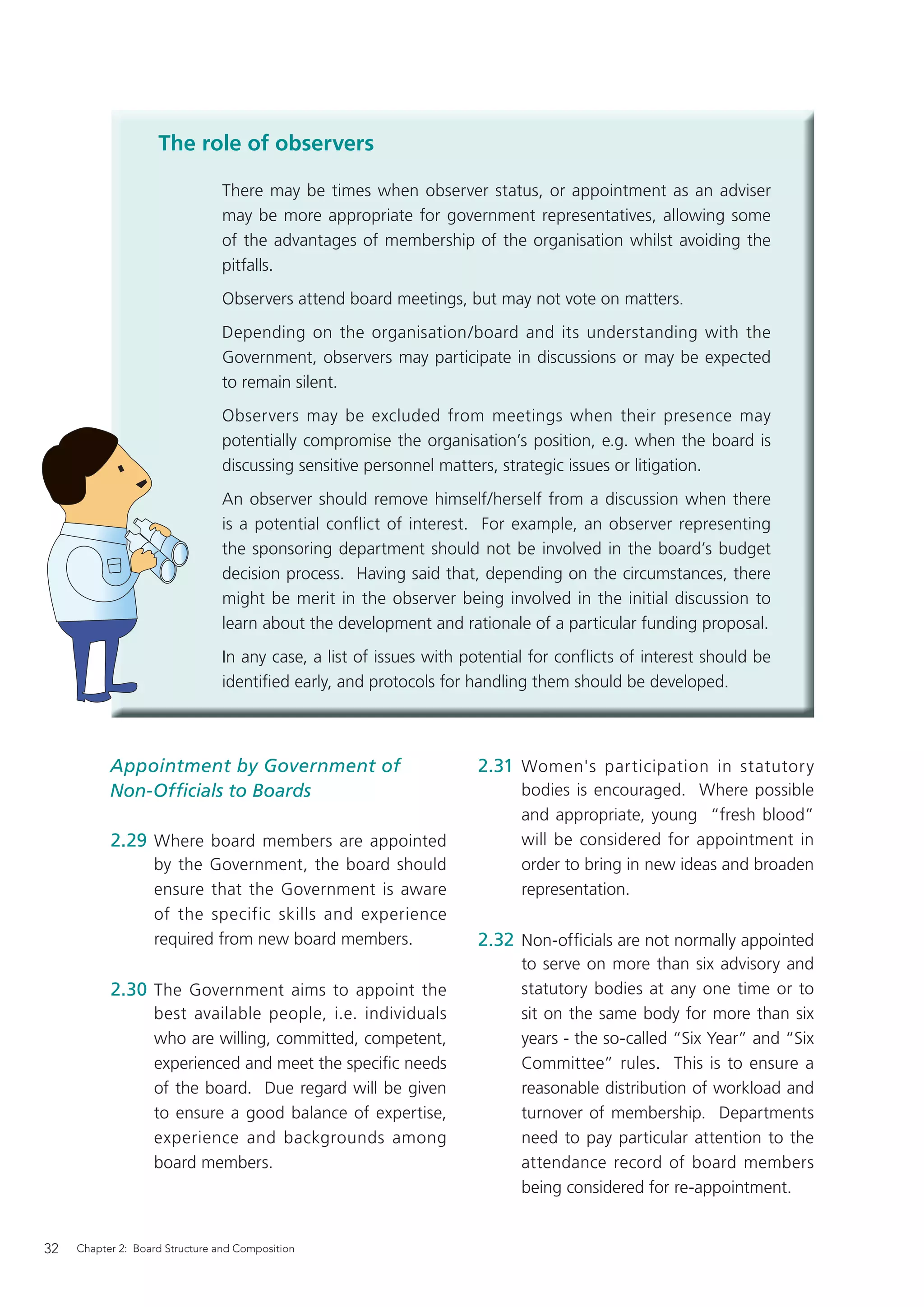
The role of observers

                                There may be times when observer status, or appointment as an adviser
                                may be more appropriate for government representatives, allowing some
                                of the advantages of membership of the organisation whilst avoiding the
                                pitfalls.
                                Observers attend board meetings, but may not vote on matters.
                                Depending on the organisation/board and its understanding with the
                                Government, observers may participate in discussions or may be expected
                                to remain silent.
                                Observers may be excluded from meetings when their presence may
                                potentially compromise the organisation’s position, e.g. when the board is
                                discussing sensitive personnel matters, strategic issues or litigation.
                                An observer should remove himself/herself from a discussion when there
                                is a potential conflict of interest. For example, an observer representing
                                the sponsoring department should not be involved in the board’s budget
                                decision process. Having said that, depending on the circumstances, there
                                might be merit in the observer being involved in the initial discussion to
                                learn about the development and rationale of a particular funding proposal.
                                In any case, a list of issues with potential for conflicts of interest should be
                                identified early, and protocols for handling them should be developed.


           Appointment by Government of                             2.31 Women's participation in statutory
           Non-Officials to Boards                                          bodies is encouraged. Where possible
                                                                           and appropriate, young “fresh blood”
           2.29 Where board members are appointed                          will be considered for appointment in
                   by the Government, the board should                     order to bring in new ideas and broaden
                   ensure that the Government is aware                     representation.
                   of the specific skills and experience
                   required from new board members.                 2.32 Non-officials are not normally appointed
                                                                           to serve on more than six advisory and
           2.30 The Government aims to appoint the                         statutory bodies at any one time or to
                   best available people, i.e. individuals                 sit on the same body for more than six
                   who are willing, committed, competent,                  years - the so-called “Six Year” and “Six
                   experienced and meet the specific needs                  Committee” rules. This is to ensure a
                   of the board. Due regard will be given                  reasonable distribution of workload and
                   to ensure a good balance of expertise,                  turnover of membership. Departments
                   experience and backgrounds among                        need to pay particular attention to the
                   board members.                                          attendance record of board members
                                                                           being considered for re-appointment.


32   Chapter 2: Board Structure and Composition
Chapter 3
Board Operation and Effectiveness


                             Chapter 3: Board Operation and Effectiveness   33
Boardroom Conduct and                                                3.5 The board should specify under what
           Relationship                                                              circumstances members should declare
                                                                                     conflicts of interests, excuse themselves
           General                                                                   from discussions and decisions, etc.

           3.1     T h e b o a r d ’s r e s p o n s i b i l i t i e s ( s e e   3.6 An annual agenda should be agreed by
                   Chapter 2 ) are numerous, varied                                  board members. This should set out all
                   and onerous. Given that most boards                               the major tasks the board proposes to
                   schedule twelve meetings or less a                                carry out in the following year and their
                   year, it is important to have formal                              associated schedules. This does not
                   processes in place that facilitate effective                      preclude inclusion of new agenda items
                   operations and maximise value.                                    as the need arises. A set of pro forma
                                                                                     agendas may be prepared, one for each
           3.2 The board should have policies and                                    of the meetings planned. The board’s
                   procedures for conducting meetings,                               meeting dates should be arranged well
                   e.g. a timetable for consideration of key                         in advance to facilitate board members’
                   issues, quorum requirements and how                               attendance.
                   decisions are made.
                                                                                3.7 Similar arrangements should apply to
           3.3 Since the board is ultimately responsible                             committees set up under the board.
                   for the management of the organisation,
                   the information it receives must be
                                                                                Preparing for a Meeting
                   adequate for it to understand what is
                   really going on and for it to be satisfied                         • The agenda for each board
                   that the organisation is being managed                              meeting should be approved by
                   properly. Therefore, board members                                  the chairperson and distributed to
                   must have a right to :                                              all board members sufficiently in
                   • Invite appropriate executives to                                  advance (e.g. two weeks before the
                      make presentations and to answer                                 meeting);
                      questions at board meetings; and
                                                                                     • The agenda should include regular
                   • Identify the information they need                                items on matters such as risk
                     and to receive it in a timely manner                              reporting and corporate citizenship;
                     or in a prescribed format.
                                                                                     • Discussions will be more effective
                                                                                       if there is a paper for every agenda
           3.4 B o a r d m e m b e r s ’ r e q u e s t s f o r                         item, providing all necessar y
                   information could involve a substantial                             background information and drawing
                   amount of work and may disrupt the                                  attention to any significant issues;
                   work of management. Therefore, the
                                                                                     • Board members should declare (and
                   board should agree on a procedure
                                                                                       the board should record) any conflict
                   by which a board member can obtain
                                                                                       of interest in respect of any agenda
                   information in an efficient way without
                                                                                       item in advance of the meeting.
                   compromising his /her right to that
                                                                                       If needed, the board member(s)
                   information.


34   Chapter 3: Board Operation and Effectiveness
concerned should excuse themselves       − Manage the right level of creative
      from the meeting (or relevant part         tension and encourage challenging
      thereof);                                  and constructive debates;
    • Board members have the right and         − Draw out the views of board
      the duty to bring to the attention         members whilst steering the board
      of the board any matters of serious        as a whole to decide upon a solution;
      concern, i.e. the chairperson should
                                               − Lead the board’s discussions to
      include them on the agenda;
                                                 clear conclusions; and
    • The chairperson needs to prioritise
                                               − Ensure that each board member
      ag enda items – mat ter s of the
                                                 has the opportunity to express
      greatest importance or deserving
                                                 their opinions (i.e. board meetings
      more discussion time should be
                                                 are not dominated by particular
      placed at the top of the agenda; and
                                                 board members).
    • The board should receive regular,
                                             • Decisions should be reached through
      timely reports and minutes from all
                                               discussion; and
      its committees.
                                             • Attendance of board members should
                                               be recorded and monitored. The
During the Meeting                             board should take action to improve
                                               the attendance of board members
    • The chairperson leads the board and
                                               with low at tendance, e.g. issue
      should:
                                               reminders.
      − Ensure the quorum is met before
        convening the meeting;
      − Control board meetings and ensure
        that the board works as a single
        and coherent unit;


                                                          Chapter 3: Board Operation and Effectiveness   35
Best Practice 9
                           Companies tend to develop their own style in minute keeping: for
                           example, some boards note the names of the key contributors to the
                           discussion, others do not. In some cases, it has to be admitted, the
                           minutes are no more than a staccato record of who attended and what
                           was decided. At the other extreme, there are minutes that are almost a
                           verbatim report of the proceedings, complete with stage directions. The
                           ideal lies between the two. Minutes should contain sufficient information
                           to capture the key threads of the discussion, any disclosures of personal
                           interest, the alternatives considered, the agreement reached, and plans
                           and responsibilities for action.


           After the Meeting                                           • The board minutes should set out
                                                                         the responsible action party and the
                   • Urgent items should be actioned,                    agreed date for completion for each
                     without waiting for draf ting,                      action item. The board should check
                     circulation and approval of minutes;                the status of each action item at each
                                                                         board meeting.
                   • The minutes of board meetings
                     s h o u l d b e c l e a r, c o n c i s e a n d
                     complete. The draft minutes should
                     be produced quickly and circulated
                     to board members for comment as
                     soon as possible. They should be
                     distributed to all board members
                     for formal endorsement at the next
                     board meeting; and


36   Chapter 3: Board Operation and Effectiveness
Director of Audit’s Observations of Common Inadequacies
   on Board Operations5

        • Poor monitoring of the attendance of members at board/ committee
          meetings;
        • Failure to remind members with low attendance records to attend
          meetings;
        • Failure to ensure a quorum was present throughout all board/committee
          meetings which cast doubts on decisions made;
        • Not issuing minutes of meetings to members as soon as possible after
          meetings;
        • Not recording declarations of interests reported by board /committee
          members in a central file; and
        • Not adopting a two-tier reporting system for managing potential conflicts
          of interests of board/committee members.


Evaluation

    • Boards should ensure that they
      have in place a process through
      which their collective and
      individual (including government
      representatives) performance can
      be evaluated and monitored. This
      may involve measuring the board’s
      per formance against widely
      accepted good corporate governance
      prac tices. A ny s h o r tco m in g s
      identified can be addressed in a
      timely, appropriate manner ensuring
      that the organisation’s standards
      for accountability and corporate
      responsibility are maintained at a high
      level.   Board evaluations typically
      involve a process of self-evaluation
      mixed with peer review.


                                                                 Chapter 3: Board Operation and Effectiveness   37
Best Practice10
                            Boards can be evaluated in a lot of different ways and at different levels.
                            Some boards have adopted (with good results) the simple measure of
                            asking a member to comment on 'how the session went' at the end of
                            each meeting.

                            However, a more formal approach to evaluation may be required, taking
                            a more global look at board performance.


                            There are two main ways of collecting information:

                            Questionnaires

                            Questionnaires can be either paper- or web-based. They are quick and
                            inexpensive. There are lots of 'canned' versions around. They have
                            a wide reach and the results can often be quantified, which facilitates
                            comparisons and provides an aura of objectivity to the results.

                            However, there are pitfalls. Questionnaires can yield superficial, and
                            sometimes even false, insights because people sometimes fill out
                            questionnaires by giving answers they consider appropriate. Problems
                            may not come out in the questionnaire responses.


                            Interviews

                            These can be by phone or in person. Interviews avoid many of the
                            problems associated with questionnaires. They can elicit nuances and
                            provide opportunities to examine complex issues. As interviews progress
                            and problems become clearer, later interviews can be used to test
                            hypotheses and explore solutions. An experienced interviewer will usually
                            be able to contribute constructively to discussions on how to deal with
                            governance problems once the interview programme is over.


38   Chapter 3: Board Operation and Effectiveness
The main downside of interviews, however, is that they take more time
           than questionnaires, and they tend to be more costly. Much depends,
           too, on the skill of the interviewer.

           Some organisations opt for evaluations by board members themselves.
           Under this approach, members may rate themselves or each other,
           either verbally or through some sort of questionnaire. Comments may
           be collated by a designated board member, such as the head of the
           nominating committee, or perhaps some knowledgeable individual who
           is now out of the fray, such as a past chair.

           Self-evaluations have the virtue of being less costly, but they need to
           be handled with sensitivity. To work well, the board must possess that
           often-elusive attribute – a culture of candour and mutual trust.


Committees                                      Executive Committee

3.8 The establishment of committees under       3.9 In a commercial setting, an executive
     the board could help suppor t the               commit tee ( E x- Com ) is commonly
     board on specific matters and provide           established and generally performs
     internal checks and balances. However,          typical duties such as managing the
     it may not be practical even for large          organisation in between regular board
     subvented organisations to establish            meetings and reporting to the full board
     all the committees mentioned below.             on progress against strategy and duties
     Whether a particular committee is               set by the board. Most of these Ex-
     necessary would depend on the unique            Coms are made up of a majority of EDs.
     circumstances of each organisation.             The actual power that the Ex-Com can
                                                     exercise depends entirely on the extent
                                                     of the board’s delegation of power.


                                                                   Chapter 3: Board Operation and Effectiveness   39
3.10 In some subvented organisations,                Remuneration Committee
                   the board may only have one ED and
                   a number of NEDs. In such cases it           3.12 To avoid potential conflicts of interest,
                   may be better to leave the day-to-day             the board may establish a Remuneration
                   running of the organisation to the CEO.           Co mmi t te e co m p o s e d of N ED s
                                                                     whose responsibilities include making
           Nomination Committee                                      recommendations to the board, or to
                                                                     Government, on remuneration-related
           3.11 A Nomination Committee deals with the                matters.
                   appointment of board members who
                   are not appointed by the Government.         3.13 In Hong Kong, remuneration of NEDs is
                   The committee should ideally contain              less of an issue as NEDs typically work
                   a majority of NEDs and be chaired by a            on a voluntary basis. In some cases,
                   NED. The committee should ensure that             they may receive an honorarium as a
                   appointments to the board are made in             gesture of appreciation for their time
                   accordance with specific criteria, which          commitment.
                   should have regard to competence and
                   individual merit, in the light of the role
                   the prospective candidate is expected to
                   fulfil.


40   Chapter 3: Board Operation and Effectiveness
Best Practice
           When determining the board remuneration (especially for EDs):
           •     No member of the board or the management should participate
                 in setting his/her own remuneration. Where appropriate,
                 independent advice should be sought; and
           •     Formal and transparent procedures for setting the remuneration
                 of individual directors should be established.


Audit Committee                                 Other Committees

3.14 The board may establish a separate         3.15 The board may consider establishing
     Audit Committee to independently                other committees dealing with
     rev iew financial information, the              corporate governance, finance, HR, risk
     framework of control, the external audit        management, business development,
     process and compliance with applicable          public complaint s, s t af f ap p eals,
     laws and regulations. See Chapter 7             information technology, investment,
     for more details.                               capital works, infrastructure planning
                                                     etc., according to the business nature
                                                     and requirements of the organisation.
                                                     The structure, roles and responsibilities
                                                     of these committees should be clearly
                                                     defined and their authority should be
                                                     properly delegated by the board. All
                                                     committees should report regularly to
                                                     the board.


                                                                  Chapter 3: Board Operation and Effectiveness   41
Best Practice
                            Corporate Governance Committee

                            Purpose
                                    • Develop, review and recommend to the board a set of
                                      corporate governance policies and guidelines
                                    • Provide oversight for the annual evaluation of the performance
                                      of the board


                            Composition
                                    • A majority of NEDs
                                    • The chairperson, if possible, should be an NED


                            Responsibilities and Duties
                                    • Develop, assess, periodically review and make recommendations
                                      to the board concerning appropriate corporate governance
                                      policies and guidelines
                                    • Monitor and report to the board on adherence to corporate
                                      guidelines, committee activities and regulatory and compliance
                                      issues
                                    • Receive comments from board members and review regularly
                                      the overall effectiveness of the board and recommend
                                      improvements where warranted


           Conflicts of Interest                                          making should be guided by principles
                                                                         of integrity, honesty, transparency and
           3.16 Boards must manage conflicts of interest                  good faith. Organisations should set
                   properly. Failure to do so may have                   out requirements to avoid conflicts of
                   a serious impact on an organisation’s                 interest, and the course of action to be
                   reputation, giving rise to criticism of               taken when a member faces a real or
                   favouritism, abuse of authorit y or                   apparent conflict of interest situation.
                   allegations of corruption. All decision-


42   Chapter 3: Board Operation and Effectiveness
3.17 Directors and employees must avoid                  threat of a conflict of interest, board
     any potential, perceived or real conflict           members/employees should again be
     of intere s t. A ll b o ard m emb er s /            required to make a declaration. The
     employees should be required to declare             general declaration of interest should
     any conflict of interest upon joining               be updated on a periodic (e.g. annual)
     the organisation. When there is a                   basis.
     special instance involving a probable


    What is a conflict of interest?

    Conflicts of interest may arise when a board member or an employee has the
    opportunity to influence the organisation’s business or other decisions in ways that
    could lead to personal gain or advantage of any kind, or benefit to their connections
    including family, personal friends, the clubs and societies to which they belong, and
    any person to whom they owe a favour or are obligated in any way.

    Private interests include both financial and non-financial interests. Situations likely to
    give rise to conflicts of interest include where a director/employee:

          • Conducts or has interest in business transactions involving goods or services,
            either directly or indirectly, with the subvented organisation;
          • Is involved in a tendering exercise and gives advice to a contractor or supplier
            on the strategy of bidding;
          • Has undeclared interests in suppliers and contractors that do business with the
            subvented organisation;
          • Assists third parties providing goods or services to the subvented organisation
            by working for them part-time or by providing consultancy services;
          • Is involved in a recruitment exercise in which a relative or friend has applied to
            join the organisation.


    Conflicts of interest can arise when there are insufficient checks and balances
    established within an organisation. No board member or employee should be able to
    approve, on their own, decisions which will benefit them. Each subvented organisation
    should put in place and enforce policies, procedures and practices that ensure that such
    decisions are taken/reviewed and endorsed by appropriate third parties.

    Organisations should be alert to conflicts of interest involving senior employees taking
    up outside employment either during their service with the organisation or in the
    period afterwards.


                                                                       Chapter 3: Board Operation and Effectiveness   43
Case                               Management of Conflicts of Interest
            5
     Studies
                                         Inadequacies

                                         One subvented organisation met the criteria for adopting a “two-tier
                                         reporting system” as set out in a Home Affairs Bureau guideline on
                                         declaration of interests for advisory and statutory bodies. However, it
                                         adopted a “one-tier reporting system” which required a director to
                                         declare and report a conflict of interest only when he became aware
                                         of it.

                                         Audit recommended that the organisation should consider
                                         adopting a “two-tier reporting system”, whereby in addition to
                                         reporting conflicts of interest at board meetings as and when
                                         they arise, board members should disclose their general interest
                                         on appointment to the board. The declaration shall be made on a
                                         registration form, which should be made available for inspections by
                                         the public.

                                         Improvements made

                                         The organisation adopted a “two-tier reporting system” for all
                                         its directors. Suggestions made by the Independent Commission
                                         Against Corruption (ICAC) have also been incorporated. A register of
                                         directors’ declaration of interests is maintained and is made available
                                         for inspection by the public.


44   Chapter 3: Board Operation and Effectiveness
Chapter 4
Strategy, Planning and Monitoring
Overview                                                Vision, Mission and Values

           4.1      A key aim of managing an organisation          4.2 Organisations often summarise their
                    is to achieve it s defined business                 business objectives into vision, mission
                    objectives. Organisations must have a               and values. The vision, mission and
                    clearly articulated and implementable               values of an organisation are the
                    strategy in order to achieve their                  cornerstones of sound strategic planning
                    business objec tives. A business                    and good corporate governance.
                    strategy is a plan that defines the                 • An organisation’s vision statement
                    range of business the organisation is                 describes its overall purpose and
                    to pursue, the kind of organisation it                desired future (“where do we want
                    is or intends to be, and the nature of                to be?”).
                    the contribution, economic and non-
                                                                        • T h e m i s s i o n s t a t e m e n t m a ke s
                    economic, it intends to make to its
                                                                          concrete the direction and purpose of
                    stakeholders.
                                                                          an organisation (“why do we exist?”).
                                                                        • The values encompass the central
                                                                          beliefs of an organisation (“how
                                                                          do we conduc t ourselves when
                                                                          accomplishing our mission?”).


                            Best Practice11
                            Why Vision, Mission and Values are Critical to Success?

                                     • The organisation is able to move forward and change without
                                       experiencing chaos because its overall direction is clear.
                                     • They instil a sense of pride in the board and staff about the
                                       nature of the work they are doing.
                                     • Mission, vision and values communicate the purpose of the
                                       organisation to its constituents and the community.


46   Chapter 4: Strategy, Planning and Monitoring
Strategic Planning

4.3 Strategic planning determines                                 4.4      St rate g i c p la nnin g
     where an organisation is                                     broadly covers the
     going over the next year                                      formulation of one or more
     or more, how it is going                                       action /strategic plans to
     to get there and how it                                         achieve the organisation’s
     will know if it got there                                       goals and objectives. It
     or not. The focus of a                                         l a y s o u t t h e p ra c t i c a l
     strategic plan is usually                                      steps to accomplish the
     on the entire organisation,                                   organisation’s vision and
     while the focus of a business                                mission. Without established
     plan is usually on a particular                            plan(s) to guide the actions,
     service or programme.                                   valuable resources could be
                                                         misused and the staff’s efforts would
                                                        be unfocused.


          Best Practice12
          Strategic Planning

                The outcome of strategic planning includes:
                • The establishment of a unique far-reaching vision
                • Addressing critical issues
                • The development of focused and clear strategies
                • Differentiation from competitors
                • The achievement of tangible benefits

                The process of strategic planning involves:
                • Pre-planning activities
                • Encouraging effective participation
                • Thinking strategically
                • Managing implementation
                • Managing strategically


                                                                        Chapter 4: Strategy, Planning and Monitoring   47
An Appropriate Approach                                4.8 O r g a n i c p l a nn in g m i g ht s t a r t by
                                                                        articulating the organisation's vision and
           4.5 T h e w ay t ha t a s t ra te g i c p l a n i s          values and then action plans to achieve
                    developed depends on the nature of                  the vision while adhering to those
                    the organisation's leadership, its culture,         values.
                    complexity of its operating environment,
                    size, expertise of its planners, etc.         Understand the Environment
                    Strategic plans could cover a time
                    span of one to ten years. Some plans
                                                                  4.9 The first step in strategic planning is to
                    include only top-level information and
                                                                        understand the external environment
                    no action plans. Some plans are five to
                                                                        at a macro level, to develop a basic
                    eight pages long, while others can be
                                                                        understanding of the trends and issues
                    considerably longer. There exist a wide
                                                                        that would significantly influence the
                    variety of models and approaches used
                                                                        organisation. A good understanding of
                    in strategic planning.
                                                                        the expectations and needs of various
                                                                        stakeholders will assist the board
           4.6 Goals-based planning is probably the                     with evaluating its strategic direction,
                    most common and starts with focus on                strategies and objectives and aligning
                    the organisation's mission (and vision              them with the established mission and
                    and/or values), goals to work toward                vision.
                    the mission, strategies to achieve the
                    goals, and action planning (who will do
                                                                  Implement the Strategy
                    what and by when).

                                                                  4.10 It is important to communicate the
           4.7 Issues-based planning often starts by                    strategy to all levels of the organisation
                    examining issues facing the organisation,           and to translate the strategy into actual
                    strategies to address those issues, and             business plans for implementation.
                    action plans.


48   Chapter 4: Strategy, Planning and Monitoring
Best Practice
Components of Strategic Planning

1.   Where are we now?
      (a) Conduct internal/external assessments via:
       • a Situation Inventory, which assesses the organisation’s current
         internal strengths and weaknesses; and
       • an Environmental Scan, which analyses key external elements
         along with the opportunities and threats in the environment in
         which the organisation operates.
     (b) Prepare a Mission Statement to define the organisation’s unique
         reason for existence.
     (c) Outline the Core Values, which describe how the organisation
         should conduct itself when carrying out its mission.


2.   Where do we want to be?
     (a) Write a Vision Statement, which forms a compelling and vivid
         conceptual image of the organisation’s desired future.
     (b) Prepare Goals for achieving the desired end results (generally this
         would encompass three or more years).


3.   How do we get there?
     (a) Draft an Action Plan or detailed description of the key strategies
         to be used to implement each objective.


4.   How do we measure the progress?
     Formulate and implement:
     (a) Per formance M easure s to c apture re sult s and ensure
         accountability.
     (b) Monitoring and Tracking Systems, which monitor progress,
         compile management information, and keep plans on course.
     (c) Systems for Resource Allocation, which are necessary for carrying
         out the desired strategies and achieving prioritised objectives.

          Source: Adapted from California State Department of Finance 13


                                                            Chapter 4: Strategy, Planning and Monitoring   49
Best Practice
                  Communicate the strategy. Organisations need to translate the strategy into
                  objectives and measures that will influence individual and team priorities. Three
                  suggested mechanisms include:
                           • Communication and education programmes: Educate the organisation on
                             the components of the strategy and reinforce this with feedback on actual
                             performance.
                           • Goal-setting programmes: Translate the high-level strategic objectives into
                             personal and team goals.
                           • Reward system: Link the organisation’s incentive and reward systems to
                             individual/team success in achieving the strategy.


                  Establish plans and targets; measure and reward performance. Middle
                  management must translate strategic initiatives into smaller, digestible action plans and
                  goals at the team and individual levels.

                  Develop a plan that defines how financial, human and other resources must be spent,
                  to close the gap between the current performance and the targets to be achieved.

                  Organisations should continually test their strategies and how they are being
                  implemented. This should involve the formulation of specific short-term targets, or
                  milestones.


                  Maintain strategic flexibility. Strategies cannot be linear or stable:
                           • Strategies are incremental and emerge over time.
                           • Intended strategies can be superseded.
                           • Strategy formulation and implementation are intertwined.
                           • Strategic ideas can arise throughout the organisation.
                  An effective strategic learning process needs to be developed to maintain strategic
                  flexibility. This can involve:
                           • A strategic framework that allows each participant to see how their activities
                             contribute to the overall strategy.
                           • Feedback that collects performance data about the strategy.
                           • A team problem-solving process that analyses the performance data and
                             adapts the strategy to emerging conditions.

                                                    Source: Adapted from Hong Kong Institute of Directors 14


50   Chapter 4: Strategy, Planning and Monitoring
Case      Strategic Planning
       5
Studies
           Inadequacies

           The Audit conducted a review of a group of subvented organisations
           providing public services of a similar nature. One of them had prepared
           a vision statement but had no formal strategic plan for realising that
           vision. Some of the other subvented organisations had prepared
           strategic plans but did not have operational plans to implement the
           strategic plans, nor provided regular updates to report progress to their
           boards or public.

           Audit recommended that the subvented organisations should –

                 Expedite action to prepare strategic plans to set out strategic
                 objectives, operational goals and strategic actions for achieving
                 the goals; annual operational plans to set out clear targets and
                 annual progress reports to present the extent of achieving those
                 targets; and
                 Publish those plans and reports on their websites.


           Improvements made

           The subvented organisation that did not have a formal strategic plan
           developed one, uploaded it onto its website and undertook to update
           it regularly. Those that had only prepared strategic plans also developed
           operational plans and compiled progress reports, and uploaded them to
           their websites to facilitate monitoring of performance.


                                                               Chapter 4: Strategy, Planning and Monitoring   51
Budgeting and Financial                              4.14 P r o p e r l y p r e p a r e d r e v e n u e a n d
           Management                                                  expenditure estimates enhance the
                                                                       management team’s ability to manage
           4.11 Budgeting should be the subject of                     the organisation’s day-to-day business
                    a continuous focus. There should be                and activities.
                    adequate oversight / procedures to
                    ensure efficient and effective budgeting     Revenue Estimates
                    and financial management.
                                                                4.15 A subvente d organis ation should
           4.12 A bud g et sh ould b e pre p are d to                  allocate its sources of income into
                    show how an organisation will use                  categories such as government
                    its resources in the coming year for               subvention (recurrent), government
                    the approval of the board. Budgeting               subvention (one-off capital), fees and
                    processes should be linked to short and            charges collected, investment/interest
                    long-term goals, policies and priorities,          income, donations, etc.
                    strategies for achieving objectives and
                    the source of funding. Well-managed         4.16 It is important to explain the basis for
                    budgeting processes help enable proper             estimating income from other sources,
                    forward planning, facilitate the best use          including the considerations for scale
                    of resources and explain the rationale             of fees for a subvented service and the
                    for the organisation’s proposed use of             assumed rate of return on investment
                    resources.                                         (e.g. interest rate on fixed deposits),
                                                                       where applicable. This information
           4.13 The board should ensure that effective                 will help the sponsoring department
                    and efficient financial management                 to consider whether there is a need to
                    processes are established, to support              adjust the levels of subventions in the
                    the management in its deployment                   light of income from other sources.
                    of limited resources, with the aim
                    of maximising the economy and               4.17 Some subvented organisations run
                    efficiency with which the organisation             self-financing activities without any
                    carries out its objectives. This process           subvention from the Government. Such
                    includes day-to-day cash management;               organisations should keep a separate
                    reprioritisation and redeployment of               set of accounts for these activities
                    resources; requirements for individual             and ensure that there is no cross-
                    unit heads to account for expenditure              subsidisation of self-financing activities
                    and report to the ‘Centre’ periodically;           by the subvented programmes in money
                    as well as the formulation of longer-              or in kind.
                    term financial objectives and strategies.
                    It should encompass such areas as the
                    planning of capital expenditure, the
                    management of working capital, and
                    funding and performance decisions.


52   Chapter 4: Strategy, Planning and Monitoring
Best Practice15
The key financial functions undertaken by the board are to:

 (a)   Approve a budget that reflects the NGO’s priorities and that is based on
       realistic assumptions of funding, costs, and other factors;

 (b)   Monitor and control expenditures on the basis of appropriate accounting
       procedures – expect and receive up-to-date financial statements at each
       board meeting and allow adequate time for their full consideration;

 (c)   Oversee the stewardship of the NGO’s assets and liabilities; and
 (d)   Approve annual reports, including financial statements.


The basic requirements for managing the financial responsibilities of
the board are listed as follows:

 (a)   A NGO should operate in accordance with an annual budget that has
       been approved by the board.

 (b)   Financial reports should be created and maintained on a timely basis
       that accurately reflect the financial activity of the NGO and allow the
       board to monitor financial performance.

 (c)   The accuracy of financial reports should be subject to external audit by
       a Certified Public Accountant.

 (d)   Internal financial statements should be prepared no less frequently than
       quarterly, should be provided to the board, and should identify and
       explain any material variation between actual and budgeted revenues
       and expenses. The board must formally ratify any financial statements,
       or reject them if they are not appropriate.

 (e)   The Board should provide staff with a confidential means to report
       suspected financial impropriety or misuse of the NGO’s resources.

 (f)   The Board should have written policies governing
         − Investment of the assets of the NGO;
         − Internal control procedures;
         − Purchasing practices; and
         − Reserve funds.


                                                                 Chapter 4: Strategy, Planning and Monitoring   53
Expenditure Estimates                                       − transport, e.g. running expenses of
                                                                         vehicles, travelling expenses; and
           4.18 A subvented organisation should provide                − training and development.
                    the following information in support of
                    its expenditure estimates:                          To allow reasonable flexibility in
                                                                        managing minor operational
                                                                        expenses, cer tain non-recurrent
                    • Staff expenses . A breakdown
                                                                        expenditure items costing less than
                      of staff expenses by items (e.g.
                                                                        a prescribed amount (e.g. $150,000)
                      salaries, other benefits including
                                                                        may be regarded as recurrent
                      the organisations’ contribution to
                                                                        expenditure.
                      provident funds, contract gratuity,
                      passages, housing allowances, cash
                      allowances, bonuses, and job-related           • Non-recurrent expenditure. This
                      allowances). In addition to explaining           covers, e.g. procurement/replacement
                      variations in the total expenditure              of equipment / s ystems / ser vices,
                      for staf f expenses bet ween the                 refurbishment of offices and facilities,
                      year s, th e o rganis ati o n sh ould            one-off furnishing and equipping a
                      provide supplementary information                facility.
                      on staff size and the distribution by
                      staff categories. If there are any        4.19 A subvented organisation may show
                      changes in its staff size and in its           depreciation of capital assets in its
                      policy on remuneration packages,               income and expenditure account s
                      the organisation should provide the            but such information must be shown
                      necessary explanation.                         separately.
                    • Other recurrent expenses. A
                      detailed list of recurrent expenditure    4.20 Any post budget/in year revisions must
                      other than staff expenses, including –         also be dealt with properly. This should
                       − administration, e.g. fuel, light and        involve: (i) an appropriate, rigorous
                         power, maintenance of computer              process of examining and approving
                         systems, cleaning service;                  post-budget revisions; (ii) adequate
                                                                     approval procedures; and (iii) clear
                       − accommodation, e.g. rent, management
                                                                     documentation.
                         /maintenance fees;
                       − stores and equipment;

                                                                                Key Quote

                   “You do not spend public funds to bid farewell to colleagues.”


                                                                 Benjamin Tang, Director of Audit


54   Chapter 4: Strategy, Planning and Monitoring
Expenditure on Overseas Duty Visits
 Case
       5
Studies    Inadequacies

           The management and monitoring of sensitive expenditure by board
           members and staff of one subvented organisation were inadequate –

                 E xpenditure involving business trips including hotel
                 accommodation, hospitality and meal expenses, and courier
                 charges was not “moderate and conservative”;
                 T h e re w e re n o g ui d e lin e s o r f ina n cia l lim i t s o n h ote l
                 accommodation, hospitality and meal expenses;
                 Funding a staff lunch out of public money before a duty visit;
                 No prior approval was sought from the board for short business
                 trips;
                 Claims for duty visit expenses were not supported by invoices or
                 bills, and no record was kept of employees and guests joining
                 hospitality meals; and
                 The board was not notified of significant programme changes,
                 particularly the addition of hospitality items.
           Audit recommended that the organisation should rectify the above
           deficiencies.

           Improvements made

                 Business trips outside Hong Kong require prior approval of the
                 board; the “moderate and conservative” principle is strictly
                 applied;
                 Prescribed financial limits on individual expenditure items such as
                 hotel accommodation, hospitality and meal expenses;
                 Claims for private meals in relation to duty visits are disallowed;
                 and
                 Revised internal guidelines require –
                − Reimbursement claims of duty visit expenses to be supported by
                  invoices or bills;
                − Records on personnel and guests attending hospitability meals
                  to be properly maintained;
                − The most economic means available for courier services; and
                − Significant programme changes, particularly hospitality items, to
                  be brought to the board’s attention.


                                                                 Chapter 4: Strategy, Planning and Monitoring   55
Sensitive Expenditure

           4.21 Expenditure on items such as entertainment,
                    accommodation, travel and fringe
                    benefits incurred by directors and staff
                    is sensitive in the eyes of the public.
                    Organisations must adopt a conservative
                    and modest approach to such matters.


           Use and Disclosure of Appropriate
           Accounting Policies and Standards

           4.22 Organisations should adopt clear and
                    consistent accounting policies and
                    standards, and follow generally-accepted
                                                                  Human Resources Management
                    accounting practices, unless there is
                    any specific need to do otherwise.
                                                                  4.24 The accomplishment of a subvented
                    The adoption of accrual accounting                  organisation’s mission is dependent
                    can help to monitor per formance                    on the commitment and ability of the
                    against its objectives, and also provide            staff it employs. The board, through
                    the information needed for cash-                    its strategy and policy-making role,
                    management purposes.                                has to provide a proper framework to
                                                                        manage the staff as well as meeting the
           Procurement Practice and Inventory                           obligations of a responsible employer.
           Control
                                                                  4.25 Organisations should establish appropriate
           4.23 Procurement practice and inventory                      recruitment, compensation, termination
                    control are important elements of day-              and per formance management
                    to-day management in conducting                     structures to manage their staff and,
                    organisational business. A good                     if applicable, volunteers. They should
                    procurement practice should be based                c re ate h e a l t hy a n d s afe w o r k in g
                    on the principles of accountability,                e nv i r o n m e nt s to m i n i m i s e w o r k-
                    value for money, transparency and fair              related illness, injury or fatalities, and
                    competition. A well set-up inventory                contribute to maintaining a proper
                    control would enable organisations to               work-life balance through reasonable
                    maintain proper supervision and control
                                                                        contractual working hours and
                    over their assets and to well utilise their
                                                                        vacation entitlements. An organisation
                    resources.
                                                                        should demonstrate its commitment
                                                                        to enhancing the competence of its
                                                                        staff through appropriate training and
                                                                        development programmes.


56   Chapter 4: Strategy, Planning and Monitoring
4.26 For those organisations which receive        4.28 Successful communication between an
     subventions to cover more than 50%                organisation and its staff is critical to
     of their operational expenses from                an organisation’s performance. Staff
     the Government, comparison with                   opinions can help provide ideas for
     the remuneration of civil servants at             the board and the management to
     comparable ranks should be made                   continuously refine its governance,
     when determining the appropriateness              improve management decision
     of remuneration packages for senior               making and minimise conflicts.
     positions. In the absence of such                 Effective consultation will improve
     comparable civil service ranks, reference         staff commitment and support for
     should be made to market practices.               management decisions and changes in
     The “moderate and conser vative”                  practices.
     principle should be observed at all times.


4.27 Organisations should communicate to
     staff the mechanism for the adjustment
     of remuneration upon appointment.
     The possibility of both upward and
     downward adjustment s should be
     incorporated into contracts, having
     re gard to t h e circums t an ce s and
     requirements pertaining to their own
     organisations.


                                                                     Chapter 4: Strategy, Planning and Monitoring   57
Best Practice
                              An effective mechanism for workplace cooperation helps to minimise
                              unnecessary misunderstandings, especially in times of change and
                              uncertainty. Workplace cooperation can take various forms:


                              Information sharing

                              This is a two-way flow of information. It involves the regular provision
                              by management of comprehensive information on a range of
                              personnel, financial and other issues of concern to employees. It also
                              involves employees reflecting staff concerns, providing feedback from
                              customers and suggestions to improve organisational performance.


                              Consultation

                              Whereby management seeks the views of employees on certain issues,
                              but retains the power to make decisions.


                              Joint decision-making

                              A process by which employees’ and employers’ representatives consider
                              and take decisions together on matters of common interest.


                              Voluntary negotiation

                              Where employers and employees voluntarily discuss and negotiate
                              matters of common concern and reach consensus.

                                                         Source: Adapted from Labour Department 16


58   Chapter 4: Strategy, Planning and Monitoring
Best practice
Setting up effective communication channels enables employers and
employees to understand each other’s needs, interests and difficulties
and reach agreements which are beneficial to both sides. Employers
should:

     • consult employees when dealing with changes in working
       practices, procedures or employment arrangements which
       affect them; and
     • consult staff associations, in-house unions or other
       consultative committees.
To be effective, employer-employee communication needs:
         − support from top management and employees;
        − objective, clear and concise communication of information;
        − to be regular and systematic; and
        − a two-way flow to allow a free exchange of ideas.


                         Source: Adapted from Labour Department 17


                                                       Chapter 4: Strategy, Planning and Monitoring   59
4.29 T h e d a y - t o - d a y m a n a g e m e n t o f        • Ensure staff are openly, fairly and
                    staff is carried out by the CEO and                    systematically recruited, appraised
                    the management team on behalf of                       and promoted;
                    the board. The board must oversee
                                                                         • Ensure that staff uphold a high
                    the establishment of an ef fec tive
                                                                           standard of probity and integrity;
                    management team whom it can trust
                    and to whom it can delegate authority.               • Review periodically the organisation
                                                                           and staff structure, in the light of
                                                                           their effectiveness in accomplishing
           4.30 The board may delegate to its management                   the organisation’s mission; and
                    the responsibility to:
                                                                         • Review the working relationship between
                    • Ensure the organisation complies with
                                                                           the board and the management.
                      the Employment Ordinance (Cap.
                      57), workplace safety regulations and
                      other regulations and requirements;           4.31 Delegating these responsibilities to the
                                                                         management team does not absolve
                    • Review its employment arrangements
                                                                         the board from assuring itself that
                      periodically to ensure that they
                                                                         the organisation is fully compliant
                      comply with good practice;
                                                                         with regulator y requirement s and
                    • Ensure staff are provided with job                 good employment prac tices. The
                      descriptions, orientation, management,             assurance can be achieved through
                      training and performance appraisals;               internal/external reviews or entrusting
                    • Ensure that staff have the skills and              the monitoring as part of an Audit
                      tools to perform the job to which                  Committee’s remit.
                      they have been assigned and comply
                      with any statutory or professional
                      requirements;
                    • Ensure that staff remuneration /
                      rewards are made in accordance
                      with established mechanisms and
                      requirements;


60   Chapter 4: Strategy, Planning and Monitoring
Best Practice
Key Human Resource Management Policies and
Practices

The board should agree the HR management policies and practices to
be implemented so that the management knows clearly the parameters
within which it operates. The following provides some pointers.

     • There are documented written personnel policies and procedures
       covering recruitment and termination, remuneration, performance
       appraisal and standard work rules. They are regularly reviewed
       and updated.
     • All staff have ready access to these policies and procedures, and
       are fully inducted on them when joining the organisation.
     • Individual staff are provided with up-to-date job descriptions,
       including required qualifications, duties, reporting relationships
       and performance measures.
     • Staff appraisals should be conducted and documented at least
       annually for each staff member. Staff appraisal may identify
       areas for performance improvement or training and development.
     • The organisation has an effective and timely process for
       succession planning, aiming at filling vacant positions at the
       earliest instances and minimising disruptions to the organisation’s
       services or operations.
     • An appropriate training policy and plan exists to ensure that the
       staff are provided with the opportunity to acquire competencies
       to meet their current task requirements and take on development
       opportunities.
     • There is a process to review and respond to ideas, suggestions,
       comments and perceptions from staff.
     • Staff are consulted whenever they are affected by major changes
       in policies and practices.


                                                          Chapter 4: Strategy, Planning and Monitoring   61
Staff Integrity

           4.32 Boards must pay at tention to the                        and intended practices are implemented
                    integrity of their directors and staff to            appropriately.
                    ensure that their policies, procedures


                  Staff Integrity 18 & 19

                  A three-pronged approach can be adopted to enhance the core value of staff integrity.

                  Prevention
                           • Formulate a code of conduct to set out the standards of behaviour expected
                             of the directors and employees;
                           • Establish an internal control mechanism to prevent and detect abuse,
                             corruption and fraud at all levels;
                           • Issue guidelines on how to handle individuals suspected to be in serious debt,
                             or experiencing financial difficulty;
                           • Provide counselling support to staff; and
                           • Promote a healthy lifestyle through board members/senior executives setting
                             an example, organisational activities, newsletters, intranet, etc.


                  Education and Training
                           • Include sessions on integrity in induction courses;
                           • Provide integrity and corruption prevention courses at all levels on a regular
                             basis;
                           • Conduct "experience-sharing sessions" using real-life case studies to illustrate
                             how public officers may come across ethics/corruption pitfalls;
                           • Assign a senior officer as Ethics Officer to plan and oversee ethical/anti-
                             corruption strategies; and
                           • Arrange the ICAC to visit the organisation to conduct presentations to all
                             directors/staff.


                  Sanction
                           • Develop and implement a mechanism to ensure prompt handling of
                             complaints and protection of complainants;
                           • Administer appropriate disciplinary sanctions; and
                           • Report suspected crime/corruption to the Police/ICAC.


62   Chapter 4: Strategy, Planning and Monitoring
Performance Monitoring                          4.35 Management should report to the board
                                                      periodically the progress towards the
4.33 Organisations should regularly evaluate          achievement of the organisation’s goals
     their per formance against their                 and objectives and compliance with
     goals and objectives. The process of             policies.
     per formance evaluation should be
     clearly defined and controls should        4.36 M a na g e m e nt sh o ul d p rov i d e t h e
     be embedded within the business                  board with reasons for any significant
     process. All relevant parties within the         deviations from the approved plans and
     organisation should be clearly informed          policies and suggest updates to the plan
     of the process.                                  that reflect the new direction for the
                                                      board’s approval.
4.34 The board should review performance
     against the organisation’s strategic
     and business plan, including assessing
     financial and operating result s to
     evaluate whether the organisation is
     being properly managed. If the board
     has delegated appropriate authority
     to management it should hold senior
     management accountable for the results
     achieved.


                                                                     Chapter 4: Strategy, Planning and Monitoring   63
Best Practice
                               Reliable and useful information enables proper evaluation of an
                               organisation’s performance. An information system and those who
                               operate it should ensure that full and proper records are kept of the
                               organisation’s affairs.

                               All records that are created and received during the conduct of business,
                               whether paper-based or electronic, should be properly captured in
                               record keeping system(s) in accordance with the organisation’s record-
                               keeping policies, procedures and practices. A systematic approach to
                               records management will enable the organisation to:
                                       Provide evidence of business conducted and decisions made
                                       Manage legal and other risks
                                       Meet its accountability obligations
                                       Facilitate future reference and queries
                                       Capture and share lessons learnt
                               Good and proper record-keeping is evidence of a well-governed
                               organisation and should be seen as an integral part of, rather than
                               incidental to, any business.


64   Chapter 4: Strategy, Planning and Monitoring
Best practice                  5


          An effective performance management system involves:

            •   Selecting key aspects of performance to measure;
            •   Developing performance indicators and setting targets;
            •   Collecting performance information;
            •   Measuring and reporting actual performance against targets; and
            •   Striving for future improvements in performance.


Monitoring                                            • Has established mechanisms to set
                                                        and agree performance targets and
4.37 Departments also have a monitoring                 to evaluate performance against
     role, and need to satisfy themselves               these targets;
     t hat a p p ro p r iate a cco unt ing an d
                                                      • Prepares budget submissions (and
     accountability systems are both in
                                                        any in-year revisions) for approval/
     place and practised. Whilst there are a
                                                        endorsement;
     variety of factors that will affect what
     is appropriate in each case, subvented           • Has an appropriate system of cost
     organisations can expect their oversight           control and monitoring to ensure
     departments to check whether the                   prudent budgetary practices and
     organisation:                                      discipline;

    • Has adequate reporting and                      • Maintains a separate set of accounts
      monitoring systems for internal                   for the government subvention, if
      control and transparency;                         the subvented organisation has other
                                                        substantial sources of income;
    • Has a system to set clear, measurable
      obje c tives in relation to public              • Submits audited financial accounts to
      funding;                                          the Government on a timely basis;

    • Reviews regularly its effectiveness in          • Follows rules and procedures on HR
      achieving these objectives;                       management, observing the principles
                                                        of fairness and transparency;
    • Prepares annual corporate/business
      plans on a timely basis;


                                                                    Chapter 4: Strategy, Planning and Monitoring   65
• Adheres to procurement policies and           4.38 The cost of overzealous application
                      practices that are transparent, fair               of corporate governance compliance/
                      and cost-effective;                                monitoring/reporting requirements is
                                                                         potentially high. Ideal regimes will be
                    • Has published it s account s, the
                                                                         appropriate, effective and cost-effective
                      director’s report and the auditor’s
                                                                         for all concerned. Organisations should
                      report;
                                                                         feel free to suggest ways to improve the
                    • Allows the Director of Audit (where                cost effectiveness and efficiency of the
                      appropriate) unhindered access to its              monitoring/reporting processes.
                      records and accounts;
                    • Allows the department (specified
                      staff/post holders) unhindered access
                      to the records and accounts, and to
                      the facilities in which the subvented
                      activities are taking place; and
                    • Allows no cross-subsidisation of
                      other activities by the subvented
                      programmes in money or in kind.

                                                                                   Key Quote

                “We always need to strike a balance between adequate accountability
                and control and proper delegation to the organisation.


                The administrative workload brought about by the necessary reporting
                requirement has always been a major concern of the subvented
                organisations. There is a need for intelligent monitoring.”

                                                    Raymond Wong, Permanent Secretary for Education


66   Chapter 4: Strategy, Planning and Monitoring
Chapter 5
Transparency and Disclosure


                         Chapter 5: Transparency and Disclosure   67
Transparency and Disclosure in
           Subvented Organisations

           5.1     Subvented organisations have an ethical
                   obligation to be accountable and
                   transparent. They should share relevant
                   information with their stakeholders
                   and use it to continually improve the
                   quality of their processes, programmes
                   and activities. Given board member’s
                   confidentiality requirements, discretion
                   should be exercised on the promulgation
                   of papers and minutes of the board
                   having regard to the nature of the
                   meeting and the items being discussed.             • Giving greater confidence regarding
                                                                        its operations to its stakeholders;

           5.2 An adequate degree of transparency and                 • Showing stakeholders whether, and
                   disclosure of both the financial and non-             to what extent, it is meeting its legal
                   financial measures that an organisation               responsibilities;
                   is taking are two cornerstones of any
                                                                      • Increasing public understanding of
                   good corporate governance framework.
                                                                        its activities, performance and overall
                   This helps support the quality and
                                                                        financial health; and
                   reliability of the information that an
                   organisation reports, which is important           • Deterring fraud and corruption.
                   fo r maint aining awaren e s s of it s
                   achievements and positioning.               Reporting

           Disclosure of Information                           Internal Reporting by the Board

           5.3 All relevant and material information,          5.4 A n o r g a n i s a t i o n c a n n o t b e n e f i t
                   the omission or misstatement of which              fully from the work of its board and
                   could influence a decision-maker, should            committees unless their deliberations
                   be disclosed. Particular care should               are reported appropriately within the
                   be taken with conflicts of interest.               organisation. The board should tell
                   Transparency and disclosure may benefit             its management about the matters it
                   an organisation by:                                has discussed. Reports and minutes of
                                                                      meetings should be formally circulated,
                   • Improving the ability of its management          having regard to confidentialit y
                     to make more-informed decisions;                 requirements.


68   Chapter 5: Transparency and Disclosure
5.5 Co m m i t t e e c h a i r p e r s o n s s h o u l d
         report to the board about the work
         and findings of their committees,
         and approved minutes of committee
         meetings should be circulated to
         members of the board on a regular
         basis.


  Internal Reporting by Management

  5.6 Manag ement should draw to the                           Financial and non-financial performance
         attention of its board any major issues in            and other accountability information
         a timely manner, and present all relevant             should be reported to the board or
         information clearly and concisely.                    appropriate committee(s) regularly.


 Case                              A number of statutory bodies (e.g. the Hospital Authority, the
       5                           Equal Opportunities Commission, the Housing Authority, the
Studies                            Independent Police Complaints Council and the Urban Renewal
                                   Authority) have adopted the practice of posting the minutes
                                   of their meetings on their websites. Apart from enhancing the
                                   accountability and transparency of the organisations concerned,
                                   such a practice could also provide a means for stakeholders and
                                   the public to monitor the performance of the councils/committees
                                   of the organisations.


                                                                                Chapter 5: Transparency and Disclosure   69
Best Practice                     20


                            Hong Kong Airport Authority’s reporting and communication lines:
                            winner of the Best Corporate Governance Disclosure Awards for Public
                            Sector/Not-for-profit category consecutively from 2001 to 2009:


                                                  Corporate Governance Structure

                                                               Shareholder
                                                    Appointment            Report
                          Appointment
                                                                           Accountability
                                                                   Board
                              Report                                                         Appointment
                                                   Appointment
                                                                           Report             Supervision
                                              Terms of Reference
                                                                           Advice               Guidance
                                                      Delegation
                                                                                                Appraisal

                                                             Board Committees

                                                            Other Committees as
                                                                appropriate

                         External Report               Audit            Remuneration
                         Auditor                     Committee           Committee

                                              Approval of          Supervision
                                              Resources &            Guidance
                                               Audit Plan
                                                               Report               Report
                                Information                              Executive
                                                   Internal Audit
                                                                        Management           Report
                                                                   Audit                     Accountability
                           Annual Audit


70   Chapter 5: Transparency and Disclosure
External Reporting                                Board Structure
                                                  • The board’s composition, including
5.7 Organisations may consider publishing
                                                    the qualifications of its members, and
     an annual report containing financial
                                                    the key work it carried out during the
     statements within, say, three months
                                                    year;
     of the end of the financial year. Larger
     organisations which account for a            • The number of board meetings it
     substantial amount of public resources         held, and the attendance of individual
     may subject themselves to a greater            board members;
     degree of scrutiny. They may in addition     • The establishment of any board
     consider reporting key information at          committees, their terms of reference,
     least once every six months. Such data         the number of meetings held, the
     could be communicated via website              attendance of individual members,
     postings or other suitable channels.           and the main tasks carried out;
                                                  • Disclosure of remuneration policies
5.8 The purpose of the annual repor t
                                                    concerning board members and
     should be to present a clear and
                                                    senior executives;
     objective picture of an organisation to
     its stakeholders. A good report would        • The total remuneration of board
     include the following general contents         members and senior executives,
     and disclosures:                               including the numbers of board
                                                    members and senior executives
     The Organisation                               for each level whose remuneration
                                                    exceeded a defined sum, expressed in
     • Its organisational structure;
                                                    bands;
     • Statements of its mission, functions
                                                  • A statement concerning the method
       and values, and its strategic vision for
                                                    and terms of appointment of board
       accomplishing these;
                                                    members; whether board members
     • Management discussion and analysis           were appointed pursuant to a specific
       concerning the environment in                statutory procedure or by an external
       which it delivers its services, and          nominating body, and whether they
       the measures its board is taking to          had any particular interests as a result
       address threats and changes;                 of their appointment; and
     • An explanation of its capital and          • A statement concerning the management’s
       funding structure and stakeholders,          role in leading the organisation
       and how its management structure             to accomplish its goals under the
       suppor ts the achievement of its             board’s direction.
       strategic goals; and
     • Annual highlights and key metrics          Performance
       that outline its main activities and       • Audited financial statements,
       accomplishments.                             including the auditors’ report, and
                                                    the appointment of auditors for the
                                                    coming year;


                                                                    Chapter 5: Transparency and Disclosure   71
• A comparison of the organisation’s                    • An honest and objective commentary
                     financial and non-financial                             concerning its financial and non-
                     per formance with per formance                          financial performance and position,
                     measures that were established                          and its ability to meet its future
                     during the previous financial year;                     liabilities and commitments;
                     plus an indication of the financial and
                                                                           • The results of any independent reviews
                     non-financial performance for the
                                                                             of its non-financial performance; and
                     following year;
                                                                           • A statement outlining the board’s
                   • A description of any support the
                                                                             responsibilit y for approving the
                     organis ation re cei ve s from the
                                                                             b u d g e t a n d ye a r- e n d f ina n c ia l
                     Government or other substantial
                                                                             statements, ensuring the adoption of
                     sponsors;
                                                                             appropriate accounting policies and
                                                                             standards, and maintenance of an
                                                                             effective control framework.


                                       Statement of Accounts
      Case
            5                          Inadequacies
     Studies
                                       Following the conclusion of a MAA between the Government and
                                       one subvented organisation, a new requirement was imposed, i.e. the
                                       auditor’s report on its annual statement of accounts should contain an
                                       expression of opinion as to whether the organisation had complied with,
                                       in all material respects, the terms and conditions of the government
                                       subvention as specified in the MAA. This called for an additional
                                       audit service which was not covered in the then contract between the
                                       organisation and its auditor. For nearly nine months after the signing of
                                       the MAA, no action was taken by the organisation to comply with the
                                       new requirement.

                                       Audit recommended that the organisation should make sure the
                                       audited reports contained an expression of opinion as to whether it had
                                       complied with the terms and conditions specified in the MAA.

                                       Improvements made

                                       The organisation confirmed that the auditor’s report for the year in which
                                       the MAA was signed showed that it had complied with, in all material
                                       aspects, all the terms and conditions of the subvention as specified in
                                       the MAA. For subsequent financial years, the organisation signed a new
                                       audit contract to ensure compliance with the new MAA arrangement.


72   Chapter 5: Transparency and Disclosure
Internal Contr ol and Risk                 Performance Measures
 Management
 • Details of the standards or code         5.9 To help assess whether it is achieving
                                                 it s objec tives, and to ensure and
   of conduct the organisation has
                                                 demonstrate that it is using its resources
   adopted;
                                                 efficiently and effectively, the board
 • A statement concerning the board’s            should establish and report on relevant
   accountability for the organisation’s         financial and non-financial performance
   governance and overall risk                   measures. Non-financial performance
   management;                                   measurements are important to improve
 • A description of its risk-management          the organisation’s operations and deliver
   and internal control processes;               high quality ser vices at the lowest
                                                 possible cost.
 • A statement of accounting policies
   and practices, including the standards
   the organisation has adopted;
                                            5.10 Key Performance Indicators (KPIs) are
                                                 a useful tool for an organisation’s
 • Whether the internal control system           management to assess its accountability,
   has been reviewed, and a report on            and they also help inform both its
   the review results;                           internal and external users. Internally,
 • The Audit Committee’s terms of                information about the organisation’s
   reference, its roles and authorities;         effectiveness provides pointers for the
                                                 organisation to improve its efficiency
 • Disclosure of the appointment,
                                                 and service quality. Externally, the
   reap p o intm ent and rem oval of
                                                 information can help sponsors to decide
   external auditors; and
                                                 whether its per formance warrants
 • A statement of compliance with                continued subvention and the levels of
   relevant legislation and regulations.         funding the organisation should receive.


 Corporate Citizenship
 • A statement of the organisation’s
   corporate citizenship measures and
   activities.
                                                           Key Quote
“Some public sector and non-profit organisations could do more on
the corporate governance sections of their annual reports. That was
part of the reasons there was only one winner for the Best Corporate
Governance Disclosure Award 2009 in the public sector.”

                                                    Paul Winkelmann,
      President of Hong Kong Institute of Certified Public Accountants


                                                                   Chapter 5: Transparency and Disclosure   73
5.11 Many subvented organisations are not                      5.13 Benchmarking is an effective way to
                   profit-driven, unlike their private-sector                  assess performance. Measuring against
                   counterparts, so their performance                          top-performing and similar organisations
                   measurements need to be quantified                          in Hong Kong or elsewhere can help an
                   i n t e r m s o f i d e nt i f i e d g o a l s a n d        organisation to improve, develop better
                   timeframes, and they should attempt to                      performance-measurement systems,
                   reflect both quantity and quality.                           and validate its operational position.
                                                                               Larger organisations may also use
           5.12 The most common bases of comparison                            internal benchmarking to improve their
                   for KPIs include:                                           performance.
                   • Comparison with the performance of
                       previous years;

                   • Comparison with similar organisations,
                       locally and/or internationally; and

                   • Comparison of actual performance
                       against target performance.


                                       Performance Measurement
      Case
            5
     Studies                           Inadequacies

                                       In the annual business plan and budget submitted to its board, one
                                       subvented organisation set out KPIs on its industry’s performance. The
                                       Audit considered that these only measured the industry’s performance,
                                       not the organisation’s. The organisation also monitored a number
                                       of indicators to measure the performance of its marketing activities.
                                       However, some KPIs, and the extent to which they had been achieved,
                                       were not made known to the public.

                                       Audit recommended the organisation should make reference to good
                                       practices and performance measures adopted by leading international
                                       organisations of a similar nature. It should also improve the reporting of
                                       performance measures by publishing them in its annual report.

                                       Improvements made

                                       The organisation has –
                                             Reviewed its KPIs in consultation with academics and the trade to
                                             enhance measurement of its marketing activities; and
                                             Included the KPIs in the Controlling Officer’s Report, and the actual
                                             performance against these indicators, in its annual reports.


74   Chapter 5: Transparency and Disclosure
Service Performance (YTD Aug 2009) - Overall HA

                                             Current Year            Target                       Prior Year

                                               YTD Aug 2009   YTD Aug        Variance        YTD Aug         Variance
                                                               2009                           2008

                                                    A            B          C = (A-B) or         D          E = (A-D) or
                                                                               (A-B) / B                       (A-D) / D

Inpatient Inpatient discharge episodes              382,183    380,832          + 0.4%          374,394          + 2.1%
services
           Bed occupancy rate (%)                    80.9%       83.4%         - 2.5%pt          82.4%         - 1.4%pt

           Average length of stay (days) for
                                                        5.9           6.0        - 2.0%               6.1        - 3.8%
           general inpatients

           Unplanned readmission rate
           within 28 days for general                10.9%       10.7%        + 0.3%pt            10.7%       + 0.2%pt
           inpatients (%)

           Day patient discharge episodes           167,885    144,092         + 16.5%          149,802        + 12.1%

Day        Geriatric day attd                        60,094      53,545        + 12.2%           54,796          + 9.7%
services
           Psychiatric day attd                      88,799      78,135        + 13.6%           76,357        + 16.3%

A&E        Total attd                               895,593    886,298          + 1.0%          876,997          + 2.1%
services
           % of A&E patients within target waiting time

           triage category

           I   (critical)       (0 min)              100%        100%             0%pt            100%            0%pt

           II (emergency)       (<15 mins)           97.7%           95%      + 2.7%pt            97.8%        - 0.1%pt

           III (urgent)         (<30 mins)           90.7%           90%      +0.7%pt            88.3%         +2.4%pt

Figures in Blue: >5% above target / prior year


                                    Figure 5.1
           Examples of Performance Highlights used by Hospital Authority 21


                                                                                           Chapter 5: Transparency and Disclosure   75
Director of Audit’s Recommendation on Performance
                           Measures5

                           Subvented organisations should consider developing more
                           performance targets/indicators to measure outcomes and
                           productivity.


           Reporting Malpractices                                 5.15 Apart from deterring malpractices,
                                                                       encouraging the reporting of
           5.14 Typically, repor ting malprac tices                    malpractices also demonstrates to
                   involves one member of staff reporting              stakeholders and regulators that the
                   a malpra c t i ce o r mis co ndu c t by             organisation is accountable and well
                   another, usually more senior, staff of              managed. This will help maintain and
                   an organisation to internal or external             enhance the organisation’s reputation.
                   parties.


                 Malpractices

                 These could take many forms, including:


                         Conflicts of interest
                         Bribery and corruption
                         Abuse of position to obtain personal gain
                         Improper procurement procedures
                         Abuse of authority or the use of authority for improper purposes
                         False expenses claims
                         Embezzlement
                         False or misleading financial reporting
                         Misrepresentation in product or service advertisements
                         Breach of environmental laws or standards
                         Abuse/improper use of information technology systems
                         Improper handling of personal data


76   Chapter 5: Transparency and Disclosure
5.16 Organisations should make clear to staff
     that if they come across any instances of
     alleged crimes, including fraud, bribery
     and corruption, they should immediately
     ensure that they are reported to the
     appropriate authorities, i.e. the Police
     in cases of criminal offences and the
     ICAC in cases of bribery and corruption.
     Individuals should not take any action or
     make enquiries as this could hinder or
     frustrate subsequent investigations.

Policy

5.17 Organisations may draw up their policy      Implementation
     to include:
                                                 5.18 The reporting channels and the relevant
     • A statement on the organisation’s              procedures should be set out clearly. It
       intolerance of any malpractices;               is also important to spell out clearly the
                                                      action and procedures which will be
     • Examples of the types of malpractice
                                                      taken after a report is made, e.g. the
       to which the policy is applicable and
                                                      investigation procedures, approximate
       the level/ types of proof that should
                                                      time that the investigation will take and
       be provided;
                                                      whether the one making a report will be
     • An assurance that reports made in              notified of the progress and/or result of
       good faith will be welcomed. On the            the investigation.
       other hand, malicious accusations
       may lead to disciplinary action or        Anonymous Complaints
       dismissal;
     • Proper, fair investigations will be
                                                 5.19 Many people would prefer to write
                                                      anonymous complaints, for fear of
       carried out and appropriate follow-up
                                                      retribution, etc. Allowing anonymous
       action taken;
                                                      complaints, however, runs the risk of
     • A statement that the identity of the           malicious, unfounded accusations being
       person making the report will be kept          made. Various Ordinances do create an
       confidential; and                               offence of making a false report, e.g.
     • Acknowledgement/recognition of the             Prevention of Bribery Ordinance (Cap.
       courage of those making reports.               201).


                                                                        Chapter 5: Transparency and Disclosure   77
5.20 Each organisation must decide whether                 • T h e Ef f i ci e n c y U ni t ’s G ui d e to
                   to entertain anonymous complaints and                Complaints Handling and Public
                   under what circumstances. In Hong                    Enquiries states that anonymous
                   Kong, there are a number of different                complaints should be recorded and
                   approaches:                                          treated in the same way as signed/
                                                                        verbal complaints – even though it is
                   • S e c tion 10 of the O mbudsman                    not possible to acknowledge or reply
                     O rdinance ( Cap. 397) prov id e s                 to them.22
                     that the Ombudsman should
                                                                      • After a comprehensive review on
                     n o t u n d e r t a ke o r c o n t i n u e a n
                                                                        the L SG Subventions System in
                     investigation if the complaint was
                                                                        2008, an Independent Complaint
                     anonymous or the complainant
                                                                        Handling Committee, composed
                     cannot be identified or traced.
                                                                        of non-official members only, was
                   • Most other legislations leave it to                established to handle all complaints
                     the authority concerned, who will                  against NGOs subvented by the Social
                     consider the seriousness of the case,              Welfare Department. Anonymous
                     whether sufficient detail is provided              complaints against NGOs are not
                     to conduct an investigation, etc.                  handled, except those with identified
                                                                        areas/information provided by the
                                                                        complainants and that fall within the
                                                                        scope of misuse of subventions, and
                                                                        cases involving abuse of service users.


78   Chapter 5: Transparency and Disclosure
Chapter 6
Corporate Citizenship


                    Chapter 6: Corporate Citizenship   79
What is Corporate Citizenship?                                 6.2 The objectives of corporate citizenship
                                                                                  are to:
           6.1      Corporate citizenship, which can also be
                    termed "corporate social responsibility"                      • Minimise Harm to stakeholders,
                    or "sustainable responsible business",                              such as by discrimination against
                    relates to the way an organisation uses                             particular groups, production of toxic
                    a self-regulating mechanism to adhere                               products, generation of pollutants,
                    to laws, ethical standards and leading                              etc.
                    practices regarding social, environmental
                                                                                  • Maximise Benefits to society,
                    and economic matters. It integrates with
                                                                                        the economy and environment, for
                    its values, strategies and daily activities,
                                                                                        example, by establishing safe working
                    and concerns the relationships the
                                                                                        environments, encouraging ethical
                    organisation has with its stakeholders
                                                                                        and fair business practices, promoting
                    (Figure 6.1).
                                                                                        environment friendly measures, etc.;
                                                                                        and

                                                                                  • Be Accountable and Responsive
                                                                                        to stakeholders, through building
                                                                                        relationships of trust and becoming
                                                                                        more transparent.
                                            ic
                                          om


                                                                 Government
                                            n


                                                                                                       So
                                        Eco


                                                                                                        cial


                                                  Employees                        Regulators


                                                                Organisation


                                                  Suppliers                             Customers


                                                              The Community


                                                               E nvi r o n m e n t al


                                                              Figure 6.1
                                                 Organisations and their Stakeholders


80   Chapter 6: Corporate Citizenship
Best Practice 23
The United Nations Global Compact asks companies to embrace, support
and enact the following 10 Principles:

Human Rights
     1. Businesses should support and respect the protection of
       internationally proclaimed human rights.

     2. Make sure that they are not complicit in human rights abuses.
Labour Standards
     3. Businesses should uphold the freedom of association and the
       effective recognition of the right to collective bargaining.

     4. The elimination of all forms of forced and compulsory labour.
     5. The effective abolition of child labour.
     6. The elimination of discrimination in respect of employment and
       occupation.

Environment
     7. Businesses should suppor t a precautionar y approach to
       environmental challenges.

     8. Under take initiatives to promote greater environmental
       responsibility.

     9. Encourage the development and diffusion of environmentally
       friendly technologies.

Anti-Corruption
     10. Businesses should work against corruption in all its forms,
       including extortion and bribery.


                                                                      Chapter 6: Corporate Citizenship   81
Why Corporate Citizenship Matters

           6.3 Subvented organisations receive funds from the
                    Government to support their activities. Their
                    standards of behaviour and operating activities
                    therefore have a significant influence on the
                    public, and they share responsibility for what
                    happens in society. Increasing stakeholder
                    expectations, heightened media attention and
                    cases of misconduct have all increased public
                    demands for organisations to demonstrate
                    corporate citizenship. Stakeholders now show
                    greater concern over organisations' business
                    ethics and levels of transparency.


                  Survey24
                  A 2007 survey of over 10 000 companies found that:
                  •        23% were aware of the corporate citizenship concept
                  •        9% had institutional mechanisms to implement, monitor and evaluate corporate
                           citizenship programmes

                  •        86% had policies to protect their customers
                  •        88% believed they have an obligation to supply safe and quality goods and
                           services

                  •        95% had environmental protection measures
                  •        18% donated to charities in the last year


           Benefits of Corporate Citizenship                              • Strengthened relationships with their
                                                                           stakeholders;
           6.4 Organisations that incorporate corporate                  • Better risk management, e.g. by
                    citizenship into their values, strategies
                                                                           reducing the risks of sudden damage
                    and daily activities can benefit from:
                                                                           to reputation brought about by legal
                                                                           action;
                   • Enhanced reputation and brand,
                       i.e. being socially responsible is a              • Improved attraction and retention
                       powerful way to differentiate one                   of talent, i.e. a positive employer
                       organisation from another;                          brand creates a strong, distinctive


82   Chapter 6: Corporate Citizenship
and attractive identity with which         Code of Conduct
           current or potential employees can,
           themselves, identify;                      6.6 A code of conduct supports the ethical
                                                            values of an organisation. It should
       • I mprove d o p erational and cos t                 be approved by the board / senior
           efficiency through reducing waste,
                                                            executives and communicated to and
           using resources more efficiently and
                                                            acknowledged by all relevant parties. It
           enjoying higher productivity from
                                                            should be re-circulated to all concerned
           more motivated employees; and
                                                            on a regular basis. A well-designed
       • Creation of a secure and healthy                   code of conduct states clearly and
           working environment.                             concisely the organisation's expectations
                                                            on ethical behaviour and basic standards
                                                            of conduct.
  Main Issues in Corporate Citizenship

                                                            It could include an introductory message
  Ethics
                                                            from the board defining the importance
  6.5 Ethics applies to all aspects of business             of ethics, integrity and compliance
       activity and to the conduct of both                  for all directors and employees, and
       individuals and organisations. Ethics                the organisation’s vision and mission
       defines how an organisation integrates               statements, values and guiding
       its core values, such as honesty, trust,             principles. It could then state that
       respect and fairness, into its policies,             directors and employees should behave
       practices and decision-making. The                   according to the following principles:
       standard of ethics in organisations plays
       a critical role in influencing stakeholders'
       perceptions of them.


                       In 1961 Texas Instruments designed a business card that its staff can
 Case                  carry with them and apply the ethics test when considering taking an
                       action:
Studies
                               Is it legal?
                               Does it comply with our values?
                               If you do it will you feel bad?
                               How will it look on the newspaper?
                               If you know it’s wrong don’t do it!
                               If you’re not sure, ask.
                               Keep asking until you get an answer.


                                                                                  Chapter 6: Corporate Citizenship   83
Integrity                                              Accountability

                   • Conduct themselves personally and                • Commit to maintaining and reporting
                       professionally in a way that instils and          accurate operational and financial
                       retains the confidence of all those               records.
                       with whom they have dealings.
                                                                      • Be responsible – individually and
                   • Not use their official position to                  collectively – for decisions and actions
                       further their personal interests or the           taken.
                       private interests of others.
                                                                      • Be responsible for the appropriate,
                   • Declare conflict of interests where an               ef ficient and ef fec tive use of
                       actual, perceived or potential situation          resources under their charge.
                       arises.
                                                                  Dedication
                   • Protect personal data and commercially
                       confidential information.                       • Act with a spirit of service to the
                                                                         community and in a professional
           Honesty                                                       manner.

                   • Use the organisation’s information,              • Fulfil their duties and obligations
                       documents and resources only for the              responsibly.
                       authorised purposes for which they
                       are provided.

                   • Admit and correct mistakes where
                       they occur.

           Objectivity

                   • Make decisions and provide advice
                       according to facts and evidence.

           Impartiality

                   • Act according to the merits of each
                       case and in line with the law and the
                       organisation’s policies and decisions.

                   • Deal with all members of the public,
                       contractors and stakeholders fairly,
                       efficiently, promptly, effectively and
                       sensibly.

                   • Commit to equal oppor tunities
                       and no tolerance of harassment or
                       discrimination in the workplace.


84   Chapter 6: Corporate Citizenship
Key Quote

     “To be successful, Codes of Ethics need to be specific, but not
     overwhelmingly detailed. They need to be understandable and aimed
     at helping individuals at all points of the organisation make good
     decisions.”

                                                              Deborah Hopen (2002)25


                     The Hospital Authority’s Code of Conduct describes how the
  Case               organisation as well as individual staff should behave in work
       26
Studies              relationships, dealings with external organisations and in the use of the
                     public funds. The Code forms part of the expectations on all staff.

                     The Content of the Code covers:
                      −    Our culture
                      −    Vision, Mission and Values
                      −    Personal code of conduct
                      −    Relations with patients
                      −    Relations with community
                      −    Relations with suppliers and contractors
                      −    Relations with Government
                      −    Corporate practices
                      −    Implementation of the code


  Ethics Audit

   6.7 One way to ensure the integrity of a              Committee. Typical questions to be
        code of conduct is to conduct periodic           covered in an ethics audit include those
        ethics audits, preferably by an arms-            in the following box.
        length auditor such as the Audit


                                                                                Chapter 6: Corporate Citizenship   85
Best Practice 27
                             Ethics Audit Questions

                                        Are there clear rules about how employees of the organisation
                                        should behave towards each other and towards external
                                        stakeholders?

                                        Is there a shared understanding of the types of behaviour that
                                        support the organisation’s stated values?

                                        Do employees understand how decisions are taken within the
                                        organisation, especially those that affect them directly?

                                        Is the organisation’s performance in relation to its stated values
                                        measured and reviewed at least annually?

                                        Does the behaviour of board members/senior executives reflect
                                        the organisation’s stated values? (Do they “walk the talk”?)

                                        Have employees been introduced to the organisation’s values and
                                        have they been instructed on how to approach possible ethical
                                        dilemmas?

                                        Is there management agreement on how the organisation should
                                        treat its people? Is compliance being measured?

                                        What is the state of employees’ morale? Are there processes
                                        and systems in place allowing employees to raise ethical concerns
                                        without fear of reprisals? Are there formal grievance procedures,
                                        and are these known and used?
                                        Are clear, unequivocal sanctions applied to those who behave in
                                        breach of the organisation’s values and ethics?

                                        Does the organisation’s code of conduct adequately define matters
                                        pertaining to conflict of interest and board members’ obligations
                                        on confidentiality of information?


86   Chapter 6: Corporate Citizenship
Environment                                                              6.9 Environmental
                                                                             policies and
   6.8 All societies face environment al                                     procedures should
       challenges. The decisions and                                         determine the
       activities of organisations can have a                                actions to be taken
       positive impact on the environment                                    to prevent, reduce
       by, for example, their use of resources,                              or mitigate harm to
       improved efficiency in areas such as                                  the environment.
       building management, operational                                      Organisations should
       processes and use of elec tronic                                   first understand and
       equipment, reducing consumption                 assess the environmental impacts of
       of energy, water and other natural              their activities and then determine the
       resources, reducing the generation              measures they will take to address these
       and emission of wastes and hazardous            impacts and that will be included in
       substances by re-use and recycling of           their policies and procedures.
       materials, etc.


                    The Chinese University of Hong Kong seeks continually to improve the
  Case              environmental quality of the campus to provide a congenial environment
       28           for teaching, learning and scholastic activities.
Studies
                    The University is committed to ensuring that all activities run by the
                    University are conducted in an environmentally responsible manner and
                    has adopted the following guidelines in pursuance of this commitment:

                    •     We endeavour to build a clean and green campus congenial to the
                          fulfilment of the purposes of the University;
                    •     We seek to comply with all applicable environmental legislation,
                          standards and regulations;
                    •     We avoid, reduce or control environmental pollution arising from
                          our activities and require our contractors to adopt and implement
                          similar environmental measures;
                    •     We seek continual improvement in the efficient use of energy and
                          other natural resources;
                    •     We raise environmental awareness among staff and students and
                          set the University as a model in environmental education and
                          environmental management;
                    •     We ensure good management practices by reviewing them
                          regularly and ensure that they are tuned to the changing internal
                          and external circumstances.


                                                                              Chapter 6: Corporate Citizenship   87
All government departments should appoint their own Green
       Case                             Managers, preferably at directorate level. Their responsibilities include:
            29
     Studies
                                        •     Implementing a programme of green housekeeping;
                                        •     Introducing measures to increase staff consciousness and
                                              improvement in relation to environmental issues; and

                                        •     Publicising the commitment to protecting the environment,
                                              formulating action plans and recording achievements.


                           Best practice 30
                           The Guide to Corporate Environmental Performance Reporting aims to help
                           organisations prepare their environmental performance reports. It gives an
                           overview of the key steps involved in the production of an environmental
                           performance report, and suggests some basic principles and options to
                           be considered. It brings together selected examples, good practices and
                           checklists for its users to plan and prepare their reports to suit circumstances
                           that befit their organisations.


           Stakeholder Relationships                                       the needs of the community is the
                                                                           first step in determining the priorities
           Community Involvement and                                       for communit y involvement and
           Development                                                     development activity.

           6.10 T h e c o m m u n i t y i s a n i m p o r t a n t    6.11 Taking part in volunteer work by staff
                    stakeholder for subvented organisations                of subvented organisations is important
                    as both share common interests and                     to demonstrate the organisation’s
                    responsibilities to enhance the public                 community involvement efforts toward
                    good and strengthen civil societ y.                    the sustainable development of the
                    Consulting with representative local                   community.
                    groups and associations to understand


88   Chapter 6: Corporate Citizenship
Key Quote

       “By taking part in volunteer work, companies can not only bring
       satisfaction to their staff, but also establish a positive image in the
       community.


       The co-operation between the Government, the business and social
       welfare sectors can contribute to the sustainable development of the
       community and enhance its ability to ride out adversity."

                                              Patrick Nip, Director of Social Welfare


                      The Hong Kong Institute of Education was recognised as a Caring
  Case                Organisation 2005/06 for the involvement of its students in developing
       31
Studies               and running courses and activities, providing opportunities for Tai Po’s
                      senior citizens to receive continuing education and for the students to
                      practise their teaching and programme planning skills.

                      In 2002, the Hong Kong Council of Social Service introduced the “Caring
                      Company Scheme”, targeting government departments, statutory
                      bodies, chambers of commerce, professional bodies, international
                      service clubs, philanthropic foundations and non-profit hospitals.
                      It recognises organisations which demonstrate a caring spirit and
                      corporate citizenship through the contribution of resources and the
                      expertise of their employees.


  Occupational Health and Safety                   Human Rights

  6.12 An organisation should establish policies   6.13 Publicly funded organisations have a
       and procedures outlining its commitment            particular responsibility to uphold human
       to occupational health and safety. It              rights. In recent years, Hong Kong
       should detail the responsibilities of              has placed greater emphasis on equal
       all relevant parties for managing and              opportunities and diversity, and anti-
       improving measures for the prevention,             discrimination over sex, race, disability
       reporting and investigation of work-               and family status. Organisations’
       related accidents, hazards and injuries.           policies and procedures should support
                                                          principles of equal and fair treatment
                                                          of employees and service users as well
                                                          as compliance with legal and regulatory
                                                          requirements.


                                                                                Chapter 6: Corporate Citizenship   89
Survey 32
                   A 2009 survey of 756 small, medium and large companies across the United States
                   found the following aspects were rated the most important:

                   •        Operating with ethical business practices (91%)
                   •        Treating employees well (81%)
                   •        Managing and reporting company finances accurately (76 %)


           From Aspirations to Actual Practice                    Make it Happen

           Understanding the Present                              6.15 To translate the aspirations of corporate
                                                                        citizenship into action, organisations
           6.14 In order to strengthen its corporate                    need to develop policies and procedures
                   citizenship, a subvented organisation has            to govern their daily operations and
                   to understand its own circumstances.                 practices.
                   This involves the organisation:
                   • Identif ying its stakeholders and            6.16 To achieve the best results, organisations
                       understanding their concerns;                    should conduct initial and ongoing
                                                                        training to increase the awareness of
                   • Gathering and examining information
                                                                        corporate citizenship in the organisation
                     on the regulatory environment and
                                                                        and to equip staff with the necessary
                     industry best practices;
                                                                        knowledge to implement the policies
                   • Assessing its current values, ethics               and procedures. Training also provides
                     and decision making structure;                     a channel for obtaining employees’
                   • Taking an inventory of its activities              feedback on relevant matters, which can
                     and programmes that fall under the                 facilitate the regular enhancement of
                     scope of corporate citizenship;                    the organisation's corporate citizenship
                                                                        practices.
                   • Revisiting its –
                       − Vision: What does the organisation       6.17 M a n a g e m e n t c a n a l s o c o n s i d e r
                         want to be?                                    establishing workgroups and committees
                       − Mission: Why does the organisation             and to promote specific aspects of
                         exist?                                         corporate citizenship.

                       − Values: How does the organisation
                         conduct itself when accomplishing
                         its mission?
                   • Defining the organisation’s specific
                     aspirations for corporate citizenship.


90   Chapter 6: Corporate Citizenship
Chapter 7
Risk Management and Compliance


                          Chapter 7: Risk Management and Compliance   91
Risk Management                                                  Protecting Assets and Mitigating
                                                                            Impacts
           Risk Management Framework
                                                                            7.3   The risk management system needs
           7.1    Risk management, or enterprise                                  to b e f l e x i b l e e n o u g h to h a n d l e
                  risk management (ERM), should be                                rapidly changing internal and external
                  considered as a key component of                                environments. To ensure continued
                  organisational strategy, as it reduces the                      effectiveness, it should be re-evaluated
                  likelihood of potential failures, increases                     thoroughly on a regular basis.
                  the chances of success, and contributes
                  to an organisation’s sustainable growth                   7.4   Organisations may face litigation - even
                  and long -term prosp erit y 33 . Risk                           for frivolous reasons. Risk management
                  management forms part of the glue that                          can provide a series of processes and
                  holds corporate governance together.                            procedures to enable the organisation
                                                                                  to demonstrate that it has followed
           7.2    Risk management helps to anticipate                             the appropriate steps in its activities. It
                  and manage future events by                                     can also serve to provide evidence that
                  i n co r p o ra t i n g a d e c i s i o n - m a k i n g         could help the organisation to prevail in
                  process to determine the best way(s)                            a lawsuit.
                  to deal with potential losses and
                  pursue potential opportunities. It is an                  7.5   B o a r d s m a y co n s i d e r p u rc h a s i n g
                  ongoing process to identify, evaluate                           insurance to mitigate certain risks.
                  and manage risks. All organisations                             Insurance can transfer some of the
                  must accept varying degrees of risks                            financial consequences of risk to
                  in order to accomplish their missions,                          another party but it does not eliminate
                  and should determine whether the type                           all negative impacts particularly in non-
                  and the degree of risks they face are                           financial areas.
                  maintained within tolerable levels. Risk
                  management cannot guarantee that
                  risks would not materialise, but it can
                  provide a reasonable basis for managing
                  risk of failure to achieve business
                  objectives.


92   Chapter 7: Risk Management and Compliance
Common Types of Organisational Risks34
      (1)      Strategic Risk:
                Relating to high-level goals associated with the support of the organisation’s
                mission

      (2)      Operational Risk:
                Relating to the effective and efficient use of an organisation’s resources and
                the delivery of its services

      (3)      Reporting Risk:
                Relating to the reliability of the organisation’s reporting procedures

      (4)      Compliance Risk:
                Relating to the organisation’s compliance with applicable laws and regulations


Risk Management Programme                                        of various stakeholders. It can then
                                                                 identify what type of uncertainties
7.6    D e v e l o p in g a r i s k m a na g e m e nt            would threaten the organisation’s
       programme involves:                                       mission and operational plan.

       • Determining the organisation’s                       • Evaluating and prioritising
         risk-taking appetite so as to                          risk helps the organisation to make
                                                                 appropriate decisions about when
            ascertain the nature of risks which
                                                                 and where to invest its time and
            the organisation is willing to take.
                                                                 resources. The organisation should
            Risk management is equally important
                                                                 develop criteria to prioritise risks
            irrespective of the organisation’s
                                                                 according to their impact on the
            risk appetite. An organisation that
                                                                 organisation and the likelihood of
            is more of a risk-taker may put in
                                                                 their occurrence. Not every risk faced
            less stringent controls but it should,
                                                                 is material and critical. The goal is to
            however, undergo the same risk
                                                                 create a workable and practical list of
            management prac tices as a risk
                                                                 significant risks on which to focus risk
            averse organisation.
                                                                 management efforts.
       • Risk identification considers
            and articulates any serious risks                 • S ele c tin g ap p ro p riate ri s k
            which the organisation faces. The                   mitigation tools is the process of
                                                                 developing strategies to minimise the
            organisation first has to identify risks
                                                                 possibility of risks materialising and
            by examining its functional areas,
                                                                 how to handle them if they do occur.
            such as sourcing of funds, community
                                                                 When determining the approach, the
            service initiatives and administrative
                                                                 organisation can choose to change,
            operations. The board should also
                                                                 transfer, avoid or retain the risks.
            perform a broader risk analysis based
            on understanding the expectations


                                                                            Chapter 7: Risk Management and Compliance   93
• Monitoring and updating the                Internal Audit
                     risk programme allows the
                      organisation to learn from experience.    7.10 I n t e r n a l a u d i t i s a t o o l u s e d b y
                      Management should be responsible                 management to identify and assess
                      for reporting risk events and the                on an independent basis potential
                      performance of control to the board              risks to the organisation’s operations.
                      on a regular basis.                              The primar y func tions of internal
                                                                       audits are to review the adequacy of
           7.7     A checklist for a risk management                   internal controls that are established
                   framework is at Annex 5.                            to ensure compliance with regulations,
                                                                       policies, plans, procedures and business
           Internal Control and Audit                                  objectives. Ensuring completeness,
                                                                       accuracy and reliability of financial
           Internal Control                                            repor ting, safe custody of asset s,
                                                                       appraising activities and utilisation
           7.8     Internal control is a process, overseen
                                                                       of resources are equally important
                   by management, designed to provide
                                                                       functions of internal audit.
                   reasonable assurance regarding
                   the effectiveness and efficiency of
                                                                       All these internal audit functions help
                   operations in achieving objectives,
                                                                       assist management in achieving the
                   reliability of financial reporting, and
                                                                       organisation’s objectives and ensuring
                   compliance with applicable laws and
                                                                       the economical, efficient and effective
                   regulations.35
                                                                       use of resources.

           7.9     Controls help to reduce certain risks
                   to acceptable levels, and to enable
                   management to identify any potential
                   problems on a timely basis. A review
                   should take place at least once a year,
                   covering all key controls, including
                   financial, operational and compliance
                   controls and risk-management functions.


                 Types of Internal Controls36

                 Detective: Designed to detect errors or irregularities that may have occurred.

                 Corrective: Designed to correct errors or irregularities that have been detected.

                 Preventive: Designed to keep errors or irregularities from occurring in the first place.


94   Chapter 7: Risk Management and Compliance
7.11 Internal auditors provide independent              7.14 Audit reports should have restricted
     and objective advice on risks                           circulation and should not normally be
     a n d co nt ro l s re l a te d to b u s in e s s        issued to others without the approval
     operations, and should not assume                       of the Head of Internal Audit and
     any executive responsibilities such                     the knowledge of the auditee. Every
     as preparing, installing or engaging                    year, th e inter nal audito r sh ould
     in any transactional processes. The                     submit both an annual audit plan and
     internal auditor should be free of any                  a report setting out the conclusions
     undue influence from the executive                      and recommendations arising from
     in id entif y ing areas of audit and                    the internal audit direct to the Audit
     selecting audit methodologies. Except                   Commit te e ( or b oard if no Audit
     for specialist audits which require                     Committee exists) for information.
     profe s si o nal k n ow l e d g e of oth er
     disciplines (e.g. quantity sur vey in              7.15 The US Institute of Internal Auditors’
     construction projects), internal audit                  best practice requires that the internal
     staff should be trained in accountancy                  audit function itself should be reviewed
     and proficient in applying auditing                     at least once every five years.
     methods, procedures and techniques.


   Director of Audit’s Recommendations on Compliance5

         • Ensure compliance with the organisation’s procurement procedures and
            requirements.

         • Ensure all sensitive expenditure items, e.g. business trips outside Hong Kong,
            including trips to Macau, must have the Board’s prior approval.


7.12 Internal auditors should be authorised
     to enter all areas of operations and have
     access to any documents and records
     considered necessary for their assigned
     responsibilities.

7.13 After conducting reviews, internal auditors
     should propose improvement opportunities
     and keep in view the implementation of
     their recommendations to ensure that
     accepted remedial actions are implemented
     effectively and efficiently.


                                                                          Chapter 7: Risk Management and Compliance   95
Brisbane City Council improved its internal auditing by integrating the
       Case                          audit department into its corporate risk management framework. This
            37
     Studies                         was achieved by directly linking annual audit plans with its divisional
                                     and branch risk registers.

                                     The internal auditors were able to promote risk management
                                     throughout the council by aligning risk analysis with the organisation’s
                                     ERM framework. This alignment challenged and enhanced risk rankings
                                     and treatments, improved the identification and evaluation of controls.
                                     Additionally, it clarified the ownership of risks, reduced the number of
                                     disputes at the conclusion of audits, and aligned audit reports more
                                     effectively with the organisation’s objectives.


           Audit Committee                                               • Establish formal and transparent
                                                                            arrangements for considering how
           7.16 There is growing use of Audit Committees                    it would apply financial reporting
                  to oversee audit arrangements. The                        and internal control principles and
                  Audit Committee also has an important                     for maint aining an appropriate
                  role in monitoring the organisation’s                     relationship with the organisation’s
                  internal control and risk management                      auditors;
                  systems. To function effectively, the
                                                                         • Engage independent advisers when
                  Audit Committee should:
                                                                            the need arises;

                  • Have written terms of reference                      • Meet with the board and senior
                      approved by the board;                                executives at least once a year to
                                                                            discuss th e qualit y of financial
                  • Be separate from and independent                        statements;
                      of the organisation’s management,
                      comprising of only NEDs who have                   • Meet the internal auditors privately at
                      the authority and the necessary skills                least once a year;
                      and experience. There should be                    • Conduct self-evaluation every year;
                      at least one independent NED with                     and
                      appropriate professional qualifications
                                                                         • Establish a mechanism to rotate
                      or accounting or related financial
                                                                            members periodically.
                      management expertise. The board
                      chairperson should not chair the
                      Audit Committee;


96   Chapter 7: Risk Management and Compliance
7.17 Some organisations may require their
     Au d i t Co m m i t te e s to r e v i e w t h e
     arrangements for staff who report
     malpractices (see Chapter 5 ), and
     conduct periodic ethics audits.

7.18 A practical guide on the formation of
     an Audit Committee was issued by the
     Hong Kong Institute of Certified Public
     Accountants.38 The Code on Corporate
     Governance Practices of the Hong Kong
     Listing Rules also sets out best practices
     for Audit Committees.39

Audit Committee’s Duties and
Authorities                                             • Monitor the integrity of the organisation’s
                                                          financial statements and review significant
7.19 An Audit Committee should:                           financial reporting judgements contained
                                                          in them, focusing on:
     • Regularly review the organisation’s                − changes in accounting policies and
        internal control and risk management
                                                            practices
        systems;
                                                          − major judgemental areas
     • Regularly review the approach to and
        extent of internal audit and external             − significant adjustments resulting from
        audit carried out over the course of                audits
        the year;                                         − compliance with accounting standards
     • D i s c u s s w i t h m a n a g e m e nt t h e       and regulatory requirements
        effectiveness of internal control systems;      • Monitor management’s responses to audit
     • Review and discuss with management                 queries to ensure that they are timely and
        the internal and external auditors’               appropriate;
        observations on the internal control            • Review and recommend the external
        systems;                                          auditor’s engagement, reappointment or
     • Manage and disclose its relationship               removal, and approve the remuneration
        with the external auditors;                       and terms of engagement of the external
                                                          auditor; and
     • Review and monitor the external
        auditor’s independence and objectivity          • Ensure sufficient resources are available
        and the effectiveness of the audit                for internal and external audits.
        process;


                                                                          Chapter 7: Risk Management and Compliance   97
Internal audit weaknesses
      Case
            5
     Studies                          In conducting inspections, a quality assurance section (QAS) of
                                      a subvented organisation had identified some common internal
                                      control weaknesses and reporting errors in the organisation's annual
                                      accounts. However, the board took a long time to follow up on the
                                      QAS recommendation. The senior management of the organisation
                                      was not involved in monitoring the implementation of the QAS
                                      recommendation.

                                      Another organisation relied on its audit team to vet the financial
                                      reports of almost all projects but the audit team did not have
                                      formal accounting and auditing training. The number of field audits
                                      conducted by the audit team decreased by 66% in 2008 and the
                                      organisation was not able to closely monitor their subsidised projects.


           External Audit                                             7.21 E x ternal auditor s may as sis t an
                                                                            organisation by reviewing its
           7.20 It is a best practice for all organisations                 compliance and governance reporting
                  to engage an external auditor. External                   or conducting efficiency studies.
                  audit s increas e an organis ation’s                      Independent third-party reviews of
                  credibility and provide an objective                      this nature can play an important
                  and independent review of its financial                   role in enhancing an organisation’s
                  reporting. They also help to encourage                    control system. The board must
                  its repor ting to be consistent and                       ensure that it maintains an objective
                  reliable, and promote transparency and                    and professional relationship with
                  accountability in its use of financial                    the organisation’s external auditors.
                  resources.                                                The Audit Committee should satisfy
                                                                            itself there are no conflicts of interest
                                                                            that might compromise the auditors’
                                                                            independence, including those that
                                                                            may arise from the proportion of fees
                                                                            that are attributable to non-audit
                                                                            work, compared with those for audit
                                                                            work.


98   Chapter 7: Risk Management and Compliance
Chapter 8
  Legal Issues


                 Chapter 8: Legal Issues   99
8.1     Su bve nte d o rg a ni s a t i o ns m ay b e
                   established under different legislation.
                   Some organisations are registered under
                   the Societies Ordinance. Organisations
                   that are statutory bodies must ensure
                   that they comply with the requirements
                   of their own Ordinances. The majority
                   of the subvented organisations are
                   believed to be incorporated under the
                   Companies Ordinance. This chapter
                   highlights some legal issues related
                   to the Companies Ordinance, and
                   to certain other Ordinances where
                   specified. This Guide does not purport
                   to give legal advice. Readers should
                   refer to the original legislation and /
                   or seek legal advice as appropriate. It
                   is the duty of each board to be fully
                                                                  Obligations of Subvented
                   aware of the legal obligations of their
                                                                  Organisations As Limited
                   organisations and the corresponding
                                                                  Companies
                   role and duties of key post holders.
                                                                  8.3 An organisation’s status is that of a
           Formation of Organisation                                   separate legal entity, that is, it is a legal
                                                                       person in its own right and separate
           8.2 The board and management should                         from its owners.
                   be aware of the applicable laws and
                   regulations and seek to ensure that a          8.4 The benefits of limited liability through
                   proper governance framework is in place             operating as a limited company also
                   in their organisations.                             bring with it the obligation to comply
                                                                       with the various provisions in the
                                                                       Ordinance. These obligations include
                                                                       the timely disclosure and reporting
                                                                       of specified information about the
                                                                       company, its officers and shareholders,
                                                                       etc. and repor ting any changes in
                                                                       such information to the Registrar of
                                                                       Companies.


100   Chapter 8: Legal Issues
Who is a Director?


    “Director” includes any person occupying the position of director by whatever name
    called.40


8.5 A director is a member of the governing           board of directors may be referred to as
     board of a company or organisation               the board of governors, the council, etc.
     incorporated under the Companies                 The highest governing body as provided
     Ordinance. It is important to know who           under the M&A, however named, shall
     directors are as they are the ultimate           be responsible in law as the board
     decision makers in an organisation               of directors and its members shall be
     and are accountable direc tly to it              responsible in law as directors.
     and indirectly to its members and
     stakeholders. Under the M &A, the


    Are you a director? 41

    “The law does nothing to control the
    growing and potentially misleading practice
    of giving employees the title of director, even
    though they perform none of the central
    management functions of a director and
    are thus not directors under the [Companies
    Ordinance]. On the other hand, a person
    who is a director, as meant by the [Companies
    Ordinance], need not be so called, for the
    term of director, as used in the legislation,
    includes any person occupying the position
    of director, by whatever name called, and
    directors of some guarantee companies are
    still called ‘governors’ or the like”.


                                                                                  Chapter 8: Legal Issues   101
Legal Duties of Directors                                    The following duties apply to all kinds of
           (the Fiduciary Duties)                                       directors and those acting as directors:

           8.6 Directors owe their legal duties to the                  (1) The duty to act in good faith in the
                   organisation instead of the members
                                                                             best interests of the objects of the
                   and stakeholders of the organisation,
                                                                             organisation
                   even though generally the interests of
                   the organisation should coincide with                     A director must ensure that the
                   those of members and stakeholders. It                     objects of the organisation, as
                   is very important to note that directors                  set out in the M&A, are actively
                   of non-profit organisations are subject                   pur sued. A lthough dire c tor s
                   to essentially the same legal duties as                   should fully consider the feedback
                   directors of commercial companies.                        from members and stakeholders,
                   Regarding the enforcement of directors’                   they must act and make decisions
                   duties, the court draws no distinction                    based on what they genuinely
                   between commercial companies and                          believe are the best interests of the
                   non-profit organisations, or between                      organisation.
                   executive and non-executive directors.


                 Base decisions on what is best for the company42

                 Sometimes it is difficult to see the reasons why we favour a particular course of action.
                 Habits develop. Directors may act as a rubber stamp for the wishes of the CEO. A
                 strong chairperson may stifle the opportunity for real debate. A good habit to develop
                 is that of asking yourself questions such as these before giving support to a decision:

                         • Do I have enough information about this issue?
                         • Do I understand the pros and cons?
                         • What is the short-term/long-term benefit to the company?
                         • Is the proposal envisaged by the objectives of the organisation?
                         • Is it in keeping with the ethos of the organisation?
                         • Will it cause a conflict of interest?
                         • Does it compromise the company in any way?


102   Chapter 8: Legal Issues
(2) The duty not to exercise powers for            •   avoid blind reliance on
    an improper purpose                                given information without
                                                       first considering whether it
    A dire c to r mus t n ot e xe rcis e
                                                       is reasonable to rely on the
    powers for any purpose other than
                                                       information.
    for the objects of the organisation.
    The powers may only be exercised           (4) The duty not to use their position
    in the pursuance and carrying out              or information improperly
    of the objects.
                                                   It is improper for a director to use
(3) The duty to serve with skill, care             his position or the organisation’s
    and diligence                                  information to gain a personal
                                                   advantage (e.g. accepting gifts or
    A director is required to give his
                                                   commissions) or for the advantage
    best endeavours with his skill,
                                                   of someone else.
    knowledge and experience in
    the conduct of the organisation’s              •   In law it is no defence that
    af fa ir s . A s n ote d a b ove, n o              the organisation does not
    distinction is to be drawn between                 suffer any real loss as a result
    EDs and NEDs. To discharge this                    of the misuse of position or
    duty, a diligent director should:                  information.

    •    as far as practical, attend all           •   Without prior approval by the
         board meetings;                               board, the directors must not
                                                       disclose the board papers and
    •    read board papers and make
                                                       the contents of any discussion
         sure they are well-informed
                                                       at board meetings to any third
         before decisions are made;
                                                       party.
    •    inform the board of his views
         by written submission if he is
         not available for a meeting;

    •    take an active part in discussions,
         noting that liability may not be
         avoided by remaining silent on
         sensitive issues;

    •    put in place proper reporting
         and monitoring procedures
         to enable them to keep track
         of the performance of the
         organisation; and


                                                                          Chapter 8: Legal Issues   103
(5) The duty not to accept personal                            prior to any discussion by the
                          benefit from third parties                               board on a matter which may
                                                                                  relate to those interests.
                          A director must not accept any
                          benefit or gift from a third party                 •    The M&A or code of conduct
                          who expects the director to exercise                    may require the director in a
                          powers in his favour, no matter                         conflict of interests not to be
                          that the exercise of powers in that                     involved in the discussion or
                          manner does not cause any actual                        the voting.
                          harm to the organisation. It should
                          also be noted that the receipt of
                          such personal benefits may subject
                          the director to a charge under the
                          Prevention of Bribery Ordinance.


                   (6) The duty to avoid any actual or
                          potential conflic ts bet ween
                          personal interests with those of the
                          organisation

                          A director must not allow himself
                          to be put in a situation in which
                          there is an actual conflict between
                          his personal interests and the
                          organisation’s interests. A director
                          would also be liable if it appears
                          that the potential conflict may          Legal Duties of the Organisation
                          compromise his loyalt y to the
                                                                   8.7 In the case where the organisation is a
                          organisation (e.g. the director
                                                                        company, all officers (including board
                          in question might not have fully
                                                                        members /directors, the (company)
                          considered the organisation’s
                                                                        s e cret ar y and manag er) have the
                          interest s due to the potential
                                                                        re s p o ns ib ili t y to e nsure t hat t h e
                          conflict).
                                                                        company has complied with all the
                          •     A director shall disclose any           applicable provisions of the Companies
                                material personal interests in          Ordinance. If a company fails to comply
                                the organisation’s contracts,           with the requirements of the Ordinance,
                                and any situation that would            the company as well as its officers may
                                lead to a conflict of interests,        be liable to prosecution.


104   Chapter 8: Legal Issues
(1) The duty to maintain proper books            by the chairperson or the company
    of accounts                                  secretary) must address certain
                                                 matters, including among other
    Directors must keep and preserve
                                                 things:
    proper books of account that give
    a true and fair view of the state            •   the principal activities of the
    of the organisation's affairs and                company and of its subsidiaries
    exhibit and explain the transactions             in the course of the financial
    and financial position of the trade              year and any significant
    or business of the organisation.                 changes in those activities in
    The books of account must be                     that year;
    retained by the company for at
                                                 •   the particulars of significant
    least seven years from the end of
                                                     changes in the fixed assets of
    the financial year to which they
                                                     the company or of any of its
    relate. The account books shall
                                                     subsidiaries that have occurred
    record correctly and on a timely
                                                     in the financial year; and
    basis:
                                                 •   the particulars of any other
    •    all sums of money received and
                                                     matters so far as they are
         expended by the organisation
                                                     material for the appreciation
         and the matters in respect
                                                     of the state of the company's
         of w hi ch t h e re ce ipt an d
                                                     af fairs by it s members,
         expenditure takes place;
                                                     provided that such disclosure
    •    all sales and purchases of                  will not, in the opinion of the
         goods by the organisation; and              directors, be harmful to the
                                                     business of the company.
    •    the assets and liabilities of the
         organisation.                       (3) The duty to appoint an auditor for
                                                 an annual audit
(2) The duty to prepare annual accounts
    and directors’ report                        A company must have its financial
                                                 statements audited by certified
    Direc tors must lay before the
                                                 public accountants annually. The
    AGM the organisation’s income
                                                 auditors are required to report to
    and expenditure accounts and
                                                 the members of the organisation at
    balance sheet made up to a date
                                                 the AGM. The auditor must state
    falling not more than nine months
                                                 whether the accounts have been
    (for a private company and a
                                                 prepared in accordance with the
    company limited by guarantee)
                                                 Companies Ordinance and whether
    before the date of the meeting.
                                                 they give a true and fair view of the
    As an attachment to the financial
                                                 state of affairs and operations of
    statements, a directors’ report
                                                 the organisation.
    (approved by the board and signed


                                                                         Chapter 8: Legal Issues   105
(4) The duty to maintain registers at
                          the registered office

                          With the assistance of the company
                          secretary, directors must make
                          sure that the specified books are
                          maintained and updated and are
                          open to appropriate parties for
                          inspection. At least the first three
                          items below should be open to
                          the public for inspection; and the
                          minutes books of general meeting
                          should be open to the members
                          for inspection. The required books
                          include:

                          •     Register of members;

                          •     R e gis te r of dire c to r s an d
                                secretaries;                                 be more than 15 months apart.
                                                                             At least 21 clear days notice of
                          •     Register of charges; and                     the AGM must be served with all
                          •     Minutes books of board                       members and the auditors of the
                                meetings and general meetings.               organisation. A copy of the audited
                                                                             financial statements, together with
                   (5) The duty to file documents with                       a copy of the directors' report and
                          the Companies Registry                             a copy of the auditors' report, are
                          With the assistance of the company                 to be laid before a company in
                          secretary, directors must make                     general meeting.
                          sure that specified documents are
                          filed with the Registry on time, e.g.
                                                                     Company Secretary
                          audited accounts together with the
                          annual return.                             8.8 Company secretaries are employees
                                                                         occupying senior managerial positions
                   (6) The duty to call an AGM                           in an organisation and are usually
                          The board of directors must ensure             members of the board. Their basic
                          that the organisation has its AGM              role is to ensure the organisation’s
                          ever y calendar year. A newly                  compliance with the relevant legislations
                          formed organisation is required                and regulatory requirements. They
                          to hold its first AGM within 18                are also responsible for advising the
                          months of its incorporation, but               directors on good corporate governance
                          its subsequent AGMs must not                   practices.


106   Chapter 8: Legal Issues
Best Practice 43
Role of Company Secretary

    • Keeping under close review all legislative, regulatory and
      corporate governance developments that might affect the
      organisation’s operations, and ensuring that the board is fully
      briefed on these and that it has regard to them when taking
      decisions;

    • Ensuring compliance with all statutory filings and regulatory
      disclosures;

    • Ensuring the smooth running of the board’s and board
      committees’ activities by helping the chairperson to set
      agendas, preparing papers and presenting papers to the board
      and board committees, advising on board procedures and
      ensuring the board follows them;

    • Establishing an effective working relationship with the
      chairperson and CEO;

    • Acting as a primary point of contact and source of advice and
      guidance for, particularly, NEDs as regards the organisation and
      its activities in order to support the decision making process;

    • To act as a confidential sounding board to the chairperson,
      NEDs and EDs on points that may concern them, and to take
      a leading role in managing difficult interpersonal issues on the
      board;

    • Inducting new board members into the organisation’s business
      and explain their roles and responsibilities;

    • Ensuring that the concept of stakeholders (particularly
      employees) is in the board’s mind when important business
      decisions are being taken; and

    • Advising the board in relation to its policy and practices with
      regard to corporate social responsibility and its reporting on
      that matter.


                                                                     Chapter 8: Legal Issues   107
Societies Ordinance

           8.9 A par t from s t atutor y b o di e s and
                   those companies incorporated under
                   t h e Co m p a ni e s O rd ina n ce, s o m e
                   subvented organisations are registered
                   under the Societies Ordinance. The
                   Societies Ordinance was not drafted
                   with corporate governance in mind and
                   imposes very few such obligations on
                   societies or their office bearers. Such
                   organisations should comply with any
                   corporate governance requirements
                   contained in the MA A or other
                   funding agreement with their oversight
                   depar tment s. They should also
                   adhere to the spirit and ethics of good
                   corporate governance enshrined in the
                   key principles of corporate governance
                   (see Introduction to this Guide).


108   Chapter 8: Legal Issues
Abbreviations and
Glossary of Terms


             Abbreviations and Glossary of Terms   109
Abbreviations and Glossary of
           Terms
            AGM                             Annual General M eeting is an annual meeting for an
                                            organisation’s members. It is an opportunity to receive copies of
                                            the accounts, review financial information for the past year and
                                            ask any questions regarding the directions the business will take
                                            in the future.


            Benchmarking                    Benchmarking is the process of measuring products, services
                                            or practices against the recognised industry/business leaders
                                            with a view to gaining information to improve an organisation’s
                                            performance.


            Board                           A board normally comprises one or more directors who are
            members                         commonly referred to as board members. The term “directors”
                                            and “board members” are used synonymously. Please also see
                                            Director.

            Board of                        The governing board of an organisation. Other terms such as
            directors                       Executive Committee, Management Committee, Council may be
                                            used in different organisations.


            CEO                             Chief Executive Officer is the head of the management team of
                                            an organisation. The CEO reports to the board of directors and
                                            is responsible for the day-to-day operations of the organisation
                                            and meeting performance targets under the board’s direction.
                                            The CEO may be member of the board. Some organisations use
                                            Executive Director or similar titles in place of CEO.


            Code of                         An ethical framework for decision-making that sets out the
            conduct                         principles covering appropriate conduct and outlines the
                                            minimum standards of behaviour expected.


            Conflict of                      A conflict of interest arises when a non-personal decision is
            interest                        influenced by personal interests. The appearance or perception of
                                            a conflict of interest can be as damaging as an actual conflict. All
                                            undermine public confidence in the integrity of the organisation
                                            involved, its staff and its board.


110   Abbreviations and Glossary of Terms
Department     The term refers to all types of government organisation such
               as bureaux, departments and agencies. It may be refered to
               as the 'oversight department' or 'sponsoring department, as
               appropriate.


Director       A director is a member of a board of directors and often is
               referred to as board member.
               Directors are sometimes referred to as “executive directors”
               or “non-executive directors”, depending on their respective
               backgrounds. Unless otherwise specified, the terms “director”
               and “board member” refer to both executive directors and non-
               executive directors.


ERM            Enterprise Risk Management is a key component of organisational
               strategy which consolidates and integrates risk management
               throughout an organisation.


Ex-Com         Executive Committee is one of the committees commonly
               established to support the board and generally performs duties
               such as managing the organisation in between regular board
               meetings.


ED             Executive Directors are members of the board of directors who
               also serve as members of the executive / management team of
               the organisation.


Hong Kong      The Hong Kong Institute of Education is a tertiary institution
Institute of   dedicated to professional teacher education in Hong Kong.
Education      http://www.ied.edu.hk


HR             Human Resources


ICAC           Independent Commission Against Corruption
               http://www.icac.org.hk


KPI            Key Performance Indicators are a set of measures focusing on
               those aspects of organisational performance that are the most
               critical for the current and future success of the organisation.


LSG            Lump Sum Grant is a subvention system administered by the
               Social Welfare Department. http://www.swd.gov.hk


                                                            Abbreviations and Glossary of Terms   111
MAA                             Memorandum of Administrative Arrangements is an agreement
                                            providing a framework for the working relationship between the
                                            Government and the subvented organisation.


            M&A                             Memorandum and Articles of Association.
                                            See Companies Ordinance (Cap. 32)


            Non-                            Organisations set up to perform tasks/deliver services to the
            departmental                    public at arm’s length from the Government. These bodies
            public bodies                   are established where a greater degree of freedom from
                                            government or flexibility is required or to effect major changes
                                            to management processes (e.g. Consumer Council, Trade
                                            Development Council and Hospital Authority, etc.). Not all non-
                                            departmental public bodies (e.g. the Airport Authority, the
                                            Housing Authority and the Urban Renewal Authority) receive
                                            recurrent subventions from the Government.


            NED                             Non-Executive Directors are members of the board of directors of
                                            a company who do not form part of the executive/ management
                                            team, are not employees of the company or affiliated with it in
                                            any other way.
                                            The term “non-executive director” includes independent non-
                                            executive directors, where appropriate.

            NGO                             Non- Governmental Organisations are independent and
                                            autonomous entities that are responsible for their own
                                            governance and are usually incorporated under the Companies
                                            Ordinance (Cap. 32) as private limited companies or as societies
                                            registered under the Societies Ordinance (Cap. 151).

            QAS                             Quality Assurance Section is a setup in an organisation which
                                            monitors and evaluates various aspects of the organisation’s
                                            activities and services to ensure that standards of quality are
                                            being met.

            Subvention                      Government funding for a non-departmental public body or
                                            non-governmental organisation for the purpose of performing
                                            specified tasks or delivery of specified services to the public.

            UGC                             The University Grants Committee is responsible for advising the
                                            Government on the development and funding needs of higher
                                            education institutions in Hong Kong.
                                            http://www.ugc.edu.hk


112   Abbreviations and Glossary of Terms
Annexes


          Annex   113
Annex 1
          Checklist for Subvented Organisations

          Purpose : to assess whether key administrative arrangements are in place to safeguard a
          subvented organisation’s standard of corporate governance. The checklist does not attempt to
          include all arrangements for every aspect of corporate governance.

          Intended for: directors/CEOs of subvented organisations

          The administrative arrangements mentioned in the checklist are high-level practices and
          procedures. Organisations should maintain /introduce arrangements according to their
          circumstances.

          Directors/CEOs should ask themselves “Does my organisation need the following arrangements?”
          If the answer is yes, then they should examine whether suitable, up-to-date arrangements are in
          place and practised.


                    Does my organisation need policies/rules/ guidelines on -

              Financial Management

               1.    Budgeting processes, including:
                     − Revenue estimates
                     − Expenditure estimates

               2.    Financial management, including:
                     −   Formulation of longer-term financial objectives and strategies
                     −   Reprioritisation and redeployment of resources
                     −   Delegation of authority
                     −   Accounting rules
                     −   Inventory control
                     −   Payments and receipts
                     −   Sensitive expenditure
                     −   Procurement practices
                     −   Reserve funds
                     −   Capital expenditure
                     −   Security arrangements


114   Annex
Human Resources Management, including volunteers, if any:

  3.    −   Equal opportunities/anti-discrimination
        −   Conflict of interest declarations
        −   Recruitment and appointment
        −   Conduct and discipline
        −   Performance management
        −   Termination of service
        −   Salaries and allowances
        −   Remuneration reviews
        −   Travel and hotel allowances
        −   Housing/rent allowances
        −   Retirement benefits
        −   Vacation
        −   Medical and dental benefits
        −   Training
        −   Occupational safety and health

Premises and Transport Management
  4.    Premises management:
        −   Space standards
        −   Furniture and fittings standards
        −   Minor maintenance and repair arrangements
        −   Environmental protection (including water conservation, waste management,
            carbon footprint reduction, reduction of noise/air pollution)

  5.    Transportation, including:
        − Vehicle standards
        − Authority to drive/use organisation’s vehicles

Security Management
  6.    Security, including:
        −   Building security
        −   Organisation security officer
        −   Fire safety
        −   Organisation/building fire safety officer
        −   Security of documents
        −   Safes, locks, keys, etc.
        −   Communications


                                                                                        Annex   115
7.    IT security, including:
                     −   Organisation IT security officers
                     −   Management responsibilities
                     −   Physical security
                     −   Access control security
                     −   Data security
                     −   Application security
                     −   Network and communication security
                     −   Security Risk Assessment and Auditing

              Internal Control and Compliance
               8.    Internal control arrangements.

               9.    Internal and external auditing arrangements.

               10.   Compliance control, to review and ensure compliance with:
                     − Relevant legislation and common law requirements
                     − Organisation’s M&A (if it exists)
                     − Organisation’s MAA or funding agreement


116   Annex
Annex 2
Checklist for the Chairperson

Purpose : to assess the effectiveness of the chairperson in discharging his/her role and
responsibilities during the previous 12 months

Intended for: chairperson (self assessment)

This checklist is intended to assist a chairperson to understand his/her own performance and
identify areas where improvements can be made. It will be of use only if the questions are
answered honestly. There is no obligation to disclose the results to third parties.


 The ratings are based on the following:

 1 = Strongly disagree             2 = Disagree               3 = Undecided

 4 = Agree                         5 = Strongly agree


                                                              1     2      3     4      5

  1.    My roles and responsibilities as chairperson are:
        −   Clearly defined in writing
        −   Understood by me
        −   Understood by the board
        −   Understood by the CEO

  2.    I am fully committed to the vision, mission
        and values of this organisation.

  3.    I have devoted sufficient time to
        handle the organisation’s affairs.

  4.    I am able to exercise sufficient degree
        of care, skill and diligence in carrying
        out the chairperson’s duties.


                                                                                            Annex   117
1   2   3   4   5

              5.   I am able to ensure that board members
                   participate constructively in board affairs.
                   For example board members are:
                   −   Briefed on their duties and responsibilities
                   −   Encouraged to participate actively in board meetings
                   −   Allowed to propose items for inclusion in agendas
                   −   Encouraged to share stakeholders’ views and
                       feedback at board meetings
                   −   Allowed sufficient time to discuss key issues
                   −   Involved in setting/reviewing the organisation’s
                       vision, mission and values
                   −   Asked to help prioritise the organisation’s activities
                   −   Involved in establishing/monitoring the
                       organisation’s performance
                   −   Encouraged to put forward their views/suggestions
                       for consideration in the decision making process

              6.   I have provided leadership for the board, e.g.
                   − The board has clear policies and procedures
                     governing its meetings
                   − The policy and procedures are followed
                   − Meetings are held regularly
                   − The agenda is properly prepared
                   − Papers are distributed to members in advance of
                     meetings
                   − The board takes into account its statutory (and
                     other) requirements when making decisions
                   − The minutes of meetings accurately record decisions
                   − Actions are properly followed up


              7.   I have established an effective working
                   relationship with the CEO, e.g.
                   − I have provided support and advice to the CEO
                   − I have respect for executive responsibility
                   − Board decisions are carried out smoothly


118   Annex
1   2   3   4   5

  8.   I have established good communication with
       external stakeholders and Government, e.g. I have
       − Developed channels of communication
       − Established disclosure policies
       − Sought and understood the views of stakeholders

  9.   I have guarded against conflicts of interest.
       − On my own part
       − On the part of other board members
       − On the part of senior executives


Any other comments on your performance, challenges faced, etc.?


                                                                                  Annex   119
Annex 3
                    Sample letter for Non-executive Director Appointment

          On [date], upon the recommendation of the nomination committee/board, the board of [‘the
          Organisation’] has appointed you as a non-executive director. I am writing to set out the terms
          of your appointment. This is a contract for services and is not a contract of employment.


          Appointment

          Your appointment will be for an initial term of [ ] years commencing on [date], unless otherwise
          terminated earlier by and at the discretion of either party upon [one month’s] written notice.
          Continuation of your contract of appointment is contingent on satisfactory performance and re-
          election at forthcoming Annual General Meetings (AGMs) of the Organisation. Non-executive
          directors are typically expected to serve two [three-year terms], although the board may invite
          you to serve for an additional period.


          Time commitment

          Overall we anticipate a time commitment of [number] days per month after the induction phase.
          This will include attendance at [monthly] board meetings, the AGM, and [at least one] site visit
          per year. In addition, you will be expected to devote appropriate preparation time ahead of each
          meeting.
          By accepting this appointment, you have confirmed that you are able to allocate sufficient time
          to meet the expectations of your role. You should consult the chairperson before accepting
          additional commitments that might affect the time you are able to devote to your role as a non-
          executive director of the Organisation.


          Role

          Non-executive directors have the same general legal responsibilities to the Organisation as any
          other director. The board as a whole is collectively responsible for promoting the success of the
          Organisation by directing and supervising its affairs. The board:

                • provides leadership of the organisation within a framework of prudent and
                  effective controls which enable risk to be assessed and managed;
                • sets the Organisation’s strategic aims, ensures that the necessary
                  financial and human resources are in place for the Organisation to meet
                  its objectives, and reviews management performance; and
                • sets the Organisation’s values and standards and ensures that its
                  obligations to its stakeholders and others are understood and met.
          In addition to these requirements of all directors, the role of the non-executive has the following
          key elements:


120   Annex
• Strategy: Non-executive directors should constructively challenge
       and contribute to the development of strategy;

     • Performance: Non-executive directors should scrutinise the
       performance of management in meeting agreed goals and
       objectives and monitor the reporting of performance;

     • Risk: Non-executive directors should satisfy themselves that
       financial information is accurate and that financial controls and
       systems of risk management are robust and defensible; and

     • People: Non-executive directors have a prime role in appointing, and where
       necessary removing, senior management and in succession planning.

Fees

You will be paid a fee of $[amount] gross per annum which will be paid monthly in arrears and
will be subject to an annual review by the board. The Organisation will reimburse you for all
reasonable and properly documented expenses you incur in performing the duties of your office.


Outside interests

It is accepted and acknowledged that you have business interests other than those of the
Organisation and have declared any conflicts that are apparent at present. In the event that you
become aware of any potential conflicts of interest, these should be disclosed to the chairperson
as soon as apparent.


Confidentiality

All information acquired during your appointment is confidential to the Organisation and should
not be released, either during your appointment or following termination (by whatever means),
to third parties without prior clearance from the chairperson.


Induction

Immediately after appointment, the Organisation will provide you with a comprehensive, formal
and tailored induction. We will arrange for site visits and meetings with senior and middle
management and the Organisation’s auditors.


Review process

The performance of individual directors and the whole board and its committees is evaluated
annually. If, in the interim, there are any matters which cause you concern regarding your role
you should discuss these with the chairperson as soon as is appropriate.


                                                                                               Annex   121
Insurance

          The Organisation has directors’ and officers’ liability insurance and it is intended to maintain such
          cover for the full term of your appointment. The current indemnity limit is $[amount]; a copy of
          the policy document is attached.


          Independent professional advice

          Situations may arise in which you consider that you need professional advice in the furtherance
          of your duties as a director. Circumstances may occur when it will be appropriate for you to
          seek advice from independent advisors at the organisation’s expense. A copy of the board’s
          agreed procedure under which directors may obtain such independent advice is attached. The
          Organisation will reimburse the full cost of expenditure incurred in accordance with the attached
          policy.


          Committees

          This letter refers to your appointment as a non-executive director of the Organisation. In the
          event that you are also asked to serve on one or more of the board committees this will be
          covered in a separate communication setting out the committee(s)’s terms of reference, and any
          specific responsibilities.

          Source: Adapted from Derek Higgs (Jan 2003), Review of the roles and effectiveness of non-
          executive directors 8


122   Annex
Annex 4
Checklist for Assessing the Performance of the Board

Purpose: to assess the overall performance of the board

Intended for: Board/self-assessment by individual board members


 The ratings are based on the following:

 1 = Strongly disagree          2 = Disagree                 3 = Undecided

 4 = Agree                      5 = Strongly agree


                                                             1    2     3    4   5

 A. Board Structure and Composition

  1.   The roles and responsibilities of
       the board members are:
       − Clearly defined in writing
       − Understood by me
       − Understood by other board members

  2.   Board members are clear about the vision,
       mission and values of this organisation.

  3.   Board members are familiar enough with the
       organisation’s business to make intelligent
       contributions to the board’s work.

  4.   Board members have exercised sufficient
       levels of care, skill and diligence
       in carrying out their duties.

  5.   Collectively, the board comprises the appropriate
       mix of expertise, experience, connections, and
       personal attributes to meet the organisation’s
       needs now and in the next few years.


                                                                                     Annex   123
1   2   3   4   5

              B. Effectiveness of the Board

              6.    The board has contributed effectively to the
                    formulation/review of the organisation’s
                    vision, mission, values, and strategy.

              7.    The organisation has adhered to its vision,
                    mission, values and strategic plan.

              8.    The board has been doing very well in
                    performing its role in risk management.

              9.    The board is given sufficient, clear and accurate
                    information on costs and performance to
                    exercise meaningful financial oversight.

              10.   The board has maintained good relationships
                    with the organisation’s stakeholders.

              C. Operation of the Board

              11.   The board:
                    − Has clear policy and procedures for conducting
                      meetings, e.g. how decisions are made, quorum
                      requirements.
                    − Follows the policy and procedures.

              12.   There is a timetable for consideration of key
                    issues and activities (e.g. corporate plan,
                    business plan, budgeting and planning).

              13.   The agenda is set and distributed (together
                    with papers) well in advance of meetings.

              14.   Sufficient time is allowed for discussion
                    of the most important agenda items.

              15.   Board members have sufficient and appropriate
                    information to foster meaningful discussions/
                    make decisions at board meetings.


124   Annex
1   2   3   4   5

 16.   The minutes:
       −   Accurately summarise meetings
       −   Record decisions
       −   Record changes in decisions
       −   Record dissent
       −   Record responsible action parties

 17.   The draft minutes are circulated
       quickly following meetings.

 18.   Actions decided at meetings are put
       into effect by the executive.

 D. Committees of the Board

 19.   The current committee structure reflects the
       current needs/priorities of the organisation.

 20.   The committees’ terms of reference
       clearly define each committee’s:
       − Authority
       − Role and responsibilities
       − Activities

 21.   For each committee, the board has evaluated:
       − The workload
       − The member’s time commitments
       − The performance of the committees

 22.   The committees report to the
       board sufficiently regularly.

 23.   The committee chairpersons provide sufficient
       information and clarity to the board.


Do you have any comments/recommendations for improvements?


                                                                                 Annex   125
Annex 5
          Checklist for a Risk Management Framework

          Purpose : to assess the effectiveness of the governance, risk management and compliance
          framework and practices of the subvented organisation

          Intended for: Chairperson, board members and senior executives of the subvented organisation


              The ratings are based on the following:

              1 = Strongly disagree           2 = Disagree                     3 = Undecided

              4 = Agree                       5 = Strongly agree


                                                                               1    2     3    4   5

              1.    The organisation has a clear risk management
                    strategy, which, for example:
                    − Identifies the key strategic, operational and financial
                      risks likely to have a negative impact;
                    − Includes the establishment of a common risk
                      management framework supported by written
                      policies and procedures;
                    − Analyses each risk’s relative threat;
                    − Assesses the likely frequency of occurrences and
                      severity of impacts;
                    − Considers the full range of risk management
                      responses (avoid, reduce, terminate, share, modify
                      and accept) and internal control;
                    − Evaluates and prioritises the risks;
                    − Selects and prioritises the most threatening risks for
                      active management;
                    − Addresses risks through the creation of action
                      plans;
                    − Insures appropriate risks; and
                    − Monitors to ensure that identified risks have been
                      adequately addressed, and that any new risks are
                      incorporated into the risk management plan.

              2.    The risk management strategy is clearly defined
                    in writing.


126   Annex
1   2   3   4   5

3.    Laws and regulations are complied with.

4.    Information used by the organisation is
      relevant, accurate, up-to-date and reliable.

5.    Financial resources are well
      managed and monitored.

6.    The organisation's financial and
      other statements are accurate.

7.    Human and other resources are well
      managed and safeguarded.

8.    Due diligence checks on the organisation’s
      major existing/potential business partners
      are conducted to ensure that these entities
      and their senior staff have high standards
      of corporate governance, integrity, etc.

9.    A compliance programme has been instituted
      to give the board confidence that relevant
      risks are being appropriately managed, e.g.
      − Effective internal control systems have been
        established;
      − Proper internal audit functions are in place;
      − Internal auditors are free of any undue influence;
      − Periodic reviews of efficient use of resources are
        conducted; and
      − The Audit Committee is separate from functions
        such as finance, investment, etc. and independent
        of the organisation’s management.

10.   There are reviews on the effectiveness of the:
      − Risk management framework; and
      − Compliance programme

11.   The CEO reports regularly to the
      board on the implementation of the
      risk management programme.


                                                                                Annex   127
1   2   3   4   5

              12.   The organisation has established channels for the
                    internal communication of information on the
                    organisation's objectives, its potential risk and
                    actual risk events arising (including reporting
                    malpractices programme).

              13.   The organisation provides training on risk
                    management and controls to management.

              14.   Risk management and performance management
                    are integrated and linked to the organisation's
                    KPIs.


          Do you have any comments/ recommendations for improvements?


128   Annex
References


             References   129
References
                   1.   The Independent Commission on Good Governance in Public
                        Services (2004)
                        The Good Governance Standard for Public Services
                        http://www.cipfa.org.uk

                   2.   Australian National Audit Office (1999)
                        Principles and Better Practices: Corporate Governance in
                        Commonwealth Authorities and Companies
                        http://www.anao.gov.au

                   3.   The Netherlands Ministry of Finance (2000)
                        Government Governance: Corporate governance in the public
                        sector, why and how?
                        http://www.ecgi.org

                   4.   Subvented organisations that have been reviewed by the
                        Director of Audit in recent years include the Hong Kong Chinese
                        Orchestra Limited, National Sports Associations, the Hong Kong
                        Productivity Council, the Office of the Privacy Commissioner
                        for Personal Data, the Equal Opportunities Commission, the
                        Hong Kong Arts Development Council, the Hong Kong Design
                        Centre, the Consumer Council, the Prince Philip Dental Hospital,
                        the Society for the Aid and Rehabilitation of Drug Abusers, the
                        Hong Kong Tourism Board, the Hong Kong Applied Science and
                        Technology Research Institute Company Limited, the English
                        Schools Foundation and UGC-funded institutions.

                   5.   Director of Audit’s Reports
                        http://www.aud.gov.hk

                   6.   Hong Kong Institute of Directors (2009)
                        Guidelines on Corporate Governance for SMEs in Hong Kong (2nd
                        Edition)
                        http://www.hkiod.com

                   7.   David Fishel (2009)
                        The Book of the Board – Effective Governance for Non-Profit
                        Organisations (2nd Edition)

                   8.   Derek Higgs (Jan 2003)
                        Review of the roles and effectiveness of non-executive directors


130   References
References
9.    Bob Tricker(2009)
      Corporate Governance – Principles, Policies and Practices

10.   Tim Plumptre (Feb 2006)
      “How Good is our Board?” - How Board Evaluations Can Improve
      Governance, Institute On Governance, Policy Brief No. 25
      http://www.iog.ca

11.   Michele Dane (2009)
      How to Create Great Vision, Mission and Values - Tips for
      Developing A Non-profit Organisation's Calling
      http://non-profit-governance.suite101.com

12.   Alan M. Zuckerman (2007)
      Advancing the State of the Art in Healthcare Strategic Planning
      http://www.hss-inc.com

13.   The California State Department of Finance (1998)
      Strategic Planning Guidelines
      http://www.dof.ca.gov

14.   Hong Kong Institute of Directors
      S M E C o r p o r a t e G o v e r n a n c e To o l k i t – F r o m G u i d e t o
      Implementation
      http://www.hkiod.com

15.   Social Welfare Department (2002)
      Leading Your NGO, Corporate Governance – A Reference Guide
      for NGO Boards
      http://www.swd.gov.hk

16.   Labour Department
      Guide to Workplace Cooperation
      http://www.labour.gov.hk

17.   Labour Department
      Guide to Good People Management Practices
      http://www.labour.gov.hk


                                                                                  References   131
References
                   18.   Legislative Council Paper for Panel on Public Services (2010)
                         Update on Integrity Enhancement Initiatives for Civil Servants (LC
                         Paper No. CB(1) 1134/09-10(04))
                         http://www.legco.gov.hk

                   19.   Independent Commission Against Corruption
                         Ethics in Practice – A Practical Guide for Managers of Public
                         Bodies
                         http://www.icac.org.hk

                   20.   Hong Kong Airport Authority
                         2008/09 Annual Report
                         http://www.hongkongairport.com

                   21.   Hong Kong Hospital Authority (2009)
                         Chief Executive’s Progress Report on Key Performance Indicators
                         (AOM-P647)
                         http://www.ha.org.hk

                   22.   Efficiency Unit (2009)
                         A Guide to Complaints Handling and Public Enquiries
                         http://www.eu.gov.hk

                   23.   United Nations Global Compact
                         The Ten Principles
                         http://www.unglobalcompact.org

                   24.   The Committee on the Promotion of Civic Education
                         Survey on Corporate Citizenship in Hong Kong
                         http://www.cpce.gov.hk

                   25.   Deborah Hopen (2002)
                         Guiding corporate behaviour: A leadership obligation not a
                         choice, The Journal for Quality and Participation
                         http://findarticles.com

                   26.   Hospital Authority
                         The code of conduct
                         http://www.ha.org.hk


132   References
References
27.   Bursa Malaysia Berhad
      Corporate Governance Guide – Towards Boardroom Excellence
      http://www.klse.com.my

28.   The Chinese University of Hong Kong
      Environmental Policy
      http://www.cuhk.edu.hk

29.   HKSARG’s General Circular No.9/93


30.   Environmental Protection Department
      A Guide to Corporate Environmental Performance Reporting
      http://www.epd.gov.hk

31.   Caring Company Scheme
      http://www.caringcompany.net

32.   The Boston College Center for Corporate Citizenship (2009)
      Weathering the Storm – The State of Corporate Citizenship
      in the United States 2009
      http://www.bcccc.net

33.   BPIR Management Brief (Volume 5, Issue 8)
      Enterprise Risk Management
      http://www.bpir.com

34.   Anderson, S.W., Christ, M.H., Sedatole, K.L., (2006)
      Risky Business,
      The Internal Auditor, Vol. 63, Institute of Internal Auditors

35.   The Committee of Sponsoring Organisations of the National
      Commission on Fraudulent Financial Reporting (1992)
      Internal Control Integrated Framework
      http://www.coso.org

36.   Mercer University
      Office of Audit and Compliance
      http://www2.mercer.edu


                                                                      References   133
References
                   37.   MacLeod, A., Overell, B. (2005)
                         A Change of Focus,
                         The Internal Auditor, Vol.62, Institute of Internal Auditors

                   38.   The Hong Kong Institute of Certified Public Accountants (2002)
                         A Guide for Effective Audit Committees
                         http://hkicpa.org.hk

                   39.   The Hong Kong Listing Rules
                         The Code on Corporate Governance Practices
                         http://www.hkex.com.hk

                   40.   Companies Ordinance (Chapter 32, Laws of Hong Kong), Section 2

                   41.   Paul Davis (2008)
                         Gower and Davies’ Principles of Modern Company Law

                   42.   The Arts Council of Ireland (2006)
                         A Practical Guide for Board Members of Arts Organisations

                   43.   The Hong Kong Institute of Chartered Secretaries (2006)
                         The Essential Company Secretary
                         http://www.hkics.org.hk


134   References
Other Useful
Reading Materials


              Other Useful Reading Materials   135
Other Useful Reading Materials

                                       Corporate governance

                                       Hong Kong Institute of Certified Public Accountants
                                       Corporate Governance for Public Bodies – A Basic Framework
                                       http://app1.hkicpa.org.hk

                                       Stephen Y.L. Cheung
                                       Corporate Governance in Hong Kong, China: Rising to the Challenge of
                                       Globalisation
                                       City University of Hong Kong

                                       Organisation for Economic Co-operation and Development (OECD)
                                       Principles of Corporate Governance
                                       http://www.oecd.org

                                       International Chamber of Commerce
                                       Corporate Governance – A Basic Guide
                                       http://www.iccwbo.org

                                       The Minnesota Council of Nonprofits (2005)
                                       Principles & Practices for Nonprofit Excellence: A guide for nonprofit
                                       board members, managers and staff

                                       Hong Kong Exchanges and Clearing Limited (Feb 2009)
                                       Analysis of Corporate Governance Practices Disclosure in 2007 Annual
                                       Reports

                                       Financial Reporting Council
                                       The Combined Code on Corporate Governance
                                       http://www.frc.org.uk

                                       Office of the Auditor General of Canada (Feb 2005)
                                       Status Report of the Auditor General of Canada, Chapter 7 - Governance
                                       of Crown Corporations
                                       http://www.oag-bvg.gc.ca

                                       The Australian Securities Exchange Corporate Governance Council
                                       Corporate Governance Principles and Recommendations (2nd edition)
                                       http://www.asx.com.au


136   Other Useful Reading Materials
Other Useful Reading Materials

The Government Commission of the German Corporate Governance
Code
http://www.corporate-governance-code.de

The National Council for Voluntary Organisations
Good Governance – A Code for the Voluntary and Community Sector
http://www.ncvo-vol.org.uk


Board structure, composition and operation

The Hong Kong Institute of Directors
Guide for Independent Non-Executive Directors (2nd edition)
http://www.hkiod.com

The Association of Chartered Certified Accountants
Unitary or Dual board Structure: Which one serves shareholders’
interests best?
http://www.accaglobal.com

Strategic planning

BPIR Management Brief – Volume 5, Issue 4
Strategic Planning
http://www.bpir.com

Roger Kaufam (1992)
Strategic Planning Plus: An Organisational Guide
SAGE

Graham Kenny (2005)
Strategic Planning and Performance Management: Develop and
Measure a Winning Strategy
Elsevier Butterworth-Heinemann

Carter McNamara (2008)
Strategic Planning (in nonprofit or for-profit organisations) Authenticity
Consulting, LLC.


                                                        Other Useful Reading Materials   137
Other Useful Reading Materials

                                       Reporting malpractices

                                       The Hong Kong Institute of Chartered Secretaries (2007)
                                       Business Ethics – A Path to Success
                                       http://www.hkics.org.hk

                                       British Standards Institution (2008)
                                       PAS 1998:2008 – Whistle blowing Arrangements: Code of Practice
                                       http://www.bsigroup.com

                                       Corporate citizenship

                                       The Committee on the Promotion of Civic Education
                                       Survey on corporate citizenship in Hong Kong
                                       http://www.cpce.gov.hk

                                       International Organisation for Standardisation. (2009)
                                       ISO/DIS 26000 Guidance on Social Responsibility

                                       Business ethics and code of conduct

                                       Independent Commission Against Corruption
                                       Ethical Leadership in Action - Handbook for Senior Managers in the Civil
                                       Service
                                       and
                                       Sample Code of Conduct for Non-Governmental Organisations
                                       http://www.icac.org.hk

                                       Risk management

                                       Andy Y. Ng and Edmund K. L. Wong (Aug 2003)
                                       Audit Committee Structures in the Asia Pacific Region
                                       Confederation of Asian and Pacific Accountants

                                       K.N. Gupta (Oct 2005)
                                       Internal Control and Management Practices in Non-Profit Organisations
                                       Northern India Regional Council of the Institute of Chartered Accounts
                                       of India

                                       Terrance S. Carter and Jacqueline M. Demczur (Oct 2008)
                                       Legal Risk Management Checklist for Not-for-Profit Organisations
                                       Carters Professional Corporation


138   Other Useful Reading Materials
Acknowledgements


               Acknowledgements   139
Acknowledgements

          The Efficiency Unit acknowledges with much gratitude the contributions made to the
          drafting of the Guide by:

                                          Duncan Fitzgerald
                                          Partner, Risk & Controls Solutions
                                          PricewaterhouseCoopers
                                          Mr. Fitzgerald has worked with public and private
                                          sector clients to establish /review their corporate
                                          governance frameworks, risk management structures
                                          and internal controls. He was a member of the
                                          Institute of Directors subcommittee that initiated the
                                          annual Director of the Year Award Scheme.


                                          Hugh Gozzard
                                          Principal, Enterprise Risk Services
                                          Deloitte
                                          Mr. Goz zard is re sp on sible for the company ’s
                                          advisory services on contract risk and compliance,
                                          risk assessment and management. He is a regular
                                          speaker at seminars on corporate governance, risk
                                          management and internal audit-related topics.


                                          Helen Li
                                          Partner, Risk & Compliance Services
                                          KPMG
                                          Ms. Li has provided corporate governance advisory
                                          services, including enterprise risk management and
                                          internal control assessment, to both private and
                                          public sectors. She has written articles in relation
                                          to corporate governance and risk management for
                                          publication.


140   Acknowledgements
Patrick Rozario
                                 Principal, Head of Business Risk Services
                                 Grant Thornton
                                 Mr. Rozario leads a team of specialists in providing
                                 corporate governance consulting and internal audit
                                 to commercial and public companies. He directs the
                                 company’s annual review of corporate governance
                                 practices of publicly traded Hong Kong companies.


                                 Davy Wu
                                 Senior lecturer, Department of Accountancy and Law
                                 Hong Kong Baptist University
                                 Dr. Wu is a member of the advisor y group on
                                 corporate finance for the rewrite of the Companies
                                 Ordinance. He was a chief examiner for the practising
                                 certificate examinations of the Hong Kong Institute
                                 of Certified Public Accountants and the international
                                 qualifying scheme of the Hong Kong Institute of
                                 Chartered Secretaries.


We would also like to warmly acknowledge the valuable comments and constructive
criticisms given during the drafting of this document by colleagues in many bureaux and
departments, expert practitioners in academia and the private sector, in Hong Kong and
overseas.


                                                                              Acknowledgements   141
NOTES


142
NOTES


        143
NOTES


144
Efficiency Unit
            13/F.,West Wing
Central Government Offices
         11 Ice House Street
        Central, Hong Kong

  Email: euwm@eu.gov.hk
            Tel: 2810 2565
            Fax: 2524 7267
  Website: www.eu.gov.hk
受 資 助 機 構 企 業 管 治 指 引 ( 二 零 一 零 年 五 月 )

受 資 助 機 構 企 業 管 治 指 引 ( 二 零 一 零 年 五 月 )

  • 2.
    CONTENTS Foreword ••••••••••••••••••••••••••••••••••••••••••••••• •••••••••••••••••••••••••••••••••••••••• 2 Key Points •••••••••••••••••••••••••••••••••••••••••••••• •••••••••••••••••••••••••••••••••••••••• 4 Introduction ••••••••••••••••••••••••••••••••••••••••••• •••••••••••••••••••••••••••••••••••••••• 6 Chapter 1: Overview of Corporate Governance ••••••••••••••••••••••••••••••••••••• 9 Chapter 2: Board Structure and Composition ••••••••••••••••• •••••••••••••••••••••• 17 Chapter 3: Board Operation and Effectiveness • • • • • • • • • • • • • • • • • • • • • • • • • • • • • • • • • • • • • • 33 Chapter 4: Strategy, Planning and Monitoring • • • • • • • • • • • • • • • • • • • • • • • • • • • • • • • • • • • • • • 45 Chapter 5: Transparency and Disclosure • • • • • • • • • • • • • • • • • • • • • • • • • • • • • • • • • • • • • • • • • • • • • • • 67 Chapter 6: Corporate Citizenship • • • • • • • • • • • • • • • • • • • • • • • • • • • • • • • • • • • • • • • • • • • • • • • • • • • • • • • • 79 Chapter 7: Risk Management and Compliance • • • • • • • • • • • • • • • • • • • • • • • • • • • • • • • • • • • • • • 91 Chapter 8: Legal Issues ••••••••••••••••••••••••••••••••••••••••••••••••••••••••••••••••••••• 99 Abbreviations and Glossary of Terms ••••••••••••••••••••••••••••••••••••••••••••••••••• 109 Annexes ••••••••••••••••••••••••••••••••••••••••••••••••••••••••••••••••••••••••••••••••••••••••• 113 References • • • • • • • • • • • • • • • • • • • • • • • • • • • • • • • • • • • • • • • • • • • • • • • • • • • • • • • • • • • • • • • • • • • • • • • • • • • • • • • • • • • • • • 129 Other Useful Reading Materials •••••••••••••••••••••••••••••••••••••••••••••••••••••••••• 135 Acknowledgements •••••••••••••••••••••••••••••••••••••••••••••••••••••••••••••••••••••••••• 139 1
  • 3.
    Foreword •••••••••••••••••••••••• Hong Kong is fortunate to have a great wealth of individuals who are willing to put their talents to public use in directing subvented organisations of every kind. Often their services are given voluntarily and amidst many other demands from work, family and other photo pursuits. This guide is intended to help all who take up this responsibility. By establishing clear frameworks of responsibility and better understanding of roles I hope that an environment can be created in which the sense of duty and commitment, passion and creativity that members of boards bring to their work can continue to be put to good effect. It is in that spirit that I commend this guide to your attention. Henry Tang Chief Secretary for Administration 2
  • 4.
    Foreword •••••••••••••••••••••••• Good governance is needed in every area of activity to which public funds are applied. The public has a right to know that their money is being put towards purposes of public value and that the organisations through which these funds flow are conducted in a manner that photo inspires confidence that the money is being used wisely and well for the public benefit. With about 40% of recurrent government expenditure being channelled through subvented organisations each year, the need for careful attention to this matter is obvious. I welcome the production of this guide and trust that it will prove helpful to all those who hold responsibilities for the governance of subvented organisations. John C Tsang Financial Secretary 3
  • 5.
    u r eade , I f yo el s hing – Key Points not t his r ead • Corporate Governance refers to the processes by which organisations are directed, controlled and held to account. It encompasses authority, accountability, stewardship, leadership, direction and control exercised in the organisation. • The Government considers it essential that subvented organisations attain, and maintain, high standards of corporate governance. • Many subvented organisations receive substantial recurrent funding from the public purse, and so must be accountable to both the Government and the community. • The board of each subvented organisation is responsible for its activities and performance. • The board and individual board members of subvented organisations have important responsibilities for corporate governance. They need to discharge their responsibilities with a serious, professional, committed and honest approach. • There is no “one-size-fits-all” corporate governance model. • Subvented organisations should establish effective and appropriate arrangements for their board of directors, to ensure that it has the necessary skills and experience available to it, that board meetings are conducted in a professional manner, and that board decisions are implemented in a timely and effective way. • Boards need to consider the various arrangements necessary and appropriate to the subvented organisation’s circumstances, then implement, monitor and review these arrangements. Of particular importance are – 4
  • 6.
    − compliance withrelevant legislation and common law requirements; − compliance with Memorandum of Administrative Arrangements or other funding agreements with the Government; − compliance with the organisation’s Memorandum and Articles of Association, if one exists; − sound budgetary and financial management; − internal and external auditing arrangements; − effective performance monitoring; − appropriate levels of transparency within the organisation, and between the organisation and its stakeholders; − proper management of conflicts of interest and establishment of codes of conduct; and − maintenance of effective communication between the board and its stakeholders including its staff. • Subvented organisations need to establish a clear working relationship between the chairperson and the Chief Executive Officer, and between the board and the senior management. There should be a clear understanding of the relevant roles, responsibilities, delegations of authority, checks and balances and so on. • The Government is responsible and accountable for the proper use of public funds, and is duty bound to monitor the activities and performance of publicly funded bodies to ensure that public monies are properly used for their intended purposes. Subvented organisations are obliged to cooperate with the Government’s monitoring. • Subvented organisations should aim to introduce the best practices outlined in this Guide. Where this is not appropriate, the organisation should be prepared to explain why not – the “comply or explain” principle. 5
  • 7.
    Introduction ••••••••••••••••• (1) This Guide to Corporate Governance for (4) Subvented organisations are diverse in Subvented Organisations (the Guide) is size, purpose and the extent of public intended to help board members and funding provided. T here are over senior executives of these organisations. 1 000 organisations receiving recurrent By setting out principles and best practices subventions from the Government, relating to the corporate governance of including schools, welfare non- such organisations, advising on matters governmental organisations ( NGOs), that have raised concern, and providing hospitals and clinics, National Sports checklists, it is intended to help individuals Associations, statutory organisations such and organisations to assess the way in as the Consumer Council, arts and sports which they are discharging their duties bodies, youth groups, and district and and decide whether changes need to be rural associations. made. The goal is to help sustain public trust in bodies which receive public funds. (5) Clearly, there is no “one-size-fits-all” corporate governance arrangement (2) T h e G u i d e i s a i m e d p r i m a r i l y a t that is appropriate to all. Subvented organisations that receive recurrent organisations are encouraged to draw subventions from the Government to on the advice and guidance contained cover part or all of their operational herein to establish their own directives. expenses. Nevertheless, organisations Common sense and judgement should be that receive capital grants, non-cash used to apply the basic expectations and concessions or one-off payments, and principles set out in the Guide to each companies in which Government holds organisation’s circumstances. shares are also encouraged to refer to the best practices promulgated in the Guide. An organisation may not find it appropriate to adopt a particular practice suggested (3) T he primar y re sp o nsibilit y fo r the in the Guide, or may not be able to behaviour and per formance of any do so. In either case it is important to subvented organisation lies with the understand and be ready to explain the board of that organisation. reason why this is so. Proper planning and training so that any necessary changes are implemented effectively is also advisable. Identifying 6
  • 8.
    priorities and apractical timetable for observed in the event of conflict with this phasing in new practices is better than Guide. hasty reaction. (9) Corporate governance is an evolving (6) The Guide does not have a binding effect concept. Many of the good practices on subvented organisations. To render set out in this Guide are recent the Guide or any government regulations developments. Some old legislation, binding over a subvented organisation, MAA or other tailor made instruments a specific requirement of compliance may need to be reviewed in light of should be contained in an agreement, these developments. Readers are also such as a Memorandum of Administrative advised to conduct regular reviews of A r ra n g e m e nt s ( M A A ) , o r f u n d i n g their corporate governance practices to agreement with a specified subvented take account of changes in need and organisation. expectation. This Guide will be reviewed and updated from time to time to assist (7) High standards of corporate governance subvented organisations with relevant are critical for public trust in subvented new practices. organisations. Failure to meet such standards is damaging to reputations (10) Subvented organisations have a wide and calls into question continued public range of structures, sizes and complexity. funding. No single Guide can prescribe what is appropriate for all of them. Nor (8) The Guide does not compromise, or can legislation, regulations, funding limit the effect of statutory provisions, agreements or codes dictate how people decisions of the Chief E xecutive in will think, act or behave. The most Council or the Finance Committee of important thing is that all concerned the Legislative Council governing the adhere to the spirit and ethics of good operation and control of a subvented corporate governance. The United organis ation. T hose provisions or Kingdom Independent Commission on decisions prevail until they are superseded, Good Corporate Governance in Public updated or amended. Similarly, the terms Services1 identifies the key principles of of existing MAA and other tailor-made good governance: instruments such as the relevant codes of aid for aided schools, the Lump Sum • Focusing on the organisation’s Grant (LSG) Manual for Welfare Services, purpose and on outcome s for University Grants Committee (UGC) Notes citizens and service users on Procedures, terms and conditions of − being clear about the organisation’s the Direct Subsidy Scheme, terms and purpose and its intended outcomes conditions for subsidies to subsidised for citizens and service users schools, and various grant agreements between departments and organisations, − making sure that users receive a continue to take precedence. Internal high quality service circular s o r m em o randa is su e d by − making sure that taxpayers receive individual departments should also be value for money 7
  • 9.
    • Performing effectivelyin clearly • Developing the capacit y and defined functions and roles c apabilit y of the b oard to b e effective − being clear about the functions of the board − making sure that directors have the skills, knowledge and experience − being clear about the responsibilities they need to perform well of directors and the staff, and making sure that those responsibilities are − developing the capability of people carried out with governance responsibilities and evaluating their performance, as − being clear about relationships individuals and as a group between directors and the public − striking a balance, in the membership of the board, between continuity • Promoting values for the whole and renewal organisation and demonstrating the values of good governance through behaviour • Engaging stakeholders and making accountability real − putting organisational values into practice − u n d e r s t a n d i n g a cc o u nt a b i l i t y relationships − individual directors behaving in ways that uphold and exemplify effective − t aking an a c ti ve and p lann e d governance approach to dialogue with and accountability to the public • Takin g info rm e d , tran s pare nt − t aking an a c ti ve and p lann e d decisions and managing risk approach to responsibility to staff − being rigorous and transparent − engaging effectively with institutional about how decisions are taken stakeholders − having and using good qualit y information, advice and support (11) A checklist to assess whether suitable administrative arrangements are in place − making sure that an effective risk is at Annex 1. management system is in operation 8
  • 10.
    Chapter 1 Overview ofCorporate Governance
  • 11.
    What is CorporateGovernance? 1.4 It is most important that subvented organisations, even if of a voluntary 1.1 Corporate governance refers to the nature, under s t and that they are processes by which organisations are publicly accountable bodies and conduct directed, controlled and held to account. themselves accordingly. It encompasses authority, accountability, stewardship, leadership, direction and Why is Corporate Governance control exercised in the organisation2. Important? 1.2 An organisation exists to achieve certain 1.5 The Government provides subventions objectives on behalf of its stakeholders to a large number of non-departmental (key stakeholders could be individual public bodies and NGOs to deliver public service users, the community as a whole, services. The non-departmental public government as regulator, government bodies are usually statutory organisations and other funding sources, sponsors, such as the Hospital Authority or the staff and, if applicable, volunteers). The Trade Development Council. The goal of corporate governance is to create NGOs are usually incorporated under safeguards 3 enabling these objectives the Companies Ordinance (Cap. 32) as to be achieved. For this purpose, the private limited companies or as societies organisation should be managed and registered under the Societies Ordinance controlled, and should be accountable ( Cap. 151) . I n s o m e c as e s larg e for its activities to its stakeholders amounts of public assets, funds and through a board of directors (board) or resources are governed by the boards of supervisor appointed on behalf of the these organisations. Furthermore, users stakeholders. Corporate governance of their services often have little or no concerns the principles and practices option to go elsewhere to obtain such adopted by a board that assure its key services. It is particularly important, stakeholders that the organisation is therefore, that appropriate steps are being managed effectively. taken to ensure that high quality services are provided. 1.3 The concept of corporate governance originated in the private sector, but is very relevant to the public sector. Good corporate governance means that the organisation’s stakeholders can rely on the organisation to do its work well, with integrity, transparency and accountability. 10 Chapter 1: Overview of Corporate Governance
  • 12.
    1.6 There areother organisations which 1.7 In the past few years the Director of re cei ve one - of f c apit al grant s or Audit has conducted a number of non-cash concessions such as free reviews on subvented organisations 4 . or concessionar y land from the Varying degrees of inadequacies in their Government. There are also entities corporate governance systems, processes which receive grants under various and practices have been found in all funds, e.g. the funds established by the cases. Issues as fundamental as basic Innovation and Technology Commission accounting practices have been found or the Sustainable Development Fund. wanting. Whilst strictly speaking these are not covered by this Guide, these and other entities may also consider whether their corporate governance arrangements would stand up to public scrutiny, and whether they would benefit from following this Guide. Key Quote “Good Corporate Governance is essential to the credibility, success and sustainability of an organisation, whether it is in the private or public sector. While achieving good corporate governance may not guarantee success, without it, failure is almost certain”. Benjamin Tang, Director of Audit Chapter 1: Overview of Corporate Governance 11
  • 13.
    Examples of Inadequaciesamong Subvented Organisations5 (1) Board structure and composition Poor composition and mix of board membership and too many board members The posts of chairperson and Chief Executive Officer (CEO) are filled by the same person Reappointing board members with low attendance rates (2) Board operation and effectiveness Lack of guidelines/manual on meeting proceedings Lack of records on votes taken at board/committee meetings Late submission of papers to board/committee members No declaration of interests by board members (3) Strategy, planning and monitoring Not preparing strategic plans in a timely manner No annual business plan Lack of budgetary control requirements, processes and management systems (4) Transparency and disclosure Non-disclosure of performance measures No periodic reviews of performance measures Lack of outcome indicators (5) Risk management and compliance Non-compliance with rules on management of investments Requirements for submitting annual reports to oversight departments not followed Reporting errors in organisation’s annual accounts, e.g. ineligible expenditure claims, spending limits exceeded (6) Corporate citizenship Not providing community services in the organisation’s area of expertise Register of directors’ interests not available for public inspection 12 Chapter 1: Overview of Corporate Governance
  • 14.
    Corporate Governance Model not blindly follow all the practices promulgated in the Guide but adapt them as appropriate. Readers should 1.8 The Guide follows the generic structure take into consideration the size, nature outlined in the following corporate and activities of an organisation when governance model. There is no single adapting the best practices set out in structure or practice that is applicable this Guide. to all organisations. Readers should Governance Outcomes: Outcomes Confidence in the organisation Authority Accountability Stewardship Processes Direction Leadership Control Components Board composition & structure & roles & responsibilities induction & training organisation composition Board boardroom conduct & operation & committees conflicts of interest relationship effectiveness Strategy, budgeting & human vision, mission strategic performance planning & financial resources & values planning monitoring monitoring management management Transparency disclosure of performance reporting reporting & disclosure information measures malpractices Corporate stakeholder ethics code of conduct environment citizenship relationships Risk risk internal control & management audit committee external audit management audit & compliance Legal Compliance Figure 1.1 The House of Corporate Governance Chapter 1: Overview of Corporate Governance 13
  • 15.
    Key Quote 2 “Good corporate governance is more than just prescribing particular corporate structures and complying with a number of accepted rules. Instead, it is about a range of broad principles which should be applied flexibly to the varying circumstances of individual organisations in a way that facilitates appropriate accountability and performance.” Australian National Audit Office (1999) Managing the Relationship legislation, or interfere with the substance of an oversight agency’s 1.9 The successful delivery of subvented tasks. However, it is proper that services hinges on the clarity of the they should take into account the subvention agreement and the quality quality of corporate governance of the relationship bet ween the in a subvented organisation and three related parties, i.e. sponsoring the evidence of its commitment to department, subvented organisation and achieve and sustain good standards service users. when considering the allocation of public funds. Officers with oversight • Sponsoring department – responsibilities are obliged to follow Depar tment s should not micro - the guidelines and broad principles manage any subvented organisation. laid down by: Nor should they take any action − A d m i n i s t r a t i o n W i n g Ci r c u l a r inconsistent with a statutory body’s Memorandum No. 2/2003 - Internal Review of Remunerations of Senior Executives of Government-funded Bodies and New Guidelines Arising from the Review − Financial Circular N o. 9 / 20 0 4 - Guidelines on the Management and Control of Government Funding for Subvented Organisations − G e n e ral Circular N o. 8 / 20 0 8 - Governance of Government-owned or Funded Statutory Bodies − Other relevant departmental circulars 14 Chapter 1: Overview of Corporate Governance
  • 16.
    • Subvented organisation– An organisation should deliver services to its end users in accordance with the agreed service requirements. It must also satisfy the department and the public that it is achieving acceptable standards of corporate governance and is being prudent in its expenditure of public funds. The organisation should understand that the department must monitor the use of public funds for public accountability’s sake, and it should cooperate with government officials who have oversight responsibilities. • Service users – End users play an important role in monitoring the quality of service delivery. The organisation concerned should put in place mechanisms to encourage regular, and structured feedback. Key Quote “It is important that we are clear about what kind of a role we want to define for ourselves. Do we want to be a micro-manager or do we want to take a macro view of how a subvented organisation is delivering its services? The bureau’s role should be commonly understood by all concerned.” Ms Sandra Lee, Permanent Secretary for Food & Health (Health) Chapter 1: Overview of Corporate Governance 15
  • 17.
    1.10 It isimportant that the relationship between the three parties is properly managed. • Managing expectations. To avoid unnecessary disputes, both the t Su g en b organisation and the department m ov pa n d e s o ri engan rt r t e i s at must cooperate and manage each n d Sp o other’s expectations. The department mus t e x plain to the subvente d io n organisation how the department operates and how to work effectively within its environment. For example, the organisation should be notified of how long it will take to obtain Se approval from the department for r vi ce u se r s changes to the agreed service delivery standards. T he subvented organis ation on the other hand must inform the department of how it is going to meet the service requirements. • Keeping to defined roles. The • Achieving and maintaining sponsoring department’s role is to a par tner ship. While well- allocate funding, monitor whether the drafted ser vice requirements lay service provider delivers the agreed the foundation for success, there outputs and outcomes, manage is no substitute for maintaining a the service delivery relationship and constructive partnering relationship monitor resources being spent. bet ween the depar tment and The subvented organisation should the subvented organisation. The act within the scope of its service objective of a partnering relationship requirements. Any change in the is to ensure that both parties work scope of its role must be agreed towards the common goal of through a formal process. Otherwise, achieving agreed service outcomes. the organisation may find itself If the relationship is not well performing tasks outside its scope for maintained, both parties may be no recompense. This may adversely distracted from achieving the desired affect its ability to deliver the services outcomes and spend time and energy originally agreed. Formal variation in unproduc tive argument s and processes are required even where exchanges, or worse. the par ties are only seeking to substitute different activities for the same amount of service payment. 16 Chapter 1: Overview of Corporate Governance
  • 18.
  • 19.
    Roles and Responsibilities • Adopting a strategic planning process (including setting out and regularly 2.1 The general role of the board is to: reviewing the mission and the annual and longer term objectives, approving • Provide the organisation with and monitoring plans to achieve s t ra t e g i c g u i d a n c e, l e a d e r s h i p them, and ensuring that corrective and overall direction, and monitor action is taken when necessary); o rg a nis a t i o na l a n d ma na g e r ia l • Overseeing the appointment, performance performance; evaluation, comp ens ation, and • Ensure appropriate stewardship of dismissal of senior executives; the organisation’s financial resources; • Dealing with complaints from staff/ • Provide guidance in balancing competing public against the senior executives of demands on the organisation in the the organisation; pursuit of its mission; • Ensuring the integrit y of the • Ensure that the organisation fulfils its organisation’s financial and non- objectives of being open, solvent, and financial repor ting systems and efficient, and works for the best long- formally approving and adopting the term interests of its stakeholders; and financial statements and the annual report; • Ensure that public funds and assets are used in an appropriate and • Ensuring that high standards of transparent manner. corporate governance are observed at all times; Responsibility of the Board • Ensuring that the organis ati on complies with any s t atutor y or administrative requirements for the 2.2 G e n e r a l l y s p e a k i n g t h e b o a r d i s use of public funds and that the responsible for: board itself operates within the limits of its statutory and /or delegated • Establishing and maintaining an up- authority; to-date framework of delegated or reserved powers, including a formal • Ensuring effective systems are in schedule of: place for the identification and management of risk, internal control − those matters specifically reserved activity and its review, promulgation for the board (see the box below of codes of conduct and complying for details); and with legal requirements; and − those matters delegated to the • Ensuring that an effective communication management. The board may policy is in place for both internal and delegate many powers to the external communications, and that management if it so wishes. these communications are monitored. 18 Chapter 2: Board Structure and Composition
  • 20.
    Best Practices6 Matters reservedfor the board 1. Appointments • Appointment of the CEO and senior management. • Membership and terms of reference of board committees. 2. Matters concerning board and senior management • Delegations of authority to the CEO. • Ratification of the organisation chart. • Approval of remuneration and incentive policies. • Management contracts. • Overseas visit approvals. • Approval of succession plans. • Disclosure of conflicts of interest. • Assessment of the organisation’s and CEO’s performance. • Assessment of board performance. • Matters concerning the governance of the organisation. 3. Relations with the members and stakeholders • Arrangements for the Annual General Meeting (AGM) and other members’ meetings [if any]. • Matters relating to reports as required by the Law. • Suggestions for nomination of directors for election by the members. 4. Financial matters • Approval of annual accounts and directors’ reports. • Approval of accounting policies. • Approval of the internal audit plan. Chapter 2: Board Structure and Composition 19
  • 21.
    • Any questionof borrowing or giving security over assets. • Treasury policies, e.g. foreign currency and interest rates. • Bank accounts and signatories. • Acceptance of audit reports including management letters. 5. Business strategy • Approval of strategic objectives and strategic plan. • Approval of proposals for major expansion or closures. • Approval of budgets. • Approval of priorities and performance indicators/measures. 6. Capital expenditure • Approval of the capital expenditure budget. • Approval of priorities. • Approval of individual expenditure items above $.... 7. Lease or purchase of buildings 8. Major transactions not included in the budget 9. Actions or transactions involving legality or propriety 10. Internal control and reporting systems • Risk assessment and insurance. • Risk management policies, e.g. hedging. • Approval of company policies, including legal compliance. • Approval of reporting systems. 11. Use of the seal 12. Donations and sponsorships above approved limits 20 Chapter 2: Board Structure and Composition
  • 22.
    2.3 Most ofthe roles and responsibilities • A position description of the role and matters reserved for the board of the chairperson, CEO, senior are not requirements of law, but in the executives, Executive Directors (EDs) case of a private company, a matter for and NEDs; the shareholders to determine when • Appointment of board committees; agreeing on the Memorandum and Articles of Association (M&A) of the • Board memb er ’s induc tion and company. training programme; • Agreed procedure for taking independent Board Charter professional advice (whether as a board or in an individual capacity) on 2.4 Every board is encouraged to have matters where there may be material a board charter/terms of reference, risk to the organisation, or where the outlining its roles and responsibilities, board members may be in breach of which is accessible by the public and their duties; and may include: • The board’s policy on transparency/ disclosure. • A general description of the board’s purpose; Composition and Organisation • An overview of the board’s monitoring role; Board Structure • Structure and membership, including any requirement of the mix and 2.5 In H ong Kong, the unit ar y board composition of board members structure, in which one single board (e.g. number or proportion of Non- comprises both EDs and NEDs, is most executive Directors (NEDs)); common. Companies incorporated under the Companies Ordinance (the • Matters reser ved for the board, delegations to commit tees and majority of subvented organisations) are executives and authority levels; required to have a unitary board. The Guide will not elaborate on other board structures. Chapter 2: Board Structure and Composition 21
  • 23.
    Size of theBoard General meeting 2.6 There is no guideline about the optimal of shareholders/ size of a board but legislation, for members example, establishing a statutory body may specify the maximum or minimum num b e r of dire c to r s all ow e d. A subvented organisation should consider the following factors when determining the appropriate board size: Board of directors • The size of the organisation; • The scope and complexity of activities CEO and top (e.g. diversity of stakeholders); management • The desired ratio of EDs to NEDs; • Independence requirements of NEDs; Managers and • Board diversity in terms of professional employees experience, gender, age, technical expertise /knowledge, and level of experience in the board; • Number of board committees and Figure 2.1 their compositions (e.g. if committees Key features of unitary board include members of the board); and • Other specific requirements, e.g. those • The board usually consists of specified in funding agreements. a majority of NEDs. 2.7 As a general principle, the number of • EDs and NEDs are both board members should be kept to a integral to the board as they minimum. Practical experience suggests work together, often with the that board management, achieving NEDs providing the necessary cons ensus, making d e cisions and and healthy questions and arranging for board meetings is more challenges to suggestions and difficult with larger boards. plans proposed by EDs. 22 Chapter 2: Board Structure and Composition
  • 24.
    Case Board Structure and Composition 5 S t u d ie s Inadequacies One subvented organisation operated 15 subsidiary service units to provide public services to over 10 000 beneficiaries. Its board comprised over 100 members from the Government, the community, service recipients, staff and management within the organisation. It had the following inadequacies – The board was too large and was not conducive to effective decision making; O ver 4 0 % of the board member s were s t af f of the organisation; and Three members of a nine-member Executive Committee were staff members, who should abstain from voting on matters concerning staff benefits. Audit recommended that the organisation should – Reduce the size of its board; Review the composition of the board with a view to creating a majority of external members (independent NEDs); and Ensure that staff members of the Ex-Com abstained from voting on matters concerning staff benefits. Improvements made The organisation established a new board of 25 members, with a substantial majority being independent members, service recipients and chairpersons of subsidiary service units. Directors were required to declare possible conflicts of interest at the beginning of each board meeting. No staff members would be appointed to committees on audit, finance and remuneration. Chapter 2: Board Structure and Composition 23
  • 25.
    Key members ofthe Board • Ensuring the appropriate induction of new board members, making sure Chairperson that they are fully briefed on their duties and responsibilities; 2.8 The chairperson is responsible for • Setting the agenda, style and tone leading the board and must demonstrate of board discussions to promote the ability to manage the board, obtain e f fe c t i v e d e c i s i o n - m a k i n g a n d the support and confidence of the board constructive debate; members and stakeholders, and devote sufficient time to the organisation’s • Ensuring that there is an effective affairs. The responsibilities of the per formance review process for chairperson include: individual board members and for the board as a whole; • Chairing AGMs and board meetings. • Ensuring that the board takes proper The chairperson must ensure that account of statutor y and other every board member contributes requirements and makes decisions to the functioning of the board. based on a full consideration of all Decisions should only be made with relevant issues; due reference to views expressed • Ensuring that the b oard me et s by board members. Dissenting regularly and that minutes of views should be fully explored with meetings accurately record decisions discussion focusing on the best taken, interests declared, views outcome; expressed and, where appropriate, • Providing leadership to the board; the attribution of views to individual board members; • Upholding the highest standards of integrity and probity; • Ensuring that key issues are discussed by the board in a timely manner, that • Promoting the highest standards of corporate governance; the board has adequate support and resources and is provided with all the • Dealing with conflict or disagreement necessary information on which to within the board; make decisions; • Establishing an effective working • Taking decisions between meetings relationship with the CEO, providing where necessar y and within support and advice while respecting parameters agreed by the board; executive responsibility, and ensuring that board decisions are carried out; • Ensuring that the organis ati on communicates effectively • Building an effective and complementary with its stakeholders; board, initiating change and planning and succession in board appointments, subject to board and stakeholders’ • Communicating with approval; external stakeholders. 24 Chapter 2: Board Structure and Composition
  • 26.
    2.9 A checklistfor the chairperson is at 2.10 D a y - t o - d a y m a n a g e m e n t o f t h e Annex 2. organisation is not the role of the chairperson. In order to strengthen the structural checks and balances, the roles of chairperson and CEO should be separated and fulfilled by different persons. Best Practice Main Responsibilities of a CEO Provide strategic vision and high-level business judgement and wisdom to facilitate the board’s decisions; Oversee the day-to-day running of the business and executing the board’s decisions/instructions; Provide leadership to achieve the organisation’s purposes and objectives; Develop rules and procedures within which the executive carries out its operations; Meet performance targets; Build necessary internal infrastructure to ensure the cost effectiveness of operations; and Maintain good relationships with the organisation’s stakeholders. Chapter 2: Board Structure and Composition 25
  • 27.
    Best Practice 7 The chairperson’s relationship with the CEO It is important for the chairperson and CEO to discuss and agree between them their respective roles, to ensure the organisation provides a united and coordinated front and to avoid potential friction. More broadly, the chairperson will need to agree with the CEO how they are going to work together. This will include: 1. Agreeing the key things they need to achieve; 2. Confirming the expectations each has of the other; 3. Confirming how the board will interact with and assist the organisation and the CEO: − What support and advice does the CEO want − What are the protocols for board-staff communication 4. Confirming how the CEO will report to the board and how the CEO’s performance will be reviewed; 5. Discussing how board meetings will be organised/serviced: − How to prepare board agendas − What are the key areas the board needs to focus on − What papers will be prepared and in what format − Who will minute the meetings and in what detail 6. Clarifying the role of the CEO in making the board effective, including recruitment of future board members; 7. Clarifying what information the chair wants/doesn’t want; and 8. Confirming who will be the principal external spokesperson for the organisation. 26 Chapter 2: Board Structure and Composition
  • 28.
    Directors 2.11 D irec to r s of a n o r g a ni s a t i o n a re The legal duties of directors are collectively responsible for corporate e x p lain e d in Chapter 8. S o m e governance and make the decisions that additional considerations specific determine the organisation’s prosperity to EDs and NEDs are shown in the and integrity. following box: Additional considerations relevant to EDs and NEDs • In cases where EDs are current • Scrutinise the organis ation’s employees of the organisation, performance in achieving agreed they must leave their functional corporate goals and objectives and responsibilities at the boardroom monitor performance reporting. door. • Satisfy themselves that financial • Ensu re a p p ro p r i a te s t a f f a n d information is accurate, and that infrastructure systems are in place. financial controls and systems of risk management are robust and • K n ow w h e n to c all o n N ED s’ defensible. support or involvement in a specific activity. • Provide an independent view on strategy, policy, performance, • Must balance the detailed day-to- accountabilit y, resources, key day business operations with the appointments and standards of board’s overall strategy. conduct. • May need to question the judgement of executives or make a stand against them. • Serve on audit and other committees as custodians of the governance process. • Monitor the executive activity and contribute to the development of strategy. • Address succession planning and other sensitive Human Resources (HR) matters. Chapter 2: Board Structure and Composition 27
  • 29.
    Best Practice The effective non-executive director • Upholds the highest ethical standards of integrity and probity; • Supports executives in their leadership of the organisation while monitoring their conduct; • Questions intelligently, debates constructively, challenges rigorously and decides dispassionately; • Listens sensitively to the views of others, inside and outside the board; • Gains the trust and respect of other board members; and • Promotes the highest standards of corporate governance. Source: Adapted from Derek Higgs (Jan 2003) 8 2.12 A sample appointment letter for a NED • Integrity – board members should is at Annex 3. not place themselves under any obligation to outside individuals or Personal and Ethical Attributes of organisations that might influence the Board Members performance of their board duties. • Objec tivit y – board members 2.13 B o a rd m e m b e r s s h o u l d have t h e should make board business choices following personal and ethical attributes: purely on merit. • Selflessness – board members • Accountability – board members should take decisions in the interest are accountable for their decisions of the organisation, not to gain and actions and must submit financial or other material benefits themselves to the appropriate level of for themselves, their family, or their scrutiny. friends. 28 Chapter 2: Board Structure and Composition
  • 30.
    • Openness –board members should 2.18 The training should explain the expected be as open as possible about the standards of integrity and accountability. decisions and actions that they take. Board members need to understand their fiduciary duty (see Chapter 8 ) to • Honesty – board members have a the organisation. duty to declare any private interests relating to their board duties. 2.19 The board should have a strategy for the • Leader ship – board member s support and personal development of should promote and support these board members so that they can keep principles by leadership and example. abreast of the knowledge and skills • Commitment – board members they need. This can include training/ who do not attend meetings and familiarisation in areas such as public other tasks regularly cannot fulfil their sec tor development s, governance roles. practices, financial literacy and risk management. 2.14 A checklist for the board is at Annex 4. 2.20 Board members should continue to visit the organisation’s facilities regularly. Induction and Training This serves both to ensure that they remain familiar with the organisation’s 2.15 New board members should undergo a operations and staff as well as helping full induction, in which they receive the t h e m to p e r fo r m t h e i r o v e r s i g ht training and information they need to function. carry out their new role. They should also meet key staff, service users and Succession Planning beneficiaries, and other stakeholders. 2.21 In many statutory bodies, it is Government 2.16 Training should enable board members that makes the appointments. In other to understand both the public sector circumstances, the board should ensure contex t in which the organisation timely replacement of directors resigning operates and its specific operations and or reaching the end of their terms. environment. Attention should be given to: 2.17 Information provided to new board • Determining an appropriate length of members should include the service so as to balance the need for organisation’s aims and objectives, a retention of corporate knowledge control environment, organisational risks with a healthy turn-over of board and risk management practices, key members; and personnel, delegation arrangements, board and staff structure, and budget • Succession planning for replacement planning and performance management of the chairperson and other processes. directors. Chapter 2: Board Structure and Composition 29
  • 31.
    2.22 B ef o r e n e w b o a r d m e m b e r s a r e 2.23 It is particularly important that individual appointed, the board (perhaps on the board members realise that an invitation advice of a Nomination Committee) to join the board of a statutory body should determine what attributes and or NGO is not merely an honour. Such knowledge are needed, and document a role carries real responsibilities and these in the form of a role description should be treated seriously. or profile. All board members including government representatives should be appointed for their relevant skills and experience. The board should ensure that the recruitment process is able to attract a wide range of candidates who possess the necessary skill sets to support the board. Best Practice Elements of a good succession planning process: • A continuous process • Driven and controlled by the board, with the CEO’s participation • Easily executable in the event of a crisis or any adverse event • Considers succession requirements based on corporate strategy • Geared towards finding the right leader at the right time • Develops talent pools at lower levels 30 Chapter 2: Board Structure and Composition
  • 32.
    Appointment of GovernmentOfficials officials appointed as board members to a Board are governed by company law when they discharge duties in this role, unless 2.24 The purpose of appointing government their duties as members are specifically officials to the board of a subvented modified by a relevant ordinance or organis ation dif fer s from case to M&A. case. Each case should be considered o n i t s m e r i t s , w i t h re g a rd to i t s 2.27 I n t h e c a s e o f a n o r g a n i s a t i o n circumstances and the legal implications e s t ablishe d by an ordinance, the of different arrangements. The role of duties of directors will depend on that a government official on a board, apart ordinance. Where the ordinance does from his/her fiduciary duties, is mainly to not vest specific duties on its directors act as a link between the Government the court would naturally extend the and the organisation. The intended company law principles to the directors. role(s) of government officials should be clearly stipulated in writing. Their O ther Forms of Government functions may include: Represent ation in Subvente d • Monitoring the performance of the O rganis ations organisation; • Enhancing understanding of service 2.28 Organisations may benefit from access delivery expectations; to public sector decision makers. To avoid the potential difficulties involved in • Ensuring that public funds are properly used; appointing government representatives to the board, other means are sometimes • Safeguarding government investments; adopted. These include: • Looking after the public interest; and • G overnm ent of ficer s at tending board meetings as observers, and/or • Offering advice on government policy. advisers. Such attendance should be based on prior agreement between 2.25 There may be times when the government the sponsoring depar tment and representatives should not be present the subvented organisation, e.g. in a board discussion, or receive the documented in the MAA or funding paper s, for fear of breaching the agreement; fiduciary duties, e.g. in relation to the organisation’s budget or bid for funding • Government officers chairing or from the Government. sitting on the Advisory Board of the organisation; and Legal P osition of Government • Stipulating measures to protect the Represent atives on B o ar ds Government’s interest in the MAA or funding agreement (e.g. having 2.26 The duties of any board members access to papers and minutes, and are governed by company law, unless the right to conduct independent modified by a relevant ordinance or audits). the organisation’s M&A. Government Chapter 2: Board Structure and Composition 31
  • 33.
    The role ofobservers There may be times when observer status, or appointment as an adviser may be more appropriate for government representatives, allowing some of the advantages of membership of the organisation whilst avoiding the pitfalls. Observers attend board meetings, but may not vote on matters. Depending on the organisation/board and its understanding with the Government, observers may participate in discussions or may be expected to remain silent. Observers may be excluded from meetings when their presence may potentially compromise the organisation’s position, e.g. when the board is discussing sensitive personnel matters, strategic issues or litigation. An observer should remove himself/herself from a discussion when there is a potential conflict of interest. For example, an observer representing the sponsoring department should not be involved in the board’s budget decision process. Having said that, depending on the circumstances, there might be merit in the observer being involved in the initial discussion to learn about the development and rationale of a particular funding proposal. In any case, a list of issues with potential for conflicts of interest should be identified early, and protocols for handling them should be developed. Appointment by Government of 2.31 Women's participation in statutory Non-Officials to Boards bodies is encouraged. Where possible and appropriate, young “fresh blood” 2.29 Where board members are appointed will be considered for appointment in by the Government, the board should order to bring in new ideas and broaden ensure that the Government is aware representation. of the specific skills and experience required from new board members. 2.32 Non-officials are not normally appointed to serve on more than six advisory and 2.30 The Government aims to appoint the statutory bodies at any one time or to best available people, i.e. individuals sit on the same body for more than six who are willing, committed, competent, years - the so-called “Six Year” and “Six experienced and meet the specific needs Committee” rules. This is to ensure a of the board. Due regard will be given reasonable distribution of workload and to ensure a good balance of expertise, turnover of membership. Departments experience and backgrounds among need to pay particular attention to the board members. attendance record of board members being considered for re-appointment. 32 Chapter 2: Board Structure and Composition
  • 34.
    Chapter 3 Board Operationand Effectiveness Chapter 3: Board Operation and Effectiveness 33
  • 35.
    Boardroom Conduct and 3.5 The board should specify under what Relationship circumstances members should declare conflicts of interests, excuse themselves General from discussions and decisions, etc. 3.1 T h e b o a r d ’s r e s p o n s i b i l i t i e s ( s e e 3.6 An annual agenda should be agreed by Chapter 2 ) are numerous, varied board members. This should set out all and onerous. Given that most boards the major tasks the board proposes to schedule twelve meetings or less a carry out in the following year and their year, it is important to have formal associated schedules. This does not processes in place that facilitate effective preclude inclusion of new agenda items operations and maximise value. as the need arises. A set of pro forma agendas may be prepared, one for each 3.2 The board should have policies and of the meetings planned. The board’s procedures for conducting meetings, meeting dates should be arranged well e.g. a timetable for consideration of key in advance to facilitate board members’ issues, quorum requirements and how attendance. decisions are made. 3.7 Similar arrangements should apply to 3.3 Since the board is ultimately responsible committees set up under the board. for the management of the organisation, the information it receives must be Preparing for a Meeting adequate for it to understand what is really going on and for it to be satisfied • The agenda for each board that the organisation is being managed meeting should be approved by properly. Therefore, board members the chairperson and distributed to must have a right to : all board members sufficiently in • Invite appropriate executives to advance (e.g. two weeks before the make presentations and to answer meeting); questions at board meetings; and • The agenda should include regular • Identify the information they need items on matters such as risk and to receive it in a timely manner reporting and corporate citizenship; or in a prescribed format. • Discussions will be more effective if there is a paper for every agenda 3.4 B o a r d m e m b e r s ’ r e q u e s t s f o r item, providing all necessar y information could involve a substantial background information and drawing amount of work and may disrupt the attention to any significant issues; work of management. Therefore, the • Board members should declare (and board should agree on a procedure the board should record) any conflict by which a board member can obtain of interest in respect of any agenda information in an efficient way without item in advance of the meeting. compromising his /her right to that If needed, the board member(s) information. 34 Chapter 3: Board Operation and Effectiveness
  • 36.
    concerned should excusethemselves − Manage the right level of creative from the meeting (or relevant part tension and encourage challenging thereof); and constructive debates; • Board members have the right and − Draw out the views of board the duty to bring to the attention members whilst steering the board of the board any matters of serious as a whole to decide upon a solution; concern, i.e. the chairperson should − Lead the board’s discussions to include them on the agenda; clear conclusions; and • The chairperson needs to prioritise − Ensure that each board member ag enda items – mat ter s of the has the opportunity to express greatest importance or deserving their opinions (i.e. board meetings more discussion time should be are not dominated by particular placed at the top of the agenda; and board members). • The board should receive regular, • Decisions should be reached through timely reports and minutes from all discussion; and its committees. • Attendance of board members should be recorded and monitored. The During the Meeting board should take action to improve the attendance of board members • The chairperson leads the board and with low at tendance, e.g. issue should: reminders. − Ensure the quorum is met before convening the meeting; − Control board meetings and ensure that the board works as a single and coherent unit; Chapter 3: Board Operation and Effectiveness 35
  • 37.
    Best Practice 9 Companies tend to develop their own style in minute keeping: for example, some boards note the names of the key contributors to the discussion, others do not. In some cases, it has to be admitted, the minutes are no more than a staccato record of who attended and what was decided. At the other extreme, there are minutes that are almost a verbatim report of the proceedings, complete with stage directions. The ideal lies between the two. Minutes should contain sufficient information to capture the key threads of the discussion, any disclosures of personal interest, the alternatives considered, the agreement reached, and plans and responsibilities for action. After the Meeting • The board minutes should set out the responsible action party and the • Urgent items should be actioned, agreed date for completion for each without waiting for draf ting, action item. The board should check circulation and approval of minutes; the status of each action item at each board meeting. • The minutes of board meetings s h o u l d b e c l e a r, c o n c i s e a n d complete. The draft minutes should be produced quickly and circulated to board members for comment as soon as possible. They should be distributed to all board members for formal endorsement at the next board meeting; and 36 Chapter 3: Board Operation and Effectiveness
  • 38.
    Director of Audit’sObservations of Common Inadequacies on Board Operations5 • Poor monitoring of the attendance of members at board/ committee meetings; • Failure to remind members with low attendance records to attend meetings; • Failure to ensure a quorum was present throughout all board/committee meetings which cast doubts on decisions made; • Not issuing minutes of meetings to members as soon as possible after meetings; • Not recording declarations of interests reported by board /committee members in a central file; and • Not adopting a two-tier reporting system for managing potential conflicts of interests of board/committee members. Evaluation • Boards should ensure that they have in place a process through which their collective and individual (including government representatives) performance can be evaluated and monitored. This may involve measuring the board’s per formance against widely accepted good corporate governance prac tices. A ny s h o r tco m in g s identified can be addressed in a timely, appropriate manner ensuring that the organisation’s standards for accountability and corporate responsibility are maintained at a high level. Board evaluations typically involve a process of self-evaluation mixed with peer review. Chapter 3: Board Operation and Effectiveness 37
  • 39.
    Best Practice10 Boards can be evaluated in a lot of different ways and at different levels. Some boards have adopted (with good results) the simple measure of asking a member to comment on 'how the session went' at the end of each meeting. However, a more formal approach to evaluation may be required, taking a more global look at board performance. There are two main ways of collecting information: Questionnaires Questionnaires can be either paper- or web-based. They are quick and inexpensive. There are lots of 'canned' versions around. They have a wide reach and the results can often be quantified, which facilitates comparisons and provides an aura of objectivity to the results. However, there are pitfalls. Questionnaires can yield superficial, and sometimes even false, insights because people sometimes fill out questionnaires by giving answers they consider appropriate. Problems may not come out in the questionnaire responses. Interviews These can be by phone or in person. Interviews avoid many of the problems associated with questionnaires. They can elicit nuances and provide opportunities to examine complex issues. As interviews progress and problems become clearer, later interviews can be used to test hypotheses and explore solutions. An experienced interviewer will usually be able to contribute constructively to discussions on how to deal with governance problems once the interview programme is over. 38 Chapter 3: Board Operation and Effectiveness
  • 40.
    The main downsideof interviews, however, is that they take more time than questionnaires, and they tend to be more costly. Much depends, too, on the skill of the interviewer. Some organisations opt for evaluations by board members themselves. Under this approach, members may rate themselves or each other, either verbally or through some sort of questionnaire. Comments may be collated by a designated board member, such as the head of the nominating committee, or perhaps some knowledgeable individual who is now out of the fray, such as a past chair. Self-evaluations have the virtue of being less costly, but they need to be handled with sensitivity. To work well, the board must possess that often-elusive attribute – a culture of candour and mutual trust. Committees Executive Committee 3.8 The establishment of committees under 3.9 In a commercial setting, an executive the board could help suppor t the commit tee ( E x- Com ) is commonly board on specific matters and provide established and generally performs internal checks and balances. However, typical duties such as managing the it may not be practical even for large organisation in between regular board subvented organisations to establish meetings and reporting to the full board all the committees mentioned below. on progress against strategy and duties Whether a particular committee is set by the board. Most of these Ex- necessary would depend on the unique Coms are made up of a majority of EDs. circumstances of each organisation. The actual power that the Ex-Com can exercise depends entirely on the extent of the board’s delegation of power. Chapter 3: Board Operation and Effectiveness 39
  • 41.
    3.10 In somesubvented organisations, Remuneration Committee the board may only have one ED and a number of NEDs. In such cases it 3.12 To avoid potential conflicts of interest, may be better to leave the day-to-day the board may establish a Remuneration running of the organisation to the CEO. Co mmi t te e co m p o s e d of N ED s whose responsibilities include making Nomination Committee recommendations to the board, or to Government, on remuneration-related 3.11 A Nomination Committee deals with the matters. appointment of board members who are not appointed by the Government. 3.13 In Hong Kong, remuneration of NEDs is The committee should ideally contain less of an issue as NEDs typically work a majority of NEDs and be chaired by a on a voluntary basis. In some cases, NED. The committee should ensure that they may receive an honorarium as a appointments to the board are made in gesture of appreciation for their time accordance with specific criteria, which commitment. should have regard to competence and individual merit, in the light of the role the prospective candidate is expected to fulfil. 40 Chapter 3: Board Operation and Effectiveness
  • 42.
    Best Practice When determining the board remuneration (especially for EDs): • No member of the board or the management should participate in setting his/her own remuneration. Where appropriate, independent advice should be sought; and • Formal and transparent procedures for setting the remuneration of individual directors should be established. Audit Committee Other Committees 3.14 The board may establish a separate 3.15 The board may consider establishing Audit Committee to independently other committees dealing with rev iew financial information, the corporate governance, finance, HR, risk framework of control, the external audit management, business development, process and compliance with applicable public complaint s, s t af f ap p eals, laws and regulations. See Chapter 7 information technology, investment, for more details. capital works, infrastructure planning etc., according to the business nature and requirements of the organisation. The structure, roles and responsibilities of these committees should be clearly defined and their authority should be properly delegated by the board. All committees should report regularly to the board. Chapter 3: Board Operation and Effectiveness 41
  • 43.
    Best Practice Corporate Governance Committee Purpose • Develop, review and recommend to the board a set of corporate governance policies and guidelines • Provide oversight for the annual evaluation of the performance of the board Composition • A majority of NEDs • The chairperson, if possible, should be an NED Responsibilities and Duties • Develop, assess, periodically review and make recommendations to the board concerning appropriate corporate governance policies and guidelines • Monitor and report to the board on adherence to corporate guidelines, committee activities and regulatory and compliance issues • Receive comments from board members and review regularly the overall effectiveness of the board and recommend improvements where warranted Conflicts of Interest making should be guided by principles of integrity, honesty, transparency and 3.16 Boards must manage conflicts of interest good faith. Organisations should set properly. Failure to do so may have out requirements to avoid conflicts of a serious impact on an organisation’s interest, and the course of action to be reputation, giving rise to criticism of taken when a member faces a real or favouritism, abuse of authorit y or apparent conflict of interest situation. allegations of corruption. All decision- 42 Chapter 3: Board Operation and Effectiveness
  • 44.
    3.17 Directors andemployees must avoid threat of a conflict of interest, board any potential, perceived or real conflict members/employees should again be of intere s t. A ll b o ard m emb er s / required to make a declaration. The employees should be required to declare general declaration of interest should any conflict of interest upon joining be updated on a periodic (e.g. annual) the organisation. When there is a basis. special instance involving a probable What is a conflict of interest? Conflicts of interest may arise when a board member or an employee has the opportunity to influence the organisation’s business or other decisions in ways that could lead to personal gain or advantage of any kind, or benefit to their connections including family, personal friends, the clubs and societies to which they belong, and any person to whom they owe a favour or are obligated in any way. Private interests include both financial and non-financial interests. Situations likely to give rise to conflicts of interest include where a director/employee: • Conducts or has interest in business transactions involving goods or services, either directly or indirectly, with the subvented organisation; • Is involved in a tendering exercise and gives advice to a contractor or supplier on the strategy of bidding; • Has undeclared interests in suppliers and contractors that do business with the subvented organisation; • Assists third parties providing goods or services to the subvented organisation by working for them part-time or by providing consultancy services; • Is involved in a recruitment exercise in which a relative or friend has applied to join the organisation. Conflicts of interest can arise when there are insufficient checks and balances established within an organisation. No board member or employee should be able to approve, on their own, decisions which will benefit them. Each subvented organisation should put in place and enforce policies, procedures and practices that ensure that such decisions are taken/reviewed and endorsed by appropriate third parties. Organisations should be alert to conflicts of interest involving senior employees taking up outside employment either during their service with the organisation or in the period afterwards. Chapter 3: Board Operation and Effectiveness 43
  • 45.
    Case Management of Conflicts of Interest 5 Studies Inadequacies One subvented organisation met the criteria for adopting a “two-tier reporting system” as set out in a Home Affairs Bureau guideline on declaration of interests for advisory and statutory bodies. However, it adopted a “one-tier reporting system” which required a director to declare and report a conflict of interest only when he became aware of it. Audit recommended that the organisation should consider adopting a “two-tier reporting system”, whereby in addition to reporting conflicts of interest at board meetings as and when they arise, board members should disclose their general interest on appointment to the board. The declaration shall be made on a registration form, which should be made available for inspections by the public. Improvements made The organisation adopted a “two-tier reporting system” for all its directors. Suggestions made by the Independent Commission Against Corruption (ICAC) have also been incorporated. A register of directors’ declaration of interests is maintained and is made available for inspection by the public. 44 Chapter 3: Board Operation and Effectiveness
  • 46.
  • 47.
    Overview Vision, Mission and Values 4.1 A key aim of managing an organisation 4.2 Organisations often summarise their is to achieve it s defined business business objectives into vision, mission objectives. Organisations must have a and values. The vision, mission and clearly articulated and implementable values of an organisation are the strategy in order to achieve their cornerstones of sound strategic planning business objec tives. A business and good corporate governance. strategy is a plan that defines the • An organisation’s vision statement range of business the organisation is describes its overall purpose and to pursue, the kind of organisation it desired future (“where do we want is or intends to be, and the nature of to be?”). the contribution, economic and non- • T h e m i s s i o n s t a t e m e n t m a ke s economic, it intends to make to its concrete the direction and purpose of stakeholders. an organisation (“why do we exist?”). • The values encompass the central beliefs of an organisation (“how do we conduc t ourselves when accomplishing our mission?”). Best Practice11 Why Vision, Mission and Values are Critical to Success? • The organisation is able to move forward and change without experiencing chaos because its overall direction is clear. • They instil a sense of pride in the board and staff about the nature of the work they are doing. • Mission, vision and values communicate the purpose of the organisation to its constituents and the community. 46 Chapter 4: Strategy, Planning and Monitoring
  • 48.
    Strategic Planning 4.3 Strategicplanning determines 4.4 St rate g i c p la nnin g where an organisation is broadly covers the going over the next year formulation of one or more or more, how it is going action /strategic plans to to get there and how it achieve the organisation’s will know if it got there goals and objectives. It or not. The focus of a l a y s o u t t h e p ra c t i c a l strategic plan is usually steps to accomplish the on the entire organisation, organisation’s vision and while the focus of a business mission. Without established plan is usually on a particular plan(s) to guide the actions, service or programme. valuable resources could be misused and the staff’s efforts would be unfocused. Best Practice12 Strategic Planning The outcome of strategic planning includes: • The establishment of a unique far-reaching vision • Addressing critical issues • The development of focused and clear strategies • Differentiation from competitors • The achievement of tangible benefits The process of strategic planning involves: • Pre-planning activities • Encouraging effective participation • Thinking strategically • Managing implementation • Managing strategically Chapter 4: Strategy, Planning and Monitoring 47
  • 49.
    An Appropriate Approach 4.8 O r g a n i c p l a nn in g m i g ht s t a r t by articulating the organisation's vision and 4.5 T h e w ay t ha t a s t ra te g i c p l a n i s values and then action plans to achieve developed depends on the nature of the vision while adhering to those the organisation's leadership, its culture, values. complexity of its operating environment, size, expertise of its planners, etc. Understand the Environment Strategic plans could cover a time span of one to ten years. Some plans 4.9 The first step in strategic planning is to include only top-level information and understand the external environment no action plans. Some plans are five to at a macro level, to develop a basic eight pages long, while others can be understanding of the trends and issues considerably longer. There exist a wide that would significantly influence the variety of models and approaches used organisation. A good understanding of in strategic planning. the expectations and needs of various stakeholders will assist the board 4.6 Goals-based planning is probably the with evaluating its strategic direction, most common and starts with focus on strategies and objectives and aligning the organisation's mission (and vision them with the established mission and and/or values), goals to work toward vision. the mission, strategies to achieve the goals, and action planning (who will do Implement the Strategy what and by when). 4.10 It is important to communicate the 4.7 Issues-based planning often starts by strategy to all levels of the organisation examining issues facing the organisation, and to translate the strategy into actual strategies to address those issues, and business plans for implementation. action plans. 48 Chapter 4: Strategy, Planning and Monitoring
  • 50.
    Best Practice Components ofStrategic Planning 1. Where are we now? (a) Conduct internal/external assessments via: • a Situation Inventory, which assesses the organisation’s current internal strengths and weaknesses; and • an Environmental Scan, which analyses key external elements along with the opportunities and threats in the environment in which the organisation operates. (b) Prepare a Mission Statement to define the organisation’s unique reason for existence. (c) Outline the Core Values, which describe how the organisation should conduct itself when carrying out its mission. 2. Where do we want to be? (a) Write a Vision Statement, which forms a compelling and vivid conceptual image of the organisation’s desired future. (b) Prepare Goals for achieving the desired end results (generally this would encompass three or more years). 3. How do we get there? (a) Draft an Action Plan or detailed description of the key strategies to be used to implement each objective. 4. How do we measure the progress? Formulate and implement: (a) Per formance M easure s to c apture re sult s and ensure accountability. (b) Monitoring and Tracking Systems, which monitor progress, compile management information, and keep plans on course. (c) Systems for Resource Allocation, which are necessary for carrying out the desired strategies and achieving prioritised objectives. Source: Adapted from California State Department of Finance 13 Chapter 4: Strategy, Planning and Monitoring 49
  • 51.
    Best Practice Communicate the strategy. Organisations need to translate the strategy into objectives and measures that will influence individual and team priorities. Three suggested mechanisms include: • Communication and education programmes: Educate the organisation on the components of the strategy and reinforce this with feedback on actual performance. • Goal-setting programmes: Translate the high-level strategic objectives into personal and team goals. • Reward system: Link the organisation’s incentive and reward systems to individual/team success in achieving the strategy. Establish plans and targets; measure and reward performance. Middle management must translate strategic initiatives into smaller, digestible action plans and goals at the team and individual levels. Develop a plan that defines how financial, human and other resources must be spent, to close the gap between the current performance and the targets to be achieved. Organisations should continually test their strategies and how they are being implemented. This should involve the formulation of specific short-term targets, or milestones. Maintain strategic flexibility. Strategies cannot be linear or stable: • Strategies are incremental and emerge over time. • Intended strategies can be superseded. • Strategy formulation and implementation are intertwined. • Strategic ideas can arise throughout the organisation. An effective strategic learning process needs to be developed to maintain strategic flexibility. This can involve: • A strategic framework that allows each participant to see how their activities contribute to the overall strategy. • Feedback that collects performance data about the strategy. • A team problem-solving process that analyses the performance data and adapts the strategy to emerging conditions. Source: Adapted from Hong Kong Institute of Directors 14 50 Chapter 4: Strategy, Planning and Monitoring
  • 52.
    Case Strategic Planning 5 Studies Inadequacies The Audit conducted a review of a group of subvented organisations providing public services of a similar nature. One of them had prepared a vision statement but had no formal strategic plan for realising that vision. Some of the other subvented organisations had prepared strategic plans but did not have operational plans to implement the strategic plans, nor provided regular updates to report progress to their boards or public. Audit recommended that the subvented organisations should – Expedite action to prepare strategic plans to set out strategic objectives, operational goals and strategic actions for achieving the goals; annual operational plans to set out clear targets and annual progress reports to present the extent of achieving those targets; and Publish those plans and reports on their websites. Improvements made The subvented organisation that did not have a formal strategic plan developed one, uploaded it onto its website and undertook to update it regularly. Those that had only prepared strategic plans also developed operational plans and compiled progress reports, and uploaded them to their websites to facilitate monitoring of performance. Chapter 4: Strategy, Planning and Monitoring 51
  • 53.
    Budgeting and Financial 4.14 P r o p e r l y p r e p a r e d r e v e n u e a n d Management expenditure estimates enhance the management team’s ability to manage 4.11 Budgeting should be the subject of the organisation’s day-to-day business a continuous focus. There should be and activities. adequate oversight / procedures to ensure efficient and effective budgeting Revenue Estimates and financial management. 4.15 A subvente d organis ation should 4.12 A bud g et sh ould b e pre p are d to allocate its sources of income into show how an organisation will use categories such as government its resources in the coming year for subvention (recurrent), government the approval of the board. Budgeting subvention (one-off capital), fees and processes should be linked to short and charges collected, investment/interest long-term goals, policies and priorities, income, donations, etc. strategies for achieving objectives and the source of funding. Well-managed 4.16 It is important to explain the basis for budgeting processes help enable proper estimating income from other sources, forward planning, facilitate the best use including the considerations for scale of resources and explain the rationale of fees for a subvented service and the for the organisation’s proposed use of assumed rate of return on investment resources. (e.g. interest rate on fixed deposits), where applicable. This information 4.13 The board should ensure that effective will help the sponsoring department and efficient financial management to consider whether there is a need to processes are established, to support adjust the levels of subventions in the the management in its deployment light of income from other sources. of limited resources, with the aim of maximising the economy and 4.17 Some subvented organisations run efficiency with which the organisation self-financing activities without any carries out its objectives. This process subvention from the Government. Such includes day-to-day cash management; organisations should keep a separate reprioritisation and redeployment of set of accounts for these activities resources; requirements for individual and ensure that there is no cross- unit heads to account for expenditure subsidisation of self-financing activities and report to the ‘Centre’ periodically; by the subvented programmes in money as well as the formulation of longer- or in kind. term financial objectives and strategies. It should encompass such areas as the planning of capital expenditure, the management of working capital, and funding and performance decisions. 52 Chapter 4: Strategy, Planning and Monitoring
  • 54.
    Best Practice15 The keyfinancial functions undertaken by the board are to: (a) Approve a budget that reflects the NGO’s priorities and that is based on realistic assumptions of funding, costs, and other factors; (b) Monitor and control expenditures on the basis of appropriate accounting procedures – expect and receive up-to-date financial statements at each board meeting and allow adequate time for their full consideration; (c) Oversee the stewardship of the NGO’s assets and liabilities; and (d) Approve annual reports, including financial statements. The basic requirements for managing the financial responsibilities of the board are listed as follows: (a) A NGO should operate in accordance with an annual budget that has been approved by the board. (b) Financial reports should be created and maintained on a timely basis that accurately reflect the financial activity of the NGO and allow the board to monitor financial performance. (c) The accuracy of financial reports should be subject to external audit by a Certified Public Accountant. (d) Internal financial statements should be prepared no less frequently than quarterly, should be provided to the board, and should identify and explain any material variation between actual and budgeted revenues and expenses. The board must formally ratify any financial statements, or reject them if they are not appropriate. (e) The Board should provide staff with a confidential means to report suspected financial impropriety or misuse of the NGO’s resources. (f) The Board should have written policies governing − Investment of the assets of the NGO; − Internal control procedures; − Purchasing practices; and − Reserve funds. Chapter 4: Strategy, Planning and Monitoring 53
  • 55.
    Expenditure Estimates − transport, e.g. running expenses of vehicles, travelling expenses; and 4.18 A subvented organisation should provide − training and development. the following information in support of its expenditure estimates: To allow reasonable flexibility in managing minor operational expenses, cer tain non-recurrent • Staff expenses . A breakdown expenditure items costing less than of staff expenses by items (e.g. a prescribed amount (e.g. $150,000) salaries, other benefits including may be regarded as recurrent the organisations’ contribution to expenditure. provident funds, contract gratuity, passages, housing allowances, cash allowances, bonuses, and job-related • Non-recurrent expenditure. This allowances). In addition to explaining covers, e.g. procurement/replacement variations in the total expenditure of equipment / s ystems / ser vices, for staf f expenses bet ween the refurbishment of offices and facilities, year s, th e o rganis ati o n sh ould one-off furnishing and equipping a provide supplementary information facility. on staff size and the distribution by staff categories. If there are any 4.19 A subvented organisation may show changes in its staff size and in its depreciation of capital assets in its policy on remuneration packages, income and expenditure account s the organisation should provide the but such information must be shown necessary explanation. separately. • Other recurrent expenses. A detailed list of recurrent expenditure 4.20 Any post budget/in year revisions must other than staff expenses, including – also be dealt with properly. This should − administration, e.g. fuel, light and involve: (i) an appropriate, rigorous power, maintenance of computer process of examining and approving systems, cleaning service; post-budget revisions; (ii) adequate approval procedures; and (iii) clear − accommodation, e.g. rent, management documentation. /maintenance fees; − stores and equipment; Key Quote “You do not spend public funds to bid farewell to colleagues.” Benjamin Tang, Director of Audit 54 Chapter 4: Strategy, Planning and Monitoring
  • 56.
    Expenditure on OverseasDuty Visits Case 5 Studies Inadequacies The management and monitoring of sensitive expenditure by board members and staff of one subvented organisation were inadequate – E xpenditure involving business trips including hotel accommodation, hospitality and meal expenses, and courier charges was not “moderate and conservative”; T h e re w e re n o g ui d e lin e s o r f ina n cia l lim i t s o n h ote l accommodation, hospitality and meal expenses; Funding a staff lunch out of public money before a duty visit; No prior approval was sought from the board for short business trips; Claims for duty visit expenses were not supported by invoices or bills, and no record was kept of employees and guests joining hospitality meals; and The board was not notified of significant programme changes, particularly the addition of hospitality items. Audit recommended that the organisation should rectify the above deficiencies. Improvements made Business trips outside Hong Kong require prior approval of the board; the “moderate and conservative” principle is strictly applied; Prescribed financial limits on individual expenditure items such as hotel accommodation, hospitality and meal expenses; Claims for private meals in relation to duty visits are disallowed; and Revised internal guidelines require – − Reimbursement claims of duty visit expenses to be supported by invoices or bills; − Records on personnel and guests attending hospitability meals to be properly maintained; − The most economic means available for courier services; and − Significant programme changes, particularly hospitality items, to be brought to the board’s attention. Chapter 4: Strategy, Planning and Monitoring 55
  • 57.
    Sensitive Expenditure 4.21 Expenditure on items such as entertainment, accommodation, travel and fringe benefits incurred by directors and staff is sensitive in the eyes of the public. Organisations must adopt a conservative and modest approach to such matters. Use and Disclosure of Appropriate Accounting Policies and Standards 4.22 Organisations should adopt clear and consistent accounting policies and standards, and follow generally-accepted Human Resources Management accounting practices, unless there is any specific need to do otherwise. 4.24 The accomplishment of a subvented The adoption of accrual accounting organisation’s mission is dependent can help to monitor per formance on the commitment and ability of the against its objectives, and also provide staff it employs. The board, through the information needed for cash- its strategy and policy-making role, management purposes. has to provide a proper framework to manage the staff as well as meeting the Procurement Practice and Inventory obligations of a responsible employer. Control 4.25 Organisations should establish appropriate 4.23 Procurement practice and inventory recruitment, compensation, termination control are important elements of day- and per formance management to-day management in conducting structures to manage their staff and, organisational business. A good if applicable, volunteers. They should procurement practice should be based c re ate h e a l t hy a n d s afe w o r k in g on the principles of accountability, e nv i r o n m e nt s to m i n i m i s e w o r k- value for money, transparency and fair related illness, injury or fatalities, and competition. A well set-up inventory contribute to maintaining a proper control would enable organisations to work-life balance through reasonable maintain proper supervision and control contractual working hours and over their assets and to well utilise their vacation entitlements. An organisation resources. should demonstrate its commitment to enhancing the competence of its staff through appropriate training and development programmes. 56 Chapter 4: Strategy, Planning and Monitoring
  • 58.
    4.26 For thoseorganisations which receive 4.28 Successful communication between an subventions to cover more than 50% organisation and its staff is critical to of their operational expenses from an organisation’s performance. Staff the Government, comparison with opinions can help provide ideas for the remuneration of civil servants at the board and the management to comparable ranks should be made continuously refine its governance, when determining the appropriateness improve management decision of remuneration packages for senior making and minimise conflicts. positions. In the absence of such Effective consultation will improve comparable civil service ranks, reference staff commitment and support for should be made to market practices. management decisions and changes in The “moderate and conser vative” practices. principle should be observed at all times. 4.27 Organisations should communicate to staff the mechanism for the adjustment of remuneration upon appointment. The possibility of both upward and downward adjustment s should be incorporated into contracts, having re gard to t h e circums t an ce s and requirements pertaining to their own organisations. Chapter 4: Strategy, Planning and Monitoring 57
  • 59.
    Best Practice An effective mechanism for workplace cooperation helps to minimise unnecessary misunderstandings, especially in times of change and uncertainty. Workplace cooperation can take various forms: Information sharing This is a two-way flow of information. It involves the regular provision by management of comprehensive information on a range of personnel, financial and other issues of concern to employees. It also involves employees reflecting staff concerns, providing feedback from customers and suggestions to improve organisational performance. Consultation Whereby management seeks the views of employees on certain issues, but retains the power to make decisions. Joint decision-making A process by which employees’ and employers’ representatives consider and take decisions together on matters of common interest. Voluntary negotiation Where employers and employees voluntarily discuss and negotiate matters of common concern and reach consensus. Source: Adapted from Labour Department 16 58 Chapter 4: Strategy, Planning and Monitoring
  • 60.
    Best practice Setting upeffective communication channels enables employers and employees to understand each other’s needs, interests and difficulties and reach agreements which are beneficial to both sides. Employers should: • consult employees when dealing with changes in working practices, procedures or employment arrangements which affect them; and • consult staff associations, in-house unions or other consultative committees. To be effective, employer-employee communication needs: − support from top management and employees; − objective, clear and concise communication of information; − to be regular and systematic; and − a two-way flow to allow a free exchange of ideas. Source: Adapted from Labour Department 17 Chapter 4: Strategy, Planning and Monitoring 59
  • 61.
    4.29 T he d a y - t o - d a y m a n a g e m e n t o f • Ensure staff are openly, fairly and staff is carried out by the CEO and systematically recruited, appraised the management team on behalf of and promoted; the board. The board must oversee • Ensure that staff uphold a high the establishment of an ef fec tive standard of probity and integrity; management team whom it can trust and to whom it can delegate authority. • Review periodically the organisation and staff structure, in the light of their effectiveness in accomplishing 4.30 The board may delegate to its management the organisation’s mission; and the responsibility to: • Review the working relationship between • Ensure the organisation complies with the board and the management. the Employment Ordinance (Cap. 57), workplace safety regulations and other regulations and requirements; 4.31 Delegating these responsibilities to the management team does not absolve • Review its employment arrangements the board from assuring itself that periodically to ensure that they the organisation is fully compliant comply with good practice; with regulator y requirement s and • Ensure staff are provided with job good employment prac tices. The descriptions, orientation, management, assurance can be achieved through training and performance appraisals; internal/external reviews or entrusting • Ensure that staff have the skills and the monitoring as part of an Audit tools to perform the job to which Committee’s remit. they have been assigned and comply with any statutory or professional requirements; • Ensure that staff remuneration / rewards are made in accordance with established mechanisms and requirements; 60 Chapter 4: Strategy, Planning and Monitoring
  • 62.
    Best Practice Key HumanResource Management Policies and Practices The board should agree the HR management policies and practices to be implemented so that the management knows clearly the parameters within which it operates. The following provides some pointers. • There are documented written personnel policies and procedures covering recruitment and termination, remuneration, performance appraisal and standard work rules. They are regularly reviewed and updated. • All staff have ready access to these policies and procedures, and are fully inducted on them when joining the organisation. • Individual staff are provided with up-to-date job descriptions, including required qualifications, duties, reporting relationships and performance measures. • Staff appraisals should be conducted and documented at least annually for each staff member. Staff appraisal may identify areas for performance improvement or training and development. • The organisation has an effective and timely process for succession planning, aiming at filling vacant positions at the earliest instances and minimising disruptions to the organisation’s services or operations. • An appropriate training policy and plan exists to ensure that the staff are provided with the opportunity to acquire competencies to meet their current task requirements and take on development opportunities. • There is a process to review and respond to ideas, suggestions, comments and perceptions from staff. • Staff are consulted whenever they are affected by major changes in policies and practices. Chapter 4: Strategy, Planning and Monitoring 61
  • 63.
    Staff Integrity 4.32 Boards must pay at tention to the and intended practices are implemented integrity of their directors and staff to appropriately. ensure that their policies, procedures Staff Integrity 18 & 19 A three-pronged approach can be adopted to enhance the core value of staff integrity. Prevention • Formulate a code of conduct to set out the standards of behaviour expected of the directors and employees; • Establish an internal control mechanism to prevent and detect abuse, corruption and fraud at all levels; • Issue guidelines on how to handle individuals suspected to be in serious debt, or experiencing financial difficulty; • Provide counselling support to staff; and • Promote a healthy lifestyle through board members/senior executives setting an example, organisational activities, newsletters, intranet, etc. Education and Training • Include sessions on integrity in induction courses; • Provide integrity and corruption prevention courses at all levels on a regular basis; • Conduct "experience-sharing sessions" using real-life case studies to illustrate how public officers may come across ethics/corruption pitfalls; • Assign a senior officer as Ethics Officer to plan and oversee ethical/anti- corruption strategies; and • Arrange the ICAC to visit the organisation to conduct presentations to all directors/staff. Sanction • Develop and implement a mechanism to ensure prompt handling of complaints and protection of complainants; • Administer appropriate disciplinary sanctions; and • Report suspected crime/corruption to the Police/ICAC. 62 Chapter 4: Strategy, Planning and Monitoring
  • 64.
    Performance Monitoring 4.35 Management should report to the board periodically the progress towards the 4.33 Organisations should regularly evaluate achievement of the organisation’s goals their per formance against their and objectives and compliance with goals and objectives. The process of policies. per formance evaluation should be clearly defined and controls should 4.36 M a na g e m e nt sh o ul d p rov i d e t h e be embedded within the business board with reasons for any significant process. All relevant parties within the deviations from the approved plans and organisation should be clearly informed policies and suggest updates to the plan of the process. that reflect the new direction for the board’s approval. 4.34 The board should review performance against the organisation’s strategic and business plan, including assessing financial and operating result s to evaluate whether the organisation is being properly managed. If the board has delegated appropriate authority to management it should hold senior management accountable for the results achieved. Chapter 4: Strategy, Planning and Monitoring 63
  • 65.
    Best Practice Reliable and useful information enables proper evaluation of an organisation’s performance. An information system and those who operate it should ensure that full and proper records are kept of the organisation’s affairs. All records that are created and received during the conduct of business, whether paper-based or electronic, should be properly captured in record keeping system(s) in accordance with the organisation’s record- keeping policies, procedures and practices. A systematic approach to records management will enable the organisation to: Provide evidence of business conducted and decisions made Manage legal and other risks Meet its accountability obligations Facilitate future reference and queries Capture and share lessons learnt Good and proper record-keeping is evidence of a well-governed organisation and should be seen as an integral part of, rather than incidental to, any business. 64 Chapter 4: Strategy, Planning and Monitoring
  • 66.
    Best practice 5 An effective performance management system involves: • Selecting key aspects of performance to measure; • Developing performance indicators and setting targets; • Collecting performance information; • Measuring and reporting actual performance against targets; and • Striving for future improvements in performance. Monitoring • Has established mechanisms to set and agree performance targets and 4.37 Departments also have a monitoring to evaluate performance against role, and need to satisfy themselves these targets; t hat a p p ro p r iate a cco unt ing an d • Prepares budget submissions (and accountability systems are both in any in-year revisions) for approval/ place and practised. Whilst there are a endorsement; variety of factors that will affect what is appropriate in each case, subvented • Has an appropriate system of cost organisations can expect their oversight control and monitoring to ensure departments to check whether the prudent budgetary practices and organisation: discipline; • Has adequate reporting and • Maintains a separate set of accounts monitoring systems for internal for the government subvention, if control and transparency; the subvented organisation has other substantial sources of income; • Has a system to set clear, measurable obje c tives in relation to public • Submits audited financial accounts to funding; the Government on a timely basis; • Reviews regularly its effectiveness in • Follows rules and procedures on HR achieving these objectives; management, observing the principles of fairness and transparency; • Prepares annual corporate/business plans on a timely basis; Chapter 4: Strategy, Planning and Monitoring 65
  • 67.
    • Adheres toprocurement policies and 4.38 The cost of overzealous application practices that are transparent, fair of corporate governance compliance/ and cost-effective; monitoring/reporting requirements is potentially high. Ideal regimes will be • Has published it s account s, the appropriate, effective and cost-effective director’s report and the auditor’s for all concerned. Organisations should report; feel free to suggest ways to improve the • Allows the Director of Audit (where cost effectiveness and efficiency of the appropriate) unhindered access to its monitoring/reporting processes. records and accounts; • Allows the department (specified staff/post holders) unhindered access to the records and accounts, and to the facilities in which the subvented activities are taking place; and • Allows no cross-subsidisation of other activities by the subvented programmes in money or in kind. Key Quote “We always need to strike a balance between adequate accountability and control and proper delegation to the organisation. The administrative workload brought about by the necessary reporting requirement has always been a major concern of the subvented organisations. There is a need for intelligent monitoring.” Raymond Wong, Permanent Secretary for Education 66 Chapter 4: Strategy, Planning and Monitoring
  • 68.
    Chapter 5 Transparency andDisclosure Chapter 5: Transparency and Disclosure 67
  • 69.
    Transparency and Disclosurein Subvented Organisations 5.1 Subvented organisations have an ethical obligation to be accountable and transparent. They should share relevant information with their stakeholders and use it to continually improve the quality of their processes, programmes and activities. Given board member’s confidentiality requirements, discretion should be exercised on the promulgation of papers and minutes of the board having regard to the nature of the meeting and the items being discussed. • Giving greater confidence regarding its operations to its stakeholders; 5.2 An adequate degree of transparency and • Showing stakeholders whether, and disclosure of both the financial and non- to what extent, it is meeting its legal financial measures that an organisation responsibilities; is taking are two cornerstones of any • Increasing public understanding of good corporate governance framework. its activities, performance and overall This helps support the quality and financial health; and reliability of the information that an organisation reports, which is important • Deterring fraud and corruption. fo r maint aining awaren e s s of it s achievements and positioning. Reporting Disclosure of Information Internal Reporting by the Board 5.3 All relevant and material information, 5.4 A n o r g a n i s a t i o n c a n n o t b e n e f i t the omission or misstatement of which fully from the work of its board and could influence a decision-maker, should committees unless their deliberations be disclosed. Particular care should are reported appropriately within the be taken with conflicts of interest. organisation. The board should tell Transparency and disclosure may benefit its management about the matters it an organisation by: has discussed. Reports and minutes of meetings should be formally circulated, • Improving the ability of its management having regard to confidentialit y to make more-informed decisions; requirements. 68 Chapter 5: Transparency and Disclosure
  • 70.
    5.5 Co mm i t t e e c h a i r p e r s o n s s h o u l d report to the board about the work and findings of their committees, and approved minutes of committee meetings should be circulated to members of the board on a regular basis. Internal Reporting by Management 5.6 Manag ement should draw to the Financial and non-financial performance attention of its board any major issues in and other accountability information a timely manner, and present all relevant should be reported to the board or information clearly and concisely. appropriate committee(s) regularly. Case A number of statutory bodies (e.g. the Hospital Authority, the 5 Equal Opportunities Commission, the Housing Authority, the Studies Independent Police Complaints Council and the Urban Renewal Authority) have adopted the practice of posting the minutes of their meetings on their websites. Apart from enhancing the accountability and transparency of the organisations concerned, such a practice could also provide a means for stakeholders and the public to monitor the performance of the councils/committees of the organisations. Chapter 5: Transparency and Disclosure 69
  • 71.
    Best Practice 20 Hong Kong Airport Authority’s reporting and communication lines: winner of the Best Corporate Governance Disclosure Awards for Public Sector/Not-for-profit category consecutively from 2001 to 2009: Corporate Governance Structure Shareholder Appointment Report Appointment Accountability Board Report Appointment Appointment Report Supervision Terms of Reference Advice Guidance Delegation Appraisal Board Committees Other Committees as appropriate External Report Audit Remuneration Auditor Committee Committee Approval of Supervision Resources & Guidance Audit Plan Report Report Information Executive Internal Audit Management Report Audit Accountability Annual Audit 70 Chapter 5: Transparency and Disclosure
  • 72.
    External Reporting Board Structure • The board’s composition, including 5.7 Organisations may consider publishing the qualifications of its members, and an annual report containing financial the key work it carried out during the statements within, say, three months year; of the end of the financial year. Larger organisations which account for a • The number of board meetings it substantial amount of public resources held, and the attendance of individual may subject themselves to a greater board members; degree of scrutiny. They may in addition • The establishment of any board consider reporting key information at committees, their terms of reference, least once every six months. Such data the number of meetings held, the could be communicated via website attendance of individual members, postings or other suitable channels. and the main tasks carried out; • Disclosure of remuneration policies 5.8 The purpose of the annual repor t concerning board members and should be to present a clear and senior executives; objective picture of an organisation to its stakeholders. A good report would • The total remuneration of board include the following general contents members and senior executives, and disclosures: including the numbers of board members and senior executives The Organisation for each level whose remuneration exceeded a defined sum, expressed in • Its organisational structure; bands; • Statements of its mission, functions • A statement concerning the method and values, and its strategic vision for and terms of appointment of board accomplishing these; members; whether board members • Management discussion and analysis were appointed pursuant to a specific concerning the environment in statutory procedure or by an external which it delivers its services, and nominating body, and whether they the measures its board is taking to had any particular interests as a result address threats and changes; of their appointment; and • An explanation of its capital and • A statement concerning the management’s funding structure and stakeholders, role in leading the organisation and how its management structure to accomplish its goals under the suppor ts the achievement of its board’s direction. strategic goals; and • Annual highlights and key metrics Performance that outline its main activities and • Audited financial statements, accomplishments. including the auditors’ report, and the appointment of auditors for the coming year; Chapter 5: Transparency and Disclosure 71
  • 73.
    • A comparisonof the organisation’s • An honest and objective commentary financial and non-financial concerning its financial and non- per formance with per formance financial performance and position, measures that were established and its ability to meet its future during the previous financial year; liabilities and commitments; plus an indication of the financial and • The results of any independent reviews non-financial performance for the of its non-financial performance; and following year; • A statement outlining the board’s • A description of any support the responsibilit y for approving the organis ation re cei ve s from the b u d g e t a n d ye a r- e n d f ina n c ia l Government or other substantial statements, ensuring the adoption of sponsors; appropriate accounting policies and standards, and maintenance of an effective control framework. Statement of Accounts Case 5 Inadequacies Studies Following the conclusion of a MAA between the Government and one subvented organisation, a new requirement was imposed, i.e. the auditor’s report on its annual statement of accounts should contain an expression of opinion as to whether the organisation had complied with, in all material respects, the terms and conditions of the government subvention as specified in the MAA. This called for an additional audit service which was not covered in the then contract between the organisation and its auditor. For nearly nine months after the signing of the MAA, no action was taken by the organisation to comply with the new requirement. Audit recommended that the organisation should make sure the audited reports contained an expression of opinion as to whether it had complied with the terms and conditions specified in the MAA. Improvements made The organisation confirmed that the auditor’s report for the year in which the MAA was signed showed that it had complied with, in all material aspects, all the terms and conditions of the subvention as specified in the MAA. For subsequent financial years, the organisation signed a new audit contract to ensure compliance with the new MAA arrangement. 72 Chapter 5: Transparency and Disclosure
  • 74.
    Internal Contr oland Risk Performance Measures Management • Details of the standards or code 5.9 To help assess whether it is achieving it s objec tives, and to ensure and of conduct the organisation has demonstrate that it is using its resources adopted; efficiently and effectively, the board • A statement concerning the board’s should establish and report on relevant accountability for the organisation’s financial and non-financial performance governance and overall risk measures. Non-financial performance management; measurements are important to improve • A description of its risk-management the organisation’s operations and deliver and internal control processes; high quality ser vices at the lowest possible cost. • A statement of accounting policies and practices, including the standards the organisation has adopted; 5.10 Key Performance Indicators (KPIs) are a useful tool for an organisation’s • Whether the internal control system management to assess its accountability, has been reviewed, and a report on and they also help inform both its the review results; internal and external users. Internally, • The Audit Committee’s terms of information about the organisation’s reference, its roles and authorities; effectiveness provides pointers for the organisation to improve its efficiency • Disclosure of the appointment, and service quality. Externally, the reap p o intm ent and rem oval of information can help sponsors to decide external auditors; and whether its per formance warrants • A statement of compliance with continued subvention and the levels of relevant legislation and regulations. funding the organisation should receive. Corporate Citizenship • A statement of the organisation’s corporate citizenship measures and activities. Key Quote “Some public sector and non-profit organisations could do more on the corporate governance sections of their annual reports. That was part of the reasons there was only one winner for the Best Corporate Governance Disclosure Award 2009 in the public sector.” Paul Winkelmann, President of Hong Kong Institute of Certified Public Accountants Chapter 5: Transparency and Disclosure 73
  • 75.
    5.11 Many subventedorganisations are not 5.13 Benchmarking is an effective way to profit-driven, unlike their private-sector assess performance. Measuring against counterparts, so their performance top-performing and similar organisations measurements need to be quantified in Hong Kong or elsewhere can help an i n t e r m s o f i d e nt i f i e d g o a l s a n d organisation to improve, develop better timeframes, and they should attempt to performance-measurement systems, reflect both quantity and quality. and validate its operational position. Larger organisations may also use 5.12 The most common bases of comparison internal benchmarking to improve their for KPIs include: performance. • Comparison with the performance of previous years; • Comparison with similar organisations, locally and/or internationally; and • Comparison of actual performance against target performance. Performance Measurement Case 5 Studies Inadequacies In the annual business plan and budget submitted to its board, one subvented organisation set out KPIs on its industry’s performance. The Audit considered that these only measured the industry’s performance, not the organisation’s. The organisation also monitored a number of indicators to measure the performance of its marketing activities. However, some KPIs, and the extent to which they had been achieved, were not made known to the public. Audit recommended the organisation should make reference to good practices and performance measures adopted by leading international organisations of a similar nature. It should also improve the reporting of performance measures by publishing them in its annual report. Improvements made The organisation has – Reviewed its KPIs in consultation with academics and the trade to enhance measurement of its marketing activities; and Included the KPIs in the Controlling Officer’s Report, and the actual performance against these indicators, in its annual reports. 74 Chapter 5: Transparency and Disclosure
  • 76.
    Service Performance (YTDAug 2009) - Overall HA Current Year Target Prior Year YTD Aug 2009 YTD Aug Variance YTD Aug Variance 2009 2008 A B C = (A-B) or D E = (A-D) or (A-B) / B (A-D) / D Inpatient Inpatient discharge episodes 382,183 380,832 + 0.4% 374,394 + 2.1% services Bed occupancy rate (%) 80.9% 83.4% - 2.5%pt 82.4% - 1.4%pt Average length of stay (days) for 5.9 6.0 - 2.0% 6.1 - 3.8% general inpatients Unplanned readmission rate within 28 days for general 10.9% 10.7% + 0.3%pt 10.7% + 0.2%pt inpatients (%) Day patient discharge episodes 167,885 144,092 + 16.5% 149,802 + 12.1% Day Geriatric day attd 60,094 53,545 + 12.2% 54,796 + 9.7% services Psychiatric day attd 88,799 78,135 + 13.6% 76,357 + 16.3% A&E Total attd 895,593 886,298 + 1.0% 876,997 + 2.1% services % of A&E patients within target waiting time triage category I (critical) (0 min) 100% 100% 0%pt 100% 0%pt II (emergency) (<15 mins) 97.7% 95% + 2.7%pt 97.8% - 0.1%pt III (urgent) (<30 mins) 90.7% 90% +0.7%pt 88.3% +2.4%pt Figures in Blue: >5% above target / prior year Figure 5.1 Examples of Performance Highlights used by Hospital Authority 21 Chapter 5: Transparency and Disclosure 75
  • 77.
    Director of Audit’sRecommendation on Performance Measures5 Subvented organisations should consider developing more performance targets/indicators to measure outcomes and productivity. Reporting Malpractices 5.15 Apart from deterring malpractices, encouraging the reporting of 5.14 Typically, repor ting malprac tices malpractices also demonstrates to involves one member of staff reporting stakeholders and regulators that the a malpra c t i ce o r mis co ndu c t by organisation is accountable and well another, usually more senior, staff of managed. This will help maintain and an organisation to internal or external enhance the organisation’s reputation. parties. Malpractices These could take many forms, including: Conflicts of interest Bribery and corruption Abuse of position to obtain personal gain Improper procurement procedures Abuse of authority or the use of authority for improper purposes False expenses claims Embezzlement False or misleading financial reporting Misrepresentation in product or service advertisements Breach of environmental laws or standards Abuse/improper use of information technology systems Improper handling of personal data 76 Chapter 5: Transparency and Disclosure
  • 78.
    5.16 Organisations shouldmake clear to staff that if they come across any instances of alleged crimes, including fraud, bribery and corruption, they should immediately ensure that they are reported to the appropriate authorities, i.e. the Police in cases of criminal offences and the ICAC in cases of bribery and corruption. Individuals should not take any action or make enquiries as this could hinder or frustrate subsequent investigations. Policy 5.17 Organisations may draw up their policy Implementation to include: 5.18 The reporting channels and the relevant • A statement on the organisation’s procedures should be set out clearly. It intolerance of any malpractices; is also important to spell out clearly the action and procedures which will be • Examples of the types of malpractice taken after a report is made, e.g. the to which the policy is applicable and investigation procedures, approximate the level/ types of proof that should time that the investigation will take and be provided; whether the one making a report will be • An assurance that reports made in notified of the progress and/or result of good faith will be welcomed. On the the investigation. other hand, malicious accusations may lead to disciplinary action or Anonymous Complaints dismissal; • Proper, fair investigations will be 5.19 Many people would prefer to write anonymous complaints, for fear of carried out and appropriate follow-up retribution, etc. Allowing anonymous action taken; complaints, however, runs the risk of • A statement that the identity of the malicious, unfounded accusations being person making the report will be kept made. Various Ordinances do create an confidential; and offence of making a false report, e.g. • Acknowledgement/recognition of the Prevention of Bribery Ordinance (Cap. courage of those making reports. 201). Chapter 5: Transparency and Disclosure 77
  • 79.
    5.20 Each organisationmust decide whether • T h e Ef f i ci e n c y U ni t ’s G ui d e to to entertain anonymous complaints and Complaints Handling and Public under what circumstances. In Hong Enquiries states that anonymous Kong, there are a number of different complaints should be recorded and approaches: treated in the same way as signed/ verbal complaints – even though it is • S e c tion 10 of the O mbudsman not possible to acknowledge or reply O rdinance ( Cap. 397) prov id e s to them.22 that the Ombudsman should • After a comprehensive review on n o t u n d e r t a ke o r c o n t i n u e a n the L SG Subventions System in investigation if the complaint was 2008, an Independent Complaint anonymous or the complainant Handling Committee, composed cannot be identified or traced. of non-official members only, was • Most other legislations leave it to established to handle all complaints the authority concerned, who will against NGOs subvented by the Social consider the seriousness of the case, Welfare Department. Anonymous whether sufficient detail is provided complaints against NGOs are not to conduct an investigation, etc. handled, except those with identified areas/information provided by the complainants and that fall within the scope of misuse of subventions, and cases involving abuse of service users. 78 Chapter 5: Transparency and Disclosure
  • 80.
    Chapter 6 Corporate Citizenship Chapter 6: Corporate Citizenship 79
  • 81.
    What is CorporateCitizenship? 6.2 The objectives of corporate citizenship are to: 6.1 Corporate citizenship, which can also be termed "corporate social responsibility" • Minimise Harm to stakeholders, or "sustainable responsible business", such as by discrimination against relates to the way an organisation uses particular groups, production of toxic a self-regulating mechanism to adhere products, generation of pollutants, to laws, ethical standards and leading etc. practices regarding social, environmental • Maximise Benefits to society, and economic matters. It integrates with the economy and environment, for its values, strategies and daily activities, example, by establishing safe working and concerns the relationships the environments, encouraging ethical organisation has with its stakeholders and fair business practices, promoting (Figure 6.1). environment friendly measures, etc.; and • Be Accountable and Responsive to stakeholders, through building relationships of trust and becoming more transparent. ic om Government n So Eco cial Employees Regulators Organisation Suppliers Customers The Community E nvi r o n m e n t al Figure 6.1 Organisations and their Stakeholders 80 Chapter 6: Corporate Citizenship
  • 82.
    Best Practice 23 TheUnited Nations Global Compact asks companies to embrace, support and enact the following 10 Principles: Human Rights 1. Businesses should support and respect the protection of internationally proclaimed human rights. 2. Make sure that they are not complicit in human rights abuses. Labour Standards 3. Businesses should uphold the freedom of association and the effective recognition of the right to collective bargaining. 4. The elimination of all forms of forced and compulsory labour. 5. The effective abolition of child labour. 6. The elimination of discrimination in respect of employment and occupation. Environment 7. Businesses should suppor t a precautionar y approach to environmental challenges. 8. Under take initiatives to promote greater environmental responsibility. 9. Encourage the development and diffusion of environmentally friendly technologies. Anti-Corruption 10. Businesses should work against corruption in all its forms, including extortion and bribery. Chapter 6: Corporate Citizenship 81
  • 83.
    Why Corporate CitizenshipMatters 6.3 Subvented organisations receive funds from the Government to support their activities. Their standards of behaviour and operating activities therefore have a significant influence on the public, and they share responsibility for what happens in society. Increasing stakeholder expectations, heightened media attention and cases of misconduct have all increased public demands for organisations to demonstrate corporate citizenship. Stakeholders now show greater concern over organisations' business ethics and levels of transparency. Survey24 A 2007 survey of over 10 000 companies found that: • 23% were aware of the corporate citizenship concept • 9% had institutional mechanisms to implement, monitor and evaluate corporate citizenship programmes • 86% had policies to protect their customers • 88% believed they have an obligation to supply safe and quality goods and services • 95% had environmental protection measures • 18% donated to charities in the last year Benefits of Corporate Citizenship • Strengthened relationships with their stakeholders; 6.4 Organisations that incorporate corporate • Better risk management, e.g. by citizenship into their values, strategies reducing the risks of sudden damage and daily activities can benefit from: to reputation brought about by legal action; • Enhanced reputation and brand, i.e. being socially responsible is a • Improved attraction and retention powerful way to differentiate one of talent, i.e. a positive employer organisation from another; brand creates a strong, distinctive 82 Chapter 6: Corporate Citizenship
  • 84.
    and attractive identitywith which Code of Conduct current or potential employees can, themselves, identify; 6.6 A code of conduct supports the ethical values of an organisation. It should • I mprove d o p erational and cos t be approved by the board / senior efficiency through reducing waste, executives and communicated to and using resources more efficiently and acknowledged by all relevant parties. It enjoying higher productivity from should be re-circulated to all concerned more motivated employees; and on a regular basis. A well-designed • Creation of a secure and healthy code of conduct states clearly and working environment. concisely the organisation's expectations on ethical behaviour and basic standards of conduct. Main Issues in Corporate Citizenship It could include an introductory message Ethics from the board defining the importance 6.5 Ethics applies to all aspects of business of ethics, integrity and compliance activity and to the conduct of both for all directors and employees, and individuals and organisations. Ethics the organisation’s vision and mission defines how an organisation integrates statements, values and guiding its core values, such as honesty, trust, principles. It could then state that respect and fairness, into its policies, directors and employees should behave practices and decision-making. The according to the following principles: standard of ethics in organisations plays a critical role in influencing stakeholders' perceptions of them. In 1961 Texas Instruments designed a business card that its staff can Case carry with them and apply the ethics test when considering taking an action: Studies Is it legal? Does it comply with our values? If you do it will you feel bad? How will it look on the newspaper? If you know it’s wrong don’t do it! If you’re not sure, ask. Keep asking until you get an answer. Chapter 6: Corporate Citizenship 83
  • 85.
    Integrity Accountability • Conduct themselves personally and • Commit to maintaining and reporting professionally in a way that instils and accurate operational and financial retains the confidence of all those records. with whom they have dealings. • Be responsible – individually and • Not use their official position to collectively – for decisions and actions further their personal interests or the taken. private interests of others. • Be responsible for the appropriate, • Declare conflict of interests where an ef ficient and ef fec tive use of actual, perceived or potential situation resources under their charge. arises. Dedication • Protect personal data and commercially confidential information. • Act with a spirit of service to the community and in a professional Honesty manner. • Use the organisation’s information, • Fulfil their duties and obligations documents and resources only for the responsibly. authorised purposes for which they are provided. • Admit and correct mistakes where they occur. Objectivity • Make decisions and provide advice according to facts and evidence. Impartiality • Act according to the merits of each case and in line with the law and the organisation’s policies and decisions. • Deal with all members of the public, contractors and stakeholders fairly, efficiently, promptly, effectively and sensibly. • Commit to equal oppor tunities and no tolerance of harassment or discrimination in the workplace. 84 Chapter 6: Corporate Citizenship
  • 86.
    Key Quote “To be successful, Codes of Ethics need to be specific, but not overwhelmingly detailed. They need to be understandable and aimed at helping individuals at all points of the organisation make good decisions.” Deborah Hopen (2002)25 The Hospital Authority’s Code of Conduct describes how the Case organisation as well as individual staff should behave in work 26 Studies relationships, dealings with external organisations and in the use of the public funds. The Code forms part of the expectations on all staff. The Content of the Code covers: − Our culture − Vision, Mission and Values − Personal code of conduct − Relations with patients − Relations with community − Relations with suppliers and contractors − Relations with Government − Corporate practices − Implementation of the code Ethics Audit 6.7 One way to ensure the integrity of a Committee. Typical questions to be code of conduct is to conduct periodic covered in an ethics audit include those ethics audits, preferably by an arms- in the following box. length auditor such as the Audit Chapter 6: Corporate Citizenship 85
  • 87.
    Best Practice 27 Ethics Audit Questions Are there clear rules about how employees of the organisation should behave towards each other and towards external stakeholders? Is there a shared understanding of the types of behaviour that support the organisation’s stated values? Do employees understand how decisions are taken within the organisation, especially those that affect them directly? Is the organisation’s performance in relation to its stated values measured and reviewed at least annually? Does the behaviour of board members/senior executives reflect the organisation’s stated values? (Do they “walk the talk”?) Have employees been introduced to the organisation’s values and have they been instructed on how to approach possible ethical dilemmas? Is there management agreement on how the organisation should treat its people? Is compliance being measured? What is the state of employees’ morale? Are there processes and systems in place allowing employees to raise ethical concerns without fear of reprisals? Are there formal grievance procedures, and are these known and used? Are clear, unequivocal sanctions applied to those who behave in breach of the organisation’s values and ethics? Does the organisation’s code of conduct adequately define matters pertaining to conflict of interest and board members’ obligations on confidentiality of information? 86 Chapter 6: Corporate Citizenship
  • 88.
    Environment 6.9 Environmental policies and 6.8 All societies face environment al procedures should challenges. The decisions and determine the activities of organisations can have a actions to be taken positive impact on the environment to prevent, reduce by, for example, their use of resources, or mitigate harm to improved efficiency in areas such as the environment. building management, operational Organisations should processes and use of elec tronic first understand and equipment, reducing consumption assess the environmental impacts of of energy, water and other natural their activities and then determine the resources, reducing the generation measures they will take to address these and emission of wastes and hazardous impacts and that will be included in substances by re-use and recycling of their policies and procedures. materials, etc. The Chinese University of Hong Kong seeks continually to improve the Case environmental quality of the campus to provide a congenial environment 28 for teaching, learning and scholastic activities. Studies The University is committed to ensuring that all activities run by the University are conducted in an environmentally responsible manner and has adopted the following guidelines in pursuance of this commitment: • We endeavour to build a clean and green campus congenial to the fulfilment of the purposes of the University; • We seek to comply with all applicable environmental legislation, standards and regulations; • We avoid, reduce or control environmental pollution arising from our activities and require our contractors to adopt and implement similar environmental measures; • We seek continual improvement in the efficient use of energy and other natural resources; • We raise environmental awareness among staff and students and set the University as a model in environmental education and environmental management; • We ensure good management practices by reviewing them regularly and ensure that they are tuned to the changing internal and external circumstances. Chapter 6: Corporate Citizenship 87
  • 89.
    All government departmentsshould appoint their own Green Case Managers, preferably at directorate level. Their responsibilities include: 29 Studies • Implementing a programme of green housekeeping; • Introducing measures to increase staff consciousness and improvement in relation to environmental issues; and • Publicising the commitment to protecting the environment, formulating action plans and recording achievements. Best practice 30 The Guide to Corporate Environmental Performance Reporting aims to help organisations prepare their environmental performance reports. It gives an overview of the key steps involved in the production of an environmental performance report, and suggests some basic principles and options to be considered. It brings together selected examples, good practices and checklists for its users to plan and prepare their reports to suit circumstances that befit their organisations. Stakeholder Relationships the needs of the community is the first step in determining the priorities Community Involvement and for communit y involvement and Development development activity. 6.10 T h e c o m m u n i t y i s a n i m p o r t a n t 6.11 Taking part in volunteer work by staff stakeholder for subvented organisations of subvented organisations is important as both share common interests and to demonstrate the organisation’s responsibilities to enhance the public community involvement efforts toward good and strengthen civil societ y. the sustainable development of the Consulting with representative local community. groups and associations to understand 88 Chapter 6: Corporate Citizenship
  • 90.
    Key Quote “By taking part in volunteer work, companies can not only bring satisfaction to their staff, but also establish a positive image in the community. The co-operation between the Government, the business and social welfare sectors can contribute to the sustainable development of the community and enhance its ability to ride out adversity." Patrick Nip, Director of Social Welfare The Hong Kong Institute of Education was recognised as a Caring Case Organisation 2005/06 for the involvement of its students in developing 31 Studies and running courses and activities, providing opportunities for Tai Po’s senior citizens to receive continuing education and for the students to practise their teaching and programme planning skills. In 2002, the Hong Kong Council of Social Service introduced the “Caring Company Scheme”, targeting government departments, statutory bodies, chambers of commerce, professional bodies, international service clubs, philanthropic foundations and non-profit hospitals. It recognises organisations which demonstrate a caring spirit and corporate citizenship through the contribution of resources and the expertise of their employees. Occupational Health and Safety Human Rights 6.12 An organisation should establish policies 6.13 Publicly funded organisations have a and procedures outlining its commitment particular responsibility to uphold human to occupational health and safety. It rights. In recent years, Hong Kong should detail the responsibilities of has placed greater emphasis on equal all relevant parties for managing and opportunities and diversity, and anti- improving measures for the prevention, discrimination over sex, race, disability reporting and investigation of work- and family status. Organisations’ related accidents, hazards and injuries. policies and procedures should support principles of equal and fair treatment of employees and service users as well as compliance with legal and regulatory requirements. Chapter 6: Corporate Citizenship 89
  • 91.
    Survey 32 A 2009 survey of 756 small, medium and large companies across the United States found the following aspects were rated the most important: • Operating with ethical business practices (91%) • Treating employees well (81%) • Managing and reporting company finances accurately (76 %) From Aspirations to Actual Practice Make it Happen Understanding the Present 6.15 To translate the aspirations of corporate citizenship into action, organisations 6.14 In order to strengthen its corporate need to develop policies and procedures citizenship, a subvented organisation has to govern their daily operations and to understand its own circumstances. practices. This involves the organisation: • Identif ying its stakeholders and 6.16 To achieve the best results, organisations understanding their concerns; should conduct initial and ongoing training to increase the awareness of • Gathering and examining information corporate citizenship in the organisation on the regulatory environment and and to equip staff with the necessary industry best practices; knowledge to implement the policies • Assessing its current values, ethics and procedures. Training also provides and decision making structure; a channel for obtaining employees’ • Taking an inventory of its activities feedback on relevant matters, which can and programmes that fall under the facilitate the regular enhancement of scope of corporate citizenship; the organisation's corporate citizenship practices. • Revisiting its – − Vision: What does the organisation 6.17 M a n a g e m e n t c a n a l s o c o n s i d e r want to be? establishing workgroups and committees − Mission: Why does the organisation and to promote specific aspects of exist? corporate citizenship. − Values: How does the organisation conduct itself when accomplishing its mission? • Defining the organisation’s specific aspirations for corporate citizenship. 90 Chapter 6: Corporate Citizenship
  • 92.
    Chapter 7 Risk Managementand Compliance Chapter 7: Risk Management and Compliance 91
  • 93.
    Risk Management Protecting Assets and Mitigating Impacts Risk Management Framework 7.3 The risk management system needs 7.1 Risk management, or enterprise to b e f l e x i b l e e n o u g h to h a n d l e risk management (ERM), should be rapidly changing internal and external considered as a key component of environments. To ensure continued organisational strategy, as it reduces the effectiveness, it should be re-evaluated likelihood of potential failures, increases thoroughly on a regular basis. the chances of success, and contributes to an organisation’s sustainable growth 7.4 Organisations may face litigation - even and long -term prosp erit y 33 . Risk for frivolous reasons. Risk management management forms part of the glue that can provide a series of processes and holds corporate governance together. procedures to enable the organisation to demonstrate that it has followed 7.2 Risk management helps to anticipate the appropriate steps in its activities. It and manage future events by can also serve to provide evidence that i n co r p o ra t i n g a d e c i s i o n - m a k i n g could help the organisation to prevail in process to determine the best way(s) a lawsuit. to deal with potential losses and pursue potential opportunities. It is an 7.5 B o a r d s m a y co n s i d e r p u rc h a s i n g ongoing process to identify, evaluate insurance to mitigate certain risks. and manage risks. All organisations Insurance can transfer some of the must accept varying degrees of risks financial consequences of risk to in order to accomplish their missions, another party but it does not eliminate and should determine whether the type all negative impacts particularly in non- and the degree of risks they face are financial areas. maintained within tolerable levels. Risk management cannot guarantee that risks would not materialise, but it can provide a reasonable basis for managing risk of failure to achieve business objectives. 92 Chapter 7: Risk Management and Compliance
  • 94.
    Common Types ofOrganisational Risks34 (1) Strategic Risk: Relating to high-level goals associated with the support of the organisation’s mission (2) Operational Risk: Relating to the effective and efficient use of an organisation’s resources and the delivery of its services (3) Reporting Risk: Relating to the reliability of the organisation’s reporting procedures (4) Compliance Risk: Relating to the organisation’s compliance with applicable laws and regulations Risk Management Programme of various stakeholders. It can then identify what type of uncertainties 7.6 D e v e l o p in g a r i s k m a na g e m e nt would threaten the organisation’s programme involves: mission and operational plan. • Determining the organisation’s • Evaluating and prioritising risk-taking appetite so as to risk helps the organisation to make appropriate decisions about when ascertain the nature of risks which and where to invest its time and the organisation is willing to take. resources. The organisation should Risk management is equally important develop criteria to prioritise risks irrespective of the organisation’s according to their impact on the risk appetite. An organisation that organisation and the likelihood of is more of a risk-taker may put in their occurrence. Not every risk faced less stringent controls but it should, is material and critical. The goal is to however, undergo the same risk create a workable and practical list of management prac tices as a risk significant risks on which to focus risk averse organisation. management efforts. • Risk identification considers and articulates any serious risks • S ele c tin g ap p ro p riate ri s k which the organisation faces. The mitigation tools is the process of developing strategies to minimise the organisation first has to identify risks possibility of risks materialising and by examining its functional areas, how to handle them if they do occur. such as sourcing of funds, community When determining the approach, the service initiatives and administrative organisation can choose to change, operations. The board should also transfer, avoid or retain the risks. perform a broader risk analysis based on understanding the expectations Chapter 7: Risk Management and Compliance 93
  • 95.
    • Monitoring andupdating the Internal Audit risk programme allows the organisation to learn from experience. 7.10 I n t e r n a l a u d i t i s a t o o l u s e d b y Management should be responsible management to identify and assess for reporting risk events and the on an independent basis potential performance of control to the board risks to the organisation’s operations. on a regular basis. The primar y func tions of internal audits are to review the adequacy of 7.7 A checklist for a risk management internal controls that are established framework is at Annex 5. to ensure compliance with regulations, policies, plans, procedures and business Internal Control and Audit objectives. Ensuring completeness, accuracy and reliability of financial Internal Control repor ting, safe custody of asset s, appraising activities and utilisation 7.8 Internal control is a process, overseen of resources are equally important by management, designed to provide functions of internal audit. reasonable assurance regarding the effectiveness and efficiency of All these internal audit functions help operations in achieving objectives, assist management in achieving the reliability of financial reporting, and organisation’s objectives and ensuring compliance with applicable laws and the economical, efficient and effective regulations.35 use of resources. 7.9 Controls help to reduce certain risks to acceptable levels, and to enable management to identify any potential problems on a timely basis. A review should take place at least once a year, covering all key controls, including financial, operational and compliance controls and risk-management functions. Types of Internal Controls36 Detective: Designed to detect errors or irregularities that may have occurred. Corrective: Designed to correct errors or irregularities that have been detected. Preventive: Designed to keep errors or irregularities from occurring in the first place. 94 Chapter 7: Risk Management and Compliance
  • 96.
    7.11 Internal auditorsprovide independent 7.14 Audit reports should have restricted and objective advice on risks circulation and should not normally be a n d co nt ro l s re l a te d to b u s in e s s issued to others without the approval operations, and should not assume of the Head of Internal Audit and any executive responsibilities such the knowledge of the auditee. Every as preparing, installing or engaging year, th e inter nal audito r sh ould in any transactional processes. The submit both an annual audit plan and internal auditor should be free of any a report setting out the conclusions undue influence from the executive and recommendations arising from in id entif y ing areas of audit and the internal audit direct to the Audit selecting audit methodologies. Except Commit te e ( or b oard if no Audit for specialist audits which require Committee exists) for information. profe s si o nal k n ow l e d g e of oth er disciplines (e.g. quantity sur vey in 7.15 The US Institute of Internal Auditors’ construction projects), internal audit best practice requires that the internal staff should be trained in accountancy audit function itself should be reviewed and proficient in applying auditing at least once every five years. methods, procedures and techniques. Director of Audit’s Recommendations on Compliance5 • Ensure compliance with the organisation’s procurement procedures and requirements. • Ensure all sensitive expenditure items, e.g. business trips outside Hong Kong, including trips to Macau, must have the Board’s prior approval. 7.12 Internal auditors should be authorised to enter all areas of operations and have access to any documents and records considered necessary for their assigned responsibilities. 7.13 After conducting reviews, internal auditors should propose improvement opportunities and keep in view the implementation of their recommendations to ensure that accepted remedial actions are implemented effectively and efficiently. Chapter 7: Risk Management and Compliance 95
  • 97.
    Brisbane City Councilimproved its internal auditing by integrating the Case audit department into its corporate risk management framework. This 37 Studies was achieved by directly linking annual audit plans with its divisional and branch risk registers. The internal auditors were able to promote risk management throughout the council by aligning risk analysis with the organisation’s ERM framework. This alignment challenged and enhanced risk rankings and treatments, improved the identification and evaluation of controls. Additionally, it clarified the ownership of risks, reduced the number of disputes at the conclusion of audits, and aligned audit reports more effectively with the organisation’s objectives. Audit Committee • Establish formal and transparent arrangements for considering how 7.16 There is growing use of Audit Committees it would apply financial reporting to oversee audit arrangements. The and internal control principles and Audit Committee also has an important for maint aining an appropriate role in monitoring the organisation’s relationship with the organisation’s internal control and risk management auditors; systems. To function effectively, the • Engage independent advisers when Audit Committee should: the need arises; • Have written terms of reference • Meet with the board and senior approved by the board; executives at least once a year to discuss th e qualit y of financial • Be separate from and independent statements; of the organisation’s management, comprising of only NEDs who have • Meet the internal auditors privately at the authority and the necessary skills least once a year; and experience. There should be • Conduct self-evaluation every year; at least one independent NED with and appropriate professional qualifications • Establish a mechanism to rotate or accounting or related financial members periodically. management expertise. The board chairperson should not chair the Audit Committee; 96 Chapter 7: Risk Management and Compliance
  • 98.
    7.17 Some organisationsmay require their Au d i t Co m m i t te e s to r e v i e w t h e arrangements for staff who report malpractices (see Chapter 5 ), and conduct periodic ethics audits. 7.18 A practical guide on the formation of an Audit Committee was issued by the Hong Kong Institute of Certified Public Accountants.38 The Code on Corporate Governance Practices of the Hong Kong Listing Rules also sets out best practices for Audit Committees.39 Audit Committee’s Duties and Authorities • Monitor the integrity of the organisation’s financial statements and review significant 7.19 An Audit Committee should: financial reporting judgements contained in them, focusing on: • Regularly review the organisation’s − changes in accounting policies and internal control and risk management practices systems; − major judgemental areas • Regularly review the approach to and extent of internal audit and external − significant adjustments resulting from audit carried out over the course of audits the year; − compliance with accounting standards • D i s c u s s w i t h m a n a g e m e nt t h e and regulatory requirements effectiveness of internal control systems; • Monitor management’s responses to audit • Review and discuss with management queries to ensure that they are timely and the internal and external auditors’ appropriate; observations on the internal control • Review and recommend the external systems; auditor’s engagement, reappointment or • Manage and disclose its relationship removal, and approve the remuneration with the external auditors; and terms of engagement of the external auditor; and • Review and monitor the external auditor’s independence and objectivity • Ensure sufficient resources are available and the effectiveness of the audit for internal and external audits. process; Chapter 7: Risk Management and Compliance 97
  • 99.
    Internal audit weaknesses Case 5 Studies In conducting inspections, a quality assurance section (QAS) of a subvented organisation had identified some common internal control weaknesses and reporting errors in the organisation's annual accounts. However, the board took a long time to follow up on the QAS recommendation. The senior management of the organisation was not involved in monitoring the implementation of the QAS recommendation. Another organisation relied on its audit team to vet the financial reports of almost all projects but the audit team did not have formal accounting and auditing training. The number of field audits conducted by the audit team decreased by 66% in 2008 and the organisation was not able to closely monitor their subsidised projects. External Audit 7.21 E x ternal auditor s may as sis t an organisation by reviewing its 7.20 It is a best practice for all organisations compliance and governance reporting to engage an external auditor. External or conducting efficiency studies. audit s increas e an organis ation’s Independent third-party reviews of credibility and provide an objective this nature can play an important and independent review of its financial role in enhancing an organisation’s reporting. They also help to encourage control system. The board must its repor ting to be consistent and ensure that it maintains an objective reliable, and promote transparency and and professional relationship with accountability in its use of financial the organisation’s external auditors. resources. The Audit Committee should satisfy itself there are no conflicts of interest that might compromise the auditors’ independence, including those that may arise from the proportion of fees that are attributable to non-audit work, compared with those for audit work. 98 Chapter 7: Risk Management and Compliance
  • 100.
    Chapter 8 Legal Issues Chapter 8: Legal Issues 99
  • 101.
    8.1 Su bve nte d o rg a ni s a t i o ns m ay b e established under different legislation. Some organisations are registered under the Societies Ordinance. Organisations that are statutory bodies must ensure that they comply with the requirements of their own Ordinances. The majority of the subvented organisations are believed to be incorporated under the Companies Ordinance. This chapter highlights some legal issues related to the Companies Ordinance, and to certain other Ordinances where specified. This Guide does not purport to give legal advice. Readers should refer to the original legislation and / or seek legal advice as appropriate. It is the duty of each board to be fully Obligations of Subvented aware of the legal obligations of their Organisations As Limited organisations and the corresponding Companies role and duties of key post holders. 8.3 An organisation’s status is that of a Formation of Organisation separate legal entity, that is, it is a legal person in its own right and separate 8.2 The board and management should from its owners. be aware of the applicable laws and regulations and seek to ensure that a 8.4 The benefits of limited liability through proper governance framework is in place operating as a limited company also in their organisations. bring with it the obligation to comply with the various provisions in the Ordinance. These obligations include the timely disclosure and reporting of specified information about the company, its officers and shareholders, etc. and repor ting any changes in such information to the Registrar of Companies. 100 Chapter 8: Legal Issues
  • 102.
    Who is aDirector? “Director” includes any person occupying the position of director by whatever name called.40 8.5 A director is a member of the governing board of directors may be referred to as board of a company or organisation the board of governors, the council, etc. incorporated under the Companies The highest governing body as provided Ordinance. It is important to know who under the M&A, however named, shall directors are as they are the ultimate be responsible in law as the board decision makers in an organisation of directors and its members shall be and are accountable direc tly to it responsible in law as directors. and indirectly to its members and stakeholders. Under the M &A, the Are you a director? 41 “The law does nothing to control the growing and potentially misleading practice of giving employees the title of director, even though they perform none of the central management functions of a director and are thus not directors under the [Companies Ordinance]. On the other hand, a person who is a director, as meant by the [Companies Ordinance], need not be so called, for the term of director, as used in the legislation, includes any person occupying the position of director, by whatever name called, and directors of some guarantee companies are still called ‘governors’ or the like”. Chapter 8: Legal Issues 101
  • 103.
    Legal Duties ofDirectors The following duties apply to all kinds of (the Fiduciary Duties) directors and those acting as directors: 8.6 Directors owe their legal duties to the (1) The duty to act in good faith in the organisation instead of the members best interests of the objects of the and stakeholders of the organisation, organisation even though generally the interests of the organisation should coincide with A director must ensure that the those of members and stakeholders. It objects of the organisation, as is very important to note that directors set out in the M&A, are actively of non-profit organisations are subject pur sued. A lthough dire c tor s to essentially the same legal duties as should fully consider the feedback directors of commercial companies. from members and stakeholders, Regarding the enforcement of directors’ they must act and make decisions duties, the court draws no distinction based on what they genuinely between commercial companies and believe are the best interests of the non-profit organisations, or between organisation. executive and non-executive directors. Base decisions on what is best for the company42 Sometimes it is difficult to see the reasons why we favour a particular course of action. Habits develop. Directors may act as a rubber stamp for the wishes of the CEO. A strong chairperson may stifle the opportunity for real debate. A good habit to develop is that of asking yourself questions such as these before giving support to a decision: • Do I have enough information about this issue? • Do I understand the pros and cons? • What is the short-term/long-term benefit to the company? • Is the proposal envisaged by the objectives of the organisation? • Is it in keeping with the ethos of the organisation? • Will it cause a conflict of interest? • Does it compromise the company in any way? 102 Chapter 8: Legal Issues
  • 104.
    (2) The dutynot to exercise powers for • avoid blind reliance on an improper purpose given information without first considering whether it A dire c to r mus t n ot e xe rcis e is reasonable to rely on the powers for any purpose other than information. for the objects of the organisation. The powers may only be exercised (4) The duty not to use their position in the pursuance and carrying out or information improperly of the objects. It is improper for a director to use (3) The duty to serve with skill, care his position or the organisation’s and diligence information to gain a personal advantage (e.g. accepting gifts or A director is required to give his commissions) or for the advantage best endeavours with his skill, of someone else. knowledge and experience in the conduct of the organisation’s • In law it is no defence that af fa ir s . A s n ote d a b ove, n o the organisation does not distinction is to be drawn between suffer any real loss as a result EDs and NEDs. To discharge this of the misuse of position or duty, a diligent director should: information. • as far as practical, attend all • Without prior approval by the board meetings; board, the directors must not disclose the board papers and • read board papers and make the contents of any discussion sure they are well-informed at board meetings to any third before decisions are made; party. • inform the board of his views by written submission if he is not available for a meeting; • take an active part in discussions, noting that liability may not be avoided by remaining silent on sensitive issues; • put in place proper reporting and monitoring procedures to enable them to keep track of the performance of the organisation; and Chapter 8: Legal Issues 103
  • 105.
    (5) The dutynot to accept personal prior to any discussion by the benefit from third parties board on a matter which may relate to those interests. A director must not accept any benefit or gift from a third party • The M&A or code of conduct who expects the director to exercise may require the director in a powers in his favour, no matter conflict of interests not to be that the exercise of powers in that involved in the discussion or manner does not cause any actual the voting. harm to the organisation. It should also be noted that the receipt of such personal benefits may subject the director to a charge under the Prevention of Bribery Ordinance. (6) The duty to avoid any actual or potential conflic ts bet ween personal interests with those of the organisation A director must not allow himself to be put in a situation in which there is an actual conflict between his personal interests and the organisation’s interests. A director would also be liable if it appears that the potential conflict may Legal Duties of the Organisation compromise his loyalt y to the 8.7 In the case where the organisation is a organisation (e.g. the director company, all officers (including board in question might not have fully members /directors, the (company) considered the organisation’s s e cret ar y and manag er) have the interest s due to the potential re s p o ns ib ili t y to e nsure t hat t h e conflict). company has complied with all the • A director shall disclose any applicable provisions of the Companies material personal interests in Ordinance. If a company fails to comply the organisation’s contracts, with the requirements of the Ordinance, and any situation that would the company as well as its officers may lead to a conflict of interests, be liable to prosecution. 104 Chapter 8: Legal Issues
  • 106.
    (1) The dutyto maintain proper books by the chairperson or the company of accounts secretary) must address certain matters, including among other Directors must keep and preserve things: proper books of account that give a true and fair view of the state • the principal activities of the of the organisation's affairs and company and of its subsidiaries exhibit and explain the transactions in the course of the financial and financial position of the trade year and any significant or business of the organisation. changes in those activities in The books of account must be that year; retained by the company for at • the particulars of significant least seven years from the end of changes in the fixed assets of the financial year to which they the company or of any of its relate. The account books shall subsidiaries that have occurred record correctly and on a timely in the financial year; and basis: • the particulars of any other • all sums of money received and matters so far as they are expended by the organisation material for the appreciation and the matters in respect of the state of the company's of w hi ch t h e re ce ipt an d af fairs by it s members, expenditure takes place; provided that such disclosure • all sales and purchases of will not, in the opinion of the goods by the organisation; and directors, be harmful to the business of the company. • the assets and liabilities of the organisation. (3) The duty to appoint an auditor for an annual audit (2) The duty to prepare annual accounts and directors’ report A company must have its financial statements audited by certified Direc tors must lay before the public accountants annually. The AGM the organisation’s income auditors are required to report to and expenditure accounts and the members of the organisation at balance sheet made up to a date the AGM. The auditor must state falling not more than nine months whether the accounts have been (for a private company and a prepared in accordance with the company limited by guarantee) Companies Ordinance and whether before the date of the meeting. they give a true and fair view of the As an attachment to the financial state of affairs and operations of statements, a directors’ report the organisation. (approved by the board and signed Chapter 8: Legal Issues 105
  • 107.
    (4) The dutyto maintain registers at the registered office With the assistance of the company secretary, directors must make sure that the specified books are maintained and updated and are open to appropriate parties for inspection. At least the first three items below should be open to the public for inspection; and the minutes books of general meeting should be open to the members for inspection. The required books include: • Register of members; • R e gis te r of dire c to r s an d secretaries; be more than 15 months apart. At least 21 clear days notice of • Register of charges; and the AGM must be served with all • Minutes books of board members and the auditors of the meetings and general meetings. organisation. A copy of the audited financial statements, together with (5) The duty to file documents with a copy of the directors' report and the Companies Registry a copy of the auditors' report, are With the assistance of the company to be laid before a company in secretary, directors must make general meeting. sure that specified documents are filed with the Registry on time, e.g. Company Secretary audited accounts together with the annual return. 8.8 Company secretaries are employees occupying senior managerial positions (6) The duty to call an AGM in an organisation and are usually The board of directors must ensure members of the board. Their basic that the organisation has its AGM role is to ensure the organisation’s ever y calendar year. A newly compliance with the relevant legislations formed organisation is required and regulatory requirements. They to hold its first AGM within 18 are also responsible for advising the months of its incorporation, but directors on good corporate governance its subsequent AGMs must not practices. 106 Chapter 8: Legal Issues
  • 108.
    Best Practice 43 Roleof Company Secretary • Keeping under close review all legislative, regulatory and corporate governance developments that might affect the organisation’s operations, and ensuring that the board is fully briefed on these and that it has regard to them when taking decisions; • Ensuring compliance with all statutory filings and regulatory disclosures; • Ensuring the smooth running of the board’s and board committees’ activities by helping the chairperson to set agendas, preparing papers and presenting papers to the board and board committees, advising on board procedures and ensuring the board follows them; • Establishing an effective working relationship with the chairperson and CEO; • Acting as a primary point of contact and source of advice and guidance for, particularly, NEDs as regards the organisation and its activities in order to support the decision making process; • To act as a confidential sounding board to the chairperson, NEDs and EDs on points that may concern them, and to take a leading role in managing difficult interpersonal issues on the board; • Inducting new board members into the organisation’s business and explain their roles and responsibilities; • Ensuring that the concept of stakeholders (particularly employees) is in the board’s mind when important business decisions are being taken; and • Advising the board in relation to its policy and practices with regard to corporate social responsibility and its reporting on that matter. Chapter 8: Legal Issues 107
  • 109.
    Societies Ordinance 8.9 A par t from s t atutor y b o di e s and those companies incorporated under t h e Co m p a ni e s O rd ina n ce, s o m e subvented organisations are registered under the Societies Ordinance. The Societies Ordinance was not drafted with corporate governance in mind and imposes very few such obligations on societies or their office bearers. Such organisations should comply with any corporate governance requirements contained in the MA A or other funding agreement with their oversight depar tment s. They should also adhere to the spirit and ethics of good corporate governance enshrined in the key principles of corporate governance (see Introduction to this Guide). 108 Chapter 8: Legal Issues
  • 110.
    Abbreviations and Glossary ofTerms Abbreviations and Glossary of Terms 109
  • 111.
    Abbreviations and Glossaryof Terms AGM Annual General M eeting is an annual meeting for an organisation’s members. It is an opportunity to receive copies of the accounts, review financial information for the past year and ask any questions regarding the directions the business will take in the future. Benchmarking Benchmarking is the process of measuring products, services or practices against the recognised industry/business leaders with a view to gaining information to improve an organisation’s performance. Board A board normally comprises one or more directors who are members commonly referred to as board members. The term “directors” and “board members” are used synonymously. Please also see Director. Board of The governing board of an organisation. Other terms such as directors Executive Committee, Management Committee, Council may be used in different organisations. CEO Chief Executive Officer is the head of the management team of an organisation. The CEO reports to the board of directors and is responsible for the day-to-day operations of the organisation and meeting performance targets under the board’s direction. The CEO may be member of the board. Some organisations use Executive Director or similar titles in place of CEO. Code of An ethical framework for decision-making that sets out the conduct principles covering appropriate conduct and outlines the minimum standards of behaviour expected. Conflict of A conflict of interest arises when a non-personal decision is interest influenced by personal interests. The appearance or perception of a conflict of interest can be as damaging as an actual conflict. All undermine public confidence in the integrity of the organisation involved, its staff and its board. 110 Abbreviations and Glossary of Terms
  • 112.
    Department The term refers to all types of government organisation such as bureaux, departments and agencies. It may be refered to as the 'oversight department' or 'sponsoring department, as appropriate. Director A director is a member of a board of directors and often is referred to as board member. Directors are sometimes referred to as “executive directors” or “non-executive directors”, depending on their respective backgrounds. Unless otherwise specified, the terms “director” and “board member” refer to both executive directors and non- executive directors. ERM Enterprise Risk Management is a key component of organisational strategy which consolidates and integrates risk management throughout an organisation. Ex-Com Executive Committee is one of the committees commonly established to support the board and generally performs duties such as managing the organisation in between regular board meetings. ED Executive Directors are members of the board of directors who also serve as members of the executive / management team of the organisation. Hong Kong The Hong Kong Institute of Education is a tertiary institution Institute of dedicated to professional teacher education in Hong Kong. Education http://www.ied.edu.hk HR Human Resources ICAC Independent Commission Against Corruption http://www.icac.org.hk KPI Key Performance Indicators are a set of measures focusing on those aspects of organisational performance that are the most critical for the current and future success of the organisation. LSG Lump Sum Grant is a subvention system administered by the Social Welfare Department. http://www.swd.gov.hk Abbreviations and Glossary of Terms 111
  • 113.
    MAA Memorandum of Administrative Arrangements is an agreement providing a framework for the working relationship between the Government and the subvented organisation. M&A Memorandum and Articles of Association. See Companies Ordinance (Cap. 32) Non- Organisations set up to perform tasks/deliver services to the departmental public at arm’s length from the Government. These bodies public bodies are established where a greater degree of freedom from government or flexibility is required or to effect major changes to management processes (e.g. Consumer Council, Trade Development Council and Hospital Authority, etc.). Not all non- departmental public bodies (e.g. the Airport Authority, the Housing Authority and the Urban Renewal Authority) receive recurrent subventions from the Government. NED Non-Executive Directors are members of the board of directors of a company who do not form part of the executive/ management team, are not employees of the company or affiliated with it in any other way. The term “non-executive director” includes independent non- executive directors, where appropriate. NGO Non- Governmental Organisations are independent and autonomous entities that are responsible for their own governance and are usually incorporated under the Companies Ordinance (Cap. 32) as private limited companies or as societies registered under the Societies Ordinance (Cap. 151). QAS Quality Assurance Section is a setup in an organisation which monitors and evaluates various aspects of the organisation’s activities and services to ensure that standards of quality are being met. Subvention Government funding for a non-departmental public body or non-governmental organisation for the purpose of performing specified tasks or delivery of specified services to the public. UGC The University Grants Committee is responsible for advising the Government on the development and funding needs of higher education institutions in Hong Kong. http://www.ugc.edu.hk 112 Abbreviations and Glossary of Terms
  • 114.
    Annexes Annex 113
  • 115.
    Annex 1 Checklist for Subvented Organisations Purpose : to assess whether key administrative arrangements are in place to safeguard a subvented organisation’s standard of corporate governance. The checklist does not attempt to include all arrangements for every aspect of corporate governance. Intended for: directors/CEOs of subvented organisations The administrative arrangements mentioned in the checklist are high-level practices and procedures. Organisations should maintain /introduce arrangements according to their circumstances. Directors/CEOs should ask themselves “Does my organisation need the following arrangements?” If the answer is yes, then they should examine whether suitable, up-to-date arrangements are in place and practised. Does my organisation need policies/rules/ guidelines on - Financial Management 1. Budgeting processes, including: − Revenue estimates − Expenditure estimates 2. Financial management, including: − Formulation of longer-term financial objectives and strategies − Reprioritisation and redeployment of resources − Delegation of authority − Accounting rules − Inventory control − Payments and receipts − Sensitive expenditure − Procurement practices − Reserve funds − Capital expenditure − Security arrangements 114 Annex
  • 116.
    Human Resources Management,including volunteers, if any: 3. − Equal opportunities/anti-discrimination − Conflict of interest declarations − Recruitment and appointment − Conduct and discipline − Performance management − Termination of service − Salaries and allowances − Remuneration reviews − Travel and hotel allowances − Housing/rent allowances − Retirement benefits − Vacation − Medical and dental benefits − Training − Occupational safety and health Premises and Transport Management 4. Premises management: − Space standards − Furniture and fittings standards − Minor maintenance and repair arrangements − Environmental protection (including water conservation, waste management, carbon footprint reduction, reduction of noise/air pollution) 5. Transportation, including: − Vehicle standards − Authority to drive/use organisation’s vehicles Security Management 6. Security, including: − Building security − Organisation security officer − Fire safety − Organisation/building fire safety officer − Security of documents − Safes, locks, keys, etc. − Communications Annex 115
  • 117.
    7. IT security, including: − Organisation IT security officers − Management responsibilities − Physical security − Access control security − Data security − Application security − Network and communication security − Security Risk Assessment and Auditing Internal Control and Compliance 8. Internal control arrangements. 9. Internal and external auditing arrangements. 10. Compliance control, to review and ensure compliance with: − Relevant legislation and common law requirements − Organisation’s M&A (if it exists) − Organisation’s MAA or funding agreement 116 Annex
  • 118.
    Annex 2 Checklist forthe Chairperson Purpose : to assess the effectiveness of the chairperson in discharging his/her role and responsibilities during the previous 12 months Intended for: chairperson (self assessment) This checklist is intended to assist a chairperson to understand his/her own performance and identify areas where improvements can be made. It will be of use only if the questions are answered honestly. There is no obligation to disclose the results to third parties. The ratings are based on the following: 1 = Strongly disagree 2 = Disagree 3 = Undecided 4 = Agree 5 = Strongly agree 1 2 3 4 5 1. My roles and responsibilities as chairperson are: − Clearly defined in writing − Understood by me − Understood by the board − Understood by the CEO 2. I am fully committed to the vision, mission and values of this organisation. 3. I have devoted sufficient time to handle the organisation’s affairs. 4. I am able to exercise sufficient degree of care, skill and diligence in carrying out the chairperson’s duties. Annex 117
  • 119.
    1 2 3 4 5 5. I am able to ensure that board members participate constructively in board affairs. For example board members are: − Briefed on their duties and responsibilities − Encouraged to participate actively in board meetings − Allowed to propose items for inclusion in agendas − Encouraged to share stakeholders’ views and feedback at board meetings − Allowed sufficient time to discuss key issues − Involved in setting/reviewing the organisation’s vision, mission and values − Asked to help prioritise the organisation’s activities − Involved in establishing/monitoring the organisation’s performance − Encouraged to put forward their views/suggestions for consideration in the decision making process 6. I have provided leadership for the board, e.g. − The board has clear policies and procedures governing its meetings − The policy and procedures are followed − Meetings are held regularly − The agenda is properly prepared − Papers are distributed to members in advance of meetings − The board takes into account its statutory (and other) requirements when making decisions − The minutes of meetings accurately record decisions − Actions are properly followed up 7. I have established an effective working relationship with the CEO, e.g. − I have provided support and advice to the CEO − I have respect for executive responsibility − Board decisions are carried out smoothly 118 Annex
  • 120.
    1 2 3 4 5 8. I have established good communication with external stakeholders and Government, e.g. I have − Developed channels of communication − Established disclosure policies − Sought and understood the views of stakeholders 9. I have guarded against conflicts of interest. − On my own part − On the part of other board members − On the part of senior executives Any other comments on your performance, challenges faced, etc.? Annex 119
  • 121.
    Annex 3 Sample letter for Non-executive Director Appointment On [date], upon the recommendation of the nomination committee/board, the board of [‘the Organisation’] has appointed you as a non-executive director. I am writing to set out the terms of your appointment. This is a contract for services and is not a contract of employment. Appointment Your appointment will be for an initial term of [ ] years commencing on [date], unless otherwise terminated earlier by and at the discretion of either party upon [one month’s] written notice. Continuation of your contract of appointment is contingent on satisfactory performance and re- election at forthcoming Annual General Meetings (AGMs) of the Organisation. Non-executive directors are typically expected to serve two [three-year terms], although the board may invite you to serve for an additional period. Time commitment Overall we anticipate a time commitment of [number] days per month after the induction phase. This will include attendance at [monthly] board meetings, the AGM, and [at least one] site visit per year. In addition, you will be expected to devote appropriate preparation time ahead of each meeting. By accepting this appointment, you have confirmed that you are able to allocate sufficient time to meet the expectations of your role. You should consult the chairperson before accepting additional commitments that might affect the time you are able to devote to your role as a non- executive director of the Organisation. Role Non-executive directors have the same general legal responsibilities to the Organisation as any other director. The board as a whole is collectively responsible for promoting the success of the Organisation by directing and supervising its affairs. The board: • provides leadership of the organisation within a framework of prudent and effective controls which enable risk to be assessed and managed; • sets the Organisation’s strategic aims, ensures that the necessary financial and human resources are in place for the Organisation to meet its objectives, and reviews management performance; and • sets the Organisation’s values and standards and ensures that its obligations to its stakeholders and others are understood and met. In addition to these requirements of all directors, the role of the non-executive has the following key elements: 120 Annex
  • 122.
    • Strategy: Non-executivedirectors should constructively challenge and contribute to the development of strategy; • Performance: Non-executive directors should scrutinise the performance of management in meeting agreed goals and objectives and monitor the reporting of performance; • Risk: Non-executive directors should satisfy themselves that financial information is accurate and that financial controls and systems of risk management are robust and defensible; and • People: Non-executive directors have a prime role in appointing, and where necessary removing, senior management and in succession planning. Fees You will be paid a fee of $[amount] gross per annum which will be paid monthly in arrears and will be subject to an annual review by the board. The Organisation will reimburse you for all reasonable and properly documented expenses you incur in performing the duties of your office. Outside interests It is accepted and acknowledged that you have business interests other than those of the Organisation and have declared any conflicts that are apparent at present. In the event that you become aware of any potential conflicts of interest, these should be disclosed to the chairperson as soon as apparent. Confidentiality All information acquired during your appointment is confidential to the Organisation and should not be released, either during your appointment or following termination (by whatever means), to third parties without prior clearance from the chairperson. Induction Immediately after appointment, the Organisation will provide you with a comprehensive, formal and tailored induction. We will arrange for site visits and meetings with senior and middle management and the Organisation’s auditors. Review process The performance of individual directors and the whole board and its committees is evaluated annually. If, in the interim, there are any matters which cause you concern regarding your role you should discuss these with the chairperson as soon as is appropriate. Annex 121
  • 123.
    Insurance The Organisation has directors’ and officers’ liability insurance and it is intended to maintain such cover for the full term of your appointment. The current indemnity limit is $[amount]; a copy of the policy document is attached. Independent professional advice Situations may arise in which you consider that you need professional advice in the furtherance of your duties as a director. Circumstances may occur when it will be appropriate for you to seek advice from independent advisors at the organisation’s expense. A copy of the board’s agreed procedure under which directors may obtain such independent advice is attached. The Organisation will reimburse the full cost of expenditure incurred in accordance with the attached policy. Committees This letter refers to your appointment as a non-executive director of the Organisation. In the event that you are also asked to serve on one or more of the board committees this will be covered in a separate communication setting out the committee(s)’s terms of reference, and any specific responsibilities. Source: Adapted from Derek Higgs (Jan 2003), Review of the roles and effectiveness of non- executive directors 8 122 Annex
  • 124.
    Annex 4 Checklist forAssessing the Performance of the Board Purpose: to assess the overall performance of the board Intended for: Board/self-assessment by individual board members The ratings are based on the following: 1 = Strongly disagree 2 = Disagree 3 = Undecided 4 = Agree 5 = Strongly agree 1 2 3 4 5 A. Board Structure and Composition 1. The roles and responsibilities of the board members are: − Clearly defined in writing − Understood by me − Understood by other board members 2. Board members are clear about the vision, mission and values of this organisation. 3. Board members are familiar enough with the organisation’s business to make intelligent contributions to the board’s work. 4. Board members have exercised sufficient levels of care, skill and diligence in carrying out their duties. 5. Collectively, the board comprises the appropriate mix of expertise, experience, connections, and personal attributes to meet the organisation’s needs now and in the next few years. Annex 123
  • 125.
    1 2 3 4 5 B. Effectiveness of the Board 6. The board has contributed effectively to the formulation/review of the organisation’s vision, mission, values, and strategy. 7. The organisation has adhered to its vision, mission, values and strategic plan. 8. The board has been doing very well in performing its role in risk management. 9. The board is given sufficient, clear and accurate information on costs and performance to exercise meaningful financial oversight. 10. The board has maintained good relationships with the organisation’s stakeholders. C. Operation of the Board 11. The board: − Has clear policy and procedures for conducting meetings, e.g. how decisions are made, quorum requirements. − Follows the policy and procedures. 12. There is a timetable for consideration of key issues and activities (e.g. corporate plan, business plan, budgeting and planning). 13. The agenda is set and distributed (together with papers) well in advance of meetings. 14. Sufficient time is allowed for discussion of the most important agenda items. 15. Board members have sufficient and appropriate information to foster meaningful discussions/ make decisions at board meetings. 124 Annex
  • 126.
    1 2 3 4 5 16. The minutes: − Accurately summarise meetings − Record decisions − Record changes in decisions − Record dissent − Record responsible action parties 17. The draft minutes are circulated quickly following meetings. 18. Actions decided at meetings are put into effect by the executive. D. Committees of the Board 19. The current committee structure reflects the current needs/priorities of the organisation. 20. The committees’ terms of reference clearly define each committee’s: − Authority − Role and responsibilities − Activities 21. For each committee, the board has evaluated: − The workload − The member’s time commitments − The performance of the committees 22. The committees report to the board sufficiently regularly. 23. The committee chairpersons provide sufficient information and clarity to the board. Do you have any comments/recommendations for improvements? Annex 125
  • 127.
    Annex 5 Checklist for a Risk Management Framework Purpose : to assess the effectiveness of the governance, risk management and compliance framework and practices of the subvented organisation Intended for: Chairperson, board members and senior executives of the subvented organisation The ratings are based on the following: 1 = Strongly disagree 2 = Disagree 3 = Undecided 4 = Agree 5 = Strongly agree 1 2 3 4 5 1. The organisation has a clear risk management strategy, which, for example: − Identifies the key strategic, operational and financial risks likely to have a negative impact; − Includes the establishment of a common risk management framework supported by written policies and procedures; − Analyses each risk’s relative threat; − Assesses the likely frequency of occurrences and severity of impacts; − Considers the full range of risk management responses (avoid, reduce, terminate, share, modify and accept) and internal control; − Evaluates and prioritises the risks; − Selects and prioritises the most threatening risks for active management; − Addresses risks through the creation of action plans; − Insures appropriate risks; and − Monitors to ensure that identified risks have been adequately addressed, and that any new risks are incorporated into the risk management plan. 2. The risk management strategy is clearly defined in writing. 126 Annex
  • 128.
    1 2 3 4 5 3. Laws and regulations are complied with. 4. Information used by the organisation is relevant, accurate, up-to-date and reliable. 5. Financial resources are well managed and monitored. 6. The organisation's financial and other statements are accurate. 7. Human and other resources are well managed and safeguarded. 8. Due diligence checks on the organisation’s major existing/potential business partners are conducted to ensure that these entities and their senior staff have high standards of corporate governance, integrity, etc. 9. A compliance programme has been instituted to give the board confidence that relevant risks are being appropriately managed, e.g. − Effective internal control systems have been established; − Proper internal audit functions are in place; − Internal auditors are free of any undue influence; − Periodic reviews of efficient use of resources are conducted; and − The Audit Committee is separate from functions such as finance, investment, etc. and independent of the organisation’s management. 10. There are reviews on the effectiveness of the: − Risk management framework; and − Compliance programme 11. The CEO reports regularly to the board on the implementation of the risk management programme. Annex 127
  • 129.
    1 2 3 4 5 12. The organisation has established channels for the internal communication of information on the organisation's objectives, its potential risk and actual risk events arising (including reporting malpractices programme). 13. The organisation provides training on risk management and controls to management. 14. Risk management and performance management are integrated and linked to the organisation's KPIs. Do you have any comments/ recommendations for improvements? 128 Annex
  • 130.
    References References 129
  • 131.
    References 1. The Independent Commission on Good Governance in Public Services (2004) The Good Governance Standard for Public Services http://www.cipfa.org.uk 2. Australian National Audit Office (1999) Principles and Better Practices: Corporate Governance in Commonwealth Authorities and Companies http://www.anao.gov.au 3. The Netherlands Ministry of Finance (2000) Government Governance: Corporate governance in the public sector, why and how? http://www.ecgi.org 4. Subvented organisations that have been reviewed by the Director of Audit in recent years include the Hong Kong Chinese Orchestra Limited, National Sports Associations, the Hong Kong Productivity Council, the Office of the Privacy Commissioner for Personal Data, the Equal Opportunities Commission, the Hong Kong Arts Development Council, the Hong Kong Design Centre, the Consumer Council, the Prince Philip Dental Hospital, the Society for the Aid and Rehabilitation of Drug Abusers, the Hong Kong Tourism Board, the Hong Kong Applied Science and Technology Research Institute Company Limited, the English Schools Foundation and UGC-funded institutions. 5. Director of Audit’s Reports http://www.aud.gov.hk 6. Hong Kong Institute of Directors (2009) Guidelines on Corporate Governance for SMEs in Hong Kong (2nd Edition) http://www.hkiod.com 7. David Fishel (2009) The Book of the Board – Effective Governance for Non-Profit Organisations (2nd Edition) 8. Derek Higgs (Jan 2003) Review of the roles and effectiveness of non-executive directors 130 References
  • 132.
    References 9. Bob Tricker(2009) Corporate Governance – Principles, Policies and Practices 10. Tim Plumptre (Feb 2006) “How Good is our Board?” - How Board Evaluations Can Improve Governance, Institute On Governance, Policy Brief No. 25 http://www.iog.ca 11. Michele Dane (2009) How to Create Great Vision, Mission and Values - Tips for Developing A Non-profit Organisation's Calling http://non-profit-governance.suite101.com 12. Alan M. Zuckerman (2007) Advancing the State of the Art in Healthcare Strategic Planning http://www.hss-inc.com 13. The California State Department of Finance (1998) Strategic Planning Guidelines http://www.dof.ca.gov 14. Hong Kong Institute of Directors S M E C o r p o r a t e G o v e r n a n c e To o l k i t – F r o m G u i d e t o Implementation http://www.hkiod.com 15. Social Welfare Department (2002) Leading Your NGO, Corporate Governance – A Reference Guide for NGO Boards http://www.swd.gov.hk 16. Labour Department Guide to Workplace Cooperation http://www.labour.gov.hk 17. Labour Department Guide to Good People Management Practices http://www.labour.gov.hk References 131
  • 133.
    References 18. Legislative Council Paper for Panel on Public Services (2010) Update on Integrity Enhancement Initiatives for Civil Servants (LC Paper No. CB(1) 1134/09-10(04)) http://www.legco.gov.hk 19. Independent Commission Against Corruption Ethics in Practice – A Practical Guide for Managers of Public Bodies http://www.icac.org.hk 20. Hong Kong Airport Authority 2008/09 Annual Report http://www.hongkongairport.com 21. Hong Kong Hospital Authority (2009) Chief Executive’s Progress Report on Key Performance Indicators (AOM-P647) http://www.ha.org.hk 22. Efficiency Unit (2009) A Guide to Complaints Handling and Public Enquiries http://www.eu.gov.hk 23. United Nations Global Compact The Ten Principles http://www.unglobalcompact.org 24. The Committee on the Promotion of Civic Education Survey on Corporate Citizenship in Hong Kong http://www.cpce.gov.hk 25. Deborah Hopen (2002) Guiding corporate behaviour: A leadership obligation not a choice, The Journal for Quality and Participation http://findarticles.com 26. Hospital Authority The code of conduct http://www.ha.org.hk 132 References
  • 134.
    References 27. Bursa Malaysia Berhad Corporate Governance Guide – Towards Boardroom Excellence http://www.klse.com.my 28. The Chinese University of Hong Kong Environmental Policy http://www.cuhk.edu.hk 29. HKSARG’s General Circular No.9/93 30. Environmental Protection Department A Guide to Corporate Environmental Performance Reporting http://www.epd.gov.hk 31. Caring Company Scheme http://www.caringcompany.net 32. The Boston College Center for Corporate Citizenship (2009) Weathering the Storm – The State of Corporate Citizenship in the United States 2009 http://www.bcccc.net 33. BPIR Management Brief (Volume 5, Issue 8) Enterprise Risk Management http://www.bpir.com 34. Anderson, S.W., Christ, M.H., Sedatole, K.L., (2006) Risky Business, The Internal Auditor, Vol. 63, Institute of Internal Auditors 35. The Committee of Sponsoring Organisations of the National Commission on Fraudulent Financial Reporting (1992) Internal Control Integrated Framework http://www.coso.org 36. Mercer University Office of Audit and Compliance http://www2.mercer.edu References 133
  • 135.
    References 37. MacLeod, A., Overell, B. (2005) A Change of Focus, The Internal Auditor, Vol.62, Institute of Internal Auditors 38. The Hong Kong Institute of Certified Public Accountants (2002) A Guide for Effective Audit Committees http://hkicpa.org.hk 39. The Hong Kong Listing Rules The Code on Corporate Governance Practices http://www.hkex.com.hk 40. Companies Ordinance (Chapter 32, Laws of Hong Kong), Section 2 41. Paul Davis (2008) Gower and Davies’ Principles of Modern Company Law 42. The Arts Council of Ireland (2006) A Practical Guide for Board Members of Arts Organisations 43. The Hong Kong Institute of Chartered Secretaries (2006) The Essential Company Secretary http://www.hkics.org.hk 134 References
  • 136.
    Other Useful Reading Materials Other Useful Reading Materials 135
  • 137.
    Other Useful ReadingMaterials Corporate governance Hong Kong Institute of Certified Public Accountants Corporate Governance for Public Bodies – A Basic Framework http://app1.hkicpa.org.hk Stephen Y.L. Cheung Corporate Governance in Hong Kong, China: Rising to the Challenge of Globalisation City University of Hong Kong Organisation for Economic Co-operation and Development (OECD) Principles of Corporate Governance http://www.oecd.org International Chamber of Commerce Corporate Governance – A Basic Guide http://www.iccwbo.org The Minnesota Council of Nonprofits (2005) Principles & Practices for Nonprofit Excellence: A guide for nonprofit board members, managers and staff Hong Kong Exchanges and Clearing Limited (Feb 2009) Analysis of Corporate Governance Practices Disclosure in 2007 Annual Reports Financial Reporting Council The Combined Code on Corporate Governance http://www.frc.org.uk Office of the Auditor General of Canada (Feb 2005) Status Report of the Auditor General of Canada, Chapter 7 - Governance of Crown Corporations http://www.oag-bvg.gc.ca The Australian Securities Exchange Corporate Governance Council Corporate Governance Principles and Recommendations (2nd edition) http://www.asx.com.au 136 Other Useful Reading Materials
  • 138.
    Other Useful ReadingMaterials The Government Commission of the German Corporate Governance Code http://www.corporate-governance-code.de The National Council for Voluntary Organisations Good Governance – A Code for the Voluntary and Community Sector http://www.ncvo-vol.org.uk Board structure, composition and operation The Hong Kong Institute of Directors Guide for Independent Non-Executive Directors (2nd edition) http://www.hkiod.com The Association of Chartered Certified Accountants Unitary or Dual board Structure: Which one serves shareholders’ interests best? http://www.accaglobal.com Strategic planning BPIR Management Brief – Volume 5, Issue 4 Strategic Planning http://www.bpir.com Roger Kaufam (1992) Strategic Planning Plus: An Organisational Guide SAGE Graham Kenny (2005) Strategic Planning and Performance Management: Develop and Measure a Winning Strategy Elsevier Butterworth-Heinemann Carter McNamara (2008) Strategic Planning (in nonprofit or for-profit organisations) Authenticity Consulting, LLC. Other Useful Reading Materials 137
  • 139.
    Other Useful ReadingMaterials Reporting malpractices The Hong Kong Institute of Chartered Secretaries (2007) Business Ethics – A Path to Success http://www.hkics.org.hk British Standards Institution (2008) PAS 1998:2008 – Whistle blowing Arrangements: Code of Practice http://www.bsigroup.com Corporate citizenship The Committee on the Promotion of Civic Education Survey on corporate citizenship in Hong Kong http://www.cpce.gov.hk International Organisation for Standardisation. (2009) ISO/DIS 26000 Guidance on Social Responsibility Business ethics and code of conduct Independent Commission Against Corruption Ethical Leadership in Action - Handbook for Senior Managers in the Civil Service and Sample Code of Conduct for Non-Governmental Organisations http://www.icac.org.hk Risk management Andy Y. Ng and Edmund K. L. Wong (Aug 2003) Audit Committee Structures in the Asia Pacific Region Confederation of Asian and Pacific Accountants K.N. Gupta (Oct 2005) Internal Control and Management Practices in Non-Profit Organisations Northern India Regional Council of the Institute of Chartered Accounts of India Terrance S. Carter and Jacqueline M. Demczur (Oct 2008) Legal Risk Management Checklist for Not-for-Profit Organisations Carters Professional Corporation 138 Other Useful Reading Materials
  • 140.
    Acknowledgements Acknowledgements 139
  • 141.
    Acknowledgements The Efficiency Unit acknowledges with much gratitude the contributions made to the drafting of the Guide by: Duncan Fitzgerald Partner, Risk & Controls Solutions PricewaterhouseCoopers Mr. Fitzgerald has worked with public and private sector clients to establish /review their corporate governance frameworks, risk management structures and internal controls. He was a member of the Institute of Directors subcommittee that initiated the annual Director of the Year Award Scheme. Hugh Gozzard Principal, Enterprise Risk Services Deloitte Mr. Goz zard is re sp on sible for the company ’s advisory services on contract risk and compliance, risk assessment and management. He is a regular speaker at seminars on corporate governance, risk management and internal audit-related topics. Helen Li Partner, Risk & Compliance Services KPMG Ms. Li has provided corporate governance advisory services, including enterprise risk management and internal control assessment, to both private and public sectors. She has written articles in relation to corporate governance and risk management for publication. 140 Acknowledgements
  • 142.
    Patrick Rozario Principal, Head of Business Risk Services Grant Thornton Mr. Rozario leads a team of specialists in providing corporate governance consulting and internal audit to commercial and public companies. He directs the company’s annual review of corporate governance practices of publicly traded Hong Kong companies. Davy Wu Senior lecturer, Department of Accountancy and Law Hong Kong Baptist University Dr. Wu is a member of the advisor y group on corporate finance for the rewrite of the Companies Ordinance. He was a chief examiner for the practising certificate examinations of the Hong Kong Institute of Certified Public Accountants and the international qualifying scheme of the Hong Kong Institute of Chartered Secretaries. We would also like to warmly acknowledge the valuable comments and constructive criticisms given during the drafting of this document by colleagues in many bureaux and departments, expert practitioners in academia and the private sector, in Hong Kong and overseas. Acknowledgements 141
  • 143.
  • 144.
    NOTES 143
  • 145.
  • 146.
    Efficiency Unit 13/F.,West Wing Central Government Offices 11 Ice House Street Central, Hong Kong Email: euwm@eu.gov.hk Tel: 2810 2565 Fax: 2524 7267 Website: www.eu.gov.hk