Dr. Karisa Ribeiro, Transportation Engineer, MWH-Christchurch.
Dr. André Dantas, Senior Lecturer, University of Canterbury.
PRIVATE-PUBLIC PARTNERSHIP
INITIATIVES AROUND THE WORLD:
LEARNING FROM EXPERIENCE
Future for PPP in New Zealand?
Issues in adopting PPP in New Zealand?
Overseas experiences and issues?
Outline
• Public Private Partnership (PPP)
• PPP Programmes Around the World
• New Zealand Context and PPP Issues
• Learning from Experiences
• Conclusions
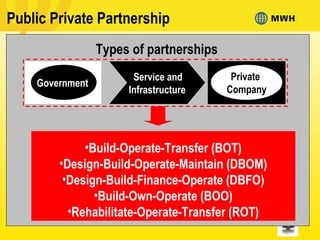
Public Private Partnership
Government
Private
Company
Service and
Infrastructure
Differences between PPP and bid contracts:
•uncertainties and risks
•realignment of responsibilities
•complicated contractual arrangements
Types of partnerships
•Build-Operate-Transfer (BOT)
•Design-Build-Operate-Maintain (DBOM)
•Design-Build-Finance-Operate (DBFO)
•Build-Own-Operate (BOO)
•Rehabilitate-Operate-Transfer (ROT)
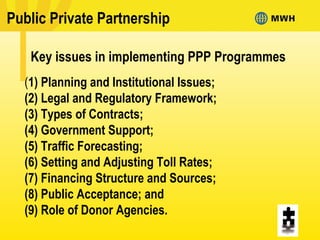
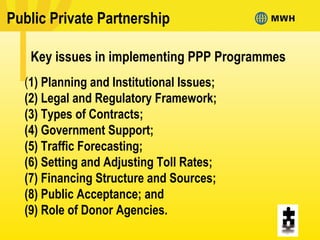
(1) Planning and Institutional Issues;
(2) Legal and Regulatory Framework;
(3) Types of Contracts;
(4) Government Support;
(5) Traffic Forecasting;
(6) Setting and Adjusting Toll Rates;
(7) Financing Structure and Sources;
(8) Public Acceptance; and
(9) Role of Donor Agencies.
Key issues in implementing PPP Programmes
Public Private Partnership
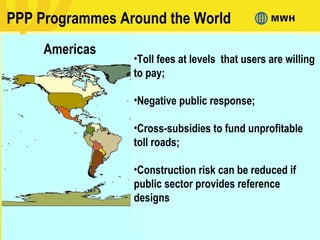
PPP Programmes Around the World
Americas
•Toll fees at levels that users are willing
to pay;
•Negative public response;
•Cross-subsidies to fund unprofitable
toll roads;
•Construction risk can be reduced if
public sector provides reference
designs
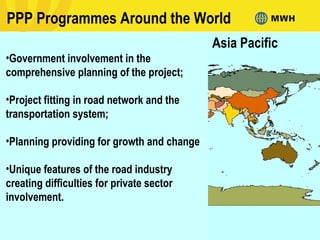
PPP Programmes Around the World
Asia Pacific
•Government involvement in the
comprehensive planning of the project;
•Project fitting in road network and the
transportation system;
•Planning providing for growth and change
•Unique features of the road industry
creating difficulties for private sector
involvement.
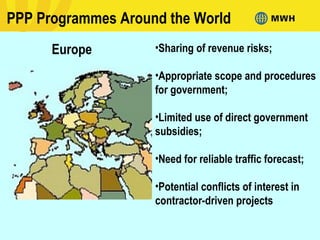
PPP Programmes Around the World
Europe •Sharing of revenue risks;
•Appropriate scope and procedures
for government;
•Limited use of direct government
subsidies;
•Need for reliable traffic forecast;
•Potential conflicts of interest in
contractor-driven projects
(1) Planning and Institutional Issues;
(2) Legal and Regulatory Framework;
(3) Types of Contracts;
(4) Government Support;
(5) Traffic Forecasting;
(6) Setting and Adjusting Toll Rates;
(7) Financing Structure and Sources;
(8) Public Acceptance; and
(9) Role of Donor Agencies.
Key issues in implementing PPP Programmes
Public Private Partnership
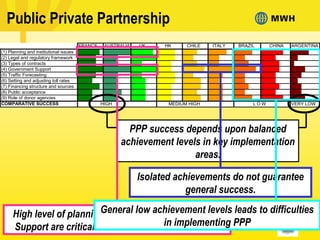
FRANCE AUSTRALIA UK HK CHILE ITALY BRAZIL CHINA ARGENTINA
(1) Planning and institutional issues
(2) Legal and regulatory framework
(3) Types of contracts
(4) Government Support
(5) Traffic Forecasting
(6) Setting and adjusting toll rates
(7) Financing structure and sources
(8) Public acceptance
(9) Role of donor agencies
COMPARATIVE SUCCESS HIGH MEDIUM HIGH L O W VERY LOW
PPP success depends upon balanced
achievement levels in key implementation
areas.
Isolated achievements do not guarantee
general success.
High level of planning combined with Government
Support are critical elements to achieve success.
General low achievement levels leads to difficulties
in implementing PPP
Future for PPP in New Zealand?
Issues in adopting PPP in New Zealand?
Overseas experiences and issues?
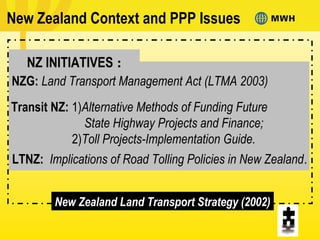
NZ INITIATIVES :
New Zealand Context and PPP Issues
NZG: Land Transport Management Act (LTMA 2003)
Transit NZ: 1)Alternative Methods of Funding Future
State Highway Projects and Finance;
2)Toll Projects-Implementation Guide.
LTNZ: Implications of Road Tolling Policies in New Zealand.
New Zealand Land Transport Strategy (2002)
New Zealand Context and PPP Issues
1- A long-term planning process of PPP is likely to
attract private companies; and
2- Selection of PPP projects has to be in accordance
to LTNZ’s mission / goals
Future for PPP in New Zealand?
Issues in adopting PPP in New Zealand?
Overseas experiences and issues?
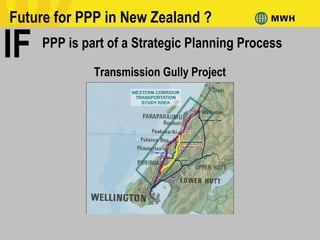
Future for PPP in New Zealand ?
Transmission Gully Project
IF PPP is part of a Strategic Planning Process
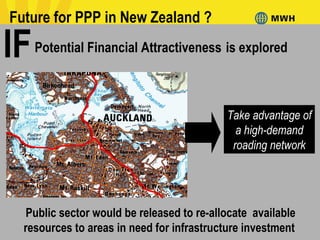
Public sector would be released to re-allocate available
resources to areas in need for infrastructure investment
Potential Financial Attractiveness is explored
Future for PPP in New Zealand ?
IF
Take advantage ofTake advantage of
a high-demanda high-demand
roading networkroading network
Conclusions
• Significant potential in attracting private sector
investment;
• Success depends on planning activities prior to
implementation;
• Simplicity, transparency and continuity are critical
criteria;
• Need for tools and methods to accurately analyse the
complex PPP environment;
• Social, political and economical as well as operational
performance must be analysed; and
• Future for PPP, IF PPP developed as part of strategic
planning process and IF projects are carefully
selected to attract the private sector.

PPP around the World: Learning from the experience

  • 1.
    Dr. Karisa Ribeiro,Transportation Engineer, MWH-Christchurch. Dr. André Dantas, Senior Lecturer, University of Canterbury. PRIVATE-PUBLIC PARTNERSHIP INITIATIVES AROUND THE WORLD: LEARNING FROM EXPERIENCE
  • 2.
    Future for PPPin New Zealand? Issues in adopting PPP in New Zealand? Overseas experiences and issues?
  • 3.
    Outline • Public PrivatePartnership (PPP) • PPP Programmes Around the World • New Zealand Context and PPP Issues • Learning from Experiences • Conclusions
  • 4.
    Public Private Partnership Government Private Company Serviceand Infrastructure Differences between PPP and bid contracts: •uncertainties and risks •realignment of responsibilities •complicated contractual arrangements Types of partnerships •Build-Operate-Transfer (BOT) •Design-Build-Operate-Maintain (DBOM) •Design-Build-Finance-Operate (DBFO) •Build-Own-Operate (BOO) •Rehabilitate-Operate-Transfer (ROT)
  • 5.
    (1) Planning andInstitutional Issues; (2) Legal and Regulatory Framework; (3) Types of Contracts; (4) Government Support; (5) Traffic Forecasting; (6) Setting and Adjusting Toll Rates; (7) Financing Structure and Sources; (8) Public Acceptance; and (9) Role of Donor Agencies. Key issues in implementing PPP Programmes Public Private Partnership
  • 6.
    PPP Programmes Aroundthe World Americas •Toll fees at levels that users are willing to pay; •Negative public response; •Cross-subsidies to fund unprofitable toll roads; •Construction risk can be reduced if public sector provides reference designs
  • 7.
    PPP Programmes Aroundthe World Asia Pacific •Government involvement in the comprehensive planning of the project; •Project fitting in road network and the transportation system; •Planning providing for growth and change •Unique features of the road industry creating difficulties for private sector involvement.
  • 8.
    PPP Programmes Aroundthe World Europe •Sharing of revenue risks; •Appropriate scope and procedures for government; •Limited use of direct government subsidies; •Need for reliable traffic forecast; •Potential conflicts of interest in contractor-driven projects
  • 9.
    (1) Planning andInstitutional Issues; (2) Legal and Regulatory Framework; (3) Types of Contracts; (4) Government Support; (5) Traffic Forecasting; (6) Setting and Adjusting Toll Rates; (7) Financing Structure and Sources; (8) Public Acceptance; and (9) Role of Donor Agencies. Key issues in implementing PPP Programmes Public Private Partnership
  • 10.
    Public Private Partnership FRANCEAUSTRALIA UK HK CHILE ITALY BRAZIL CHINA ARGENTINA (1) Planning and institutional issues (2) Legal and regulatory framework (3) Types of contracts (4) Government Support (5) Traffic Forecasting (6) Setting and adjusting toll rates (7) Financing structure and sources (8) Public acceptance (9) Role of donor agencies COMPARATIVE SUCCESS HIGH MEDIUM HIGH L O W VERY LOW PPP success depends upon balanced achievement levels in key implementation areas. Isolated achievements do not guarantee general success. High level of planning combined with Government Support are critical elements to achieve success. General low achievement levels leads to difficulties in implementing PPP
  • 11.
    Future for PPPin New Zealand? Issues in adopting PPP in New Zealand? Overseas experiences and issues?
  • 12.
    NZ INITIATIVES : NewZealand Context and PPP Issues NZG: Land Transport Management Act (LTMA 2003) Transit NZ: 1)Alternative Methods of Funding Future State Highway Projects and Finance; 2)Toll Projects-Implementation Guide. LTNZ: Implications of Road Tolling Policies in New Zealand. New Zealand Land Transport Strategy (2002)
  • 13.
    New Zealand Contextand PPP Issues 1- A long-term planning process of PPP is likely to attract private companies; and 2- Selection of PPP projects has to be in accordance to LTNZ’s mission / goals
  • 14.
    Future for PPPin New Zealand? Issues in adopting PPP in New Zealand? Overseas experiences and issues?
  • 15.
    Future for PPPin New Zealand ? Transmission Gully Project IF PPP is part of a Strategic Planning Process
  • 16.
    Public sector wouldbe released to re-allocate available resources to areas in need for infrastructure investment Potential Financial Attractiveness is explored Future for PPP in New Zealand ? IF Take advantage ofTake advantage of a high-demanda high-demand roading networkroading network
  • 17.
    Conclusions • Significant potentialin attracting private sector investment; • Success depends on planning activities prior to implementation; • Simplicity, transparency and continuity are critical criteria; • Need for tools and methods to accurately analyse the complex PPP environment; • Social, political and economical as well as operational performance must be analysed; and • Future for PPP, IF PPP developed as part of strategic planning process and IF projects are carefully selected to attract the private sector.

Editor's Notes

  • #2 <number> There has been a growing tendency in involving the private sector in financing infrastructure in order to meet the needs of rapid economic growth. traditionally, the public sector has financed and operated infrastructure projects using resources from taxes However, the recent disparity between the capacity to generate resources and the demand for new facilities has forced governments to look for new way of funding infrastructure. Many countries are using an arrangement between public and private sectors named Public Private Partnerships (PPP) to finance, design, build, operate and maintain public infrastructure, community facilities and related services. In this sense, this paper aims to analysis some experience around the world and discuss the pros and cons of PPP projects Bringing this analysis to the NZ context, we wish to answer a critical question.
  • #3 Is there a future for PPP in New Zealand? What are the issues in adopting PPP in New Zealand? What have been overseas experiences and issues?
  • #4 This presentation is organised into
  • #5 But what is PPP? PPP is a arrangement between public and private sectors that enables them to work co-operatively. The main differences from the traditional design-bid-build contracts are: Thus PPP may have various type of agreement, for example
  • #6 <number> Various researches have identified key issues to implement PPP programme they are... In practice, These issues have been addressed differently in American, Asian pacific and European countries
  • #7 In the Americas, it was observed that:
  • #8 In Asia pacific countries Essential for government involvement in the comprehensive planning of the project; -how the project fits within the overall road network and the transportation system; -Planning has to provide for growth and change while creating sustainable, efficient, and equitable cities and regions; -some unique features of the roads industry produce some difficulties for private sector involvement. ;.
  • #9 And in Europe
  • #10 <number> Various researches have identified key issues to implement PPP programme they are... In practice, These issues have been addressed differently in American, Asian pacific and European countries
  • #11 <number> COMPARING THE ACHIEVEMENTS IN VARIOUS COUNTRIES, WE CAN OBSERVE THAT: PPP success depends upon balanced achievement levels in key implementation areas. For example, Argentina’s experience shows that despite high government support limited provisions were made in other critical areas such as the legal framework and financing. On the other hand, France’s achievements in all criteria have produced a very successful PPP programme.
  • #12 Based upon on these overseas experiences, We move on to identifying the issues in adopting PPP in NZ Firstly, Let look at what NZ has done so far What are the issues in adopting PPP in New Zealand? What have been overseas experiences and issues?
  • #13 In NZ, only a few initiatives have been taking place they are MOT- allows to PPP be implemented And also The Bill places a number of conditions on PPP Transit NZ has produced these docs that provide guidance in implementing alternatively funded State Highway projects using PPP And also LTNZ funded report which despite its focus only on public financed toll roads. This report identified main areas of deficiency in tolling road specially the assumptions using to modelling the traffic and economic evaluation.
  • #14 Considering NZ legislative framework and international experiences two main lessons can be taken To establish a long-term planning process of PPP, which are likely to attract private companies; and and second considering the land transport strategy, : To select PPP projects which are in accordance to LTNZ’s mission / goals
  • #15 Based upon on these overseas experiences, We move on to identifying the issues in adopting PPP in NZ Firstly, Let look at what NZ has done so far What are the issues in adopting PPP in New Zealand? What have been overseas experiences and issues?
  • #16 There would be future for PPP in NZ IF Where PPP projects are considered as part of a national development policy. This could contribute to overcome current issues obstructing the implementation of major projects such as T G. Out of PPP Strategic plannig process, this project is likely to take a long while to its completion. HOWEVER with the combination of p-p sectors sharing risks, investments and revenues this could ACCELERATE THE PROCESS OF IMPLEMENTATION OF SUCH a major infrastructure project. This may explain why no PPP roading infrastructure project has actually been implemented, despite the existence of legal provisions in NZ.
  • #17 Furthermore, There would be a future for ppp IF …. For example, areas such as the Auckland region could be very attractive due to its high demand. This would contribute to releasing the public sector to re-allocate available resources to areas in need for infrastructure investment.