Public–Private Partnerships
New Options for Project Delivery

            Transportation Forum
              Ontario, California
                May 2, 2008

                 Kent Olsen
             PB AMERICAS Inc.
             olsen@pbworld.com
Public Private Partnerships
 What are they?
 Why are they needed?
 What are advantages?
 What are disadvantages?
 How do we encourage more?
Public Private Partnerships

     What Are They?
Public Private Partnerships
From the National Council of Public-Private
  Partnerships:

“a contractual agreement between a public agency
  (federal, state or local) and a for-profit corporation.
  Through this agreement the skills and assets of each
  sector (public and private) are shared in delivering a
  service or facility for the use of the general public. In
  addition to the sharing of resources, each party shares
  in the risks and rewards potential in the delivery of the
  service and/or facility.”
Public Private Partnerships
In Transportation
 Design-build
 Innovative financing by public sector
 Finance, design-build
 Design-build, operate, maintain (public
 sector financing
 Finance, design-build, operate,
 maintain
 Franchise or concession
Public Private Partnerships
A Little History
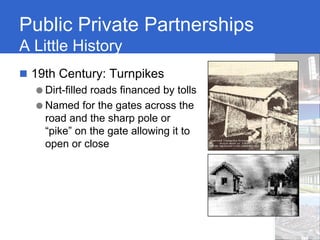
 19th Century: Turnpikes
  ● Dirt-filled roads financed by tolls
  ● Named for the gates across the
    road and the sharp pole or
    “pike” on the gate allowing it to
    open or close
Public Private Partnerships
A Little History
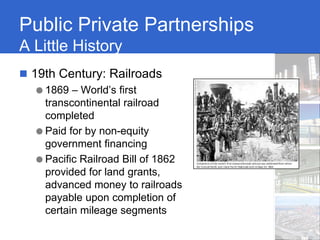
 19th Century: Railroads
  ● 1869 – World’s first
    transcontinental railroad
    completed
  ● Paid for by non-equity
    government financing
  ● Pacific Railroad Bill of 1862
    provided for land grants,
    advanced money to railroads
    payable upon completion of
    certain mileage segments
Public Private Partnerships
A Little History
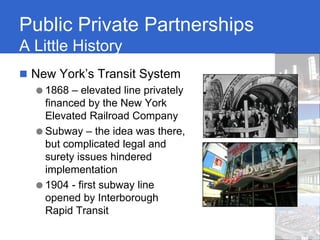
 New York’s Transit System
  ● 1868 – elevated line privately
    financed by the New York
    Elevated Railroad Company
  ● Subway – the idea was there,
    but complicated legal and
    surety issues hindered
    implementation
  ● 1904 - first subway line
    opened by Interborough
    Rapid Transit
Public Private Partnerships
A Little History
 20th Century:
 State Turnpikes
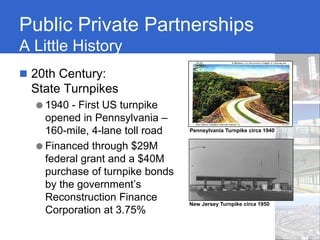
  ● 1940 - First US turnpike
    opened in Pennsylvania –
    160-mile, 4-lane toll road   Pennsylvania Turnpike circa 1940


  ● Financed through $29M
    federal grant and a $40M
    purchase of turnpike bonds
    by the government’s
    Reconstruction Finance       New Jersey Turnpike circa 1950
    Corporation at 3.75%
Public-Private Partnerships
A Little History
 20th Century: Mixed
 Record in California:
  ● Orange County Toll Roads
  ● SR 91
  ● SR 125 San Diego
  ● Alameda Corridor
  ● LA to San Diego
    Bullet Train
  ● Two other AB 680 Projects
Public Private Partnerships:
Options
 Shadow tolls
 FAIR lanes
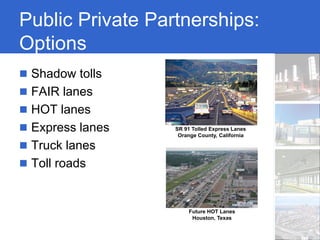
 HOT lanes
 Express lanes    SR 91 Tolled Express Lanes
                   Orange County, California

 Truck lanes
 Toll roads


                      Future HOT Lanes
                       Houston, Texas
Public Private Partnerships

    Why Do We Need
        Them?
Public Private Partnerships: Why?
Options to Address Transportation
 Raise the vehicle fuel tax
 Increase enforcement of traffic laws
 Increase general taxes to fund
 transportation
 More aggressive traffic management
 Implement vehicle mileage fee
 Allow congestion to discourage users
 Attract private capital to fund
 transportation projects
Public Private Partnerships

       What Are the
       Advantages?
Public Private Partnerships:
Advantages
 Additional project funding
 Potential up-front payment
 Increase leverage from revenue
 streams
 Requires less public resources
 Faster delivery of projects
 Shares risk
Public Private Partnerships

      What Are the
     Disadvantages?
Public Private Partnerships:
Drawbacks
 Less public control of project
 Public perception of the concept
 Long term commitment
Public Private Partnerships

 How Do We Encourage More?
Encouraging Public Private Partnerships
What Can the Public Sector Do?
  Start with a well-defined project
  Streamline the procurement process
  Prepare contract with fair risk allocation
  Fund environmental studies
  Procure right-of-way in urban areas
  Reduce government involvement in
  implementation
  Draw on lessons learned elsewhere
Encouraging Public Private Partnerships
Optimum Project Characteristics
  High-priority with strong support
  Non-controversial
  Well developed project concept
  Does not rely on unproven technology or
  approach
  Greater than $200 million in size
Public–Private Partnerships
New Options for Project Delivery

            Transportation Forum
              Ontario, California
                May 2, 2008

                 Kent Olsen
             PB AMERICAS Inc.
             olsen@pbworld.com

LTC, Annual Forum, For Whom the Road Should Toll: The Future of Toll Roads and Road Pricing in California, 05/02/2008, Kent Olsen

  • 1.
    Public–Private Partnerships New Optionsfor Project Delivery Transportation Forum Ontario, California May 2, 2008 Kent Olsen PB AMERICAS Inc. olsen@pbworld.com
  • 2.
    Public Private Partnerships What are they? Why are they needed? What are advantages? What are disadvantages? How do we encourage more?
  • 3.
  • 4.
    Public Private Partnerships Fromthe National Council of Public-Private Partnerships: “a contractual agreement between a public agency (federal, state or local) and a for-profit corporation. Through this agreement the skills and assets of each sector (public and private) are shared in delivering a service or facility for the use of the general public. In addition to the sharing of resources, each party shares in the risks and rewards potential in the delivery of the service and/or facility.”
  • 5.
    Public Private Partnerships InTransportation Design-build Innovative financing by public sector Finance, design-build Design-build, operate, maintain (public sector financing Finance, design-build, operate, maintain Franchise or concession
  • 6.
    Public Private Partnerships ALittle History 19th Century: Turnpikes ● Dirt-filled roads financed by tolls ● Named for the gates across the road and the sharp pole or “pike” on the gate allowing it to open or close
  • 7.
    Public Private Partnerships ALittle History 19th Century: Railroads ● 1869 – World’s first transcontinental railroad completed ● Paid for by non-equity government financing ● Pacific Railroad Bill of 1862 provided for land grants, advanced money to railroads payable upon completion of certain mileage segments
  • 8.
    Public Private Partnerships ALittle History New York’s Transit System ● 1868 – elevated line privately financed by the New York Elevated Railroad Company ● Subway – the idea was there, but complicated legal and surety issues hindered implementation ● 1904 - first subway line opened by Interborough Rapid Transit
  • 9.
    Public Private Partnerships ALittle History 20th Century: State Turnpikes ● 1940 - First US turnpike opened in Pennsylvania – 160-mile, 4-lane toll road Pennsylvania Turnpike circa 1940 ● Financed through $29M federal grant and a $40M purchase of turnpike bonds by the government’s Reconstruction Finance New Jersey Turnpike circa 1950 Corporation at 3.75%
  • 10.
    Public-Private Partnerships A LittleHistory 20th Century: Mixed Record in California: ● Orange County Toll Roads ● SR 91 ● SR 125 San Diego ● Alameda Corridor ● LA to San Diego Bullet Train ● Two other AB 680 Projects
  • 11.
    Public Private Partnerships: Options Shadow tolls FAIR lanes HOT lanes Express lanes SR 91 Tolled Express Lanes Orange County, California Truck lanes Toll roads Future HOT Lanes Houston, Texas
  • 12.
    Public Private Partnerships Why Do We Need Them?
  • 13.
  • 14.
    Options to AddressTransportation Raise the vehicle fuel tax Increase enforcement of traffic laws Increase general taxes to fund transportation More aggressive traffic management Implement vehicle mileage fee Allow congestion to discourage users Attract private capital to fund transportation projects
  • 15.
    Public Private Partnerships What Are the Advantages?
  • 16.
    Public Private Partnerships: Advantages Additional project funding Potential up-front payment Increase leverage from revenue streams Requires less public resources Faster delivery of projects Shares risk
  • 17.
    Public Private Partnerships What Are the Disadvantages?
  • 18.
    Public Private Partnerships: Drawbacks Less public control of project Public perception of the concept Long term commitment
  • 19.
    Public Private Partnerships How Do We Encourage More?
  • 20.
    Encouraging Public PrivatePartnerships What Can the Public Sector Do? Start with a well-defined project Streamline the procurement process Prepare contract with fair risk allocation Fund environmental studies Procure right-of-way in urban areas Reduce government involvement in implementation Draw on lessons learned elsewhere
  • 21.
    Encouraging Public PrivatePartnerships Optimum Project Characteristics High-priority with strong support Non-controversial Well developed project concept Does not rely on unproven technology or approach Greater than $200 million in size
  • 22.
    Public–Private Partnerships New Optionsfor Project Delivery Transportation Forum Ontario, California May 2, 2008 Kent Olsen PB AMERICAS Inc. olsen@pbworld.com