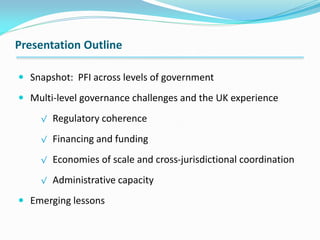
Presentation Outline
 Snapshot: PFI across levels of government
 Multi-level governance challenges and the UK experience
√ Regulatory coherence
√ Financing and funding
√ Economies of scale and cross-jurisdictional coordination
√ Administrative capacity
 Emerging lessons
SNAPSHOT
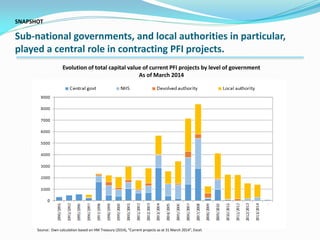
Sub-national governments, and local authorities in particular,
played a central role in contracting PFI projects.
Source: Own calculation based on HM Treasury (2014), “Current projects as at 31 March 2014”, Excel.
Evolution of total capital value of current PFI projects by level of government
As of March 2014
SNAPSHOT
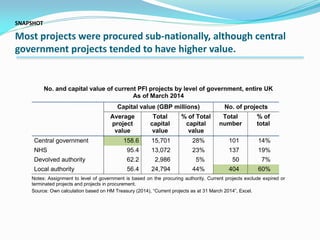
Most projects were procured sub-nationally, although central
government projects tended to have higher value.
No. and capital value of current PFI projects by level of government, entire UK
As of March 2014
Capital value (GBP millions) No. of projects
Average
project
value
Total
capital
value
% of Total
capital
value
Total
number
% of
total
Central government 158.6 15,701 28% 101 14%
NHS 95.4 13,072 23% 137 19%
Devolved authority 62.2 2,986 5% 50 7%
Local authority 56.4 24,794 44% 404 60%
Notes: Assignment to level of government is based on the procuring authority. Current projects exclude expired or
terminated projects and projects in procurement.
Source: Own calculation based on HM Treasury (2014), “Current projects as at 31 March 2014”, Excel.
SNAPSHOT
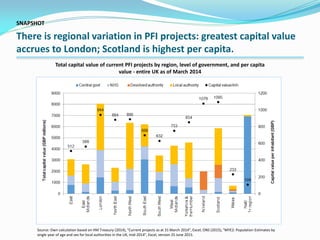
There is regional variation in PFI projects: greatest capital value
accrues to London; Scotland is highest per capita.
Source: Own calculation based on HM Treasury (2014), “Current projects as at 31 March 2014”, Excel; ONS (2015), "MYE2: Population Estimates by
single year of age and sex for local authorities in the UK, mid-2014", Excel, version 25 June 2015.
Total capital value of current PFI projects by region, level of government, and per capita
value - entire UK as of March 2014
REGULATORY COHERENCE AND ADMINISTRATIVE BURDEN
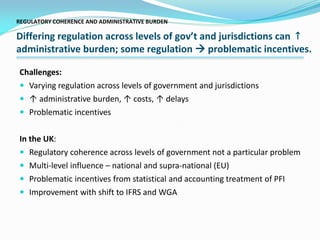
Differing regulation across levels of gov’t and jurisdictions can ↑
administrative burden; some regulation  problematic incentives.
Challenges:
 Varying regulation across levels of government and jurisdictions
 ↑ administrative burden, ↑ costs, ↑ delays
 Problematic incentives
In the UK:
 Regulatory coherence across levels of government not a particular problem
 Multi-level influence – national and supra-national (EU)
 Problematic incentives from statistical and accounting treatment of PFI
 Improvement with shift to IFRS and WGA
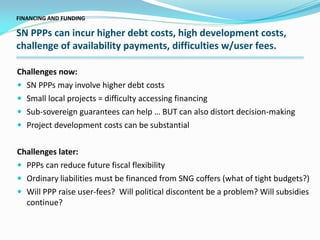
Challenges now:
 SN PPPs may involve higher debt costs
 Small local projects = difficulty accessing financing
 Sub-sovereign guarantees can help … BUT can also distort decision-making
 Project development costs can be substantial
Challenges later:
 PPPs can reduce future fiscal flexibility
 Ordinary liabilities must be financed from SNG coffers (what of tight budgets?)
 Will PPP raise user-fees? Will political discontent be a problem? Will subsidies
continue?
FINANCING AND FUNDING
SN PPPs can incur higher debt costs, high development costs,
challenge of availability payments, difficulties w/user fees.
FINANCING AND FUNDING
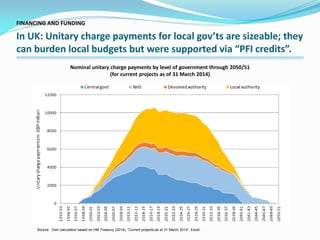
In UK: Unitary charge payments for local gov’ts are sizeable; they
can burden local budgets but were supported via “PFI credits”.
Source: Own calculation based on HM Treasury (2014), “Current projects as at 31 March 2014”, Excel.
Nominal unitary charge payments by level of government through 2050/51
(for current projects as of 31 March 2014)
ECONOMIES OF SCALE & CROSS-JURISDICTIONAL COORDINATION
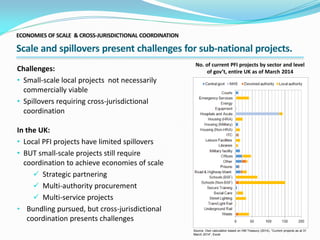
Scale and spillovers present challenges for sub-national projects.
No. of current PFI projects by sector and level
of gov’t, entire UK as of March 2014Challenges:
• Small-scale local projects not necessarily
commercially viable
• Spillovers requiring cross-jurisdictional
coordination
In the UK:
• Local PFI projects have limited spillovers
• BUT small-scale projects still require
coordination to achieve economies of scale
 Strategic partnering
 Multi-authority procurement
 Multi-service projects
• Bundling pursued, but cross-jurisdictional
coordination presents challenges
Source: Own calculation based on HM Treasury (2014), “Current projects as at 31
March 2014”, Excel.
ADMINISTRATIVE CAPACITY
SNGs face notable administrative capacity constraints. In UK,
governance arrangements targeted SN capacity, but gaps remain.
Challenge:
 Technical demands for PPPs are high and skills vary over the project cycle
 SNGs can be at disadvantage relative to the private sector
 Difficulty to recruit and/or retain qualified staff
 Availability of skills can vary by place
In UK:
 Governance arrangements supported SN administrative capacity:
 Institutional support at all levels of government, with specific support for LGs
(4ps  Local Partnerships)
 Reinforced scrutiny of local projects via Project Review Group
 Standardised contracts and documents (e.g. SoPC, updated over time)
 But…
 Emphasis on project appraisal and effective procurement
 Contract management skills also critical
Emerging lessons
 SNGs are often key players delivering infrastructure via PPPs
 Multi-level/intergovernmental lens in important
 (+) Some arrangements can mitigate risks and facilitate SN PPPs
 Regulatory coherence, standardization of contracts and
documentation, staffing support, project reviews
 (-) Other arrangements can distort incentives and VFM assessment
 Subsidizing availability payments, off-budget incentives
 Long-term view is crucial
 Constraints on future SN fiscal flexibility
 SN capacity throughout the project life cycle
Thank you.

PPP for regional development - Lee MIZELL, Consultant

  • 2.
    Presentation Outline  Snapshot:PFI across levels of government  Multi-level governance challenges and the UK experience √ Regulatory coherence √ Financing and funding √ Economies of scale and cross-jurisdictional coordination √ Administrative capacity  Emerging lessons
  • 4.
    SNAPSHOT Sub-national governments, andlocal authorities in particular, played a central role in contracting PFI projects. Source: Own calculation based on HM Treasury (2014), “Current projects as at 31 March 2014”, Excel. Evolution of total capital value of current PFI projects by level of government As of March 2014
  • 5.
    SNAPSHOT Most projects wereprocured sub-nationally, although central government projects tended to have higher value. No. and capital value of current PFI projects by level of government, entire UK As of March 2014 Capital value (GBP millions) No. of projects Average project value Total capital value % of Total capital value Total number % of total Central government 158.6 15,701 28% 101 14% NHS 95.4 13,072 23% 137 19% Devolved authority 62.2 2,986 5% 50 7% Local authority 56.4 24,794 44% 404 60% Notes: Assignment to level of government is based on the procuring authority. Current projects exclude expired or terminated projects and projects in procurement. Source: Own calculation based on HM Treasury (2014), “Current projects as at 31 March 2014”, Excel.
  • 6.
    SNAPSHOT There is regionalvariation in PFI projects: greatest capital value accrues to London; Scotland is highest per capita. Source: Own calculation based on HM Treasury (2014), “Current projects as at 31 March 2014”, Excel; ONS (2015), "MYE2: Population Estimates by single year of age and sex for local authorities in the UK, mid-2014", Excel, version 25 June 2015. Total capital value of current PFI projects by region, level of government, and per capita value - entire UK as of March 2014
  • 8.
    REGULATORY COHERENCE ANDADMINISTRATIVE BURDEN Differing regulation across levels of gov’t and jurisdictions can ↑ administrative burden; some regulation  problematic incentives. Challenges:  Varying regulation across levels of government and jurisdictions  ↑ administrative burden, ↑ costs, ↑ delays  Problematic incentives In the UK:  Regulatory coherence across levels of government not a particular problem  Multi-level influence – national and supra-national (EU)  Problematic incentives from statistical and accounting treatment of PFI  Improvement with shift to IFRS and WGA
  • 9.
    Challenges now:  SNPPPs may involve higher debt costs  Small local projects = difficulty accessing financing  Sub-sovereign guarantees can help … BUT can also distort decision-making  Project development costs can be substantial Challenges later:  PPPs can reduce future fiscal flexibility  Ordinary liabilities must be financed from SNG coffers (what of tight budgets?)  Will PPP raise user-fees? Will political discontent be a problem? Will subsidies continue? FINANCING AND FUNDING SN PPPs can incur higher debt costs, high development costs, challenge of availability payments, difficulties w/user fees.
  • 10.
    FINANCING AND FUNDING InUK: Unitary charge payments for local gov’ts are sizeable; they can burden local budgets but were supported via “PFI credits”. Source: Own calculation based on HM Treasury (2014), “Current projects as at 31 March 2014”, Excel. Nominal unitary charge payments by level of government through 2050/51 (for current projects as of 31 March 2014)
  • 11.
    ECONOMIES OF SCALE& CROSS-JURISDICTIONAL COORDINATION Scale and spillovers present challenges for sub-national projects. No. of current PFI projects by sector and level of gov’t, entire UK as of March 2014Challenges: • Small-scale local projects not necessarily commercially viable • Spillovers requiring cross-jurisdictional coordination In the UK: • Local PFI projects have limited spillovers • BUT small-scale projects still require coordination to achieve economies of scale  Strategic partnering  Multi-authority procurement  Multi-service projects • Bundling pursued, but cross-jurisdictional coordination presents challenges Source: Own calculation based on HM Treasury (2014), “Current projects as at 31 March 2014”, Excel.
  • 12.
    ADMINISTRATIVE CAPACITY SNGs facenotable administrative capacity constraints. In UK, governance arrangements targeted SN capacity, but gaps remain. Challenge:  Technical demands for PPPs are high and skills vary over the project cycle  SNGs can be at disadvantage relative to the private sector  Difficulty to recruit and/or retain qualified staff  Availability of skills can vary by place In UK:  Governance arrangements supported SN administrative capacity:  Institutional support at all levels of government, with specific support for LGs (4ps  Local Partnerships)  Reinforced scrutiny of local projects via Project Review Group  Standardised contracts and documents (e.g. SoPC, updated over time)  But…  Emphasis on project appraisal and effective procurement  Contract management skills also critical
  • 13.
    Emerging lessons  SNGsare often key players delivering infrastructure via PPPs  Multi-level/intergovernmental lens in important  (+) Some arrangements can mitigate risks and facilitate SN PPPs  Regulatory coherence, standardization of contracts and documentation, staffing support, project reviews  (-) Other arrangements can distort incentives and VFM assessment  Subsidizing availability payments, off-budget incentives  Long-term view is crucial  Constraints on future SN fiscal flexibility  SN capacity throughout the project life cycle Thank you.