T o o l k i t   f o r    P u b l i c - P r i v a t e    P a r t n e r s h i p s    i n    r o a d s    &   H i g h w a y s
30
M
odu
l
e
1
M
odu
l
e
2
M
odu
l
e
3
M
odu
l
e
4
M
odu
l
e
5
Module 5 : Implementation and monitoring
Updated march 2009
Feasibility Study (FS) Contents
Theredonotseemtobeanystandarddefinitionsofa‘pre’feasibilityor‘full’feasibilitystudy
worldwide. Such studies can therefore be subject to different interpretations depending
on circumstances and the type of project. A feasibility study for public procurement
would naturally have a different focus and requirements than a PPP feasibility study.
Therefore, the Toolkit considers and recommends what is actually needed to be prepared
in the context of PPP projects i.e. it considers the objectives. It is possible that some
parts of a full study could be analyzed in lesser detail or that for complex projects a pre
study is undertaken first to study options and scope the project. A preliminary study
might also be quicker with fewer stages.
For most highway projects, there will always at some point be the need for a FS and
therefore, in most cases a pre feasibility study could just add time and costs to the study
process.
However, in some instances, major bridge or tunnel alternatives and other complex
urban highway projects, would justify an initial or pre FS. The key objectives of both
types of feasibility study are to:
•	 Ensure risks are identified, allocated and mitigated effectively;
•	 Provide Government with sufficient information for proceeding or bidding;
•	 Provide the bases of negotiations; and
•	 Minimize the transaction costs of PPP projects and avoid unnecessary delays
For a PPP feasibility study, the requirement is to produce analysis and information to:
•	 Establish the technical characteristics of the project, demand, project capacity/
size, preliminary design of proposed facilities with their related capital and
annual project costs;
•	 Establish the social, environmental, economic and financial characteristics of
each project (including its attractiveness to the private sector and GOI), based
on the projected project, its cost, demand and impacts;
•	 Determine the extent of government support (if required), PPP modalities and
project risks;
•	 Prepare the Business case for the project that encompasses all of the above
information and which when presented together, provides a convincing and solid
case to both public and private sectors as a basis for procurement of the private
partner.
•	 Include a draft contract for the project based on the characteristics of the project.
This draft will then be finalized by the government before bidding.
•	 Prepare a RFP that has sufficient data to allow the tenders to prepare competitive
technical and financial bids and which informs them at the time of bidding, how
such bids will be subsequently evaluated; and
•	 Provide data that allows the Government to negotiate and sign a PPP contract
with confidence.
T o o l k i t   f o r    P u b l i c - P r i v a t e    P a r t n e r s h i p s    i n    r o a d s    &   H i g h w a y s
31
M
odu
l
e
1
M
odu
l
e
2
M
odu
l
e
3
M
odu
l
e
4
M
odu
l
e
5
Module 5 : Implementation and monitoring
Updated march 2009
It is therefore considered that in practice, ‘full’ feasibility studies should
always normally be prepared in Stage 2 for all PPP projects selected for
implementation. For complex or projects for which some preliminary reports and/
or data already exists, a less than full study may be appropriate initially but the
needed end result that should be achieved will be a full PPP feasibility study.
It is advisable that the sector PPP units produce draft outline TORs for both types of
feasibility studies to help PPP contracting agencies, along with guidelines as to which
to choose. The normally required contents of a feasibility study for a PPP project is
described under the headings below.
Technical Evaluation
•	 Demand Forecasts, including specific demand surveys if required. These should
be made for the short, medium and long terms (10, 15, 20+ years) and should
provide scenarios and sensitivity.
•	 Preliminary Design, including sufficient technical ground surveys to prepare a
capital cost estimate to within ±20%.
•	The technical needs of a study are described but each project will require different
technical assessments. The prescribed capital cost accuracy is the main criterion
to be followed.
Socio-Economic Cost-Benefit Analysis (SCBA)
•	 Project rationale, benefits and quantitative assessments according to WB/ADB
Guidelines.
•	 Must include environmental impacts statement that defines all major impacts,
proposed mitigation and the broad estimate of mitigation costs (for input to the
economic project cost).
•	 Social Impacts; Must identify all social impacts and resettlement, proposed
mitigation and their related costs (for input to the economic project cost).
T o o l k i t   f o r    P u b l i c - P r i v a t e    P a r t n e r s h i p s    i n    r o a d s    &   H i g h w a y s
32
M
odu
l
e
1
M
odu
l
e
2
M
odu
l
e
3
M
odu
l
e
4
M
odu
l
e
5
Module 5 : Implementation and monitoring
Updated march 2009
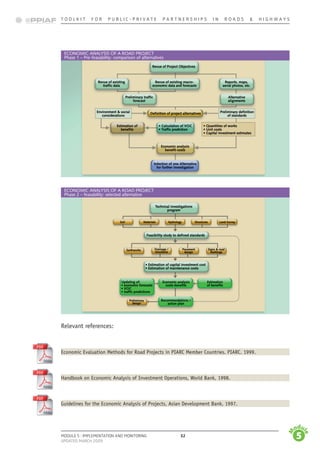
Relevant references:
	 Economic Evaluation Methods for Road Projects in PIARC Member Countries. PIARC. 1999.
	 Handbook on Economic Analysis of Investment Operations, World Bank, 1998.
	 Guidelines for the Economic Analysis of Projects, Asian Development Bank, 1997.
T o o l k i t   f o r    P u b l i c - P r i v a t e    P a r t n e r s h i p s    i n    r o a d s    &   H i g h w a y s
33
M
odu
l
e
1
M
odu
l
e
2
M
odu
l
e
3
M
odu
l
e
4
M
odu
l
e
5
Module 5 : Implementation and monitoring
Updated march 2009
	 Handbook for Integrating Risk Analysis in the Economic Analysis of Projects,
	 Asian Development Bank, 2002.
Financial Analysis
This will contain a financial model, but not necessarily too sophisticated. Financial
scenarios must be tested including:
•	 Levels of Tariffs: existing, cost recovery levels, other tariff objectives, etc
•	Tariff escalation rates or formulae
•	 Debt/equity options
•	 Debt service options (interest/tenor, grace and principal repayment period, etc)
The financial model must:
•	 Output at minimum, FIRR, FNPV, Payback and Debt service cover ratios
•	 Identify the needs, if any, of fiscal support/subsidy
•	 Assess the different types e.g. contingent (initial and periodic) and non contingent
(guarantees)
•	 Identify the costs and timing of any fiscal support/subsidy
Risk Assessment and Allocation
Risks must be identified and assessed. An initial allocation of risks must be made (and/
or scenarios) and risk mitigation proposed.
The PPP Business Case
•	 All relevant information developed during Stage Two should be drawn together
into a PPP Business Case, the purpose of which is to provide all the technical,
financial, risk, and other project information into a form which will provide the
basis for decisions by government to proceed or not to the next stage for each
specific project. Assuming if positive, it provides the basis for a bankable project
i.e. a project that sources of finance would be interested to consider.
•	The PPP Business Case will:
•	 define the project and service requirement i.e. what the concessionaire is expected
to provide;
•	 specify the value for money and the PSC if required;
•	 specify the PPP delivery options and the PPP Model;
•	 outline risk sharing arrangements with the various Project Delivery Options;
•	 provide information on the key issues considered and solutions proposed;
•	 analyze the various Project Delivery Options identified; and
•	 identify the preferred Project Delivery Option for meeting the service requirement;
•	 provide all the relevant information that will allow the government to decide on
pursuing this project as a PPP project, and as a basis for proceeding to tender.
T o o l k i t   f o r    P u b l i c - P r i v a t e    P a r t n e r s h i p s    i n    r o a d s    &   H i g h w a y s
34
M
odu
l
e
1
M
odu
l
e
2
M
odu
l
e
3
M
odu
l
e
4
M
odu
l
e
5
Module 5 : Implementation and monitoring
Updated march 2009
Assuming approval of the FS, with incorporation of comments, concerns, additional
requirements etc. of government/the highway authority, the next stage is to prepare the
draft and final tender documents and proceed to procurement of/tender for the private
sector partner(s).

Feasibility study 5 contents

  • 1.
    T o ol k i t   f o r    P u b l i c - P r i v a t e    P a r t n e r s h i p s    i n    r o a d s    &   H i g h w a y s 30 M odu l e 1 M odu l e 2 M odu l e 3 M odu l e 4 M odu l e 5 Module 5 : Implementation and monitoring Updated march 2009 Feasibility Study (FS) Contents Theredonotseemtobeanystandarddefinitionsofa‘pre’feasibilityor‘full’feasibilitystudy worldwide. Such studies can therefore be subject to different interpretations depending on circumstances and the type of project. A feasibility study for public procurement would naturally have a different focus and requirements than a PPP feasibility study. Therefore, the Toolkit considers and recommends what is actually needed to be prepared in the context of PPP projects i.e. it considers the objectives. It is possible that some parts of a full study could be analyzed in lesser detail or that for complex projects a pre study is undertaken first to study options and scope the project. A preliminary study might also be quicker with fewer stages. For most highway projects, there will always at some point be the need for a FS and therefore, in most cases a pre feasibility study could just add time and costs to the study process. However, in some instances, major bridge or tunnel alternatives and other complex urban highway projects, would justify an initial or pre FS. The key objectives of both types of feasibility study are to: • Ensure risks are identified, allocated and mitigated effectively; • Provide Government with sufficient information for proceeding or bidding; • Provide the bases of negotiations; and • Minimize the transaction costs of PPP projects and avoid unnecessary delays For a PPP feasibility study, the requirement is to produce analysis and information to: • Establish the technical characteristics of the project, demand, project capacity/ size, preliminary design of proposed facilities with their related capital and annual project costs; • Establish the social, environmental, economic and financial characteristics of each project (including its attractiveness to the private sector and GOI), based on the projected project, its cost, demand and impacts; • Determine the extent of government support (if required), PPP modalities and project risks; • Prepare the Business case for the project that encompasses all of the above information and which when presented together, provides a convincing and solid case to both public and private sectors as a basis for procurement of the private partner. • Include a draft contract for the project based on the characteristics of the project. This draft will then be finalized by the government before bidding. • Prepare a RFP that has sufficient data to allow the tenders to prepare competitive technical and financial bids and which informs them at the time of bidding, how such bids will be subsequently evaluated; and • Provide data that allows the Government to negotiate and sign a PPP contract with confidence.
  • 2.
    T o ol k i t   f o r    P u b l i c - P r i v a t e    P a r t n e r s h i p s    i n    r o a d s    &   H i g h w a y s 31 M odu l e 1 M odu l e 2 M odu l e 3 M odu l e 4 M odu l e 5 Module 5 : Implementation and monitoring Updated march 2009 It is therefore considered that in practice, ‘full’ feasibility studies should always normally be prepared in Stage 2 for all PPP projects selected for implementation. For complex or projects for which some preliminary reports and/ or data already exists, a less than full study may be appropriate initially but the needed end result that should be achieved will be a full PPP feasibility study. It is advisable that the sector PPP units produce draft outline TORs for both types of feasibility studies to help PPP contracting agencies, along with guidelines as to which to choose. The normally required contents of a feasibility study for a PPP project is described under the headings below. Technical Evaluation • Demand Forecasts, including specific demand surveys if required. These should be made for the short, medium and long terms (10, 15, 20+ years) and should provide scenarios and sensitivity. • Preliminary Design, including sufficient technical ground surveys to prepare a capital cost estimate to within ±20%. • The technical needs of a study are described but each project will require different technical assessments. The prescribed capital cost accuracy is the main criterion to be followed. Socio-Economic Cost-Benefit Analysis (SCBA) • Project rationale, benefits and quantitative assessments according to WB/ADB Guidelines. • Must include environmental impacts statement that defines all major impacts, proposed mitigation and the broad estimate of mitigation costs (for input to the economic project cost). • Social Impacts; Must identify all social impacts and resettlement, proposed mitigation and their related costs (for input to the economic project cost).
  • 3.
    T o ol k i t   f o r    P u b l i c - P r i v a t e    P a r t n e r s h i p s    i n    r o a d s    &   H i g h w a y s 32 M odu l e 1 M odu l e 2 M odu l e 3 M odu l e 4 M odu l e 5 Module 5 : Implementation and monitoring Updated march 2009 Relevant references: Economic Evaluation Methods for Road Projects in PIARC Member Countries. PIARC. 1999. Handbook on Economic Analysis of Investment Operations, World Bank, 1998. Guidelines for the Economic Analysis of Projects, Asian Development Bank, 1997.
  • 4.
    T o ol k i t   f o r    P u b l i c - P r i v a t e    P a r t n e r s h i p s    i n    r o a d s    &   H i g h w a y s 33 M odu l e 1 M odu l e 2 M odu l e 3 M odu l e 4 M odu l e 5 Module 5 : Implementation and monitoring Updated march 2009 Handbook for Integrating Risk Analysis in the Economic Analysis of Projects, Asian Development Bank, 2002. Financial Analysis This will contain a financial model, but not necessarily too sophisticated. Financial scenarios must be tested including: • Levels of Tariffs: existing, cost recovery levels, other tariff objectives, etc • Tariff escalation rates or formulae • Debt/equity options • Debt service options (interest/tenor, grace and principal repayment period, etc) The financial model must: • Output at minimum, FIRR, FNPV, Payback and Debt service cover ratios • Identify the needs, if any, of fiscal support/subsidy • Assess the different types e.g. contingent (initial and periodic) and non contingent (guarantees) • Identify the costs and timing of any fiscal support/subsidy Risk Assessment and Allocation Risks must be identified and assessed. An initial allocation of risks must be made (and/ or scenarios) and risk mitigation proposed. The PPP Business Case • All relevant information developed during Stage Two should be drawn together into a PPP Business Case, the purpose of which is to provide all the technical, financial, risk, and other project information into a form which will provide the basis for decisions by government to proceed or not to the next stage for each specific project. Assuming if positive, it provides the basis for a bankable project i.e. a project that sources of finance would be interested to consider. • The PPP Business Case will: • define the project and service requirement i.e. what the concessionaire is expected to provide; • specify the value for money and the PSC if required; • specify the PPP delivery options and the PPP Model; • outline risk sharing arrangements with the various Project Delivery Options; • provide information on the key issues considered and solutions proposed; • analyze the various Project Delivery Options identified; and • identify the preferred Project Delivery Option for meeting the service requirement; • provide all the relevant information that will allow the government to decide on pursuing this project as a PPP project, and as a basis for proceeding to tender.
  • 5.
    T o ol k i t   f o r    P u b l i c - P r i v a t e    P a r t n e r s h i p s    i n    r o a d s    &   H i g h w a y s 34 M odu l e 1 M odu l e 2 M odu l e 3 M odu l e 4 M odu l e 5 Module 5 : Implementation and monitoring Updated march 2009 Assuming approval of the FS, with incorporation of comments, concerns, additional requirements etc. of government/the highway authority, the next stage is to prepare the draft and final tender documents and proceed to procurement of/tender for the private sector partner(s).