PPAP REQUIREMENTS
FOR ACTIA
Supplier Quality Manual
Provided by:
Index
 What is PPAP?
 PPAP Purpose
 PPAP Benefits
 When is PPAP required?
 Significant production run
 LEVEL and element of PPAP
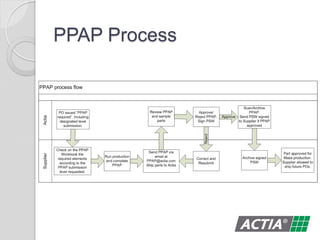
 PPAP Process
 ACTIA PPAP Workbook
 How to complete PPAP elements
 Shipping Instructions
 Electronic Submission Requirements
 Submission Status
What is PPAP?
 PPAP stands for “Production Part Approval Process”
 Standard used to formally reduce risks prior
to product or service release, in a team oriented
manner using well established tools and techniques
 Initially developed by AIAG (Auto Industry Action
Group) in 1993 with input from the Big 3 - Ford,
Chrysler, and GM
 AIAG’s 4th edition is effective since June 1st , 2006.
For latest version available check at www.aiag.org
 PPAP has now spread to many different industries
beyond automotive
PPAP purpose
• To provide the evidence that all customer
engineering design record and specification
requirements are properly understood by the
manufacturing organization.
• To demonstrate that the manufacturing process
has the potential to produce product that
consistently meets all requirements during an
actual production run at the quoted production
rate.
PPAP Benefits
 Forces formal part conformance and approval
 Ensures formal quality planning
 Helps to maintain design integrity
 Identifies issues early for resolution
 Reduces warranty charges and prevents costs because of
poor quality
 Assists with managing supplier changes
 Prevents use of unapproved and nonconforming parts
 Identifies suppliers that need more development
 Improves the overall quality of the product & customer
satisfaction
When is PPAP required?
 New part
 Engineering change(s)
 Tooling: transfer, replacement, refurbishment, or additional
tooling
 Correction of discrepancy
 Tooling inactive for more than one year (12 months)
 Change to optional construction or material
 Sub-supplier or material source change
 Change in part processing
 Parts produced at a new or additional location
PPAP is required with any significant
change to product or process!
Significant Production run
 PPAP data must be submitted from a production
run using:
 Production equipment and tooling
 Production employees
 Production rate
 Production process
All data reflects the actual production
process to be used at start-up!
Level and elements of PPAP
 PPAP submission requirements are called
Elements
 The PPAP Submission Level will determine
which Element(s) are required for submission.
 ACTIA requests PPAP submission Level 1, 2,
3,4, 4a, 4b, 5. Level 4a and 4b are
predetermined levels defined by ACTIA. Level 4
will be defined by ACTIA during the PPAP
request
 ACTIA will indicate the required PPAP
submission level on the Purchase Order.
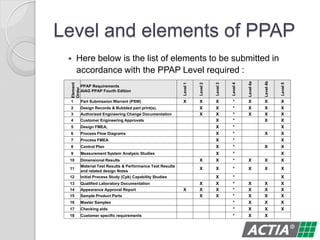
Level and elements of PPAP
Element
Order
PPAP Requirements
AIAG PPAP Fourth Edition
Level
1
Level
2
Level
3
Level
4
Level
4a
Level
4b
Level
5
1 Part Submission Warrant (PSW) X X X * X X X
2 Design Records & Bubbled part print(s). X X * X X X
3 Authorized Engineering Change Documentation X X * X X X
4 Customer Engineering Approvals X * X X
5 Design FMEA, X * X
6 Process Flow Diagrams X * X X
7 Process FMEA X * X
8 Control Plan X * X X
9 Measurement System Analysis Studies X * X
10 Dimensional Results X X * X X X
11
Material Test Results & Performance Test Results
and related design Notes
X X * X X X
12 Initial Process Study (Cpk) Capability Studies X * X
13 Qualified Laboratory Documentation X X * X X X
14 Appearance Approval Report X X X * X X X
15 Sample Product Parts X X * X X X
16 Master Samples * X X X
17 Checking aids * X X X
18 Customer specific requirements * X X
 Here below is the list of elements to be submitted in
accordance with the PPAP Level required :
PPAP Process
ACTIA PPAP Workbook
 What is the ACTIA PPAP Workbook?
 An Excel spreadsheet containing templates of the documents suppliers
are required to submit to ACTIA
 Why use the PPAP Workbook?
 Simplifies the process for suppliers by serving as a “checklist” of what
needs to be submitted to ACTIA
 Enables the SQE to quickly see if anything is missing
 Provide templates to supplier for the required elements of PPAP
 Requirements on PPAP Elements format
 The following form is mandatory for submission to ACTIA:
1) ACTIA PSW (Part Submission Warrant)
 For the remaining elements, the organization is free to use its own format
as long as it meets AIAG and ACTIA requirements.
HOW to complete PPAP
Workbook ?
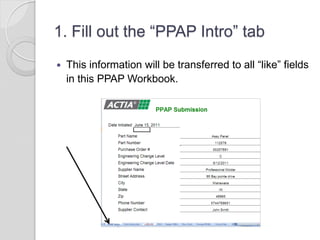
1. Fill out the “PPAP Intro” tab
 This information will be transferred to all “like” fields
in this PPAP Workbook.
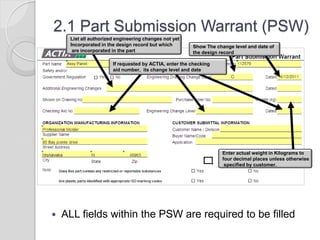
2.1 Part Submission Warrant (PSW)
 ALL fields within the PSW are required to be filled
List all authorized engineering changes not yet
Incorporated in the design record but which
are incorporated in the part
Enter actual weight in Kilograms to
four decimal places unless otherwise
specified by customer.
Show The change level and date of
the design record
If requested by ACTIA, enter the checking
aid number, its change level and date
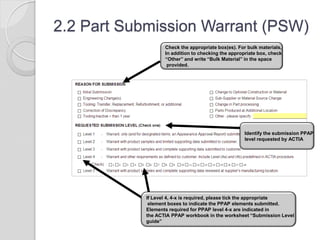
2.2 Part Submission Warrant (PSW)
Check the appropriate box(es). For bulk materials,
In addition to checking the appropriate box, check
“Other” and write “Bulk Material” in the space
provided.
Identify the submission PPAP
level requested by ACTIA
If Level 4, 4-x is required, please tick the appropriate
element boxes to indicate the PPAP elements submitted.
Elements required for PPAP level 4-x are indicated in
the ACTIA PPAP workbook in the worksheet “Submission Level
guide”
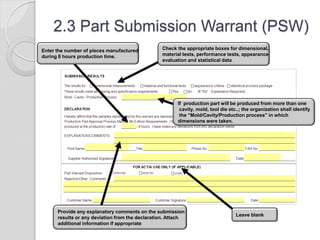
2.3 Part Submission Warrant (PSW)
If production part will be produced from more than one
cavity, mold, tool die etc..; the organization shall identify
the “Mold/Cavity/Production process” in which
dimensions were taken.
Check the appropriate boxes for dimensional,
material tests, performance tests, appearance
evaluation and statistical data
Enter the number of pieces manufactured
during 8 hours production time.
Leave blank
Provide any explanatory comments on the submission
results or any deviation from the declaration. Attach
additional information if appropriate
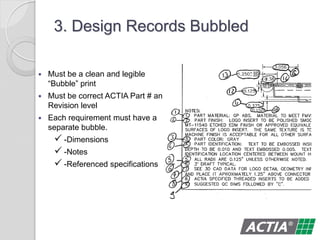
3. Design Records Bubbled
 Must be a clean and legible
“Bubble” print
 Must be correct ACTIA Part # and
Revision level
 Each requirement must have a
separate bubble.
 -Dimensions
 -Notes
 -Referenced specifications
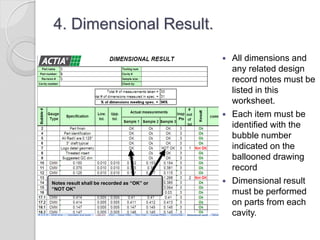
4. Dimensional Result.
 All dimensions and
any related design
record notes must be
listed in this
worksheet.
 Each item must be
identified with the
bubble number
indicated on the
ballooned drawing
record
 Dimensional result
must be performed
on parts from each
cavity.
Notes result shall be recorded as “OK” or
“NOT OK”
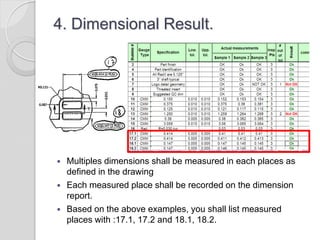
4. Dimensional Result.
 Multiples dimensions shall be measured in each places as
defined in the drawing
 Each measured place shall be recorded on the dimension
report.
 Based on the above examples, you shall list measured
places with :17.1, 17.2 and 18.1, 18.2.
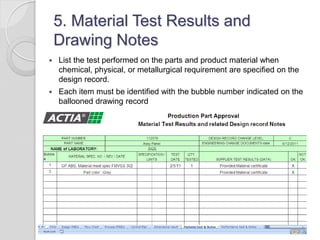
5. Material Test Results and
Drawing Notes
 List the test performed on the parts and product material when
chemical, physical, or metallurgical requirement are specified on the
design record.
 Each item must be identified with the bubble number indicated on the
ballooned drawing record
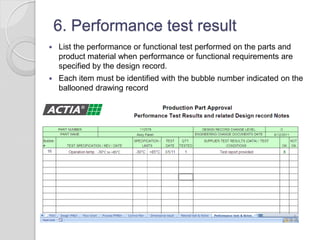
6. Performance test result
 List the performance or functional test performed on the parts and
product material when performance or functional requirements are
specified by the design record.
 Each item must be identified with the bubble number indicated on the
ballooned drawing record
7. Process Flow Diagram
• Process flow must identify each step in the process
• Should include abnormal handling processes
Scrap
Rework
• Process flow must include all phases of the process
Receiving of raw material
Part manufacturing
Offline inspections and checks
Assembly
Shipping
• The Organization is free to use its own process flow format
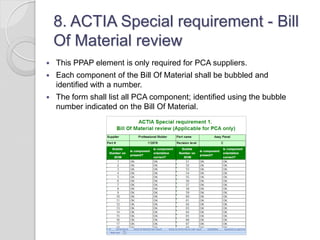
8. ACTIA Special requirement - Bill
Of Material review
 This PPAP element is only required for PCA suppliers.
 Each component of the Bill Of Material shall be bubbled and
identified with a number.
 The form shall list all PCA component; identified using the bubble
number indicated on the Bill Of Material.
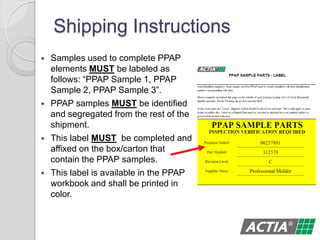
Shipping Instructions
 Samples used to complete PPAP
elements MUST be labeled as
follows: “PPAP Sample 1, PPAP
Sample 2, PPAP Sample 3”.
 PPAP samples MUST be identified
and segregated from the rest of the
shipment.
 This label MUST be completed and
affixed on the box/carton that
contain the PPAP samples.
 This label is available in the PPAP
workbook and shall be printed in
color.
Electronic Submission
Requirements
• ACTIA requires that all PPAP’s be submitted
electronically via email in pdf or native format.
• All PPAP documents should be sent to:
PPAP@ACTIA.com
• The size of the attachment cannot exceed 5Mb
 Please send in several emails indicating the email number if
this occurs.
• ACTIA part number MUST be indicated in the
subject line of the email
• Electronic submission MUST be received prior to
the PPAP due date.
Submission Status
The PPAP submission will be reviewed and a disposition given with
one of the following submission statuses:
• Approved: A formal acceptance of the submission within the
guidelines of any and all criteria set forth by ACTIA.
• Rejected: The provision is not acceptable and needs to be
corrected and resubmitted for approval.
(Note: Submission to the wrong revision level or part number will
constitute an automatic rejection.)
• Other (Approved under condition) : PPAP is approved under
certain conditions that need to be approved by ACTIA. This case
will require a deviation and corrective action to be set up in order to
meet requirements for the future.
If you have additional questions concerning
the PPAP requirements, please contact your
ACTIA buyer or Quality Engineer.
52765 Bridger Court
Elkhart, IN 46514-7603
(574) 264-2373
PPAP@ACTIA.com

ppap Requirements for actia-training-pdf.pdf

  • 1.
    PPAP REQUIREMENTS FOR ACTIA SupplierQuality Manual Provided by:
  • 2.
    Index  What isPPAP?  PPAP Purpose  PPAP Benefits  When is PPAP required?  Significant production run  LEVEL and element of PPAP  PPAP Process  ACTIA PPAP Workbook  How to complete PPAP elements  Shipping Instructions  Electronic Submission Requirements  Submission Status
  • 3.
    What is PPAP? PPAP stands for “Production Part Approval Process”  Standard used to formally reduce risks prior to product or service release, in a team oriented manner using well established tools and techniques  Initially developed by AIAG (Auto Industry Action Group) in 1993 with input from the Big 3 - Ford, Chrysler, and GM  AIAG’s 4th edition is effective since June 1st , 2006. For latest version available check at www.aiag.org  PPAP has now spread to many different industries beyond automotive
  • 4.
    PPAP purpose • Toprovide the evidence that all customer engineering design record and specification requirements are properly understood by the manufacturing organization. • To demonstrate that the manufacturing process has the potential to produce product that consistently meets all requirements during an actual production run at the quoted production rate.
  • 5.
    PPAP Benefits  Forcesformal part conformance and approval  Ensures formal quality planning  Helps to maintain design integrity  Identifies issues early for resolution  Reduces warranty charges and prevents costs because of poor quality  Assists with managing supplier changes  Prevents use of unapproved and nonconforming parts  Identifies suppliers that need more development  Improves the overall quality of the product & customer satisfaction
  • 6.
    When is PPAPrequired?  New part  Engineering change(s)  Tooling: transfer, replacement, refurbishment, or additional tooling  Correction of discrepancy  Tooling inactive for more than one year (12 months)  Change to optional construction or material  Sub-supplier or material source change  Change in part processing  Parts produced at a new or additional location PPAP is required with any significant change to product or process!
  • 7.
    Significant Production run PPAP data must be submitted from a production run using:  Production equipment and tooling  Production employees  Production rate  Production process All data reflects the actual production process to be used at start-up!
  • 8.
    Level and elementsof PPAP  PPAP submission requirements are called Elements  The PPAP Submission Level will determine which Element(s) are required for submission.  ACTIA requests PPAP submission Level 1, 2, 3,4, 4a, 4b, 5. Level 4a and 4b are predetermined levels defined by ACTIA. Level 4 will be defined by ACTIA during the PPAP request  ACTIA will indicate the required PPAP submission level on the Purchase Order.
  • 9.
    Level and elementsof PPAP Element Order PPAP Requirements AIAG PPAP Fourth Edition Level 1 Level 2 Level 3 Level 4 Level 4a Level 4b Level 5 1 Part Submission Warrant (PSW) X X X * X X X 2 Design Records & Bubbled part print(s). X X * X X X 3 Authorized Engineering Change Documentation X X * X X X 4 Customer Engineering Approvals X * X X 5 Design FMEA, X * X 6 Process Flow Diagrams X * X X 7 Process FMEA X * X 8 Control Plan X * X X 9 Measurement System Analysis Studies X * X 10 Dimensional Results X X * X X X 11 Material Test Results & Performance Test Results and related design Notes X X * X X X 12 Initial Process Study (Cpk) Capability Studies X * X 13 Qualified Laboratory Documentation X X * X X X 14 Appearance Approval Report X X X * X X X 15 Sample Product Parts X X * X X X 16 Master Samples * X X X 17 Checking aids * X X X 18 Customer specific requirements * X X  Here below is the list of elements to be submitted in accordance with the PPAP Level required :
  • 10.
  • 11.
    ACTIA PPAP Workbook What is the ACTIA PPAP Workbook?  An Excel spreadsheet containing templates of the documents suppliers are required to submit to ACTIA  Why use the PPAP Workbook?  Simplifies the process for suppliers by serving as a “checklist” of what needs to be submitted to ACTIA  Enables the SQE to quickly see if anything is missing  Provide templates to supplier for the required elements of PPAP  Requirements on PPAP Elements format  The following form is mandatory for submission to ACTIA: 1) ACTIA PSW (Part Submission Warrant)  For the remaining elements, the organization is free to use its own format as long as it meets AIAG and ACTIA requirements.
  • 12.
    HOW to completePPAP Workbook ?
  • 13.
    1. Fill outthe “PPAP Intro” tab  This information will be transferred to all “like” fields in this PPAP Workbook.
  • 14.
    2.1 Part SubmissionWarrant (PSW)  ALL fields within the PSW are required to be filled List all authorized engineering changes not yet Incorporated in the design record but which are incorporated in the part Enter actual weight in Kilograms to four decimal places unless otherwise specified by customer. Show The change level and date of the design record If requested by ACTIA, enter the checking aid number, its change level and date
  • 15.
    2.2 Part SubmissionWarrant (PSW) Check the appropriate box(es). For bulk materials, In addition to checking the appropriate box, check “Other” and write “Bulk Material” in the space provided. Identify the submission PPAP level requested by ACTIA If Level 4, 4-x is required, please tick the appropriate element boxes to indicate the PPAP elements submitted. Elements required for PPAP level 4-x are indicated in the ACTIA PPAP workbook in the worksheet “Submission Level guide”
  • 16.
    2.3 Part SubmissionWarrant (PSW) If production part will be produced from more than one cavity, mold, tool die etc..; the organization shall identify the “Mold/Cavity/Production process” in which dimensions were taken. Check the appropriate boxes for dimensional, material tests, performance tests, appearance evaluation and statistical data Enter the number of pieces manufactured during 8 hours production time. Leave blank Provide any explanatory comments on the submission results or any deviation from the declaration. Attach additional information if appropriate
  • 17.
    3. Design RecordsBubbled  Must be a clean and legible “Bubble” print  Must be correct ACTIA Part # and Revision level  Each requirement must have a separate bubble.  -Dimensions  -Notes  -Referenced specifications
  • 18.
    4. Dimensional Result. All dimensions and any related design record notes must be listed in this worksheet.  Each item must be identified with the bubble number indicated on the ballooned drawing record  Dimensional result must be performed on parts from each cavity. Notes result shall be recorded as “OK” or “NOT OK”
  • 19.
    4. Dimensional Result. Multiples dimensions shall be measured in each places as defined in the drawing  Each measured place shall be recorded on the dimension report.  Based on the above examples, you shall list measured places with :17.1, 17.2 and 18.1, 18.2.
  • 20.
    5. Material TestResults and Drawing Notes  List the test performed on the parts and product material when chemical, physical, or metallurgical requirement are specified on the design record.  Each item must be identified with the bubble number indicated on the ballooned drawing record
  • 21.
    6. Performance testresult  List the performance or functional test performed on the parts and product material when performance or functional requirements are specified by the design record.  Each item must be identified with the bubble number indicated on the ballooned drawing record
  • 22.
    7. Process FlowDiagram • Process flow must identify each step in the process • Should include abnormal handling processes Scrap Rework • Process flow must include all phases of the process Receiving of raw material Part manufacturing Offline inspections and checks Assembly Shipping • The Organization is free to use its own process flow format
  • 23.
    8. ACTIA Specialrequirement - Bill Of Material review  This PPAP element is only required for PCA suppliers.  Each component of the Bill Of Material shall be bubbled and identified with a number.  The form shall list all PCA component; identified using the bubble number indicated on the Bill Of Material.
  • 24.
    Shipping Instructions  Samplesused to complete PPAP elements MUST be labeled as follows: “PPAP Sample 1, PPAP Sample 2, PPAP Sample 3”.  PPAP samples MUST be identified and segregated from the rest of the shipment.  This label MUST be completed and affixed on the box/carton that contain the PPAP samples.  This label is available in the PPAP workbook and shall be printed in color.
  • 25.
    Electronic Submission Requirements • ACTIArequires that all PPAP’s be submitted electronically via email in pdf or native format. • All PPAP documents should be sent to: PPAP@ACTIA.com • The size of the attachment cannot exceed 5Mb  Please send in several emails indicating the email number if this occurs. • ACTIA part number MUST be indicated in the subject line of the email • Electronic submission MUST be received prior to the PPAP due date.
  • 26.
    Submission Status The PPAPsubmission will be reviewed and a disposition given with one of the following submission statuses: • Approved: A formal acceptance of the submission within the guidelines of any and all criteria set forth by ACTIA. • Rejected: The provision is not acceptable and needs to be corrected and resubmitted for approval. (Note: Submission to the wrong revision level or part number will constitute an automatic rejection.) • Other (Approved under condition) : PPAP is approved under certain conditions that need to be approved by ACTIA. This case will require a deviation and corrective action to be set up in order to meet requirements for the future.
  • 27.
    If you haveadditional questions concerning the PPAP requirements, please contact your ACTIA buyer or Quality Engineer. 52765 Bridger Court Elkhart, IN 46514-7603 (574) 264-2373 PPAP@ACTIA.com