Craniofacial morphology and
growth of cleft palate patients
K. Siotou1, I. Christopoulou2, A. Apostolaki3, P. Zelou4, A.I. Tsolakis1,5
1Department of Orthodontics, National and Kapodistrian University of Athens
2Department of Metabolic Bone Diseases, National and Kapodistria University of Athens
3School of Dentistry, National and Kapodistrian University of Athens
4Grigore T. Popa, University of Medicine and Pharmacy, Iași
5Department of Orthodontics, Case Western Reserve University, Cleveland
Craniofacial morphology and growth of cleft palate patients
• Introduction: Orofacial cleft is a common birth defect that has a significant functional
and aesthetic impact on affected patients. Multidisciplinary teams of surgeons, speech
therapists, orthodontists and pediatric dentists collaborate for the effective treatment of
cleft lip and palate patients. Even though the progress in the management of those patients
is undoubtable, arguments for the appropriate treatment protocol still exist. The aim of
this study is to investigate the dental characteristics and the morphology of the
craniofacial complex in cleft palate patients.
• Aim/ Methods: Young patients with cleft lip and palate sought orthodontic treatment at a
Private Orthodontic Office and at the Orthodontic Department of the National and
Kapodistrian University of Athens. Patients underwent clinical and radiographic
examination.
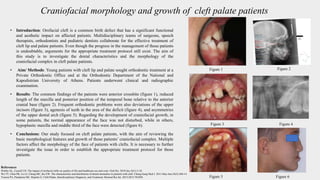
• Results: The common findings of the patients were anterior crossbite (figure 1), reduced
length of the maxilla and posterior position of the temporal bone relative to the anterior
cranial base (figure 2). Frequent orthodontic problems were also deviations of the upper
incisors (figure 3), agenesis of teeth in the area of ​​the deficit (figure 4), and asymmetries
of the upper dental arch (figure 5). Regarding the development of craniofacial growth, in
some patients, the normal appearance of the face was not disturbed, while in others,
hypoplastic maxilla and middle third of the face were detected (figure 6).
• Conclusions: Our study focused on cleft palate patients, with the aim of reviewing the
basic morphological features and growth of those patients’ craniofacial complex. Multiple
factors affect the morphology of the face of patients with clefts. It is necessary to further
investigate the issue in order to establish the appropriate treatment protocol for those
patients.
Figure 1 Figure 2
Figure 3 Figure 4
Figure 5
References
Wehby GL, Cassell CH. The impact of orofacial clefts on quality of life and healthcare use and costs. Oral Dis. 2010 Jan;16(1):3-10.
Wu TT, Chen PK, Lo LJ, Cheng MC, Ko EW. The characteristics and distribution of dental anomalies in patients with cleft. Chang Gung Med J. 2011 May-Jun;34(3):306-14.
Ysunza PA, Pamplona MC, Repetto G. Cleft Palate, Interdisciplinary Diagnosis, and Treatment. Biomed Res Int. 2015;2015:701850. Figure 6

Pp cleft final

  • 1.
    Craniofacial morphology and growthof cleft palate patients K. Siotou1, I. Christopoulou2, A. Apostolaki3, P. Zelou4, A.I. Tsolakis1,5 1Department of Orthodontics, National and Kapodistrian University of Athens 2Department of Metabolic Bone Diseases, National and Kapodistria University of Athens 3School of Dentistry, National and Kapodistrian University of Athens 4Grigore T. Popa, University of Medicine and Pharmacy, Iași 5Department of Orthodontics, Case Western Reserve University, Cleveland
  • 2.
    Craniofacial morphology andgrowth of cleft palate patients • Introduction: Orofacial cleft is a common birth defect that has a significant functional and aesthetic impact on affected patients. Multidisciplinary teams of surgeons, speech therapists, orthodontists and pediatric dentists collaborate for the effective treatment of cleft lip and palate patients. Even though the progress in the management of those patients is undoubtable, arguments for the appropriate treatment protocol still exist. The aim of this study is to investigate the dental characteristics and the morphology of the craniofacial complex in cleft palate patients. • Aim/ Methods: Young patients with cleft lip and palate sought orthodontic treatment at a Private Orthodontic Office and at the Orthodontic Department of the National and Kapodistrian University of Athens. Patients underwent clinical and radiographic examination. • Results: The common findings of the patients were anterior crossbite (figure 1), reduced length of the maxilla and posterior position of the temporal bone relative to the anterior cranial base (figure 2). Frequent orthodontic problems were also deviations of the upper incisors (figure 3), agenesis of teeth in the area of ​​the deficit (figure 4), and asymmetries of the upper dental arch (figure 5). Regarding the development of craniofacial growth, in some patients, the normal appearance of the face was not disturbed, while in others, hypoplastic maxilla and middle third of the face were detected (figure 6). • Conclusions: Our study focused on cleft palate patients, with the aim of reviewing the basic morphological features and growth of those patients’ craniofacial complex. Multiple factors affect the morphology of the face of patients with clefts. It is necessary to further investigate the issue in order to establish the appropriate treatment protocol for those patients. Figure 1 Figure 2 Figure 3 Figure 4 Figure 5 References Wehby GL, Cassell CH. The impact of orofacial clefts on quality of life and healthcare use and costs. Oral Dis. 2010 Jan;16(1):3-10. Wu TT, Chen PK, Lo LJ, Cheng MC, Ko EW. The characteristics and distribution of dental anomalies in patients with cleft. Chang Gung Med J. 2011 May-Jun;34(3):306-14. Ysunza PA, Pamplona MC, Repetto G. Cleft Palate, Interdisciplinary Diagnosis, and Treatment. Biomed Res Int. 2015;2015:701850. Figure 6