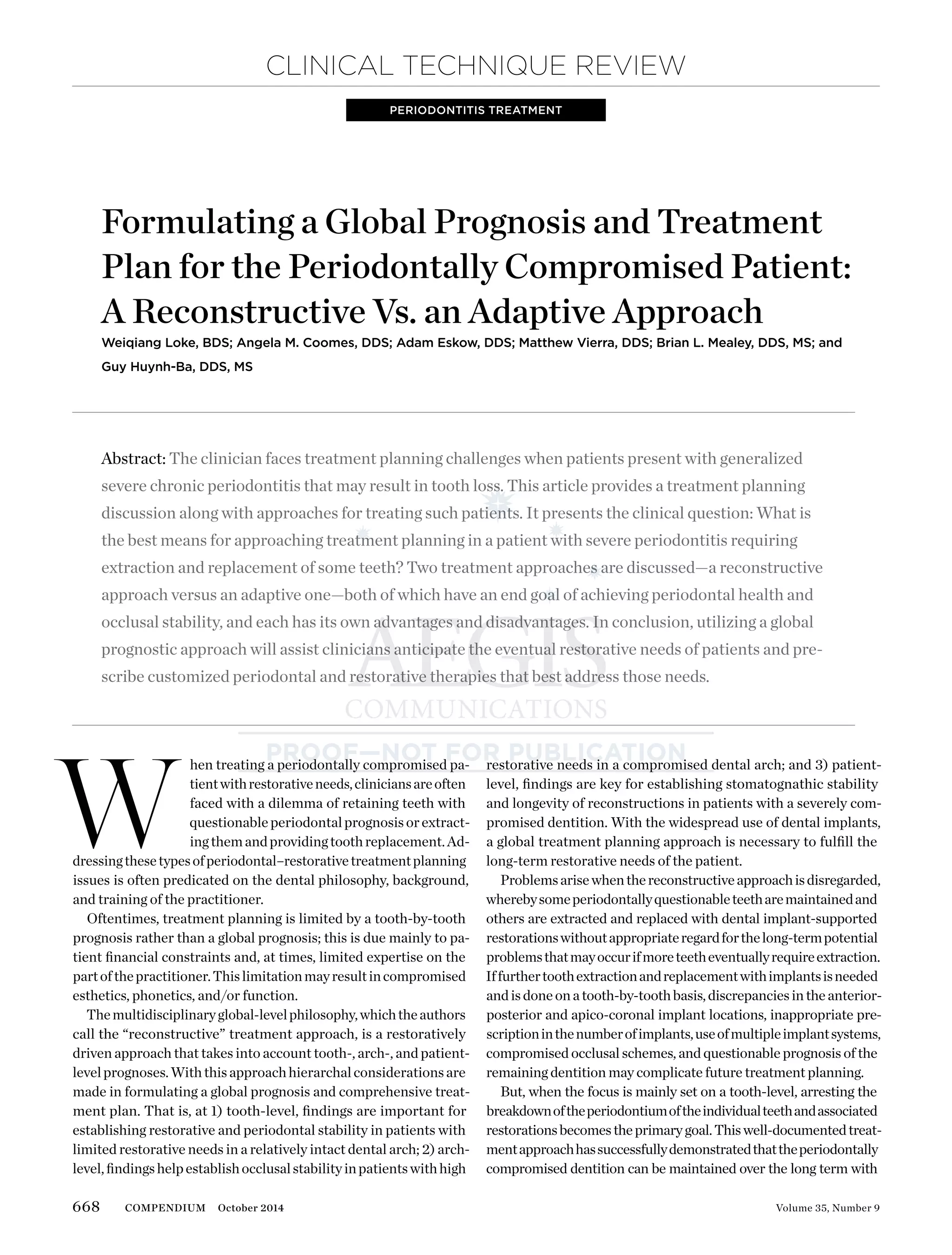
668 Volume 35, Number 9COMPENDIUM October 2014
W
hen treating a periodontally compromised pa-
tientwithrestorativeneeds,cliniciansareoften
faced with a dilemma of retaining teeth with
questionableperiodontalprognosisorextract-
ingthemandprovidingtoothreplacement.Ad-
dressingthesetypesofperiodontal–restorativetreatmentplanning
issues is often predicated on the dental philosophy, background,
and training of the practitioner.
Oftentimes, treatment planning is limited by a tooth-by-tooth
prognosis rather than a global prognosis; this is due mainly to pa-
tient financial constraints and, at times, limited expertise on the
partofthepractitioner.Thislimitationmayresultincompromised
esthetics, phonetics, and/or function.
Themultidisciplinaryglobal-levelphilosophy,whichtheauthors
call the “reconstructive” treatment approach, is a restoratively
driven approach that takes into account tooth-, arch-, and patient-
levelprognoses.Withthisapproachhierarchalconsiderationsare
made in formulating a global prognosis and comprehensive treat-
ment plan. That is, at 1) tooth-level, findings are important for
establishing restorative and periodontal stability in patients with
limited restorative needs in a relatively intact dental arch; 2) arch-
level,findingshelpestablishocclusalstabilityinpatientswithhigh
restorative needs in a compromised dental arch; and 3) patient-
level, findings are key for establishing stomatognathic stability
and longevity of reconstructions in patients with a severely com-
promised dentition. With the widespread use of dental implants,
a global treatment planning approach is necessary to fulfill the
long-term restorative needs of the patient.
Problemsarisewhenthereconstructiveapproachisdisregarded,
wherebysomeperiodontallyquestionableteetharemaintainedand
others are extracted and replaced with dental implant-supported
restorationswithoutappropriateregardforthelong-termpotential
problemsthatmayoccurifmoreteetheventuallyrequireextraction.
Iffurthertoothextractionandreplacementwithimplantsisneeded
andisdoneonatooth-by-toothbasis,discrepanciesintheanterior-
posterior and apico-coronal implant locations, inappropriate pre-
scriptioninthenumberofimplants,useofmultipleimplantsystems,
compromised occlusal schemes, and questionable prognosis of the
remaining dentition may complicate future treatment planning.
But, when the focus is mainly set on a tooth-level, arresting the
breakdownoftheperiodontiumoftheindividualteethandassociated
restorationsbecomestheprimarygoal.Thiswell-documentedtreat-
mentapproachhassuccessfullydemonstratedthattheperiodontally
compromised dentition can be maintained over the long term with
Abstract: The clinician faces treatment planning challenges when patients present with generalized
severe chronic periodontitis that may result in tooth loss. This article provides a treatment planning
discussion along with approaches for treating such patients. It presents the clinical question: What is
the best means for approaching treatment planning in a patient with severe periodontitis requiring
extraction and replacement of some teeth? Two treatment approaches are discussed—a reconstructive
approach versus an adaptive one—both of which have an end goal of achieving periodontal health and
occlusal stability, and each has its own advantages and disadvantages. In conclusion, utilizing a global
prognostic approach will assist clinicians anticipate the eventual restorative needs of patients and pre-
scribe customized periodontal and restorative therapies that best address those needs.
Formulating a Global Prognosis and Treatment
Plan for the Periodontally Compromised Patient:
A Reconstructive Vs. an Adaptive Approach
Weiqiang Loke, BDS; Angela M. Coomes, DDS; Adam Eskow, DDS; Matthew Vierra, DDS; Brian L. Mealey, DDS, MS; and
Guy Huynh-Ba, DDS, MS
CLINICAL TECHNIQUE REVIEW
PERIODONTITIS TREATMENT
669www.compendiumlive.com October 2014 COMPENDIUM
appropriate patient control of local and systemic factors in conjunc-
tion with regular professional evaluation and maintenance. This
approach offers the patient much therapeutic value and would less
likelycomplicaterestorativetreatmentplanningforpatientswhoonly
requireconventionalnon-implant–basedrestorativetherapy.Theau-
thorsrefertothisasthe“adaptive”treatmentapproach,asitgenerally
adaptsrestorativecaretothepatient’sexistingteethandarchform.
Case Presentation
Apatientscenarioispresentedthatoffersthought-provokingtreat-
mentconsiderations.Treatmentcouldeasilyfolloweithertheadap-
tive or reconstructive approach to satisfy the patient’s desires and
result in the best long-term solution.
ThepatientpresentedattheUniversityofBernintheDepartment
of Periodontology and Fixed Prosthodontics in May 2003. Upon
comprehensive initial examination of the 58-year-old Caucasian
male, a diagnosis of generalized severe chronic periodontitis was
assigned (Figure 1 and Figure 2). The patient’s medical history
was non-contributory. The patient reported smoking a pack of
cigarettesperdayforthepast30years.Oralhygienewasextremely
poor; the patient had neglected his oral health for many years.
TeethNos.1through3,14through16,and25weremissing.Probing
depthsrangedfrom2mmto10mm,whileattachmentlevelsranged
from 3 mm to 12 mm, with significant bleeding on probing. Class 2
Miller’smobility1
wasnotedforteethNos.18,23,24,and26.Allteeth
tested vital to cold, and Grade 3 Glickman furcation involvement2
was noted on teeth Nos. 17 through 19 and 30 through 32. An assess-
mentofthepatient’ssystemichealth,age,behavioral/psychological
status, socioeconomic status, and esthetic and functional goals was
completed and taken into account in the prescribed treatment plan.
Clinical Approaches
Thispatientscenariopresentsacommontreatmentplanningdilemma.
In cases of generalized severe chronic periodontal destruction, dif-
ferencesintreatmentmethodologymaybehighlightedthroughtwo
somewhatantagonisticapproaches:reconstructiveversusadaptive.
Anadaptiveapproachischaracterizedbyconservativeretention
of teeth deemed to have a good-to-questionable prognosis and
utilizinglimitedrestorativetherapythatmayconsistofremovable
and/or fixed conventional/implant-based restorative prostheses.
The reconstructive approach, on the other hand, is typically char-
acterizedbyamoreinterceptiveandprostheticallydriventherapy
whereby questionable teeth are extracted early to make way for
implant-basedrestorativeprostheses.Thedifferencesbetweenthe
adaptiveandreconstructiveapproachesaresummarizedinTable1.
On one side, the reconstructive approach calls for a more oc-
clusally and biomechanically stable therapeutic endpoint through
prosthetically driven therapies, including total odontectomy with
alveoloplasty for prosthetic rehabilitation. On the other side, an
adaptiveandmoreconservativeapproachaimsatarrestingdisease
progression through traditional periodontal surgical intervention
andmaintenanceoftheexistingdentition.Thesetwotreatmentap-
proachesillustratedifferentpathstocommongoals:oralhealthand
occlusalstability.Theprovenclinicalsuccessofperiodontaltherapy
andmaintenancesupportstheadaptivetreatmentapproachthatis
oftenoverlookedbypractitionersseekingtoestablishanarch-level
implant-restorativesolutionatthecostofsalvageableteeth,which,
at best, may achieve similar long-term outcomes. There are merits
tobotharguments,aswillbediscussedinthefollowingparagraphs.
Itshouldbenotedthat,dependingonthecomplexityofacase,both
treatmentapproachesmayrequireamultidisciplinaryteamstrategy
involving different specialties (eg, periodontics, orthodontics, end-
odontics, and oral surgery) to ensure a comprehensive assessment
of the case prior to treatment planning.
An adaptive approach to treatment consists of comprehensive
periodontaltherapy,extractionofhopelessteeth,followedbyrestor-
ativetherapy.Inthepresentcase,basedontheclinicalexamination
(includingpatient’sfull-mouthperiodontalchart),radiographs,and
clinical photographs (Figure 1 and Figure 2) obtained, it was evi-
dentthatteethNos.17through19and30through32hadahopeless
prognosisduetosevereboneloss,thoroughfurcationinvolvements,
and dento-alveolar extrusion. All other teeth were considered to
have a fair-to-poor prognosis with periodontal therapy. The restor-
ative options given to the patient included extraction of all remain-
ing maxillary teeth and reconstruction with an implant-retained
or implant-supported fixed or removable prosthesis. Instead, the
patient elected to retain all questionable teeth in both arches and
extractionofhishopelessteeth,choosingtomaintainasmanyofhis
naturalteethaspossible;heelectednottohaveanyreplacementfor
hisposteriorteeth.Thisrestorativeplanwasbasedontheshortened
dentalarchphilosophy.3
Periodontaltherapyforthepatientincluded
four quadrants of scaling and root planing, extraction of teeth Nos.
17 through 19 and 30 through 32 due to hopeless periodontal prog-
nosis. Periodontal re-evaluation at 8 weeks showed dramatic im-
provementsinoralhygieneefforts,withminimalgingivalerythema
and bleeding on probing only at sites with deeper probing depths.
Periodontal surgery followed, which included open-flap debride-
mentwithlimitedosteoplastyandregenerationusingtheprinciples
of guided tissue regeneration at site No. 10.
The patient was then seen for periodontal maintenance at
3-month intervals, which demonstrated maintainable pockets of
3mmto4mm,althoughmobilityofNos.24and26increased.Upon
re-evaluation at the maintenance phase, a second-phase restor-
ative treatment plan was accepted by the patient, which included
extractions of Nos. 24 and 26 and implant placement at these cor-
responding sites. Restorative treatment ensued and the patient
eventually received implant-supported fixed dental prostheses to
replace teeth Nos. 23 through 26 (Figure 3).
Support for this approach in treating the patient is provided by
research showing that periodontal treatment of a periodontally
compromised dentition has relatively predictable outcomes over-
all. Classic studies have shown that 62% to 83% of teeth are well-
maintained with minimal tooth loss over 15 to 22 years in chronic
periodontitispatientswhoreceiveperiodontaltreatmentandmain-
tenanceevery4to6months.4-6
Eachoftheselong-termstudiesdem-
onstrates that a small number of patients exhibit progression of
periodontal destruction despite optimal therapy and maintenance
(4%extremedownhillpatientswholost10to23teeth,13%downhill
patients who lost 4 to 9 teeth). It is this risk for progressive disease
thatmaycauseclinicianstore-evaluatethetraditionalapproachto
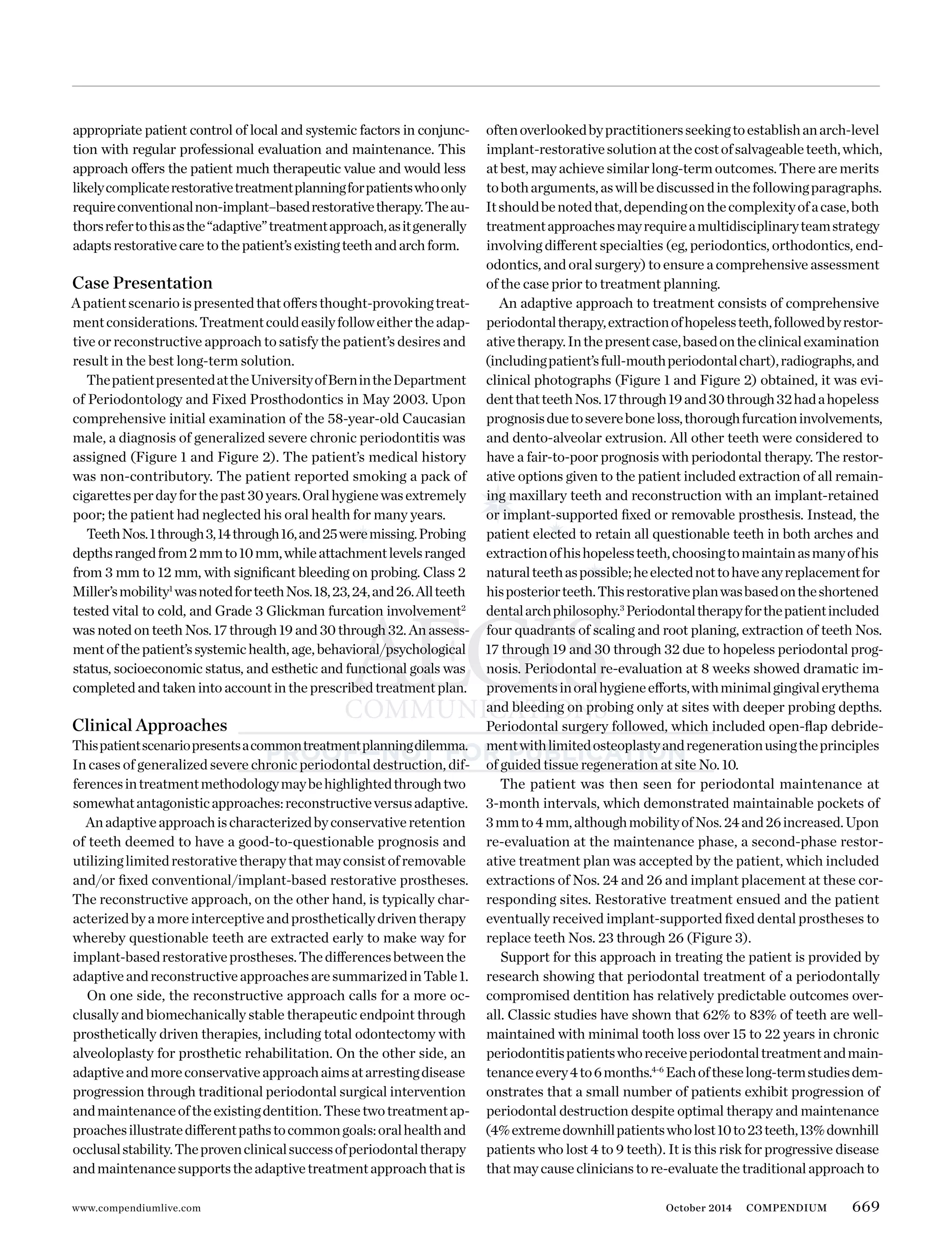
670 Volume 35, Number 9COMPENDIUM October 2014
CLINICAL TECHNIQUE REVIEW | PERIODONTITIS TREATMENT
managing such patients, especially when dental implants become
part of the restorative treatment plan.
Analternativeapproachtotreatingthesamepatientwhodesires
fixed restorative solutions or implant-retained/supported therapy
would be to initiate the treatment planning process using a recon-
structive approach that prioritizes the most efficient and effective
restorative solutions for the patient as the primary consideration.
Thisapproachtakesintoaccounttheprognosesateachofthethree
aforementionedlevels(ie,tooth-level,arch-level,andpatient-level).
These tooth-level (ie, endodontics, periodontics, prosthodontics,
orthodontics) and arch-level(ie,periodontics-prosthodontics,oral
surgery-orthodontics)prognosticassessmentsmayincludethepre-
sentingtoothanatomy,toothstructure,periodontium,pulpalsystem,
archform,archrelation,spacedistribution,alignmentofteeth,and
statusofexistingrestorationsordefects.Theseassessmentsshould
thenbe correlated withpatient-levelassessments,largelycentered
on the patient’s biologic, biomechanical, social, environmental, es-
thetic, financial, and psychological risk profiles.
Beforearrivingatadecisionwhethertoextractorretainatoothor
teeth,theclinicianshoulddevelopaglobalprognosisofthepatient,
takingintoaccounttheprojectedfutureneedsandrisksthatmayaf-
fectlong-termtreatmentoutcomes.Allocatinganaccurateprogno-
sisforeachindividualtoothandfortheentiredentitionisadifficult
task, and research demonstrates that prognostication is an impre-
cise process that often leads to erroneous conclusions.7-9
However,
whenrestorativetherapyincludesimplants,itisparamountthatthe
clinician bases prognostic decisions on patient-level risk profiles
(biologic, esthetic, biomechanical, caries, etc.) that may directly
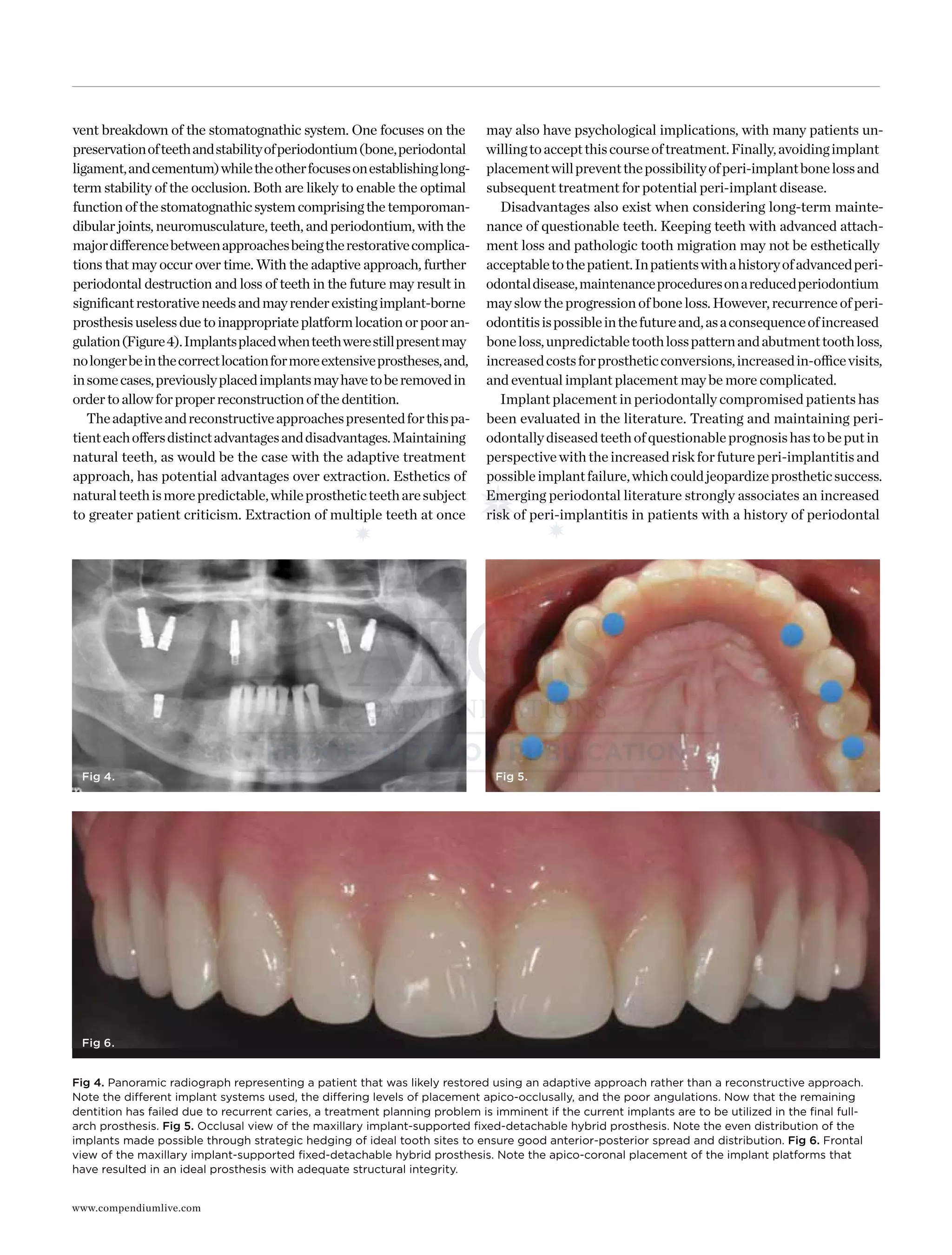
impactthefutureofthepatient’sfinalrestorativescheme.Implants
placed in one position today to replace a single tooth may end up
beinginacompletelyincorrectlocationinthefutureshouldfurther
tooth loss occur and a more extensive restorative plan be required
(Figure4).Theundesirableresultsofatooth-by-toothreplacement
strategy, including inappropriate number and poor distribution of
implants, can be avoided if patient-level and arch-level consider-
ations override tooth-level considerations.
Hence, the reconstructive treatment approach is built upon the
pertinentregionaltooth-relatedandarch-relatedissuesinrestoring
thepatientbacktohealth,ratherthanbeingfocusedonthetooth-level
prognoses(Table1).Theoverridingpatient-levelconsiderationsand
restorativeneeds,beingabovethoseofarch-levelandtooth-levelas-
sessments,drivesthecliniciantoconsiderandanticipatealternative
restorativesolutionsneededforthepatient(reconstructivetherapy
versusadaptivetherapy).Thistreatmentplanningapproachsatisfies
therationalizationfortoothextractionorretentionwhileatthesame
timeaffordingcriticalbiomechanicalconsiderations,suchasoptimal
implant distribution (anterior-posterior spread, minimizing distal
cantilever)andpositioning,tobefactoredintotreatmentplanningfor
theeventualimplant-basedrestorativeneedsofpatientswithasevere
periodontallycompromiseddentition.Thereconstructiveapproach
wouldresultintotalodontectomyofthemaxillaryarchwithretention
oftheposteriormandibularteethandmandibularcanines.Afull-arch,
Fig 1. Full-mouth periapical x-rays revealing generalized severe horizontal bone loss in the maxilla and the mandible.
Fig 1.
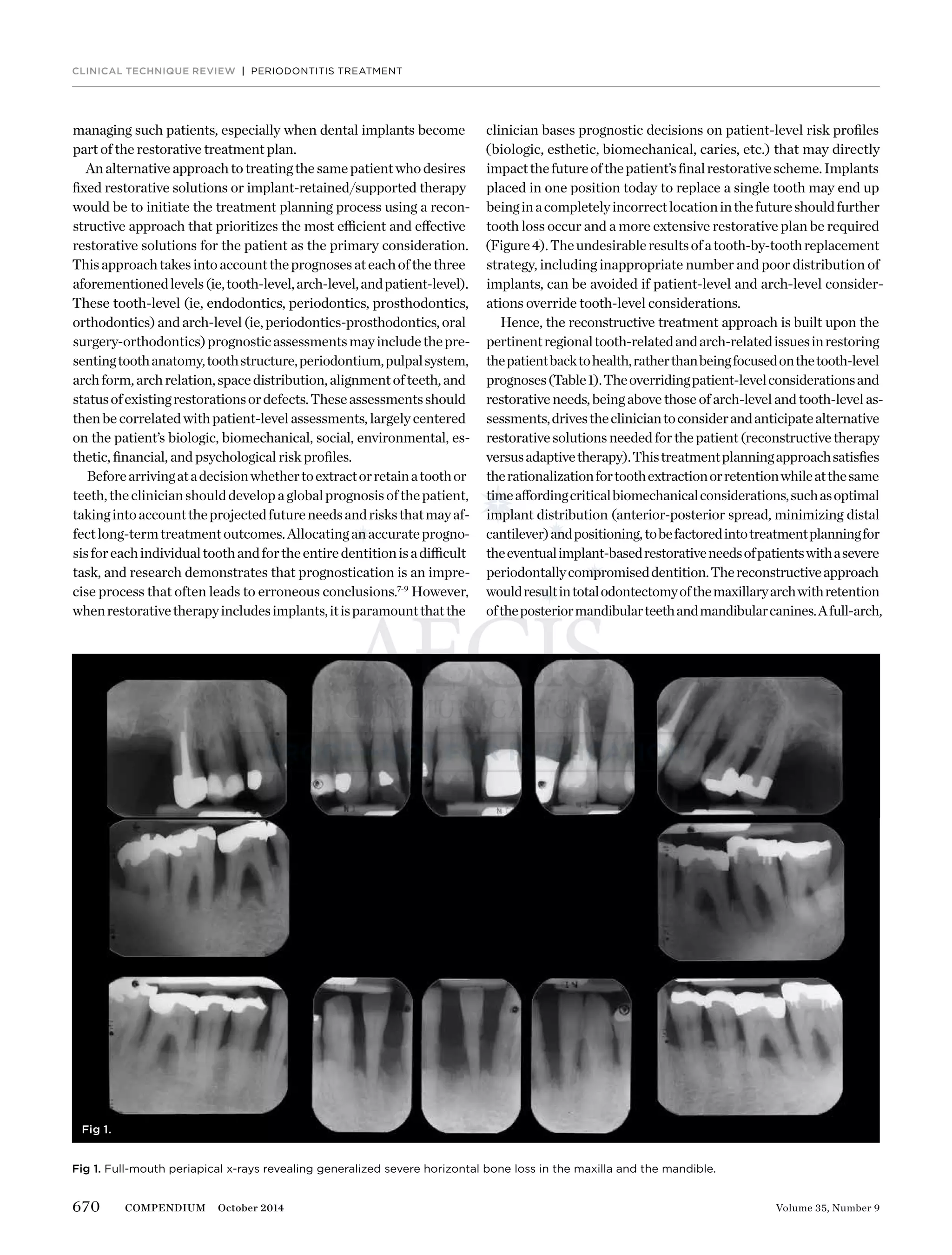
672 Volume 35, Number 9COMPENDIUM October 2014
CLINICAL TECHNIQUE REVIEW | PERIODONTITIS TREATMENT
fixed, implant-retained maxillary hybrid prosthesis combined with
an implant-retained mandibular fixed dental prosthesis for Nos. 23
through26wouldrestorethepatient’sesthetics,health,andfunction.
The approach utilizing a full-arch implant-supported fixed
TABLE 1
Adaptive Vs. Reconstructive Approach
ADAPTIVE APPROACH
Mild to moderately debilitated occlusion
Mildly compromised dentition with sufficient restorative
space and occlusal stops
Limited single-unit to regional unilateral prostheses that
may or may not include implants
Little to no occlusal issues that may affect functional
restorative outcome
Limited finances and low functional needs that could be
met with conventional fixed or removable prostheses
Moderate esthetic expectations
RECONSTRUCTIVE APPROACH
Severely debilitated occlusion with multiple
questionable teeth
Severely worn dentition with or without loss of
restorative space
Multiple missing teeth with multi-unit implant restorations
or arch-level prostheses being planned
Profound occlusal discrepancies not amenable to
limited treatment
Patient desires and high functional needs that require
complex tooth-borne and/or implant-based restorations
High esthetic expectations
Fig 2.
Fig 3.
Fig 2. Intraoral photograph revealing poor oral hygiene with significant
supragingival calculus accumulation and generalized erythematous
gingival margins. Fig 3. Post-periodontal therapy with final implant-
supported restorations, Nos. 23 through 26, in place.
dental prosthesis (Figure 5 through Figure 7) is well-evidenced in
the literature. Malo et al,10,11
who has published a series of articles
on maxillary reconstructions based on an all-on-4 concept, has
demonstrated that this can be a successful treatment approach.
The cumulative 10-year success rates for such prostheses in the
edentulous mandible were 93.8% and 94.8% for patient-related
andimplant-relatedsuccess,respectively.10
Interestingly,theuseof
thistreatmentmodalityinedentulouspatientswithaprevioushis-
toryofperiodontaldiseaseyieldedadecreased5-yearsuccessrate
to 91%.11
Therefore, if extractions are due to previous periodontal
disease, the clinician must consider that the prognosis of implant-
supported fixed dental prostheses does not compare as favorably.
Full-arch implant-retained prostheses utilizing more than four
implantshavesimilarprosthesissuccessandsurvivalrates.Arecent
systematic review and meta-analysis reported the 5-year and 10-
yearsurvivalratesandassociatedcomplicationsofimplant-retained
prostheses in partial or totally edentulous patients.12
For full-arch
implant-retainedprosthesesinthemaxillawithfourtosiximplants,
thesurvivalratewas97.5%at5years,whilethe10-yearsurvivalrate
was95%.Arestoredmandibulararchreportedsimilarsurvivalrates
(98% and 95.9% at 5 and 10 years, respectively).12
Furthermore, an
8-yearprospectivestudyfollowingsubjectswithfull-archimplant-re-
tainedprosthesesinthemaxillasupportedbysiximplantsreportedan
implantsurvivalrateof99%andaprosthesissurvivalrateof100%.13
Discussion
Theaforementionedclinicalapproachesarecommontreatmentcon-
siderations for a patient with generalized severe chronic periodon-
titis. One approach—the adaptive approach—utilizes conventional
periodontal, endodontic, and restorative therapy while maintaining
as many natural teeth as possible. The other approach—reconstruc-
tive—focusesparticularlyontheprognosisoftheteethandarchover
the long term and uses primarily implant-based fixed restorations.
Philosophically, the two approaches share a sincere attempt to pre-
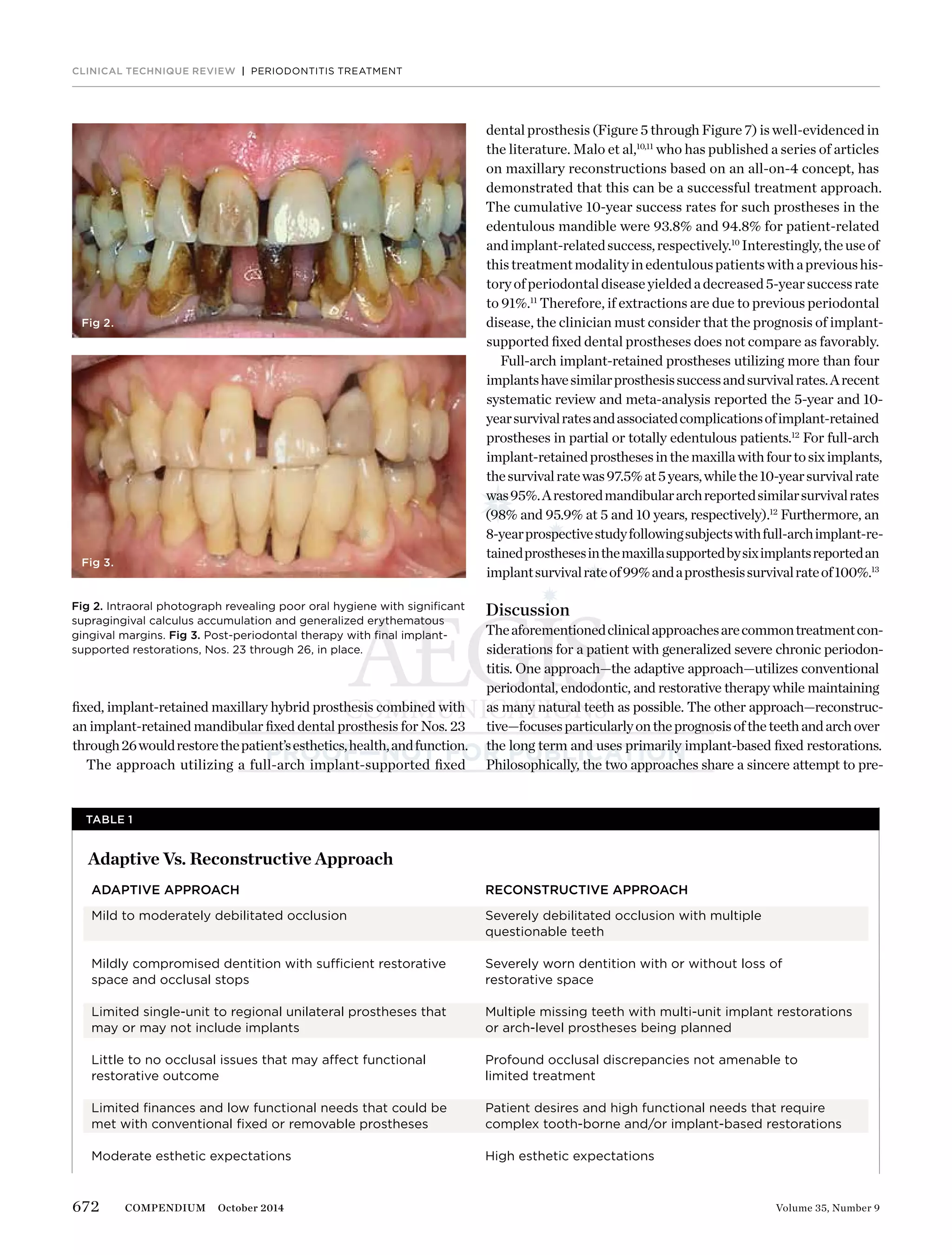
www.compendiumlive.com
vent breakdown of the stomatognathic system. One focuses on the
preservationofteethandstabilityofperiodontium(bone,periodontal
ligament,andcementum)whiletheotherfocusesonestablishinglong-
term stability of the occlusion. Both are likely to enable the optimal
functionofthestomatognathicsystemcomprisingthetemporoman-
dibular joints, neuromusculature, teeth, and periodontium, with the
majordifferencebetweenapproachesbeingtherestorativecomplica-
tions that may occur over time. With the adaptive approach, further
periodontal destruction and loss of teeth in the future may result in
significantrestorativeneedsandmayrenderexistingimplant-borne
prosthesisuselessduetoinappropriateplatformlocationorpooran-
gulation(Figure4).Implantsplacedwhenteethwerestillpresentmay
nolongerbeinthecorrectlocationformoreextensiveprostheses,and,
insomecases,previouslyplacedimplantsmayhavetoberemovedin
ordertoallowforproperreconstructionofthedentition. 
Theadaptiveandreconstructiveapproachespresentedforthispa-
tienteachoffersdistinctadvantagesanddisadvantages.Maintaining
natural teeth, as would be the case with the adaptive treatment
approach, has potential advantages over extraction. Esthetics of
naturalteethismorepredictable,whileprostheticteetharesubject
to greater patient criticism. Extraction of multiple teeth at once
may also have psychological implications, with many patients un-
willingtoacceptthiscourseoftreatment.Finally,avoidingimplant
placementwillpreventthepossibilityofperi-implantbonelossand
subsequent treatment for potential peri-implant disease.
Disadvantages also exist when considering long-term mainte-
nance of questionable teeth. Keeping teeth with advanced attach-
ment loss and pathologic tooth migration may not be esthetically
acceptabletothepatient.Inpatientswithahistoryofadvancedperi-
odontaldisease,maintenanceproceduresonareducedperiodontium
may slow the progression of bone loss. However, recurrence of peri-
odontitisispossibleinthefutureand,asaconsequenceofincreased
boneloss,unpredictabletoothlosspatternandabutmenttoothloss,
increasedcostsforprostheticconversions,increasedin-officevisits,
and eventual implant placement may be more complicated.
Implant placement in periodontally compromised patients has
been evaluated in the literature. Treating and maintaining peri-
odontallydiseasedteethofquestionableprognosishastobeputin
perspectivewiththeincreasedriskforfutureperi-implantitisand
possibleimplantfailure,whichcouldjeopardizeprostheticsuccess.
Emerging periodontal literature strongly associates an increased
risk of peri-implantitis in patients with a history of periodontal
Fig 4. Fig 5.
Fig 6.
Fig 4. Panoramic radiograph representing a patient that was likely restored using an adaptive approach rather than a reconstructive approach.
Note the different implant systems used, the differing levels of placement apico-occlusally, and the poor angulations. Now that the remaining
dentition has failed due to recurrent caries, a treatment planning problem is imminent if the current implants are to be utilized in the final full-
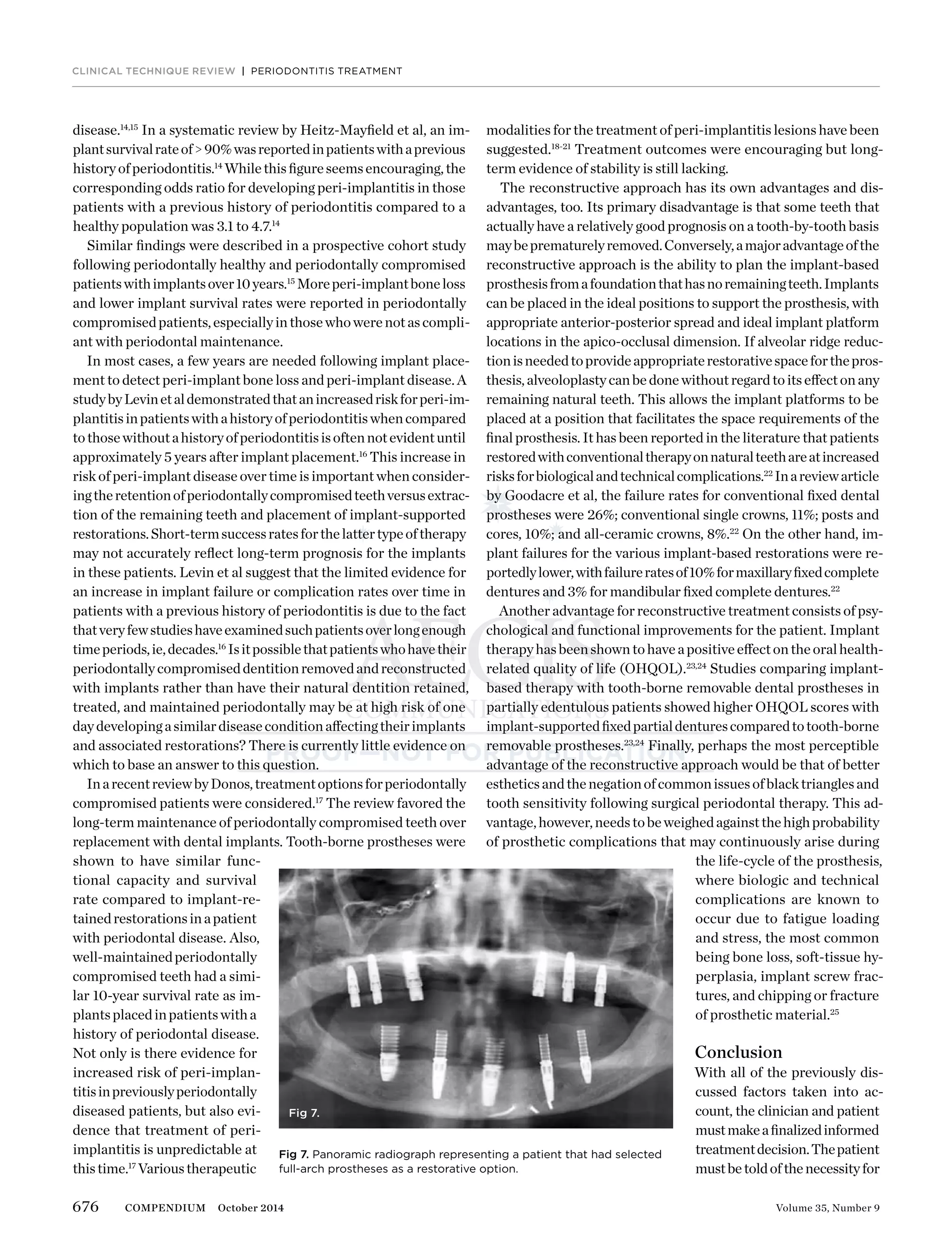
arch prosthesis. Fig 5. Occlusal view of the maxillary implant-supported fixed-detachable hybrid prosthesis. Note the even distribution of the
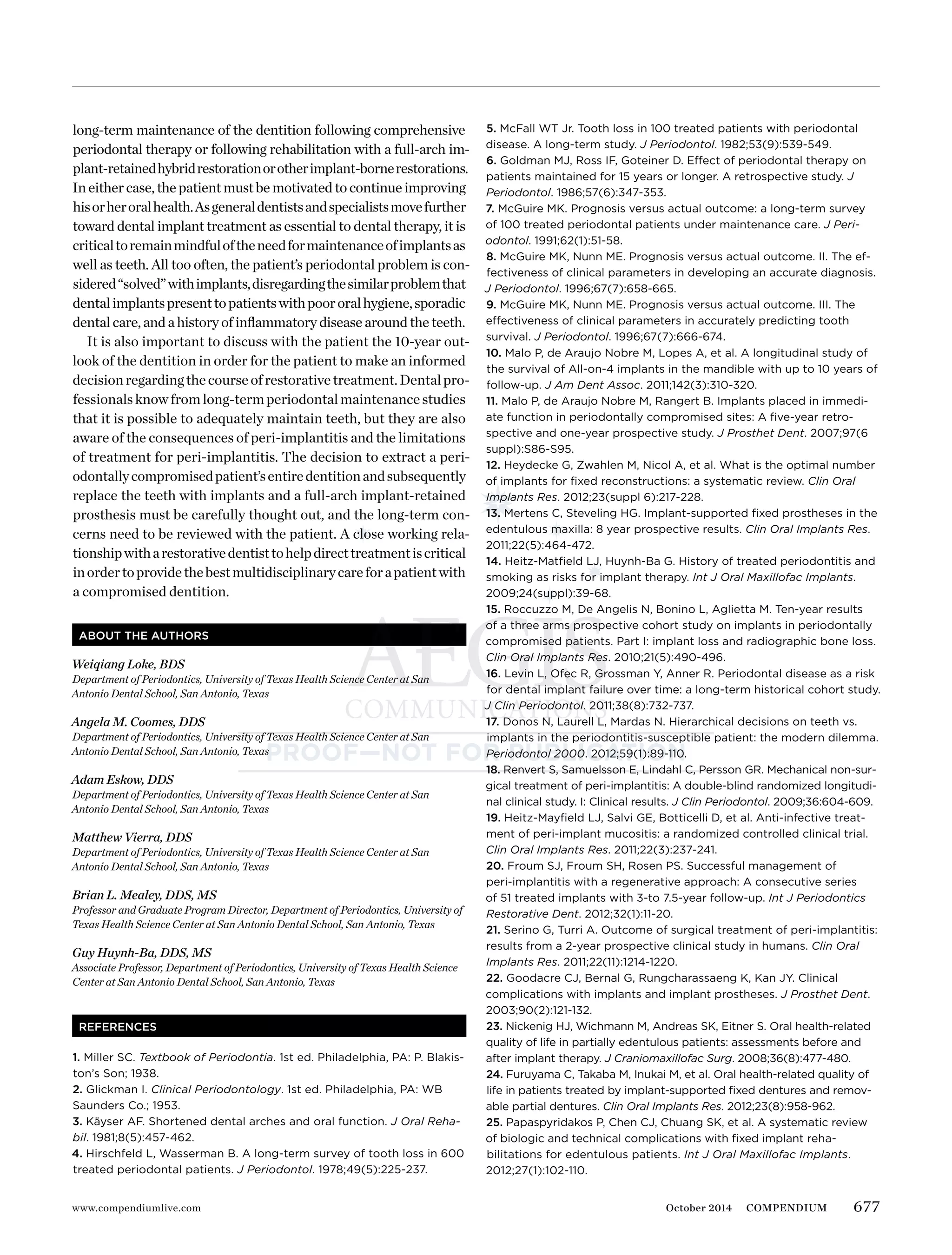
implants made possible through strategic hedging of ideal tooth sites to ensure good anterior-posterior spread and distribution. Fig 6. Frontal
view of the maxillary implant-supported fixed-detachable hybrid prosthesis. Note the apico-coronal placement of the implant platforms that
have resulted in an ideal prosthesis with adequate structural integrity.
676 Volume 35, Number 9COMPENDIUM October 2014
disease.14,15
In a systematic review by Heitz-Mayfield et al, an im-
plantsurvivalrateof>90%wasreportedinpatientswithaprevious
historyofperiodontitis.14
Whilethisfigureseemsencouraging,the
corresponding odds ratio for developing peri-implantitis in those
patients with a previous history of periodontitis compared to a
healthy population was 3.1 to 4.7.14
Similar findings were described in a prospective cohort study
following periodontally healthy and periodontally compromised
patientswithimplantsover10years.15
Moreperi-implantboneloss
and lower implant survival rates were reported in periodontally
compromisedpatients,especiallyinthosewhowerenotascompli-
ant with periodontal maintenance.
In most cases, a few years are needed following implant place-
ment to detect peri-implant bone loss and peri-implant disease. A
studybyLevinetaldemonstratedthatanincreasedriskforperi-im-
plantitisinpatientswithahistoryofperiodontitiswhencompared
tothosewithoutahistoryofperiodontitisisoftennotevidentuntil
approximately 5 years after implant placement.16
This increase in
risk of peri-implant disease over time is important when consider-
ingtheretentionofperiodontallycompromisedteethversusextrac-
tion of the remaining teeth and placement of implant-supported
restorations.Short-termsuccessratesforthelattertypeoftherapy
may not accurately reflect long-term prognosis for the implants
in these patients. Levin et al suggest that the limited evidence for
an increase in implant failure or complication rates over time in
patients with a previous history of periodontitis is due to the fact
thatveryfewstudieshaveexaminedsuchpatientsoverlongenough
timeperiods,ie,decades.16
Isitpossiblethatpatientswhohavetheir
periodontallycompromiseddentitionremovedandreconstructed
with implants rather than have their natural dentition retained,
treated, and maintained periodontally may be at high risk of one
daydevelopingasimilardiseaseconditionaffectingtheirimplants
and associated restorations? There is currently little evidence on
which to base an answer to this question.
InarecentreviewbyDonos,treatmentoptionsforperiodontally
compromised patients were considered.17
The review favored the
long-term maintenance of periodontally compromised teeth over
replacement with dental implants. Tooth-borne prostheses were
shown to have similar func-
tional capacity and survival
rate compared to implant-re-
tainedrestorationsinapatient
with periodontal disease. Also,
well-maintainedperiodontally
compromised teeth had a simi-
lar 10-year survival rate as im-
plantsplacedinpatientswitha
history of periodontal disease.
Not only is there evidence for
increased risk of peri-implan-
titisinpreviouslyperiodontally
diseased patients, but also evi-
dence that treatment of peri-
implantitis is unpredictable at
thistime.17
Varioustherapeutic
CLINICAL TECHNIQUE REVIEW | PERIODONTITIS TREATMENT
modalities for the treatment of peri-implantitis lesions have been
suggested.18-21
Treatment outcomes were encouraging but long-
term evidence of stability is still lacking.
The reconstructive approach has its own advantages and dis-
advantages, too. Its primary disadvantage is that some teeth that
actually have a relatively good prognosis on a tooth-by-tooth basis
maybeprematurelyremoved.Conversely,amajoradvantageofthe
reconstructive approach is the ability to plan the implant-based
prosthesisfromafoundationthathasnoremainingteeth.Implants
can be placed in the ideal positions to support the prosthesis, with
appropriate anterior-posterior spread and ideal implant platform
locations in the apico-occlusal dimension. If alveolar ridge reduc-
tionisneededtoprovideappropriaterestorativespaceforthepros-
thesis,alveoloplastycanbedonewithoutregardtoitseffectonany
remaining natural teeth. This allows the implant platforms to be
placed at a position that facilitates the space requirements of the
final prosthesis. It has been reported in the literature that patients
restoredwithconventionaltherapyonnaturalteethareatincreased
risksforbiologicalandtechnicalcomplications.22
Inareviewarticle
by Goodacre et al, the failure rates for conventional fixed dental
prostheses were 26%; conventional single crowns, 11%; posts and
cores, 10%; and all-ceramic crowns, 8%.22
On the other hand, im-
plant failures for the various implant-based restorations were re-
portedlylower,withfailureratesof10%formaxillaryfixedcomplete
dentures and 3% for mandibular fixed complete dentures.22
Another advantage for reconstructive treatment consists of psy-
chological and functional improvements for the patient. Implant
therapyhasbeenshowntohaveapositiveeffectontheoralhealth-
related quality of life (OHQOL).23,24
Studies comparing implant-
based therapy with tooth-borne removable dental prostheses in
partially edentulous patients showed higher OHQOL scores with
implant-supportedfixedpartialdenturescomparedtotooth-borne
removable prostheses.23,24
Finally, perhaps the most perceptible
advantage of the reconstructive approach would be that of better
estheticsandthenegationofcommonissuesofblacktrianglesand
tooth sensitivity following surgical periodontal therapy. This ad-
vantage,however,needstobeweighedagainstthehighprobability
of prosthetic complications that may continuously arise during
the life-cycle of the prosthesis,
where biologic and technical
complications are known to
occur due to fatigue loading
and stress, the most common
being bone loss, soft-tissue hy-
perplasia, implant screw frac-
tures, and chipping or fracture
of prosthetic material.25
Conclusion
With all of the previously dis-
cussed factors taken into ac-
count, the clinician and patient
mustmakeafinalizedinformed
treatmentdecision.Thepatient
mustbetoldofthenecessityfor
Fig 7.
Fig 7. Panoramic radiograph representing a patient that had selected
full-arch prostheses as a restorative option.
677www.compendiumlive.com October 2014 COMPENDIUM
long-term maintenance of the dentition following comprehensive
periodontal therapy or following rehabilitation with a full-arch im-
plant-retainedhybridrestorationorotherimplant-bornerestorations.
In either case, the patient must be motivated to continue improving
hisorheroralhealth.Asgeneraldentistsandspecialistsmovefurther
toward dental implant treatment as essential to dental therapy, it is
criticaltoremainmindfuloftheneedformaintenanceofimplantsas
well as teeth. All too often, the patient’s periodontal problem is con-
sidered“solved”withimplants,disregardingthesimilarproblemthat
dentalimplantspresenttopatientswithpoororalhygiene,sporadic
dental care, and a history of inflammatory disease around the teeth.
It is also important to discuss with the patient the 10-year out-
look of the dentition in order for the patient to make an informed
decisionregardingthecourseofrestorativetreatment.Dentalpro-
fessionalsknowfromlong-termperiodontalmaintenancestudies
that it is possible to adequately maintain teeth, but they are also
aware of the consequences of peri-implantitis and the limitations
of treatment for peri-implantitis. The decision to extract a peri-
odontallycompromisedpatient’sentiredentitionandsubsequently
replace the teeth with implants and a full-arch implant-retained
prosthesis must be carefully thought out, and the long-term con-
cerns need to be reviewed with the patient. A close working rela-
tionshipwitharestorativedentisttohelpdirecttreatmentiscritical
inordertoprovidethebestmultidisciplinarycareforapatientwith
a compromised dentition.
ABOUT THE AUTHORS
Weiqiang Loke, BDS
Department of Periodontics, University of Texas Health Science Center at San
Antonio Dental School, San Antonio, Texas
Angela M. Coomes, DDS
Department of Periodontics, University of Texas Health Science Center at San
Antonio Dental School, San Antonio, Texas
Adam Eskow, DDS
Department of Periodontics, University of Texas Health Science Center at San
Antonio Dental School, San Antonio, Texas
Matthew Vierra, DDS
Department of Periodontics, University of Texas Health Science Center at San
Antonio Dental School, San Antonio, Texas
Brian L. Mealey, DDS, MS
Professor and Graduate Program Director, Department of Periodontics, University of
Texas Health Science Center at San Antonio Dental School, San Antonio, Texas
Guy Huynh-Ba, DDS, MS
Associate Professor, Department of Periodontics, University of Texas Health Science
Center at San Antonio Dental School, San Antonio, Texas
REFERENCES
1. Miller SC. Textbook of Periodontia. 1st ed. Philadelphia, PA: P. Blakis-
ton’s Son; 1938.
2. Glickman I. Clinical Periodontology. 1st ed. Philadelphia, PA: WB
Saunders Co.; 1953.
3. Käyser AF. Shortened dental arches and oral function. J Oral Reha-
bil. 1981;8(5):457-462.
4. Hirschfeld L, Wasserman B. A long-term survey of tooth loss in 600
treated periodontal patients. J Periodontol. 1978;49(5):225-237.
5. McFall WT Jr. Tooth loss in 100 treated patients with periodontal
disease. A long-term study. J Periodontol. 1982;53(9):539-549.
6. Goldman MJ, Ross IF, Goteiner D. Effect of periodontal therapy on
patients maintained for 15 years or longer. A retrospective study. J
Periodontol. 1986;57(6):347-353.
7. McGuire MK. Prognosis versus actual outcome: a long-term survey
of 100 treated periodontal patients under maintenance care. J Peri-
odontol. 1991;62(1):51-58.
8. McGuire MK, Nunn ME. Prognosis versus actual outcome. II. The ef-
fectiveness of clinical parameters in developing an accurate diagnosis.
J Periodontol. 1996;67(7):658-665.
9. McGuire MK, Nunn ME. Prognosis versus actual outcome. III. The
effectiveness of clinical parameters in accurately predicting tooth
survival. J Periodontol. 1996;67(7):666-674.
10. Malo P, de Araujo Nobre M, Lopes A, et al. A longitudinal study of
the survival of All-on-4 implants in the mandible with up to 10 years of
follow-up. J Am Dent Assoc. 2011;142(3):310-320.
11. Malo P, de Araujo Nobre M, Rangert B. Implants placed in immedi-
ate function in periodontally compromised sites: A five-year retro-
spective and one-year prospective study. J Prosthet Dent. 2007;97(6
suppl):S86-S95.
12. Heydecke G, Zwahlen M, Nicol A, et al. What is the optimal number
of implants for fixed reconstructions: a systematic review. Clin Oral
Implants Res. 2012;23(suppl 6):217-228.
13. Mertens C, Steveling HG. Implant-supported fixed prostheses in the
edentulous maxilla: 8 year prospective results. Clin Oral Implants Res.
2011;22(5):464-472.
14. Heitz-Matfield LJ, Huynh-Ba G. History of treated periodontitis and
smoking as risks for implant therapy. Int J Oral Maxillofac Implants.
2009;24(suppl):39-68.
15. Roccuzzo M, De Angelis N, Bonino L, Aglietta M. Ten-year results
of a three arms prospective cohort study on implants in periodontally
compromised patients. Part I: implant loss and radiographic bone loss.
Clin Oral Implants Res. 2010;21(5):490-496.
16. Levin L, Ofec R, Grossman Y, Anner R. Periodontal disease as a risk
for dental implant failure over time: a long-term historical cohort study.
J Clin Periodontol. 2011;38(8):732-737.
17. Donos N, Laurell L, Mardas N. Hierarchical decisions on teeth vs.
implants in the periodontitis-susceptible patient: the modern dilemma.
Periodontol 2000. 2012;59(1):89-110.
18. Renvert S, Samuelsson E, Lindahl C, Persson GR. Mechanical non-sur-
gical treatment of peri-implantitis: A double-blind randomized longitudi-
nal clinical study. I: Clinical results. J Clin Periodontol. 2009;36:604-609.
19. Heitz-Mayfield LJ, Salvi GE, Botticelli D, et al. Anti-infective treat-
ment of peri-implant mucositis: a randomized controlled clinical trial.
Clin Oral Implants Res. 2011;22(3):237-241.
20. Froum SJ, Froum SH, Rosen PS. Successful management of
peri-implantitis with a regenerative approach: A consecutive series
of 51 treated implants with 3-to 7.5-year follow-up. Int J Periodontics
Restorative Dent. 2012;32(1):11-20.
21. Serino G, Turri A. Outcome of surgical treatment of peri-implantitis:
results from a 2-year prospective clinical study in humans. Clin Oral
Implants Res. 2011;22(11):1214-1220.
22. Goodacre CJ, Bernal G, Rungcharassaeng K, Kan JY. Clinical
complications with implants and implant prostheses. J Prosthet Dent.
2003;90(2):121-132.
23. Nickenig HJ, Wichmann M, Andreas SK, Eitner S. Oral health-related
quality of life in partially edentulous patients: assessments before and
after implant therapy. J Craniomaxillofac Surg. 2008;36(8):477-480.
24. Furuyama C, Takaba M, Inukai M, et al. Oral health-related quality of
life in patients treated by implant-supported fixed dentures and remov-
able partial dentures. Clin Oral Implants Res. 2012;23(8):958-962.
25. Papaspyridakos P, Chen CJ, Chuang SK, et al. A systematic review
of biologic and technical complications with fixed implant reha-
bilitations for edentulous patients. Int J Oral Maxillofac Implants.
2012;27(1):102-110.

Compendium_Clin_Technique_Loke_

  • 1.
    668 Volume 35,Number 9COMPENDIUM October 2014 W hen treating a periodontally compromised pa- tientwithrestorativeneeds,cliniciansareoften faced with a dilemma of retaining teeth with questionableperiodontalprognosisorextract- ingthemandprovidingtoothreplacement.Ad- dressingthesetypesofperiodontal–restorativetreatmentplanning issues is often predicated on the dental philosophy, background, and training of the practitioner. Oftentimes, treatment planning is limited by a tooth-by-tooth prognosis rather than a global prognosis; this is due mainly to pa- tient financial constraints and, at times, limited expertise on the partofthepractitioner.Thislimitationmayresultincompromised esthetics, phonetics, and/or function. Themultidisciplinaryglobal-levelphilosophy,whichtheauthors call the “reconstructive” treatment approach, is a restoratively driven approach that takes into account tooth-, arch-, and patient- levelprognoses.Withthisapproachhierarchalconsiderationsare made in formulating a global prognosis and comprehensive treat- ment plan. That is, at 1) tooth-level, findings are important for establishing restorative and periodontal stability in patients with limited restorative needs in a relatively intact dental arch; 2) arch- level,findingshelpestablishocclusalstabilityinpatientswithhigh restorative needs in a compromised dental arch; and 3) patient- level, findings are key for establishing stomatognathic stability and longevity of reconstructions in patients with a severely com- promised dentition. With the widespread use of dental implants, a global treatment planning approach is necessary to fulfill the long-term restorative needs of the patient. Problemsarisewhenthereconstructiveapproachisdisregarded, wherebysomeperiodontallyquestionableteetharemaintainedand others are extracted and replaced with dental implant-supported restorationswithoutappropriateregardforthelong-termpotential problemsthatmayoccurifmoreteetheventuallyrequireextraction. Iffurthertoothextractionandreplacementwithimplantsisneeded andisdoneonatooth-by-toothbasis,discrepanciesintheanterior- posterior and apico-coronal implant locations, inappropriate pre- scriptioninthenumberofimplants,useofmultipleimplantsystems, compromised occlusal schemes, and questionable prognosis of the remaining dentition may complicate future treatment planning. But, when the focus is mainly set on a tooth-level, arresting the breakdownoftheperiodontiumoftheindividualteethandassociated restorationsbecomestheprimarygoal.Thiswell-documentedtreat- mentapproachhassuccessfullydemonstratedthattheperiodontally compromised dentition can be maintained over the long term with Abstract: The clinician faces treatment planning challenges when patients present with generalized severe chronic periodontitis that may result in tooth loss. This article provides a treatment planning discussion along with approaches for treating such patients. It presents the clinical question: What is the best means for approaching treatment planning in a patient with severe periodontitis requiring extraction and replacement of some teeth? Two treatment approaches are discussed—a reconstructive approach versus an adaptive one—both of which have an end goal of achieving periodontal health and occlusal stability, and each has its own advantages and disadvantages. In conclusion, utilizing a global prognostic approach will assist clinicians anticipate the eventual restorative needs of patients and pre- scribe customized periodontal and restorative therapies that best address those needs. Formulating a Global Prognosis and Treatment Plan for the Periodontally Compromised Patient: A Reconstructive Vs. an Adaptive Approach Weiqiang Loke, BDS; Angela M. Coomes, DDS; Adam Eskow, DDS; Matthew Vierra, DDS; Brian L. Mealey, DDS, MS; and Guy Huynh-Ba, DDS, MS CLINICAL TECHNIQUE REVIEW PERIODONTITIS TREATMENT
  • 2.
    669www.compendiumlive.com October 2014COMPENDIUM appropriate patient control of local and systemic factors in conjunc- tion with regular professional evaluation and maintenance. This approach offers the patient much therapeutic value and would less likelycomplicaterestorativetreatmentplanningforpatientswhoonly requireconventionalnon-implant–basedrestorativetherapy.Theau- thorsrefertothisasthe“adaptive”treatmentapproach,asitgenerally adaptsrestorativecaretothepatient’sexistingteethandarchform. Case Presentation Apatientscenarioispresentedthatoffersthought-provokingtreat- mentconsiderations.Treatmentcouldeasilyfolloweithertheadap- tive or reconstructive approach to satisfy the patient’s desires and result in the best long-term solution. ThepatientpresentedattheUniversityofBernintheDepartment of Periodontology and Fixed Prosthodontics in May 2003. Upon comprehensive initial examination of the 58-year-old Caucasian male, a diagnosis of generalized severe chronic periodontitis was assigned (Figure 1 and Figure 2). The patient’s medical history was non-contributory. The patient reported smoking a pack of cigarettesperdayforthepast30years.Oralhygienewasextremely poor; the patient had neglected his oral health for many years. TeethNos.1through3,14through16,and25weremissing.Probing depthsrangedfrom2mmto10mm,whileattachmentlevelsranged from 3 mm to 12 mm, with significant bleeding on probing. Class 2 Miller’smobility1 wasnotedforteethNos.18,23,24,and26.Allteeth tested vital to cold, and Grade 3 Glickman furcation involvement2 was noted on teeth Nos. 17 through 19 and 30 through 32. An assess- mentofthepatient’ssystemichealth,age,behavioral/psychological status, socioeconomic status, and esthetic and functional goals was completed and taken into account in the prescribed treatment plan. Clinical Approaches Thispatientscenariopresentsacommontreatmentplanningdilemma. In cases of generalized severe chronic periodontal destruction, dif- ferencesintreatmentmethodologymaybehighlightedthroughtwo somewhatantagonisticapproaches:reconstructiveversusadaptive. Anadaptiveapproachischaracterizedbyconservativeretention of teeth deemed to have a good-to-questionable prognosis and utilizinglimitedrestorativetherapythatmayconsistofremovable and/or fixed conventional/implant-based restorative prostheses. The reconstructive approach, on the other hand, is typically char- acterizedbyamoreinterceptiveandprostheticallydriventherapy whereby questionable teeth are extracted early to make way for implant-basedrestorativeprostheses.Thedifferencesbetweenthe adaptiveandreconstructiveapproachesaresummarizedinTable1. On one side, the reconstructive approach calls for a more oc- clusally and biomechanically stable therapeutic endpoint through prosthetically driven therapies, including total odontectomy with alveoloplasty for prosthetic rehabilitation. On the other side, an adaptiveandmoreconservativeapproachaimsatarrestingdisease progression through traditional periodontal surgical intervention andmaintenanceoftheexistingdentition.Thesetwotreatmentap- proachesillustratedifferentpathstocommongoals:oralhealthand occlusalstability.Theprovenclinicalsuccessofperiodontaltherapy andmaintenancesupportstheadaptivetreatmentapproachthatis oftenoverlookedbypractitionersseekingtoestablishanarch-level implant-restorativesolutionatthecostofsalvageableteeth,which, at best, may achieve similar long-term outcomes. There are merits tobotharguments,aswillbediscussedinthefollowingparagraphs. Itshouldbenotedthat,dependingonthecomplexityofacase,both treatmentapproachesmayrequireamultidisciplinaryteamstrategy involving different specialties (eg, periodontics, orthodontics, end- odontics, and oral surgery) to ensure a comprehensive assessment of the case prior to treatment planning. An adaptive approach to treatment consists of comprehensive periodontaltherapy,extractionofhopelessteeth,followedbyrestor- ativetherapy.Inthepresentcase,basedontheclinicalexamination (includingpatient’sfull-mouthperiodontalchart),radiographs,and clinical photographs (Figure 1 and Figure 2) obtained, it was evi- dentthatteethNos.17through19and30through32hadahopeless prognosisduetosevereboneloss,thoroughfurcationinvolvements, and dento-alveolar extrusion. All other teeth were considered to have a fair-to-poor prognosis with periodontal therapy. The restor- ative options given to the patient included extraction of all remain- ing maxillary teeth and reconstruction with an implant-retained or implant-supported fixed or removable prosthesis. Instead, the patient elected to retain all questionable teeth in both arches and extractionofhishopelessteeth,choosingtomaintainasmanyofhis naturalteethaspossible;heelectednottohaveanyreplacementfor hisposteriorteeth.Thisrestorativeplanwasbasedontheshortened dentalarchphilosophy.3 Periodontaltherapyforthepatientincluded four quadrants of scaling and root planing, extraction of teeth Nos. 17 through 19 and 30 through 32 due to hopeless periodontal prog- nosis. Periodontal re-evaluation at 8 weeks showed dramatic im- provementsinoralhygieneefforts,withminimalgingivalerythema and bleeding on probing only at sites with deeper probing depths. Periodontal surgery followed, which included open-flap debride- mentwithlimitedosteoplastyandregenerationusingtheprinciples of guided tissue regeneration at site No. 10. The patient was then seen for periodontal maintenance at 3-month intervals, which demonstrated maintainable pockets of 3mmto4mm,althoughmobilityofNos.24and26increased.Upon re-evaluation at the maintenance phase, a second-phase restor- ative treatment plan was accepted by the patient, which included extractions of Nos. 24 and 26 and implant placement at these cor- responding sites. Restorative treatment ensued and the patient eventually received implant-supported fixed dental prostheses to replace teeth Nos. 23 through 26 (Figure 3). Support for this approach in treating the patient is provided by research showing that periodontal treatment of a periodontally compromised dentition has relatively predictable outcomes over- all. Classic studies have shown that 62% to 83% of teeth are well- maintained with minimal tooth loss over 15 to 22 years in chronic periodontitispatientswhoreceiveperiodontaltreatmentandmain- tenanceevery4to6months.4-6 Eachoftheselong-termstudiesdem- onstrates that a small number of patients exhibit progression of periodontal destruction despite optimal therapy and maintenance (4%extremedownhillpatientswholost10to23teeth,13%downhill patients who lost 4 to 9 teeth). It is this risk for progressive disease thatmaycauseclinicianstore-evaluatethetraditionalapproachto
  • 3.
    670 Volume 35,Number 9COMPENDIUM October 2014 CLINICAL TECHNIQUE REVIEW | PERIODONTITIS TREATMENT managing such patients, especially when dental implants become part of the restorative treatment plan. Analternativeapproachtotreatingthesamepatientwhodesires fixed restorative solutions or implant-retained/supported therapy would be to initiate the treatment planning process using a recon- structive approach that prioritizes the most efficient and effective restorative solutions for the patient as the primary consideration. Thisapproachtakesintoaccounttheprognosesateachofthethree aforementionedlevels(ie,tooth-level,arch-level,andpatient-level). These tooth-level (ie, endodontics, periodontics, prosthodontics, orthodontics) and arch-level(ie,periodontics-prosthodontics,oral surgery-orthodontics)prognosticassessmentsmayincludethepre- sentingtoothanatomy,toothstructure,periodontium,pulpalsystem, archform,archrelation,spacedistribution,alignmentofteeth,and statusofexistingrestorationsordefects.Theseassessmentsshould thenbe correlated withpatient-levelassessments,largelycentered on the patient’s biologic, biomechanical, social, environmental, es- thetic, financial, and psychological risk profiles. Beforearrivingatadecisionwhethertoextractorretainatoothor teeth,theclinicianshoulddevelopaglobalprognosisofthepatient, takingintoaccounttheprojectedfutureneedsandrisksthatmayaf- fectlong-termtreatmentoutcomes.Allocatinganaccurateprogno- sisforeachindividualtoothandfortheentiredentitionisadifficult task, and research demonstrates that prognostication is an impre- cise process that often leads to erroneous conclusions.7-9 However, whenrestorativetherapyincludesimplants,itisparamountthatthe clinician bases prognostic decisions on patient-level risk profiles (biologic, esthetic, biomechanical, caries, etc.) that may directly impactthefutureofthepatient’sfinalrestorativescheme.Implants placed in one position today to replace a single tooth may end up beinginacompletelyincorrectlocationinthefutureshouldfurther tooth loss occur and a more extensive restorative plan be required (Figure4).Theundesirableresultsofatooth-by-toothreplacement strategy, including inappropriate number and poor distribution of implants, can be avoided if patient-level and arch-level consider- ations override tooth-level considerations. Hence, the reconstructive treatment approach is built upon the pertinentregionaltooth-relatedandarch-relatedissuesinrestoring thepatientbacktohealth,ratherthanbeingfocusedonthetooth-level prognoses(Table1).Theoverridingpatient-levelconsiderationsand restorativeneeds,beingabovethoseofarch-levelandtooth-levelas- sessments,drivesthecliniciantoconsiderandanticipatealternative restorativesolutionsneededforthepatient(reconstructivetherapy versusadaptivetherapy).Thistreatmentplanningapproachsatisfies therationalizationfortoothextractionorretentionwhileatthesame timeaffordingcriticalbiomechanicalconsiderations,suchasoptimal implant distribution (anterior-posterior spread, minimizing distal cantilever)andpositioning,tobefactoredintotreatmentplanningfor theeventualimplant-basedrestorativeneedsofpatientswithasevere periodontallycompromiseddentition.Thereconstructiveapproach wouldresultintotalodontectomyofthemaxillaryarchwithretention oftheposteriormandibularteethandmandibularcanines.Afull-arch, Fig 1. Full-mouth periapical x-rays revealing generalized severe horizontal bone loss in the maxilla and the mandible. Fig 1.
  • 4.
    672 Volume 35,Number 9COMPENDIUM October 2014 CLINICAL TECHNIQUE REVIEW | PERIODONTITIS TREATMENT fixed, implant-retained maxillary hybrid prosthesis combined with an implant-retained mandibular fixed dental prosthesis for Nos. 23 through26wouldrestorethepatient’sesthetics,health,andfunction. The approach utilizing a full-arch implant-supported fixed TABLE 1 Adaptive Vs. Reconstructive Approach ADAPTIVE APPROACH Mild to moderately debilitated occlusion Mildly compromised dentition with sufficient restorative space and occlusal stops Limited single-unit to regional unilateral prostheses that may or may not include implants Little to no occlusal issues that may affect functional restorative outcome Limited finances and low functional needs that could be met with conventional fixed or removable prostheses Moderate esthetic expectations RECONSTRUCTIVE APPROACH Severely debilitated occlusion with multiple questionable teeth Severely worn dentition with or without loss of restorative space Multiple missing teeth with multi-unit implant restorations or arch-level prostheses being planned Profound occlusal discrepancies not amenable to limited treatment Patient desires and high functional needs that require complex tooth-borne and/or implant-based restorations High esthetic expectations Fig 2. Fig 3. Fig 2. Intraoral photograph revealing poor oral hygiene with significant supragingival calculus accumulation and generalized erythematous gingival margins. Fig 3. Post-periodontal therapy with final implant- supported restorations, Nos. 23 through 26, in place. dental prosthesis (Figure 5 through Figure 7) is well-evidenced in the literature. Malo et al,10,11 who has published a series of articles on maxillary reconstructions based on an all-on-4 concept, has demonstrated that this can be a successful treatment approach. The cumulative 10-year success rates for such prostheses in the edentulous mandible were 93.8% and 94.8% for patient-related andimplant-relatedsuccess,respectively.10 Interestingly,theuseof thistreatmentmodalityinedentulouspatientswithaprevioushis- toryofperiodontaldiseaseyieldedadecreased5-yearsuccessrate to 91%.11 Therefore, if extractions are due to previous periodontal disease, the clinician must consider that the prognosis of implant- supported fixed dental prostheses does not compare as favorably. Full-arch implant-retained prostheses utilizing more than four implantshavesimilarprosthesissuccessandsurvivalrates.Arecent systematic review and meta-analysis reported the 5-year and 10- yearsurvivalratesandassociatedcomplicationsofimplant-retained prostheses in partial or totally edentulous patients.12 For full-arch implant-retainedprosthesesinthemaxillawithfourtosiximplants, thesurvivalratewas97.5%at5years,whilethe10-yearsurvivalrate was95%.Arestoredmandibulararchreportedsimilarsurvivalrates (98% and 95.9% at 5 and 10 years, respectively).12 Furthermore, an 8-yearprospectivestudyfollowingsubjectswithfull-archimplant-re- tainedprosthesesinthemaxillasupportedbysiximplantsreportedan implantsurvivalrateof99%andaprosthesissurvivalrateof100%.13 Discussion Theaforementionedclinicalapproachesarecommontreatmentcon- siderations for a patient with generalized severe chronic periodon- titis. One approach—the adaptive approach—utilizes conventional periodontal, endodontic, and restorative therapy while maintaining as many natural teeth as possible. The other approach—reconstruc- tive—focusesparticularlyontheprognosisoftheteethandarchover the long term and uses primarily implant-based fixed restorations. Philosophically, the two approaches share a sincere attempt to pre-
  • 5.
    www.compendiumlive.com vent breakdown ofthe stomatognathic system. One focuses on the preservationofteethandstabilityofperiodontium(bone,periodontal ligament,andcementum)whiletheotherfocusesonestablishinglong- term stability of the occlusion. Both are likely to enable the optimal functionofthestomatognathicsystemcomprisingthetemporoman- dibular joints, neuromusculature, teeth, and periodontium, with the majordifferencebetweenapproachesbeingtherestorativecomplica- tions that may occur over time. With the adaptive approach, further periodontal destruction and loss of teeth in the future may result in significantrestorativeneedsandmayrenderexistingimplant-borne prosthesisuselessduetoinappropriateplatformlocationorpooran- gulation(Figure4).Implantsplacedwhenteethwerestillpresentmay nolongerbeinthecorrectlocationformoreextensiveprostheses,and, insomecases,previouslyplacedimplantsmayhavetoberemovedin ordertoallowforproperreconstructionofthedentition.  Theadaptiveandreconstructiveapproachespresentedforthispa- tienteachoffersdistinctadvantagesanddisadvantages.Maintaining natural teeth, as would be the case with the adaptive treatment approach, has potential advantages over extraction. Esthetics of naturalteethismorepredictable,whileprostheticteetharesubject to greater patient criticism. Extraction of multiple teeth at once may also have psychological implications, with many patients un- willingtoacceptthiscourseoftreatment.Finally,avoidingimplant placementwillpreventthepossibilityofperi-implantbonelossand subsequent treatment for potential peri-implant disease. Disadvantages also exist when considering long-term mainte- nance of questionable teeth. Keeping teeth with advanced attach- ment loss and pathologic tooth migration may not be esthetically acceptabletothepatient.Inpatientswithahistoryofadvancedperi- odontaldisease,maintenanceproceduresonareducedperiodontium may slow the progression of bone loss. However, recurrence of peri- odontitisispossibleinthefutureand,asaconsequenceofincreased boneloss,unpredictabletoothlosspatternandabutmenttoothloss, increasedcostsforprostheticconversions,increasedin-officevisits, and eventual implant placement may be more complicated. Implant placement in periodontally compromised patients has been evaluated in the literature. Treating and maintaining peri- odontallydiseasedteethofquestionableprognosishastobeputin perspectivewiththeincreasedriskforfutureperi-implantitisand possibleimplantfailure,whichcouldjeopardizeprostheticsuccess. Emerging periodontal literature strongly associates an increased risk of peri-implantitis in patients with a history of periodontal Fig 4. Fig 5. Fig 6. Fig 4. Panoramic radiograph representing a patient that was likely restored using an adaptive approach rather than a reconstructive approach. Note the different implant systems used, the differing levels of placement apico-occlusally, and the poor angulations. Now that the remaining dentition has failed due to recurrent caries, a treatment planning problem is imminent if the current implants are to be utilized in the final full- arch prosthesis. Fig 5. Occlusal view of the maxillary implant-supported fixed-detachable hybrid prosthesis. Note the even distribution of the implants made possible through strategic hedging of ideal tooth sites to ensure good anterior-posterior spread and distribution. Fig 6. Frontal view of the maxillary implant-supported fixed-detachable hybrid prosthesis. Note the apico-coronal placement of the implant platforms that have resulted in an ideal prosthesis with adequate structural integrity.
  • 6.
    676 Volume 35,Number 9COMPENDIUM October 2014 disease.14,15 In a systematic review by Heitz-Mayfield et al, an im- plantsurvivalrateof>90%wasreportedinpatientswithaprevious historyofperiodontitis.14 Whilethisfigureseemsencouraging,the corresponding odds ratio for developing peri-implantitis in those patients with a previous history of periodontitis compared to a healthy population was 3.1 to 4.7.14 Similar findings were described in a prospective cohort study following periodontally healthy and periodontally compromised patientswithimplantsover10years.15 Moreperi-implantboneloss and lower implant survival rates were reported in periodontally compromisedpatients,especiallyinthosewhowerenotascompli- ant with periodontal maintenance. In most cases, a few years are needed following implant place- ment to detect peri-implant bone loss and peri-implant disease. A studybyLevinetaldemonstratedthatanincreasedriskforperi-im- plantitisinpatientswithahistoryofperiodontitiswhencompared tothosewithoutahistoryofperiodontitisisoftennotevidentuntil approximately 5 years after implant placement.16 This increase in risk of peri-implant disease over time is important when consider- ingtheretentionofperiodontallycompromisedteethversusextrac- tion of the remaining teeth and placement of implant-supported restorations.Short-termsuccessratesforthelattertypeoftherapy may not accurately reflect long-term prognosis for the implants in these patients. Levin et al suggest that the limited evidence for an increase in implant failure or complication rates over time in patients with a previous history of periodontitis is due to the fact thatveryfewstudieshaveexaminedsuchpatientsoverlongenough timeperiods,ie,decades.16 Isitpossiblethatpatientswhohavetheir periodontallycompromiseddentitionremovedandreconstructed with implants rather than have their natural dentition retained, treated, and maintained periodontally may be at high risk of one daydevelopingasimilardiseaseconditionaffectingtheirimplants and associated restorations? There is currently little evidence on which to base an answer to this question. InarecentreviewbyDonos,treatmentoptionsforperiodontally compromised patients were considered.17 The review favored the long-term maintenance of periodontally compromised teeth over replacement with dental implants. Tooth-borne prostheses were shown to have similar func- tional capacity and survival rate compared to implant-re- tainedrestorationsinapatient with periodontal disease. Also, well-maintainedperiodontally compromised teeth had a simi- lar 10-year survival rate as im- plantsplacedinpatientswitha history of periodontal disease. Not only is there evidence for increased risk of peri-implan- titisinpreviouslyperiodontally diseased patients, but also evi- dence that treatment of peri- implantitis is unpredictable at thistime.17 Varioustherapeutic CLINICAL TECHNIQUE REVIEW | PERIODONTITIS TREATMENT modalities for the treatment of peri-implantitis lesions have been suggested.18-21 Treatment outcomes were encouraging but long- term evidence of stability is still lacking. The reconstructive approach has its own advantages and dis- advantages, too. Its primary disadvantage is that some teeth that actually have a relatively good prognosis on a tooth-by-tooth basis maybeprematurelyremoved.Conversely,amajoradvantageofthe reconstructive approach is the ability to plan the implant-based prosthesisfromafoundationthathasnoremainingteeth.Implants can be placed in the ideal positions to support the prosthesis, with appropriate anterior-posterior spread and ideal implant platform locations in the apico-occlusal dimension. If alveolar ridge reduc- tionisneededtoprovideappropriaterestorativespaceforthepros- thesis,alveoloplastycanbedonewithoutregardtoitseffectonany remaining natural teeth. This allows the implant platforms to be placed at a position that facilitates the space requirements of the final prosthesis. It has been reported in the literature that patients restoredwithconventionaltherapyonnaturalteethareatincreased risksforbiologicalandtechnicalcomplications.22 Inareviewarticle by Goodacre et al, the failure rates for conventional fixed dental prostheses were 26%; conventional single crowns, 11%; posts and cores, 10%; and all-ceramic crowns, 8%.22 On the other hand, im- plant failures for the various implant-based restorations were re- portedlylower,withfailureratesof10%formaxillaryfixedcomplete dentures and 3% for mandibular fixed complete dentures.22 Another advantage for reconstructive treatment consists of psy- chological and functional improvements for the patient. Implant therapyhasbeenshowntohaveapositiveeffectontheoralhealth- related quality of life (OHQOL).23,24 Studies comparing implant- based therapy with tooth-borne removable dental prostheses in partially edentulous patients showed higher OHQOL scores with implant-supportedfixedpartialdenturescomparedtotooth-borne removable prostheses.23,24 Finally, perhaps the most perceptible advantage of the reconstructive approach would be that of better estheticsandthenegationofcommonissuesofblacktrianglesand tooth sensitivity following surgical periodontal therapy. This ad- vantage,however,needstobeweighedagainstthehighprobability of prosthetic complications that may continuously arise during the life-cycle of the prosthesis, where biologic and technical complications are known to occur due to fatigue loading and stress, the most common being bone loss, soft-tissue hy- perplasia, implant screw frac- tures, and chipping or fracture of prosthetic material.25 Conclusion With all of the previously dis- cussed factors taken into ac- count, the clinician and patient mustmakeafinalizedinformed treatmentdecision.Thepatient mustbetoldofthenecessityfor Fig 7. Fig 7. Panoramic radiograph representing a patient that had selected full-arch prostheses as a restorative option.
  • 7.
    677www.compendiumlive.com October 2014COMPENDIUM long-term maintenance of the dentition following comprehensive periodontal therapy or following rehabilitation with a full-arch im- plant-retainedhybridrestorationorotherimplant-bornerestorations. In either case, the patient must be motivated to continue improving hisorheroralhealth.Asgeneraldentistsandspecialistsmovefurther toward dental implant treatment as essential to dental therapy, it is criticaltoremainmindfuloftheneedformaintenanceofimplantsas well as teeth. All too often, the patient’s periodontal problem is con- sidered“solved”withimplants,disregardingthesimilarproblemthat dentalimplantspresenttopatientswithpoororalhygiene,sporadic dental care, and a history of inflammatory disease around the teeth. It is also important to discuss with the patient the 10-year out- look of the dentition in order for the patient to make an informed decisionregardingthecourseofrestorativetreatment.Dentalpro- fessionalsknowfromlong-termperiodontalmaintenancestudies that it is possible to adequately maintain teeth, but they are also aware of the consequences of peri-implantitis and the limitations of treatment for peri-implantitis. The decision to extract a peri- odontallycompromisedpatient’sentiredentitionandsubsequently replace the teeth with implants and a full-arch implant-retained prosthesis must be carefully thought out, and the long-term con- cerns need to be reviewed with the patient. A close working rela- tionshipwitharestorativedentisttohelpdirecttreatmentiscritical inordertoprovidethebestmultidisciplinarycareforapatientwith a compromised dentition. ABOUT THE AUTHORS Weiqiang Loke, BDS Department of Periodontics, University of Texas Health Science Center at San Antonio Dental School, San Antonio, Texas Angela M. Coomes, DDS Department of Periodontics, University of Texas Health Science Center at San Antonio Dental School, San Antonio, Texas Adam Eskow, DDS Department of Periodontics, University of Texas Health Science Center at San Antonio Dental School, San Antonio, Texas Matthew Vierra, DDS Department of Periodontics, University of Texas Health Science Center at San Antonio Dental School, San Antonio, Texas Brian L. Mealey, DDS, MS Professor and Graduate Program Director, Department of Periodontics, University of Texas Health Science Center at San Antonio Dental School, San Antonio, Texas Guy Huynh-Ba, DDS, MS Associate Professor, Department of Periodontics, University of Texas Health Science Center at San Antonio Dental School, San Antonio, Texas REFERENCES 1. Miller SC. Textbook of Periodontia. 1st ed. Philadelphia, PA: P. Blakis- ton’s Son; 1938. 2. Glickman I. Clinical Periodontology. 1st ed. Philadelphia, PA: WB Saunders Co.; 1953. 3. Käyser AF. Shortened dental arches and oral function. J Oral Reha- bil. 1981;8(5):457-462. 4. Hirschfeld L, Wasserman B. A long-term survey of tooth loss in 600 treated periodontal patients. J Periodontol. 1978;49(5):225-237. 5. McFall WT Jr. Tooth loss in 100 treated patients with periodontal disease. A long-term study. J Periodontol. 1982;53(9):539-549. 6. Goldman MJ, Ross IF, Goteiner D. Effect of periodontal therapy on patients maintained for 15 years or longer. A retrospective study. J Periodontol. 1986;57(6):347-353. 7. McGuire MK. Prognosis versus actual outcome: a long-term survey of 100 treated periodontal patients under maintenance care. J Peri- odontol. 1991;62(1):51-58. 8. McGuire MK, Nunn ME. Prognosis versus actual outcome. II. The ef- fectiveness of clinical parameters in developing an accurate diagnosis. J Periodontol. 1996;67(7):658-665. 9. McGuire MK, Nunn ME. Prognosis versus actual outcome. III. The effectiveness of clinical parameters in accurately predicting tooth survival. J Periodontol. 1996;67(7):666-674. 10. Malo P, de Araujo Nobre M, Lopes A, et al. A longitudinal study of the survival of All-on-4 implants in the mandible with up to 10 years of follow-up. J Am Dent Assoc. 2011;142(3):310-320. 11. Malo P, de Araujo Nobre M, Rangert B. Implants placed in immedi- ate function in periodontally compromised sites: A five-year retro- spective and one-year prospective study. J Prosthet Dent. 2007;97(6 suppl):S86-S95. 12. Heydecke G, Zwahlen M, Nicol A, et al. What is the optimal number of implants for fixed reconstructions: a systematic review. Clin Oral Implants Res. 2012;23(suppl 6):217-228. 13. Mertens C, Steveling HG. Implant-supported fixed prostheses in the edentulous maxilla: 8 year prospective results. Clin Oral Implants Res. 2011;22(5):464-472. 14. Heitz-Matfield LJ, Huynh-Ba G. History of treated periodontitis and smoking as risks for implant therapy. Int J Oral Maxillofac Implants. 2009;24(suppl):39-68. 15. Roccuzzo M, De Angelis N, Bonino L, Aglietta M. Ten-year results of a three arms prospective cohort study on implants in periodontally compromised patients. Part I: implant loss and radiographic bone loss. Clin Oral Implants Res. 2010;21(5):490-496. 16. Levin L, Ofec R, Grossman Y, Anner R. Periodontal disease as a risk for dental implant failure over time: a long-term historical cohort study. J Clin Periodontol. 2011;38(8):732-737. 17. Donos N, Laurell L, Mardas N. Hierarchical decisions on teeth vs. implants in the periodontitis-susceptible patient: the modern dilemma. Periodontol 2000. 2012;59(1):89-110. 18. Renvert S, Samuelsson E, Lindahl C, Persson GR. Mechanical non-sur- gical treatment of peri-implantitis: A double-blind randomized longitudi- nal clinical study. I: Clinical results. J Clin Periodontol. 2009;36:604-609. 19. Heitz-Mayfield LJ, Salvi GE, Botticelli D, et al. Anti-infective treat- ment of peri-implant mucositis: a randomized controlled clinical trial. Clin Oral Implants Res. 2011;22(3):237-241. 20. Froum SJ, Froum SH, Rosen PS. Successful management of peri-implantitis with a regenerative approach: A consecutive series of 51 treated implants with 3-to 7.5-year follow-up. Int J Periodontics Restorative Dent. 2012;32(1):11-20. 21. Serino G, Turri A. Outcome of surgical treatment of peri-implantitis: results from a 2-year prospective clinical study in humans. Clin Oral Implants Res. 2011;22(11):1214-1220. 22. Goodacre CJ, Bernal G, Rungcharassaeng K, Kan JY. Clinical complications with implants and implant prostheses. J Prosthet Dent. 2003;90(2):121-132. 23. Nickenig HJ, Wichmann M, Andreas SK, Eitner S. Oral health-related quality of life in partially edentulous patients: assessments before and after implant therapy. J Craniomaxillofac Surg. 2008;36(8):477-480. 24. Furuyama C, Takaba M, Inukai M, et al. Oral health-related quality of life in patients treated by implant-supported fixed dentures and remov- able partial dentures. Clin Oral Implants Res. 2012;23(8):958-962. 25. Papaspyridakos P, Chen CJ, Chuang SK, et al. A systematic review of biologic and technical complications with fixed implant reha- bilitations for edentulous patients. Int J Oral Maxillofac Implants. 2012;27(1):102-110.