Anterior open bite associated
with breathing problems in an
adult patient: a case report
K. Siotou1, I. Christopoulou2, A. Apostolaki3, A.I. Tsolakis1,4
1Department of Orthodontics, National and Kapodistrian University of Athens
2Department of Metabolic Bone Diseases, National and Kapodistria University of Athens
3School of Dentist4Department of Orthodontics, Case Western Reserve University, Cleveland
ry, National and Kapodistrian University of Athens
Anterior open bite associated with breathing problems in an adult patient: a case report
Introduction: Anterior open bite is multifactorial and can be caused by parafunctional
habits, dental or skeletal factors. Early diagnosis of skeletal problems is important as, unlike
dental, they do not regress but often worsen, and usually in adults, their resolution requires a
combination of orthodontic and orthognathic surgery. The aim of this study is to highlight the
association of respiratory problems with anterior open bite in an adult patient.
Aim/ Methods: A patient, aged 38, sought orthodontic treatment at the Orthodontic
Department of the National and Kapodistrian University of Athens, referring to her medical
history respiratory problems. The patient underwent clinical and radiographic examination
and evaluation.
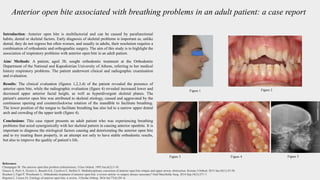
Results: The clinical evaluation (figures 1,2,3,4) of the patient revealed the presence of
anterior open bite, while the radiographic evaluation (figure 4) revealed increased lower and
decreased upper anterior facial height, as well as hyperdivergent skeletal planes. The
patient's anterior open bite was attributed to skeletal etiology, caused and aggravated by the
continuous opening and counterclockwise rotation of the mandible to facilitate breathing.
The lower position of the tongue to facilitate breathing has also led to a narrow upper dental
arch and crowding of the upper teeth (figure 4).
Conclusions: This case report presents an adult patient who was experiencing breathing
problems that acted synergistically with her skeletal pattern in causing anterior openbite. It is
important to diagnose the etiological factors causing and deteriorating the anterior open bite
and to try treating them properly, in an attempt not only to have stable orthodontic results,
but also to improve the quality of patient’s life.
Figure 1 Figure 2
Figure 4
Figure 3
References
Champagne M. The anterior open bite problem (infraclusion). J Gen Orthod. 1995 Jun;6(2):5-10.
Gracco A, Perri A, Siviero L, Bonetti GA, Cocilovo F, Stellini E. Multidisciplinary correction of anterior open bite relapse and upper airway obstruction. Korean J Orthod. 2015 Jan;45(1):47-56.
Reichert I, Figel P, Winchester L. Orthodontic treatment of anterior open bite: a review article--is surgery always necessary? Oral Maxillofac Surg. 2014 Sep;18(3):271-7.
Rijpstra C, Lisson JA. Etiology of anterior open bite: a review. J Orofac Orthop. 2016 Jul;77(4):281-6.
Figure 5

Pp openbite final

  • 1.
    Anterior open biteassociated with breathing problems in an adult patient: a case report K. Siotou1, I. Christopoulou2, A. Apostolaki3, A.I. Tsolakis1,4 1Department of Orthodontics, National and Kapodistrian University of Athens 2Department of Metabolic Bone Diseases, National and Kapodistria University of Athens 3School of Dentist4Department of Orthodontics, Case Western Reserve University, Cleveland ry, National and Kapodistrian University of Athens
  • 2.
    Anterior open biteassociated with breathing problems in an adult patient: a case report Introduction: Anterior open bite is multifactorial and can be caused by parafunctional habits, dental or skeletal factors. Early diagnosis of skeletal problems is important as, unlike dental, they do not regress but often worsen, and usually in adults, their resolution requires a combination of orthodontic and orthognathic surgery. The aim of this study is to highlight the association of respiratory problems with anterior open bite in an adult patient. Aim/ Methods: A patient, aged 38, sought orthodontic treatment at the Orthodontic Department of the National and Kapodistrian University of Athens, referring to her medical history respiratory problems. The patient underwent clinical and radiographic examination and evaluation. Results: The clinical evaluation (figures 1,2,3,4) of the patient revealed the presence of anterior open bite, while the radiographic evaluation (figure 4) revealed increased lower and decreased upper anterior facial height, as well as hyperdivergent skeletal planes. The patient's anterior open bite was attributed to skeletal etiology, caused and aggravated by the continuous opening and counterclockwise rotation of the mandible to facilitate breathing. The lower position of the tongue to facilitate breathing has also led to a narrow upper dental arch and crowding of the upper teeth (figure 4). Conclusions: This case report presents an adult patient who was experiencing breathing problems that acted synergistically with her skeletal pattern in causing anterior openbite. It is important to diagnose the etiological factors causing and deteriorating the anterior open bite and to try treating them properly, in an attempt not only to have stable orthodontic results, but also to improve the quality of patient’s life. Figure 1 Figure 2 Figure 4 Figure 3 References Champagne M. The anterior open bite problem (infraclusion). J Gen Orthod. 1995 Jun;6(2):5-10. Gracco A, Perri A, Siviero L, Bonetti GA, Cocilovo F, Stellini E. Multidisciplinary correction of anterior open bite relapse and upper airway obstruction. Korean J Orthod. 2015 Jan;45(1):47-56. Reichert I, Figel P, Winchester L. Orthodontic treatment of anterior open bite: a review article--is surgery always necessary? Oral Maxillofac Surg. 2014 Sep;18(3):271-7. Rijpstra C, Lisson JA. Etiology of anterior open bite: a review. J Orofac Orthop. 2016 Jul;77(4):281-6. Figure 5