The DentCare August 2019 7
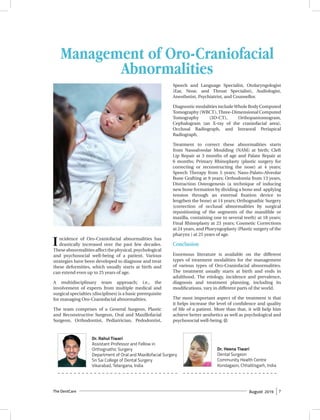
Incidence of Oro-Craniofacial abnormalities has
drastically increased over the past few decades.
Theseabnormalitiesaffectthephysical,psychological
and psychosocial well-being of a patient. Various
strategies have been developed to diagnose and treat
these deformities, which usually starts at birth and
can extend even up to 25 years of age.
A multidisciplinary team approach; i.e., the
involvement of experts from multiple medical and
surgical specialties (disciplines) is a basic prerequisite
for managing Oro-Craniofacial abnormalities.
The team comprises of a General Surgeon, Plastic
and Reconstructive Surgeon, Oral and Maxillofacial
Surgeon, Orthodontist, Pediatrician, Pedodontist,
Speech and Language Specialist, Otolaryngologist
(Ear, Nose, and Throat Specialist), Audiologist,
Anesthetist, Psychiatrist, and Counsellor.
Diagnostic modalities include Whole Body Computed
Tomography (WBCT), Three-Dimensional Computed
Tomography (3D-CT), Orthopantomogram,
Cephalogram (an X-ray of the craniofacial area),
Occlusal Radiograph, and Intraoral Periapical
Radiograph.
Treatment to correct these abnormalities starts
from Nasoalveolar Moulding (NAM) at birth; Cleft
Lip Repair at 3 months of age and Palate Repair at
6 months; Primary Rhinoplasty (plastic surgery for
correcting or reconstructing the nose) at 4 years;
Speech Therapy from 5 years; Naso-Palato-Alveolar
Bone Grafting at 9 years; Orthodontia from 13 years,
Distraction Osteogenesis (a technique of inducing
new bone formation by dividing a bone and applying
tension through an external fixation device to
lengthen the bone) at 14 years; Orthognathic Surgery
(correction of occlusal abnormalities by surgical
repositioning of the segments of the mandible or
maxilla, containing one to several teeth) at 18 years;
Final Rhinoplasty at 23 years; Cosmetic Corrections
at 24 years, and Pharyngoplasty (Plastic surgery of the
pharynx ) at 25 years of age.
Conclusion
Enormous literature is available on the different
types of treatment modalities for the management
of various types of Oro-Craniofacial abnormalities.
The treatment usually starts at birth and ends in
adulthood. The etiology, incidence and prevalence,
diagnosis and treatment planning, including its
modifications, vary in different parts of the world.
The most important aspect of the treatment is that
it helps increase the level of confidence and quality
of life of a patient. More than that, it will help him
achieve better aesthetics as well as psychological and
psychosocial well-being.
Dr. Heena Tiwari
Dental Surgeon
Community Health Centre
Kondagaon, Chhattisgarh, India
Dr. Rahul Tiwari
Assistant Professor and Fellow in
Orthognathic Surgery
Department of Oral and Maxillofacial Surgery
Sri Sai College of Dental Surgery
Vikarabad, Telangana, India
Management of Oro-Craniofacial
Abnormalities
DC

orocraniofacial anomlies

  • 1.
    The DentCare August2019 7 Incidence of Oro-Craniofacial abnormalities has drastically increased over the past few decades. Theseabnormalitiesaffectthephysical,psychological and psychosocial well-being of a patient. Various strategies have been developed to diagnose and treat these deformities, which usually starts at birth and can extend even up to 25 years of age. A multidisciplinary team approach; i.e., the involvement of experts from multiple medical and surgical specialties (disciplines) is a basic prerequisite for managing Oro-Craniofacial abnormalities. The team comprises of a General Surgeon, Plastic and Reconstructive Surgeon, Oral and Maxillofacial Surgeon, Orthodontist, Pediatrician, Pedodontist, Speech and Language Specialist, Otolaryngologist (Ear, Nose, and Throat Specialist), Audiologist, Anesthetist, Psychiatrist, and Counsellor. Diagnostic modalities include Whole Body Computed Tomography (WBCT), Three-Dimensional Computed Tomography (3D-CT), Orthopantomogram, Cephalogram (an X-ray of the craniofacial area), Occlusal Radiograph, and Intraoral Periapical Radiograph. Treatment to correct these abnormalities starts from Nasoalveolar Moulding (NAM) at birth; Cleft Lip Repair at 3 months of age and Palate Repair at 6 months; Primary Rhinoplasty (plastic surgery for correcting or reconstructing the nose) at 4 years; Speech Therapy from 5 years; Naso-Palato-Alveolar Bone Grafting at 9 years; Orthodontia from 13 years, Distraction Osteogenesis (a technique of inducing new bone formation by dividing a bone and applying tension through an external fixation device to lengthen the bone) at 14 years; Orthognathic Surgery (correction of occlusal abnormalities by surgical repositioning of the segments of the mandible or maxilla, containing one to several teeth) at 18 years; Final Rhinoplasty at 23 years; Cosmetic Corrections at 24 years, and Pharyngoplasty (Plastic surgery of the pharynx ) at 25 years of age. Conclusion Enormous literature is available on the different types of treatment modalities for the management of various types of Oro-Craniofacial abnormalities. The treatment usually starts at birth and ends in adulthood. The etiology, incidence and prevalence, diagnosis and treatment planning, including its modifications, vary in different parts of the world. The most important aspect of the treatment is that it helps increase the level of confidence and quality of life of a patient. More than that, it will help him achieve better aesthetics as well as psychological and psychosocial well-being. Dr. Heena Tiwari Dental Surgeon Community Health Centre Kondagaon, Chhattisgarh, India Dr. Rahul Tiwari Assistant Professor and Fellow in Orthognathic Surgery Department of Oral and Maxillofacial Surgery Sri Sai College of Dental Surgery Vikarabad, Telangana, India Management of Oro-Craniofacial Abnormalities DC