Water conservation includes all the policies, strategies and
activities to sustainably manage the natural resource of
fresh water, to protect the hydrosphere, and to meet the
current and future human demand
Water conservation programs involved in social solutions are typically initiated at the local level,
by either municipal water utilities or regional governments. Common strategies include
public outreach campaigns, tiered water rates (charging progressively higher prices as water use
increases), or restrictions on outdoor water use such as lawn watering and car washing. Cities in
dry climates often require or encourage the installation of xeriscaping or natural landscaping in
new homes to reduce outdoor water usage. Most urban outdoor water use in California is
residential, illustrating a reason for outreach to households as well as businesses.
Water conservation is the practice of using water efficiently
to reduce unnecessary water usage. According to
Fresh water watch, water conservation is important because
fresh clean water is a limited resource, as well as a costly one.

Your body uses water in all its cells, organs, and tissues to
help regulate its temperature and maintain other bodily
functions. Because your body loses water through breathing,
sweating, and digestion, it's important to rehydrate by
drinking fluids and eating foods that contain water.
We cannot live without water.
Saving water helps to preserve our
environment. It reduces the energy required
to process and deliver water, which helps in
reducing pollution and in conserving fuel
resources. Saving water now means
having water available in the future for
recreational purposes, too.
1.Check your toilet for leaks. ...
2.Stop using your toilet as an ashtray or wastebasket.
...
3.Put a plastic bottle in your toilet tank. ...
4.Take shorter showers. ...
5.Install water-saving shower heads or flow
restrictors. ...
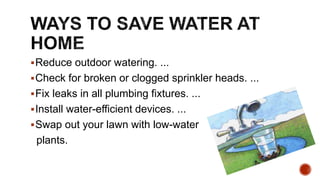
Reduce outdoor watering. ...
Check for broken or clogged sprinkler heads. ...
Fix leaks in all plumbing fixtures. ...
Install water-efficient devices. ...
Swap out your lawn with low-water
plants.
Water conservation
Water conservation

Water conservation

  • 2.
    Water conservation includesall the policies, strategies and activities to sustainably manage the natural resource of fresh water, to protect the hydrosphere, and to meet the current and future human demand
  • 4.
    Water conservation programsinvolved in social solutions are typically initiated at the local level, by either municipal water utilities or regional governments. Common strategies include public outreach campaigns, tiered water rates (charging progressively higher prices as water use increases), or restrictions on outdoor water use such as lawn watering and car washing. Cities in dry climates often require or encourage the installation of xeriscaping or natural landscaping in new homes to reduce outdoor water usage. Most urban outdoor water use in California is residential, illustrating a reason for outreach to households as well as businesses.
  • 5.
    Water conservation isthe practice of using water efficiently to reduce unnecessary water usage. According to Fresh water watch, water conservation is important because fresh clean water is a limited resource, as well as a costly one.  Your body uses water in all its cells, organs, and tissues to help regulate its temperature and maintain other bodily functions. Because your body loses water through breathing, sweating, and digestion, it's important to rehydrate by drinking fluids and eating foods that contain water.
  • 7.
    We cannot livewithout water. Saving water helps to preserve our environment. It reduces the energy required to process and deliver water, which helps in reducing pollution and in conserving fuel resources. Saving water now means having water available in the future for recreational purposes, too.
  • 8.
    1.Check your toiletfor leaks. ... 2.Stop using your toilet as an ashtray or wastebasket. ... 3.Put a plastic bottle in your toilet tank. ... 4.Take shorter showers. ... 5.Install water-saving shower heads or flow restrictors. ...
  • 9.
    Reduce outdoor watering.... Check for broken or clogged sprinkler heads. ... Fix leaks in all plumbing fixtures. ... Install water-efficient devices. ... Swap out your lawn with low-water plants.