MALICIOUS
SOFTWARE
CSS 10
Malware
•is blanket term for viruses, worms,
Trojans, and other harmful computer
programs hackers use to wreak
destruction and gain access to
sensitive information.
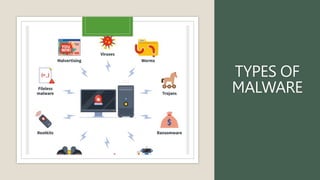
TYPES OF
MALWARE
WORM
•A worm is a standalone piece of malicious
software that reproduces itself and spreads
from computer to computer.
VIRUS
•is a piece of computer code that inserts
itself within the code of another
standalone program, then forces that
program to take malicious action and
spread itself.
TROJAN
•a program that cannot reproduce itself but
masquerades as something the user wants
and tricks them into activating it so it can
do its damage and spread.
SPYWARE
•it spies on your behavior as you use your
computer, and on the data you send and
receive.
•A Keylogger is a specific kind of spyware that
records all the keystrokes a user makes—great
for stealing passwords.
ROOTKIT
•as described by TechTarget, "a program or,
more often, a collection of software tools
that gives a threat actor remote access to
and control over a computer or other
system."
ADWARE
•It forces your browser to redirect to web
advertisements, which often themselves seek
to download further, even more malicious
software. As The New York Times notes,
adware often piggybacks onto tempting "free"
programs like games or browser extensions.
RANSOMWARE
•is a flavor of malware that encrypts your
hard drive's files and demands a payment,
usually in Bitcoin, in exchange for the
decryption key.
MALVERTISING
•is the use of legitimate ads or ad networks to
covertly deliver malware to unsuspecting users’
computers. For example, a cybercriminal might
pay to place an ad on a legitimate website. When
a user clicks on the ad, code in the ad either
redirects them to a malicious website or installs
malware on their computer.
How do computer viruses spread?
•Floppy Disks
•Internet
•Downloading infected files
•Emails
•CDs
•Flash drives
Types of virus
•Resident Viruses - This type of virus is a permanent
which dwells in the RAM memory.
•From there it can overcome and interrupt all of the
operations executed by the system: corrupting files
and programs that are opened, closed, copied,
renamed etc.
•Examples include: Randex, CMJ, Meve, and MrKlunky.
Types of virus
•Overwrite Viruses - overwrite viruses overwrite
file content to infect entire folders, files, and
programs, totally useless once they have been
infected.
•Examples of this virus include: Way, Trj.Reboot,
Trivial.88.D.
Types of virus
•Directory viruses - This virus alters the
paths indicating a file’s location.
Types of virus
•Browser Hijacker- Easily detected, this
virus type infects your browser and
redirects you to malicious websites.
Types of virus
•Browser Hijacker- Easily detected, this
virus type infects your browser and
redirects you to malicious websites.
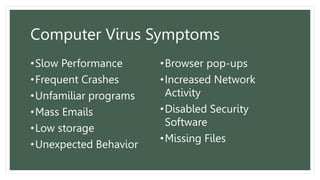
Computer Virus Symptoms
•Slow Performance
•Frequent Crashes
•Unfamiliar programs
•Mass Emails
•Low storage
•Unexpected Behavior
•Browser pop-ups
•Increased Network
Activity
•Disabled Security
Software
•Missing Files
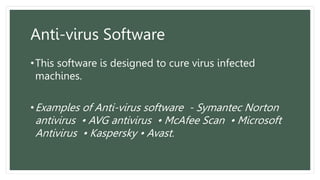
Anti-virus Software
•This software is designed to cure virus infected
machines.
•Examples of Anti-virus software - Symantec Norton
antivirus • AVG antivirus • McAfee Scan • Microsoft
Antivirus • Kaspersky • Avast.

PowerPoint presentation about computer virus

  • 1.
  • 2.
    Malware •is blanket termfor viruses, worms, Trojans, and other harmful computer programs hackers use to wreak destruction and gain access to sensitive information.
  • 3.
  • 4.
    WORM •A worm isa standalone piece of malicious software that reproduces itself and spreads from computer to computer.
  • 5.
    VIRUS •is a pieceof computer code that inserts itself within the code of another standalone program, then forces that program to take malicious action and spread itself.
  • 6.
    TROJAN •a program thatcannot reproduce itself but masquerades as something the user wants and tricks them into activating it so it can do its damage and spread.
  • 7.
    SPYWARE •it spies onyour behavior as you use your computer, and on the data you send and receive. •A Keylogger is a specific kind of spyware that records all the keystrokes a user makes—great for stealing passwords.
  • 8.
    ROOTKIT •as described byTechTarget, "a program or, more often, a collection of software tools that gives a threat actor remote access to and control over a computer or other system."
  • 9.
    ADWARE •It forces yourbrowser to redirect to web advertisements, which often themselves seek to download further, even more malicious software. As The New York Times notes, adware often piggybacks onto tempting "free" programs like games or browser extensions.
  • 10.
    RANSOMWARE •is a flavorof malware that encrypts your hard drive's files and demands a payment, usually in Bitcoin, in exchange for the decryption key.
  • 11.
    MALVERTISING •is the useof legitimate ads or ad networks to covertly deliver malware to unsuspecting users’ computers. For example, a cybercriminal might pay to place an ad on a legitimate website. When a user clicks on the ad, code in the ad either redirects them to a malicious website or installs malware on their computer.
  • 12.
    How do computerviruses spread? •Floppy Disks •Internet •Downloading infected files •Emails •CDs •Flash drives
  • 13.
    Types of virus •ResidentViruses - This type of virus is a permanent which dwells in the RAM memory. •From there it can overcome and interrupt all of the operations executed by the system: corrupting files and programs that are opened, closed, copied, renamed etc. •Examples include: Randex, CMJ, Meve, and MrKlunky.
  • 14.
    Types of virus •OverwriteViruses - overwrite viruses overwrite file content to infect entire folders, files, and programs, totally useless once they have been infected. •Examples of this virus include: Way, Trj.Reboot, Trivial.88.D.
  • 15.
    Types of virus •Directoryviruses - This virus alters the paths indicating a file’s location.
  • 16.
    Types of virus •BrowserHijacker- Easily detected, this virus type infects your browser and redirects you to malicious websites.
  • 17.
    Types of virus •BrowserHijacker- Easily detected, this virus type infects your browser and redirects you to malicious websites.
  • 18.
    Computer Virus Symptoms •SlowPerformance •Frequent Crashes •Unfamiliar programs •Mass Emails •Low storage •Unexpected Behavior •Browser pop-ups •Increased Network Activity •Disabled Security Software •Missing Files
  • 19.
    Anti-virus Software •This softwareis designed to cure virus infected machines. •Examples of Anti-virus software - Symantec Norton antivirus • AVG antivirus • McAfee Scan • Microsoft Antivirus • Kaspersky • Avast.