Adult Numeracy Level 2 Multiplication of Decimals (by Dave Cross, Suffolk New College)
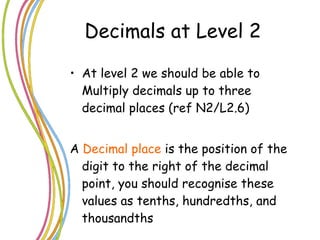
Decimals at Level 2 At level 2 we should be able to Multiply decimals up to three decimal places (ref N2/L2.6) A  Decimal place  is the position of the digit to the right of the decimal point, you should recognise these values as tenths, hundredths, and thousandths
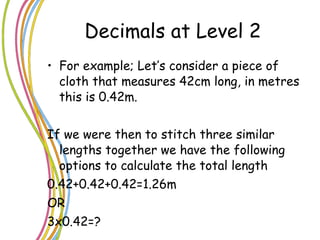
Decimals at Level 2 For example; Let’s consider a piece of cloth that measures 42cm long, in metres this is 0.42m. If we were then to stitch three similar lengths together we have the following options to calculate the total length 0.42+0.42+0.42=1.26m OR 3x0.42=?
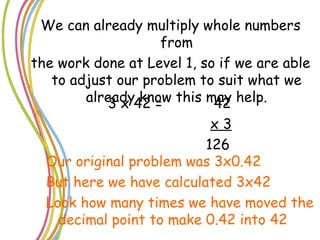
We can already multiply whole numbers from the work done at Level 1, so if we are able to adjust our problem to suit what we already know this may help. 3 x 42 =  42 x 3 126 Our original problem was 3x0.42 But here we have calculated 3x42 Look how many times we have moved the decimal point to make 0.42 into 42
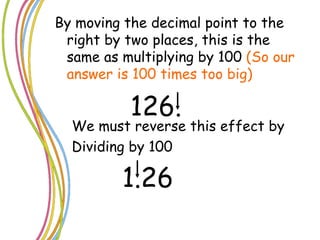
By moving the decimal point to the right by two places, this is the same as multiplying by 100  (So our answer is 100 times too big) 126. 1.26 We must reverse this effect by Dividing by 100
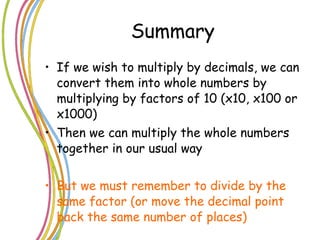
Summary If we wish to multiply by decimals, we can convert them into whole numbers by multiplying by factors of 10 (x10, x100 or x1000) Then we can multiply the whole numbers together in our usual way But we must remember to divide by the same factor (or move the decimal point back the same number of places)
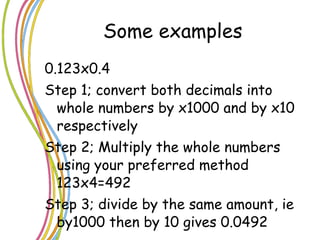
Some examples 0.123x0.4  Step 1; convert both decimals into whole numbers by x1000 and by x10 respectively Step 2; Multiply the whole numbers using your preferred method 123x4=492 Step 3; divide by the same amount, ie by1000 then by 10 gives 0.0492
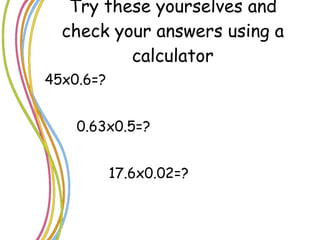
Try these yourselves and check your answers using a calculator 45x0.6=? 0.63x0.5=? 17.6x0.02=?

Powerpoint Multiplication Of Decimals L2

  • 1.
    Adult Numeracy Level2 Multiplication of Decimals (by Dave Cross, Suffolk New College)
  • 2.
    Decimals at Level2 At level 2 we should be able to Multiply decimals up to three decimal places (ref N2/L2.6) A Decimal place is the position of the digit to the right of the decimal point, you should recognise these values as tenths, hundredths, and thousandths
  • 3.
    Decimals at Level2 For example; Let’s consider a piece of cloth that measures 42cm long, in metres this is 0.42m. If we were then to stitch three similar lengths together we have the following options to calculate the total length 0.42+0.42+0.42=1.26m OR 3x0.42=?
  • 4.
    We can alreadymultiply whole numbers from the work done at Level 1, so if we are able to adjust our problem to suit what we already know this may help. 3 x 42 = 42 x 3 126 Our original problem was 3x0.42 But here we have calculated 3x42 Look how many times we have moved the decimal point to make 0.42 into 42
  • 5.
    By moving thedecimal point to the right by two places, this is the same as multiplying by 100 (So our answer is 100 times too big) 126. 1.26 We must reverse this effect by Dividing by 100
  • 6.
    Summary If wewish to multiply by decimals, we can convert them into whole numbers by multiplying by factors of 10 (x10, x100 or x1000) Then we can multiply the whole numbers together in our usual way But we must remember to divide by the same factor (or move the decimal point back the same number of places)
  • 7.
    Some examples 0.123x0.4 Step 1; convert both decimals into whole numbers by x1000 and by x10 respectively Step 2; Multiply the whole numbers using your preferred method 123x4=492 Step 3; divide by the same amount, ie by1000 then by 10 gives 0.0492
  • 8.
    Try these yourselvesand check your answers using a calculator 45x0.6=? 0.63x0.5=? 17.6x0.02=?