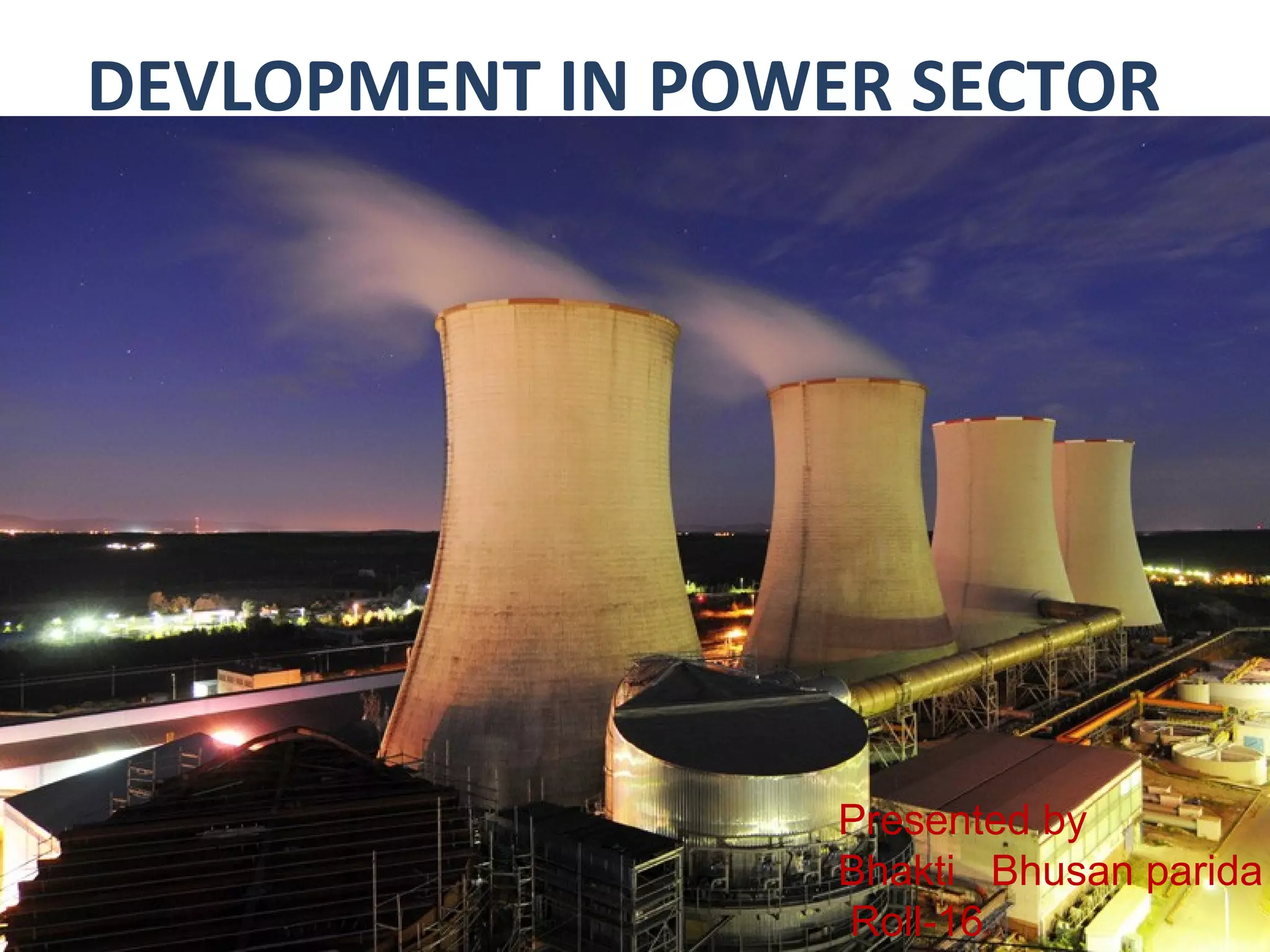

DEVLOPMENT IN POWER SECTOR

Presented by
Bhakti Bhusan parida
Roll-16
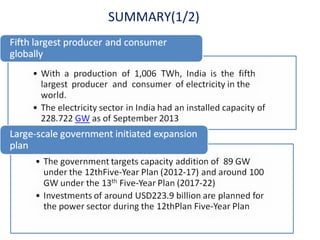
SUMMARY(1/2)
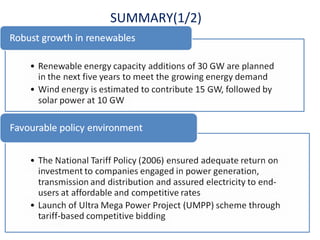
SUMMARY(1/2)
Evolution
(1991-2003)
Liberalisation
Era
1956-1991
Nationalisation
Stage

Industrial Policy
Resolution
(1956)
Before
•Generation
1956
and distribution
Introdu •Electricity
ctory
(Supply) Act of power under
Stage 1948
state ownership
•Establishm •Power losses,
ent of semi- subsidies,
autonomous infrastructure
State
bottlenecks and
Electricity
resource
Boards
constraints

2003
Onwards
Growth Era
Legislative and
policy initiatives
(1991)
•Private sector
participation in
generation
•Electricity
Regulatory
Commissions Act
(1998) for
establishing
Central and State
Electricity
Regulatory
Commissions and
rationalisation of
tariff

Electricity Act
(2003)
•National Tariff
Policy (2006)
•Elimination of
licensing for
generation projects
•Increased
competition
through
international
competitive
bidding engaged in
power
generation,transms
sion and
distribution
•Launch of UMPP
scheme
•Fuel supply
agreement of
power companies
SOURCES OF POWER WITH SHARE IN INSTALLED
CAPACITY(1/2)
THERMAL
(68%)

HYDRO
(18%)
RENEWABLE
(12%)
Nuclear
(2%)

COAL
GAS

As of April 2012, total coal reserves stood at
293.5 billion tonnes;
India’s proven natural gas reserves measure
about 1,074 billion cubic metres

India has enormous potential for hydropower; the 12th
Five-Year Plan (2012–17) includes additional 30,000 MW of
hydro-electric power generation. Currently, India has 39.6
GW of hydro power generating capacity
Wind energy is the largest renewable energy source in
India; projects like the Jawaharlal Nehru National Solar
Mission (aims to generate 20,000 MW of solar power by
2022).
Currently, India has 4.8 GW of net electricity generation
capacity using nuclear fuels (across 20 reactors) and aims to
increase it to 20GW by 2020.
SOURCES OF POWER WITH SHARE IN INSTALLED
CAPACITY(2/2)
•

•

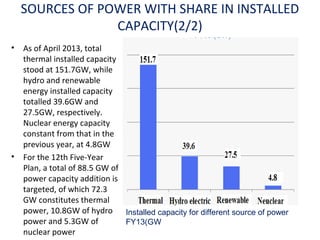
As of April 2013, total
thermal installed capacity
stood at 151.7GW, while
hydro and renewable
energy installed capacity
totalled 39.6GW and
27.5GW, respectively.
Nuclear energy capacity
constant from that in the
previous year, at 4.8GW
For the 12th Five-Year
Plan, a total of 88.5 GW of
power capacity addition is
targeted, of which 72.3
GW constitutes thermal
power, 10.8GW of hydro Installed capacity for different source of power
power and 5.3GW of
FY13(GW
nuclear power
Power generation has grown rapidly
over the year
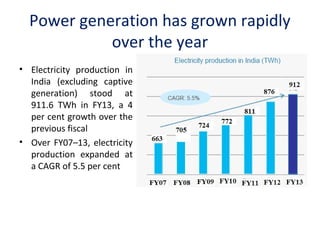
• Electricity production in
India (excluding captive
generation) stood at
911.6 TWh in FY13, a 4
per cent growth over the
previous fiscal
• Over FY07–13, electricity
production expanded at
a CAGR of 5.5 per cent
Generation capacity has increased at a
healthy pace
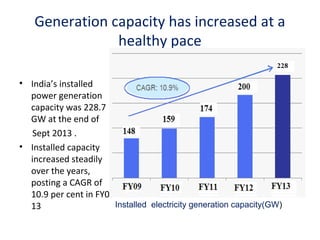
• India’s installed
power generation
capacity was 228.7
GW at the end of
Sept 2013 .
• Installed capacity
increased steadily
over the years,
posting a CAGR of
10.9 per cent in FY09–
Installed electricity generation capacity(GW)
13
Company

Business description
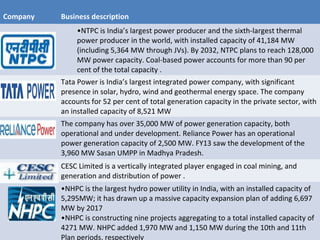
•NTPC is India’s largest power producer and the sixth-largest thermal
power producer in the world, with installed capacity of 41,184 MW
(including 5,364 MW through JVs). By 2032, NTPC plans to reach 128,000
MW power capacity. Coal-based power accounts for more than 90 per
cent of the total capacity .
Tata Power is India’s largest integrated power company, with significant
presence in solar, hydro, wind and geothermal energy space. The company
accounts for 52 per cent of total generation capacity in the private sector, with
an installed capacity of 8,521 MW
The company has over 35,000 MW of power generation capacity, both
operational and under development. Reliance Power has an operational
power generation capacity of 2,500 MW. FY13 saw the development of the
3,960 MW Sasan UMPP in Madhya Pradesh.
CESC Limited is a vertically integrated player engaged in coal mining, and
generation and distribution of power .
•NHPC is the largest hydro power utility in India, with an installed capacity of
5,295MW; it has drawn up a massive capacity expansion plan of adding 6,697
MW by 2017
•NHPC is constructing nine projects aggregating to a total installed capacity of
4271 MW. NHPC added 1,970 MW and 1,150 MW during the 10th and 11th
Plan periods, respectively
Company

Business description
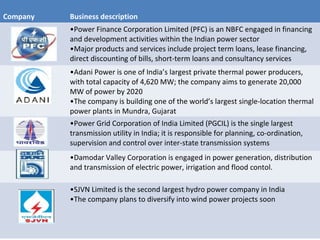
•Power Finance Corporation Limited (PFC) is an NBFC engaged in financing
and development activities within the Indian power sector
•Major products and services include project term loans, lease financing,
direct discounting of bills, short-term loans and consultancy services
•Adani Power is one of India’s largest private thermal power producers,
with total capacity of 4,620 MW; the company aims to generate 20,000
MW of power by 2020
•The company is building one of the world’s largest single-location thermal
power plants in Mundra, Gujarat
•Power Grid Corporation of India Limited (PGCIL) is the single largest
transmission utility in India; it is responsible for planning, co-ordination,
supervision and control over inter-state transmission systems
•Damodar Valley Corporation is engaged in power generation, distribution
and transmission of electric power, irrigation and flood contol.
•SJVN Limited is the second largest hydro power company in India
•The company plans to diversify into wind power projects soon
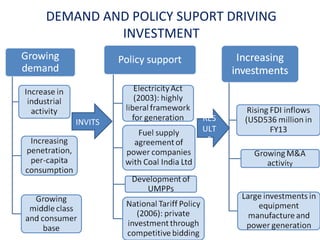
DEMAND AND POLICY SUPORT DRIVING
INVESTMENT

INVITS

RES
ULT
S
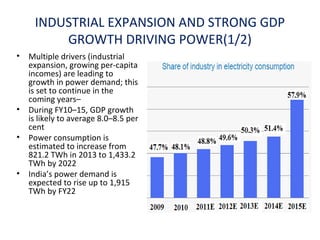
INDUSTRIAL EXPANSION AND STRONG GDP
GROWTH DRIVING POWER(1/2)
•

•
•

•

Multiple drivers (industrial
expansion, growing per-capita
incomes) are leading to
growth in power demand; this
is set to continue in the
coming years–
During FY10–15, GDP growth
is likely to average 8.0–8.5 per
cent
Power consumption is
estimated to increase from
821.2 TWh in 2013 to 1,433.2
TWh by 2022
India’s power demand is
expected to rise up to 1,915
TWh by FY22
•

•

•

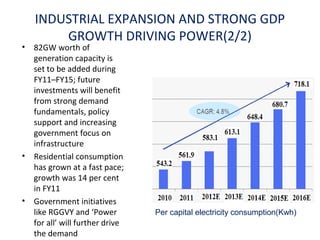
INDUSTRIAL EXPANSION AND STRONG GDP
GROWTH DRIVING POWER(2/2)

82GW worth of
generation capacity is
set to be added during
FY11–FY15; future
investments will benefit
from strong demand
fundamentals, policy
support and increasing
government focus on
infrastructure
Residential consumption
has grown at a fast pace;
growth was 14 per cent
in FY11
Government initiatives
like RGGVY and ‘Power
for all’ will further drive
the demand

Per capital electricity consumption(Kwh)
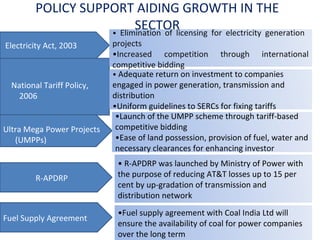
POLICY SUPPORT AIDING GROWTH IN THE
SECTOR
• Elimination of licensing for electricity generation
Electricity Act, 2003

National Tariff Policy,
2006

Ultra Mega Power Projects
(UMPPs)

R-APDRP

Fuel Supply Agreement

projects
•Increased competition through international
competitive bidding
• Adequate return on investment to companies
•Demarcation of transmission as a separate activity
engaged in power generation, transmission and
distribution
•Uniform guidelines to SERCs for fixing tariffs
•Launch of the UMPP scheme through tariff-based
competitive bidding
•Ease of land possession, provision of fuel, water and
necessary clearances for enhancing investor
confidence
• R-APDRP was launched by Ministry of Power with
the purpose of reducing AT&T losses up to 15 per
cent by up-gradation of transmission and
distribution network
•Fuel supply agreement with Coal India Ltd will
ensure the availability of coal for power companies
over the long term
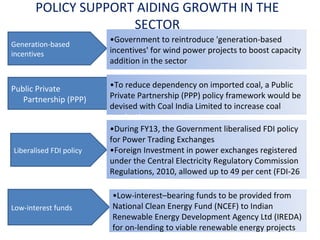
POLICY SUPPORT AIDING GROWTH IN THE
SECTOR
Generation-based
incentives

Public Private
Partnership (PPP)

Liberalised FDI policy

Low-interest funds

•Government to reintroduce 'generation-based
incentives' for wind power projects to boost capacity
addition in the sector
•To reduce dependency on imported coal, a Public
Private Partnership (PPP) policy framework would be
devised with Coal India Limited to increase coal
production
•During FY13, the Government liberalised FDI policy
for Power Trading Exchanges
•Foreign Investment in power exchanges registered
under the Central Electricity Regulatory Commission
Regulations, 2010, allowed up to 49 per cent (FDI-26
per cent and FII-23 per cent)
•Low-interest–bearing funds to be provided from
National Clean Energy Fund (NCEF) to Indian
Renewable Energy Development Agency Ltd (IREDA)
for on-lending to viable renewable energy projects
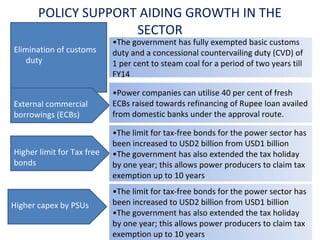
POLICY SUPPORT AIDING GROWTH IN THE
SECTOR
Elimination of customs
duty

External commercial
borrowings (ECBs)

Higher limit for Tax free
bonds

Higher capex by PSUs

•The government has fully exempted basic customs
duty and a concessional countervailing duty (CVD) of
1 per cent to steam coal for a period of two years till
FY14
•Power companies can utilise 40 per cent of fresh
ECBs raised towards refinancing of Rupee loan availed
from domestic banks under the approval route.
•The limit for tax-free bonds for the power sector has
been increased to USD2 billion from USD1 billion
•The government has also extended the tax holiday
by one year; this allows power producers to claim tax
exemption up to 10 years
•The limit for tax-free bonds for the power sector has
been increased to USD2 billion from USD1 billion
•The government has also extended the tax holiday
by one year; this allows power producers to claim tax
exemption up to 10 years
Power sector ,devlopment

Power sector ,devlopment

  • 1.
    DEVLOPMENT IN POWERSECTOR Presented by Bhakti Bhusan parida Roll-16
  • 2.
  • 3.
  • 4.
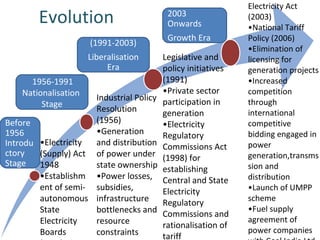
    Evolution (1991-2003) Liberalisation Era 1956-1991 Nationalisation Stage Industrial Policy Resolution (1956) Before •Generation 1956 and distribution Introdu•Electricity ctory (Supply) Act of power under Stage 1948 state ownership •Establishm •Power losses, ent of semi- subsidies, autonomous infrastructure State bottlenecks and Electricity resource Boards constraints 2003 Onwards Growth Era Legislative and policy initiatives (1991) •Private sector participation in generation •Electricity Regulatory Commissions Act (1998) for establishing Central and State Electricity Regulatory Commissions and rationalisation of tariff Electricity Act (2003) •National Tariff Policy (2006) •Elimination of licensing for generation projects •Increased competition through international competitive bidding engaged in power generation,transms sion and distribution •Launch of UMPP scheme •Fuel supply agreement of power companies
  • 5.
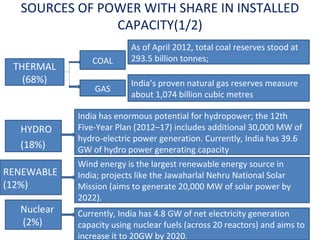
    SOURCES OF POWERWITH SHARE IN INSTALLED CAPACITY(1/2) THERMAL (68%) HYDRO (18%) RENEWABLE (12%) Nuclear (2%) COAL GAS As of April 2012, total coal reserves stood at 293.5 billion tonnes; India’s proven natural gas reserves measure about 1,074 billion cubic metres India has enormous potential for hydropower; the 12th Five-Year Plan (2012–17) includes additional 30,000 MW of hydro-electric power generation. Currently, India has 39.6 GW of hydro power generating capacity Wind energy is the largest renewable energy source in India; projects like the Jawaharlal Nehru National Solar Mission (aims to generate 20,000 MW of solar power by 2022). Currently, India has 4.8 GW of net electricity generation capacity using nuclear fuels (across 20 reactors) and aims to increase it to 20GW by 2020.
  • 6.
    SOURCES OF POWERWITH SHARE IN INSTALLED CAPACITY(2/2) • • As of April 2013, total thermal installed capacity stood at 151.7GW, while hydro and renewable energy installed capacity totalled 39.6GW and 27.5GW, respectively. Nuclear energy capacity constant from that in the previous year, at 4.8GW For the 12th Five-Year Plan, a total of 88.5 GW of power capacity addition is targeted, of which 72.3 GW constitutes thermal power, 10.8GW of hydro Installed capacity for different source of power power and 5.3GW of FY13(GW nuclear power
  • 7.
    Power generation hasgrown rapidly over the year • Electricity production in India (excluding captive generation) stood at 911.6 TWh in FY13, a 4 per cent growth over the previous fiscal • Over FY07–13, electricity production expanded at a CAGR of 5.5 per cent
  • 8.
    Generation capacity hasincreased at a healthy pace • India’s installed power generation capacity was 228.7 GW at the end of Sept 2013 . • Installed capacity increased steadily over the years, posting a CAGR of 10.9 per cent in FY09– Installed electricity generation capacity(GW) 13
  • 9.
    Company Business description •NTPC isIndia’s largest power producer and the sixth-largest thermal power producer in the world, with installed capacity of 41,184 MW (including 5,364 MW through JVs). By 2032, NTPC plans to reach 128,000 MW power capacity. Coal-based power accounts for more than 90 per cent of the total capacity . Tata Power is India’s largest integrated power company, with significant presence in solar, hydro, wind and geothermal energy space. The company accounts for 52 per cent of total generation capacity in the private sector, with an installed capacity of 8,521 MW The company has over 35,000 MW of power generation capacity, both operational and under development. Reliance Power has an operational power generation capacity of 2,500 MW. FY13 saw the development of the 3,960 MW Sasan UMPP in Madhya Pradesh. CESC Limited is a vertically integrated player engaged in coal mining, and generation and distribution of power . •NHPC is the largest hydro power utility in India, with an installed capacity of 5,295MW; it has drawn up a massive capacity expansion plan of adding 6,697 MW by 2017 •NHPC is constructing nine projects aggregating to a total installed capacity of 4271 MW. NHPC added 1,970 MW and 1,150 MW during the 10th and 11th Plan periods, respectively
  • 10.
    Company Business description •Power FinanceCorporation Limited (PFC) is an NBFC engaged in financing and development activities within the Indian power sector •Major products and services include project term loans, lease financing, direct discounting of bills, short-term loans and consultancy services •Adani Power is one of India’s largest private thermal power producers, with total capacity of 4,620 MW; the company aims to generate 20,000 MW of power by 2020 •The company is building one of the world’s largest single-location thermal power plants in Mundra, Gujarat •Power Grid Corporation of India Limited (PGCIL) is the single largest transmission utility in India; it is responsible for planning, co-ordination, supervision and control over inter-state transmission systems •Damodar Valley Corporation is engaged in power generation, distribution and transmission of electric power, irrigation and flood contol. •SJVN Limited is the second largest hydro power company in India •The company plans to diversify into wind power projects soon
  • 11.
    DEMAND AND POLICYSUPORT DRIVING INVESTMENT INVITS RES ULT S
  • 12.
    INDUSTRIAL EXPANSION ANDSTRONG GDP GROWTH DRIVING POWER(1/2) • • • • Multiple drivers (industrial expansion, growing per-capita incomes) are leading to growth in power demand; this is set to continue in the coming years– During FY10–15, GDP growth is likely to average 8.0–8.5 per cent Power consumption is estimated to increase from 821.2 TWh in 2013 to 1,433.2 TWh by 2022 India’s power demand is expected to rise up to 1,915 TWh by FY22
  • 13.
    • • • INDUSTRIAL EXPANSION ANDSTRONG GDP GROWTH DRIVING POWER(2/2) 82GW worth of generation capacity is set to be added during FY11–FY15; future investments will benefit from strong demand fundamentals, policy support and increasing government focus on infrastructure Residential consumption has grown at a fast pace; growth was 14 per cent in FY11 Government initiatives like RGGVY and ‘Power for all’ will further drive the demand Per capital electricity consumption(Kwh)
  • 14.
    POLICY SUPPORT AIDINGGROWTH IN THE SECTOR • Elimination of licensing for electricity generation Electricity Act, 2003 National Tariff Policy, 2006 Ultra Mega Power Projects (UMPPs) R-APDRP Fuel Supply Agreement projects •Increased competition through international competitive bidding • Adequate return on investment to companies •Demarcation of transmission as a separate activity engaged in power generation, transmission and distribution •Uniform guidelines to SERCs for fixing tariffs •Launch of the UMPP scheme through tariff-based competitive bidding •Ease of land possession, provision of fuel, water and necessary clearances for enhancing investor confidence • R-APDRP was launched by Ministry of Power with the purpose of reducing AT&T losses up to 15 per cent by up-gradation of transmission and distribution network •Fuel supply agreement with Coal India Ltd will ensure the availability of coal for power companies over the long term
  • 15.
    POLICY SUPPORT AIDINGGROWTH IN THE SECTOR Generation-based incentives Public Private Partnership (PPP) Liberalised FDI policy Low-interest funds •Government to reintroduce 'generation-based incentives' for wind power projects to boost capacity addition in the sector •To reduce dependency on imported coal, a Public Private Partnership (PPP) policy framework would be devised with Coal India Limited to increase coal production •During FY13, the Government liberalised FDI policy for Power Trading Exchanges •Foreign Investment in power exchanges registered under the Central Electricity Regulatory Commission Regulations, 2010, allowed up to 49 per cent (FDI-26 per cent and FII-23 per cent) •Low-interest–bearing funds to be provided from National Clean Energy Fund (NCEF) to Indian Renewable Energy Development Agency Ltd (IREDA) for on-lending to viable renewable energy projects
  • 16.
    POLICY SUPPORT AIDINGGROWTH IN THE SECTOR Elimination of customs duty External commercial borrowings (ECBs) Higher limit for Tax free bonds Higher capex by PSUs •The government has fully exempted basic customs duty and a concessional countervailing duty (CVD) of 1 per cent to steam coal for a period of two years till FY14 •Power companies can utilise 40 per cent of fresh ECBs raised towards refinancing of Rupee loan availed from domestic banks under the approval route. •The limit for tax-free bonds for the power sector has been increased to USD2 billion from USD1 billion •The government has also extended the tax holiday by one year; this allows power producers to claim tax exemption up to 10 years •The limit for tax-free bonds for the power sector has been increased to USD2 billion from USD1 billion •The government has also extended the tax holiday by one year; this allows power producers to claim tax exemption up to 10 years