Computing Fundamentals Module
Lesson 1 — Introducing Computers


          Computer Literacy BASICS
Objectives

        Define a computer.
        Identify how computers are used in our daily
         lives.
        Compare and classify types of computers.
        List the parts of a computer system.
        Explain how computers are integrated into
         larger systems through networks.


2                                      Computer Literacy BASICS
Vocabulary

        Channel               Internet
        Computer              Local area network
        Computer system        (LAN)
        Data                  Mainframe
        Data                   computers
         communications        Microcomputer
        Hardware              Microprocessors

3                                    Computer Literacy BASICS
Vocabulary (cont.)

        Minicomputers           Sender
        Network                 Software
        Notebook computer       Supercomputers
        People                  Wide area networks
        Protocol                 (WANs)
        Receiver


4                                      Computer Literacy BASICS
What Makes a Computer
    a Computer

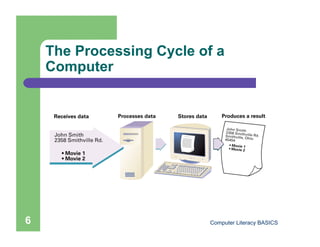
    A computer is an electronic device that
        Receives data: Information, such as text, numbers,
         or graphic images, is entered into the computer.
        Processes data: The computer will change the data
         from what was entered into the result the user wants.
        Stores data: The information is stored in the
         computer’s memory.
        Produces a result: A final display of the information
         that was entered can be printed or displayed on a
         monitor.
5                                            Computer Literacy BASICS
The Processing Cycle of a
    Computer


6                         Computer Literacy BASICS
Computers Perform Three
    Operations

        Arithmetic operations
         –    Adding, subtracting, multiplying, and dividing
        Logical comparisons
         –    Equal to, greater than or less than, etc.
        Storage and retrieval operations


7                                             Computer Literacy BASICS
Why Are Computers So Popular?

        Computers perform functions very quickly.
        Computers produce accurate and reliable
         results.
        Computers store large amounts of data.
        Computers are versatile and cost-effective.
        Computers are becoming more powerful and
         more useful every day.

8                                     Computer Literacy BASICS
How Computers Are Used Today

    Computers are used every day for
        News: Newspapers and television news stations
         post breaking news, and weather can be
         accessed on demand on the Internet.
        Shopping: Millions of people use the Internet
         every day to purchase goods and services.


9                                         Computer Literacy BASICS
How Computers Are Used Today
     (cont.)

         Homework: Students have instant access to
          research and information and use word-
          processing and other software applications for
          assignments.
         Managing businesses: Businesses use
          computers to maintain inventory records, print
          invoices, track financial information and
          personnel records, advertise online, and many
          other tasks.
10                                      Computer Literacy BASICS
Types of Computers

         Supercomputers: The largest and fastest
          computers that are used by government
          agencies and large corporations to process
          tremendous volumes of data.
         Mainframes: Large, very expensive
          machines that can support thousands of
          users; used by large corporations.


11                                      Computer Literacy BASICS
Types of Computers

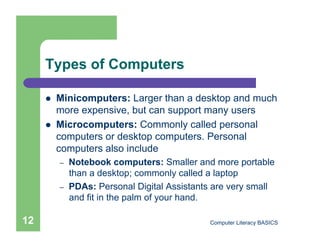
         Minicomputers: Larger than a desktop and much
          more expensive, but can support many users
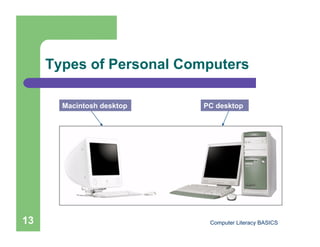
         Microcomputers: Commonly called personal
          computers or desktop computers. Personal
          computers also include
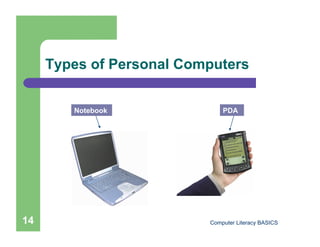
          –    Notebook computers: Smaller and more portable
               than a desktop; commonly called a laptop
          –    PDAs: Personal Digital Assistants are very small
               and fit in the palm of your hand.

12                                             Computer Literacy BASICS
Types of Personal Computers

       Macintosh desktop   PC desktop


13                          Computer Literacy BASICS
Types of Personal Computers


        Notebook              PDA


14                        Computer Literacy BASICS
Other Computing Devices

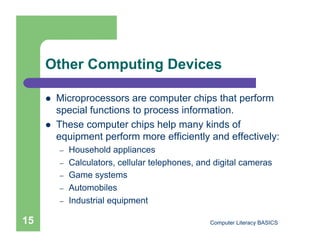
         Microprocessors are computer chips that perform
          special functions to process information.
         These computer chips help many kinds of
          equipment perform more efficiently and effectively:
          –    Household appliances
          –    Calculators, cellular telephones, and digital cameras
          –    Game systems
          –    Automobiles
          –    Industrial equipment

15                                                 Computer Literacy BASICS
Computer Systems

         A computer system is a combination of parts working
          together:
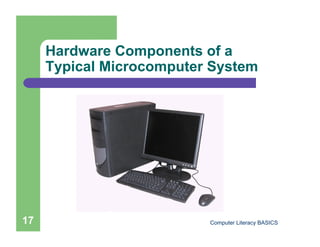
          –    Hardware: The physical devices such as keyboard,
               monitor, CPU, and so on
          –    Software: Operating systems and application
               programs
          –    Data: The facts entered into a computer to be
               processed
          –    People: The users who enter the data and use the
               resulting output

16                                              Computer Literacy BASICS
Hardware Components of a
     Typical Microcomputer System


17                        Computer Literacy BASICS
Data Communications

         Data communications is the technology that enables
          computers to communicate.
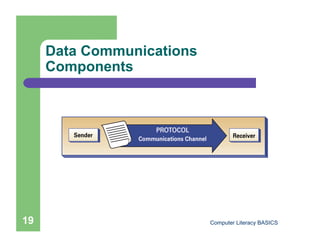
         The four components of data communications are
          –    Sender: The computer that is sending the message
          –    Receiver: The computer receiving the message
               Channel: The media that carries or transports the
               message. This could be telephone wire, coaxial cable,
               microwave signal, or fiber optic.
          –    Protocol: The rules that govern the orderly transfer of
               the data sent

18                                                 Computer Literacy BASICS
Data Communications
     Components


19                         Computer Literacy BASICS
Computer Networks

         Businesses utilize a type of data communications
          called a network.
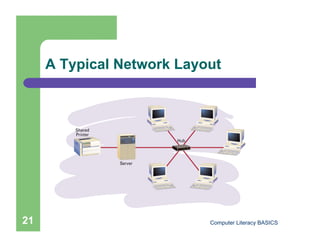
         A network consists of multiple computers
          connected to each other to share data and
          resources.
         A computer network located in a small
          geographical area, such as one building or
          department, is called a local area network or LAN.
         A network made up of several local networks in a
          city, region, or across the world is called a wide
          area network or WAN.
20                                          Computer Literacy BASICS
A Typical Network Layout


21                         Computer Literacy BASICS
Intranets

         An intranet is used exclusively within an
          organization and contains company
          information such as handbooks, forms, and
          newsletters.
         The major advantages of using an intranet
          include reliability and security because the
          organization can control access to this kind
          of network.

22                                       Computer Literacy BASICS
Extranets

         Extranets are computer networks that allow
          outside organizations to access a business’s
          internal information systems.
         Access is controlled tightly and is usually
          reserved for suppliers or customers.


23                                      Computer Literacy BASICS
The Internet

         The Internet was developed for government
          research projects to share information quickly and
          easily.
         Today it is the largest network in the world.
         It is used daily by millions of computer users.
         It has become a critical and valuable business tool
          used by businesses of all sizes.
         The most commonly used feature of the Internet is
          electronic mail, or e-mail.
24                                           Computer Literacy BASICS
Summary

         A computer is an electronic device that
          receives data, processes data, and stores
          data to produce a result.
         Early computers were large, expensive
          machines used by governments and major
          corporations.
         Computers can be found in almost every
          aspect of our lives.
25                                     Computer Literacy BASICS
Summary (cont.)

         Computers are classified by size, speed, and
          application.
         There are different types of computers
          including supercomputers, mainframe
          computers, minicomputers, and
          microcomputers.


26                                      Computer Literacy BASICS
Summary (cont.)

         Microcomputers are classified by the type of
          operating system they use, most commonly
          Windows or DOS on PCs and Mac OS on
          Macintosh computers.
         Notebook computers are small, portable
          computers that allow people to work away
          from their desks.


27                                       Computer Literacy BASICS
Summary (cont.)

         Other devices that incorporate computers or
          task-specific microprocessors include
          personal digital assistants, cellular phones,
          digital cameras, interactive books, game
          systems, home appliances, automobile
          engines, and industrial equipment.


28                                       Computer Literacy BASICS
Summary (cont.)

         A computer system consists of the following
          components: hardware, software, data, and
          people.
         Data communications is the transmission of
          text, numeric, voice, or video data from one
          machine to another.


29                                       Computer Literacy BASICS
Summary (cont.)

         The four components of data communica-
          tions are the sender, the receiver, the
          channel, and the protocol.
         A local area network connects multiple
          computers within a building to share data and
          resources. A wide area network includes
          several local area networks within a city,
          region, country, continent, or the world.

30                                      Computer Literacy BASICS
Summary (cont.)

         The Internet was originally developed so
          information could be shared by government
          researchers around the world. E-mail is the
          most common experience most people have
          with the Internet, allowing messages to be
          sent from one computer to another locally
          and around the world.


31                                      Computer Literacy BASICS

Power point lesson 01

  • 1.
    Computing Fundamentals Module Lesson1 — Introducing Computers Computer Literacy BASICS
  • 2.
    Objectives   Define a computer.   Identify how computers are used in our daily lives.   Compare and classify types of computers.   List the parts of a computer system.   Explain how computers are integrated into larger systems through networks. 2 Computer Literacy BASICS
  • 3.
    Vocabulary   Channel   Internet   Computer   Local area network   Computer system (LAN)   Data   Mainframe   Data computers communications   Microcomputer   Hardware   Microprocessors 3 Computer Literacy BASICS
  • 4.
    Vocabulary (cont.)   Minicomputers   Sender   Network   Software   Notebook computer   Supercomputers   People   Wide area networks   Protocol (WANs)   Receiver 4 Computer Literacy BASICS
  • 5.
    What Makes aComputer a Computer A computer is an electronic device that   Receives data: Information, such as text, numbers, or graphic images, is entered into the computer.   Processes data: The computer will change the data from what was entered into the result the user wants.   Stores data: The information is stored in the computer’s memory.   Produces a result: A final display of the information that was entered can be printed or displayed on a monitor. 5 Computer Literacy BASICS
  • 6.
    The Processing Cycleof a Computer 6 Computer Literacy BASICS
  • 7.
    Computers Perform Three Operations   Arithmetic operations –  Adding, subtracting, multiplying, and dividing   Logical comparisons –  Equal to, greater than or less than, etc.   Storage and retrieval operations 7 Computer Literacy BASICS
  • 8.
    Why Are ComputersSo Popular?   Computers perform functions very quickly.   Computers produce accurate and reliable results.   Computers store large amounts of data.   Computers are versatile and cost-effective.   Computers are becoming more powerful and more useful every day. 8 Computer Literacy BASICS
  • 9.
    How Computers AreUsed Today Computers are used every day for   News: Newspapers and television news stations post breaking news, and weather can be accessed on demand on the Internet.   Shopping: Millions of people use the Internet every day to purchase goods and services. 9 Computer Literacy BASICS
  • 10.
    How Computers AreUsed Today (cont.)   Homework: Students have instant access to research and information and use word- processing and other software applications for assignments.   Managing businesses: Businesses use computers to maintain inventory records, print invoices, track financial information and personnel records, advertise online, and many other tasks. 10 Computer Literacy BASICS
  • 11.
    Types of Computers   Supercomputers: The largest and fastest computers that are used by government agencies and large corporations to process tremendous volumes of data.   Mainframes: Large, very expensive machines that can support thousands of users; used by large corporations. 11 Computer Literacy BASICS
  • 12.
    Types of Computers   Minicomputers: Larger than a desktop and much more expensive, but can support many users   Microcomputers: Commonly called personal computers or desktop computers. Personal computers also include –  Notebook computers: Smaller and more portable than a desktop; commonly called a laptop –  PDAs: Personal Digital Assistants are very small and fit in the palm of your hand. 12 Computer Literacy BASICS
  • 13.
    Types of PersonalComputers Macintosh desktop PC desktop 13 Computer Literacy BASICS
  • 14.
    Types of PersonalComputers Notebook PDA 14 Computer Literacy BASICS
  • 15.
    Other Computing Devices   Microprocessors are computer chips that perform special functions to process information.   These computer chips help many kinds of equipment perform more efficiently and effectively: –  Household appliances –  Calculators, cellular telephones, and digital cameras –  Game systems –  Automobiles –  Industrial equipment 15 Computer Literacy BASICS
  • 16.
    Computer Systems   A computer system is a combination of parts working together: –  Hardware: The physical devices such as keyboard, monitor, CPU, and so on –  Software: Operating systems and application programs –  Data: The facts entered into a computer to be processed –  People: The users who enter the data and use the resulting output 16 Computer Literacy BASICS
  • 17.
    Hardware Components ofa Typical Microcomputer System 17 Computer Literacy BASICS
  • 18.
    Data Communications   Data communications is the technology that enables computers to communicate.   The four components of data communications are –  Sender: The computer that is sending the message –  Receiver: The computer receiving the message Channel: The media that carries or transports the message. This could be telephone wire, coaxial cable, microwave signal, or fiber optic. –  Protocol: The rules that govern the orderly transfer of the data sent 18 Computer Literacy BASICS
  • 19.
    Data Communications Components 19 Computer Literacy BASICS
  • 20.
    Computer Networks   Businesses utilize a type of data communications called a network.   A network consists of multiple computers connected to each other to share data and resources.   A computer network located in a small geographical area, such as one building or department, is called a local area network or LAN.   A network made up of several local networks in a city, region, or across the world is called a wide area network or WAN. 20 Computer Literacy BASICS
  • 21.
    A Typical NetworkLayout 21 Computer Literacy BASICS
  • 22.
    Intranets   An intranet is used exclusively within an organization and contains company information such as handbooks, forms, and newsletters.   The major advantages of using an intranet include reliability and security because the organization can control access to this kind of network. 22 Computer Literacy BASICS
  • 23.
    Extranets   Extranets are computer networks that allow outside organizations to access a business’s internal information systems.   Access is controlled tightly and is usually reserved for suppliers or customers. 23 Computer Literacy BASICS
  • 24.
    The Internet   The Internet was developed for government research projects to share information quickly and easily.   Today it is the largest network in the world.   It is used daily by millions of computer users.   It has become a critical and valuable business tool used by businesses of all sizes.   The most commonly used feature of the Internet is electronic mail, or e-mail. 24 Computer Literacy BASICS
  • 25.
    Summary   A computer is an electronic device that receives data, processes data, and stores data to produce a result.   Early computers were large, expensive machines used by governments and major corporations.   Computers can be found in almost every aspect of our lives. 25 Computer Literacy BASICS
  • 26.
    Summary (cont.)   Computers are classified by size, speed, and application.   There are different types of computers including supercomputers, mainframe computers, minicomputers, and microcomputers. 26 Computer Literacy BASICS
  • 27.
    Summary (cont.)   Microcomputers are classified by the type of operating system they use, most commonly Windows or DOS on PCs and Mac OS on Macintosh computers.   Notebook computers are small, portable computers that allow people to work away from their desks. 27 Computer Literacy BASICS
  • 28.
    Summary (cont.)   Other devices that incorporate computers or task-specific microprocessors include personal digital assistants, cellular phones, digital cameras, interactive books, game systems, home appliances, automobile engines, and industrial equipment. 28 Computer Literacy BASICS
  • 29.
    Summary (cont.)   A computer system consists of the following components: hardware, software, data, and people.   Data communications is the transmission of text, numeric, voice, or video data from one machine to another. 29 Computer Literacy BASICS
  • 30.
    Summary (cont.)   The four components of data communica- tions are the sender, the receiver, the channel, and the protocol.   A local area network connects multiple computers within a building to share data and resources. A wide area network includes several local area networks within a city, region, country, continent, or the world. 30 Computer Literacy BASICS
  • 31.
    Summary (cont.)   The Internet was originally developed so information could be shared by government researchers around the world. E-mail is the most common experience most people have with the Internet, allowing messages to be sent from one computer to another locally and around the world. 31 Computer Literacy BASICS