POWER GENERATING STATION
ELECTRICAL POWER - II
6TH SEMESTER ELECTRICAL ENGG.
Barjinder singh
Senior Lecturer Electrical Engg.
Government Polytechnic College,
Guru Teg Bahadurgarh, Moga
07/02/2013 Barjinder Singh
Topics
• Introduction
• Advantages of Electrical energy
• Natural Sources of Energy
1. Water
2. Fuels
3. Nuclear energy
4. Sun
5. Wind
6. Sea Waves
7. Tides
8. Biomass
07/02/2013 Barjinder Singh
Topics
• Non Renewable & Renewable Sources of
Energy
• Major Generating Stations
1. Hydro Electric Power Stations
2. Steam Power Station
3. Diesel Power Station
4. Nuclear Power Station
• Operating Costs
• Comparison between Various Power Stations
• Examples
07/02/2013 Barjinder Singh
Introduction
• Electricity plays very important role in our
daily life. All our activities are directly or
indirectly related to electricity. Electricity
come in India in 1897 at Darjeeling. In Delhi
the first electricity generating plant was
established on 1905 for public.
• We know the demand of electricity keeps on
increasing as the dependence of man kind
increasing day by day.
07/02/2013 Barjinder Singh
Introduction
• The electrical energy is generated at far away
places and consumed by different consumers
in cities, towns and villages. When the energy
is transmitted and distributed to various
consumers there is loss of energy called
transmission losses.
• In fact, in India, a large portion of these losses
is due to theft of electrical energy.
07/02/2013 Barjinder Singh
Advantages of Electrical Energy
The different forms of energy available from
various natural sources are converted into
Electrical energy . It is because of the following
merits of electrical energy over the other forms
1. Economical : It is more economical than the
other forms because of low losses.
2. Easy to handle : It can be handled very easily
over a long distance, through conductors.
3. Flexible : Electrical system is very flexible. It
can be taken easily to any corner of house,
factory, street etc using flexible conductors.
07/02/2013 Barjinder Singh
Advantages of Electrical Energ
4. Cleanliness : Electrical energy , heating and
electrical gadgets do not produce any smoke,
dust etc.
5. No poisonous Gases : Electrical energy is not
associated with smoke, fumes or other
harmful gases. So it can be used safely for
domestic and industrial purposes.
6. Easy to operate : Electrical systems starting,
control and operation is very simple.
07/02/2013 Barjinder Singh
Natural Sources of Energy
1. Water
2. Fuels
3. Nuclear Energy
4. Sun
5. Wind
6. Sea waves
7. Tides
8. Biomass etc.
07/02/2013 Barjinder Singh
Water
The potential energy of water collected at
higher level or the kinetic energy of water
flowing at high velocity can be used to run the
turbines. These turbines or prime- movers are
known as hydraulic turbines. Generators are
coupled to these turbines which converts
mechanical energy into electrical energy.
The capital investment is high but the running
cost is low as no fuel is used. So this type of
system is more popular.
07/02/2013 Barjinder Singh
Water
In India, one of the major hydro electric power
project is Bhakra Nangal Project. The dam is
erected across the river Sutlej and a lake
called Gobind Sagar is created behind it. This
project has two power houses :
The capacity of left bank is 540 MW and
capacity of right bank is 660 MW and overall
capacity is 1200 MW.
07/02/2013 Barjinder Singh
Water
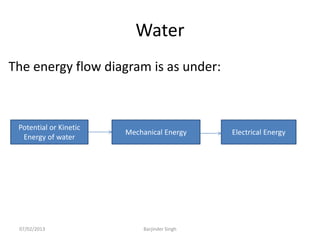
The energy flow diagram is as under:
Potential or Kinetic
Energy of water
Mechanical Energy Electrical Energy
07/02/2013 Barjinder Singh
Fuel
The most common source of energy is fuel and
is available as under :
1. Solid fuels
2. Liquid fuels
3. Gaseous fuels
The initial cost of these power stations are low
but the operating cost is high.
07/02/2013 Barjinder Singh
Solid Fuels
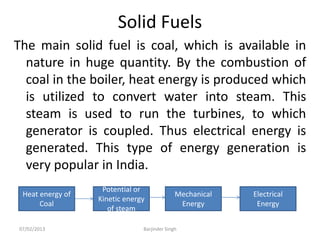
The main solid fuel is coal, which is available in
nature in huge quantity. By the combustion of
coal in the boiler, heat energy is produced which
is utilized to convert water into steam. This
steam is used to run the turbines, to which
generator is coupled. Thus electrical energy is
generated. This type of energy generation is
very popular in India.
Heat energy of
Coal
Potential or
Kinetic energy
of steam
Mechanical
Energy
Electrical
Energy
07/02/2013 Barjinder Singh
liquid Fuels
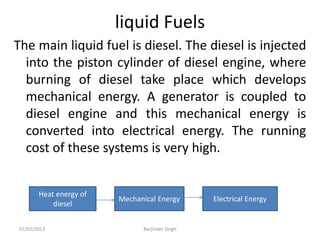
The main liquid fuel is diesel. The diesel is injected
into the piston cylinder of diesel engine, where
burning of diesel take place which develops
mechanical energy. A generator is coupled to
diesel engine and this mechanical energy is
converted into electrical energy. The running
cost of these systems is very high.
Heat energy of
diesel
Mechanical Energy Electrical Energy
07/02/2013 Barjinder Singh
Gaseous Fuels
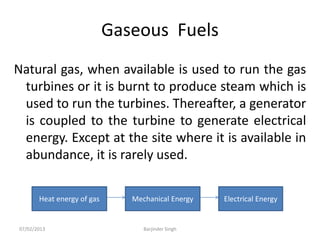
Natural gas, when available is used to run the gas
turbines or it is burnt to produce steam which is
used to run the turbines. Thereafter, a generator
is coupled to the turbine to generate electrical
energy. Except at the site where it is available in
abundance, it is rarely used.
Heat energy of gas Mechanical Energy Electrical Energy
07/02/2013 Barjinder Singh
Nuclear Energy
The heavy substance whose nucleus can be broken
into fragments is called nuclear fuel. The only
substance found in nature which fissions and is
capable of propagating nuclear chain reaction is
Uranium. By fission of nuclear of Uranium,
binding energy is released in the form of heat
energy, which is used for conversion of water
into steam. Steam is used to run turbines, and a
coupled generator produces electrical energy.
The operating cost is very low, however limited
availability of material and high initial cost are
the main drawbacks.
07/02/2013 Barjinder Singh
Sun
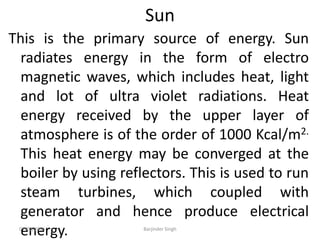
This is the primary source of energy. Sun
radiates energy in the form of electro
magnetic waves, which includes heat, light
and lot of ultra violet radiations. Heat
energy received by the upper layer of
atmosphere is of the order of 1000 Kcal/m2.
This heat energy may be converged at the
boiler by using reflectors. This is used to run
steam turbines, which coupled with
generator and hence produce electrical
energy.
07/02/2013 Barjinder Singh
Sun
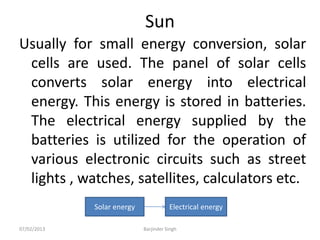
Usually for small energy conversion, solar
cells are used. The panel of solar cells
converts solar energy into electrical
energy. This energy is stored in batteries.
The electrical energy supplied by the
batteries is utilized for the operation of
various electronic circuits such as street
lights , watches, satellites, calculators etc.
Solar energy Electrical energy
07/02/2013 Barjinder Singh
Wind energy
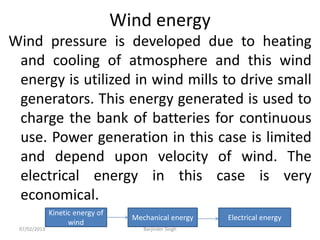
Wind pressure is developed due to heating
and cooling of atmosphere and this wind
energy is utilized in wind mills to drive small
generators. This energy generated is used to
charge the bank of batteries for continuous
use. Power generation in this case is limited
and depend upon velocity of wind. The
electrical energy in this case is very
economical.
Kinetic energy of
wind
Mechanical energy Electrical energy
07/02/2013 Barjinder Singh
Sea Waves
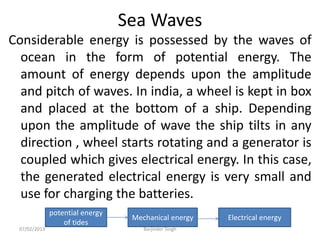
Considerable energy is possessed by the waves of
ocean in the form of potential energy. The
amount of energy depends upon the amplitude
and pitch of waves. In india, a wheel is kept in box
and placed at the bottom of a ship. Depending
upon the amplitude of wave the ship tilts in any
direction , wheel starts rotating and a generator is
coupled which gives electrical energy. In this case,
the generated electrical energy is very small and
use for charging the batteries.
potential energy
of tides
Mechanical energy Electrical energy
07/02/2013 Barjinder Singh
Tides
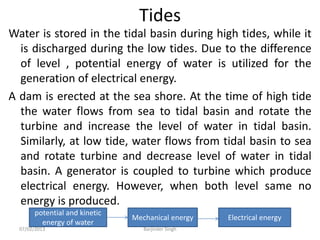
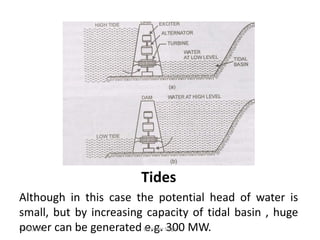
Water is stored in the tidal basin during high tides, while it
is discharged during the low tides. Due to the difference
of level , potential energy of water is utilized for the
generation of electrical energy.
A dam is erected at the sea shore. At the time of high tide
the water flows from sea to tidal basin and rotate the
turbine and increase the level of water in tidal basin.
Similarly, at low tide, water flows from tidal basin to sea
and rotate turbine and decrease level of water in tidal
basin. A generator is coupled to turbine which produce
electrical energy. However, when both level same no
energy is produced.
potential and kinetic
energy of water
Mechanical energy Electrical energy
07/02/2013 Barjinder Singh
Tides
Although in this case the potential head of water is
small, but by increasing capacity of tidal basin , huge
power can be generated e.g. 300 MW.
07/02/2013 Barjinder Singh
Biomass
Biomass contain chemical energy. We have seen
people in villages burning cowdung cakes as fuel.
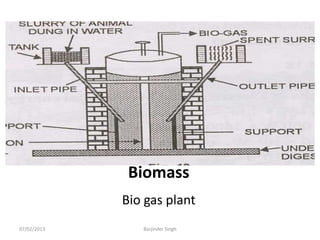
A better method is to convert biomass into gas
called biogas. This gas is prepared in biogas
plants. In this case, biomass is mixed with water
and slury is made. It is an excellent fuel for
cooking.
It can also used as street lighting and running
engines in villages.
07/02/2013 Barjinder Singh
Biomass
Bio gas plant
07/02/2013 Barjinder Singh
Source of energy
1.Non renewable sources : The sources of
energy which once used can not be replaced
are called as non renewable source of energy
such as coal, petroleum etc.
2.Renewable sources : The source of energy
which will never runout are called renewable
source of energy such as sun, water, wind,
tides and biomass etc.
07/02/2013 Barjinder Singh
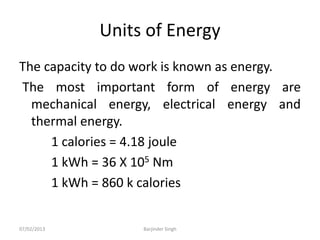
Units of Energy
The capacity to do work is known as energy.
The most important form of energy are
mechanical energy, electrical energy and
thermal energy.
1 calories = 4.18 joule
1 kWh = 36 X 105 Nm
1 kWh = 860 k calories
07/02/2013 Barjinder Singh
Generation of Electrical Energy
Since energy can neither be created nor destroyed
but it can only be transformed from one type to
an other.
Thus, the conversion of energy available in
different forms in nature into electrical energy is
known as Generation of Electrical Energy. Major
types of generations are as under :
1. Hydro electric power station
2. Steam power station
3. Diesel power station
4. Nuclear power station.
07/02/2013 Barjinder Singh
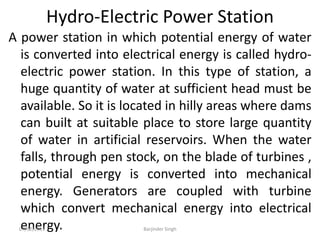
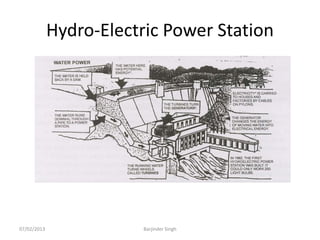
Hydro-Electric Power Station
A power station in which potential energy of water
is converted into electrical energy is called hydro-
electric power station. In this type of station, a
huge quantity of water at sufficient head must be
available. So it is located in hilly areas where dams
can built at suitable place to store large quantity
of water in artificial reservoirs. When the water
falls, through pen stock, on the blade of turbines ,
potential energy is converted into mechanical
energy. Generators are coupled with turbine
which convert mechanical energy into electrical
energy.
07/02/2013 Barjinder Singh
Hydro-Electric Power Station
07/02/2013 Barjinder Singh
Advantages of Hydro-Electric Power Station
Due to limited reserves of fuels and increasing
demand of electrical power, the hydro- electric
power stations are becoming more and more
popular.
Advantages :Following are the main advantages:
1. As no fuel is used , so no charge for
transportation.
2. Operating cost is low because only operators are
required.
3. Low maintenance cost
4. As these are in hilly areas so cost of land is small.
07/02/2013 Barjinder Singh
Advantages of Hydro-Electric Power Station
5. The efficiency is high approximately 80 to 90 %.
6. It is very neat and clean as there is no smoke, ash
and dust.
7. It can be put into service instantly.
8. The plant has long life.
9. The plant has constant frequency.
10.These plants are flood control and use for
irrigation purposes.
07/02/2013 Barjinder Singh
Disadvantages of Hydro-Electric Power Station
1. The capital cost is high.
2. As it built in hilly areas, so the cost of
transmission power is high.
3. The power generation depends on nature and in
dry season the generation of power reduces.
4. It requires large area for reservoir and dam.
5. It takes long time for erection.
07/02/2013 Barjinder Singh
Selection of site for hydro –electric
Power Plant
The following are the main factors for selection of site
:
1. The plants should be installed where adequate
quantity of water is available.
2. The reservoir should have huge capacity and large
catchment area.
3. Water collected behind dam has sufficient head to
deliver more potential energy.
4. Land should be strong to withstand weight of dam.
5. Transportation facilities are available.
07/02/2013 Barjinder Singh
Elements of hydro power station
1. Catchment area
2. Reservoir
3. Dam
4. Spillways
5. Valve house
6. Surge tank
7. Racks
8. Penstock
07/02/2013 Barjinder Singh
Elements of hydro power station
9. Water turbines
10.Draft tube
11.Tail race
12.Alternator
13.Control room
14.Switch yard
07/02/2013 Barjinder Singh
Catchment Area
The surrounding area of a hydro-electric plant
from where water is collected into reservoir is
called catchment area.
In hilly areas, rain water and water from melting
of ice . These reach to valley where water is
collected by erecting the dams. The
surrounding from where these stream are
coming into reservoir is called catchment area.
07/02/2013 Barjinder Singh
Reservoir
A large storage tank of water is called reservoir.
A reservoir may be natural or artificial lake. The
reservoir must have huge capacity and large
catchment area so that continuous flow of
water is available throughout the year. The
main source of water are rainfall in the
catchment area and melting of snow in the
mountains.
07/02/2013 Barjinder Singh
Dam
A strong wall with large base, behind which
water is stored is called a dam
A dam , according to its structural material,
performs two following functions ;
1. It creates the necessary water head
2. Store water in the reservoir
Dam is suitably designed to resist against
sliding, overturning and rupturing.
07/02/2013 Barjinder Singh
Spillways
The ways or passages for water to be released
from the dam, when water increases beyond
its safe level are called spillways.
At a particular level spillways are constructed on
the dams. They act as safely valves for the
dam. During rainy seasons, water reaching in
the reservoir increases beyond the capacity
of reservoir, then surplus water is released
through these spillways to the downstream.
07/02/2013 Barjinder Singh
Valve house
The cabin in which controls are kept to operate
the valves of the gates of the penstocks is
called valve house. It is situated at the start
of penstock and contains main valve which
control the flow of water.
07/02/2013 Barjinder Singh
Surge Tank
An open tank connected to the penstock which
regulates water supply through the penstock
is called surge tank.
A surge tank is built just before the turbine. In
case sudden closing of water turbine, the
surge tank absorbs the water hammerage by
increasing water level in it.
If it is not provided the water hammerage
damage the penstock.
07/02/2013 Barjinder Singh
Racks
At the entrance of tunnel racks are provided to
prevent the floating and other maters to the
turbine.
The space between the bars varies from 40 mm
to 200 mm in accordance with the minimum
width of water passage through the turbine.
07/02/2013 Barjinder Singh
Penstocks
Huge steel or reinforced steel pipes that carries
large quantity of water from valve house to
the scroll case of the turbines are called
penstocks.
In case of low and medium head power plants
each turbine is provided with its own
penstock, whereas in case of high head
power plants a single penstock is used.
07/02/2013 Barjinder Singh
Water Turbines
A device that converts the potential energy of
water into mechanical energy is called water
turbine. The type of turbine use depends
upon the head of water.
According to action , they are classified as :
Impulse turbine
Reaction turbine
07/02/2013 Barjinder Singh
Impulse Turbines
In an impulse turbine the whole head of water is
converted into kinetic energy before it enters
the wheel. During flow, pressure remains
same and due to change of velocity both
direction and magnitude, the water exerts a
driving force on wheel and thus kinetic
energy is converted into mechanical energy.
Impulse turbines are usually employed in high
head power plants.
07/02/2013 Barjinder Singh
Reaction Turbines
In the reaction turbine water may enter the
wheel partly with pressure energy and partly
with velocity head. During the passage
through wheel both pressure and velocity of
water are reduced and water gives up its
energy to the wheel, which converts into
mechanical energy.
Impulse turbines are usually employed in low
and medium head power plants.
07/02/2013 Barjinder Singh
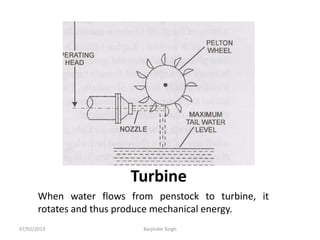
Turbine
When water flows from penstock to turbine, it
rotates and thus produce mechanical energy.
07/02/2013 Barjinder Singh
Turbines
Pelton Turbine : It is a impulse turbine and used
for low flow and high head.
Francis Turbine : It is a reaction turbine and used
for low and medium head plant.
Kaplan Turbine : It is a reaction turbine and used
for low head and large flow plants.
07/02/2013 Barjinder Singh
Draft Tube
It is an air tight pipe of suitable diameter. It is
connected at the bottom of the scroll case of
turbine and provide outlet for water coming
from turbine . It discharge the water in the tail
race.
07/02/2013 Barjinder Singh
Tail Race
Draft tube discharges water in the tail race,
which may lead it to the same stream or to
another.
07/02/2013 Barjinder Singh
Alternator
An alternator is coupled to the turbine, which
converts mechanical energy into electrical
energy. The alternators employed in these
power plants are of salient pole type,
operating at slow speeds.
07/02/2013 Barjinder Singh
Control Room
In the control room all the controlling
equipments, protective devices, indicating
instruments etc. are placed on the pannels.
Electrical equipments like transformers, circuit
breakers, CT’s, PT’s etc. are installed in switch
yard.
07/02/2013 Barjinder Singh
Classification of hydro station
On the basis of operating head, hydro –electric
power stations may be classified as :
1. Low head power stations
2. Medium head power stations
3. High head power stations
Below 60 meter head is considered as low head,
between 60 to 300 meter the head is
medium and above 300 meter head is
considered as high head.
07/02/2013 Barjinder Singh
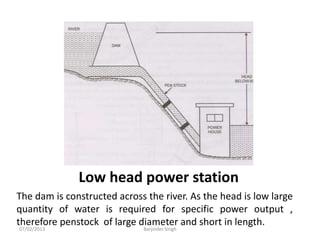
Low head power station
The dam is constructed across the river. As the head is low large
quantity of water is required for specific power output ,
therefore penstock of large diameter and short in length.
07/02/2013 Barjinder Singh
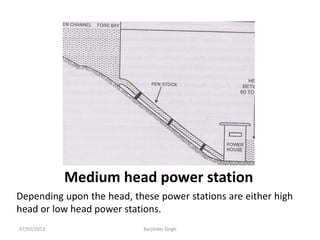
Medium head power station
Depending upon the head, these power stations are either high
head or low head power stations.
07/02/2013 Barjinder Singh
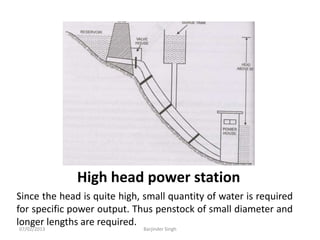
High head power station
Since the head is quite high, small quantity of water is required
for specific power output. Thus penstock of small diameter and
longer lengths are required.
07/02/2013 Barjinder Singh
Calorific value of Fuels
The amount of heat produced by the complete
combustion of a unit mass of the fuel is called
the calorific value.
It is measured in J/Kg or Kcal/Kg.
The calorific value of a fuel represents the
amount of heat available by the complete
combustion of that fuel. The greater the
calorific value, smaller the quantity of that
fuel required for generation.
07/02/2013 Barjinder Singh
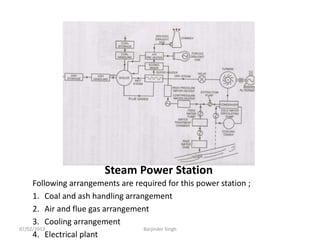
Steam power Station
The power stations in which heat energy of coal
combustion is converted into electrical energy
are called steam power station.
In these power stations, the heat of
combustion of coal is utilized for conversion of
water into steam which run the steam engine
or turbine. An alternator coupled to the steam
engine or turbine, converts mechanical energy
into electrical energy.
07/02/2013 Barjinder Singh
Steam Power Station
Following arrangements are required for this power station ;
1. Coal and ash handling arrangement
2. Air and flue gas arrangement
3. Cooling arrangement
4. Electrical plant
07/02/2013 Barjinder Singh
Advantages of Steam Power Plant
1. The fuel used is of low cost.
2. Less initial cost as compared to other.
3. The cost of generation is less.
4. They can be installed anywhere.
5. It requires less space.
6. Transmission line cost is less as located near
load centre.
07/02/2013 Barjinder Singh
Disadvantages of Steam Power
Plant
1. Atmosphere is polluted due to smoke and
fumes.
2. Running cost is high as compared to hydro
electric power plant.
3. These requires more maintenance as
compared to hydro power station.
07/02/2013 Barjinder Singh
Selection of site for Steam Power
Plant
1. The site should be near the coal site as
possible.
2. The site should have sufficient supply of
cooling water or near canal.
3. The land should be of low cost.
4. The site should be away from the populated
areas.
07/02/2013 Barjinder Singh
Elements of Steam Power Plant
1. Boiler
2. Super heater
3. Economizer
4. Air pre-heater
5. Condenser
6. Prime mover
07/02/2013 Barjinder Singh
Boiler
There are two type of boilers used in steam power
plants namely fire tube and water tube boiler.
In fire tube boilers, the hot gases circulate
inside the tubes, which are surrounded by
water. These types has low cost and used in
small power stations due to low pressure. In
case of water tube boiler, water circulates in
tube and hot gases outside the tube. These
type of boilers are used for large capacity due
to high pressure , safe in operation, less space,
and better overall control.
07/02/2013 Barjinder Singh
Super heater
It is a part of a boiler which consists of number of
special steel tubes. Depending upon the
temperature of steam the diameter of tubes
ranges from 25 mm to 64 mm.
The wet steam from the boiler is passed through
the tubes of super heater where it is dried and
super heated by the flue gases on their way to
chimney. Thus the waste heat energy of flue
gases is utilized.
07/02/2013 Barjinder Singh
Economizer
It consists of large number of tubes made of
special steel depending upon the temperature
of steam. The feed water is passed through
economizer before supplying to boiler.
Thus the temperature of feed water is raised by
using the heat energy of waste flue gases.
07/02/2013 Barjinder Singh
Condenser
The function of the condenser is to permits
expansion of steam in the prime mover to a
very low pressure and increases the efficiency
of the power plant.
The exhausted steam is condensed in the
condenser, which is again feed to the boiler.
07/02/2013 Barjinder Singh
Primer mover
According to the action of steam on the moving
blades, there are two types of turbines :
1. Impulse turbine : In this turbines, steam expands
in nozzles only and when passes over the blade
its pressure remains constant. It converts kinetic
energy into mechanical energy.
2. Reaction turbine : In these turbines, steam
expands as it flow over the blades, the blades
itself act as nozzles. It converts heat energy into
mechanical energy.
07/02/2013 Barjinder Singh
Diesel Power Station
A power station in which diesel engines are used as
prime mover and energy produced by the
combustion of diesel oil is converted into
electrical energy is called as diesel power
station.
In these power stations the gases produced by the
combustion of diesel oil are used to produce
mechanical energy. An alternator is coupled to
the diesel engine , which converts mechanical
energy into electrical energy.
07/02/2013 Barjinder Singh
Advantages of Diesel Power Station
1. less space is required for installation.
2. design and installation is simple.
3. Less quantity of water is required for cooling
purposes.
4. Over all initial cost is low.
5. It is quickly started in operation.
6.These types of plants are located near load
centre.
7.Cost of transportation diesel oil and transmission
of power is low.
07/02/2013 Barjinder Singh
Disadvantages of Diesel Power
Station
1. Diesel is costly, thus running cost is high.
2. Capacity of diesel engine is limited.
3. Maintenance cost of diesel engine is more.
07/02/2013 Barjinder Singh
Nuclear Power Station
A power station in which nuclear energy is used to
produced electrical energy is called a nuclear
power station.
It is interesting to know that 1 kg of nuclear fuel
produces the same amount of heat which is
produced by 2700 tons of coal.
07/02/2013 Barjinder Singh
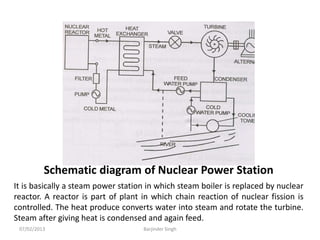
Schematic diagram of Nuclear Power Station
It is basically a steam power station in which steam boiler is replaced by nuclear
reactor. A reactor is part of plant in which chain reaction of nuclear fission is
controlled. The heat produce converts water into steam and rotate the turbine.
Steam after giving heat is condensed and again feed.
07/02/2013 Barjinder Singh
Advantages of Nuclear Power Plant
1.Amount of fuel requires is very small thus
transportation cost reduces.
2. It requires less space.
3. The running cost is very low so it most
economical.
07/02/2013 Barjinder Singh
Disadvantages of Nuclear Power
Plant
1. The danger of radioactivity is always there.
2. Initial cost is high.
3. Maintenance cost is more.
4. More time is required for installation.
07/02/2013 Barjinder Singh
Elements of Nuclear power Plants
The following are the important parts of nuclear
power plant :
1. Nuclear Reactor
2. Heat exchanger
3. Steam turbine
4. Alternator
07/02/2013 Barjinder Singh
Nuclear Reactor
It is a nuclear furnace for carrying out controlled
fission of radioactive material like Uranium-
235.
It provides neutrons with sufficient energy so
that it is absorbed by the nuclei and causing
fission.
It also controls the chain process.
07/02/2013 Barjinder Singh
Heat Exchanger
It is an arrangement by which heat produced
due to nuclear fission.
Heat produced in the nuclear reactor is given to
the coolant and it convert water into steam.
After giving up heat, the coolant is again back to
the reactor.
07/02/2013 Barjinder Singh
Steam Turbine
The steam produced by the heat exchanger is
fed to the steam turbine through valve, which
converts heat energy into mechanical energy.
07/02/2013 Barjinder Singh
Alternator
An alternator is coupled to the steam turbine
which converts mechanical energy into
electrical energy.
07/02/2013 Barjinder Singh
Thank you
07/02/2013 Barjinder Singh

POWER GENERATING STATIONS Feb.,2013.ppt

  • 1.
    POWER GENERATING STATION ELECTRICALPOWER - II 6TH SEMESTER ELECTRICAL ENGG. Barjinder singh Senior Lecturer Electrical Engg. Government Polytechnic College, Guru Teg Bahadurgarh, Moga 07/02/2013 Barjinder Singh
  • 2.
    Topics • Introduction • Advantagesof Electrical energy • Natural Sources of Energy 1. Water 2. Fuels 3. Nuclear energy 4. Sun 5. Wind 6. Sea Waves 7. Tides 8. Biomass 07/02/2013 Barjinder Singh
  • 3.
    Topics • Non Renewable& Renewable Sources of Energy • Major Generating Stations 1. Hydro Electric Power Stations 2. Steam Power Station 3. Diesel Power Station 4. Nuclear Power Station • Operating Costs • Comparison between Various Power Stations • Examples 07/02/2013 Barjinder Singh
  • 4.
    Introduction • Electricity playsvery important role in our daily life. All our activities are directly or indirectly related to electricity. Electricity come in India in 1897 at Darjeeling. In Delhi the first electricity generating plant was established on 1905 for public. • We know the demand of electricity keeps on increasing as the dependence of man kind increasing day by day. 07/02/2013 Barjinder Singh
  • 5.
    Introduction • The electricalenergy is generated at far away places and consumed by different consumers in cities, towns and villages. When the energy is transmitted and distributed to various consumers there is loss of energy called transmission losses. • In fact, in India, a large portion of these losses is due to theft of electrical energy. 07/02/2013 Barjinder Singh
  • 6.
    Advantages of ElectricalEnergy The different forms of energy available from various natural sources are converted into Electrical energy . It is because of the following merits of electrical energy over the other forms 1. Economical : It is more economical than the other forms because of low losses. 2. Easy to handle : It can be handled very easily over a long distance, through conductors. 3. Flexible : Electrical system is very flexible. It can be taken easily to any corner of house, factory, street etc using flexible conductors. 07/02/2013 Barjinder Singh
  • 7.
    Advantages of ElectricalEnerg 4. Cleanliness : Electrical energy , heating and electrical gadgets do not produce any smoke, dust etc. 5. No poisonous Gases : Electrical energy is not associated with smoke, fumes or other harmful gases. So it can be used safely for domestic and industrial purposes. 6. Easy to operate : Electrical systems starting, control and operation is very simple. 07/02/2013 Barjinder Singh
  • 8.
    Natural Sources ofEnergy 1. Water 2. Fuels 3. Nuclear Energy 4. Sun 5. Wind 6. Sea waves 7. Tides 8. Biomass etc. 07/02/2013 Barjinder Singh
  • 9.
    Water The potential energyof water collected at higher level or the kinetic energy of water flowing at high velocity can be used to run the turbines. These turbines or prime- movers are known as hydraulic turbines. Generators are coupled to these turbines which converts mechanical energy into electrical energy. The capital investment is high but the running cost is low as no fuel is used. So this type of system is more popular. 07/02/2013 Barjinder Singh
  • 10.
    Water In India, oneof the major hydro electric power project is Bhakra Nangal Project. The dam is erected across the river Sutlej and a lake called Gobind Sagar is created behind it. This project has two power houses : The capacity of left bank is 540 MW and capacity of right bank is 660 MW and overall capacity is 1200 MW. 07/02/2013 Barjinder Singh
  • 11.
    Water The energy flowdiagram is as under: Potential or Kinetic Energy of water Mechanical Energy Electrical Energy 07/02/2013 Barjinder Singh
  • 12.
    Fuel The most commonsource of energy is fuel and is available as under : 1. Solid fuels 2. Liquid fuels 3. Gaseous fuels The initial cost of these power stations are low but the operating cost is high. 07/02/2013 Barjinder Singh
  • 13.
    Solid Fuels The mainsolid fuel is coal, which is available in nature in huge quantity. By the combustion of coal in the boiler, heat energy is produced which is utilized to convert water into steam. This steam is used to run the turbines, to which generator is coupled. Thus electrical energy is generated. This type of energy generation is very popular in India. Heat energy of Coal Potential or Kinetic energy of steam Mechanical Energy Electrical Energy 07/02/2013 Barjinder Singh
  • 14.
    liquid Fuels The mainliquid fuel is diesel. The diesel is injected into the piston cylinder of diesel engine, where burning of diesel take place which develops mechanical energy. A generator is coupled to diesel engine and this mechanical energy is converted into electrical energy. The running cost of these systems is very high. Heat energy of diesel Mechanical Energy Electrical Energy 07/02/2013 Barjinder Singh
  • 15.
    Gaseous Fuels Natural gas,when available is used to run the gas turbines or it is burnt to produce steam which is used to run the turbines. Thereafter, a generator is coupled to the turbine to generate electrical energy. Except at the site where it is available in abundance, it is rarely used. Heat energy of gas Mechanical Energy Electrical Energy 07/02/2013 Barjinder Singh
  • 16.
    Nuclear Energy The heavysubstance whose nucleus can be broken into fragments is called nuclear fuel. The only substance found in nature which fissions and is capable of propagating nuclear chain reaction is Uranium. By fission of nuclear of Uranium, binding energy is released in the form of heat energy, which is used for conversion of water into steam. Steam is used to run turbines, and a coupled generator produces electrical energy. The operating cost is very low, however limited availability of material and high initial cost are the main drawbacks. 07/02/2013 Barjinder Singh
  • 17.
    Sun This is theprimary source of energy. Sun radiates energy in the form of electro magnetic waves, which includes heat, light and lot of ultra violet radiations. Heat energy received by the upper layer of atmosphere is of the order of 1000 Kcal/m2. This heat energy may be converged at the boiler by using reflectors. This is used to run steam turbines, which coupled with generator and hence produce electrical energy. 07/02/2013 Barjinder Singh
  • 18.
    Sun Usually for smallenergy conversion, solar cells are used. The panel of solar cells converts solar energy into electrical energy. This energy is stored in batteries. The electrical energy supplied by the batteries is utilized for the operation of various electronic circuits such as street lights , watches, satellites, calculators etc. Solar energy Electrical energy 07/02/2013 Barjinder Singh
  • 19.
    Wind energy Wind pressureis developed due to heating and cooling of atmosphere and this wind energy is utilized in wind mills to drive small generators. This energy generated is used to charge the bank of batteries for continuous use. Power generation in this case is limited and depend upon velocity of wind. The electrical energy in this case is very economical. Kinetic energy of wind Mechanical energy Electrical energy 07/02/2013 Barjinder Singh
  • 20.
    Sea Waves Considerable energyis possessed by the waves of ocean in the form of potential energy. The amount of energy depends upon the amplitude and pitch of waves. In india, a wheel is kept in box and placed at the bottom of a ship. Depending upon the amplitude of wave the ship tilts in any direction , wheel starts rotating and a generator is coupled which gives electrical energy. In this case, the generated electrical energy is very small and use for charging the batteries. potential energy of tides Mechanical energy Electrical energy 07/02/2013 Barjinder Singh
  • 21.
    Tides Water is storedin the tidal basin during high tides, while it is discharged during the low tides. Due to the difference of level , potential energy of water is utilized for the generation of electrical energy. A dam is erected at the sea shore. At the time of high tide the water flows from sea to tidal basin and rotate the turbine and increase the level of water in tidal basin. Similarly, at low tide, water flows from tidal basin to sea and rotate turbine and decrease level of water in tidal basin. A generator is coupled to turbine which produce electrical energy. However, when both level same no energy is produced. potential and kinetic energy of water Mechanical energy Electrical energy 07/02/2013 Barjinder Singh
  • 22.
    Tides Although in thiscase the potential head of water is small, but by increasing capacity of tidal basin , huge power can be generated e.g. 300 MW. 07/02/2013 Barjinder Singh
  • 23.
    Biomass Biomass contain chemicalenergy. We have seen people in villages burning cowdung cakes as fuel. A better method is to convert biomass into gas called biogas. This gas is prepared in biogas plants. In this case, biomass is mixed with water and slury is made. It is an excellent fuel for cooking. It can also used as street lighting and running engines in villages. 07/02/2013 Barjinder Singh
  • 24.
  • 25.
    Source of energy 1.Nonrenewable sources : The sources of energy which once used can not be replaced are called as non renewable source of energy such as coal, petroleum etc. 2.Renewable sources : The source of energy which will never runout are called renewable source of energy such as sun, water, wind, tides and biomass etc. 07/02/2013 Barjinder Singh
  • 26.
    Units of Energy Thecapacity to do work is known as energy. The most important form of energy are mechanical energy, electrical energy and thermal energy. 1 calories = 4.18 joule 1 kWh = 36 X 105 Nm 1 kWh = 860 k calories 07/02/2013 Barjinder Singh
  • 27.
    Generation of ElectricalEnergy Since energy can neither be created nor destroyed but it can only be transformed from one type to an other. Thus, the conversion of energy available in different forms in nature into electrical energy is known as Generation of Electrical Energy. Major types of generations are as under : 1. Hydro electric power station 2. Steam power station 3. Diesel power station 4. Nuclear power station. 07/02/2013 Barjinder Singh
  • 28.
    Hydro-Electric Power Station Apower station in which potential energy of water is converted into electrical energy is called hydro- electric power station. In this type of station, a huge quantity of water at sufficient head must be available. So it is located in hilly areas where dams can built at suitable place to store large quantity of water in artificial reservoirs. When the water falls, through pen stock, on the blade of turbines , potential energy is converted into mechanical energy. Generators are coupled with turbine which convert mechanical energy into electrical energy. 07/02/2013 Barjinder Singh
  • 29.
  • 30.
    Advantages of Hydro-ElectricPower Station Due to limited reserves of fuels and increasing demand of electrical power, the hydro- electric power stations are becoming more and more popular. Advantages :Following are the main advantages: 1. As no fuel is used , so no charge for transportation. 2. Operating cost is low because only operators are required. 3. Low maintenance cost 4. As these are in hilly areas so cost of land is small. 07/02/2013 Barjinder Singh
  • 31.
    Advantages of Hydro-ElectricPower Station 5. The efficiency is high approximately 80 to 90 %. 6. It is very neat and clean as there is no smoke, ash and dust. 7. It can be put into service instantly. 8. The plant has long life. 9. The plant has constant frequency. 10.These plants are flood control and use for irrigation purposes. 07/02/2013 Barjinder Singh
  • 32.
    Disadvantages of Hydro-ElectricPower Station 1. The capital cost is high. 2. As it built in hilly areas, so the cost of transmission power is high. 3. The power generation depends on nature and in dry season the generation of power reduces. 4. It requires large area for reservoir and dam. 5. It takes long time for erection. 07/02/2013 Barjinder Singh
  • 33.
    Selection of sitefor hydro –electric Power Plant The following are the main factors for selection of site : 1. The plants should be installed where adequate quantity of water is available. 2. The reservoir should have huge capacity and large catchment area. 3. Water collected behind dam has sufficient head to deliver more potential energy. 4. Land should be strong to withstand weight of dam. 5. Transportation facilities are available. 07/02/2013 Barjinder Singh
  • 34.
    Elements of hydropower station 1. Catchment area 2. Reservoir 3. Dam 4. Spillways 5. Valve house 6. Surge tank 7. Racks 8. Penstock 07/02/2013 Barjinder Singh
  • 35.
    Elements of hydropower station 9. Water turbines 10.Draft tube 11.Tail race 12.Alternator 13.Control room 14.Switch yard 07/02/2013 Barjinder Singh
  • 36.
    Catchment Area The surroundingarea of a hydro-electric plant from where water is collected into reservoir is called catchment area. In hilly areas, rain water and water from melting of ice . These reach to valley where water is collected by erecting the dams. The surrounding from where these stream are coming into reservoir is called catchment area. 07/02/2013 Barjinder Singh
  • 37.
    Reservoir A large storagetank of water is called reservoir. A reservoir may be natural or artificial lake. The reservoir must have huge capacity and large catchment area so that continuous flow of water is available throughout the year. The main source of water are rainfall in the catchment area and melting of snow in the mountains. 07/02/2013 Barjinder Singh
  • 38.
    Dam A strong wallwith large base, behind which water is stored is called a dam A dam , according to its structural material, performs two following functions ; 1. It creates the necessary water head 2. Store water in the reservoir Dam is suitably designed to resist against sliding, overturning and rupturing. 07/02/2013 Barjinder Singh
  • 39.
    Spillways The ways orpassages for water to be released from the dam, when water increases beyond its safe level are called spillways. At a particular level spillways are constructed on the dams. They act as safely valves for the dam. During rainy seasons, water reaching in the reservoir increases beyond the capacity of reservoir, then surplus water is released through these spillways to the downstream. 07/02/2013 Barjinder Singh
  • 40.
    Valve house The cabinin which controls are kept to operate the valves of the gates of the penstocks is called valve house. It is situated at the start of penstock and contains main valve which control the flow of water. 07/02/2013 Barjinder Singh
  • 41.
    Surge Tank An opentank connected to the penstock which regulates water supply through the penstock is called surge tank. A surge tank is built just before the turbine. In case sudden closing of water turbine, the surge tank absorbs the water hammerage by increasing water level in it. If it is not provided the water hammerage damage the penstock. 07/02/2013 Barjinder Singh
  • 42.
    Racks At the entranceof tunnel racks are provided to prevent the floating and other maters to the turbine. The space between the bars varies from 40 mm to 200 mm in accordance with the minimum width of water passage through the turbine. 07/02/2013 Barjinder Singh
  • 43.
    Penstocks Huge steel orreinforced steel pipes that carries large quantity of water from valve house to the scroll case of the turbines are called penstocks. In case of low and medium head power plants each turbine is provided with its own penstock, whereas in case of high head power plants a single penstock is used. 07/02/2013 Barjinder Singh
  • 44.
    Water Turbines A devicethat converts the potential energy of water into mechanical energy is called water turbine. The type of turbine use depends upon the head of water. According to action , they are classified as : Impulse turbine Reaction turbine 07/02/2013 Barjinder Singh
  • 45.
    Impulse Turbines In animpulse turbine the whole head of water is converted into kinetic energy before it enters the wheel. During flow, pressure remains same and due to change of velocity both direction and magnitude, the water exerts a driving force on wheel and thus kinetic energy is converted into mechanical energy. Impulse turbines are usually employed in high head power plants. 07/02/2013 Barjinder Singh
  • 46.
    Reaction Turbines In thereaction turbine water may enter the wheel partly with pressure energy and partly with velocity head. During the passage through wheel both pressure and velocity of water are reduced and water gives up its energy to the wheel, which converts into mechanical energy. Impulse turbines are usually employed in low and medium head power plants. 07/02/2013 Barjinder Singh
  • 47.
    Turbine When water flowsfrom penstock to turbine, it rotates and thus produce mechanical energy. 07/02/2013 Barjinder Singh
  • 48.
    Turbines Pelton Turbine :It is a impulse turbine and used for low flow and high head. Francis Turbine : It is a reaction turbine and used for low and medium head plant. Kaplan Turbine : It is a reaction turbine and used for low head and large flow plants. 07/02/2013 Barjinder Singh
  • 49.
    Draft Tube It isan air tight pipe of suitable diameter. It is connected at the bottom of the scroll case of turbine and provide outlet for water coming from turbine . It discharge the water in the tail race. 07/02/2013 Barjinder Singh
  • 50.
    Tail Race Draft tubedischarges water in the tail race, which may lead it to the same stream or to another. 07/02/2013 Barjinder Singh
  • 51.
    Alternator An alternator iscoupled to the turbine, which converts mechanical energy into electrical energy. The alternators employed in these power plants are of salient pole type, operating at slow speeds. 07/02/2013 Barjinder Singh
  • 52.
    Control Room In thecontrol room all the controlling equipments, protective devices, indicating instruments etc. are placed on the pannels. Electrical equipments like transformers, circuit breakers, CT’s, PT’s etc. are installed in switch yard. 07/02/2013 Barjinder Singh
  • 53.
    Classification of hydrostation On the basis of operating head, hydro –electric power stations may be classified as : 1. Low head power stations 2. Medium head power stations 3. High head power stations Below 60 meter head is considered as low head, between 60 to 300 meter the head is medium and above 300 meter head is considered as high head. 07/02/2013 Barjinder Singh
  • 54.
    Low head powerstation The dam is constructed across the river. As the head is low large quantity of water is required for specific power output , therefore penstock of large diameter and short in length. 07/02/2013 Barjinder Singh
  • 55.
    Medium head powerstation Depending upon the head, these power stations are either high head or low head power stations. 07/02/2013 Barjinder Singh
  • 56.
    High head powerstation Since the head is quite high, small quantity of water is required for specific power output. Thus penstock of small diameter and longer lengths are required. 07/02/2013 Barjinder Singh
  • 57.
    Calorific value ofFuels The amount of heat produced by the complete combustion of a unit mass of the fuel is called the calorific value. It is measured in J/Kg or Kcal/Kg. The calorific value of a fuel represents the amount of heat available by the complete combustion of that fuel. The greater the calorific value, smaller the quantity of that fuel required for generation. 07/02/2013 Barjinder Singh
  • 58.
    Steam power Station Thepower stations in which heat energy of coal combustion is converted into electrical energy are called steam power station. In these power stations, the heat of combustion of coal is utilized for conversion of water into steam which run the steam engine or turbine. An alternator coupled to the steam engine or turbine, converts mechanical energy into electrical energy. 07/02/2013 Barjinder Singh
  • 59.
    Steam Power Station Followingarrangements are required for this power station ; 1. Coal and ash handling arrangement 2. Air and flue gas arrangement 3. Cooling arrangement 4. Electrical plant 07/02/2013 Barjinder Singh
  • 60.
    Advantages of SteamPower Plant 1. The fuel used is of low cost. 2. Less initial cost as compared to other. 3. The cost of generation is less. 4. They can be installed anywhere. 5. It requires less space. 6. Transmission line cost is less as located near load centre. 07/02/2013 Barjinder Singh
  • 61.
    Disadvantages of SteamPower Plant 1. Atmosphere is polluted due to smoke and fumes. 2. Running cost is high as compared to hydro electric power plant. 3. These requires more maintenance as compared to hydro power station. 07/02/2013 Barjinder Singh
  • 62.
    Selection of sitefor Steam Power Plant 1. The site should be near the coal site as possible. 2. The site should have sufficient supply of cooling water or near canal. 3. The land should be of low cost. 4. The site should be away from the populated areas. 07/02/2013 Barjinder Singh
  • 63.
    Elements of SteamPower Plant 1. Boiler 2. Super heater 3. Economizer 4. Air pre-heater 5. Condenser 6. Prime mover 07/02/2013 Barjinder Singh
  • 64.
    Boiler There are twotype of boilers used in steam power plants namely fire tube and water tube boiler. In fire tube boilers, the hot gases circulate inside the tubes, which are surrounded by water. These types has low cost and used in small power stations due to low pressure. In case of water tube boiler, water circulates in tube and hot gases outside the tube. These type of boilers are used for large capacity due to high pressure , safe in operation, less space, and better overall control. 07/02/2013 Barjinder Singh
  • 65.
    Super heater It isa part of a boiler which consists of number of special steel tubes. Depending upon the temperature of steam the diameter of tubes ranges from 25 mm to 64 mm. The wet steam from the boiler is passed through the tubes of super heater where it is dried and super heated by the flue gases on their way to chimney. Thus the waste heat energy of flue gases is utilized. 07/02/2013 Barjinder Singh
  • 66.
    Economizer It consists oflarge number of tubes made of special steel depending upon the temperature of steam. The feed water is passed through economizer before supplying to boiler. Thus the temperature of feed water is raised by using the heat energy of waste flue gases. 07/02/2013 Barjinder Singh
  • 67.
    Condenser The function ofthe condenser is to permits expansion of steam in the prime mover to a very low pressure and increases the efficiency of the power plant. The exhausted steam is condensed in the condenser, which is again feed to the boiler. 07/02/2013 Barjinder Singh
  • 68.
    Primer mover According tothe action of steam on the moving blades, there are two types of turbines : 1. Impulse turbine : In this turbines, steam expands in nozzles only and when passes over the blade its pressure remains constant. It converts kinetic energy into mechanical energy. 2. Reaction turbine : In these turbines, steam expands as it flow over the blades, the blades itself act as nozzles. It converts heat energy into mechanical energy. 07/02/2013 Barjinder Singh
  • 69.
    Diesel Power Station Apower station in which diesel engines are used as prime mover and energy produced by the combustion of diesel oil is converted into electrical energy is called as diesel power station. In these power stations the gases produced by the combustion of diesel oil are used to produce mechanical energy. An alternator is coupled to the diesel engine , which converts mechanical energy into electrical energy. 07/02/2013 Barjinder Singh
  • 70.
    Advantages of DieselPower Station 1. less space is required for installation. 2. design and installation is simple. 3. Less quantity of water is required for cooling purposes. 4. Over all initial cost is low. 5. It is quickly started in operation. 6.These types of plants are located near load centre. 7.Cost of transportation diesel oil and transmission of power is low. 07/02/2013 Barjinder Singh
  • 71.
    Disadvantages of DieselPower Station 1. Diesel is costly, thus running cost is high. 2. Capacity of diesel engine is limited. 3. Maintenance cost of diesel engine is more. 07/02/2013 Barjinder Singh
  • 72.
    Nuclear Power Station Apower station in which nuclear energy is used to produced electrical energy is called a nuclear power station. It is interesting to know that 1 kg of nuclear fuel produces the same amount of heat which is produced by 2700 tons of coal. 07/02/2013 Barjinder Singh
  • 73.
    Schematic diagram ofNuclear Power Station It is basically a steam power station in which steam boiler is replaced by nuclear reactor. A reactor is part of plant in which chain reaction of nuclear fission is controlled. The heat produce converts water into steam and rotate the turbine. Steam after giving heat is condensed and again feed. 07/02/2013 Barjinder Singh
  • 74.
    Advantages of NuclearPower Plant 1.Amount of fuel requires is very small thus transportation cost reduces. 2. It requires less space. 3. The running cost is very low so it most economical. 07/02/2013 Barjinder Singh
  • 75.
    Disadvantages of NuclearPower Plant 1. The danger of radioactivity is always there. 2. Initial cost is high. 3. Maintenance cost is more. 4. More time is required for installation. 07/02/2013 Barjinder Singh
  • 76.
    Elements of Nuclearpower Plants The following are the important parts of nuclear power plant : 1. Nuclear Reactor 2. Heat exchanger 3. Steam turbine 4. Alternator 07/02/2013 Barjinder Singh
  • 77.
    Nuclear Reactor It isa nuclear furnace for carrying out controlled fission of radioactive material like Uranium- 235. It provides neutrons with sufficient energy so that it is absorbed by the nuclei and causing fission. It also controls the chain process. 07/02/2013 Barjinder Singh
  • 78.
    Heat Exchanger It isan arrangement by which heat produced due to nuclear fission. Heat produced in the nuclear reactor is given to the coolant and it convert water into steam. After giving up heat, the coolant is again back to the reactor. 07/02/2013 Barjinder Singh
  • 79.
    Steam Turbine The steamproduced by the heat exchanger is fed to the steam turbine through valve, which converts heat energy into mechanical energy. 07/02/2013 Barjinder Singh
  • 80.
    Alternator An alternator iscoupled to the steam turbine which converts mechanical energy into electrical energy. 07/02/2013 Barjinder Singh
  • 81.