PHYSICS – Energy Resources
LEARNING
OBJECTIVES
1.7.2 Energy resources
Core
• Describe how electricity or other
useful forms of energy may be obtained
from:
– chemical energy stored in fuel
– water, including the energy stored in
waves, in tides, and in water behind
hydroelectric dams
– geothermal resources
– nuclear fission
– heat and light from the Sun (solar
cells and panels)
– wind
• Give advantages and disadvantages of
each method in terms of renewability,
cost, reliability, scale and environmental
impact
• Show a qualitative understanding of
efficiency
Supplement
• Understand that the Sun is the source
of energy for all our energy resources
except geothermal, nuclear and tidal
• Show an understanding that energy is
released by nuclear fusion in the Sun
• Recall and use the equation:
efficiency = useful energy output
energy input ×
100%
• efficiency = useful power output
Power input × 100%
Electricity
Electricity is known as a
secondary energy source
because it is produced using
primary energy sources (eg.
Coal, nuclear fuel, wind
power).
How is electricity generated?
Electricity
Hydroelectric
How is electricity generated?
Electricity
Hydroelectric
Wind
How is electricity generated?
Electricity
Hydroelectric
Wind
Nuclear
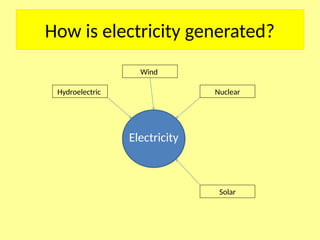
How is electricity generated?
Electricity
Hydroelectric
Wind
Nuclear
Solar
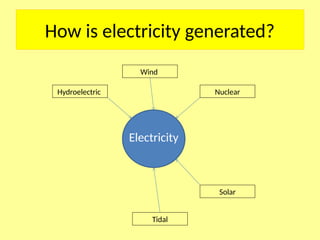
How is electricity generated?
Electricity
Hydroelectric
Wind
Nuclear
Solar
Tidal
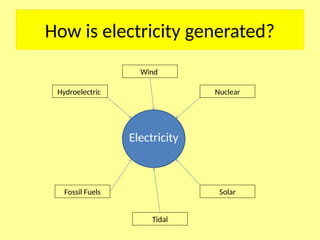
How is electricity generated?
Electricity
Hydroelectric
Wind
Nuclear
Solar
Tidal
Fossil Fuels
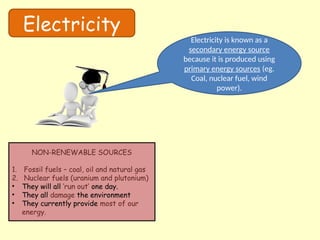
Electricity
Electricity is known as a
secondary energy source
because it is produced using
primary energy sources (eg.
Coal, nuclear fuel, wind
power).
NON-RENEWABLE SOURCES
1. Fossil fuels – coal, oil and natural gas
2. Nuclear fuels (uranium and plutonium)
• They will all ‘run out’ one day.
• They all damage the environment
• They currently provide most of our
energy.
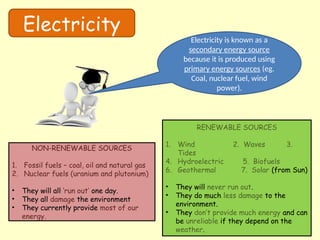
Electricity
Electricity is known as a
secondary energy source
because it is produced using
primary energy sources (eg.
Coal, nuclear fuel, wind
power).
NON-RENEWABLE SOURCES
1. Fossil fuels – coal, oil and natural gas
2. Nuclear fuels (uranium and plutonium)
• They will all ‘run out’ one day.
• They all damage the environment
• They currently provide most of our
energy.
RENEWABLE SOURCES
1. Wind 2. Waves 3.
Tides
4. Hydroelectric 5. Biofuels
6. Geothermal 7. Solar (from Sun)
• They will never run out.
• They do much less damage to the
environment.
• They don’t provide much energy and can
be unreliable if they depend on the
weather.
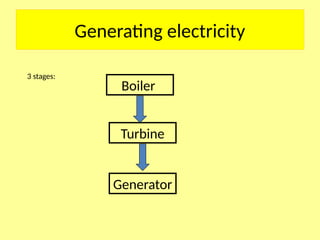
Generating electricity
3 stages:
Boiler
Turbine
Generator
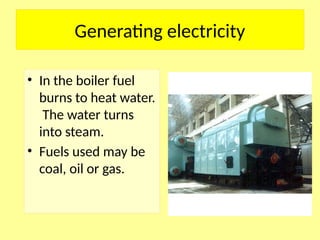
Generating electricity
• In the boiler fuel
burns to heat water.
The water turns
into steam.
• Fuels used may be
coal, oil or gas.
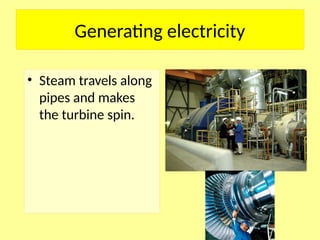
Generating electricity
• Steam travels along
pipes and makes
the turbine spin.
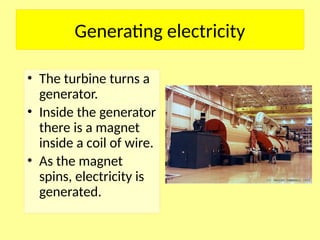
Generating electricity
• The turbine turns a
generator.
• Inside the generator
there is a magnet
inside a coil of wire.
• As the magnet
spins, electricity is
generated.
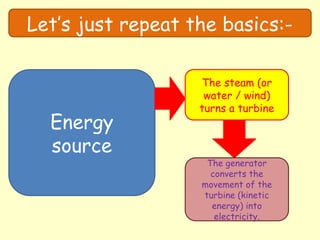
Let’s just repeat the basics:-
Energy
source
The steam (or
water / wind)
turns a turbine
The generator
converts the
movement of the
turbine (kinetic
energy) into
electricity.
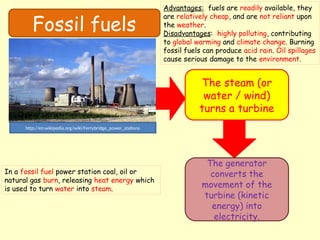
Fossil fuels
The steam (or
water / wind)
turns a turbine
The generator
converts the
movement of the
turbine (kinetic
energy) into
electricity.
In a fossil fuel power station coal, oil or
natural gas burn, releasing heat energy which
is used to turn water into steam.
http://en.wikipedia.org/wiki/Ferrybridge_power_stations
Advantages: fuels are readily available, they
are relatively cheap, and are not reliant upon
the weather.
Disadvantages: highly polluting, contributing
to global warming and climate change. Burning
fossil fuels can produce acid rain. Oil spillages
cause serious damage to the environment.
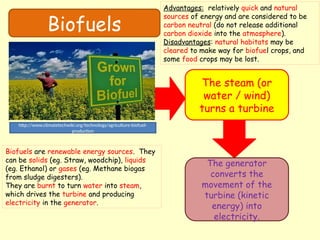
Biofuels
The steam (or
water / wind)
turns a turbine
The generator
converts the
movement of the
turbine (kinetic
energy) into
electricity.
Biofuels are renewable energy sources. They
can be solids (eg. Straw, woodchip), liquids
(eg. Ethanol) or gases (eg. Methane biogas
from sludge digesters).
They are burnt to turn water into steam,
which drives the turbine and producing
electricity in the generator.
http://www.climatetechwiki.org/technology/agriculture-biofuel-
production
Advantages: relatively quick and natural
sources of energy and are considered to be
carbon neutral (do not release additional
carbon dioxide into the atmosphere).
Disadvantages: natural habitats may be
cleared to make way for biofuel crops, and
some food crops may be lost.
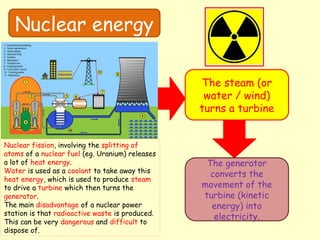
Nuclear energy
The steam (or
water / wind)
turns a turbine
The generator
converts the
movement of the
turbine (kinetic
energy) into
electricity.
Nuclear fission, involving the splitting of
atoms of a nuclear fuel (eg. Uranium) releases
a lot of heat energy.
Water is used as a coolant to take away this
heat energy, which is used to produce steam
to drive a turbine which then turns the
generator.
The main disadvantage of a nuclear power
station is that radioactive waste is produced.
This can be very dangerous and difficult to
dispose of.
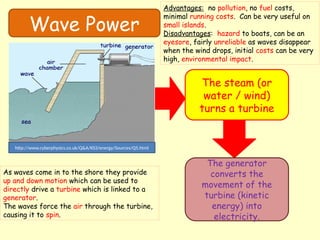
Wave Power
The steam (or
water / wind)
turns a turbine
The generator
converts the
movement of the
turbine (kinetic
energy) into
electricity.
http://www.cyberphysics.co.uk/Q&A/KS3/energy/Sources/Q5.html
As waves come in to the shore they provide
up and down motion which can be used to
directly drive a turbine which is linked to a
generator.
The waves force the air through the turbine,
causing it to spin.
Advantages: no pollution, no fuel costs,
minimal running costs. Can be very useful on
small islands.
Disadvantages: hazard to boats, can be an
eyesore, fairly unreliable as waves disappear
when the wind drops, initial costs can be very
high, environmental impact.
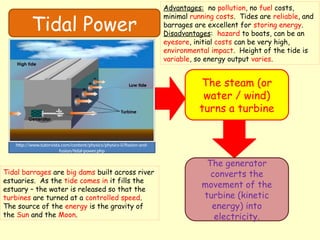
Tidal Power
The steam (or
water / wind)
turns a turbine
The generator
converts the
movement of the
turbine (kinetic
energy) into
electricity.
http://www.tutorvista.com/content/physics/physics-ii/fission-and-
fusion/tidal-power.php
Tidal barrages are big dams built across river
estuaries. As the tide comes in it fills the
estuary – the water is released so that the
turbines are turned at a controlled speed.
The source of the energy is the gravity of
the Sun and the Moon.
Advantages: no pollution, no fuel costs,
minimal running costs. Tides are reliable, and
barrages are excellent for storing energy.
Disadvantages: hazard to boats, can be an
eyesore, initial costs can be very high,
environmental impact. Height of the tide is
variable, so energy output varies.
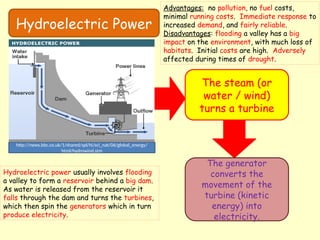
Hydroelectric Power
The steam (or
water / wind)
turns a turbine
The generator
converts the
movement of the
turbine (kinetic
energy) into
electricity.
http://news.bbc.co.uk/1/shared/spl/hi/sci_nat/06/global_energy/
html/hydrowind.stm
Hydroelectric power usually involves flooding
a valley to form a reservoir behind a big dam.
As water is released from the reservoir it
falls through the dam and turns the turbines,
which then spin the generators which in turn
produce electricity.
Advantages: no pollution, no fuel costs,
minimal running costs. Immediate response to
increased demand, and fairly reliable.
Disadvantages: flooding a valley has a big
impact on the environment, with much loss of
habitats. Initial costs are high. Adversely
affected during times of drought.
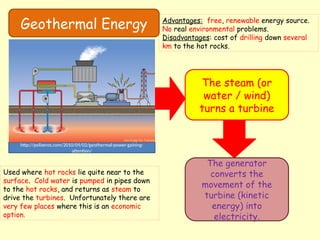
Geothermal Energy
The steam (or
water / wind)
turns a turbine
The generator
converts the
movement of the
turbine (kinetic
energy) into
electricity.
http://polizeros.com/2010/09/02/geothermal-power-gaining-
attention/
Used where hot rocks lie quite near to the
surface. Cold water is pumped in pipes down
to the hot rocks, and returns as steam to
drive the turbines. Unfortunately there are
very few places where this is an economic
option.
Advantages: free, renewable energy source.
No real environmental problems.
Disadvantages: cost of drilling down several
km to the hot rocks.
Solar cells
The steam (or
water / wind)
turns a turbine
The generator
converts the
movement of the
turbine (kinetic
energy) into
electricity.
http://etap.com/renewable-energy/photovoltaic-101.htm
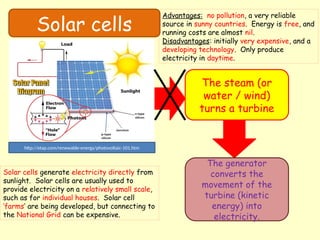
Solar cells generate electricity directly from
sunlight. Solar cells are usually used to
provide electricity on a relatively small scale,
such as for individual houses. Solar cell
‘farms’ are being developed, but connecting to
the National Grid can be expensive.
Advantages: no pollution, a very reliable
source in sunny countries. Energy is free, and
running costs are almost nil.
Disadvantages: initially very expensive, and a
developing technology. Only produce
electricity in daytime.
Solar panels
The steam (or
water / wind)
turns a turbine
The generator
converts the
movement of the
turbine (kinetic
energy) into
electricity.
http://www.west-norfolk.gov.uk/default.aspx?page=22430
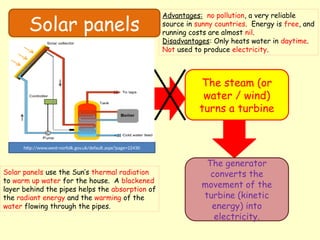
Solar panels use the Sun’s thermal radiation
to warm up water for the house. A blackened
layer behind the pipes helps the absorption of
the radiant energy and the warming of the
water flowing through the pipes.
Advantages: no pollution, a very reliable
source in sunny countries. Energy is free, and
running costs are almost nil.
Disadvantages: Only heats water in daytime.
Not used to produce electricity.
Wind Power
The steam (or
water / wind)
turns a turbine
The generator
converts the
movement of the
turbine (kinetic
energy) into
electricity.
http://www.newhomewindpower.com/wind-power-generators.html
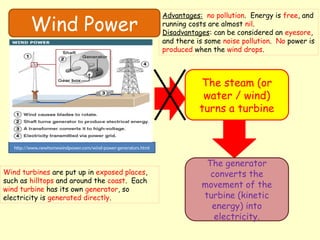
Wind turbines are put up in exposed places,
such as hilltops and around the coast. Each
wind turbine has its own generator, so
electricity is generated directly.
Advantages: no pollution. Energy is free, and
running costs are almost nil.
Disadvantages: can be considered an eyesore,
and there is some noise pollution. No power is
produced when the wind drops.
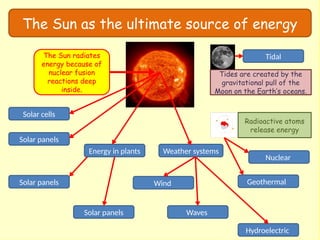
The Sun as the ultimate source of energy
The Sun radiates
energy because of
nuclear fusion
reactions deep
inside.
Solar cells
Solar panels
Energy in plants
Solar panels
Solar panels
Weather systems
Hydroelectric
Waves
Wind
Tidal
Tides are created by the
gravitational pull of the
Moon on the Earth’s oceans.
Radioactive atoms
release energy
Geothermal
Nuclear
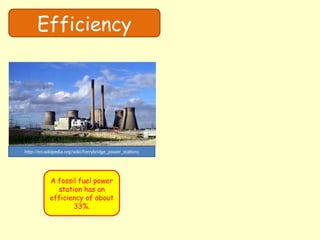
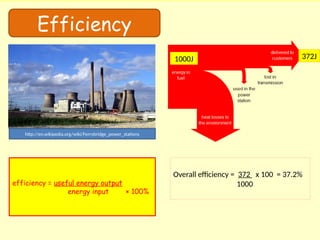
Efficiency
http://en.wikipedia.org/wiki/Ferrybridge_power_stations
A fossil fuel power
station has an
efficiency of about
33%.
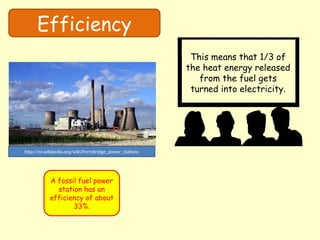
Efficiency
http://en.wikipedia.org/wiki/Ferrybridge_power_stations
A fossil fuel power
station has an
efficiency of about
33%.
This means that 1/3 of
the heat energy released
from the fuel gets
turned into electricity.
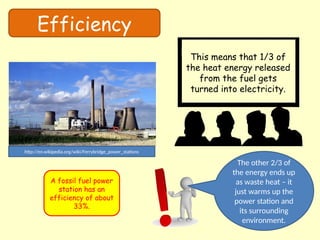
Efficiency
http://en.wikipedia.org/wiki/Ferrybridge_power_stations
A fossil fuel power
station has an
efficiency of about
33%.
This means that 1/3 of
the heat energy released
from the fuel gets
turned into electricity.
The other 2/3 of
the energy ends up
as waste heat – it
just warms up the
power station and
its surrounding
environment.
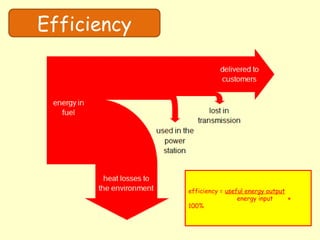
Efficiency
efficiency = useful energy output
energy input ×
100%
Efficiency
http://en.wikipedia.org/wiki/Ferrybridge_power_stations
efficiency = useful energy output
energy input × 100%
1000J 372J
Overall efficiency = 372 x 100 = 37.2%
1000
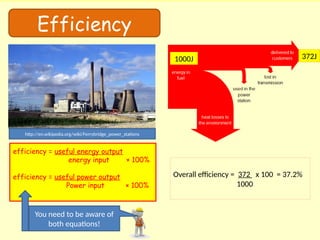
Efficiency
http://en.wikipedia.org/wiki/Ferrybridge_power_stations
efficiency = useful energy output
energy input × 100%
efficiency = useful power output
Power input × 100%
1000J 372J
Overall efficiency = 372 x 100 = 37.2%
1000
You need to be aware of
both equations!
LEARNING
OBJECTIVES
1.7.2 Energy resources
Core
• Describe how electricity or other
useful forms of energy may be obtained
from:
– chemical energy stored in fuel
– water, including the energy stored in
waves, in tides, and in water behind
hydroelectric dams
– geothermal resources
– nuclear fission
– heat and light from the Sun (solar
cells and panels)
– wind
• Give advantages and disadvantages of
each method in terms of renewability,
cost, reliability, scale and environmental
impact
• Show a qualitative understanding of
efficiency
Supplement
• Understand that the Sun is the source
of energy for all our energy resources
except geothermal, nuclear and tidal
• Show an understanding that energy is
released by nuclear fusion in the Sun
• Recall and use the equation:
efficiency = useful energy output
energy input ×
100%
• efficiency = useful power output
Power input × 100%
PHYSICS – Energy Resources
Physics (Energy resources)-Cambridge IGCSE

Physics (Energy resources)-Cambridge IGCSE

  • 1.
  • 2.
    LEARNING OBJECTIVES 1.7.2 Energy resources Core •Describe how electricity or other useful forms of energy may be obtained from: – chemical energy stored in fuel – water, including the energy stored in waves, in tides, and in water behind hydroelectric dams – geothermal resources – nuclear fission – heat and light from the Sun (solar cells and panels) – wind • Give advantages and disadvantages of each method in terms of renewability, cost, reliability, scale and environmental impact • Show a qualitative understanding of efficiency Supplement • Understand that the Sun is the source of energy for all our energy resources except geothermal, nuclear and tidal • Show an understanding that energy is released by nuclear fusion in the Sun • Recall and use the equation: efficiency = useful energy output energy input × 100% • efficiency = useful power output Power input × 100%
  • 3.
    Electricity Electricity is knownas a secondary energy source because it is produced using primary energy sources (eg. Coal, nuclear fuel, wind power).
  • 4.
    How is electricitygenerated? Electricity Hydroelectric
  • 5.
    How is electricitygenerated? Electricity Hydroelectric Wind
  • 6.
    How is electricitygenerated? Electricity Hydroelectric Wind Nuclear
  • 7.
    How is electricitygenerated? Electricity Hydroelectric Wind Nuclear Solar
  • 8.
    How is electricitygenerated? Electricity Hydroelectric Wind Nuclear Solar Tidal
  • 9.
    How is electricitygenerated? Electricity Hydroelectric Wind Nuclear Solar Tidal Fossil Fuels
  • 10.
    Electricity Electricity is knownas a secondary energy source because it is produced using primary energy sources (eg. Coal, nuclear fuel, wind power). NON-RENEWABLE SOURCES 1. Fossil fuels – coal, oil and natural gas 2. Nuclear fuels (uranium and plutonium) • They will all ‘run out’ one day. • They all damage the environment • They currently provide most of our energy.
  • 11.
    Electricity Electricity is knownas a secondary energy source because it is produced using primary energy sources (eg. Coal, nuclear fuel, wind power). NON-RENEWABLE SOURCES 1. Fossil fuels – coal, oil and natural gas 2. Nuclear fuels (uranium and plutonium) • They will all ‘run out’ one day. • They all damage the environment • They currently provide most of our energy. RENEWABLE SOURCES 1. Wind 2. Waves 3. Tides 4. Hydroelectric 5. Biofuels 6. Geothermal 7. Solar (from Sun) • They will never run out. • They do much less damage to the environment. • They don’t provide much energy and can be unreliable if they depend on the weather.
  • 12.
  • 13.
    Generating electricity • Inthe boiler fuel burns to heat water. The water turns into steam. • Fuels used may be coal, oil or gas.
  • 14.
    Generating electricity • Steamtravels along pipes and makes the turbine spin.
  • 15.
    Generating electricity • Theturbine turns a generator. • Inside the generator there is a magnet inside a coil of wire. • As the magnet spins, electricity is generated.
  • 16.
    Let’s just repeatthe basics:- Energy source The steam (or water / wind) turns a turbine The generator converts the movement of the turbine (kinetic energy) into electricity.
  • 17.
    Fossil fuels The steam(or water / wind) turns a turbine The generator converts the movement of the turbine (kinetic energy) into electricity. In a fossil fuel power station coal, oil or natural gas burn, releasing heat energy which is used to turn water into steam. http://en.wikipedia.org/wiki/Ferrybridge_power_stations Advantages: fuels are readily available, they are relatively cheap, and are not reliant upon the weather. Disadvantages: highly polluting, contributing to global warming and climate change. Burning fossil fuels can produce acid rain. Oil spillages cause serious damage to the environment.
  • 18.
    Biofuels The steam (or water/ wind) turns a turbine The generator converts the movement of the turbine (kinetic energy) into electricity. Biofuels are renewable energy sources. They can be solids (eg. Straw, woodchip), liquids (eg. Ethanol) or gases (eg. Methane biogas from sludge digesters). They are burnt to turn water into steam, which drives the turbine and producing electricity in the generator. http://www.climatetechwiki.org/technology/agriculture-biofuel- production Advantages: relatively quick and natural sources of energy and are considered to be carbon neutral (do not release additional carbon dioxide into the atmosphere). Disadvantages: natural habitats may be cleared to make way for biofuel crops, and some food crops may be lost.
  • 19.
    Nuclear energy The steam(or water / wind) turns a turbine The generator converts the movement of the turbine (kinetic energy) into electricity. Nuclear fission, involving the splitting of atoms of a nuclear fuel (eg. Uranium) releases a lot of heat energy. Water is used as a coolant to take away this heat energy, which is used to produce steam to drive a turbine which then turns the generator. The main disadvantage of a nuclear power station is that radioactive waste is produced. This can be very dangerous and difficult to dispose of.
  • 20.
    Wave Power The steam(or water / wind) turns a turbine The generator converts the movement of the turbine (kinetic energy) into electricity. http://www.cyberphysics.co.uk/Q&A/KS3/energy/Sources/Q5.html As waves come in to the shore they provide up and down motion which can be used to directly drive a turbine which is linked to a generator. The waves force the air through the turbine, causing it to spin. Advantages: no pollution, no fuel costs, minimal running costs. Can be very useful on small islands. Disadvantages: hazard to boats, can be an eyesore, fairly unreliable as waves disappear when the wind drops, initial costs can be very high, environmental impact.
  • 21.
    Tidal Power The steam(or water / wind) turns a turbine The generator converts the movement of the turbine (kinetic energy) into electricity. http://www.tutorvista.com/content/physics/physics-ii/fission-and- fusion/tidal-power.php Tidal barrages are big dams built across river estuaries. As the tide comes in it fills the estuary – the water is released so that the turbines are turned at a controlled speed. The source of the energy is the gravity of the Sun and the Moon. Advantages: no pollution, no fuel costs, minimal running costs. Tides are reliable, and barrages are excellent for storing energy. Disadvantages: hazard to boats, can be an eyesore, initial costs can be very high, environmental impact. Height of the tide is variable, so energy output varies.
  • 22.
    Hydroelectric Power The steam(or water / wind) turns a turbine The generator converts the movement of the turbine (kinetic energy) into electricity. http://news.bbc.co.uk/1/shared/spl/hi/sci_nat/06/global_energy/ html/hydrowind.stm Hydroelectric power usually involves flooding a valley to form a reservoir behind a big dam. As water is released from the reservoir it falls through the dam and turns the turbines, which then spin the generators which in turn produce electricity. Advantages: no pollution, no fuel costs, minimal running costs. Immediate response to increased demand, and fairly reliable. Disadvantages: flooding a valley has a big impact on the environment, with much loss of habitats. Initial costs are high. Adversely affected during times of drought.
  • 23.
    Geothermal Energy The steam(or water / wind) turns a turbine The generator converts the movement of the turbine (kinetic energy) into electricity. http://polizeros.com/2010/09/02/geothermal-power-gaining- attention/ Used where hot rocks lie quite near to the surface. Cold water is pumped in pipes down to the hot rocks, and returns as steam to drive the turbines. Unfortunately there are very few places where this is an economic option. Advantages: free, renewable energy source. No real environmental problems. Disadvantages: cost of drilling down several km to the hot rocks.
  • 24.
    Solar cells The steam(or water / wind) turns a turbine The generator converts the movement of the turbine (kinetic energy) into electricity. http://etap.com/renewable-energy/photovoltaic-101.htm Solar cells generate electricity directly from sunlight. Solar cells are usually used to provide electricity on a relatively small scale, such as for individual houses. Solar cell ‘farms’ are being developed, but connecting to the National Grid can be expensive. Advantages: no pollution, a very reliable source in sunny countries. Energy is free, and running costs are almost nil. Disadvantages: initially very expensive, and a developing technology. Only produce electricity in daytime.
  • 25.
    Solar panels The steam(or water / wind) turns a turbine The generator converts the movement of the turbine (kinetic energy) into electricity. http://www.west-norfolk.gov.uk/default.aspx?page=22430 Solar panels use the Sun’s thermal radiation to warm up water for the house. A blackened layer behind the pipes helps the absorption of the radiant energy and the warming of the water flowing through the pipes. Advantages: no pollution, a very reliable source in sunny countries. Energy is free, and running costs are almost nil. Disadvantages: Only heats water in daytime. Not used to produce electricity.
  • 26.
    Wind Power The steam(or water / wind) turns a turbine The generator converts the movement of the turbine (kinetic energy) into electricity. http://www.newhomewindpower.com/wind-power-generators.html Wind turbines are put up in exposed places, such as hilltops and around the coast. Each wind turbine has its own generator, so electricity is generated directly. Advantages: no pollution. Energy is free, and running costs are almost nil. Disadvantages: can be considered an eyesore, and there is some noise pollution. No power is produced when the wind drops.
  • 27.
    The Sun asthe ultimate source of energy The Sun radiates energy because of nuclear fusion reactions deep inside. Solar cells Solar panels Energy in plants Solar panels Solar panels Weather systems Hydroelectric Waves Wind Tidal Tides are created by the gravitational pull of the Moon on the Earth’s oceans. Radioactive atoms release energy Geothermal Nuclear
  • 28.
  • 29.
    Efficiency http://en.wikipedia.org/wiki/Ferrybridge_power_stations A fossil fuelpower station has an efficiency of about 33%. This means that 1/3 of the heat energy released from the fuel gets turned into electricity.
  • 30.
    Efficiency http://en.wikipedia.org/wiki/Ferrybridge_power_stations A fossil fuelpower station has an efficiency of about 33%. This means that 1/3 of the heat energy released from the fuel gets turned into electricity. The other 2/3 of the energy ends up as waste heat – it just warms up the power station and its surrounding environment.
  • 31.
    Efficiency efficiency = usefulenergy output energy input × 100%
  • 32.
    Efficiency http://en.wikipedia.org/wiki/Ferrybridge_power_stations efficiency = usefulenergy output energy input × 100% 1000J 372J Overall efficiency = 372 x 100 = 37.2% 1000
  • 33.
    Efficiency http://en.wikipedia.org/wiki/Ferrybridge_power_stations efficiency = usefulenergy output energy input × 100% efficiency = useful power output Power input × 100% 1000J 372J Overall efficiency = 372 x 100 = 37.2% 1000 You need to be aware of both equations!
  • 34.
    LEARNING OBJECTIVES 1.7.2 Energy resources Core •Describe how electricity or other useful forms of energy may be obtained from: – chemical energy stored in fuel – water, including the energy stored in waves, in tides, and in water behind hydroelectric dams – geothermal resources – nuclear fission – heat and light from the Sun (solar cells and panels) – wind • Give advantages and disadvantages of each method in terms of renewability, cost, reliability, scale and environmental impact • Show a qualitative understanding of efficiency Supplement • Understand that the Sun is the source of energy for all our energy resources except geothermal, nuclear and tidal • Show an understanding that energy is released by nuclear fusion in the Sun • Recall and use the equation: efficiency = useful energy output energy input × 100% • efficiency = useful power output Power input × 100%
  • 35.