Innovative Systems Design and Engineering                                                      www.iiste.org
ISSN 2222-1727 (Paper) ISSN 2222-2871 (Online)
Vol 3, No 2, 2012


    Power Flow Control/Limiting Short Circuit Current Using
                                                 TCSC
                                    Gannavarapu Akhilesh1*          D.Raju2
           1.     ACTS, JNTU-H, PO box 500035, Hyderabad, Andhra Pradesh, India
           2.     M.Tech (NIT Nagpur), Hyderabad, Andhra Pradesh, India.
                *E-mail of the corresponding author: akkigannavarapu@gmail.com


Abstract
This paper presents the various advantages of Thyristor Controller Series Capacitor (TCSC), both as a Power
Flow Controller, as well as a Short Circuit limiter during faults. The results have been derived and verified
from the software PSCAD, and the graphs and calculations are included in the paper. The results and
information included in the paper are sufficiently accurate.
Keywords: Modelling, power system dynamic stability.


1. Introduction
Thyristor Controlled Series Capacitor (TCSC) is a series FACTS device which allows rapid band continuous
changes of the transmission line impedance. It has great application potential in accurately regulating the
power flow on a transmission line, damping inter-area power oscillations, mitigating sub synchronous
resonance (SSR) and improving transient stability.
The characteristics of a TCSC at steady-state and very low frequencies can be studied using fundamental
frequency analytical models [1], [2]. These particular models recognize the importance of having different
approach from SVC modeling (assuming only line current as a constant) which, although more demanding on
the derivation, gives the most accurate TCSC model.
The fundamental frequency models cannot be used in wider frequency range since they only give the
relationship     among      fundamental     components         of    variables   when     at     steady-state.
Conventionally, the electromechanical transient programs like EMTP or PSCAD/EMTDC are used for
TCSC transient stability analysis. These simulation tools are accurate but they employ trial and error type
studies only, implying use of a large number of repetitive simulation runs for varying parameters in the case
of complex analysis or design tasks. On the other hand, the application of dynamic systems analysis
techniques or modern control design theories would bring benefits like shorter design time, optimization of
resources and development of new improved designs. In particular, the eigenvalue and frequency domain
analysis are widely recognized tools and they would prove invaluable for system designers and operators.
These techniques however always necessitate a suitable and accurate dynamic system model.
                                                     13
Innovative Systems Design and Engineering                                                       www.iiste.org
ISSN 2222-1727 (Paper) ISSN 2222-2871 (Online)
Vol 3, No 2, 2012


There have been a number of attempts to derive an accurate analytical model of a TCSC that can be employed
in system stability studies and controller design [3]–[6]. The model presented in [3] uses a special form of
discretization, applying Poincare mapping, for the particular Kayenta TCSC installation. The model
derivation for a different system will be similarly tedious and the final model form is not convenient for the
application of standard stability studies and controller design theories especially not for larger systems. A
similar final model form is derived in [4], and the model derivation is improved since direct discretization of
the linear system model is used, however, it suffers other shortcomings as the model in [3]. The modeling
principle reported in [5] avoids discretization and stresses the need for assuming only line current as an ideal
sine, however, it employs rotating vectors that might be difficult to use with stability studies, and only
considers the open loop configuration. The model in [5] is also oversimplified because of the use of
equivalent reactance and equivalent capacitance that might be deficient when used in wider frequency range.
Most of these re- ported models are therefore concerned with a particular system or particular type of study,
use overly simplified approach and do not include control elements or phase-locked loops (PLLs). In this
study, we attempt to derive a suitable linear continuous TCSC model in state-space form. The model should
have reasonable accuracy for the dynamic studies in the sub synchronous range and it should incorporate
common control elements including PLL. To enable flexibility of the model use with different ac systems, the
model structure adopts subsystem units interlinked in similar manner as with SVC modeling [6].
We also seek to offer complete closed-loop model verification in the time and frequency domains.
1.1 Test System
The test system for the study is a long transmission system compensated by a TCSC and connected to a firm
voltage source on each side. Fig. 1 shows a single line diagram of the test system where the transmission line
is represented by a lumped resistance and inductance in accordance with the approach for sub-synchronous
resonance studies [7]. Each phase of the TCSC is composed of a fixed capacitor in parallel with a
thyristor-controlled reactor (TCR). The TCSC is controlled by varying the phase delay of the thyristor firing
pulses synchronized through a PLL to the line current waveform.


                                                      14
Innovative Systems Design and Engineering                                                   www.iiste.org
ISSN 2222-1727 (Paper) ISSN 2222-2871 (Online)
Vol 3, No 2, 2012


Three different test systems are used in order to verify the model accuracy with different system parameter
and different operating points:
• System 1—75% compensation, capacitive mode;
• System 2—40% compensation, capacitive mode;
• System 3—75% compensation, inductive mode.
The test system parameters are practically selected according to the recommendations in [8]
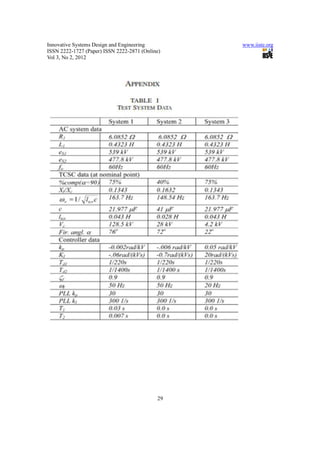
(regarding         and natural resonance) and the test system data are given in the Appendix.


1.2 Fundamental Frequency Model
                                                    15
Innovative Systems Design and Engineering                                                        www.iiste.org
ISSN 2222-1727 (Paper) ISSN 2222-2871 (Online)
Vol 3, No 2, 2012


The fundamental frequency model of a TCSC is derived first to enable initialization of the steady-state
parameters. The voltage across the TCSC capacitor comprises an uncontrolled and a controlled component
[8], and it is presumed that the line current is constant over one fundamental cycle in accordance with [1], [2],
[5]. The uncontrolled component is a sine wave (unaffected by thyristor switching) and it is also constant
over a fundamental cycle since it is directly related to the amplitude of the prevailing line current. The
controlled component       is a nonlinear variable that depends on circuit variables and on the TCR firing
angle.
In this study, the controlled component is represented as a nonlinear function of the uncontrolled component
and firing angle, as shown in Fig. 2.With this approach, captures the nonlinear phenomena caused by
thyristor switching    influence    and   all   internal    interactions   with capacitor   voltage    assuming
only that the line current and are linear. We seek in our work to study dynamics of in a wider frequency
range and also to offer a simplified representation for fundamental frequency studies. The fundamental
components of reactor current and the voltages and are selected as state variables and the non- linear
state-space model is presented as


                             Simulation Circuit for TCSC (500 KV System)


                                                       16
Innovative Systems Design and Engineering                                                  www.iiste.org
ISSN 2222-1727 (Paper) ISSN 2222-2871 (Online)
Vol 3, No 2, 2012


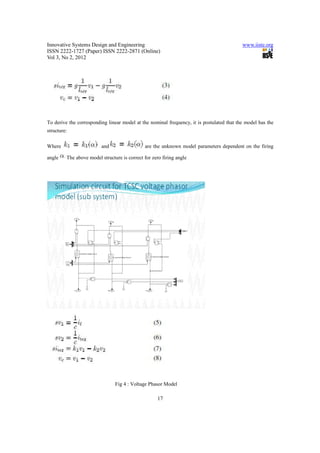
To derive the corresponding linear model at the nominal frequency, it is postulated that the model has the
structure:

Where                    and                  are the unknown model parameters dependent on the firing

angle    The above model structure is correct for zero firing angle


                                Fig 4 : Voltage Phasor Model

                                                    17
Innovative Systems Design and Engineering                                                        www.iiste.org
ISSN 2222-1727 (Paper) ISSN 2222-2871 (Online)
Vol 3, No 2, 2012


(                    , i.e., full conduction with   measured from the voltage crest) and we presume the same

model structure but different parameter values for                              .


Considering the two components of the thyristor current on the right side of (7) we note that          produces

the current that is driven by a constant voltage  (over one fundamental cycle) in accordance to the earlier
assumption. As a result, the configuration is similar to the shunt connection of TRC in a SVC, and the

constant    can be calculated using the approach of equivalent reactance            for the TCR current in a SVC
[6], [8]


In order to determine the constant       , we represent (6)–(7) as
a transfer function in the following form:


Observing (10), it is seen that       is the resonant frequency of an undamped second order system. The

proposed expression for this frequency is given below in (12) and it is determined using the experimental
frequency response of the model for the nonlinear TCSC segment as presented later in Section 1.3.


                                                      18
Innovative Systems Design and Engineering                                               www.iiste.org
ISSN 2222-1727 (Paper) ISSN 2222-2871 (Online)
Vol 3, No 2, 2012


                                Fig 5: Simulation Circuit for TCSC.


TCSC gain at fundamental frequency is derived


TCSC fundamental frequency impedance is


Where


And       is defined in (12).

Compared with the fundamental frequency TCSC model in [1], [2], the derived model (13) is considerably
simpler, yet it will be shown that the accuracy is very similar.


                                                       19
Innovative Systems Design and Engineering                                                          www.iiste.org
ISSN 2222-1727 (Paper) ISSN 2222-2871 (Online)
Vol 3, No 2, 2012


The above model is tested against PSCAD in the following way. The system is operated in open loop, i.e.,
with a fixed reference thyristor firing angle, in the configuration of Fig. 1. The value of the reference thyristor

angle is changed in interval                   and for each angle the value of the TCSC voltage

is observed. Since all other parameters are constant, the TCSC voltage is directly proportional to the TCSC
impedance and this is an effective way to obtain accurate information on the fundamental TCSC impedance.
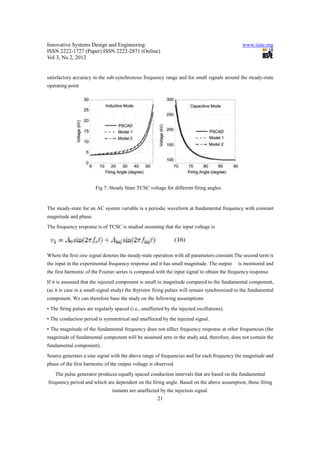
Fig. 3 shows the steady-state TCSC voltage against the range of firing angle values, where the above linear
model results are shown as model 2 and also the results from researchers [1], [2] as model 1. It is seen that the
proposed model shows good accuracy across the entire firing angle range and especially the results are very
close to those from [1], [2]. In fact the above model differs negligibly from the model [1], [2], except in the

less used low firing angles in range                         where the difference is still below 5%. It is also
evident that the two analytical models show small but consistent discrepancy against PSCAD/EMTDC, and
despite all simplifications in PSCAD it was not possible to obtain better matching.


                                Fig 6: TCSC Power measurement.


1.3 Small-Signal Dynamic Analytical Model
A. TCSC Model
The transfer function in (10) is accurate only at fundamental frequency and it cannot be used for wider
frequency studies. The goal of the dynamic modeling is to derive a dynamic expression for model of


                                                        20
Innovative Systems Design and Engineering                                                      www.iiste.org
ISSN 2222-1727 (Paper) ISSN 2222-2871 (Online)
Vol 3, No 2, 2012


satisfactory accuracy in the sub-synchronous frequency range and for small signals around the steady-state
operating point


                        Fig 7: Steady State TCSC voltage for different firing angles.


The steady-state for an AC system variable is a periodic waveform at fundamental frequency with constant
magnitude and phase.
The frequency response is of TCSC is studied assuming that the input voltage is


Where the first sine signal denotes the steady-state operation with all parameters constant.The second term is
the input in the experimental frequency response and it has small magnitude. The output      is monitored and
the first harmonic of the Fourier series is compared with the input signal to obtain the frequency response.
If it is assumed that the injected component is small in magnitude compared to the fundamental component,
(as it is case in a small-signal study) the thyristor firing pulses will remain synchronized to the fundamental
component. We can therefore base the study on the following assumptions:
• The firing pulses are regularly spaced (i.e., unaffected by the injected oscillations).
• The conduction period is symmetrical and unaffected by the injected signal.
• The magnitude of the fundamental frequency does not affect frequency response at other frequencies (the
magnitude of fundamental component will be assumed zero in the study and, therefore, does not contain the
fundamental component).
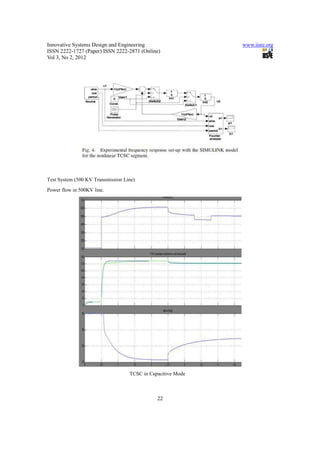
Source generates a sine signal with the above range of frequencies and for each frequency the magnitude and
phase of the first harmonic of the output voltage is observed.
    The pulse generator produces equally spaced conduction intervals that are based on the fundamental
frequency period and which are dependent on the firing angle. Based on the above assumption, these firing
                                instants are unaffected by the injection signal.
                                                       21
Innovative Systems Design and Engineering                    www.iiste.org
ISSN 2222-1727 (Paper) ISSN 2222-2871 (Online)
Vol 3, No 2, 2012


Test System (500 KV Transmission Line)
Power flow in 500KV line.


                                   TCSC in Capacitive Mode


                                              22
Innovative Systems Design and Engineering                             www.iiste.org
ISSN 2222-1727 (Paper) ISSN 2222-2871 (Online)
Vol 3, No 2, 2012


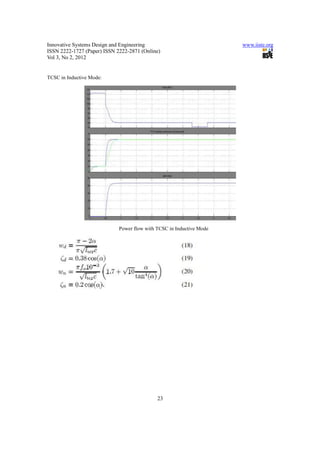
TCSC in Inductive Mode:


                             Power flow with TCSC in Inductive Mode


                                             23
Innovative Systems Design and Engineering        www.iiste.org
ISSN 2222-1727 (Paper) ISSN 2222-2871 (Online)
Vol 3, No 2, 2012


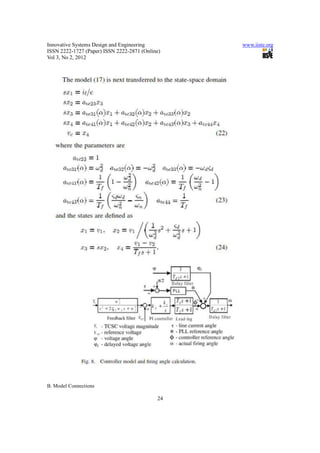
B. Model Connections

                                            24
Innovative Systems Design and Engineering                                           www.iiste.org
ISSN 2222-1727 (Paper) ISSN 2222-2871 (Online)
Vol 3, No 2, 2012


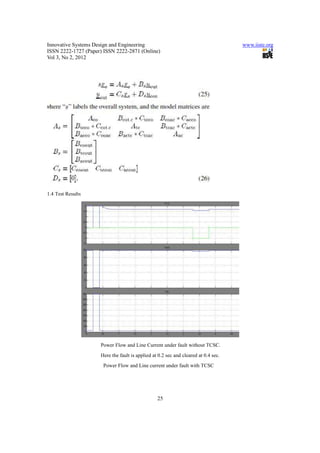
1.4 Test Results


                     Power Flow and Line Current under fault without TCSC.
                     Here the fault is applied at 0.2 sec and cleared at 0.4 sec.
                      Power Flow and Line current under fault with TCSC


                                                 25
Innovative Systems Design and Engineering                                            www.iiste.org
ISSN 2222-1727 (Paper) ISSN 2222-2871 (Online)
Vol 3, No 2, 2012


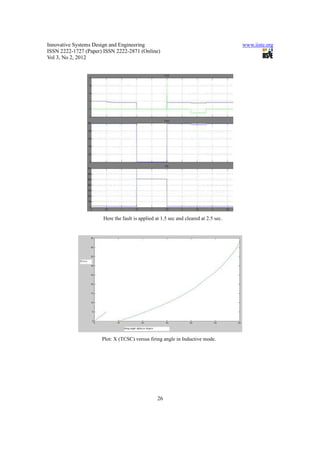
                      Here the fault is applied at 1.5 sec and cleared at 2.5 sec.


                      Plot: X (TCSC) versus firing angle in Inductive mode.


                                                 26
Innovative Systems Design and Engineering                                                     www.iiste.org
ISSN 2222-1727 (Paper) ISSN 2222-2871 (Online)
Vol 3, No 2, 2012


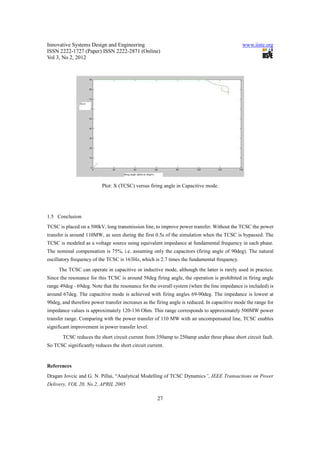
                          Plot: X (TCSC) versus firing angle in Capacitive mode.


1.5 Conclusion
TCSC is placed on a 500kV, long transmission line, to improve power transfer. Without the TCSC the power
transfer is around 110MW, as seen during the first 0.5s of the simulation when the TCSC is bypassed. The
TCSC is modeled as a voltage source using equivalent impedance at fundamental frequency in each phase.
The nominal compensation is 75%, i.e. assuming only the capacitors (firing angle of 90deg). The natural
oscillatory frequency of the TCSC is 163Hz, which is 2.7 times the fundamental frequency.
     The TCSC can operate in capacitive or inductive mode, although the latter is rarely used in practice.
Since the resonance for this TCSC is around 58deg firing angle, the operation is prohibited in firing angle
range 49deg - 69deg. Note that the resonance for the overall system (when the line impedance is included) is
around 67deg. The capacitive mode is achieved with firing angles 69-90deg. The impedance is lowest at
90deg, and therefore power transfer increases as the firing angle is reduced. In capacitive mode the range for
impedance values is approximately 120-136 Ohm. This range corresponds to approximately 500MW power
transfer range. Comparing with the power transfer of 110 MW with an uncompensated line, TCSC enables
significant improvement in power transfer level.
       TCSC reduces the short circuit current from 350amp to 250amp under three phase short circuit fault.
So TCSC significantly reduces the short circuit current.


References
Dragan Jovcic and G. N. Pillai, “Analytical Modelling of TCSC Dynamics”, IEEE Transactions on Power
Delivery, VOL 20, No.2, APRIL 2005

                                                     27
Innovative Systems Design and Engineering                                                   www.iiste.org
ISSN 2222-1727 (Paper) ISSN 2222-2871 (Online)
Vol 3, No 2, 2012


S. G. Jalali, R. A. Hedin, M. Pereira, and K. Sadek, “A stability model for the advanced series compensator
(ASC),” IEEE Trans. Power Del., vol. 11, no. 2, pp. 1128–1137, Apr. 1996.
C. R. Fuerte-Esquivel, E. Acha, and H. Ambriz-Perez, “A thyristor controlled series compensator model for
the power flow solution of practical power networks,” IEEE Trans. Power Syst., vol. 9, no. 15, pp.
58–64,Feb. 2000.
D. Jovcic, N. Pahalawaththa, M. Zavahir, and H. Hassan, “SVC dynamic analytical model,” IEEE Trans.
Power Del., vol. 18, no. 4, pp.1455–1461, Oct. 2003.


G. Akhilesh from Hyderabad, born on 6th January, 1990. Currently pursuing Bachelor of Technology, in
Electrical and Electronic Engineering, from ACTS, JNTU, Hyderabad, India. Previously published the paper
titled “Fuzzy Logic Scheme for Speed Control of Induction Motor”, ICCA ’12.


D.Raju Pursued M.Tech from National Institute of Technology, Nagpur. Currently pursuing Ph.D from
National Institute of Technology, Nagpur.


                                                    28
Innovative Systems Design and Engineering        www.iiste.org
ISSN 2222-1727 (Paper) ISSN 2222-2871 (Online)
Vol 3, No 2, 2012


                                            29

Power flow control limiting short circuit current using tcsc

  • 1.
    Innovative Systems Designand Engineering www.iiste.org ISSN 2222-1727 (Paper) ISSN 2222-2871 (Online) Vol 3, No 2, 2012 Power Flow Control/Limiting Short Circuit Current Using TCSC Gannavarapu Akhilesh1* D.Raju2 1. ACTS, JNTU-H, PO box 500035, Hyderabad, Andhra Pradesh, India 2. M.Tech (NIT Nagpur), Hyderabad, Andhra Pradesh, India. *E-mail of the corresponding author: akkigannavarapu@gmail.com Abstract This paper presents the various advantages of Thyristor Controller Series Capacitor (TCSC), both as a Power Flow Controller, as well as a Short Circuit limiter during faults. The results have been derived and verified from the software PSCAD, and the graphs and calculations are included in the paper. The results and information included in the paper are sufficiently accurate. Keywords: Modelling, power system dynamic stability. 1. Introduction Thyristor Controlled Series Capacitor (TCSC) is a series FACTS device which allows rapid band continuous changes of the transmission line impedance. It has great application potential in accurately regulating the power flow on a transmission line, damping inter-area power oscillations, mitigating sub synchronous resonance (SSR) and improving transient stability. The characteristics of a TCSC at steady-state and very low frequencies can be studied using fundamental frequency analytical models [1], [2]. These particular models recognize the importance of having different approach from SVC modeling (assuming only line current as a constant) which, although more demanding on the derivation, gives the most accurate TCSC model. The fundamental frequency models cannot be used in wider frequency range since they only give the relationship among fundamental components of variables when at steady-state. Conventionally, the electromechanical transient programs like EMTP or PSCAD/EMTDC are used for TCSC transient stability analysis. These simulation tools are accurate but they employ trial and error type studies only, implying use of a large number of repetitive simulation runs for varying parameters in the case of complex analysis or design tasks. On the other hand, the application of dynamic systems analysis techniques or modern control design theories would bring benefits like shorter design time, optimization of resources and development of new improved designs. In particular, the eigenvalue and frequency domain analysis are widely recognized tools and they would prove invaluable for system designers and operators. These techniques however always necessitate a suitable and accurate dynamic system model. 13
  • 2.
    Innovative Systems Designand Engineering www.iiste.org ISSN 2222-1727 (Paper) ISSN 2222-2871 (Online) Vol 3, No 2, 2012 There have been a number of attempts to derive an accurate analytical model of a TCSC that can be employed in system stability studies and controller design [3]–[6]. The model presented in [3] uses a special form of discretization, applying Poincare mapping, for the particular Kayenta TCSC installation. The model derivation for a different system will be similarly tedious and the final model form is not convenient for the application of standard stability studies and controller design theories especially not for larger systems. A similar final model form is derived in [4], and the model derivation is improved since direct discretization of the linear system model is used, however, it suffers other shortcomings as the model in [3]. The modeling principle reported in [5] avoids discretization and stresses the need for assuming only line current as an ideal sine, however, it employs rotating vectors that might be difficult to use with stability studies, and only considers the open loop configuration. The model in [5] is also oversimplified because of the use of equivalent reactance and equivalent capacitance that might be deficient when used in wider frequency range. Most of these re- ported models are therefore concerned with a particular system or particular type of study, use overly simplified approach and do not include control elements or phase-locked loops (PLLs). In this study, we attempt to derive a suitable linear continuous TCSC model in state-space form. The model should have reasonable accuracy for the dynamic studies in the sub synchronous range and it should incorporate common control elements including PLL. To enable flexibility of the model use with different ac systems, the model structure adopts subsystem units interlinked in similar manner as with SVC modeling [6]. We also seek to offer complete closed-loop model verification in the time and frequency domains. 1.1 Test System The test system for the study is a long transmission system compensated by a TCSC and connected to a firm voltage source on each side. Fig. 1 shows a single line diagram of the test system where the transmission line is represented by a lumped resistance and inductance in accordance with the approach for sub-synchronous resonance studies [7]. Each phase of the TCSC is composed of a fixed capacitor in parallel with a thyristor-controlled reactor (TCR). The TCSC is controlled by varying the phase delay of the thyristor firing pulses synchronized through a PLL to the line current waveform. 14
  • 3.
    Innovative Systems Designand Engineering www.iiste.org ISSN 2222-1727 (Paper) ISSN 2222-2871 (Online) Vol 3, No 2, 2012 Three different test systems are used in order to verify the model accuracy with different system parameter and different operating points: • System 1—75% compensation, capacitive mode; • System 2—40% compensation, capacitive mode; • System 3—75% compensation, inductive mode. The test system parameters are practically selected according to the recommendations in [8] (regarding and natural resonance) and the test system data are given in the Appendix. 1.2 Fundamental Frequency Model 15
  • 4.
    Innovative Systems Designand Engineering www.iiste.org ISSN 2222-1727 (Paper) ISSN 2222-2871 (Online) Vol 3, No 2, 2012 The fundamental frequency model of a TCSC is derived first to enable initialization of the steady-state parameters. The voltage across the TCSC capacitor comprises an uncontrolled and a controlled component [8], and it is presumed that the line current is constant over one fundamental cycle in accordance with [1], [2], [5]. The uncontrolled component is a sine wave (unaffected by thyristor switching) and it is also constant over a fundamental cycle since it is directly related to the amplitude of the prevailing line current. The controlled component is a nonlinear variable that depends on circuit variables and on the TCR firing angle. In this study, the controlled component is represented as a nonlinear function of the uncontrolled component and firing angle, as shown in Fig. 2.With this approach, captures the nonlinear phenomena caused by thyristor switching influence and all internal interactions with capacitor voltage assuming only that the line current and are linear. We seek in our work to study dynamics of in a wider frequency range and also to offer a simplified representation for fundamental frequency studies. The fundamental components of reactor current and the voltages and are selected as state variables and the non- linear state-space model is presented as Simulation Circuit for TCSC (500 KV System) 16
  • 5.
    Innovative Systems Designand Engineering www.iiste.org ISSN 2222-1727 (Paper) ISSN 2222-2871 (Online) Vol 3, No 2, 2012 To derive the corresponding linear model at the nominal frequency, it is postulated that the model has the structure: Where and are the unknown model parameters dependent on the firing angle The above model structure is correct for zero firing angle Fig 4 : Voltage Phasor Model 17
  • 6.
    Innovative Systems Designand Engineering www.iiste.org ISSN 2222-1727 (Paper) ISSN 2222-2871 (Online) Vol 3, No 2, 2012 ( , i.e., full conduction with measured from the voltage crest) and we presume the same model structure but different parameter values for . Considering the two components of the thyristor current on the right side of (7) we note that produces the current that is driven by a constant voltage (over one fundamental cycle) in accordance to the earlier assumption. As a result, the configuration is similar to the shunt connection of TRC in a SVC, and the constant can be calculated using the approach of equivalent reactance for the TCR current in a SVC [6], [8] In order to determine the constant , we represent (6)–(7) as a transfer function in the following form: Observing (10), it is seen that is the resonant frequency of an undamped second order system. The proposed expression for this frequency is given below in (12) and it is determined using the experimental frequency response of the model for the nonlinear TCSC segment as presented later in Section 1.3. 18
  • 7.
    Innovative Systems Designand Engineering www.iiste.org ISSN 2222-1727 (Paper) ISSN 2222-2871 (Online) Vol 3, No 2, 2012 Fig 5: Simulation Circuit for TCSC. TCSC gain at fundamental frequency is derived TCSC fundamental frequency impedance is Where And is defined in (12). Compared with the fundamental frequency TCSC model in [1], [2], the derived model (13) is considerably simpler, yet it will be shown that the accuracy is very similar. 19
  • 8.
    Innovative Systems Designand Engineering www.iiste.org ISSN 2222-1727 (Paper) ISSN 2222-2871 (Online) Vol 3, No 2, 2012 The above model is tested against PSCAD in the following way. The system is operated in open loop, i.e., with a fixed reference thyristor firing angle, in the configuration of Fig. 1. The value of the reference thyristor angle is changed in interval and for each angle the value of the TCSC voltage is observed. Since all other parameters are constant, the TCSC voltage is directly proportional to the TCSC impedance and this is an effective way to obtain accurate information on the fundamental TCSC impedance. Fig. 3 shows the steady-state TCSC voltage against the range of firing angle values, where the above linear model results are shown as model 2 and also the results from researchers [1], [2] as model 1. It is seen that the proposed model shows good accuracy across the entire firing angle range and especially the results are very close to those from [1], [2]. In fact the above model differs negligibly from the model [1], [2], except in the less used low firing angles in range where the difference is still below 5%. It is also evident that the two analytical models show small but consistent discrepancy against PSCAD/EMTDC, and despite all simplifications in PSCAD it was not possible to obtain better matching. Fig 6: TCSC Power measurement. 1.3 Small-Signal Dynamic Analytical Model A. TCSC Model The transfer function in (10) is accurate only at fundamental frequency and it cannot be used for wider frequency studies. The goal of the dynamic modeling is to derive a dynamic expression for model of 20
  • 9.
    Innovative Systems Designand Engineering www.iiste.org ISSN 2222-1727 (Paper) ISSN 2222-2871 (Online) Vol 3, No 2, 2012 satisfactory accuracy in the sub-synchronous frequency range and for small signals around the steady-state operating point Fig 7: Steady State TCSC voltage for different firing angles. The steady-state for an AC system variable is a periodic waveform at fundamental frequency with constant magnitude and phase. The frequency response is of TCSC is studied assuming that the input voltage is Where the first sine signal denotes the steady-state operation with all parameters constant.The second term is the input in the experimental frequency response and it has small magnitude. The output is monitored and the first harmonic of the Fourier series is compared with the input signal to obtain the frequency response. If it is assumed that the injected component is small in magnitude compared to the fundamental component, (as it is case in a small-signal study) the thyristor firing pulses will remain synchronized to the fundamental component. We can therefore base the study on the following assumptions: • The firing pulses are regularly spaced (i.e., unaffected by the injected oscillations). • The conduction period is symmetrical and unaffected by the injected signal. • The magnitude of the fundamental frequency does not affect frequency response at other frequencies (the magnitude of fundamental component will be assumed zero in the study and, therefore, does not contain the fundamental component). Source generates a sine signal with the above range of frequencies and for each frequency the magnitude and phase of the first harmonic of the output voltage is observed. The pulse generator produces equally spaced conduction intervals that are based on the fundamental frequency period and which are dependent on the firing angle. Based on the above assumption, these firing instants are unaffected by the injection signal. 21
  • 10.
    Innovative Systems Designand Engineering www.iiste.org ISSN 2222-1727 (Paper) ISSN 2222-2871 (Online) Vol 3, No 2, 2012 Test System (500 KV Transmission Line) Power flow in 500KV line. TCSC in Capacitive Mode 22
  • 11.
    Innovative Systems Designand Engineering www.iiste.org ISSN 2222-1727 (Paper) ISSN 2222-2871 (Online) Vol 3, No 2, 2012 TCSC in Inductive Mode: Power flow with TCSC in Inductive Mode 23
  • 12.
    Innovative Systems Designand Engineering www.iiste.org ISSN 2222-1727 (Paper) ISSN 2222-2871 (Online) Vol 3, No 2, 2012 B. Model Connections 24
  • 13.
    Innovative Systems Designand Engineering www.iiste.org ISSN 2222-1727 (Paper) ISSN 2222-2871 (Online) Vol 3, No 2, 2012 1.4 Test Results Power Flow and Line Current under fault without TCSC. Here the fault is applied at 0.2 sec and cleared at 0.4 sec. Power Flow and Line current under fault with TCSC 25
  • 14.
    Innovative Systems Designand Engineering www.iiste.org ISSN 2222-1727 (Paper) ISSN 2222-2871 (Online) Vol 3, No 2, 2012 Here the fault is applied at 1.5 sec and cleared at 2.5 sec. Plot: X (TCSC) versus firing angle in Inductive mode. 26
  • 15.
    Innovative Systems Designand Engineering www.iiste.org ISSN 2222-1727 (Paper) ISSN 2222-2871 (Online) Vol 3, No 2, 2012 Plot: X (TCSC) versus firing angle in Capacitive mode. 1.5 Conclusion TCSC is placed on a 500kV, long transmission line, to improve power transfer. Without the TCSC the power transfer is around 110MW, as seen during the first 0.5s of the simulation when the TCSC is bypassed. The TCSC is modeled as a voltage source using equivalent impedance at fundamental frequency in each phase. The nominal compensation is 75%, i.e. assuming only the capacitors (firing angle of 90deg). The natural oscillatory frequency of the TCSC is 163Hz, which is 2.7 times the fundamental frequency. The TCSC can operate in capacitive or inductive mode, although the latter is rarely used in practice. Since the resonance for this TCSC is around 58deg firing angle, the operation is prohibited in firing angle range 49deg - 69deg. Note that the resonance for the overall system (when the line impedance is included) is around 67deg. The capacitive mode is achieved with firing angles 69-90deg. The impedance is lowest at 90deg, and therefore power transfer increases as the firing angle is reduced. In capacitive mode the range for impedance values is approximately 120-136 Ohm. This range corresponds to approximately 500MW power transfer range. Comparing with the power transfer of 110 MW with an uncompensated line, TCSC enables significant improvement in power transfer level. TCSC reduces the short circuit current from 350amp to 250amp under three phase short circuit fault. So TCSC significantly reduces the short circuit current. References Dragan Jovcic and G. N. Pillai, “Analytical Modelling of TCSC Dynamics”, IEEE Transactions on Power Delivery, VOL 20, No.2, APRIL 2005 27
  • 16.
    Innovative Systems Designand Engineering www.iiste.org ISSN 2222-1727 (Paper) ISSN 2222-2871 (Online) Vol 3, No 2, 2012 S. G. Jalali, R. A. Hedin, M. Pereira, and K. Sadek, “A stability model for the advanced series compensator (ASC),” IEEE Trans. Power Del., vol. 11, no. 2, pp. 1128–1137, Apr. 1996. C. R. Fuerte-Esquivel, E. Acha, and H. Ambriz-Perez, “A thyristor controlled series compensator model for the power flow solution of practical power networks,” IEEE Trans. Power Syst., vol. 9, no. 15, pp. 58–64,Feb. 2000. D. Jovcic, N. Pahalawaththa, M. Zavahir, and H. Hassan, “SVC dynamic analytical model,” IEEE Trans. Power Del., vol. 18, no. 4, pp.1455–1461, Oct. 2003. G. Akhilesh from Hyderabad, born on 6th January, 1990. Currently pursuing Bachelor of Technology, in Electrical and Electronic Engineering, from ACTS, JNTU, Hyderabad, India. Previously published the paper titled “Fuzzy Logic Scheme for Speed Control of Induction Motor”, ICCA ’12. D.Raju Pursued M.Tech from National Institute of Technology, Nagpur. Currently pursuing Ph.D from National Institute of Technology, Nagpur. 28
  • 17.
    Innovative Systems Designand Engineering www.iiste.org ISSN 2222-1727 (Paper) ISSN 2222-2871 (Online) Vol 3, No 2, 2012 29