International Research Journal of Engineering and Technology (IRJET) e-ISSN: 2395-0056
Volume: 10 Issue: 04 | Apr 2023 www.irjet.net p-ISSN: 2395-0072
© 2023, IRJET | Impact Factor value: 8.226 | ISO 9001:2008 Certified Journal | Page 129
Pothole Detection using IoT, Android and iOS
Shreya Ghute1, Xavier Dsouza2, Srushti Satardekar3
1 Shreya Ghute,2Xavier Dsouza,3Srushti Satardekar, Students, Dept. of Information Technology, Don Bosco
Institute of Technology, Mumbai University, Maharashtra, India
---------------------------------------------------------------------***--------------------------------------------------------------------
Abstract - Due to various reasons, potholes are created
which causes problems in day to day lives of the people.
The objective of this project was to make transparency
between people and provide updates about potholes in
their travel route. This project was focused on getting the
data from a cloud database, reported by the user, and that
data could be accessed through the mobile application.
Project has achieved detecting the potholes and reporting
the potholes successfully on the database. People can view
the current pothole conditions and can report a pothole
manually which is a key feature of the app. The IoT device
can detect a pothole and location with the help of sensors
like accelerometer, GPS, Arduino. The detected latitude,
longitude, z axis values are sent to the cloud database for
reporting. The future scope is to detect depth of the
pothole to get accuracy in data and solve the problem
more efficiently.
Key Words: Accelerometer, GPS sensor, sensing,
potholes, detection, location.
1. INTRODUCTION
Potholes have always been a menace and are one of the
biggest problems which people face on a daily basis while
they travel. There is presently no such system to track
potholes on the road in India [1]. Our approach to detect
potholes is using an IoT device fitted in cars. Users can
also report manually through Android and iOS
applications. This system can track and record the
potholes in a centralized system. It displays the pothole’s
progress on the map. This system will aid to reduce
accidents and fatalities on roads due to potholes.
2. RELATED WORK
A. A pothole detection system was created using various
Android smartphones with accelerometers. They worked
with accelerometers present in various smartphones using
various pothole detection algorithms to deploy this system
[2].
B. There are various systems that use mobile sensing
technology for detection of potholes. This part provides a
short explanation about different mechanisms which were
implemented on various resources. There is an image
recognition method which Yu and Salari proposed for
pothole detection is based on laser imaging technique,
which collects the road information using algorithms like
Artificial neural network [3].
C. Another method by researchers Lin and Liu used using a
vector machine algorithm could provide high accuracy.[4]
This has high accuracy but requires more computational
power.
3. TECHNICAL REQUIREMENTS
The following technical requirements were chosen as a
basis for pothole finder system:
1. System should be able to detect potholes along with its
location while driving in a passenger car. Two-wheeler
vehicles such as motorcycles and scooters are not
considered.
2. System should be able to detect potholes in real time.
Collection of raw data will be stored in a local SD card in
the system.
3. Data will be then pushed into a cloud database, and
processed and stored into it.
4. A smart-phone is required with Android OS or IOS to
access the application for viewing the pothole.
5. An authenticated phone number is required to report
through the mobile application.
6. System available on mobile should be able to display
potholes on its locations.
7. Internet connectivity for viewing data in mobile.
4. ARCHITECTURAL DESIGN
The device is based on Arduino which is connected with
sensors consisting of a 3-axis accelerometer ADXL345
used to detect a vertical force(pothole) using z-axis [5]and
keeping a note of device positioning using x-axis.
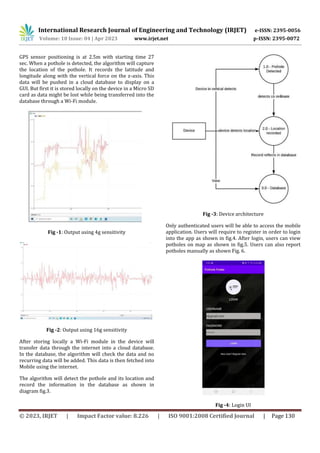
Accelerometer was tested at different sensitivities, using
at 4g and 8g no accuracy was obtained as shown in fig.1.
Using 16g in ADXL345 accuracy was observed as shown in
fig.2. A GPS module, Ublox NEO-6M GPS [6] is used to
record the location of the pothole.
International Research Journal of Engineering and Technology (IRJET) e-ISSN: 2395-0056
Volume: 10 Issue: 04 | Apr 2023 www.irjet.net p-ISSN: 2395-0072
© 2023, IRJET | Impact Factor value: 8.226 | ISO 9001:2008 Certified Journal | Page 130
GPS sensor positioning is at 2.5m with starting time 27
sec. When a pothole is detected, the algorithm will capture
the location of the pothole. It records the latitude and
longitude along with the vertical force on the z-axis. This
data will be pushed in a cloud database to display on a
GUI. But first it is stored locally on the device in a Micro SD
card as data might be lost while being transferred into the
database through a Wi-Fi module.
Fig -1: Output using 4g sensitivity
Fig -2: Output using 16g sensitivity
After storing locally a Wi-Fi module in the device will
transfer data through the internet into a cloud database.
In the database, the algorithm will check the data and no
recurring data will be added. This data is then fetched into
Mobile using the internet.
The algorithm will detect the pothole and its location and
record the information in the database as shown in
diagram fig.3.
Fig -3: Device architecture
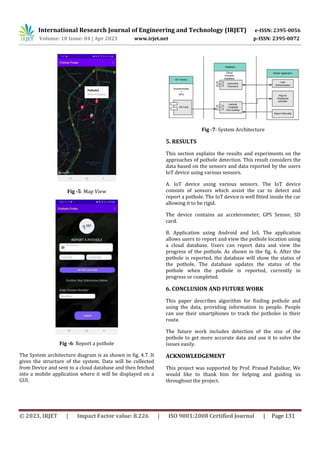
Only authenticated users will be able to access the mobile
application. Users will require to register in order to login
into the app as shown in fig.4. After login, users can view
potholes on map as shown in fig.5. Users can also report
potholes manually as shown Fig. 6.
Fig -4: Login UI
International Research Journal of Engineering and Technology (IRJET) e-ISSN: 2395-0056
Volume: 10 Issue: 04 | Apr 2023 www.irjet.net p-ISSN: 2395-0072
© 2023, IRJET | Impact Factor value: 8.226 | ISO 9001:2008 Certified Journal | Page 131
Fig -5: Map View
Fig -6: Report a pothole
The System architecture diagram is as shown in fig. 4.7. It
gives the structure of the system. Data will be collected
from Device and sent to a cloud database and then fetched
into a mobile application where it will be displayed on a
GUI.
Fig -7: System Architecture
5. RESULTS
This section explains the results and experiments on the
approaches of pothole detection. This result considers the
data based on the sensors and data reported by the users
IoT device using various sensors.
A. IoT device using various sensors. The IoT device
consists of sensors which assist the car to detect and
report a pothole. The IoT device is well fitted inside the car
allowing it to be rigid.
The device contains an accelerometer, GPS Sensor, SD
card.
B. Application using Android and IoS. The application
allows users to report and view the pothole location using
a cloud database. Users can report data and view the
progress of the pothole. As shown in the fig. 6. After the
pothole is reported, the database will show the status of
the pothole. The database updates the status of the
pothole when the pothole is reported, currently in
progress or completed.
6. CONCLUSION AND FUTURE WORK
This paper describes algorithm for finding pothole and
using the data, providing information to people. People
can use their smartphones to track the potholes in their
route.
The future work includes detection of the size of the
pothole to get more accurate data and use it to solve the
issues easily.
ACKNOWLEDGEMENT
This project was supported by Prof. Prasad Padalkar, We
would like to thank him for helping and guiding us
throughout the project.
International Research Journal of Engineering and Technology (IRJET) e-ISSN: 2395-0056
Volume: 10 Issue: 04 | Apr 2023 www.irjet.net p-ISSN: 2395-0072
© 2023, IRJET | Impact Factor value: 8.226 | ISO 9001:2008 Certified Journal | Page 132
REFERENCES
[1] MumbaiMirror Article [Online] .Available :
https://mumbaimirror.indiatimes.com/mumbai/other
/photos-roads-full-of- potholes-across-mumbai- enrage-
commuters/articleshow/70460342.cms
[2] Artis Mednis, Girts Strazdins, Reinholds Zviedris,
Georgijs Kanonirs, Leo Selavo. (06 June 2014). Real Time
Pothole Detection using Android Smartphones with
Accelerometers.[Online] Available
https://www.researchgate.net/publication/22425315
4_Real_Time_Pothole_Detection_Using_Android_Smartpho
nes_with_Accelerometers
[3] X. Yu and E. Salari, “Pavement pothole detection and
severity measurement using laser imaging,” in
Proceedings of the IEEE International Conference on
Electro/Information Technology (EIT ’11), pp. 1–5,
Mankato, Minn, USA, May 2011.
[4] J. Lin and Y. Liu, “Potholes detection based on SVM in
the pavement distress image,” in Proceedings of the 9th
International Symposium on Distributed Computing and
Applications to Business, Engineering and Science
(DCABES ’10), pp. 544–547, Hong Kong, August 2010.
[5] Accelerometer, (1 March 2019) W3C Process
Document[Online].
Available :
https://www.w3.org/TR/accelerometer/#acceleromet er-
z
[6]GPS[Online]Available:https://www.electroschematics.c
om/neo-6m-gps- module/

Pothole Detection using IoT, Android and iOS

  • 1.
    International Research Journalof Engineering and Technology (IRJET) e-ISSN: 2395-0056 Volume: 10 Issue: 04 | Apr 2023 www.irjet.net p-ISSN: 2395-0072 © 2023, IRJET | Impact Factor value: 8.226 | ISO 9001:2008 Certified Journal | Page 129 Pothole Detection using IoT, Android and iOS Shreya Ghute1, Xavier Dsouza2, Srushti Satardekar3 1 Shreya Ghute,2Xavier Dsouza,3Srushti Satardekar, Students, Dept. of Information Technology, Don Bosco Institute of Technology, Mumbai University, Maharashtra, India ---------------------------------------------------------------------***-------------------------------------------------------------------- Abstract - Due to various reasons, potholes are created which causes problems in day to day lives of the people. The objective of this project was to make transparency between people and provide updates about potholes in their travel route. This project was focused on getting the data from a cloud database, reported by the user, and that data could be accessed through the mobile application. Project has achieved detecting the potholes and reporting the potholes successfully on the database. People can view the current pothole conditions and can report a pothole manually which is a key feature of the app. The IoT device can detect a pothole and location with the help of sensors like accelerometer, GPS, Arduino. The detected latitude, longitude, z axis values are sent to the cloud database for reporting. The future scope is to detect depth of the pothole to get accuracy in data and solve the problem more efficiently. Key Words: Accelerometer, GPS sensor, sensing, potholes, detection, location. 1. INTRODUCTION Potholes have always been a menace and are one of the biggest problems which people face on a daily basis while they travel. There is presently no such system to track potholes on the road in India [1]. Our approach to detect potholes is using an IoT device fitted in cars. Users can also report manually through Android and iOS applications. This system can track and record the potholes in a centralized system. It displays the pothole’s progress on the map. This system will aid to reduce accidents and fatalities on roads due to potholes. 2. RELATED WORK A. A pothole detection system was created using various Android smartphones with accelerometers. They worked with accelerometers present in various smartphones using various pothole detection algorithms to deploy this system [2]. B. There are various systems that use mobile sensing technology for detection of potholes. This part provides a short explanation about different mechanisms which were implemented on various resources. There is an image recognition method which Yu and Salari proposed for pothole detection is based on laser imaging technique, which collects the road information using algorithms like Artificial neural network [3]. C. Another method by researchers Lin and Liu used using a vector machine algorithm could provide high accuracy.[4] This has high accuracy but requires more computational power. 3. TECHNICAL REQUIREMENTS The following technical requirements were chosen as a basis for pothole finder system: 1. System should be able to detect potholes along with its location while driving in a passenger car. Two-wheeler vehicles such as motorcycles and scooters are not considered. 2. System should be able to detect potholes in real time. Collection of raw data will be stored in a local SD card in the system. 3. Data will be then pushed into a cloud database, and processed and stored into it. 4. A smart-phone is required with Android OS or IOS to access the application for viewing the pothole. 5. An authenticated phone number is required to report through the mobile application. 6. System available on mobile should be able to display potholes on its locations. 7. Internet connectivity for viewing data in mobile. 4. ARCHITECTURAL DESIGN The device is based on Arduino which is connected with sensors consisting of a 3-axis accelerometer ADXL345 used to detect a vertical force(pothole) using z-axis [5]and keeping a note of device positioning using x-axis. Accelerometer was tested at different sensitivities, using at 4g and 8g no accuracy was obtained as shown in fig.1. Using 16g in ADXL345 accuracy was observed as shown in fig.2. A GPS module, Ublox NEO-6M GPS [6] is used to record the location of the pothole.
  • 2.
    International Research Journalof Engineering and Technology (IRJET) e-ISSN: 2395-0056 Volume: 10 Issue: 04 | Apr 2023 www.irjet.net p-ISSN: 2395-0072 © 2023, IRJET | Impact Factor value: 8.226 | ISO 9001:2008 Certified Journal | Page 130 GPS sensor positioning is at 2.5m with starting time 27 sec. When a pothole is detected, the algorithm will capture the location of the pothole. It records the latitude and longitude along with the vertical force on the z-axis. This data will be pushed in a cloud database to display on a GUI. But first it is stored locally on the device in a Micro SD card as data might be lost while being transferred into the database through a Wi-Fi module. Fig -1: Output using 4g sensitivity Fig -2: Output using 16g sensitivity After storing locally a Wi-Fi module in the device will transfer data through the internet into a cloud database. In the database, the algorithm will check the data and no recurring data will be added. This data is then fetched into Mobile using the internet. The algorithm will detect the pothole and its location and record the information in the database as shown in diagram fig.3. Fig -3: Device architecture Only authenticated users will be able to access the mobile application. Users will require to register in order to login into the app as shown in fig.4. After login, users can view potholes on map as shown in fig.5. Users can also report potholes manually as shown Fig. 6. Fig -4: Login UI
  • 3.
    International Research Journalof Engineering and Technology (IRJET) e-ISSN: 2395-0056 Volume: 10 Issue: 04 | Apr 2023 www.irjet.net p-ISSN: 2395-0072 © 2023, IRJET | Impact Factor value: 8.226 | ISO 9001:2008 Certified Journal | Page 131 Fig -5: Map View Fig -6: Report a pothole The System architecture diagram is as shown in fig. 4.7. It gives the structure of the system. Data will be collected from Device and sent to a cloud database and then fetched into a mobile application where it will be displayed on a GUI. Fig -7: System Architecture 5. RESULTS This section explains the results and experiments on the approaches of pothole detection. This result considers the data based on the sensors and data reported by the users IoT device using various sensors. A. IoT device using various sensors. The IoT device consists of sensors which assist the car to detect and report a pothole. The IoT device is well fitted inside the car allowing it to be rigid. The device contains an accelerometer, GPS Sensor, SD card. B. Application using Android and IoS. The application allows users to report and view the pothole location using a cloud database. Users can report data and view the progress of the pothole. As shown in the fig. 6. After the pothole is reported, the database will show the status of the pothole. The database updates the status of the pothole when the pothole is reported, currently in progress or completed. 6. CONCLUSION AND FUTURE WORK This paper describes algorithm for finding pothole and using the data, providing information to people. People can use their smartphones to track the potholes in their route. The future work includes detection of the size of the pothole to get more accurate data and use it to solve the issues easily. ACKNOWLEDGEMENT This project was supported by Prof. Prasad Padalkar, We would like to thank him for helping and guiding us throughout the project.
  • 4.
    International Research Journalof Engineering and Technology (IRJET) e-ISSN: 2395-0056 Volume: 10 Issue: 04 | Apr 2023 www.irjet.net p-ISSN: 2395-0072 © 2023, IRJET | Impact Factor value: 8.226 | ISO 9001:2008 Certified Journal | Page 132 REFERENCES [1] MumbaiMirror Article [Online] .Available : https://mumbaimirror.indiatimes.com/mumbai/other /photos-roads-full-of- potholes-across-mumbai- enrage- commuters/articleshow/70460342.cms [2] Artis Mednis, Girts Strazdins, Reinholds Zviedris, Georgijs Kanonirs, Leo Selavo. (06 June 2014). Real Time Pothole Detection using Android Smartphones with Accelerometers.[Online] Available https://www.researchgate.net/publication/22425315 4_Real_Time_Pothole_Detection_Using_Android_Smartpho nes_with_Accelerometers [3] X. Yu and E. Salari, “Pavement pothole detection and severity measurement using laser imaging,” in Proceedings of the IEEE International Conference on Electro/Information Technology (EIT ’11), pp. 1–5, Mankato, Minn, USA, May 2011. [4] J. Lin and Y. Liu, “Potholes detection based on SVM in the pavement distress image,” in Proceedings of the 9th International Symposium on Distributed Computing and Applications to Business, Engineering and Science (DCABES ’10), pp. 544–547, Hong Kong, August 2010. [5] Accelerometer, (1 March 2019) W3C Process Document[Online]. Available : https://www.w3.org/TR/accelerometer/#acceleromet er- z [6]GPS[Online]Available:https://www.electroschematics.c om/neo-6m-gps- module/