© POTEN & PARTNERS 2008
CONFIDENTIAL
Financing the LNG infrastructure chain
Melanie Lovatt
Business Intelligence
Poten & Partners
June, 2017
LNG/Natural Gas
LPG
Tankers
Other Hydrocarbons
Capital Services
Houston
New York London
Guangzhou
Singapore
Perth
Athens
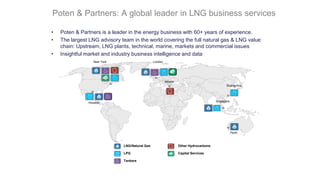
Poten & Partners: A global leader in LNG business services
• Poten & Partners is a leader in the energy business with 60+ years of experience.
• The largest LNG advisory team in the world covering the full natural gas & LNG value
chain: Upstream, LNG plants, technical, marine, markets and commercial issues
• Insightful market and industry business intelligence and data
MONTH 2009
© POTEN & PARTNERS 2009
CONFIDENTIAL
© POTEN & PARTNERS
April 2017 Page 3
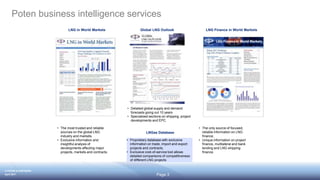
LNG in World Markets
• The most trusted and reliable
sources on the global LNG
industry and markets.
• Exclusive information and
insightful analysis of
developments affecting major
projects, markets and contracts.
LNG Finance in World Markets
• The only source of focused,
reliable information on LNG
finance.
• Unique information on project
finance, multilateral and bank
lending and LNG shipping
finance.
Global LNG Outlook
• Detailed global supply and demand
forecasts going out 10 years
• Specialized sections on shipping, project
developments and EPC.
LNGas Database
• Proprietary database with exclusive
information on trade, import and export
projects and contracts.
• Exclusive cost-of-service tool allows
detailed comparisons of competitiveness
of different LNG projects
Poten business intelligence services
MONTH 2009
© POTEN & PARTNERS 2009
CONFIDENTIAL
© POTEN & PARTNERS
June 2017 Page 4
Introduction
• Funding for LNG infrastructure – LNG ships, floating storage and regasification
units (FSRUs), land based regasification terminals, floating liquefaction (FLNG)
and land-based liquefaction comes from a number of different sources
• For each of these sectors, we look at the entities raising the funds, the pools of
funding they are tapping and how financing is being structured
• We examine the shift in funding patterns and what is driving these changes
MONTH 2009
© POTEN & PARTNERS 2009
CONFIDENTIAL
© POTEN & PARTNERS
June 2017 Page 5
Liquefaction sees largest funding requirement
• In 2016 liquefaction took the largest share of funding, as it did in 2015 and 2014
• But results are skewed by Yamal. Take it away and you get only $25bn for 2016
Liquefaction $29.01
LNG Carriers $4.88
FSRUs $0.69
Import terminals $1.42
FLNG $1.16
Small scale $1.28
Pipelines - feeding LNG
facility $3.70
Upstream $1.01
Liquefaction $32.07
LNG Carriers $4.75
FSRUs $0.32
FSRU-to-power $0.29
Import terminals $4.15
Small scale $0.34
2016 vs. 2015 SectorType ($bn)
2016
$41.94
2015
$43.15
MONTH 2009
© POTEN & PARTNERS 2009
CONFIDENTIAL
© POTEN & PARTNERS
June 2017 Page 6
Project finance takes a large share of global
LNG funding
2016 vs. 2015 FundingType ($bn)
Loans $4.30
Project finance $24.07
Equity funding $1.82
Bonds $0.20
IPO, share offer $0.45
Bank market refi $2.92
Bond market refi $7.31
MLP drop down $0.29
Sale and leaseback,
asset backed $0.57
Loans $5.45
Project finance $21.09
Equity funding $2.10
Bonds $3.65
IPO, share offer $0.57
Bank market refi $5.00
Bond market refi $4.33
MLP drop down $0.76
Sale and leaseback,
asset backed $0.20
2016
$41.94
2015
$43.15
• LNG funding activity slipped slightly in 2016 vs 2015
• Results skewed by Yamal LNG
MONTH 2009
© POTEN & PARTNERS 2009
CONFIDENTIAL
© POTEN & PARTNERS
June 2017 Page 7
Loans from big international project finance banks and
sometimes local banks
Banks also supply underlying funds for ECA-covered loans
Provide both direct lending and also insurance cover to
which the banks provide underling funds. This cover
brings down cost of funding.
They support equipment, expertise
from their own countries. Big players
in LNG: JBIC, Sace, Coface, US
Exim, Chin Exim, Kexim, K-Sure
Include development banks, such as
China Development Bank, African
Development bank, European Investment
Bank (ie e.g. Egypt LNG transactions)
Bonds
Sponsor co-loans
Sovereign wealth funds
EPC, equipment provider funding
Commercial banks
Multilaterals
Export credit agencies
Others
Debt
Sources
Liquefaction: Financed by JVs, majors, through PF, using equity and debt
MONTH 2009
© POTEN & PARTNERS 2009
CONFIDENTIAL
© POTEN & PARTNERS
April 2017 Page 8
0 5 10 15 20 25 30 35 40
Qalhat
Tangguh - Fujian Tranche - supplies 2.6MMt/y to CNOOC
ELNG Train 2
Segas, Damietta
Sakhalin 2
Donggi Senoro
PNG LNG - cost overun
Yemen LNG
Freeport T1
Qatargas 3
Freeport T3
Peru LNG
ELNG Train 1
Sabine Pass T5
Tangguh
Freeport T2
Sabine Pass T1, T2
Qatargas 4
Tangguh
Sabine Pass T3, T4
Cameron T1, T2, T3
Australia Pacific LNG
Qatargas 2
RasGas 2,3
Corpus Christi T1, T2
PNG LNG
Sakhalin 2
Yamal LNG
Ichthys LNG
Bank Debt
ECAs
Multi-laterals
Sponsor co-loans
Bonds
Equity
Sovereign wealth
2005
2007
2005
2007
2009
2014
2013
2008
2014
2005
2008
2005
2015
2006
2014
2012
2006
2013
2014
2012
2004
2005
2009
2015
2008
2012
2015
Average Project Debt /
Equity Ratio is 67:33
2016
2016
Security of long term contracts allows liquefaction sponsors to raise billions of
dollars in limited recourse project finance
$ billions
MONTH 2009
© POTEN & PARTNERS 2009
CONFIDENTIAL
© POTEN & PARTNERS
April 2017 Page 9
LNG offers volume risk protection; defaults are rare
• LNG: Take-or-pay/tolling = volume risk protection
• Power: long term PPA similar to LNG structure
• Stress‐tested to break even at low gas prices and/or oil prices that
allow projects to ride out commodity downturns, long-term contracts
or long-term tolling deals allow loan payback across the 14‐year
plus horizons that are common in LNG project finance
• But many PFs in other industries are exposed to volume risk
• 2 petchem PF deals on top 10 list, but sponsors are industry giants
– Aramco/Dow, Aramco/Total
• PF defaults - merchant power, volume based toll roads
• Some projects, such as Australia’s US$54bn, 15.6 MMt/y Gorgon
are financed using sponsors’ balance sheets. But many prefer
the protection offered by PF structures – limited recourse to the
sponsor
MONTH 2009
© POTEN & PARTNERS 2009
CONFIDENTIAL
© POTEN & PARTNERS
June 2017 Page 10
FLNG – can it be project-financed?
• Floating liquefaction vessels under construction have been balance sheet financed by:
Petronas 1.2-MMt/y PFLNG-1 to start this year offshore Malaysia
Shell’s 3.6-MMt/y Prelude to start 2017 offshore Australia
• Banks were set this week to sign an agreement to provide Eni and partners with $4.8
billion of financing for its 3.4-MMt/y Coral floater offshore Mozambique. Issues to
overcome include banks’ concerns over ‘new’ technology risk. At one-fifth size of land-
based liquefaction plants, space is tighter
• Completion/operating guarantees needed. Insurance capacity was a concern for all FLNG
projects, but it has been growing and appears to be sufficient
• Golar has been using a type of project finance for its LNGc to FLNG conversions, but
these are special hybrids – sale and leasebacks provided by Chinese financiers. It is ship
finance rather than classic PF
MONTH 2009
© POTEN & PARTNERS 2009
CONFIDENTIAL
© POTEN & PARTNERS
JUNE 2016 Page 11
Land-based import terminals often also structured as PF
Project Sponsor Debt raised
mn
Financiers
Bahrain LNG – Nov
‘16
Nogaholding, Teekay,
Samsung, GIC
$741 $584mn covered by K-Sure, banks
supply underlying funding
$160mn uncovered supplied by banks
Chhara – Nov ‘15
5 MMt/y
Gujurat, India
Hindustan Petroleum,
Shapoorji Pallonji
JV
$558 11 Indian banks
Mundra – Apr ‘15
5 MMt/y
Gujurat, India
Gujarat State
Petroleum, Adani JV
$560 11 Indian banks
Gate Break Bulk –
Nov ‘14
Gate expansion – ‘09
Gasunie
Vopak
€76
€136
EIB, banks
Banks
MONTH 2009
© POTEN & PARTNERS 2009
CONFIDENTIAL
© POTEN & PARTNERS
June 2017 Page 12
GasLog
• $1.3 billion corporate Oct ‘15 for 8 new builds
• 14 banks
• Export credit agencies: Kexim & K-Sure
Christophe de Margerie Arc7 icebreaker
Russia’s VTB provided a $260mn 13-year loan
Many of the Japanese LNG ship fundings
structured as project finance
ECAs also provide funding, cover
Golar used ICBC sale & leaseback for Golar
Glacier, Golar Snow, Golar Ice, Golar, and
Kelvin – delivered in 4Q15
Also $960mn sale & leaseback from CSSC Hong
Kong, for 1st FLNG conversion, the Hilli, costing
$1.2bn, with cargo due 1Q18. Also for the Gandria
• Gaslog and Teekay LNG partners
issued Norwegian krone bonds in 2016
• ICBC issued fixed rate long term bond
last year guaranteed by Kexim, to
finance the Ice and Kelvin
Corporate finance
Leasing, sale & leaseback
Project finance
bonds and equities
Capital markets
FUNDING
Sources
LNG carriers, FSRUs, FLNG, mostly financed by shipping companies
tapping different funding sources
raised by the company for one or more vessels limited recourse to the ship owner
loan paid back from the ship’s earnings
prevails in Chinese transactions
MONTH 2009
© POTEN & PARTNERS 2009
CONFIDENTIAL
© POTEN & PARTNERS
June 2017 Page 13
Equity market funding includes offers of shares & MLP units
Ships are ‘dropped down’ from the company into the MLP
0
100
200
300
400
500
600
700
800
900
1000
0
5
10
15
20
25
30
35
40
45
50
Jul-14 Oct-14 Jan-15 Apr-15 Jul-15 Oct-15 Jan-16 Apr-16 Jul-16 Oct-16
AlerianIndex
$/share
TGP GLOP HMLP GMLP DLNG Alerian MLP Index Alerian Natural Gas MLP Index
LNG Shipping Equity Listings vs. Alerian MLP Indices
TGP: Teekay LNG Partners; GLOP: GasLog Partners LP;
GMLP: Golar LNG Partners; DLNG: Dynagas LNG Partners; HMLP: Hoegh LNG
Partners
Source: NYSE, Reuters
MONTH 2009
© POTEN & PARTNERS 2009
CONFIDENTIAL
© POTEN & PARTNERS
June 2017 Page 14
Most funding is raised by shipping companies for LNG carriers. But the FSRU sector is growing. Golar raised funds via a share
offer in 2014 for its Hilli conversion to FLNG. In 2015 it received $960mn in a sale and leaseback for the Hilli and Exmar got a
$200mn loan from Industrial & Commercial Bank of China for its newbuild LNG vessel
Carriers FSRUs FLNG Not Specified
$4.88 bn$6.80 bn
201420152016
Totals may not add due to rounding
4.75
0.61
3.74
1.08
1.16
0.83
$5.36 bn
3.80
0.40
0.68
MONTH 2009
© POTEN & PARTNERS 2009
CONFIDENTIAL
© POTEN & PARTNERS
June 2017 Page 15
Fund-raising climbed in 2015, then edged lower in 2016. Loans, either corporate or provided via project finance structures are the
dominant method used by shipping companies to raise funds. But use of sales & leaseback structures is growing. Offerings of
shares and MLP units, and IPO activity fell in 2015 and 2016 as shipping was impacted by lower energy prices
Loans Bonds Shares, IPOs MLP drop down Sale, leaseback
201420152016
Equity purchase
$4.88 bn$6.80 bn$5.36 bn
Totals may not add due to rounding
3.46
0.51
0.45
0.29
0.36
0.29
4.38
0.65
0.46
0.37
0.96
3.14
0.43
1.31
MONTH 2009
© POTEN & PARTNERS 2009
CONFIDENTIAL
© POTEN & PARTNERS
June 2017 Page 16
59%
30%
6%
5%
Independent
Project/Government
Gas Major
Utility
83%
11%
6%
Independent
Project/Government
Gas Major
Utility
LNG carriers – ownership shifts from project
companies to independent ship owners
Existing fleet
Order book
Source: Poten & Partners
MONTH 2009
© POTEN & PARTNERS 2009
CONFIDENTIAL
© POTEN & PARTNERS
June 2017 Page 17
Independents are at the center of fund-raising activity
MONTH 2009
© POTEN & PARTNERS 2009
CONFIDENTIAL
© POTEN & PARTNERS
June 2017 Page 18
0
50
100
150
200
250
300
350
400
0
100
200
300
400
500
600
2000 2002 2004 2006 2008 2010 2012 2014 2016 2018 2020
LNGDemandMMt/y
NumberofShips
On Order
(138)
Operational
Fleet**
(408)
Global LNG
Demand
The LNG fleet is growing more rapidly than LNG demand
- but new ships are needed from 2019/2020, 160 extra by 2030
*excludes floating liquefaction and small-scale ships
**excludes ships in (semi) lay-up Source: Poten & Partners
Growth of the LNG Fleet*
MONTH 2009
© POTEN & PARTNERS 2009
CONFIDENTIAL
© POTEN & PARTNERS
June 2017 Page 19
Arc7 LNG ice-breakers will cost $320mn or $4.8bn in total –
a debt-raising test for ownersArc7 Ice-Breaking Ship Investments
But the Arc7s’ 25-year charters make financing easier to secure
$260mn loan
from Russia’s
VTB Bank on
June 20
MONTH 2009
© POTEN & PARTNERS 2009
CONFIDENTIAL
© POTEN & PARTNERS
JUNE 2016 Page 20
SPEC
San Pedro de Macoris
Bahia Blanca
Pecem
Guanabara Bay
Dubai
Mina Al-Ahmadi
Neptune LNG
Northeast Gateway
Offshore Toscana
West Java
Escobar
Central Java
Port Qasim
Lampung
Ba Ria
GNL del Plata
Port Meridian
Mossel Bay
Bahia
Rio Grande do Sul
Tianjin
Hadera
Aguirre
Alexandroupolis
Tripoli
Klaipeda Port
Kakinada
Ain Sokhna Aqaba
Notes: Projects classed under construction are not the same as vessels under construction
Does not include: previously announced projects considered dormant; floating storage terminals. Includes FSU projects.
Mejillones
Octopus
Grand Bassam
Tema
Benin
Chittagong
Pipavav
Yangcheng
Yantai
Existing (19)
Under Construction (4)
Planned (~30)
Kavala
Batangas
Mindanao
Son My
Mombasa
Dakar
Suape
Sergipe
Walvis Bay
Takoradi
Yuzhny
Bahrain
Port Esquivel
Ain Sokhna 2
Kaliningrad
East Java
Myanmar
Malacca
Source: Poten & Partners
FSRU sector has grown rapidly since 2005
MONTH 2009
© POTEN & PARTNERS 2009
CONFIDENTIAL
© POTEN & PARTNERS
JUNE 2016 Page 21
FSRUs & lower LNG prices put gas within reach for more
countries – financiers show demand side appetite
• FSRU advantages over land-based terminals: Quicker & cheaper construction; flexibility –
can deploy to another location; vessel is leased reducing up-front cost for importer. Some
are newbuilds, some converted from LNG carriers.
• FSRU financing follows a similar pattern to LNG carriers: corporate finance or project
finance, supplied by banks and/or ECAs; leases & sale and leaseback, bonds, share
issues, MLPs, etc
• Longer charters mean that project finance can be used, but for shorter charters, corporate
loan structures are more common
• NB: In Feb Hoegh secured a $223mn loan from 6 banks for its 7th FSRU at 3.8%. Without
employment advance rate is 65% and 15yr tenor, with charter 75% advance, 20 yr tenor
MONTH 2009
© POTEN & PARTNERS 2009
CONFIDENTIAL
© POTEN & PARTNERS
June 2017 Page 22
Difficult market conditions impact funding
• New builds have pressured spot charter rates. Tri-fuel diesel electric rates are at
historic lows of about $28,000-30,000/day vs $140,000 in 2013, steam turbine
rates at $23,000-24,000/day vs peak of $155,000/day in 2012. Shippers have
honed strategies. Some focus on FLNG, others on FSRUs (Hoegh) and Golar
on both including FRSU-to-power
• Ships without employment will get shorter payback horizons, lower advance
rates, and pay higher margins – if they manage to attract lenders
• Charter lengths have been reduced by accounting changes and the shift in the
market. Loans can extend beyond the charter length, which makes the owner’s
risk profile more important. On charter expiry, can the owner secure further
employment to service debt?
• Another issue in the LNG sector for liquefaction project sponsors is the shift from
a sellers’ to a buyers’ market, amid low pricing and ample supplies
MONTH 2009
© POTEN & PARTNERS 2009
CONFIDENTIAL
© POTEN & PARTNERS
June 2017 Page 23
• Supply curve is continuing to flatten
• Growing questions about timing of global supply additions
• US capacity additions involved in intense competition for contracts, funding
• Questions about supply availability over the medium term
• Significant questions remain about demand
• Demand stagnating among traditional large consumers
• Demand is rising quickly in China, India and South East Asia
• But incremental markets – Middle East and the Americas – are flattening out
• Buyers behavior is changing
• Reluctant to sign long-term contracts given developing supply overhang
• Building supply portfolios that include spot, short-, medium- and long-term contracts
• Seeking more flexibility in volumes, pricing, commercial terms
• New entrants to LNG markets more focused on flexibility, short- and medium-term
• More LNG trading taking place, more to come
• Pure traders and aggregators are becoming more dynamic
• Some end users in Europe and Asia have overcommitted so they are reselling
• The majors may become more aggressive in less credit-worthy markets
The markets are in flux and the mainstay of liquefaction
project finance – long term contracts – are harder to secure
MONTH 2009
© POTEN & PARTNERS 2009
CONFIDENTIAL
© POTEN & PARTNERS
April 2017 Page 24
Substantial homeless LNG remains an issue
LNG supplies in search of final end users• Homeless LNG is LNG not
committed to an end user
• Aggregator supplies not under
contract
• Surplus supplies under contract
to end users that will be resold
• Uncontracted tons held by
producers
• A few things can happen with
homeless LNG
• It can be sold under contract
– Recent deals include
Pakistan, Kuwait and others
– There are many contracts
expiring over the next decade
• It can flow into the spot market
• It can stay in the ground or flow
to domestic markets
– This is most likely in the US,
Australia, Malaysia and
Indonesia
0
50
100
150
200
250
300
350
400
450
2017 2018 2019 2020 2021 2022 2023 2024 2025 2026
MMt
Supply Homeless LNG
Source: Poten & Partners’ Consulting
MONTH 2009
© POTEN & PARTNERS 2009
CONFIDENTIAL
© POTEN & PARTNERS
June 2017 Page 25
Structuring the next liquefaction financings
• Use of long-term take‐or‐pay contracts with investment-grade counterparties
provides both banks and ECAs with security – as we’ve seen they were
dominant debt providers in LNG project financings completed in 2005-2016
• With the slowdown in FIDs, sponsors have not yet tested the ‘new’ market.
• Is it possible that a project financing could go ahead with a mix of short and
longer term contracts and a mix of investment grade and sub-investment grade
buyers?
• If so, where is the sweet spot for the mix?
• If a project can’t secure long term offtake can it theoretically go ahead on a
merchant basis?
• Do producers have sufficient confidence in the nascent spot market to proceed?
• Other industries build projects on a merchant basis, but over the last ten years,
liquefaction project financings carrying multi-billion dollar price tags have been
more expensive than those in other sectors.
• Golar’s FLNG units are securing debt with recourse to the asset that does not
rely on credit support from buyers. Having buyers is an advantage, but they may
therefore not be required to allow financing and FID.
MONTH 2009
© POTEN & PARTNERS 2009
CONFIDENTIAL
© POTEN & PARTNERS
June 2017 Page 26
Our outlook for 2017 and beyond
• The structure of the markets will continue to see significant change
• We are getting more concerned about progress on new LNG capacity
• Unless new projects go to FID in the next two years, there is a risk of
underinvestment – one project, Tangguh Train 3, made FID last year
• Many buyers are reluctant to sign long-term contracts, but some anchor
customers and aggregators might
• There is a lot of work to be done in developing contract structures that
will allow new projects to be built. Project sponsors and their financial
advisors are examining the options
• Lenders will take some convincing. Many banks and ECAs will accept
very little market risk, if at all, and are adamant that long-term contracts
will remain the foundation for financing liquefaction projects for the
foreseeable future. While a few banks appear to be a bit more
accommodating, the ultimate test would be getting the deal past their
credit committees, which act as gate-keepers on transactions
• Reduced access to debt could favour modular construction
MONTH 2009
© POTEN & PARTNERS 2009
CONFIDENTIAL
© POTEN & PARTNERS
June 2017 Page 27
Conclusion
• As the LNG market shifts to a more mature, traded market shorter term contracts are
being sought by buyers of LNG cargoes. The length of ship charters is also shortening.
Both of these have ramifications for financing. The long term impact is hard to assess.
• In the LNG shipping sector, creditworthy owners with longer charters will see better
appetite from financiers than weaker competitors/those with no employment for LNGcs
• FLNG funding is in its infancy. Although funding can proceed if sufficient contractual
protections are in place
• More countries are looking to import LNG and shippers are managing to fund FSRUs to
serve these needs. But if too many jump into the sector, it could become oversupplied
• The growing small scale sector, including bunkering and break-bulk, is expected to
continue to attract development bank and other types of government support amid stricter
legislation restricting marine pollution
MONTH 2009
© POTEN & PARTNERS 2009
CONFIDENTIAL
© POTEN & PARTNERS
June 2017 Page 28
NATURAL GAS & LNG CONSULTING CONTACTS:
AMERICAS (NEW YORK)
Contact: Jim Briggs
Email: jbriggs@poten.com
Tel: +1 212 230 2000
EUROPE, M. EAST, AFRICA
Contact: Graham Hartnell
Email: ghartnell@poten.com
Tel: +44 20 3747 4820
ASIA PACIFIC
Contact: Stephen Thompson
Email: sthompson@poten.com
Tel: +61 8 6468 7942
AMERICAS (HOUSTON)
Contact: Doug Brown
Email: dbrown@poten.com
Tel: +1 713 344 2378
BUSINESS INTELLIGENCE CONTACTS
GLOBAL HEAD
Contact: Jason Feer
Email: jfeer@poten.com
Tel: +1 13 344 2367
Contact: Stephen Park
Email: spark@poten.com
Tel: +44 20 3747 4849
Contact: Melanie Lovatt
Email: mlovatt@poten.com
Tel: +357 22 770 735
Contact: Edward Gomersall
Email: egomersall@poten.com
Tel: +44 20 3747 4830

Poten and partners

  • 1.
    © POTEN &PARTNERS 2008 CONFIDENTIAL Financing the LNG infrastructure chain Melanie Lovatt Business Intelligence Poten & Partners June, 2017
  • 2.
    LNG/Natural Gas LPG Tankers Other Hydrocarbons CapitalServices Houston New York London Guangzhou Singapore Perth Athens Poten & Partners: A global leader in LNG business services • Poten & Partners is a leader in the energy business with 60+ years of experience. • The largest LNG advisory team in the world covering the full natural gas & LNG value chain: Upstream, LNG plants, technical, marine, markets and commercial issues • Insightful market and industry business intelligence and data
  • 3.
    MONTH 2009 © POTEN& PARTNERS 2009 CONFIDENTIAL © POTEN & PARTNERS April 2017 Page 3 LNG in World Markets • The most trusted and reliable sources on the global LNG industry and markets. • Exclusive information and insightful analysis of developments affecting major projects, markets and contracts. LNG Finance in World Markets • The only source of focused, reliable information on LNG finance. • Unique information on project finance, multilateral and bank lending and LNG shipping finance. Global LNG Outlook • Detailed global supply and demand forecasts going out 10 years • Specialized sections on shipping, project developments and EPC. LNGas Database • Proprietary database with exclusive information on trade, import and export projects and contracts. • Exclusive cost-of-service tool allows detailed comparisons of competitiveness of different LNG projects Poten business intelligence services
  • 4.
    MONTH 2009 © POTEN& PARTNERS 2009 CONFIDENTIAL © POTEN & PARTNERS June 2017 Page 4 Introduction • Funding for LNG infrastructure – LNG ships, floating storage and regasification units (FSRUs), land based regasification terminals, floating liquefaction (FLNG) and land-based liquefaction comes from a number of different sources • For each of these sectors, we look at the entities raising the funds, the pools of funding they are tapping and how financing is being structured • We examine the shift in funding patterns and what is driving these changes
  • 5.
    MONTH 2009 © POTEN& PARTNERS 2009 CONFIDENTIAL © POTEN & PARTNERS June 2017 Page 5 Liquefaction sees largest funding requirement • In 2016 liquefaction took the largest share of funding, as it did in 2015 and 2014 • But results are skewed by Yamal. Take it away and you get only $25bn for 2016 Liquefaction $29.01 LNG Carriers $4.88 FSRUs $0.69 Import terminals $1.42 FLNG $1.16 Small scale $1.28 Pipelines - feeding LNG facility $3.70 Upstream $1.01 Liquefaction $32.07 LNG Carriers $4.75 FSRUs $0.32 FSRU-to-power $0.29 Import terminals $4.15 Small scale $0.34 2016 vs. 2015 SectorType ($bn) 2016 $41.94 2015 $43.15
  • 6.
    MONTH 2009 © POTEN& PARTNERS 2009 CONFIDENTIAL © POTEN & PARTNERS June 2017 Page 6 Project finance takes a large share of global LNG funding 2016 vs. 2015 FundingType ($bn) Loans $4.30 Project finance $24.07 Equity funding $1.82 Bonds $0.20 IPO, share offer $0.45 Bank market refi $2.92 Bond market refi $7.31 MLP drop down $0.29 Sale and leaseback, asset backed $0.57 Loans $5.45 Project finance $21.09 Equity funding $2.10 Bonds $3.65 IPO, share offer $0.57 Bank market refi $5.00 Bond market refi $4.33 MLP drop down $0.76 Sale and leaseback, asset backed $0.20 2016 $41.94 2015 $43.15 • LNG funding activity slipped slightly in 2016 vs 2015 • Results skewed by Yamal LNG
  • 7.
    MONTH 2009 © POTEN& PARTNERS 2009 CONFIDENTIAL © POTEN & PARTNERS June 2017 Page 7 Loans from big international project finance banks and sometimes local banks Banks also supply underlying funds for ECA-covered loans Provide both direct lending and also insurance cover to which the banks provide underling funds. This cover brings down cost of funding. They support equipment, expertise from their own countries. Big players in LNG: JBIC, Sace, Coface, US Exim, Chin Exim, Kexim, K-Sure Include development banks, such as China Development Bank, African Development bank, European Investment Bank (ie e.g. Egypt LNG transactions) Bonds Sponsor co-loans Sovereign wealth funds EPC, equipment provider funding Commercial banks Multilaterals Export credit agencies Others Debt Sources Liquefaction: Financed by JVs, majors, through PF, using equity and debt
  • 8.
    MONTH 2009 © POTEN& PARTNERS 2009 CONFIDENTIAL © POTEN & PARTNERS April 2017 Page 8 0 5 10 15 20 25 30 35 40 Qalhat Tangguh - Fujian Tranche - supplies 2.6MMt/y to CNOOC ELNG Train 2 Segas, Damietta Sakhalin 2 Donggi Senoro PNG LNG - cost overun Yemen LNG Freeport T1 Qatargas 3 Freeport T3 Peru LNG ELNG Train 1 Sabine Pass T5 Tangguh Freeport T2 Sabine Pass T1, T2 Qatargas 4 Tangguh Sabine Pass T3, T4 Cameron T1, T2, T3 Australia Pacific LNG Qatargas 2 RasGas 2,3 Corpus Christi T1, T2 PNG LNG Sakhalin 2 Yamal LNG Ichthys LNG Bank Debt ECAs Multi-laterals Sponsor co-loans Bonds Equity Sovereign wealth 2005 2007 2005 2007 2009 2014 2013 2008 2014 2005 2008 2005 2015 2006 2014 2012 2006 2013 2014 2012 2004 2005 2009 2015 2008 2012 2015 Average Project Debt / Equity Ratio is 67:33 2016 2016 Security of long term contracts allows liquefaction sponsors to raise billions of dollars in limited recourse project finance $ billions
  • 9.
    MONTH 2009 © POTEN& PARTNERS 2009 CONFIDENTIAL © POTEN & PARTNERS April 2017 Page 9 LNG offers volume risk protection; defaults are rare • LNG: Take-or-pay/tolling = volume risk protection • Power: long term PPA similar to LNG structure • Stress‐tested to break even at low gas prices and/or oil prices that allow projects to ride out commodity downturns, long-term contracts or long-term tolling deals allow loan payback across the 14‐year plus horizons that are common in LNG project finance • But many PFs in other industries are exposed to volume risk • 2 petchem PF deals on top 10 list, but sponsors are industry giants – Aramco/Dow, Aramco/Total • PF defaults - merchant power, volume based toll roads • Some projects, such as Australia’s US$54bn, 15.6 MMt/y Gorgon are financed using sponsors’ balance sheets. But many prefer the protection offered by PF structures – limited recourse to the sponsor
  • 10.
    MONTH 2009 © POTEN& PARTNERS 2009 CONFIDENTIAL © POTEN & PARTNERS June 2017 Page 10 FLNG – can it be project-financed? • Floating liquefaction vessels under construction have been balance sheet financed by: Petronas 1.2-MMt/y PFLNG-1 to start this year offshore Malaysia Shell’s 3.6-MMt/y Prelude to start 2017 offshore Australia • Banks were set this week to sign an agreement to provide Eni and partners with $4.8 billion of financing for its 3.4-MMt/y Coral floater offshore Mozambique. Issues to overcome include banks’ concerns over ‘new’ technology risk. At one-fifth size of land- based liquefaction plants, space is tighter • Completion/operating guarantees needed. Insurance capacity was a concern for all FLNG projects, but it has been growing and appears to be sufficient • Golar has been using a type of project finance for its LNGc to FLNG conversions, but these are special hybrids – sale and leasebacks provided by Chinese financiers. It is ship finance rather than classic PF
  • 11.
    MONTH 2009 © POTEN& PARTNERS 2009 CONFIDENTIAL © POTEN & PARTNERS JUNE 2016 Page 11 Land-based import terminals often also structured as PF Project Sponsor Debt raised mn Financiers Bahrain LNG – Nov ‘16 Nogaholding, Teekay, Samsung, GIC $741 $584mn covered by K-Sure, banks supply underlying funding $160mn uncovered supplied by banks Chhara – Nov ‘15 5 MMt/y Gujurat, India Hindustan Petroleum, Shapoorji Pallonji JV $558 11 Indian banks Mundra – Apr ‘15 5 MMt/y Gujurat, India Gujarat State Petroleum, Adani JV $560 11 Indian banks Gate Break Bulk – Nov ‘14 Gate expansion – ‘09 Gasunie Vopak €76 €136 EIB, banks Banks
  • 12.
    MONTH 2009 © POTEN& PARTNERS 2009 CONFIDENTIAL © POTEN & PARTNERS June 2017 Page 12 GasLog • $1.3 billion corporate Oct ‘15 for 8 new builds • 14 banks • Export credit agencies: Kexim & K-Sure Christophe de Margerie Arc7 icebreaker Russia’s VTB provided a $260mn 13-year loan Many of the Japanese LNG ship fundings structured as project finance ECAs also provide funding, cover Golar used ICBC sale & leaseback for Golar Glacier, Golar Snow, Golar Ice, Golar, and Kelvin – delivered in 4Q15 Also $960mn sale & leaseback from CSSC Hong Kong, for 1st FLNG conversion, the Hilli, costing $1.2bn, with cargo due 1Q18. Also for the Gandria • Gaslog and Teekay LNG partners issued Norwegian krone bonds in 2016 • ICBC issued fixed rate long term bond last year guaranteed by Kexim, to finance the Ice and Kelvin Corporate finance Leasing, sale & leaseback Project finance bonds and equities Capital markets FUNDING Sources LNG carriers, FSRUs, FLNG, mostly financed by shipping companies tapping different funding sources raised by the company for one or more vessels limited recourse to the ship owner loan paid back from the ship’s earnings prevails in Chinese transactions
  • 13.
    MONTH 2009 © POTEN& PARTNERS 2009 CONFIDENTIAL © POTEN & PARTNERS June 2017 Page 13 Equity market funding includes offers of shares & MLP units Ships are ‘dropped down’ from the company into the MLP 0 100 200 300 400 500 600 700 800 900 1000 0 5 10 15 20 25 30 35 40 45 50 Jul-14 Oct-14 Jan-15 Apr-15 Jul-15 Oct-15 Jan-16 Apr-16 Jul-16 Oct-16 AlerianIndex $/share TGP GLOP HMLP GMLP DLNG Alerian MLP Index Alerian Natural Gas MLP Index LNG Shipping Equity Listings vs. Alerian MLP Indices TGP: Teekay LNG Partners; GLOP: GasLog Partners LP; GMLP: Golar LNG Partners; DLNG: Dynagas LNG Partners; HMLP: Hoegh LNG Partners Source: NYSE, Reuters
  • 14.
    MONTH 2009 © POTEN& PARTNERS 2009 CONFIDENTIAL © POTEN & PARTNERS June 2017 Page 14 Most funding is raised by shipping companies for LNG carriers. But the FSRU sector is growing. Golar raised funds via a share offer in 2014 for its Hilli conversion to FLNG. In 2015 it received $960mn in a sale and leaseback for the Hilli and Exmar got a $200mn loan from Industrial & Commercial Bank of China for its newbuild LNG vessel Carriers FSRUs FLNG Not Specified $4.88 bn$6.80 bn 201420152016 Totals may not add due to rounding 4.75 0.61 3.74 1.08 1.16 0.83 $5.36 bn 3.80 0.40 0.68
  • 15.
    MONTH 2009 © POTEN& PARTNERS 2009 CONFIDENTIAL © POTEN & PARTNERS June 2017 Page 15 Fund-raising climbed in 2015, then edged lower in 2016. Loans, either corporate or provided via project finance structures are the dominant method used by shipping companies to raise funds. But use of sales & leaseback structures is growing. Offerings of shares and MLP units, and IPO activity fell in 2015 and 2016 as shipping was impacted by lower energy prices Loans Bonds Shares, IPOs MLP drop down Sale, leaseback 201420152016 Equity purchase $4.88 bn$6.80 bn$5.36 bn Totals may not add due to rounding 3.46 0.51 0.45 0.29 0.36 0.29 4.38 0.65 0.46 0.37 0.96 3.14 0.43 1.31
  • 16.
    MONTH 2009 © POTEN& PARTNERS 2009 CONFIDENTIAL © POTEN & PARTNERS June 2017 Page 16 59% 30% 6% 5% Independent Project/Government Gas Major Utility 83% 11% 6% Independent Project/Government Gas Major Utility LNG carriers – ownership shifts from project companies to independent ship owners Existing fleet Order book Source: Poten & Partners
  • 17.
    MONTH 2009 © POTEN& PARTNERS 2009 CONFIDENTIAL © POTEN & PARTNERS June 2017 Page 17 Independents are at the center of fund-raising activity
  • 18.
    MONTH 2009 © POTEN& PARTNERS 2009 CONFIDENTIAL © POTEN & PARTNERS June 2017 Page 18 0 50 100 150 200 250 300 350 400 0 100 200 300 400 500 600 2000 2002 2004 2006 2008 2010 2012 2014 2016 2018 2020 LNGDemandMMt/y NumberofShips On Order (138) Operational Fleet** (408) Global LNG Demand The LNG fleet is growing more rapidly than LNG demand - but new ships are needed from 2019/2020, 160 extra by 2030 *excludes floating liquefaction and small-scale ships **excludes ships in (semi) lay-up Source: Poten & Partners Growth of the LNG Fleet*
  • 19.
    MONTH 2009 © POTEN& PARTNERS 2009 CONFIDENTIAL © POTEN & PARTNERS June 2017 Page 19 Arc7 LNG ice-breakers will cost $320mn or $4.8bn in total – a debt-raising test for ownersArc7 Ice-Breaking Ship Investments But the Arc7s’ 25-year charters make financing easier to secure $260mn loan from Russia’s VTB Bank on June 20
  • 20.
    MONTH 2009 © POTEN& PARTNERS 2009 CONFIDENTIAL © POTEN & PARTNERS JUNE 2016 Page 20 SPEC San Pedro de Macoris Bahia Blanca Pecem Guanabara Bay Dubai Mina Al-Ahmadi Neptune LNG Northeast Gateway Offshore Toscana West Java Escobar Central Java Port Qasim Lampung Ba Ria GNL del Plata Port Meridian Mossel Bay Bahia Rio Grande do Sul Tianjin Hadera Aguirre Alexandroupolis Tripoli Klaipeda Port Kakinada Ain Sokhna Aqaba Notes: Projects classed under construction are not the same as vessels under construction Does not include: previously announced projects considered dormant; floating storage terminals. Includes FSU projects. Mejillones Octopus Grand Bassam Tema Benin Chittagong Pipavav Yangcheng Yantai Existing (19) Under Construction (4) Planned (~30) Kavala Batangas Mindanao Son My Mombasa Dakar Suape Sergipe Walvis Bay Takoradi Yuzhny Bahrain Port Esquivel Ain Sokhna 2 Kaliningrad East Java Myanmar Malacca Source: Poten & Partners FSRU sector has grown rapidly since 2005
  • 21.
    MONTH 2009 © POTEN& PARTNERS 2009 CONFIDENTIAL © POTEN & PARTNERS JUNE 2016 Page 21 FSRUs & lower LNG prices put gas within reach for more countries – financiers show demand side appetite • FSRU advantages over land-based terminals: Quicker & cheaper construction; flexibility – can deploy to another location; vessel is leased reducing up-front cost for importer. Some are newbuilds, some converted from LNG carriers. • FSRU financing follows a similar pattern to LNG carriers: corporate finance or project finance, supplied by banks and/or ECAs; leases & sale and leaseback, bonds, share issues, MLPs, etc • Longer charters mean that project finance can be used, but for shorter charters, corporate loan structures are more common • NB: In Feb Hoegh secured a $223mn loan from 6 banks for its 7th FSRU at 3.8%. Without employment advance rate is 65% and 15yr tenor, with charter 75% advance, 20 yr tenor
  • 22.
    MONTH 2009 © POTEN& PARTNERS 2009 CONFIDENTIAL © POTEN & PARTNERS June 2017 Page 22 Difficult market conditions impact funding • New builds have pressured spot charter rates. Tri-fuel diesel electric rates are at historic lows of about $28,000-30,000/day vs $140,000 in 2013, steam turbine rates at $23,000-24,000/day vs peak of $155,000/day in 2012. Shippers have honed strategies. Some focus on FLNG, others on FSRUs (Hoegh) and Golar on both including FRSU-to-power • Ships without employment will get shorter payback horizons, lower advance rates, and pay higher margins – if they manage to attract lenders • Charter lengths have been reduced by accounting changes and the shift in the market. Loans can extend beyond the charter length, which makes the owner’s risk profile more important. On charter expiry, can the owner secure further employment to service debt? • Another issue in the LNG sector for liquefaction project sponsors is the shift from a sellers’ to a buyers’ market, amid low pricing and ample supplies
  • 23.
    MONTH 2009 © POTEN& PARTNERS 2009 CONFIDENTIAL © POTEN & PARTNERS June 2017 Page 23 • Supply curve is continuing to flatten • Growing questions about timing of global supply additions • US capacity additions involved in intense competition for contracts, funding • Questions about supply availability over the medium term • Significant questions remain about demand • Demand stagnating among traditional large consumers • Demand is rising quickly in China, India and South East Asia • But incremental markets – Middle East and the Americas – are flattening out • Buyers behavior is changing • Reluctant to sign long-term contracts given developing supply overhang • Building supply portfolios that include spot, short-, medium- and long-term contracts • Seeking more flexibility in volumes, pricing, commercial terms • New entrants to LNG markets more focused on flexibility, short- and medium-term • More LNG trading taking place, more to come • Pure traders and aggregators are becoming more dynamic • Some end users in Europe and Asia have overcommitted so they are reselling • The majors may become more aggressive in less credit-worthy markets The markets are in flux and the mainstay of liquefaction project finance – long term contracts – are harder to secure
  • 24.
    MONTH 2009 © POTEN& PARTNERS 2009 CONFIDENTIAL © POTEN & PARTNERS April 2017 Page 24 Substantial homeless LNG remains an issue LNG supplies in search of final end users• Homeless LNG is LNG not committed to an end user • Aggregator supplies not under contract • Surplus supplies under contract to end users that will be resold • Uncontracted tons held by producers • A few things can happen with homeless LNG • It can be sold under contract – Recent deals include Pakistan, Kuwait and others – There are many contracts expiring over the next decade • It can flow into the spot market • It can stay in the ground or flow to domestic markets – This is most likely in the US, Australia, Malaysia and Indonesia 0 50 100 150 200 250 300 350 400 450 2017 2018 2019 2020 2021 2022 2023 2024 2025 2026 MMt Supply Homeless LNG Source: Poten & Partners’ Consulting
  • 25.
    MONTH 2009 © POTEN& PARTNERS 2009 CONFIDENTIAL © POTEN & PARTNERS June 2017 Page 25 Structuring the next liquefaction financings • Use of long-term take‐or‐pay contracts with investment-grade counterparties provides both banks and ECAs with security – as we’ve seen they were dominant debt providers in LNG project financings completed in 2005-2016 • With the slowdown in FIDs, sponsors have not yet tested the ‘new’ market. • Is it possible that a project financing could go ahead with a mix of short and longer term contracts and a mix of investment grade and sub-investment grade buyers? • If so, where is the sweet spot for the mix? • If a project can’t secure long term offtake can it theoretically go ahead on a merchant basis? • Do producers have sufficient confidence in the nascent spot market to proceed? • Other industries build projects on a merchant basis, but over the last ten years, liquefaction project financings carrying multi-billion dollar price tags have been more expensive than those in other sectors. • Golar’s FLNG units are securing debt with recourse to the asset that does not rely on credit support from buyers. Having buyers is an advantage, but they may therefore not be required to allow financing and FID.
  • 26.
    MONTH 2009 © POTEN& PARTNERS 2009 CONFIDENTIAL © POTEN & PARTNERS June 2017 Page 26 Our outlook for 2017 and beyond • The structure of the markets will continue to see significant change • We are getting more concerned about progress on new LNG capacity • Unless new projects go to FID in the next two years, there is a risk of underinvestment – one project, Tangguh Train 3, made FID last year • Many buyers are reluctant to sign long-term contracts, but some anchor customers and aggregators might • There is a lot of work to be done in developing contract structures that will allow new projects to be built. Project sponsors and their financial advisors are examining the options • Lenders will take some convincing. Many banks and ECAs will accept very little market risk, if at all, and are adamant that long-term contracts will remain the foundation for financing liquefaction projects for the foreseeable future. While a few banks appear to be a bit more accommodating, the ultimate test would be getting the deal past their credit committees, which act as gate-keepers on transactions • Reduced access to debt could favour modular construction
  • 27.
    MONTH 2009 © POTEN& PARTNERS 2009 CONFIDENTIAL © POTEN & PARTNERS June 2017 Page 27 Conclusion • As the LNG market shifts to a more mature, traded market shorter term contracts are being sought by buyers of LNG cargoes. The length of ship charters is also shortening. Both of these have ramifications for financing. The long term impact is hard to assess. • In the LNG shipping sector, creditworthy owners with longer charters will see better appetite from financiers than weaker competitors/those with no employment for LNGcs • FLNG funding is in its infancy. Although funding can proceed if sufficient contractual protections are in place • More countries are looking to import LNG and shippers are managing to fund FSRUs to serve these needs. But if too many jump into the sector, it could become oversupplied • The growing small scale sector, including bunkering and break-bulk, is expected to continue to attract development bank and other types of government support amid stricter legislation restricting marine pollution
  • 28.
    MONTH 2009 © POTEN& PARTNERS 2009 CONFIDENTIAL © POTEN & PARTNERS June 2017 Page 28 NATURAL GAS & LNG CONSULTING CONTACTS: AMERICAS (NEW YORK) Contact: Jim Briggs Email: jbriggs@poten.com Tel: +1 212 230 2000 EUROPE, M. EAST, AFRICA Contact: Graham Hartnell Email: ghartnell@poten.com Tel: +44 20 3747 4820 ASIA PACIFIC Contact: Stephen Thompson Email: sthompson@poten.com Tel: +61 8 6468 7942 AMERICAS (HOUSTON) Contact: Doug Brown Email: dbrown@poten.com Tel: +1 713 344 2378 BUSINESS INTELLIGENCE CONTACTS GLOBAL HEAD Contact: Jason Feer Email: jfeer@poten.com Tel: +1 13 344 2367 Contact: Stephen Park Email: spark@poten.com Tel: +44 20 3747 4849 Contact: Melanie Lovatt Email: mlovatt@poten.com Tel: +357 22 770 735 Contact: Edward Gomersall Email: egomersall@poten.com Tel: +44 20 3747 4830

Editor's Notes

  • #17 Owners are grouped in four categories: Projects/Governments Independents Gas Majors/Aggregators Utilities Traditional model - projects owned their ships. LNG ship ownership is becoming the realm of independent owners as projects and companies focus on core activities. The orderbook shows that shipowners are mostly independent.
  • #19 LNG demand is growing steadily, driven by growing energy needs globally, but also competitive prices to diesel oil for power generation and environmental merits. Demand projected to grow to 423 mtpa in 2030. 1/ explain graph (legend, what is included what is not) 2/ Commentary on the graph: Two waves: Past growth was led by Qatari projects, with 45 Q-flex/Q-max ships delivered between 2007 and 2010 Current growth (mainly still under construction) is driven by export requirements for Australia, the US and Yamal LNG (Russia) + speculative orders. LNG fleet growth faster than LNG demand growth (by about 20 %).