Posturing	
  IPRs	
  for	
  Se0lement	
  
Timothy	
  E.	
  Bianchi	
  
Patent	
  A0orney	
  
Schwegman	
  Lundberg	
  Woessner,	
  PA	
  
Copyright	
  2016	
  Timothy	
  E.	
  Bianchi	
  -­‐	
  
Posturing	
  IPRs	
  for	
  Early	
  Se0lement	
  
1	
  
About	
  Tim	
  Bianchi	
  
•  M.S.E.E.	
  Patent	
  A0orney	
  
– Electronics,	
  Medical	
  Devices,	
  SoLware	
  
•  Principal,	
  Schwegman	
  Lundberg	
  Woessner	
  
– 120	
  patent	
  a0orneys	
  in	
  Minneapolis,	
  San	
  Jose,	
  
AusNn	
  +	
  
– Patent	
  Prep	
  &	
  ProsecuNon	
  
– Opinions	
  and	
  Due	
  Diligence	
  
– LiNgaNon	
  Support	
  
– Post-­‐Grant	
  Proceedings	
  
Copyright	
  2016	
  Timothy	
  E.	
  Bianchi	
  -­‐	
  
Posturing	
  IPRs	
  for	
  Early	
  Se0lement	
  
2	
  
About	
  Today’s	
  Talk	
  
•  Brief	
  IntroducNon	
  With	
  IPR	
  StaNsNcs	
  
•  PeNNoners	
  and	
  Patent	
  Owners	
  Viewpoints	
  
–  Why	
  they	
  overlook	
  opportuniNes	
  to	
  se0le	
  
–  Benefits	
  
•  For	
  both	
  ParNes,	
  Se0lement:	
  
–  Saves	
  Nme	
  and	
  money	
  
–  Provides	
  Certainty	
  and	
  reduces	
  risk	
  
•  Timing	
  Factors	
  for	
  PotenNal	
  Early	
  Se0lement	
  
•  Posturing	
  Your	
  IPR	
  for	
  Early	
  Se0lement	
  
Copyright	
  2016	
  Timothy	
  E.	
  Bianchi	
  -­‐	
  
Posturing	
  IPRs	
  for	
  Early	
  Se0lement	
  
3	
  
A	
  Few	
  StaNsNcs	
  –	
  Total	
  AIA	
  PeNNons	
  
Copyright	
  2016	
  Timothy	
  E.	
  Bianchi	
  -­‐	
  
Posturing	
  IPRs	
  for	
  Early	
  Se0lement	
  
4	
  
Source:	
  	
  USPTO	
  
Data	
  Current	
  to	
  
2/29/2016	


PeNNons	
  Per	
  Year	
  
Copyright	
  2016	
  Timothy	
  E.	
  Bianchi	
  -­‐	
  
Posturing	
  IPRs	
  for	
  Early	
  Se0lement	
  
5	
  
Source:	
  	
  USPTO	
  
Data	
  Current	
  to	
  
2/29/2016	


IPR	
  Decisions	
  
Copyright	
  2016	
  Timothy	
  E.	
  Bianchi	
  -­‐	
  
Posturing	
  IPRs	
  for	
  Early	
  Se0lement	
  
6	
  
Source:	
  	
  USPTO	
  
Data	
  Current	
  to	
  
2/29/2016	


IPR	
  Se0lements	
  
Copyright	
  2016	
  Timothy	
  E.	
  Bianchi	
  -­‐	
  
Posturing	
  IPRs	
  for	
  Early	
  Se0lement	
  
7	
  
Source:	
  	
  USPTO	
  
Data	
  Current	
  to	
  
2/29/2016	


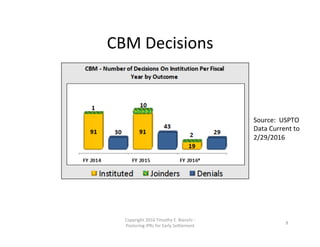
CBM	
  Decisions	
  
Copyright	
  2016	
  Timothy	
  E.	
  Bianchi	
  -­‐	
  
Posturing	
  IPRs	
  for	
  Early	
  Se0lement	
  
8	
  
Source:	
  	
  USPTO	
  
Data	
  Current	
  to	
  
2/29/2016	


CBM	
  Se0lements	
  
Copyright	
  2016	
  Timothy	
  E.	
  Bianchi	
  -­‐	
  
Posturing	
  IPRs	
  for	
  Early	
  Se0lement	
  
9	
  
Source:	
  	
  USPTO	
  
Data	
  Current	
  to	
  
2/29/2016	


PeNNoner	
  Psychology	
  
•  Patent	
  has	
  every	
  appearance	
  of	
  being	
  invalid	
  
–  Known	
  publicaNon	
  prior	
  art	
  “data	
  points”	
  
–  Concern	
  about	
  certain	
  dependent	
  claims?	
  
•  NonpublicaNon	
  Prior	
  Art	
  also	
  Known	
  
–  Non-­‐publicaNon	
  prior	
  art	
  can	
  be	
  useful	
  in	
  patent	
  liNgaNon	
  if	
  IPR	
  not	
  successful	
  
•  IPRs	
  are	
  staNsNcally	
  successful,	
  but	
  if	
  I	
  don’t	
  win	
  on	
  insNtuNon	
  of	
  IPR	
  on	
  at	
  
least	
  the	
  relevant	
  claims	
  it	
  will	
  be	
  harder	
  to	
  defend	
  against	
  this	
  patent	
  
•  Conclusions:	
  
–  Patent	
  Owner	
  is	
  not	
  being	
  reasonable	
  
–  Company	
  Will	
  Not	
  Pay	
  For	
  License/Patent	
  
–  As	
  long	
  as	
  insNtuNon	
  and	
  final	
  wri0en	
  decision	
  against	
  patent	
  is	
  likely,	
  
PeNNoner	
  will	
  forge	
  ahead	
  
Copyright	
  2016	
  Timothy	
  E.	
  Bianchi	
  -­‐	
  
Posturing	
  IPRs	
  for	
  Early	
  Se0lement	
  
10	
  
PeNNoner	
  Wants	
  to	
  Know	
  
•  Will	
  the	
  IPR	
  be	
  successful?	
  
–  Against	
  all	
  relevant	
  claims?	
  
•  Are	
  there	
  relevant	
  dependent	
  claims	
  that	
  are	
  likely	
  to	
  survive	
  the	
  IPR?	
  
–  ParNal	
  insNtuNon	
  and/or	
  parNal	
  invalidity	
  is	
  not	
  a	
  full	
  soluNon	
  
•  Can	
  I	
  get	
  a	
  claim	
  construcNon	
  that	
  will	
  resolve	
  issues	
  for	
  me	
  
in	
  a	
  parallel	
  liNgaNon?	
  
•  Does	
  the	
  Patent	
  Owner	
  have	
  a	
  right	
  to	
  file	
  conNnuaNons?	
  
•  Will	
  this	
  challenge	
  of	
  the	
  patent	
  help	
  me	
  or	
  help	
  my	
  
compeNNon	
  or	
  both?	
  
Copyright	
  2016	
  Timothy	
  E.	
  Bianchi	
  -­‐	
  
Posturing	
  IPRs	
  for	
  Early	
  Se0lement	
  
11	
  
Psychology	
  of	
  Patent	
  Owner	
  
•  My	
  claims	
  were	
  allowed	
  for	
  a	
  reason	
  
–  The	
  Patent	
  Office	
  issued	
  the	
  claimed	
  invenNon	
  
–  Want	
  to	
  tell	
  my	
  story	
  of	
  why	
  my	
  claims	
  are	
  patentable	
  over	
  the	
  prior	
  art	
  
•  The	
  peNNon	
  is	
  flawed	
  
–  It	
  has	
  defects	
  
–  The	
  cited	
  prior	
  art	
  is	
  not	
  on	
  point	
  
•  Or:	
  prior	
  art	
  is	
  analogous,	
  but	
  I	
  have	
  dependent	
  claims	
  that	
  should	
  survive	
  the	
  IPR	
  
•  If	
  my	
  patent	
  claims	
  are	
  insNtuted	
  for	
  trial,	
  it	
  could	
  ruin	
  my	
  chances	
  to	
  
enforce	
  patent	
  against	
  PeNNoner	
  and	
  against	
  other	
  defendants	
  
•  Patent	
  Owner	
  wants	
  to	
  fight	
  the	
  IPR,	
  but	
  insNtuNon	
  is	
  a	
  serious	
  threat	
  
Copyright	
  2016	
  Timothy	
  E.	
  Bianchi	
  -­‐	
  
Posturing	
  IPRs	
  for	
  Early	
  Se0lement	
  
12	
  
Patent	
  Owner	
  Wants	
  to	
  
•  Tell	
  a	
  consistent	
  story	
  with	
  its	
  patents	
  
–  How	
  can	
  that	
  be	
  done	
  with	
  BRI	
  v.	
  Phillips	
  claim	
  
construcNons?	
  
•  Use	
  the	
  IPR	
  to	
  strengthen	
  its	
  patent(s)	
  
–  That	
  which	
  does	
  not	
  kill	
  my	
  patents,	
  only	
  makes	
  them	
  
stronger	
  
–  But	
  avoid	
  joinder	
  opportuniNes	
  for	
  other	
  potenNal	
  
PeNNoner	
  Defendants	


•  Educate	
  other	
  infringers	
  about	
  the	
  strength	
  if	
  its	
  
pornolio	
  
Copyright	
  2016	
  Timothy	
  E.	
  Bianchi	
  -­‐	
  
Posturing	
  IPRs	
  for	
  Early	
  Se0lement	
  
13	
  
IPR	
  Timeline	
  (early	
  stages)	
  
Copyright	
  2016	
  Timothy	
  E.	
  Bianchi	
  -­‐	
  
Posturing	
  IPRs	
  for	
  Early	
  Se0lement	
  
14	
  
PeNNoner	
  
Patent	
  Owner	
  
Early	
  Se0lement	
  OpportuniNes	
  
Data	
  Gathering	
  
PeNNon	
  
Filing	
  
PeNNon	
  Prep	
  
Data	
  Gathering	
   Prelim	
  Response	
  Prep	
  
Prelim	
  
Resp	
  Filing	
  
InsNtuNon	
  
Decision	
  
3	
  Mos.	
  Max	
  
Pre-­‐Prep	
   Pre-­‐Filing	
  
Pre-­‐Prelim	
  
Resp	
  
Pre-­‐ID	
  
IPR	
  Timeline	
  (cont’d)	
  
Copyright	
  2016	
  Timothy	
  E.	
  Bianchi	
  -­‐	
  
Posturing	
  IPRs	
  for	
  Early	
  Se0lement	
  
15	
  
PeNNoner	
  
Patent	
  Owner	
  
Data	
  Gathering	
  
PO	
  
Response	
  
PO	
  Response	
  Prep	
  
Data	
  Gathering	
   Reply	
  Prep	
  
PeNNoner	
  
Reply	
  
InsNtuNon	
  
Decision	
   Hearing/
FWD	
  
PeNNoners	
  Can	
  Encourage	
  Early	
  
Se0lement	
  
•  Develop	
  case	
  thoroughly	
  
•  Need	
  best	
  prior	
  art	
  and	
  arguments	
  
•  Know	
  how	
  you	
  stand	
  compared	
  to	
  other	
  defendants	
  
–  RelaNve	
  sizes	
  of	
  liability	
  
–  Timing	
  of	
  suits/bars	
  
–  IPR	
  team	
  factors	
  
–  ComplicaNng	
  factors	
  
•  e.g.	
  real	
  party	
  in	
  interest	
  
•  Work	
  with	
  liNgaNon	
  team	
  
•  Communicate	
  the	
  strengths	
  of	
  PeNNoner’s	
  IPR	
  without	
  undermining	
  it	
  
–  PeNNoner	
  needs	
  to	
  show	
  that	
  it	
  understands	
  the	
  target	
  patent,	
  its	
  technology,	
  the	
  prior	
  art,	
  
and	
  the	
  process	
  be0er	
  than	
  Patent	
  Owner	
  understands	
  it	
  
•  SomeNmes	
  filing	
  is	
  the	
  only	
  way	
  to	
  resolve	
  the	
  case	
  
Copyright	
  2016	
  Timothy	
  E.	
  Bianchi	
  -­‐	
  
Posturing	
  IPRs	
  for	
  Early	
  Se0lement	
  
16	
  
Patent	
  Owners	
  Can	
  Also	
  Encourage	
  
Early	
  Se0lement	
  
•  Analyze	
  patent	
  at	
  issue	
  promptly	
  in	
  either	
  case:	
  
–  Upon	
  a	
  threat	
  of	
  IPR	
  (no	
  peNNon	
  filed)	
  
•  Communicated	
  by	
  potenNal	
  peNNoner	
  or	
  liNgaNon	
  team	
  
–  ALer	
  IPR	
  peNNon	
  is	
  filed	
  
•  CriNcal	
  to	
  get	
  as	
  much	
  informaNon	
  as	
  possible	
  and	
  review	
  the	
  asserNons	
  
using	
  experience	
  and	
  an	
  open	
  mind	
  
•  If	
  a	
  peNNon	
  is	
  filed,	
  and	
  negoNaNon	
  is	
  not	
  a	
  likely	
  opNon,	
  prepare	
  a	
  strong	
  
Patent	
  Owner’s	
  Preliminary	
  Response	
  
•  Be	
  realisNc	
  about	
  the	
  prior	
  art	
  and	
  amendments	
  
–  Broadest	
  reasonable	
  interpretaNon	
  
•  Use	
  other	
  tools	
  
Copyright	
  2016	
  Timothy	
  E.	
  Bianchi	
  -­‐	
  
Posturing	
  IPRs	
  for	
  Early	
  Se0lement	
  
17	
  
Higher	
  PotenNal	
  for	
  Se0lement	
  Before	
  
the	
  InsNtuNon	
  Decision	
  When	
  .	
  .	
  .	
  
•  PeNNoner	
  Defendant	
  is	
  not	
  the	
  Patent	
  
Owner’s	
  main	
  target	
  
– And	
  especially	
  If:	
  
•  PeNNoner	
  has	
  a	
  strong	
  IPR	
  team	
  and	
  strong	
  IPR	
  peNNon	
  
•  Other	
  Defendants	
  are	
  barred	
  under	
  the	
  315(b)	
  bar	
  for	
  
failure	
  to	
  Nmely	
  file	
  an	
  IPR	
  peNNon	
  
–  Joinder	
  is	
  their	
  only	
  entry	
  to	
  IPR	
  
Copyright	
  2016	
  Timothy	
  E.	
  Bianchi	
  -­‐	
  
Posturing	
  IPRs	
  for	
  Early	
  Se0lement	
  
18	
  
Higher	
  PotenNal	
  For	
  Se0lement	
  ALer	
  
InsNtuNon	
  Decision	
  When	
  
•  ParNal	
  InsNtuNon	
  of	
  Claims	
  
– Especially	
  when	
  PeNNoner	
  is	
  barred	
  or	
  effecNvely	
  
barred	
  from	
  future	
  IPR	
  filings	
  
•  MulNple	
  Patent	
  Cases	
  with	
  Many	
  PeNNons	
  
– Especially	
  with	
  parNal	
  insNtuNon	
  of	
  patents/claims	
  
Copyright	
  2016	
  Timothy	
  E.	
  Bianchi	
  -­‐	
  
Posturing	
  IPRs	
  for	
  Early	
  Se0lement	
  
19	
  
Discussion	
  
•  If	
  QuesNons,	
  please	
  contact	
  
– Tim	
  Bianchi	
  
– (612)	
  373-­‐6912	
  
– tbianchi@slwip.com	
  
– See	
  my	
  blog	
  on	
  patent	
  prosecuNon,	
  liNgaNon	
  and	
  
post-­‐grant	
  topics	
  at	
  www.ReexamLink.com	
  
Copyright	
  2016	
  Timothy	
  E.	
  Bianchi	
  -­‐	
  
Posturing	
  IPRs	
  for	
  Early	
  Se0lement	
  
20	
  

Posturing ip rs for settlement (2016-03-24)

  • 1.
    Posturing  IPRs  for  Se0lement   Timothy  E.  Bianchi   Patent  A0orney   Schwegman  Lundberg  Woessner,  PA   Copyright  2016  Timothy  E.  Bianchi  -­‐   Posturing  IPRs  for  Early  Se0lement   1  
  • 2.
    About  Tim  Bianchi   •  M.S.E.E.  Patent  A0orney   – Electronics,  Medical  Devices,  SoLware   •  Principal,  Schwegman  Lundberg  Woessner   – 120  patent  a0orneys  in  Minneapolis,  San  Jose,   AusNn  +   – Patent  Prep  &  ProsecuNon   – Opinions  and  Due  Diligence   – LiNgaNon  Support   – Post-­‐Grant  Proceedings   Copyright  2016  Timothy  E.  Bianchi  -­‐   Posturing  IPRs  for  Early  Se0lement   2  
  • 3.
    About  Today’s  Talk   •  Brief  IntroducNon  With  IPR  StaNsNcs   •  PeNNoners  and  Patent  Owners  Viewpoints   –  Why  they  overlook  opportuniNes  to  se0le   –  Benefits   •  For  both  ParNes,  Se0lement:   –  Saves  Nme  and  money   –  Provides  Certainty  and  reduces  risk   •  Timing  Factors  for  PotenNal  Early  Se0lement   •  Posturing  Your  IPR  for  Early  Se0lement   Copyright  2016  Timothy  E.  Bianchi  -­‐   Posturing  IPRs  for  Early  Se0lement   3  
  • 4.
    A  Few  StaNsNcs  –  Total  AIA  PeNNons   Copyright  2016  Timothy  E.  Bianchi  -­‐   Posturing  IPRs  for  Early  Se0lement   4   Source:    USPTO   Data  Current  to   2/29/2016    
  • 5.
    PeNNons  Per  Year   Copyright  2016  Timothy  E.  Bianchi  -­‐   Posturing  IPRs  for  Early  Se0lement   5   Source:    USPTO   Data  Current  to   2/29/2016    
  • 6.
    IPR  Decisions   Copyright  2016  Timothy  E.  Bianchi  -­‐   Posturing  IPRs  for  Early  Se0lement   6   Source:    USPTO   Data  Current  to   2/29/2016    
  • 7.
    IPR  Se0lements   Copyright  2016  Timothy  E.  Bianchi  -­‐   Posturing  IPRs  for  Early  Se0lement   7   Source:    USPTO   Data  Current  to   2/29/2016    
  • 8.
    CBM  Decisions   Copyright  2016  Timothy  E.  Bianchi  -­‐   Posturing  IPRs  for  Early  Se0lement   8   Source:    USPTO   Data  Current  to   2/29/2016    
  • 9.
    CBM  Se0lements   Copyright  2016  Timothy  E.  Bianchi  -­‐   Posturing  IPRs  for  Early  Se0lement   9   Source:    USPTO   Data  Current  to   2/29/2016    
  • 10.
    PeNNoner  Psychology   • Patent  has  every  appearance  of  being  invalid   –  Known  publicaNon  prior  art  “data  points”   –  Concern  about  certain  dependent  claims?   •  NonpublicaNon  Prior  Art  also  Known   –  Non-­‐publicaNon  prior  art  can  be  useful  in  patent  liNgaNon  if  IPR  not  successful   •  IPRs  are  staNsNcally  successful,  but  if  I  don’t  win  on  insNtuNon  of  IPR  on  at   least  the  relevant  claims  it  will  be  harder  to  defend  against  this  patent   •  Conclusions:   –  Patent  Owner  is  not  being  reasonable   –  Company  Will  Not  Pay  For  License/Patent   –  As  long  as  insNtuNon  and  final  wri0en  decision  against  patent  is  likely,   PeNNoner  will  forge  ahead   Copyright  2016  Timothy  E.  Bianchi  -­‐   Posturing  IPRs  for  Early  Se0lement   10  
  • 11.
    PeNNoner  Wants  to  Know   •  Will  the  IPR  be  successful?   –  Against  all  relevant  claims?   •  Are  there  relevant  dependent  claims  that  are  likely  to  survive  the  IPR?   –  ParNal  insNtuNon  and/or  parNal  invalidity  is  not  a  full  soluNon   •  Can  I  get  a  claim  construcNon  that  will  resolve  issues  for  me   in  a  parallel  liNgaNon?   •  Does  the  Patent  Owner  have  a  right  to  file  conNnuaNons?   •  Will  this  challenge  of  the  patent  help  me  or  help  my   compeNNon  or  both?   Copyright  2016  Timothy  E.  Bianchi  -­‐   Posturing  IPRs  for  Early  Se0lement   11  
  • 12.
    Psychology  of  Patent  Owner   •  My  claims  were  allowed  for  a  reason   –  The  Patent  Office  issued  the  claimed  invenNon   –  Want  to  tell  my  story  of  why  my  claims  are  patentable  over  the  prior  art   •  The  peNNon  is  flawed   –  It  has  defects   –  The  cited  prior  art  is  not  on  point   •  Or:  prior  art  is  analogous,  but  I  have  dependent  claims  that  should  survive  the  IPR   •  If  my  patent  claims  are  insNtuted  for  trial,  it  could  ruin  my  chances  to   enforce  patent  against  PeNNoner  and  against  other  defendants   •  Patent  Owner  wants  to  fight  the  IPR,  but  insNtuNon  is  a  serious  threat   Copyright  2016  Timothy  E.  Bianchi  -­‐   Posturing  IPRs  for  Early  Se0lement   12  
  • 13.
    Patent  Owner  Wants  to   •  Tell  a  consistent  story  with  its  patents   –  How  can  that  be  done  with  BRI  v.  Phillips  claim   construcNons?   •  Use  the  IPR  to  strengthen  its  patent(s)   –  That  which  does  not  kill  my  patents,  only  makes  them   stronger   –  But  avoid  joinder  opportuniNes  for  other  potenNal   PeNNoner  Defendants     •  Educate  other  infringers  about  the  strength  if  its   pornolio   Copyright  2016  Timothy  E.  Bianchi  -­‐   Posturing  IPRs  for  Early  Se0lement   13  
  • 14.
    IPR  Timeline  (early  stages)   Copyright  2016  Timothy  E.  Bianchi  -­‐   Posturing  IPRs  for  Early  Se0lement   14   PeNNoner   Patent  Owner   Early  Se0lement  OpportuniNes   Data  Gathering   PeNNon   Filing   PeNNon  Prep   Data  Gathering   Prelim  Response  Prep   Prelim   Resp  Filing   InsNtuNon   Decision   3  Mos.  Max   Pre-­‐Prep   Pre-­‐Filing   Pre-­‐Prelim   Resp   Pre-­‐ID  
  • 15.
    IPR  Timeline  (cont’d)   Copyright  2016  Timothy  E.  Bianchi  -­‐   Posturing  IPRs  for  Early  Se0lement   15   PeNNoner   Patent  Owner   Data  Gathering   PO   Response   PO  Response  Prep   Data  Gathering   Reply  Prep   PeNNoner   Reply   InsNtuNon   Decision   Hearing/ FWD  
  • 16.
    PeNNoners  Can  Encourage  Early   Se0lement   •  Develop  case  thoroughly   •  Need  best  prior  art  and  arguments   •  Know  how  you  stand  compared  to  other  defendants   –  RelaNve  sizes  of  liability   –  Timing  of  suits/bars   –  IPR  team  factors   –  ComplicaNng  factors   •  e.g.  real  party  in  interest   •  Work  with  liNgaNon  team   •  Communicate  the  strengths  of  PeNNoner’s  IPR  without  undermining  it   –  PeNNoner  needs  to  show  that  it  understands  the  target  patent,  its  technology,  the  prior  art,   and  the  process  be0er  than  Patent  Owner  understands  it   •  SomeNmes  filing  is  the  only  way  to  resolve  the  case   Copyright  2016  Timothy  E.  Bianchi  -­‐   Posturing  IPRs  for  Early  Se0lement   16  
  • 17.
    Patent  Owners  Can  Also  Encourage   Early  Se0lement   •  Analyze  patent  at  issue  promptly  in  either  case:   –  Upon  a  threat  of  IPR  (no  peNNon  filed)   •  Communicated  by  potenNal  peNNoner  or  liNgaNon  team   –  ALer  IPR  peNNon  is  filed   •  CriNcal  to  get  as  much  informaNon  as  possible  and  review  the  asserNons   using  experience  and  an  open  mind   •  If  a  peNNon  is  filed,  and  negoNaNon  is  not  a  likely  opNon,  prepare  a  strong   Patent  Owner’s  Preliminary  Response   •  Be  realisNc  about  the  prior  art  and  amendments   –  Broadest  reasonable  interpretaNon   •  Use  other  tools   Copyright  2016  Timothy  E.  Bianchi  -­‐   Posturing  IPRs  for  Early  Se0lement   17  
  • 18.
    Higher  PotenNal  for  Se0lement  Before   the  InsNtuNon  Decision  When  .  .  .   •  PeNNoner  Defendant  is  not  the  Patent   Owner’s  main  target   – And  especially  If:   •  PeNNoner  has  a  strong  IPR  team  and  strong  IPR  peNNon   •  Other  Defendants  are  barred  under  the  315(b)  bar  for   failure  to  Nmely  file  an  IPR  peNNon   –  Joinder  is  their  only  entry  to  IPR   Copyright  2016  Timothy  E.  Bianchi  -­‐   Posturing  IPRs  for  Early  Se0lement   18  
  • 19.
    Higher  PotenNal  For  Se0lement  ALer   InsNtuNon  Decision  When   •  ParNal  InsNtuNon  of  Claims   – Especially  when  PeNNoner  is  barred  or  effecNvely   barred  from  future  IPR  filings   •  MulNple  Patent  Cases  with  Many  PeNNons   – Especially  with  parNal  insNtuNon  of  patents/claims   Copyright  2016  Timothy  E.  Bianchi  -­‐   Posturing  IPRs  for  Early  Se0lement   19  
  • 20.
    Discussion   •  If  QuesNons,  please  contact   – Tim  Bianchi   – (612)  373-­‐6912   – tbianchi@slwip.com   – See  my  blog  on  patent  prosecuNon,  liNgaNon  and   post-­‐grant  topics  at  www.ReexamLink.com   Copyright  2016  Timothy  E.  Bianchi  -­‐   Posturing  IPRs  for  Early  Se0lement   20