What Inventors Need To Know About
Protecting Their Intellectual Property
Andrew Rapacke, JD | USPatentsNMore™
TM
Get to know Andrew Rapacke, JD
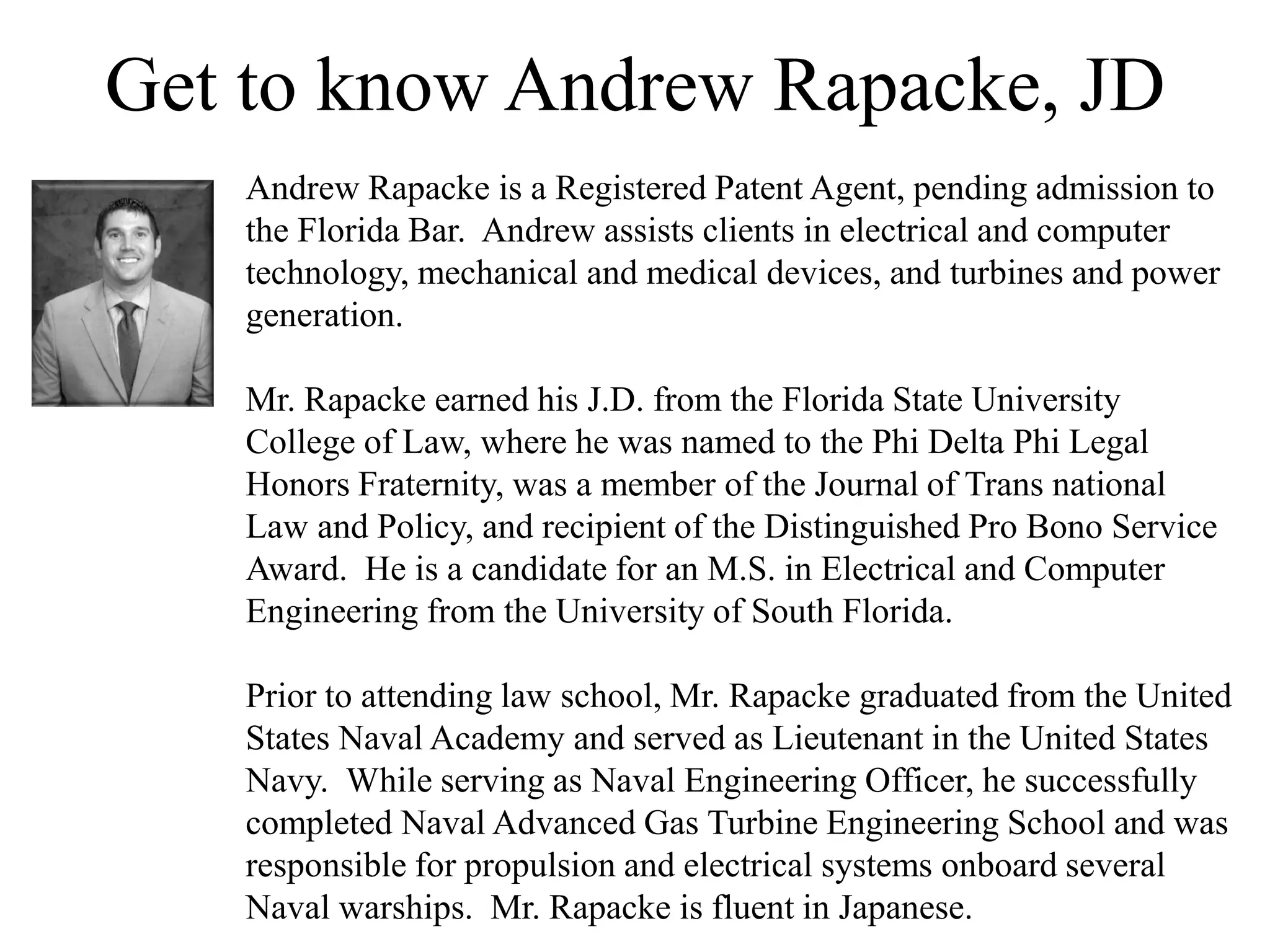
Andrew Rapacke is a Registered Patent Agent, pending admission to the
Florida Bar. Through his company USPatentsNMore, he works with
organizations to provide meaningful protection and helps them transform
their patent portfolio to meet the IP needs of their business. Andrew assists
clients in electrical and computer technology, mechanical and medical
devices, and turbines and power generation.
Mr. Rapacke earned his J.D. from the Florida State University College of
Law, where he was named to the Phi Delta Phi Legal Honors Fraternity, was
a member of the Journal of Trans national Law and Policy, and recipient of
the Distinguished Pro Bono Service Award. He is a candidate for an M.S. in
Electrical and Computer Engineering from the University of South Florida.
Prior to attending law school, Mr. Rapacke graduated from the United States
Naval Academy and served as Lieutenant in the United States Navy. While
serving as Naval Engineering Officer, he successfully completed Naval
Advanced Gas Turbine Engineering School and was responsible for
propulsion and electrical systems onboard several Naval warships. Mr.
Rapacke is fluent in Japanese.
Get to know USPatentsNMore™
Protect your inventions, ideas, and brands without
sacrificing quality.
We don't nickel and dime - we provide clear and simple
proposals so you can understand what you're paying for and
exactly what it will cost.
We take a strategic approach - we understand business and
most importantly we understand your need to get a return on
your intellectual property investment. we provide the
services that you need to build and grow profit and sales.
We’re lean - most intellectual property firms have massive
overheads from fancy offices with big expense accounts. We
know clients have to pay for that overhead so we keep a lean
and intelligent approach to our own business so we can
deliver high-quality and affordable IP services.
Overview
• Why care?
• What IP do I need?
• Why conduct a prior art search?
• Understanding the ‘Big Picture’
• Patents in a nutshell
• Trademarks
• Copyrights
• May I combine IP?
• Prior Art Search
• Avoid these common mistakes Inventors make
• Common IP speedbumps
• Why Inventors need IP early
• Closing thoughts
Why care?
Meaningful patentability
↓
Commercial potential
If you are an inventor, you care about:
Patents in a nutshell
• What?
- process
- machine
- product
- composition of matter
(includes software)
• Patentability
- novel
- useful
- non-obvious
• Exclusive right – not an
affirmative one!
… Patents in a nutshell
• Term
– 20 years from filing
• Challenges
– must file within one year of
public use, offer for sale,
sale, or publication; and, even
that isn’t so safe under first-to-
file; enters public domain after
expiration of patent
• Variations
- plant patent
(asexual reproduction)
- design patent
(ornamental - 14 years)
Trademarks
• Trademarks are words, names,
symbols, devices and images
that represent products, goods,
or services.
• Trademarks identify and
promote different brands or
services.
• For example, I would
trademark register the service
name USPatentsNMore™
• ™ versus ®
Copyrights
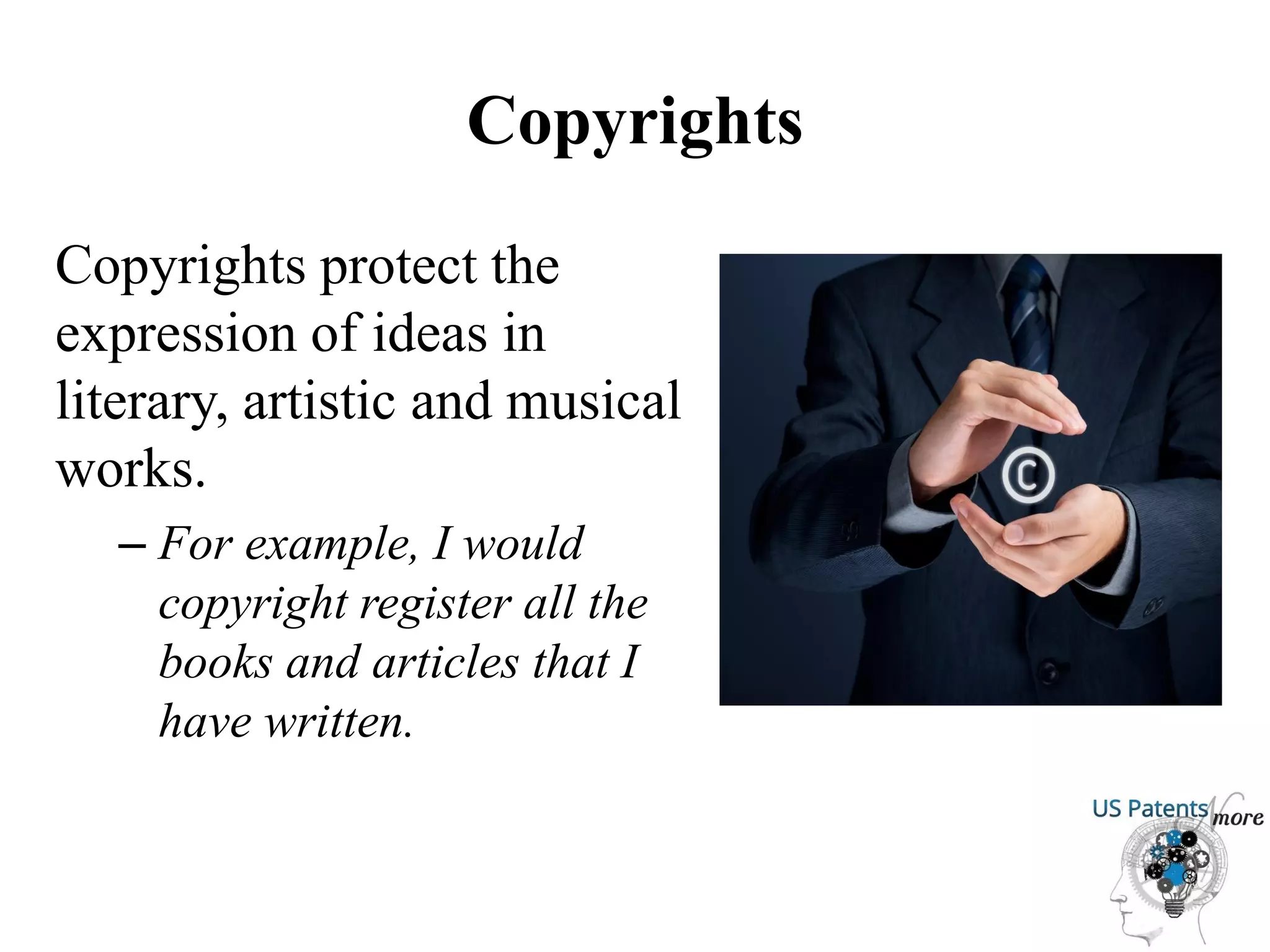
Copyrights protect the
expression of ideas in
literary, artistic and musical
works.
– For example, I would
copyright register all the
books and articles that I
have written.
May I combine IP?
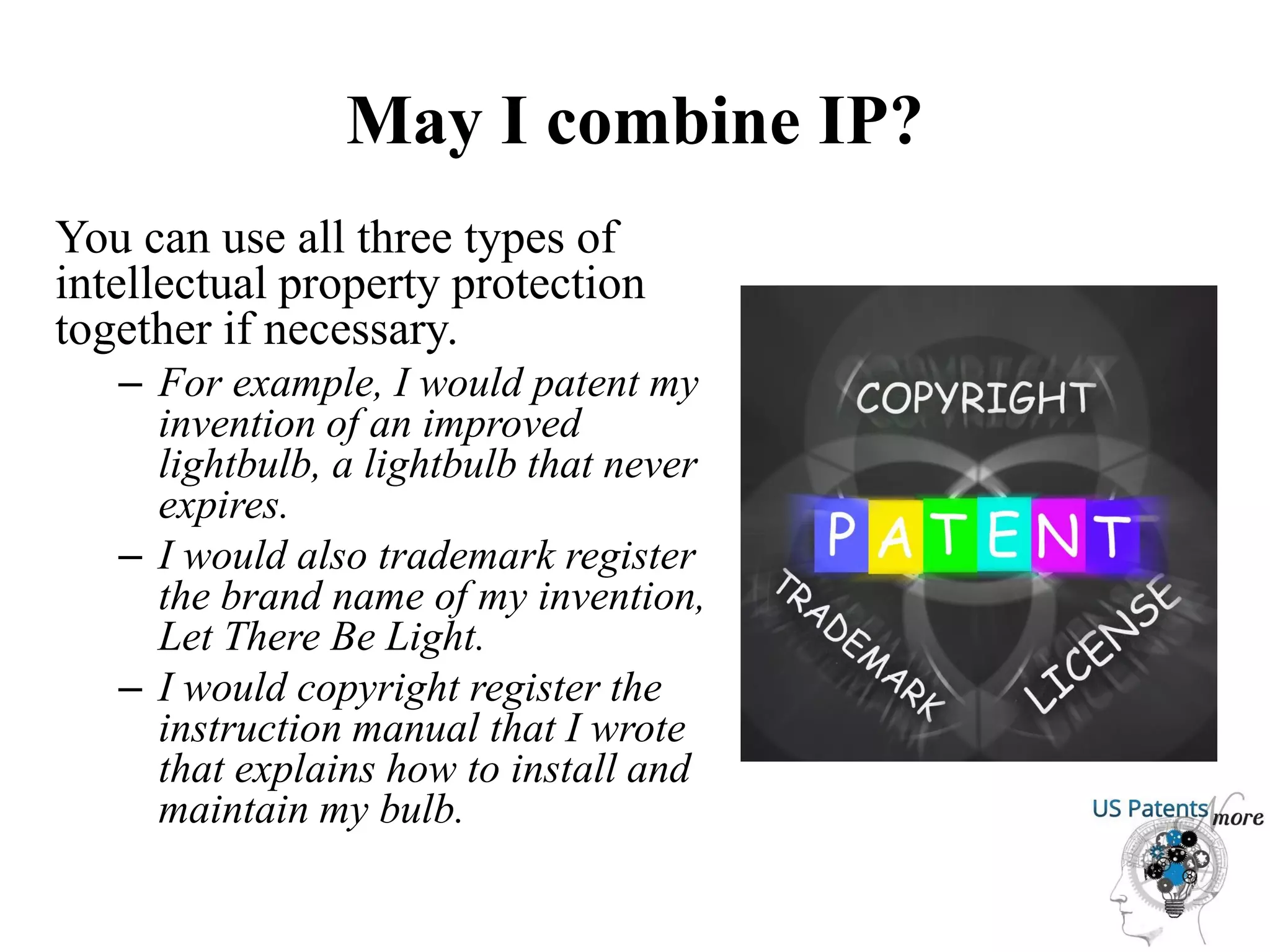
You can use all three types of
intellectual property protection
together if necessary.
– For example, I would patent my
invention of an improved
lightbulb, a lightbulb that never
expires.
– I would also trademark register
the brand name of my invention,
Let There Be Light.
– I would copyright register the
instruction manual that I wrote
that explains how to install and
maintain my bulb.
Avoid these Common Mistakes Inventors Make
• Letting yourself ‘get in the way’
• Trying to do it all yourself
• Selling the Invention
• Publicly using the invention
• Bad provisional patent applications
• Poor Prior Art Search
• Sinking all your money into a patent
• Unclear product differentiation
• Inability to articulate ’30 second elevator speech’
• Assuming everyone will want your invention
• Falling into a scam
• Lacking business acumen
• Expecting unrealistic results
What is Prior Art?
Prior Art is any information in the public domain in
any form before a given date that might be relevant to
potential features and embodiments of your invention.
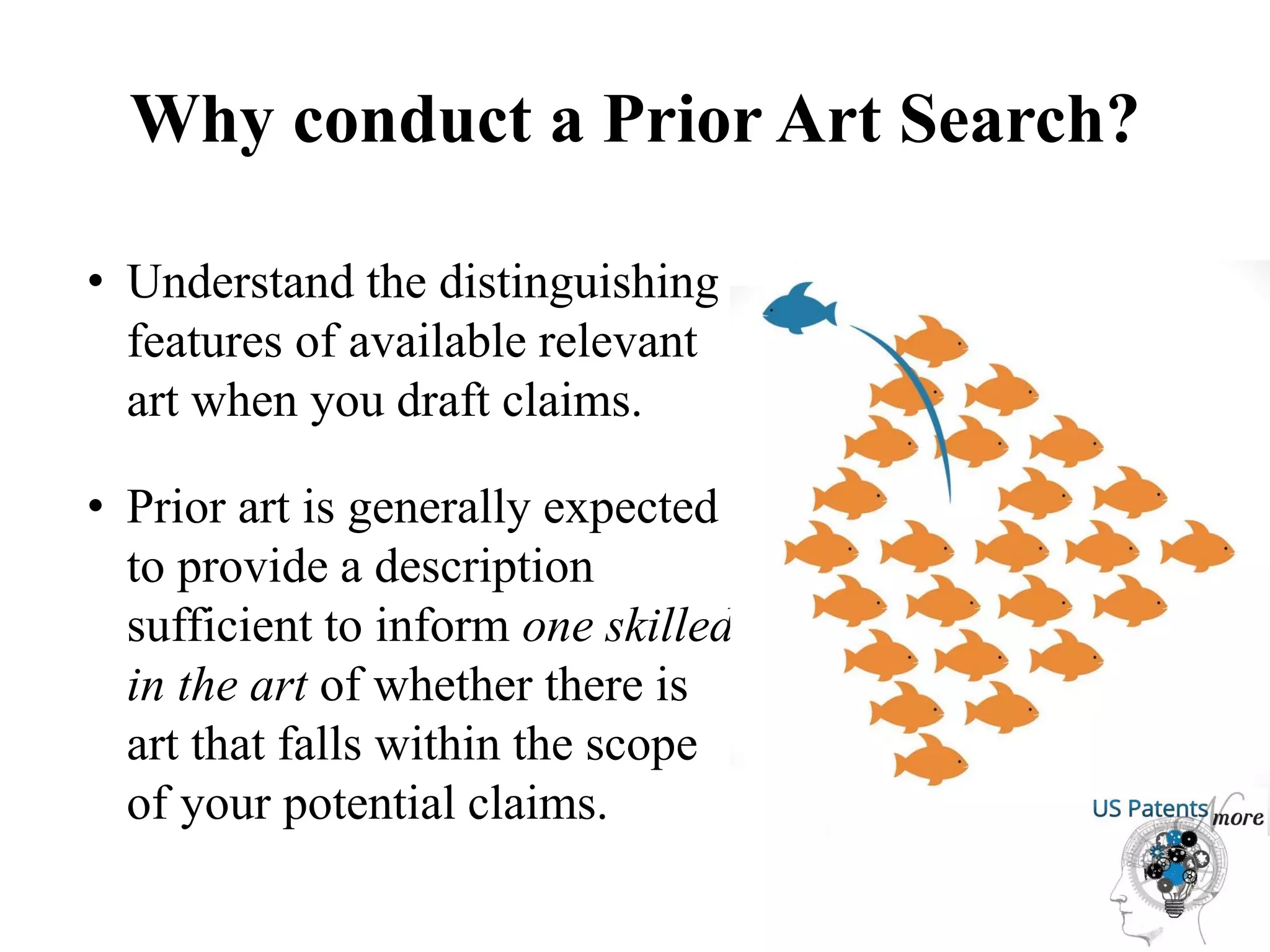
Why conduct a Prior Art Search?
• Understand the distinguishing
features of available relevant
art when you draft claims.
• Prior art is generally expected
to provide a description
sufficient to inform one skilled
in the art of whether there is
art that falls within the scope
of your potential claims.
Weigh the pros and cons of a
“do-it yourself” search
• Advantage:
• Potentially having a better
understanding of the nuances of
an invention, technical materials,
publications, and relevant art
• Disadvantages:
• Not being able to detach yourself
from the invention to be able to
give an unbiased assessment
• Risk not understanding “the duty
to disclose” or “what's close
enough?”
The USPatentsNMore Approach to Prior Art Search
• Start a broad search
(200-300 results)
• Attempt to identify families of
patents and look for patterns
• Create a “score card” of each
patent and include notes
• Identify your highest scoring
prior art and begin an in-depth
analysis
• Identify distinguishing features
in the prior art
• Remember - Don’t confuse
search results with
patentability!
Common IP Speedbumps
• Assuming IP is not important
or not valuable for my
invention or business
• The Do-It-Yourself Approach
• Leaping Before You Look
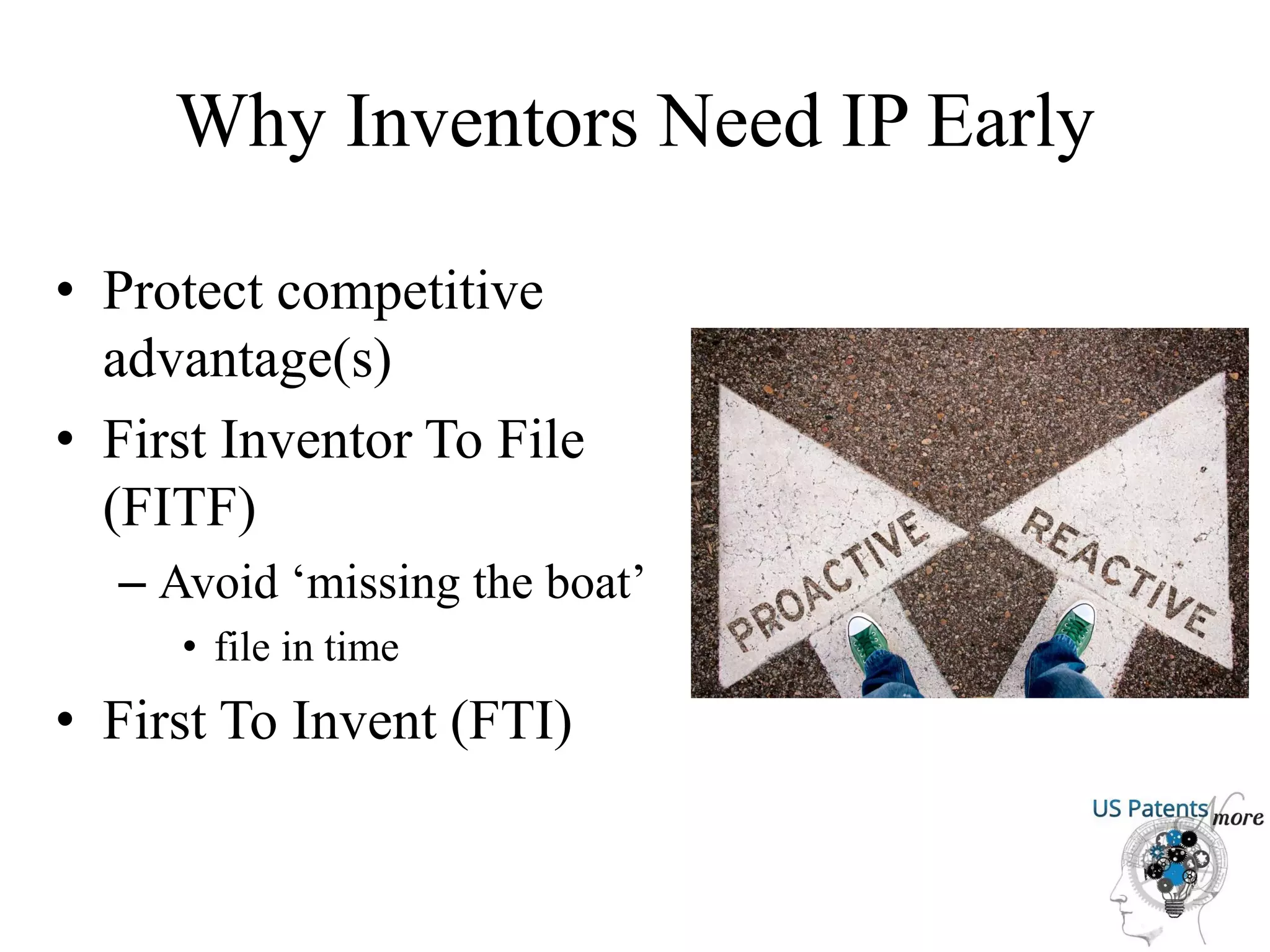
Why Inventors Need IP Early
• Protect competitive
advantage(s)
• First Inventor To File
(FITF)
– Avoid ‘missing the boat’
• file in time
• First To Invent (FTI)
Trusted Partners
• Carrie Jeske / Will It Launch | As Seen On TV
• Stephen Keys / ©inventRight
• Steven Sauer / Bigger Tuna
• Barb Gray / Flutterby Media
Closing thoughts
Thank you!
Contact me for questions and/or help with your IP!
Andrew Rapacke, JD | Registered Patent Agent
andy@cweisslaw.com | 407.801.9368
USPatentsNMore.com

What Inventors Need To Know About Protecting Their Intellectual Property

  • 1.
    What Inventors NeedTo Know About Protecting Their Intellectual Property Andrew Rapacke, JD | USPatentsNMore™ TM
  • 2.
    Get to knowAndrew Rapacke, JD Andrew Rapacke is a Registered Patent Agent, pending admission to the Florida Bar. Through his company USPatentsNMore, he works with organizations to provide meaningful protection and helps them transform their patent portfolio to meet the IP needs of their business. Andrew assists clients in electrical and computer technology, mechanical and medical devices, and turbines and power generation. Mr. Rapacke earned his J.D. from the Florida State University College of Law, where he was named to the Phi Delta Phi Legal Honors Fraternity, was a member of the Journal of Trans national Law and Policy, and recipient of the Distinguished Pro Bono Service Award. He is a candidate for an M.S. in Electrical and Computer Engineering from the University of South Florida. Prior to attending law school, Mr. Rapacke graduated from the United States Naval Academy and served as Lieutenant in the United States Navy. While serving as Naval Engineering Officer, he successfully completed Naval Advanced Gas Turbine Engineering School and was responsible for propulsion and electrical systems onboard several Naval warships. Mr. Rapacke is fluent in Japanese.
  • 3.
    Get to knowUSPatentsNMore™ Protect your inventions, ideas, and brands without sacrificing quality. We don't nickel and dime - we provide clear and simple proposals so you can understand what you're paying for and exactly what it will cost. We take a strategic approach - we understand business and most importantly we understand your need to get a return on your intellectual property investment. we provide the services that you need to build and grow profit and sales. We’re lean - most intellectual property firms have massive overheads from fancy offices with big expense accounts. We know clients have to pay for that overhead so we keep a lean and intelligent approach to our own business so we can deliver high-quality and affordable IP services.
  • 4.
    Overview • Why care? •What IP do I need? • Why conduct a prior art search? • Understanding the ‘Big Picture’ • Patents in a nutshell • Trademarks • Copyrights • May I combine IP? • Prior Art Search • Avoid these common mistakes Inventors make • Common IP speedbumps • Why Inventors need IP early • Closing thoughts
  • 5.
    Why care? Meaningful patentability ↓ Commercialpotential If you are an inventor, you care about:
  • 6.
    Patents in anutshell • What? - process - machine - product - composition of matter (includes software) • Patentability - novel - useful - non-obvious • Exclusive right – not an affirmative one!
  • 7.
    … Patents ina nutshell • Term – 20 years from filing • Challenges – must file within one year of public use, offer for sale, sale, or publication; and, even that isn’t so safe under first-to- file; enters public domain after expiration of patent • Variations - plant patent (asexual reproduction) - design patent (ornamental - 14 years)
  • 8.
    Trademarks • Trademarks arewords, names, symbols, devices and images that represent products, goods, or services. • Trademarks identify and promote different brands or services. • For example, I would trademark register the service name USPatentsNMore™ • ™ versus ®
  • 9.
    Copyrights Copyrights protect the expressionof ideas in literary, artistic and musical works. – For example, I would copyright register all the books and articles that I have written.
  • 10.
    May I combineIP? You can use all three types of intellectual property protection together if necessary. – For example, I would patent my invention of an improved lightbulb, a lightbulb that never expires. – I would also trademark register the brand name of my invention, Let There Be Light. – I would copyright register the instruction manual that I wrote that explains how to install and maintain my bulb.
  • 11.
    Avoid these CommonMistakes Inventors Make • Letting yourself ‘get in the way’ • Trying to do it all yourself • Selling the Invention • Publicly using the invention • Bad provisional patent applications • Poor Prior Art Search • Sinking all your money into a patent • Unclear product differentiation • Inability to articulate ’30 second elevator speech’ • Assuming everyone will want your invention • Falling into a scam • Lacking business acumen • Expecting unrealistic results
  • 12.
    What is PriorArt? Prior Art is any information in the public domain in any form before a given date that might be relevant to potential features and embodiments of your invention.
  • 13.
    Why conduct aPrior Art Search? • Understand the distinguishing features of available relevant art when you draft claims. • Prior art is generally expected to provide a description sufficient to inform one skilled in the art of whether there is art that falls within the scope of your potential claims.
  • 14.
    Weigh the prosand cons of a “do-it yourself” search • Advantage: • Potentially having a better understanding of the nuances of an invention, technical materials, publications, and relevant art • Disadvantages: • Not being able to detach yourself from the invention to be able to give an unbiased assessment • Risk not understanding “the duty to disclose” or “what's close enough?”
  • 15.
    The USPatentsNMore Approachto Prior Art Search • Start a broad search (200-300 results) • Attempt to identify families of patents and look for patterns • Create a “score card” of each patent and include notes • Identify your highest scoring prior art and begin an in-depth analysis • Identify distinguishing features in the prior art • Remember - Don’t confuse search results with patentability!
  • 16.
    Common IP Speedbumps •Assuming IP is not important or not valuable for my invention or business • The Do-It-Yourself Approach • Leaping Before You Look
  • 17.
    Why Inventors NeedIP Early • Protect competitive advantage(s) • First Inventor To File (FITF) – Avoid ‘missing the boat’ • file in time • First To Invent (FTI)
  • 18.
    Trusted Partners • CarrieJeske / Will It Launch | As Seen On TV • Stephen Keys / ©inventRight • Steven Sauer / Bigger Tuna • Barb Gray / Flutterby Media
  • 19.
  • 20.
    Thank you! Contact mefor questions and/or help with your IP! Andrew Rapacke, JD | Registered Patent Agent andy@cweisslaw.com | 407.801.9368 USPatentsNMore.com