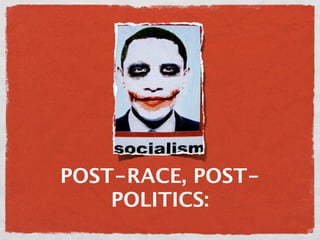
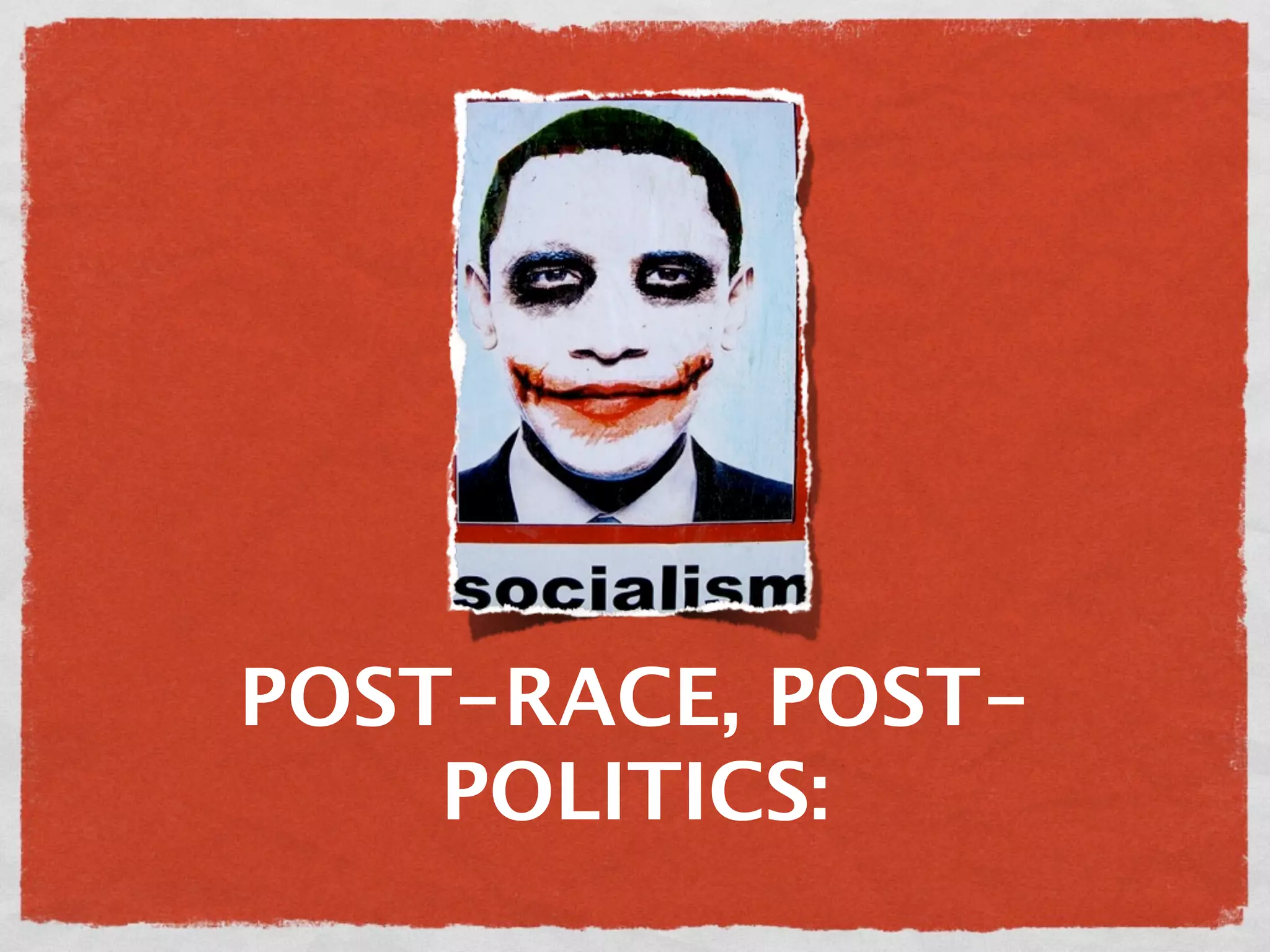
POST-RACE, POST-
    POLITICS:
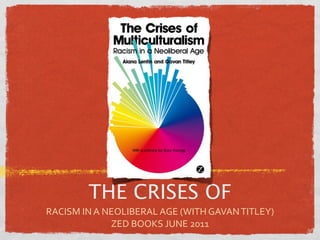
THE CRISES OF
RACISM
IN
A
NEOLIBERAL
AGE
(WITH
GAVAN
TITLEY)
             ZED
BOOKS
JUNE
2011
OVERVIEW
OVERVIEW

Today,
post‐racialism
is
the
dominant
mode
in
which

racism
finds
discursive
expression.
OVERVIEW

Today,
post‐racialism
is
the
dominant
mode
in
which

racism
finds
discursive
expression.

The
debate
on
multiculturalism
is
inscribed
in
a
post‐
racial
logic.
OVERVIEW

Today,
post‐racialism
is
the
dominant
mode
in
which

racism
finds
discursive
expression.

The
debate
on
multiculturalism
is
inscribed
in
a
post‐
racial
logic.

So,
we
need
to
look
at
how
race/racism
and
culture/
culturalism
are
intertwined.
3 MAIN
3 MAIN

The
‘Crisis
of
Multiculturalism’
is
a
critique
of
‘too

much
diversity’.
3 MAIN

The
‘Crisis
of
Multiculturalism’
is
a
critique
of
‘too

much
diversity’.

A
generalised
culturalization
of
politics
finds
cultural

solutions
to
socioeconomic/political
problems.
3 MAIN

The
‘Crisis
of
Multiculturalism’
is
a
critique
of
‘too

much
diversity’.

A
generalised
culturalization
of
politics
finds
cultural

solutions
to
socioeconomic/political
problems.

The
ubiquity
of
culture
mirrors
the
19th
century
‘race

is
all’
notion
and
is
in
this
sense
‘post‐political’.
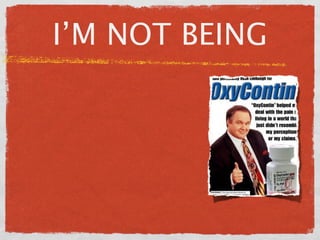
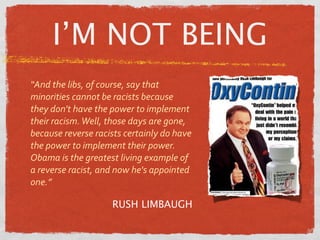
I’M NOT BEING
I’M NOT BEING
“And
the
libs,
of
course,
say
that

minorities
cannot
be
racists
because

they
don't
have
the
power
to
implement

their
racism.
Well,
those
days
are
gone,

because
reverse
racists
certainly
do
have

the
power
to
implement
their
power.

Obama
is
the
greatest
living
example
of

a
reverse
racist,
and
now
he's
appointed

one.”

                     RUSH LIMBAUGH
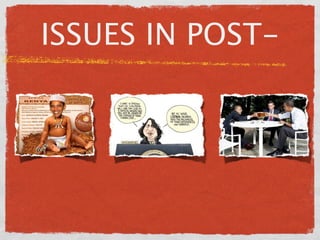
ISSUES IN POST-
ISSUES IN POST-
ISSUES IN POST-
ISSUES IN POST-
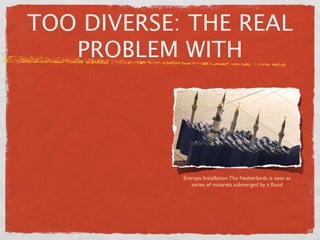
TOO DIVERSE: THE REAL
   PROBLEM WITH


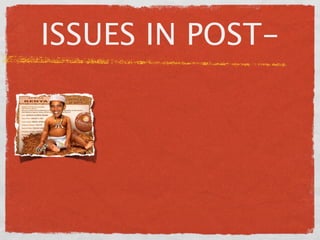
            Entropa Installation: The Netherlands is seen as
               series of minarets submerged by a flood
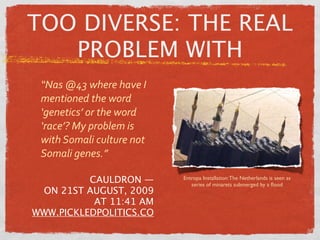
TOO DIVERSE: THE REAL
   PROBLEM WITH
 “Nas
@43
where
have
I

 mentioned
the
word

 ‘genetics’
or
the
word

 ‘race’?
My
problem
is

 with
Somali
culture
not

 Somali
genes.”

          CAULDRON —        Entropa Installation: The Netherlands is seen as
                               series of minarets submerged by a flood
 ON 21ST AUGUST, 2009
           AT 11:41 AM
WWW.PICKLEDPOLITICS.CO
‘WHAT’S NEW ABOUT
   NEO-RACISM?’
‘WHAT’S NEW ABOUT
    NEO-RACISM?’

Arguments
for
‘cultural
racism’
artifically
separate

between
‘real’
biological
racism
and
a
less
pernicious

objection
to
the
‘incompatible’
practices
of
‘minority

groups’.
‘WHAT’S NEW ABOUT
    NEO-RACISM?’

Arguments
for
‘cultural
racism’
artifically
separate

between
‘real’
biological
racism
and
a
less
pernicious

objection
to
the
‘incompatible’
practices
of
‘minority

groups’.

But,
racism
has
always
relied
on
different
tropes
‐

both
cultural
and
biological
‐
to
make
its
case.
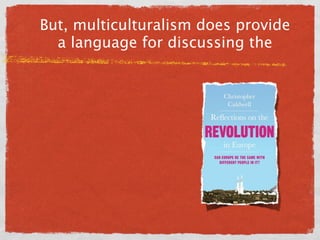
But, multiculturalism does provide
  a language for discussing the
But, multiculturalism does provide
  a language for discussing the

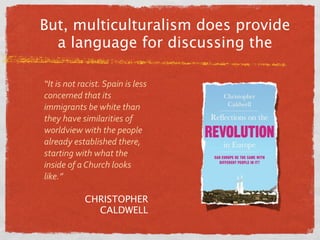
“It
is
not
racist.
Spain
is
less

concerned
that
its

immigrants
be
white
than

they
have
similarities
of

worldview
with
the
people

already
established
there,

starting
with
what
the

inside
of
a
Church
looks

like.”

            CHRISTOPHER
              CALDWELL
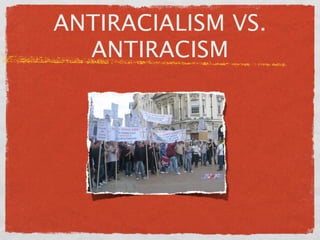
ANTIRACIALISM VS.
  ANTIRACISM
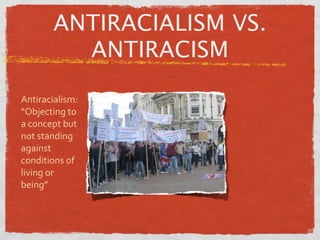
ANTIRACIALISM VS.
         ANTIRACISM

Antiracialism:
“Objecting
to

a
concept
but

not
standing

against

conditions
of

living
or

being”
ANTIRACIALISM VS.
         ANTIRACISM
                     Antiracism:
“the

                     risk
of
death”
in

Antiracialism:
                     the
name
of

“Objecting
to

                     refusing
the

a
concept
but

                     “impostion
and

not
standing

                     constraint,
[...]

against

                     the
devaluation

conditions
of

                     and
attendant

living
or

                     humiliation”

being”
                     caused
by
being

                     raced.

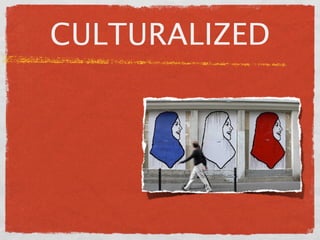
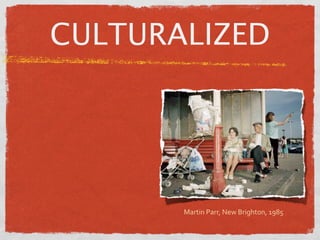
CULTURALIZED
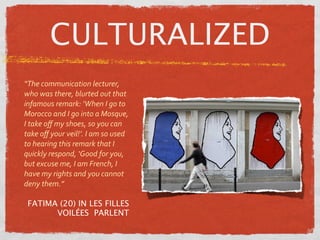
CULTURALIZED
“The
communication
lecturer,

who
was
there,
blurted
out
that

infamous
remark:
‘When
I
go
to

Morocco
and
I
go
into
a
Mosque,

I
take
off
my
shoes,
so
you
can

take
off
your
veil!’.
I
am
so
used

to
hearing
this
remark
that
I

quickly
respond,
‘Good
for
you,

but
excuse
me,
I
am
French,
I

have
my
rights
and
you
cannot

deny
them.”

 FATIMA (20) IN LES FILLES
       VOILÉES PARLENT
CULTURALIZED


       Martin
Parr,
New
Brighton,
1985
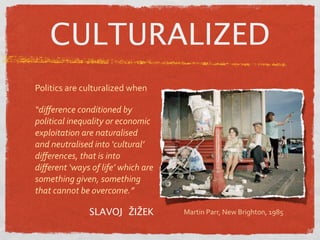
CULTURALIZED
Politics
are
culturalized
when


“difference
conditioned
by

political
inequality
or
economic

exploitation
are
naturalised

and
neutralised
into
‘cultural’

differences,
that
is
into

different
‘ways
of
life’
which
are

something
given,
something

that
cannot
be
overcome.”

               SLAVOJ ŽIŽEK          Martin
Parr,
New
Brighton,
1985
CULTURAL SOLUTIONS
       TO
CULTURAL SOLUTIONS
       TO

The
‘crisis
of
multiculturalism’
rhetoric
is
itself
mired

in
culturalism.
CULTURAL SOLUTIONS
       TO

The
‘crisis
of
multiculturalism’
rhetoric
is
itself
mired

in
culturalism.

The
problem
is
not
with
culture
per
se
but
with
its

excess,
always
to
be
only
found
in
an‐Other’s
culture.
CULTURAL SOLUTIONS
       TO

The
‘crisis
of
multiculturalism’
rhetoric
is
itself
mired

in
culturalism.

The
problem
is
not
with
culture
per
se
but
with
its

excess,
always
to
be
only
found
in
an‐Other’s
culture.

Therefore,
the
call
is
for
more
of
‘our’
culture.
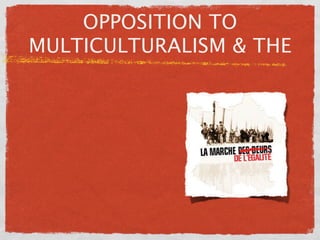
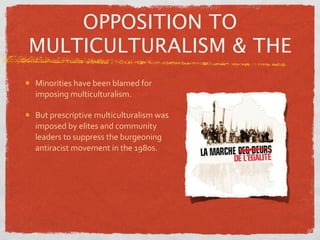
OPPOSITION TO
MULTICULTURALISM & THE
OPPOSITION TO
MULTICULTURALISM & THE
Minorities
have
been
blamed
for

imposing
multiculturalism.
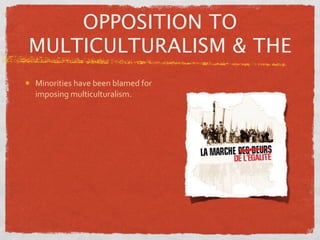
OPPOSITION TO
MULTICULTURALISM & THE
Minorities
have
been
blamed
for

imposing
multiculturalism.

But
prescriptive
multiculturalism
was

imposed
by
elites
and
community

leaders
to
suppress
the
burgeoning

antiracist
movement
in
the
1980s.
OPPOSITION TO
MULTICULTURALISM & THE
Minorities
have
been
blamed
for

imposing
multiculturalism.

But
prescriptive
multiculturalism
was

imposed
by
elites
and
community

leaders
to
suppress
the
burgeoning

antiracist
movement
in
the
1980s.

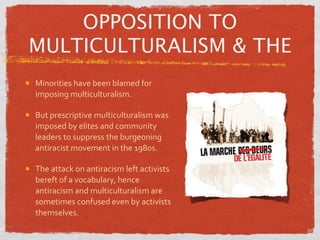
The
attack
on
antiracism
left
activists

bereft
of
a
vocabulary,
hence

antiracism
and
multiculturalism
are

sometimes
confused
even
by
activists

themselves.
FROM BIOPOWER TO
 CULTURAL POWER
FROM BIOPOWER TO
    CULTURAL POWER
Since
civil
rights,
‘identities’
in
the
US
have

been“incorporated
into
a
range
of
governmental
(in

the
Foucauldian
sense)
mechanisms.”
FROM BIOPOWER TO
    CULTURAL POWER
Since
civil
rights,
‘identities’
in
the
US
have

been“incorporated
into
a
range
of
governmental
(in

the
Foucauldian
sense)
mechanisms.”

These
identities
serve
a
function
both
for
their

performers
and
for
the
“state
institutions
and
media

and
market
projections
that
shape,
respectively,

clients
and
consumers.”
INCLUDE ME
INCLUDE ME
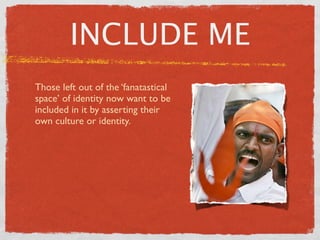
Those left out of the ‘fanatastical
space’ of identity now want to be
included in it by asserting their
own culture or identity.
INCLUDE ME
Those left out of the ‘fanatastical
space’ of identity now want to be
included in it by asserting their
own culture or identity.

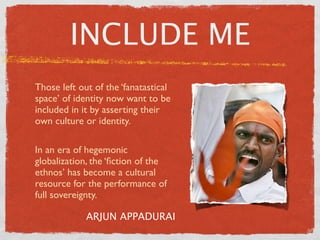
In an era of hegemonic
globalization, the ‘fiction of the
ethnos’ has become a cultural
resource for the performance of
full sovereignty.

             ARJUN APPADURAI
BACK TO RACE
BACK TO RACE

Politically,
the
concept
of
culture
is
not
dissociable

from
that
of
race.
BACK TO RACE

Politically,
the
concept
of
culture
is
not
dissociable

from
that
of
race.

Both
culturalization
and
racialization
are
imbricated

in
the
disciplining
of
non‐normative
bodies
by
the

state
and
the
market.
NOT POST-RACE, BUT
  POST-POLITICS
NOT POST-RACE, BUT
  POST-POLITICS
The
failure
to
see
race
as
central
to
modern
political

formation
means
that
the
displacement
of
politics
by

race
persists.
NOT POST-RACE, BUT
   POST-POLITICS
The
failure
to
see
race
as
central
to
modern
political

formation
means
that
the
displacement
of
politics
by

race
persists.

The
culturalization
of
politics
is
a
continuation
of
the

shift
from
a
political
to
a
biopolitical/racial

understanding
of
conflict.
NOT POST-RACE, BUT
   POST-POLITICS
The
failure
to
see
race
as
central
to
modern
political

formation
means
that
the
displacement
of
politics
by

race
persists.

The
culturalization
of
politics
is
a
continuation
of
the

shift
from
a
political
to
a
biopolitical/racial

understanding
of
conflict.

Therefore,
interchangeable
racial
and
cultural
frames

inform
interpretations
of
belonging,
rights,
equality,

citizenship,
life
and
death.
CONCLUSION: THE
DISPLACEMENT OF
CONCLUSION: THE
       DISPLACEMENT OF
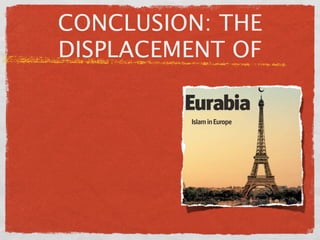
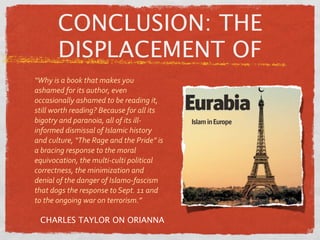
“Why
is
a
book
that
makes
you

ashamed
for
its
author,
even

occasionally
ashamed
to
be
reading
it,

still
worth
reading?
Because
for
all
its

bigotry
and
paranoia,
all
of
its
ill‐
informed
dismissal
of
Islamic
history

and
culture,
“The
Rage
and
the
Pride”
is

a
bracing
response
to
the
moral

equivocation,
the
multi‐culti
political

correctness,
the
minimization
and

denial
of
the
danger
of
Islamo‐fascism

that
dogs
the
response
to
Sept.
11
and

to
the
ongoing
war
on
terrorism.”

 CHARLES TAYLOR ON ORIANNA

Post-race, post-politics

Editor's Notes

  • #2 \n
  • #3 \n
  • #4 \n
  • #5 \n
  • #6 \n
  • #7 \n
  • #8 \n
  • #9 \n
  • #10 It is in the US that we can observe the post-racial story most clearly.\n
  • #11 1. Birther movement.\n2. Sotomayor’s nomination to the Supreme Court.\n3. Gates’s arrest.\n\nRight-wing and liberal opinion converges over post-race. For the right we are post-race because minorities are racist too - Obama being the ultimate example. Hence, the charge of racism coming from minorities, who are portrayed as being hegemonic, has become meaningless.\n\nFor liberals, the election of Obama proves the end of racism, therefore allowing them to avoid the persistent questions of race and racism that continue to dog society.\n
  • #12 1. Birther movement.\n2. Sotomayor’s nomination to the Supreme Court.\n3. Gates’s arrest.\n\nRight-wing and liberal opinion converges over post-race. For the right we are post-race because minorities are racist too - Obama being the ultimate example. Hence, the charge of racism coming from minorities, who are portrayed as being hegemonic, has become meaningless.\n\nFor liberals, the election of Obama proves the end of racism, therefore allowing them to avoid the persistent questions of race and racism that continue to dog society.\n
  • #13 1. Birther movement.\n2. Sotomayor’s nomination to the Supreme Court.\n3. Gates’s arrest.\n\nRight-wing and liberal opinion converges over post-race. For the right we are post-race because minorities are racist too - Obama being the ultimate example. Hence, the charge of racism coming from minorities, who are portrayed as being hegemonic, has become meaningless.\n\nFor liberals, the election of Obama proves the end of racism, therefore allowing them to avoid the persistent questions of race and racism that continue to dog society.\n
  • #14 Both conservative and liberal readings of post-race are inextricable from the debate about the future of multiculturalism.\n\nThe furore about MC leading to segregated societies is not targeted at MC policies but at the fact of ‘too much diversity’ (Goodhart).\n\nIt is a riff on the old story that blames different others for the ills of society at large.\n\n
  • #15 1. Those who theorised a new culturalist racism in the 1980s and 1990s unwittingly contributed to the idea that objecting to a group on the grounds of their ‘culture’ (rather than race) is by no means racist or discriminatory. \n\n2. But as Balibar showed in 1991, arguments about the immutable difference of undesirable others have always used both biological and cultural explanations, the case of antisemitism being a case in point.\n\nBecause it has become taboo to refer to race in biological terms, culture has become the means through which both difference and hierarchy are most commonly marked. \n
  • #16 1. Those who theorised a new culturalist racism in the 1980s and 1990s unwittingly contributed to the idea that objecting to a group on the grounds of their ‘culture’ (rather than race) is by no means racist or discriminatory. \n\n2. But as Balibar showed in 1991, arguments about the immutable difference of undesirable others have always used both biological and cultural explanations, the case of antisemitism being a case in point.\n\nBecause it has become taboo to refer to race in biological terms, culture has become the means through which both difference and hierarchy are most commonly marked. \n
  • #17 The ascent of MC has provided a language for discussing the problems posed by the difference of groups portrayed as alien when race is taboo.\n\nFor example, Caldwell can shake off the charge of racism by explicitly using the language of ethnicity and culture, instead of race, in his book on the threat posed by Islam and Muslims to the future of Europe.\n\nAccording to this logic, race is something that officially does not exist and, in any case, only ever concerned skin colour. By this token, racism too is a thing of the past. Cultures on the other hand are objective entities. Therefore, to claim that different cultures are incompatible is mere commonsense.\n
  • #18 Caldwell’s beliefs can be traced back to the refusal of the post-WW II world to engage with the centrality of race and racism in modernity. The taboo of race caused it to be characterised in official discourse as an external force, a pathology or a psychological state. Any effort to link it to colonialism, capitalism or state power remained a purely academic exercise.\n\nThe official response to the persistence of racial discrimination after the rejection of race is what Goldberg calls anti-racialism [quote 1]. He opposes this to antiracism [reveal quote 2].\n\nOfficial antiracialism coexists with the current rejection of multiculturalism which is, in itself, a stance against antiracism.\n\nThose who oppose ‘too much diversity’ are in fact opposing ‘minorities’ demand for equality and their right, as equals, to stand up against racist oppression.\n\nBecause the language of race and racism has been replaced by that of ‘different but equal’ culture, the terms of the debate about MC fail to incorporate the experience of racism and the struggle for equality and justice which antiracism involves.\n\nThis is what allows both the right and liberals to proclaim that we are post-race.\nThe right, on the one hand, dismisses the experience of racism while liberals present an idealistic view of a post-racial society. This leads to both those who oppose MC and, crucially, the racialised themselves being left without a vocabulary to adequately describe either what they are opposing or what they are upholding.\n\nThis means that the struggle for justice becomes a fight for the recognition of cultural identity.\nAnd for the right, opposition to too much diversity can be dressed up as a commonsense questioning of ‘political correctness gone mad’.\n
  • #19 Caldwell’s beliefs can be traced back to the refusal of the post-WW II world to engage with the centrality of race and racism in modernity. The taboo of race caused it to be characterised in official discourse as an external force, a pathology or a psychological state. Any effort to link it to colonialism, capitalism or state power remained a purely academic exercise.\n\nThe official response to the persistence of racial discrimination after the rejection of race is what Goldberg calls anti-racialism [quote 1]. He opposes this to antiracism [reveal quote 2].\n\nOfficial antiracialism coexists with the current rejection of multiculturalism which is, in itself, a stance against antiracism.\n\nThose who oppose ‘too much diversity’ are in fact opposing ‘minorities’ demand for equality and their right, as equals, to stand up against racist oppression.\n\nBecause the language of race and racism has been replaced by that of ‘different but equal’ culture, the terms of the debate about MC fail to incorporate the experience of racism and the struggle for equality and justice which antiracism involves.\n\nThis is what allows both the right and liberals to proclaim that we are post-race.\nThe right, on the one hand, dismisses the experience of racism while liberals present an idealistic view of a post-racial society. This leads to both those who oppose MC and, crucially, the racialised themselves being left without a vocabulary to adequately describe either what they are opposing or what they are upholding.\n\nThis means that the struggle for justice becomes a fight for the recognition of cultural identity.\nAnd for the right, opposition to too much diversity can be dressed up as a commonsense questioning of ‘political correctness gone mad’.\n
  • #20 Building on this analysis of the status quo on the so-called ‘crisis of multiculturalism’, I now want to argue that this can be seen within a wider framework that I am calling the culturalization of politics. \n
  • #21 Zizek blames the culturalization of politics on those whom he calls ‘liberal multiculturalists’. \n\nWhile this reading is limiting in that it seems to accept the right-wing notion that MC is hegemonic, his basic point is that culture has become the dominant way of analysing problems that would previously have been seen as political, such as inequality, exploitation and power.\n\n[Time impedes me from going deeper into the fullness of Zizek’s argument - I do this in the paper].\n
  • #22 1. The culturalist frame which I am arguing dominates our view of social relations rhetoric not only essentialises individuals as belonging to ‘cultural groups’ - a common critique of MC - it also reifies culture itself to the exclusion of all other modes of explanation. \n\nVague invocations of the liberal do little to mask the fact that most critics of MC are in fact waging a ‘culture war’. This leads people like Caldwell to be able to say that “immigration is not enhancing or validating European culture; it is supplanting it.” \n\n2. So the problem is not with culture per se, but with its excess, an excess that is always to be found in an-Other culture. \n\n3. To counteract this excess, more of ‘our’ culture is needed. Hence, citizenship tests and ceremonies, calls for a return to ‘national values’ and so on.\nThe dominant culture is thus portrayed as neutral (almost cultureless - in the sense of raceless) while ‘other cultures’ are seen as ‘too cultural’.\n
  • #23 1. The culturalist frame which I am arguing dominates our view of social relations rhetoric not only essentialises individuals as belonging to ‘cultural groups’ - a common critique of MC - it also reifies culture itself to the exclusion of all other modes of explanation. \n\nVague invocations of the liberal do little to mask the fact that most critics of MC are in fact waging a ‘culture war’. This leads people like Caldwell to be able to say that “immigration is not enhancing or validating European culture; it is supplanting it.” \n\n2. So the problem is not with culture per se, but with its excess, an excess that is always to be found in an-Other culture. \n\n3. To counteract this excess, more of ‘our’ culture is needed. Hence, citizenship tests and ceremonies, calls for a return to ‘national values’ and so on.\nThe dominant culture is thus portrayed as neutral (almost cultureless - in the sense of raceless) while ‘other cultures’ are seen as ‘too cultural’.\n
  • #24 1. The culturalist frame which I am arguing dominates our view of social relations rhetoric not only essentialises individuals as belonging to ‘cultural groups’ - a common critique of MC - it also reifies culture itself to the exclusion of all other modes of explanation. \n\nVague invocations of the liberal do little to mask the fact that most critics of MC are in fact waging a ‘culture war’. This leads people like Caldwell to be able to say that “immigration is not enhancing or validating European culture; it is supplanting it.” \n\n2. So the problem is not with culture per se, but with its excess, an excess that is always to be found in an-Other culture. \n\n3. To counteract this excess, more of ‘our’ culture is needed. Hence, citizenship tests and ceremonies, calls for a return to ‘national values’ and so on.\nThe dominant culture is thus portrayed as neutral (almost cultureless - in the sense of raceless) while ‘other cultures’ are seen as ‘too cultural’.\n
  • #25 1. In essence, what is being opposed by the anti-multiculturalists is descriptive MC - or lived multiculture - the fact that our postcolonial, postimmigration societies are no longer (as though they ever were) culturally homogeneous.\n\n2. Prescriptive MC - or multicultural policies - are seen, not as top-down, but as imposed by minorities intent on having their cultural identity recognised.\n\nIn fact, as Paul Gilroy showed back in the late 1980s in the British case, an alliance of government and authoritarian community leaders installed MC policies as a means of reining in a burgeoning antiracist movement. \n\n3. Be that as it may, the fact today is that prescriptive and descriptive MC have become enmeshed, not only in the minds of those who oppose MC, but also for antiracists who today rush to defend it.\n\n
  • #26 1. In essence, what is being opposed by the anti-multiculturalists is descriptive MC - or lived multiculture - the fact that our postcolonial, postimmigration societies are no longer (as though they ever were) culturally homogeneous.\n\n2. Prescriptive MC - or multicultural policies - are seen, not as top-down, but as imposed by minorities intent on having their cultural identity recognised.\n\nIn fact, as Paul Gilroy showed back in the late 1980s in the British case, an alliance of government and authoritarian community leaders installed MC policies as a means of reining in a burgeoning antiracist movement. \n\n3. Be that as it may, the fact today is that prescriptive and descriptive MC have become enmeshed, not only in the minds of those who oppose MC, but also for antiracists who today rush to defend it.\n\n
  • #27 1. In essence, what is being opposed by the anti-multiculturalists is descriptive MC - or lived multiculture - the fact that our postcolonial, postimmigration societies are no longer (as though they ever were) culturally homogeneous.\n\n2. Prescriptive MC - or multicultural policies - are seen, not as top-down, but as imposed by minorities intent on having their cultural identity recognised.\n\nIn fact, as Paul Gilroy showed back in the late 1980s in the British case, an alliance of government and authoritarian community leaders installed MC policies as a means of reining in a burgeoning antiracist movement. \n\n3. Be that as it may, the fact today is that prescriptive and descriptive MC have become enmeshed, not only in the minds of those who oppose MC, but also for antiracists who today rush to defend it.\n\n
  • #28 1. This process has been elucidated by George Yudice in his book, The Expediency of Culture.\nYudice explains that in the US since civil rights there has been a rise in the performance of identities for political ends.\n\n2. This has had its uses, not only for excluded ‘minority‘ groups but also for the state and the market that require that these identities be performed. \n\nThe point for Yudice is not to blame those who perform identity who are doing it for politically expedient reasons. Rather, we need to see how it is impossible to disentangle the performance of identity as a political strategy from the Foucauldian management of populations because this too operates according to a logic of culture/identity. \n\nIn other words, groups are conceptualised in terms of belonging to so-called cultural groups and disciplined as such.\n\nThis is what Yudice calls ‘cultural power’, building on the Foucauldian biopower which is implicit in governmentalisation. \n
  • #29 1. This process has been elucidated by George Yudice in his book, The Expediency of Culture.\nYudice explains that in the US since civil rights there has been a rise in the performance of identities for political ends.\n\n2. This has had its uses, not only for excluded ‘minority‘ groups but also for the state and the market that require that these identities be performed. \n\nThe point for Yudice is not to blame those who perform identity who are doing it for politically expedient reasons. Rather, we need to see how it is impossible to disentangle the performance of identity as a political strategy from the Foucauldian management of populations because this too operates according to a logic of culture/identity. \n\nIn other words, groups are conceptualised in terms of belonging to so-called cultural groups and disciplined as such.\n\nThis is what Yudice calls ‘cultural power’, building on the Foucauldian biopower which is implicit in governmentalisation. \n
  • #30 For Yudice, cultural power has created a ‘fantastical space’ in which all marginalised groups are equivalent to each other and can be “visibly represented as parallel forms of identity.”\n\nThis of course skips over the obvious uneven power relations that do in fact exist between groups, such as perhaps between middle class white homosexuals and working class black women.\n\n1. The problem arises for MC when those who perceive themselves to have been left out of this fantastical space - the previously unproblematised majority - now wish to be included in it. \n\nThey now want to assert their culture too. But they do not see their culture as equivalent to that of the marginalised. It is superior because it comes with a greater sense of entitlement.\n\n2. Arjun Appadurai argues that this is in large part a response to globalisation against which the ‘fiction of the ethnos’ seeks to assert itself. But because of the ephemeral nature of globalisation, anger is directed against minorities within states who are seen as having usurped ‘our’ cultural hegemony.\n\nThis is why where we can observe the culturalisation of politics most acutely is in the solutions being proposed to the problems caused by the excess of diversity. \n\nFor example, the banning of the hijab in French schools and public buildings is presented as being based on universal principles which, far from being truly universalist, are presented as culturally French.\n
  • #31 For Yudice, cultural power has created a ‘fantastical space’ in which all marginalised groups are equivalent to each other and can be “visibly represented as parallel forms of identity.”\n\nThis of course skips over the obvious uneven power relations that do in fact exist between groups, such as perhaps between middle class white homosexuals and working class black women.\n\n1. The problem arises for MC when those who perceive themselves to have been left out of this fantastical space - the previously unproblematised majority - now wish to be included in it. \n\nThey now want to assert their culture too. But they do not see their culture as equivalent to that of the marginalised. It is superior because it comes with a greater sense of entitlement.\n\n2. Arjun Appadurai argues that this is in large part a response to globalisation against which the ‘fiction of the ethnos’ seeks to assert itself. But because of the ephemeral nature of globalisation, anger is directed against minorities within states who are seen as having usurped ‘our’ cultural hegemony.\n\nThis is why where we can observe the culturalisation of politics most acutely is in the solutions being proposed to the problems caused by the excess of diversity. \n\nFor example, the banning of the hijab in French schools and public buildings is presented as being based on universal principles which, far from being truly universalist, are presented as culturally French.\n
  • #32 The final part of my argument brings us back to race - and racism.\n\n1. Just as culturalism should not be seen as radical break with racism, neither should culture in the way it is used to reference ‘different others’ be seen as radically different to race. They are both ways of ordering and dividing people.\n\n2. Culturalization can be seen as continuous to racialization because both are involved in what Jasbir Puar refers to as ‘the management of life’. \n\nEssentially, whether you name the difference you oppose racial or cultural does not matter to the way the person on the receiving end of that naming perceives it.\n
  • #33 The final part of my argument brings us back to race - and racism.\n\n1. Just as culturalism should not be seen as radical break with racism, neither should culture in the way it is used to reference ‘different others’ be seen as radically different to race. They are both ways of ordering and dividing people.\n\n2. Culturalization can be seen as continuous to racialization because both are involved in what Jasbir Puar refers to as ‘the management of life’. \n\nEssentially, whether you name the difference you oppose racial or cultural does not matter to the way the person on the receiving end of that naming perceives it.\n
  • #34 I want here to briefly make the connection between Foucault’s biopower and Yudice’s cultural power more concrete and, in doing so, link the three moments of the post-racial, the culturalist and the post-political.\n\nFoucault’s work on racism is unfortunately restricted to a few lectures in Society Must be Defended and a brief mention in the History of Sexuality. Nevertheless, it is instructive precisely because of the connection to biopower.\n\n1. The biopolitical state - as opposed to the sovereign state before it - sees its population as a single organism in a world of similarly constituted and competing organisms that must be kept alive.\n\n2. Racism enters the picture for Foucault in order to explain how a power whose function it is to ensure the survival of its population is nonetheless involved in killing. Whereas under sovereign rule, the death of one’s enemies ensured the population’s survival, under the biopolitical state their death allows one’s population to flourish. This is the difference between a political view of conflict and a biological or racial one.\n\nSo, for Foucault racism divides between those within the population who have the right to live and those who must die for the strength of the organism as a whole. \n\n3. Therefore, while under sovereignty, enemies were conceived of as being external, the biopolitical or racial view of enemies as biological means that they can be internal as well as external. Hence the rise of eugenics, for example.\n\n
  • #35 I want here to briefly make the connection between Foucault’s biopower and Yudice’s cultural power more concrete and, in doing so, link the three moments of the post-racial, the culturalist and the post-political.\n\nFoucault’s work on racism is unfortunately restricted to a few lectures in Society Must be Defended and a brief mention in the History of Sexuality. Nevertheless, it is instructive precisely because of the connection to biopower.\n\n1. The biopolitical state - as opposed to the sovereign state before it - sees its population as a single organism in a world of similarly constituted and competing organisms that must be kept alive.\n\n2. Racism enters the picture for Foucault in order to explain how a power whose function it is to ensure the survival of its population is nonetheless involved in killing. Whereas under sovereign rule, the death of one’s enemies ensured the population’s survival, under the biopolitical state their death allows one’s population to flourish. This is the difference between a political view of conflict and a biological or racial one.\n\nSo, for Foucault racism divides between those within the population who have the right to live and those who must die for the strength of the organism as a whole. \n\n3. Therefore, while under sovereignty, enemies were conceived of as being external, the biopolitical or racial view of enemies as biological means that they can be internal as well as external. Hence the rise of eugenics, for example.\n\n
  • #36 I want here to briefly make the connection between Foucault’s biopower and Yudice’s cultural power more concrete and, in doing so, link the three moments of the post-racial, the culturalist and the post-political.\n\nFoucault’s work on racism is unfortunately restricted to a few lectures in Society Must be Defended and a brief mention in the History of Sexuality. Nevertheless, it is instructive precisely because of the connection to biopower.\n\n1. The biopolitical state - as opposed to the sovereign state before it - sees its population as a single organism in a world of similarly constituted and competing organisms that must be kept alive.\n\n2. Racism enters the picture for Foucault in order to explain how a power whose function it is to ensure the survival of its population is nonetheless involved in killing. Whereas under sovereign rule, the death of one’s enemies ensured the population’s survival, under the biopolitical state their death allows one’s population to flourish. This is the difference between a political view of conflict and a biological or racial one.\n\nSo, for Foucault racism divides between those within the population who have the right to live and those who must die for the strength of the organism as a whole. \n\n3. Therefore, while under sovereignty, enemies were conceived of as being external, the biopolitical or racial view of enemies as biological means that they can be internal as well as external. Hence the rise of eugenics, for example.\n\n
  • #37 Conceiving of the relationship to one’s enemies as biological rather than political transforms politics, as Hannaford makes clear in this quote. \n\nThis new understanding of politics means that the interests of the state became subsumed to that of the race. So the state’s power becomes invested in internally rationalising its population and in justifying the rampant fight for imperialist domination. \n\n
  • #38 1. If we accept this Foucauldian approach, the extent to which racism and biopower transformed politics in the West remains a political problem for us today because there has never been a serious effort made to deal with the centrality of race to modern political formation.\n\n2. This becomes even clearer if we accept the argument I have been making that today’s culturalization of politics represents a continuation of the shift from a political to a biopolitical or racial understanding of conflict.\n\n3. Yudice’s point - that cultural power has been added to biopower, also shows how interchangeable racial and cultural frames inform interpretations of belonging, rights, equality, citizenship and even life and death (particularly in the relationship with the developing world or in conflicts such as Iraq and Afghanistan).\n\n\n
  • #39 1. If we accept this Foucauldian approach, the extent to which racism and biopower transformed politics in the West remains a political problem for us today because there has never been a serious effort made to deal with the centrality of race to modern political formation.\n\n2. This becomes even clearer if we accept the argument I have been making that today’s culturalization of politics represents a continuation of the shift from a political to a biopolitical or racial understanding of conflict.\n\n3. Yudice’s point - that cultural power has been added to biopower, also shows how interchangeable racial and cultural frames inform interpretations of belonging, rights, equality, citizenship and even life and death (particularly in the relationship with the developing world or in conflicts such as Iraq and Afghanistan).\n\n\n
  • #40 1. If we accept this Foucauldian approach, the extent to which racism and biopower transformed politics in the West remains a political problem for us today because there has never been a serious effort made to deal with the centrality of race to modern political formation.\n\n2. This becomes even clearer if we accept the argument I have been making that today’s culturalization of politics represents a continuation of the shift from a political to a biopolitical or racial understanding of conflict.\n\n3. Yudice’s point - that cultural power has been added to biopower, also shows how interchangeable racial and cultural frames inform interpretations of belonging, rights, equality, citizenship and even life and death (particularly in the relationship with the developing world or in conflicts such as Iraq and Afghanistan).\n\n\n
  • #41 When Christopher Caldwell falsely claims that “Muslims now either dominate or vie for domination of certain important European cities” (2009: 96) and that “Europe finds itself in a contest with Islam for the allegiance of its newcomers” (ibid.: 286), he is mobilising the language of race war identified by Foucault. \n\nWhether or not Muslims are conceived as genetically or culturally incompatible is irrelevant to the choices made about how to deal with them. \n\nSimilarly, when governments propose a ‘return’ to national values as a response to so-called self-segregation, isn’t what they are advocating a regularisation of society according to the logic of ‘cultural power’? \n\nIsn’t the concern with the lack of social cohesion inscribed in the same logic as fear for the fitness of the race nation? \n\nIf we accept that the two discourses bear similarities at least, we have to ask what purpose would cultural uniformity have and at what cost should it be achieved? The effect of these considerations on politics is as important as it was in the 19th century. The surety with which the need for cultural compatibility is being expressed today denies the negotiation, challenge and conflict which is essential to politics. It is in this sense that the post-racial, post-multicultural moment is also a post-political one. It remains to be seen whether the force of difference can adequately resist the power of regulation.\n\n