PHILOSOPHY OF EDUCATION
IAN MARK LLOYD SANTISAS
What is Post-modernism
• Postmodernism is an intellectual stance or
mode of discourse
• A term that refers to a self-conscious cultural
movement that reacted against the
principles of modernism
• Ideals of the modernist movements in
literature, art, architecture, film, philosophy.
And more
Post -
modernism
Post-modernism: basic concept
Post -
modernism
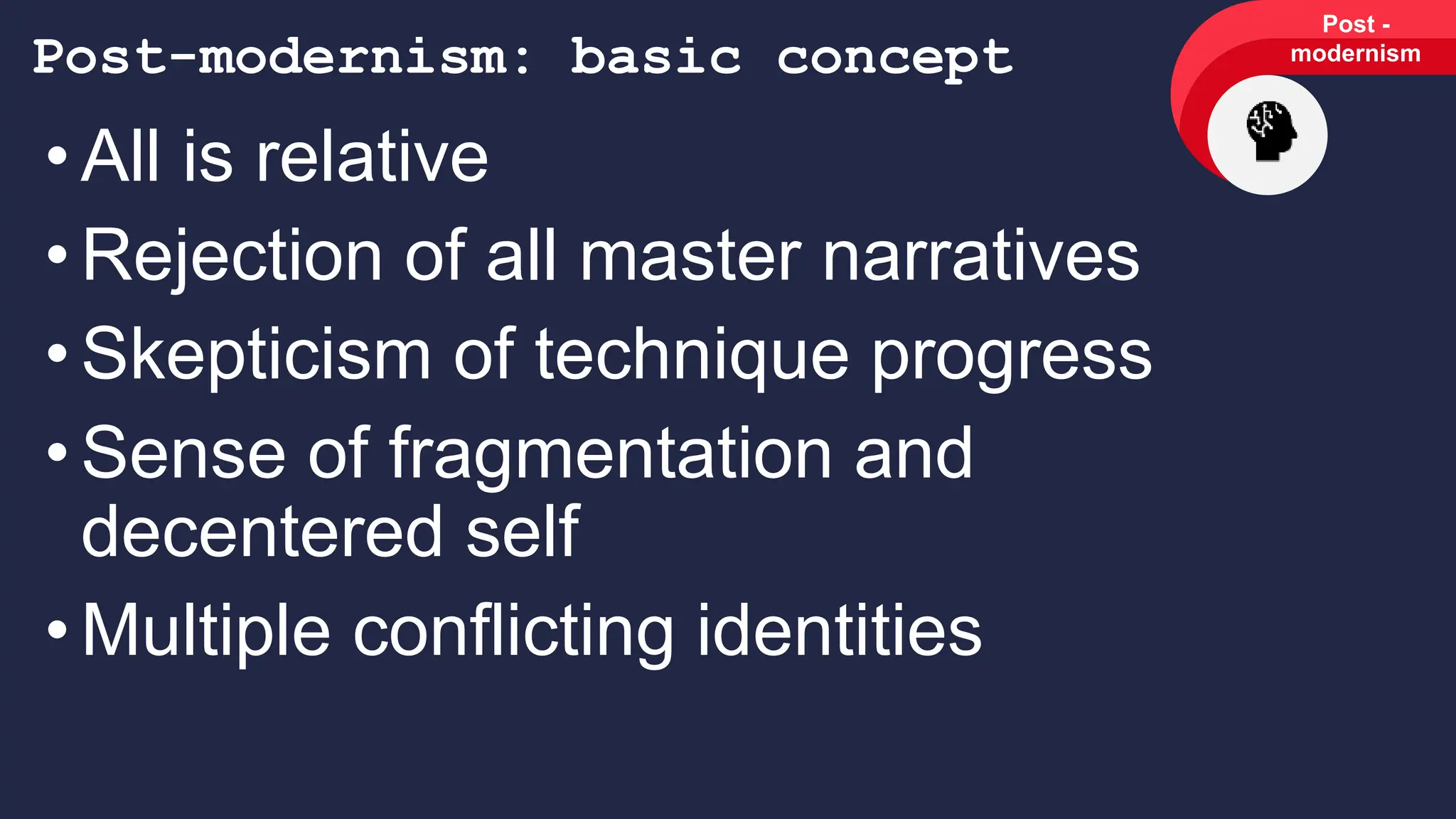
•All is relative
•Rejection of all master narratives
•Skepticism of technique progress
•Sense of fragmentation and
decentered self
•Multiple conflicting identities
Post-modernism
• Has refused the most of the
modernism’s main ideas. The most
important point in modernism
educational opinion is rationality.
• Postmodernists challenge educators to
understand that diversity, inclusion,
and multiplicity are essential (McLaren
& Torres, 1998).
Post -
modernism
Post-modernism Philosophy
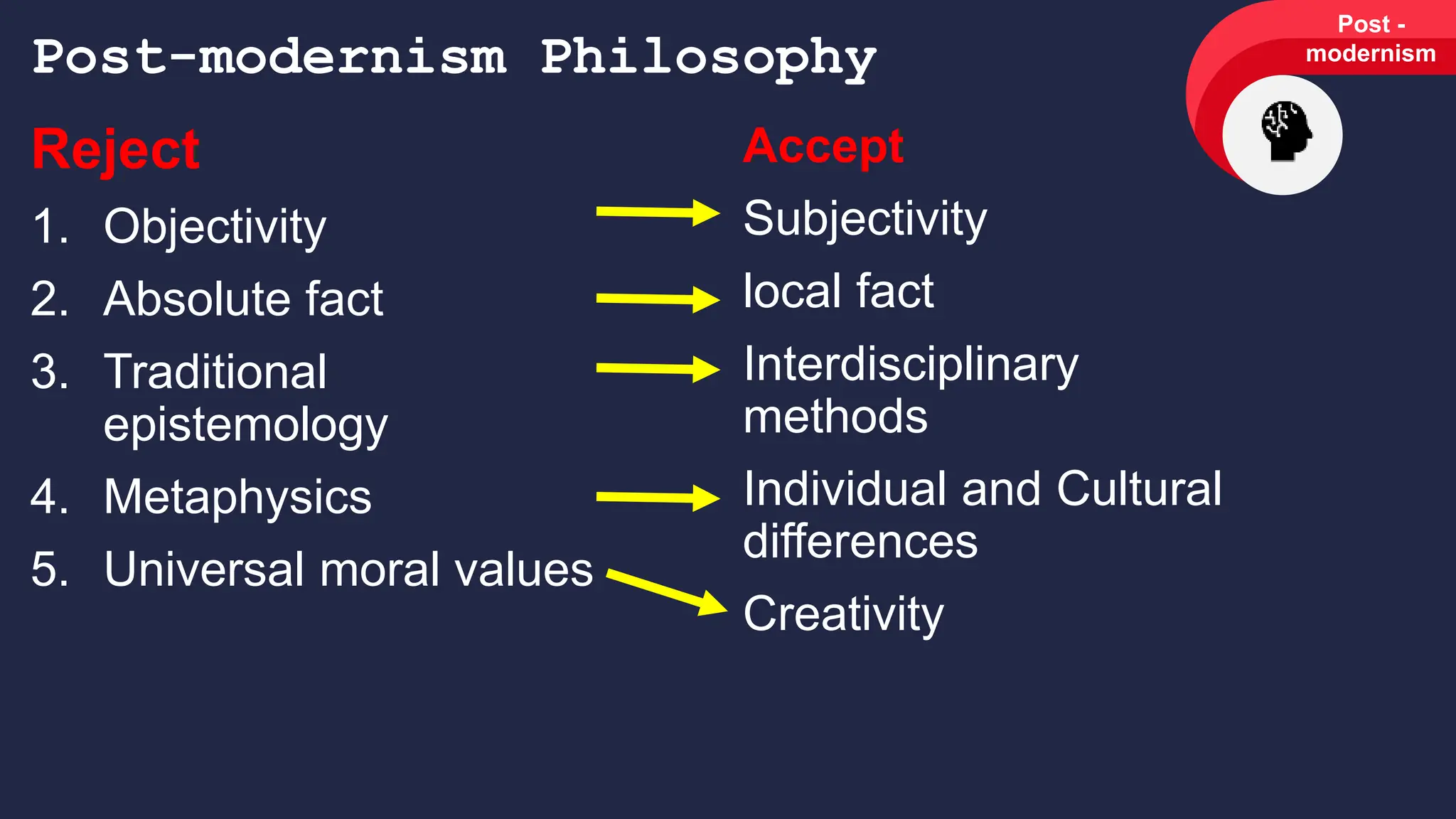
Reject
1. Objectivity
2. Absolute fact
3. Traditional
epistemology
4. Metaphysics
5. Universal moral values
Post -
modernism
Accept
Subjectivity
local fact
Interdisciplinary
methods
Individual and Cultural
differences
Creativity
Curriculum
• To challenge cultural politics that promote
inequality based on class, gender, sexuality,
race, ethnicity, or nationalism
• By teaching through a “social justice”
framework.
• Students would also be exposed to a wide
variety of reading materials
to cultural inequality and identify ways to
advocate for social justice.
Post -
modernism
INSTRUCTION IN THE CLASSROOM
Post -
modernism
• Critical inquiry and critical play a
central role
• Include any instructional method
that would help students
recognize and understand the
notion of hegemony
INSTRUCTION IN THE CLASSROOM
Post -
modernism
• Students construct their own
knowledge and meaning via:
• Hands-on, problem-solving activities.
• Asking questions to promote critical literacy.
• Critiquing and examining diverse cultures
and institutions.
• Exploring the contradictions and variable
meanings of the language we use in our
speech and text
INSTRUCTION IN THE CLASSROOM Post -
modernism
• Students construct their own knowledge and
meaning via:
• Exploring students‘ autobiographical histories,
languages, and cultures.
• Discussing the hidden curriculum, or “unexpressed
perpetuation of the dominant western culture
through institutional processes”
• Using the text, or “any set of symbolic objects
through which we attempt to communicate
something and through which we create meaning
(to critically examine the curriculum
Role of the Teacher
Post -
modernism
• is often identified as a “change agent.”
• doing of critical theory
• to demonstrate effective strategies for:
questioning, critiquing, and analyzing
• Teacher is needed to effectively put
these skills into practice on a daily
basis as well as teach their students
how to apply them.
Role of Student
Post -
modernism
• Metacognitive strategies are
required; students learn how to
learn
• Students encouraged to find
personal meaning from the
learning
Teaching and learning in the
postmodern world
Post -
modernism
• Knowledge about ways in which to
live and learn in an open system
in which there is considerable
ambiguity and development.
Teaching and learning in the
postmodern world
Post -
modernism
• Creation of individual plans wherein the
students is an active; creation of
partnerships between teachers and
students in learning a body of knowledge
within a contemporary context
• Ideas are brought together through a
holistic approach to form new ways of
knowing the world
Postmodern perspectives bring to
education an openness to diversity
and complexity that moves beyond a
critique of narrow scientific
knowledge. It brings to the fore
the much more complex realities of
social, cultural, and political
contexts and their influences on
educational institutions,
practices, and settings.
THANK YOU
IAN MARK LLOYD L. SANTISAS

Post-Modernism in Education .pptx

  • 1.
    PHILOSOPHY OF EDUCATION IANMARK LLOYD SANTISAS
  • 2.
    What is Post-modernism •Postmodernism is an intellectual stance or mode of discourse • A term that refers to a self-conscious cultural movement that reacted against the principles of modernism • Ideals of the modernist movements in literature, art, architecture, film, philosophy. And more Post - modernism
  • 3.
    Post-modernism: basic concept Post- modernism •All is relative •Rejection of all master narratives •Skepticism of technique progress •Sense of fragmentation and decentered self •Multiple conflicting identities
  • 4.
    Post-modernism • Has refusedthe most of the modernism’s main ideas. The most important point in modernism educational opinion is rationality. • Postmodernists challenge educators to understand that diversity, inclusion, and multiplicity are essential (McLaren & Torres, 1998). Post - modernism
  • 5.
    Post-modernism Philosophy Reject 1. Objectivity 2.Absolute fact 3. Traditional epistemology 4. Metaphysics 5. Universal moral values Post - modernism Accept Subjectivity local fact Interdisciplinary methods Individual and Cultural differences Creativity
  • 6.
    Curriculum • To challengecultural politics that promote inequality based on class, gender, sexuality, race, ethnicity, or nationalism • By teaching through a “social justice” framework. • Students would also be exposed to a wide variety of reading materials to cultural inequality and identify ways to advocate for social justice. Post - modernism
  • 7.
    INSTRUCTION IN THECLASSROOM Post - modernism • Critical inquiry and critical play a central role • Include any instructional method that would help students recognize and understand the notion of hegemony
  • 8.
    INSTRUCTION IN THECLASSROOM Post - modernism • Students construct their own knowledge and meaning via: • Hands-on, problem-solving activities. • Asking questions to promote critical literacy. • Critiquing and examining diverse cultures and institutions. • Exploring the contradictions and variable meanings of the language we use in our speech and text
  • 9.
    INSTRUCTION IN THECLASSROOM Post - modernism • Students construct their own knowledge and meaning via: • Exploring students‘ autobiographical histories, languages, and cultures. • Discussing the hidden curriculum, or “unexpressed perpetuation of the dominant western culture through institutional processes” • Using the text, or “any set of symbolic objects through which we attempt to communicate something and through which we create meaning (to critically examine the curriculum
  • 10.
    Role of theTeacher Post - modernism • is often identified as a “change agent.” • doing of critical theory • to demonstrate effective strategies for: questioning, critiquing, and analyzing • Teacher is needed to effectively put these skills into practice on a daily basis as well as teach their students how to apply them.
  • 11.
    Role of Student Post- modernism • Metacognitive strategies are required; students learn how to learn • Students encouraged to find personal meaning from the learning
  • 12.
    Teaching and learningin the postmodern world Post - modernism • Knowledge about ways in which to live and learn in an open system in which there is considerable ambiguity and development.
  • 13.
    Teaching and learningin the postmodern world Post - modernism • Creation of individual plans wherein the students is an active; creation of partnerships between teachers and students in learning a body of knowledge within a contemporary context • Ideas are brought together through a holistic approach to form new ways of knowing the world
  • 14.
    Postmodern perspectives bringto education an openness to diversity and complexity that moves beyond a critique of narrow scientific knowledge. It brings to the fore the much more complex realities of social, cultural, and political contexts and their influences on educational institutions, practices, and settings.
  • 15.
    THANK YOU IAN MARKLLOYD L. SANTISAS

Editor's Notes

  • #3 Discourse - written or spoken
  • #7 The focus social justice framework is a way of seeing and acting aimed at resisting unfairness and inequity while enhancing freedom and possibility for all. Not only to exposed it would also challenge them to think critically about issues related to cultural inequality and identify ways to advocate for social justice. which would empower students to identify and unmask those human beliefs and practices that limit freedom, justice, and democracy.
  • #8 So doubt and skepticism about hypothesis necessary for
  • #9 Postmodern philosophers… It should be considered…
  • #10 Hegemony - authority over others in which the dominant culture exercises domination over subordinate classes or groups with the partial consent of the subordinate group Pedagogy - is the combination of teaching methods
  • #11 Also incorporate the learning theory of constructivism, whereby
  • #12 Also incorporate the learning theory of constructivism, whereby classrooms, film, books, clothing)”
  • #13 avoid alienating or offending others, and work hard to always respect the rights of all individuals to share their points of view.
  • #14 Metacognitive strategies empower students to think about their own thinking. -Students are supposed to voice their opinions and question the purpose of major institutions in society, including the school Students are encouraged to challenge the curriculum of the school, especially when it comes to the hidden curriculum. hidden curriculum is all the other things students learn in school that is not explicitly taught or written down; concepts like friendship, honesty, fairness, the value of work, ethnic relations, and cultural differences.
  • #15 AMBIGUITY - a word or expression that can be understood in two or more possible ways
  • #16 have the capacity to understand that humans are responsible for the phenomena of wars, poverty, violence, corruption, and social, political, economic, and ecological injustices (Martusewicz, 2001). So they encourage students to look at societal issues that are culturally and politically inequitable and challenge them.