School of Architecture, Building and Design
Foundation in Natural Built and Environment
Culture & Civilization FDES 0815
Project 3 Postcard
Literature Review
Name : Yvonne Chin Yun Miin
Student ID : 0315662
Title : Line O’ Art
Lecturer: Normah Sulaiman
Submission Date : 13th
June 2014
Content
Assignment Brief 3
Concept and Theme
Introduction and Acknowledgmentof Line 5
Introduction to Architectural Buildings in Kuala Lumpur 6
Research and Mapping 7
Layout Planning 17
Final Product & Packaging 18
References 20
Appendices 21
First Mapping
Tutorial Sheets
3
SCHOOL OF ARCHITECTURE, BUILDING & DESIGN
Research Unit for Modern Architecture Studies in Southeast Asia
Foundation of Natural and Built Environments
CULTURE & CIVILIZATION (FDES 0815)
Prerequisite: None
Lecturer : Normah Sulaiman . Delliya Mohd.Zain
______________________________________________________________________
Project 3 (Individual Assignment) : Art + Architecture + Culture
40% marks
Submission Date: 3rd
June 2014 (week 17)
Introduction
"What travel teaches us is that we are all essentially the same. There is not a 'them' and
an 'us’ there is really only 'us.'" The stunning photographs capture the theme of places of
visit. A good coffee table books serve a number of purposes: they're decorative,
informative, and attractive.
Objectives of Project
1. To introduce the Western and Eastern culture and civilization through an
overview of archeological discoveries, ancient monuments, artworks, philosophy
and achievement of great leaders from prehistoric to present.
2. To show basic skills on enquiry, investigation, application and presentation of
relevant information.
Learning Outcome
1. Able to describe the historical development of human civilization.
2. Able to recall the development of Eastern and Western human civilizations in
the past as well as present.
3. Able to demonstrate good documentation and presentation skills.
4
Tasks
Part I: You are required to do a literature research on places of interest of your site
visit. From the literature review, you are to study the theme given and its connection
between the historical, architectural and social aspects of the place. Documenting
the right building, spaces and places with the right content is important in this project. You
are advised to work closely with your tutor to ensure you are on the right track.
Theme:
1. Food Culture
Kopitiam
Street Food
Coffee Culture
2. Architecture
Malaysian Architecture
Fusion
Religious Places
Spaces and People
Part II: You are to design a graphical expression of your findings in a postcard
series with a proper packaging that complement the final postcard design. The
postcard series will create awareness and educate your audience on the subject matter
or focus of the study. This includes design & layout, purpose, content, writing style,
colours and etc. You are strongly encouraged to meet with us regularly for further
assistance.
Submission Requirement
Part I: Compilation of literature review in A4 and comb bound format. (Guidelines of
content will be provided during class)
Part II: Coffee Table Book – A5 format size
Part III : PDF compilation of individual work in a CD* with proper cover and information.
5
Concept and Theme
Introduction to Line
Line in art is part of an element to create an artwork. It is a path left by a
moving point. Lines can be in many forms, like straight, curve, or even just
scribbles. It can change over its pathways like having a horizontal curved in the
end of the line.
As for line contours, it shows the shape of an object. Every artists has a way
of feeling and expressing their art, which you can see it from the way the draw. A
short, hard line differs from the flowing line, which gives different feelings to the
viewers. Other than that, there are also many kinds of intersection between lines
to create a cross section and geometrical drawings.
For my understanding, lines can create perspective images and and create a
form of illusion in art. But most importantly, the most basic element of art is the key
to any architecture course. Without the basic elements of lines and, of course,
creativity, we would not see these famous and outstanding building designs in the
world.
6
Introduction to Architectural Buildings in Kuala Lumpur
Far back beyond the centuries, Peninsular Malaysia was a crosspoint
between China and India. It has a strategic location north to the equator as the
middleground between the Indian Ocean and the South China Sea, which it
represents a historical meeting point for the Orientals and the Westerns.
With that, the fusion of cultures is reflected also in the architecture of the
buildings in Kuala Lumpur. The design of the domes and minarets that adorn the
mosques and buildings of the 1800s are influenced b the Moorish from Africa.
Furthermore, Colonial and Tudor influences from the British can also be found in
the architecture of the Administrative buildings. The Chinese influences are most
evidentt in the Buddhist temples and Padagos that has dot the landscape of the
ciy of Kuala Lumpur.
Over the year, the landscape of Kuala Lumpur is constantly developing,
especially the last three decades.Some of the traditional houses and old shops
has been displaced to make way for the modern skyscrapers that line Kuala
Lumpur’s skyline now. Even so, the gorvernment still preserves historical
buildings and that the identity and heritage Malaysians cherish the most.
~ Malaysia Travel Guide
7
Research and Mapping
The locations that I have chosen was given consideration after I did some
researches and mapping for my postcards which combines the line concept and
the architecture in Kuala Lumpur.
Since most of the places I was doing are located in Kuala Lumpur, I need to
take public transportations, like the Commuter (KTM), Light Rail Train (LRT),
Monorail, buses, or even taxis go get to my destinations, accompanied by my
fellow friends.
8
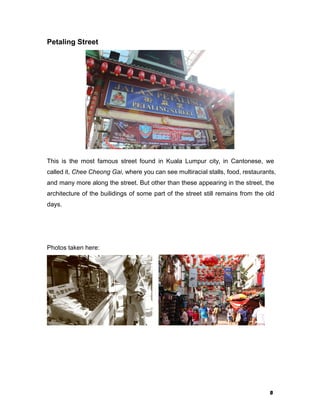
Petaling Street
This is the most famous street found in Kuala Lumpur city, in Cantonese, we
called it, Chee Cheong Gai, where you can see multiracial stalls, food, restaurants,
and many more along the street. But other than these appearing in the street, the
architecture of the builidings of some part of the street still remains from the old
days.
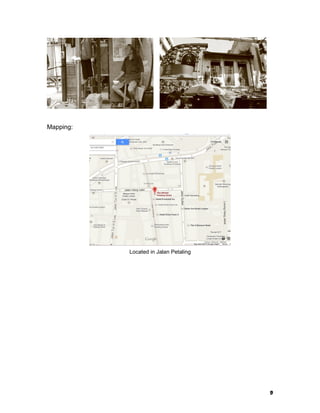
Photos taken here:
9
Mapping:
Located in Jalan Petaling
10
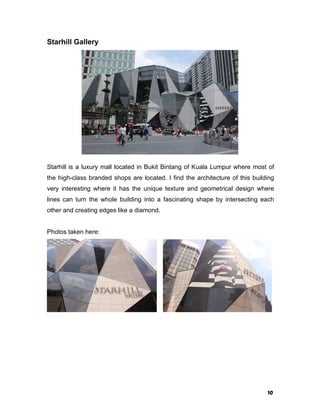
Starhill Gallery
Starhill is a luxury mall located in Bukit Bintang of Kuala Lumpur where most of
the high-class branded shops are located. I find the architecture of this building
very interesting where it has the unique texture and geometrical design where
lines can turn the whole building into a fascinating shape by intersecting each
other and creating edges like a diamond.
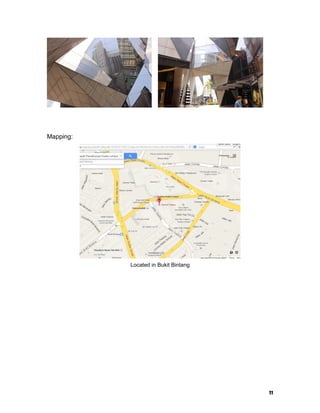
Photos taken here:
11
Mapping:
Located in Bukit Bintang
12
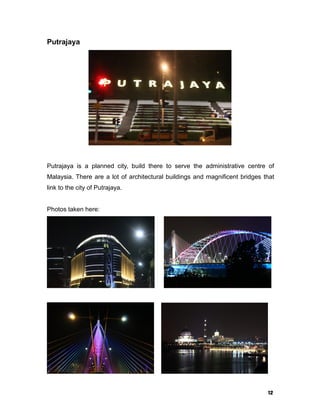
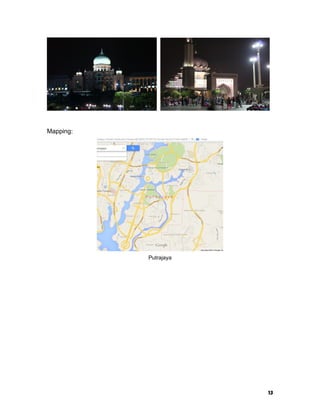
Putrajaya
Putrajaya is a planned city, build there to serve the administrative centre of
Malaysia. There are a lot of architectural buildings and magnificent bridges that
link to the city of Putrajaya.
Photos taken here:
13
Mapping:
Putrajaya
14
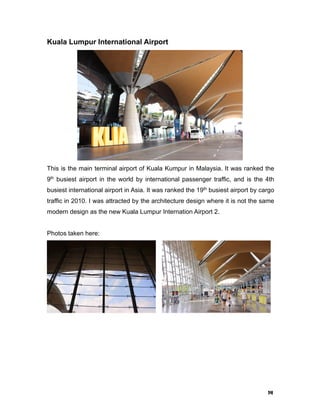
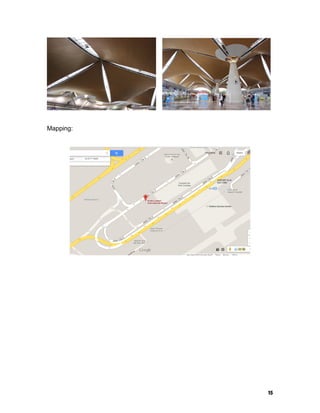
Kuala Lumpur International Airport
This is the main terminal airport of Kuala Kumpur in Malaysia. It was ranked the
9th
busiest airport in the world by international passenger traffic, and is the 4th
busiest international airport in Asia. It was ranked the 19th
busiest airport by cargo
traffic in 2010. I was attracted by the architecture design where it is not the same
modern design as the new Kuala Lumpur Internation Airport 2.
Photos taken here:
15
Mapping:
16
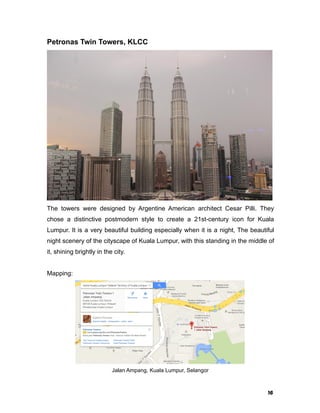
Petronas Twin Towers, KLCC
The towers were designed by Argentine American architect Cesar Pilli. They
chose a distinctive postmodern style to create a 21st-century icon for Kuala
Lumpur. It is a very beautiful building especially when it is a night, The beautiful
night scenery of the cityscape of Kuala Lumpur, with this standing in the middle of
it, shining brightly in the city.
Mapping:
Jalan Ampang, Kuala Lumpur, Selangor
17
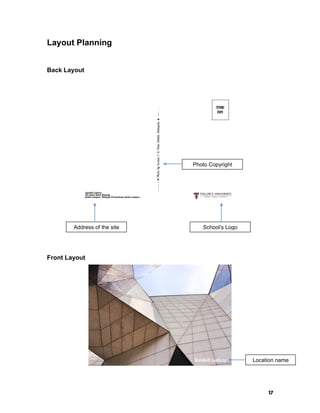
Layout Planning
Back Layout
Front Layout
Address of the site School’s Logo
Photo Copyright
Location name
18
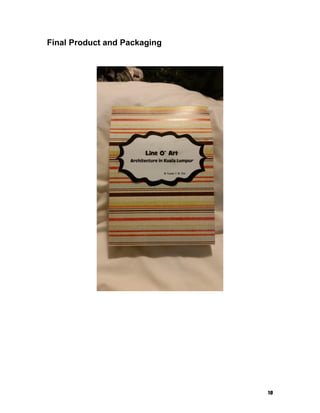
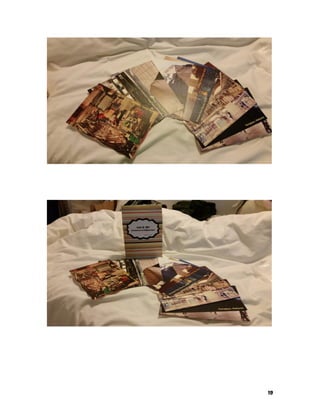
Final Product and Packaging
19
20
References
Elements of Art. (2014). Retrieved 2014, 10 June from
http://www.bbc.co.uk/schools/gcsebitesize/art/practicalities/elementsofart1.shtml
Elements of Art - “Line”. (2014). Retreived 2014, 10 June from
http://thevirtualinstructor.com/line.html
Malaysia Travel Guides, Kuala Lumpur. (2014). Retrieved 2014, 10 June from
http://www.malaysia-travel-guide.com/kuala-lumpur-landmarks.html
21
Appendices

Postcard report

  • 1.
    School of Architecture,Building and Design Foundation in Natural Built and Environment Culture & Civilization FDES 0815 Project 3 Postcard Literature Review Name : Yvonne Chin Yun Miin Student ID : 0315662 Title : Line O’ Art Lecturer: Normah Sulaiman Submission Date : 13th June 2014
  • 2.
    Content Assignment Brief 3 Conceptand Theme Introduction and Acknowledgmentof Line 5 Introduction to Architectural Buildings in Kuala Lumpur 6 Research and Mapping 7 Layout Planning 17 Final Product & Packaging 18 References 20 Appendices 21 First Mapping Tutorial Sheets
  • 3.
    3 SCHOOL OF ARCHITECTURE,BUILDING & DESIGN Research Unit for Modern Architecture Studies in Southeast Asia Foundation of Natural and Built Environments CULTURE & CIVILIZATION (FDES 0815) Prerequisite: None Lecturer : Normah Sulaiman . Delliya Mohd.Zain ______________________________________________________________________ Project 3 (Individual Assignment) : Art + Architecture + Culture 40% marks Submission Date: 3rd June 2014 (week 17) Introduction "What travel teaches us is that we are all essentially the same. There is not a 'them' and an 'us’ there is really only 'us.'" The stunning photographs capture the theme of places of visit. A good coffee table books serve a number of purposes: they're decorative, informative, and attractive. Objectives of Project 1. To introduce the Western and Eastern culture and civilization through an overview of archeological discoveries, ancient monuments, artworks, philosophy and achievement of great leaders from prehistoric to present. 2. To show basic skills on enquiry, investigation, application and presentation of relevant information. Learning Outcome 1. Able to describe the historical development of human civilization. 2. Able to recall the development of Eastern and Western human civilizations in the past as well as present. 3. Able to demonstrate good documentation and presentation skills.
  • 4.
    4 Tasks Part I: Youare required to do a literature research on places of interest of your site visit. From the literature review, you are to study the theme given and its connection between the historical, architectural and social aspects of the place. Documenting the right building, spaces and places with the right content is important in this project. You are advised to work closely with your tutor to ensure you are on the right track. Theme: 1. Food Culture Kopitiam Street Food Coffee Culture 2. Architecture Malaysian Architecture Fusion Religious Places Spaces and People Part II: You are to design a graphical expression of your findings in a postcard series with a proper packaging that complement the final postcard design. The postcard series will create awareness and educate your audience on the subject matter or focus of the study. This includes design & layout, purpose, content, writing style, colours and etc. You are strongly encouraged to meet with us regularly for further assistance. Submission Requirement Part I: Compilation of literature review in A4 and comb bound format. (Guidelines of content will be provided during class) Part II: Coffee Table Book – A5 format size Part III : PDF compilation of individual work in a CD* with proper cover and information.
  • 5.
    5 Concept and Theme Introductionto Line Line in art is part of an element to create an artwork. It is a path left by a moving point. Lines can be in many forms, like straight, curve, or even just scribbles. It can change over its pathways like having a horizontal curved in the end of the line. As for line contours, it shows the shape of an object. Every artists has a way of feeling and expressing their art, which you can see it from the way the draw. A short, hard line differs from the flowing line, which gives different feelings to the viewers. Other than that, there are also many kinds of intersection between lines to create a cross section and geometrical drawings. For my understanding, lines can create perspective images and and create a form of illusion in art. But most importantly, the most basic element of art is the key to any architecture course. Without the basic elements of lines and, of course, creativity, we would not see these famous and outstanding building designs in the world.
  • 6.
    6 Introduction to ArchitecturalBuildings in Kuala Lumpur Far back beyond the centuries, Peninsular Malaysia was a crosspoint between China and India. It has a strategic location north to the equator as the middleground between the Indian Ocean and the South China Sea, which it represents a historical meeting point for the Orientals and the Westerns. With that, the fusion of cultures is reflected also in the architecture of the buildings in Kuala Lumpur. The design of the domes and minarets that adorn the mosques and buildings of the 1800s are influenced b the Moorish from Africa. Furthermore, Colonial and Tudor influences from the British can also be found in the architecture of the Administrative buildings. The Chinese influences are most evidentt in the Buddhist temples and Padagos that has dot the landscape of the ciy of Kuala Lumpur. Over the year, the landscape of Kuala Lumpur is constantly developing, especially the last three decades.Some of the traditional houses and old shops has been displaced to make way for the modern skyscrapers that line Kuala Lumpur’s skyline now. Even so, the gorvernment still preserves historical buildings and that the identity and heritage Malaysians cherish the most. ~ Malaysia Travel Guide
  • 7.
    7 Research and Mapping Thelocations that I have chosen was given consideration after I did some researches and mapping for my postcards which combines the line concept and the architecture in Kuala Lumpur. Since most of the places I was doing are located in Kuala Lumpur, I need to take public transportations, like the Commuter (KTM), Light Rail Train (LRT), Monorail, buses, or even taxis go get to my destinations, accompanied by my fellow friends.
  • 8.
    8 Petaling Street This isthe most famous street found in Kuala Lumpur city, in Cantonese, we called it, Chee Cheong Gai, where you can see multiracial stalls, food, restaurants, and many more along the street. But other than these appearing in the street, the architecture of the builidings of some part of the street still remains from the old days. Photos taken here:
  • 9.
  • 10.
    10 Starhill Gallery Starhill isa luxury mall located in Bukit Bintang of Kuala Lumpur where most of the high-class branded shops are located. I find the architecture of this building very interesting where it has the unique texture and geometrical design where lines can turn the whole building into a fascinating shape by intersecting each other and creating edges like a diamond. Photos taken here:
  • 11.
  • 12.
    12 Putrajaya Putrajaya is aplanned city, build there to serve the administrative centre of Malaysia. There are a lot of architectural buildings and magnificent bridges that link to the city of Putrajaya. Photos taken here:
  • 13.
  • 14.
    14 Kuala Lumpur InternationalAirport This is the main terminal airport of Kuala Kumpur in Malaysia. It was ranked the 9th busiest airport in the world by international passenger traffic, and is the 4th busiest international airport in Asia. It was ranked the 19th busiest airport by cargo traffic in 2010. I was attracted by the architecture design where it is not the same modern design as the new Kuala Lumpur Internation Airport 2. Photos taken here:
  • 15.
  • 16.
    16 Petronas Twin Towers,KLCC The towers were designed by Argentine American architect Cesar Pilli. They chose a distinctive postmodern style to create a 21st-century icon for Kuala Lumpur. It is a very beautiful building especially when it is a night, The beautiful night scenery of the cityscape of Kuala Lumpur, with this standing in the middle of it, shining brightly in the city. Mapping: Jalan Ampang, Kuala Lumpur, Selangor
  • 17.
    17 Layout Planning Back Layout FrontLayout Address of the site School’s Logo Photo Copyright Location name
  • 18.
  • 19.
  • 20.
    20 References Elements of Art.(2014). Retrieved 2014, 10 June from http://www.bbc.co.uk/schools/gcsebitesize/art/practicalities/elementsofart1.shtml Elements of Art - “Line”. (2014). Retreived 2014, 10 June from http://thevirtualinstructor.com/line.html Malaysia Travel Guides, Kuala Lumpur. (2014). Retrieved 2014, 10 June from http://www.malaysia-travel-guide.com/kuala-lumpur-landmarks.html
  • 21.