Copyright, 2002 Niwot Ridge Consulting
Post Normal Science and eXtreme Programming
How can we come to understand the impacts
of eXtreme Programming and other Agile
methods in the absence of scientific data?
Copyright, 2002 Niwot Ridge Consulting
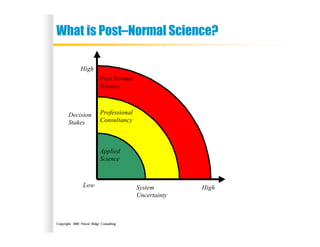
What is Post–Normal Science?
Post Normal
Science
Professional
Consultancy
Applied
Science
System
Uncertainty
Decision
Stakes
Low High
High
Copyright, 2002 Niwot Ridge Consulting
Three Kinds of “Science”
♦ Normal Science
– Uses standard scientific techniques and procedures
– Peer review processes ensure quality and validity
– Appropriate in situations with high levels of certainty and low
levels of risk
♦ Professional Consultancy
– Applies science through “experts”
– Appropriate for situations with less certainty, some “art” is
required and error is a matter of personal judgment.
– Quality and validity responsibility extended to “clients”
♦ Post Normal Science [Funtowicz 92]
– Community responsible for ensuring quality and validity
– Quality and validity responsibility extended to “all
stakeholders”
Copyright, 2002 Niwot Ridge Consulting
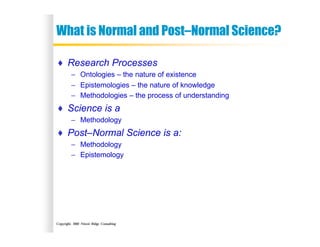
What is Normal and Post–Normal Science?
♦ Research Processes
– Ontologies – the nature of existence
– Epistemologies – the nature of knowledge
– Methodologies – the process of understanding
♦ Science is a
– Methodology
♦ Post–Normal Science is a:
– Methodology
– Epistemology
Copyright, 2002 Niwot Ridge Consulting
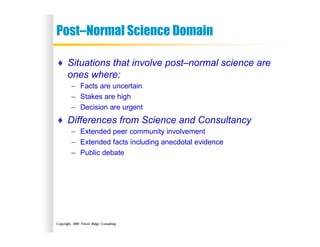
Post–Normal Science Domain
♦ Situations that involve post–normal science are
ones where:
– Facts are uncertain
– Stakes are high
– Decision are urgent
♦ Differences from Science and Consultancy
– Extended peer community involvement
– Extended facts including anecdotal evidence
– Public debate
Copyright, 2002 Niwot Ridge Consulting
What are the Phases of a “Revolution?”
Copyright, 2002 Niwot Ridge Consulting
What is Normal Science?
♦ Normal Science is:
– Firmly based on one or more past scientific achievements.
– Achievements that the scientific community acknowledges for
a time as supplying the foundation for its further practice
[Kuhn 70].
♦ Although normal science seems restrictive:
– When paradigms are taken for granted, the field does not
need to be built anew each time.
– “Restrictions born from confidence in a paradigm, turn out to
be essential to the development of science,” [Kuhn 70], pp.
24.
Copyright, 2002 Niwot Ridge Consulting
What is a Pre–Paradigm Phase?
Copyright, 2002 Niwot Ridge Consulting
Bibliography
[Kuhn 70] Structure of Scientific Revolutions, Thomas Kuhn,
Cambridge University Press, 1970.
[Functowicz 92] “Three Kinds of Risk Assessment and the
Emergence of Post Normal Science,” S. O. Funtowicz and J. R.
Raveyz, in Social Theories of Risk, S. Krimsky and D. Golding
editors, Greenwood Publishing Group, 1992.

Post Normal Science and eXtreme Programming

  • 1.
    Copyright, 2002 NiwotRidge Consulting Post Normal Science and eXtreme Programming How can we come to understand the impacts of eXtreme Programming and other Agile methods in the absence of scientific data?
  • 2.
    Copyright, 2002 NiwotRidge Consulting What is Post–Normal Science? Post Normal Science Professional Consultancy Applied Science System Uncertainty Decision Stakes Low High High
  • 3.
    Copyright, 2002 NiwotRidge Consulting Three Kinds of “Science” ♦ Normal Science – Uses standard scientific techniques and procedures – Peer review processes ensure quality and validity – Appropriate in situations with high levels of certainty and low levels of risk ♦ Professional Consultancy – Applies science through “experts” – Appropriate for situations with less certainty, some “art” is required and error is a matter of personal judgment. – Quality and validity responsibility extended to “clients” ♦ Post Normal Science [Funtowicz 92] – Community responsible for ensuring quality and validity – Quality and validity responsibility extended to “all stakeholders”
  • 4.
    Copyright, 2002 NiwotRidge Consulting What is Normal and Post–Normal Science? ♦ Research Processes – Ontologies – the nature of existence – Epistemologies – the nature of knowledge – Methodologies – the process of understanding ♦ Science is a – Methodology ♦ Post–Normal Science is a: – Methodology – Epistemology
  • 5.
    Copyright, 2002 NiwotRidge Consulting Post–Normal Science Domain ♦ Situations that involve post–normal science are ones where: – Facts are uncertain – Stakes are high – Decision are urgent ♦ Differences from Science and Consultancy – Extended peer community involvement – Extended facts including anecdotal evidence – Public debate
  • 6.
    Copyright, 2002 NiwotRidge Consulting What are the Phases of a “Revolution?”
  • 7.
    Copyright, 2002 NiwotRidge Consulting What is Normal Science? ♦ Normal Science is: – Firmly based on one or more past scientific achievements. – Achievements that the scientific community acknowledges for a time as supplying the foundation for its further practice [Kuhn 70]. ♦ Although normal science seems restrictive: – When paradigms are taken for granted, the field does not need to be built anew each time. – “Restrictions born from confidence in a paradigm, turn out to be essential to the development of science,” [Kuhn 70], pp. 24.
  • 8.
    Copyright, 2002 NiwotRidge Consulting What is a Pre–Paradigm Phase?
  • 9.
    Copyright, 2002 NiwotRidge Consulting Bibliography [Kuhn 70] Structure of Scientific Revolutions, Thomas Kuhn, Cambridge University Press, 1970. [Functowicz 92] “Three Kinds of Risk Assessment and the Emergence of Post Normal Science,” S. O. Funtowicz and J. R. Raveyz, in Social Theories of Risk, S. Krimsky and D. Golding editors, Greenwood Publishing Group, 1992.