MDR TUBERCULOSIS
PRESENTED BY : MAJ S S SANGHA
GD SPL MED, 172 MH
OVERVIEW
• Mycobacterium tuberculosis
• Clinical presentation
• Microscopy
• Radiology
• Microscopy
- simplest & most rapid procedure
- ZN stain used
- requires at least 5000-10,000
bacilli/mm3
- technician dependent
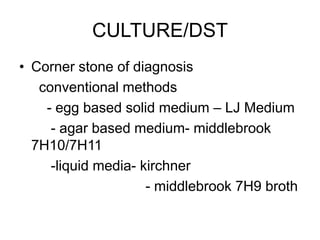
CULTURE/DST
• Corner stone of diagnosis
conventional methods
- egg based solid medium – LJ Medium
- agar based medium- middlebrook
7H10/7H11
-liquid media- kirchner
- middlebrook 7H9 broth
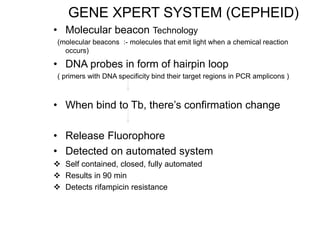
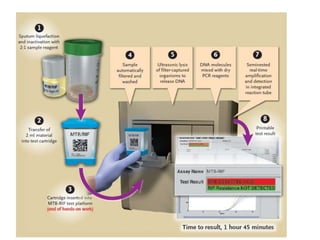
GENE XPERT SYSTEM (CEPHEID)
• Molecular beacon Technology
(molecular beacons :- molecules that emit light when a chemical reaction
occurs)
• DNA probes in form of hairpin loop
( primers with DNA specificity bind their target regions in PCR amplicons )
• When bind to Tb, there’s confirmation change
• Release Fluorophore
• Detected on automated system
 Self contained, closed, fully automated
 Results in 90 min
 Detects rifampicin resistance
• The main advantage of smear
microscopy:
(i) It is inexpensive, simple.
(ii) It is relatively easy to
perform
(iii) quick
(iv) epidemiological indicators
needed for evaluation of the National
Tuberculosis Control programme.
ATT Regimen
Cat 1 New sputum smear positive
smear negative/extrapul seriously ill
2HRZE+4HR
Cat 2
Failure/relapse/defaulted
2HRZES+1HRZE+5HRE
Cat3
New Smear negative/extrapul not seriously ill
MDR TUBERCULOSIS
DEFINITIONS
• Multidrug-resistant (Mdr) Tuberculosis
• Extensively Drug-resistant (Xdr) Tuberculosis
• Total drug resistance
• ? What next
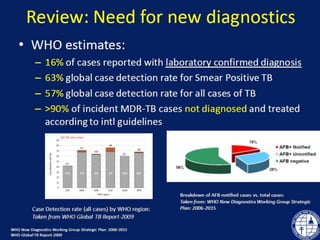
WHAT IS THE PRESENT THREAT
• National Programs are failing to diagnose
and treat MDR Tuberculosis.
• 30,000 Cases of MDR Tuberculosis were
reported to the WHO In 2008 (7% Of The
Estimated Total)
• Less Than One Fifth Were Managed
According To International Guidelines
• The Vast Majority Of The Remaining Cases
Probably Are Not Diagnosed Or, If
Diagnosed, Are Mismanaged
WHAT IS THE PRESENT THREAT
• By 2009, a total of 58 countries had
reported at least one case of XDR
tuberculosis
• In eight countries, reported cases of XDR
tuberculosis accounted for more than 10%
of all cases of MDR tuberculosis
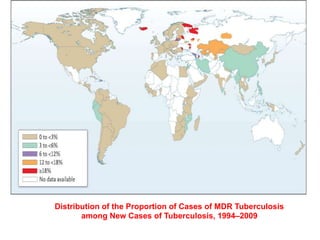
Distribution of the Proportion of Cases of MDR Tuberculosis
among New Cases of Tuberculosis, 1994–2009
Drug-Resistant TB: Definitions
• Primary drug-resistance: “New Cases”
Drug resistance in a patient who has never
been treated for tuberculosis or received less
than one month of therapy
• Secondary (acquired) drug-resistance:
“Previously Treated Cases”
Drug resistance in a patient who has received at
least one month of anti-TB therapy
• Mono-resistance: resistance to any one
antitubercular drug
• Poly-resistance: resistance to more than one
antituberculosis drug, other than both isoniazid
and rifampicin.
• Multidrug-resistance: resistance to at least
isoniazid and rifampicin.
• Extensive drug-resistance: resistance to any
fluoroquinolone, and at least one of three
injectable second-line drugs (capreomycin,
kanamycin and amikacin), in addition to multidrug-
resistance.
Definitions
Definitions
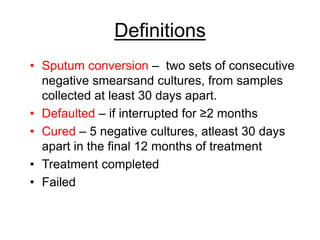
• Sputum conversion – two sets of consecutive
negative smearsand cultures, from samples
collected at least 30 days apart.
• Defaulted – if interrupted for ≥2 months
• Cured – 5 negative cultures, atleast 30 days
apart in the final 12 months of treatment
• Treatment completed
• Failed
DRUG RESISTANCE TB –A MAN
MADE PROBLEM
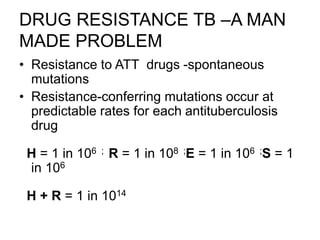
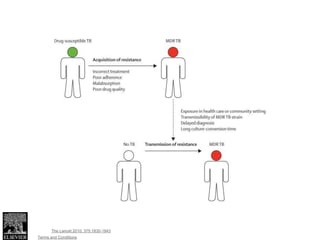
• Resistance to ATT drugs -spontaneous
mutations
• Resistance-conferring mutations occur at
predictable rates for each antituberculosis
drug
H = 1 in 106 ; R = 1 in 108 ;E = 1 in 106 ;S = 1
in 106
H + R = 1 in 1014
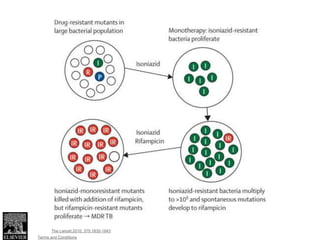
Figure 3
Source: The Lancet 2010; 375:1830-1843 (DOI:10.1016/S0140-6736(10)60410-2)
Terms and Conditions
Figure 4
Source: The Lancet 2010; 375:1830-1843 (DOI:10.1016/S0140-6736(10)60410-2)
Terms and Conditions
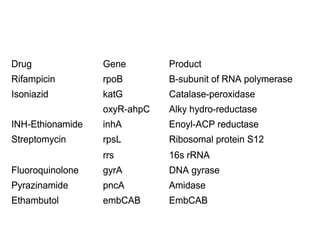
Molecular Basis of Drug
Resistance
ISONIAZID (INH)
• Also called Isonicotinic acid Hydrazide
• Synthetic preparation - 1950
• Mechanism of action largely unknown till…
• It was discovered that INH resistant organisms
had decreased catalase activity
• Transported into bacteria by an oxygen dependant
process- acts on katG site- encodes catalase
peroxidase enzyme- active moiety- inhibits mycolic
acid synthesis.
INH RESISTANCE (katG)
• Mutations in the katG gene encoding catalase
peroxidase
• Estimated frequency 10 –5 to 10 –7
• Mutation is much commoner than other drugs
• Or deletion of the katG gene
• Additional genes - inhA gene - coding for
resistance to both INH and Ethionamide
RIFAMPICIN
• Introduced in the 1970’s
• Produced from Streptomyces mediterranei
• Bactericidal and active against slow growing
intracellular forms and dormant organisms
• Mechanism involves inhibition of DNA dependant
RNA polymerase inhibits transcription.
• Gene has 4 sub units- rpo A B C D
• RIF binds to the β sub unit of the enzyme
• GeneXpert detects this rpo/b mutaion
INDIA – MDR TB
• Non standardized study
• MDR TB - Lab Diagnosis
1% - 3% (New)
12% (Treated)
• R - 2%
• INH - 18 %
MDR SUSPECT
• Any TB patient who fails an RNTCP
Category I or III treatment regimen
• Any RNTCP Category II patient who is
sputum smear positive at the end of the
fourth month of treatment
• Close contacts of MDR-TB patients who are
found to have smear positive pulmonary TB
(PTB) disease
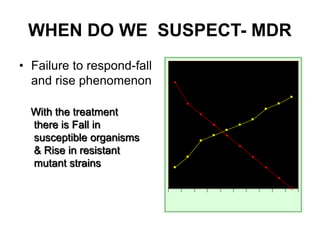
WHEN DO WE SUSPECT- MDR
• Failure to respond-fall
and rise phenomenon
With the treatment
there is Fall in
susceptible organisms
& Rise in resistant
mutant strains
How to go about MDR Suspects
• To be refd to the DTO for confirmation
at the earliest i.e. within 2 weeks
• All women of child bearing age
identified as MDR TB suspects should
be advised to use a reliable and
appropriate contraceptive method till
the results of culture and DST are
available
TREATMENT
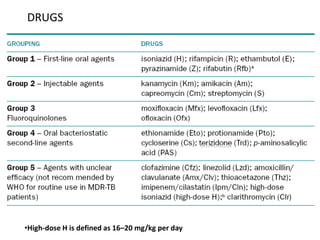
•High-dose H is defined as 16–20 mg/kg per day
DRUGS
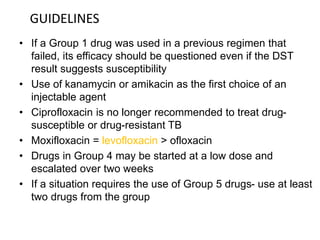
• If a Group 1 drug was used in a previous regimen that
failed, its efficacy should be questioned even if the DST
result suggests susceptibility
• Use of kanamycin or amikacin as the first choice of an
injectable agent
• Ciprofloxacin is no longer recommended to treat drug-
susceptible or drug-resistant TB
• Moxifloxacin = levofloxacin > ofloxacin
• Drugs in Group 4 may be started at a low dose and
escalated over two weeks
• If a situation requires the use of Group 5 drugs- use at least
two drugs from the group
GUIDELINES
Cross-resistance among various
Drugs
• All rifamycins have high levels of cross-
resistance
• Fluoroquinolones -variable cross-resistance
between each other
• Capreomycin and viomycin have high cross-
resistance
• Amikacin and kanamycin have very high
cross- resistance
General principles
• Regimens should be based on the history of drugs
taken by the patient.
• Drugs commonly used in the country and
prevalence of resistance
• Regimens should consist of at least four drugs
with either certain, or almost certain, effectiveness
• More than four drugs may be started
– susceptibility pattern is unknown
– effectiveness is questionable
– extensive, bilateral pulmonary disease is present
35
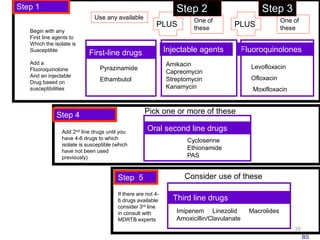
Step 5
Third line drugs
Imipenem Linezolid Macrolides
Amoxicillin/Clavulanate
Consider use of these
If there are not 4-
6 drugs available
consider 3rd line
in consult with
MDRTB experts
Step 1
Use any available
Begin with any
First line agents to
Which the isolate is
Susceptible
Add a
Fluoroquinolone
And an injectable
Drug based on
susceptibilities
Fluoroquinolones
Levofloxacin
Ofloxacin
Moxifloxacin
Injectable agents
Amikacin
Capreomycin
Streptomycin
Kanamycin
PLUS
One of
these
One of
these
First-line drugs
Pyrazinamide
Ethambutol
PLUS
Step 4 Pick one or more of these
Oral second line drugs
Cycloserine
Ethionamide
PAS
Add 2nd line drugs until you
have 4-6 drugs to which
isolate is susceptible (which
have not been used
previously)
BS
Step 2 Step 3
Monitoring MDR Patient
• Close monitoring esssential
• Assess treatment response, sputum
smears and cultures should be performed
monthly until smear and culture
conversion
• Conversion is defined as two consecutive
negative smears and cultures taken 30
days apart
Monitoring MDR Patient
• After conversion
bacteriological monitoring is monthly for
smears and quarterly for cultures
• Monitoring of MDR-TB patients
monthly until sputum conversion, then every 2–
3 months
• Each patient’s weight should be monitored
monthly
Duration of treatment for MDR-TB
• Intensive phase
Duration of treatment with the injectable
Continued for a minimum of 6 months, 4
months after conversion
• Continue 18 months after culture
conversion.
• Extension of therapy to 24 months may be
indicated in chronic cases with extensive
pulmonary damage.
PROGNOSTIC MARKERS
• EXTRA PULMONARY INVOLVEMENT A RISK
FACTOR FOR SHORTER SURVIVAL
• AN IMMUNOCOMPROMISED PATIENT - 9
TIMES MORE LIKELY TO DIE
• EVERY 10 YR INCREASE IN AGE THE RISK OF
DEATH DOUBLED
SURGERY
• RESECTIONAL SURGERY IS
RECOMMENDED, AS ADJUNCT MAY
IMPROVE RESULTS OF CHEMOTHERAPY
• INDICATIONS
1. PERSISTENCE OF CULTURE +VE MDR-TB
DESPITE EXTENDED DRUG RE-TREATMENT
2. EXTENSIVE PATTERNS OF DRUG
RESISTANCE THAT ARE ASSOCIATED WITH
TREATMENT FAILURE
3. LOCAL CAVITARY, NECROTIC/DESTRUCTIVE
DISEASE IN A LOBE OR REGION OF THE
LUNG
• OPERATION – EARLY IN THERAPY B/W
6-9 MTH
• POSTOPERATIVE – CONTINUE
THERAPY FOR 12-24 MONTHS
• OVER 90% OF PATIENTS ACHIEVE
SPUTUM NEGATIVE STATUS
• OPERATION RELATED MORTALITY <
3%
THANKS
• New patients with pulmonary TB may receive a
daily intensive phase followed by three times
weekly continuation phase [2HRZE/4(HR)3],
provided that each dose is directly observed
(Conditional/High or moderate grade of evidence)
• Three times weekly dosing throughout therapy
[2(HRZE)3/4(HR)3], provided that every dose is
directly observed therapy and the patient is
NOT living with HIV or living in an HIV-
prevalent setting
(Conditional/High or moderate grade of evidence)
• In populations with known or
suspected high levels of isoniazid
resistance, new TB patients may
receive HRE as therapy in the
continuation phase as an acceptable
alternative to HR
(Weak/Insufficient evidence, expert opinion)
TB treatment in persons living with HIV
• TB patients with known positive HIV status and all TB
patients living in HIV-prevalent settings1 should receive
daily TB treatment at least during the intensive phase
(Strong/High grade of evidence)
• For the continuation phase, the optimal dosing frequency
is also daily for these patients
(Strong/High grade of evidence)
• It is recommended that TB patients who are living with
HIV receive the same duration of TB treatment as HIV-
negative TB patients
(Strong/High grade of evidence)
Sputum monitoring during Tb treatment of smear-positive pulmonary Tb
patients
• For smear-positive pulmonary TB patients treated with first-line drugs,
sputum smear microscopy may be performed at completion of the
intensive phase of treatment
(Conditional/High or moderate grade of evidence)
• In new patients, if the specimen obtained at the end of the intensive
phase (month 2) is smear-positive, sputum smear microscopy should
optimally be obtained at the end of the month 3
(Strong/High grade of evidence)
• In new patients, if the specimen obtained at the end of month 3 is
smear-positive, sputum culture and drug susceptibility testing (DST)
should be performed
(Strong/High grade of evidence)
• In previously treated patients, if the specimen obtained at the end of
the intensive phase (month 3) is smear-positive, sputum culture and
drug susceptibility testing (DST) should be performed
(Strong/High grade of evidence)
Treatment extension in new pulmonary
TB patients
• In patients treated with the regimen
containing rifampicin throughout
treatment, if a positive sputum smear is
found at completion of the intensive
phase, extension of the intensive phase
is not recommended
(Strong/High grade of evidence)
Previously treated patients
• In settings where rapid DST is available, the results should
guide the choice of regimen
• In settings where rapid DST results are not routinely available
to guide the management of individual patients, empirical
treatment should be started as follows:
TB patients whose treatment has failed or other patient
groups with high likelihood of multidrug-resistant TB (MDR)
should be started on an empirical MDR regimen
TB patients returning after defaulting or relapsing from
their first treatment course may receive the retreatment
regimen containing first-line drugs 2HRZES/1HRZE/5HRE if
country-specific data show low or medium levels of MDR in
these patients or if such data are unavailable
In settings where DST results are not yet routinely
available to guide the management of individual patients, the
empirical regimens will continue throughout the course of
treatment
Diagnosis of tuberculosis
• There are two basic approaches
- direct approach
- indirect method
• Sensitivity of smear microscopy can be
improved by
- sputum concentration by
cytocentrifugation – sensitivity enhanced
by 100%
-liquefaction of sputum by NaHCLO
overnight- sensitivity enhanced by 70%
- treatment with zwitter ion reagent
How to diagnose MDR -tb
• Sputum smear and x-ray – no additional
inputs
• Clinical judgement – most critical
• Who mdr tb guidelines
- DST not recommended for E,Z,all gp
4 & 5 drugs
- only DST for R ,H reliable
• Rapid Methods of diagnosis
- microcolony detection on solid media
- septicheck AFB method
- MODS
- BACTEC 460 radiometric system
- BACTEC MGIT 960 system
• Radiometric BACTEC 460 TB
- specific for mycobacterial growth
-14c labelled palmitic acid in 7H12 used
-presence of mycobacterium – based on
metabolism
- 14 co2 reported in terms of GI value
- specific test
• Advantages
-drug susceptibility tests
-time factor
87% positive cultures-7 days
96% positive cultures- 14 days
- cost factor
• MGIT 960 Mycobacteria Detection system
- Automated
- 960 samples can be continuously
monitored
- Increase in flourescence
-Growth detected by AFB O2 utilisation &
Intensification of O2 contained flourescent dye
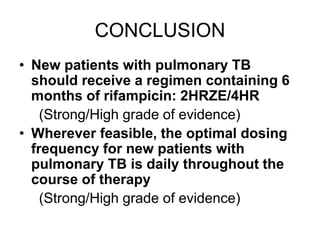
CONCLUSION
• New patients with pulmonary TB
should receive a regimen containing 6
months of rifampicin: 2HRZE/4HR
(Strong/High grade of evidence)
• Wherever feasible, the optimal dosing
frequency for new patients with
pulmonary TB is daily throughout the
course of therapy
(Strong/High grade of evidence)
• Advantages
- time factor
- accurate
- cost effective at high vol lab
• MB/Bac T system
- non radiometric method
- colorimetric detection of O2
• Acceptable alternative for BACTEC 460
• ESP culture system II
- fully automated ,continuous
monitoring system
- detects pressure changes within
headspace above broth culture in sealed
bottle
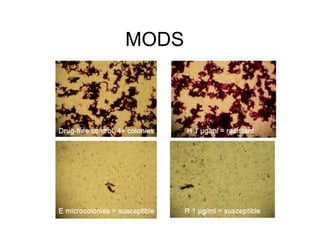
• MODS.
Developed by Luz Caviedes
Test based on three key principles
(1) M. tb grows faster in liquid (broth)
than on solid media
(2) visually characteristic growth
(tangles, cording)
(3)drug susceptibility testing from
sputum samples
MODS
• the overall sensitivity of the MODS method
is 97 to 98% and 92 to 97% for MDR
TBSpecificity was between 94 and 99%.
• advantage of MODS over standard
culture
• rapid time to TB diagnosis
• median time to detection 7 to 9
days
• luciferase gene (present in fireflies) catalyzes
the reaction of luciferin with ATP
photons generation and thereby emit light.
• Using recombinant DNA technology the gene
for luciferase inserted into
mycobacteriophage
• Mycobacteriophage
LIGHT
(luciferase gene) ATP & LUCIFERIN & viable mycobacteria
• Emitted light is measured by a luminometer /
film
• DST : Drug-resistant strains of M. Tb
produce light in the presence of
antimycobacterial therapy
- against rifampicin within hours
- slow-acting drugs such as
ethambutol, isoniazid, and ciprofloxacin
require 2 to 3 days
• Fast plaque TB test
- Based on ability of m.tb to support
replication of mycobacteriophage
- Results of replication are available in <
48 hrs
- Lysed cells form a plaque on lawn
culture of m.smegmatis which is
counted
• Antigen-Based Assay: Lipoarabinomannan (LAM)
Detection.
• monoclonal antibodies have been developed to target
proteins and glycolipids such as LAM, a
• urine test - LAM-ELISA
• Sensitivity 75-80%
• Specificity 99%
• higher LAM concentrations in patients coinfected with
TB and HIV
CALORIMETRIC SYSTEMS
TK MEDIUM [SALUBRIS]
• Rapid liquid culture
• Indicator dyes change colour on growth
• SPUTUM + :- orange,
• No growth :- red
• Detects in 2 weeks
LINE PROBE ASSAYS
• Detect Rifampicin resistance related mutations in
rpo B gene of MTB
• detect TB + MDR TB
• PCR based
• 24-72 hrs results
• Culture still required in smear negative
• Conventional DST is required in XDR TB
WHO guidelines 2008 :- to implement line
probe assays for low and middle income
countries
Hain assay (genotype MTBDR assay)
- Good sensitivity and specificity for drug
resistant TB
- advocated for sputum positive only
Molecular beacons
• Molecular beacons are nucleic acid
hybridizationprobes.
• Designed to bind to target DNA sequences
in regions, such as the rpoB, where
resistance mutations are known to occur
PCR
• Allows small sequences of DNA to be
amplified
• Can identify as low as 10-100 org
• Most common target IS6110
THANK YOU
• DEVELOPED RASH 0N 13 SEPT- 2ND LINE ATT
STOPPED
• STARTED AGAIN WEF 11 OCT 10
S,Lfx,Eto,E,H,R,Z
DST (13 NOV 10)
RESEISTANCE TO HRZE
SENSITIVE TO Km,Eto,Cs,Oflx,Am,PAS,Rfb,C
ZE WERE STOPPED WEF 13 NOV 10
SPUTUM FOR AFB +VE( 11 DEC 10)
EmbCAB
embCAB
Ethambutol
Amidase
pncA
Pyrazinamide
DNA gyrase
gyrA
Fluoroquinolone
16s rRNA
rrs
Ribosomal protein S12
rpsL
Streptomycin
Enoyl-ACP reductase
inhA
INH-Ethionamide
Alky hydro-reductase
oxyR-ahpC
Catalase-peroxidase
katG
Isoniazid
B-subunit of RNA polymerase
rpoB
Rifampicin
Product
Gene
Drug
EmbCAB
embCAB
Ethambutol
Amidase
pncA
Pyrazinamide
DNA gyrase
gyrA
Fluoroquinolone
16s rRNA
rrs
Ribosomal protein S12
rpsL
Streptomycin
Enoyl-ACP reductase
inhA
INH-Ethionamide
Alky hydro-reductase
oxyR-ahpC
Catalase-peroxidase
katG
Isoniazid
B-subunit of RNA polymerase
rpoB
Rifampicin
Product
Gene
Drug
EmbCAB
embCAB
Ethambutol
Amidase
pncA
Pyrazinamide
DNA gyrase
gyrA
Fluoroquinolone
16s rRNA
rrs
Ribosomal protein S12
rpsL
Streptomycin
Enoyl-ACP reductase
inhA
INH-Ethionamide
Alky hydro-reductase
oxyR-ahpC
Catalase-peroxidase
katG
Isoniazid
B-subunit of RNA polymerase
rpoB
Rifampicin
Product
Gene
Drug
EmbCAB
embCAB
Ethambutol
Amidase
pncA
Pyrazinamide
DNA gyrase
gyrA
Fluoroquinolone
16s rRNA
rrs
Ribosomal protein S12
rpsL
Streptomycin
Enoyl-ACP reductase
inhA
INH-Ethionamide
Alky hydro-reductase
oxyR-ahpC
Catalase-peroxidase
katG
Isoniazid
B-subunit of RNA polymerase
rpoB
Rifampicin
Product
Gene
Drug
EmbCAB
embCAB
Ethambutol
Amidase
pncA
Pyrazinamide
DNA gyrase
gyrA
Fluoroquinolone
16s rRNA
rrs
Ribosomal protein S12
rpsL
Streptomycin
Enoyl-ACP reductase
inhA
INH-Ethionamide
Alky hydro-reductase
oxyR-ahpC
Catalase-peroxidase
katG
Isoniazid
B-subunit of RNA polymerase
rpoB
Rifampicin
Product
Gene
Drug
EmbCAB
embCAB
Ethambutol
Amidase
pncA
Pyrazinamide
DNA gyrase
gyrA
Fluoroquinolone
16s rRNA
rrs
Ribosomal protein S12
rpsL
Streptomycin
Enoyl-ACP reductase
inhA
INH-Ethionamide
Alky hydro-reductase
oxyR-ahpC
Catalase-peroxidase
katG
Isoniazid
B-subunit of RNA polymerase
rpoB
Rifampicin
Product
Gene
Drug
,
,
;
,
,
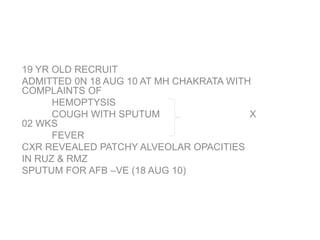
19 YR OLD RECRUIT
ADMITTED 0N 18 AUG 10 AT MH CHAKRATA WITH
COMPLAINTS OF
HEMOPTYSIS
COUGH WITH SPUTUM X
02 WKS
FEVER
CXR REVEALED PATCHY ALVEOLAR OPACITIES
IN RUZ & RMZ
SPUTUM FOR AFB –VE (18 AUG 10)
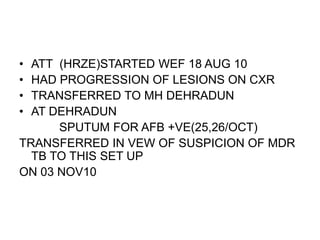
• ATT (HRZE)STARTED WEF 18 AUG 10
• HAD PROGRESSION OF LESIONS ON CXR
• TRANSFERRED TO MH DEHRADUN
• AT DEHRADUN
SPUTUM FOR AFB +VE(25,26/OCT)
TRANSFERRED IN VEW OF SUSPICION OF MDR
TB TO THIS SET UP
ON 03 NOV10
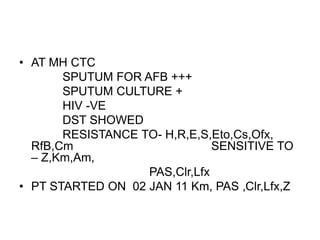
• AT MH CTC
SPUTUM FOR AFB +++
SPUTUM CULTURE +
HIV -VE
DST SHOWED
RESISTANCE TO- H,R,E,S,Eto,Cs,Ofx,
RfB,Cm SENSITIVE TO
– Z,Km,Am,
PAS,Clr,Lfx
• PT STARTED ON 02 JAN 11 Km, PAS ,Clr,Lfx,Z
• 28 YR OLD SERVING SOLDIER
• TREATED AS A CASE OF SMEAR +VE
,MTB CULTURE +VE PULMONARY TB
WITH 09 MTHS ATT(12/10/09-12/7/10)
INITIALLY HAD SHOWN SLOW
RESPONSE TO ATT
-SLOW SPUTUM CONVERSION
AFTER 04 MTHS OF ATT
- SPUTUM MTB INITIALLY WAS
SENSITIVE TO HRZES
• REPORTED FOR RECAT WITH
COMPLAINTS OF 04 KGS WT
LOSS,FEVER,COUGH IN NOV 10
• SPUTUM DONE ON 24/11 SHOWED AFB
+++
• CXR –PATCHY AIR SPACE OPACITIES RUZ
,RMZ,RLZ WITH AREAS OF BREAKDOWN
AND CAVITATION
• STARTED EMPIRICALLY ON 2ND LINE ATT
WEF 30 NOV 10
Km,Mfx,Eto,H,R
• 28 /MALE
• PRESENTED WITH COUGH AND WT LOSS OF 03 WKS ON
JAN 10 AT MH NAMKUM
• INITIAL EVALUATION
SPUTUM AFB + ; MTB CULTURE +VE
DST : SENSITIVE TO EHR
RESISTANT TO Z
WAS ADMINISTERED ATT HRZE
INTENSIVE PHASE (22 JAN 10 – 03 JUN 10 )
CONTINUATION PHASE (04 JUN -22 OCT 10)
• GAINED WT O4 KGS
• SPUTUM CONVERSION AFTER 03 MTHS
WAS CULTURE –VE ON MAR 10
• READMITTED IN LAST WEEK OF THERAPY
WITH H/O HEMOPTYSIS
• REFD FROM MH BHOPAL
AT MH CTC
FOUND TO BE SPUTUM AFB+++ (06 NOV 10)
STARTED ON EMPIRICAL 2ND LINE REGIMEN
S,H,R,E,Mfx
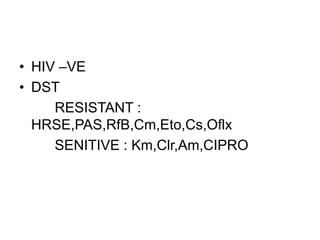
• HIV –VE
• DST
RESISTANT :
HRSE,PAS,RfB,Cm,Eto,Cs,Oflx
SENITIVE : Km,Clr,Am,CIPRO
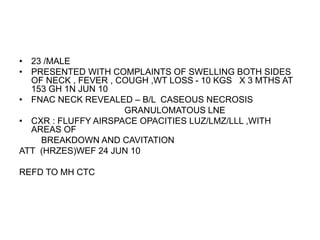
• 23 /MALE
• PRESENTED WITH COMPLAINTS OF SWELLING BOTH SIDES
OF NECK , FEVER , COUGH ,WT LOSS - 10 KGS X 3 MTHS AT
153 GH 1N JUN 10
• FNAC NECK REVEALED – B/L CASEOUS NECROSIS
GRANULOMATOUS LNE
• CXR : FLUFFY AIRSPACE OPACITIES LUZ/LMZ/LLL ,WITH
AREAS OF
BREAKDOWN AND CAVITATION
ATT (HRZES)WEF 24 JUN 10
REFD TO MH CTC
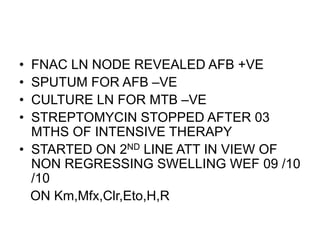
• FNAC LN NODE REVEALED AFB +VE
• SPUTUM FOR AFB –VE
• CULTURE LN FOR MTB –VE
• STREPTOMYCIN STOPPED AFTER 03
MTHS OF INTENSIVE THERAPY
• STARTED ON 2ND LINE ATT IN VIEW OF
NON REGRESSING SWELLING WEF 09 /10
/10
ON Km,Mfx,Clr,Eto,H,R
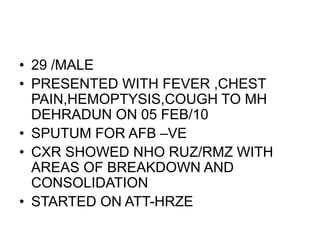
• 29 /MALE
• PRESENTED WITH FEVER ,CHEST
PAIN,HEMOPTYSIS,COUGH TO MH
DEHRADUN ON 05 FEB/10
• SPUTUM FOR AFB –VE
• CXR SHOWED NHO RUZ/RMZ WITH
AREAS OF BREAKDOWN AND
CONSOLIDATION
• STARTED ON ATT-HRZE
• SPUTUM FOR AFB ++++(03 MAR 10 )
++++(05 APR 10)
EHRZ CONTD (05 FEB 10- 05 JUN 10)
EHR STATED WEF 06 JUN
SPUTUM FOR AFB -ve(03 JUL 10)
SPUTUM FOR AFB +ve(28 AUG 10)
STARTED ON E,H,R,S,Eto,Cs 0N 03 SEP
SPUTUM FOR AFB ++(13 SEP 10)
+++(14 SEP 10)

MDR TB ppt.pptx

  • 1.
    MDR TUBERCULOSIS PRESENTED BY: MAJ S S SANGHA GD SPL MED, 172 MH
  • 2.
    OVERVIEW • Mycobacterium tuberculosis •Clinical presentation • Microscopy • Radiology
  • 3.
    • Microscopy - simplest& most rapid procedure - ZN stain used - requires at least 5000-10,000 bacilli/mm3 - technician dependent
  • 4.
    CULTURE/DST • Corner stoneof diagnosis conventional methods - egg based solid medium – LJ Medium - agar based medium- middlebrook 7H10/7H11 -liquid media- kirchner - middlebrook 7H9 broth
  • 5.
    GENE XPERT SYSTEM(CEPHEID) • Molecular beacon Technology (molecular beacons :- molecules that emit light when a chemical reaction occurs) • DNA probes in form of hairpin loop ( primers with DNA specificity bind their target regions in PCR amplicons ) • When bind to Tb, there’s confirmation change • Release Fluorophore • Detected on automated system  Self contained, closed, fully automated  Results in 90 min  Detects rifampicin resistance
  • 7.
    • The mainadvantage of smear microscopy: (i) It is inexpensive, simple. (ii) It is relatively easy to perform (iii) quick (iv) epidemiological indicators needed for evaluation of the National Tuberculosis Control programme.
  • 8.
    ATT Regimen Cat 1New sputum smear positive smear negative/extrapul seriously ill 2HRZE+4HR Cat 2 Failure/relapse/defaulted 2HRZES+1HRZE+5HRE Cat3 New Smear negative/extrapul not seriously ill
  • 9.
  • 10.
    DEFINITIONS • Multidrug-resistant (Mdr)Tuberculosis • Extensively Drug-resistant (Xdr) Tuberculosis • Total drug resistance • ? What next
  • 11.
    WHAT IS THEPRESENT THREAT • National Programs are failing to diagnose and treat MDR Tuberculosis. • 30,000 Cases of MDR Tuberculosis were reported to the WHO In 2008 (7% Of The Estimated Total) • Less Than One Fifth Were Managed According To International Guidelines • The Vast Majority Of The Remaining Cases Probably Are Not Diagnosed Or, If Diagnosed, Are Mismanaged
  • 12.
    WHAT IS THEPRESENT THREAT • By 2009, a total of 58 countries had reported at least one case of XDR tuberculosis • In eight countries, reported cases of XDR tuberculosis accounted for more than 10% of all cases of MDR tuberculosis
  • 13.
    Distribution of theProportion of Cases of MDR Tuberculosis among New Cases of Tuberculosis, 1994–2009
  • 14.
    Drug-Resistant TB: Definitions •Primary drug-resistance: “New Cases” Drug resistance in a patient who has never been treated for tuberculosis or received less than one month of therapy • Secondary (acquired) drug-resistance: “Previously Treated Cases” Drug resistance in a patient who has received at least one month of anti-TB therapy
  • 15.
    • Mono-resistance: resistanceto any one antitubercular drug • Poly-resistance: resistance to more than one antituberculosis drug, other than both isoniazid and rifampicin. • Multidrug-resistance: resistance to at least isoniazid and rifampicin. • Extensive drug-resistance: resistance to any fluoroquinolone, and at least one of three injectable second-line drugs (capreomycin, kanamycin and amikacin), in addition to multidrug- resistance. Definitions
  • 16.
    Definitions • Sputum conversion– two sets of consecutive negative smearsand cultures, from samples collected at least 30 days apart. • Defaulted – if interrupted for ≥2 months • Cured – 5 negative cultures, atleast 30 days apart in the final 12 months of treatment • Treatment completed • Failed
  • 18.
    DRUG RESISTANCE TB–A MAN MADE PROBLEM • Resistance to ATT drugs -spontaneous mutations • Resistance-conferring mutations occur at predictable rates for each antituberculosis drug H = 1 in 106 ; R = 1 in 108 ;E = 1 in 106 ;S = 1 in 106 H + R = 1 in 1014
  • 19.
    Figure 3 Source: TheLancet 2010; 375:1830-1843 (DOI:10.1016/S0140-6736(10)60410-2) Terms and Conditions
  • 20.
    Figure 4 Source: TheLancet 2010; 375:1830-1843 (DOI:10.1016/S0140-6736(10)60410-2) Terms and Conditions
  • 21.
    Molecular Basis ofDrug Resistance
  • 22.
    ISONIAZID (INH) • Alsocalled Isonicotinic acid Hydrazide • Synthetic preparation - 1950 • Mechanism of action largely unknown till… • It was discovered that INH resistant organisms had decreased catalase activity • Transported into bacteria by an oxygen dependant process- acts on katG site- encodes catalase peroxidase enzyme- active moiety- inhibits mycolic acid synthesis.
  • 23.
    INH RESISTANCE (katG) •Mutations in the katG gene encoding catalase peroxidase • Estimated frequency 10 –5 to 10 –7 • Mutation is much commoner than other drugs • Or deletion of the katG gene • Additional genes - inhA gene - coding for resistance to both INH and Ethionamide
  • 24.
    RIFAMPICIN • Introduced inthe 1970’s • Produced from Streptomyces mediterranei • Bactericidal and active against slow growing intracellular forms and dormant organisms • Mechanism involves inhibition of DNA dependant RNA polymerase inhibits transcription. • Gene has 4 sub units- rpo A B C D • RIF binds to the β sub unit of the enzyme • GeneXpert detects this rpo/b mutaion
  • 25.
    INDIA – MDRTB • Non standardized study • MDR TB - Lab Diagnosis 1% - 3% (New) 12% (Treated) • R - 2% • INH - 18 %
  • 26.
    MDR SUSPECT • AnyTB patient who fails an RNTCP Category I or III treatment regimen • Any RNTCP Category II patient who is sputum smear positive at the end of the fourth month of treatment • Close contacts of MDR-TB patients who are found to have smear positive pulmonary TB (PTB) disease
  • 27.
    WHEN DO WESUSPECT- MDR • Failure to respond-fall and rise phenomenon With the treatment there is Fall in susceptible organisms & Rise in resistant mutant strains
  • 28.
    How to goabout MDR Suspects • To be refd to the DTO for confirmation at the earliest i.e. within 2 weeks • All women of child bearing age identified as MDR TB suspects should be advised to use a reliable and appropriate contraceptive method till the results of culture and DST are available
  • 29.
  • 30.
    •High-dose H isdefined as 16–20 mg/kg per day DRUGS
  • 31.
    • If aGroup 1 drug was used in a previous regimen that failed, its efficacy should be questioned even if the DST result suggests susceptibility • Use of kanamycin or amikacin as the first choice of an injectable agent • Ciprofloxacin is no longer recommended to treat drug- susceptible or drug-resistant TB • Moxifloxacin = levofloxacin > ofloxacin • Drugs in Group 4 may be started at a low dose and escalated over two weeks • If a situation requires the use of Group 5 drugs- use at least two drugs from the group GUIDELINES
  • 32.
    Cross-resistance among various Drugs •All rifamycins have high levels of cross- resistance • Fluoroquinolones -variable cross-resistance between each other • Capreomycin and viomycin have high cross- resistance • Amikacin and kanamycin have very high cross- resistance
  • 33.
    General principles • Regimensshould be based on the history of drugs taken by the patient. • Drugs commonly used in the country and prevalence of resistance • Regimens should consist of at least four drugs with either certain, or almost certain, effectiveness • More than four drugs may be started – susceptibility pattern is unknown – effectiveness is questionable – extensive, bilateral pulmonary disease is present
  • 34.
    35 Step 5 Third linedrugs Imipenem Linezolid Macrolides Amoxicillin/Clavulanate Consider use of these If there are not 4- 6 drugs available consider 3rd line in consult with MDRTB experts Step 1 Use any available Begin with any First line agents to Which the isolate is Susceptible Add a Fluoroquinolone And an injectable Drug based on susceptibilities Fluoroquinolones Levofloxacin Ofloxacin Moxifloxacin Injectable agents Amikacin Capreomycin Streptomycin Kanamycin PLUS One of these One of these First-line drugs Pyrazinamide Ethambutol PLUS Step 4 Pick one or more of these Oral second line drugs Cycloserine Ethionamide PAS Add 2nd line drugs until you have 4-6 drugs to which isolate is susceptible (which have not been used previously) BS Step 2 Step 3
  • 35.
    Monitoring MDR Patient •Close monitoring esssential • Assess treatment response, sputum smears and cultures should be performed monthly until smear and culture conversion • Conversion is defined as two consecutive negative smears and cultures taken 30 days apart
  • 36.
    Monitoring MDR Patient •After conversion bacteriological monitoring is monthly for smears and quarterly for cultures • Monitoring of MDR-TB patients monthly until sputum conversion, then every 2– 3 months • Each patient’s weight should be monitored monthly
  • 37.
    Duration of treatmentfor MDR-TB • Intensive phase Duration of treatment with the injectable Continued for a minimum of 6 months, 4 months after conversion • Continue 18 months after culture conversion. • Extension of therapy to 24 months may be indicated in chronic cases with extensive pulmonary damage.
  • 38.
    PROGNOSTIC MARKERS • EXTRAPULMONARY INVOLVEMENT A RISK FACTOR FOR SHORTER SURVIVAL • AN IMMUNOCOMPROMISED PATIENT - 9 TIMES MORE LIKELY TO DIE • EVERY 10 YR INCREASE IN AGE THE RISK OF DEATH DOUBLED
  • 39.
    SURGERY • RESECTIONAL SURGERYIS RECOMMENDED, AS ADJUNCT MAY IMPROVE RESULTS OF CHEMOTHERAPY • INDICATIONS 1. PERSISTENCE OF CULTURE +VE MDR-TB DESPITE EXTENDED DRUG RE-TREATMENT 2. EXTENSIVE PATTERNS OF DRUG RESISTANCE THAT ARE ASSOCIATED WITH TREATMENT FAILURE 3. LOCAL CAVITARY, NECROTIC/DESTRUCTIVE DISEASE IN A LOBE OR REGION OF THE LUNG
  • 40.
    • OPERATION –EARLY IN THERAPY B/W 6-9 MTH • POSTOPERATIVE – CONTINUE THERAPY FOR 12-24 MONTHS • OVER 90% OF PATIENTS ACHIEVE SPUTUM NEGATIVE STATUS • OPERATION RELATED MORTALITY < 3%
  • 41.
  • 42.
    • New patientswith pulmonary TB may receive a daily intensive phase followed by three times weekly continuation phase [2HRZE/4(HR)3], provided that each dose is directly observed (Conditional/High or moderate grade of evidence) • Three times weekly dosing throughout therapy [2(HRZE)3/4(HR)3], provided that every dose is directly observed therapy and the patient is NOT living with HIV or living in an HIV- prevalent setting (Conditional/High or moderate grade of evidence)
  • 43.
    • In populationswith known or suspected high levels of isoniazid resistance, new TB patients may receive HRE as therapy in the continuation phase as an acceptable alternative to HR (Weak/Insufficient evidence, expert opinion)
  • 44.
    TB treatment inpersons living with HIV • TB patients with known positive HIV status and all TB patients living in HIV-prevalent settings1 should receive daily TB treatment at least during the intensive phase (Strong/High grade of evidence) • For the continuation phase, the optimal dosing frequency is also daily for these patients (Strong/High grade of evidence) • It is recommended that TB patients who are living with HIV receive the same duration of TB treatment as HIV- negative TB patients (Strong/High grade of evidence)
  • 45.
    Sputum monitoring duringTb treatment of smear-positive pulmonary Tb patients • For smear-positive pulmonary TB patients treated with first-line drugs, sputum smear microscopy may be performed at completion of the intensive phase of treatment (Conditional/High or moderate grade of evidence) • In new patients, if the specimen obtained at the end of the intensive phase (month 2) is smear-positive, sputum smear microscopy should optimally be obtained at the end of the month 3 (Strong/High grade of evidence) • In new patients, if the specimen obtained at the end of month 3 is smear-positive, sputum culture and drug susceptibility testing (DST) should be performed (Strong/High grade of evidence) • In previously treated patients, if the specimen obtained at the end of the intensive phase (month 3) is smear-positive, sputum culture and drug susceptibility testing (DST) should be performed (Strong/High grade of evidence)
  • 46.
    Treatment extension innew pulmonary TB patients • In patients treated with the regimen containing rifampicin throughout treatment, if a positive sputum smear is found at completion of the intensive phase, extension of the intensive phase is not recommended (Strong/High grade of evidence)
  • 47.
    Previously treated patients •In settings where rapid DST is available, the results should guide the choice of regimen • In settings where rapid DST results are not routinely available to guide the management of individual patients, empirical treatment should be started as follows: TB patients whose treatment has failed or other patient groups with high likelihood of multidrug-resistant TB (MDR) should be started on an empirical MDR regimen TB patients returning after defaulting or relapsing from their first treatment course may receive the retreatment regimen containing first-line drugs 2HRZES/1HRZE/5HRE if country-specific data show low or medium levels of MDR in these patients or if such data are unavailable In settings where DST results are not yet routinely available to guide the management of individual patients, the empirical regimens will continue throughout the course of treatment
  • 48.
    Diagnosis of tuberculosis •There are two basic approaches - direct approach - indirect method
  • 49.
    • Sensitivity ofsmear microscopy can be improved by - sputum concentration by cytocentrifugation – sensitivity enhanced by 100% -liquefaction of sputum by NaHCLO overnight- sensitivity enhanced by 70% - treatment with zwitter ion reagent
  • 50.
    How to diagnoseMDR -tb • Sputum smear and x-ray – no additional inputs • Clinical judgement – most critical • Who mdr tb guidelines - DST not recommended for E,Z,all gp 4 & 5 drugs - only DST for R ,H reliable
  • 51.
    • Rapid Methodsof diagnosis - microcolony detection on solid media - septicheck AFB method - MODS - BACTEC 460 radiometric system - BACTEC MGIT 960 system
  • 52.
    • Radiometric BACTEC460 TB - specific for mycobacterial growth -14c labelled palmitic acid in 7H12 used -presence of mycobacterium – based on metabolism - 14 co2 reported in terms of GI value - specific test
  • 53.
    • Advantages -drug susceptibilitytests -time factor 87% positive cultures-7 days 96% positive cultures- 14 days - cost factor
  • 54.
    • MGIT 960Mycobacteria Detection system - Automated - 960 samples can be continuously monitored - Increase in flourescence -Growth detected by AFB O2 utilisation & Intensification of O2 contained flourescent dye
  • 55.
    CONCLUSION • New patientswith pulmonary TB should receive a regimen containing 6 months of rifampicin: 2HRZE/4HR (Strong/High grade of evidence) • Wherever feasible, the optimal dosing frequency for new patients with pulmonary TB is daily throughout the course of therapy (Strong/High grade of evidence)
  • 56.
    • Advantages - timefactor - accurate - cost effective at high vol lab
  • 57.
    • MB/Bac Tsystem - non radiometric method - colorimetric detection of O2 • Acceptable alternative for BACTEC 460
  • 58.
    • ESP culturesystem II - fully automated ,continuous monitoring system - detects pressure changes within headspace above broth culture in sealed bottle
  • 59.
    • MODS. Developed byLuz Caviedes Test based on three key principles (1) M. tb grows faster in liquid (broth) than on solid media (2) visually characteristic growth (tangles, cording) (3)drug susceptibility testing from sputum samples
  • 60.
  • 61.
    • the overallsensitivity of the MODS method is 97 to 98% and 92 to 97% for MDR TBSpecificity was between 94 and 99%. • advantage of MODS over standard culture • rapid time to TB diagnosis • median time to detection 7 to 9 days
  • 62.
    • luciferase gene(present in fireflies) catalyzes the reaction of luciferin with ATP photons generation and thereby emit light. • Using recombinant DNA technology the gene for luciferase inserted into mycobacteriophage • Mycobacteriophage LIGHT (luciferase gene) ATP & LUCIFERIN & viable mycobacteria • Emitted light is measured by a luminometer / film
  • 63.
    • DST :Drug-resistant strains of M. Tb produce light in the presence of antimycobacterial therapy - against rifampicin within hours - slow-acting drugs such as ethambutol, isoniazid, and ciprofloxacin require 2 to 3 days
  • 64.
    • Fast plaqueTB test - Based on ability of m.tb to support replication of mycobacteriophage - Results of replication are available in < 48 hrs - Lysed cells form a plaque on lawn culture of m.smegmatis which is counted
  • 65.
    • Antigen-Based Assay:Lipoarabinomannan (LAM) Detection. • monoclonal antibodies have been developed to target proteins and glycolipids such as LAM, a • urine test - LAM-ELISA • Sensitivity 75-80% • Specificity 99% • higher LAM concentrations in patients coinfected with TB and HIV
  • 66.
    CALORIMETRIC SYSTEMS TK MEDIUM[SALUBRIS] • Rapid liquid culture • Indicator dyes change colour on growth • SPUTUM + :- orange, • No growth :- red • Detects in 2 weeks
  • 67.
    LINE PROBE ASSAYS •Detect Rifampicin resistance related mutations in rpo B gene of MTB • detect TB + MDR TB • PCR based • 24-72 hrs results • Culture still required in smear negative • Conventional DST is required in XDR TB WHO guidelines 2008 :- to implement line probe assays for low and middle income countries
  • 68.
    Hain assay (genotypeMTBDR assay) - Good sensitivity and specificity for drug resistant TB - advocated for sputum positive only
  • 69.
    Molecular beacons • Molecularbeacons are nucleic acid hybridizationprobes. • Designed to bind to target DNA sequences in regions, such as the rpoB, where resistance mutations are known to occur
  • 70.
    PCR • Allows smallsequences of DNA to be amplified • Can identify as low as 10-100 org • Most common target IS6110
  • 71.
  • 72.
    • DEVELOPED RASH0N 13 SEPT- 2ND LINE ATT STOPPED • STARTED AGAIN WEF 11 OCT 10 S,Lfx,Eto,E,H,R,Z DST (13 NOV 10) RESEISTANCE TO HRZE SENSITIVE TO Km,Eto,Cs,Oflx,Am,PAS,Rfb,C ZE WERE STOPPED WEF 13 NOV 10 SPUTUM FOR AFB +VE( 11 DEC 10)
  • 73.
    EmbCAB embCAB Ethambutol Amidase pncA Pyrazinamide DNA gyrase gyrA Fluoroquinolone 16s rRNA rrs Ribosomalprotein S12 rpsL Streptomycin Enoyl-ACP reductase inhA INH-Ethionamide Alky hydro-reductase oxyR-ahpC Catalase-peroxidase katG Isoniazid B-subunit of RNA polymerase rpoB Rifampicin Product Gene Drug EmbCAB embCAB Ethambutol Amidase pncA Pyrazinamide DNA gyrase gyrA Fluoroquinolone 16s rRNA rrs Ribosomal protein S12 rpsL Streptomycin Enoyl-ACP reductase inhA INH-Ethionamide Alky hydro-reductase oxyR-ahpC Catalase-peroxidase katG Isoniazid B-subunit of RNA polymerase rpoB Rifampicin Product Gene Drug EmbCAB embCAB Ethambutol Amidase pncA Pyrazinamide DNA gyrase gyrA Fluoroquinolone 16s rRNA rrs Ribosomal protein S12 rpsL Streptomycin Enoyl-ACP reductase inhA INH-Ethionamide Alky hydro-reductase oxyR-ahpC Catalase-peroxidase katG Isoniazid B-subunit of RNA polymerase rpoB Rifampicin Product Gene Drug EmbCAB embCAB Ethambutol Amidase pncA Pyrazinamide DNA gyrase gyrA Fluoroquinolone 16s rRNA rrs Ribosomal protein S12 rpsL Streptomycin Enoyl-ACP reductase inhA INH-Ethionamide Alky hydro-reductase oxyR-ahpC Catalase-peroxidase katG Isoniazid B-subunit of RNA polymerase rpoB Rifampicin Product Gene Drug EmbCAB embCAB Ethambutol Amidase pncA Pyrazinamide DNA gyrase gyrA Fluoroquinolone 16s rRNA rrs Ribosomal protein S12 rpsL Streptomycin Enoyl-ACP reductase inhA INH-Ethionamide Alky hydro-reductase oxyR-ahpC Catalase-peroxidase katG Isoniazid B-subunit of RNA polymerase rpoB Rifampicin Product Gene Drug EmbCAB embCAB Ethambutol Amidase pncA Pyrazinamide DNA gyrase gyrA Fluoroquinolone 16s rRNA rrs Ribosomal protein S12 rpsL Streptomycin Enoyl-ACP reductase inhA INH-Ethionamide Alky hydro-reductase oxyR-ahpC Catalase-peroxidase katG Isoniazid B-subunit of RNA polymerase rpoB Rifampicin Product Gene Drug
  • 74.
  • 75.
    19 YR OLDRECRUIT ADMITTED 0N 18 AUG 10 AT MH CHAKRATA WITH COMPLAINTS OF HEMOPTYSIS COUGH WITH SPUTUM X 02 WKS FEVER CXR REVEALED PATCHY ALVEOLAR OPACITIES IN RUZ & RMZ SPUTUM FOR AFB –VE (18 AUG 10)
  • 76.
    • ATT (HRZE)STARTEDWEF 18 AUG 10 • HAD PROGRESSION OF LESIONS ON CXR • TRANSFERRED TO MH DEHRADUN • AT DEHRADUN SPUTUM FOR AFB +VE(25,26/OCT) TRANSFERRED IN VEW OF SUSPICION OF MDR TB TO THIS SET UP ON 03 NOV10
  • 77.
    • AT MHCTC SPUTUM FOR AFB +++ SPUTUM CULTURE + HIV -VE DST SHOWED RESISTANCE TO- H,R,E,S,Eto,Cs,Ofx, RfB,Cm SENSITIVE TO – Z,Km,Am, PAS,Clr,Lfx • PT STARTED ON 02 JAN 11 Km, PAS ,Clr,Lfx,Z
  • 78.
    • 28 YROLD SERVING SOLDIER • TREATED AS A CASE OF SMEAR +VE ,MTB CULTURE +VE PULMONARY TB WITH 09 MTHS ATT(12/10/09-12/7/10) INITIALLY HAD SHOWN SLOW RESPONSE TO ATT -SLOW SPUTUM CONVERSION AFTER 04 MTHS OF ATT - SPUTUM MTB INITIALLY WAS SENSITIVE TO HRZES
  • 79.
    • REPORTED FORRECAT WITH COMPLAINTS OF 04 KGS WT LOSS,FEVER,COUGH IN NOV 10 • SPUTUM DONE ON 24/11 SHOWED AFB +++ • CXR –PATCHY AIR SPACE OPACITIES RUZ ,RMZ,RLZ WITH AREAS OF BREAKDOWN AND CAVITATION • STARTED EMPIRICALLY ON 2ND LINE ATT WEF 30 NOV 10 Km,Mfx,Eto,H,R
  • 80.
    • 28 /MALE •PRESENTED WITH COUGH AND WT LOSS OF 03 WKS ON JAN 10 AT MH NAMKUM • INITIAL EVALUATION SPUTUM AFB + ; MTB CULTURE +VE DST : SENSITIVE TO EHR RESISTANT TO Z WAS ADMINISTERED ATT HRZE INTENSIVE PHASE (22 JAN 10 – 03 JUN 10 ) CONTINUATION PHASE (04 JUN -22 OCT 10)
  • 81.
    • GAINED WTO4 KGS • SPUTUM CONVERSION AFTER 03 MTHS WAS CULTURE –VE ON MAR 10 • READMITTED IN LAST WEEK OF THERAPY WITH H/O HEMOPTYSIS • REFD FROM MH BHOPAL AT MH CTC FOUND TO BE SPUTUM AFB+++ (06 NOV 10) STARTED ON EMPIRICAL 2ND LINE REGIMEN S,H,R,E,Mfx
  • 82.
    • HIV –VE •DST RESISTANT : HRSE,PAS,RfB,Cm,Eto,Cs,Oflx SENITIVE : Km,Clr,Am,CIPRO
  • 83.
    • 23 /MALE •PRESENTED WITH COMPLAINTS OF SWELLING BOTH SIDES OF NECK , FEVER , COUGH ,WT LOSS - 10 KGS X 3 MTHS AT 153 GH 1N JUN 10 • FNAC NECK REVEALED – B/L CASEOUS NECROSIS GRANULOMATOUS LNE • CXR : FLUFFY AIRSPACE OPACITIES LUZ/LMZ/LLL ,WITH AREAS OF BREAKDOWN AND CAVITATION ATT (HRZES)WEF 24 JUN 10 REFD TO MH CTC
  • 84.
    • FNAC LNNODE REVEALED AFB +VE • SPUTUM FOR AFB –VE • CULTURE LN FOR MTB –VE • STREPTOMYCIN STOPPED AFTER 03 MTHS OF INTENSIVE THERAPY • STARTED ON 2ND LINE ATT IN VIEW OF NON REGRESSING SWELLING WEF 09 /10 /10 ON Km,Mfx,Clr,Eto,H,R
  • 85.
    • 29 /MALE •PRESENTED WITH FEVER ,CHEST PAIN,HEMOPTYSIS,COUGH TO MH DEHRADUN ON 05 FEB/10 • SPUTUM FOR AFB –VE • CXR SHOWED NHO RUZ/RMZ WITH AREAS OF BREAKDOWN AND CONSOLIDATION • STARTED ON ATT-HRZE
  • 86.
    • SPUTUM FORAFB ++++(03 MAR 10 ) ++++(05 APR 10) EHRZ CONTD (05 FEB 10- 05 JUN 10) EHR STATED WEF 06 JUN SPUTUM FOR AFB -ve(03 JUL 10) SPUTUM FOR AFB +ve(28 AUG 10) STARTED ON E,H,R,S,Eto,Cs 0N 03 SEP SPUTUM FOR AFB ++(13 SEP 10) +++(14 SEP 10)