Possibilities of adding FM-specific data into BIM in early Design Phases
UGent – Beyond BIM – 09.12.2015
ir-arch. Ruben Van de Walle
lecturer CAAD.BIM
coordinator Bachelor Papers
Howest University of Applied Sciences - Bruges
Department of Applied Architecture
Possibilities of adding FM-specific data into BIM in early Design Phases
UGent – Beyond BIM – 09.12.2015
• Facility Management with BIM
• Why use BIM for FM?
• Common workflow
• STEP-by-STEP example
• BIM with Facility Management
FM with BIM – Overview of Available Solutions
“a BIM model could be gainfully used for FM, since it was able to capture so
much of the building information that could be re-used for its operation and
maintenance rather than have to re-create it”
Lachmi Khemlani – founder AECBytes
AECBytes Feature Article “BIM for Facilities Management” 30.09.2011
Using BIM as a database for Facility Management
Two main types of BIM-implementation in FM-suites:
1. Incorporated within a larger AEC-software portfolio (FM adopted by BIM-providers):
• Autodesk: Building OPS
• Graphisoft: ArchiFM
• Bentley: Bentley Facilities
2. FM-Software, providing exchange with BIM
• FM Systems
• Planon
All of them use the as-built BIM (delivered at hand-over) as a starting point for ‘filling up’ the FM-
database.
Bi-directional exchange is (sometimes) possible, but almost always requires a type of
modelling-software to be used to keep the model up to date.
Motivation for using BIM in FM
“According to a 2004 report by the National Institute of Standards and
Technology (NIST), 71 percent of design and engineering documentation
maintained by facility executives is still recorded on paper. […]
A NIST report on inadequate data interoperability estimated the cost at
$15.8 billion in 2002.”
Brandon Lorenz, Senior Editor at facilitiesnet
“The Case For Data Interoperability” - March 2006
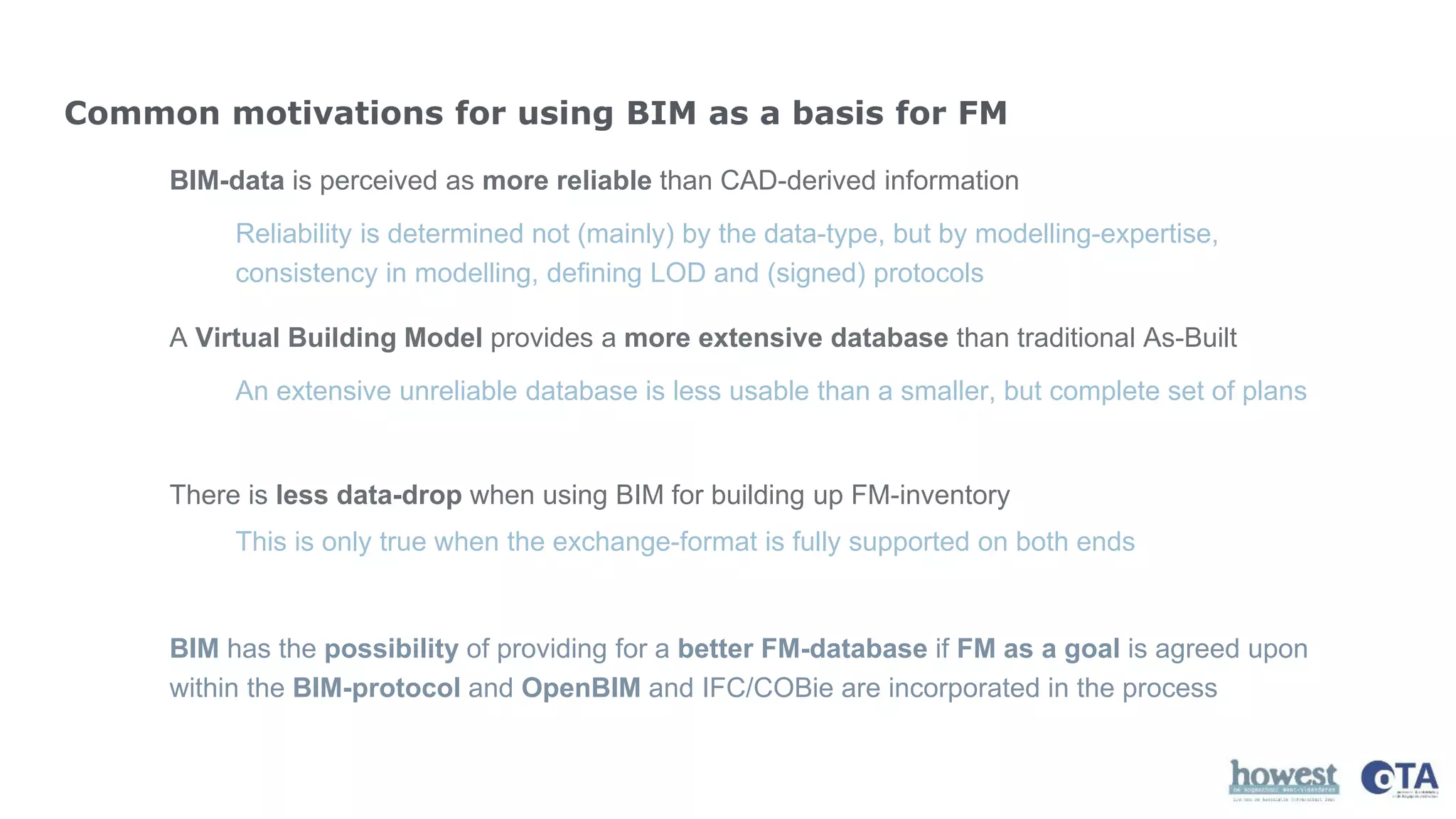
Common motivations for using BIM as a basis for FM
BIM-data is perceived as more reliable than CAD-derived information
A Virtual Building Model provides a more extensive database than traditional As-Built
There is less data-drop when using BIM for building up FM-inventory
Reliability is determined not (mainly) by the data-type, but by modelling-expertise,
consistency in modelling, defining LOD and (signed) protocols
An extensive unreliable database is less usable than a smaller, but complete set of plans
This is only true when the exchange-format is fully supported on both ends
BIM has the possibility of providing for a better FM-database if FM as a goal is agreed upon
within the BIM-protocol and OpenBIM and IFC/COBie are incorporated in the process
Common workflow
“The biggest hurdle, however, is the lack of good data for FM i
n the BIM model.”
Lachmi Khemlani – founder AECBytes
AECBytes Feature Article “BIM for Facilities Management” 30.09.2011
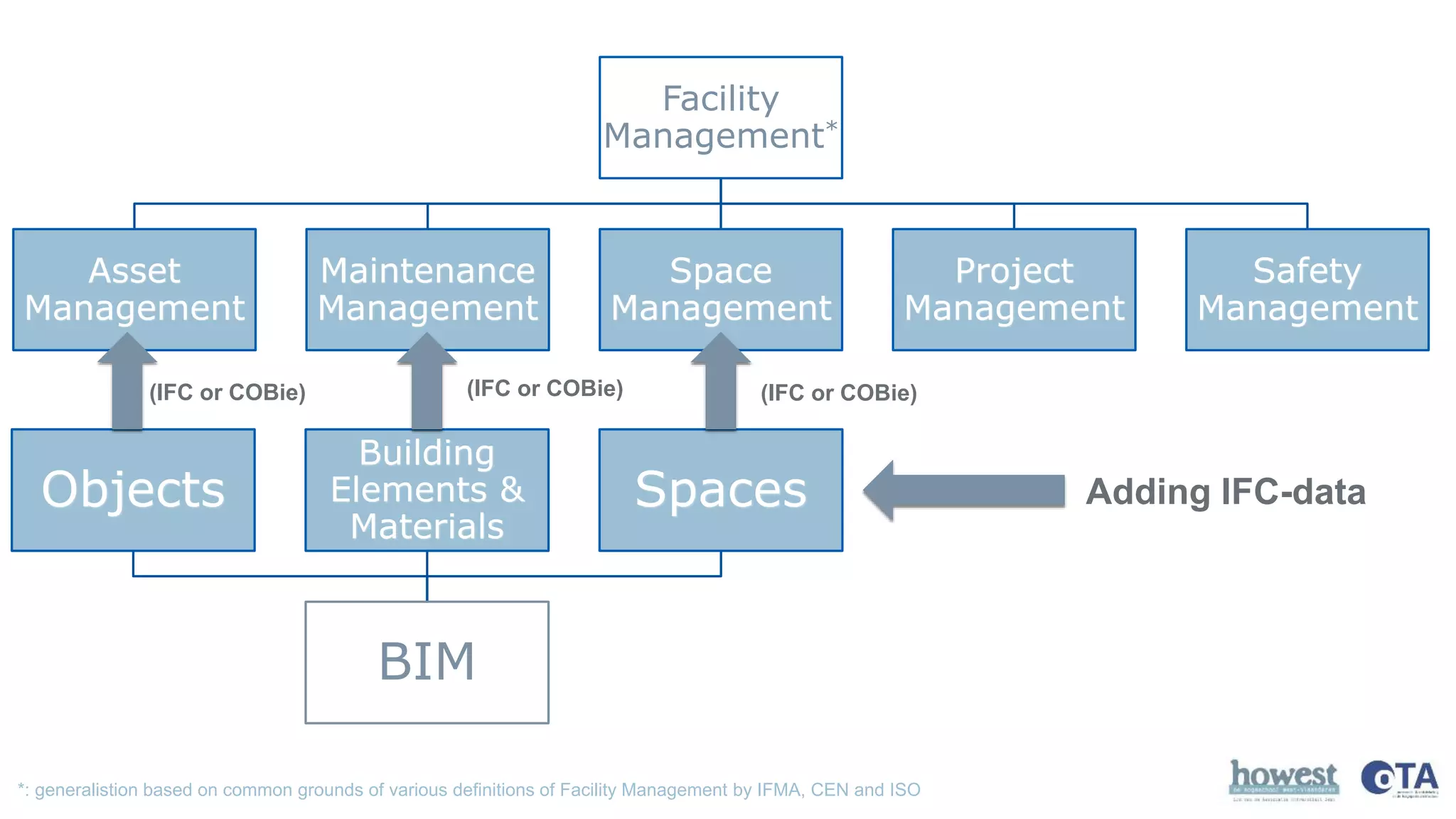
BIM
Objects
Building
Elements &
Materials
Spaces
Facility
Management*
Asset
Management
Maintenance
Management
Space
Management
Project
Management
Safety
Management
*: generalistion based on common grounds of various definitions of Facility Management by IFMA, CEN and ISO
Adding IFC-data
(IFC or COBie) (IFC or COBie) (IFC or COBie)
Step-by-step example
“Before BIM, if a truck backed into a curtain wall, and you were looking for materials to repair it,
the answer was often bound in files, not searchable, not indexed.
BIM is well-populated, searchable, and easy to query. It is a better source of information about
make, model, and potentially the serial number so that the owner understands what’s in the
building and can make repairs.”
Michael Schley, founder and CEO of FM:Systems
Business Advice Article by Jeff Link on lineshapespace.com
“BIM for Facilities Management: 4 Tips to Improve Lifecycle Performance and Reduce Costs” – 24.08.2015
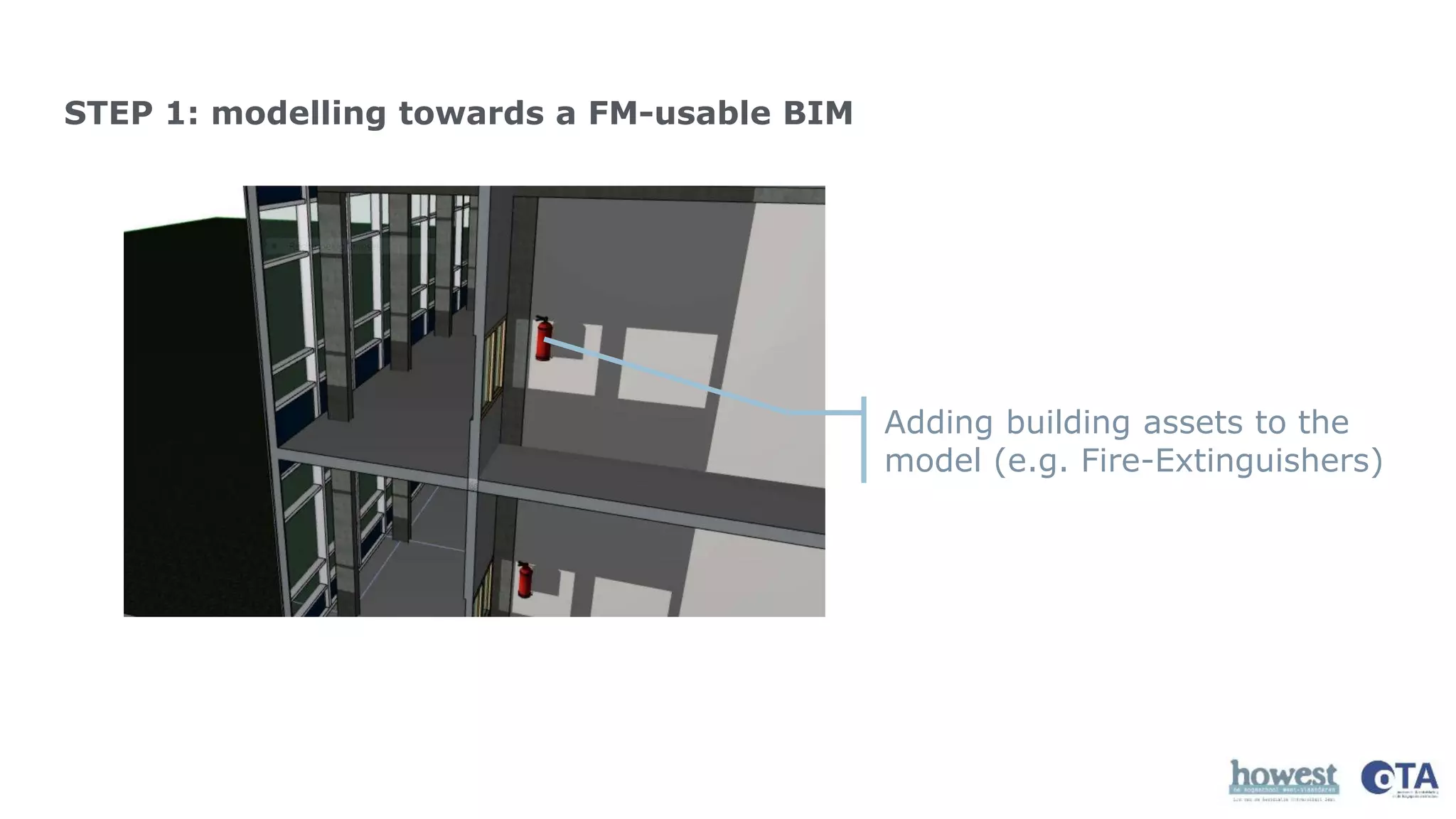
STEP 1: modelling towards a FM-usable BIM
Adding building assets to the
model (e.g. Fire-Extinguishers)
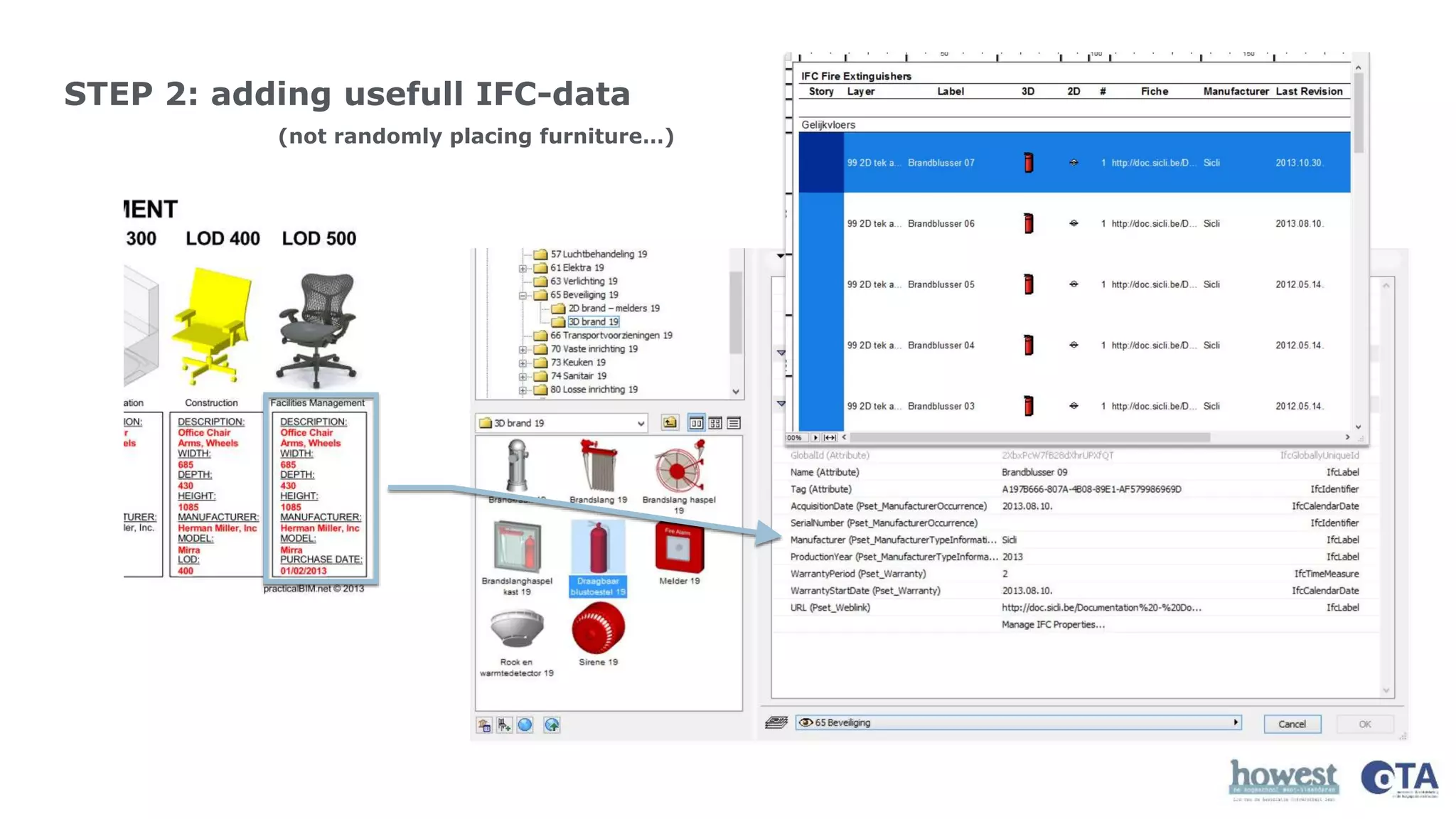
STEP 2: adding usefull IFC-data
(not randomly placing furniture…)
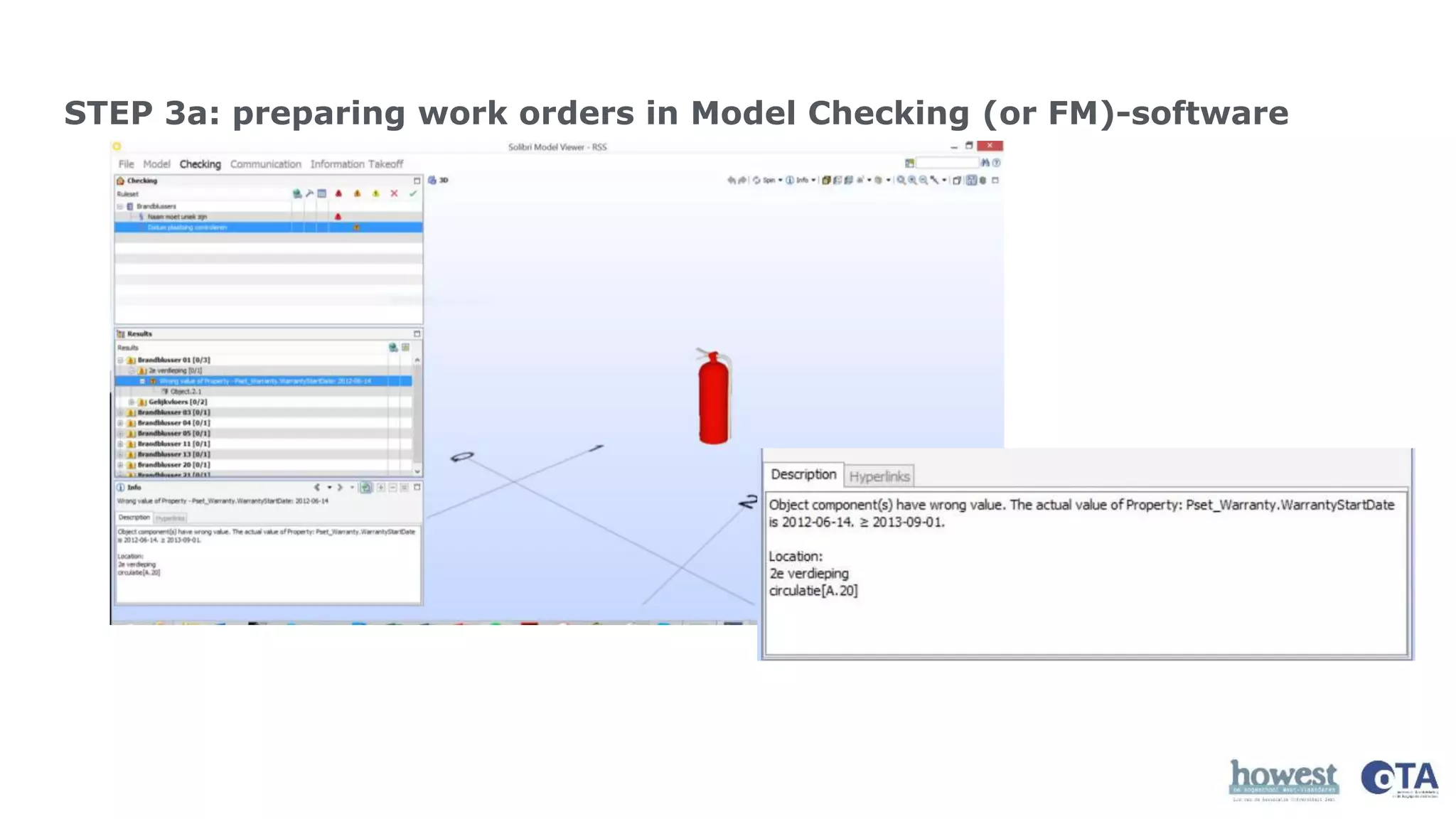
STEP 3a: preparing work orders in Model Checking (or FM)-software
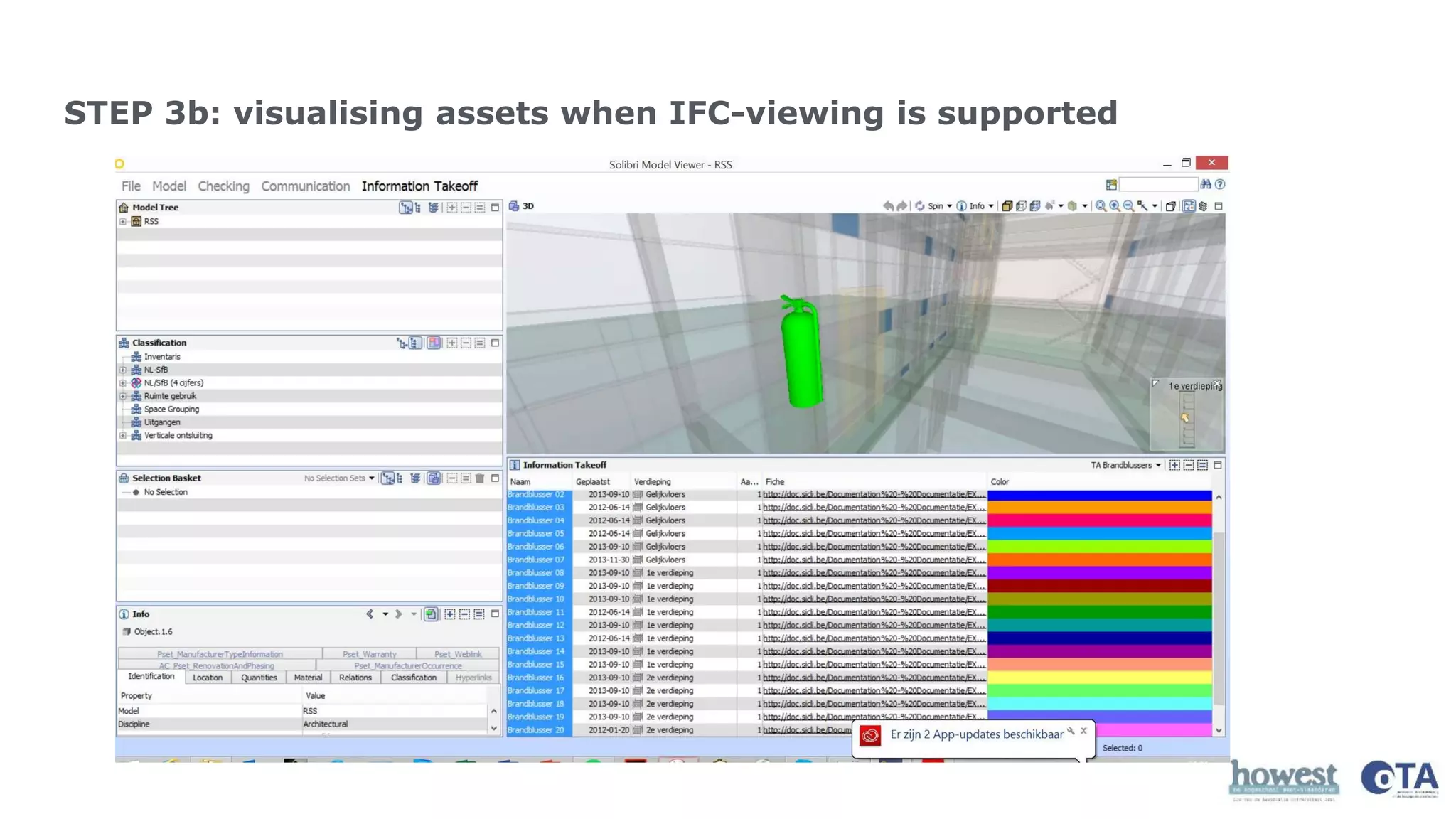
STEP 3b: visualising assets when IFC-viewing is supported
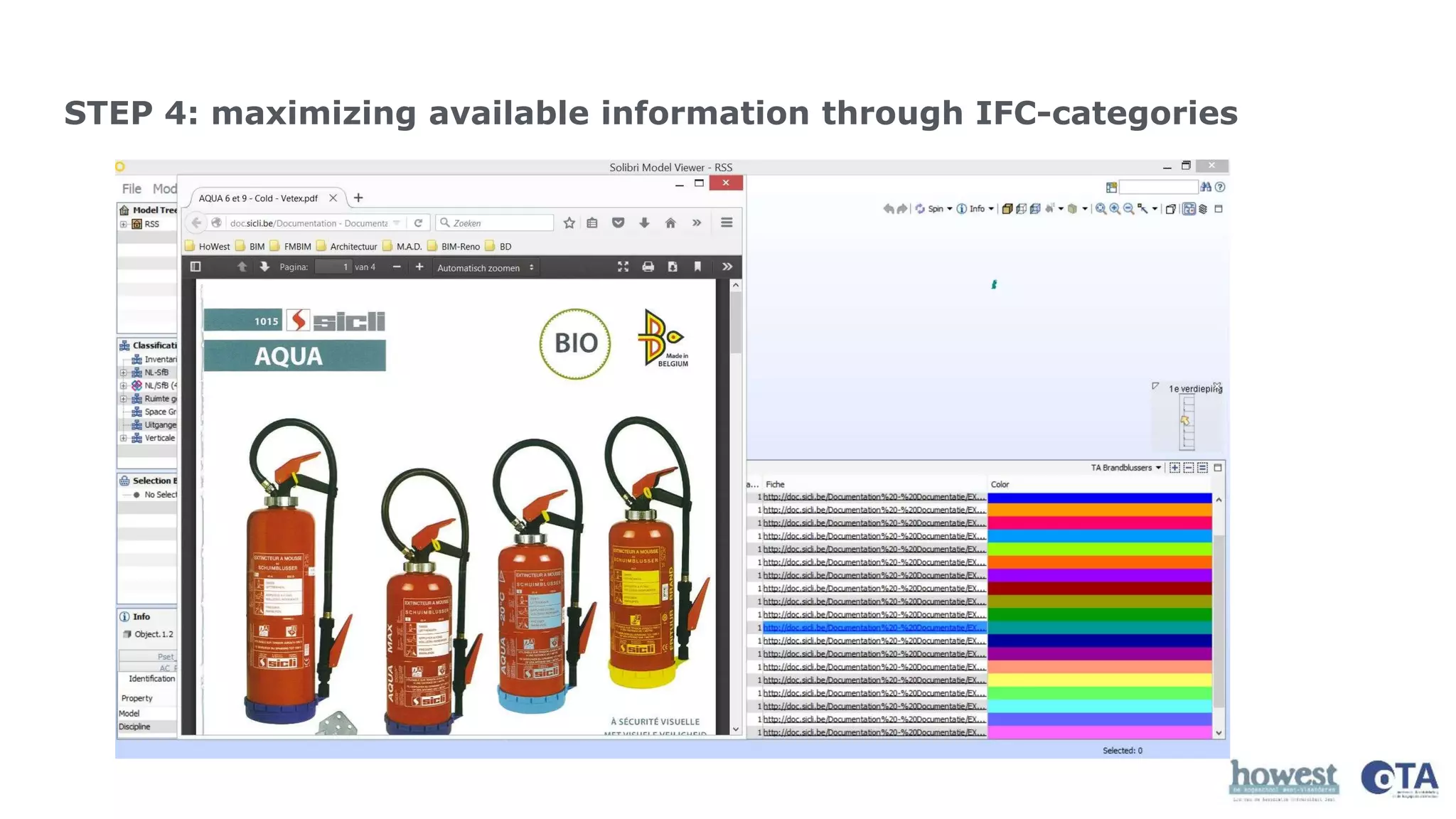
STEP 4: maximizing available information through IFC-categories
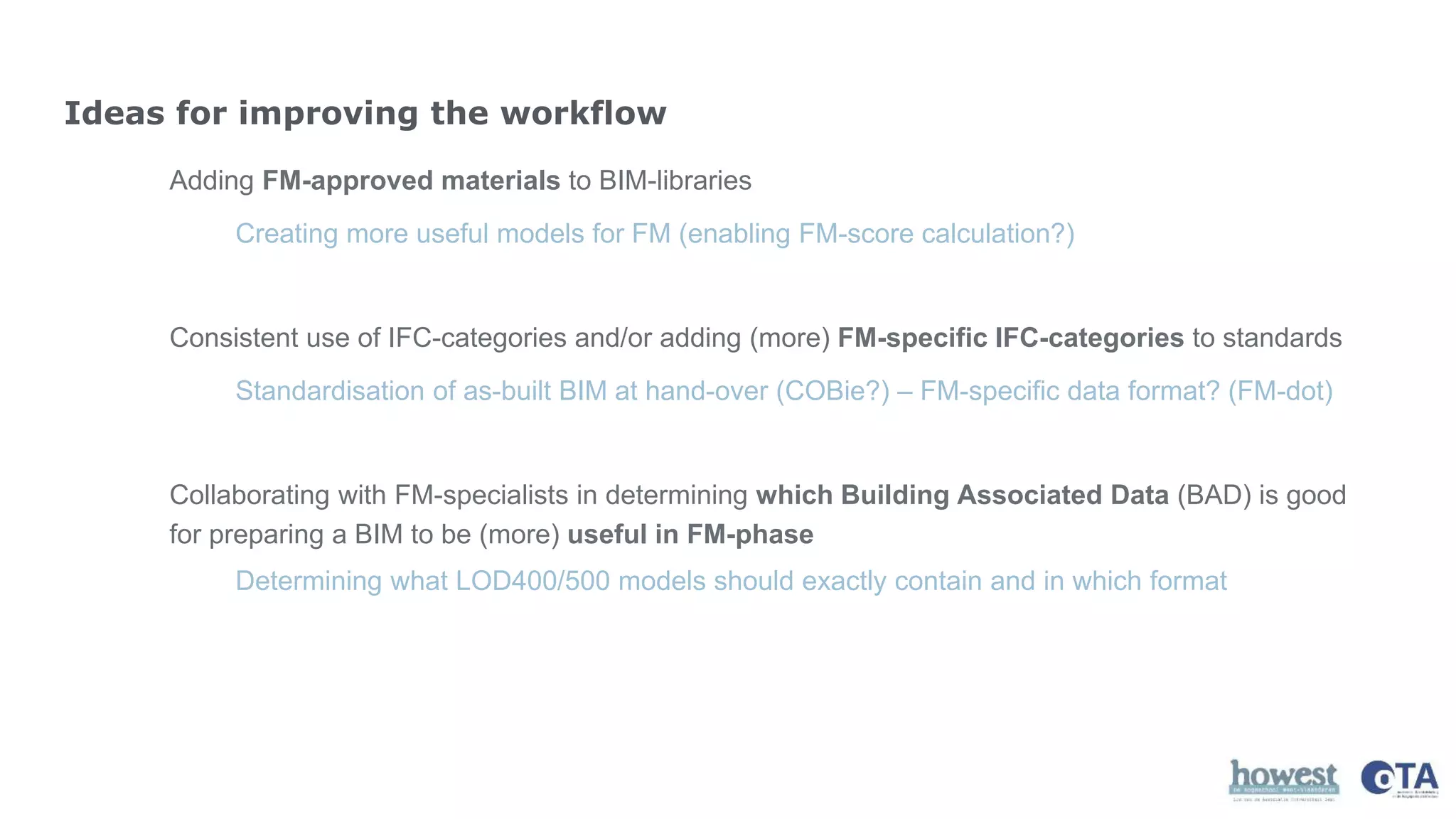
Adding FM-approved materials to BIM-libraries
Consistent use of IFC-categories and/or adding (more) FM-specific IFC-categories to standards
Collaborating with FM-specialists in determining which Building Associated Data (BAD) is good
for preparing a BIM to be (more) useful in FM-phase
Ideas for improving the workflow
Creating more useful models for FM (enabling FM-score calculation?)
Standardisation of as-built BIM at hand-over (COBie?) – FM-specific data format? (FM-dot)
Determining what LOD400/500 models should exactly contain and in which format
STEP 5: Calculating and optimizing travel distances using model software
Using techniques for
escape routes in
studying travel
distances
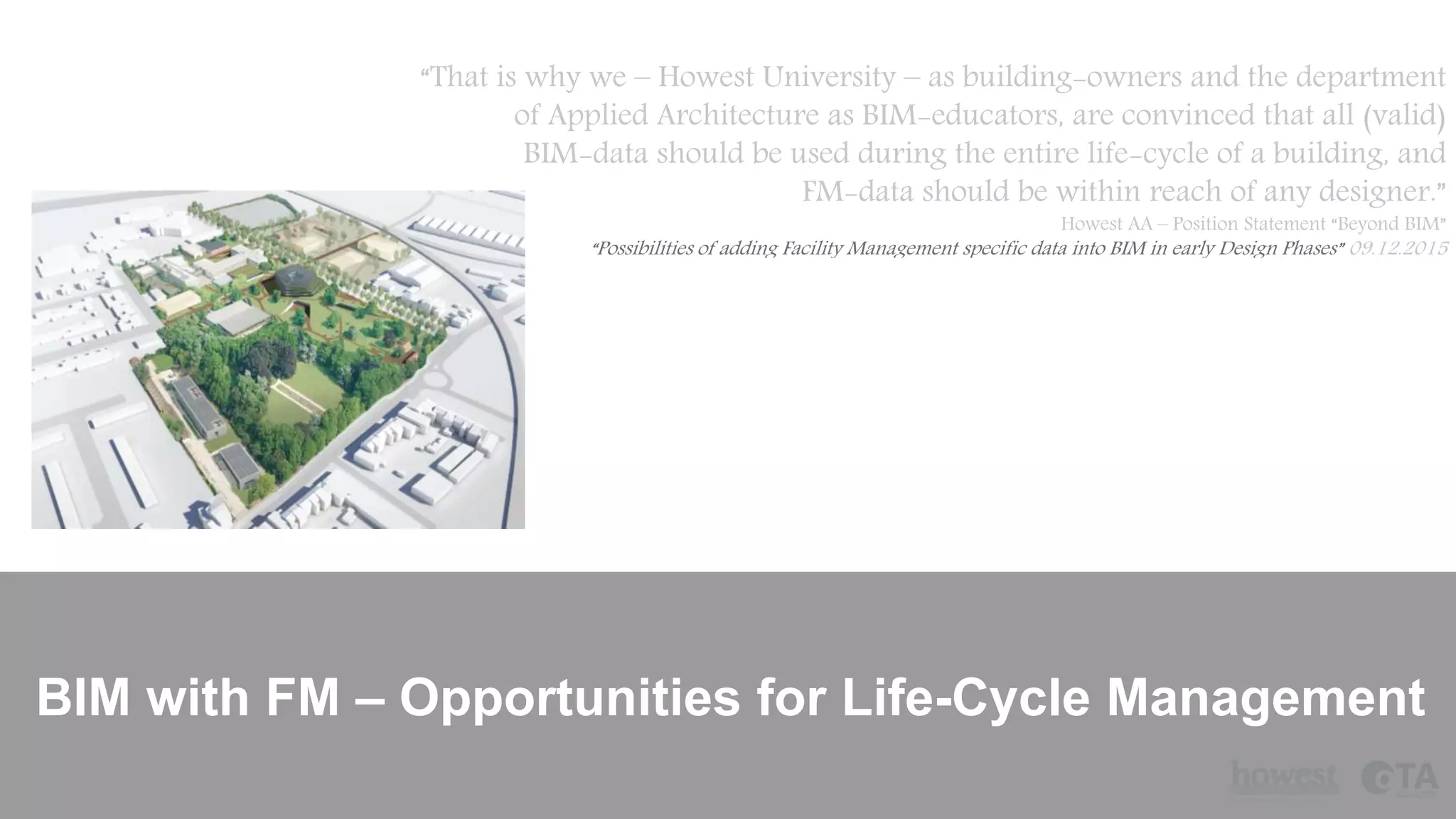
BIM with FM – Opportunities for Life-Cycle Management
“That is why we – Howest University – as building-owners and the department
of Applied Architecture as BIM-educators, are convinced that all (valid)
BIM-data should be used during the entire life-cycle of a building, and
FM-data should be within reach of any designer.”
Howest AA – Position Statement “Beyond BIM”
“Possibilities of adding Facility Management specific data into BIM in early Design Phases” 09.12.2015
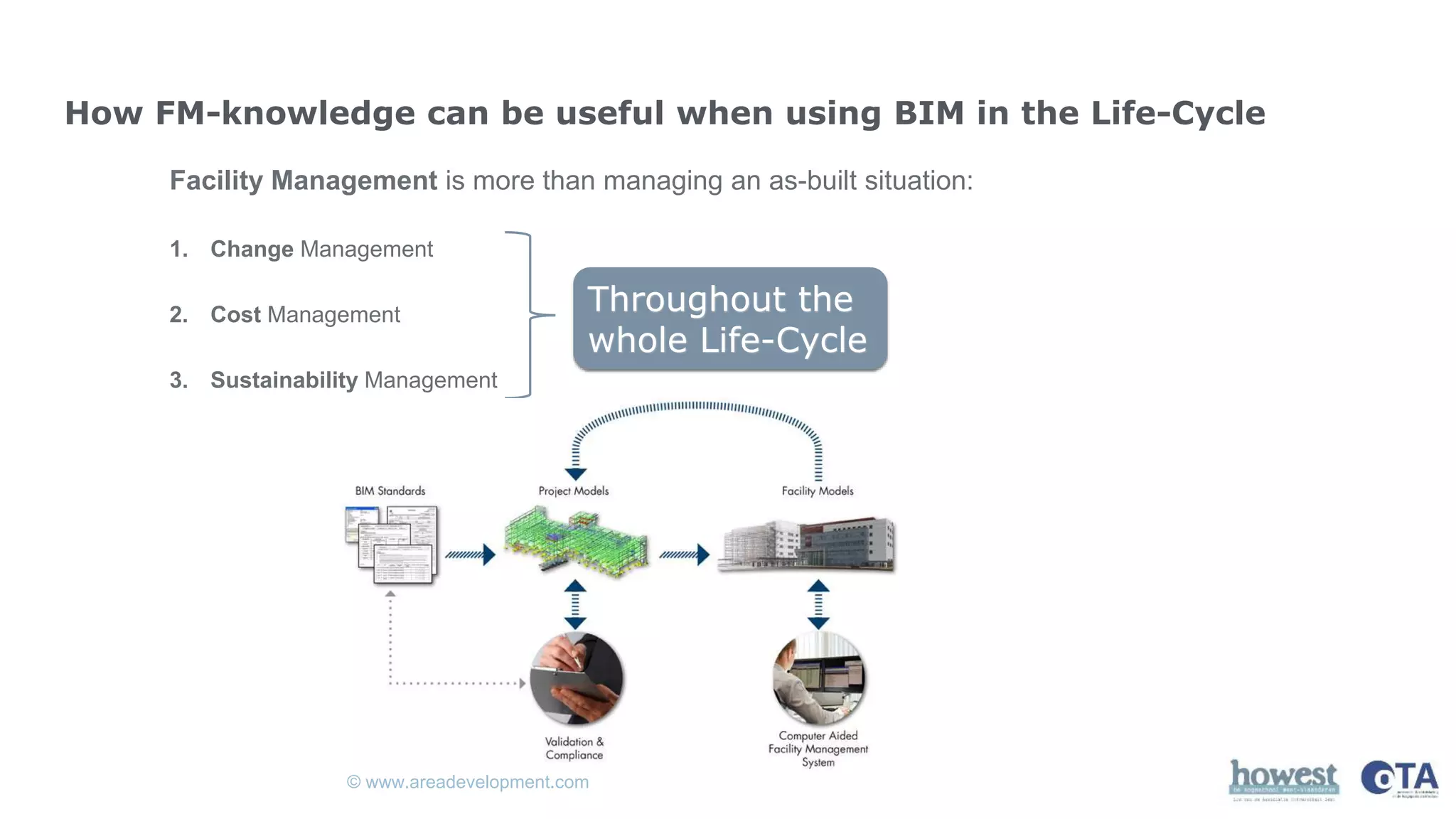
How FM-knowledge can be useful when using BIM in the Life-Cycle
Facility Management is more than managing an as-built situation:
1. Change Management
2. Cost Management
3. Sustainability Management
Throughout the
whole Life-Cycle
© www.areadevelopment.com
Change Management
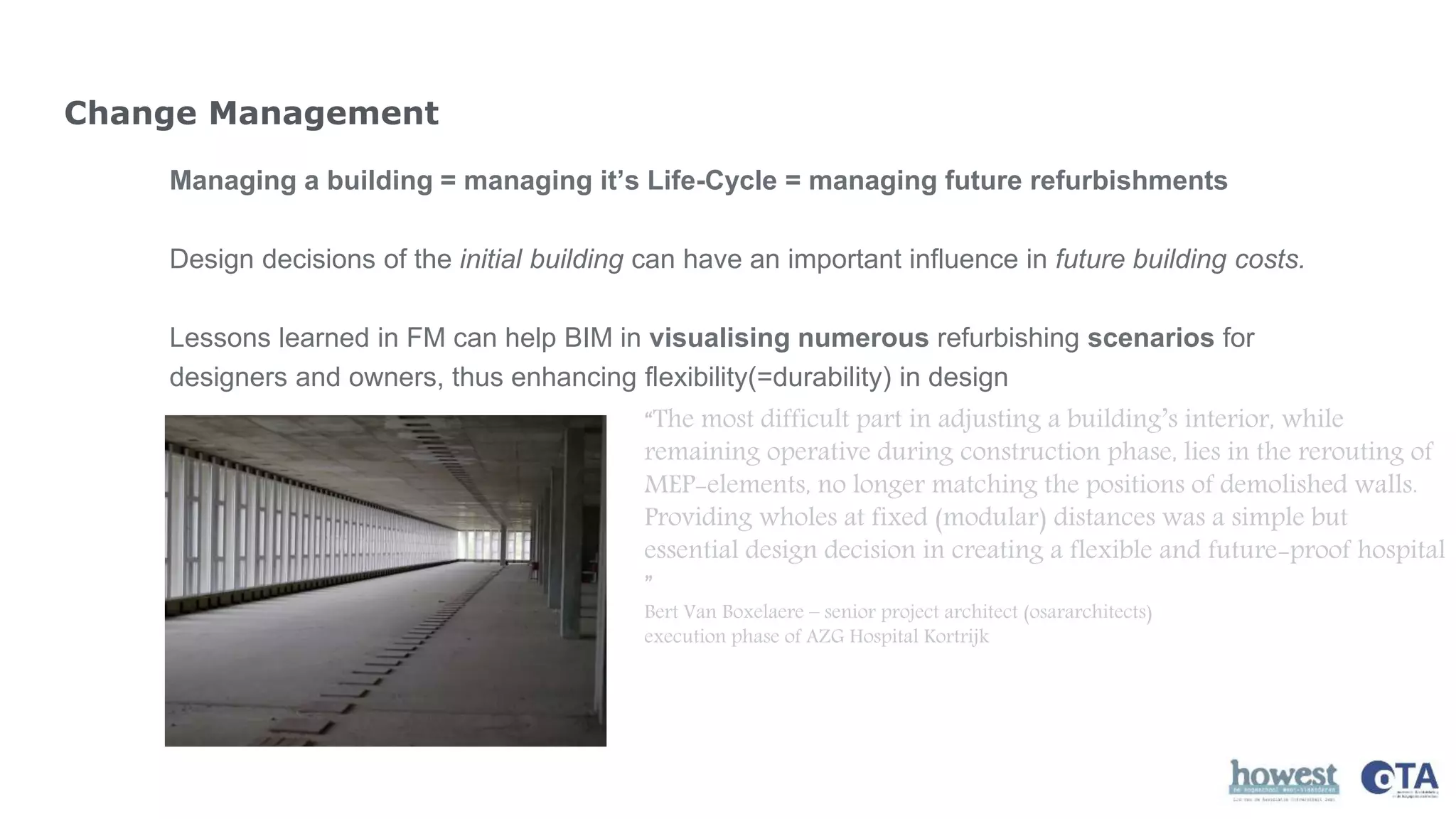
Managing a building = managing it’s Life-Cycle = managing future refurbishments
Design decisions of the initial building can have an important influence in future building costs.
Lessons learned in FM can help BIM in visualising numerous refurbishing scenarios for
designers and owners, thus enhancing flexibility(=durability) in design
“The most difficult part in adjusting a building’s interior, while
remaining operative during construction phase, lies in the rerouting of
MEP-elements, no longer matching the positions of demolished walls.
Providing wholes at fixed (modular) distances was a simple but
essential design decision in creating a flexible and future-proof hospital
”
Bert Van Boxelaere – senior project architect (osararchitects)
execution phase of AZG Hospital Kortrijk
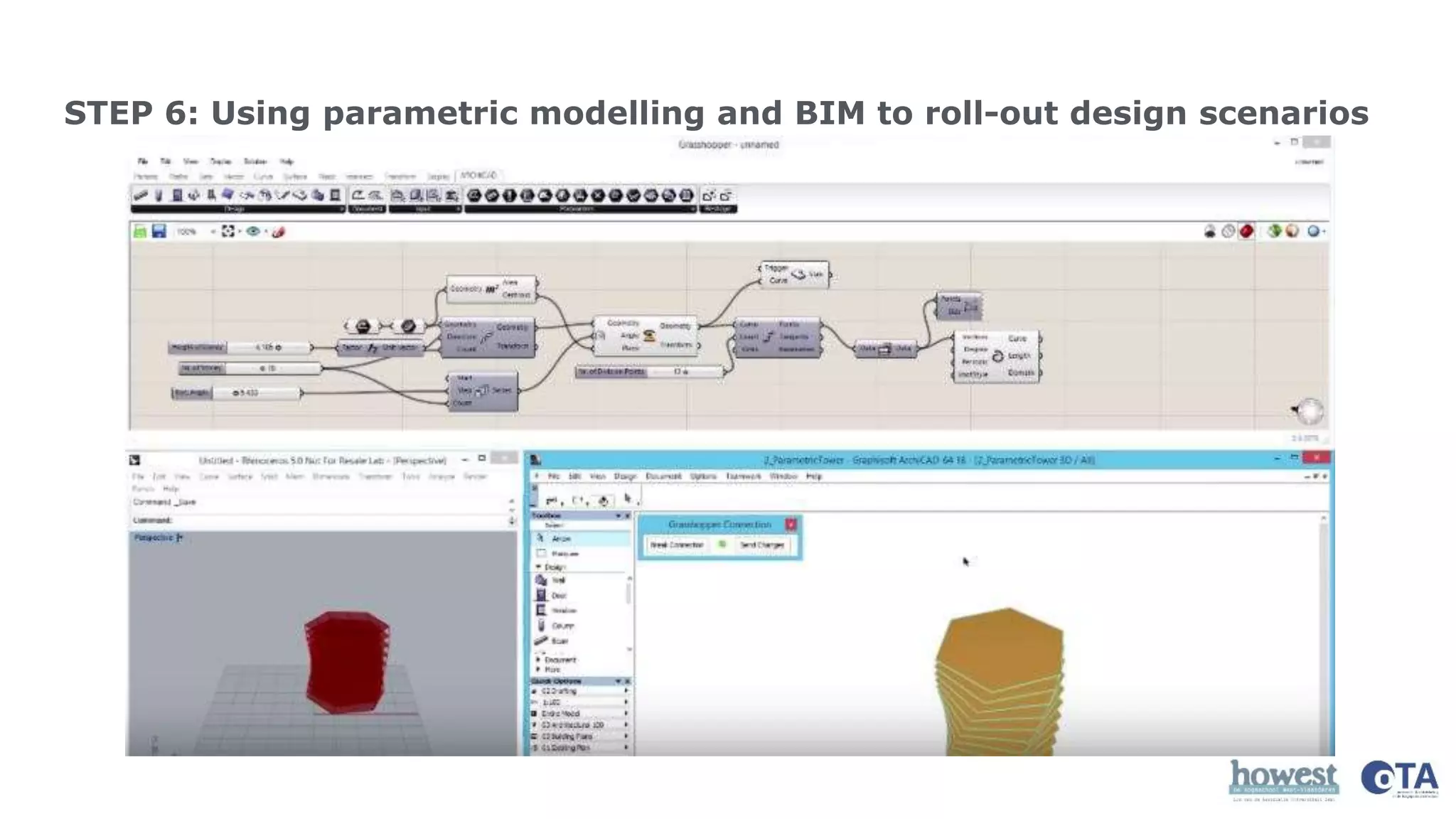
STEP 6: Using parametric modelling and BIM to roll-out design scenarios
Cost Management
Total Building Cost = focus on operation and maintenance cost > construction cost
Although the rule-of-thumb 1:5:200 isn’t as valid as often presumed2, integrating operating and
maintenance costs is clearly a logical step in using BIM+FM in Life-Cycle Management.
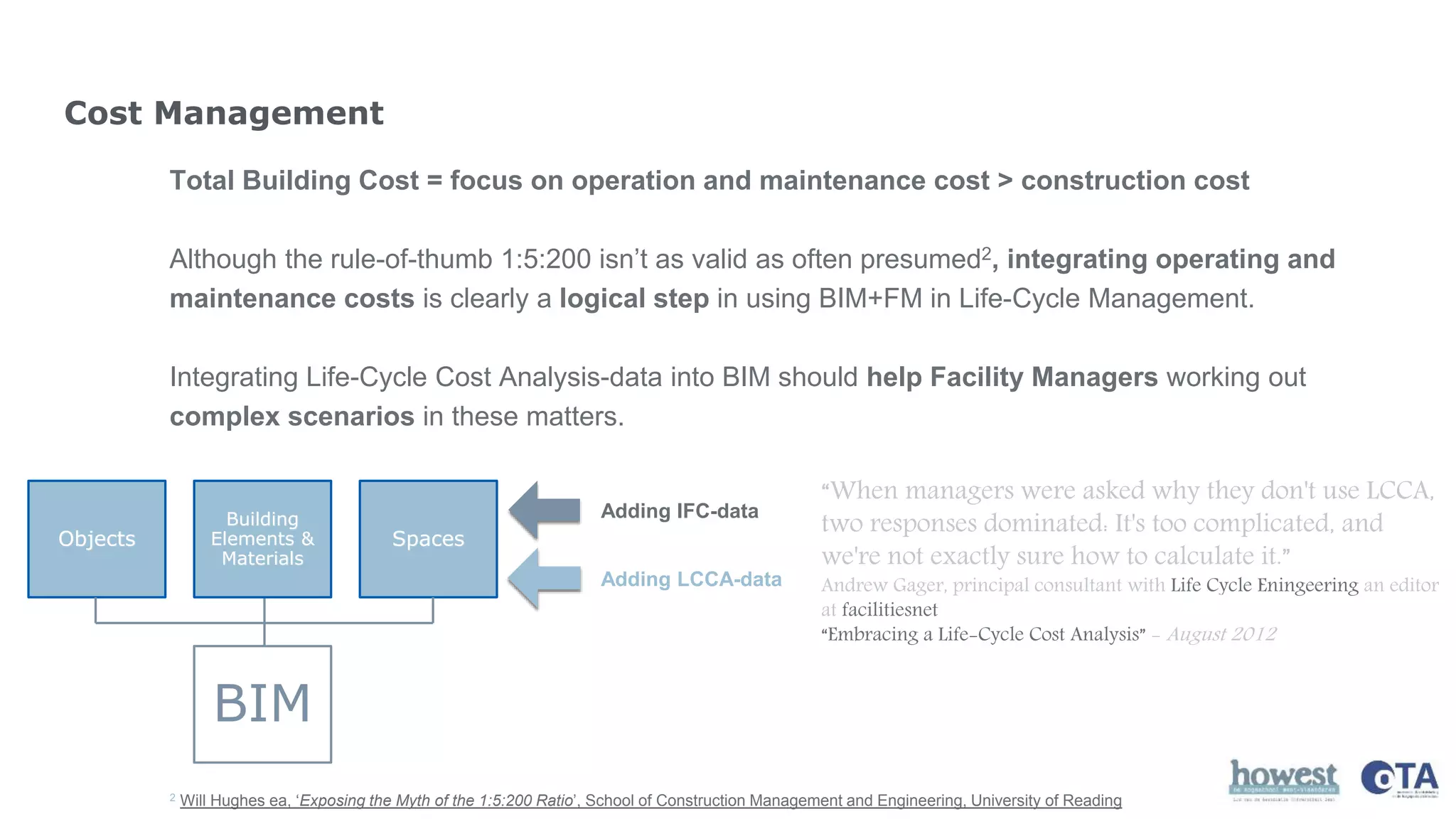
Integrating Life-Cycle Cost Analysis-data into BIM should help Facility Managers working out
complex scenarios in these matters.
“When managers were asked why they don't use LCCA,
two responses dominated: It's too complicated, and
we're not exactly sure how to calculate it.”
Andrew Gager, principal consultant with Life Cycle Eningeering an editor
at facilitiesnet
“Embracing a Life-Cycle Cost Analysis” - August 2012
2 Will Hughes ea, ‘Exposing the Myth of the 1:5:200 Ratio’, School of Construction Management and Engineering, University of Reading
BIM
Objects
Building
Elements &
Materials
Spaces
Adding IFC-data
Adding LCCA-data
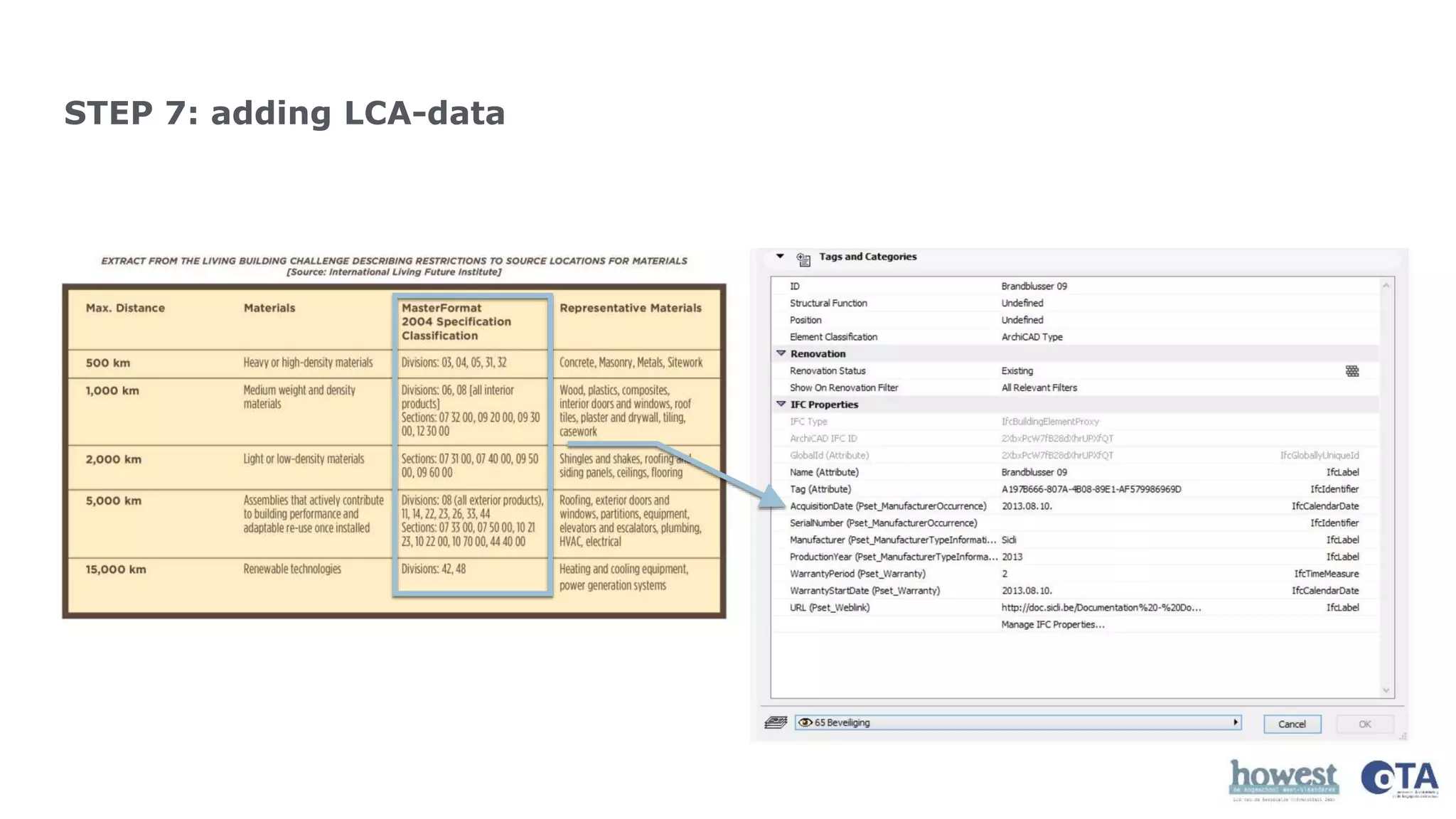
STEP 7: adding LCA-data
Sustainability Management
FM-approved materials = easy and cost-effective maintenance, demolition and re-use
Managing a Building through it’s entire Life-Cycle takes in account it’s refurbishment(s), and
ultimately it’s demolition.
A building is a vast resource-mine. ‘Mining’ will be more effective when a database provides
Facility Managers and Designers with a reliable and detailed inventory of all used materials.
An extensive, all-inclusive definition of digital building materials and their parameters and
properties is necessary to make this possible
“The aims of BAMB (Buildings as Material Banks) are the prevention of construction and demolition waste,
the reduction of virgin resource consumption and the development towards a circular economy through
industrial symbiosis”
Objective of the CORDIS-project by IBGE
“Buildings as Material Banks” 01.09.2015-01.09.2018
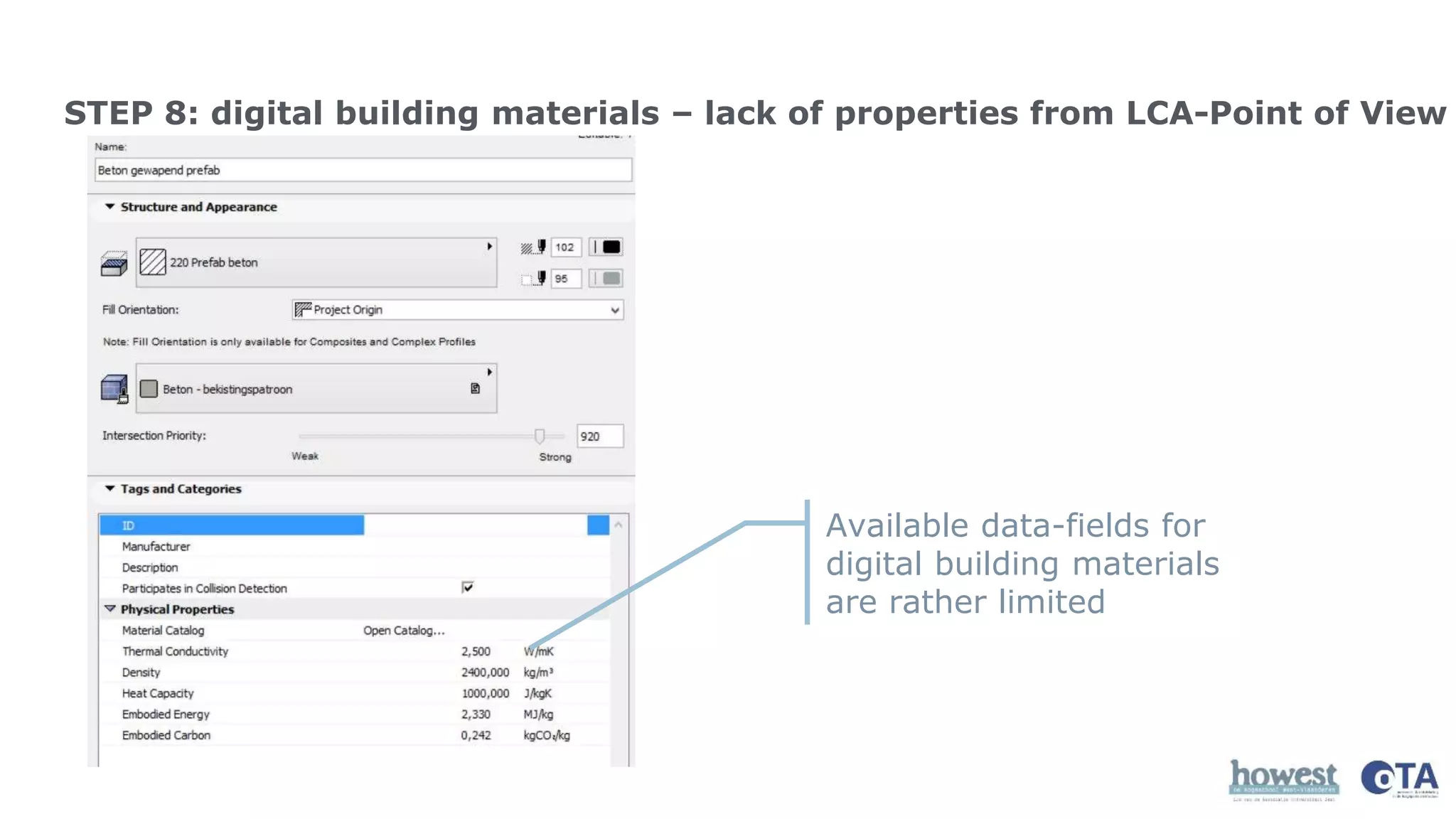
STEP 8: digital building materials – lack of properties from LCA-Point of View
Available data-fields for
digital building materials
are rather limited
Any questions…?

Possibilities of adding FM-specific data into BIM in early Design Phases

  • 1.
    Possibilities of addingFM-specific data into BIM in early Design Phases UGent – Beyond BIM – 09.12.2015 ir-arch. Ruben Van de Walle lecturer CAAD.BIM coordinator Bachelor Papers Howest University of Applied Sciences - Bruges Department of Applied Architecture
  • 2.
    Possibilities of addingFM-specific data into BIM in early Design Phases UGent – Beyond BIM – 09.12.2015 • Facility Management with BIM • Why use BIM for FM? • Common workflow • STEP-by-STEP example • BIM with Facility Management
  • 3.
    FM with BIM– Overview of Available Solutions “a BIM model could be gainfully used for FM, since it was able to capture so much of the building information that could be re-used for its operation and maintenance rather than have to re-create it” Lachmi Khemlani – founder AECBytes AECBytes Feature Article “BIM for Facilities Management” 30.09.2011
  • 4.
    Using BIM asa database for Facility Management Two main types of BIM-implementation in FM-suites: 1. Incorporated within a larger AEC-software portfolio (FM adopted by BIM-providers): • Autodesk: Building OPS • Graphisoft: ArchiFM • Bentley: Bentley Facilities 2. FM-Software, providing exchange with BIM • FM Systems • Planon All of them use the as-built BIM (delivered at hand-over) as a starting point for ‘filling up’ the FM- database. Bi-directional exchange is (sometimes) possible, but almost always requires a type of modelling-software to be used to keep the model up to date.
  • 5.
    Motivation for usingBIM in FM “According to a 2004 report by the National Institute of Standards and Technology (NIST), 71 percent of design and engineering documentation maintained by facility executives is still recorded on paper. […] A NIST report on inadequate data interoperability estimated the cost at $15.8 billion in 2002.” Brandon Lorenz, Senior Editor at facilitiesnet “The Case For Data Interoperability” - March 2006
  • 6.
    Common motivations forusing BIM as a basis for FM BIM-data is perceived as more reliable than CAD-derived information A Virtual Building Model provides a more extensive database than traditional As-Built There is less data-drop when using BIM for building up FM-inventory Reliability is determined not (mainly) by the data-type, but by modelling-expertise, consistency in modelling, defining LOD and (signed) protocols An extensive unreliable database is less usable than a smaller, but complete set of plans This is only true when the exchange-format is fully supported on both ends BIM has the possibility of providing for a better FM-database if FM as a goal is agreed upon within the BIM-protocol and OpenBIM and IFC/COBie are incorporated in the process
  • 7.
    Common workflow “The biggesthurdle, however, is the lack of good data for FM i n the BIM model.” Lachmi Khemlani – founder AECBytes AECBytes Feature Article “BIM for Facilities Management” 30.09.2011
  • 8.
    BIM Objects Building Elements & Materials Spaces Facility Management* Asset Management Maintenance Management Space Management Project Management Safety Management *: generalistionbased on common grounds of various definitions of Facility Management by IFMA, CEN and ISO Adding IFC-data (IFC or COBie) (IFC or COBie) (IFC or COBie)
  • 9.
    Step-by-step example “Before BIM,if a truck backed into a curtain wall, and you were looking for materials to repair it, the answer was often bound in files, not searchable, not indexed. BIM is well-populated, searchable, and easy to query. It is a better source of information about make, model, and potentially the serial number so that the owner understands what’s in the building and can make repairs.” Michael Schley, founder and CEO of FM:Systems Business Advice Article by Jeff Link on lineshapespace.com “BIM for Facilities Management: 4 Tips to Improve Lifecycle Performance and Reduce Costs” – 24.08.2015
  • 10.
    STEP 1: modellingtowards a FM-usable BIM Adding building assets to the model (e.g. Fire-Extinguishers)
  • 11.
    STEP 2: addingusefull IFC-data (not randomly placing furniture…)
  • 12.
    STEP 3a: preparingwork orders in Model Checking (or FM)-software
  • 13.
    STEP 3b: visualisingassets when IFC-viewing is supported
  • 14.
    STEP 4: maximizingavailable information through IFC-categories
  • 15.
    Adding FM-approved materialsto BIM-libraries Consistent use of IFC-categories and/or adding (more) FM-specific IFC-categories to standards Collaborating with FM-specialists in determining which Building Associated Data (BAD) is good for preparing a BIM to be (more) useful in FM-phase Ideas for improving the workflow Creating more useful models for FM (enabling FM-score calculation?) Standardisation of as-built BIM at hand-over (COBie?) – FM-specific data format? (FM-dot) Determining what LOD400/500 models should exactly contain and in which format
  • 16.
    STEP 5: Calculatingand optimizing travel distances using model software Using techniques for escape routes in studying travel distances
  • 17.
    BIM with FM– Opportunities for Life-Cycle Management “That is why we – Howest University – as building-owners and the department of Applied Architecture as BIM-educators, are convinced that all (valid) BIM-data should be used during the entire life-cycle of a building, and FM-data should be within reach of any designer.” Howest AA – Position Statement “Beyond BIM” “Possibilities of adding Facility Management specific data into BIM in early Design Phases” 09.12.2015
  • 18.
    How FM-knowledge canbe useful when using BIM in the Life-Cycle Facility Management is more than managing an as-built situation: 1. Change Management 2. Cost Management 3. Sustainability Management Throughout the whole Life-Cycle © www.areadevelopment.com
  • 19.
    Change Management Managing abuilding = managing it’s Life-Cycle = managing future refurbishments Design decisions of the initial building can have an important influence in future building costs. Lessons learned in FM can help BIM in visualising numerous refurbishing scenarios for designers and owners, thus enhancing flexibility(=durability) in design “The most difficult part in adjusting a building’s interior, while remaining operative during construction phase, lies in the rerouting of MEP-elements, no longer matching the positions of demolished walls. Providing wholes at fixed (modular) distances was a simple but essential design decision in creating a flexible and future-proof hospital ” Bert Van Boxelaere – senior project architect (osararchitects) execution phase of AZG Hospital Kortrijk
  • 20.
    STEP 6: Usingparametric modelling and BIM to roll-out design scenarios
  • 21.
    Cost Management Total BuildingCost = focus on operation and maintenance cost > construction cost Although the rule-of-thumb 1:5:200 isn’t as valid as often presumed2, integrating operating and maintenance costs is clearly a logical step in using BIM+FM in Life-Cycle Management. Integrating Life-Cycle Cost Analysis-data into BIM should help Facility Managers working out complex scenarios in these matters. “When managers were asked why they don't use LCCA, two responses dominated: It's too complicated, and we're not exactly sure how to calculate it.” Andrew Gager, principal consultant with Life Cycle Eningeering an editor at facilitiesnet “Embracing a Life-Cycle Cost Analysis” - August 2012 2 Will Hughes ea, ‘Exposing the Myth of the 1:5:200 Ratio’, School of Construction Management and Engineering, University of Reading BIM Objects Building Elements & Materials Spaces Adding IFC-data Adding LCCA-data
  • 22.
  • 23.
    Sustainability Management FM-approved materials= easy and cost-effective maintenance, demolition and re-use Managing a Building through it’s entire Life-Cycle takes in account it’s refurbishment(s), and ultimately it’s demolition. A building is a vast resource-mine. ‘Mining’ will be more effective when a database provides Facility Managers and Designers with a reliable and detailed inventory of all used materials. An extensive, all-inclusive definition of digital building materials and their parameters and properties is necessary to make this possible “The aims of BAMB (Buildings as Material Banks) are the prevention of construction and demolition waste, the reduction of virgin resource consumption and the development towards a circular economy through industrial symbiosis” Objective of the CORDIS-project by IBGE “Buildings as Material Banks” 01.09.2015-01.09.2018
  • 24.
    STEP 8: digitalbuilding materials – lack of properties from LCA-Point of View Available data-fields for digital building materials are rather limited
  • 25.