www.google-melange.com
Agenda
● Who am I?
● What is Google Summer of Code?
● What are the goals of the program?
● How does Google Summer of Code work?
● Google Summer of Code timeline
● Stipends
● Participating projects
● Useful links
Who am I?
● Carol Smith (carols@google.com)
● I've been at Google 8.5 years
● I have work as an administrative assistant,
program manager, and now community manager
and open source programs manager
● I have a degree from California State University,
Northridge in journalism
● I'm a movie geek, bibilophile, and recreational
century bicyclist
What is Google Summer of
Code?
Google Summer of Code is a program designed to
encourage university student participation in open
source software development.
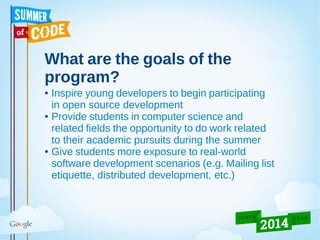
What are the goals of the
program?
● Inspire young developers to begin participating
in open source development
● Provide students in computer science and
related fields the opportunity to do work related
to their academic pursuits during the summer
● Give students more exposure to real-world
software development scenarios (e.g. Mailing list
etiquette, distributed development, etc.)
What are the goals of the
program?
● Get more open source code created and
released for the benefit of all
● Help open source projects identify and bring in
new developers and committers
How does Google Summer of
Code work?
● Organizations apply and are chosen by Google
● Students submit project proposals to the chosen
organizations, who then select student(s) and
pair with mentor(s) from the org
● Students execute milestones laid out in their
accepted project proposal during the summer
● Students are evaluated twice during the term
● Students are paid a stipend in exchange for
passing each evaluation, and are sent a t-shirt at
the end of the year if they submit their successful
project code sample
Google Summer of Code timeline
● Early February: Organizations apply and are
chosen by Google
● Early March: Student application period
● Late April: Accepted students announced on
google-melange.com
● Mid May: Students begin coding
● Late June: Mid-term evaluations
● Late August: Final evaluations
Stipends
● Accepted students in good standing with their
mentoring organizations will receive 500 USD
shortly after coding begins.
● Students who pass their mid-term evaluations
will receive 2250 USD shortly after the mid-term
evaluations.
● Students who receive passing final evaluations
will receive 2750 USD shortly after the final
evaluation deadline.
Participating Projects
● Operating Systems
● Mobile, Portable, Handheld Devices
● Databases
● Programming Languages
● Video, Music, TV, and Photography
● Code Design, Development & Management
● Humanitarian Efforts
● Biology, Analytical Sciences, Health Care
http://goo.gl/dhvPVn
Some Interesting Student
Success Stories
● There was a GSoC student at CERN when they
discovered the Higgs boson
● A GSoC student competed in the London
summer olympics (in race walking!)
● Students have worked on projects for Twitter and
Facebook in previous years
● 50 million lines of code produced by students in
GSoC!
Useful Links
● Melange: http://www.google-melange.com
● Google Summer of Code discussion list:
https://groups.google.com/forum/#!forum/google-
summer-of-code-discuss
● Google Summer of Code student manual:
http://flossmanuals.net/GSoCStudentGuide/
What is Google Code-in?
● Global, online contest for 13-17 year old pre-university students
● Introduction to open source software development
● 10 Open source organizations create tasks for students to work on
● Students earn certificates, t-shirts and can work toward Grand Prize trip to
Google’s campus
Types of Tasks
Each task is designed to take approximately the same amount of time to
complete (about 3-5 hours)
Categories of Tasks
● Coding
● Documentation/Training
● Outreach/Research
● Quality Assurance
● User Interface
Why participate in GCI?
● Apply classroom skills to real life OS projects
● Excite students about the many types of open source projects they can
choose from
● Become part of the community
● Easy entry, mentors available to guide students
● OS software isn’t just about coding - variety of types of tasks to choose from
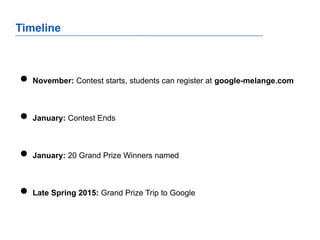
Timeline
● November: Contest starts, students can register at google-melange.com
● January: Contest Ends
● January: 20 Grand Prize Winners named
● Late Spring 2015: Grand Prize Trip to Google
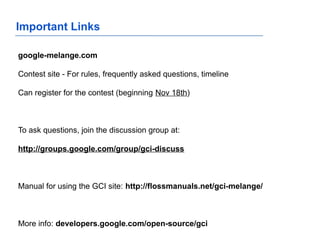
Important Links
google-melange.com
Contest site - For rules, frequently asked questions, timeline
Can register for the contest (beginning Nov 18th)
To ask questions, join the discussion group at:
http://groups.google.com/group/gci-discuss
Manual for using the GCI site: http://flossmanuals.net/gci-melange/
More info: developers.google.com/open-source/gci
www.google-melange.org
Thank You!
carols@google
.com

9-July-2014 Open Source Software Panel - Google Summer of Code & Code-In introduction

  • 1.
  • 2.
    Agenda ● Who amI? ● What is Google Summer of Code? ● What are the goals of the program? ● How does Google Summer of Code work? ● Google Summer of Code timeline ● Stipends ● Participating projects ● Useful links
  • 3.
    Who am I? ●Carol Smith (carols@google.com) ● I've been at Google 8.5 years ● I have work as an administrative assistant, program manager, and now community manager and open source programs manager ● I have a degree from California State University, Northridge in journalism ● I'm a movie geek, bibilophile, and recreational century bicyclist
  • 4.
    What is GoogleSummer of Code? Google Summer of Code is a program designed to encourage university student participation in open source software development.
  • 8.
    What are thegoals of the program? ● Inspire young developers to begin participating in open source development ● Provide students in computer science and related fields the opportunity to do work related to their academic pursuits during the summer ● Give students more exposure to real-world software development scenarios (e.g. Mailing list etiquette, distributed development, etc.)
  • 9.
    What are thegoals of the program? ● Get more open source code created and released for the benefit of all ● Help open source projects identify and bring in new developers and committers
  • 10.
    How does GoogleSummer of Code work? ● Organizations apply and are chosen by Google ● Students submit project proposals to the chosen organizations, who then select student(s) and pair with mentor(s) from the org ● Students execute milestones laid out in their accepted project proposal during the summer ● Students are evaluated twice during the term ● Students are paid a stipend in exchange for passing each evaluation, and are sent a t-shirt at the end of the year if they submit their successful project code sample
  • 11.
    Google Summer ofCode timeline ● Early February: Organizations apply and are chosen by Google ● Early March: Student application period ● Late April: Accepted students announced on google-melange.com ● Mid May: Students begin coding ● Late June: Mid-term evaluations ● Late August: Final evaluations
  • 12.
    Stipends ● Accepted studentsin good standing with their mentoring organizations will receive 500 USD shortly after coding begins. ● Students who pass their mid-term evaluations will receive 2250 USD shortly after the mid-term evaluations. ● Students who receive passing final evaluations will receive 2750 USD shortly after the final evaluation deadline.
  • 13.
    Participating Projects ● OperatingSystems ● Mobile, Portable, Handheld Devices ● Databases ● Programming Languages ● Video, Music, TV, and Photography ● Code Design, Development & Management ● Humanitarian Efforts ● Biology, Analytical Sciences, Health Care http://goo.gl/dhvPVn
  • 14.
    Some Interesting Student SuccessStories ● There was a GSoC student at CERN when they discovered the Higgs boson ● A GSoC student competed in the London summer olympics (in race walking!) ● Students have worked on projects for Twitter and Facebook in previous years ● 50 million lines of code produced by students in GSoC!
  • 15.
    Useful Links ● Melange:http://www.google-melange.com ● Google Summer of Code discussion list: https://groups.google.com/forum/#!forum/google- summer-of-code-discuss ● Google Summer of Code student manual: http://flossmanuals.net/GSoCStudentGuide/
  • 17.
    What is GoogleCode-in? ● Global, online contest for 13-17 year old pre-university students ● Introduction to open source software development ● 10 Open source organizations create tasks for students to work on ● Students earn certificates, t-shirts and can work toward Grand Prize trip to Google’s campus
  • 18.
    Types of Tasks Eachtask is designed to take approximately the same amount of time to complete (about 3-5 hours) Categories of Tasks ● Coding ● Documentation/Training ● Outreach/Research ● Quality Assurance ● User Interface
  • 19.
    Why participate inGCI? ● Apply classroom skills to real life OS projects ● Excite students about the many types of open source projects they can choose from ● Become part of the community ● Easy entry, mentors available to guide students ● OS software isn’t just about coding - variety of types of tasks to choose from
  • 21.
    Timeline ● November: Conteststarts, students can register at google-melange.com ● January: Contest Ends ● January: 20 Grand Prize Winners named ● Late Spring 2015: Grand Prize Trip to Google
  • 22.
    Important Links google-melange.com Contest site- For rules, frequently asked questions, timeline Can register for the contest (beginning Nov 18th) To ask questions, join the discussion group at: http://groups.google.com/group/gci-discuss Manual for using the GCI site: http://flossmanuals.net/gci-melange/ More info: developers.google.com/open-source/gci
  • 23.