- Virag A Timbadia
1
 Introduction
 Types & Application
 Explanation Of Each Type
 Pressure Range
2
 Define Pump
 State Various Types Of Pump
 Explain Construction & Working Of Pump
 Enlist Applications Of Various Types Of Pump
 State Pressure Range
3
 Pump is a device used
 To move fluids (liquids or gases)
 Increases the mechanical energy of the fluid
 It acts as a Heart
 Link between reservoir and control valve
4
Pump
Positive displacement
Rotary
Gear
External
Internal
Gerotor
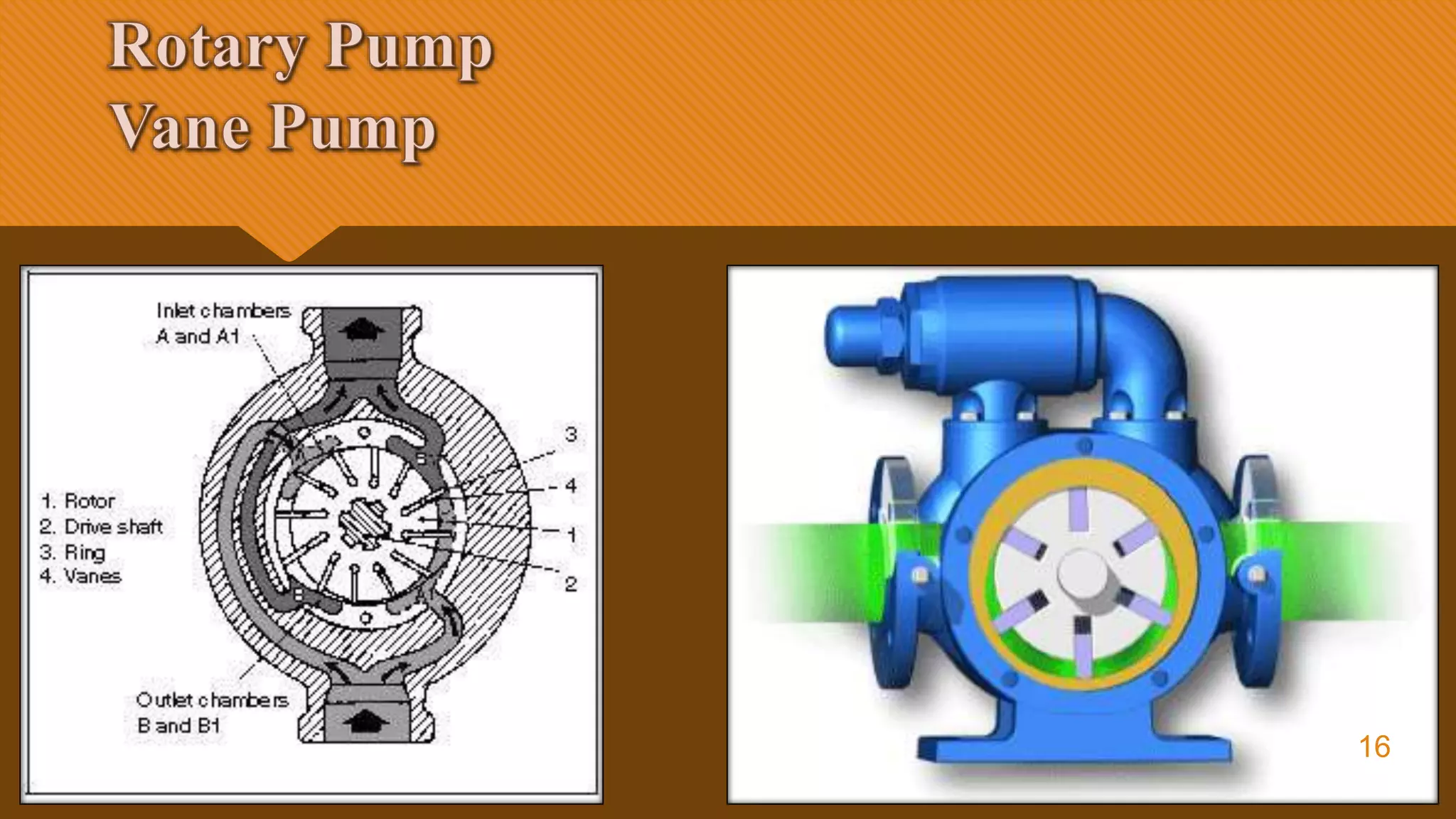
Lobe Vane
Fixed displacement
Unbalanced vane
Balanced vane
Variable displacement
Screw
Single
(Mono)
Twin
Reciprocating
Axial piston
In line
Variable
plate
Inclinable swash
plate
Cam/crank shaft driven
piston pump
Bent axis
Radial
piston
Stationary cylinder
block
Rotating cylinder
block
Non-Positive displacement /
Rotodynamic
centrifugal
Axial Flow
Radial Flow
5
 Pumping volume changes
 From maximum to minimum during each cycle
 Advantages of Hydrostatic
 Widely used & generate high pressure
 Small in size & high (power/weight)
 High volumetric efficiency
 Flexibility of performance (N = p ≠ Constant)
6
 Fluid displaced using fluid (motion) inertia
 Low pressure (rarely used as p < 40kg/cm2)
 Advantages of Hydro dynamic
 Initial & maintenance cost is less
 Simplicity of operation & operated quietly
 High reliability
 Capable of handling any type of fluid
7
 Uses the meshing gears to displace fluid
 Can be classified as
 External gear pump
 Internal gear pump
 Gerotor pump
8
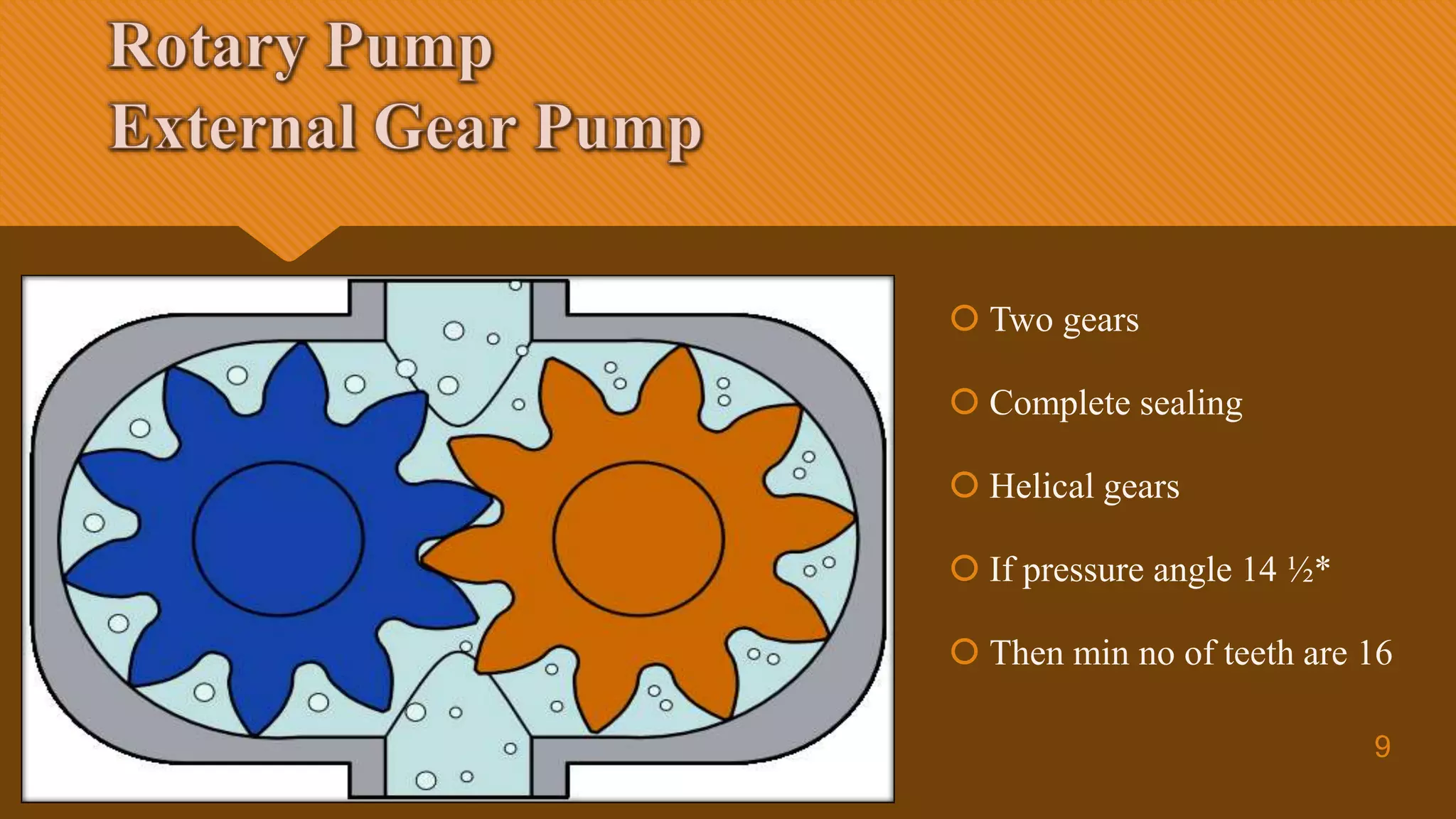
 Two gears
 Complete sealing
 Helical gears
 If pressure angle 14 ½*
 Then min no of teeth are 16
9
 Various fuel oils
 Chemical additive and polymer metering
 Chemical mixing and blending (double pump)
 Industrial and mobile hydraulic applications (log splitters, lifts, etc.)
 Acids and caustic (stainless steel or composite construction)
 Low volume transfer or application
10
 Two gears & one Cresent
 Pressure up to 350bar
 Less noise
Drive Gear
Inlet Cam
Driven Gear
Delivery
11
 All varieties of fuel oil
 Resins and Polymers, Alcohols and solvents
 Polyurethane foam (Isocyanate and polyol)
 Food products such as chocolate, and peanut butter
 Paint, inks, and pigments
 Soaps and surfactants, Glycol
12
 Outer gear idler
 Outer Gerotor has one tooth more
 Axis offset
 Rev = inner teeth/outer teeth
 Pressure 125bar
 If not precise leakage
 Compact compare to ext. pump
13
 More quantity of oil at low pressure
14
 Polymers, Paper coatings
 Soaps and surfactants
 Paints and dyes
 Rubber and adhesives
 Pharmaceuticals
 Food applications
15
16
 Aerosol and Propellants, Refrigeration Coolants
 Aviation Service - Fuel Transfer, Deicing
 Auto Industry - Fuels, Lubes
 Bulk Transfer of LPG and NH3, Aqueous solutions
 LPG Cylinder Filling, Alcohols, Solvents
 Refrigeration - Freons, Ammonia 17
Elastomer Stator Universal Coupling
Single Screw Rotor
18
19
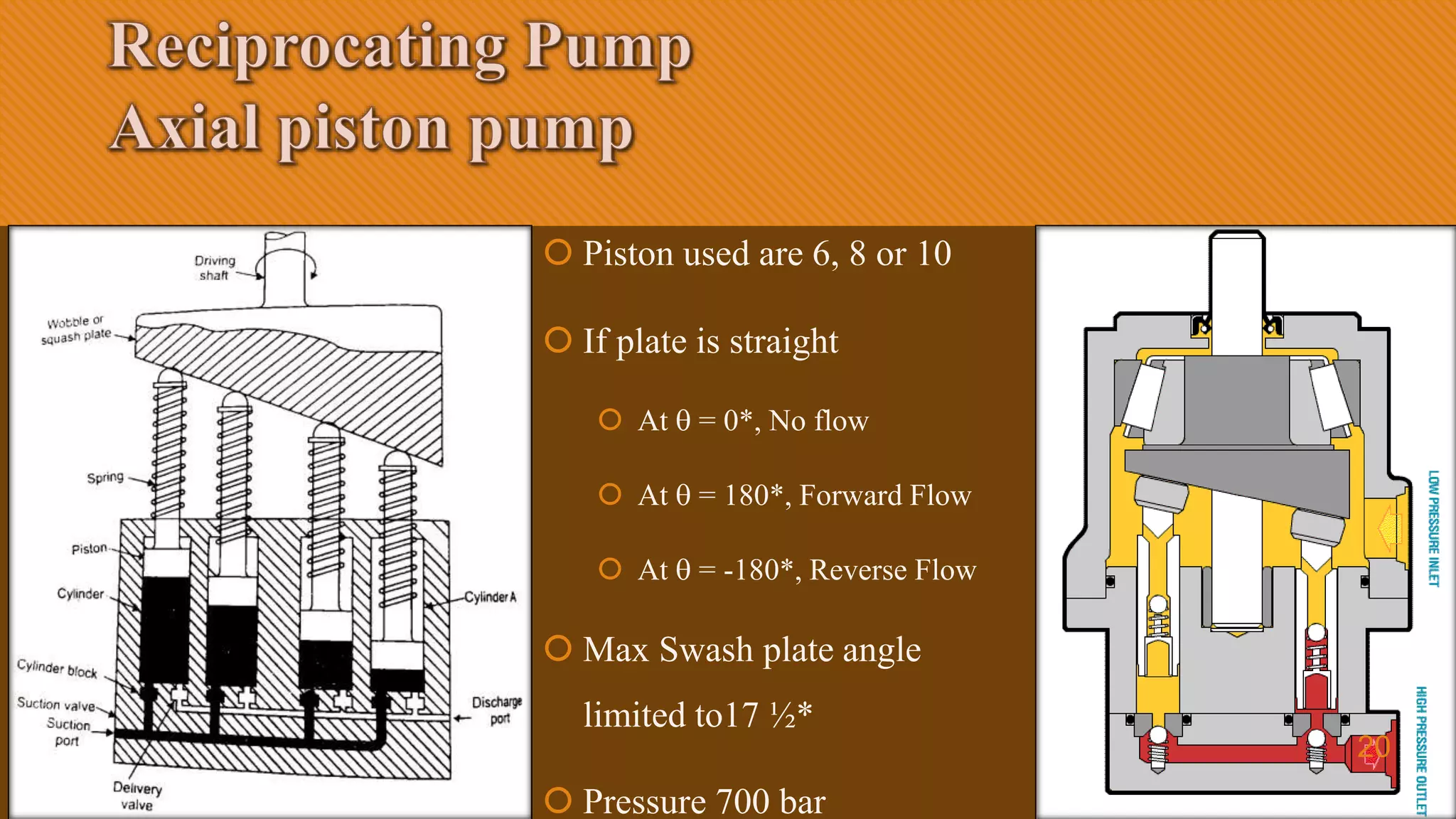
 Piston used are 6, 8 or 10
 If plate is straight
 At  = 0*, No flow
 At  = 180*, Forward Flow
 At  = -180*, Reverse Flow
 Max Swash plate angle
limited to17 ½*
 Pressure 700 bar
20
21
22
Sr. No. Pump Pressure (bar) Efficiency (%)
1 External gear pump 300 60
2 Internal gear pump 350 85
3 Fixed vane pump 175 75
4 Variable vane pump 125 85
5 Screw pump 175 75
6 Axial piston pump 700 85
7 Bent axis pump 700 90
23
 Following things studied during session
 Pump and its function
 Classification
 Construction of various types of pump
 Working of various types of pump
 Application of various types of pump
 Pressure Range & Efficiency
24
Any Questions???
25

Positive Displacement Pumps : Hydraulics

  • 1.
    - Virag ATimbadia 1
  • 2.
     Introduction  Types& Application  Explanation Of Each Type  Pressure Range 2
  • 3.
     Define Pump State Various Types Of Pump  Explain Construction & Working Of Pump  Enlist Applications Of Various Types Of Pump  State Pressure Range 3
  • 4.
     Pump isa device used  To move fluids (liquids or gases)  Increases the mechanical energy of the fluid  It acts as a Heart  Link between reservoir and control valve 4
  • 5.
    Pump Positive displacement Rotary Gear External Internal Gerotor Lobe Vane Fixeddisplacement Unbalanced vane Balanced vane Variable displacement Screw Single (Mono) Twin Reciprocating Axial piston In line Variable plate Inclinable swash plate Cam/crank shaft driven piston pump Bent axis Radial piston Stationary cylinder block Rotating cylinder block Non-Positive displacement / Rotodynamic centrifugal Axial Flow Radial Flow 5
  • 6.
     Pumping volumechanges  From maximum to minimum during each cycle  Advantages of Hydrostatic  Widely used & generate high pressure  Small in size & high (power/weight)  High volumetric efficiency  Flexibility of performance (N = p ≠ Constant) 6
  • 7.
     Fluid displacedusing fluid (motion) inertia  Low pressure (rarely used as p < 40kg/cm2)  Advantages of Hydro dynamic  Initial & maintenance cost is less  Simplicity of operation & operated quietly  High reliability  Capable of handling any type of fluid 7
  • 8.
     Uses themeshing gears to displace fluid  Can be classified as  External gear pump  Internal gear pump  Gerotor pump 8
  • 9.
     Two gears Complete sealing  Helical gears  If pressure angle 14 ½*  Then min no of teeth are 16 9
  • 10.
     Various fueloils  Chemical additive and polymer metering  Chemical mixing and blending (double pump)  Industrial and mobile hydraulic applications (log splitters, lifts, etc.)  Acids and caustic (stainless steel or composite construction)  Low volume transfer or application 10
  • 11.
     Two gears& one Cresent  Pressure up to 350bar  Less noise Drive Gear Inlet Cam Driven Gear Delivery 11
  • 12.
     All varietiesof fuel oil  Resins and Polymers, Alcohols and solvents  Polyurethane foam (Isocyanate and polyol)  Food products such as chocolate, and peanut butter  Paint, inks, and pigments  Soaps and surfactants, Glycol 12
  • 13.
     Outer gearidler  Outer Gerotor has one tooth more  Axis offset  Rev = inner teeth/outer teeth  Pressure 125bar  If not precise leakage  Compact compare to ext. pump 13
  • 14.
     More quantityof oil at low pressure 14
  • 15.
     Polymers, Papercoatings  Soaps and surfactants  Paints and dyes  Rubber and adhesives  Pharmaceuticals  Food applications 15
  • 16.
  • 17.
     Aerosol andPropellants, Refrigeration Coolants  Aviation Service - Fuel Transfer, Deicing  Auto Industry - Fuels, Lubes  Bulk Transfer of LPG and NH3, Aqueous solutions  LPG Cylinder Filling, Alcohols, Solvents  Refrigeration - Freons, Ammonia 17
  • 18.
    Elastomer Stator UniversalCoupling Single Screw Rotor 18
  • 19.
  • 20.
     Piston usedare 6, 8 or 10  If plate is straight  At  = 0*, No flow  At  = 180*, Forward Flow  At  = -180*, Reverse Flow  Max Swash plate angle limited to17 ½*  Pressure 700 bar 20
  • 21.
  • 22.
  • 23.
    Sr. No. PumpPressure (bar) Efficiency (%) 1 External gear pump 300 60 2 Internal gear pump 350 85 3 Fixed vane pump 175 75 4 Variable vane pump 125 85 5 Screw pump 175 75 6 Axial piston pump 700 85 7 Bent axis pump 700 90 23
  • 24.
     Following thingsstudied during session  Pump and its function  Classification  Construction of various types of pump  Working of various types of pump  Application of various types of pump  Pressure Range & Efficiency 24
  • 25.