POSITIONING TERRITORIES
CONCEPT
2
Our perceptions are selective and our memory is highly selective. Harvard
psychologist George Miller proposed that only seven ‘chunks’ of
information, like seven brands in a category, can easily be held in short-
term memory. Therefore, the importance of good brand positioning is
crucial for the success of a business.
Positioning is about defining that single thought or idea you want to own
and then focusing on owning it. This strongest and most persuasive
thought in the customers mind must be true to you, relevant to your
audience and must make it difficult for your competition to compete.
Most businesses talk about the same things and forget to mention the
things that make them truly different. If you’re competing with a giant in
your category and talk about the same things, you’ll lose.
3
PRICE -THE CHEAPEST OR BESTVALUE
Coles and Walmart focus on the price or value that
they offer. The words ‘save everyday’ and ‘always low
prices’ are the most persuasive thoughts in the
customer’s mind when they think of the brand.
NB: This was one of Michael Porter’s famous strategy
choices of price leader vs. value differentiation.
4
SIZE -THE MOST
This positioning territory of size focuses on the large
range of products or services the brand offers. It is
the aim of this territory to fix ‘range’ into the
consumer’s mind, so if breadth of choice is the need,
then they’re the brand that springs in to mind.
5
SIZE -THE LARGEST
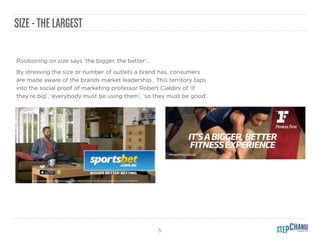
Positioning on size says ‘the bigger, the better’.
By stressing the size or number of outlets a brand has, consumers
are made aware of the brands market leadership. This territory taps
into the social proof of marketing professor Robert Cialdini of ‘if
they’re big’, ‘everybody must be using them’, ‘so they must be good’.
6
FIRST - WEARETHE ORIGINAL
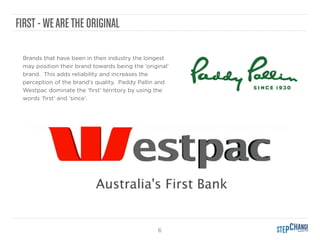
Brands that have been in their industry the longest
may position their brand towards being the ‘original’
brand. This adds reliability and increases the
perception of the brand’s quality. Paddy Pallin and
Westpac dominate the ‘first’ territory by using the
words ‘first’ and ‘since’.
7
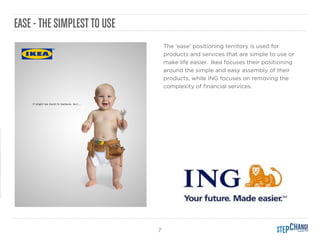
EASE -THE SIMPLESTTO USE
The ‘ease’ positioning territory is used for
products and services that are simple to use or
make life easier. Ikea focuses their positioning
around the simple and easy assembly of their
products, while ING focuses on removing the
complexity of financial services.
8
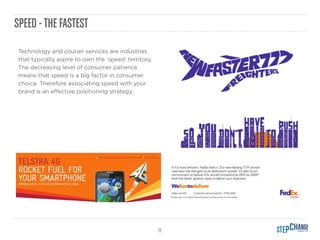
SPEED -THE FASTEST
Technology and courier services are industries
that typically aspire to own the ‘speed’ territory.
The decreasing level of consumer patience
means that speed is a big factor in consumer
choice. Therefore associating speed with your
brand is an effective positioning strategy.
9
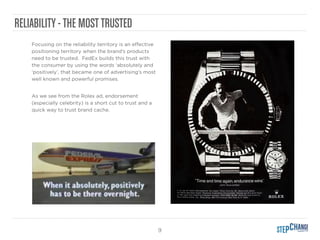
RELIABILITY-THE MOSTTRUSTED
Focusing on the reliability territory is an effective
positioning territory when the brand’s products
need to be trusted. FedEx builds this trust with
the consumer by using the words ‘absolutely and
‘positively’, that became one of advertising’s most
well known and powerful promises.
As we see from the Rolex ad, endorsement
(especially celebrity) is a short cut to trust and a
quick way to trust brand cache.
10
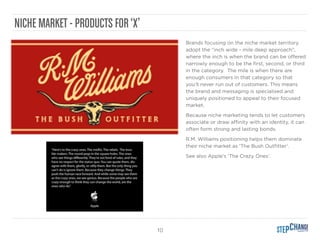
NICHE MARKET - PRODUCTS FOR‘X’
Brands focusing on the niche market territory
adopt the “inch wide - mile deep approach”,
where the inch is when the brand can be offered
narrowly enough to be the first, second, or third
in the category. The mile is when there are
enough consumers in that category so that
you’ll never run out of customers. This means
the brand and messaging is specialised and
uniquely positioned to appeal to their focused
market.
Because niche marketing tends to let customers
associate or draw affinity with an identity, it can
often form strong and lasting bonds.
R.M. Williams positioning helps them dominate
their niche market as ‘The Bush Outfitter’.
See also Apple’s ‘The Crazy Ones’.
11
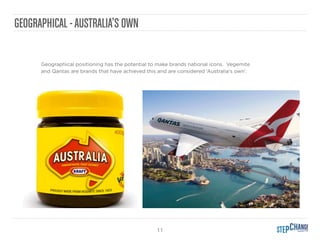
GEOGRAPHICAL -AUSTRALIA’S OWN
Geographical positioning has the potential to make brands national icons. Vegemite
and Qantas are brands that have achieved this and are considered ‘Australia's own’.
12
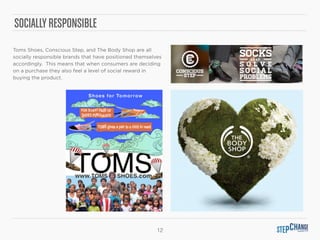
SOCIALLYRESPONSIBLE
Toms Shoes, Conscious Step, and The Body Shop are all
socially responsible brands that have positioned themselves
accordingly. This means that when consumers are deciding
on a purchase they also feel a level of social reward in
buying the product.
13
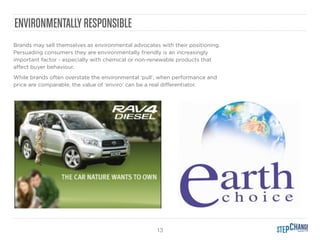
ENVIRONMENTALLYRESPONSIBLE
Brands may sell themselves as environmental advocates with their positioning.
Persuading consumers they are environmentally friendly is an increasingly
important factor - especially with chemical or non-renewable products that
affect buyer behaviour.
While brands often overstate the environmental ‘pull’, when performance and
price are comparable, the value of ‘enviro’ can be a real differentiator.
14
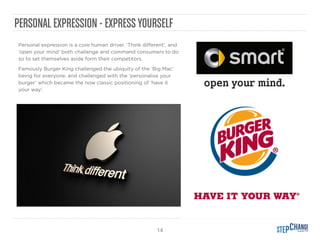
PERSONAL EXPRESSION - EXPRESSYOURSELF
Personal expression is a core human driver. ‘Think different’, and
‘open your mind’ both challenge and command consumers to do
so to set themselves aside form their competitors.
Famously Burger King challenged the ubiquity of the ‘Big Mac’
being for everyone, and challenged with the ‘personalise your
burger’ which became the now classic positioning of ‘have it
your way’.
15
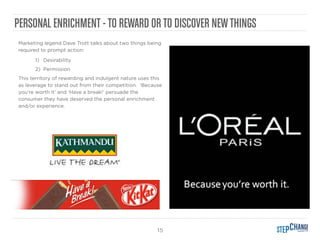
PERSONAL ENRICHMENT -TO REWARD ORTO DISCOVER NEWTHINGS
Marketing legend Dave Trott talks about two things being
required to prompt action:
1) Desirability
2) Permission
This territory of rewarding and indulgent nature uses this
as leverage to stand out from their competition. ‘Because
you’re worth it’ and ‘Have a break!’ persuade the
consumer they have deserved the personal enrichment
and/or experience.
16
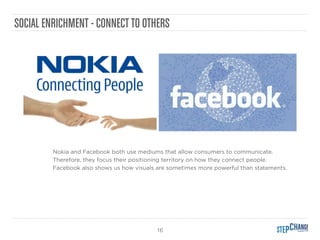
SOCIAL ENRICHMENT - CONNECTTO OTHERS
Nokia and Facebook both use mediums that allow consumers to communicate.
Therefore, they focus their positioning territory on how they connect people.
Facebook also shows us how visuals are sometimes more powerful than statements.
17
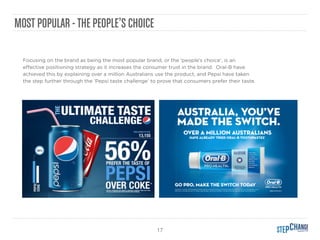
MOST POPULAR -THE PEOPLE’S CHOICE
Focusing on the brand as being the most popular brand, or the ‘people’s choice’, is an
effective positioning strategy as it increases the consumer trust in the brand. Oral-B have
achieved this by explaining over a million Australians use the product, and Pepsi have taken
the step further through the ‘Pepsi taste challenge’ to prove that consumers prefer their taste.
18
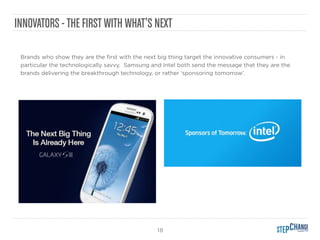
INNOVATORS -THE FIRST WITH WHAT’S NEXT
Brands who show they are the first with the next big thing target the innovative consumers - in
particular the technologically savvy. Samsung and Intel both send the message that they are the
brands delivering the breakthrough technology, or rather ‘sponsoring tomorrow’.
19
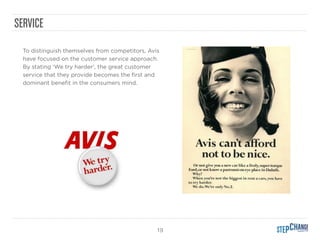
SERVICE
To distinguish themselves from competitors, Avis
have focused on the customer service approach.
By stating ‘We try harder’, the great customer
service that they provide becomes the first and
dominant benefit in the consumers mind.
20
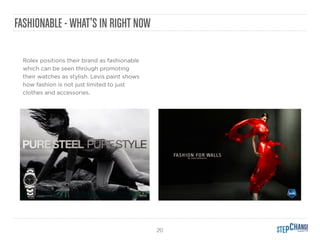
FASHIONABLE - WHAT’S IN RIGHT NOW
Rolex positions their brand as fashionable
which can be seen through promoting
their watches as stylish. Levis paint shows
how fashion is not just limited to just
clothes and accessories.
21
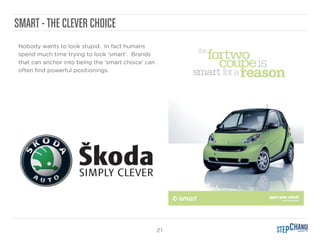
SMART -THE CLEVER CHOICE
Nobody wants to look stupid. In fact humans
spend much time trying to look ‘smart’. Brands
that can anchor into being the ‘smart choice’ can
often find powerful positionings.
22
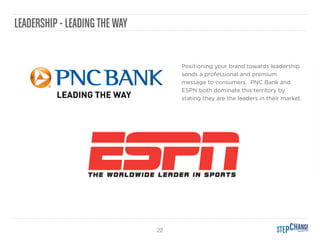
LEADERSHIP - LEADINGTHE WAY
Positioning your brand towards leadership
sends a professional and premium
message to consumers. PNC Bank and
ESPN both dominate this territory by
stating they are the leaders in their market.
23
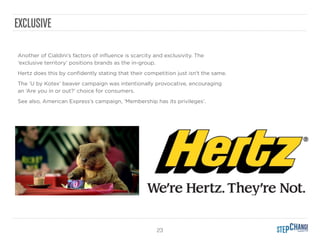
Another of Cialdini’s factors of influence is scarcity and exclusivity. The
‘exclusive territory’ positions brands as the in-group.
Hertz does this by confidently stating that their competition just isn't the same.
The ‘U by Kotex’ beaver campaign was intentionally provocative, encouraging
an ‘Are you in or out?’ choice for consumers.
See also, American Express’s campaign, ‘Membership has its privileges’.
EXCLUSIVE
24
TRADITION
People often exhibit revisionist’s history,
where they recall the past as far more
favourable and enjoyable than it actually
was. Brands that understand this can
benefit from these positive associations.
Good old fashioned values are focused
on within the ‘tradition’ territory.
Wendy’s burgers are a classic example
of this.
25
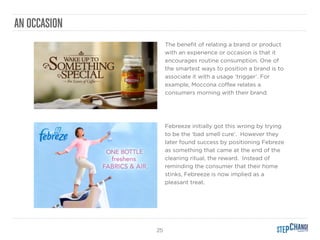
AN OCCASION
The benefit of relating a brand or product
with an experience or occasion is that it
encourages routine consumption. One of
the smartest ways to position a brand is to
associate it with a usage ‘trigger’. For
example, Moccona coffee relates a
consumers morning with their brand.
!
!
Febreeze initially got this wrong by trying
to be the ‘bad smell cure’. However they
later found success by positioning Febreze
as something that came at the end of the
cleaning ritual, the reward. Instead of
reminding the consumer that their home
stinks, Febreeze is now implied as a
pleasant treat.

23 of the world's most effective Positioning Territories

  • 1.
  • 2.
    CONCEPT 2 Our perceptions areselective and our memory is highly selective. Harvard psychologist George Miller proposed that only seven ‘chunks’ of information, like seven brands in a category, can easily be held in short- term memory. Therefore, the importance of good brand positioning is crucial for the success of a business. Positioning is about defining that single thought or idea you want to own and then focusing on owning it. This strongest and most persuasive thought in the customers mind must be true to you, relevant to your audience and must make it difficult for your competition to compete. Most businesses talk about the same things and forget to mention the things that make them truly different. If you’re competing with a giant in your category and talk about the same things, you’ll lose.
  • 3.
    3 PRICE -THE CHEAPESTOR BESTVALUE Coles and Walmart focus on the price or value that they offer. The words ‘save everyday’ and ‘always low prices’ are the most persuasive thoughts in the customer’s mind when they think of the brand. NB: This was one of Michael Porter’s famous strategy choices of price leader vs. value differentiation.
  • 4.
    4 SIZE -THE MOST Thispositioning territory of size focuses on the large range of products or services the brand offers. It is the aim of this territory to fix ‘range’ into the consumer’s mind, so if breadth of choice is the need, then they’re the brand that springs in to mind.
  • 5.
    5 SIZE -THE LARGEST Positioningon size says ‘the bigger, the better’. By stressing the size or number of outlets a brand has, consumers are made aware of the brands market leadership. This territory taps into the social proof of marketing professor Robert Cialdini of ‘if they’re big’, ‘everybody must be using them’, ‘so they must be good’.
  • 6.
    6 FIRST - WEARETHEORIGINAL Brands that have been in their industry the longest may position their brand towards being the ‘original’ brand. This adds reliability and increases the perception of the brand’s quality. Paddy Pallin and Westpac dominate the ‘first’ territory by using the words ‘first’ and ‘since’.
  • 7.
    7 EASE -THE SIMPLESTTOUSE The ‘ease’ positioning territory is used for products and services that are simple to use or make life easier. Ikea focuses their positioning around the simple and easy assembly of their products, while ING focuses on removing the complexity of financial services.
  • 8.
    8 SPEED -THE FASTEST Technologyand courier services are industries that typically aspire to own the ‘speed’ territory. The decreasing level of consumer patience means that speed is a big factor in consumer choice. Therefore associating speed with your brand is an effective positioning strategy.
  • 9.
    9 RELIABILITY-THE MOSTTRUSTED Focusing onthe reliability territory is an effective positioning territory when the brand’s products need to be trusted. FedEx builds this trust with the consumer by using the words ‘absolutely and ‘positively’, that became one of advertising’s most well known and powerful promises. As we see from the Rolex ad, endorsement (especially celebrity) is a short cut to trust and a quick way to trust brand cache.
  • 10.
    10 NICHE MARKET -PRODUCTS FOR‘X’ Brands focusing on the niche market territory adopt the “inch wide - mile deep approach”, where the inch is when the brand can be offered narrowly enough to be the first, second, or third in the category. The mile is when there are enough consumers in that category so that you’ll never run out of customers. This means the brand and messaging is specialised and uniquely positioned to appeal to their focused market. Because niche marketing tends to let customers associate or draw affinity with an identity, it can often form strong and lasting bonds. R.M. Williams positioning helps them dominate their niche market as ‘The Bush Outfitter’. See also Apple’s ‘The Crazy Ones’.
  • 11.
    11 GEOGRAPHICAL -AUSTRALIA’S OWN Geographicalpositioning has the potential to make brands national icons. Vegemite and Qantas are brands that have achieved this and are considered ‘Australia's own’.
  • 12.
    12 SOCIALLYRESPONSIBLE Toms Shoes, ConsciousStep, and The Body Shop are all socially responsible brands that have positioned themselves accordingly. This means that when consumers are deciding on a purchase they also feel a level of social reward in buying the product.
  • 13.
    13 ENVIRONMENTALLYRESPONSIBLE Brands may sellthemselves as environmental advocates with their positioning. Persuading consumers they are environmentally friendly is an increasingly important factor - especially with chemical or non-renewable products that affect buyer behaviour. While brands often overstate the environmental ‘pull’, when performance and price are comparable, the value of ‘enviro’ can be a real differentiator.
  • 14.
    14 PERSONAL EXPRESSION -EXPRESSYOURSELF Personal expression is a core human driver. ‘Think different’, and ‘open your mind’ both challenge and command consumers to do so to set themselves aside form their competitors. Famously Burger King challenged the ubiquity of the ‘Big Mac’ being for everyone, and challenged with the ‘personalise your burger’ which became the now classic positioning of ‘have it your way’.
  • 15.
    15 PERSONAL ENRICHMENT -TOREWARD ORTO DISCOVER NEWTHINGS Marketing legend Dave Trott talks about two things being required to prompt action: 1) Desirability 2) Permission This territory of rewarding and indulgent nature uses this as leverage to stand out from their competition. ‘Because you’re worth it’ and ‘Have a break!’ persuade the consumer they have deserved the personal enrichment and/or experience.
  • 16.
    16 SOCIAL ENRICHMENT -CONNECTTO OTHERS Nokia and Facebook both use mediums that allow consumers to communicate. Therefore, they focus their positioning territory on how they connect people. Facebook also shows us how visuals are sometimes more powerful than statements.
  • 17.
    17 MOST POPULAR -THEPEOPLE’S CHOICE Focusing on the brand as being the most popular brand, or the ‘people’s choice’, is an effective positioning strategy as it increases the consumer trust in the brand. Oral-B have achieved this by explaining over a million Australians use the product, and Pepsi have taken the step further through the ‘Pepsi taste challenge’ to prove that consumers prefer their taste.
  • 18.
    18 INNOVATORS -THE FIRSTWITH WHAT’S NEXT Brands who show they are the first with the next big thing target the innovative consumers - in particular the technologically savvy. Samsung and Intel both send the message that they are the brands delivering the breakthrough technology, or rather ‘sponsoring tomorrow’.
  • 19.
    19 SERVICE To distinguish themselvesfrom competitors, Avis have focused on the customer service approach. By stating ‘We try harder’, the great customer service that they provide becomes the first and dominant benefit in the consumers mind.
  • 20.
    20 FASHIONABLE - WHAT’SIN RIGHT NOW Rolex positions their brand as fashionable which can be seen through promoting their watches as stylish. Levis paint shows how fashion is not just limited to just clothes and accessories.
  • 21.
    21 SMART -THE CLEVERCHOICE Nobody wants to look stupid. In fact humans spend much time trying to look ‘smart’. Brands that can anchor into being the ‘smart choice’ can often find powerful positionings.
  • 22.
    22 LEADERSHIP - LEADINGTHEWAY Positioning your brand towards leadership sends a professional and premium message to consumers. PNC Bank and ESPN both dominate this territory by stating they are the leaders in their market.
  • 23.
    23 Another of Cialdini’sfactors of influence is scarcity and exclusivity. The ‘exclusive territory’ positions brands as the in-group. Hertz does this by confidently stating that their competition just isn't the same. The ‘U by Kotex’ beaver campaign was intentionally provocative, encouraging an ‘Are you in or out?’ choice for consumers. See also, American Express’s campaign, ‘Membership has its privileges’. EXCLUSIVE
  • 24.
    24 TRADITION People often exhibitrevisionist’s history, where they recall the past as far more favourable and enjoyable than it actually was. Brands that understand this can benefit from these positive associations. Good old fashioned values are focused on within the ‘tradition’ territory. Wendy’s burgers are a classic example of this.
  • 25.
    25 AN OCCASION The benefitof relating a brand or product with an experience or occasion is that it encourages routine consumption. One of the smartest ways to position a brand is to associate it with a usage ‘trigger’. For example, Moccona coffee relates a consumers morning with their brand. ! ! Febreeze initially got this wrong by trying to be the ‘bad smell cure’. However they later found success by positioning Febreze as something that came at the end of the cleaning ritual, the reward. Instead of reminding the consumer that their home stinks, Febreeze is now implied as a pleasant treat.