SBRT LUNG
Dr Kanhu Charan Patro
MD,DNB(Radiation Oncology),MBA,FICRO,FAROI(USA),PDCR,CEPC
Clinical Director, HOD (Radiation Oncology)
ISRo- Institute of Stereotactic Radiation oncology
Mahatma Gandhi Cancer Hospital & Research Institute, Visakhapatnam
drkcpatro@gmail.com /M- +91-9160470564/ www.drkanhupatro.com
Let’s analyze INTERLACE
INTERLACE Trial
Induction Chemotherapy
followed by Chemoradiotherapy
vs Chemoradiotherapy Alone
INTRODUCTION
1. The INTERLACE trial investigates the effect of adding induction chemotherapy to
standard chemo-radiotherapy in locally advanced cervical cancer to improve
progression-free and overall survival.
2. Trial conducted at 32 medical centers globally, including Brazil, India, Italy, Mexico,
and the UK.
Which journal?
Lancet Oncology
Who is the author?
Multicentric
Which group?
INTERLACE GROUP
Where?
Multicentric
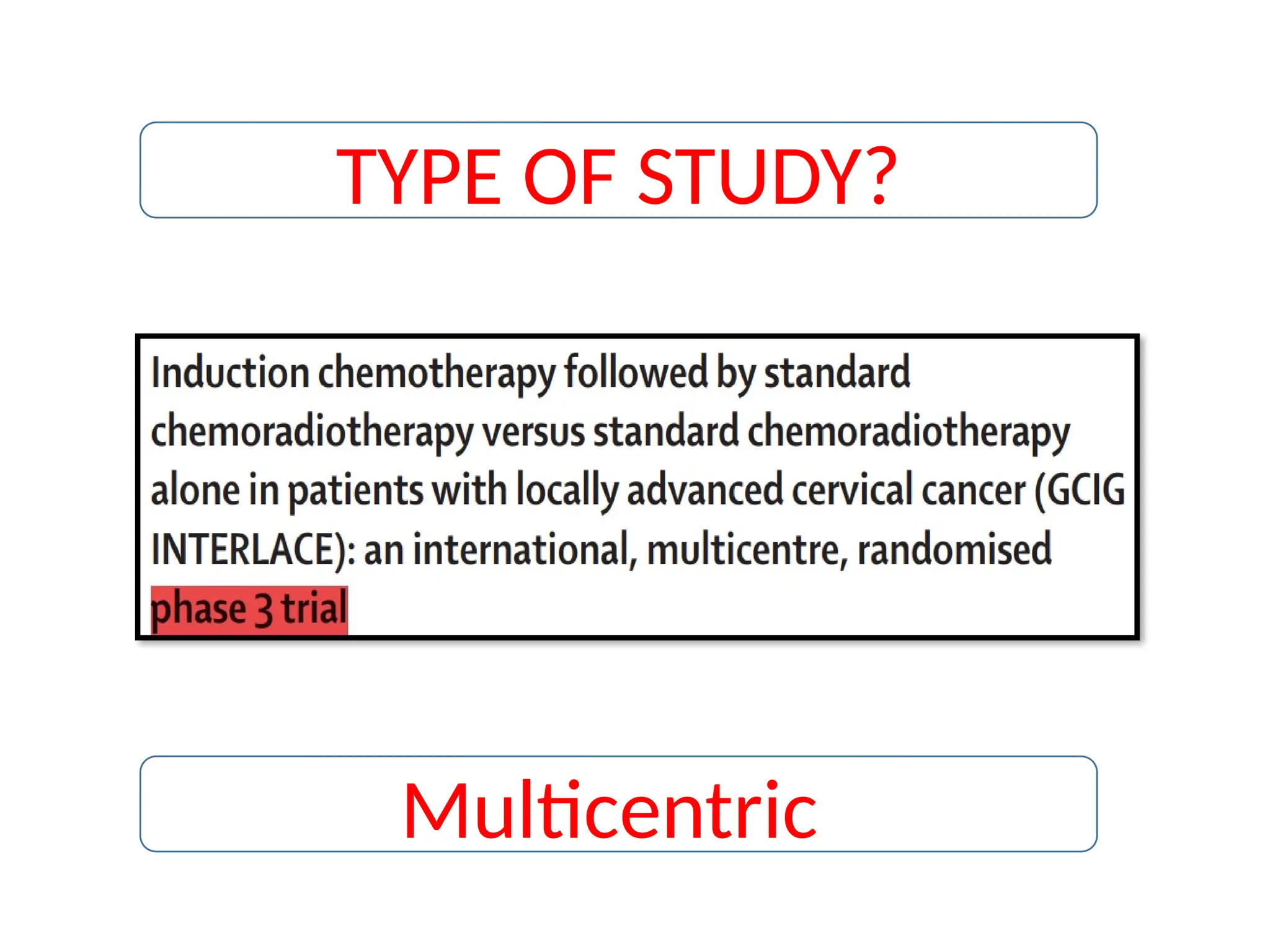
TYPE OF STUDY?
Multicentric
TYPE OF STUDY?
What is the basis of the study?
Metaanalysis/CXII study
Ethics adherence?
Funding?
Trial design
Inclusion and exclusion
Randomization
Trial profile
ITT
TREATMENT DETAILS
Study Design and Participants
• Study Population:
• Stage IB1 with nodal involvement to Stage IVA cervical
cancer (FIGO 2008 staging)
• Randomized Phase 3 trial with 500 patients
• Treatment arms:
• Induction chemotherapy (Carboplatin + Paclitaxel for 6
weeks) followed by chemoradiotherapy (cisplatin-based)
• Chemoradiotherapy alone (cisplatin-based)
Radiotherapy details
Follow up
End points
PRIMARY END POINTS
1. Progression-Free Survival (PFS): Time from randomization to progression
or death.
2. Overall Survival (OS): Time from randomization to death from any cause.
SECONDARY END POINTS
1. Adverse events (Grade 3–4 toxicity)
2. Patterns of relapse (local vs distant metastasis)
3. Quality of Life (QoL) assessed with EORTC QLQ-C30 and CX24 modules
Statistical analysis
Analysis
Study period
Demographic analysis
Adherence to chemotherapy
Adherence to radiotherapy
CENTRAL REVIEW
MEDIAN FOLLOW UP
KEY RESULTS
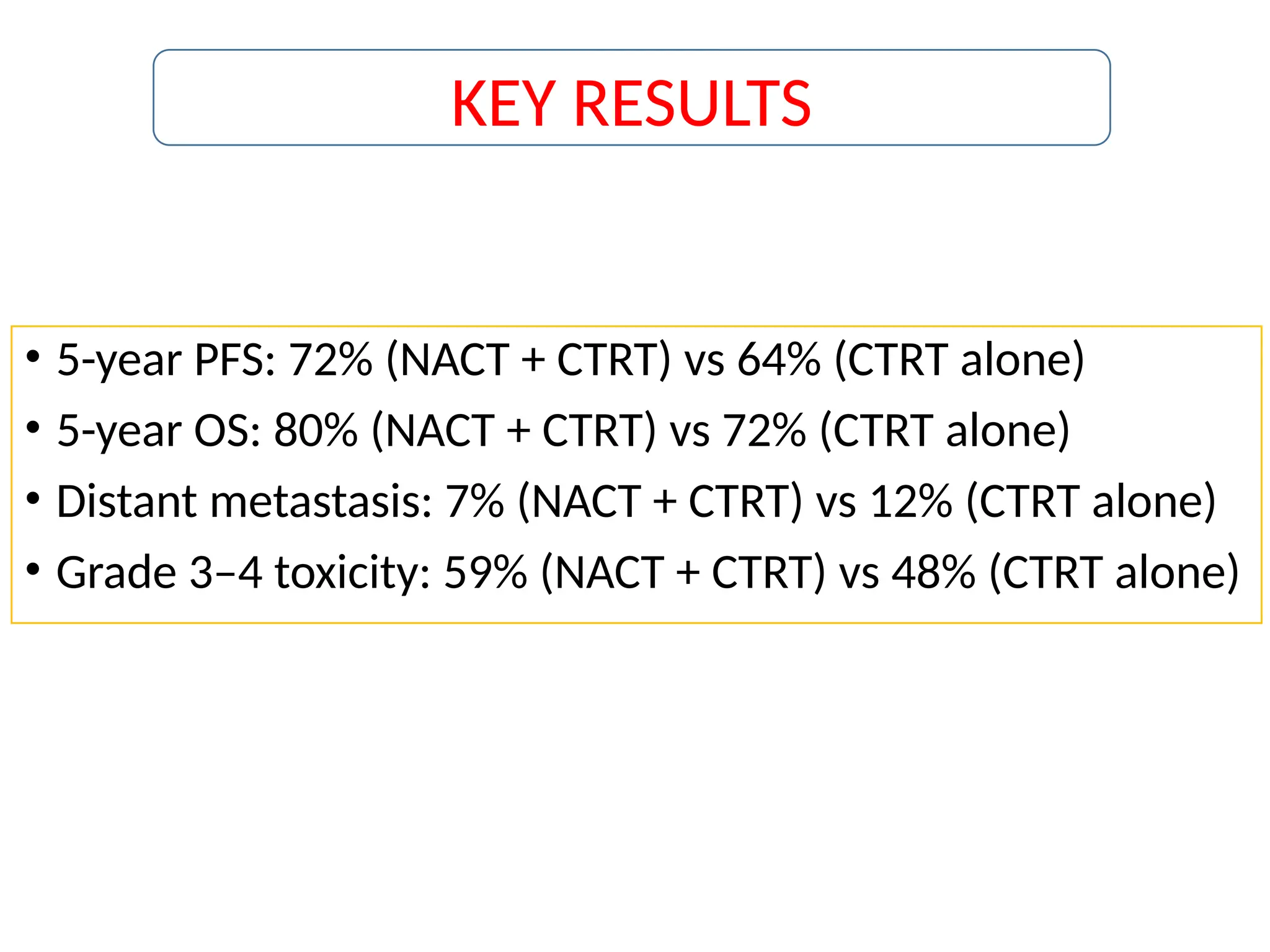
• 5-year PFS: 72% (NACT + CTRT) vs 64% (CTRT alone)
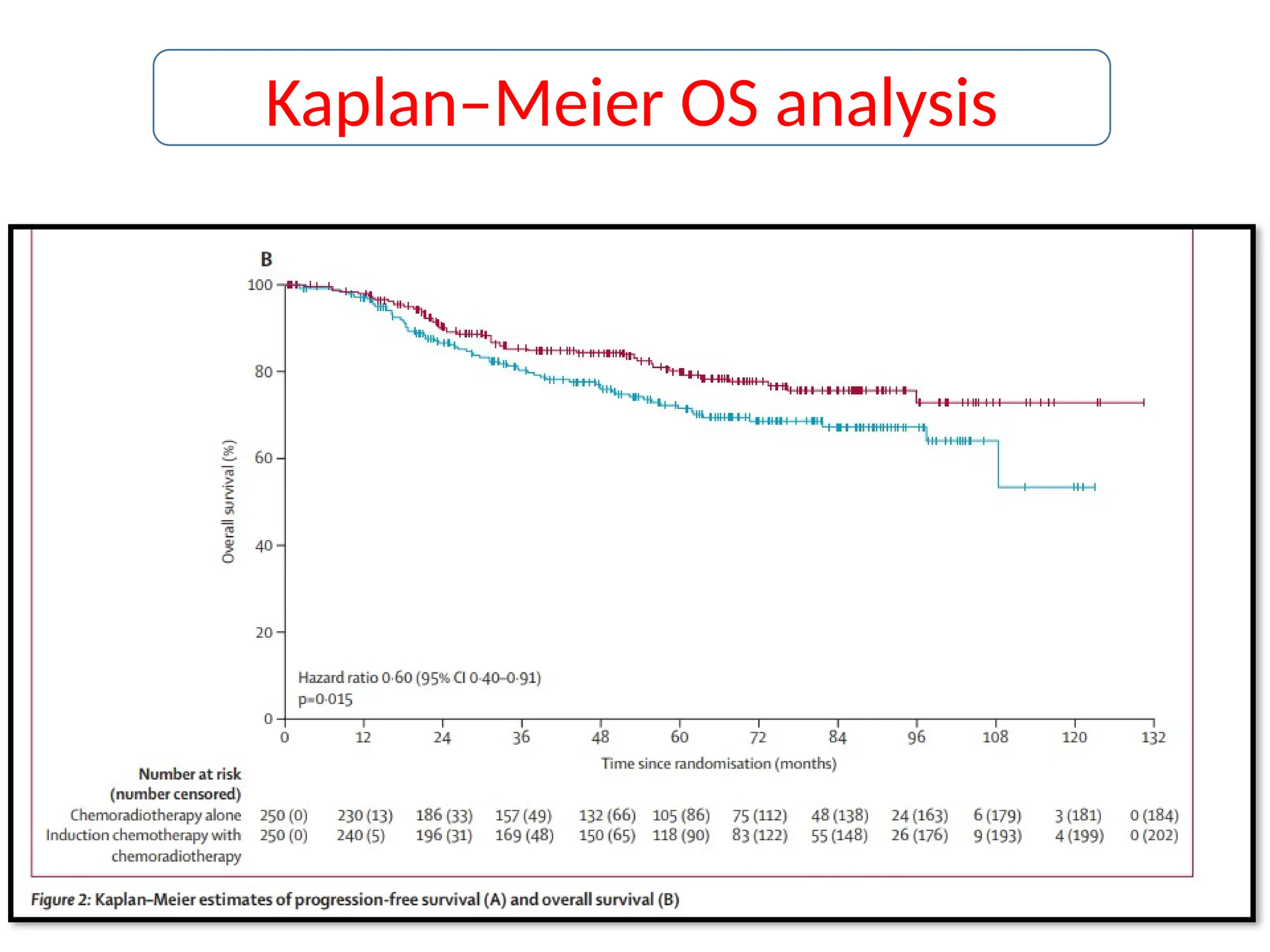
• 5-year OS: 80% (NACT + CTRT) vs 72% (CTRT alone)
• Distant metastasis: 7% (NACT + CTRT) vs 12% (CTRT alone)
• Grade 3–4 toxicity: 59% (NACT + CTRT) vs 48% (CTRT alone)
Kaplan–Meier PFS analysis
Kaplan–Meier OS analysis
Distance recurrence
Pa nodal recurrence
Adverse event analysis
TOXICITY
1. Higher hematological toxicity in NACT arm (30% Grade 3–4 vs 13% in CTRT arm)
2. Main toxicities: Neutropenia (19% vs 5%), Anemia (28% vs 17%)
3. Non-hematological toxicities were similar between both groups
DEATH
There were 3 deaths within 30 days of completing
treatment, one (respiratory failure) in the
induction chemotherapy with chemoradiotherapy
group, and 2 in the chemoradiotherapy alone
group (sepsis and pulmonary embolism); none
were considered treatment-related.
QOL
1.Temporary decline in QoL during
induction chemotherapy phase
2.No long-term differences between
the two groups after treatment
What are the criticisms?
Strong Points favoring the study
1. This is a phase 3 study
2. Electronic randomization of 500 patients.
3. It was a Multicentric study involving around 32 nations.
4. ITT analysis
5. Significance level at 0.05
6. Power is level at 80%
7. Central review of radiation details
Negative Points of the study
1. FIGO 2008 staging was used to stage the patient prior to allocating the
treatment arm.
2. Acute toxicity was higher in the NACT arm
3. Adherence to concurrent chemotherapy during radiotherapy was hindered in
the NACT arm, resulting in deviation from the standard of care treatment.
4. The increase in overall treatment time in the NACT arm is a concern.
5. Temporary decline in the QOL is present in the NACT arm.
6. 10 percent lost to follow up
Is it practice changing?
SUMMARY
1. NACT followed by CTRT showed improved progression-free and overall survival
compared to CTRT alone.
2. Increased toxicity in the NACT arm but manageable with standard care.
3. NACT + CTRT can be considered as a new standard of care for locally advanced
cervical cancer.
INTERLACE STUDY IN CERVIX CANCER ANALYSIS

INTERLACE STUDY IN CERVIX CANCER ANALYSIS