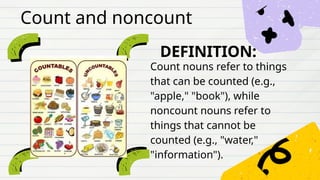
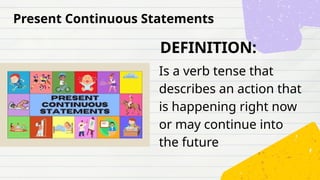
DEFINITION:
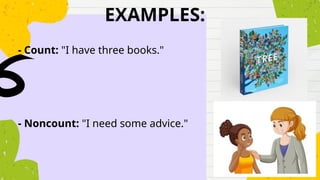
Count nouns referto things
that can be counted (e.g.,
"apple," "book"), while
noncount nouns refer to
things that cannot be
counted (e.g., "water,"
"information").
Count and noncount
5.
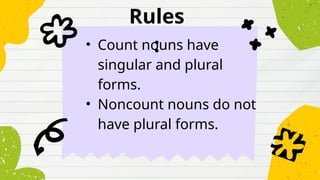
Rules
:
• Count nounshave
singular and plural
forms.
• Noncount nouns do not
have plural forms.
Rules
:
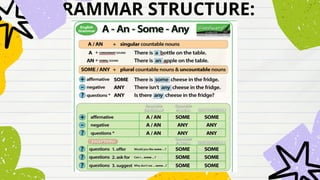
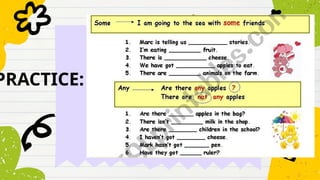
Rules for "Some"and "Any"
"Some" and "Any" are quantifiers used with countable and uncountable
nouns. They indicate an unspecified quantity or number.
1. "Some" (used in positive sentences)
Used in affirmative sentences.
Can be used with countable (plural) and uncountable nouns.
2. "Any" (used in negative sentences and questions)
Used in negative sentences and questions.
Can also be used with countable (plural) and uncountable nouns.
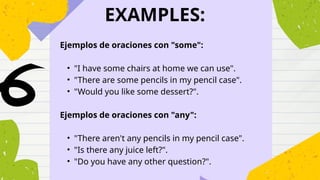
EXAMPLES:
Ejemplos de oracionescon "some":
• "I have some chairs at home we can use".
• "There are some pencils in my pencil case".
• "Would you like some dessert?".
Ejemplos de oraciones con "any":
• "There aren't any pencils in my pencil case".
• "Is there any juice left?".
• "Do you have any other question?".
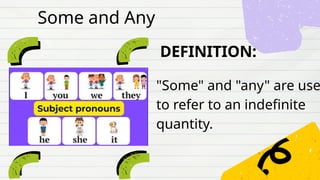
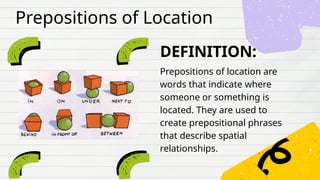
DEFINITION:
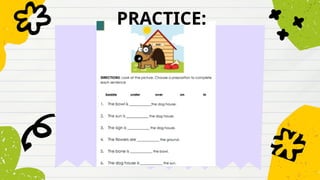
Prepositions of locationare
words that indicate where
someone or something is
located. They are used to
create prepositional phrases
that describe spatial
relationships.
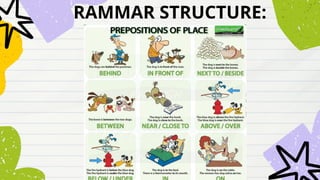
Prepositions of Location
17.
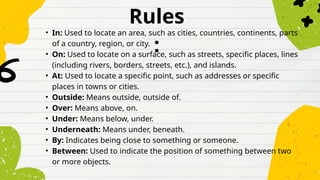
Rules
:
• In: Usedto locate an area, such as cities, countries, continents, parts
of a country, region, or city.
• On: Used to locate on a surface, such as streets, specific places, lines
(including rivers, borders, streets, etc.), and islands.
• At: Used to locate a specific point, such as addresses or specific
places in towns or cities.
• Outside: Means outside, outside of.
• Over: Means above, on.
• Under: Means below, under.
• Underneath: Means under, beneath.
• By: Indicates being close to something or someone.
• Between: Used to indicate the position of something between two
or more objects.
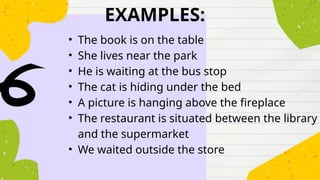
EXAMPLES:
• The bookis on the table
• She lives near the park
• He is waiting at the bus stop
• The cat is hiding under the bed
• A picture is hanging above the fireplace
• The restaurant is situated between the library
and the supermarket
• We waited outside the store
Rules
:
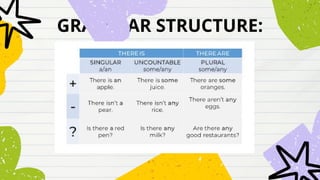
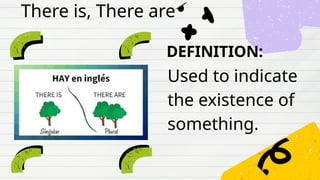
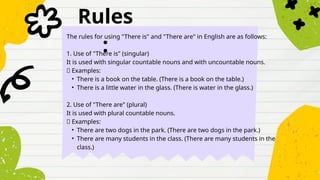
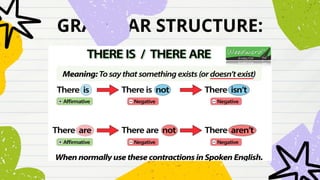
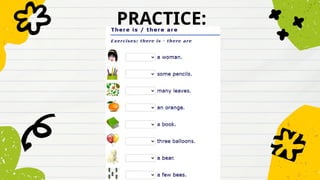
The rules forusing "There is" and "There are" in English are as follows:
1. Use of "There is" (singular)
It is used with singular countable nouns and with uncountable nouns.
✅ Examples:
• There is a book on the table. (There is a book on the table.)
• There is a little water in the glass. (There is water in the glass.)
2. Use of "There are" (plural)
It is used with plural countable nouns.
✅ Examples:
• There are two dogs in the park. (There are two dogs in the park.)
• There are many students in the class. (There are many students in the
class.)
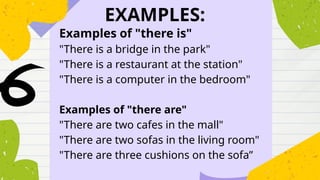
EXAMPLES:
Examples of "thereis"
"There is a bridge in the park"
"There is a restaurant at the station"
"There is a computer in the bedroom"
Examples of "there are"
"There are two cafes in the mall"
"There are two sofas in the living room"
"There are three cushions on the sofa”
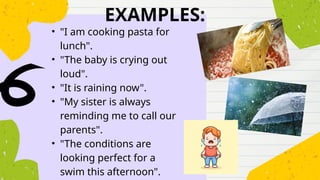
EXAMPLES:
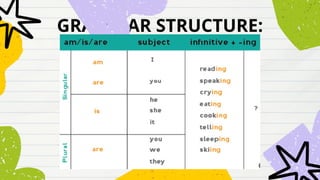
• "I amcooking pasta for
lunch".
• "The baby is crying out
loud".
• "It is raining now".
• "My sister is always
reminding me to call our
parents".
• "The conditions are
looking perfect for a
swim this afternoon".
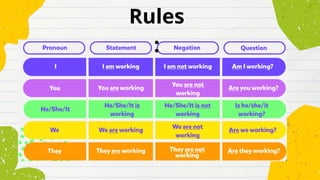
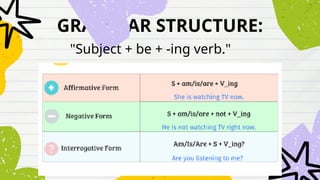
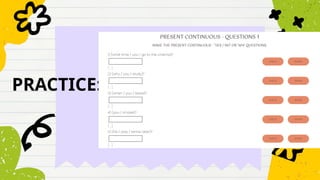
Rules
:
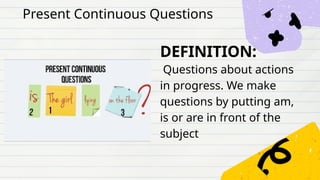
To form questionsin the
present continuous tense, you
can use the formula
"am/is/are" + subject + verb-
ing. For example, "Is she
working today?
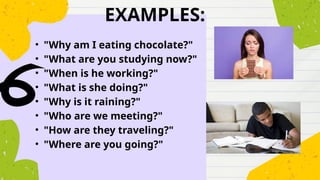
EXAMPLES:
• "Why amI eating chocolate?"
• "What are you studying now?"
• "When is he working?"
• "What is she doing?"
• "Why is it raining?"
• "Who are we meeting?"
• "How are they traveling?"
• "Where are you going?"
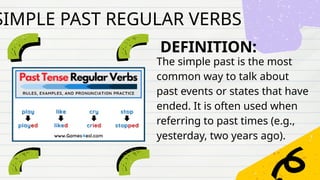
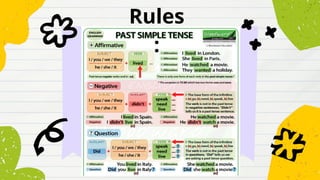
DEFINITION:
The simple pastis the most
common way to talk about
past events or states that have
ended. It is often used when
referring to past times (e.g.,
yesterday, two years ago).
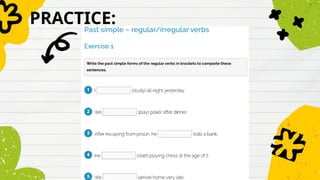
SIMPLE PAST REGULAR VERBS
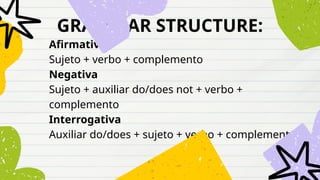
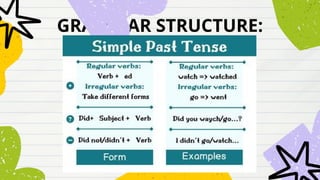
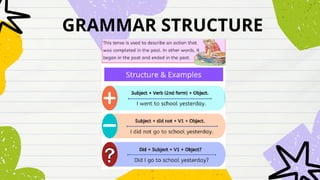
GRAMMAR STRUCTURE:
Afirmativa
Sujeto +verbo + complemento
Negativa
Sujeto + auxiliar do/does not + verbo +
complemento
Interrogativa
Auxiliar do/does + sujeto + verbo + complemento
43.
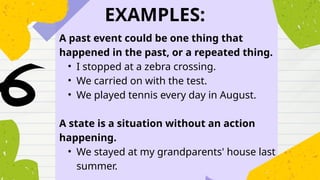
EXAMPLES:
A past eventcould be one thing that
happened in the past, or a repeated thing.
• I stopped at a zebra crossing.
• We carried on with the test.
• We played tennis every day in August.
A state is a situation without an action
happening.
• We stayed at my grandparents' house last
summer.
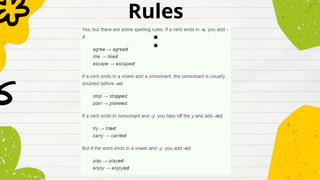
Rules
:
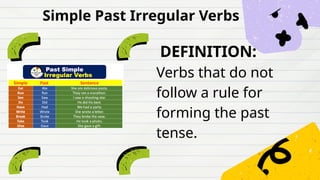
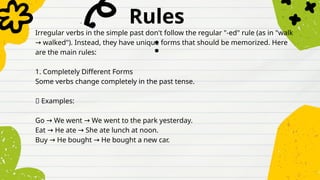
Irregular verbs inthe simple past don't follow the regular "-ed" rule (as in "walk
walked"). Instead, they have unique forms that should be memorized. Here
→
are the main rules:
1. Completely Different Forms
Some verbs change completely in the past tense.
✅ Examples:
Go We went We went to the park yesterday.
→ →
Eat He ate She ate lunch at noon.
→ →
Buy He bought He bought a new car.
→ →
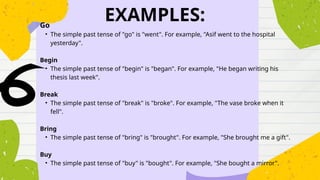
EXAMPLES:
Go
• The simplepast tense of "go" is "went". For example, "Asif went to the hospital
yesterday".
Begin
• The simple past tense of "begin" is "began". For example, "He began writing his
thesis last week".
Break
• The simple past tense of "break" is "broke". For example, "The vase broke when it
fell".
Bring
• The simple past tense of "bring" is "brought". For example, "She brought me a gift".
Buy
• The simple past tense of "buy" is "bought". For example, "She bought a mirror".
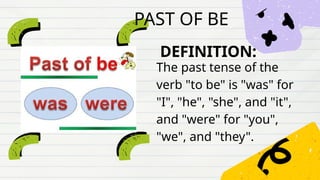
EXAMPLES:
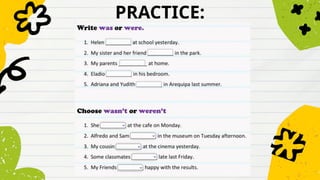
• I wasat my gran's house yesterday.
• You were in the garden yesterday.
• It was sunny yesterday.
• They were at the beach last weekend.
• I was not late for school this morning.
• I wasn't late for school this morning.
DEFINITION:
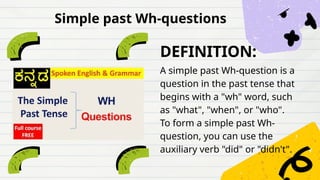
A simple pastWh-question is a
question in the past tense that
begins with a "wh" word, such
as "what", "when", or "who".
To form a simple past Wh-
question, you can use the
auxiliary verb "did" or "didn't".
Simple past Wh-questions
59.
Rules
:
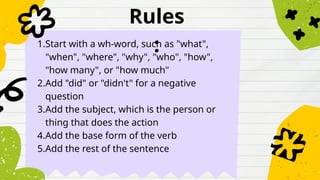
1.Start with awh-word, such as "what",
"when", "where", "why", "who", "how",
"how many", or "how much"
2.Add "did" or "didn't" for a negative
question
3.Add the subject, which is the person or
thing that does the action
4.Add the base form of the verb
5.Add the rest of the sentence
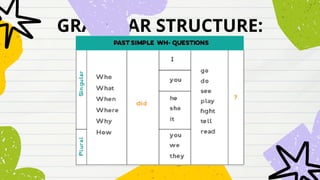
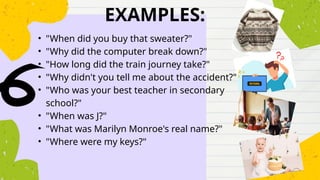
EXAMPLES:
• "When didyou buy that sweater?"
• "Why did the computer break down?"
• "How long did the train journey take?"
• "Why didn't you tell me about the accident?"
• "Who was your best teacher in secondary
school?"
• "When was J?"
• "What was Marilyn Monroe's real name?"
• "Where were my keys?"
DEFINITION:
Yes/no questions using
"begoing to" are used to
ask about future plans or
intentions. The answer to
these questions is either
"yes" or "no".
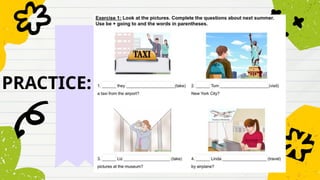
Be going to yes/no questions
65.
Rules
:
• How toform yes/no questions with
"be going to":
1.Start with "am", "is", or "are"
2.Choose a subject
3.Add "going to"
4.Add the base form of the verb
5.End with a question mark
66.
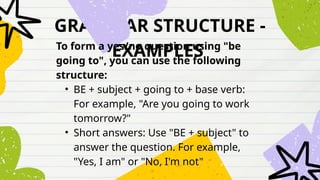
GRAMMAR STRUCTURE -
EXAMPLES
Toform a yes/no question using "be
going to", you can use the following
structure:
• BE + subject + going to + base verb:
For example, "Are you going to work
tomorrow?"
• Short answers: Use "BE + subject" to
answer the question. For example,
"Yes, I am" or "No, I'm not"
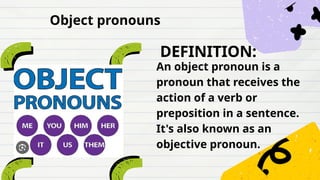
DEFINITION:
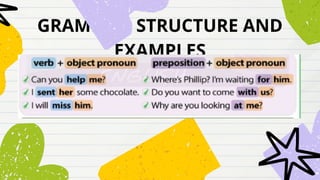
An object pronounis a
pronoun that receives the
action of a verb or
preposition in a sentence.
It's also known as an
objective pronoun.
Object pronouns
70.
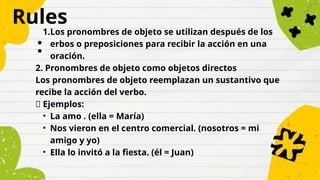
Rules
:
1.Los pronombres deobjeto se utilizan después de los
erbos o preposiciones para recibir la acción en una
oración.
2. Pronombres de objeto como objetos directos
Los pronombres de objeto reemplazan un sustantivo que
recibe la acción del verbo.
✅ Ejemplos:
• La amo . (ella = María)
• Nos vieron en el centro comercial. (nosotros = mi
amigo y yo)
• Ella lo invitó a la fiesta. (él = Juan)













![]English_Grammar_in_Use_-_4th_Edition.pdf](https://cdn.slidesharecdn.com/ss_thumbnails/3englishgrammarinuse-4thedition-230112125316-9f3c5264-thumbnail.jpg?width=640&height=640&fit=bounds)


