MSH 2012 - Mathematics for Semiconductor Heterostructures 
Berlin - September 27, 2012 
Multiscale Modeling of Heterojunction 
Organic Photovoltaic Devices 
Matteo Porro 
Dipartimento di Matematica Francesco Brioschi" 
Politecnico di Milano, Italy 
Center for Nano Science and Technology @PoliMi 
Istituto Italiano di Tecnologia, Italy 
email: matteo.porro@mail.polimi.it 
web: www1.mate.polimi.it/porro
Summary 
 Organic solar cells - A brief introduction 
 Mathematical model and multiscale approach 
 Numerical results 
 Beyond OSCs - Light harvesting capacitor and 
arti
cial retina 
Matteo Porro - Multiscale Modeling of Heterojunction Organic Photovoltaic Devices 2/22
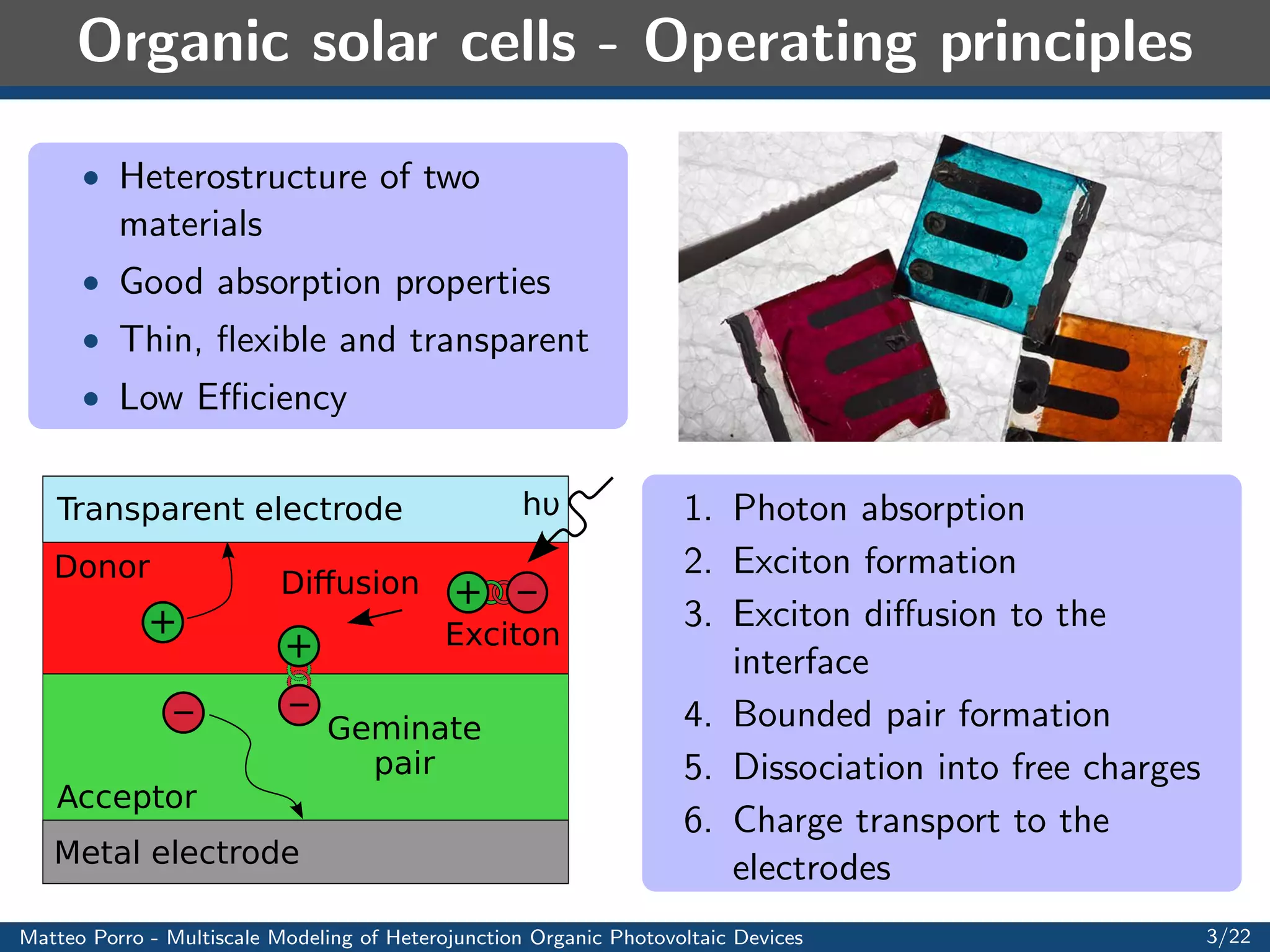
Organic solar cells - Operating principles 
 Heterostructure of two 
materials 
 Good absorption properties 
 Thin, 
exible and transparent 
 Low Eciency 
Transparent electrode 
Donor 
Acceptor 
+ 
Metal electrode 
+ 
hυ 1. Photon absorption 
_ 
_ 
+ 
_ 
Di usion 
Geminate 
pair 
Exciton 
2. Exciton formation 
3. Exciton diusion to the 
interface 
4. Bounded pair formation 
5. Dissociation into free charges 
6. Charge transport to the 
electrodes 
Matteo Porro - Multiscale Modeling of Heterojunction Organic Photovoltaic Devices 3/22
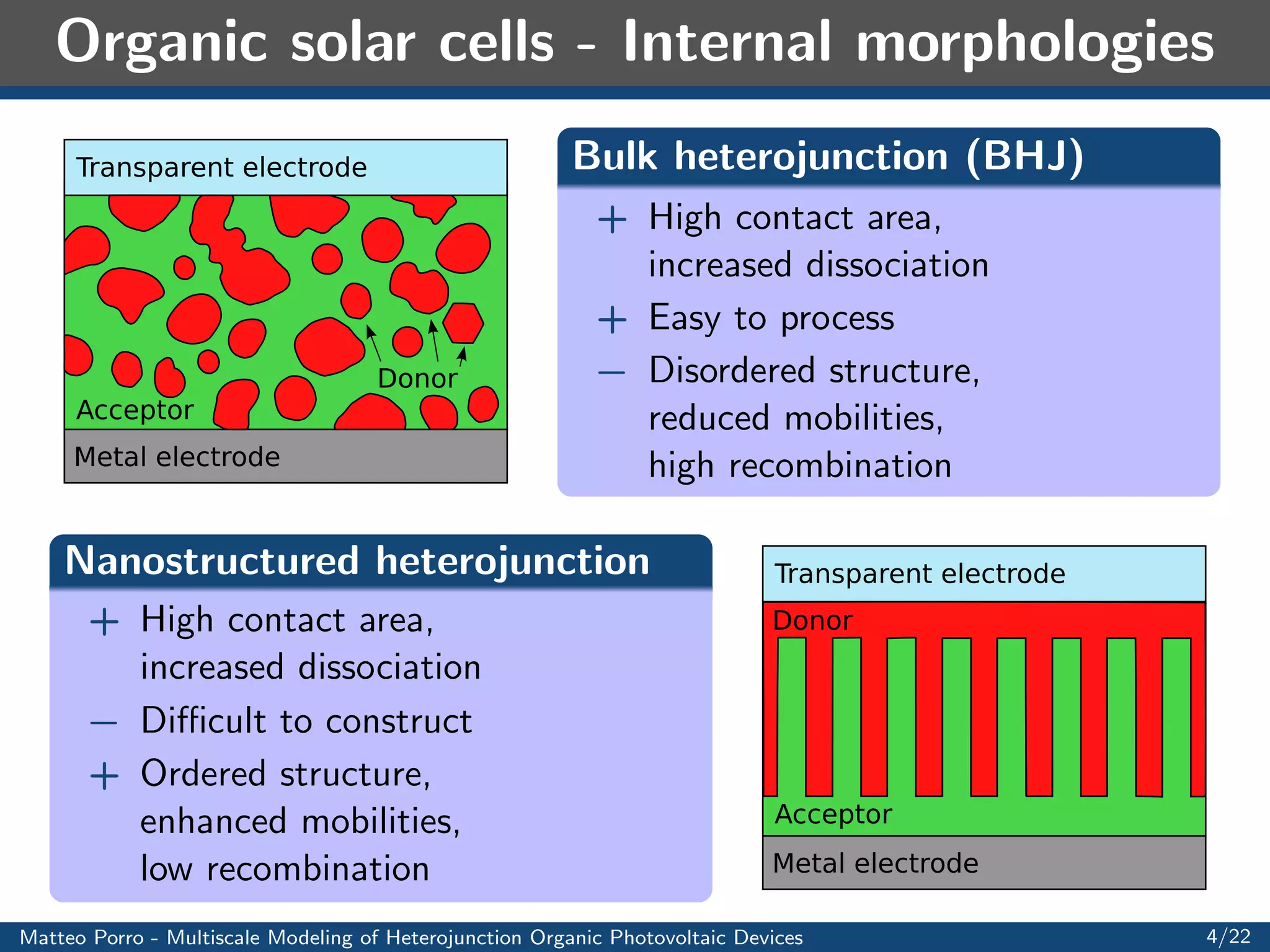
Organic solar cells - Internal morphologies 
Transparent electrode 
Acceptor 
Metal electrode 
Donor 
Bulk heterojunction (BHJ) 
+ High contact area, 
increased dissociation 
+ Easy to process 
 Disordered structure, 
reduced mobilities, 
high recombination 
Nanostructured heterojunction 
+ High contact area, 
increased dissociation 
 Dicult to construct 
+ Ordered structure, 
Transparent electrode 
Donor 
Acceptor 
enhanced mobilities, 
low recombination Metal electrode 
Matteo Porro - Multiscale Modeling of Heterojunction Organic Photovoltaic Devices 4/22
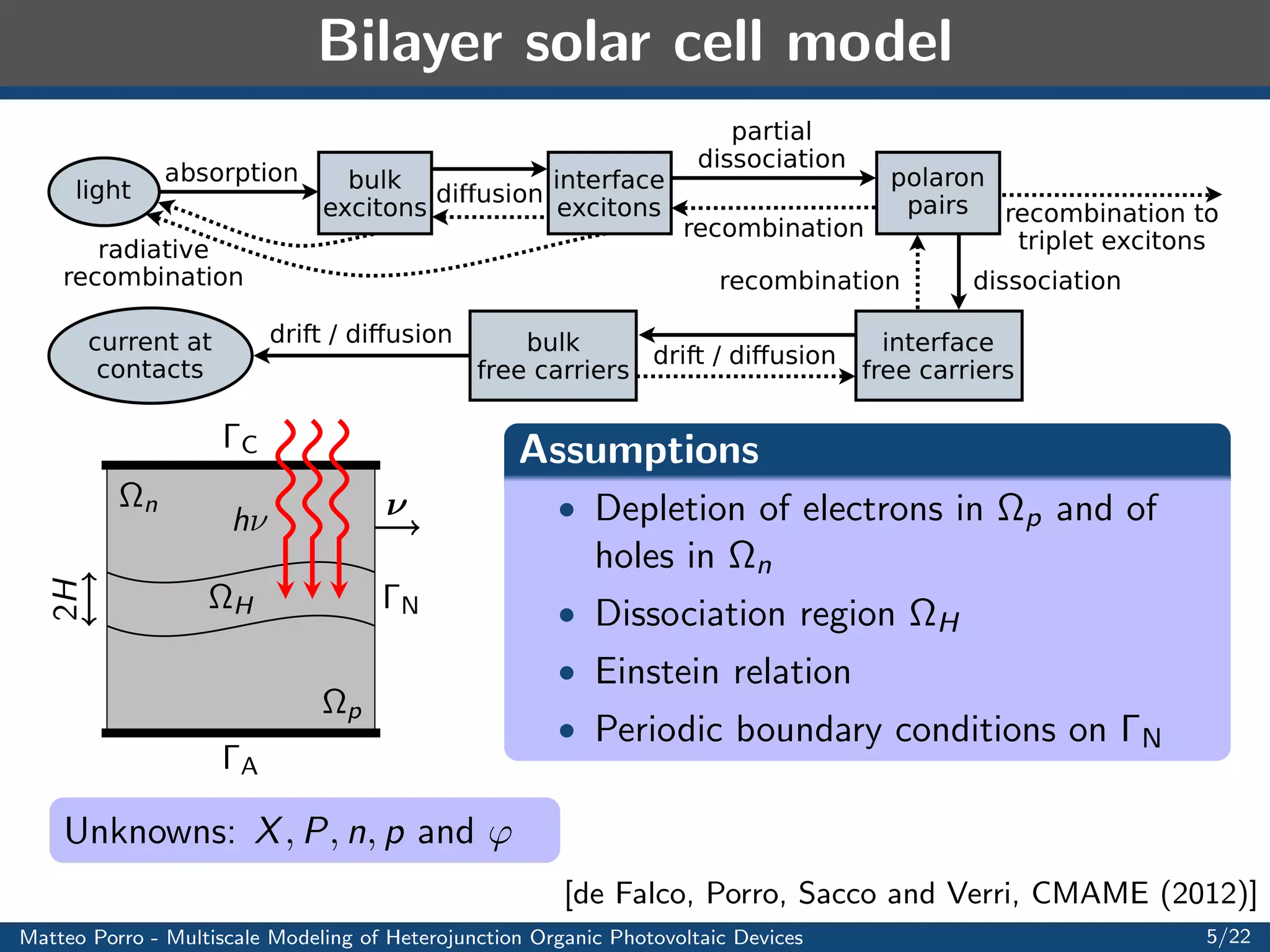
Bilayer solar cell model 
absorption 
di 
C 
h 

n 

p 

H 
A 
 
N 
2H 
Assumptions 
 Depletion of electrons in 
p and of 
holes in 
n 
 Dissociation region 
H 
 Einstein relation 
 Periodic boundary conditions on N 
Unknowns: X; P; n; p and ' 
[de Falco, Porro, Sacco and Verri, CMAME (2012)] 
Matteo Porro - Multiscale Modeling of Heterojunction Organic Photovoltaic Devices 5/22
Multiscale modeling - Interface lumping 
 Device thickness  active layer thickness 
( 102/ 100 nm) 
 Despite this, a re
ned mesh size is needed 
to accurately describe phenomena in 
H 
Idea 
 Neglect the thickness of the active layer 
 Assume the phenomena to occur just on the 
mathematical interface  
C 
h 

n 
N N 

p 
 
A 
 
New computational 
domain 
 Many nodes 
 Less nodes 
 Good resolution 
Matteo Porro - Multiscale Modeling of Heterojunction Organic Photovoltaic Devices 6/22
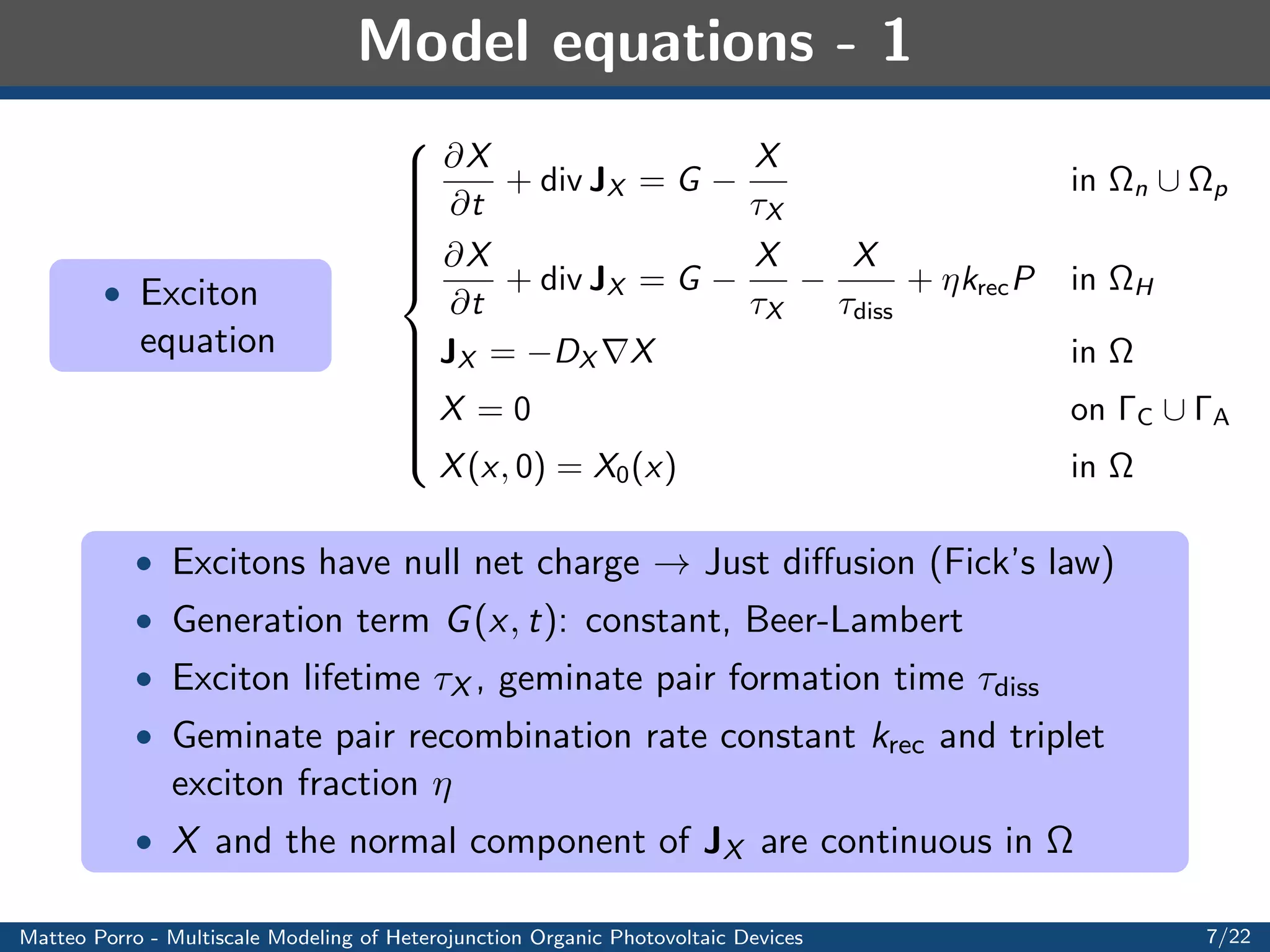
Model equations - 1 
 Exciton 
equation 
8 
: 
@X 
@t 
+ div JX = G  
X 
X 
in 
n [ 
p 
@X 
@t 
+ div JX = G  
X 
X 
 
X 
diss 
+ krecP in 
H 
JX = DXrX in 
 
X = 0 on C [ A 
X(x; 0) = X0(x) in 
 
 Excitons have null net charge ! Just diusion (Fick's law) 
 Generation term G(x; t): constant, Beer-Lambert 
 Exciton lifetime X , geminate pair formation time diss 
 Geminate pair recombination rate constant krec and triplet 
exciton fraction  
 X and the normal component of JX are continuous in 
 
Matteo Porro - Multiscale Modeling of Heterojunction Organic Photovoltaic Devices 7/22
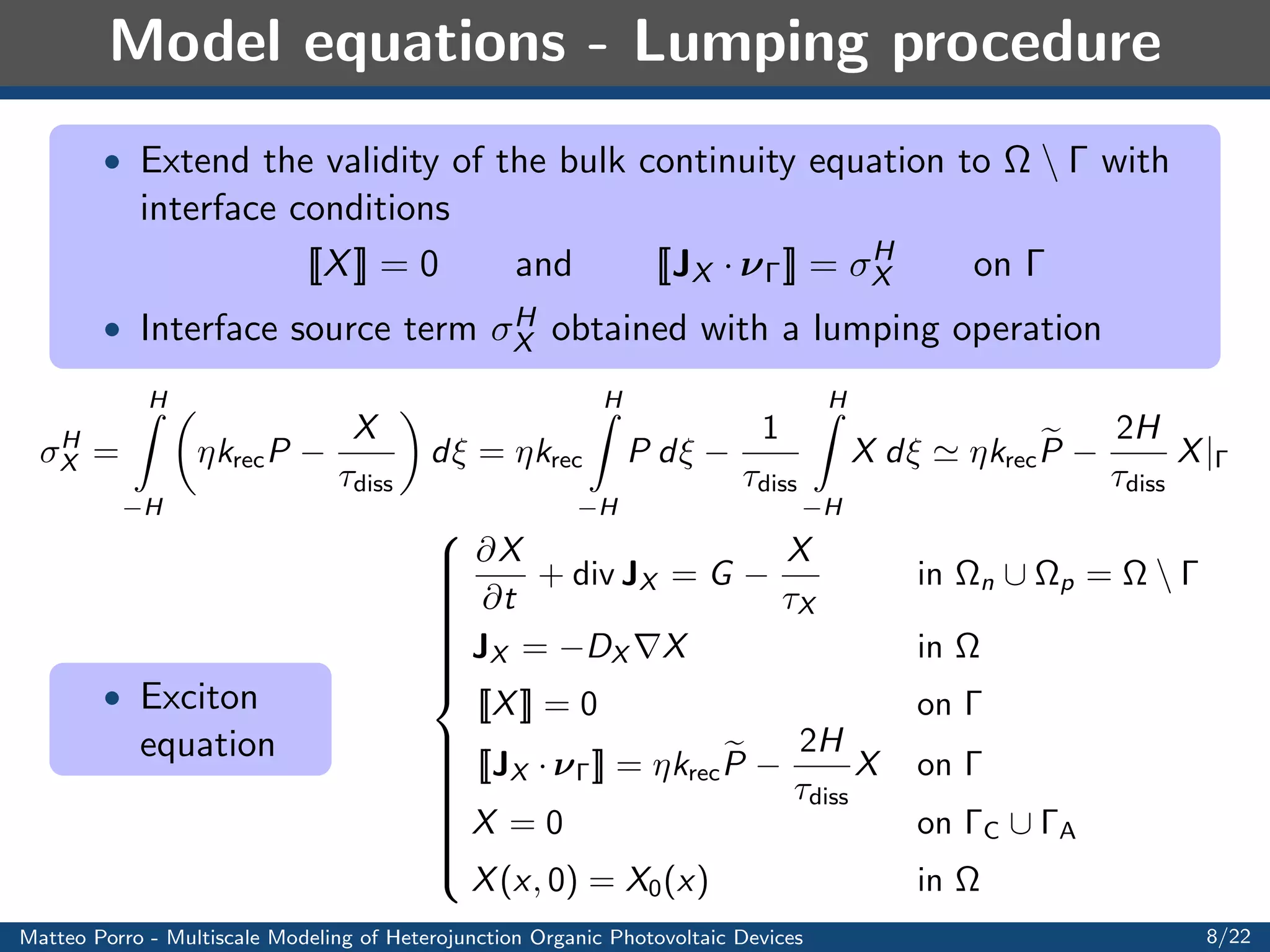
Model equations - Lumping procedure 
 Extend the validity of the bulk continuity equation to 
 n  with 
interface conditions 
[[X]] = 0 and [[JX  ]] = H 
X on  
 Interface source term H 
X obtained with a lumping operation 
H 
X = 
ZH 
H 
 
krecP  
X 
diss 
 
d = krec 
ZH 
H 
P d  
1 
diss 
ZH 
H 
X d ' kreceP 
 
2H 
diss 
Xj 
 Exciton 
equation 
8 
: 
@X 
@t 
+ div JX = G  
X 
X 
in 
n [ 
p = 
 n  
eP 
JX = DXrX in 
 
[[X]] = 0 on  
[[JX  ]] = krec 
2H 
diss 
X on  
X = 0 on C [ A 
X(x; 0) = X0(x) in 
 
Matteo Porro - Multiscale Modeling of Heterojunction Organic Photovoltaic Devices 8/22
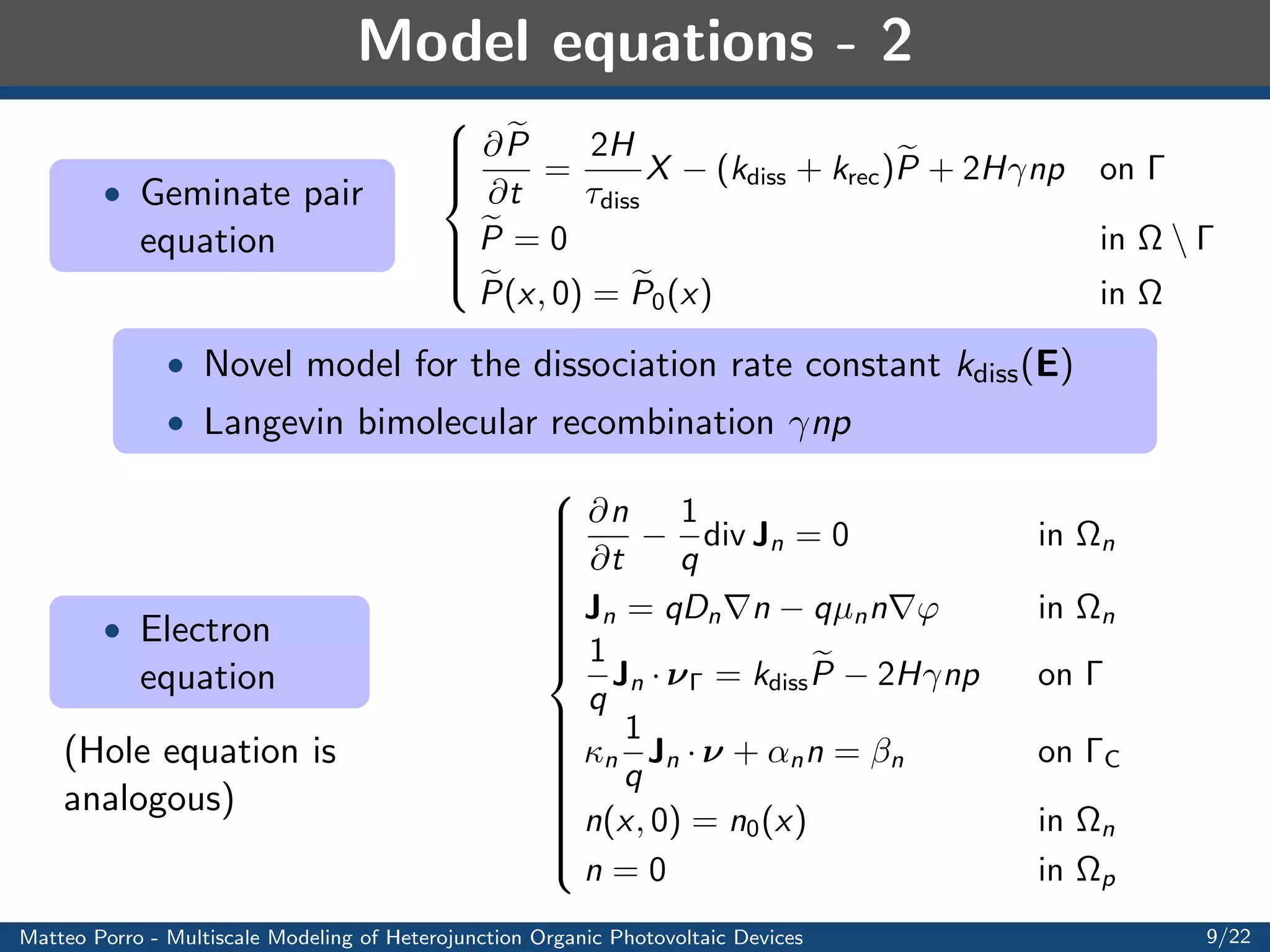
Model equations - 2 
 Geminate pair 
equation 
8 
: 
@eP 
@t 
= 
2H 
diss 
X  (kdiss + krec)eP 
+ 2H
np on  
eP 
= 0 in 
 n  
eP 
(x; 0) = eP0(x) in 
 
 Novel model for the dissociation rate constant kdiss(E) 
 Langevin bimolecular recombination 
np 
 Electron 
equation 
(Hole equation is 
analogous) 
8 
: 
@n 
@t 
 
1 
q 
div Jn = 0 in 
n 
eP 
Jn = qDnrn  qnnr' in 
n 
1 
Jn   = kdiss 2H
np on  
q 
n 
1 
q 
Jn   + nn =
n on C 
n(x; 0) = n0(x) in 
n 
n = 0 in 
p 
Matteo Porro - Multiscale Modeling of Heterojunction Organic Photovoltaic Devices 9/22
Model equations - 3 
 Poisson 
equation 
8 
: 
div 
 
r' 
 
= qn in 
n 
div 
 
r' 
 
= +qp in 
p 
[[']] = [[r'  ]] = 0 on  
' = Vappl  Vbi on A 
' = 0 on C 
 Fixed potential at the electrodes (applied and built-in potential) 
! Dirichlet boundary conditions 
 The dielectric constant  may vary in the materials 
 The electric potential ' and the normal component of the electric 
displacement
eld D = r'   are continuous 
Matteo Porro - Multiscale Modeling of Heterojunction Organic Photovoltaic Devices 10/22
Dissociation model - 1 
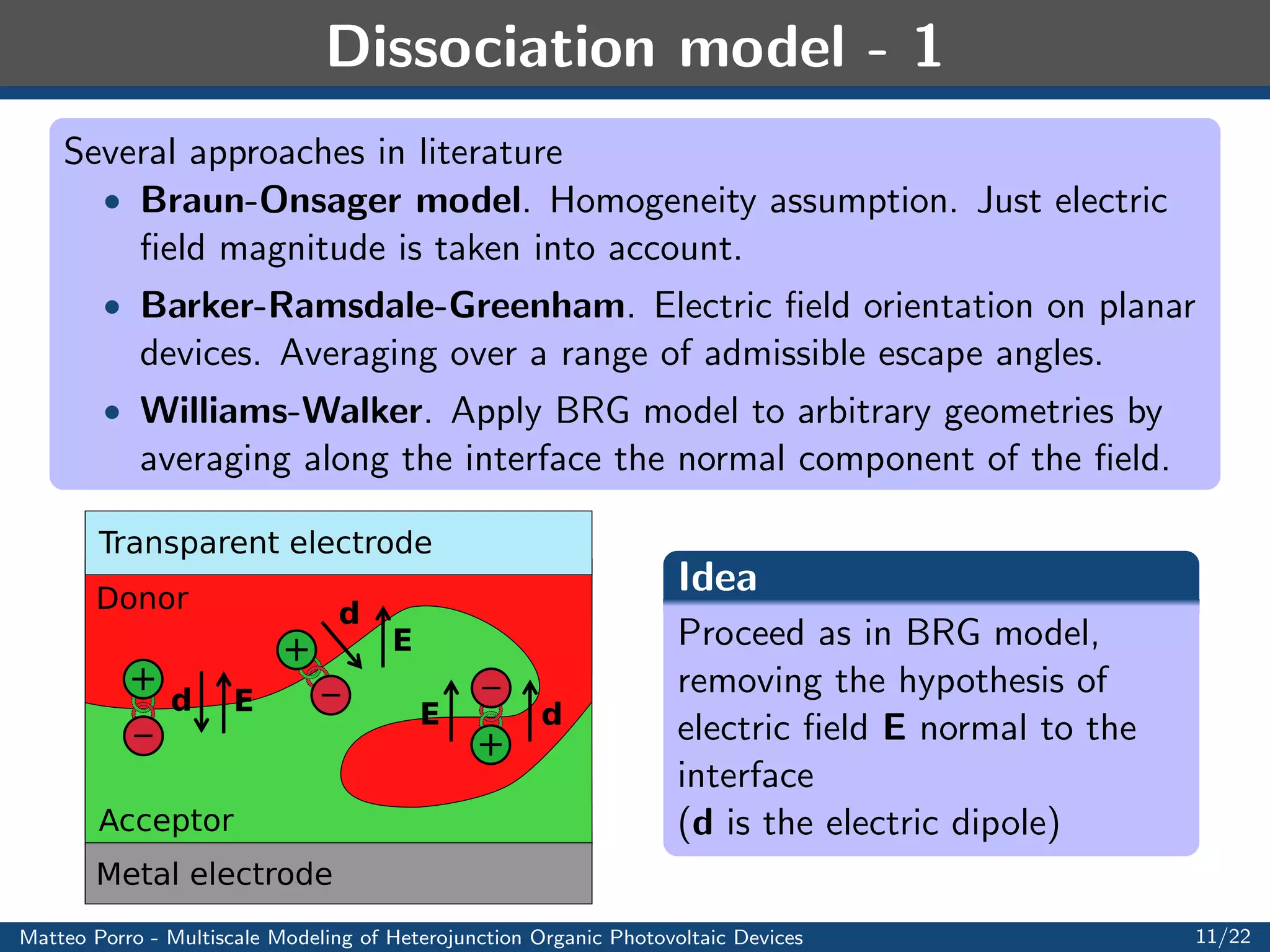
Several approaches in literature 
 Braun-Onsager model. Homogeneity assumption. Just electric
eld magnitude is taken into account. 
 Barker-Ramsdale-Greenham. Electric
eld orientation on planar 
devices. Averaging over a range of admissible escape angles. 
 Williams-Walker. Apply BRG model to arbitrary geometries by 
averaging along the interface the normal component of the
eld. 
Transparent electrode 
Donor 
+ _ 
_ 
Acceptor 
Metal electrode 
+ 
_ 
+ 
E 
E 
d 
d 
E d 
Idea 
Proceed as in BRG model, 
removing the hypothesis of 
electric
eld E normal to the 
interface 
(d is the electric dipole) 
Matteo Porro - Multiscale Modeling of Heterojunction Organic Photovoltaic Devices 11/22
Dissociation model - 2 
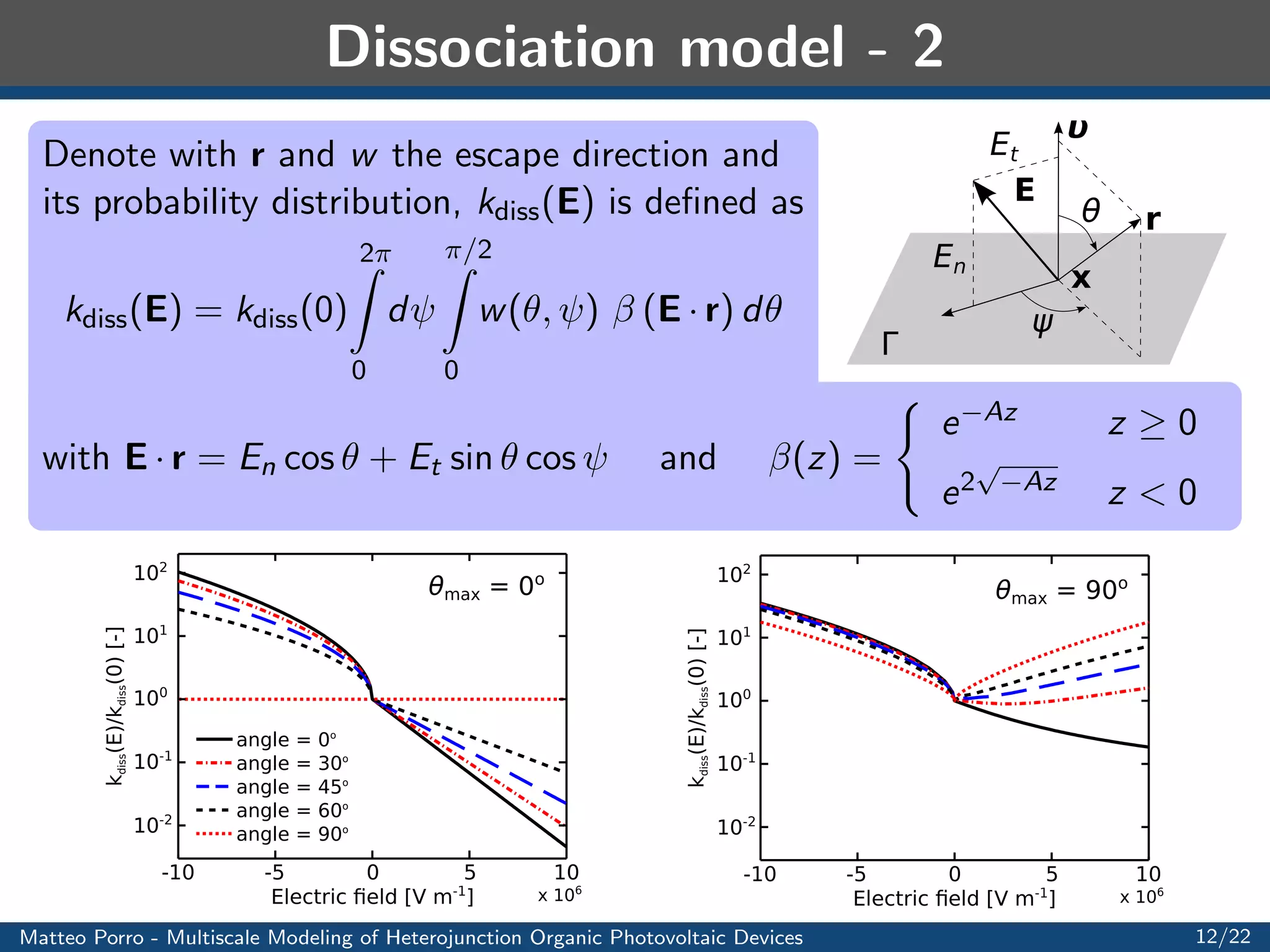
Denote with r and w the escape direction and 
its probability distribution, kdiss(E) is de
ned as 
kdiss(E) = kdiss(0) 
Z2 
0 
d  
Z=2 
0 
w(;  )
(E  r) d 
Γ 
ψ 
υ 
θ 
Et 
E 
En 
r 
x 
with E  r = En cos  + Et sin  cos   and

porro_msh_2012

  • 1.
    MSH 2012 -Mathematics for Semiconductor Heterostructures Berlin - September 27, 2012 Multiscale Modeling of Heterojunction Organic Photovoltaic Devices Matteo Porro Dipartimento di Matematica Francesco Brioschi" Politecnico di Milano, Italy Center for Nano Science and Technology @PoliMi Istituto Italiano di Tecnologia, Italy email: matteo.porro@mail.polimi.it web: www1.mate.polimi.it/porro
  • 2.
    Summary Organicsolar cells - A brief introduction Mathematical model and multiscale approach Numerical results Beyond OSCs - Light harvesting capacitor and arti
  • 3.
    cial retina MatteoPorro - Multiscale Modeling of Heterojunction Organic Photovoltaic Devices 2/22
  • 4.
    Organic solar cells- Operating principles Heterostructure of two materials Good absorption properties Thin, exible and transparent Low Eciency Transparent electrode Donor Acceptor + Metal electrode + hυ 1. Photon absorption _ _ + _ Di usion Geminate pair Exciton 2. Exciton formation 3. Exciton diusion to the interface 4. Bounded pair formation 5. Dissociation into free charges 6. Charge transport to the electrodes Matteo Porro - Multiscale Modeling of Heterojunction Organic Photovoltaic Devices 3/22
  • 5.
    Organic solar cells- Internal morphologies Transparent electrode Acceptor Metal electrode Donor Bulk heterojunction (BHJ) + High contact area, increased dissociation + Easy to process Disordered structure, reduced mobilities, high recombination Nanostructured heterojunction + High contact area, increased dissociation Dicult to construct + Ordered structure, Transparent electrode Donor Acceptor enhanced mobilities, low recombination Metal electrode Matteo Porro - Multiscale Modeling of Heterojunction Organic Photovoltaic Devices 4/22
  • 6.
    Bilayer solar cellmodel absorption di C h n p H A N 2H Assumptions Depletion of electrons in p and of holes in n Dissociation region H Einstein relation Periodic boundary conditions on N Unknowns: X; P; n; p and ' [de Falco, Porro, Sacco and Verri, CMAME (2012)] Matteo Porro - Multiscale Modeling of Heterojunction Organic Photovoltaic Devices 5/22
  • 7.
    Multiscale modeling -Interface lumping Device thickness active layer thickness ( 102/ 100 nm) Despite this, a re
  • 8.
    ned mesh sizeis needed to accurately describe phenomena in H Idea Neglect the thickness of the active layer Assume the phenomena to occur just on the mathematical interface C h n N N p A New computational domain Many nodes Less nodes Good resolution Matteo Porro - Multiscale Modeling of Heterojunction Organic Photovoltaic Devices 6/22
  • 9.
    Model equations -1 Exciton equation 8 : @X @t + div JX = G X X in n [ p @X @t + div JX = G X X X diss + krecP in H JX = DXrX in X = 0 on C [ A X(x; 0) = X0(x) in Excitons have null net charge ! Just diusion (Fick's law) Generation term G(x; t): constant, Beer-Lambert Exciton lifetime X , geminate pair formation time diss Geminate pair recombination rate constant krec and triplet exciton fraction X and the normal component of JX are continuous in Matteo Porro - Multiscale Modeling of Heterojunction Organic Photovoltaic Devices 7/22
  • 10.
    Model equations -Lumping procedure Extend the validity of the bulk continuity equation to n with interface conditions [[X]] = 0 and [[JX ]] = H X on Interface source term H X obtained with a lumping operation H X = ZH H krecP X diss d = krec ZH H P d 1 diss ZH H X d ' kreceP 2H diss Xj Exciton equation 8 : @X @t + div JX = G X X in n [ p = n eP JX = DXrX in [[X]] = 0 on [[JX ]] = krec 2H diss X on X = 0 on C [ A X(x; 0) = X0(x) in Matteo Porro - Multiscale Modeling of Heterojunction Organic Photovoltaic Devices 8/22
  • 11.
    Model equations -2 Geminate pair equation 8 : @eP @t = 2H diss X (kdiss + krec)eP + 2H np on eP = 0 in n eP (x; 0) = eP0(x) in Novel model for the dissociation rate constant kdiss(E) Langevin bimolecular recombination np Electron equation (Hole equation is analogous) 8 : @n @t 1 q div Jn = 0 in n eP Jn = qDnrn qnnr' in n 1 Jn = kdiss 2H np on q n 1 q Jn + nn =
  • 12.
    n on C n(x; 0) = n0(x) in n n = 0 in p Matteo Porro - Multiscale Modeling of Heterojunction Organic Photovoltaic Devices 9/22
  • 13.
    Model equations -3 Poisson equation 8 : div r' = qn in n div r' = +qp in p [[']] = [[r' ]] = 0 on ' = Vappl Vbi on A ' = 0 on C Fixed potential at the electrodes (applied and built-in potential) ! Dirichlet boundary conditions The dielectric constant may vary in the materials The electric potential ' and the normal component of the electric displacement
  • 14.
    eld D =r' are continuous Matteo Porro - Multiscale Modeling of Heterojunction Organic Photovoltaic Devices 10/22
  • 15.
    Dissociation model -1 Several approaches in literature Braun-Onsager model. Homogeneity assumption. Just electric
  • 16.
    eld magnitude istaken into account. Barker-Ramsdale-Greenham. Electric
  • 17.
    eld orientation onplanar devices. Averaging over a range of admissible escape angles. Williams-Walker. Apply BRG model to arbitrary geometries by averaging along the interface the normal component of the
  • 18.
    eld. Transparent electrode Donor + _ _ Acceptor Metal electrode + _ + E E d d E d Idea Proceed as in BRG model, removing the hypothesis of electric
  • 19.
    eld E normalto the interface (d is the electric dipole) Matteo Porro - Multiscale Modeling of Heterojunction Organic Photovoltaic Devices 11/22
  • 20.
    Dissociation model -2 Denote with r and w the escape direction and its probability distribution, kdiss(E) is de
  • 21.
    ned as kdiss(E)= kdiss(0) Z2 0 d Z=2 0 w(; )
  • 22.
    (E r)d Γ ψ υ θ Et E En r x with E r = En cos + Et sin cos and
  • 23.
    (z) = ( eAz z 0 p e2 Az z 0 102 101 [-] 0) (diss100 kE)/angle = 0o (diss10-1 angle = 30o kangle = 45o angle = 60o 10-2 angle = 90o θmax = 0o -10 -5 0 5 10 Electric eld [V m-1] x 106 102 101 100 -10 -5 0 5 10 kdiss(E)/kdiss(0) [-] Electric eld [V m-1] x 106 10-1 10-2 θmax = 90o Matteo Porro - Multiscale Modeling of Heterojunction Organic Photovoltaic Devices 12/22
  • 24.
    Numerical approach Theproblem and its constraints Fully coupled system Strongly nonlinear equations Avoid negative concentrations, also to prevent instabilities and numerical oscillation in the iterative solution algorithm Rothe's method Time discretization with an adaptive BDF method Problem linearization with a quasi-Newton method Spatial discretization with SG exponentially
  • 25.
    tted FEs Numericalimplementation of 1D/2D versions of the model with the open source tool GNU Octave. Light-weight simulations: O(min). Matteo Porro - Multiscale Modeling of Heterojunction Organic Photovoltaic Devices 13/22
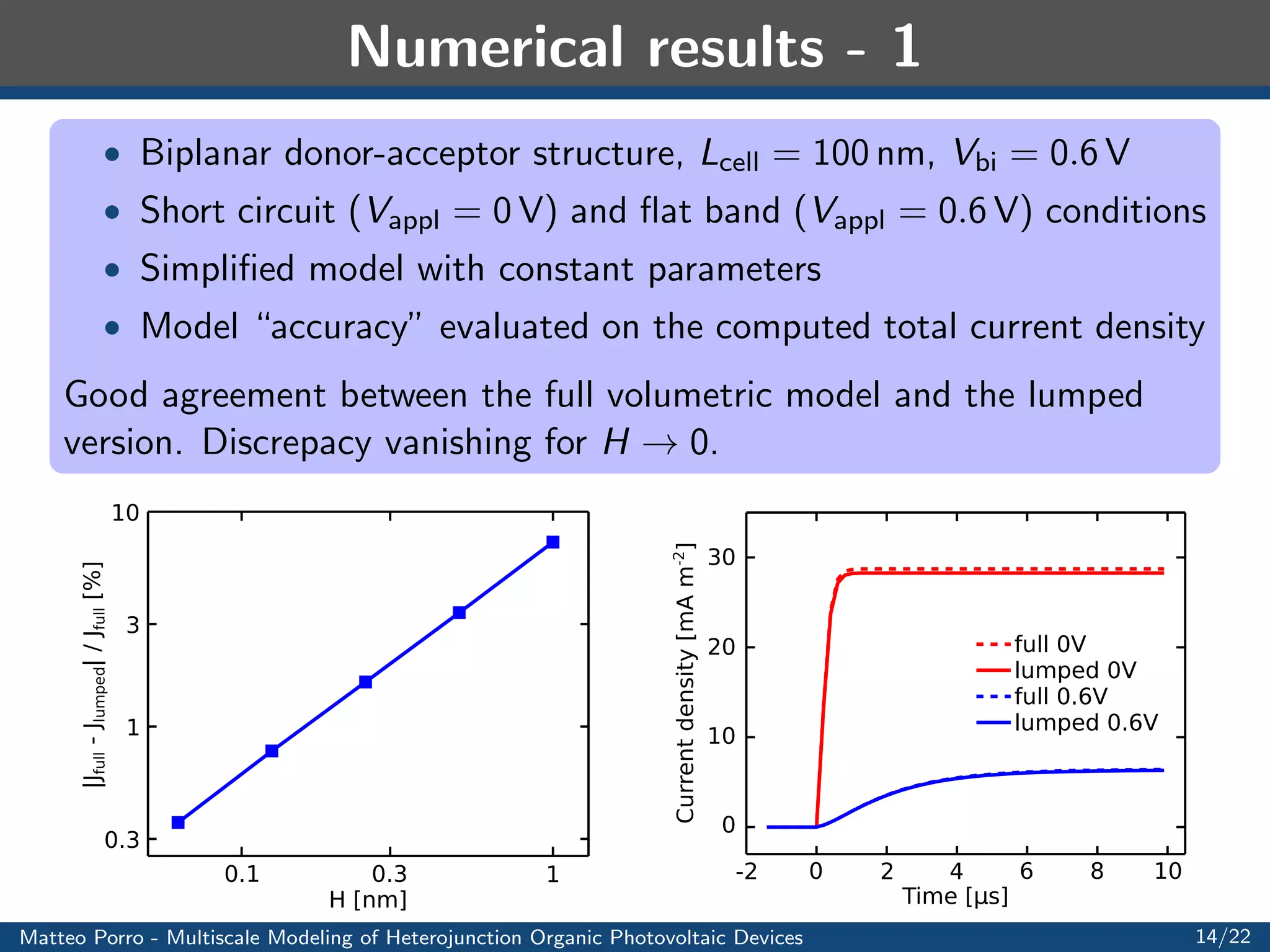
  • 26.
    Numerical results -1 Biplanar donor-acceptor structure, Lcell = 100 nm, Vbi = 0:6 V Short circuit (Vappl = 0 V) and at band (Vappl = 0:6 V) conditions Simpli
  • 27.
    ed model withconstant parameters Model accuracy evaluated on the computed total current density Good agreement between the full volumetric model and the lumped version. Discrepacy vanishing for H ! 0. 0.1 0.3 1 H [nm] |Jfull - Jlumped| / Jfull [%] 10 3 1 0.3 full 0V lumped 0V full 0.6V lumped 0.6V 30 20 10 -2 0 2 4 6 8 10 Time [ s] 0 Current density [mA m-2] Matteo Porro - Multiscale Modeling of Heterojunction Organic Photovoltaic Devices 14/22
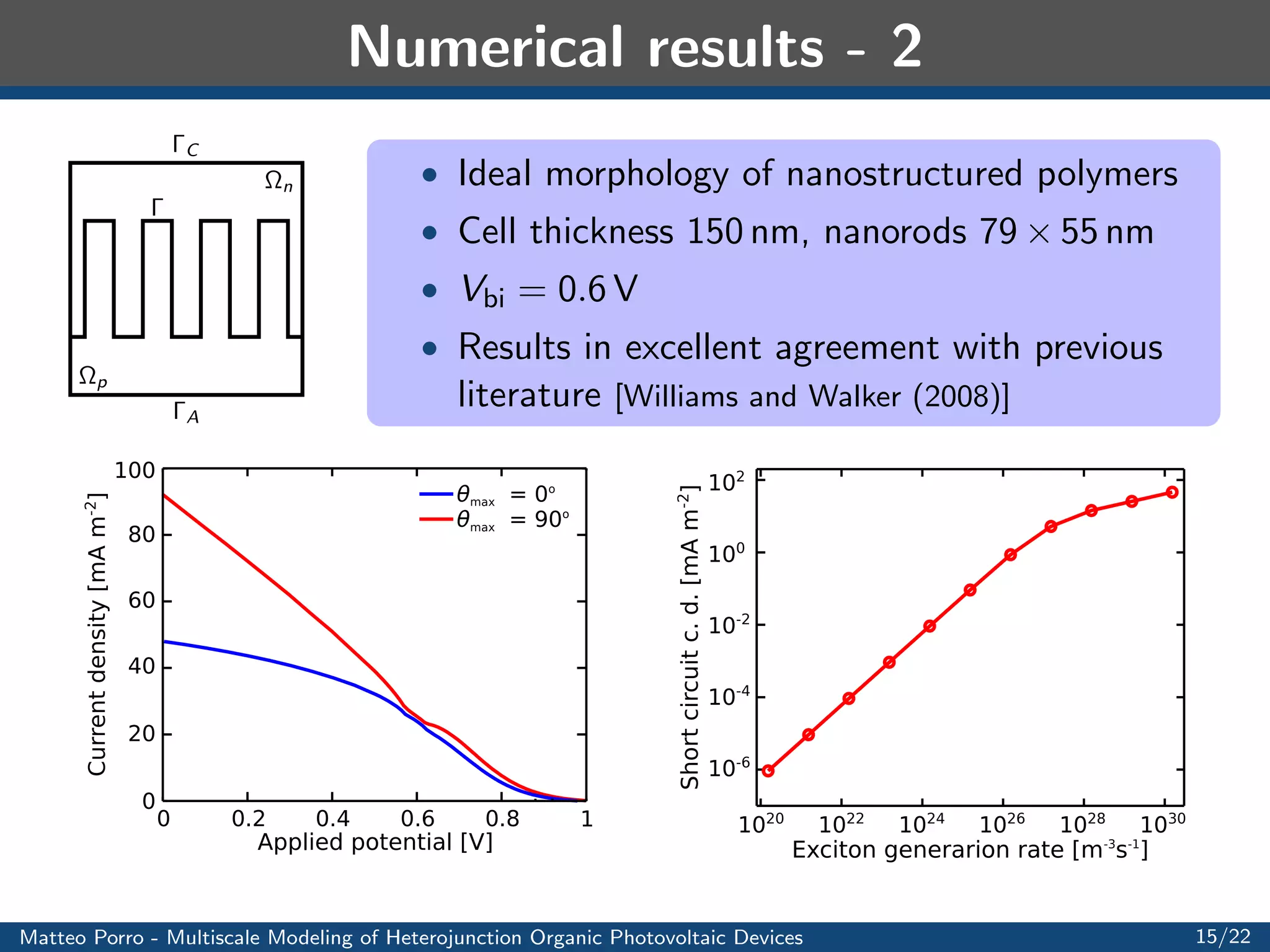
  • 28.
    Numerical results -2 n p C A Ideal morphology of nanostructured polymers Cell thickness 150 nm, nanorods 7955 nm Vbi = 0:6 V Results in excellent agreement with previous literature [Williams and Walker (2008)] θmax = 0o θmax = 90o 100 2] m-80 mA [density 60 40 Current 20 0 Applied potential [V] 0 0.2 0.4 0.6 0.8 1 Exciton generarion rate [m-3s-1] Short circuit c. d. [mA m-2] 102 100 10-2 10-4 10-6 1020 1022 1024 1026 1028 1030 Matteo Porro - Multiscale Modeling of Heterojunction Organic Photovoltaic Devices 15/22
  • 29.
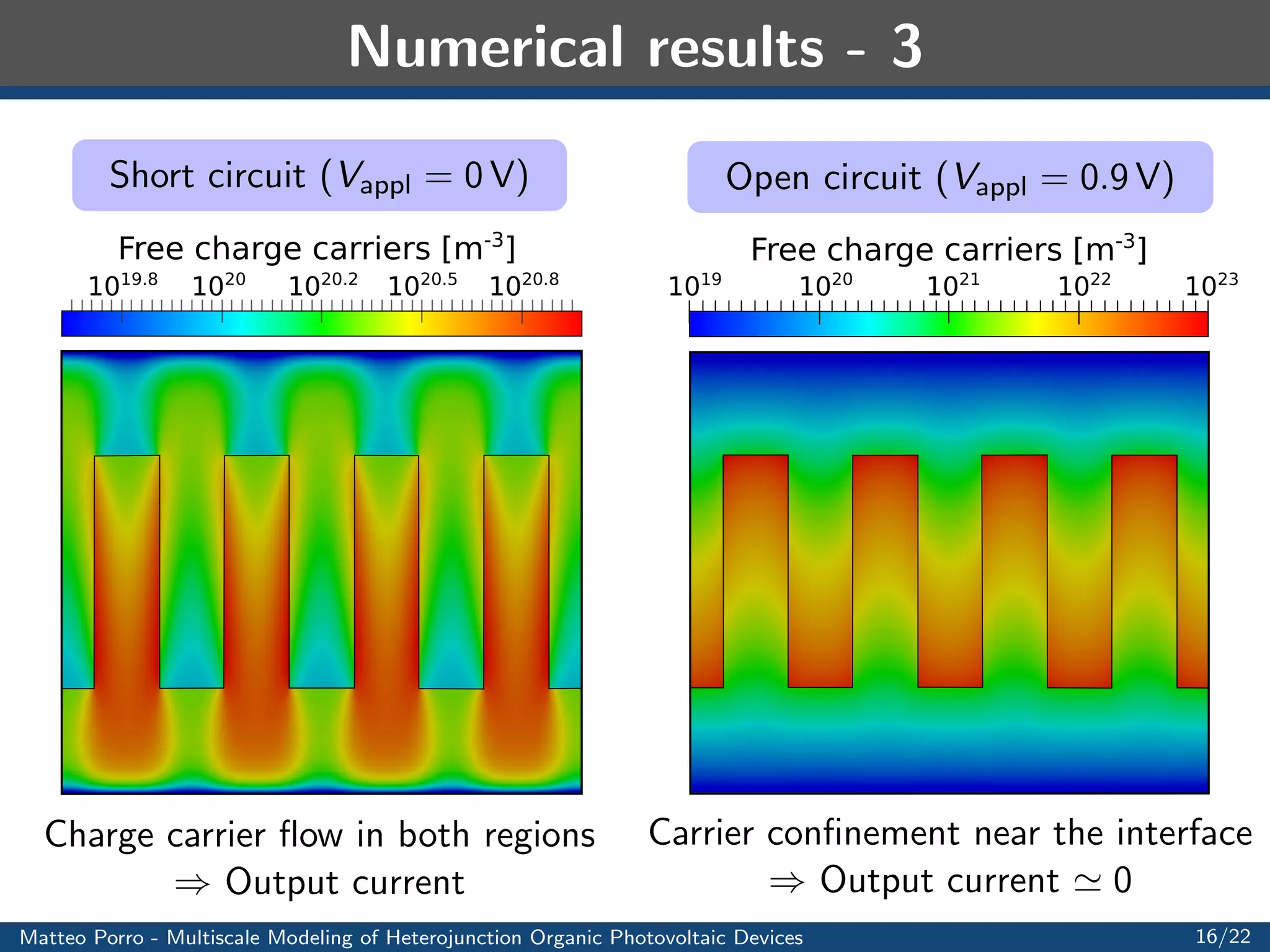
    Numerical results -3 Short circuit (Vappl = 0 V) Free charge carriers [m-3] 1019.8 1020 1020.2 1020.5 1020.8 Charge carrier ow in both regions ) Output current Open circuit (Vappl = 0:9 V) Free charge carriers [m-3] 1019 1020 1021 1022 1023 Carrier con
  • 30.
    nement near theinterface ) Output current ' 0 Matteo Porro - Multiscale Modeling of Heterojunction Organic Photovoltaic Devices 16/22
  • 31.
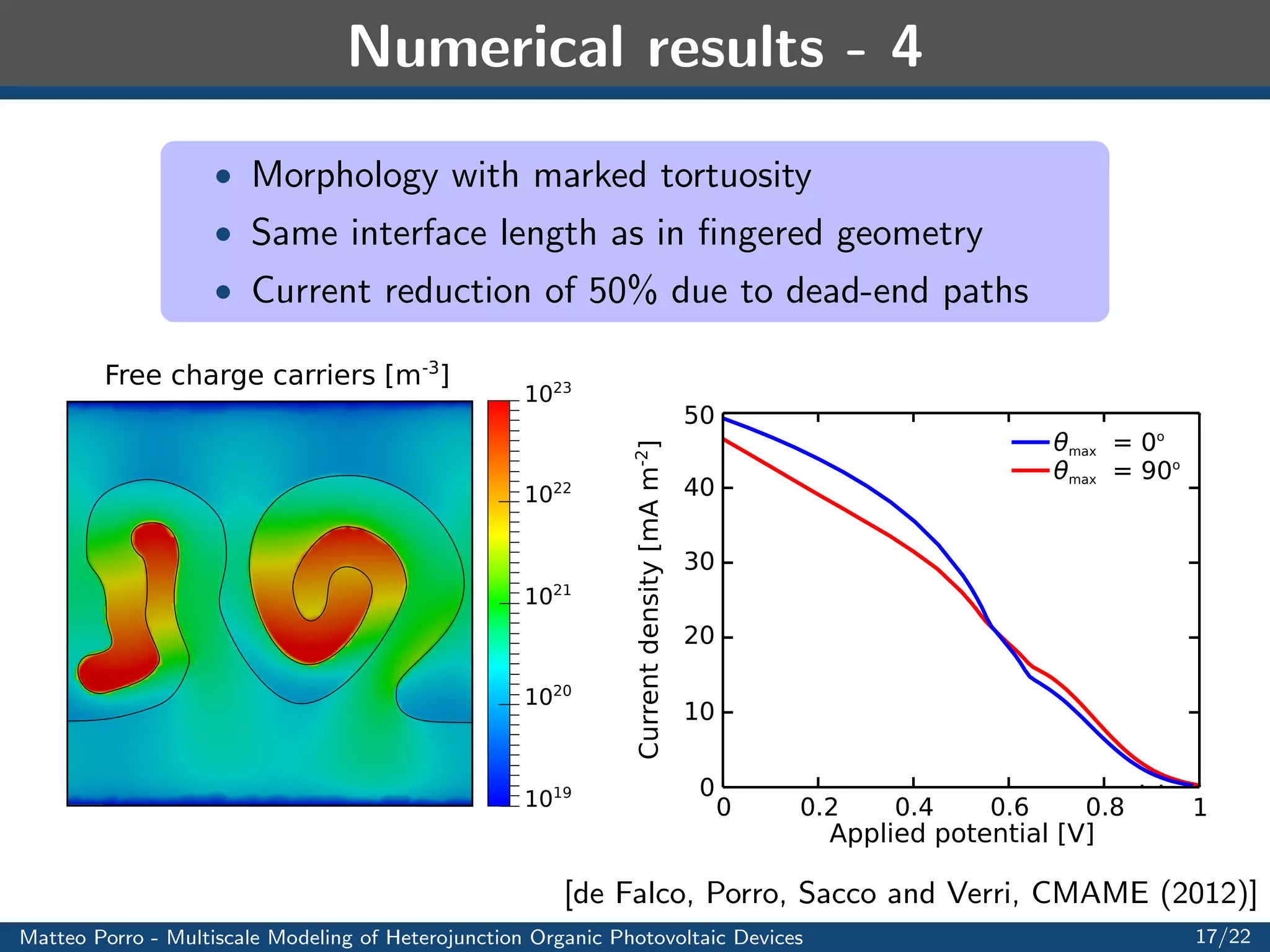
    Numerical results -4 Morphology with marked tortuosity Same interface length as in
  • 32.
    ngered geometry Current reduction of 50% due to dead-end paths 1023 Free charge carriers [m-3] 1022 1021 1020 1019 θmax = 0o θmax = 90o Applied potential [V] Current density [mA m-2] 50 40 30 20 10 0 0 0.2 0.4 0.6 0.8 1 [de Falco, Porro, Sacco and Verri, CMAME (2012)] Matteo Porro - Multiscale Modeling of Heterojunction Organic Photovoltaic Devices 17/22
  • 33.
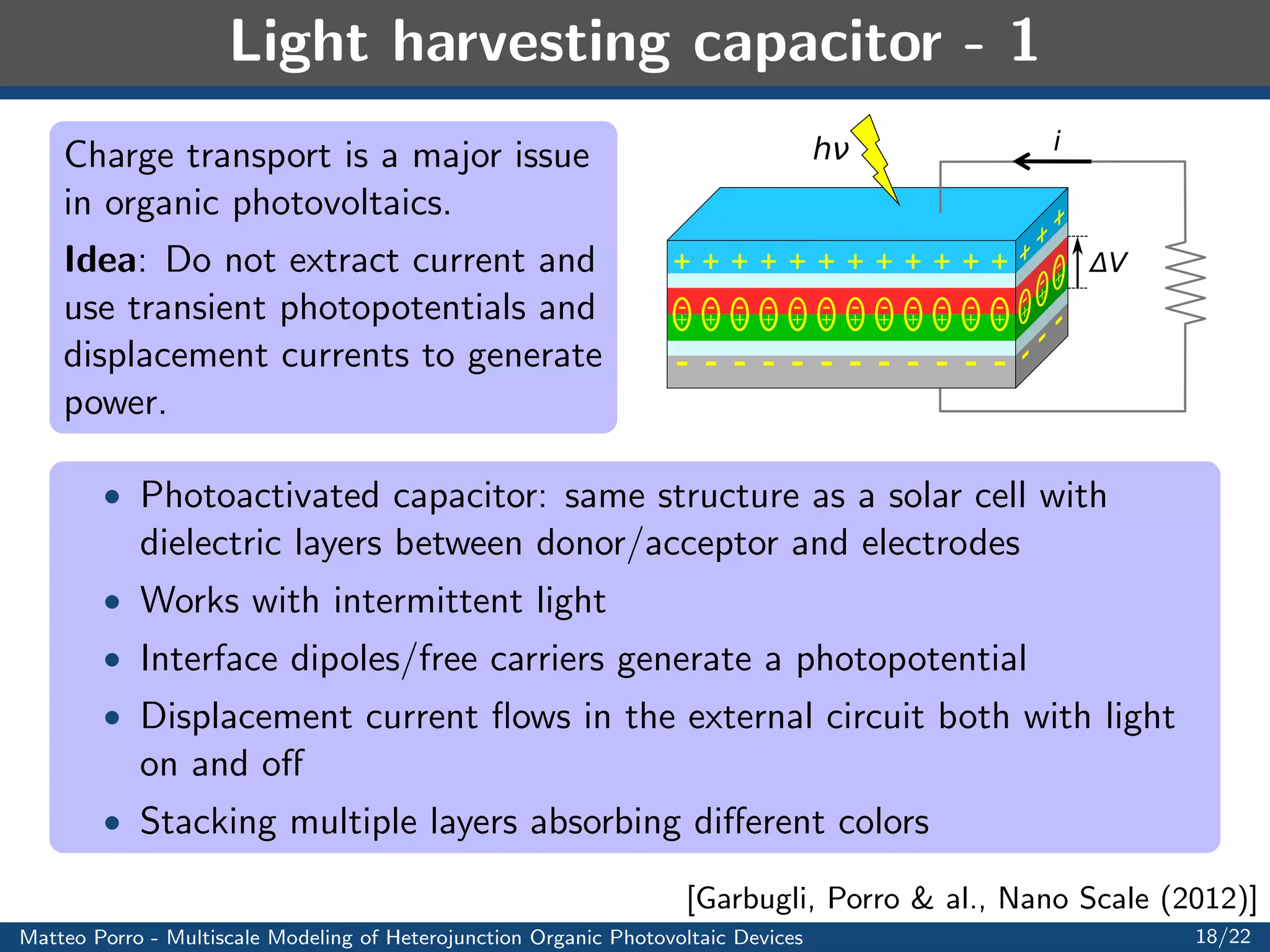
    Light harvesting capacitor- 1 Charge transport is a major issue in organic photovoltaics. Idea: Do not extract current and use transient photopotentials and displacement currents to generate power. h Δ i + + + + + + + + + + + + - + - + - + - - - - + - + - + - + - + - + - + - + - + - + - + - + + + + - - - - - - - - - - - - Photoactivated capacitor: same structure as a solar cell with dielectric layers between donor/acceptor and electrodes Works with intermittent light Interface dipoles/free carriers generate a photopotential Displacement current ows in the external circuit both with light on and o Stacking multiple layers absorbing dierent colors [Garbugli, Porro al., Nano Scale (2012)] Matteo Porro - Multiscale Modeling of Heterojunction Organic Photovoltaic Devices 18/22
  • 34.
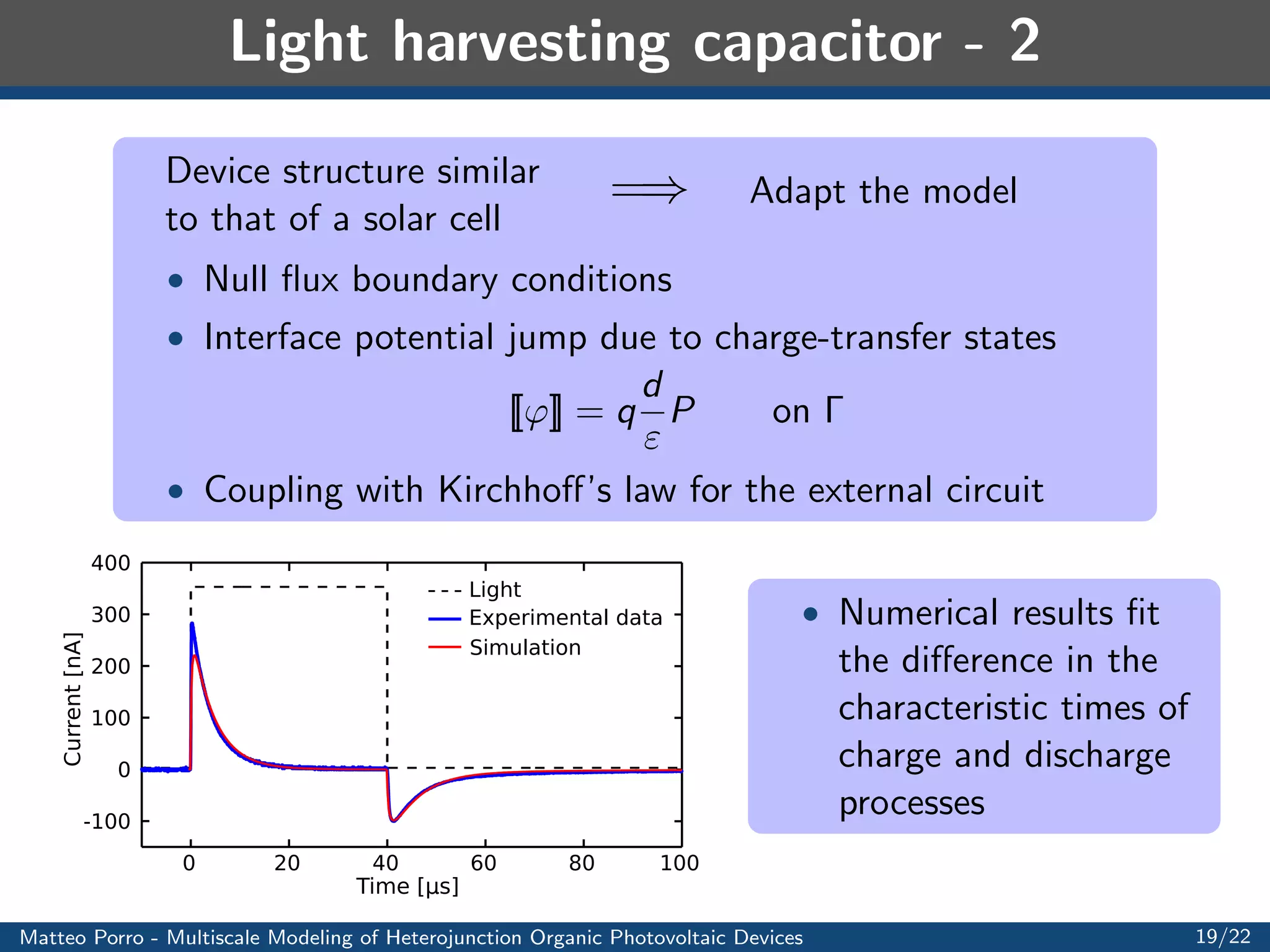
    Light harvesting capacitor- 2 Device structure similar to that of a solar cell =) Adapt the model Null ux boundary conditions Interface potential jump due to charge-transfer states [[']] = q d P on Coupling with Kirchho's law for the external circuit Current [nA] 400 300 200 100 0 -100 0 20 40 60 80 100 Time [ s] Light Experimental data Simulation Numerical results
  • 35.
    t the dierencein the characteristic times of charge and discharge processes Matteo Porro - Multiscale Modeling of Heterojunction Organic Photovoltaic Devices 19/22
  • 36.
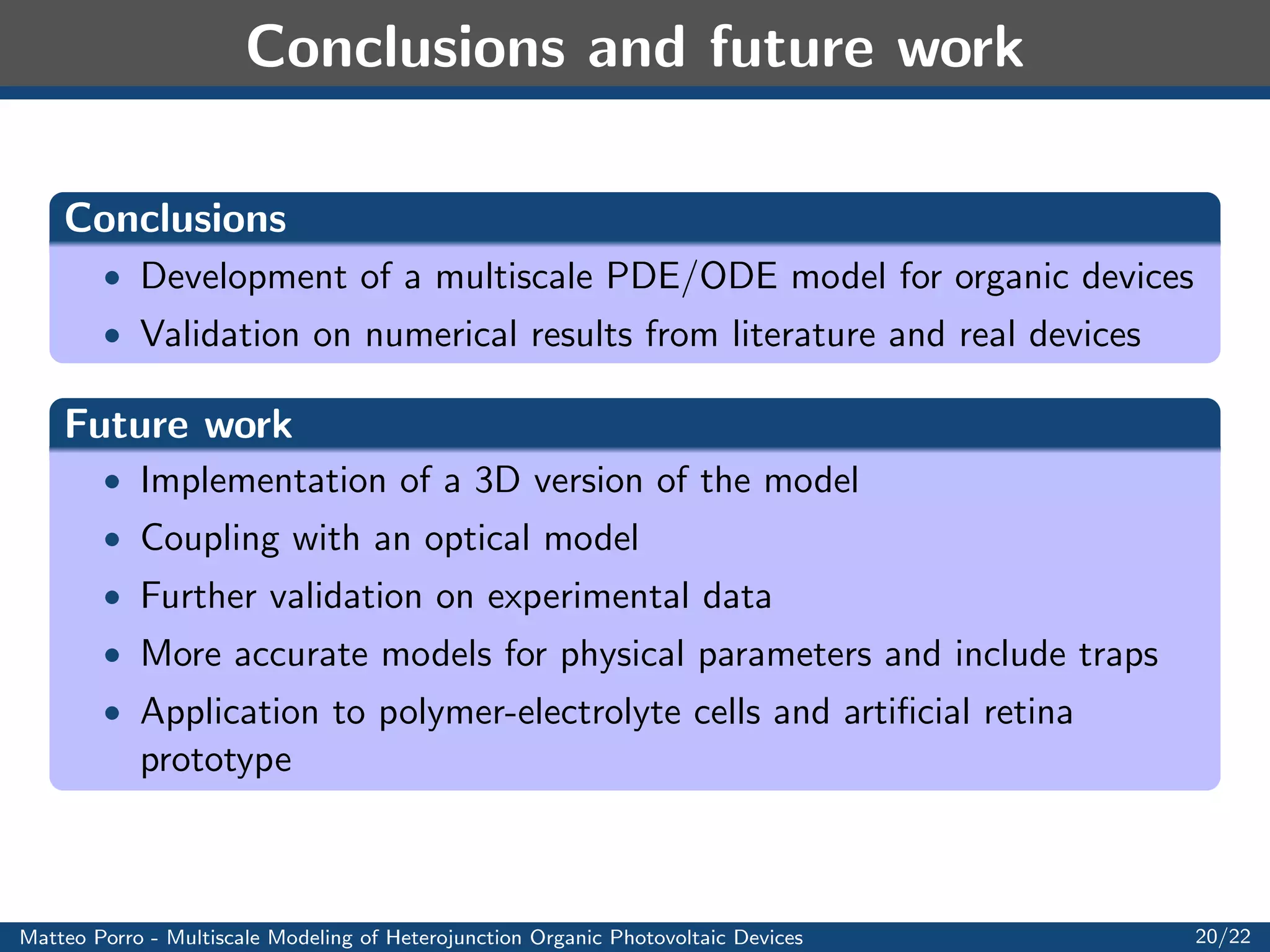
    Conclusions and futurework Conclusions Development of a multiscale PDE/ODE model for organic devices Validation on numerical results from literature and real devices Future work Implementation of a 3D version of the model Coupling with an optical model Further validation on experimental data More accurate models for physical parameters and include traps Application to polymer-electrolyte cells and arti
  • 37.
    cial retina prototype Matteo Porro - Multiscale Modeling of Heterojunction Organic Photovoltaic Devices 20/22
  • 38.
  • 39.
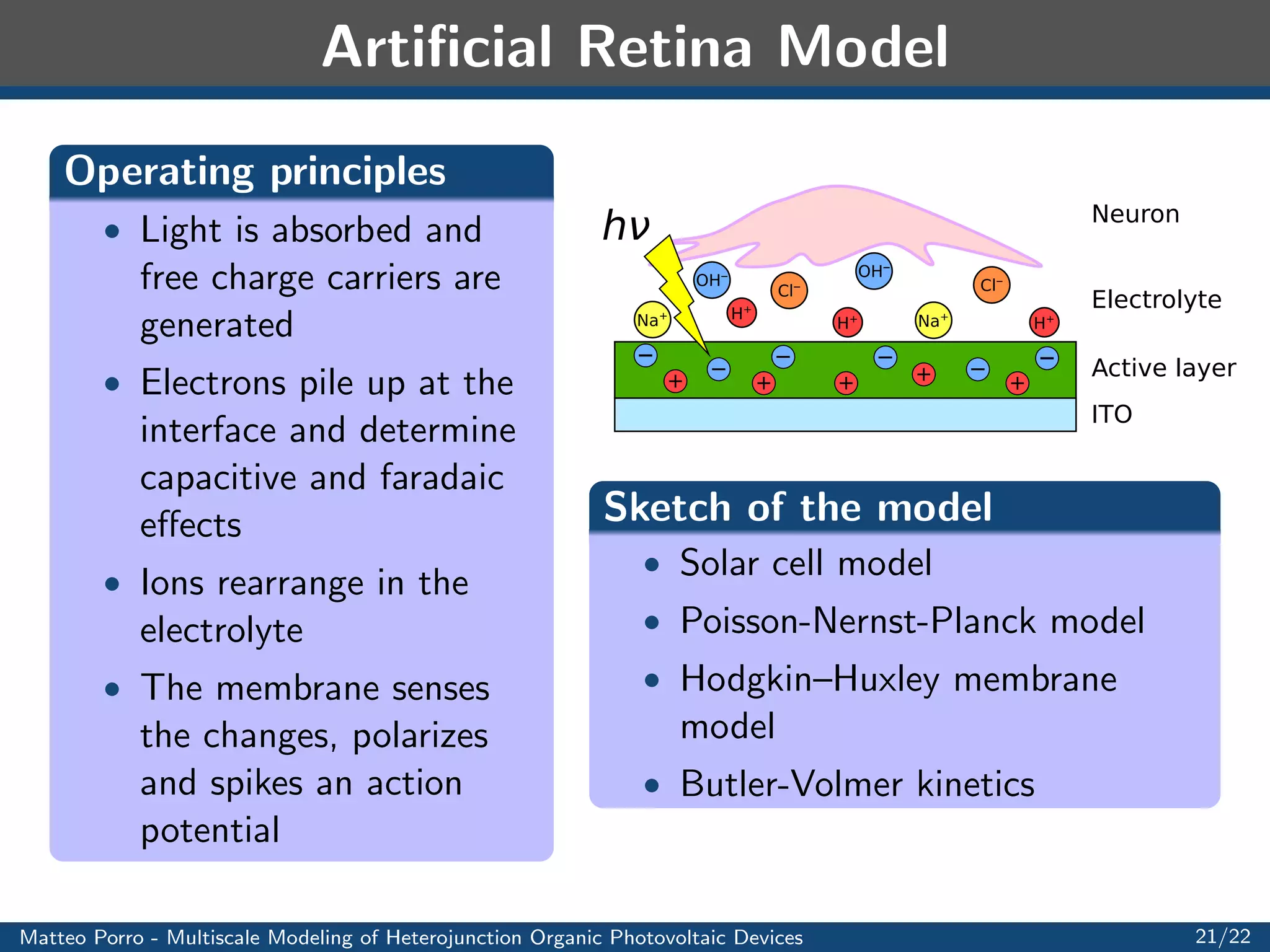
    cial Retina Model Operating principles Light is absorbed and free charge carriers are generated Electrons pile up at the interface and determine capacitive and faradaic eects Ions rearrange in the electrolyte The membrane senses the changes, polarizes and spikes an action potential Neuron Electrolyte Active layer ITO OH OH Cl Cl Na+ H Na+ + H+ H+ + + + + + hν Sketch of the model Solar cell model Poisson-Nernst-Planck model Hodgkin{Huxley membrane model Butler-Volmer kinetics Matteo Porro - Multiscale Modeling of Heterojunction Organic Photovoltaic Devices 21/22
  • 40.
    Acknowledgements Politecnico diMilano Prof. Riccardo Sacco Prof. Maurizio Verri Dr. Carlo de Falco Center for Nano Science and Technology Prof. Guglielmo Lanzani Dr. Maria Rosa Antognazza Matteo Porro - Multiscale Modeling of Heterojunction Organic Photovoltaic Devices 22/22