“Farmers should raise less corn
and more hell.”
-Mary Lease, Populist
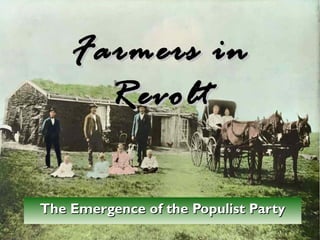
Farmers in
Revolt
The Emergence of the Populist Party
Early Farm
Organizations

The Grange

Original Purpose 1867
 “To provide a social outlet and
educational services for isolated
farmers”
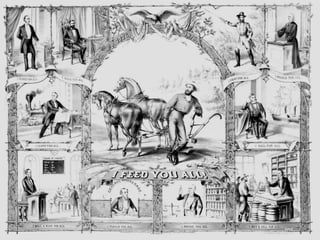
Farmer’s Poem
When the banker says he’s broke
And the merchants up in smoke,
They forget that it’s the farmer who
feeds them all.
It would put them to the test
If the farmer took a rest;
Then they’d know that it’s the farmer
who feeds them all.
Political Grange
• The Grange united to combat the
monopolistic practices of the
railroads and grain elevators
– Its aim was to advance the political,
economic, and social interests of the
nation's farmers
– 860,000 national members

• One way they did this was by Grange
members getting elected to local,
state legislature and Congress offices
Political Grange

• Elected members to state legislature
and Congress
• Passed “Granger Laws” in the states
to regulate the rates charged by
railroads and warehouses.
• Supreme Court overturns many of
these laws
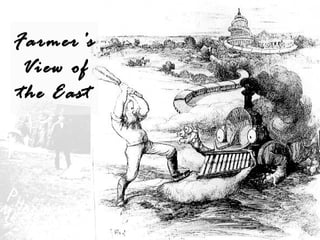
Farmer’s
View of
the East
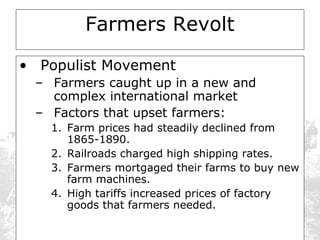
Farmers Revolt
• Populist Movement
– Farmers caught up in a new and
complex international market
– Factors that upset farmers:
1. Farm prices had steadily declined from
1865-1890.
2. Railroads charged high shipping rates.
3. Farmers mortgaged their farms to buy new
farm machines.
4. High tariffs increased prices of factory
goods that farmers needed.
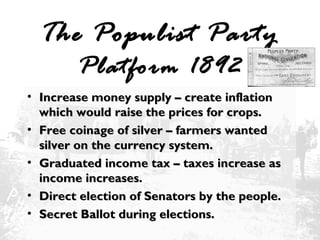
The Populist Party
Platform 1892

• Increase money supply – create inflation
which would raise the prices for crops.
• Free coinage of silver – farmers wanted
silver on the currency system.
• Graduated income tax – taxes increase as
income increases.
• Direct election of Senators by the people.
• Secret Ballot during elections.
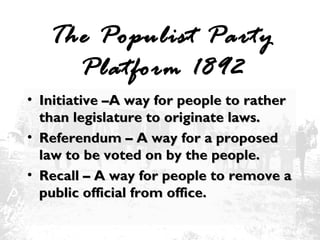
The Populist Party
Platform 1892
• Initiative –A way for people to rather
than legislature to originate laws.
• Referendum – A way for a proposed
law to be voted on by the people.
• Recall – A way for people to remove a
public official from office.
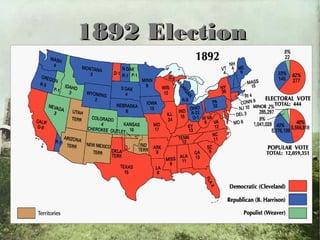
1892 Election
Election of 1892
• Impact:
• The Populists did not win the
presidential election, but did
achieve huge results throughout
the nation.
• Populists elected governors in Kansas
and North Dakota, 10 U.S.
Congressmen, 5 U.S. Senators, and 1500
members to state legislatures
Panic of
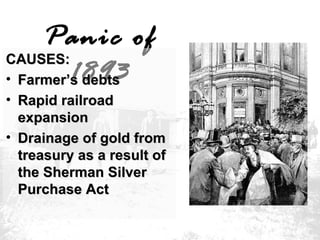
CAUSES:
1893
• Farmer’s debts

• Rapid railroad
expansion
• Drainage of gold from
treasury as a result of
the Sherman Silver
Purchase Act
Result of Panic
• By the end of the year, over 15,000
businesses and 500 banks had
collapsed.
• Farmers and Workers demand change.
• Populist Party and Democratic Party
nominate William Jennings Bryan who
favors money to be backed in both gold
and silver.
Election of 1896
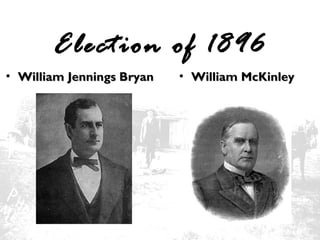
• William Jennings Bryan

• William McKinley
Election of
1896

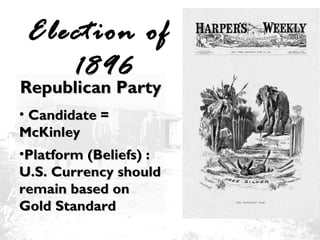
Republican Party
• Candidate =
McKinley
•Platform (Beliefs) :
U.S. Currency should
remain based on
Gold Standard
Election of 1896
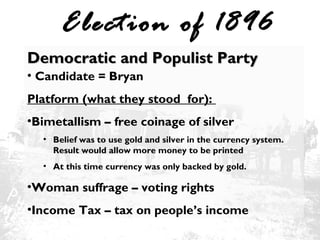
Democratic and Populist Party
• Candidate = Bryan
Platform (what they stood for):
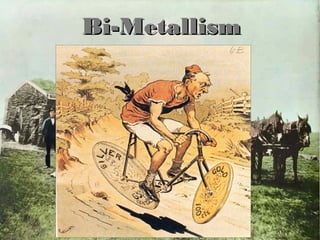
•Bimetallism – free coinage of silver
• Belief was to use gold and silver in the currency system.
Result would allow more money to be printed
• At this time currency was only backed by gold.

•Woman suffrage – voting rights
•Income Tax – tax on people’s income
Bi-Metallism
Issue
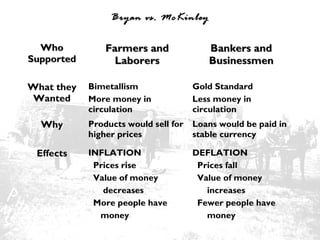
Bryan vs. McKinley
Who
Supported
What they
Wanted
Why
Effects

Farmers and
Laborers

Bankers and
Businessmen

Bimetallism
More money in
circulation

Gold Standard
Less money in
circulation

Products would sell for
higher prices

Loans would be paid in
stable currency

INFLATION
Prices rise
Value of money
decreases
More people have
money

DEFLATION
Prices fall
Value of money
increases
Fewer people have
money
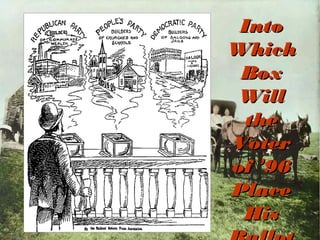
Into
Which
Box
Will
the
Voter
of ’96
Place
His
Election Results
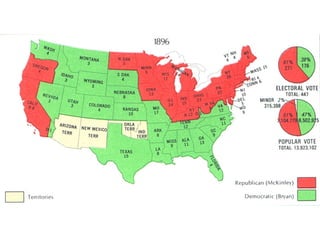
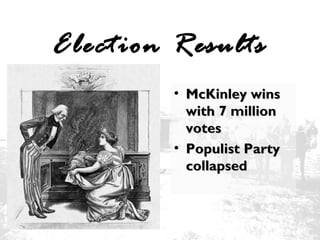
• McKinley wins
with 7 million
votes
• Populist Party
collapsed
Legacy of the
Populist Party
• The downtrodden (lower class) could
organize and have political impact
• Many of the ideas of the Populist
Party Platform became law during
the first years of the 20th century
Populist
Party in
Literature
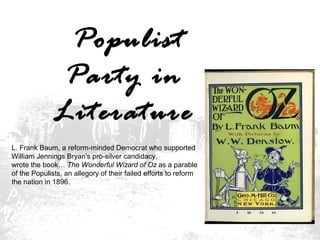
L. Frank Baum, a reform-minded Democrat who supported
William Jennings Bryan's pro-silver candidacy,
wrote the book… The Wonderful Wizard of Oz as a parable
of the Populists, an allegory of their failed efforts to reform
the nation in 1896.
Wonderful Wizard of Oz
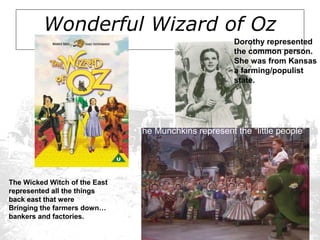
Dorothy represented
the common person.
She was from Kansas
a farming/populist
state.

•The Munchkins represent the “little people”

The Wicked Witch of the East
represented all the things
back east that were
Bringing the farmers down…
bankers and factories.
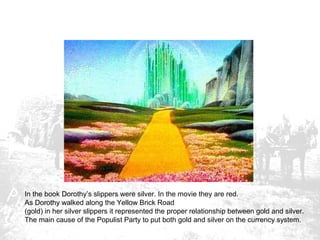
In the book Dorothy’s slippers were silver. In the movie they are red.
As Dorothy walked along the Yellow Brick Road
(gold) in her silver slippers it represented the proper relationship between gold and silver.
The main cause of the Populist Party to put both gold and silver on the currency system.
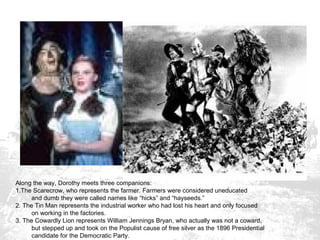
Along the way, Dorothy meets three companions:
1.The Scarecrow, who represents the farmer. Farmers were considered uneducated
and dumb they were called names like “hicks” and “hayseeds.”
2. The Tin Man represents the industrial worker who had lost his heart and only focused
on working in the factories.
3. The Cowardly Lion represents William Jennings Bryan, who actually was not a coward,
but stepped up and took on the Populist cause of free silver as the 1896 Presidential
candidate for the Democratic Party.
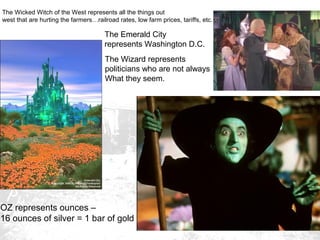
The Wicked Witch of the West represents all the things out
west that are hurting the farmers…railroad rates, low farm prices, tariffs, etc.

The Emerald City
represents Washington D.C.
The Wizard represents
politicians who are not always
What they seem.

OZ represents ounces –
16 ounces of silver = 1 bar of gold
The Wonderful Wizard of Oz
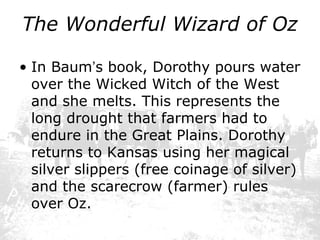
• In Baum’s book, Dorothy pours water
over the Wicked Witch of the West
and she melts. This represents the
long drought that farmers had to
endure in the Great Plains. Dorothy
returns to Kansas using her magical
silver slippers (free coinage of silver)
and the scarecrow (farmer) rules
over Oz.
Legacy of the Populist Party
• Direct election of senators (17th
Amendment)
• Federal Income tax (16th
Amendment)
• Women’s suffrage (19th Amendment)
• Initiative
• Referendum
• Recall

Populism

  • 1.
    “Farmers should raiseless corn and more hell.” -Mary Lease, Populist
  • 2.
    Farmers in Revolt The Emergenceof the Populist Party
  • 3.
    Early Farm Organizations The Grange OriginalPurpose 1867  “To provide a social outlet and educational services for isolated farmers”
  • 5.
    Farmer’s Poem When thebanker says he’s broke And the merchants up in smoke, They forget that it’s the farmer who feeds them all. It would put them to the test If the farmer took a rest; Then they’d know that it’s the farmer who feeds them all.
  • 6.
    Political Grange • TheGrange united to combat the monopolistic practices of the railroads and grain elevators – Its aim was to advance the political, economic, and social interests of the nation's farmers – 860,000 national members • One way they did this was by Grange members getting elected to local, state legislature and Congress offices
  • 7.
    Political Grange • Electedmembers to state legislature and Congress • Passed “Granger Laws” in the states to regulate the rates charged by railroads and warehouses. • Supreme Court overturns many of these laws
  • 8.
  • 9.
    Farmers Revolt • PopulistMovement – Farmers caught up in a new and complex international market – Factors that upset farmers: 1. Farm prices had steadily declined from 1865-1890. 2. Railroads charged high shipping rates. 3. Farmers mortgaged their farms to buy new farm machines. 4. High tariffs increased prices of factory goods that farmers needed.
  • 10.
    The Populist Party Platform1892 • Increase money supply – create inflation which would raise the prices for crops. • Free coinage of silver – farmers wanted silver on the currency system. • Graduated income tax – taxes increase as income increases. • Direct election of Senators by the people. • Secret Ballot during elections.
  • 11.
    The Populist Party Platform1892 • Initiative –A way for people to rather than legislature to originate laws. • Referendum – A way for a proposed law to be voted on by the people. • Recall – A way for people to remove a public official from office.
  • 12.
  • 13.
    Election of 1892 •Impact: • The Populists did not win the presidential election, but did achieve huge results throughout the nation. • Populists elected governors in Kansas and North Dakota, 10 U.S. Congressmen, 5 U.S. Senators, and 1500 members to state legislatures
  • 14.
    Panic of CAUSES: 1893 • Farmer’sdebts • Rapid railroad expansion • Drainage of gold from treasury as a result of the Sherman Silver Purchase Act
  • 15.
    Result of Panic •By the end of the year, over 15,000 businesses and 500 banks had collapsed. • Farmers and Workers demand change. • Populist Party and Democratic Party nominate William Jennings Bryan who favors money to be backed in both gold and silver.
  • 16.
    Election of 1896 •William Jennings Bryan • William McKinley
  • 17.
    Election of 1896 Republican Party • Candidate= McKinley •Platform (Beliefs) : U.S. Currency should remain based on Gold Standard
  • 18.
    Election of 1896 Democraticand Populist Party • Candidate = Bryan Platform (what they stood for): •Bimetallism – free coinage of silver • Belief was to use gold and silver in the currency system. Result would allow more money to be printed • At this time currency was only backed by gold. •Woman suffrage – voting rights •Income Tax – tax on people’s income
  • 19.
  • 20.
    Bryan vs. McKinley Who Supported Whatthey Wanted Why Effects Farmers and Laborers Bankers and Businessmen Bimetallism More money in circulation Gold Standard Less money in circulation Products would sell for higher prices Loans would be paid in stable currency INFLATION Prices rise Value of money decreases More people have money DEFLATION Prices fall Value of money increases Fewer people have money
  • 21.
  • 23.
    Election Results • McKinleywins with 7 million votes • Populist Party collapsed
  • 24.
    Legacy of the PopulistParty • The downtrodden (lower class) could organize and have political impact • Many of the ideas of the Populist Party Platform became law during the first years of the 20th century
  • 25.
    Populist Party in Literature L. FrankBaum, a reform-minded Democrat who supported William Jennings Bryan's pro-silver candidacy, wrote the book… The Wonderful Wizard of Oz as a parable of the Populists, an allegory of their failed efforts to reform the nation in 1896.
  • 26.
    Wonderful Wizard ofOz Dorothy represented the common person. She was from Kansas a farming/populist state. •The Munchkins represent the “little people” The Wicked Witch of the East represented all the things back east that were Bringing the farmers down… bankers and factories.
  • 27.
    In the bookDorothy’s slippers were silver. In the movie they are red. As Dorothy walked along the Yellow Brick Road (gold) in her silver slippers it represented the proper relationship between gold and silver. The main cause of the Populist Party to put both gold and silver on the currency system.
  • 28.
    Along the way,Dorothy meets three companions: 1.The Scarecrow, who represents the farmer. Farmers were considered uneducated and dumb they were called names like “hicks” and “hayseeds.” 2. The Tin Man represents the industrial worker who had lost his heart and only focused on working in the factories. 3. The Cowardly Lion represents William Jennings Bryan, who actually was not a coward, but stepped up and took on the Populist cause of free silver as the 1896 Presidential candidate for the Democratic Party.
  • 29.
    The Wicked Witchof the West represents all the things out west that are hurting the farmers…railroad rates, low farm prices, tariffs, etc. The Emerald City represents Washington D.C. The Wizard represents politicians who are not always What they seem. OZ represents ounces – 16 ounces of silver = 1 bar of gold
  • 30.
    The Wonderful Wizardof Oz • In Baum’s book, Dorothy pours water over the Wicked Witch of the West and she melts. This represents the long drought that farmers had to endure in the Great Plains. Dorothy returns to Kansas using her magical silver slippers (free coinage of silver) and the scarecrow (farmer) rules over Oz.
  • 31.
    Legacy of thePopulist Party • Direct election of senators (17th Amendment) • Federal Income tax (16th Amendment) • Women’s suffrage (19th Amendment) • Initiative • Referendum • Recall

Editor's Notes

  • #2 {"22":"http://teachpol.tcnj.edu/amer_pol_hist/thumbnail241.html\n","17":"Bimetallism – A monetary system in which the government would give citizens either gold or silver in exchanged for paper currency.\nhttp://elections.harpweek.com/NewSite/1896/cartoon-1896-Medium.asp?UniqueID=10&Year=1896\nComplete HarpWeek Explanation:This postdated cover cartoon was published less than a week before the Republican National Convention opened in St. Louis. It is a warning to the GOP not to follow the lead of the Democratic Party into the Populist’s trap and sink into the “Free Silver” swamp. Although Democrats did not meet until early July, it was already clear to cartoonist W. A. Rogers and other political observers that the party would endorse “free silver.” The Populist “savages” who have laid the trap are (left-right): Senator William Morris Stewart of Nevada, a Silver Republican; Senator Marion Butler of North Carolina, elected as a Populist in 1895 and chairman of the Populist National Executive Committee; and Senator William Peffer of Kansas, who in 1891 had become the first Populist elected to the U.S. Senate\n","23":"http://www.loc.gov/exhibits/treasures/trr070.html\nUncle Sam Image\nhttp://elections.harpweek.com/NewSite/1896/cartoon-1896-Medium.asp?UniqueID=29&Year=1896\n","18":"Bimetallism – A monetary system in which the government would give citizens either gold or silver in exchanged for paper currency.\n","2":"Theodore Jerdine sod house, Osnabrock, North Dakota / photo by Melin. \nCREATED/PUBLISHED[June 1906] \nSUMMARYSod house with sod roof, stovepipe and three windows showing. Men from left to right: Christ Evenrude (hired hand), Lars Gvesrude, Theodore Jerdine. In the buggy: Mrs. Theodore Jerdine and her mother, Mrs. Gvesrude. Children sitting on the ground: Johanna, Thilda, Julia, and Rudolph. \nNOTESTitle taken from label with hand-colored print. \n","25":"http://www.loc.gov/exhibits/oz/images/vc9p2.jpg\n","14":"To help the farmers and silver industry, Congress passed the Sherman Silver Purchase Act in 1890. Persons holding silver certificates could redeem them in gold. This caused the drainage of gold.\n","3":"The Grange had a membership as high as 1l5 million by 1874. \n","4":"Complete Explanation:No doubt inspired by the Granger movement, the artist asserts the importance of the farmer in American society. The title is a variation on the movement's motto, "I Pay for All." The Grange was an organization composed mostly of midwestern farmers, who united to combat the monopolistic practices of the railroads and grain elevators. The central vignette shows a farmer with a plough and two horses. In the distance is a large house. The vignette appears within a framework of twigs and oak branches, with stalks of corn and sheafs of wheat in the corners. Above the scene is an eagle and an arrangement of flags, with the inscription "1776. 1876." \nSeveral smaller scenes surround the central vignette. Clockwise from the upper left corner are: a lawyer ("I Plead for All"); a seated President Ulysses S. Grant ("I Rule for All"); an officer leading a charge ("I Fight for All"); a clergyman at his pulpit ("I Preach for All"); a ship owner watching his vessel through a window ("I Sail for All"); a shopkeeper in a general store ("I Buy & Sell for All"); a doctor with a scale and drugs ("I Physic You All"); a broker at his window ("I Fleece You All"); a trader (I Bull & Bear for All"); and a railroad owner watching his locomotive ("I Carry for All"). \nhttp://loc.harpweek.com/LCPoliticalCartoons/DisplayCartoonLarge.asp?MaxID=26&UniqueID=19&Year=1875&YearMark=1871\n"}