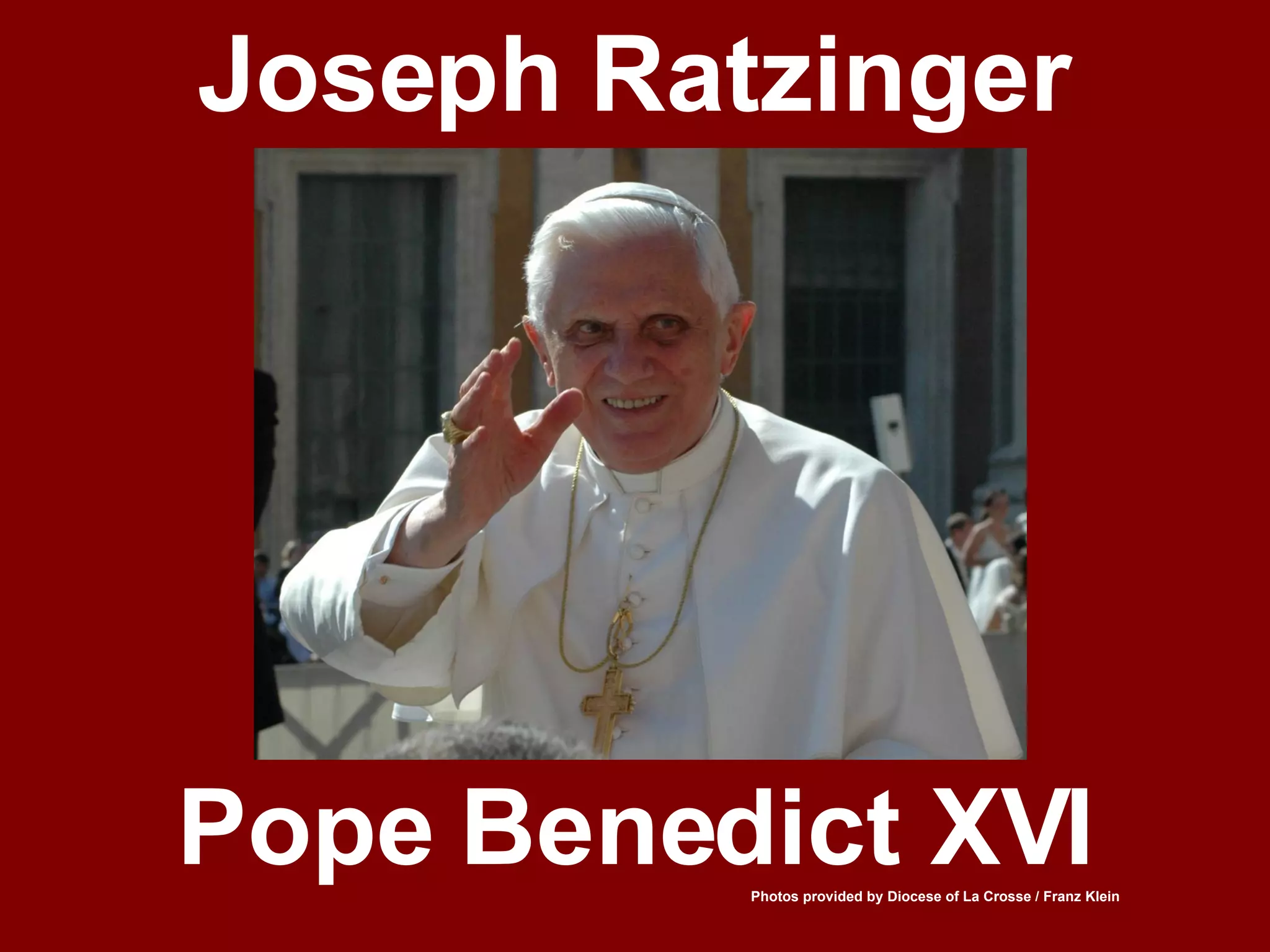
Joseph Ratzinger Pope Benedict XVI Photos provided by Diocese of La Crosse / Franz Klein
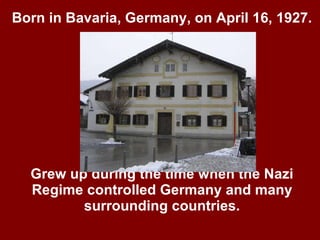
Born in Bavaria, Germany, on April 16, 1927. Grew up during the time when the Nazi Regime controlled Germany and many surrounding countries.
In 1941, just after his 14 th  birthday, he was forced to enter the Hitler Youth Corps - but he never attended meetings. In that same year, his cousin, suffering from Down Syndrome, was murdered by the Nazis in their program to do away with the physically and mentally disabled.
In 1943, while in a minor seminary, Joseph was drafted into the German army at age 16.  He was initially trained as an anti-aircraft gunner and later trained for the infantry. In 1945, as the allied front drew closer to his post, he escaped from the army.
After the war, he and his brother reentered the seminary. They were ordained on June 29, 1951 .
A year after his ordination, in 1952, Father Joseph Ratzinger began a teaching career as a high school instructor. After earning a doctorate in theology, he began a long career as a university lecturer. Teacher and Author
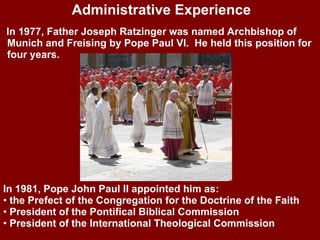
In 1977, Father Joseph Ratzinger was named Archbishop of Munich and Freising by Pope Paul VI.  He held this position for four years. Administrative Experience In 1981, Pope John Paul II appointed him as: the Prefect of the Congregation for the Doctrine of the Faith President of the Pontifical Biblical Commission President of the International Theological Commission
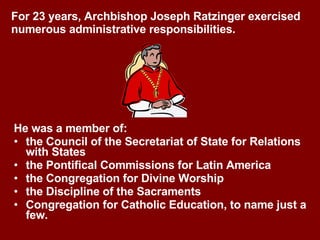
He was a member of: the Council of the Secretariat of State for Relations with States the Pontifical Commissions for Latin America the Congregation for Divine Worship  the Discipline of the Sacraments  Congregation for Catholic Education, to name just a few. For 23 years, Archbishop Joseph Ratzinger exercised numerous administrative responsibilities.
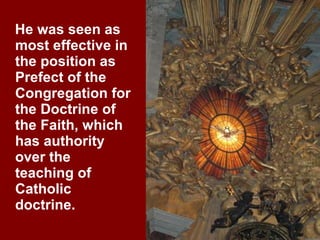
He was seen as most effective in the position as Prefect of the Congregation for the Doctrine of the Faith, which has authority over the teaching of Catholic doctrine.
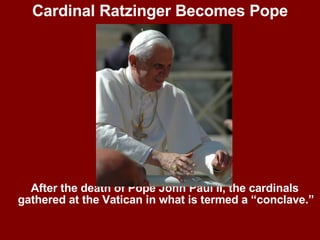
Cardinal Ratzinger Becomes Pope After the death of Pope John Paul II, the cardinals gathered at the Vatican in what is termed a “conclave.”
The term derives from the Latin phrase  con clave , literally “with a key,” since the voting cardinals are locked in the Sistine Chapel for the process of electing the new Pope. The Pope is elected by cardinals, and only cardinals, who have not reached their 80 th  birthday. Cardinal Joseph Ratzinger was elected on the second day of balloting during the fourth session of the day on April 19, 2005, three days after his 78 th  birthday.
The Pope, upon election, takes on a new name, which indicates a change in identity. Cardinal Joseph Ratzinger chose the name Benedict to create a spiritual bond with Benedict XV who steered the Church through a period of turmoil caused by the First World War.
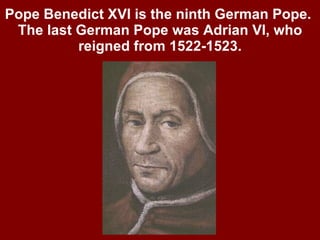
Pope Benedict XVI is the ninth German Pope.  The last German Pope was Adrian VI, who reigned from 1522-1523.
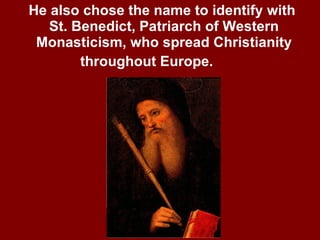
He also chose the name to identify with  St. Benedict, Patriarch of Western Monasticism, who spread Christianity throughout Europe.
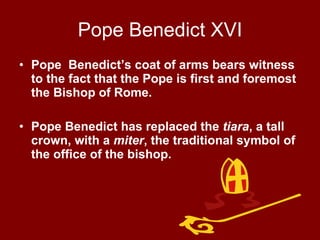
Pope Benedict XVI Pope  Benedict’s coat of arms bears witness to the fact that the Pope is first and foremost the Bishop of Rome. Pope Benedict has replaced the  tiara , a tall crown, with a  miter , the traditional symbol of the office of the bishop.
Pope Benedict XVI is a gifted linguist.  In addition to his native German, he is fluent in Italian, French, English, Spanish and Latin.
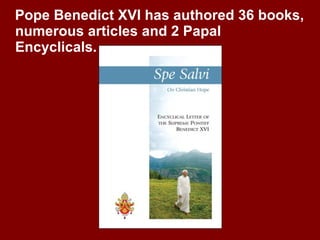
Pope Benedict XVI has authored 36 books, numerous articles and 2 Papal Encyclicals.
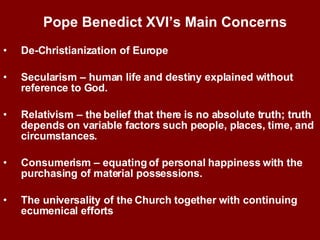
De-Christianization of Europe Secularism – human life and destiny explained without reference to God. Relativism – the belief that there is no absolute truth; truth depends on variable factors such people, places, time, and circumstances. Consumerism – equating of personal happiness with the purchasing of material possessions.  The universality of the Church together with continuing ecumenical efforts Pope Benedict XVI’s Main Concerns
 
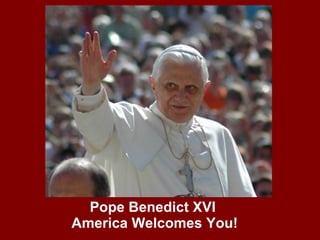
Pope Benedict XVI  America Welcomes You!

Pope Pope Benedict W Photos

  • 1.
    Joseph Ratzinger PopeBenedict XVI Photos provided by Diocese of La Crosse / Franz Klein
  • 2.
    Born in Bavaria,Germany, on April 16, 1927. Grew up during the time when the Nazi Regime controlled Germany and many surrounding countries.
  • 3.
    In 1941, justafter his 14 th birthday, he was forced to enter the Hitler Youth Corps - but he never attended meetings. In that same year, his cousin, suffering from Down Syndrome, was murdered by the Nazis in their program to do away with the physically and mentally disabled.
  • 4.
    In 1943, whilein a minor seminary, Joseph was drafted into the German army at age 16. He was initially trained as an anti-aircraft gunner and later trained for the infantry. In 1945, as the allied front drew closer to his post, he escaped from the army.
  • 5.
    After the war,he and his brother reentered the seminary. They were ordained on June 29, 1951 .
  • 6.
    A year afterhis ordination, in 1952, Father Joseph Ratzinger began a teaching career as a high school instructor. After earning a doctorate in theology, he began a long career as a university lecturer. Teacher and Author
  • 7.
    In 1977, FatherJoseph Ratzinger was named Archbishop of Munich and Freising by Pope Paul VI. He held this position for four years. Administrative Experience In 1981, Pope John Paul II appointed him as: the Prefect of the Congregation for the Doctrine of the Faith President of the Pontifical Biblical Commission President of the International Theological Commission
  • 8.
    He was amember of: the Council of the Secretariat of State for Relations with States the Pontifical Commissions for Latin America the Congregation for Divine Worship the Discipline of the Sacraments Congregation for Catholic Education, to name just a few. For 23 years, Archbishop Joseph Ratzinger exercised numerous administrative responsibilities.
  • 9.
    He was seenas most effective in the position as Prefect of the Congregation for the Doctrine of the Faith, which has authority over the teaching of Catholic doctrine.
  • 10.
    Cardinal Ratzinger BecomesPope After the death of Pope John Paul II, the cardinals gathered at the Vatican in what is termed a “conclave.”
  • 11.
    The term derivesfrom the Latin phrase con clave , literally “with a key,” since the voting cardinals are locked in the Sistine Chapel for the process of electing the new Pope. The Pope is elected by cardinals, and only cardinals, who have not reached their 80 th birthday. Cardinal Joseph Ratzinger was elected on the second day of balloting during the fourth session of the day on April 19, 2005, three days after his 78 th birthday.
  • 12.
    The Pope, uponelection, takes on a new name, which indicates a change in identity. Cardinal Joseph Ratzinger chose the name Benedict to create a spiritual bond with Benedict XV who steered the Church through a period of turmoil caused by the First World War.
  • 13.
    Pope Benedict XVIis the ninth German Pope. The last German Pope was Adrian VI, who reigned from 1522-1523.
  • 14.
    He also chosethe name to identify with St. Benedict, Patriarch of Western Monasticism, who spread Christianity throughout Europe.
  • 15.
    Pope Benedict XVIPope Benedict’s coat of arms bears witness to the fact that the Pope is first and foremost the Bishop of Rome. Pope Benedict has replaced the tiara , a tall crown, with a miter , the traditional symbol of the office of the bishop.
  • 16.
    Pope Benedict XVIis a gifted linguist. In addition to his native German, he is fluent in Italian, French, English, Spanish and Latin.
  • 17.
    Pope Benedict XVIhas authored 36 books, numerous articles and 2 Papal Encyclicals.
  • 18.
    De-Christianization of EuropeSecularism – human life and destiny explained without reference to God. Relativism – the belief that there is no absolute truth; truth depends on variable factors such people, places, time, and circumstances. Consumerism – equating of personal happiness with the purchasing of material possessions. The universality of the Church together with continuing ecumenical efforts Pope Benedict XVI’s Main Concerns
  • 19.
  • 20.
    Pope Benedict XVI America Welcomes You!